Commentaires
Brazil’s election bust
18 novembre 2026

Brazil’s bull market collapsed as President Lula da Silva defied pollsters and prediction markets to win re-election in a run-off poll on the 25th of October. The result was a shock following the strong win in the first round by his right-wing opponent, Flávio Bolsonaro.
Lula is the first presidential candidate since Brazil’s return to democracy in the 1980s to come back from a first-round defeat. Falling abstention in the second round saw a wave of votes come Lula’s way in almost every municipality.
The market treated a probable Bolsonaro win as a certainty
The rally in Brazilian equities after the first round on the 4th of October priced a change of government and a shift to conservative fiscal policy before it actually happened. The reality of a fourth term of Lula’s fiscal profligacy hit on Monday, the 26th of October, as the Ibovespa plunged 13.9% – the largest decline since March 2020. The Brazilian real had its worst day in 23 years and long rates rose by more than 250 basis points.
Forward interest rate curve reflects run-off surprise
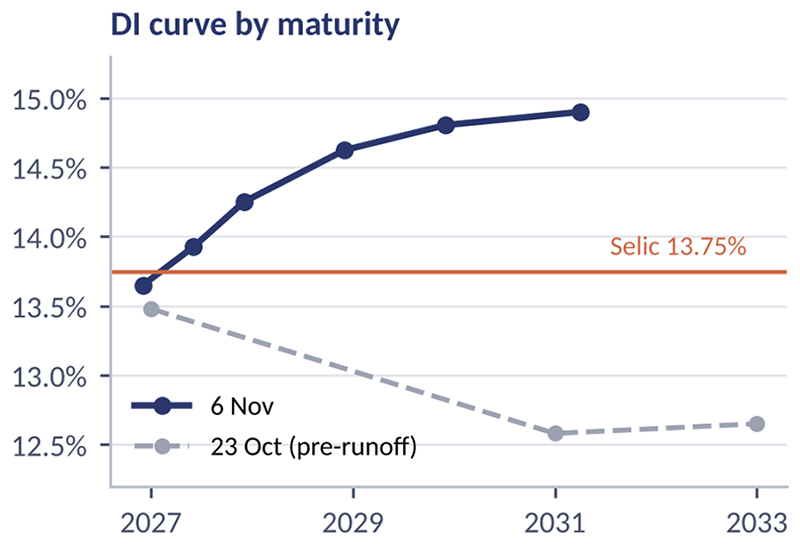
Source: NS Partners & Bloomberg
Brazilian blackjack
Over the past year, we framed the investment opportunity in Brazil as akin to a game of blackjack where fiscal deficits, high interest rates and political uncertainty were the low cards favouring the dealer, and cheap valuations, resilient companies and the prospect of political change were the high cards. As the low cards come out of the deck, the investors’ odds gradually improve.
By August 2025, that “count” was becoming more favourable: economic resilience, easing inflation and increasingly credible prospects for a market-friendly political shift supported lifting exposure, while maintaining a strong bias towards quality companies.
The odds moved decisively in the investor’s favour in October 2026, when Flávio Bolsonaro’s unexpectedly strong first-round election result, combined with a major shift to the right in the Senate, raised expectations of fiscal consolidation and market-friendly policy.
Overweight into the first round
We went into the first round of elections with a modest overweight to Brazil (accounting for c.4% of the MSCI EM Index as at the 30th of September), which was well timed. Following a sharp rally, we decided to trim the exposure, focusing on businesses that were no longer as attractively valued, and recycled the profits into other LatAm countries.
Falling knife
Given Bolsonaro’s polling strength for the second round – the long-awaited “ace” of positive political change coming into view – we tilted the remaining exposure in Brazil towards higher beta names which would be more sensitive to falling rates.
Brazil’s Ibovespa tanked in the immediate aftermath of Lula’s victory, with the higher beta portion of our exposure underperforming. For these companies we were happy to wait for a bounce before selling in order to de-risk and move underweight Brazil. Higher quality businesses with ROIC well above the cost of capital, strong balance sheets, dollar revenues and less leverage to the economy were retained.
There is no appetite here for mechanically buying the dip as the risk-reward proposition has changed dramatically in our view. The bulls argue that Lula has campaigned as a socialist but governed as a pragmatist in the past and that we should expect the same this time around. This is debatable and the reality today is that the starting conditions for Lula’s fourth term are different:
- Public debt is above 80% of GDP, having risen by more than 10 percentage points over Lula’s third term.
- Less than 8% of the federal budget is adjustable due to mandatory spending.
- Lula’s rhetoric and campaign commitment signals a more expansionary policy regime, with increased pension expenditure, welfare commitments and proposed debt-relief programs.
- This is likely to pressure inflation higher, which has not been tamed by a Selic policy rate of 13.75%.
- Highly indebted households and corporates are already struggling with rising debt servicing costs.
The outlook for Brazil has changed, and thus a collapse in equity prices does not automatically signal a buying opportunity.
As you can see below, the market remains above its level 60 days ago when polls suggested a tight election. This hardly screams “bargain” to us.
Ibovespa Index – last 60 days
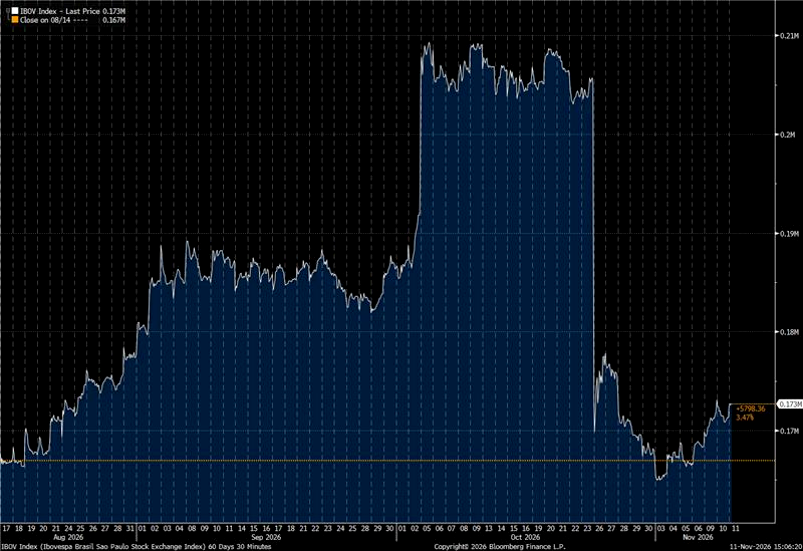
Source: Bloomberg
The regional picture for LatAm ex-Brazil is attractive
Reducing exposure in Brazil is also a matter of opportunity cost. As a region, Latin America trades on c.10x forward earnings versus 14x for emerging Asia, the widest discount since 2010. Trailing earnings are up 22% year on year and ROE is over 18% with a dividend yield of nearly 5% (Bradesco BBI, October 2026).
Unlike Brazil, the political backdrop for the rest of the region is more favourable. Market friendly right-wing governments lead 9 out of 20 countries versus six in January 2023, which includes Argentina and Peru where the portfolio has banking, IT and energy exposure.
Mexico is a notable exception, led by left-wing president Claudia Sheinbaum. She has proven to be a more pragmatic leader than her socialist predecessor AMLO and has managed US-Mexico relations well with an eye to supply chain “nearshoring” opportunities, while seeking to secure a relatively positive outcome from USMCA negotiations. A favourable trade deal would be a tailwind for Mexican equities exposed to renewed investor confidence and compliant exporters integrated into US supply chains.