
Commentaires
Are we all emerging markets now?
17 septembre 2026

“We can’t ignore the fact that there are emerging-market-type risks in some of the actions the US has been taking.” This is former Morgan Stanley Chief Economist Ellen Zetner’s take on how policy uncertainty and fiscal trajectory in the United States are increasingly mirroring traditional EM risk factors.
Fiscal incontinence and financial repression are macro risks that investors typically associate with emerging markets. Their developed counterparts have enjoyed valuation premiums in their stock and bond markets based on a perception of stronger fiscal and monetary discipline, as well as better institutional protections.
The current flare-up in sovereign bonds yields in developed markets partly reflects their governments’ failure to curb rising debt burdens by cutting public spending back to pre-Covid levels, coupled with anaemic growth (with the exception of the United States). Investors fear that, lacking the political will to rein in spending, governments in developed countries will adopt policies of financial repression, keeping interest rates below the rate of inflation to slow or reverse the rise in debt-to-GDP ratios.
Relative to developed markets, many emerging markets have become more fiscally and monetarily disciplined over the past decade. Having learnt the consequences of fiscal and monetary incontinence the hard way, they have strengthened central bank credibility, maintained positive real interest rates and improved macroeconomic resilience.
China’s export boom risks a backlash from trading partners
We having been gradually reducing portfolio exposure to leading Chinese exporters in recent months as risk grows of an international backlash to overproduction of high-end manufactured goods.
The internal contradictions in Beijing’s model for economic growth model have fuelled an export boom that is nearing the end of the road. While the Chinese Communist Party (CCP) has acknowledged that involution – or excessive levels of competition by firms producing more at low or negative margins – is unsustainable, we are yet to see any concrete measures to curb overcapacity.
“The world is not enough”
The issue is that China now accounts for 30% of global industrial production with the share set to grow to 45% by 2030 according to the UN. As noted by Council on Foreign Relations President Michael Froman in a piece for Foreign Affairs this month, this is a level of industrial dominance not seen since the United States at the end of the Second World War. He also emphasised that in 2025 China recorded the largest trade surplus in history in US dollar value terms, with exports growing at three times the rate of global goods trade.
China has outgrown its economic model and the global economy’s capacity to absorb its exports. It must take decisive steps to rebalance towards an economy driven by consumption. Unfortunately, CCP policy incentives underpinning rigid GDP growth targets and local government financing create powerful and entrenched feedback loops that fuel overcapacity, which is vented to the rest of the world through exports.
While flooding the world with cheap goods has been a disinflationary force over several decades, it has also created huge trade imbalances leading to de-industrialisation and rising debt in many of China’s trading partners. China’s economic model suppresses domestic consumption in order to maximise industrial output through an undervalued currency, subsidies and preferential financing (among other measures). Peking University economist Michael Pettis argues that this system defies David Ricardo’s principle of comparative advantage, explaining why free trade maximises global output. To quote from a Substack post by Pettis in February this year:
Competitive advantage is not the same as a comparative advantage. The former means an economy is able to produce more cheaply than its trade partners. The latter means that the relative “cheapness” with which an economy produces some goods is greater than the relative “cheapness” with which it produces other goods, so that it can only have a comparative advantage in roughly half the goods it produces.
This is because comparative advantage is about relative costs, not absolute costs, and while an economy can have lower absolute costs in most or even all things, by definition it cannot have lower relative costs in much more than half of what it produces. Ricardo’s example shows this very clearly. In his model. Portugal produces both textiles and wine more cheaply and efficiently than England, which means that Portugal has a competitive advantage in all goods, and England a competitive disadvantage in all goods.
But Ricardo did not argue that the world would benefit if Portugal produced both wine and textiles, with England producing neither and acquiring them by running trade deficits with Portugal. Instead, he showed that because the relative “cheapness” with which Portugal produces wine is greater than the relative “cheapness” with which it produces textiles, Portugal only has a comparative advantage in producing wine, and England has a comparative advantage in producing textiles. He showed that if Portugal only produces wine, and exports some of it to England to buy textiles, and if England only produces textiles, and exports some of it to Portugal to buy wine, trade would be balanced and total output would be maximized – and as counterintuitive as it may seem, this is the case even though Portugal can produce textiles more cheaply and efficiently than England.
Looking at today’s global trading system, Ricardo might argue that China’s exploitation of its competitive advantage is creating persistent global imbalances, as a result of which global production falls and unemployment rises, or “debt must rise in deficit countries to make up for weak demand in the surplus country and to prevent unemployment from rising.”
We can see both of these outcomes occurring in Europe. France relies on debt to prop up demand while Germany’s industrial giants are announcing the largest layoffs since the Global Financial Crisis.
Volkswagen flags 50,000 job cuts across group as board approves turnaround plan (Reuters, September 3, 2026)
Volkswagen’s supervisory board on Thursday approved a transformation plan that will include cutting another 50,000 jobs in its attempt to counter painful tariffs, overcapacity and aggressive Chinese rivals.
The plan, the most extensive restructuring in Volkswagen’s 89-year history, includes exploring alternatives for four German plants that will eventually run out of models during the next decade.
As Stein’s Law goes, “if something cannot go on forever, it will stop.” China’s domestic economic imbalances are provoking social and political responses among its major trading partners. In response, governments in virtually all advanced economies have taken their first steps to address the issue, enacting stronger import duties, local content requirements, and even bans on Chinese equipment in sensitive sectors such as telecoms. However, these measures will fall short without structural change in China.
Layoffs in the German auto industry virtually guarantee a more forceful and coordinated response from Europe.
Italian lobby group calls for 80% EU tariff on Chinese cars and parts (Reuters, September 10, 2026)
The head of Italian auto suppliers lobby Anfia has urged the European Union to impose 80% tariffs on Chinese-made vehicles and parts above a certain threshold to safeguard Europe’s car industry.
Anfia President Roberto Vavassori told Reuters that Chinese imports to the European Union should be tariff-free up to 8% of annual European vehicle registrations, but with an 80% tariff on imports above that limit.
It should cover both vehicles and components, he said, as parts account for roughly 80% of a vehicle’s value. « We have maximum respect for what the Chinese industry has achieved, » Vavassori told Reuters. « But that respect has now turned into fear. »
« Europe cannot lose an industry which is essential for its strategic autonomy. »
His comments come days after Volkswagen approved a major restructuring in the face of slumping demand and increasing competition from China. Figures from the European Automobile Manufacturers’ Association (ACEA) showed that the share of Chinese-branded cars sold in the EU rose to top 9% in the first half of this year.
Other countries fearing the damage of a China supply shock to their leading manufacturing industries may also seek to collaborate with Europe and the United States to address the issue. There are strong incentives for both China and major trading partners to collaborate with the aim of engineering a gradual rebalancing over decades, lest more sudden measures trigger an external demand collapse for Chinese exporters, and globally inflationary supply chain disruption.
We remain admirers of the Chinese entrepreneurs that have built outstanding businesses across autos, renewable energy, batteries, heavy industries and other advanced manufacturing processes. The leaders in these industries have been innovators able to scale across a continental-sized economy amid ferocious competition and go global to challenge incumbents. In our view, their long-term prospects remain bright and they would continue to prosper in a more balanced environment for international trade, and in a domestic environment where competition is rationalised through the re-alignment of economic policy incentives that promote more sustainable growth. However, portfolio changes including reducing exposure to battery manufacturer CATL and avoiding automaker BYD altogether for the past year or more reflect lower conviction levels over the short to medium term as we move through a period of realignment in international trade.
October’s presidential election in Brazil will be a tight contest
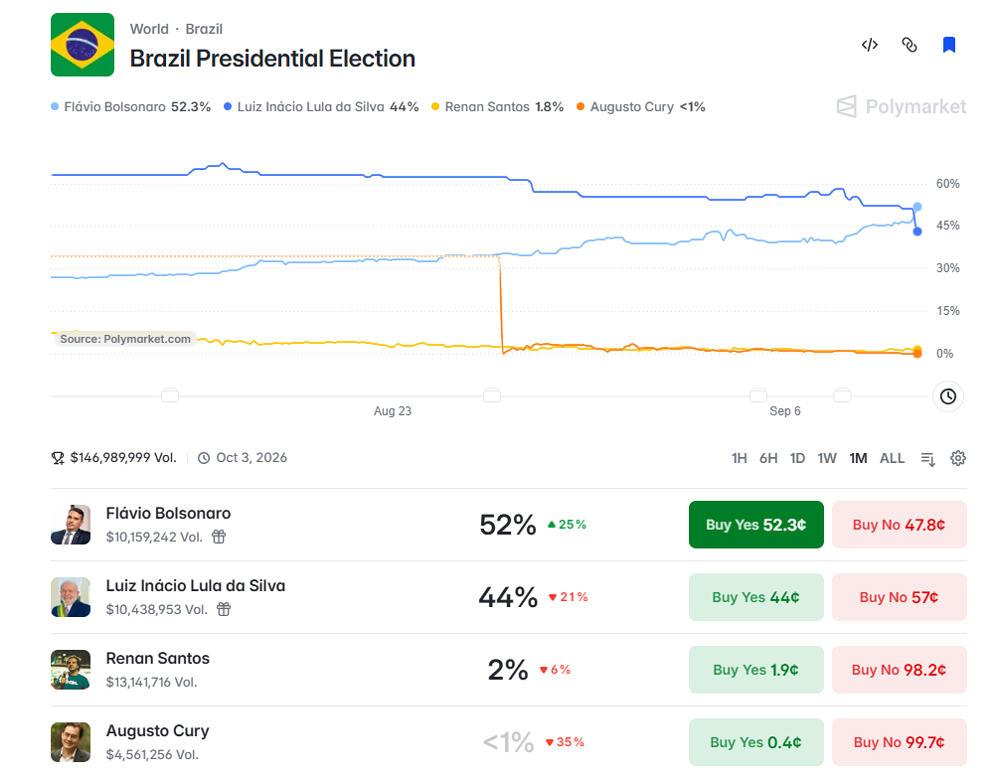
Source: Polymarket, 10 September 2026
We wrote previously on how political uncertainty has weighed on Brazilian equities:
Brazilian Blackjack: Decoding the allure of a high-risk, high-reward market
Crunch time is approaching with the presidential election set to take place in less than a month. Picking up the blackjack analogy, it is safe to say there are no high cards (more moderate and economically conservative candidates stepping up to make a run) left in the deck to be dealt in this political cycle. Voters are set to choose between two deeply flawed candidates in incumbent Lula and Flavio Bolsonaro, who are both fending off corruption allegations.
Nevertheless, our view was that political risk was reflected in extremely cheap valuations for some high-quality businesses, which led us to move to a modest overweight in Brazilian equities. The market has been rallying in recent weeks, partly reflecting a betting-market lead for Flavio Bolsonaro, perceived by investors as more market friendly (debatable in our view).
We read the market move with some caution. The betting-market odds are out of line with the polls, which remain a statistical tie in second-round simulations, and much of the recent shift tracks an internal Supreme Court dispute and leaked communications weighing on Lula rather than a durable realignment of the electorate.
With a first round on 4 October and a probable runoff on the 25th, event risk is high and early, contrarian positioning has been rewarded already. Our exposure remains focused on quality names trading below intrinsic value, and sized to give us room to take advantage of volatility in the months ahead.