L’argent, le moteur des marchés
US money update: mixed signals
25 novembre 2026 par Simon Ward
US broad money growth is cooling but narrow money strength suggests that near-term economic data will remain robust, adding to pressure for Fed tightening.
The broad money measure calculated here – M2+, which adds large time deposits and institutional money funds to official M2 – rose by 0.4% in October. Six-month growth eased to 7.3% annualised, having peaked at 8.0% in July – see chart 1.
Chart 1
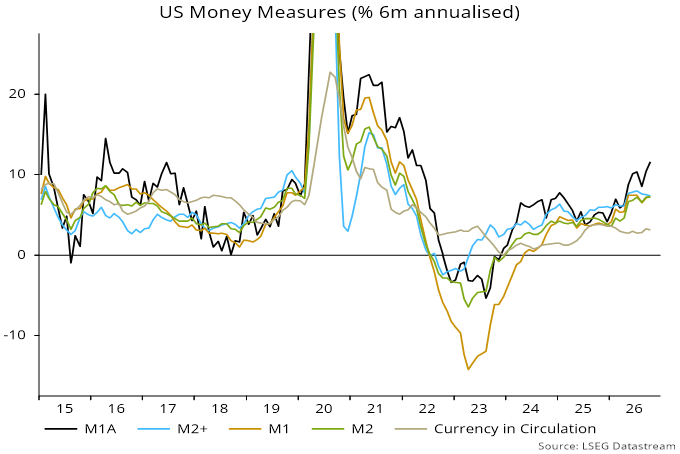
By contrast, six-month growth of narrow money M1A – currency plus demand deposits – picked up further to 11.6% annualised, the strongest since 2022, with a 1.0% monthly rise.
The broad / narrow money divergence suggests that monetary tightening has begun but has not yet fed through to spending intentions – a key driver of the demand for narrow money.
The earlier acceleration in the measures has been reflected in above-trend economic growth and renewed labour market tightening.
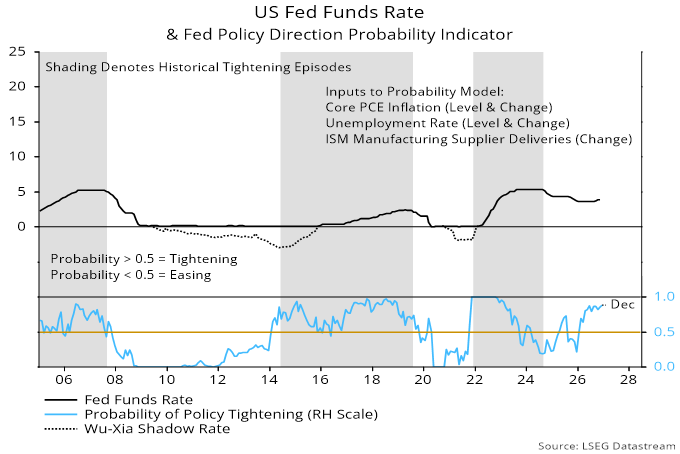
The simple Fed policy direction model followed here currently estimates the probability of a December rate hike at 88% – chart 2. The final model reading will depend on November data for unemployment and the ISM manufacturing delivery delays index. The corresponding component of the S&P Global US manufacturing PMI survey signalled longer delays, while rising Indeed job postings and an improved assessment of labour market conditions in the Conference Board consumer survey suggest a decline in the jobless rate.
Chart 2
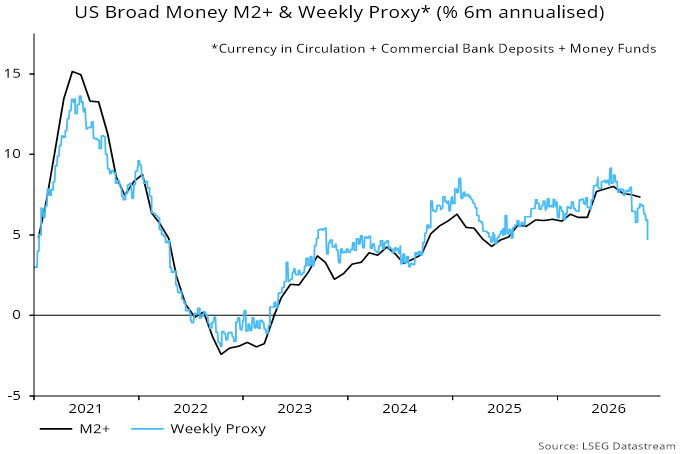
Six-month money growth should ease in November, reflecting a negative base effect – M2+ and M1A rose by 1.2% and 1.4% respectively in May. The weekly M2+ proxy calculated here is slowing on schedule – chart 3.
Chart 3
Still, a big fall in narrow money momentum is needed to signal weakening economic prospects and an approaching peak in rates.