
L’argent, le moteur des marchés
UK house prices: (much) more downside
13 octobre 2026 par Simon Ward
UK house prices have fallen significantly relative to rents since 2022. The assessment here is that they would need to decline by a further 14-37% to represent “fair value” by historical standards.
The basis for the calculations is a measure of the rental yield derived from the national accounts, by dividing aggregate rents (actual and imputed) by an estimate of the value of the housing stock*.
This yield bottomed at 4.0% at end-2022 and is projected to reach 5.2% by end-2026, based on H1 rental growth and an assumption of stable prices over the reminder of the year – see chart 1.
Chart 1
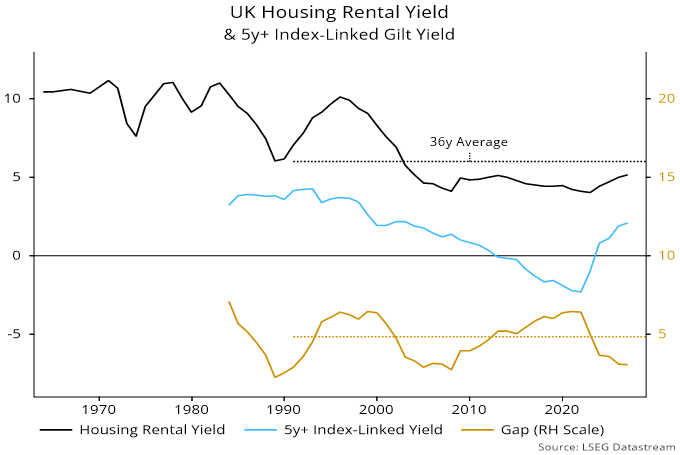
The yield, however, has averaged 6.0% over the last 36 years (representing two complete housing cycles). Based on current rents, prices would need to fall by a further 14% to achieve this level.
An assessment of fair value should also take into account yields / expected returns on competing investments. Index-linked gilts are a “risk-free” alternative, their coupons providing similar inflation protection to rents.
The premium of the rental yield over the yield on over-five-year index-linked gilts averaged 4.8 pp over the last 36 years, currently standing at 3.1% – chart 1. Closing the gap would require a 37% fall in house prices, based on current rents and assuming an unchanged real yield.
The comparison with index-linked offers a different interpretation of recent history. Rather than signalling house price overvaluation, the low level of the rental yield at end-2022 was consistent with still-negative index-linked yields – the rental yield premium was close to its long-term average.
The rise in the rental yield since then has lagged the increase in index-linked yields, resulting in the rental yield premium falling to its lowest level since 2007.
The suggestion, therefore, is that housing has become more expensive despite a rising absolute level of the rental yield, with the degree of overvaluation now comparable with the beginning of the crash phase of the last 18-year cycle.
*See footnote in previous post for more details.