
L’argent, le moteur des marchés
Japanese money update: further weakness
20 août 2026 par Simon Ward
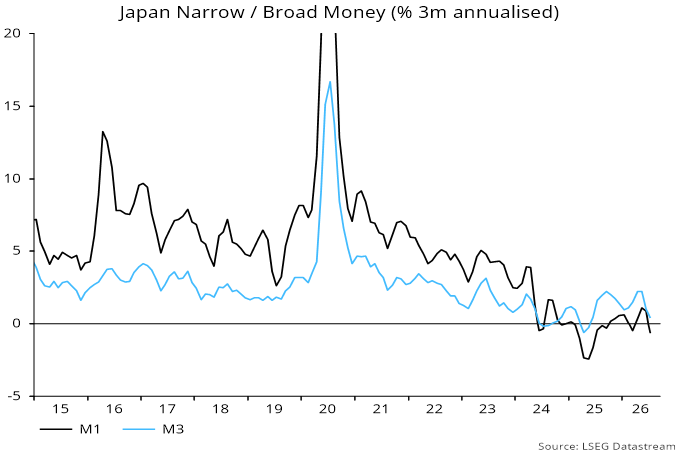
Japanese money trends are flashing red again. Broad money M3 grew by only 0.4% annualised in the three months to July, while narrow money M1 contracted – see chart 1.
Chart 1
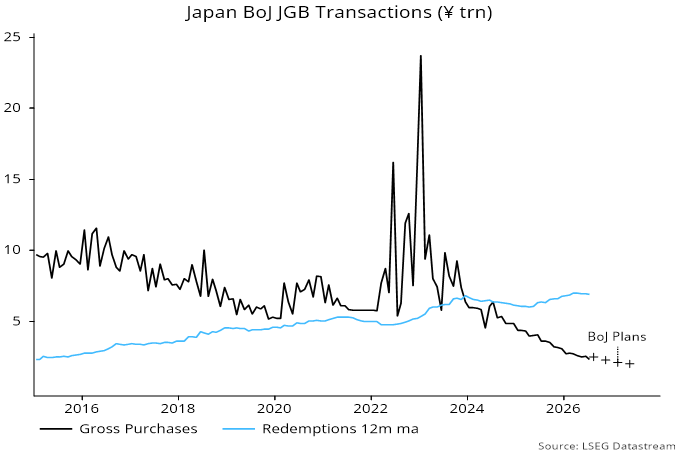
Renewed weakness is unsurprising because the BoJ is continuing to ramp up QT, with monthly JGB purchases falling further behind the run-rate of redemptions – chart 2.
Chart 2
Recent f/x intervention will be a further drag on August numbers. (Yen purchases occurred on 30-31 July, so settled on 3-4 August.)
A post-covid fall in annual money growth accelerated from Q1 2024. This has been reflected in a slowdown in annual nominal GDP expansion since Q2 2025, to 3.1% last quarter – chart 3.
Chart 3
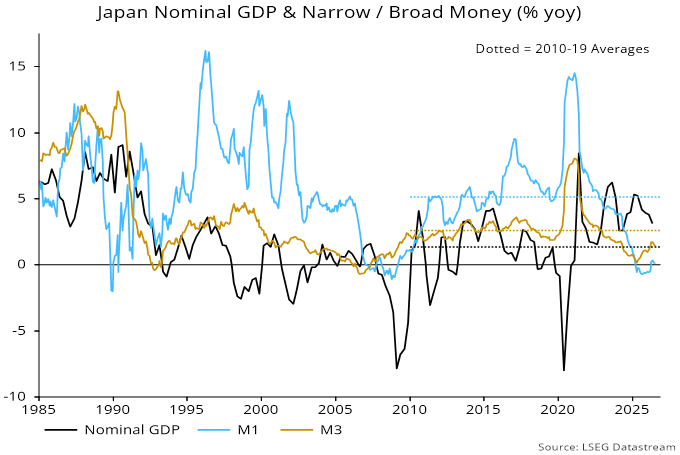
Nominal GDP growth may soon be at or below a pace consistent with the 2% inflation target, based on the BoJ’s estimate of potential expansion of 0.7% pa.
Annual money growth bottomed in Q2 2025, with a tepid recovery into Q2 2026 probably now reversing.
Money growth rates are far below 2010-19 means, when nominal GDP expansion averaged 1.4% pa, a pace associated with average annual CPI inflation of just 0.5%.
Optimists cite strong bank credit growth. Commercial banks’ domestic loans and discounts grew by an annual 6.7% in June, with corporate lending up by 7.8% – chart 4.
Chart 4
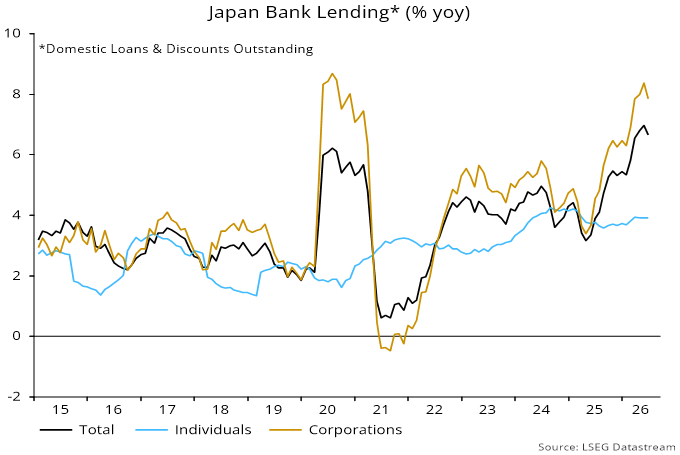
The “monetarist” view is that stronger lending has limited economic effects unless accompanied by faster monetary expansion. Otherwise, any rise in demand associated with the lending is balanced by weaker spending elsewhere – a monetary “crowding out” effect.
Lending buoyancy, in any case, is partly a consequence of the monetary squeeze imposed by QT, rather than being an independent positive signal. Rising yields due to the JGB dump have encouraged corporations to switch from bond market funding to cheaper bank borrowing.
Corporations may also have been borrowing domestically to finance rising FDI, contributing to downward pressure on the yen.
What would happen if QT were suspended? With the distortion of BoJ supply removed, domestic and foreign demand for JGBs would likely revive, resulting in lower yields and a rally in the yen. Money growth would recover but probably only to a moderate level, reflecting an associated slowdown in bank lending. Excessive monetary acceleration could be countered by raising rates. A stronger yen would damp near-term inflation while a recovery in money growth would reduce the risk of a medium-term undershoot.
Worth pushing for, Secretary Bessent?