
L’argent, le moteur des marchés
What explains the bond bear?
01 octobre 2026
The recent rise in global government bond yields has been variously attributed to spiking energy prices, hawkish central bankers, fiscal sustainability worries and increased competition for capital from the AI build-out.
The view here is that the rise is best understood as a symptom of a restrictive shift in global “excess” money conditions.
Conditions are defined to be accommodative or restrictive depending on whether the global stock of money is above or below the level required to support current economic activity. Any imbalance – and its rate of change – will have implications for asset prices.
Excess money can’t be observed directly. A flow-based proxy measure found to be informative historically is the difference between six-month rates of change of global real narrow money and industrial output.
In data since 1970, global equities performed strongly on average when this measure was positive (allowing for reporting lags), lagging cash returns when it was negative.
Government bond markets appear to be more sensitive to changes in excess money than its level. Chart 1 shows a coincident relationship between the six-month change in US 10-year Treasury yields and the equivalent change in the proxy measure, plotted inverted – chart 1.
Chart 1
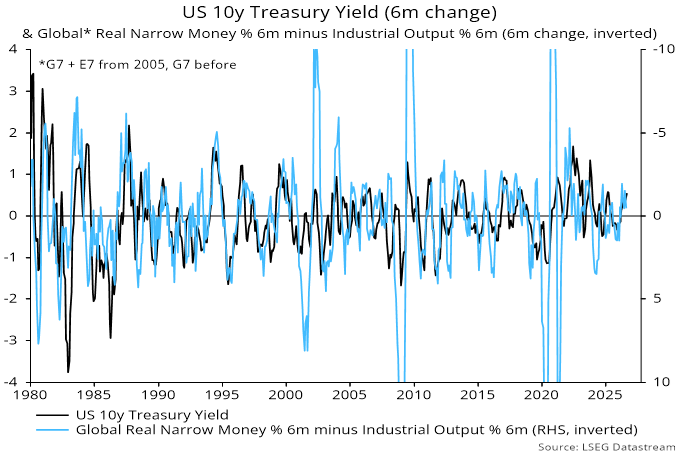
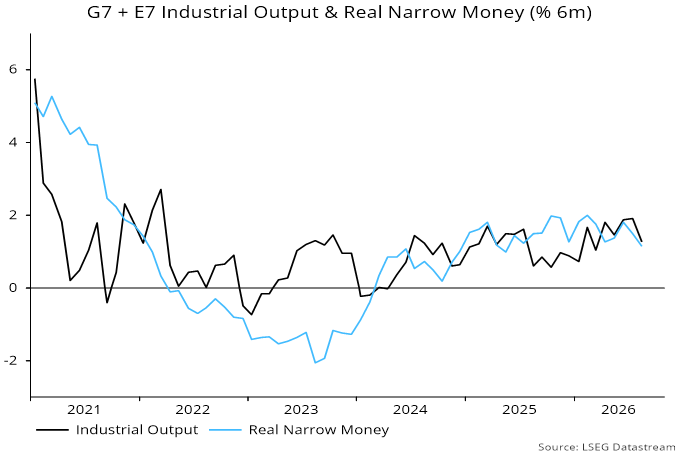
Global real money growth moved from above to below industrial output expansion between February and August, i.e. the proxy measure switched from positive to negative – chart 2. An associated shift in its six-month rate of change aligns with the pick-up in yields – chart 1.
Chart 2
How might excess money conditions develop from here? Monetary trends are difficult to forecast but policy tightening and a near-term inflation boost from higher energy costs suggest a further decline in real money growth.
Upbeat September PMI results support optimism about near-term industrial output prospects but slower real money growth may be reflected in a loss of momentum towards year-end, allowing for a normal lag.
A reasonable expectation, therefore, is that the real money / output growth gap will remain negative but stop widening soon. The six-month change in the proxy measure, in other words, could return to zero, in turn implying a stabilisation of bond yields.
A still-negative gap would, however, suggest downside risk for equities.