L’argent, le moteur des marchés
US money update: further acceleration
29 juillet 2026 par Simon Ward
Chair Warsh has stressed the Fed’s commitment to delivering 2% inflation. Current monetary trends are inconsistent with this goal.
Official M2 rose by an annualised 7.3% between December and June, the strongest six-month increase since March 2022. The broader M2+ measure calculated here – which additionally includes large time deposits and institutional money funds – expanded by 8.5% over the same period. Growth of narrow money M1A (currency plus demand deposits) was faster still, at 10.6% – see chart 1.
Chart 1
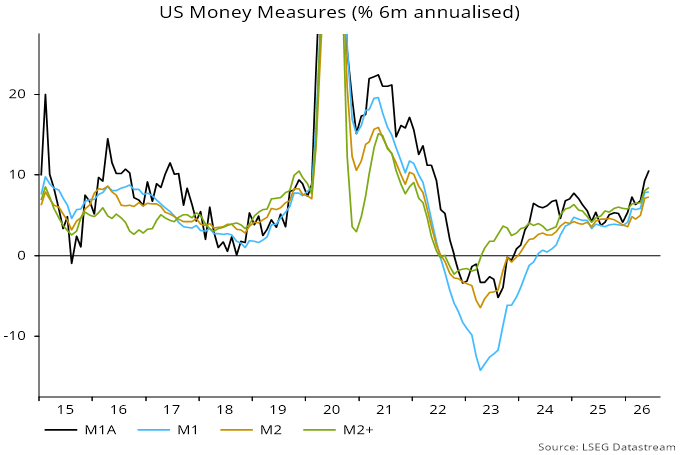
Money growth is reflected in some combination of real GDP expansion, inflation and falling velocity. Even optimists would doubt that current potential GDP growth is more than 3% pa. Broad money expansion of more than 8%, therefore, requires a contraction in velocity of at least 3% pa to be consistent with 2% inflation. Such a decline is implausible on a trend basis: M2+ velocity fell by an average 0.8% pa over 1960-2025.
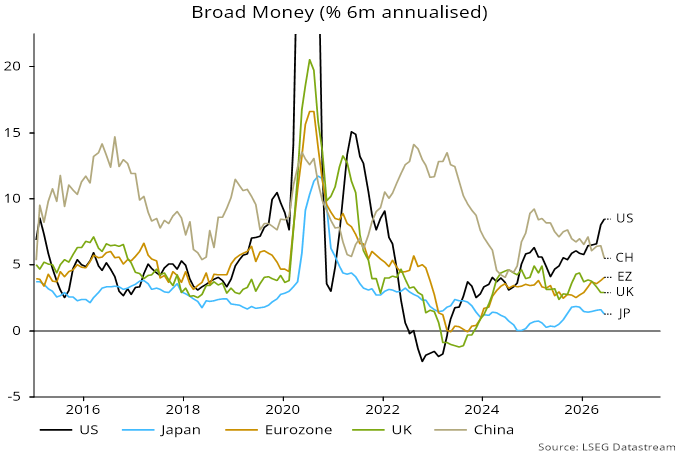
US monetary acceleration contrasts with weakness or slowdowns in other developed economies. Six-month broad money growth in June was 4.1% annualised in the Eurozone (non-financial M3), 2.9% in the UK (non-financial M4) and 1.3% in Japan (M3) – chart 2.
Chart 2
Six-month real narrow money momentum remains negative in the Eurozone, UK and Japan even as US growth moves above a 2024 high – chart 3.
Chart 3
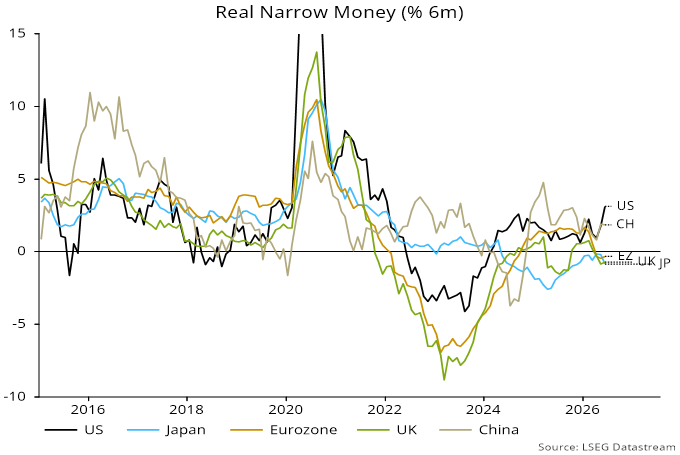
The scale of the monetary divergence goes beyond signalling a stronger case for US policy tightening, suggesting that other central banks should be moving in the opposite direction to the Fed.
What explains US acceleration? Unlike other central banks, the Fed has never published a “counterparts” analysis of broad money. However, the key drivers are likely to have been stronger bank lending – commercial bank loans and leases grew by 8.2% annualised in the six months to June, up from 6.3% in the prior half-year – and the Fed’s resumption of QE (“reserve management purchases”) from December. External flows may also have contributed, reflecting strong foreign buying of US equities.
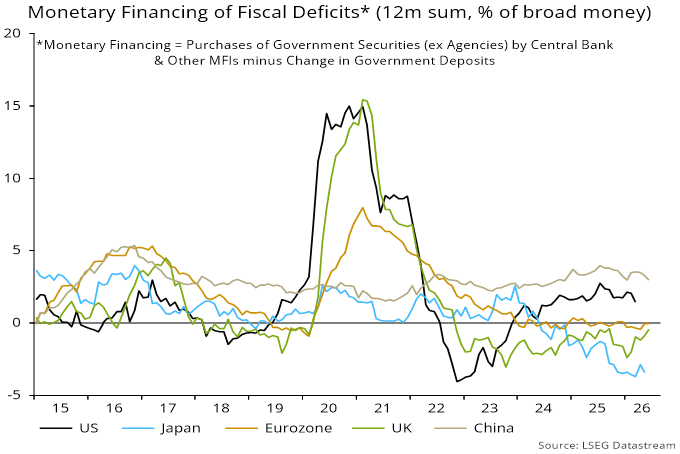
“Monetary financing” is a broader concept than QE, encompassing purchases of Treasury bills and notes by commercial banks and money funds as well as QE and changes in the Treasury’s balance at the Fed. The level of money growth in the US continues to be inflated relative to other developed economies by monetary financing of a much larger fiscal deficit – chart 4.
Chart 4