
L’argent, le moteur des marchés
More UK stop-go
13 août 2026 par Simon Ward
Solid UK H1 GDP growth has been interpreted by some commentators as evidence of underlying economic resilience, warranting an upgrade to forecasts. Monetary trends argue otherwise.
GDP (gross value added) rose by 1.1%, or 2.2% annualised, in the six months to June, having shown no growth in the prior six months (i.e. between June and December 2025).
Energy prices spiked at the end of Q1 with the increase only now feeding through to household tariffs, so the claim of resilience is premature, even ignoring monetary considerations.
Both the economic stagnation of H2 2025 and the H1 2026 pick-up were signalled by money trends. Six-month rates of change of real narrow and broad money turned negative in spring 2025 but rebounded into early this year – see chart 1.
Chart 1
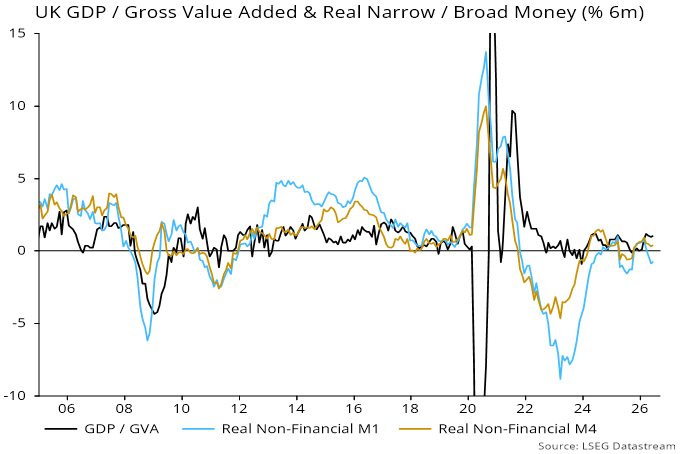
Momentum has since softened again, with real narrow money returning to contraction. Trends are not yet as weak as a year ago but still suggest a significant H2 economic slowdown.
As an aside, the latest Monetary Policy Report included an analysis of broad money developments, focusing on whether the current stock is out of line with its “equilibrium” level, implying future changes to spending / prices to restore balance. The conclusion was that any “money gap” is small, in contrast to 2022, when the analysis would have suggested significant inflationary potential.
While any discussion of money in the MPR is welcome, the view here is that a focus on uncertain estimates of stock disequilibrium risks neglecting the information content of changes in money growth for future activity and inflation. Monetary acceleration / deceleration carries a message for policy even in the absence of an underlying stock imbalance.