
L’argent, le moteur des marchés
A cynical view of central bank money-speak
22 juillet 2026 par Simon Ward
The Fed and Bank of England have included references to money in recent reports. The suspicion is that this represents tokenism and money trends still have no influence on policy decisions.
The Fed’s latest semi-annual Monetary Policy Report to Congress contains a paragraph discussing recent trends in the M2 money measure, included, apparently, at the behest of Chair Warsh.
In follow-up Q&A, Chair Warsh explained that he is not a “monetarist” but nevertheless holds the “old-fashioned view that monetary policy has something to do with money”.
Meanwhile, perhaps not coincidentally, former Fed Governor Miran has co-authored a paper that attempts to rehabilitate the P* monetarist approach to inflation forecasting.
P* is the level of prices implied by the current money stock, incorporating assumptions about trend GDP and velocity. The gap between P* and the prevailing price level P is a measure of future inflationary (or disinflationary) pressure. Miran et al present estimates of the price gap based on M2 and other (Divisia) money measures, showing that these gaps exhibit a statistically significant relationship with future inflation.
Both the Fed report and the Miran paper suggest that current monetary trends are non-inflationary. The former notes that annual M2 growth averaged 4.7% in the first five months of the year, which is “closer to the range typically observed in the 2010s”, when inflation undershot the 2% target.
Similarly, the current price gap estimates presented by Miran et al are all around zero, implying that “the stance of monetary policy is quite close to neutral right now, putting neither upward nor downward pressure on the inflation rate”.
A cynic might wonder if the appearance of these references to monetary trends has been motivated by a search for arguments to push back against a strengthening case for policy tightening based on conventional economic data (reflected in the Fed policy direction model discussed in previous posts).
In any case, the assessment that current trends are unthreatening may soon be out-of-date. Year-to-date annual M2 growth of 4.7% conceals a pick-up in six-month expansion to a 7.1% annualised pace in May. The broader M2+ measure calculated here rose by 8.2% over the same period – see chart 1.
Chart 1
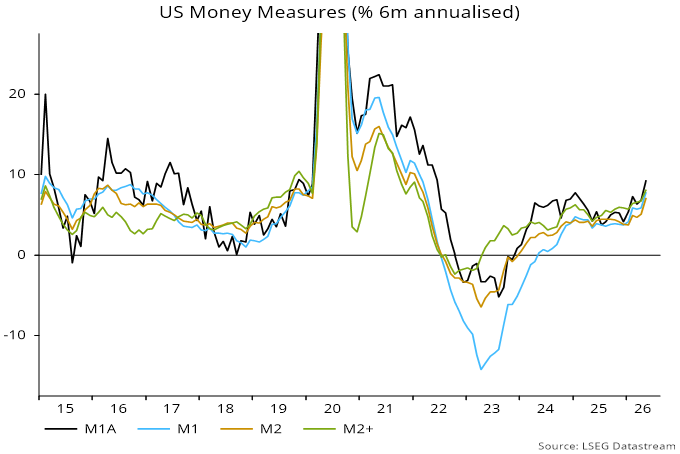
The recent acceleration suggests that the Miran et al price gap estimates are now positive.
By contrast, six-month growth of the Bank of England’s M4ex broad money aggregate was 4.4% annualised in May, with the non-financial M4 measure preferred here rising by just 2.8%.
The Bank’s quarterly Monetary Policy Report (or Inflation Report before November 2019) contained no mention of money between May 2019 and May 2023, a period during which annual non-financial M4 growth reached 16.0%. A reappearance in August 2023 coincided with the annual rate of change turning negative. Editions in May 2024 and May 2025 included boxes discussing broad money developments in detail.
Still, there is no evidence from the minutes that monetary considerations have played a role in any decisions of any MPC member. Regular references to money trends are, it appears, little more than a box-ticking exercise. The same will likely be true at the Fed.