Image of office skyscrapers with reflections in the sunlight

Fonds Connor, Clark & Lunn Inc. (Fonds CC&L) est heureuse d’annoncer deux portefeuilles axés sur le rendement absolu sous forme de fonds alternatifs liquides, soit le Fonds mondial neutre au marché CC&L II et le Fonds d’actions mondiales longues/courtes CC&L (les Fonds).

Le Fonds mondial neutre au marché CC&L II cherche à obtenir un rendement positif et intéressant à long terme après correction du risque, présentant une faible corrélation avec les marchés boursiers traditionnels, et moins volatil que ces derniers. Cote de risque : Faible à moyenne.

Le Fonds d’actions mondiales longues/courtes CC&L vise à procurer une plus-value du capital à long terme et des rendements corrigés du risque intéressants en investissant activement dans un portefeuille de titres à court et à long terme. Cote de risque : Moyenne.

Pour gérer les Fonds, Fonds CC&L a retenu les services de Gestion de placements Connor, Clark & Lunn Ltée (Gestion de placements CC&L), établie à Vancouver; cette entité est l’une des plus importantes sociétés de gestion de placements privées au Canada, avec près de 20 ans d’expérience dans la gestion de stratégies de placement non traditionnelles pour les investisseurs institutionnels.

« Nos clients nous ont dit qu’ils veulent avoir accès à des placements non traditionnels de calibre institutionnel, gérés par une équipe qui a un historique de bons résultats, dans le but d’obtenir un fonds alternatif liquide. En lançant ces deux nouveaux portefeuilles, nous atteignons ces objectifs et offrons aux conseillers en placement et à leurs clients deux profils de risque et de rendement intéressants parmi lesquels choisir », a déclaré Tim Elliott, président et chef de la direction de Fonds CC&L.

« Nous sommes ravis que ces solutions de placement non traditionnelles soient offertes à un plus grand nombre d’investisseurs canadiens. Comme nous sommes passés à un contexte caractérisé par des taux d’intérêt et une inflation structurellement plus élevés, nous nous attendons à ce que les cycles de marché soient plus courts, que la volatilité soit plus élevée et que les rendements des actifs risqués conventionnels soient plus faibles. Dans un tel contexte, nous croyons qu’il deviendra plus important pour les investisseurs d’intégrer des sources de rendement indépendantes des marchés boursiers et obligataires afin d’améliorer les résultats du portefeuille », a déclaré Martin Gerber, président et chef des placements à Gestion de placements CC&L.

Fonds CC&L et Gestion de placements CC&L sont des sociétés affiliées du Groupe financier Connor, Clark and Lunn (CC&L), dont la structure à multiples sociétés affiliées réunit les talents d’équipes de placement diversifiées qui offrent une vaste gamme de solutions de placement traditionnelles et non traditionnelles. CC&L est l’un des plus importants gestionnaires de placements indépendants au Canada; il gère plus de 104 milliards de dollars d’actifs pour le compte d’investisseurs institutionnels et particuliers.

À propos des fonds

Offerts en parts de série A et de série F, les fonds sont conformes au cadre réglementaire des fonds communs de placement non traditionnels offerts par prospectus simplifiés. Les parts des fonds sont vendues par l’intermédiaire de courtiers en placement titulaires d’un permis; leur prix est évalué quotidiennement et elles pourront être rachetées quotidiennement. Le fonds est offert au moyen de FundServ.

À propos de Fonds Connor, Clark & Lunn Inc.

Fonds Connor, Clark & Lunn Inc. (les Fonds CC&L) noue des partenariats avec des institutions financières canadiennes de premier plan et leurs conseillers en placement afin d’offrir des stratégies de placements institutionnelles uniques à des investisseurs particuliers, grâce à une gamme de fonds, de placements alternatifs liquides et de comptes en gestion distincte choisis avec soin.

En limitant sa gamme à un groupe de solutions de placement en particulier, Fonds CC&L est en mesure d’offrir des stratégies uniques conçues pour améliorer les portefeuilles traditionnels des investisseurs. Pour obtenir des précisions, consultez le site cclfundsinc.com.

À propos de Gestion de placements Connor, Clark & Lunn Ltée

Gestion de placements Connor, Clark & Lunn Ltée (Gestion de placements CC&L) est l’une des plus importantes sociétés de gestion de placements indépendantes au Canada (elle appartient à ses associés) et gère un actif de 54,2 milliards de dollars. Fondée en 1982, elle propose une gamme diversifiée de solutions de placements traditionnels (actions, titres à revenu fixe et placements équilibrés) et non traditionnels (stratégies neutres au marché, à alpha portable et à rendement absolu).

CC&L fait partie du Groupe financier Connor, Clark & Lunn (Groupe financier CC&L), une société de gestion d’actifs dotée d’une structure multientreprise, dont les sociétés affiliées gèrent collectivement un actif financier de plus de 104 milliards de dollars. Pour de plus amples renseignements, consultez le site cclinvest.com.

À propos du Groupe financier Connor, Clark & Lunn Ltée.

Le Groupe financier Connor, Clark & Lunn Ltée (Groupe financier CC&L) est une société de gestion d’actifs indépendante à multiples sociétés affiliées qui offre une vaste gamme de solutions de gestion de placements traditionnelles et non traditionnelles aux investisseurs institutionnels et individuels. Le Groupe financier CC&L procure une envergure et une expertise considérables qui permettent d’assumer des fonctions administratives qui ne sont pas liées aux placements tout en laissant les gestionnaires de placement se concentrer sur ce qu’ils font le mieux grâce à la centralisation des activités liées aux opérations et à la distribution. Les sociétés affiliées du Groupe financier CC&L gèrent un actif de plus de 104 milliards de dollars. Pour obtenir des précisions, consultez le site cclgroup.com.

Personne-ressource

Lisa Wilson
Directrice, Produits et service à la clientèle
Fonds Connor, Clark & Lunn Inc.
416 864-3120
[email protected]
Eurozone February monetary data were extraordinarily negative, suggesting that interest rates were already at a restrictive level before the 50 bp rate hikes in February / March. 

Economic sentiment has lifted in early 2023 in response to a collapsing gas price and China’s reopening but the impact of monetary restriction has yet to kick in. 

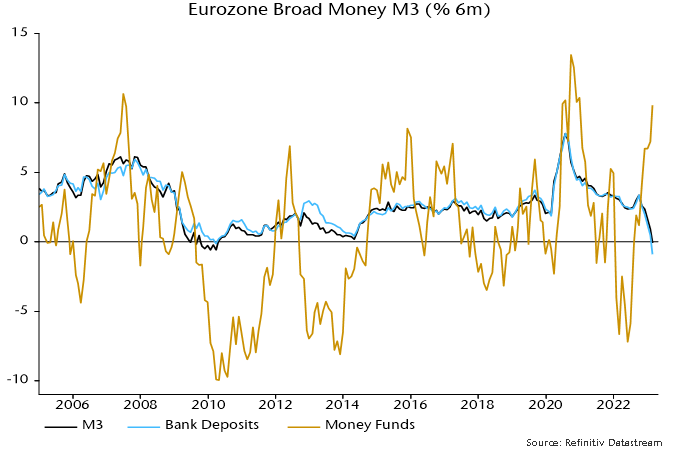
The headline M3 broad money measure was down again in February and has fallen in four of the last five months. The six-month rate of change turned negative and is the weakest since 2010 in the aftermath of the GFC – see chart 1. 

Chart 1

Chart 1 showing Eurozone Broad Money M3 (% 6m)

Bank deposits are contracting at a faster pace than then because of a portfolio switch into money market funds and short-term bank bonds. This switch has been motivated by relative yields but the banking crisis could give a further boost to money fund inflows. 

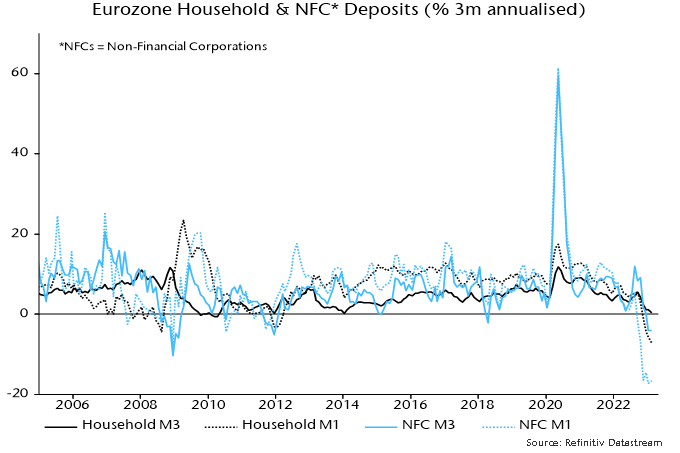
Corporate money trends are particularly alarming. Bank deposits of non-financial corporations contracted at a 4.0% annualised pace in the latest three months, with the overnight (M1) component down by 16.6% – chart 2. Household deposits fell in February and are barely up over three months, with a shift out of overnight accounts suggesting weak spending intentions. 

Chart 2

Chart 2 showing Eurozone Household & NFC* Deposits (% 3m annualised) *NFCs = Non-Financial Corporations

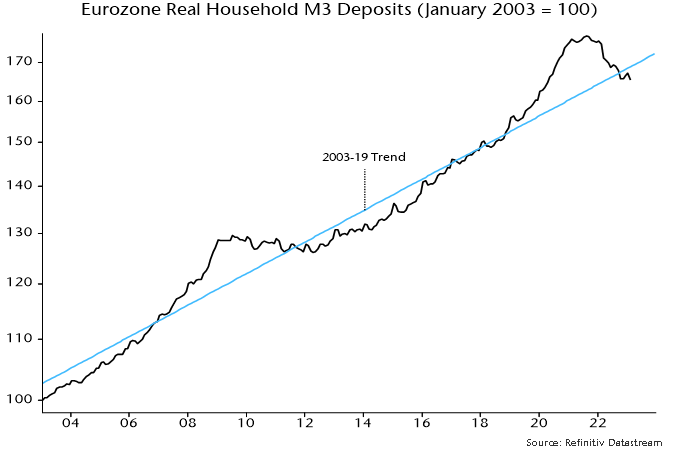
Talk of households still sitting on substantial spendable “excess” savings is suspect. Allowing for inflation erosion, household M3 deposits are below their pre-pandemic trend – chart 3. 

Chart 3

Chart 3 showing Eurozone Real Household M3 Deposits (January 2003 = 100)

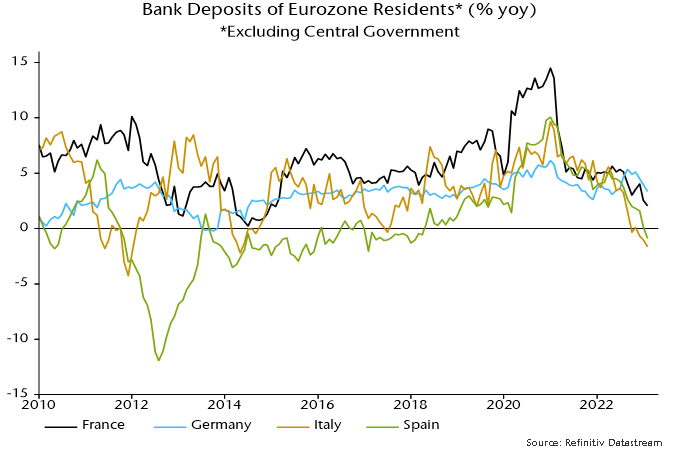
Country deposit data suggest that a core / periphery divergence is opening up, with Spain following Italy into year-on-year contraction – chart 4. 

Chart 4

Chart 4 showing Bank Deposits of Eurozone Residents* (% yoy) *Excluding Central Government

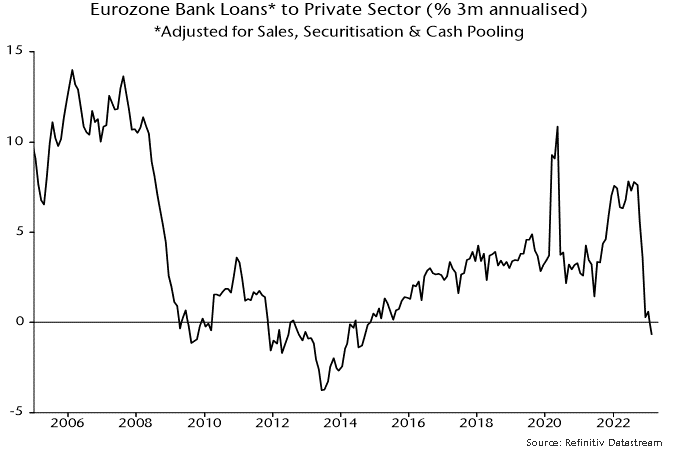
Monetary weakness partly reflects a collapse in credit growth: three-month loan momentum was running at an annualised 7.6% as recently as September but turned negative in February – chart 5. 

Chart 5

Chart 5 showing Eurozone Bank Loans* to Private Sector (% 3m annualised) *Adjusted for Sales, Securitisation & Cash Pooling

Corporations have been repaying short-term loans in size since November, consistent with a downswing in stockbuilding, which reached a record share of GDP in Q4. Numbers could bounce near term as firms draw down credit lines while they still can.

Downtown skyline of Toronto Canada at twilight.

Fonds Connor, Clark & Lunn inc., le gestionnaire du Fonds de rendement absolu II PCJ (le « Fonds ») est heureux d’annoncer un changement aux modalités de liquidité du Fonds.

À partir de maintenant, les ordres d’achat, de vente et de substitution du Fonds ne seront plus hebdomadaires à 16 h, heure de l’Est, le vendredi, mais quotidiens à 15 h, heure de l’Est, chaque jour ouvrable ou avant la fermeture de la Bourse de Toronto (TSX) pour la journée, selon la première éventualité, et tous les ordres seront traités en fonction de la valeur liquidative calculée ce jour-là. Les ordres reçus après 15 h, heure de l’Est, seront traités le jour ouvrable suivant en fonction de la valeur liquidative de ce jour-là.

À propos de Fonds Connor, Clark & Lunn Inc.

Fonds Connor, Clark & Lunn Inc. (les Fonds CC&L) noue des partenariats avec des institutions financières canadiennes de premier plan et leurs conseillers en placement afin d’offrir des stratégies de placements institutionnelles uniques à des investisseurs particuliers, grâce à une gamme de fonds, de placements alternatifs liquides et de comptes en gestion distincte choisis avec soin.

En limitant sa gamme à un groupe de solutions de placement en particulier, Fonds CC&L est en mesure d’offrir des stratégies uniques conçues pour améliorer les portefeuilles traditionnels des investisseurs. Pour obtenir des précisions, consultez le site cclfundsinc.com.

Renseignements prospectifs

Le présent communiqué peut contenir des renseignements prospectifs (au sens des lois sur les valeurs mobilières applicables) à l’égard des activités du gestionnaire et du Fonds (les « énoncés prospectifs »). Ces énoncés prospectifs se reconnaissent par des mots comme « croire », « anticiper », « projeter », « s’attendre à », « avoir l’intention de », « planifier », « pourrait », « estimer » et d’autres expressions semblables. Les énoncés prospectifs contenus dans le présent communiqué sont fondés sur certaines hypothèses; ils ne sont pas garants du rendement futur et comportent des risques et des incertitudes difficiles à contrôler ou à prévoir. Un certain nombre de facteurs pourraient faire en sorte que les résultats réels diffèrent considérablement des résultats présentés dans les énoncés prospectifs, y compris, mais sans s’y limiter, les facteurs énumérés à la rubrique « Qu’est-ce qu’un organisme de placement collectif et quels sont les risques associés à un placement dans un tel organisme? » dans le prospectus simplifié disponible sur le profil SEDAR du Fonds au www.sedar.com. Rien ne garantit que les énoncés prospectifs se révéleront exacts, car les rendements et les résultats réels peuvent considérablement différer de ceux qui y sont exprimés. En conséquence, les lecteurs ne devraient pas se fier indûment à de tels énoncés prospectifs. De plus, ces énoncés prospectifs sont faits en date du présent communiqué et, sauf si la loi applicable l’exige expressément, le gestionnaire et le Fonds ne s’engagent aucunement à mettre à jour ou à réviser tout énoncé prospectif public, que ce soit à la suite de l’obtention de nouveaux renseignements, d’événements futurs ou autres.

Personne-ressource

Lisa Wilson
Directrice, Produits et service à la clientèle
Fonds Connor, Clark & Lunn Inc.
416-864-3120
[email protected]
Current monetary stagnation implies that policy-makers’ worries about a sustained inflation overshoot are as misplaced as their deflation panic in 2020 when money growth was surging.

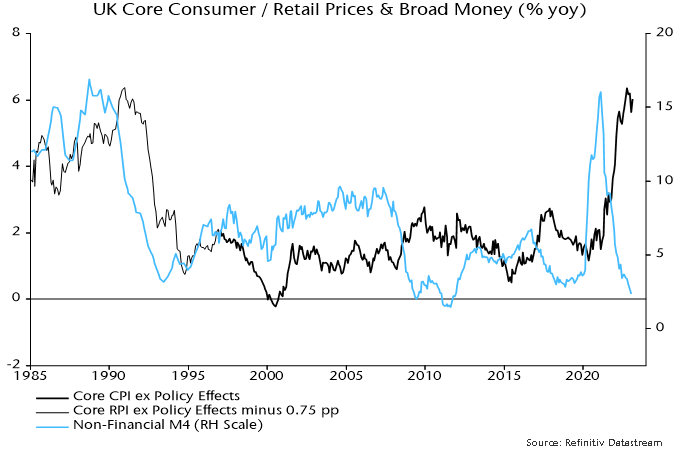
UK annual broad money growth peaked in February 2021. It should be no surprise that annual inflation was still riding high in February 2023, based on the “monetarist” understanding of a roughly two year lead. 

Annual money growth, however, collapsed after February 2021. Non-financial M4 rose by 2.4% in the year to January and by only 0.9% annualised in the latest three months. 

A consensus concern is that a coming inflation decline will fail to return it to target – one informed commentator expects stickiness at about 4%. No explanation is offered of how such a scenario is compatible with barely growing broad money. Is velocity expected to pick up, against its long-term downtrend? Or is 4% inflation projected to coexist with economic contraction of 3% pa – the implication if money growth runs at 1% pa and velocity is stable? 

The collapse in annual money growth closely resembles a decline over 1990-93, following which annual core RPI inflation fell below 2% in H2 1994, consistent with a core CPI rate (unavailable then) of about 1% – see chart 1. 

Chart 1

Chart 1 showing UK Core Consumer / Retail Prices & Broad Money (% yoy)

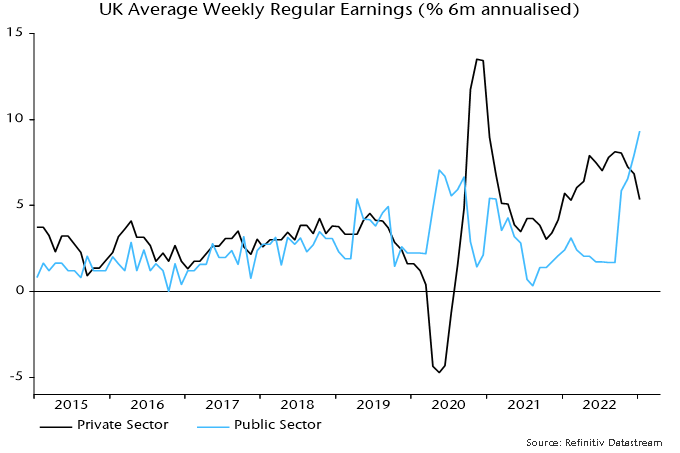
The push-back to a similar scenario now is that the unemployment rate is much lower than at the start of the 1990-92 recession. Average earnings growth, however, was significantly higher then – the annual increase in total pay was above 10% (three-month moving average) when the recession started versus below 6% now. Private pay momentum is already slowing despite limited labour market cooling to date – chart 2. 

Chart 2

Chart 2 showing UK Average Weekly Regular Earnings (% 6m annualised)

The 1991-1994 inflation plunge, moreover, occurred despite upward pressure on import prices from a 12% drop in the effective exchange rate between 1990 and 1993 (calendar year averages). There is no such currency headwind to an inflation decline now. 

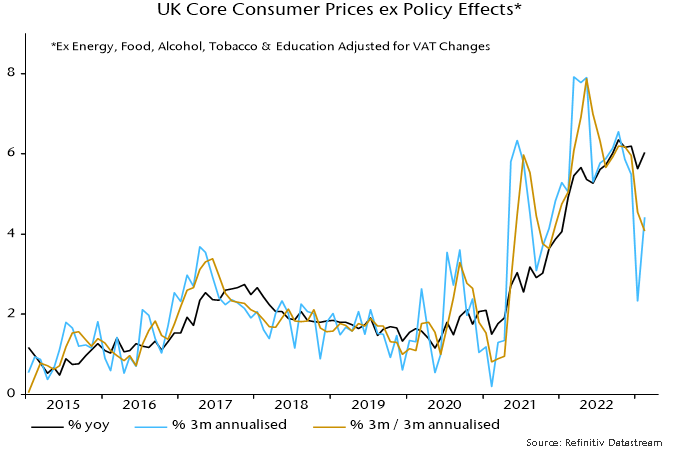
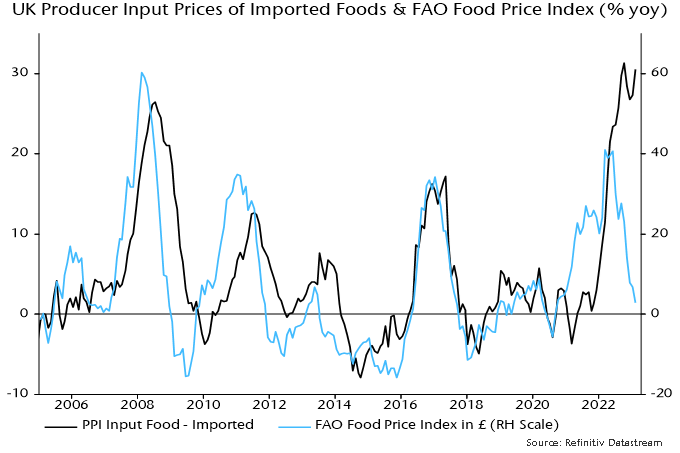
Annual core CPI inflation rose in February but three-month momentum remains well down from its May 2022 peak – chart 3. Commodity prices signal a coming slowdown in food inflation – chart 4 – while energy prices will soon be falling year-on-year. The February inflation result is irrelevant for assessing 2024-25 prospects and the MPC should ignore it. 

Chart 3

Chart 3 showing UK Core Consumer Prices ex Policy Effects* *Ex Energy, Food, Alcohol, Tobacco & Education Adjusted for VAT Changes

Chart 4

Chart 4 showing UK Producer Input Prices of Imported Foods & FAO Food Price Index (% yoy)
Selamat Datang Monument in central Jakarta, Indonesia.

We believe emerging markets (EMs) offer a multitude of benefits to equity investors, including: 

  • High growth potential. EMs typically follow rapid economic growth trajectories, which can be reflected in the performance of companies operating within these markets. 
  • Undervalued quality assets. EMs are home to many high-quality companies not yet recognized by the broader investment community. As these companies grow, they gain awareness and appreciate. 
  • Diversification. Investing in EMs can help diversify portfolios concentrated in more developed markets, enhancing their risk-return profile. 
  • Favourable demographics. Most EMs have young and growing populations that can drive economic growth and provide opportunities for companies catering to these markets. 

Small-cap (SC) companies can often have significantly more room for growth than their larger peers, as they launch new products and expand into new markets, providing substantial upside potential. Also, because they are typically less known outside of their domestic market and inadequately covered by sell-side analysts, they can present “hidden gem” opportunities that the market maybe be overlooking. The EM SC investable universe comprises over 11,000 companies offering a wide variety of investment ideas across 24 countries and 11 sectors. 

For a company to be included on our shortlist, it must be run by an outstanding management team and have a sustainable competitive advantage and defined growth strategy within what we believe is an attractive market. Although we are bottom-up investors, we are also macro aware and acknowledge secular investment themes in the EM middle-class consumer space. Notably, EM countries have nearly four times the middle-income households as their developed market counterparts.  

Indonesia, which we last wrote about in August 2021, is the largest economy in Southeast Asia, the world’s fourth most populous country and home to more than 50 million consumers in the middle-income bracket. Amid gloomy economic projections for many countries globally, Indonesia is expected to experience only a mild slowdown and actually grow 4.8% in 2023. Its economy is supported by strong exports, investment (with foreign direct investment having consistently posted new records every quarter last year) and household spending (being the most significant GDP contributor). Even with the possibility of a global recession and a tight global financial environment threatening Indonesia’s momentum, our view is that companies with sustainable business models, pricing power and appealing product offerings can nevertheless extract meaningful benefits. We believe that one of our Emerging Markets Small Cap portfolio’s core holdings offers the best exposure to Indonesia’s middle-income consumers.

Business overview

Mitra Adiperkasa (MAPI IJ) is Indonesia’s leading multi-format lifestyle retailer catering primarily to middle- and high-income earners. Since its establishment in 1995, the company has managed to build a diversified portfolio of franchise agreements with more than 150 world-class brands (e.g., Zara, Marks & Spencer, Footlocker, Converse, Starbucks, Subway, Krispy Kreme, Tissot, Pandora, Sephora, Samsonite). Mitra Adiperkasa has cultivated long-term relationships with its principals and secures exclusive rights from virtually all brands it partners with. Supported by a veritable army of 23,000 employees, the company runs an omnichannel network of nearly 3,000 physical and 20 online stores. In 2016, Mitra Adiperkasa started its overseas expansion venturing into Vietnam, followed by the Philippines in 2020, and Malaysia and Singapore in 2022.

Competitive advantages

  • Diversified portfolio of exclusive brands and long-term relationships with principals.  
  • Unmatched scale and store network. 
  • Strong reputation and track record of execution. 
  • Focus on target customers with resilient purchasing power. 
  • Solid balance sheet with net cash position. 

Growth strategy

  • Same-store sales growth and store network expansion, with a focus on higher-profit specialty stores. 
  • Addition of new brands and optimization of existing ones. 
  • Expansion in Vietnam, the Philippines and Malaysia. 

A combination of target demographics with more resilient purchasing power, a diverse portfolio of exclusive brands and a robust omnichannel strategy in our view make Mitra Adiperkasa one of the best-positioned consumer companies in the EM SC universe.

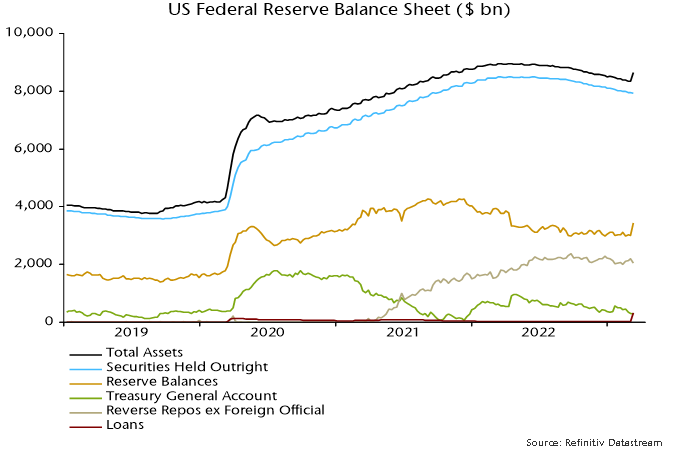
Lending by the Fed to depository institutions jumped from $15 billion to $318 billion between 8 and 15 March – see chart 1 (red line). The emergency loans – mostly via the discount window and via the FDIC rather than under the new Bank Term Funding Program – were the main driver of a $441 billion surge in banks’ reserves at the Fed. 

Chart 1 

Chart 1 showing US Federal Reserve Balance Sheet ($ bn)

These developments do not represent an easing of monetary conditions, except relative to a much tighter baseline that would have resulted from the Fed failing to accommodate increased demand for monetary base due to the banking crisis. 

  • Unlike QE, Fed lending to the banking system has no direct impact on money stock measures (i.e. money held by households and non-bank firms). (QE has an impact to the extent that securities are purchased from non-banks.) 
  • Unlike QE, the reserves rise is temporary and will reverse if the crisis abates and lending is repaid. 
  • The emergency / temporary nature of the lending / reserves rise implies no incentive for banks currently experiencing inflows to expand assets. (QE can have secondary monetary effects by encouraging lending / securities purchases.) 

Resolution of the crisis requires the authorities to arrest broad money contraction. A run-down of the Treasury’s cash balance at the Fed won’t be sufficient; QT needs to be suspended / reversed to offset a cutback in lending by troubled banks. Consideration should also be given to limiting the drain of deposits to money funds, e.g. by capping their access to Fed’s overnight reverse repo facility.

Mount fuji at Lake kawaguchiko with cherry blossoms near Tokyo, Japan.

March is the start of the cherry blossom season, and also the start of major investment conferences in Japan. Recently we attended three conferences held by Daiwa, Mizuho and SMBC Nikko Securities. In this week’s commentary, we would like to share some of our observations from the conferences.

COVID restrictions lifted in May

Walking in Tokyo, a notable scene was that 99.99% of people still wore masks everywhere, indoors and outdoors, including at the conferences. Although wearing a mask was not legally required in most places, it was culturally expected. Japanese culture emphasizes the importance of considering the well-being of others, so wearing a mask during COVID period is seen as a responsible thing to do.

On May 8, 2023, the Japanese government will downgrade COVID-19 to the same category as seasonal influenza. This means the end of the vaccination-or-test requirement, as well as the indoor masking recommendation, signaling a return to a pre-pandemic normal.

Returning of foreign visitors

The Daiwa Investor Conference is the largest of its kind in Japan. Over 400 companies and 500 overseas investors participated, similar to 2019 numbers. For most overseas investors, it was their first trip to Japan since 2020. The overall sentiment was positive about the recovery in various aspects.

In department stores and duty-free shops, we saw mandarin-speaking sales assistants again. They played very important roles before COVID to guide Chinese tourists. In 2019, about 32 million foreign tourists visited Japan and spent a record high of ¥4.81 trillion. 9.59 million Chinese tourists contributed to most of the spending, and popular items were cosmetics and skincare products, electronics, souvenirs, food and snacks, and luxury goods.

More significant wage increase

In 2022, Japanese nominal wages grew 2.1% year-over-year, the biggest annual hike since 4.4% in 1991. In December, the wage increase was 4.8%. A survey of more than 2,000 unions nationwide showed an average 4.49% raise request for this year, first time above 4% since 1998’s 4.36%, according to the Japanese Trade Union Confederation. Some major firms have promised large pay increase to retain skilled workers amid labour crunch. For example, Toyota accepted a union demand for the biggest base salary increase in 20 years and a rise in bonus, although they did not disclose the percentage. Fast Retailing, which owns clothing giant Uniqlo, said it would boost pay by up to 40%. Video game maker Nintendo planned to increase base pay by 10%.

Inflation creeping up

The annual inflation rate in Japan rose to 4.3% in January 2023, up from 4.0% the prior month. This was the highest reading since December 1981, amid a rise in prices of imported raw commodities and a weak yen.

An extra economic package of ¥29 trillion (US$215 billion) was recently announced in October 2022, worth around 5% of GDP. The package aimed to bring down inflation by 1.2% between January and September 2023.

Economists remain divided on whether the wage increase are a one-off and wider inflationary pressure are expected to subside after government curbs on gas and electricity prices take effect. The latest outlook of Bank of Japan (BOJ) indicated that inflation for the fiscal year ending in March 2023 is expected to be 3%, and to fall below 2% in the next two fiscal years.

Interest rate trend

For now, the BOJ has kept short-term interests at minus 0.1% and its target for the 10-year Japanese government bond yield at around zero. With inflation going up, it is under pressure to abandon its yield curve control policy.

The new head of BOJ, Kazuo Ueda will take office on April 8. He has a scholarly background with a doctorate from the Massachusetts Institute of Technology. He has promised a smooth transition from his predecessor’s ultra-loose monetary policy. We don’t expect Ueda to rush existing the zero-interest policy. He has been with BOJ since 1998, and so was involved in developing the recent monetary policies.

Conclusion

Back to the conferences, we met about 40 companies and conducted 3 company visits. All companies mentioned salary increase, mostly below 5%. They have managed to pass on most cost increases if not all to customers. Managements don’t seem to worry much about the rising interest rate. They believe it will happen, but in a very gradual manner. Most of our Japanese holdings are in net cash position. The biggest consensus of managements was that Japan is on the right track of COVID recovery and will benefit greatly from China re-opening and inbound tourism.

We remain cautiously optimistic about the Japanese economy and its stock market, and maintain a very diversified portfolio. Compared with Western countries, Japan has been slow in implementing an exit strategy from the pandemic. The prudence reflected in Japan’s COVID policy is part of its culture, focusing on discipline, self-control and orderliness. We believe these values are deeply ingrained in the society and will continue to help shape its government policy and corporate practices.

Mount fuji at Lake kawaguchiko with cherry blossoms near Tokyo, Japan.

March is the start of the cherry blossom season, and also the start of major investment conferences in Japan. Recently we attended three conferences held by Daiwa, Mizuho and SMBC Nikko Securities. In this week’s commentary, we would like to share some of our observations from the conferences.

COVID restrictions lifted in May

Walking in Tokyo, a notable scene was that 99.99% of people still wore masks everywhere, indoors and outdoors, including at the conferences. Although wearing a mask was not legally required in most places, it was culturally expected. Japanese culture emphasizes the importance of considering the well-being of others, so wearing a mask during COVID period is seen as a responsible thing to do.

On May 8, 2023, the Japanese government will downgrade COVID-19 to the same category as seasonal influenza. This means the end of the vaccination-or-test requirement, as well as the indoor masking recommendation, signaling a return to a pre-pandemic normal.

Returning of foreign visitors

The Daiwa Investor Conference is the largest of its kind in Japan. Over 400 companies and 500 overseas investors participated, similar to 2019 numbers. For most overseas investors, it was their first trip to Japan since 2020. The overall sentiment was positive about the recovery in various aspects.

In department stores and duty-free shops, we saw mandarin-speaking sales assistants again. They played very important roles before COVID to guide Chinese tourists. In 2019, about 32 million foreign tourists visited Japan and spent a record high of ¥4.81 trillion. 9.59 million Chinese tourists contributed to most of the spending, and popular items were cosmetics and skincare products, electronics, souvenirs, food and snacks, and luxury goods.

More significant wage increase

In 2022, Japanese nominal wages grew 2.1% year-over-year, the biggest annual hike since 4.4% in 1991. In December, the wage increase was 4.8%. A survey of more than 2,000 unions nationwide showed an average 4.49% raise request for this year, first time above 4% since 1998’s 4.36%, according to the Japanese Trade Union Confederation. Some major firms have promised large pay increase to retain skilled workers amid labour crunch. For example, Toyota accepted a union demand for the biggest base salary increase in 20 years and a rise in bonus, although they did not disclose the percentage. Fast Retailing, which owns clothing giant Uniqlo, said it would boost pay by up to 40%. Video game maker Nintendo planned to increase base pay by 10%.

Inflation creeping up

The annual inflation rate in Japan rose to 4.3% in January 2023, up from 4.0% the prior month. This was the highest reading since December 1981, amid a rise in prices of imported raw commodities and a weak yen.

An extra economic package of ¥29 trillion (US$215 billion) was recently announced in October 2022, worth around 5% of GDP. The package aimed to bring down inflation by 1.2% between January and September 2023.

Economists remain divided on whether the wage increase are a one-off and wider inflationary pressure are expected to subside after government curbs on gas and electricity prices take effect. The latest outlook of Bank of Japan (BOJ) indicated that inflation for the fiscal year ending in March 2023 is expected to be 3%, and to fall below 2% in the next two fiscal years.

Interest rate trend

For now, the BOJ has kept short-term interests at minus 0.1% and its target for the 10-year Japanese government bond yield at around zero. With inflation going up, it is under pressure to abandon its yield curve control policy.

The new head of BOJ, Kazuo Ueda will take office on April 8. He has a scholarly background with a doctorate from the Massachusetts Institute of Technology. He has promised a smooth transition from his predecessor’s ultra-loose monetary policy. We don’t expect Ueda to rush existing the zero-interest policy. He has been with BOJ since 1998, and so was involved in developing the recent monetary policies.

Conclusion

Back to the conferences, we met about 40 companies and conducted 3 company visits. All companies mentioned salary increase, mostly below 5%. They have managed to pass on most cost increases if not all to customers. Managements don’t seem to worry much about the rising interest rate. They believe it will happen, but in a very gradual manner. Most of our Japanese holdings are in net cash position. The biggest consensus of managements was that Japan is on the right track of COVID recovery and will benefit greatly from China re-opening and inbound tourism.

We remain cautiously optimistic about the Japanese economy and its stock market, and maintain a very diversified portfolio. Compared with Western countries, Japan has been slow in implementing an exit strategy from the pandemic. The prudence reflected in Japan’s COVID policy is part of its culture, focusing on discipline, self-control and orderliness. We believe these values are deeply ingrained in the society and will continue to help shape its government policy and corporate practices.

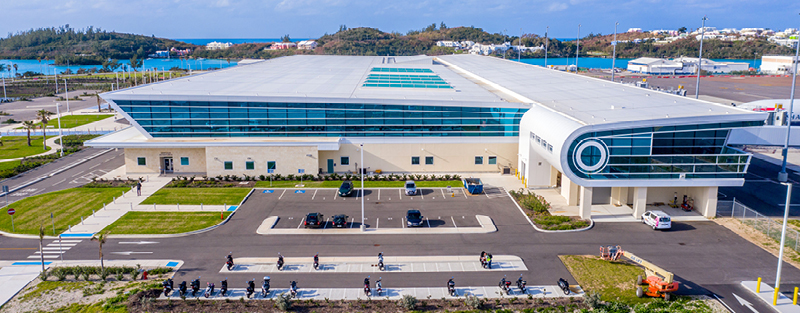
L.F. Wade International Airport

Connor, Clark & Lunn Infrastructure (CC&L Infrastructure) a annoncé aujourd’hui l’acquisition d’une participation minoritaire de 49,9 % dans Bermuda Skyport Corporation Limited (Skyport) d’Aecon Group Inc. (Aecon), le concessionnaire de l’aéroport international L.F. Wade (l’aéroport international des Bermudes). Aecon est une importante société canadienne de construction et de développement d’infrastructures, qui continuera d’être le propriétaire majoritaire et l’exploitant de l’aéroport. Le prix d’achat de la participation acquise est de 128,5 M$ US, et la transaction demeure assujettie à un certain nombre de conditions de clôture qui, selon les parties, seront satisfaites au cours des prochaines semaines.

L’aéroport international des Bermudes offre aux voyageurs internationaux et aux Bermudiens le seul accès aérien à l’île. Cet aéroport moderne de calibre mondial, doté d’un nouveau terminal de passagers ultramoderne, soutient l’industrie touristique grandissante des Bermudes et son statut de centre financier mondial. L’installation a été construite avec des systèmes d’éclairage, de climatisation et de traitement des eaux usées écoénergétiques et de façon à s’adapter aux conditions météorologiques extrêmes communes aux nations insulaires.

Le réaménagement de l’aéroport international des Bermudes a été achevé en 2020 dans le cadre d’un accord de concession entre Skyport, une filiale en propriété exclusive d’Aecon, et la Bermuda Airport Authority. Skyport est responsable de l’exploitation, de l’entretien et des fonctions commerciales de l’aéroport et coordonne l’ensemble du projet de réaménagement de celui-ci dans le cadre d’un accord de concession, qui a encore 24 ans à courir sur sa durée initiale de 30 ans.

« Nous sommes enthousiastes à l’idée de nous étendre à un nouveau secteur et à une nouvelle région en ajoutant à notre portefeuille d’infrastructures cette participation dans un aéroport de classe mondiale, a déclaré Matt O’Brien, président de CC&L Infrastructure. Cet investissement est conforme à notre stratégie qui consiste à investir dans des actifs de qualité supérieure à long terme dans des territoires solvables. L’aéroport international L.F. Wade est un excellent exemple d’un actif durable et résilient qui présente un potentiel de croissance, à mesure que le trafic de passagers se redresse dans la foulée de la COVID-19, et constitue un complément intéressant à notre portefeuille existant et bien diversifié d’infrastructures. »

« Nous croyons que les Bermudes sont un territoire de choix pour les investissements et nous sommes ravis de nous associer à Aecon et à l’équipe de Skyport pour offrir un aéroport de grande qualité à l’État et à la population des Bermudes, a ajouté Ryan Lapointe, directeur général de CC&L Infrastructure. En tant qu’investisseurs à long terme, nous sommes impatients de travailler avec nos partenaires d’Aecon et du gouvernement des Bermudes pour assurer le succès de l’exploitation de l’aéroport international des Bermudes pendant de nombreuses années. »

Marchés des capitaux  CIBC a agi à titre de conseiller financier et Torys LLP est conseiller juridique de CC&L Infrastructure à l’égard de la transaction.

À propos de Connor, Clark & Lunn Infrastructure

CC&L Infrastructure investit dans des infrastructures du marché intermédiaire qui présentent un profil risque-rendement intéressant, une longue durée de vie et un potentiel de production de flux de trésorerie stables. À ce jour, CC&L Infrastructure a accumulé un actif sous gestion de plus de 5 milliards de dollars, couvrant divers secteurs, types d’actif et régions, et compte plus de 90 installations sous-jacentes réparties dans plus de 30 placements individuels. CC&L Infrastructure est membre du Groupe financier Connor, Clark & Lunn Ltd., une société de gestion de placements dotée d’une structure multientreprise et dont les sociétés affiliées gèrent collectivement un actif plus de 100 milliards de dollars canadiens. Pour obtenir de plus amples renseignements, veuillez consulter le site www.cclinfrastructure.com.

Personne-ressource

Vrushabh Kamat
Connor, Clark & Lunn Infrastructure
437 928-5184
[email protected]

TORONTO (Ontario), le 14 mars 2023 – Investissements immobiliers Crestpoint Ltée (Crestpoint) a annoncé aujourd’hui l’acquisition d’une nouvelle propriété industrielle, le Coastal Heights Distribution Centre.

Cette installation de 428 000 pieds carrés nouvellement construite présente des caractéristiques d’entrepôt industriel de premier ordre, notamment une hauteur libre de 36 pieds, 49 portes de chargement accessibles au moyen d’une cour sécurisée, un aménagement efficace, une excellente voie d’entrée et de sortie composée de quatre points d’accès et amplement de places de stationnement. Située sur un terrain de 19 acres dans le secteur industriel de Campbell Heights à Surrey, en Colombie-Britannique, la propriété est stratégiquement située près de plusieurs autoroutes importantes et procure un accès facile à la frontière canado-américaine. L’immeuble est entièrement loué pendant 10 ans à une société figurant au classement Fortune 500. Crestpoint a acquis une participation de 100 % dans la propriété au nom de la Stratégie immobilière de base plus Crestpoint, soit son fonds à capital variable, avec deux clients institutionnels de Crestpoint.

La conclusion de ces acquisitions porte l’actif sous gestion total de Crestpoint à plus de 9,7 milliards de dollars et de 36,0 millions de pieds carrés.

À propos de Crestpoint

Investissements immobiliers Crestpoint Ltée est une société de gestion de placements immobiliers commerciaux qui cherche à fournir aux investisseurs un accès direct à un portefeuille diversifié d’actifs du secteur immobilier commercial. Crestpoint est membre du Groupe financier Connor, Clark & Lunn, une société de gestion de placements dotée d’une structure multientreprise qui offre des produits et des services de gestion de placements à des clients institutionnels et à valeur nette élevée. Possédant des bureaux partout au Canada, ainsi qu’à Chicago, à Londres et à Gurugram, en Inde, le Groupe financier Connor, Clark & Lunn et ses sociétés affiliées gèrent collectivement un actif d’environ 104 milliards de dollars. Pour obtenir de plus amples renseignements, veuillez consulter le site : www.crestpoint.ca.

Personne-ressource

Elizabeth Steele  
Directrice, Relations avec les clients  
Investissements immobiliers Crestpoint Ltée  
(416) 304-8743  
[email protected]