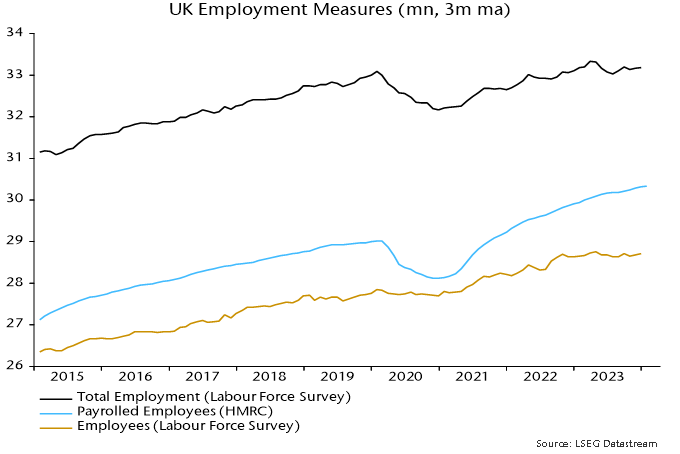
Perceptions of UK labour market “resilience” rest partly on continued growth in the payrolled employees series, based on PAYE data. This series, however, is likely to have been boosted by a rise in the proportion of self-employed people included in PAYE.

Labour Force Survey (LFS) employment is, at least in concept, the most comprehensive measure of employed people, including all employees and self-employed. The payrolled employees series covers most employees* along with self-employed people who receive pay through PAYE. The latter group includes business owners who choose to draw a salary, contractors on the payroll of the client and self-employed people with second jobs as employees.

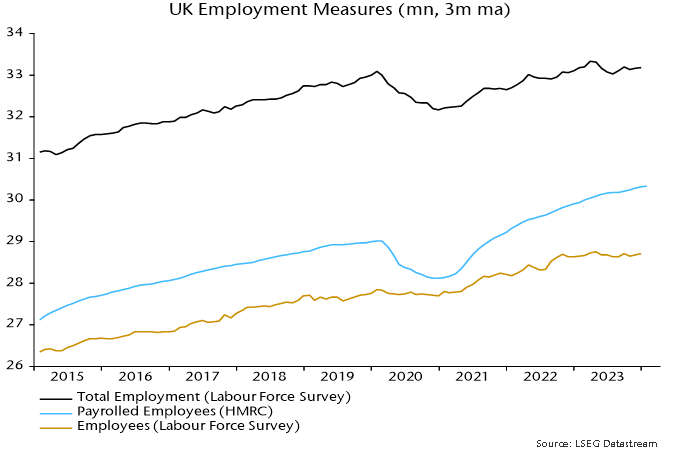
LFS employment peaked in the three months to April 2023, standing 150,000 below that level in the three months to January. This is consistent with GDP / gross value added data indicating a recession starting in Q2 2023.

The payrolled employees series, by contrast, grew by 270,000 over the same interval.

This continues a longer-term divergence. LFS employment in the latest three months was 85,000 above its pre-pandemic peak, reached in the three months to February 2020. Payrolled employees have increased by 1.3 million since then – see chart 1.

Chart 1

Chart 1 showing UK Employment Measures (mn, 3m ma)

There are two reasons for suspecting that the payrolled employees series has been swollen by increased PAYE coverage of the self-employed. First, reform of IR35 rules in the private sector in April 2021 are likely to have resulted in some contractors being moved onto clients’ payrolls.

Secondly, the number of employee jobs has risen by more than employee numbers, suggesting a rise in multiple job-holding**. This may have resulted in some people identifying as self-employed in the LFS being picked up in PAYE.

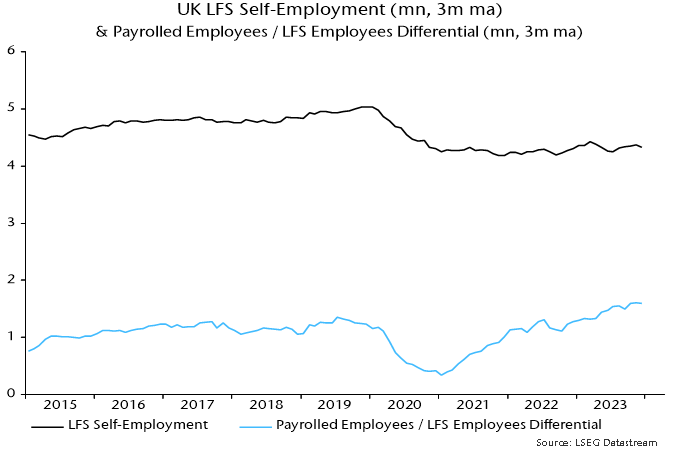
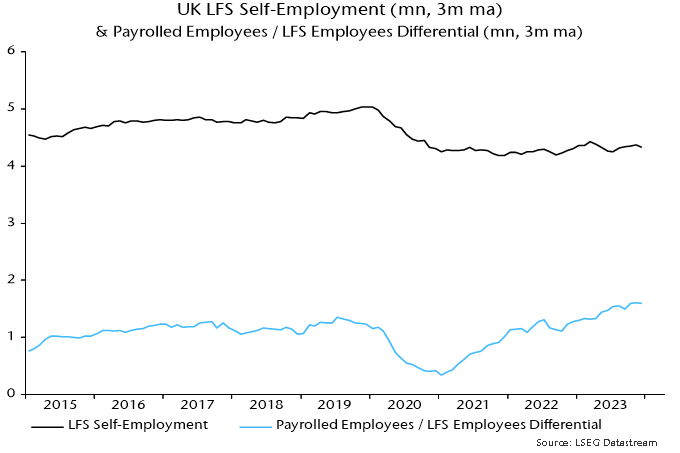
LFS self-employment was 4.33 million in the three months to January. A rough guide to the number included in PAYE is the difference between the payrolled employees series and the LFS measure of employees – 1.6 million.

Chart 2 shows that the latter differential mirrored changes in LFS self-employment until early 2021. It then embarked on a rising trend while LFS self-employment moved sideways. The timing is consistent with an impact from the IR35 reform.

Chart 2

Chart 2 showing UK LFS Self-Employment (mn, 3m ma) & Payrolled Employees / LFS Employees Differential (mn, 3m ma)

The rise in the payrolled employees / LFS employees differential is unlikely to be solely attributable to increased PAYE coverage of the self-employed. The decline in quality of LFS data due to a falling response rate may have been associated with underrecording of growth in employee numbers.

The payrolled employees series, nevertheless, warrants a health warning and its relative strength should be at least partly discounted, particularly as it jars with other evidence including an ongoing fall in vacancies, rising claimant unemployment, weak REC jobs reports and a recent increase in redundancies.

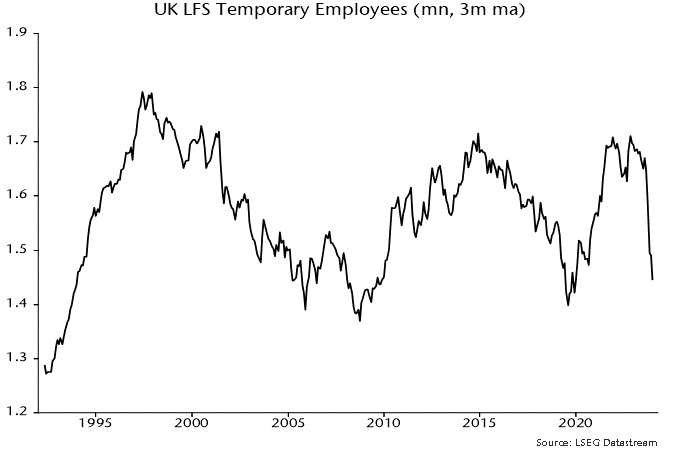
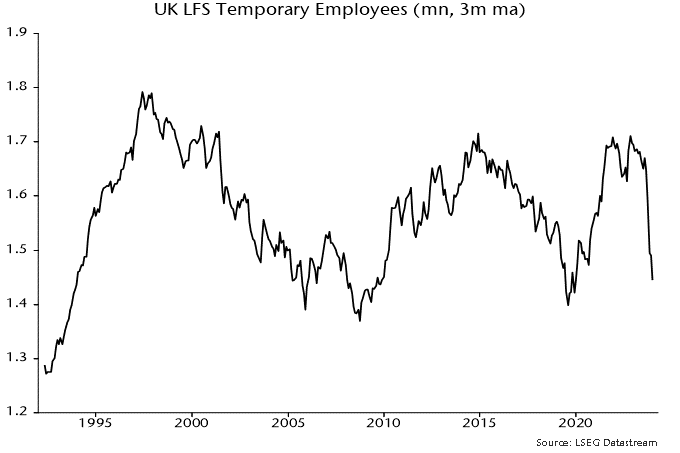
Addendum: Falling US temporary help services employment has been a harbinger of weakness in aggregate payrolls historically. UK LFS temporary employment has a patchier record as a leading indicator but a plunge since the summer is eye-catching – chart 3.

Chart 3

Chart 3 showing UK LFS Temporary Employees (mn, 3m ma)

*It does not include employees of companies paying below the national insurance lower earnings limit.

**The Workforce Jobs dataset shows a rise in employee jobs of 1.79 million between Q4 2019 and Q4 2023 versus a 955,000 increase in the LFS measure of employee numbers over the same period.

The Fed’s quarterly financial accounts provide information on sector money trends and funds flows. Several features of the Q4 accounts, released last week, are noteworthy.

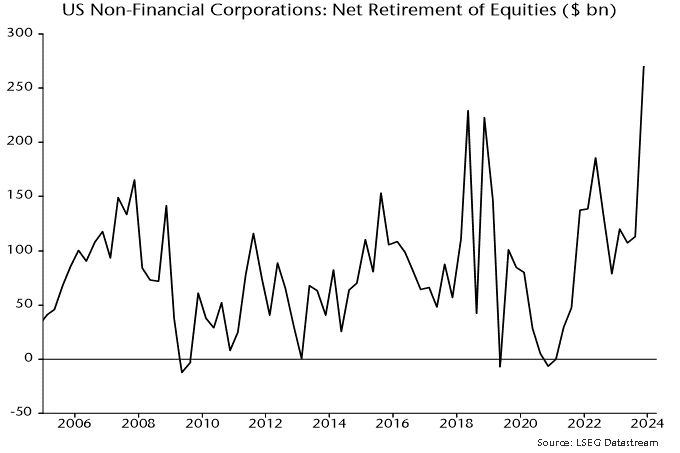
First, net retirement of equities by non-financial corporations (via buy-backs and cash take-overs) reached a record dollar amount ($270 billion) in Q4, confirming that corporate buying was a key driver of the year-end rally – see chart 1.

Chart 1

Chart 1 showing US Non-Financial Corporations: Net Retirement of Equities ($ bn)

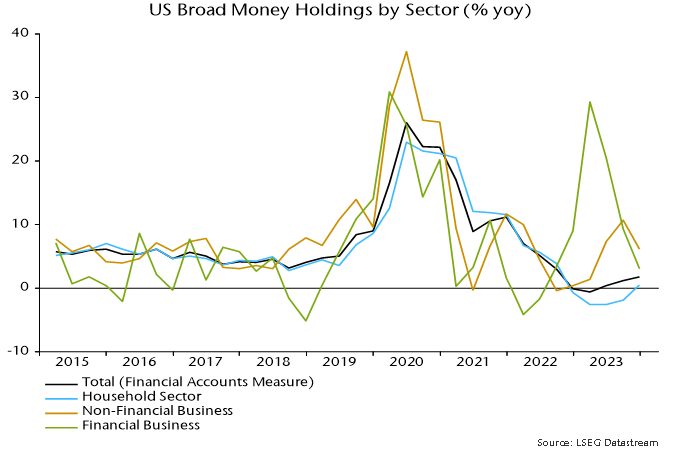
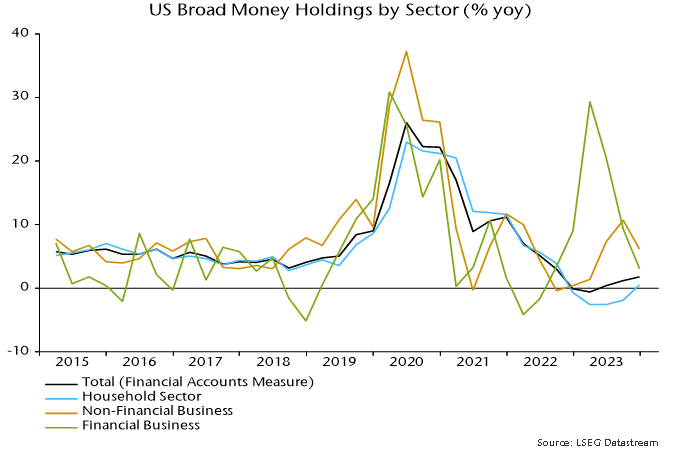
The rise in equity purchases followed strong growth of non-financial business broad money holdings in the year to end-Q3, discussed in a previous post. Such holdings, however, contracted slightly in Q4, pulling annual growth down from 10.6% to 6.2% – chart 2.

Chart 2

Chart 2 showing US Broad Money Holdings by Sector (% yoy)

Financial business money holdings had surged in the year to end-Q1 2023, perhaps partly reflecting cash-raising related to equity market weakness in 2022. These balances were run down during H2, though still finished the year slightly higher than at end-2022.

The recent weaker trends in non-financial and financial business money suggest less buying support for equities and other risk assets going forward.

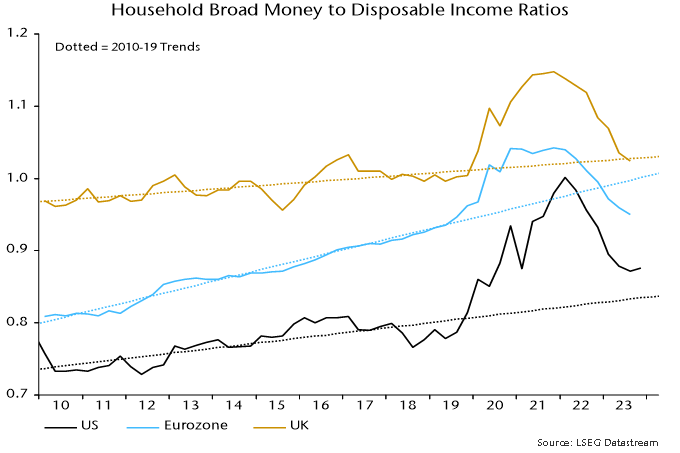
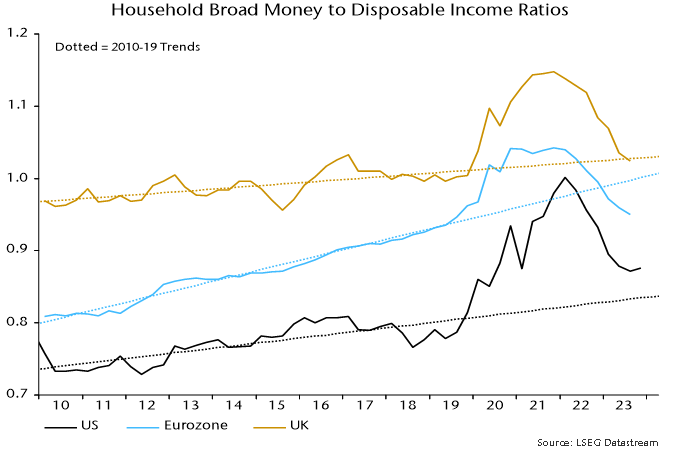
Household broad money, by contrast, rose solidly in Q4, resulting in the annual change returning to positive territory. The ratio of money holdings to disposable income recovered slightly following six consecutive quarterly declines, remaining above its pre-pandemic trend, in contrast to shortfalls for corresponding Eurozone and UK ratios – chart 3.

Chart 3

Chart 3 showing Household Broad Money to Disposable Income Ratios

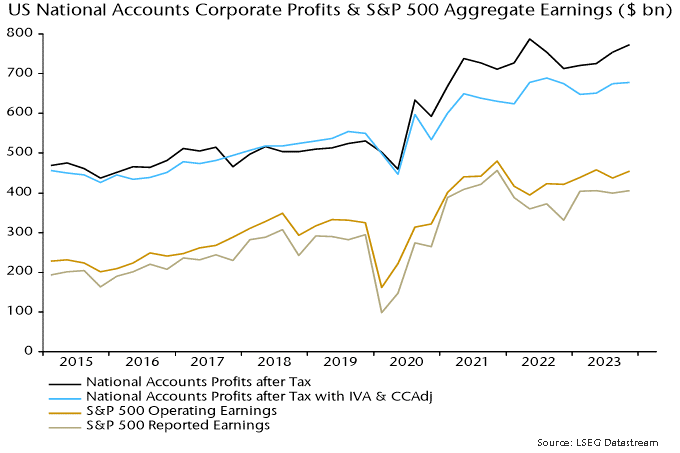
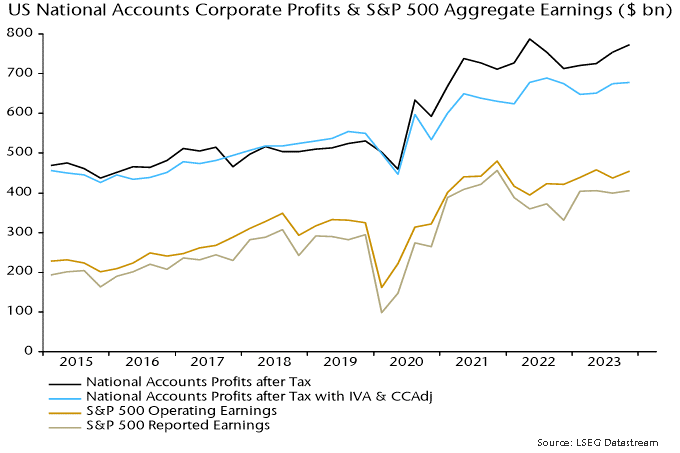
The Q4 financial accounts also contain initial estimates of corporate profits and gross domestic income (GDI). Profits after tax adjusted for stock appreciation and economic depreciation rose at a 2.5% annualised rate last quarter and remain below a peak reached in Q3 2022 – chart 4, blue line. The range-bound movement is consistent with S&P 500 earnings data and questions perceptions of economic / profits strength.

Chart 4

Chart 4 showing US National Accounts Corporate Profits & S&P 500 Aggregate Earnings ($ bn)

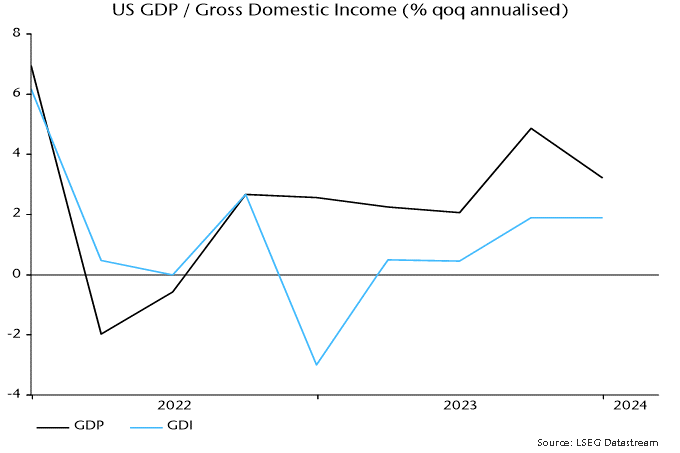
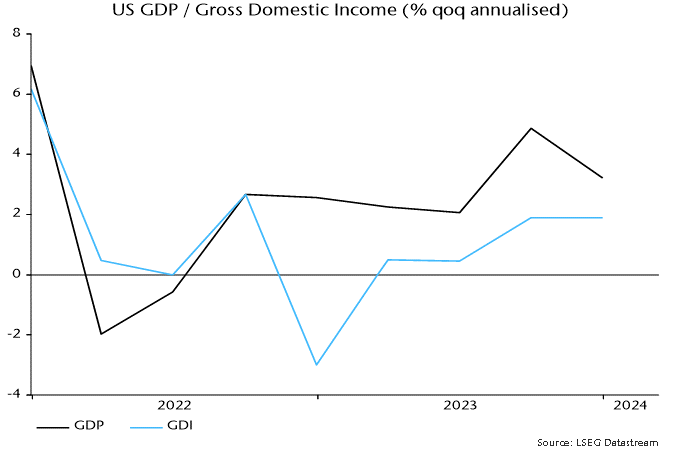
GDI is an alternative estimate of GDP and has consistently lagged the headline expenditure-based measure in recent quarters – see previous post. It did so again in Q4, rising at a 1.9% annualised rate versus headline GDP growth of 3.2% – chart 5. GDI grew by just 1.2% in the year to Q4.

Chart 5

Chart 5 showing US GDP / Gross Domestic Income (% qoq annualised)

Sunset view of high voltage electricity towers on the shoreline of San Francisco bay area; California.

It’s no secret that the US electrical grid is in a dire state now more than ever. Most of the infrastructure we see today was built in the 1960s and 1970s, with over 70% being more than 25 years old. Marked by significant and consistent underinvestment, the US grid continues to experience increasing supply disruptions, blackouts and fire incidents. Maintenance and repair are perpetual needs. A notable example of maintenance disrepair happened last year with the Hawaiian Electric fire. In August 2023, Maui County sued Hawaiian Electric, the state’s largest supplier of electricity, accusing the utility of negligence in what became the deadliest US fire in over a century resulting in thousands of acres burned and over 100 fatalities.

The push for electrification

Additionally, with rising population levels and the ongoing push for electrification, the grid is ill-equipped to manage the volume of electricity being transmitted through existing power lines. Electricity demand in the US is expected to increase by 18% by 2030 and 38% by 2035. This increased electricity transmission will be driven by the transition to electric vehicles as well as the build out of carbon-neutral energy sources, namely renewables.

Facing the future: investment and innovation

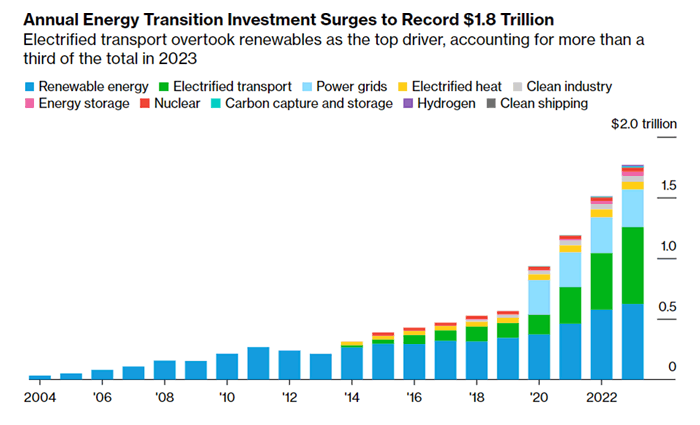
To meet the rising demand and supply of electricity, significant augmentation and expansion of the current grid, with substantial resources invested, will be necessary. Several states have already announced massive investment projects to address these needs. Notably, in October 2023, the Biden-Harris administration announced a USD$3.5 billion funding initiative for 58 projects across 44 states for grid infrastructure, signalling the beginning of extensive future investments. The International Energy Agency estimates that, by the end of the decade, over $600 billion a year will need to be invested globally to ensure a resilient supply of clean and reliable electricity. In fact, from 2020 to 2023, global grid investments have grown from USD$285 billion to over USD$310 billion.

Bar chart showing growth of energy transition investment, 2004 to 2023.

Source: BNEF

These developments make the grid infrastructure trend one we are closely watching as we seek to identify companies poised to benefit from this theme.

Nexans: a catalyst for change

One such company is Nexans (NEX FP), a recent addition to our portfolio that stands to gain from escalating investment in US grid infrastructure over the next decade. A France-based cable manufacturer with a significant presence in the US, Nexans specializes in producing high, medium and low voltage transmission cables and serves a variety of end markets.

Several years ago, recognizing the global trend towards electrification, Nexans decided to realign its portfolio to become a pure electrification player by 2024, committing to divest from three divisions unrelated to this goal, namely telecom, auto harness and a portfolio of small unrelated segments.

2023 marked a transition year for the company as it intensified its refocus efforts. This was met by some volatility in its stock price due to a challenging market environment that made divestment difficult along with uncertainties in offshore wind markets. However, the company has recently shown significant progress and is delivering on its portfolio transition ahead of schedule. Moreover, offshore wind markets in the US are experiencing renewed positive sentiment, evidenced by strong auction prices that de-risked them last week. Nexans’ stock price has rebounded from a multiyear low in October 2023 to a multiyear high and we remain optimistic about the company’s future prospects and its successful transition to full electrification.

Hands holding freshly roasted aromatic coffee beans.

Coffee is one of the most valuable agricultural commodities and the most widely used socially acceptable drug, yet few people take the time to understand its significance in modern society and human history. Originating from an Ethiopian mountainside a couple of thousand years ago, today’s coffee market sustains roughly 125 million jobs. With its total addressable market estimated at $468 billion, it’s on track to outpace global GDP, fueled by rising per capita consumption in emerging markets.

Medicinal luxury to cultural staple

Initially, coffee in Europe was a medicinal luxury for the elite. As it became more accessible, it gradually became the favoured drink of both blue- and white-collar workers, embedding itself in Western culture. The first English coffeehouse opened at Oxford University in 1650. By 1700, there were over 2,000 coffeehouses paying more rent than any other trade at the time. Coffee’s exploding popularity can be attributed to the historical British reputation for alcohol consumption; coffee presented a healthier alternative that still offered a communal space for socializing – and it helped with hangovers.

Coffee’s political and economic influence

In 18th century Germany, its popularity even led Frederick the Great to ban it to curb the outflow of money abroad and promote beer, Germany’s traditional beverage. This prohibition spurred a flourishing black market and large-scale protests that lasted four years before being revoked. The impact of coffee in England and Germany, however, pales in comparison to its role in shaping American culture and history.

Coffee and the American Revolution

The famous Boston Tea Party is often cited as the tipping point of coffee in the US. Americans were already avid consumers of tea, coffee and beer at the time and most taverns and coffeehouses offered all three options to their patrons. In an act of defiance against King George’s tea tax, Americans embraced coffee as a symbol of independence, significantly boosting its consumption. From 0.19 pounds per capita in 1772 to 1.41 pounds by 1799, coffee became intertwined with the fabric of the nation, a trend that has only grown stronger with time.

Why coffee captures our attention

So, why is Global Alpha excited about coffee? Are we investing in coffee beans? If you’ve been reading our commentaries for a while, you’ll know that we often seek creative and sometimes indirect exposure to secular themes that we favour. Like most commodities, coffee is a volatile and hard to predict market prone to oversupply and weather events – areas outside our expertise. Instead, we are invested in a company that provides tools for coffee enthusiasts to enjoy their drinks precisely as they want to.

Brewing success in the coffee appliance market

De’Longhi SpA (DLG IM) is an Italian global leader in the production of small domestic appliances, with a market-leading position among European coffee makers. The company designs its premium products in-house and its brand appeal is best-in-class, boasting a 35% global market share in the espresso coffee machine segment. It’s fitting that a company like De’Longhi originated in Europe, where per capita coffee consumption is the world’s highest.

Local success to global expansion

De’Longhi’s initial success lent strong credibility to its brands and has helped accelerate its global expansion in the last decade, especially in the US and Far East markets. Historically, the company sold professional coffee makers through its Eversys brand, but in December it announced the acquisition of La Marzocco to accelerate its leadership in the professional segment. The professional coffee-making market alone is a $5 billion industry growing at approximately 5% annually, driven by a long-term shift from making coffee at home to buying it from coffee shops. Starbucks for example plans to expand its current 38,000 stores to over 55,000 by 2030. This acquisition enables De’Longhi to cover virtually the entire coffee machine space, from budget-friendly to luxury household and high-output professional machines.

De’Longhi SWOT analysis

Strengths

  • Brand recognition in espresso machines (De’Longhi) and food preparation (Kenwood/nutribullet).
  • Strong distribution partnerships globally and owned manufacturing capacity.

Weaknesses

  • The household appliance market is highly competitive.
  • Consumer habits and preferences for coffee consumption are continuously evolving.

Opportunities

  • Expansion of the professional coffee segment following the acquisition of La Marzocco.
  • Opportunities for product innovation.

Threats

  • Consolidation of the distribution market.
  • Valuation of potential M&A targets.

Brewing beyond the bean

Most of our weekly readers, much like ourselves, are probably coffee consumers, yet many of us spend little time thinking about this beverage we crave each morning. This “taken-for-granted” product represents exactly the kind of space Global Alpha aims to invest in for the long term.

Source: Pendergrast, M. (2010). Uncommon Grounds: the history of coffee and how it transformed the world.

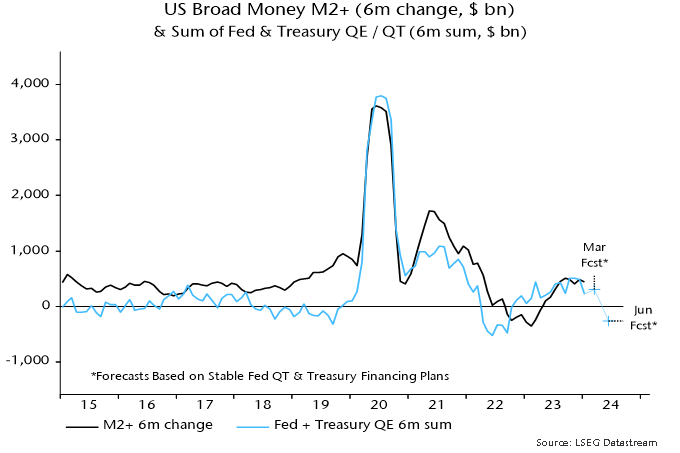
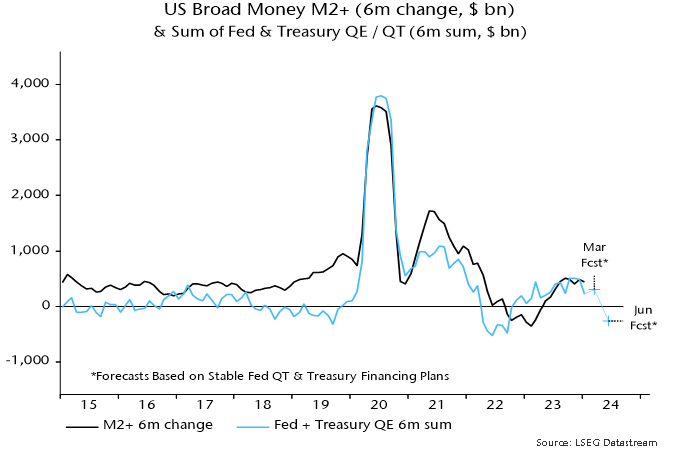
US monetary conditions eased during H2 2023, reflecting the Treasury’s decision to skew debt issuance towards bills and the Fed’s December pivot. This loosening is now reversing, partly because of the recent sticky inflation scare and associated back-up in yields, and prospectively as the Treasury scales back bill financing in Q2.

January monetary statistics are consistent with a turnaround. The narrow M1A measure followed here contracted by 1.4% on the month, more than reversing a 1.0% December gain. Broad money M2+ stagnated after a 0.8% December rise*.

Six-month M2+ growth appears to be rolling over in line with the forecast in a previous post – see chart 1. To recap, sales of Treasury bills to money funds should continue to offset the monetary impact of the Fed’s QT during Q1 but the Treasury’s plans to redeem bills in Q2 imply a dramatic contractionary shift – unless the Fed simultaneously halts QT.

Chart 1

Chart 1 showing US Broad Money M2+ (6m change, $ bn) & Sum of Fed & Treasury QE / QT (6m sum, $ bn)

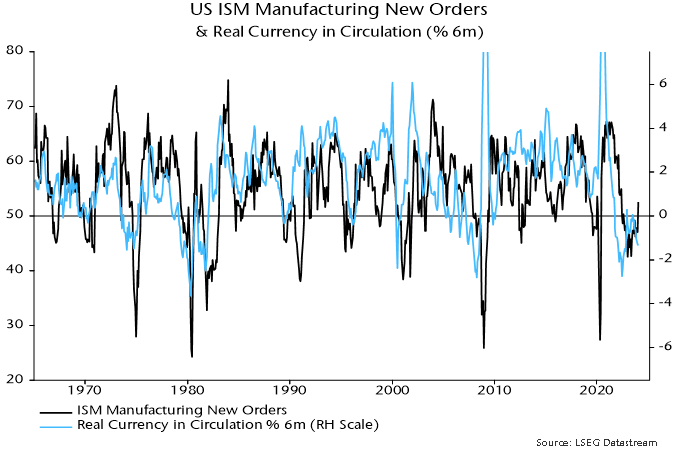
Prospective monetary weakness poses a threat to risk assets and could coincide with economic news that derails the current soft / no landing consensus. This consensus has been bolstered by a recent pick-up in the ISM manufacturing new orders index, a widely-watched cyclical indicator. A post in July signalled a coming ISM rebound but suggested that it would prove temporary.

That remains the base-case view here. A relapse is expected in reflection of global real narrow money weakness into last autumn and on the view that the 2022-23 stockbuilding cycle downswing has yet to reach a final low.

US six-month real narrow money momentum has led swings in ISM new orders historically. The currency component has displayed a slightly stronger correlation than the aggregate, probably because of a linkage with retail goods spending – chart 2. Real currency momentum signalled the current ISM recovery but has been moving lower since last summer. January retail sales weakness may have been more than weather-related and the ISM recovery may be about to abort.

Chart 2

Chart 2 showing US ISM Manufacturing New Orders & Real Currency in Circulation (% 6m)

*M1A = currency in circulation plus demand deposits. M2+ = M2 plus large time deposits at commercial banks and institutional money funds.

Investissements de l'équipe commerciale dans une salle de surveillance sur des ordinateurs de bureau avec des écrans affichant les données boursières.

En mai 2024, les marchés américains et canadiens passeront au cycle de règlement à T+1. Dans le cadre de la transition vers un cycle de règlement écourté, nous croyons qu’il est important que vous soyez au courant de ce changement à venir et des préparatifs effectués par CC&L, de concert avec nos partenaires du secteur.

Vous trouverez ci-dessous les réponses aux questions les plus courantes qui vous aideront à comprendre la prochaine transition vers le règlement à T+1, ainsi que ce que nous faisons pour nous y préparer.

Qu’est-ce que le règlement à T+1?

Le règlement à T+1 désigne le processus par lequel les opérations sur titres sont effectuées un jour ouvrable après l’exécution d’une opération. Actuellement, au Canada, aux États-Unis et au Mexique, la norme est de régler ces opérations deux jours après l’opération (c.-à-d. à T+2).

Quels marchés passent au règlement à T+1?

Les marchés américain et canadien prévoient passer au règlement à T+1 au cours de la fin de semaine du Jour du Souvenir entre le 25 mai et le 28 mai 2024. Le Mexique souhaite procéder à ce changement pour s’aligner sur les États-Unis, mais attend l’approbation des organismes de réglementation.

L’Europe et le Royaume-Uni cherchent également à réduire leur cycle de règlement des titres. L’Association for Financial Markets in Europe (AFME) a mis sur pied un groupe de travail sectoriel sur le règlement à T+1 en mars 2023 et le Royaume-Uni a formé un groupe comparable appelé l’Accelerated Settlement Taskforce en décembre 2022. Cependant, ni l’Europe ni le Royaume-Uni n’ont fixé de date pour la transition vers le règlement à T+1.

Quelle est la date de mise en œuvre du règlement à T+1 au Canada et aux États-Unis?

Calendrier de la transition vers le cycle de règlement à T+1 au Canada

Vendredi
24 mai 2024
Samedi
25 mai 2024
Dimanche
26 mai 2024
Lundi
27 mai 2024
Mardi
28 mai 2024
Mercredi
29 mai 2024
Jeudi
30 mai 2024
Date des dernières opérations T+2 Fin de semaine de la conversion Fin de semaine de la conversion Date des premières opérations T+1 Date du double mode de règlement Opération et règlement à T+1 Opération et règlement à T+1
Vendredi
24 mai 2024
Date des dernières opérations T+2
Samedi
25 mai 2024
Fin de semaine de la conversion
Dimanche
26 mai 2024
Fin de semaine de la conversion
Lundi
27 mai 2024
Date des premières opérations T+1
Mardi
28 mai 2024
Date du double mode de règlement
Mercredi
29 mai 2024
Opération et règlement à T+1
Jeudi
30 mai 2024
Opération et règlement à T+1


Calendrier de la transition vers le cycle de règlement à T+1 aux États-Unis

Vendredi
24 mai 2024
Samedi
25 mai 2024
Dimanche
26 mai 2024
Lundi
27 mai 2024
Mardi
28 mai 2024
Mercredi
29 mai 2024
Jeudi
30 mai 2024
Date des dernières opérations T+2 Fin de semaine de la conversion Fin de semaine de la conversion Marchés fermés
Fin de semaine de la conversion
Date des premières opérations T+1 Date du double mode de règlement Opération et règlement à T+1
Vendredi
24 mai 2024
Date des dernières opérations T+2
Samedi
25 mai 2024
Fin de semaine de la conversion
Dimanche
26 mai 2024
Fin de semaine de la conversion
Lundi
27 mai 2024
Marchés fermés
Fin de semaine de la conversion
Mardi
28 mai 2024
Date des premières opérations T+1
Mercredi
29 mai 2024
Date du double mode de règlement
Jeudi
30 mai 2024
Opération et règlement à T+1


Quels sont les avantages du règlement à T+1?

Le passage au règlement à T+1 présente plusieurs avantages. Selon la Securities Exchange Commission (SEC), il rend la négociation plus sûre en raccourcissant le délai entre la réalisation et le règlement d’une opération, ce qui contribue également à protéger les investisseurs et rend le processus de négociation plus efficace. Un délai de règlement écourté peut réduire le risque de crédit et de contrepartie ainsi que les coûts de garantie et accroître la liquidité du marché. Il peut aussi contribuer à réduire les exigences de couverture et de garantie des courtiers.

Qu’est-ce qui différencie le passage au règlement à T+1 des précédentes compressions de date de règlement?

Le passage au règlement à T+1 est différent des changements précédents, comme le passage de T+3 à T+2 en 2017, et plus compliqué avec son calendrier plus serré comportant des mises à jour plus complexes des technologies et des processus. Le changement précédent était une décision conjointe du secteur et des organismes de réglementation visant à rendre la compensation et le règlement plus sûrs et mieux coordonnés avec les calendriers du cycle de vie des opérations de l’UE et du Royaume-Uni. Le passage au règlement à T+1 est motivé par des événements précis et imposé par la SEC, ce qui complique la tâche des participants aux marchés.

Quelles sont les principales difficultés liées au passage au règlement à T+1?

Le passage au règlement à T+1 apporte son lot de difficultés. Tout d’abord, s’il réduit le risque pour les personnes qui vendent des titres, il augmente la charge de travail et le risque d’erreur du côté des acheteurs en raison du délai de règlement écourté. Ce changement signifie que les sociétés doivent examiner de près leur mode de fonctionnement pour faire face au rythme plus rapide.

Voici quelques-uns des principaux enjeux pour notre société :

  • Des délais de règlement différents sur les marchés mondiaux, ce qui peut compliquer la coordination des opérations.
  • La date à laquelle les opérations de change de devises doivent avoir lieu après les opérations sur titres, ce qui peut avoir une incidence sur la date et le mode de règlement des opérations.
  • La gestion du cycle des flux de trésorerie pour les clients détenant des fonds en gestion commune et un compte distinct, ce qui influe sur le moment où les opérations peuvent être effectuées et nécessite des changements dans le mode de fonctionnement des équipes de placement.

Ces difficultés signifient que les sociétés doivent procéder à une planification minutieuse pour continuer à négocier sans problème dans le cadre du nouveau calendrier de règlement écourté.

Quels titres seront concernés par la réduction du cycle de règlement?

L’Association canadienne des marchés des capitaux (ACMC) a dressé une liste des titres qui devraient passer du cycle de règlement actuel à T+2 au cycle de règlement à T+1 en 2024. Vous pouvez consulter cette liste sur le site Web de l’ACMC à l’adresse suivante : https://ccma-acmc.ca/en/t1-resources/canadian-t1-asset-list-liste-dactifs-canadiens-t1/.

La Depository Trust & Clearing Corporation (DTCC) offre également des renseignements sur les cycles de règlement et les changements connexes sur son site Web à l’adresse dtcc.com.

Des pénalités seront-elles appliquées en cas de règlement tardif des obligations et des opérations?

Aucune nouvelle pénalité ne sera introduite; toutefois, les courtiers et les conseillers inscrits qui ne respecteront pas les exigences cibles en matière d’appariement des opérations pourraient en subir les conséquences. La Banque du Canada envisage d’imposer des pénalités pour les opérations sur obligations gouvernementales réglées en dehors du délai prescrit. Cette pénalité ne sera introduite qu’une fois la transition vers le règlement à T+1 achevée et son incidence sera correctement évaluée.

Comment CC&L se prépare-t-elle au règlement à T+1?

Au printemps 2023, CC&L a formé une équipe de projet pour s’occuper du passage au règlement à T+1. Cette équipe est divisée en quatre grands groupes de travail chargés de repérer et de résoudre les problèmes et d’apporter des changements à la façon dont les opérations sont gérées. Elle couvre tous les domaines, des prescriptions légales au mode de financement et de règlement des opérations.

Il est également impératif que nos pairs et les parties prenantes du secteur soient prêts pour ce changement. CC&L a commencé à discuter avec les courtiers et les dépositaires pour comprendre leurs plans pour la transition vers le règlement à T+1 et déterminer ce dont CC&L a besoin pour maintenir la meilleure exécution.

De plus, CC&L a consulté des fournisseurs de technologies pour explorer des outils qui pourraient aider à raccourcir la période de règlement.

Quelles sont les prochaines étapes pour CC&L?

À l’approche de mai 2024, CC&L continuera de communiquer avec les partenaires du secteur et les clients, de les informer sur le changement et de travailler sur les ajustements nécessaires pour respecter la nouvelle norme.

Toute mise à jour sur la façon dont CC&L traite les opérations sera communiquée aux clients à l’approche de la date de début.

Si votre question n’a pas trouvé de réponse ci-dessus, veuillez nous écrire à l’adresse [email protected].
Cosmetic skin care products on green leaves.

Rising consumer demand driving supply chain transparency

Recognizing the trends shaping the trajectory of ESG integration by companies in their processes in 2024 is a key focus point. Amid growing regulatory requirements and increasing consumer demand for transparency, the spotlight has now extended to companies’ supply chain practices, emphasizing the need for holistic ESG considerations.

Regulatory momentum

The surge in regulatory frameworks, such as the upcoming Corporate Sustainable Due Diligence Directive (CSDDD) and the Deforestation Regulation in the EU, alongside proposals like the Securities and Exchange Commission’s mandate for emissions disclosure across value chains, signal a global push toward heightened accountability and risk management. These directives require companies to broaden their due diligence to encompass their entire supply chains, addressing human rights and environmental sustainability risks to preempt controversies and safeguard against reputational damage that could adversely affect shareholder value.

Consumer power and the ripple effect

A driver in these regulatory developments is undoubtedly rising consumer preference for goods that are ethically and sustainably produced. As shoppers become more mindful of the environmental and social impacts, companies are compelled to reevaluate their supply chain practices. Not meeting these emerging standards can result in serious brand and financial repercussions, as evidenced by the backlash against major labels like Adidas and Nike over labour misconduct allegations within their supply chains that triggered boycotts and meaningful share price declines in 2020. Especially within the apparel and footwear industry, there is an acute pressure to implement sustainable practices along supply chains.

Examples of ESG risk management in supply chains

Asics (7936 JP), a Japan-based sporting goods manufacturer in our portfolios, has increasingly integrated ESG principles and enhanced due diligence in its supply chain in recent years. The company, involved in labour issues in a Cambodian factory in 2013 and 2017, has been working on increasing supplier traceability initiatives, including corporate social responsibility (CSR) and human rights policies, audits and monitoring, aiming to reduce the risks of human rights abuses and environmentally harmful practices in procurement activities. As a result of its supply chain initiatives, Asics was recognized on the CDP Supplier Engagement Leaderboard in 2021, a leading international non-profit dedicated to assessing the disclosure of companies on environmental matters. Furthermore, a Human Rights Committee established in 2022 at the board level oversees and evaluates the effectiveness of these initiatives. This strategic focus on ESG not only bolsters brand credibility but also mitigates reputational and legal risks. For instance, Asics avoided the fallout faced by peers in 2020-21 over cotton sourcing controversies from China’s Xinjiang region, likely the result of its intensified risk management.

L’Occitane and the beauty of responsibility

Similarly, the personal care products industry is witnessing rising customer demand for ethically sourced products. Another company in our portfolio, L’Occitane International SA (973 HK), a global leader in natural and organic beauty and skincare products, is considered a champion in this area. By prioritizing a partnerships-based approach with suppliers and rigorously assessing the CSR performance of over 9,000 suppliers worldwide, L’Occitane ensures holistic risk mitigation and proactive engagement with at-risk suppliers. The group participates in the Responsible Beauty Initiative (RBI) and the Partners by Nature program, to help promote responsible sourcing practices in the industry and strengthen its collaboration with strategic suppliers. In 2022, it was invited to join the EcoVadis trailblazer’s network as one of the awarded companies in the 2021 edition. This network includes the most advanced companies in terms of responsible value chains that come together to share best practices and challenges. In addition to being a leader in this field, the company’s commitment to responsible sourcing, increasingly popular among consumers worldwide, is in line with its brand image and strategy.

The bottom line – sustainability as a strategic supply chain priority

In today’s environment of regulatory scrutiny and elevated consumer expectations, ESG integration in portfolio company supply chains can build trust and help to mitigate the legal risks of regulatory non-compliance.

Disclaimer: ESG integration at Global Alpha is driven by taking into account material sustainability and/or ESG risks that could impact investment returns, rather than being driven by specific ethical principles or norms. The investment professionals may still invest in securities that present sustainability and/or ESG risks, including where the portfolio managers believe the potential compensation outweighs the risks identified.

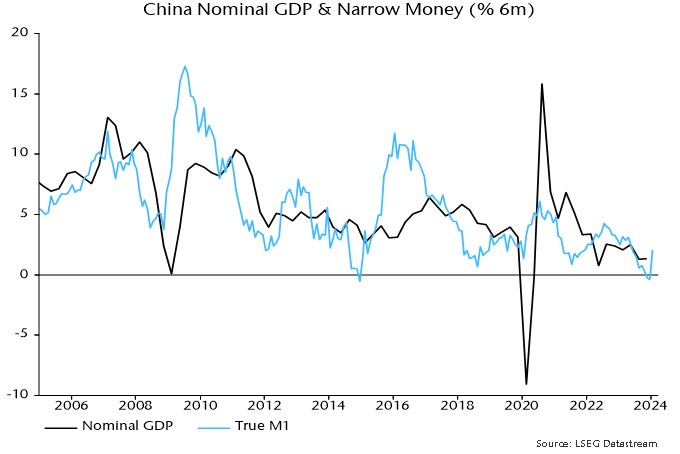
Chinese monetary statistics for January suggest that policy easing is starting to become effective.

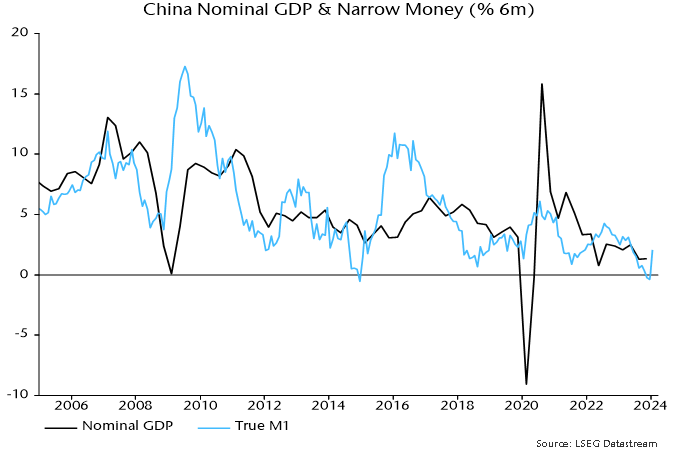
Six-month growth of narrow money, as measured by true M1*, rebounded from a negative December reading to its highest level since May – see chart 1.

Chart 1

Chart 1 showing China Nominal GDP & Narrow Money (% 6m)

Q1 numbers can be volatile because of New Year timing effects, so improvement needs to be confirmed by February / March data.

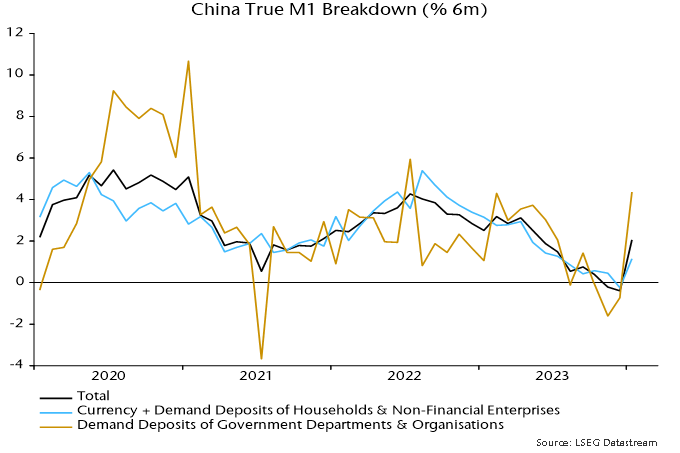
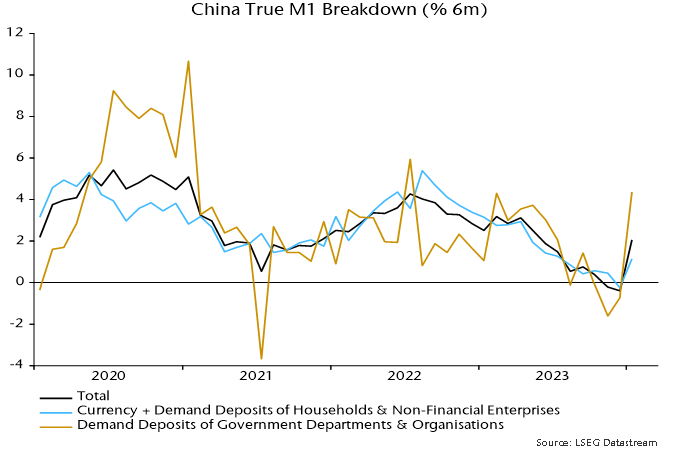
True M1 can be broken down into “private” and “public” sector components. The former aggregates currency in circulation and demand deposits of households and non-financial enterprises. The latter is calculated as a residual and is dominated by demand deposits of government departments and organisations.

Six-month growth rates of both components rose in January but the public sector increase was much larger, consistent with funds being mobilised to boost fiscal spending – chart 2.

Chart 2

Chart 2 showing China True M1 Breakdown (% 6m)

Progress in implementing fiscal stimulus is also suggested by a strong rise in central government deposits – these are excluded from money definitions but deployment of funds will have a positive monetary impact.

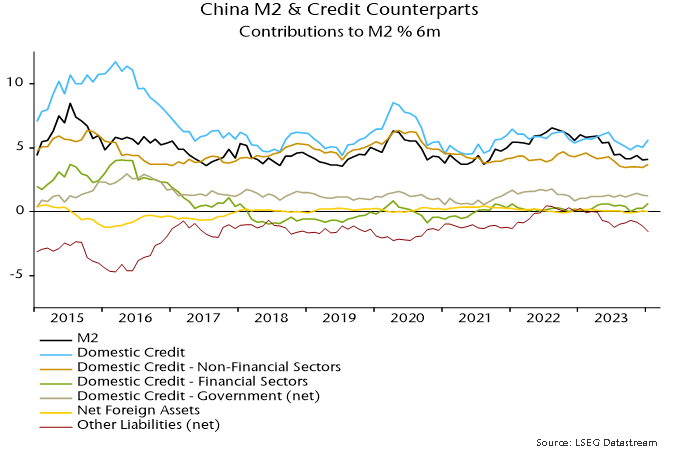
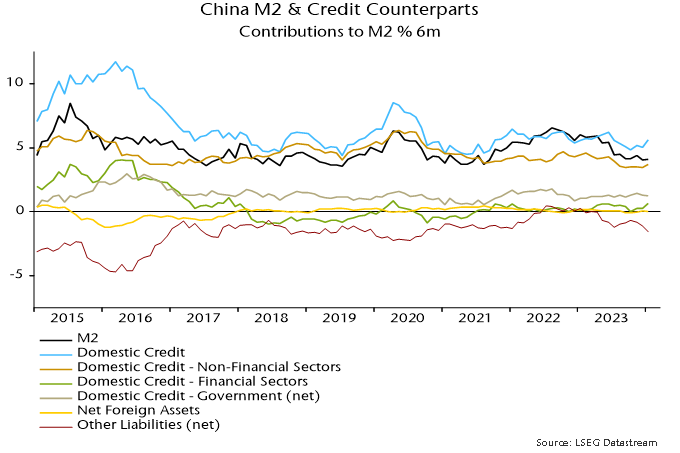
The broader M2 measure continues to outpace narrow money, with six-month growth little changed in January, extending a recent sideways movement. In terms of the “credit counterparts”, domestic credit expansion has firmed since late 2023 but there has been an offsetting increase in non-monetary funding (“other liabilities”) – chart 3.

Chart 3

Chart 3 showing China M2 & Credit Counterparts Contributions to M2 % 6m

A reduction in the broad / narrow money growth gap driven by narrow acceleration is usually a positive economic signal, indicating a rise in broad money velocity.

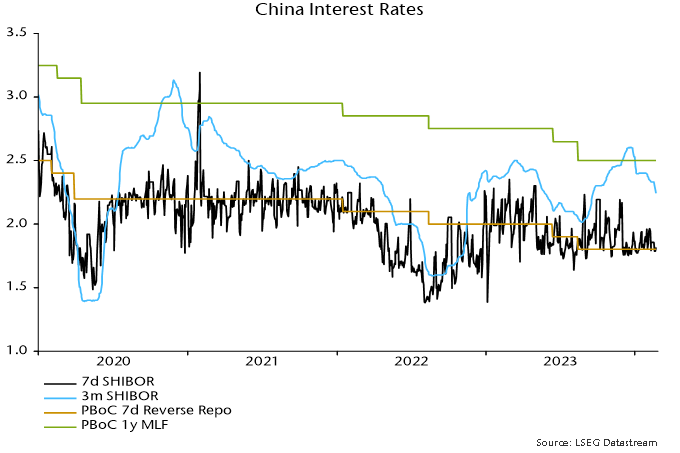
The January narrow money recovery, as noted, partly reflects implementation of fiscal spending plans. A sustained pick-up requires monetary policy to be sufficiently accommodative. Recent developments are promising. PBoC lending to the banking system grew by a record amount in Q4. Banks’ excess reserve ratio rose to 2.1%, the highest since Q4 2020 – before the recent 0.5 pp further reduction in the requirement ratio. The reserves injection has contributed to three-month SHIBOR reversing half of its August-December rise since the start of the year – chart 4. Currency weakness has remained contained despite softer rates; indeed, the JP Morgan effective index has risen slightly year-to-date.

Chart 4

Chart 4 showing China Interest Rates

Monetary deterioration into late 2023 argues for economic weakness through H1 2024. Confirmation that monetary trends have turned would suggest improving prospects for H2.

*Official M1 plus household demand deposits. M1 conventionally includes such deposits but they are omitted from the Chinese official measure for historical reasons.

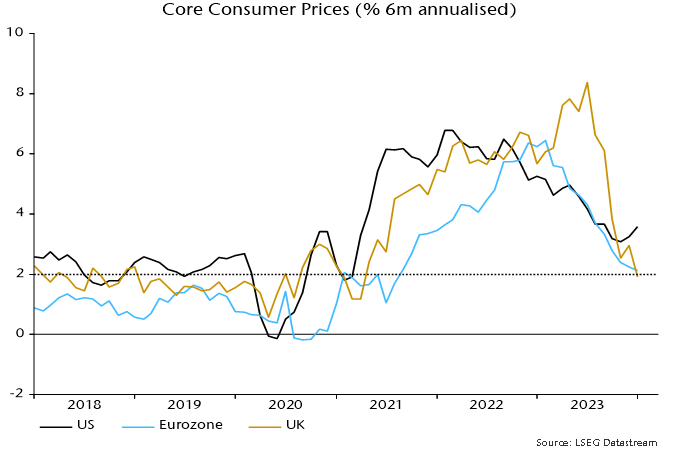
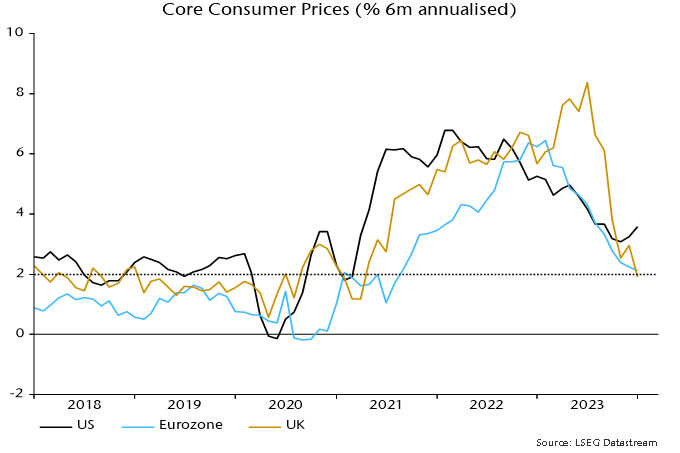
Six-month core CPI momentum has returned to a target-consistent level in the Eurozone and UK, with January readings of 2.1% and 1.9% annualised respectively*. US momentum is significantly higher, at 3.6% – see chart 1. What explains this gap?

Chart 1

Chart 1 showing Core Consumer Prices (% 6m annualised)

One answer is that the US CPI is overstating core pressure. The six-month increase in the Fed’s preferred core PCE measure was 1.9% annualised in December. Assuming a monthly rise of 0.4% in January (the same as for core CPI), six-month momentum would firm to 2.4% – still little different from Eurozone / UK core CPI readings.

The stronger rise in the US CPI than the PCE index reflects a higher weighting of housing rents and a faster measured increase in “supercore” services prices.

Perhaps reality lies somewhere between the two gauges, i.e. the stickiness of US core CPI momentum is at least partly genuine. If so, the US / European divergence may be explicable by monetary trends in 2021-22.

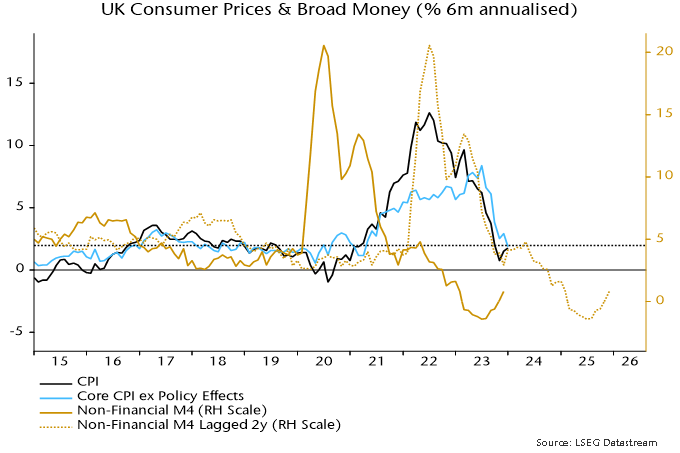
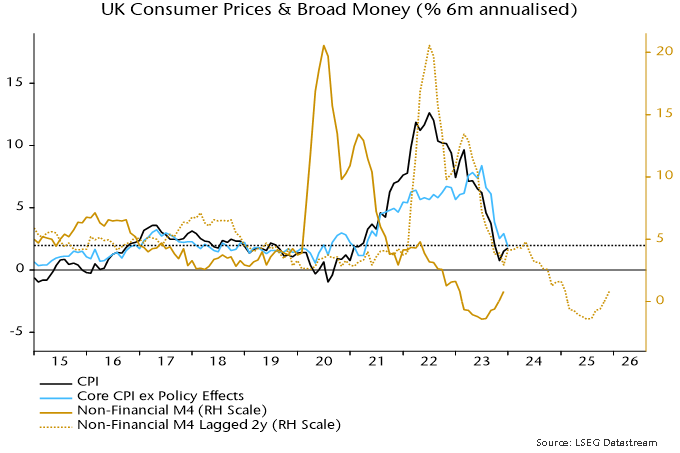
Previous posts highlighted the close correspondence between the slowdowns in Eurozone and UK six-month CPI momentum and profiles of broad money growth two years earlier. Chart 2 updates the UK comparison to incorporate January CPI data.

Chart 2

Chart 2 showing UK Consumer Prices & Broad Money (% 6m annualised)

UK and Eurozone six-month broad money momentum peaked in summer 2020 and had returned to the pre-pandemic range by late 2021. This is consistent with the reversion of six-month headline and core CPI momentum to target-consistent levels around end-2023.

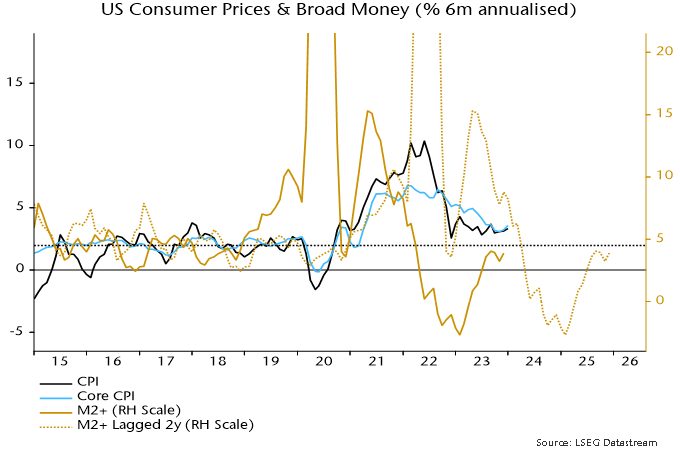
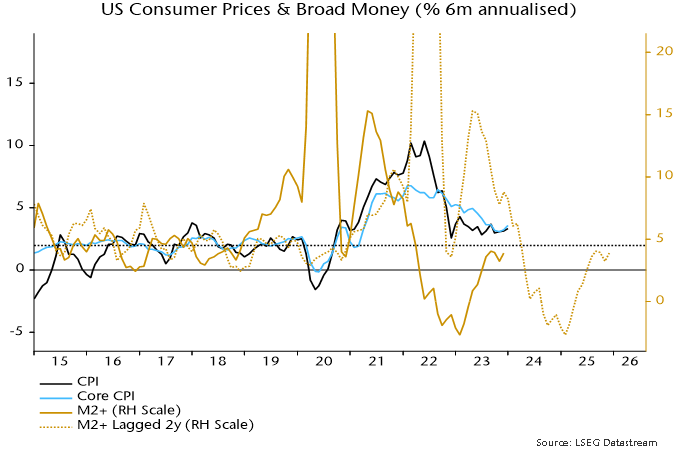
US broad money momentum followed a different path, with a more extreme surge in summer 2020, a return to earth in H2 2020 and a secondary rise in H1 2021, driven partly by disbursement of stimulus checks in December 2020 and March 2021 – chart 3.

Chart 3

Chart 3 showing US Consumer Prices & Broad Money (% 6m annualised)

The sharp fall in US six-month money growth during H2 2020 was echoed by a slowdown in CPI momentum into end-2022 – much earlier than occurred in the Eurozone and UK. More recent CPI stickiness may reflect the lagged effects of the secondary monetary acceleration into mid-2021.

What does this suggest for absolute and relative prospects? The judgement here is that broad money growth of 4-5% pa is consistent with 2% inflation over the medium term. US six-month money momentum crossed below both this range and UK / Eurozone momentum in May 2022, reaching an eventual low in February 2023, at a weaker level than (later) lows in the UK / Eurozone.

Assuming a two-year lead, this suggests that US six-month core CPI momentum will move down to 2% around mid-2024 on the way to a larger (though possibly shorter) undershoot than in the UK / Eurozone.

*Eurozone = ECB seasonally adjusted CPI excluding energy and food including alcohol and tobacco. UK = own measure additionally excluding education and incorporating estimated effects of VAT changes, seasonally adjusted.

East indian female pediatrician and mother measuring the weight of baby girl during a routine medical check-up.

When it comes to our wealth, we often think about assets or money that we own. However, when we’re sick, we realize our health represents our real wealth and the importance of investing in it.

Population surge meets healthcare hurdle

With its rapidly growing population, India faces significant challenges in providing adequate healthcare services to its citizens. The World Health Organization (WHO) projects India’s population to reach 1.5 billion by 2030, making it the most populous country globally. This growth puts immense pressure on the healthcare system to meet increasing demand for medical services and facilities.

India’s bold step with the world’s largest insurance plan

In 2018, India’s Prime Minister, Narendra Modi, launched Ayushman Bharat Pradhan Mantri Jan Arogya Yojana (AB-PMJAY), the world’s largest universal health insurance plan often referred to as the National Health Protection Scheme. The program aims to help India’s most vulnerable population by offering Rs. 5 lakh (~CDN$8,000) per family per year. The plan is estimated to support 550 million citizens across the country, allowing cashless benefits at any public or private impaneled hospital nationwide. This significantly increases access to quality healthcare and medication for almost 40% of the population, covering almost all secondary and many tertiary hospitalizations. It also addresses the previously unmet needs of a hidden population that lacks financial resources. The plan helps to control costs by providing treatment at fixed, packaged rates.

A flourishing market, billions in the making

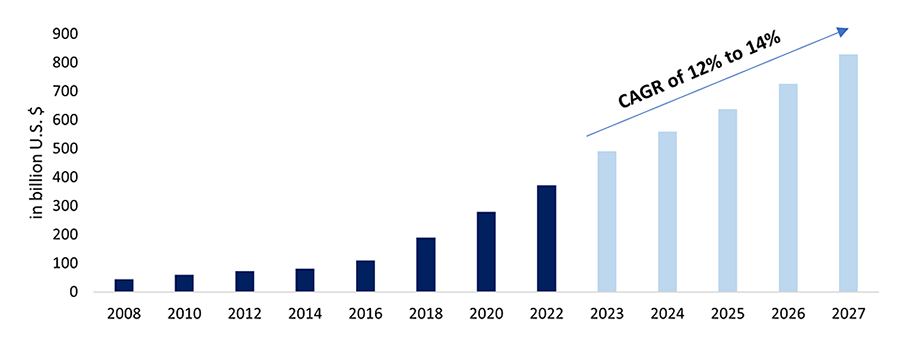
Since 2015, India’s healthcare sector has been growing at a CAGR of 18%, currently valued at ~USD$450 billion. Narayana Health’s CEO, one of India’s largest hospital chains, estimates the market to be worth USD$828 billion by 2027. This growth is mainly driven by increased spending from both public and private sectors.

India’s healthcare market value (USD)

Source: Frost & Sullivan; Aranca Research; Various sources (LSI Financial Services, Deloitte).

Foreign direct investment and pharmaceutical export

It’s not surprising that drugs and pharmaceuticals comprise a large percentage (63.4%) of foreign direct investment, as Western countries outsource generic drug manufacturing to India to benefit from reduced labour costs. This is followed by investment in hospitals/diagnostic centres (26.6%) and medical/surgical appliances (9%).

India remains the world’s largest provider of generic drugs, exporting $25.4 billion worth in 2023. We view this market as attractive as the competitive landscape has forced new players to innovate as patents expire.

Ajanta Pharma – a beacon of innovation in India’s pharmaceutical sector

We continue to own Ajanta Pharma (AJP IN). It has high exposure to branded generic markets and a leading position in niche categories, with a superior margin and return profile. The company operates across India, the US and more than 30 emerging countries in Africa and Asia, focusing on cardiology, ophthalmology, dermatology and pain management.

Despite being a smaller player in the space with a 0.7% market share, Ajanta maintained this position during the lockdown and outperformed industry growth by 200 basis points. Owned by its founder, with the family retaining close to 70% of the business, Ajanta benefits from over four decades of experience and we believe continues to be in capable hands.

This growth story is a testament to how investment can translate into tangible health benefits, weaving a new narrative of prosperity and the true value of wealth in health.