Summary

  • A down month in EM equities was led by continued investor pessimism in China, down by over -10% in USD terms. Further commentary below.
  • Bucking the trend were securities in India across healthcare, communications, real estate and consumer staples.
  • Stocks in Taiwan with AI exposure also outperformed.

Korea adopts Japan’s playbook to boost equities

Bottoming Korean exports growth from October has been led by a recovery in the semiconductor sector, reflected by the outperformance of equities with exposure to the AI supply chain, which posted strong returns through 2023.

South Korea Exports YoY Index
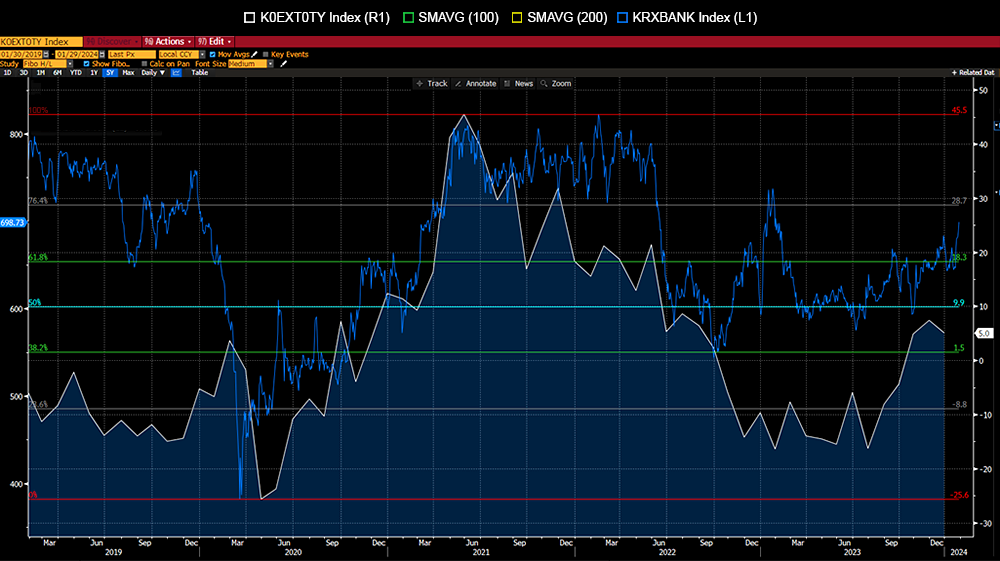
Line graph showing South Korea year-over-year exports from 2019 to January 2024.

Source: Bloomberg

The market pulled back during the month before bouncing on news that Korean regulators are looking to emulate Japan’s efforts to pressure companies into improving governance and driving higher valuations. These proposed measures look set to boost market laggards trading at below 1x price/book – or around half of the Kospi 200.

While yet to be finalised, terms of the proposal include:

  • A requirement that listed companies disclose valuation improvement measures.
  • Financial authorities will publish a name-and-shame list of companies that have not announced valuation improvement plans.

Efforts by listed Korean companies to improve payouts, repair balance sheets and buy back shares could see super-cheap stocks lead the market higher. According to CLSA, Korean stocks are under-owned by GEM investors with the Kospi trading at 0.88x P/B as of 18 January.

Strong retail presence

The catalyst for the move is clear. Parliamentary elections loom in April for deeply unpopular president Yoon Suk Yeol, who is looking to improve his prospects by adding further fuel to an export-led economic recovery via the stock market. The move looks savvy given over 30% of the voting age population invests in single stocks in a market that is dirt cheap.
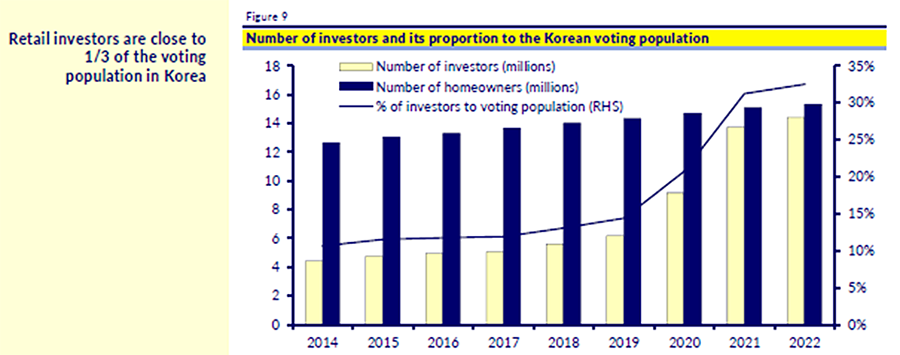
Bar chart comparing Korean investors to Korean homeowners and the voting population from 2014 to 2022.

Source: CLSA (Feb 2024)

Our playbook is to stick with our quality names in Korea, across semis giants Samsung and Hynix, autos and financials. Preferred shares for a number of companies also look attractive given massive discounts to ordinary shares. For instance, Samsung preferred shares are trading at a c.20% discount. Pref shares could be bought back at a discount by the parent companies as a cost-effective way to boost shareholder returns.

Economic recovery and reforms to benefit rising automaker KIA

KIA is a brand on the rise, continuing to execute on a premiumisation strategy led by the launch of a series of popular EV models that are on track to reach 40% of sales by 2030.
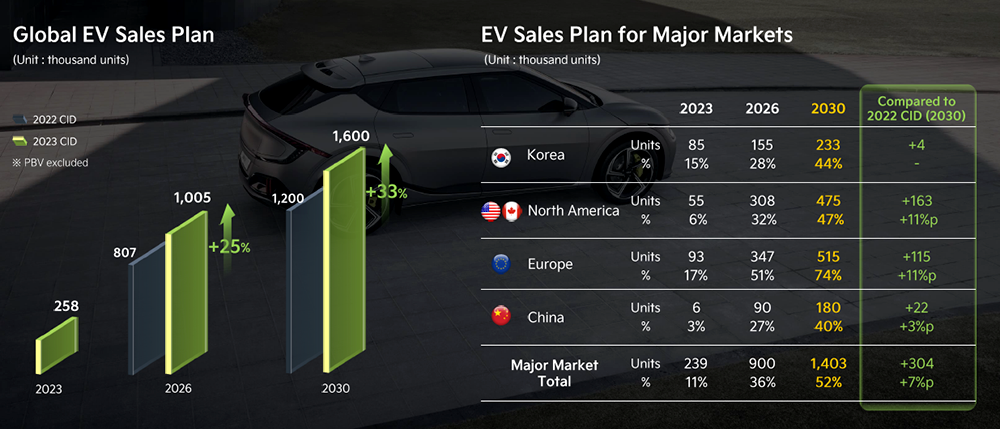
Illustration showing KIA EV sales plan projections to 2030.

Source: Kia Investor Presentation, 2022

The stock is trading around 2024E 4.2x PE for a 5.6% dividend yield and return on equity of 18%. This qualifies KIA for laggard status in our view, as it trades below its Japanese peers despite much better returns and margin profile. The company appears to embrace the drive to improve stock performance, having committed to buying and cancelling Won 2.5trn worth of stocks over the next 5 years (6% of outstanding shares).

KIA enjoys strong brand recognition and growing market share in the US and Europe, along with other growing markets such as India. Average selling prices are set to rise as EVs take a greater share of sales, attracting customers on higher incomes (i.e., KIA’s average customer in the US earns over US$150k per annum) who tend to opt for the more expensive trim options. The company has launched a series of premium EVs, which include a number of SUV models (the EV9 is pictured below) that have been especially popular in the US. They boast fast-charging, battery range, performance and looks (KIA’s chief designers hail from the likes of Audi, Lamborghini and VW), rivalling the best EV offerings from premium European brands.

Picture of a KIA SUV.

Source: evo.co.uk

Rising vehicle financing costs and recession risks in the US and Europe could slow progress, but recent results have been strong. Declining raw materials costs and the higher SUV mix allowed the company to raise operating profit margin guidance to above the 2023 level (11.9%) and higher-than-market forecasts, putting KIA well ahead of Tesla (9%).

Former general set to clinch presidency in Indonesia

Former Indonesian general Prabowo Subianto is the favourite to win the country’s presidential election in February. The election marks the end of Joko Widodo’s decade in power, stepping down with a remarkable 80% approval rating. Having run against Widodo in the 2014 and 2019 elections, Prabowo now has the backing of the president, along with his 36-year-old son Gibran Rakabuming Raka as a running mate.
The latest polling suggests Prabowo has a chance of winning 50% of the vote needed to avoid a second round run-off. The former military strongman now dubbed the “dancing grandpa” by his young base of supporters has pledged continuity with the policies of Widodo. This includes encouraging investment in industries such as nickel processing to capture more of the battery value chain, along with boosting GDP from the pedestrian 4-5% under Widodo up into the high single digits.

Mexico now the #1 source of imports to the US

Mexico overtook China as the top source of imports to the US in 2023, fuel for the narrative that “friend-shoring” supply chains will gradually screen China out of the Western trading bloc.
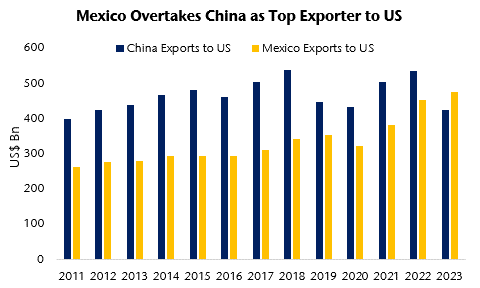
Bar chart comparing China and Mexico exports to the US between 2011 and 2023.

Source: US Census data

The real story isn’t quite so simple – US import data understate Chinese exports, with the total recorded in Chinese data being c.25% higher. This seems to reflect systematic tariff avoidance. In addition, many Chinese firms are investing aggressively in Mexico to take advantage of the North American Free Trade Agreement and gain frictionless access to the US market. As the Wall Street Journal illustrates in a recent piece, China’s exporters can access the US duty-free with Made in Mexico labels:

The participation of Chinese companies in this shift attests to the deepening assumption that the breach dividing the United States and China will be an enduring feature of the next phase of globalization. Yet it also reveals something more fundamental: Whatever the political strains, the commercial forces linking the United States and China are even more powerful.

Chinese companies have no intention of forsaking the American economy, still the largest on earth. Instead, they are setting up operations inside the North American trading bloc as a way to supply Americans with goods, from electronics to clothing to furniture.
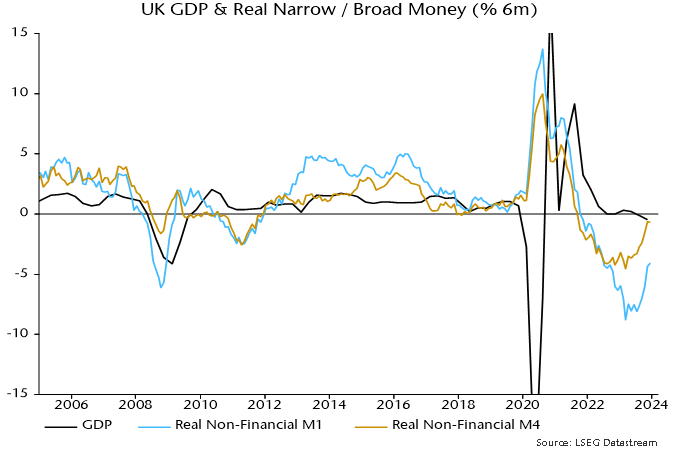
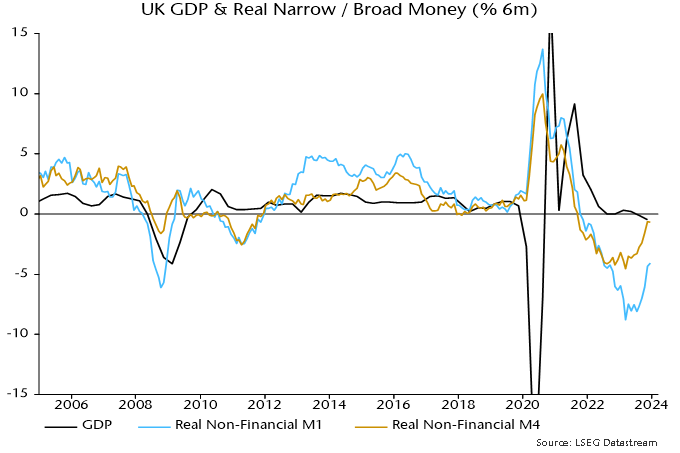
UK real money contraction warned of 2022 economic stagnation and 2023 recession. Weakness has abated but real money measures have yet to resume expansion, casting doubt on hopes of a sustainable economic recovery.

The latest ONS numbers are consistent with a recession having started in Q2 2023. Among key features of the GDP release:

  • Gross value added (GVA) at basic prices peaked in Q1 2023, falling by 0.03% in Q2, 0.16% in Q3 and 0.34% in Q4.
  • The cumulative decline in GVA / GDP of 0.5% between Q2 and Q4 is inconsistent with a description of the economy as “flatlining”.
  • Similarly, claims that the consumer has been holding up are no longer tenable given a 1.0% cumulative contraction in household consumption between Q2 and Q4.
  • GDP / GVA fell by 0.2% and 0.3% respectively in the year to Q4, meeting a stronger recession definition than the two-quarter rule (in contrast to Japanese GDP also released today).
  • Nominal as well as real GDP fell in Q4, with the GDP deflator rising at a 2.0% annualised pace between Q2 and Q4.

The suggestion of cyclical peak in Q1 2023 is supported by the LFS employment measure, which reached a high in the three-month period centred on March. (The LFS aggregate is 10% larger than the PAYE employment series, reflecting coverage of self-employment.) Aggregate hours worked also peaked then, falling 1.5% through November.

Real money measures began to contract in H2 2021. GDP stagnated from Q2 2022, consistent with the usual lag. The six-month rates of decline of real narrow and broad money reached a peak in March 2023, warning of H2 economic contraction – see chart 1.

Chart 1

Chart 1 showing UK GDP & Real Narrow / Broad Money (% 6m)

Six-month real money momentum has recovered significantly but has yet to turn positive. Slowing inflation has been a key driver, while nominal broad money is no longer contracting. Economic weakness may abate in H1 2024 but current monetary trends appear inconsistent with a meaningful recovery. Early rate cuts are urgently required to limit still-significant downside risk and head off an extended inflation undershoot.

Kingdom of Saudi Arabia, Riyadh, King Abdullah Financial District.

MENA equity markets finished the fourth quarter with returns of 5.9% (for the S&P Pan Arabian Index), rounding out a reasonably strong year with an Index return of 10.2%.

2023 marked the third consecutive year of outperformance for the S&P Pan Arabian index against Emerging Markets (the MSCI EM Index). Over that period, MENA outperformed EM by a remarkable 59.2%. Despite this, an EPFR survey cited by JP Morgan of key EM managers indicates most are staying bearish on the region (as measured by the median exposure relative to the region’s MSCI EM Index weight as of January 8, 2024).

Morgan Stanley’s MENA equity sales desk notes that ~50% of GEM funds have zero exposure to Saudi Arabia, which has a 4.1% weight in the MSCI EM Index. While foreign institutional ownership of Saudi stocks has risen dramatically over recent years (the latest weekly data from the Tadawul shows foreign institutions own 12.5% of the free-float market capitalisation), positioning remains relatively conservative.

Without speculating on the reason(s) why EM managers have taken this view, we continue to believe it demonstrates a knowledge gap from the years when markets like Saudi were all but shut to foreign investors. This presents an opportunity for specialised managers with an early mover advantage in these markets to operate and invest with an edge that is difficult to establish in other well-trodden EMs.

Since the end of the first quarter of 2023, we have become more vocal about our concern on valuation levels in Saudi. During this period, we’ve seen an increase in geopolitical risk, persistently high interest rates, and lower oil prices. None of those factors seem (for the time being) to temper local and regional investor enthusiasm for Saudi stocks, particularly mid-caps and IPOs. We believe it is prudent to avoid being overly exposed to situations where, by our estimates, investor positioning and expectations are excessively high. While we remain constructive on the quality of the Saudi-based businesses we own and the country’s structural growth story, especially in the consumer, healthcare, and education sectors, we enter 2024 with lower exposure to these stocks. The Saudi market is highly dynamic, and we expect there will be opportunities to rebuild our exposure to those stocks throughout year.

We are relatively more bullish on the UAE, focusing primarily on banks and quasi-monopoly businesses like utilities and infrastructure. Benign liquidity conditions and strong economic growth favour UAE banks with a solid deposit franchise and strong lending opportunities in 2024. We have already seen at the beginning of this year that banks are signalling confidence in their outlook by significantly upgrading their dividend payout ratios for the profits from last year. Our UAE banks portfolio is yielding over 6% on average (as of the date of this letter), an attractive level as the interest rate cycle begins to turn.

In other markets, we continue to back Morocco-based companies in the retail and technology sectors and have expanded our portfolio with a new investment in healthcare, a sector set to grow significantly from a universal health scheme that will materially improve access to much-needed medical services. We expect Morocco to perform better in 2024 as inflation pressures ease and the country continues to develop a competitive base for manufacturing and services that we believe will unlock growth this year and beyond. (In a recent Bloomberg article, Morocco, alongside Mexico, Poland, Vietnam, and Indonesia were identified as key “economic connectors” that will benefit from supply chain reshuffling.)

In Qatar and Kuwait, we remain selective, with growth remaining constrained, though we see potential in Qatar’s liquified natural gas value chain and are more optimistic about Kuwait following the appointment of a reformist royal as the new Emir in late 2023.

Egypt remains a wildcard, with an imminent devaluation likely to be the first step in a long journey towards rebuilding policy credibility with investors. That said, we remain open to increasing our ownership in our preferred Egyptian healthcare and technology businesses if opportunities arise later this year.

We wish you a prosperous 2024 and look forward to sharing updates on our strategy with you.

Palace of Culture and Science & city skyline at night, Warsaw, Poland.

The strategy focuses on investing in frontier and emerging market companies that our team expects will benefit from demographic trends, changing consumer behaviour, policy and regulatory reform, and technological advancements.

Below, we explore some of the key factors influencing returns and share observations on the portfolio and the markets.

Internet

The strategy saw strong returns from the internet portfolio in the quarter. We capitalised on share price weakness in Allegro.eu (ALE), Poland’s leading online marketplace, following a partial sell down by its private equity majority shareholders. Allegro boasts over 14.5 million active buyers in Poland and generated ~$13 billion in gross merchandise value in the last twelve months, securing a clear market lead with a ~35% share of online retail. Under new management over the last 18 months, the company has demonstrated an impressive capacity to enhance commercial terms with merchants and suppliers, increase advertising revenue contribution, and instil much-needed cost and capital allocation discipline. Furthermore, the company is growing its market share and improving engagement through a heavier focus on its SMART! program (akin to Amazon’s Prime). These efforts have driven a noticeable increase in the take rate to 11.9% as of Q3 2023 (a top-quartile take rate amongst EM e-commerce peer group) and underpinned a sustainable operating margin profile of nearly 20% in the nine-month period ending September 2023. While we acknowledge that the overhang from its private equity owners will remain for some time, we plan to take advantage of opportunities to add to our Allegro position as those sellers continue to divest their stake in the business.

Continuing with Emerging Europe, the strategy also saw strong returns from BCG Classifieds Group (BCG), the leading online classifieds group in the Baltics with a dominant position in auto, real estate, jobs and services, and generalist marketplaces in Lithuania and Estonia. BCG’s shares reacted positively to a strong set of results in the second half of 2023, with revenue and operating profits growing 20% and 36% year-over-year (y-o-y), respectively. BCG exemplifies the dominant, unassailable position of a leading classifieds business. In Lithuania, it is six times and 21 times larger than its closest competitor in auto and real estate classifieds, respectively. In Estonia, it is 29 times and 16 times larger than its closest competitor in those categories. This dominance only grows with time, as buyers and sellers find that the largest opportunity to transact (i.e., marketplace liquidity) is with the clear market leader. Management has effectively reinforced the company’s leadership position whilst making prudent capital allocation decisions, including share buybacks and reducing capital throughout the year.

Healthcare

The healthcare portfolio delivered strong returns in the quarter, led by Medikaloka Hermina (HEAL), the Indonesian healthcare provider. HEAL’s share price reacted positively to a strong third-quarter earnings report that showed 22% and 72% y-o-y growth in revenue and EBTIDA, respectively. The profit margin expansion at HEAL reinforced our belief in the company’s potential for profitable growth from its 47 hospitals, whilst scaling up the network to take advantage of the vast opportunity that Indonesia’s 250 million population provides. That said, we took advantage of the strong share price reaction and reduced our exposure to HEAL on account of valuations.

We also saw positive contributions from Integrated Diagnostics Holdings (IDHC) in Egypt due to insider buying, and AGP Pharma (AGP) in Pakistan owing to the country’s improving macroeconomic outlook. We acted on the positive share-price movement at both companies, reducing exposure in Egypt, and exiting Pakistan.

Additionally, we invested in a Thai healthcare provider focused on medical tourism (~70% of revenue). Thailand, ranked as the eighth most popular tourist destination globally, has developed a formidable medical tourism infrastructure over the last 20 years. The company we invested in has established a reputable brand among relatively affluent patients from the Gulf countries, Cambodia, Laos, and parts of the subcontinent.

Financial services

The strategy experienced weak performance from the financials portfolio in the quarter, affected by Indonesian microfinance and UAE banks and financial services. In Indonesia, persistent asset quality pressures continue as low-income households face considerable challenges with disposable income and their ability to make good on loans. Although we anticipated election-related spending to trickle down to this segment, it appears unlikely to significantly change the outlook for these households. There may be more clarity after the Indonesian presidential elections, expected to conclude in June 2024. Accordingly, we decided to scale back our exposure to this theme until more policy clarity emerges after the elections. In the UAE, we remain bullish about the financial services opportunity set and have been adding to our exposure there throughout the quarter.

Consumer portfolio

The strategy’s Asian consumer staples portfolio performed poorly in the quarter. Weakening consumer purchasing power is adversely affecting demand across a range of consumer categories, including health supplements in Indonesia, beer in Vietnam, paints in Thailand, and tiles and sanitary ware in the Philippines. The region’s consumers are generally cautious, and we expect this to continue until inflationary pressures subside. We have been reducing our exposure to consumer stocks in the region but remain invested in our highest-conviction consumer companies, as their valuations appear very attractive to us.

Outlook

As we move into 2024, our team feels confident in the portfolio, buoyed by a powerful combination of expectations of strong earnings growth and attractive valuations. While the environment remains challenging for many economies we invest in, emerging green shoots make us more optimistic about the future. We look forward to updating you on the strategy as the year progresses.

Image of wind turbines on prairies

Connor, Clark & Lunn Infrastructure (« CC&L Infrastructure ») est heureuse d’annoncer qu’elle a conclu une entente visant l’acquisition d’une participation majoritaire dans le parc éolien Sharp Hills (« Sharp Hills » ou le « projet ») d’EDP Renewables Canada Ltd. (« EDPR Canada »), filiale d’EDP Renewables pour une Valeur d’Entreprise estimée de 0,6 milliards de dollars canadiens pour une participation de 80 % et comprenant les crédits d’impôt sur l’investissement. Avec l’ajout de cet investissement, CC&L Infrastructure détiendra des actifs éoliens totalisant plus de 600 mégawatts (MW), et la capacité d’énergie propre de l’ensemble de son portefeuille de projets d’énergie renouvelable au Canada, aux États-Unis et au Chili dépassera les 1,8 gigawatt (GW).

Située dans le sud-est de l’Alberta, Sharp Hills est l’un des plus grands parcs éoliens terrestres au Canada, sa capacité étant d’environ 300 MW, ce qui représente une production d’énergie propre équivalant à la consommation d’électricité de plus de 160 000 foyers en Alberta. Le nouveau projet a récemment été mis en exploitation, et les travaux de construction restants devraient être achevés d’ici le deuxième trimestre de 2024. La construction de cette installation a représenté un investissement important dans la province; elle a contribué à l’économie locale par la création d’emplois et un financement au sein de la collectivité. Sharp Hills a conclu une entente d’achat d’énergie d’une durée de 15 ans avec une contrepartie de grande qualité.

« Le parc éolien Sharp Hills est un ajout intéressant à notre portefeuille de plus en plus diversifié d’actifs en infrastructures. Nous nous réjouissons à l’idée de poursuivre notre collaboration avec notre partenaire, EDPR, dans l’exploitation sécuritaire et fructueuse de cette installation pour les années à venir », a déclaré Matt O’Brien, président de CC&L Infrastructure. « CC&L Infrastructure possède une longue feuille de route et une expertise importante en tant que propriétaire de plus de 80 projets d’énergie propre. Nous sommes enthousiastes à l’idée de poursuivre l’expansion de notre éventail d’actifs et cherchons activement d’autres occasions d’investissement découlant de la demande croissante d’énergie renouvelable et de la transition énergétique qui s’opère en ce moment. »

« Nous sommes heureux de nous associer de nouveau à CC&L Infrastructure, cette fois en Alberta », a ajouté Sandhya Ganapathy, chef de la direction d’EDP Renewables North America. « Le projet Sharp Hills souligne notre engagement continu à investir en Alberta et à contribuer à la résilience de son réseau et à sa sécurité énergétique. Nous sommes impatients de poursuivre nos efforts axés sur la transition énergétique au Canada. »

Il s’agit de la deuxième transaction que CC&L Infrastructure effectue avec EDPR, la société ayant déjà acquis auprès du promoteur des actifs éoliens et solaires qui totalisent 560 MW aux États-Unis. EDPR conservera une participation minoritaire dans Sharp Hills et continuera d’exploiter et de gérer le portefeuille. Financière Banque Nationale inc. a conseillé CC&L Infrastructure à titre de conseiller financier et Torys LLP, à titre de conseiller juridique, tandis que Marchés des capitaux CIBC a agi à titre de conseiller financier auprès d’EDPR Canada. La transaction est assujettie aux conditions de clôture habituelles, lesquelles devraient être remplies au cours des prochaines semaines.

À propos de Connor, Clark & Lunn Infrastructure

CC&L Infrastructure investit dans des infrastructures du marché intermédiaire qui présentent un profil risque-rendement intéressant, une longue durée de vie et un potentiel de production de flux de trésorerie stables. À ce jour, CC&L Infrastructure a accumulé un actif sous gestion de plus de 5 milliards de dollars, couvrant divers secteurs, types d’actif et régions, et compte plus de 90 installations sous-jacentes réparties dans plus de 30 placements individuels. CC&L Infrastructure est membre du Groupe financier Connor, Clark & Lunn Ltd., une société de gestion de placements dotée d’une structure multientreprise et dont les sociétés affiliées gèrent collectivement un actif de plus de 118 milliards de dollars canadiens.

Pour obtenir de plus amples renseignements, veuillez consulter notre site Web : www.cclinfrastructure.com et suivez-nous sur LinkedIn.

À propos d’EDP Renewables North America

EDP Renewables North America LLC (« EDPR NA »), ses sociétés affiliées et ses filiales développent, construisent, possèdent et exploitent des parcs éoliens, des parcs solaires et des systèmes de stockage d’énergie partout en Amérique du Nord. Ayant son siège social à Houston, au Texas, et comptant 60 parcs éoliens, 12 parcs solaires et huit bureaux régionaux en Amérique du Nord, EDPR NA a développé des projets pour plus de 9 600 mégawatts (MW) et exploite des projets d’énergie renouvelable terrestres à grande échelle produisant plus de 8 900 MW. Forte de plus de 1 000 employés, l’équipe hautement qualifiée d’EDPR NA a démontré sa capacité à mener à bien des projets à travers le continent.

Pour obtenir de plus amples renseignements, veuillez consulter notre site Web : www.edpr.com/north-america et suivez-nous sur LinkedIn.

Personne-ressource

Ryan Lapointe
Directeur générale
Connor, Clark & Lunn Infrastructure
416 216-3545
[email protected]

Tom Weirich
Responsable – Marketing et relations avec les parties prenantes
EDP Renewables North America (EDPR NA)
(281) 825-2771
[email protected]

"Vote" election campaign button badges on the American flag.

Elections and stocks: A surprising non-story

In a recent weekly update, we discussed how 2024 is an important election year worldwide. As it relates to US elections and stock returns, the data shows limited impact. Although markets can be volatile in election years, the political party in the White House has historically had minimal effect on returns. Since 1936, the 10-year annualized return of US stocks (as measured by the S&P 500 Index) at the start of an election year is 11.2% for a Democratic win and 10.5% for a Republican win. Sector performance, however, can be affected by short-term policy planning headlines.

Election rhetoric and the real story of healthcare stocks

For example, the healthcare sector often underperforms during a US election year due to the attention on drug and medical cost control. The global impact is significant, as the US is a major driver of healthcare economics. For 2024, the effect on healthcare may be less pronounced. The Biden administration’s measures for drug price control as part of the 2022 Inflation Reduction Act have already been implemented, but with only 10 high-profile drugs priced by the government under the reform, the economic impact has been muted. The pace of implementation could slow further under a Republican administration, potentially leading to positive earnings surprises.

Our Global portfolio includes a pure-play drug manufacturer, ANI Pharmaceuticals (ANIP:US), which owns a large facility in Minnesota where it produces a wide range of specialty and generic drugs and has a rapidly growing immune therapy franchise. None of its drugs have been targeted by US authorities for price negotiations.

From tariffs to technology

Recent protectionism, particularly new tariffs in sectors like semi equipment initiated during the Trump administration, may extend to medical devices and biotechnology. Don’t be alarmed if more are implemented. It’s our job to identify the tailwinds. Medical devices and biotechnology companies are likely to be the next tariff targets, especially those involving China. Over the past decade, Chinese productivity and quality have risen sharply in the fields of biotechnology, drug and device development.

Two proposed bills: the Biosecure Act and the Prohibiting Foreign Access to American Genetic Information Act of 2024 enjoy bipartisan support, with a 60% China tariff on healthcare goods proposed by Republicans in the event of their victory. This could create positive competitive tailwinds for North American and European contract drug manufacturers.

Evotec’s leap forward

Global Alpha owns Evotec SE (EVT:GR), a rapidly growing biological drug manufacturing contractor with technologies for low-cost and fast scaling of drug production. Evotec also has potential for numerous drug development partnerships and is developing a new stem cell medical device system for diabetes treatment.

Medical devices as the market’s quiet titans

The medical device industry, known for its high barriers to entry and advanced technology, appears well-positioned for profitable growth. It tends to be less scrutinized by policymakers and therefore less affected by elections. In the last three decades, the industry has outpaced the S&P 500 by almost 15 percentage points, with stellar performance in the early 1990s, mid-2000s and late 2010s. Yet value creation has become more difficult in the past five years, especially for large, diversified companies. The top-30 largest medical device companies have underperformed the S&P 500 over one-, three- and five-year periods.

Our focus is on smaller, nimble names like Globus Medical Inc. (GMED:US), now an orthopedic powerhouse after acquiring its competitor, NuVasive. This acquisition has broadened its portfolio and enhanced its geographic reach. Globus’s expanded sales force will also support its fast-growing robotics business, a relatively new area. These robots improve the efficiency and output of orthopedic surgeons during back surgeries. Globus has also recently initiated a trauma product line that has successfully penetrated the market, further benefiting from its increased sales force. The orthopedic market is very large, valued at USD$72.3 billion and growing at a 5.3% rate.

Seeing clearly: The vision market’s rapid growth

Medical devices target a broad range of very large markets. For example, the global vision care market is projected to reach USD$192.85 billion by 2026, with a CAGR of 5.6%.

Global Alpha owns Menicon Co. Ltd. (7780:JT), Japan’s first and largest contact lens manufacturer, which now has a presence in over 80 countries. The company offers a comprehensive product lineup including disposables (daily, 2 weeks, 1 month, >3 months, silicone hydrogel), other soft contact lenses and RGP (Rigid Gas Permeable) lenses.

In China alone, myopia affects 146 million people. The condition is especially prevalent among children, creating a strong demand for corrective devices. Orthokeratology, a technique using contact lenses to reshape the cornea for long-lasting effects, had a global market value of $2.5 billion in 2023 and is expected to grow at a CAGR of 6.1% beyond 2026. Market penetration in China is only 2.0%. Menicon ranks as the second-leading company in this space.

The true power of legislative winds

To sum up, it seems ineffective to predict the direction of the US stock market based on political party forecasting. However, it is important to monitor the progression of legislation from announcement through to funding and implementation. This is because bills go through phases of hype, disillusionment and reality, similar to many other events that can influence the economy.


Recent US equity market buoyancy is likely to be related to a rebound in broad money momentum during H2 2023. The previous post argued that this was driven by monetary financing of the federal deficit – specifically, large-scale issuance of Treasury bills that were bought mainly by money funds and banks.

A more contentious interpretation is that the Treasury has been operating a form of QE that has overridden the monetary effects of the Fed’s QT.

The federal deficit can be financed by running down the Treasury’s cash balance at the Fed or issuing bills / coupon debt. The first option injects money directly. Issuing bills is also likely to expand broad money, since money funds and banks usually absorb the bulk of new supply. Coupon issuance usually has the smallest monetary impact because coupon debt is purchased mainly by non-banks.

So a summary measure of the monetary influence of financing operations is the difference between Treasury bill issuance and the change in the Treasury balance at the Fed – henceforth “Treasury QE”.

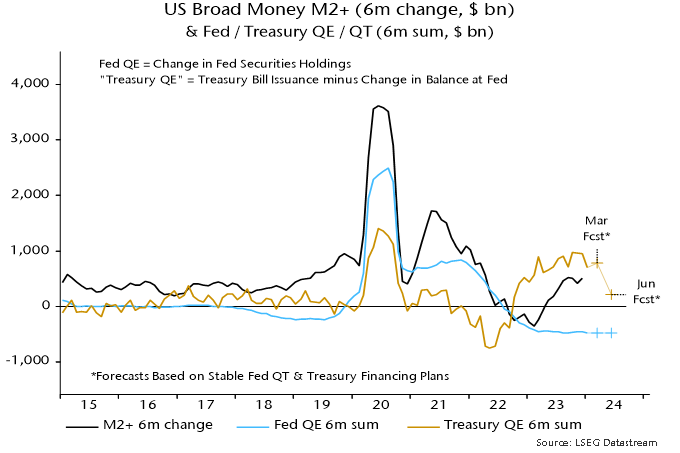
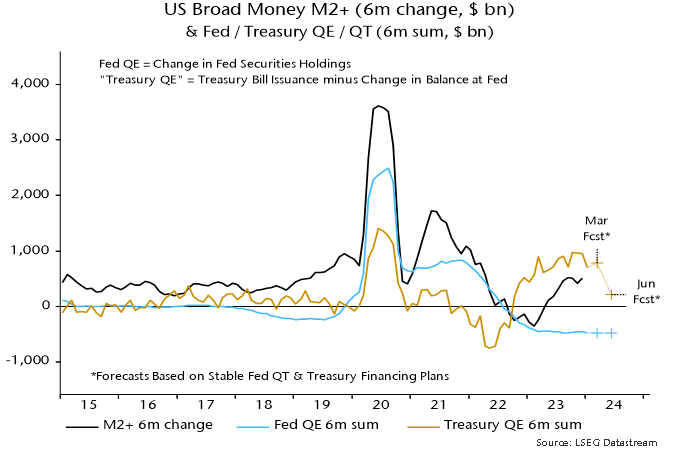
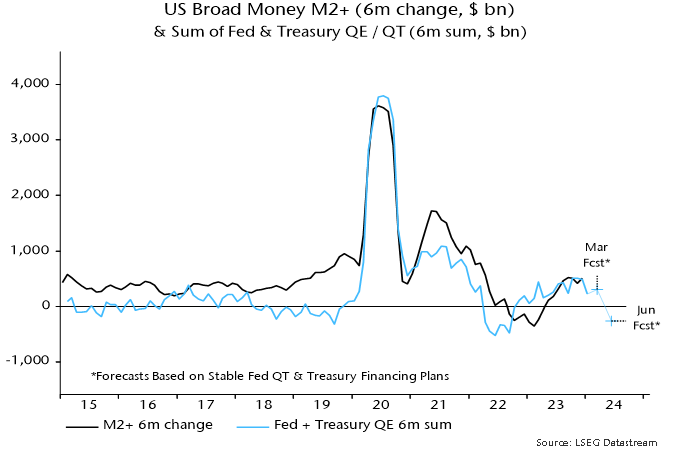
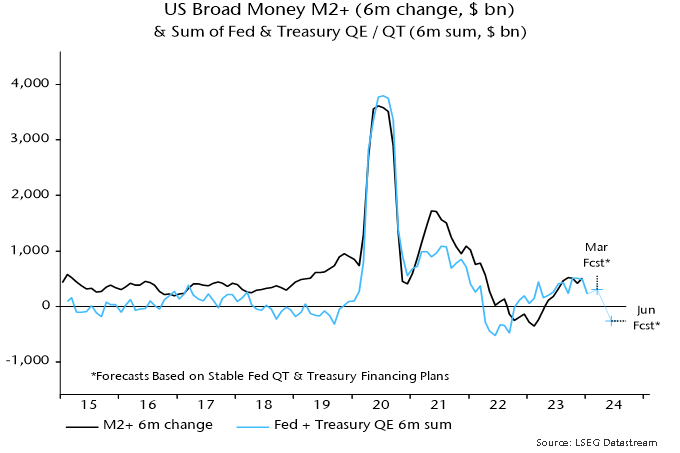
Chart 1 shows six-month running totals of Fed QE / QT and the suggested Treasury monetary impact along with the six-month change in broad money. The sum of the Fed and Treasury series “explains” most of the variation in money momentum in recent years – chart 2.

Chart 1

Chart 1 showing US Broad Money M2+ (6m change, $ bn) & Fed / Treasury QE / QT (6m sum, $ bn) Fed QE = Change in Fed Securities Holdings “Treasury QE” = Treasury Bill Issuance minus Change in Balance at Fed

Chart 2

Chart 2 showing US Broad Money M2+ (6m change, $ bn) & Sum of Fed & Treasury QE / QT (6m sum, $ bn)

“Treasury QE” was a major contributor to the 2020 monetary surge and became significant again in late 2022 / early 2023, mainly reflecting a run-down of the Treasury’s cash balance. Following suspension of the debt ceiling in June 2023, the Treasury rebuilt the balance but the monetary impact was more than offset by bumper bill issuance – see the previous post for details.

The Treasury’s recently released financing plans imply a swing from expansion to contraction during H1 2024. The cash balance at the Fed is targeted to fall from $769 billion at end-2023 to $750 billion at end-Q1, remaining at this level at end-Q2. The stock of bills, meanwhile, is projected to rise by $442 billion in Q1 but fall by $245 billion in Q2. “Treasury QE” would remain strong at $461 billion in Q1 – far ahead of expected Fed QT of about $240 billion – but a dramatic shift would occur in Q2, with “QT” of $245 billion.

If Fed QT were to continue at its current pace, the suggestion is that the six-month change in broad money would return to negative territory by mid-year, unless other monetary counterparts were to show offsetting strength – chart 2.

Note that the above argument is distinct from the notion that ongoing Fed QT risks pushing reserve balances and / or deposits at the overnight reverse repo (ON RRP) facility below the level required for money market stability. The possibility of a broad money shortage due to a withdrawal of Treasury monetary support would remain even if the minimum reserves / ON RRP level proves to be lower than feared. The two risks, however, could interact.

A possible conclusion is that markets face a monetary air pocket in Q2 unless the Fed halts QT at its March meeting. A cynic might speculate that the Treasury’s financing plans are designed to increase pressure for an early Fed cessation, which might be followed by a H2 resumption of bill financing to swell monetary support ahead of the November election.

Woman in suit looks out at Shanghai skyline at sunset from window in building.

Contrary to the market’s expectations of a robust post-pandemic economic recovery, China’s rebound has been underwhelming. Although its 2023 GDP growth surpassed the official “around 5%” target, key indicators point to a struggling economy in the post-COVID era. This situation reveals three primary challenges: debt, deflation and demographics (collectively termed the 3Ds), reminiscent of Japan in the 1990s. China is arguably in a stronger position, with potential for higher growth, lower asset-price inflation and more effective currency management. Nevertheless, addressing these problems is complex. While debt and deflation could be mitigated through proactive government policies and a shift to a consumption-driven economy, demographic trends are less malleable.

The one-child policy legacy

For the second year in a row, China’s population decreased by 2.08 million people in 2023 after losing 850,000 in 2022. The longstanding one-child policy, only lifted in 2016, has had a lasting impact. Government initiatives to encourage marriage and parenthood have been insufficient. Educational and employment gains have empowered women to have more control over reproductive choices, contributing to a lower fertility rate. This demographic shift threatens China’s economic prosperity by reducing the labour force and consumer spending.

Balancing the productivity and social welfare equation

Globally, countries like Sweden, Japan, South Korea and Russia have tried various strategies to tackle similar demographic dilemmas, including financial incentives, and housing and childcare assistance, yet a sustainable solution remains elusive. For instance, Japan anticipates a shortfall of 11 million workers by 2040. However, this does not render these countries, including China, less attractive for investment. To adapt, China must improve its existing workforce’s productivity.

In 2022, household consumption in China constituted 37% of its GDP, lower than in Japan (55%) and the US (68%). This may be primarily due to the lack of a strong social safety net, leading to a high savings rate for healthcare, education and retirement. Enhancing these supports could unlock significant consumer spending. China’s government is transitioning the economy towards consumption, but pension, healthcare and unemployment reforms face political and fiscal hurdles. We believe improving social welfare is also essential for China’s economy.

Sector opportunities

Meanwhile, China’s equity market appears historically undervalued and relative to its emerging markets peers. After losing more than US$6 trillion in market capitalization since early 2021, it risks becoming a value trap if fundamental issues aren’t resolved. At the same time, certain sectors, like electric vehicles, renewable energy, robotics, healthcare, services and tourism, may enjoy strong tailwinds.

Fu Shou Yuan: A case study in market potential

An example is Fu Shou Yuan (1448 HK), a leading private provider of deathcare services that we hold in our Emerging Markets Small Cap Fund. Operating in 46 cities across 19 provinces, the company targets the premium market in a highly fragmented and regulated industry forecasted to grow at a 9% CAGR and reach US$56 billion by 2026, according to Goldman Sachs. Fu Shou Yuan’s extensive land bank, expertise and reputation position it to continue consolidating the market through tuck-in acquisitions and public-private partnerships.

China’s future amid the 3Ds

In the short term, investors in China are anticipating more impactful stimulus measures. We believe that for it to achieve sustainable growth, the country must simultaneously deal with its core structural issues and revive flagging consumer confidence.

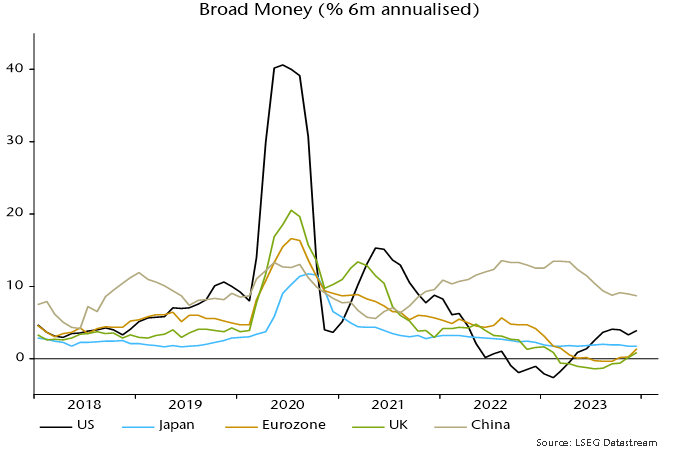
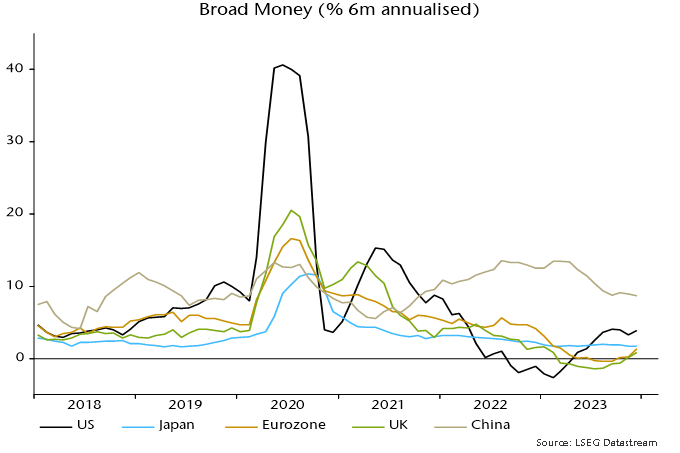
The six-month rate of change of US broad money has recovered from negative territory in early 2023 to 3.9% annualised in December – close to an average of 4.2% over 2010-19, when economic performance was generally favourable.

Does this signal that the economy has adjusted to higher interest rates and monetary conditions are no longer particularly restrictive, in turn suggesting less need for Fed easing?

The analysis below of the “credit counterparts” to monetary expansion indicates that the recent revival has been driven by exceptionally large-scale purchases of Treasury bills by money market funds.

Such buying will fall back but its recent importance highlights a larger point. If the fiscal deficit remains at its current level (or rises further), and the Treasury continues to choose to fund a large proportion of the deficit by expanding the Treasury bill issue, the contribution of deficit financing to monetary growth is likely to be significant, even assuming no return to QE. In this scenario, a higher average level of interest rates may be necessary to constrain money growth to a pace – of perhaps 4-5% pa – compatible with trend economic expansion and on-target inflation.

On the suggestion that the recovery in money growth obviates the need for policy easing, a key point is that the effects of prior monetary restriction are still feeding through and may not be fully apparent for another year or more. Rate cuts are likely to be warranted to cushion near-term economic weakness and avert an inflation undershoot.

The numbers quoted above for US broad money expansion refer to the “M2+” measure calculated here, which adds large time deposits at commercial banks and institutional money funds to the official M2 measure. The inclusion of these items is important as they capture a significant proportion of money holdings of non-financial businesses and non-bank financial institutions. As previously discussed, US business money holdings have been rising rapidly in recent quarters, resulting in six-month momentum of M2+ diverging positively from that of M2 since late 2022, i.e. M2 is understating broad money growth at present.

Six-month broad money momentum has recovered by much more and to a higher level in the US than in the Eurozone and UK – see chart 1.

Chart 1

Chart 1 showing Broad Money (% 6m annualised)

The credit counterparts analysis links changes in broad money to movements in other items on the monetary sector’s balance sheet, the US monetary sector being defined as the Fed, commercial banks and other depository institutions, and money funds. The following simple formulation is used for the analysis here:

Change in broad money = monetary financing of federal deficit + change in commercial banks’ loans and leases + other counterparts (residual)

Monetary financing of federal deficit = net purchases of Treasury securities by Fed, commercial banks and money funds – change in Treasury general account balance at Fed

The table shows the contribution of these items to the six-month change in M2+, not annualised, in December 2022 and December 2023.

Table 1 showing the contribution of these items to the six-month change in M2+, not annualised, in December 2022 and December 2023

The positive swing in six-month momentum between the two periods was driven by monetary deficit financing and, in particular, a huge change in money funds’ transactions in Treasuries, from selling in H2 2022 to exceptionally large-scale buying in H2 2023.

What caused this turnaround? Following the suspension of the debt ceiling in June 2023, the Treasury issued a net $1.21 trillion of Treasury bills in H2 2023, up from $170 billion in H2 2022 and the second-highest half-year amount ever (after H1 2020).

Money funds and commercial banks are natural buyers of Treasury bills because of the maturity structure of their liabilities. The market mechanism that induced them to increase demand was a rise in Treasury bill yields relative to other short-term rates, including the emergence of a premium over the Fed’s overnight reverse repo rate.

Money funds moved $1.1 trillion out of the Fed facility during H2 2023, buying an estimated $900 billion of Treasury securities and placing the remainder (and an additional amount) in the private repo market (with those funds probably also used to buy Treasuries, suggesting further indirect monetary financing).

Money funds’ Treasury buying is likely to slow dramatically in H1 2024, for two reasons. First, expansion of the Treasury bill issue will be scaled back to $200 billion (from $1.21 trillion in H2 2023), according to refunding plans. Secondly, money funds’ balance in the Fed facility was down to $800 billion at end-2023 (from $2.3 trillion a year earlier), with a further decline in early 2024. The rate of Treasury bill purchases will plausibly slow as the balance approaches exhaustion.

It would, however, be misleading to suggest that purchases of Treasuries by money funds and banks face a constraint in terms of the availability of investible resources. The first-round effect of the fiscal deficit is to swell the broad money stock, i.e. it creates the liquidity necessary to absorb associated debt issuance. If new Treasuries are sold to non-banks, the monetary boost is reversed. If, alternatively, money-holders choose to retain their higher balances, banks and money funds have additional funds with which to buy Treasuries. The money creation due to the deficit then remains unsterilised.

How large a boost could this private form of monetary financing give to broad money growth over the medium term? The federal deficit was $1.78 trillion in calendar 2023, equivalent to 6.5% of GDP and 6.8% of the M2+ stock at end-2022. Suppose that 1) the deficit remains stable as a proportion of the money stock, 2) it is half-financed via Treasury bills and 3) money funds and banks take up half of the issued bills. Assuming no QE / QT and a stable Treasury balance at the Fed, monetary deficit financing would contribute 1.7 pp to annual M2+ growth.

For comparison, Treasury buying by money funds and banks contributed 0.6 pp to average annual growth of M2+ over 2010-19.

Suggested conclusions are: 1) prior monetary weakness will be the dominant influence on economic developments over the next few quarters; 2) the recovery in broad money growth is likely to stall in H1 2024; and 3) a persistent large fiscal deficit could cause funding indigestion and force a renewed increase in reliance on bill financing (or, in the extreme, a resumption of QE), in turn posing an upside risk to medium-term money growth and inflation.

Photo of Sabrina Lacroix


En tant que responsable de la conformité, Sabrina Lacroix s’appuie sur les bases établies au cours de son mandat en tant que gestionnaire principale de la conformité. Elle apporte une connaissance approfondie des cadres réglementaires et un dévouement au soutien des normes de conformité rigoureuses.

Nous nous réjouissons de l’impact qu’elle aura sur Global Alpha.