Two businessmen shaking hands in an office.

The fluctuation in mergers and acquisitions (M&A) activity in 2021 followed a typical cyclical pattern, echoing broader economic trends. The initial surge in M&A was propelled by low interest rates and a swift reopening from the COVID-19 pandemic that encouraged companies to pursue strategic acquisitions. This led to the highest M&A volumes since 2007.

However, several factors dampened the momentum in 2022-23. Aggressive interest rate hikes, rising inflation, geopolitical tensions such as the war in Europe, and an overall economic slowdown contributed to a decline in M&A activity. Additionally, decreasing confidence among C-suite executives and a wider bid-ask spread between buyers and sellers further reduced dealmaking.

As a result, total M&A volumes dropped by 18% to approximately $3 trillion in 2023, according to data from Dealogic. This marked the lowest level of M&A activity since 2013 when deal volumes were at $2.8 trillion, indicative of the challenges and uncertainties faced by global dealmakers amidst shifting economic conditions and geopolitical risks.

All of this changed when the Federal government started hinting about lowering interest rates in 2024. This week, we look at how this trend stands to benefit our portfolio.

Global M&A volumes
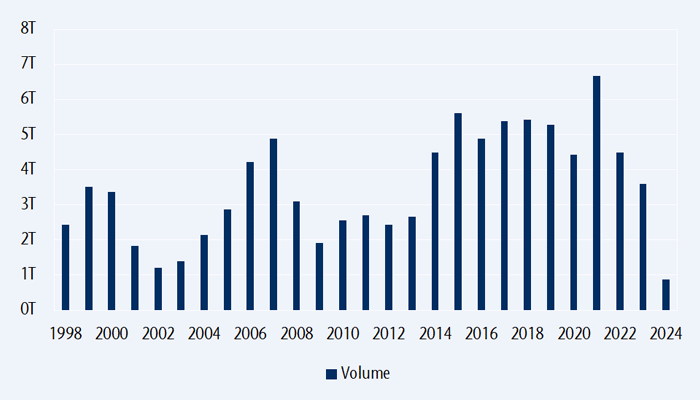
Global mergers and acquisitions volumes from 1998 to 2024.
Source: Bloomberg

Starting bell sounding for an upswing in M&A activity

Despite ongoing macroeconomic and geopolitical uncertainties, signs are pointing to a potential turnaround for dealmaking in 2024. Three key factors support this optimism:

  1. Financial markets have rebounded significantly since the previous year, with expectations for declining interest rates.
  2. Considerable “dry powder” is waiting on the sidelines, coupled with a rise in board confidence.
  3. There is pent-up demand for deals, alongside an ample supply, reflecting a readiness to engage in M&A activity.

Global non-financial listed companies hold $5.6 trillion in cash, while private market investors possess $2.5 trillion in dry powder, providing substantial resources for dealmaking. Additionally, depressed small cap valuations along with structural factors such as advancements in AI, the transition to clean energy, innovation in life sciences, reshoring initiatives and geographic diversification are further driving demand for M&A.

The dismal performance of 2023, marked by the lowest completed M&A volumes in a decade relative to nominal US GDP, underscore the potential for a rebound in deal activity in 2024. So, how big can it get?

We could see up to $9.5 trillion of M&A in 2024

Based on Dealogic’s data, global M&A volume has averaged around $5.5 trillion per year since 2014. With corporations potentially aiming to catch up on the $2 trillion shortfall from the last two years, M&A volumes for 2024 could range from $5.5 trillion to about $9.5 trillion. Actual figures will depend on various factors such as economic conditions, geopolitical stability and corporate strategies.

The underlying drivers are especially visible in markets like Europe that have seen a drought in M&A activity.

Western Europe M&A volumes
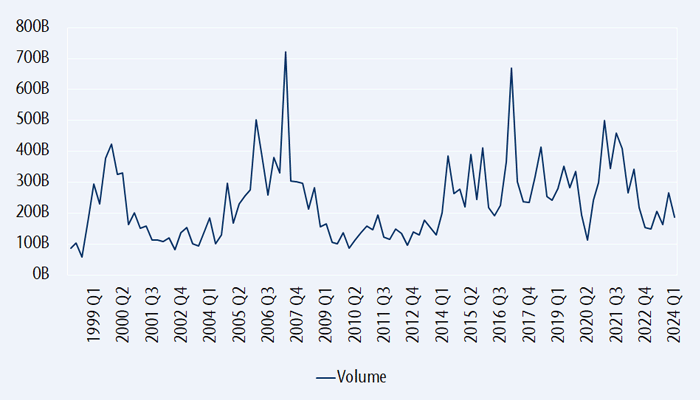
Mergers and acquisitions volumes in Europe from 1999 to 2024.
Source: Bloomberg

Looking at Japan, the structural shift towards greater corporate efficiency and activity is notable and expected to drive further M&A activity in the market. Despite the challenges faced by global markets, Japan has managed to maintain positive M&A volumes, demonstrating a resilience and proactive approach among Japanese companies.

Rising costs, stricter governance rules and mounting shareholder pressure are compelling companies in Japan to explore strategic options, including M&A. This trend is part of a broader effort to enhance corporate performance and unlock shareholder value.

Moreover, the potential wave of management buyout (MBO) activity in Japan is bolstered by recent reforms in the Tokyo Stock Exchange and guidelines by the Ministry of Economy, Trade and Industry (METI) for corporate takeovers. These reforms and guidelines are meant to promote shareholder earnings and increasing corporate value, aligning with the goals of enhancing efficiency and profitability.

For Japanese companies, especially those with lower capital efficiency, MBOs present an attractive way to streamline operations, improve governance and maximize shareholder returns. As a result, we can anticipate more M&A and MBO activity in Japan as companies adapt to evolving market dynamics and regulatory environments.

Japan M&A volumes
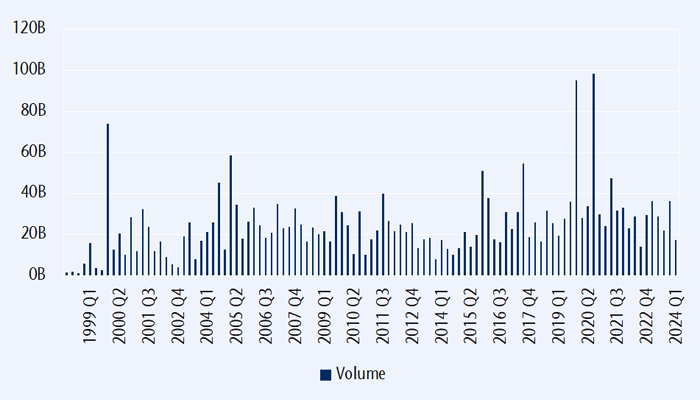
Mergers and acquisitions volumes in Japan from 1999 to 2024.
Source: Bloomberg

Many other markets like Australia, India, Korea and ASEAN are also expecting heightened M&A activity this year.

How does this impact the portfolio?

The accelerating M&A environment can be positive for smaller companies as their larger counterparts are willing to pay to acquire agile and innovative companies that can provide positive long-term growth perspectives. Furthermore, big companies seem to be diversifying by acquisition type. Larger, maturing companies can lack the same innovation capabilities as small companies to adjust, create and develop faster due to their nimble structure.

How else do we participate in the M&A cycle? 

Another way to capitalize on this trend is by investing in a M&A advisory firm. These companies provide advice on corporate mergers, acquisitions and divestitures as well as debt and equity financing, acting as intermediaries in business sale transactions for either the selling company or the buyer.

We have profited from the M&A theme via Rothschild & Co., a France-based merger and acquisition boutique firm that has generated solid returns for our clients. Also, we recently initiated a position in Evercore, a name we have owned in the past and decided to repurchase because it is poised to outperform its competitors in the M&A space.

Founded in 1995, Evercore is an independent investment bank and asset manager, ranking #1 among independent firms and #4 among all M&A boutiques, including well-known players like Goldman Sachs. The company has a strong and liquid balance sheet, making it an excellent example of an investment that should benefit from the exciting uptick in M&A activity.

Paysage urbain au coucher du soleil capturé depuis un gratte-ciel résidentiel du centre-ville de New York.

Michael Mormile, ancien gestionnaire de portefeuille de Citadel, ainsi que Jonathan Hartofilis et Richard Li, s’associent au Groupe financier Connor, Clark & Lunn Ltée (Groupe financier CC&L) pour lancer conjointement FortWood Capital (FortWood), un nouveau gestionnaire de placements dans les marchés émergents. Dans le cadre du lancement, le Groupe financier CC&L fournira des capitaux de démarrage ainsi que des placements d’autres clients.

FortWood cherche à tirer parti des occasions offertes par les inefficiences structurelles des titres de créance des marchés émergents mondiaux au moyen d’un portefeuille diversifié de titres de créance. Michael Mormile explique : « Notre approche combine une analyse macroéconomique et fondamentale approfondie avec un cadre de gestion du risque rigoureux afin de gérer efficacement les complexités du marché des titres de créance des marchés émergents et de transformer la volatilité inhérente aux marchés en force pour le portefeuille. »

Les stratégies de rendement absolu et à gestion active composées exclusivement de positions acheteur sur les marchés émergents ciblent les obligations de sociétés et d’État libellées en monnaies étrangères. Ces stratégies sont conçues pour les clients qui cherchent à tirer parti des taux attrayants et des divergences de valeur que l’on trouve dans les marchés sous-étudiés.

« Notre partenariat avec Michael, Jonathan et Richard pour étendre notre présence dans les titres de créance des marchés émergents est une excellente nouvelle pour nous. L’expertise de l’équipe FortWood dans ces régions et ces marchés offre aux clients la possibilité d’une diversification supplémentaire complémentaire à nos produits existants, ainsi que des rendements potentiellement plus élevés, » déclare Warren Stoddart, chef de la direction du Groupe financier CC&L.

« En nous joignant au Groupe financier CC&L, nous obtenons non seulement un soutien opérationnel institutionnel et une distribution mondiale, mais aussi une culture d’excellence partagée qui nous permettra sans aucun doute de nous concentrer sur ce que nous faisons le mieux et d’obtenir des résultats exceptionnels pour nos clients, » déclare Michael Mormile.

Ce partenariat, qui repose sur une équipe solide et des principes communs, permet à FortWood et au Groupe financier CC&L de tirer parti d’une catégorie d’actif en croissance ainsi que de nouvelles occasions de produire de meilleurs résultats pour les clients.

À propos de FortWood Capital

FortWood Capital se spécialise dans les stratégies de titres de créance des marchés émergents à gestion active. En mettant en œuvre son expertise en placement et un cadre de gestion du risque rigoureux, la société compose avec des marchés complexes et des conditions difficiles afin de dénicher de la valeur. FortWood, dont le siège social est situé à Greenwich, au Connecticut, fait partie du Groupe financier CC&L. Pour obtenir des précisions, consultez le site fortwoodcapital.com.

À propos du Groupe financier Connor, Clark & Lunn Ltée

Le Groupe financier CC&L est une société indépendante de gestion d’actifs multientreprises appartenant à ses employés qui travaille en partenariat avec des professionnels des placements pour bâtir et faire croître des entreprises de gestion d’actifs prospères. Il offre, par l’intermédiaire de ses sociétés affiliées, une vaste gamme de produits et de solutions de gestion de placements traditionnels et non traditionnels aux clients institutionnels, aux clients fortunés et aux particuliers. Comptant des bureaux aux États-Unis, au Royaume-Uni, en Inde et partout au Canada, le Groupe financier CC&L a plus de 40 ans d’histoire et ses sociétés affiliées gèrent collectivement un actif d’environ 90 milliards de dollars américains. Pour obtenir des précisions, consultez le site cclgroup.com.

Personnes-ressources pour les médias :

Rebecca Jan
[email protected]

Personnes-ressources pour les ventes mondiales :

États-Unis
Eric Hasenauer
[email protected]

Europe et EMOA
Carlos Stelin
[email protected]

Canada
Brent Wilkins
[email protected]

The quarterly commentary in mid-2023 noted that the cycle and monetary analyses were giving conflicting signals. The stockbuilding cycle appeared to be tracing out a low, a development usually associated with stronger performance of equities and other cyclical assets. However, greater weight was accorded to continued weakness in global real narrow money momentum, which suggested downside risk to economic activity and insufficient liquidity to support market gains.

The cycle signal has so far proved the correct one, with cyclical assets rallying strongly over the past five months. Monetary conditions have been more permissive than expected, probably reflecting continued deployment of “excess” money balances left over from the 2020-21 monetary surge, as well as unusual US deficit-financing operations.

What now? Valuations of some cyclical assets appear already to discount a solid and sustained economic upswing. Global real narrow money momentum has recovered slightly but remains negative, while the level of money balances may now be below “equilibrium”. Until money growth normalises, the risk is that an initial stockbuilding cycle recovery will prove disappointingly weak or even fail, with a retest of the 2023 low. A monetary revival, meanwhile, may have been pushed back by major central banks’ caution in reversing 2022-23 policy restriction, although an easing trend is under way in EM.

Commentaries in 2022 argued that the stockbuilding cycle was likely to bottom in 2023, probably in H2, based on the cycle’s 3.33-year average length and the prior low having occurred in Q2 2020. The possibility of an earlier trough was considered, on the view that the current cycle could be shorter than average to compensate for a longer prior cycle (4.25 years).

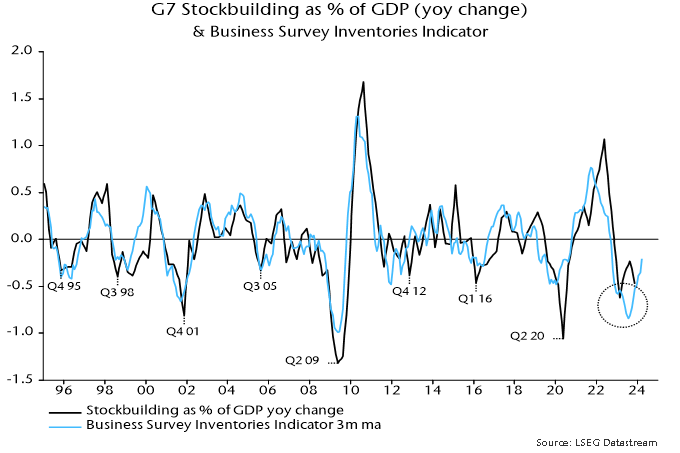
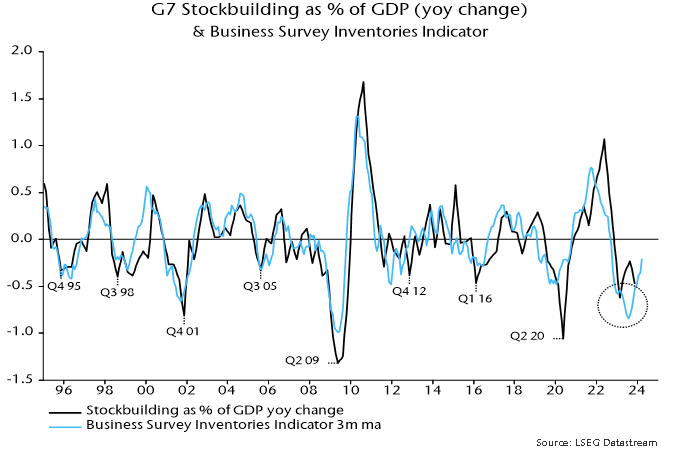
The key indicator used to monitor the cycle – the annual change in the stockbuilding share of G7 GDP – appears to have reached a major low in Q1 2023. A secondary indicator based on business surveys confirmed this trough in July – see chart 1.

Chart 1

Chart 1 showing G7 Stockbuilding as % of GDP (yoy change) & Business Survey Inventories Indicator

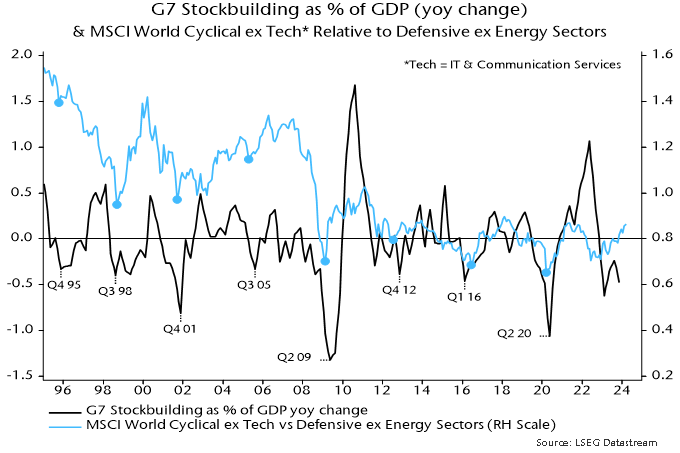
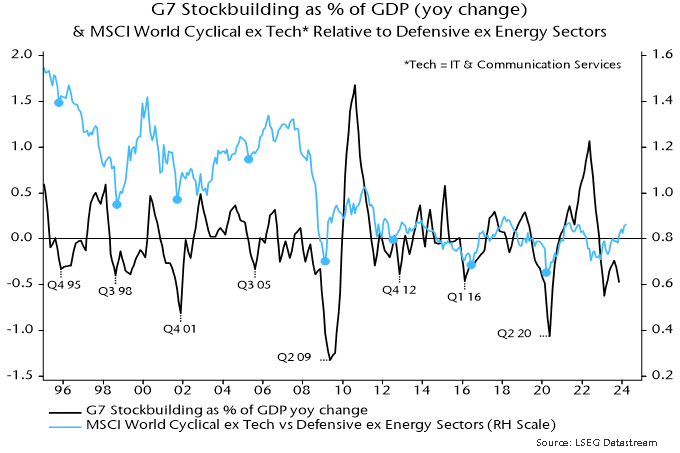
Stockbuilding cycle lows historically were usually associated with nearby major or minor lows in cyclical asset prices. Chart 2 shows the relationship with the relative performance of equity market cyclical sectors, excluding IT and communication services. A cyclical rally gathered pace from April 2023, consistent with a H1 cycle trough.

Chart 2

Chart 2 showing G7 Stockbuilding as % of GDP (yoy change) & MSCI World Cyclical ex Tech* Relative to Defensive ex Energy Sectors *Tech = IT & Communication Services

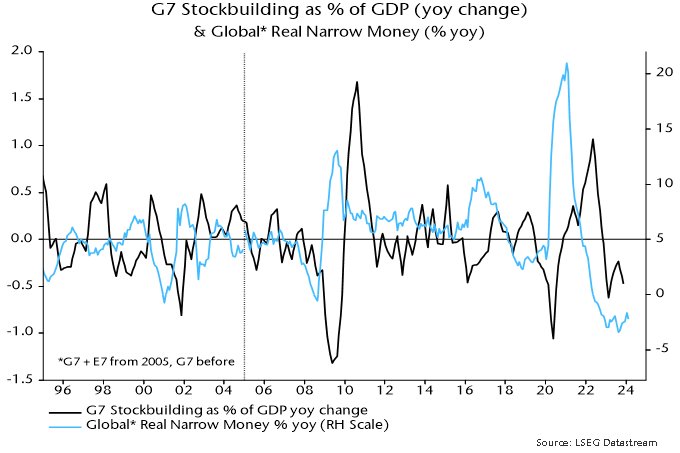
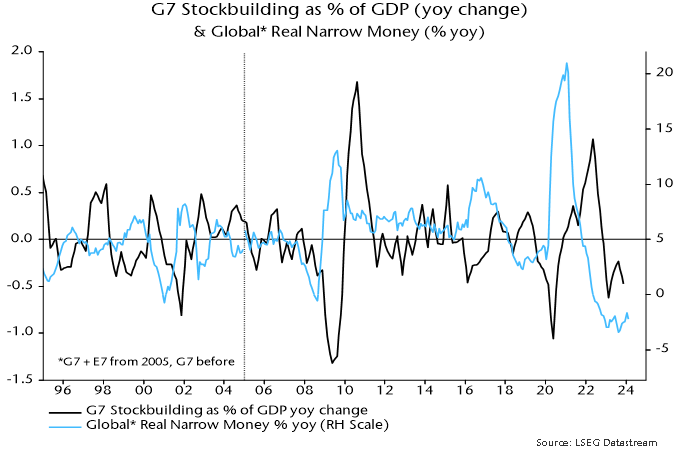
Why was a scenario anticipated in 2022 sadly underplayed in commentaries last year? The difficulty was that stockbuilding cycle lows historically were preceded by an upturn in global real narrow money momentum – chart 3. A marginal recovery in annual momentum occurred between February and June last year but a relapse to a lower low ensued. With no monetary improvement, and major central banks continuing to tighten into H2, it seemed unlikely that economic news and fund flows would support outperformance of cyclical assets.

Chart 3

Chart 3 showing G7 Stockbuilding as % of GDP (yoy change) & Global* Real Narrow Money (% yoy) *G7 + E7 from 2005, G7 before

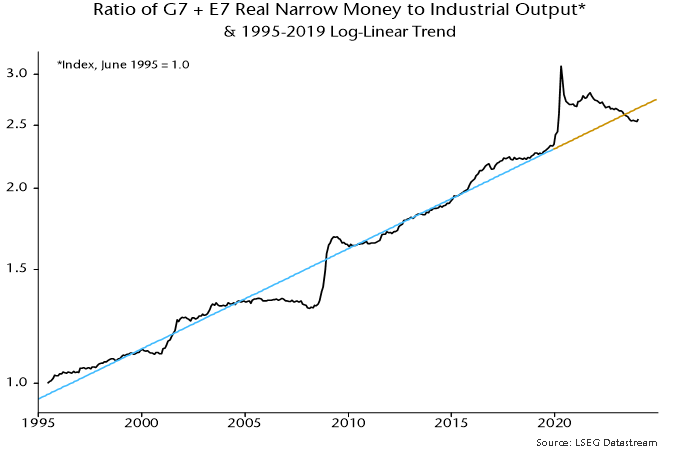
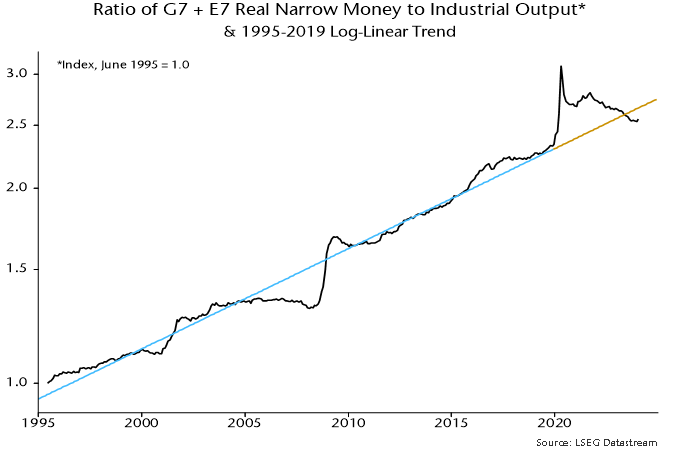
One explanation for the disconnect is that real money momentum, while a reliable indicator historically, failed to capture the availability of money to support activity and markets because of an overhang of “excess” balances created by earlier monetary strength. The ratio of the stock of global real narrow money to industrial output at end-2022 was still 4% above its steeply rising pre-pandemic trend – chart 4.

Chart 4

Chart 4 showing Ratio of G7 + E7 Real Narrow Money to Industrial Output* & 1995-2019 Log-Linear Trend *Index, June 1995 = 1.0

The strength of US equities may also have partly reflected the US Treasury’s decision, following the suspension of the debt ceiling in June, to “overfund” the federal deficit via issuance of bills, which were purchased mainly by money-creating institutions. This had the effect of more than offsetting the monetary drag from the Fed’s QT, while low coupon issuance created space in investors’ portfolios for additional purchases of credit and equities.

Support from these influences should be at or close to an end. The ratio of global real narrow money to industrial output returned to its March 2020 level in mid-2023, moving sideways since and now 4% below the pre-pandemic trend – chart 4. The Treasury’s financing plans, meanwhile, envisage a reduction in the bill float in Q2, raising the possibility of renewed monetary US weakness unless the Fed swiftly tapers QT.

Global real narrow money momentum has firmed again since Q3 2023 but remains negative, in both annual and six-month terms. A revival could, in theory, continue even if major central banks delay policy easing: rising economic confidence could be reflected in a switch out of time deposits and money funds into demand / overnight deposits, while EM money trends may improve further in response to recent policy easing. More likely, a normalisation of money growth will require a significant reversal of 2022-23 DM policy rate hikes.

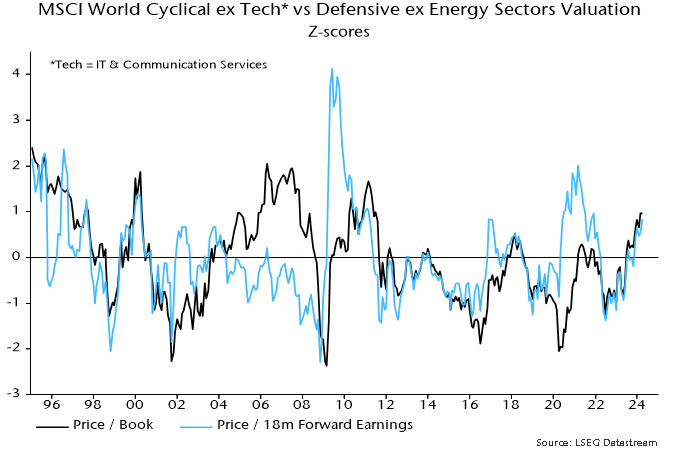
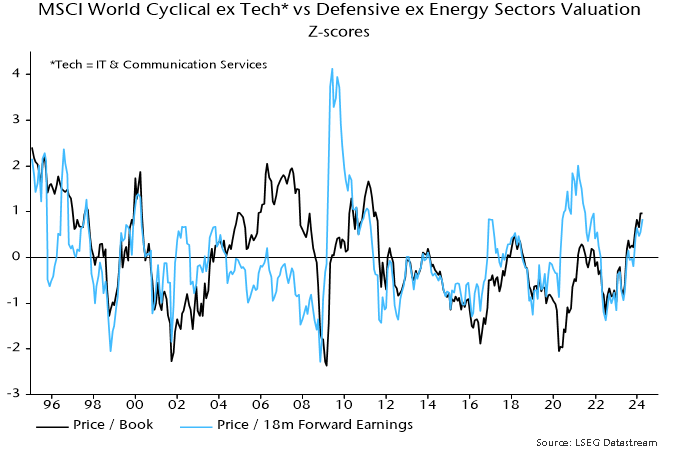
Without a further rise in real money momentum, the initial stockbuilding cycle recovery may prove disappointingly limp or even fizzle altogether, revisiting the H1 2023 low. Such a scenario would pose a major risk to some cyclical assets now apparently discounting solid / sustained economic growth, such as the DM cyclical equities sector basket – chart 5.

Chart 5

Chart 5 showing MSCI World Cyclical ex Tech* vs Defensive ex Energy Sectors Valuation Z-scores *Tech = IT & Communication Services

How could investors sharing the latter concern and favouring a defensive bias hedge against the possibility that a stockbuilding cycle upswing unfolds normally, implying economic acceleration into 2025? Some cyclical assets have lagged, including industrial commodity prices, the DM materials sector and EM cyclical sectors, which – unlike in DM – are at a low valuation versus defensive sectors relative to history.

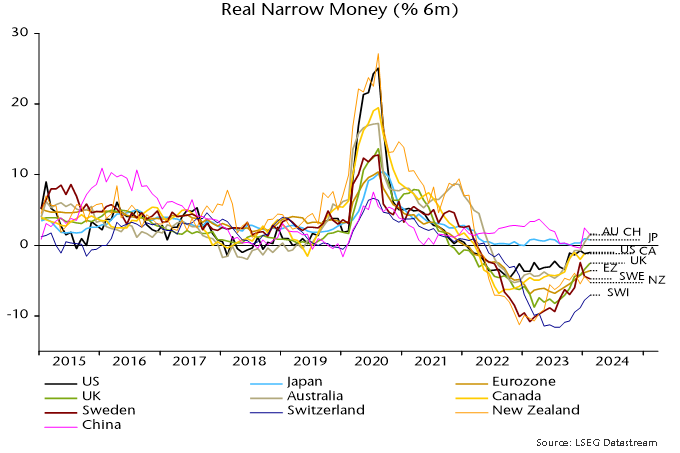
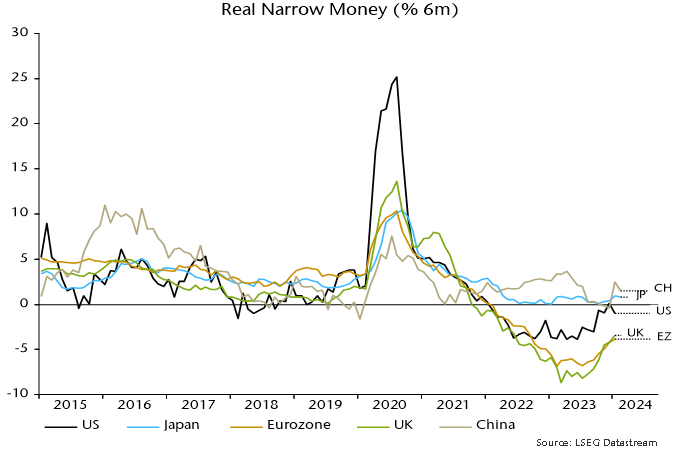
Chart 6 shows six-month real narrow money momentum in major countries. The US remains above Europe but the gap has narrowed, while, as argued above, the US recovery could go into reverse into Q2. The UK, meanwhile, has crossed above the Eurozone, suggesting improving relative economic prospects following GDP underperformance in the year to Q4.

Chart 6

Chart 6 showing Real Narrow Money (% 6m)

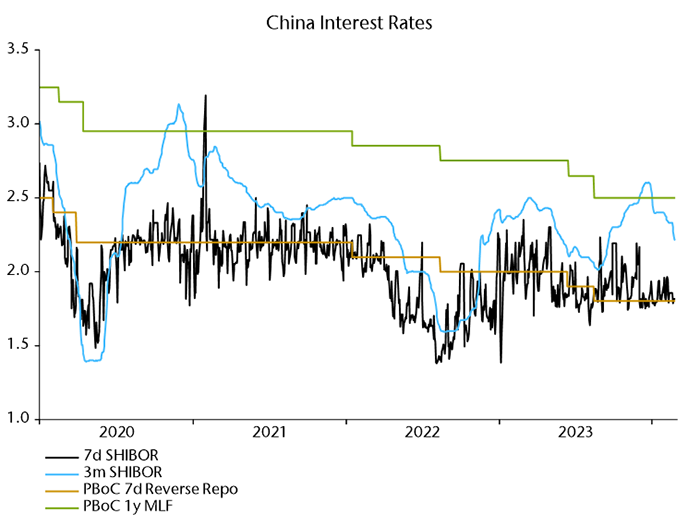
China was a significant contributor to the recent rise in global real narrow money momentum, following record PBoC lending to banks in Q4. Such lending, however, contracted in January / February and a decline in term money rates has stalled, raising concern that the recovery in money growth will falter.

Other notable features include a pick-up in Australia, continued relative weakness in Switzerland and a relapse in Sweden. The suggestion is that the Australian economy will outperform, delaying rate cuts; by contrast, the Swiss National Bank has already embarked on easing, with the Riksbank expected to follow in Q2.

G7 inflation has continued to moderate in line with a simplistic monetarist forecast based on the profile of broad money growth two years earlier. A note in November 2022 suggested that annual consumer price inflation (GDP-weighted average), then at 7.8%, would fall below 3% by December 2023. The latest reading, for February, was 2.9%.

US annual core inflation on the Fed’s favoured PCE measure was 2.8% in February or 2.2% excluding lagging rents. Market concerns about inflation remaining “stubborn” are based on a rebound in shorter-term momentum measures but this has been mainly due to an outsized January gain, possibly reflecting residual seasonality (which could also explain unexpected weakness in late 2023), i.e. these measures are likely to fall back sharply as the January effect drops out.

G7 annual broad money growth continued to decline into April 2023, suggesting that the primary inflation trend will remain down into H1 2025. The reduction to date, however, was accelerated by post-pandemic normalisation of supply chains and weakness in commodity prices – the former effect is over and commodity prices usually rise during stockbuilding cycle upswings. The baseline view here remains that inflation rates will return to target by H2 2024 with significant risk of a subsequent undershoot and no sustained rebound before H2 2025.

International equity markets were weak in Q1 2022, initially on poor inflation news and the Federal Reserve turning more hawkish, then in response to the Russian invasion of Ukraine.  Markets hit a closing low on 8th March and recovered into the quarter end.  The EAFE index fell 3.6% in local currency terms and 5.79% in US dollars.  Energy was the strongest sector, gaining 17.22% as oil and gas prices rose sharply.  IT, considered a long duration sector sensitive to interest rates in the short term, was the weakest, falling 16% as bond yields rose.

The invasion has united Western leaders in condemnation of President Putin’s regime and the world’s liberal democracies have responded with sanctions and military aid to Ukraine.  The need to spend more on defence and reduce reliance on Russian commodities has become clear and Germany has had to reverse its policy of economic and business engagement with the Kremlin.  The extraordinary bravery of the Ukrainian forces matched by a poorly performing Russian military have denied Putin a swift victory and a longer conflict has ensued.  NATO leaders have avoided an escalation involving member nations so far.  A negotiated peace settlement, however distasteful that process may be, will be the solution but Putin will come to the table seriously only when he believes he has enough gains to sell his actions to the Russian people as a victory.  Given his autocratic control of the media that may come sooner than expected.

Economic growth expectations have been revised down across Europe as consumer confidence has fallen and real wages are squeezed by higher inflation.  Monetary authorities have been behind the curve and are responding too late, probably making another policy mistake by tightening policy as the global economy slows sharply.  President Macron’s attempts at diplomacy with Putin initially served him well in the polls for the French presidency but his ratings have since been slipping and he will face the right wing Marine Le Pen in the run-off, a repeat of the 2017 election.  Eurozone real money growth has slowed significantly suggesting the economy could tip over into recession later this year or in 2023.  In the United Kingdom the squeeze on real incomes is particularly acute as consumers experience significant rises in energy bills as the price cap rolls off exposing users to the surge in European gas prices.  The invasion of Ukraine has reduced the pressure on Prime Minister Johnson from the ‘Partygate’ scandal but the cost of living crisis with higher taxes and higher prices may undermine his premiership further.

In Asia the Japanese yen was notably weaker as the Bank of Japan maintained its 25bp 10 year yield ceiling in its ongoing efforts to stimulate inflation.  A higher oil price is bad for a country that imports most of its energy but the weaker currency should help competiveness.  Another problem for Japan is the weakness of the Chinese economy which has had to instigate more lockdowns as Covid infections rise in many regions.  The outlook improved for the beleaguered Chinese tech stocks, which had been under regulatory pressure in 2021.  An announcement from China’s state council signalled a desire to keep its capital markets stable, an end to the regulatory clampdown on big tech soon and support for overseas stock listings.  There remains a risk of a negative response from trading partners if China provides support for Russia but policy-makers now seem to realise that continuing to punish the big internet stocks is no way to build a cutting edge technology sector.

Our liquidity indicators continue to give a negative signal for the global economy and risk assets.  The rise in inflation is probably peaking but tighter monetary policy implemented belatedly by central banks will continue to suppress real money growth.  The negative excess liquidity signal usually coincides with relative underperformance by tech and other cyclical sectors while energy and other defensive sectors outperform.  Normally high yield and quality outperform while momentum suffers.  Higher bond yields due to stronger commodity prices have prevented the usual outperformance by quality which often trades at a valuation premium.  The drag from the stockbuilding cycle should ease the upward pressure on commodity prices allowing bond yields to fall and quality stocks to reassert their usual pattern of outperformance in slow growth environments.          

Transactions over the quarter reduced the underweight in Europe, moved Japan underweight, reduced emerging markets and moved Asia ex Japan overweight.  At the sector level we have added to energy moving slightly overweight and are also now overweight communications.  IT has been reduced and we have exited some UK domestically orientated stocks where we fear the economy faces a hard landing.  The focus has been to add to defensive stocks reducing cyclical exposure.  Stock and sector selection were both negative over the quarter with our preferred quality and growth factors lagging value and high yield.  The average underweight in financials, energy and miners was negative as was the overweight in IT.  Stock picks were negative across regions and most sectors the exceptions being energy and IT.

The Composite fell 9.42% (9.56% Net) versus a 5.91% fall for the benchmark.

Smiling woman holding mobile phone shopping in grocery store.

Food banks in Canada are expecting an 18% increase in demand in 2024 as consumers continue to face cost of living concerns. Last week, Liberal members of the House of Commons finance committee supported an NDP motion to implement an excess profits tax on large grocery retailers to address rising food prices.

Seeking efficiencies in retail

In response, grocery retailers are likely to seek new efficiencies. VusionGroup (Ticker: VU.FP and formerly called SES-imagotag), a recent addition to our portfolio, is positioned as a key player in this scenario, offering cutting-edge digital equipment and software services to help retailers digitalize and optimize their points of sale. The company offers an extensive range of IoT devices, such as electronic shelf labels, video displays, sensors, wireless shelf cameras and smart rails designed to streamline operations and reduce labour for low value-added tasks. Vusion’s in-house software solutions automate pricing and enable efficient inventory management, enhancing the shopping experience and brand marketing efforts.

The shift to electronic shelf labels (ESLs)

Switching to ESLs presents several advantages for retailers, including operational cost reduction and improved pricing flexibility, which can boost revenue and profitability. Changing paper-based labels in stores is labour-intensive and many staff are paid low or minimum wages, a sector that has seen significant raises. Prices displayed on ESLs can be automatically and quickly updated using Vusion’s software, allowing retailers to either reduce staff or reallocate them to higher value-added and customer-facing tasks.

Enhancing efficiency and the retail experience

The automatic pricing feature of ESLs offers additional benefits. Retailers can be more flexible with pricing, quickly adjusting to inflation and the competitive environment, thereby maximizing revenues and profitability. This flexibility also facilitates pricing adjustments, such as promotions on fresh produce, to limit waste. In general, fewer pricing errors improve the overall customer experience.

Another aspect of improving the customer experience is ensuring product availability on shelves. Industry experts estimate sales lost due to lack of products on shelves are around 8% of total revenues for a point of sale. By integrating ESLs and smart cameras, Vusion enables store managers to be automatically notified if a product is running low, prompting shelf replenishment from store inventory or triggering an order for more products. Optimizing inventory management maximizes cash generation at the store level.

Leveraging technology for inventory and online order efficiency

The COVID-19 pandemic accelerated online grocery sales in the US, a trend expected to grow at a rate of over 20% annually. Vusion’s products allow for efficient processing of online orders, with most being fulfilled directly from the stores. ESLs enable “pickers” to be more efficient by providing the fastest route to collect all items in an order. ESLs even flash to indicate where a product can be found, reducing the time employees spend on each order and minimizing the risk of incomplete or incorrect orders. Retailers and fast-moving consumer goods companies can also use ESLs as a marketing tool by implementing targeted promotions and offering coupons to customers.


Conclusion: Vusion’s promising long-term growth

Despite initial challenges due to concerns over battery life, technological improvements have addressed these issues and significant milestones, such as Walmart’s recent large-scale ESL deployment, signal a promising growth trajectory for the technology. Vusion’s leadership in the global ESL market suggests a strong growth outlook, with the potential for widespread ESL adoption and market penetration to the tune of 20% to 30% from approximately 7% today, or up to three billion labels by 2027. Adding replacement labels, smart camera installation opportunities, and cloud and software subscriptions only increases the potential addressable market.

With a dominant market share, a top-tier and broad product range, and strong relationships with major retailers, Vusion is an exciting long-term growth story in our view.

US economic “resilience” in 2023, recent inflation stabilisation and buoyant risk asset markets raise the question of whether the current level of policy rates is restrictive.

A “neutral” level of rates, according to the monetarist view, is one that results in monetary growth consistent with target inflation. Based on 2010s experience, US broad money expansion of about 5% pa could reasonably be expected to yield medium-term inflation of 2%. (“Broad money” here refers to an expanded M2 measure – “M2+” – incorporating large time deposits at commercial banks and institutional money funds.)

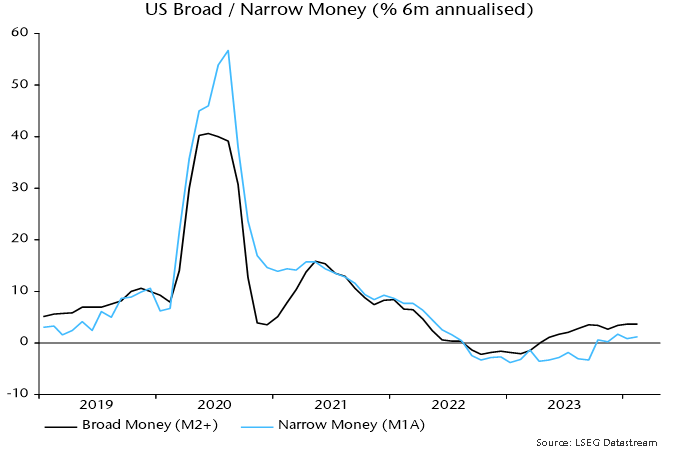
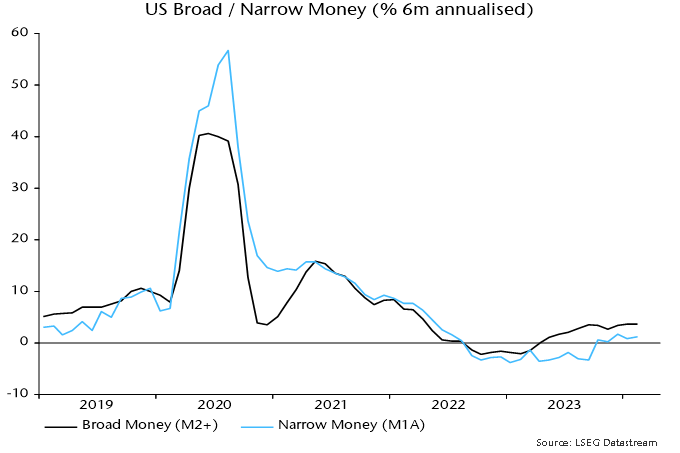
The six-month rate of change of broad money recovered from negative territory in early 2023 to 3.7% annualised in January, remaining at this level in February – see chart 1. This might be taken to suggest that the economy is adjusting to the higher level of rates and the current deviation from “neutral” is modest.

Chart 1

Chart 1 showing US Broad / Narrow Money (% 6m annualised)

Money growth over the past year, however, was boosted by unusual deficit financing operations, which more than offset monetary destruction due to the Fed’s QT. The Treasury’s plans to scale back bill issuance imply a sharp reversal in Q2, as previously discussed.

Put differently, the “neutral” level of rates may have been temporarily lifted by the Treasury’s financing operations but a relapse is now likely.

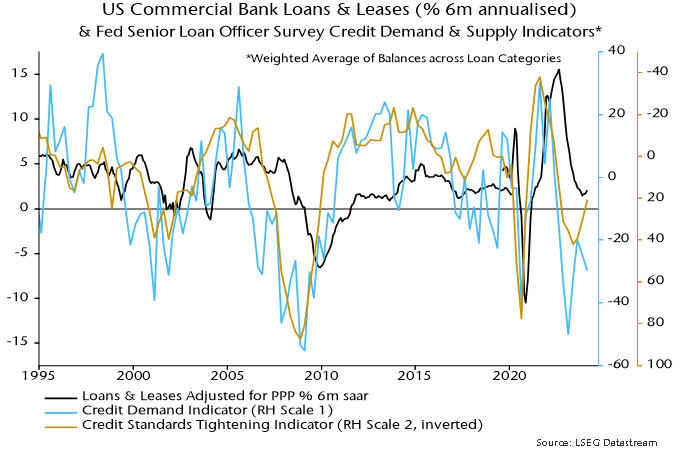
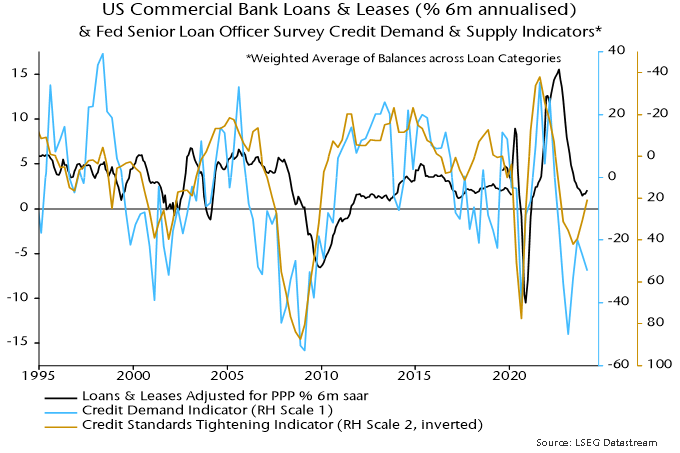
Could a recovery in bank lending offset a near-term drag on money growth from less expansionary Treasury operations and ongoing QT? Six-month growth of commercial bank loans appears to have bottomed in late 2023 but was only 2.1% annualised in February, while the last Fed loan officer survey remained downbeat – chart 2.

Chart 2

Chart 2 showing US Commercial Bank Loans & Leases (% 6m annualised) & Fed Senior Loan Officer Survey Credit Demand & Supply Indicators* *Weighted Average of Balances across Loan Categories

The suggestion that “neutral” is significantly lower than the current level of policy rates is supported by narrow money trends. (“Narrow money” = M1A = currency in circulation plus demand deposits.) Six-month momentum also recovered during 2023 but peaked at only 1.7% annualised in December, easing to 1.2% in February – chart 1.

Narrow money may be re-entering contraction – monthly changes were negative in January and February.

The latest US data support concern that a minor recovery in global six-month real narrow money momentum is about to go into reverse.

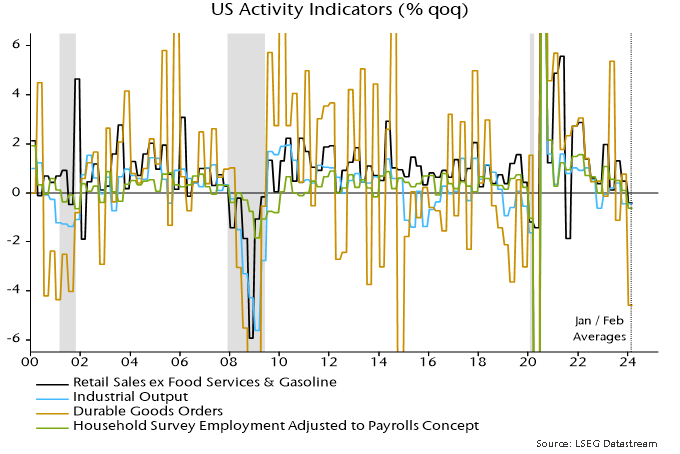
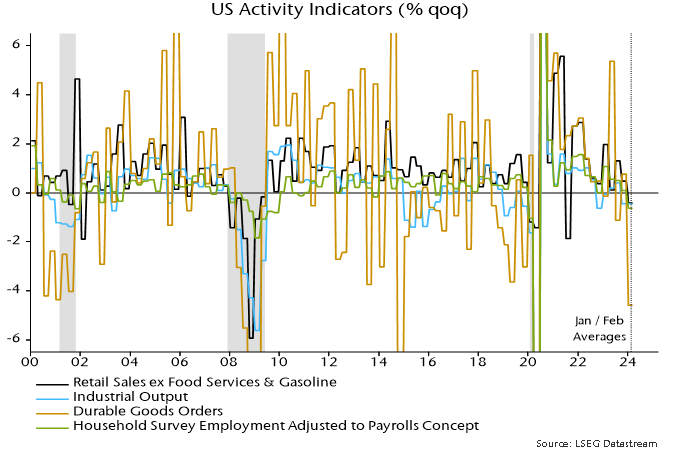
Meanwhile, weakness in US “hard” economic data for January / February has, perhaps, received less attention than it deserves. Average levels of retail sales, industrial production, durable goods orders and household survey employment were lower than in Q4 – chart 3. March data could change the story but joint quarterly declines were historically characteristic of recessions.

Chart 3

Chart 3 showing US Activity Indicators (% qoq)

View of Shibuya Crossing in Tokyo, Japan, one of the busiest crosswalks in the world.

Japan’s banking sector has long been overlooked by investors. It’s considered either not essential to own or to be avoided due to the challenges posed by negative interest rates and deflation, which have consistently squeezed bank profitability. However, the recent rally in Japanese banking stocks since 2023 signals a potential return to normalcy. So, what exactly is happening within Japan’s banking sector, what factors are driving the rally and is it sustainable?

Looking back – Deflation and Japan’s ultra-loose monetary policy

Understanding the current situation entails looking back on Japan’s prolonged battle with deflation and the rationale behind introducing negative interest rates.

Japan has experienced deflation since the mid-1990s, following the collapse of its economic bubble in the early 1990s. Various economic factors, including a domestic consumption tax hike from 3% to 5% and the Asian currency crisis in 1997, put downward pressure on the Japanese economy. In response, the Bank of Japan (BOJ) gradually reduced its policy rate throughout the 1990s, eventually adopting a zero-interest rate policy in 1999. Despite briefly abandoning this policy in 2000, the BOJ introduced quantitative easing in 2001 after the bursting of the IT bubble in the US. Further challenges emerged with China’s entry into the World Trade Organization in 2001, putting deflationary pressure on Japan by supplying cheap labour. The Great Financial Crisis of 2008 intensified the issues. Exports were sluggish due to a strong yen against dollar (USD/JPY fell below the 76 level), and declining demand amid a global recession.

Change began to emerge in late 2012 with the introduction of Prime Minister Abe’s economic policies, known as Abenomics, which included quantitative and qualitative easing measures. This initially signalled a shift away from deflation. But the momentum stopped when the government hiked the consumption tax rate from 5% to 8% in April 2014. Then BOJ Governor Kuroda committed the BOJ to achieving 2% inflation, but the target was pushed further into the future.

Recognizing the need for intervention, the BOJ introduced negative interest rates in January 2016, surprising the market and causing significant disruptions. Subsequently, the BOJ introduced its yield curve control policy in September 2016, which had been in effect until it was terminated by the BOJ earlier this week.

Turning the tides by escaping deflation and normalizing interest rates

Fast forward to today, after decades of efforts to fight deflation, Japan is finally seeing signs of progress. Inflation has been consistently above the BOJ’s targets of 2% since May 2022, helped by price hikes and wage increases.

Historically, Japanese companies are reluctant to pass on higher costs to consumers or clients, fearing it may damage the relationship. Instead, they turn to cost-cutting measures internally. However, the unprecedented challenges during the pandemic forced many companies to negotiate higher prices with customers. To their surprise, most customers were cooperative and willing to accept the price increase, leading to improved margins across industries. The mindset of Japanese companies is also starting to change, where they are becoming more willing to pass on higher costs and reduce unprofitable businesses.

Additionally, Prime Minister Kishida’s government has been pushing corporates to increase wages, a key policy of its “new form of capitalism” campaign. Finally in April 2023, labour unions in Japan won the biggest pay increase in 30 years in their spring wage negotiations with management, achieving an average wage hike of 3.7%. In 2024, the union group announced an even higher raise of 5.28%. Although this largely applies to the biggest companies in Japan, smaller employers are likely to follow suit given the country’s tight labour market. With higher disposable income and improved consumer sentiment, the virtuous cycle should be able to support the sustainability of inflation. As a result, the BOJ decided to guide overnight lending rates to 0% to 0.1%, up from -0.1% to 0%, marking the first time the BOJ has raised its interest rates in 17 years.

Rallying behind banking: Equity markets and corporate governance reform

Equity markets are starting to view Japanese banking stocks as normal investment targets once again due to the end of deflation and interest rate normalization.

Another positive change is corporate governance reform. Although it has been several years since the Corporate Governance Code was established by the Tokyo Stock Exchange (TSE) in 2015, 2023 saw the most changes at Japanese publicly listed companies after the TSE called on companies’ management to be more mindful of the cost of capital and stock prices to enhance corporate value. This initiative particularly targets companies with price-to-book ratios below 1x. The vast majority of Japanese banks trade at a significant discount to their book value. Responding to this request, many banks laid out improvement plans aimed at enhancing Return on Risk-weighted Assets (RORA), Return on Equity (ROE) and shareholder returns.

Looking ahead, the prospects of Japanese banks appear promising, with sustainable inflation driven by economic growth and wage increases. In addition, the relocating of manufacturing facilities back to Japan amid the onshoring and reshoring trend, and increased loan demand, are also expected to benefit the sector. Japan is still in the very early phase of rate normalization, and Japanese banking stocks are still in the process of returning to normal compared with Japanese stocks in general. The improving financial metrics should also help J-banks to be more comparable to their global peers.

Spotlight on Concordia Financial Group

We initiated a position in Japanese regional bank Concordia Financial Group (7186 JP) in 2023. Concordia FG consists of three banks – the core is Bank of Yokohama, with over 100 years of history – and two other smaller banks, Higashi-Nippon Bank and Kanagawa Bank, which the group acquired in the past few years. As one of Japan’s largest regional banks, Concordia FG boasts efficient operations and strong loan growth, particularly in Tokyo and the Kanagawa Prefecture, which have seen the highest net migration from other areas and strong banking demand due to high concentration of corporates and SMEs.

Unlike some of the problematic regional banks in the US that rely on corporate deposits, Japanese banks have accumulated their deposits over time from loyal retail customers. In the case of Concordia FG, over 70% of deposits are from retail channels. Even after the bank run at Silicon Valley Bank (SVB) in March 2023, deposits at Concordia FG continued to grow steadily, with no obvious change in customers’ banking behaviour. The bank maintains a low securities-to-asset ratio of 12%. The same ratio was over 50% for SVB. The bank also has very tight risk controls in its lending practices, maintaining a conservative loan-to-asset ratio of 85%. The banks’ loan portfolio is well-diversified, with no exposure to the commercial real estate sector in the US.

Further prospects and technological advances

Despite Japan’s rising personnel costs, Japanese banks’ management teams remain committed to controlling costs. Recent years have seen continued downsizing efforts, including branch closures and reductions in the number of ATMs. Branch closures are not simply an effort to reduce network size, but part of a strategic shift to increase online banking usage and enhance convenience for consumers. Efforts include expanding the number of ATMs at convenience stores and providing non-branch ATMs in collaboration with other major banks.

Another Japan-based bank we invest in, Seven Bank (8410 JP), is expected to benefit from this trend. With banks seeking to streamline their ATM fleets, some have chosen to partner with Seven Bank, boasting the largest ATM network in Japan with over 27,000 ATMs. Its next-generation ATMs offer advanced features beyond simple deposits and withdrawals, including face recognition for identity verification, settlement with QR codes and the ability to open bank accounts. It also utilizes AI and IoT to predict cash demand more precisely and detect potential component failures, which helps to optimize ATM operations.

As Japan’s banking sector continues to adapt to evolving economic conditions, we remain optimistic about its long-term prospects.

Global six-month real narrow money momentum – a key leading indicator in the forecasting approach employed here – has recovered from a low in September 2023 but remains negative and could be stalling. Allowing for the typical lead, this suggests a slide in economic momentum into mid-year with limited subsequent revival.

Monetary trends, therefore, cast doubt on the current market consensus view that a global cyclical upswing is under way.

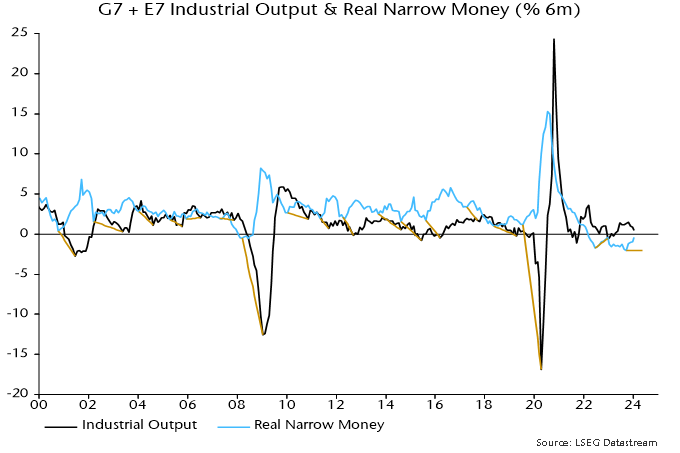
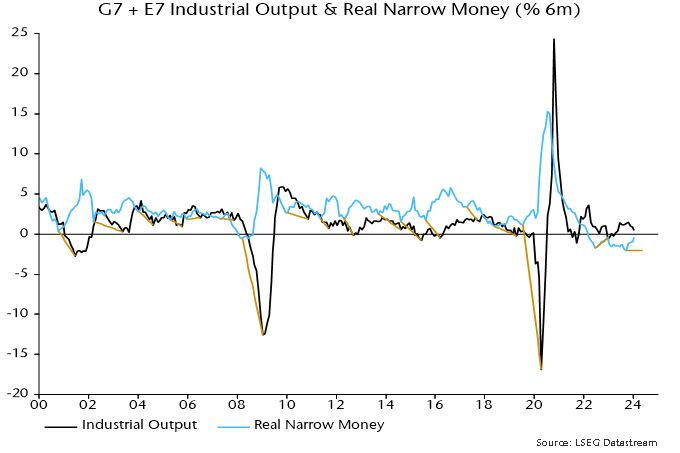
The real money / economic momentum relationship is primarily directional, i.e. involving turning points rather than levels. Chart 1 highlights related troughs in six-month rates of change of global (i.e. G7 plus E7) real narrow money and industrial output since 2000. The average lead time at these lows was eight months, with a range of four to 14.

Chart 1

Chart 1 showing G7 + E7 Industrial Output & Real Narrow Money (% 6m)

So the September 2023 low in real money momentum could be associated with an output momentum low any time between January and December 2024.

The directional relationship was briefly disrupted during the pandemic but has since been reestablished: a trough in real money momentum in June 2022 was followed by an output momentum low in December 2022, with subsequent peaks in December 2022 and October 2023 respectively.

Six-month output growth in January was the slowest since May.

While the directional relationship is intact, output momentum in 2022-23 was much stronger than suggested by prior levels of real money momentum. As previously discussed, this is probably attributable to a monetary “overhang” from rapid growth in 2020-21. The ratio of the stock of global real narrow money to industrial output returned to its March 2020 level in September last year and has since moved sideways, arguing for a normalisation of the levels relationship of real money and economic momentum.

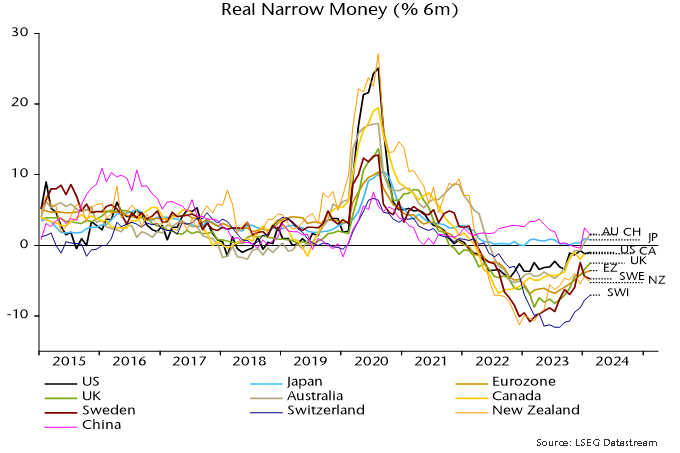
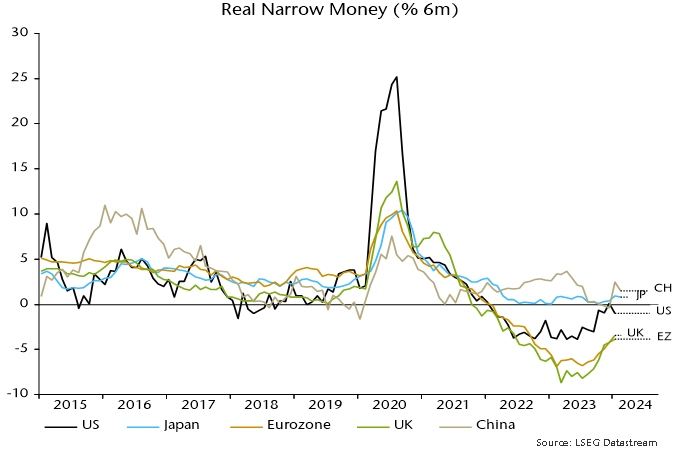
The recovery in real money momentum between September 2023 and January 2024 was broadly based across countries but the US pick-up reversed in January – see previous post – while Chinese / Japanese momentum declined in February – chart 2. So the global revival could be stalling with momentum still negative. (A February update will be provided following release of US / Eurozone monetary data next week.)

Chart 2

Chart 2 showing Real Narrow Money (% 6m)

How do monetary signals compare with messages from the yield curve?

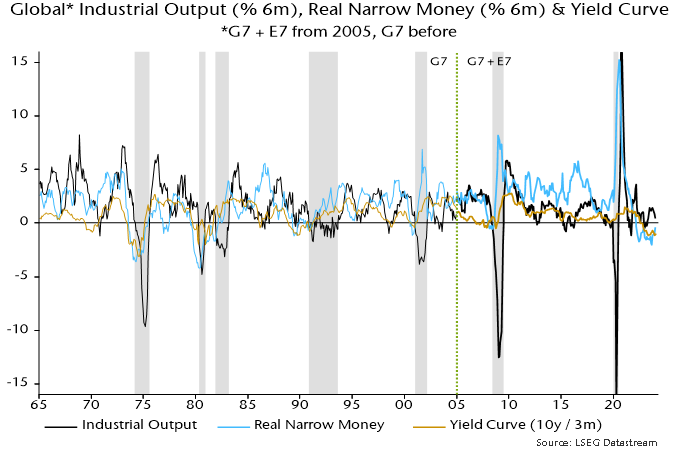
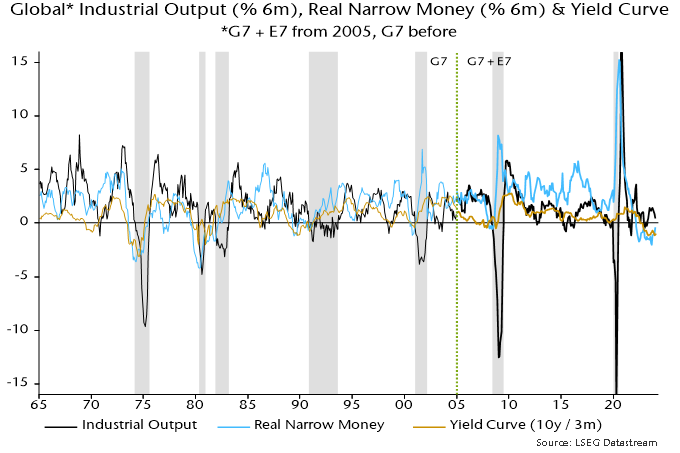
Chart 3 shows a longer-term history of six-month rates of change of global industrial output and real narrow money, along with the differential between GDP-weighted averages of 10-year government bond yields and three-month money rates. (The chart splices together G7 data through 2004 with subsequent G7 plus E7 numbers.)

Chart 3

Chart 3 showing Global* Industrial Output (% 6m), Real Narrow Money (% 6m) & Yield Curve *G7 + E7 from 2005, G7 before

The directional leading relationship between real money and economic momentum is equally convincing pre-2000, with a similar average lead time.

The yield curve has broadly mirrored trends in real money momentum, with a slight tendency for money to lead. However, the curve predicted fewer output momentum turning points, particularly in recent years, i.e. monetary signals have been more informative and reliable.

Continued yield curve inversion is consistent with still-negative real money momentum. An increase in inversion since October, moreover, contrasts with the recent monetary recovery, supporting concern that the latter may be stalling.

Combinations of negative real money momentum and an inverted curve were always followed by global recessions. The longest interval between a joint signal and recession onset was in 1989-90: real money momentum and the yield curve were both negative in April 1989, with a recession judged to have started in November 1990*.

The most recent joint signal occurred in October 2022, when the yield curve moved into inversion. Based on history, a recession would be expected by May 2024 at the latest. Are markets premature in sounding the all-clear? Assuming no downturn through May, should the signal be disregarded? Do I feel lucky?

*The recession bands in the chart begin when the six-month change in industrial output turns negative ahead of a fall to below -1.25% (not annualised).

Asian traveler with suitcase next to row of luggage carts at airport.

Summary

  • A bounce in unloved Chinese equities led a positive month for EM stocks, with the MSCI EM Index up nearly 5% in USD terms.
  • Among the leaders was portfolio holding Trip.com, which surged over 25%, reflecting a recovery in consumer demand for travel in China.
  • Korean stocks continued a run of strong performance fed by enthusiasm for the government’s proposed Corporate Value-up Program (covered in detail in last month’s commentary: Super-cheap Korean equities rally on market reform talks).
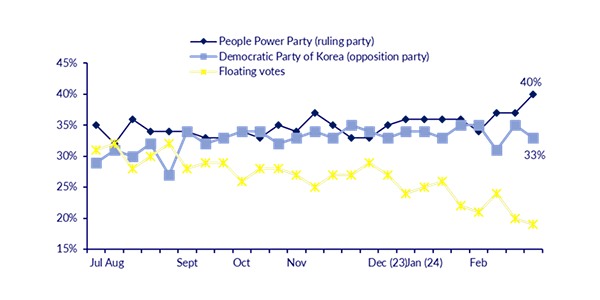
  • With around a third of South Korea’s population actively participating in the stock market, the reforms have boosted the ruling Democratic Party’s legislative election prospects, its approval rating reaching 40% against 33% for the opposition. The chart below from CLSA shows the turnaround in fortunes since the program was announced earlier in the year.

Korea general election poll
Line graph showing election polling results in Korea, July 2023 to February 2024.
Source: Gallup Korea &  CLSA, March 2024.

  • With less than one month before the election, re-election of the Democratic Party with a mandate to press forward with the reforms could be a catalyst for further outperformance by Korean equities.


AI boom exposes supply chain bottlenecks

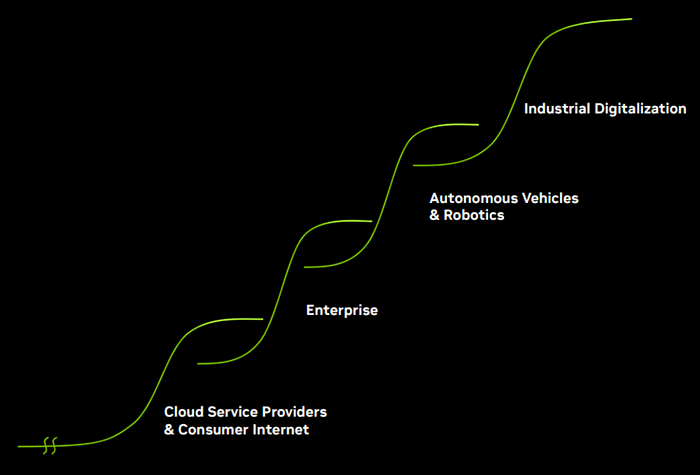
The global rush is on to harness an explosion of AI innovation, with investment by hyperscale cloud and consumer tech giants only the first wave of adoption powering demand for the technology.

Waves of AI adoption


Source: Nvidia Corporate Presentation, 2024.


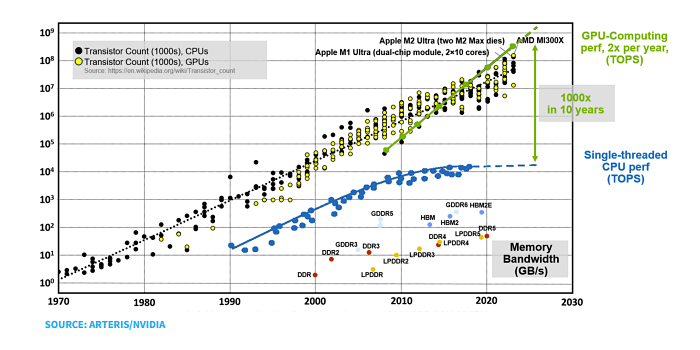
What unleashed this step change? While some more complex neural network architectures and algorithms have emerged in recent decades, the real shift has been the rapid advances in brute processing power that enables machine learning.

The chart below illustrates the yawning gap which has opened up between the power of GPUs (green line) and conventional CPUs (blue line), with the former now capable of executing many trillions more operations per second (TOPS).

Explosion in power of high-end chips
Line graph showing increasing GPU computing performance relative to CPUs.
Source: Nvidia/Arteris, 2023.


The chart also hints at one of the key bottlenecks to scaling AI applications like ChatGPT – aside from the difficulty of meeting the sheer scale of demand for Nvidia’s high-end GPUs –  which is “memory wall.”

To illustrate the concept, one useful analogy we have heard is to imagine an AI server as a steam train, with the GPU being the engine, data being the coal, and the network being the person shovelling the coal. Getting all the juice out of the massive GPU engine depends in large part on how quickly that coal (data) can be shovelled into the furnace.

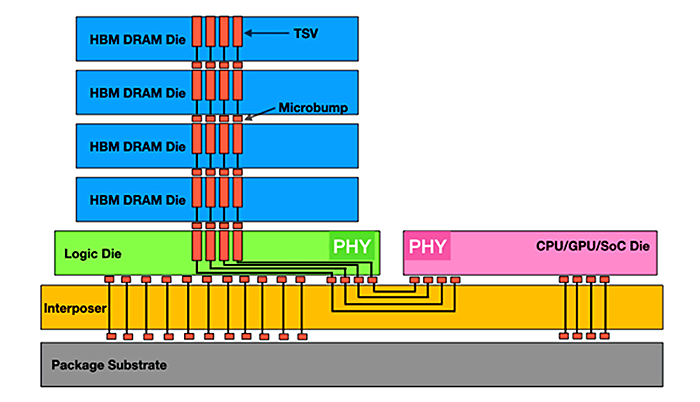
This is where High Bandwidth Memory (HBM) comes in. HBM is physically bonded to the GPUs in stacked layers via thousands of pins which enable “massively parallel data throughout” (The Pragmatic Engineer: Five Real-World Engineering Challenges).

HBM stack

Source: Semiconductor Engineering, 2023.


This tech enables the data transmission at a speed of about 3TB/second, around 100 times faster than conventional data transfer architecture powering PCs. This speed is crucial given the massive amounts of data that need to be fed into large language models like ChatGPT.

The issue (and opportunity) is that this wave of demand for leading-edge computing tech to power AI is far outpacing supply. HBM costs around five times more than conventional memory, with Korean memory giant SK Hynix controlling half of global supply, and the remainder split between Samsung and Micron. Hynix is set to enjoy a margin boost driven by premium memory products such as HBM, which it forecasts to grow at a 60-80% CAGR for the next five years.

Emerging markets are home to a host of companies like Hynix, which dominate their respective niches in the AI supply chain. Opportunities exist across multiple segments including fabrication, design, and testing capabilities, as well as key components (like HBM) that form the foundations of hyperscale computing that powers AI.

Chinese stocks outperform as stimulus efforts kick into gear

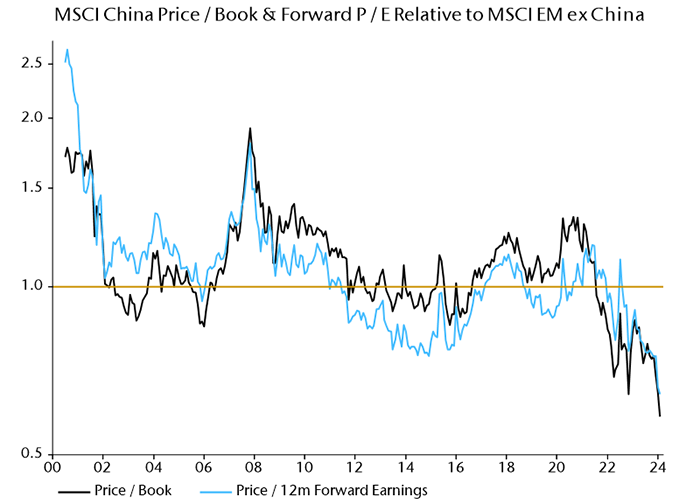
Chinese stocks are plumbing the depths, now trading at a CAPE of around 10X (from 21X in 2021) discounting a deflationary outlook. While Premier Li Qiang attended the World Economic Forum meeting in Davos earlier this year to announce that China met its 5% GDP growth target for 2023, investors were fretting about steepening consumer price declines. The stock market is signalling an increasing risk of corporate bankruptcies (BBC – Evergrande: Crisis-hit Chinese property giant ordered to liquidate) and financial instability in the absence of decisive monetary and/or fiscal intervention.

Will the authorities blink? It is certainly within the Party’s wheelhouse to pivot, especially given the risk that further economic malaise stokes political instability. The abrupt end to zero-COVID policy in 2022 is the most recent pragmatic policy turn under Xi. Could he reprise Deng Xiaoping’s dictum that “to get rich is glorious” alongside an announcement of fiscal stimulus?

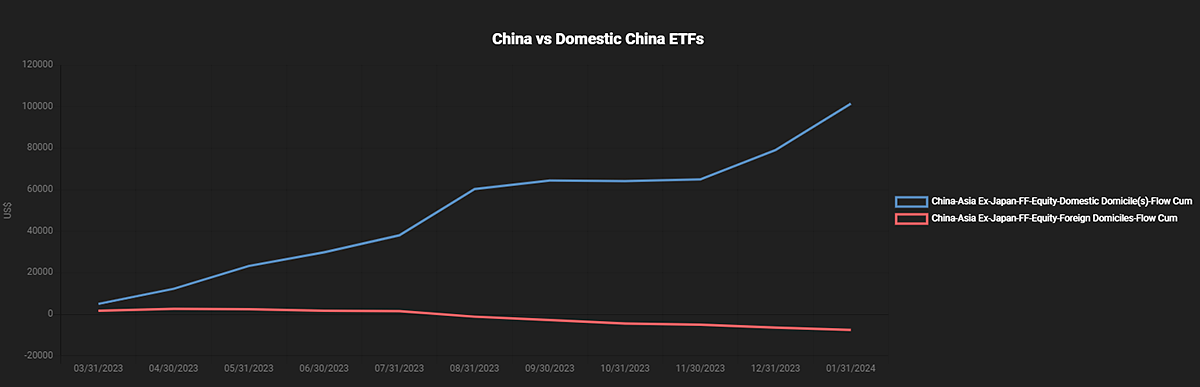
That is doubtful to say the least, but recent activity suggests the authorities understand there is a problem. SOE and SOE-linked names outperformed through February on the back of the “national team” (state-backed financial services companies) ploughing US$57 billion into Chinese equities so far in 2024 (China ‘national team’ ETF buying reaches $57bn this year, says UBS). The chart below from fund data provider EPFR shows flows from local Chinese investors into domestically domiciled China funds (blue line) of just under $100 billion over the 12 months to 31st January 2024. Contrast this with negative flows for foreign-domiciled China funds (i.e. for foreign investors) over the same period.

Line graph comparing domestic and foreign investment in China-based equities, March 2023 to March 2024.
Source: EPFR


During the month, Xi Jinping was briefed by the China Securities Regulatory Commission (CSRC), coinciding with the replacement of the Commission’s chief Yi Huiman in favour of former banking regulation veteran Wu Qing (known as the “broker butcher”). Bloomberg noted that the move echoed government efforts in 2016 to boost market confidence by dismissing financial regulators amid a market rout (China Replaces Top Markets Regulator as Xi Tries to End Rout).

A visit to the central bank by Xi last year preceded record levels of lending from the PBoC to the banks in Q4, followed by an earlier and larger than expected cut in the reserve requirement ratio (RRR) in January, which suggests the central bank is now back on an easing track.

Money rates responding to liquidity injection

Interest rate movements in China, 2020 to 2024.
Source: LSEG Datastream.


On the fiscal side, the government revealed a GDP target of “around 5%” at its National People’s Congress, suggesting further modest stimulus is on the way.

We have flagged in previous commentary the risk that deteriorating institutional quality under Xi appears to be crushing the animal spirits of entrepreneurs and consumers. Indeed, we saw Xi tighten the CCP’s grip over the private sector, announcing new anti-corruption crackdowns across a host of key sectors in January.

Tone-deaf policymaking amid a fragile economic backdrop is causing economic paralysis and interferes with the credit impulse. No one is complaining about a shortage of credit. The real issue is a shortage of confidence among consumers and businesspeople. Consumers are hoarding cash in time deposits, while banks aren’t looking to borrow short and lend long to businesses to invest. While all of this is structurally negative for China over the long term, continued policy easing at these valuations could be the catalyst for a large trading rally in Chinese equities.

MSCI China at record discount to rest of EM

Line graph comparing the MSCI China Index and MSCI EM ex. China Index price-to-book and 12-month forward earnings.
Source: LSEG Datastream.
Our strategy is to maintain a modest underweight to China and position defensively while waiting for further confirmation that liquidity is improving.

A display of colorful woven fabrics from India.

One of the perks of being on the road to meet our holdings is the opportunity to see firsthand the daily challenges of running a business. It’s often said that the devil is in the details, and this holds particularly true in emerging markets, where every few kilometres bring a change in culture, customs and language. Some industries demand more from their execution strategies than others, with the microfinance sector standing out due to its complexity. While simple in concept, providing loans to underserved populations is more nuanced in practice.

The birth of microfinance

The microfinance business has its origins in Bangladesh, where Nobel Laureate Mohammed Yunus discovered that, despite their lack of resources, the impoverished were neither lacking in financial savvy nor in reliability as borrowers. In 1983, Yunus founded Grameen Bank, focusing on the strengths of his clients, including trustworthiness and creativity, rather than their lack of formal education or financial resources.

One of our holdings, CreditAccess Grameen (CREDAG IN), mirrors Grameen Bank’s business model and name. Our recent visit with CREDAG allowed us to observe its operations and engage with its customers, 99% of whom are women. As India’s largest microfinance institution, with 1,900 branches, 4.6 million clients and $2.7 billion in assets under management, CREDAG in our view exemplifies how to handle the complexities of a demanding businesses.

Ground-level insights

CREDAG’s strategy emphasizes local engagement and consistently doing the “little things” right. In a nation with 22 official languages, having branches staffed by locals who understand the regional dialect and economy are key. This local presence marks many employees’ first foray into the formal job market, fostering a strong sense of loyalty among them.


Outside a typical rural CREDAG branch in rural Bangladore.

We got to see CREDAG in action, where morning efforts focus on collections and afternoons on new client acquisition. The company’s investment in employee wellbeing, evidenced by providing kitchen spaces, covering grocery costs and reimbursing fuel expenses, further translates to high employee loyalty.

Relationship building – more than just transactions

The local economy in the villages we toured is driven by dairy and silk farming. In fact, the district is India’s largest cocoon silk producer.


A CREDAG client with her home silkworm business. The silkworms are feeding on mulberry leaves.


Silkworm cocoons in a bamboo tray for the local wholesale market.

Building customer relationships

Our participation in collection meetings highlighted the importance of CREDAG’s joint lending model.


A CREDAG collection meeting outside the village temple.

Meetings start and end with pledges, underscoring the powerful psychology of positive reinforcement to change borrowers’ behaviour for the better.

Leadership within borrower groups streamlines the payment process, allowing for relationship building, educational and sales opportunities. With most of its customers having no credit history or verifiable income, local connections (and intelligence) become crucial parts of good underwriting.

We also had the chance to see an income-generation loan being paid out to a dairy farmer.


Receipt for a 2-year, Rs 50,000 loan for buying a cow to be repaid in 104 installments.

Customized innovation: tradition meets tech

CREDAG leads in integrating technology, reducing client onboarding times and introducing new products rapidly. Its core banking solution caters to remote areas. Even with no internet connection, loan applications can be processed offline and then bulk uploaded when access is available. This allows CREDAG to offer flexible repayment options that align with its customers’ income cycle and new products like gold loans to reduce product time to market.

We also saw its technology in action. CREDAG offers cash emergency loans of up to RS 1000 as a complimentary service to creditworthy customers. This is especially beneficial to those in far-flung areas with no nearby bank branch. Customers can scan their biometric details to pull up their account information on the loan officer’s tablet. Once account details are verified, cash is disbursed on the spot. The whole exercise takes less than five minutes!


A CREDAG customer getting her biometrics scanned for account verification.

Details, details, details

Our visit with CREDAG reinforced how small details matter in building loyalty and maintaining operational efficiency. In the case of CREDAG, it translates to a best-in-class cost structure and customer retention ratio. While we recognize the inherent cyclicality of the microfinance sector, our visit helped us appreciate the need for rigorous execution and a deep understanding of the local context to achieve operational excellence.