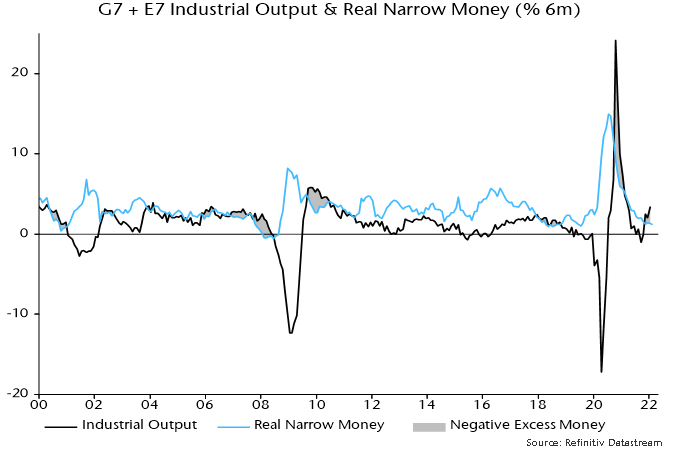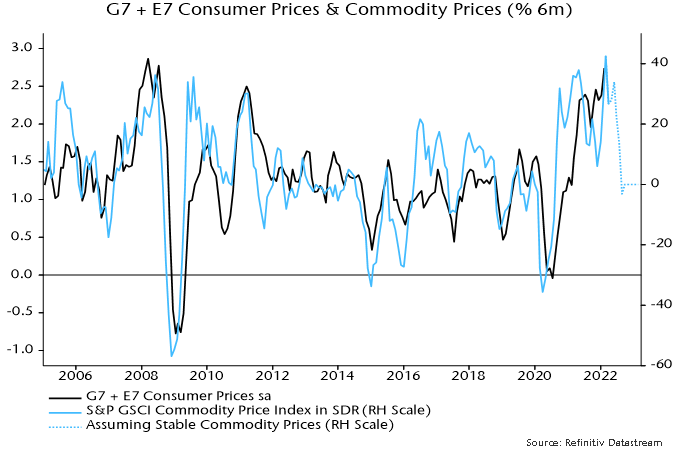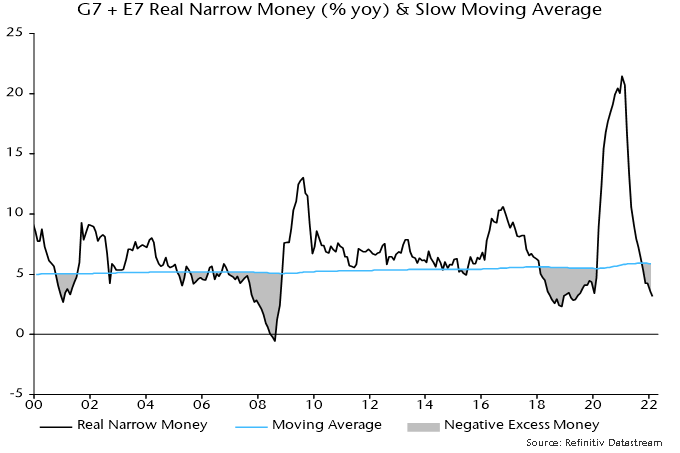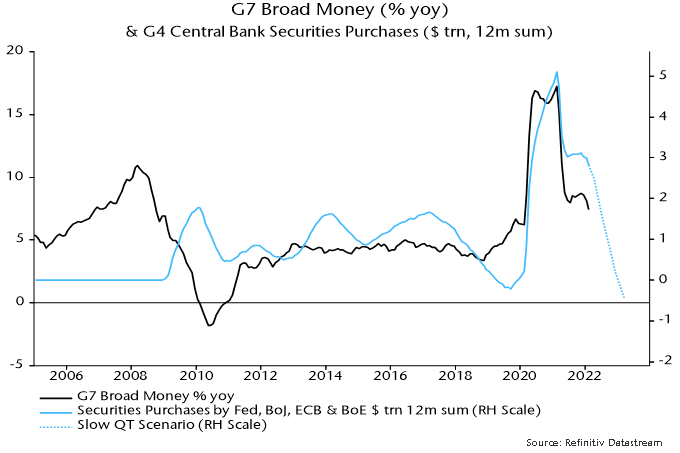
The ECB under former President Jean-Claude Trichet twice raised interest rates into oncoming recessions (in 2008 and 2011). The current ECB hasn’t raised rates yet but is scaling back QE much faster than was expected late last year.

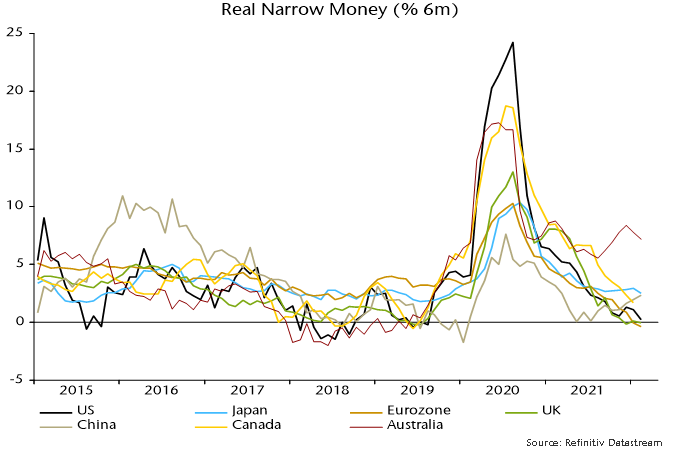
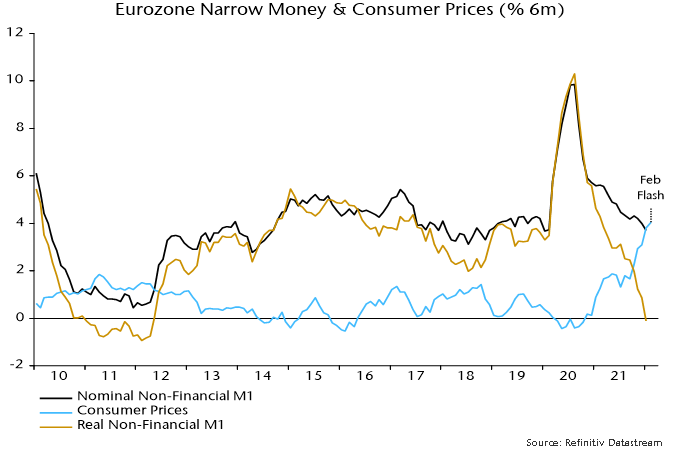
The six-month rate of change of Eurozone real narrow money had turned negative before the 2008 / 2011 rate rises and subsequent recessions. It is about to do so again now.

In an eerie replay, M. Trichet yesterday gave an interview in which he opined that the Eurozone was “far from recession territory”.

The current ECB seems equally complacent. The staff forecast for GDP growth in 2022 was yesterday lowered from 4.2% to 3.7% but still incorporates quarterly increases of 1.0% in Q2 and Q3, i.e. a combined 2.0% or 4% annualised.

The “best” monetary leading indicator of Eurozone GDP, according to the ECB’s own research, is real non-financial M1, i.e. holdings of currency and overnight deposits by households and non-financial corporations deflated by consumer prices.

The six-month change in real non-financial M1 fell to zero in January and is likely to have been negative in February, based on a further increase in six-month consumer price momentum – see chart 1.

Chart 1

Chart showing Eurozone Narrow Money & Consumer Prices.

The six-month real narrow money change was negative in 18% of months between 1970 and 2019. The average change in GDP in the subsequent two quarters combined was zero. The average since the inception of the euro in 1999 was -0.8%.

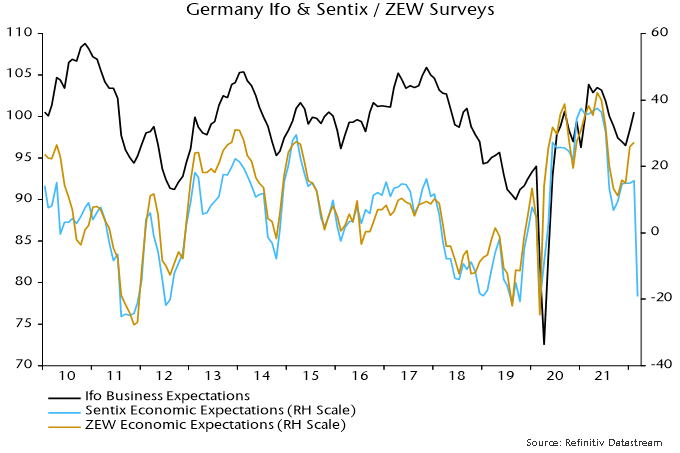
Business surveys could be about to crater: the March Sentix survey of financial analysts is ominous – chart 2. The ECB and consensus may portray weakness as a temporary response to Russia’s invasion of Ukraine, drawing a parallel with past geopolitical events that had little lasting economic impact. Monetary trends suggest that a slowdown to stall speed was already in prospect and the Ukraine shock may tip the economy over into recession.

Chart 2

Chart showing Germany Ifo & Sentix / ZEW Surveys.

The ECB is in a policy bind of its own making. The view here is that it is too late to tighten and the only option is to ride out the current inflation storm. The worry for policy-makers is that inflation expectations will become “unanchored”. Fake hawkish rhetoric backed by fantasy GDP forecasts may be their attempted escape route.

The Chinese economy has undergone major changes over the past year, aimed at stabilizing the long-term sustainability of its economy. We discussed many of these changes in our commentary, Navigating through current China uncertainties (and opportunities). Looking ahead, we will continue to carefully analyze the movement of Beijing’s policies, which provide key insights into the economy and financial markets this year.

Based on our analysis and interactions with companies, we anticipate a better second half of the year, and history has shown us similar behavior.

Regarding the property sector, in the first two months of 2022, sales in the top 30 cities declined 29% year-over-year (YoY), making it the second worst year since the start of the decade. Sales for 200 developers in lower tier cities dropped 43% YoY.[1] Falling property prices are often an indicator of a drop in land values, which directly affects local governments, as it is an important source of revenue. 

If we recall the last property down cycles in 2011-12 and 2014-15, they lasted around 9 months. As the current down cycle started in September-October, best case scenario would be improvements starting in the second half of 2022. During the first half, most indicators will continue to look very bad, and developers may face problems.

What can the government do then to improve sentiment?

Real estate and credit growth have always been key metrics for GDP expansion in China. Further, previous down cycles could guide government action. For example, the government could turn to a more easing mode, similar to actions taken in 2012 and 2015. As a result, we could see growth of new housing starts to bottom. That said, we don’t expect a massive easing in the property market, unless situation spreads very widely.

In the second half of 2012, Chinese policy makers released a set of stimulus measures. While each of these measures differ, it is similar to what’s been happening in 2022. In 2012 policy makers were reluctant to loosen measures and reiterated the idle land policy: a 20% penalty if idled for one year and forfeiture if idled for two years. The policy makers wanted to test the market and see results with gradual easing.

In March of 2015, minimum down payment was reduced to from 60% to 40% for second time home buyers who have still not paid the first mortgage. For first time buyers the down payment was reduced from 30% to 20%. State Council meeting was held on Dec 14th and analyzed the urban planning for 2016. Key focus was to reduce real estate inventory deepening urbanization.

 In 2022, we think policy makers have the tools to do similar easing, although, considering last year’s common prosperity, the willingness to do so is likely a little more difficult.

Many cities are easing mortgage lending (e.g., Guangzhou), lowering down payment rates (e.g., Heze, a third-tier city in Shandong province), or relaxing home purchase restrictions (e.g., Zhengzhou). China will also make it easier for state-owned enterprises (SoE) to buy distressed assets for private peers in order to avoid a credit crunch in the sector. For example, SoEs acquiring distressed assets will not be majorly subject to the three red lines policies. Likewise, some developers are being allowed to issue bonds in onshore markets.

The last Politburo meeting in December had a clear message: policy makers would shift from regulatory tightening to supporting growth. We believe China will defend around 5.5% growth (announced last week in NPC meeting) and considering mounting growth pressures, the current property tightening mode should shift to a gradual easing, similar to 2012 and 2015. Top leaders have declared their intention to double the Chinese economy from 2020 to 2035, which implies a minimum 4.7% CAGR growth.

The main pillar of this relaxation cycle was understanding the change of policy makers from December 2020 (regulatory tightening) to 2021 (stability). What policy makers state at the beginning of the year is the most important message for understanding further actions. The latter meant that most probably regulation in many sectors has peaked. Chinese policy makers are extremely careful in making the best they can in order to fulfil their guidelines.

Together with property initial reactions, credit impulse is has also seemed bottoming up.  In January, credit figures came in better than expected. Total Social Financing was RMB 6.2 trillion (consensus 5.4 trillion) and credit growth expanded from 10.3% YoY) to 10.5% YoY.[2] This is part of the initiation of a more deep easing cycle.

Is it time to leverage the economy again?

It could be, if you consider the messages out of the yearly Politburo meetings. In 2019 it was all about deleveraging. Why? Because GDP growth was not an issue. In 2022, stability is the main concern, which implies that GDP growth is a target. Government bond issuance and short term corporate lending have picked up substantially (especially the latter) in January. 

In addition, on January 20th, China lowered its benchmark loan rate, or Loan Prime Rate (LPR), from 3.8% to 3.7%. Meanwhile, the 5-year LPR was also lowered by 5bps to 4.6% in December (a small move but this rate is linked to the property sector). On Monday of the same week the one year Medium Lending Facility (MLF) rate was lowered 10 bps. Again, not a relevant move but the importance was the signal considering it was the first move since April 2020. The MLF cutting cycle is also the 5th decrease since the global financing crisis. China will also enter in a divergence driven by its easing and the tightening on the FED. The latter could make some pressure over the Yuan over time which can eventually anticipate some further easing measures.

Another factor that can boost China’s economy this year is Infrastructure investment, which could accelerate in 2022, considering fiscal policy has ample room to turn from contraction to expansion. Fiscal deficit was solely 4.5% of GDP (vs 6.5% expected at the beginning of the year) rolling over more than 3 trillion for 2022 spending, although policymakers should lose the controls on local government debt.

Regarding consumption, the disposable income from Chinese families has been affected by current economy slowdown, however the greatest negative impact from consumption is Zero Covid policy. As long as this measure doesn’t change it will be very difficult for consumption metrics to improve. History has shown us that consumption growth has been quite stable in the past, with low volatility. This implies that any change in Zero Covid, can bump consumption in a great extent. Most likely it will be gradually changed to more targeted measures (not locking down entire cities), nevertheless we don’t expect the complete elimination of the policy until at least the National Congress of the Chinese Communist Party this fall.

China’s top scientist Zeng Guang recently declared that China and Covid could coexist.[3] This is an important signal for an eventual turning point of Beijing to open the door to more discussions in following periods.

Despite the sluggish current economy we are overweight in China our emerging markets (EM) Small Cap Portfolio. Our approach is to invest in companies/sectors that are subject to less regulation and more likely to benefit from the new trends that we see emerging in the future.

Zhou Hei Ya (1458 HK)

We have recently initiated a position in Zhou Hei Ya (ZHY) in our Global Alpha Emerging Markets Small Cap Strategy. Our global and international small cap strategy do not invest in this country. ZHY is a leading braised food company in China and their main products include packaged duck products, such as duck necks and wings.

The brand is originally from Wuhan and is particularly strong among many cities in the country. ZHY is the first company in China to introduce MAP, which makes it possible to store braised food for up to seven days in a chilled environment. In the past, braised food products had to be unpackaged and consumed within the same day, hence it could only serve dining demand. MAP technology makes it much easier for people to consume braised foods on a variety of occasions.

China’s casual braised food industry reached a market size of RMB 109 billion in retail sales as of 2020, growing at a 16% CAGR over 2015-20. According to Frost & Sullivan they should continue increasing at similar pace, reaching RMB 205 billion in 2025. The main reasons for this increase are: increasing repurchases, a recovery in traffic post Covid-19, growing all-day snacking demand, and a convergence of consumer behavior in low-tier cities vs. top-tier cities.

ZHY has a highly standardized and scalable operating model. In 2019 it installed a franchisee model that will very likely speed up growth. ZHY has superior store unit economics (self-operating and franchisee stores take two to three months to breakeven), distinctive brand positioning, high stickiness, and are popular among the younger population It has been severely affected by Covid, but store openings are intact. We see strong potential for store expansions throughout China, fostering earnings and margins growth. Post Covid-19, we believe consumers will prefer more quality, healthier products. ZHY’s packaged products are perceived as safe and cleaner products vs. unpackaged ones. In summary, after a very tough 2021 and a difficult first half of 2022, we are starting to see some light at the end of the tunnel. The messages from policy makers have been key to understanding the direction of the Chinese economy during the year. Although every year has its own particular characteristics, we see some historical patterns that are showing similar signals in 2021- 2022. As Mark Twain stated, History Doesn’t Repeat Itself but it often Rhymes. The current Russia/Ukraine conflict and its implications on the Chinese economy are risks we are closely monitoring.


[1] Source : Macquaire

[2] Source: Bloomberg and Macquaire

[3] China Should Eventually “Co-Exist” With Covid, Says Top Scientist (ndtv.com)

On February 21st, Australia finally reopened its border to international travellers after two years of being fully closed. One of the strictest travel bans of the COVID era, at one point more than 30,000 Australians were unable to access the country due to the limited amount of people allowed to return home every month.[1] The Australian government was not afraid to make a public example out of a certain tennis player to show how no exceptions would be made. Nonetheless, it slowly started showing signs in 2022 that it would shift from its strict zero-COVID strategy and instead hinted that it would follow the steps taken by the UK and other western countries to figure out how to live with the virus.

One of the biggest casualties of its zero-COVID strategy will be the end of its streak as the longest period of economic growth in modern history. Australia was able to navigate the Asian financial crisis, the dot-com bubble, the great recession of 2008, and a once-in-a-generation mining boom that ended in 2014 without experiencing a recession. Even after 30 years of continued growth, it took an almost complete shutdown of international trade to pull the Australian economy back into a recession. For the record, it was still a less severe downturn than almost every single country in the world except China experienced.[2]

Despite the end of this streak, Australia retains most of the growth drivers of the last 30 years. The strength of its consumers remains in solid shape thanks to government support, upward wage pressure due to a labour shortage, significant household savings, and the safety of the strong pension benefits. Australia’s geographic location places them in a unique position to benefit from the growth in Asian consumer spending power. Its abundant natural resources, especially its mining industry, are resilient and should benefit from an inflationary environment, and what many expect to be the start of a commodity super cycle.[3]

People more pessimistic about the Australian economy will usually point to its dependence on China as a trading partner. The trade war between the two nations was escalated to the World Trade Organization (WTO) in 2021 over tariffs that China implemented in 2020 on Australian products such as barley, coal, cotton, logs, meat and wine. This was the result of Australia’s previous criticism of China’s human rights record and the decision to ban Huawei from the country, in addition to other grievances formulated toward the Chinese government. While it is true that China always represents a risk to the Australian economy, representing roughly 40% of their good exports, this misses the dependence China has on some Australian commodities. Unsurprisingly, their largest export, iron ore, was not part of the tariffs China imposed on Australia. The Chinese government knew very well how difficult it is to find other sources of the same scale as Australia. Furthermore, as China was facing a coal shortage in October, it resumed letting Australian coal ships access their port after being banned since December 2020.[4] Although, strong political rhetoric between the two countries is expected to continue, it is unlikely that economic relations will get much worse in the short term.

It is also worth noting that the country’s reputation as being an economy dependent on natural resources is often exaggerated. Like Canada, Australia’s stock markets tend to move along with commodity prices. But the reality is that much like other developed markets, Australia’s economy is dominated by the service sector. Representing more than 70% of GDP, almost 80% of its labour force and 40% of its export earnings, its expertise range from energy and mining-related services to banking and fintech.[5] Outside of the tourism industry, the impact of the travel ban and other COVID measures had a limited economic impact as evidenced by the unemployment rate increasing only 1.45% between 2019 and 2020.[6]

Global Alpha enjoys the exposure to various names in the Australian services industry.

ALS Ltd (ALQ AU)

Based in Brisbane, ALS is one of the world’s largest testing providers of laboratory analysis services, offering assessment, inspection, certification and verification. They operate out of 350 sites across 65 countries and across three segments: life sciences, commodities and industrials. The new management is in the process of solving many business inefficiencies to improve margins and their growth profile to be more sustainable. ALS should be a clear winner from the exploding demand for commodities and the new project development that will result from it.

Bravura Solutions Ltd. (BVS AU)

Bravura Solutions provides web-based software products and SaaS to the wealth management and funds administration industries, primarily in the Asia-Pacific and European regions. With over 70 bluechip clients and $2.3t trillion in assets managed through its systems, it is a market leader with a sticky product that participates in an industry with increasing regulation and the need for outsourcing.

Smartgroup Corp Ltd. (SIQ AU)

Founded in 2001, Smartgroup is a leading provider of salary packaging, fleet management, share plan administration and payroll services based in Sydney. Quite popular in Australia, the concept of salary packaging involves an arrangement between employer and employees where certain items or benefits can be paid for out of your pre-tax salary, reducing taxable income and therefore tax payable. Their business model involves charging employers an admin fee for outsourcing this for an average of AUD$200 per employee every year. Their client base mostly includes entities that benefit from not having to manage this internally, such as not-for-profit, hospitals, governments, and universities.

Australia is a relatively small weight within our developed market benchmarks but a mix of its exposure to the Asian consumer, strong expected consumer and corporate demand, and a Federal election in May that could lead to more deficit expanding policies, should result in outsized growth in the years ahead. We are quite satisfied with the varied exposure we currently have there.


[1] Australia is ending its zero-covid strategy | The Economist

[2] Just four countries fared better than Australia (afr.com)

[3] June 10th 2021 GA commentary – Hot commodity

[4] China accepts stranded Australian coal as shortages bite, but unofficial ban on new orders remains (afr.com)

[5] The importance of services trade to Australia | Australian Government Department of Foreign Affairs and Trade (dfat.gov.au)

[6] Australia Unemployment Rate 1991-2022 | MacroTrends

Dear Clients and Colleagues:

As the world transitions to green energy over the next 30 years, China must find short-term alternatives to their coal thermal plant problem, which represents 18% of total global carbon dioxide (CO2) emissions. 1

While it may seem like a contrary solution, China sees gas-fired power as the most realistic transitory solution until greener and grid friendly alternatives take scale. Gas has lower emissions than coal (50% less, oil is 25% less) and gas is more flexible than solar, wind, and even pumped-storage hydropower. It seems that China wants to import natural gas as fast as pipeline and LNG infrastructure is built. China’s pipeline gas volume surged 154.2% in 2021, to 7.54 million metric tons (mt). Natural gas imports (LNG) from Russia rose 50.5% year-over-year in 2021.2 Meanwhile, China LNG imports from the United States (U.S.) saw the biggest year-over-year jump, rising 187.4% to 9.21 million mt in 2021.3 

According to GlobalData, LNG liquefaction capacity is expected to grow by 70% over the next four years.3 China will add as much as 21.5 million mt/year of LNG receiving capacity in 2022, this from more than the 14 million mt/year added in 2021 for a total import capacity of 127 mt/year in 2022.1 Japan pioeneered LNG 60 years ago and recently fell in second place in terms of activity with 75 mt/year of LNG imports.4

Although the Chinese LNG import growth only absorbes world gas production by less than 1%, it is enough to pressure pricing upwards, especially since Europe and other regions try to curb thermal coal as well. Supply side dynamics are not helping either, as world rig counts are 45% lower than in 2015.5 Why so few? Oil and gas companies are shuffling with higher exploration costs, regulations and low labor availability.

Coming back to Japan, the country has low internal energy resources and imports 90% of its energy requirements. An important part of the country’s electrification is fuelled with LNG imports. Japan has the largest LNG capacity with 227 mt/year.4 As part of its CO2 emission targets, the country is trending towards a hydrogen strategy fuelled by renewables while reducing its LNG imports and nuclear power.

Iwatani (8088:JT)

Global Alpha owns Iwatani, the largest provider of LPG liquified propane gas, from importing to stove tanks. Iwatani provides an essential service throughout Japan, a country with very low penetration of utility style gas piping to the house. Although Japan’s LNG imports for electrification will decline, LPG will continue to be a key part of Japanese culture for cooking and heating especially in rural settings. Iwatani is also Japan’s only fully integrated supplier of hydrogen, with a nationwide network, including manufacturing, transportation, storage, supply, and security. It had 53 hydrogen stations in Japan as of 2021. Plans are to add 270 by 2030.

With plans to start exports by 2025, the west coast of Canada is set to benefit from the Asian LNG expansion. The energy shipped from Canada over to Asia is expected to offset up to 90 million tonnes of CO2 emissions in a single year. This is equivalent to shutting down 40 to 60 coal fired plants in China.7

ARC Resources (ARX:TSE)

Global Alpha owns ARC Resources, a Canadian energy company with operations focused in the Montney Resource Play in Alberta and northeast British Columbia. The company is best positioned with its gas assets to supply LNG requirements for Asian LNG exports. ARX is an industry leaders in terms of ESG with many initiatives regarding gas flaring and CO2 carbon capture.

Clean Energy Fuels (CLNE:US)

North American natural gas usage is also expected to increase in renewable growth as it is mixed with captured methane producing negative CO2 emission. For this Global Alpha owns Clean Energy Fuels, the largest network of retail natural gas distribution in the country.

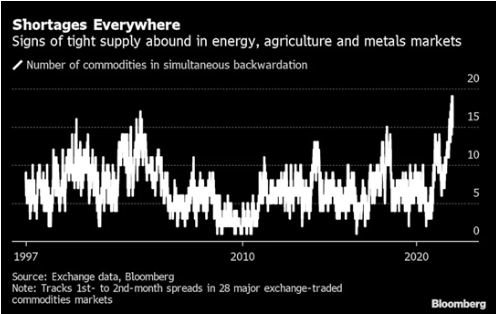
China’s need for energy to fuel cars and electrify houses (and give them some benefit, to reduce thermal coal) has forced them to shut down many internally produced commodities that demand  high energy consumptions (as well as high CO2 emission) notably aluminium and copper smelters. China still needs these commodities and has reverted to the global trade market. If we add the change in habits brought on by COVID-19 that supported a rush for hard goods during the pandemic, this is the consequence.

With a high energy production input, shipping aluminum is basically shipping energy. 

Alumina (AWC:AU)

Global Alpha owns Australia’s Alumina, which owns 40% of the world’s largest alumina business, Alcoa World Alumina and Chemicals (AWAC), the recognized industry leader. Precursor to aluminum, the metal powder alumina is refined from bauxite. AWC owns alumina refineries, bauxite mines and aluminum refineries globally with a good concentration in Australia. Close to China, AWC Australia large operations present the lowest cost import option for China. As well, AWC sources all of its energy requirements from natural gas. AWC also has important ESG initiatives such as Mechanical Vapor Recompression (MVR) which turns waste vapor into steam.

If we consider the energy transition to renewables as a secular event, the trend has certainly affected commodity prices in addition to more typical demand and supply forces.

Have a nice week.

The Global Alpha team

1 https://www.statista.com/statistics/239093/co2-emissions-in-china/#:~:text=China%20released%2010.67%20billion%20metric,of%20countries%20where%20emissions%20increased

2 https://www.spglobal.com/platts/en/market-insights/latest-news/lng/012022-china-data-total-natural-gas-imports-rose-20-in-2021-on-strong-energy-demand

3 https://store.globaldata.com/report/global-capacity-and-capital-expenditure-outlook-for-lng-liquefaction-terminals-to-2025-north-america-dominates-global-capacity-additions-and-capex-spending/

4 https://www.statista.com/statistics/1285639/japan-share-lng-in-energy-production/

5 https://rigcount.bakerhughes.com/intl-rig-count

6 https://world-nuclear.org/information-library/country-profiles/countries-g-n/japan-nuclear-power.aspx

7 https://biv.com/article/2022/01/lng-canada-project-construction-kicking-high-gear

This report is provided solely for informational purposes and nothing in this document constitutes an offer or a solicitation of an offer to purchase any security. This report has no regard to the specific investment objectives, financial situation or particular needs of any specific recipient and does not constitute a representation that any investment strategy is suitable or appropriate to a recipient’s individual circumstances. Global Alpha Capital Management Ltd. (Global Alpha) in no case directly or implicitly guarantees the future value of securities mentioned in this document. The opinions expressed herein are based on Global Alpha’s analysis as at the date of this report, and any opinions, projections or estimates may be changed without notice. Global Alpha, its affiliates, directors, officers and employees may sell or hold a position in securities of a company(ies) mentioned herein. The particulars contained herein were obtained from sources, which Global Alpha believes to be reliable but Global Alpha makes no representation or warranty as to the completeness or accuracy of the information contained herein and accepts no responsibility or liability for loss or damage arising from the receipt or use of this document or its contents.

Source: MSCI. The MSCI information may only be used for your internal use, may not be reproduced or redisseminated in any form and may not be used as a basis for or a component of any financial instruments or products or indices. MSCI makes no express or implied warranties or implied warranties or representations and shall have no liability whatsoever with respect to any MSCI data contained herein. This report is not approved, reviewed or produced by MSCI.

February 17, 2022

Dear Clients and Colleagues:

In October 2021, Mark Zuckerberg made headlines by announcing the rebranding of Facebook into Meta Platforms to focus on the metaverse. Zuckerberg also announced plans to invest more than US$10 billion on related hardware, apps and services. For the general public, it was likely the very first time they heard about the metaverse. However, it had already become the main next-big-thing idea for many tech companies worldwide, with many of them putting their money where their mouth is and investing mind-boggling amounts in the metaverse-related projects.

Despite the seeming novelty, the term metaverse was first coined in 1992 as an Internet of the future based on virtual reality in the science fiction novel, Snow Crash by Neal Stephenson. Launched in 1999, Cyworld, a South Korean social network, created a two-dimensional virtual world and implemented several elements of the metaverse, such as avatars and virtual spaces, and became one of the first companies to profit from the sale of digital items. In 2003, United States (U.S.)-based tech developer Linden Lab launched an online virtual world called Second Life, which is considered the prototype of a metaverse in the Western Hemisphere. Quite a few top-rated video games, such as Minecraft, Roblox and Fortnite have many elements of the metaverse. However, saying that any of them is the metaverse overstretches a stretch, similar to saying that Google is the Internet. However, they do give a bit of a taste of the metaverse. Hollywood also made notable steps into exploring the metaverse, with the Matrix and Ready Player One movies. 

Despite the current hype around the metaverse in media and tech business conversations, the term remains hard to define as there are many disagreements on what metaverse exactly is and how it should work. Will users have a single identity or avatar? Will there be a single operator of the metaverse? Will there be a single metaverse? If you have issues explaining what metaverse means to a three-year-old, you are not alone. Zuckerberg spent almost 80 minutes describing it during his Connect 2021 conference. You can check for yourself if he succeeded.¹ Although metaverse means different things to different people, most supporters will agree that it is essential for the Internet of the future. 

Matthew Ball, a venture capitalist and author of multiple high-quality pieces on metaverse, suggests that it is too early to give it a single intuitive definition, but still offers his best swing: “The metaverse is a massively scaled and interoperable network of real-time rendered three-dimensional virtual worlds, which can be experienced synchronously and persistently by an effectively unlimited number of users with an individual sense of presence, and with continuity of data, such as identity, history, entitlements, objects, communications, and payments”.² With a risk of oversimplification, we can think of the metaverse as a virtual space shared with myriad users integrating digital reality and the physical world by employing different aspects of technology. It is expected to provide fully immersive experiences, be accessible on any device and have an economy enabled by digital money and non-fungible tokens (NFT). 

In the not so distant future, users will be able to imitate or even migrate parts of their lives in virtual worlds, thanks to the efforts of numerous developers. Skeptics see a meager set of applications, primarily gaming and social networking. However, over time, metaverse can have a profound impact on society. Enterprise collaboration, fitness, education, healthcare, research and development, product engineering – this is a short list of activities that can reach a new level with the help of the metaverse. For instance, surgeons can perfect their mastery in the metaverse, and engineers can improve design prototyping while saving time and resources.

Even if the metaverse falls short of the fantastic pictures painted by science fiction authors, it is likely to generate substantial economic value, with some estimates coming in at trillions of dollars in revenue as a new immersive ecosystem and content platform. According to Gartner, the current buzz around the metaverse is expected to unwind and transition into numerous new business models so that by 2026, 30% of the companies worldwide will have products and services available on a metaverse, and 25% of the population globally will spend at least one hour per day for work, education, entertainment, social and other purposes on a metaverse.³ It would be very short-sighted to believe that the metaverse looks attractive only to tech nerds. For instance, Seoul⁴ and Shanghai⁵ are on the verge of making their foray into the metaverse. 

Anticipating solid demand from investors, several asset managers started offering ETFs tied to the metaverse. Although it is still too early to gauge which investments will pay off in the long run, companies should take the time to study, investigate, and plan for a metaverse to gain a competitive advantage on the Internet of the future. Even Zuckerberg, with a very ambitious vision for the metaverse, thinks it could take up to 10 years to become mainstream.

We believe the metaverse architecture is based on the following building blocks, which allude to the business models poised to benefit from new massive market opportunities:

  • Platform – providing a metaverse ecosystem.
  • Content – providing content suitable for the metaverse.
  • Infrastructure and software – providing technology and software related to the metaverse.
  • Hardware – providing whole or components of devices connected to the metaverse.

Although it is too early to validate the sustainability of the investment case of the metaverse, we believe it is one of the most intriguing emerging themes that we are carefully studying at Global Alpha. Several holdings of our Emerging Markets strategy started exploring metaverse-related opportunities long before this idea hit the news. We want to point out that none of those investment cases were built purely around the metaverse opportunities, as those companies have high-quality core operations and appealing investment theses. However, they provide an option to tackle a massive market if efforts turn out to be successful. 

AfreecaTV (067160 KS)

AfreecaTV, the most prominent South Korean live streaming platform transforming into a multi-vertical entertainment hub, with its strong content IP and fandom-like user following, is poised to capture the rising opportunities in the metaverse. On November 3, 2021, the company launched Afreeca Token Market, a digital NFT marketplace. The items available for trade include NFTs based on three-dimensional characters of popular AfreecaTV streamers, live streaming, and video-on-demand clips. On December 3, 2021, the first NFT bid for the avatar of a famous streamer, Chulgu, ended with a final bid of KRW 13.4 million, while other NFT bids for other popular streamer avatars were finalized in the range of KRW 3-7 million. On January 28, 2022, the company launched the open-beta version of its metaverse platform, FreeBlox. Although it is currently available only for PC in South Korea, AfreecaTV unveiled plans to deploy a mobile version soon and launch a global platform. Within the metaverse, we believe that AfreecaTV will explore various business models while users can interact with the streamers and participate in gaming, shopping, live broadcasting and other activities.

Elite Material (2383 TT)

Elite Material, based in Taiwan, is one of the global leading copper clad laminate (CCL) manufacturers. The metaverse will require massive network, storage and compute resources. According to Intel, a major data centre CPU manufacturer and client of Elite Material, the existing processing power is inadequate to support metaverse ambitions. Its senior vice president and head of Accelerated Computing Systems and Graphics Group, Raja Koduri, suggests that a thousand times increase in power might be needed over the current collective computing capacity.⁶ We believe that Elite Material is a major beneficiary of the secular growth of data centre capex given its ongoing market share wins within Intel and AMD server platforms and CCL content growth.

Ennoconn (6414 TT)

On January 4, 2022, Ennoconn, a leading industrial PC company in Taiwan specializing in embedded boards and systems, with applications in various vertical markets including point-of-sale (POS), automation, gaming, and networking, announced a new round of equity placement for Google. This partnership should enrich Ennoconn’s wearable devices capabilities for the industrial metaverse AR use cases. According to the International Data Corporation (IDC), AR and VR market is expected to grow at a 54% compound annual growth rate over 2020-2024.⁷

Have a nice week.

The Global Alpha team

1 https://www.youtube.com/watch?v=Uvufun6xer8

2 https://www.matthewball.vc/all/forwardtothemetaverseprimer

3 https://www.gartner.com/en/newsroom/press-releases/2022-02-07-gartner-predicts-25-percent-of-people-will-spend-at-least-one-hour-per-day-in-the-metaverse-by-2026

4 https://www.businessapac.com/seoul-government-venture-into-the-metaverse/

5 https://www.blockchain-council.org/news/shanghai-leans-towards-metaverse-in-its-progression-plan/

6 https://www.theverge.com/2021/12/15/22836401/intel-metaverse-computing-capability-cpu-gpu-algorithms

7 https://www.idc.com/getdoc.jsp?containerId=prUS47012020

This report is provided solely for informational purposes and nothing in this document constitutes an offer or a solicitation of an offer to purchase any security. This report has no regard to the specific investment objectives, financial situation or particular needs of any specific recipient and does not constitute a representation that any investment strategy is suitable or appropriate to a recipient’s individual circumstances. Global Alpha Capital Management Ltd. (Global Alpha) in no case directly or implicitly guarantees the future value of securities mentioned in this document. The opinions expressed herein are based on Global Alpha’s analysis as at the date of this report, and any opinions, projections or estimates may be changed without notice. Global Alpha, its affiliates, directors, officers and employees may sell or hold a position in securities of a company(ies) mentioned herein. The particulars contained herein were obtained from sources, which Global Alpha believes to be reliable but Global Alpha makes no representation or warranty as to the completeness or accuracy of the information contained herein and accepts no responsibility or liability for loss or damage arising from the receipt or use of this document or its contents.

Source: MSCI. The MSCI information may only be used for your internal use, may not be reproduced or redisseminated in any form and may not be used as a basis for or a component of any financial instruments or products or indices. MSCI makes no express or implied warranties or implied warranties or representations and shall have no liability whatsoever with respect to any MSCI data contained herein. This report is not approved, reviewed or produced by MSCI.

Dear Clients and Colleagues:

Last week, the Lunar New Year was celebrated in Asia and beyond, and we entered the Year of the Tiger. Additionally, the 2022 Winter Olympics commenced in Beijing. As Asia appears more in headline news these days, you may wonder how it has been doing during the pandemic. The short answer is: resilient. Asia remains the fastest growing region in the world.

In 2020, global GDP contracted by 3.3% year-over-year, while Asia contracted by 1.5%. For 2021, the International Monetary Fund (IMF) forecasted that global GDP would grow 5.9%, while Asia would grow faster at 6.5%, including Hong Kong at 6.4% and Singapore at 6%. China grew 8.1% in 2021, and is expected to continue leading the Asian growth.

However, in the short term, Asia undoubtedly still faces many challenges.

  • China: Although China rebounded strongly last year, thanks to robust exports, there are signs of fading momentum due to weakening consumption and a property downturn. The zero-COVID policy may continue to cause lockdowns that hurt local economies. 
  • Slow COVID recovery: Although the vaccination rate is increasing in many Asian countries, the rise in new COVID cases, along with other supply chain issues, are causing production disruptions. Many countries are seeing an increase in cases following Lunar New Year celebrations. In Japan, where cases have reached record highs, the Prime Minister announced today the extension of its COVID-19 quasi-state of emergency in Tokyo and 12 prefectures; the restrictions are extended for three weeks, until March 6.
  • High debt burden: The Federal Reserve System’s (Fed) interest rate increase trajectory will add financing pressure. The debt in Asia has increased significantly in the past 15 years. Back in 2007, Asia accounted for about 27% of global debt. In 2021, it accounted for almost 40% of global debt.

Geopolitical tensions: The rise of China has complicated the old post-World War II international order by challenging the United States’ (U.S.) dominance in Asia. Tensions between the U.S. and China have been escalating for years, with Taiwan being the key issue. There is no sign of easing from both countries.

However, looking forward, the future of Asia’s growth remains bright.

  • High consumption growth: According to McKinsey, by 2030, Asian consumers are expected to account for 50% of global consumption growth, representing a $10 trillion opportunity, driven by rising incomes and changing consumption habits.
  • Closer intra-Asia ties: The Association of Southeast Asian Nations (ASEAN) is a priority in China’s foreign policy. Since 2009, China has been ASEAN’s largest trading partner. In 2020, ASEAN became China’s largest trade partner for the first time, overtaking the European Union (EU). Regarding Foreign Direct Investment, China is ASEAN’s fourth largest source, after the U.S., Japan, and the EU.
  • Accelerating digitization: Asia continues to vividly embrace the new digital world with Internet users far exceeding numbers in other regions. The trend is easily reflected by a high penetration of e-commerce, widespread e-payment systems, and active innovation carried out by companies.
  • Vigorous R&D investment: Asia is the largest R&D investing region in the world, with more than 44% of the global R&D share, mainly due to the escalating investment by China’s government, industries, and universities.
  • Renewable energy boom: Among the world’s installed renewable capacity, Asia has the largest share at 45%, vs. 25% in Europe, and 16% in North America, according to the International Energy Agency. Asia is also expected to account for 64% of new renewable capacity additions globally between 2019 and 2040.

At Global Alpha, Asia has been a very important market for our investments. It carries about 20% of the weight in the global small cap strategy, 45% in the international small cap strategy, and 75% in the emerging market small cap strategy.  

The valuation of Asian Small Caps is cheaper than peers in the U.S. and Europe. Based on the MSCI index data, as of January 31, 2022. Forward P/E of MSCI AC Asia Small Caps is at 12.8, vs. Europe Small Caps, at 15.8 and U.S. Small Caps, at 18.6. 

Our top three holdings in Asia are a good representation of diversification by region and sector, benefiting from the secular growth trends of consumption and healthcare.

L’Occitane (973 HK)

L’Occitane is a global retailer of skincare and beauty products made with natural and organic ingredients. Originally from France, it is a truly global player present in over 90 countries and 3,000 retail locations. Its key brands are L’Occitane en Provence, Elemis, and Limelight. Recently, it acquired Sol de Janeiro, an innovative leader in the global premium body care market, inspired by the Brazilian philosophy of self-love and joy. L’Occitane’s sales have surpassed the pre-pandemic level and last month, it raised full year revenue and profit guidance. We expect consistent growth, margin expansion, and synergies through sharing distribution channels and product development know-hows.  

Sega Sammy (6460 JP)

Sega Sammy is a Japanese entertainment company established through the merger of the game maker Sega and pachinko machine maker Sammy. It provides comprehensive products, including commercial video game machines, home video game software, and pachislot and pachinko machines. The company has many video game IPs. For example, Sonic the Hedgehog’s all time unit sales exceeded 1,380 million globally. Other popular titles include the Total War (37.8 million unit sales) and the Puyo Puyo series (35 million unit sales). There are a few exciting catalysts in 2022: the movie Sonic the Hedgehog 2 will be released on April 8, 2022; Sonic the Hedgehog animated series will be on Netflix; and a new title, Sonic Frontier, will be released in the winter of 2022.

Raffles Medical (RFMD SP)

Raffles Medical is a leading private healthcare group in Asia, with primary care, inpatient care, and specialist care. It was the first healthcare group in Asia to join the Mayo Clinic network back in 2015. The company has one hospital, and more than 60 clinics in Singapore, and three hospitals in China. Although the pandemic reduced regular patient visits, thanks to its excellent reputation, the company was chosen by the Singaporean government as the only healthcare provider to conduct COVID-19 screenings at the Changi Airport. It also provides COVID-19 PCR and serology testing and runs several vaccination centres in Singapore. We expect its China business to become the main growth driver going forward.

Have a nice week.

The Global Alpha team

World GDP 196 0-2022 | MacroTrends
IMF downgrades its growth forecast for Asia, says Covid still ‘ravaging’ the region (msn.com)
3 Coronavirus cases spike across Asia after Lunar New Year celebrations | LA Times
4 Japan to extend COVID-19 curbs for 13 regions by three weeks | Reuters
IMF says the Fed’s rate hikes will ‘definitely slow down Asia’s recovery’ (msn.com)
Meet your future Asian consumer | McKinsey
China and ASEAN: Flourishing at 30  | ORF (orfonline.org)
Global R&D investments unabated in spending growth – Research & Development World (rdworldonline.com)

Dear Clients and Colleagues:

The last time we wrote about renewable energy was in February 2021, right after the deep freeze in the United States (U.S.) that created havoc in energy markets, particularly in Texas. At the time, many criticized wind and solar as not being reliable sources of power, and over the last year, a lot has happened.

Clean energy stocks are down, and the U.S. has seen its first increase in coal-fired electricity generation since 2014. Additionally, the market is selling off, which creates some uncertainty; will we see a repeat of the clean tech bust that occurred more than a decade ago? In short, we do not think so, but rather believe the current correction is an opportunity.

The chart below shows the Wilderhill Clean Energy Index. It is a dollar-weighted index of publicly traded companies whose business stands to benefit from society’s move to cleaner energy and conservation. It is down 28% year-to-date and down over 65% from its peak in February 2021.

As you may know from reading our weekly commentaries, we believe in the present and future role of renewable energy. An important milestone occurred in 2013 when the world added 143 gigawatts (GW) of renewable electricity capacity, compared to 141 GW added from new plants that burn fossil fuels (including nuclear).

A new record for clean energy capacity was anticipated for 2021, as 290 GW was added, which is double what we saw in 2013. The International Energy Agency (IEA) notes, “By 2026, global energy renewable electricity capacity is forecast to rise more than 60% from 2020, to over 4,800 GW, equivalent to the current global power capacity of fossil fuels and nuclear combined.”

Solar power was the most important source of new capacity in 2021, with around 160 GW

In terms of growth for 2021-2026, China should add 1,200 GW of new capacity, four years earlier than its target of 2030. India will double its rate of growth for the period 2015-2020 and will have the highest rate of growth. The U.S. and Europe will also see higher growth rates than what we saw in the last five years.

This is driven by ever-stronger government commitments. The rising cost of fossil fuels also makes clean energy more competitive. In fact, 2021 saw the first increase in coal-fired electricity generation in the U.S. since 2014 due to the strong demand and the high cost of natural gas.

In terms of costs, despite rising raw material costs, renewables remain the most competitive options.

Renewables Downtrend Costs

Bloomberg Powder River Basin 8800 BTU Coal Spot Price FOB/Gillette Wyoming

New York Mercantile Exchange Natural Gas Future contract

In last year’s commentary, we noted that at the end of 2020, 27 U.S. states had renewable energy targets, including eight that had a 100% clean energy target. In 2021, five more states were added to the 100% club.

In the U.S., renewable energy sources increased from 19% to 20% for all of 2021, and should increase to about 24% in 2023.

We hear a lot about hydro, solar, and wind, and we have exposure through a few companies, such as Innergex (INE:CN), Schweiter (SWTQ:SW), and Landis+Gyr (LAND:SW). Less discussed are other forms of renewables, such as deep geothermal (note, we do not consider nuclear power to be a renewable source of energy).

Deep geothermal

Geothermal power is a key component of our energy future, as it is endless, green, and most importantly, base loaded to counterbalance solar. The caveat has been the scarcity of geothermal beds close to the earth’s surface. If only we could go deeper and longer. We have had the answer for a decade. Companies are now perfecting the adaptation of oil and gas fracking techniques to create deeper and longer geothermal looping systems to access the earth’s endless source of heat. Refer to last year’s commentary, published on May 6, 2021 for more details.

Ormat Technologies (ORA: US)

Since 2008, we have held Ormat Technologies (ORA US, ORA IT) in our portfolio, a world-leading geothermal energy company. Ormat Technologies was founded in Israel in 1965 to pursue its objective to further develop renewable energy. Active in the geothermal field since the early 1980s, the Integrated Two-Level Unit (ITLU) was a vital development in maximizing the thermodynamic efficiencies of lower-temperature resources. The patented ITLU design revolutionized the industry, and to this day, distinguishes Ormat from other companies. The company has been public since 2004, and has established its headquarters in Reno, Nevada. Further, Ormat is an energy producer with 1,015 megawatts (MW) of production globally (up from 933 MW last year). In addition to its geothermal expertise, Ormat is now a leading player in the field of energy storage and management with 83 MW of installed power. Its 2023 goals are to increase electricity production to about 1,265 MW and its energy storage to about 325 MW.

Gas capture

Methane is produced from decaying organics (i.e., food waste, livestock, and fracking). Methane negatively produces 25 times more heat capturing units in the atmosphere than carbon dioxide (CO2). Converting captured methane into a natural gas equivalent (renewable or redeem gas) and then using it for transportation is actually carbon emission negative if we account for manure emissions. A mix with regular natural gas provides a complete carbon neutral gas, offering the U.S. energy infrastructure a potential carbon neutral future. As such, the five largest U.S. utilities have committed to zero carbon emission by 2050, renewable natural gas being core to the strategy.

Clean Energy Fuels (CLNE: US)

Based out of Newport Beach, California, Clean Energy Fuels Corporation owns and operates more than 560 natural gas fuelling stations across the U.S. and Canada, with over 1,000 fleet customers like Amazon, UPS or Waste Management. Clean Energy is a leading Renewable Natural Gas player with about 65% market share.

Biffa (BIFF: LN)

Biffa plc is a waste management company headquartered in High Wycombe, United Kingdom (UK). It provides collection, landfill, recycling, and special waste services to local authorities, and industrial and commercial clients in the UK. Biffa is the second-largest UK-based waste-management company.

The company is a leading player in capturing organic gases and turning them into energy. Biffa operates over 90 MW of generation capacity. In addition, the company is building two energy from waste (EFW) facilities; the first one will be ready in 2023 and will produce 42 MW, enough to power around 80,000 homes. The company is also investing in solar power with a goal to produce up to 100 MW by the end of the decade.

Hydrogen

The greenest of all molecules certainly holds great promise. Fuel cell, coupled with an electric motor, is two to three times more efficient than an internal combustion engine running on gasoline. Fuel cell costs have decreased by 70% since 2006.

A few of our companies, other than Clean Energy Fuels, participate in the hydrogen economy include Iwatani (8088:JP) and Hexagon composites (HEX:NO). You can read more about these companies in our commentary on May 6, 2021.

Have a great weekend.                                                            

The Global Alpha team

The Omicron variant of COVID-19 has caused some short-term weakness in the travel industry. The reintroduction of lockdown measures in some parts of the world, and the continuation of travel restrictions have once again penalized the industry. After a slightly tougher start to the year, we still expect the travel industry to begin its recovery by March or April.

One area of travel that surpassed the pre-pandemic era is the overall outdoor living and leisure products sector, and with it, recreational vehicles (RVs). Demand for RVs has remarkably increased over the past two years. Even before the pandemic, this market segment benefited from favourable structural changes.

We believe that future demand for RVs and outdoor products should remain strong, in part because of sustained consumer interest, as well as the fact that the profile among RV owners and outdoor enthusiasts has changed. The RV Industry Association (RVIA) noted that half of the 11.2 million households that own RVs are less than 55 year old, with the 18-34 years old category representing 22% of the market. The RVIA’s survey also showed that an additional 9.6 million households said they were considering buying an RV in the next five years, combined with over 10 million households that camped for the first time during 2020.

Thanks to the growing popularity of leisure vehicles among younger consumers and families, there has been an increased preference for local destinations, and more interest in eco-friendly vacations. We anticipate demand for outdoor products will remain strong.

Companies offering sustainable solutions designed for consumers interested in outdoor adventures and exploring nature more frequently, should do well in that context. Dometic, a company we initiated at the end of 2021 in our international portfolios, could benefit from that trend.

Dometic is a Swedish manufacturer of products within the climate, hygiene and sanitation, and food and beverages sectors. The products are used in recreational vehicles, pleasure boats, work boats, trucks, and premium cars. Some of Dometic’s products include: refrigerators, barbecues, heating solutions, air conditioning, blinds, power solutions, safety solutions, and much more.

Dometic operates 28 plants in nine countries, and 85% of products sold are manufactured in-house. The products are sold in close to 100 countries through Original Equipment Manufacturers (OEM), aftermarket, and distributors. The company generates 32% of its sales in Europe, 30% in the Americas, 9% in Asia, and 29% in global markets such as marine, residential, hospitality, mobile deliveries, coolers. During the last 12 months, the company reported sales of SEK 20,187 million (USD 2,229 million) and an EBIT of SEK 2,937 million (USD 324 million).

Market size

Growth strategy

  • Signing more customers and increasing its product portfolio by developing new products.
  • Entering new product categories or new applications.
  • Growing the distribution network.
  • Bolt-on acquisitions.

Strengths

  • Strong market leading position (number 1 or 2 in most markets).
  • Growing share in aftermarket channel, which carries a higher margin profile.
  • High barriers to entry due to high product requirements and tailor-made product dimension.
  • Strong relationships with clients.

Sales diversifications amongst RV, recreational boating, and commercial vehicles. 

January has the reputation of being the most disliked month. In many parts of the world, it’s a long, cold period without any festivities and not much to look forward to. And in the aftermath of Christmas, it’s also a month of financial reckoning. For a lot of people, money stresses are high as the credit card bills from December begin to roll in.

All the exuberant spending on Christmas and New Year’s comes due in January, adding an extra bite to an already frosty month. But not to worry. A brand new business model has emerged to help consumers keep on spending, despite the post-Christmas budget crunch.

We’re talking about a new generation of Buy Now, Pay Later (BNPL) services, which are “helping” consumers push that age-old IOU even further down the road. The tantalizing draw of instant gratification and delayed payment have helped BNPL companies flourish in recent years, but at what cost? While the BNPL industry is indeed growing quickly, high user fees, ballooning consumer debt, and lack of collateral, point to another financial crisis – and an unviable business model for the long term.

What is BNPL?

BNPL is simply a spin on the lay-away plan, wrapped in the latest technology and artificial intelligence to make it sound more appealing to young online shoppers. In a traditional lay-away plan, you have to finish making all the payments before you get the item. With the new BNPL model, consumers get their items right away, and make the payments later. The basic concept is the same: lure and nudge consumers to spend more on things they can’t immediately afford today, with the promise to pay in the future.

The big difference? In the past, lay-away was used to purchase mostly bigger ticket, tangible items, such as washing machines. Nowadays, online shoppers can use BNPL to pay for almost anything, from massages to t-shirts.

Source: Urban Outfitters

Who are the main BNPL players?

Four companies in the BNPL industry have built scale: Afterpay, Klarna, Affirm and Zip. Many other small players are more focused on a geography (e.g. Sezzle in the United States) and/or verticals (Brighte in home improvement).

The business model

In the BNPL world, there are no credit checks on customers. The merchant is paid upfront and the BNPL company collects the installment payments.

Cost can be incurred in three ways when using BNPL products:

  1. Interest payments (if all payments are not made by specified deadlines);
  2. Late fees; or
  3. Account fees.

Costs differ for each provider. For example, Afterpay and Klarna don’t charge account keeping fees, whereas Zip collects a monthly account fee.

The maximum amount of purchases one can make varies depending on the company. On paper, credit loss is mitigated as the book turns anywhere from nine to 15 times a year, depending on the terms and loan balances.

What is driving BNPL industry growth?

Consumer

The massive shift to online shopping has naturally led to a growing increase in online transaction volume. There is also a structural shift away from credit cards to online payment methods, like BNPL. Penetration of BNPL is merely 1% of United States (U.S.) e-commerce and 1-3% in most parts of Europe, compared to 10% in Australia or 25% in Sweden, so there is a strong secular tailwind.

At a combined 140 million, Gen Z and Millennials now comprise the largest portion of the U.S. population. They are the driving force in e-commerce growth, and the primary target customers for BNPL operators. This is because many of them do not have credit cards, with a major concern being the fees and penalties associated with having one. Interest-free instalment payments offer an appealing alternative, and have quickly gained traction among younger consumers. Even older Generation X adults are starting to adopt BNPL products.

Merchant

There is an obvious value proposition for merchants, namely access to a large, engaged, and rapidly expanding online customer base. BNPL provides higher conversion from leads to sales, increased average order value, and improved online and in-store traffic. Many BNPL companies also provide customer insights and benchmarking data to retailers. The average merchant fee can range anywhere from 2-6%, depending on the provider and the services rendered.

The looming risks of the BNPL industry

Historically, recessions are almost always triggered by problems in the credit market. BNPL could very well be that trigger. For now, the consumer balance sheet is in great shape, but the question is for how long? What happens when government handouts stop, and all these installment payments come due? We could be setting ourselves up for the next global financial crisis.

Take credit scores, for example. As BNPL in most cases is not considered conventional credit, it does not show up on credit scores. This in turn paints a distorted picture of the consumer’s true financial health. 

Where is the collateral in case of default? Many consumers are using BNPL to pay for clothes, vacations or other services which do not have any resale value as they are not tangible. How will the lenders recover the unpaid debts?

There is also regulatory risk. The rules differ from country to country. In Australia, the BNPL industry is allowed to self-regulate. In the U.S., regulations are lax and differ by states. For example, the State of California requires BNPL providers to obtain a license from the Department of Business Oversight (DBO). But this is not the case in other parts of the country. In the United Kingdom (UK), the Financial Conduct Authority (UK) is currently reviewing the regulation of unsecured credit, including BNPL arrangements.

At some point, customers will have to come up with the funds to pay their loan, and if they don’t, they will be on the hook for late payment fees and/or high interest payments. Many customers might even default. One thing seems certain: BNPL loans will make the collective debt burden worse.

Portfolio impact

At Global Alpha, we do not invest in BNPL. Our focus is on finding high-quality companies with defensible business models and strong balance sheets that should outperform the small-cap benchmark.

However, one of our holdings, ACI Worldwide (ACIW), is benefitting from increased transactions online. Every time a customer uses a credit or debit card, a number of systems are involved, including the merchant processor: Visa, Mastercard, or the ATM and the card issuer systems. ACIW software essentially provides the “electronic handshake” that connects these systems.

Every second a purchase is made using BNPL, we can rest assured in some way or another that ACIW is benefiting from it without the inherent risk of the “buy now, pay later” industry. As the saying goes, ACIW is enjoying both the cake and the cherry.

Have a nice day.

The Global Alpha team


2022 is already upon us and the New Year often brings up some resolutions, usually based on some form of self-improvement such as living a healthier lifestyle or picking up a new hobby. It is believed that the first resolutions were made about 4,000 years ago by the ancient Babylonians. The Babylonian New Year was actually in March, when crops were planted, and the festivities lasted for 12 days. Part of the festivities were making promises to the gods to repay debts and return any borrowed objects.

More recently, the link between the New Year and debt comes from consumers assessing their spending habits for the holiday season. A survey of 2,000 Americans by LendingTree showed that 36% of those surveyed spent more than they could afford during the holiday season, and went into debt with an average sum owed of just over $1,200. Putting debt onto a credit card remains the most popular option, and with the shift to online shopping, we saw an increase of almost 40% of “buy now, pay later” financing to spread out expenses. Whether this encourages consumers to spend more than they can afford is a different question. Credit cards remain an expensive way to borrow, and over 80% of holiday borrowers will be unable to clear their debt within a month.

During the early stages of the pandemic, credit card balances were paid down at record levels. During 2020, when American consumers were receiving more stimulus checks but had fewer ways to spend discretionary income, $83 billion was paid off in credit card debt.

However, as many predicted, there was a surge in consumer spending once vaccination campaigns progressed, COVID-19-related restrictions eased and the economy reopened, which meant people slipped back into old habits and credit card use increased during 2021. The latest data from the Federal Reserve Bank of New York saw a $17 billion increase in credit card balances.

The trend continued into the fourth quarter, fuelled by the holiday season. It was estimated that Americans were on pace to add $70 billion in credit card debt throughout the year. The expectation is that this number will continue to rise in 2022. TransUnion is expecting a further 10% increase in debt based on more applications for credit and increased spending.

By the end of this year, the balance is forecasted to reach over $800 billion, attaining its highest level since the start of the pandemic.

On a larger scale, a recent blog by the International Monetary Fund (IMF) observed that global debt was at $226 trillion at the end of 2020, which represents 235% of GDP. Debt was already high going into the pandemic, but actions were taken to protect lives and jobs and avoid significant bankruptcies.

There was a distinct difference between developed and emerging markets. Developed markets (and China) were responsible for over 90% of the $28 trillion debt that was added in 2020, primarily due to low interest rates and central bank actions. Emerging markets, faced with higher interest rates and more limited access to funding, added significantly less debt.

The problem going forward is finding the correct balance of fiscal and monetary policies in the current high debt, inflationary environment. The two combined well during the pandemic, with lower interest rates facilitating government borrowing. However, central banks are now signalling a rise in interest rates to combat inflation but this, combined with high debt, puts a brake on how governments can support the recovery and the private sector’s future investment prospects. Central banks are also reducing asset purchase programs. Fiscal responses have historically been less effective in times of rising interest rates. The greater risk is interest rates rising faster than expected, hurting economic growth. This would place heightened pressures on the most highly leveraged governments, households, and firms. If everyone has to deliver at the same time, growth will stumble.

Global Alpha has some exposure to the debt industry via two companies.

PRA Group (PRAA US)

PRA is one of the largest acquirers of non-performing loans in the world. PRA returns capital to banks and other creditors to help expand financial services for consumers. The main business consists of the purchase, collection, and management of portfolios of non-performing loans. These are typically unpaid obligations of individuals owed to credit originators: e.g., banks and other types of financing companies. The portfolios of non-performing loans are bought at a discount in two broad categories being core and insolvency operations

Core operations specialize in the purchase and collection of non-performing loans, which PRA is able to buy as the credit originator and/or other third-party collection agencies have not succeeded in collecting the full balance owed. Insolvency operations differ slightly as they seek to purchase and collect on non-performing loan accounts where the customer is bankrupt.

doValue (DOV IM)

doValue is a manager of loans and real estate assets for banks and investors. It is the market leader in Italy, Spain, Portugal, Greece, and Cyprus, which are attractive markets with significant growth opportunities because of high levels of non-performing loans and the strong interest from international investors. doValue is an independent servicer with an asset-light business model. It differs from PRA in that it does not make direct investments in loan portfolios or real estate assets. Revenues are earned from fixed and variable fees. doValue operates in high-value-added activities including the management of medium to large corporate loans secured by real estate assets (the non-performing loans), helping banks in the early stages of the loan management cycle (Early Arrears and Unable to Pay) and also in the optimization of real estate portfolios from credit recovery actions.

Have a nice day,

The Global Alpha team