Office Buildings in Financial District La Defense, Paris, France

Equities have rallied since the low point in June but several headwinds remain, including a slower economic outlook, tightened financial conditions, and the end of the reopening dynamics coupled with an uncertain gas supply in Europe.

Here are some thoughts regarding the European economic landscape and fundamentals behind companies having reported their half year financial results:

  • The majority of European companies have reported their first half results. The levels of earnings beats remains very high. Indeed, the magnitudes of these beats have hit a new records. So far, 69% of companies in STOXX 600 index have reported revenues beating consensus while 17% missed. The revenue beat/miss ratio for this European index reached 4.0x at the end of July versus the 5-year average of 1.7x, according to BNP Paribas Exane Research’s Strategy on August 5, 2022.
  • Amongst other things, European companies have benefited from the reopening of the economy and a weak Euro. Companies that generate a significant portion of their sales in U.S. dollar have experienced a positive translation effect on their top line. Looking at the performance by geographies, sales generated in North America outperformed while sales in China, Northern and Eastern Europe underperformed.
  • Consumer sentiment deteriorates; with real disposable income falling, non-essential purchases like apparel may be impacted. This creates the risk of oversupply and possibly the need for general retailers to offer significant discounts to clear up inventory. Companies like Gap and Walmart have seen an increase in promotional activities. On the other hand, companies exposed to the service side of the economy continues to experience strong consumer demand. Travel and lodging remains a priority.

Resurgence of political risk; the resignation of Italy’s Prime Minister Draghi adds uncertainty to the future fiscal path of Italy and may contribute to higher spreads. The election planned for September 25 will hopefully provide more clarity on the sustainability of the Italian public finances.

Farmer hand holding young plant.

In this week’s commentary, we take a different approach. Written by Sain Godil, Portfolio Manager, he shares how the alchemy of art and science that goes into gardening is similar to Global Alpha’s investment philosophy.

Recession, war, supply disruption, inflation, and Bitcoin crash – it seems that this is much of what you hear in the news these days. Our recent weeklies have focused on how our portfolio is extremely well positioned to benefit in periods of turmoil. We have also talked about how and why small caps tend to outperform in a global recession. So, we don’t need to cover these themes again.

Today’s weekly topic is a bit different. It came to mind while I was tending my garden. Like most people, once the first signs of spring arrive, I begin thinking about what vegetables and flowers to grow.

Gardening has become a hobby of mine because it gets me outside and pulls me away from my digital devices. It allows me to show my kids where food comes from and what goes into growing your own plants. Plus, what’s better than watching seeds transform into a tasty salad you share with your friends and family over a glass of wine?

While I was pruning my tomato plants, it occurred to me there are many similarities between gardening and the Global Alpha investment philosophy. Just like investing, gardening is an alchemy of art and science. You need a proven process, vigilance, and patience to yield fruit. Here’s how I see the parallels.

Step 1 – Preparing the ground

Gardening – It all begins with a vision of where you want to position your garden bed. The type of soil and fertilizer you choose will have a direct impact on the yield you get when the plants bloom later in the summer. Make the wrong choice, and all the time and money you spent goes to waste.

Investing – Similar to gardening, smart investing begins with careful positioning. This can be done via different asset classes, market cap ranges, fundamental or quant-based approaches, etc.

At Global Alpha, we are fundamental managers focused on global small cap. That’s our “fertile ground”. As stock pickers, this strategy gives us an opportunity to identify the best companies out of an available of 11,000 names. By carving out this particular garden patch of the investible universe, we lay the groundwork for fruitful returns for our clients.

Step 2 – Choosing the right plants

Gardening – After preparing the garden bed, you need to decide which plants to grow and where to place them. Each plant needs a specific amount of sun and water to optimize the yield. I learned this firsthand last summer, when I mistakenly placed my pepper plants in the shade and ended the season with only two tiny green peppers (one of which was eaten by a squirrel).

Investing – Just like a garden needs adequate sunlight and water, your portfolio needs companies that can grow revenues and profits much faster than the industry. We achieve this objective by understanding the addressable markets in which our companies operate – and identifying names that are well-positioned to flourish in that environment.

As our companies grow their revenues and earnings, investors can expect healthy out-performance over the long term. On the flip side, if the end market is shrinking, even the most promising company cannot grow. It simply won’t get the nourishment and support needed to thrive.

Step 3 – Care and attention

Gardening – An outdoor garden needs your constant attention. Besides regular watering, you must be on guard against the continuous onslaught of insects and animals that want to gobble up your harvest. Weeding and pruning are also key to optimizing the health and output of your plants. It’s all about staying vigilant.

Investing – At Global Alpha, we are constantly re-evaluating every holding in the portfolio. Our on-the-ground research helps us identify threats our companies may face. By meeting competitors, we get an understanding of the market dynamics and challenges our companies may face in the future. Based on the intel we gather, we prune the portfolio by managing the weights of individual companies. This is how we create a diversified portfolio that adds value in up markets and has superior down market protection. In other words, we know how to weather the storm.

Step 4 – Reaping your rewards

Gardening – All the hard work has paid off, and it’s time to reap your rewards. Nothing compares to the taste of vegetables you grew yourself. And, it’s also the perfect time to reflect on how you’ll optimize your growing process for next year to get an even better harvest.

Investing – Our team spends a lot of time reflecting on what we got right and what could have been improved in the portfolio management process. We are constantly evaluating which other companies and industries we could invest in. It’s all about continuous improvement to deliver the best possible results.

Conclusion

As I write this, the garden I planted in the spring has begun to flourish with kale, spinach, peppers, tomatoes, cucumbers, and herbs. Each year it gets better as I refine my growing process and figure out which pitfalls to avoid (like those sneaky squirrels).

It brings to mind the Global Alpha journey, which began with three founders and has expanded to 14 team members over the past 14 years. Since inception, our continuous refinement of our portfolio management process has helped us consistently outperform the benchmark.

Despite the inevitable changes in the weather, our team continues to learn, adapt, and identify flourishing businesses around the world. Here’s to another 14 years of growth!

Industrial plant at night

The Emergency Plan for Gas for the Federal Republic of Germany was published in September 2019. The third paragraph of the background section states “Germany’s natural gas supply is very secure and reliable”. It goes on to say, “a serious deterioration in supply cannot be ruled out completely… though the likelihood of such a severe crisis in supply actually occurring is very small.” On June 23, Germany announced they were moving to stage two of the three-stage national gas emergency plan due to reduced Russian gas supplies coming from the Nord Stream 1 pipeline. Currently at 58% gas storage levels, the German government is aiming to reach 90% by December.

Stage two does not involve gas rationing. The focus instead is on increased coordination with network providers and mechanisms such as an auction system to incentivize industrial users to slash consumption and sell back unused gas. These measures could come too late for some players as Uniper (UN01.GY) submitted a bailout application for government support due to financial distress (Uniper is not one of our holdings).

Stage two also allows the government to trigger an article of the new energy security law that would allow utility companies “in case of a substantial reduction in gas import volumes” to increase gas prices for companies and households to an “appropriate level” with a notice period of one week. An upward adjustment of retail gas prices could potentially have a double-digit percentage impact on inflation and negatively affect GDP growth due to weaker consumption. This would be an unacceptable situation for the German government. Should energy prices remain elevated, some kind of fiscal response would be needed, either to dampen the impact on retail gas prices or in the form of cut taxes.

By moving to stage two, the risk of advancing to the emergency level (stage three) is also clearly on the table. At stage three, gas rationing would be allowed for unprotected customers, including industrial users. Should gas supplies be interrupted, it is highly likely that Germany would fall into recession. This would be a huge blow to the manufacturing industry, which serves as the engine that drives the German economy. In June, the German Central Bank lowered its forecast for GDP growth in 2022 to 1.9% from 4.2%.

Natural gas provides about 25% of the energy needed for German industry, with over half of coming from Russian imports. Tough decisions would need to be made on which industries would be allocated gas supplies in order to keep producing, and which would be considered dispensable. For example, it would be impractical to turn off large gas-powered furnaces or smelters. Once they cool down, bringing them back up to the required operational temperature would consume even more energy. Switching to another source of power or relocating is also impossible, due to size as well as the environmental and economic cost. If the worst case scenario plays out and some industries do have to shut down in the winter, there would be significant job loss; one study estimates that Germany’s GDP could fall by 12.7%.

There are calls for home owners to have their gas boilers and radiators checked and adjusted to maximize their efficiency, and if possible, to save energy in order to reach the needed storage levels for winter. Vonovia (VNA.GY), one of Europe’s leading private residential housing providers with an estimated 1 million tenants in Germany, has instructed technicians to place a limit on its tenants’ overnight heating systems to 17° Celsius (63° Fahrenheit). (Note, Vonovia is not a Global Alpha holding.)

We will soon know how the gas supply situation will play out for the rest of the year. Regularly scheduled maintenance on the Nord Stream 1 pipeline that runs under the Baltic Sea from Russia to Germany started on July 11. In the past, the shutdown has lasted for approximately 10 days. If the gas flow from Russia does not start up when the maintenance is complete, the discussion around rations will ramp up and limits on hot water for private households should not be ruled out.

Aurubis (NDA.GY)

Our most exposed German holding to gas supply disruption is Aurubis. Aurubis is a leading global producer of non-ferrous metals and one of the largest copper recyclers worldwide. Annually, the company produces more than 1 million tons of copper cathodes as well as a number of other metals and additional products such as sulfuric acid. As an energy intensive business, increased energy prices have had an impact on costs, despite a large part of the company’s energy needs being hedged.

Aurubis can successfully pass on some of the higher energy costs to customers in the form of product surcharges. The biggest risk would be a lack of supply to two of its smelters that are reliant on Russian natural gas. Despite this, the share price weakness so far this year is more related to base metals and copper price in particular declining due to growing concerns over a global economic slowdown on the back of rapid interest rate hikes across the world. We continue to like Aurubis as a play on the secular recycling trend. The company has the multi-metal expertise and network to capitalize on the opportunity that is expected to present itself by way of a significant increase in the supply of complex recycling material.

Our other German holdings are less affected. Evotec (EVT.GY) is a biotech company that is a leading provider of outsourced services for early-phase drug research and development to the pharmaceutical industry. Patrizia (PAT.GY) is one of Europe’s largest real estate asset managers, with about €55billion of assets under management. Finally flatexDEGIRO (FTK.GY) is one of the leading and fastest growing online brokerage businesses in Europe.

While most of the focus has been on Germany, other European countries are affected deeply by the reduced gas supplies. The Global Alpha team is closely following the situation for any signs of escalation.

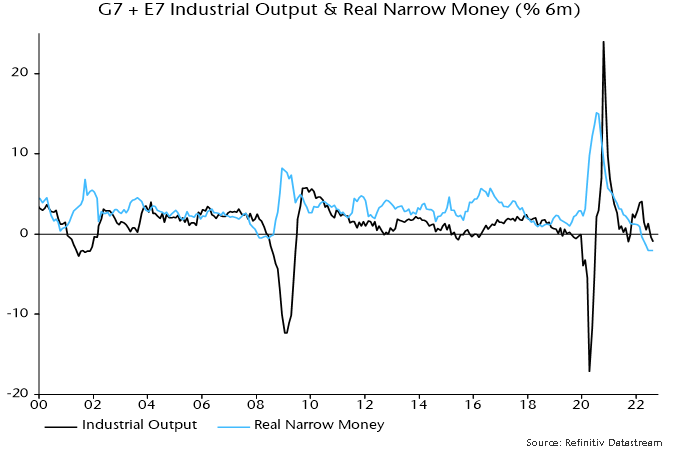
A fall in global six-month real narrow money momentum below zero in March signalled a shift in the economic outlook from slowdown to recession. A subsequent further decline in momentum to its weakest since 1980 suggests a deep recession extending into Q1 2023, at least. Economic contraction will release liquidity for markets, with “safe” bonds and quality stocks possible beneficiaries. Chinese real money momentum is diverging positively, supporting relative economic / equity market prospects.

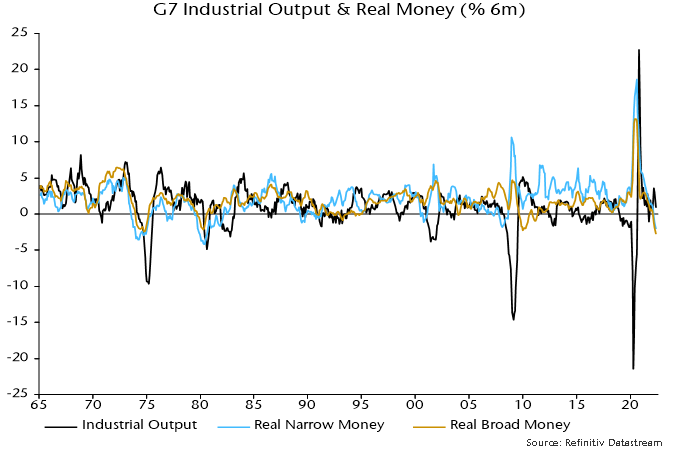
Global (i.e. G7 plus E7) six-month real narrow money momentum in May was below its GFC low and the weakest on record in data extending back to 1995. In longer-run G7-only data, the current rate of contraction was matched in 1973 and 1979 before severe recessions – see chart 1.

Chart 1

Chart 1 showing G7 Industrial Output & Real Money (% 6m)

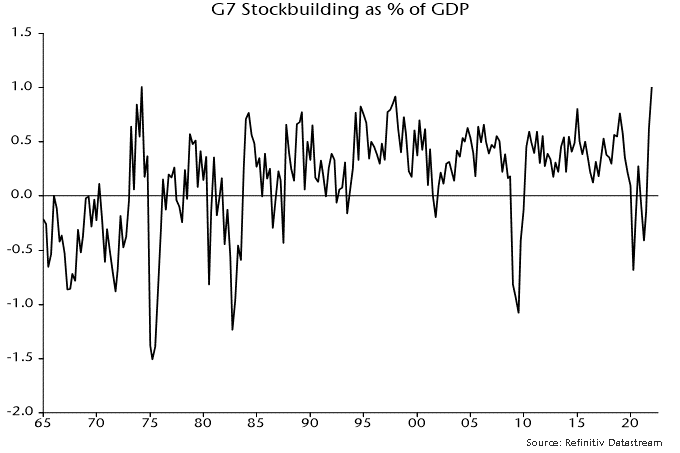
A further recessionary consideration is the recent pace of stockbuilding: the G7 stockbuilding share of GDP matched a 1974 high in Q1 – chart 2. The cycle upswing was supercharged by firms overordering inputs because of supply shortages. With final demand falling away, a liquidation of inventories will be amplified back through supply chains – the “bullwhip” effect.

Chart 2

Chart 2 showing G7 Stockbuilding as % of GDP

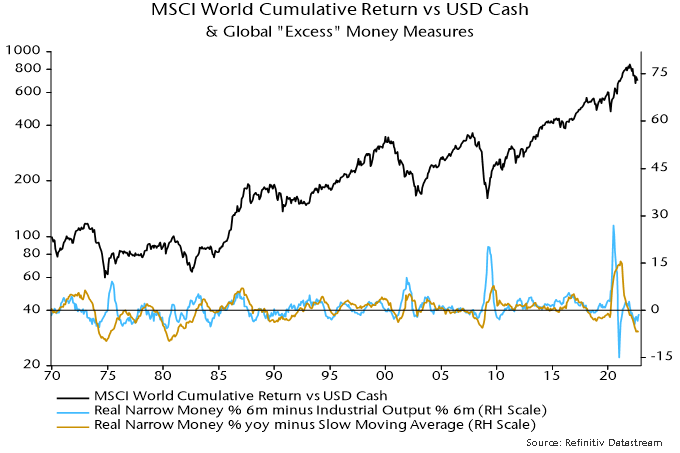
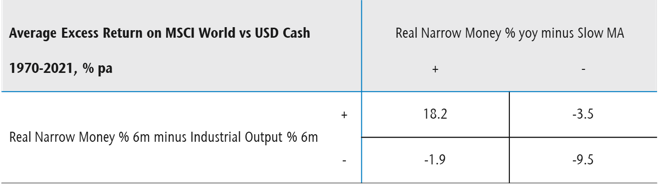
The assessment of market prospects here is informed by two measures of global “excess” money: the gap between six-month real narrow money and industrial output momentum; and the deviation of 12-month real money momentum from a slow moving average. Both measures were negative by end-January, a condition historically associated with weak equity markets – table 1.

Table 1

Table 1 showing Average Excess Return on MSCI World vs USD Cash 1970-2021, % pa

The expected recession and a likely sharp fall in six-month consumer price momentum suggest that the first measure – the real money / output momentum gap – will return to positive territory in H2, possibly in Q3. The second measure may remain negative: 12-month real money momentum is currently far below its moving average and will be slower to recover. The implication is a possible shift from the bottom right quadrant in the table to top right – still an unfavourable backdrop for equities but less grim than during H1.

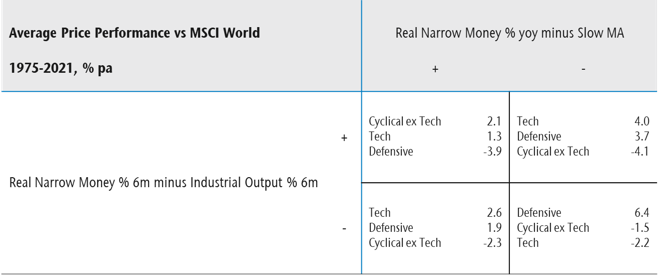
The excess money indicators are informative about sector and style performance. Recent outperformance of defensive sectors and underperformance of tech accords with the historical pattern under “double negative” readings – table 2. A switch to the upper right quadrant would suggest a tech recovery but further outperformance of defensive vs. non-tech cyclical sectors. Within the defensive basket, however, energy has historically performed poorly under this regime.

Table 2

Table 2 showing Average Price Performance vs MSCI World 1975-2021, % pa

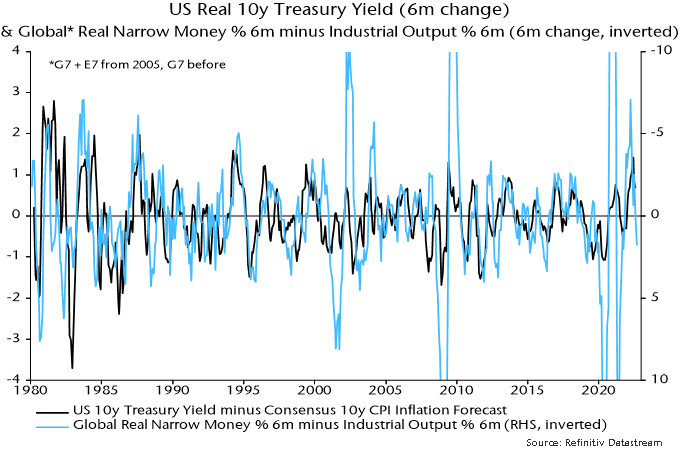
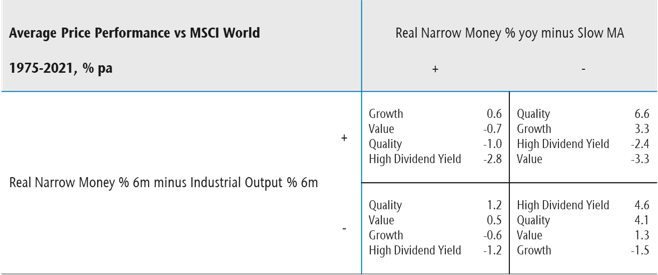
Style-wise, recent outperformance of high dividend yield stocks accords with the historical pattern in the bottom right quadrant but quality has not on this occasion proved defensive, probably reflecting its inverse correlation with Treasury yields and the magnitude of the H1 rise in the latter – table 3. This suggests that quality will stage a come-back if yields reverse, with a potential shift to the upper right quadrant an additional positive – this was the best regime for quality and growth historically.

Table 3

Table 3 showing Average Price Performance vs MSCI World 1975-2021, % pa

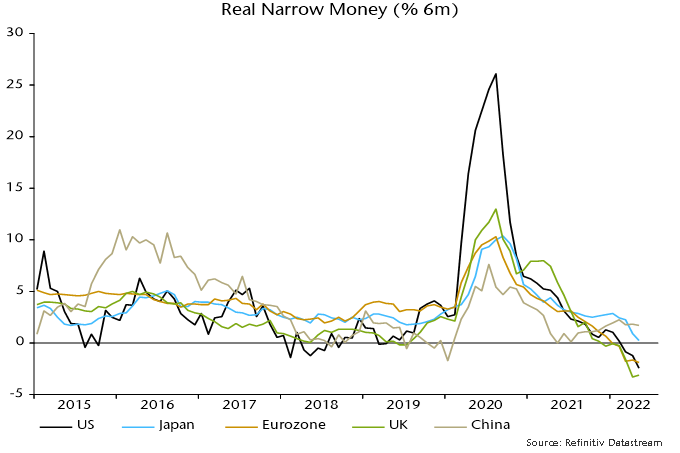
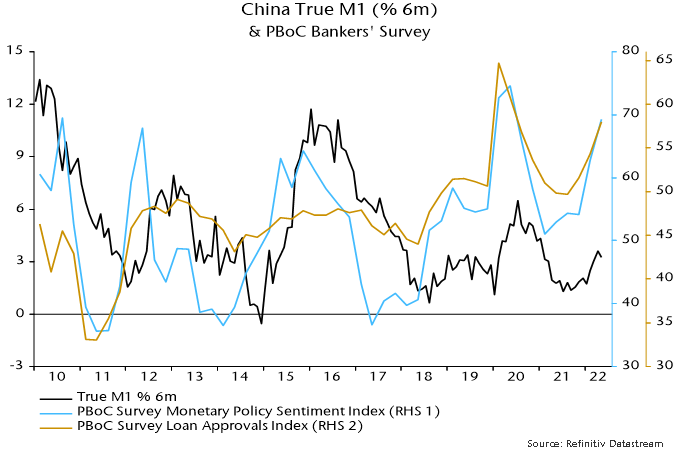
Six-month real narrow money momentum is similarly weak in the US and Europe but China and, to a lesser extent, Japan are diverging positively – chart 3. A further pick-up in China would support a forecast of economic recovery despite an export drag from recessions elsewhere. The latest PBoC bankers’ survey is consistent with monetary acceleration, indicating substantial policy easing and an increase in loan supply – chart 4.

Chart 3

Chart 3 showing Real Narrow Money (% 6m)

Chart 4

Chart 4 showing China True M1 (% 6m) & PBoC Bankers’ Survey

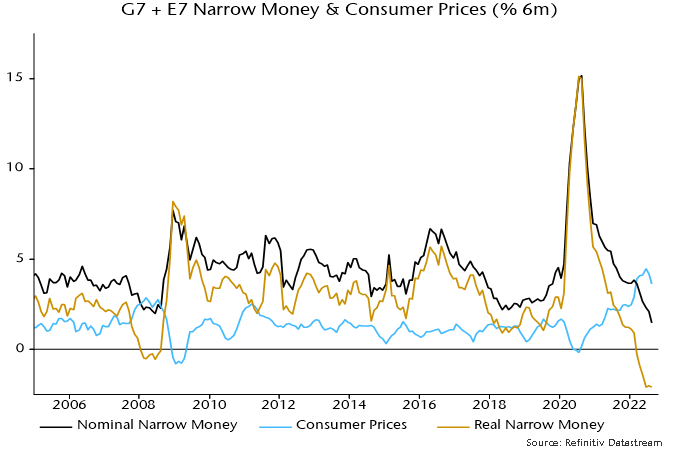
Global inflation prospects have improved dramatically. Having warned of the current overshoot, monetary trends are now consistent with inflation rates returning to target. G7 annual broad money growth was down to 4.9% in May from a peak 17.3% and is on course to move below its 2015-19 average of 4.5%: the money stock expanded at an annualised pace of only 1.3% in the latest three months.

The monetarist rule of thumb is that money growth leads inflation with a long and variable lag averaging two years. G7 annual broad money growth peaked in February 2021 so this average would suggest no inflation relief before early 2023. Some monetarist economists argue that the 2020-21 money growth surge has left a large monetary overhang, raising the possibility of a longer-than-average lag.

The view here is that the historical variability of the money growth / inflation lag partly reflects the position of the stockbuilding cycle, which is a key driver of commodity prices. The assessment that the cycle has peaked and will be in a strong downswing in H2 2022 suggests that recent commodity price weakness will be sustained, in which case their current large positive impact on annual CPI inflation rates will moderate through H2 and turn negative by early 2023.

Core inflation is widely expected to remain high into 2023, reflecting labour market tightness. Recession and monetary weakness, however, suggest that firms will lack pricing power to pass on increases in labour costs, which may, instead, squeeze historically generous margins and trigger early job cuts. Labour markets could weaken surprisingly sharply, with signs of an imminent unemployment reversal appearing recently in a range of sensitive indicators.

Close-up trading monitor with stock market candle chart

Several major global indices fell into bear market territories in the past weeks. Investor behavior has shifted from ‘buy the dip’ during the pandemic to ‘sell the rally’, fearing of a potential recession. A wave of layoffs has swept across businesses, especially in the tech sector in the United States (U.S.) in the first half of 2022. The University of Michigan Consumer Sentiment Index fell sharply to a record low of 50.2 in June of 2022, well below market forecasts of 58, mostly attributable to the soaring inflation, which is at a 40-year high.

To combat the inflation, the Federal Reserve (Fed) has accelerated the pace of its interest rate hike, lifting interest rates by 75 basis points in June. This represents the third hike in 2022, and the largest since 1994. Historically, recessions start a median of 25 months after the Fed begins a tightening cycle, although there have been three cases (in 1963, 1994, and 2015) when a recession did not follow.

The best scenario for the markets would be a so-called soft landing, where the Fed could bring inflation under control without causing a recession. An ideal outcome would be similar to 1994, when the Fed hiked interest rates seven times in 13 months, almost doubling the rate from 3.05% to 6.05%, while avoiding a recession. However, the annual inflation was only 2.7% in 1994, while the latest inflation rate accelerated to 8.6% in May of this year. The unemployment rate was also higher in 1994, at 5.5%, versus 3.6% in May 2022, indicating a tighter labour market and higher labour cost today. These factors suggest it will be more challenging for the central bank to tame the inflation this time around. It is more likely than not that we are going to have a recession as early as next year, as predicted by leading economists.

How long does a recession last?

Based on data provided by the National Bureau of Economic Research, since 1945, the U.S. has experienced 13 recessions, including the short one in 2020. The average length of a growing economy is 5.3 years, and the average recession lasts for 10 months. A full economic cycle is around 6.3 years.

What about the stock market? In the same time period, the S&P 500 experienced 11 bear markets, six of which were accompanied by a recession, according to data compiled by Invesco. Bear markets on average have taken about one year to go from peak to trough, and 2.3 years to return to break-even. The S&P 500 index plunged an average of 33% during bear markets in that period, with the biggest decline occurring between 2007 and 2009, when the S&P 500 dropped 56%.

What does small cap do historically in bear markets or recessions?

History indicates that small caps tend to outperform larger caps after a bear market, and small caps have outperformed large coming out of nine of the last 10 recessions since World War II, according to the Jefferies Equity Research report published on April 8, 2020, JEF’s SMID-Cap Strategy – Thoughts & Observations.

Small cap vs. inflation

Small caps have historically outperformed and have shown better pricing power during most of the previous high inflation regimes, including the early 1960s, and the 1970s. Margins of small cap companies have declined less than large caps when inflation goes up, and in some cases, small cap margins go up with inflation, according to the BofA report by Jim Carey Hall, Small cap primer: the big guide to small stocks, published on May 31, 2022. Companies we invest in at Global Alpha are leaders in their niche markets, which gives them the pricing power to pass on higher costs to clients, hence maintain a healthy margin in an inflationary environment. 

Small cap vs. high interest rates

Two types of companies are most likely to suffer from higher interest rates. From the valuation perspective, expensive stocks are more likely to get hurt; from the operation point of view, heavily leveraged companies are likely to suffer. The valuation of small caps looks particularly attractive today, as small caps were expensive vs. large leading into almost every other Fed tightening cycle since the 1980s. Today, small caps trade at discount to large caps, as noted in the BofA’s report, Small cap primer: the big guide to small stocks. Companies we invest in at Global Alpha are high-quality companies trading at reasonable prices. Approximately one third of the companies in our portfolios have a net cash position.

Expansion and recession are a natural part of the economic cycle. It is important to be diversified, and stick to quality names that benefit from secular trends. It is during the down markets that more investment opportunities will emerge. The Global Alpha team has identified many great companies that are trading at attractive valuations, and we will introduce these names in future commentaries.

People walking through airport, silhouette (focus on aeroplane)

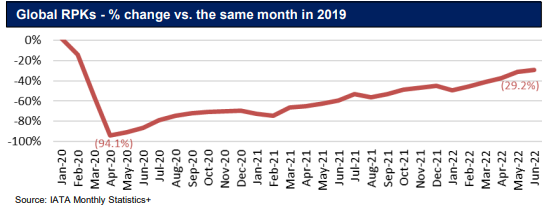
As the first official day of the summer approaches, it finally feels like the world is getting back to normal. Many countries are now dropping Covid requirements and restrictions, such as testing, masking and quarantining. Tourists are definitely itching to get their holiday plans back on track. In fact, travel is forecasted to reach pre-pandemic levels this year in many regions of the world. In the last two years, countries around the world have lost billions of dollars due to the lack of tourists and many are launching campaigns to attract foreigners back to their favourite holiday destinations.

Earlier this week, the United States (U.S.) announced a five-year strategy to revive national travel and tourism, which is aimed at promoting the U.S. as a premier vacation destination. According to the Bloomberg article, US launches plan to bring back foreign tourists, before the pandemic, travel contributed about $240 billion to the U.S. economy, benefiting companies operating restaurants, hotels, attractions, shopping and more. Despite a lull in international travel, demand in the U.S. has picked up quite rapidly. Over the last five months, travellers have contributed to a trade surplus in the country, signalling an improving appetite for travel. Demand is likely to continue increasing over the summer as international tourists have yet to reach their pre-Covid numbers.

Pent-up demand has been seen across Europe as well. If April travel data is any indication of what’s to come, Europe is in for a busy summer. In April, popular tourist destinations have seen tourist numbers increase anywhere from two to tenfold. Travellers are also spending a lot during their holidays. In France, for instance, foreign travel spending was up 201%, compared to 2021, and up 477%, compared to 2020, as noted in the Bloomberg article, France Foreign Travel Spending Up 201% in April Y/Y. Another Bloomberg article, Number of tourists visiting Spain in April up nearly tenfold YoY, notes that in Spain, the 6.1 million tourists who visited the country in April spent close to what 7.14 million tourists spent back in 2019. It seems that higher prices for hotel rooms and plane tickets are not dissuading tourists from packing their bags, enjoying their holidays and doing some shopping and eating out too.

Japan has taken a more cautionary approach to its reopening plans. As of Friday, June 10th, the country will be accepting visa applications and allowing tourists to come into the country, but only if they are part of a guided tour and continue masking. They have been allowing up to 20,000 arrivals a day since June 1, and this daily cap includes business travellers, foreign students, and Japanese nationals. It will also include the newly allowed tourist arrivals. It will be interesting to see how many tourists will book holidays to Japan on these organized tours. One factor that could boost the attractiveness is the weak Japanese Yen. It is currently trading at a 20-year low, which could incentivize travellers to take advantage of lower than usual prices within the country.

China remains in an uncertain state. The country has been looking to ease border restrictions, especially after the two-month lockdown in Shanghai. While they loosened restrictions, parts of Beijing and Shanghai are already back in lockdown for a mass testing exercise, given the country’s zero Covid policy. We will be keeping a close eye as the situation emerges, although it remains unclear as to how things will progress over the summer.

Despite the Organisation for Economic Co-operation and Development (OECD) lowering its global growth outlook to 3% in 2022, down from the previous 4.5% forecast, summer travel does not seem to be a casualty of the slowdown. We believe that travel-exposed names could really benefit from the summer vacation tailwinds and keep performance on track despite the general economic slowdown.

Samsonite (SMSEY)

Samsonite has been one name that has benefitted from the global travel recovery and could further benefit from the reopening of the Asian regions. Sales for 2022 are on track to reach 80% of pre-Covid levels. The company is a well-established travel and lifestyle bag and luggage company with several brands under its umbrella. Some of these brands include Samsonite, Tumi, American Tourister, Gregory, and Lipault. The company’s exposure to different segments within the travel industry, as well as different geographies, makes it particularly attractive. In terms of business and leisure travel, which has been on the rise, they own Tumi and Samsonite, which cater to the more frequent, long-haul travellers. Gregory and High Sierra on the other hand, cater to the short-distance, outdoor-casual travellers who are looking to buy new gear for their road trips and backpacking adventures. As a result of these trends, sales in North America have been growing at a strong pace this year.

Asia is their second most important region in terms of revenues, accounting for about 34% of sales, just behind the Americas at 40%. However, the company’s sales in the Asian regions have been lagging, given the harsh lockdown measures that were in place over the last few months. Although more recently, news coming from Japan about the loosening of border restrictions for tourists and the slow reopening of several regions in China have given their Asian regional sales a boost. As China opened its inter-province travelling, sales have been improving, and with the broader reopening of the region, we remain confident that the company will be able to deliver strong sales in 2022 despite the slow start to the year.

L’Occitane (LCCTF)

Another one of our holdings that could benefit from tourists opening their wallets abroad is L’Occitane. The company owns many different brands in the cosmetics and beauty industry that appeal to diverse demographics. Their three top markets are China, the U.S., and Japan. Although there are still some uncertainties about the reopening situation in China, we expect the U.S., Japan and the rest of their geographies to make up for the slower growth in China. The company not only operates independently-owned boutiques, but it also has its products in major airports around the world at duty-free shops while also having a strong B2B distribution channel through which the company sells to airlines and hotels. With the global travel rebound, the company is looking to benefit not only from individual consumers’ spending during their trips but also from its B2B segment in which airlines and hotel chains will need to replenish their inventories to welcome travellers.

On the cost side, like most companies, L’Occitane has also been facing some expenditure inflation. However, the company has been able to swiftly manage its increased input costs. The pricing pressure that L’Occitane has been facing mainly stems from logistics and raw material costs. The group raised prices in all geographies during the month of April by 4-5%. This has been its largest price increase to date and the company expects it to be sufficient to maintain margins this year.

A person checking stock market data on a mobile device.

“Intuition is linear; our imaginations are weak. Even the brightest of us only extrapolate from what we know now; for the most part, we’re afraid to really stretch.” – Ray Kurzweil

When it comes to investing, similar to technology, vision and imagination play a big role in achieving outsized outcomes. Ray Kurzweil was referring to the human imagination – or the lack of it – when we extrapolate linearly into a future with infinite possibilities. While human beings sometimes have difficulty grasping exponential change, there are also instances where we blindly extrapolate and exaggerate a recent trend indefinitely into the future. It’s easy to forget sometimes that the more things change, the more they stay the same.

It wasn’t that long ago that we were confined to the four walls of our homes, completely reliant on the internet economy to feed, clothe and entertain us. Much was made of the internet adoption of the future being fast forwarded back into the present. We were quick to pronounce the end of the brick and mortar economy. Turns out we were a bit too premature with this conclusion.

To understand why, we need to take a look at why the digital takeover did not quite live up to its promise. First, the pandemic led to large scale disruptions to a supply chain that is finely tuned to the needs of just-in-time inventory. It is no longer cheap to get your product from its factory in China to a warehouse/store near you. The cost to ship a container from China sky rocketed from a few thousand dollars pre pandemic to close to $15,000 today.

Second, the soaring cost of digital ads means the barriers to entry for a digital only brand/venture to succeed is much higher now. Many brands in the early 2010s were built on the back of cheap digital advertising. The cost of acquiring customers now is much higher and digital ads don’t quite make the impact they used to with their poor targeting and lower click through rates.

For example, the cost to advertise on Facebook has tripled in the last two years. At the same time, Apple’s latest privacy update has forced apps to comply with the Ad Tracking Transparency (ATT) framework, which requires advertisers to seek permission to track user activity. This makes it harder to track ad performance, leading companies to spend more for sub optimal results.

What this means is that a lot of digital-only brands and startups looking for new tricks to achieve growth have settled for an old trick – brick and mortar stores. It helps that the pandemic has led to plenty of empty store fronts to choose from. Landlords are now open to shorter leases and better terms, allowing digital native brands to experiment with a brick and mortar presence.

A classic example of a digital native brand thriving in this new world is Warby Parker. While Warby Parker is not new to physical stores, their big bet on brick and mortar is an admission of the fact that the adoption of online purchase of glasses has not fully lived up to expectations. Currently, their brick and mortar stores are more profitable than their website and the company expects most of the growth in 2022 to be driven by retail stores.

This trend has borne out in the larger economy. In 2021, U.S. brick and mortar sales overtook e-commerce for the first time ever. It remains to be seen if this is a sustainable trend, but clearly, brick and mortar is far from dead. At Global Alpha, we are cognizant of the fact that trends tend to get exaggerated to the extremes. The goal is to be mindful of these extreme swings and to look for mispriced opportunities when they arise.

Clicks Group (CLICKS SJ)

One of the brick and mortar champions within the emerging market universe is the Clicks Group based in South Africa. Clicks operates the largest retail pharmacy chain in South Africa, along with a health and beauty retail business. It also operates a wholesale distribution business and runs the Body Shop and GNC franchises in South Africa.

In a difficult environment marked by Covid and social unrest, Clicks continues to invest in its brick and mortar operations by opening close to 40+ stores every year. In spite of pandemic-led restrictions, its 800 stores have driven both top and bottom line growth.

Clicks interestingly uses the online channel as a more defensive strategy, letting them add and experiment with new categories and private label products. Our conversation with management informed us that South Africans prefer to go to shopping centres where most of the Clicks stores are located rather than shop online. They also value the privacy of shopping in a pharmacy rather than having items delivered home. Clicks illustrates how traditional retail and e-commerce can complement each other to drive sustainable growth. Irrespective of headlines, we continue to keep our ears to the ground to find great businesses.

Elevated view of Makati, the business district of Metro Manila.

Since 2010, the Philippines has been growing at a rate of 6%, with controlled inflation (except in 2018 due to rice inventories) and reasonable macro indicators. From 2010 to 2016, President Benigno Aquino implemented some pro-market reforms, increasing the space for growth and spending, reducing corruption, and implying an increase in investment and foreign flows. In the period of the Aquino presidency, the most pro-market policies caused FDI inflows in most years (which had only been seen in the period between 2003 and 2007). The Philippines received its investment-grade in 2012, after which the country continued growing nicely, and with good macro indicators, it was mostly market friendly.

In 2016, Rodrigo Duterte assumed the presidency of the country. Although the Build! Build! Build! infrastructure program was an interesting initiative, there was no significant progress, and the handling of the contracts led to doubts among investors. The Public-Private Partnerships (PPP) investment initiatives created by President Aquino were better accepted by the foreign investor community.

The Duterte government was faced with a strong fight against drugs, problems surrounding international relations (especially with the U.S. in its first half), and faced increasing internal protests. All of the above caused foreign investors to divest from local stocks almost every year. According to the CLSA report, BBM is it, more than USD$5 billion was divested from the Philippines market in 2016-2021, causing foreign ownership of the index to drop from around 30% in 2012 to nearly 20% currently.

Although the macro indicators continued to show good dynamism and controlled inflation, there was a certain crisis of confidence in the Duterte administration, along with a series of track records of policies missteps, troublesome relationships with some western countries, and better opportunities in other markets. The Philippines has essentially been forgotten by the foreign investment community for the last six years.

In the recent presidential election, Ferdinand “Bongbong” Marcos was elected. There is a logical execution risk for his new term. Nevertheless, its comparable base is very low. With foreign investments mostly out of the country, there is plenty of room to improve international relations. However, the huge infrastructure gap in relation to other countries remains. Bongbong Marcos wants to continue with the Build! Build! Build! Program, but may frame it differently.

Although it is too early to say, he doesn’t seem as conflictive as the former president was with some local groups. Duterte had some conflicts with leading economic groups, one example being the shutdown of ABS-CBN, the country’s leading broadcaster. In short, Bongbong Marcos has to avoid internal conflict and taking sides in international relations (as Duterte did with China). In that scenario, considering its vast growth potential (the Philippines should continue growing around by 6% in the coming years), foreign investors should regain some confidence in the country.

Of course, the transition is not easy. Investors will be keen to see some initiatives that will lower the deficit/GDP ratio from levels of -8.6% in 2021 to at least normal levels of -3% during his mandate. There are also ongoing discussions for a tax reform. Although there is no official proposal yet, the reform is not intended to harm a particular sector or corporations. It is more of a blended tax increase among different products (for example, liquor, cigarettes, removal of some exemptions in VAT). If done properly, the probable tax increases should be seen positively by investors and present organized measures to reduce the current deficit.

All in all, if the country is able to promote more FDI, it will benefit its deficit and debt ratios. Likewise, one of the best ways to grow the economy without compromising debt indicators is with more foreign and domestic investments. This could be a catalyst to regain a better sentiment towards the country. Investors need a clear roadmap. In 2017, we saw a rally in the stock market when the Duterte administration was elaborating a tax reform in order to reduce the deficit.

Together with a roadmap to reduce the deficit and create a sound monetary policy, investors are expecting Macros to appoint credible cabinet members. The President recently announced that Central Bank Governor Benjamin E. Diokno would serve as the new finance minister, which is good news for the market. Moreover, he is expected to make sound economic pronouncements and pursue pro-business policies. In his campaign, he mentioned several market-friendly initiatives, such as:

  • Continue the Build-Build-Build initiative of the former administration and increase digital infrastructure.
  • Increase attention on the agricultural sector (although many former politicians have mentioned the same thing and few improvements have been made).
  • Increase investments in healthcare (sound opportunity as consumption).
  • Increase funding for tourism (could be a relevant catalyst for the mid-term, as explained before).

One of the themes that we often take into account in emerging markets is the consumption of the emerging middle class. We feel that in a mid-long term scenario, opportunities are massively driven by the increasing purchasing power of the emerging middle class, as well as people climbing the corporate ladder, therefore accessing better opportunities and quality of life.

While it will take time, the transformation of the Philippines is possible; take Chile for example. In the 2000s, the country had a GDP/capita of close to 11,000 USD, and in 2019, it was close to 25,000 USD. Indonesia is another example, with a population of nearly 250 million, the country enjoys great opportunities to increase the purchasing power of the emerging middle class, fostering its current 4,500 GDP/Capita. In order to be able to upgrade and increase consumption patterns, a stable and open macroeconomic scenario, certainty and foreign investments are required. Indonesia has undergone several transformations aimed at achieving better investor confidence.

As for the Philippines, hopefully this new government will be able to boost investors’ confidence. We feel the country should follow a similar pattern as Indonesia, with some lag. The mining sector is very relevant in Indonesia, but has been quiet in the Philippines. Although the country has one of the highest worldwide resources in gold and copper, a lack of investments and politics have clouded its development. Last year, the Duterte administration lifted a nine-year ban on new mines, which is likely to slightly improve the scenario, but foreign capital is needed. The country can enjoy relevant opportunities in the mining sector if things are managed correctly, following a similar path that Indonesia is currently developing.

In terms of drivers of growth, the Philippines is one of the world’s biggest suppliers of labour. Remittances are around USD$35 billion per year, accounting for close to 8% of the GDP, as per the CLSA report, Back on the Road. Revenues have been growing at a rate of 4-5% per year, and they are expected to continue doing so. Moreover, the country enjoys the world’s second position in business process outsourcing (after India), accounting for USD$25-30 billion per year, around 7% of the GDP, growing at similar levels to remittances.

Tourism is another source of revenue the country must increase. Rich in natural beauty, tourism in the Philippines represents only 2-3% of GDP, a far cry from what tourism represents for nearby Thailand and Malaysia. If things are done well, the country could be another reopening player. In the first quarter of 2022 GDP increased by 8.3%, and the banking sector loan growth continues to pick up according to Bloomberg data. In February and March 2022, they were up 8.9% and 8.8% year-over-year, respectively. There are many catalysts for the Philippines to perform well. In the last six years, the country hasn’t driven foreign investor attention, remaining an undiscovered country with plenty of potential to unlock value.

We are currently overweight in the Philippines. Our investment in the country is in Puregold Price Club Inc. (Puregold)

Puregold Price Club Inc. (PGOLD PM)

Puregold is a multi-format consumer retailer in the Philippines. The company operates under the two phimain brands: Puregold and S&R. Puregold includes hypermarkets and supermarket discounters, mainly serving lower income classes, with the average ticket size of PHP 0.9k. S&R operates 20 warehouse stores based on annual membership fees and primarily targets customers in the middle to upper income classes, with an average ticket size of PHP 4.1k.

The top three formal grocery retailers account for 40-45% of the market. S&M Retail (owned by the country’s richest family, Sy) holds 20% of the market share and is also the leading mall operator. Puregold is the second=largest grocery retailer, with a 15% market share. Robinsons Retail accounts for 5-10% of the grocery market and is also engaged in department and specialty stores, hardware stores, and malls. Puregold is the only pure grocery operator among the largest players. The grocery industry is expected to grow in line with the nominal GDP, at 9-11% annually.

The company enjoys many strengths. Their multi-format strategy provides more flexibility and optionality. Covering all income segments makes Puregold a more defensive retail player and enables the company to benefit from improvements in the spending power of all income groups. Puregold has a strong balance sheet, generating plenty of free cash flow with almost no debt. Their stores have strong unit economics. Additionally, Puregold is a well-recognized brand with a perception of the best value among consumers, coupled with a large loyalty program that enhances customer loyalty.

In terms of opportunities, the company is well-positioned for the Philippines’ growth due to its lower-priced merchandise. The consolidation of mom-and-pop stores and small chains is also a driver for growth considering its strong track record of integrating acquired grocery chains. Moreover, a rise in the private label mix has an ongoing positive contribution to margin expansion (from <1% currently to at least 10-20% in the medium term).

Colleagues discussing new business strategies in the office

After growing at 9% compound annual growth rate (CAGR) for the last decade, there is still much to get excited about regarding the long-term prospects of the video game industry. New marketable technologies, streaming that provides exposure to lesser-known games, and new phone owners becoming potential gamers, are only a few of the reasons to believe that the industry will be able to maintain this growth over the next decade.

Despite these positive secular trends, video game developers and publishers have been facing a difficult start to the year. Two years of COVID has brought production delays that had initially been offset by significantly increased consumer engagement from various lockdowns across the world. With the reopening now well underway, these “non-core” consumers are going back to their pre-COVID lifestyle. This obviously creates difficult comps for companies that saw record growth for the last two years and are still often facing production delays, with many big names, such as Activision, Nintendo and Ubisoft posting negative year-over-year (YoY) revenue growth in 2022. Although, the delays were initially blamed on the work from home situation, where collaboration was more difficult and productivity was inconsistent. It is now the talent retention that seems to be at fault.

Indeed, game designers and engineers have a long history of being underpaid, compared to their peers in other fields, often trading higher salaries in exchange for working for companies that create games they are passionate about. Payscale.com listed the median video game designer salary at $66,452 versus software developers at $73,177 for 2021. Wage inflation is now rampant across virtually the entire economy. Additionally, many employees are reluctant to go back to the office, meaning that designers, developers, and game engineers are receiving multiple offers from competitors from within but also outside the video game industry. Video game development requires substantially more collaboration than many other software developer jobs. Management teams face a difficult choice between maintaining the perks of working from home to retain talent and bringing everyone back to the office to meet production timelines without requiring more resources.

It is not all negative for game developers and publishers though; 2022 is already the biggest year on record for mergers and acquisitions (M&A) in the video game industry. Microsoft acquiring Activision Blizzard for $68 billion is on its own the biggest video game company acquisition of all time. Other recent deal announcements, such as Sony acquiring Bungie and Take-Two Interactive acquiring Zynga, have shown that there is still demand for Intellectual Property (IP) and that the studio consolidation trend is well and alive. The top 10 gaming companies already represent over 65% of the market and that share is set to grow over the next decade. Increased M&A also tend to be beneficial for small-cap as their acquisitions are usually at a premium to their market value.

So how is Global Alpha positioning itself? We currently own Sega Sammy Holdings.

Sega Sammy Holdings (6460 JP)

Established through the integration of game publisher SEGA Corporation and pachinko machine manufacturer Sammy Corporation in 2004, it has historically also been involved in amusement centres and theme parks. A defensive name in our portfolio, the company owns strong and long-lasting franchises, such as Total War and Sonic, which they have a solid history of monetizing. The company has been divesting from its arcade business in recent years to reinvest in its gaming segment, which will allow them to more aggressively acquire studios and IPs, as well as facilitate the distribution of games worldwide.

The company differentiates itself from western game publishers through its diversification in the pachinko and pachislot business, which provides them with a more consistent cash flow than its video game business. Furthermore, their Pachinko and Pachislot business benefits from the economic reopening play where the video game segment would usually suffer. Another differentiator is the labour market in Japan, which is not facing the same wage pressure as seen in the west and therefore did not see the same challenges in retaining talent.

SWOT analysis

Strengths

  • Owns popular IPs and strong brand moat
  • Diversified complementary revenue stream

Weaknesses

  • Margins weaker than peers as it is not a pure play

Opportunities

  • Margin expansion from divestment
  • Deployment of cash for acquisition

Threats

  • Regulatory risk in their Pachinko business
  • Fail to produce or obtain exciting new titles/IP

Global Alpha is excited about the long-term growth prospects of the video game industry, and we believe the recent negative sentiment seen in markets worldwide offers good investment opportunities to stock pickers.

Warehouse worker wearing face mask and protective workwear checking products using digital tablet.

China accounts for about 12% of global trade. Covid restrictions have idled many factories and warehouses, and it could prove to have a great impact on local and global businesses. United States (U.S.) and European ports are already swamped from the present supply crisis, leaving them vulnerable to additional shocks.

China’s top exports are broadcasting equipment ($223 billion), computers ($156 billion) and integrated circuits ($120 billion). Top imports include crude petroleum ($150 billion), integrated circuits ($144 billion), and iron ore ($99 billion).

In the short run, the pile-ups will mean more costly headaches for the $22 trillion global merchandise trade. In the mid-term, investments in China will slow as cross-border travel will remain difficult. To give a sense of implications, there are more than 70,000 foreign-invested companies in Shanghai alone.

Chinese Covid restrictions will only accelerate the need to onshore, a theme that has been developing in the last couple of years. For a company, the risk factor of buying key components from foreign countries has become an important consideration among managers on a daily basis. The availability of goods has become critical in competitive landscapes. And, as the saying goes, the downfall of some will be the fortunes of others.

As investors, we certainly look to profit from these disruptions and seek to identify the companies who will gain market share from supply chain disruption or abrupt changes in market conditions, such as changes in tariff regulations.

Lesson learned, in 2017, Global Alpha invested in Solaredge Technologies, a small, sub $1 billion market cap technology firm providing high-quality inverters to the solar industry. At the time, Huawei was to enter the US market and compete heavily on price. The story unfolded where Huawei could not compete technically, and, deterred to enter the U.S. by international trade tariffs, Solaredge has a $12 billion market cap today. We have since exited the position.

Global Alpha believes that the China lockdown and the accelerated onshoring could provide more Solaredge-type opportunities.

Caesarstone (CSTE:US)

Caesarstone is a concept and lifestyle-driven company with a customer-centred approach to designing, developing, and producing high-end engineered surfaces used in residential and commercial buildings globally. The company has two main manufacturing facilities: one in Israel and the other in the U.S.

The company provides high-quality countertops for the professional network of architects and home designers. With time, it has expanded its offering to big box outlets, such as Home Depot, Lowes and IKEA. Its markets are global, with concentrated sales in the U.S., Canada, Australia and Israel.

In the last few years, competition from Chinese countertop manufacturers has put pressure on company margins, as well as demonstrated a deeper need to innovate from quartz to ceramics materials.

Recently, Caesarstone has shown revenue growth, both from the rebound of U.S. construction, as well as a strong focus on its product mix, both in the professional and big-box segments. With a strong presence in the southeastern United States, Caesarstone is also in a good position to benefit from a fast-growing market.

The supply shortages occurring in China could affect Ceasarstone’s competition as Chinese countertops lack availability. We would expect the company to take full advantage of this situation. Long term, non-Asian distributors could increase their relationships with Caesarstone as they implement deeper onshoring strategies.

De’Longhi (DLG:IM)

De’Longhi is an Italian manufacturer and distributor of small domestic appliances worldwide, with operations in the espresso coffee makers, food preparation, comfort and home care segments. The group’s brand portfolio comprises De’Longhi, Kenwood, Braun and Ariete.

The company competes against French company Group SEB and Australian company Breville in many home-destined consumer products. The competition in the high-end coffee maker segment has been notable with Hollywood-level advertising and De’Longhi using Brad Pitt to fend off George Clooney’s success with Nespresso.

With a strong manufacturing base in Treviso, Italy, the company may be able to navigate the Chinese supply issues with some ease. Its competitor Groupe SEB is four times the size of De’Longhi, but mostly because it has global dominance in cookware. As Groupe SEB ferociously competed with the Chinese in cookware, they moved most of their production to China. Today, De’Longhi is in a position to take the market share because of its favoured local production. 

The onshoring theme is providing many strong tailwinds in certain industries. As an example, Taiwan chip manufacturer TSMC is investing heavily in Japan in an effort to diversify from China. In fact, Japan could become a major beneficiary of moving production out of China from its industrial technology leadership, proximity to Asian markets and developed market status.

Kurita Water (6370 JP)

Global Alpha recently purchased Kurita Water in Japan. Founded in 1949, Kurita Water manufactures and sells water treatment equipment and chemicals. Revenue mix by region is Japan at 60%, Asia 18%, and the rest of the world at 22%. Water treatment equipment represents 61%, while chemical sales are 39%, a strong recurring revenue source. The main industry focus of Kurita is the electronics industry, at 63% of revenues.

Water treatment in electronic manufacturing is of high technical standard supporting Kurita’s expertise and leadership in water treatment.

Kurita Water has always been on our watch list for the quality of its products and long history. During the last eight years, it participated in a highly competitive Chinese market. The diversification decision by its clients, such as TSMC to develop chip manufacturing in Japan, should support company growth over several periods.