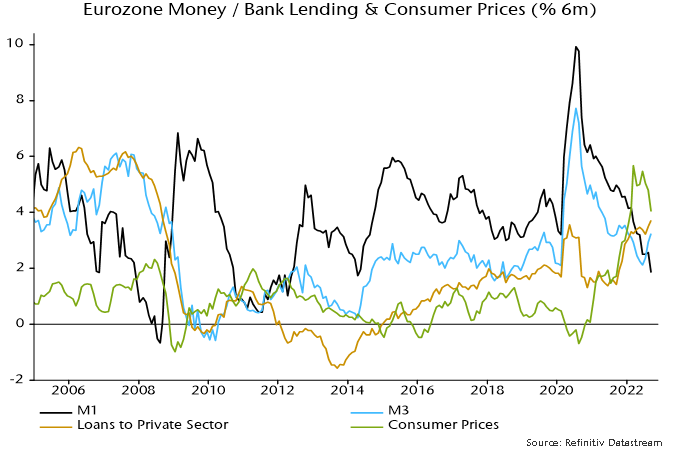
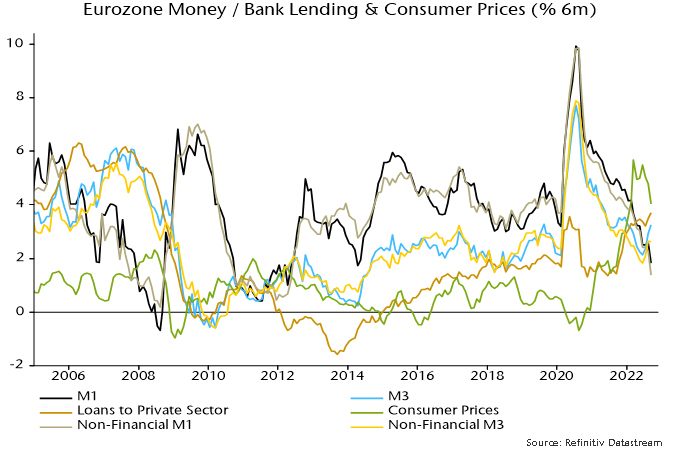
Eurozone money measures are giving mixed signals. Headline broad money M3 rose by a strong 0.7% in September, pushing six-month growth up to 3.3% (6.6% annualised), the highest since December. Narrow money M1, by contrast, contracted on the month, with six-month growth falling further to 1.8% (3.7% annualised) – see chart 1. 

Chart 1

Chart 1 showing Eurozone Money / Bank Lending & Consumer Prices (% 6m)

Broad money reacceleration, on the face of it, suggests an economic recovery towards mid-2023 after a sharp winter recession. The judgement here, however, is that broad money numbers have been boosted by technical / temporary factors and intensifying narrow money weakness is a better representation of current monetary conditions and economic prospects. 

The six-month rate of change of real M3, it should be emphasised, remains negative, with consumer prices (ECB seasonally adjusted series) rising by an annualised 8.2% between March and September. 

The sectoral breakdown of the headline M3 / M1 numbers, moreover, shows a significant recent contribution from rising money holdings of financial institutions. This probably reflects cash-raising related to weak markets and is not an expansionary / inflationary signal for the economy. 

The forecasting approach here focuses on non-financial money measures where available, i.e. encompassing holdings of households and non-financial firms only. Six-month growth of non-financial M3 was 2.6% in September versus 3.3% for M3 and has shown a smaller recent recovery – chart 2. 

Chart 2

Chart 2 showing Eurozone Money / Bank Lending & Consumer Prices (% 6m)

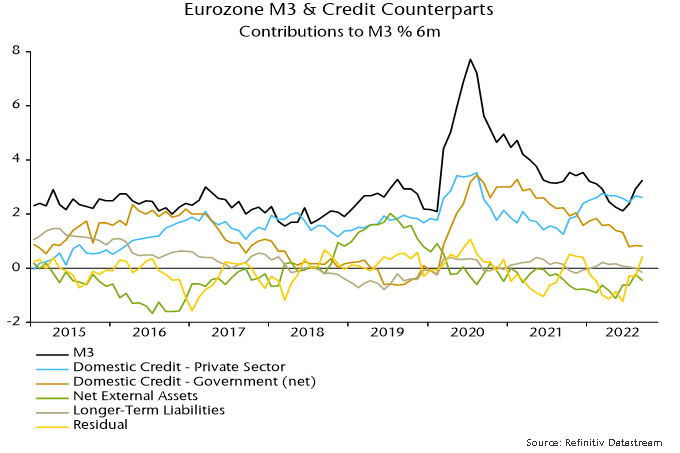
A further reason for playing down the broad money pick-up is that it is not explained by any of the conventional “credit counterparts” – credit to the private sector and government, net external assets and longer-term liabilities. The counterparts analysis shows a positive contribution from unspecified residual items, which behave erratically, suggesting a future reversal – chart 3. 

Chart 3

Chart 3 showing Eurozone M3 & Credit Counterparts Contributions to M3 % 6m

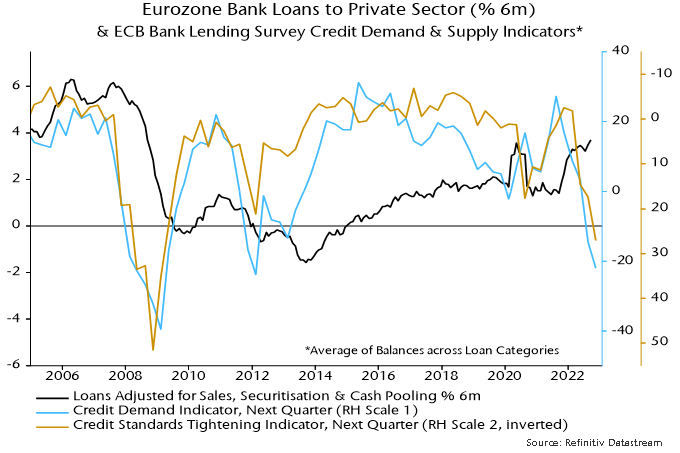
Solid growth of lending to the private sector has been the key driver of recent M3 expansion. The October bank lending survey, however, showed a further plunge in credit demand and supply balances, signalling a future lending slowdown or even contraction – chart 4. 

Chart 4

Chart 4 showing Eurozone Bank Loans to Private Sector (% 6m) & ECB Bank Lending Survey Credit Demand & Supply Indicators* *Average of Balances across Loan Categories

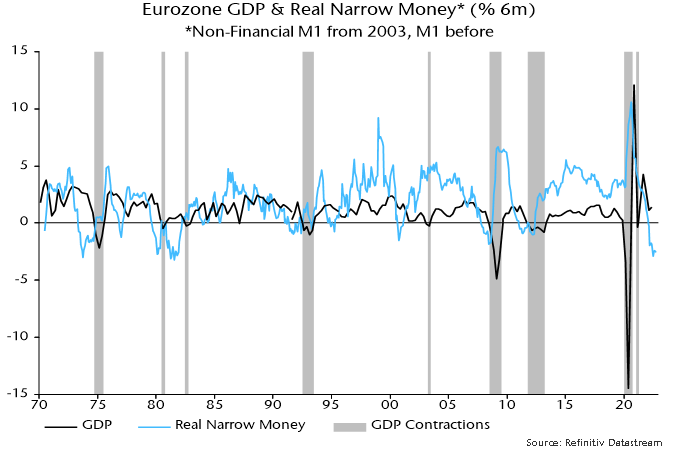
Statistical studies show that real non-financial M1 has the strongest leading indicator properties of the various money and lending measures. Its six-month rate of change remains at the bottom of the historical range, suggesting no economic recovery before H2 2023 – chart 5. 

Chart 5

Chart 5 showing Eurozone GDP & Real Narrow Money* (% 6m) *Non-Financial M1 from 2003, M1 before
Big crowd of people gathered together in one place (top view).

“Demography is Destiny.”

– August Comte1

From the dawn of mankind to the 1960s, it took approximately 60,000 years for the Earth’s population to hit the 3 billion mark. All it took was just 60 more years to add 4 billion more inhabitants and we remain on track to hit 10 billion by 2060.

Demographics influence everything from politics to sociology to economic growth. In fact, economic or GDP growth is essentially driven by two factors – growth in population and increase in productivity. 

While Europe and Japan have lately been associated with aging societies, declining populations and slowing growth, emerging markets continue to be associated with mega cities and limitless demographic dividends acting as investment tailwinds far into the future. However, the stark reality is that most emerging markets have already exhausted their demographic dividends. According to research by Aberdeen, even among emerging markets, only Pakistan and Nigeria are expected to reap dividends far into the future.

In fact, we think there could be a downward bias to population growth estimates for most emerging markets for reasons that are both societal and structural. Let’s take a look at the two emerging market giants – China and India.

China’s rapid rise has been facilitated by a demographic dividend that has not sustained for as long as most analysts predicted. To the contrary, China’s population has begun to decline a full nine years earlier than expected, with the population shrinking for the very first time in 2022. From the beginning of President Xi Jinping’s term in 2012 to 2021, the number of babies born each year fell more than 45%. 

Meanwhile, India’s population is expected to surpass China in 2023, a good seven years earlier than expected. With India, one would expect the opposite trajectory with the promise of a rich demographic dividend ready to be encashed for decades to come. But according to the United Nations, India’s population is actually expected to peak a decade earlier than expected (in 2050) and at a lower level (1.6 billion vs 1.7 billion). Given how badly statisticians and demographers have been off the mark with China, it would be reasonable to assume that these numbers could be revised downwards very soon.  

The downward revisions stem from our underestimation of some of the structural factors driving this decline in both countries. These factors include: 

The last point, as surprising as it may sound to some readers, could be a swing factor in decision making for the next generation of parents. According to a survey published by GlobeScan, four in ten people are not willing to bring children into a world suffering from the disastrous effects of climate change. Even growing emerging market populations in Egypt (61%), Turkey (54%), India (52%) and Vietnam (49%) are expressing doubts about having children in an uncertain world.

While no doubt many EM countries will have large growing middle classes, we remain mindful of opportunities that might arise from trends brewing beneath the surface. In some countries, the era of “easy” GDP growth might be over. This means we need to focus either on opportunities that cater to servicing aging populations or those that enhance the productivity of a smaller working age population. Below, we look at an example that services an aging population. 

Fu Shou Yuan (1448 HK) 

One of our holdings is Fu Shou Yuan (FSY), which is the largest death care provider in China. With a rapidly aging population, we expect FSY to benefit as the government slowly exits this market and releases cemetery land to the private sector. FSY operates in the premium segment, offering a full range of afterlife services, from funerals and cemetery plots to digital services, where customers can keep memories of their loved ones alive digitally.

China is the world’s largest aged society, with 10 million deaths per annum. The death care industry in China is expected to grow at 8% compound annual growth rate (CAGR) until 2024. With 3.4 million square feet of space and a valuable land bank around Shanghai, FSY has a reputation for operating clean, spacious, aesthetically designed cemeteries. In an industry where acquiring business licenses is difficult, FSY is able to leverage both its reputation and size to acquire government and private operations. 

FSY shows us that even in an industry such as death care, it is possible to differentiate a generic product through value-added services like landscaping and sculpture design, cremation jewelry, digital services and insurance coverage. At Global Alpha, we recognize that demography is not destiny and not all emerging markets are on the same trajectory. Finding horses for courses is one of the key elements of our investment process.


1August Comte (1798-1857) was a 19th century French philosopher whose ideas helped develop the modern field of sociology. He was one the first people to connect population trends with the future of a country. 

Lake Pichola with City Palace view in Udaipur, Rajasthan, India.

“It is far better to buy a wonderful company at a fair price than a fair company at a wonderful price.” 
– Warren Buffet

“Anticipate trend and benefit from it. Traders should go against human nature.”
– Ramesh Jhunjhunwala

We recently passed the year mark for our Emerging Markets Small Cap portfolio. In a tough environment, there have been markets that have outperformed the EM MSCI Small Cap Index in a substantial way, and we were able to outperform some of those markets. One interesting case has been India, where despite tough valuations, the market has behaved well. MSCI India has outperformed MSCI EM SC by over 23%, according to Bloomberg.  

Why does this happen? Why does a market that trades at 20.3 forward price-to-earnings (PE) vs 10.0 MSCI EM SC index (according to Bloomberg, October 5, 2022), massively outperform in this cloudy environment? Referring to the second quote by Ramesh1, when we are investing in India, we are thinking more long term. This is because we are able to find some of the top-quality companies among outstanding trends, which are well managed and are likely to overcome many cycles. India also conveys strong demographic tailwinds and is one of the few EM countries that is actively fostering investing and growth. Will we sometimes have to pay a higher than average index valuations? Probably yes, and that’s fair, because at Global Alpha, we like finding wonderful companies, generating cash flows, low debt and a good balance sheet at a fair price because it’s the core of our process. We are thinking more long term and it is our intention that our bottom-up selection process relates to companies with secular trends that are particularly interesting in the EM space. In the case of India, it is a good match because we can find multiple ideas with secular trends, where EPS growth is followed by stock price appreciation. 

India has been our best performing market both year-to-date (YTD), and since inception of the EM Small Cap portfolio. Although we have taken some profits, we continue to like good companies that present interesting investment opportunities. Moreover, the current administration is boosting capex spending, which benefits many sectors. According to Macquarie, the central government spending has increased 34% YTD, driven by spending on roads, railways and defence. Public Sector Undertakings (PSUs) have also increased their spending, and the trend should continue in the remaining part of the year. The private sector is also picking up, albeit not at the same pace, but increasing nonetheless. This has rarely happened in India in the last decade. Public sector spending is concentrated more on infrastructure, while the private sector focuses on renewables, automation and data centres. If we look at this in relative terms, we see some decoupling from India and the rest of the world. Considering the global recession, it’s hard to find countries in the EM space that are fostering investments and growth (Saudi Arabia is another case). As India is a domestic-oriented economy and has an enormous quantity of investment deficits (and opportunities) in different areas, the country can continue with policies that imply growth and investments. While we expect some slowdown in FY24, we anticipate that India should continue with short-mid-term growth that is higher than other countries. 

Flow-wise, foreign institutional investors are returning to India. There was a clear sell-off in this market from October 2021, with close to USD 20 billion of outflows, as noted in the CLSA report, Flowmeter: Breakdown of Foreign and domestic flows in India. The market didn’t reflect any major impact basically driven by strong domestic investors’ inflows.  In the last three months, we’ve seen foreign direct investment (FDI) coming again to the country, which still conveys strong domestic inflows support. South Africa, Taiwan and Korea have also experienced massive outflows this year. In the two last countries, this is largely explained by its tech-driven markets in a hawkish U.S. Federal Reserve (Fed) environment.  

All in all, the equation is not so complicated. Among EM Small Cap, Fed hikes have implied strong outflows in tech-related countries (USD 50 billion between Taiwan and South Korea, according to the CLSA report, Flowmeter: Breakdown of Foreign and domestic flows in India), as China maintains its own internal issues driven by zero Covid policies and the property sector. Some markets, such as Turkey, Chile and Brazil, have outperformed YTD mainly because of low valuations among a hawkish Fed. In the case of India, we think quality structural stories are likely to be favoured in this environment, in domestic oriented market focused economies, with structural demographic tailwinds.  We provide two stock examples that have been the key in our outperformance in the Indian market. 

Phoenix Mills (PML) 

Phoenix Mills is a leading Indian developer of large-format retail-led mixed use developments. Over the last few years, PML has spread its wings across Tier I, II and III cities in India by entering into joint ventures with established regional players and bringing in strategic investors to support the growth of its ongoing and future developments. It differentiates itself by its prime-location assets (currently eight shopping centres) across key cities like Mumbai, Chennai, Bangalore, Pune; steady cash flows; near-term execution visibility; and a healthy balance sheet. PML’s core vision is to create iconic city-centric, mixed-use developments with retail as the core and offices and hotels as complimentary assets, according a HSBC report published June 21, Buy: Growth beyond.  

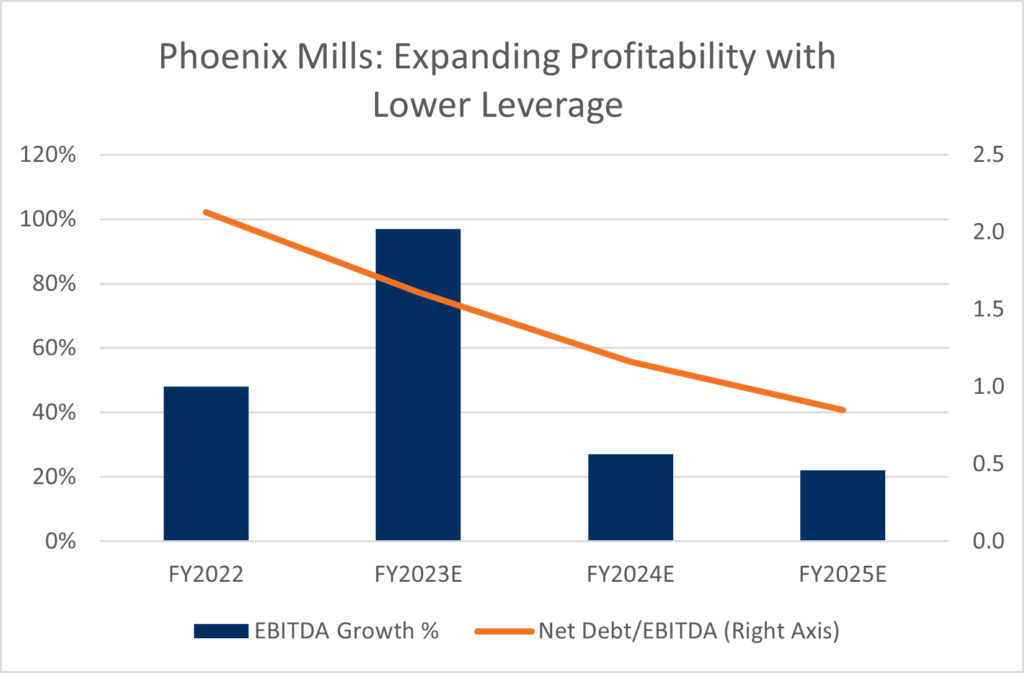
One of PML’s main strengths is the quality of its partners. Phoenix has joint developments with Canadian Pension Plan Investment Board (CPPIB) and Government of Singapore Investment Corporation (GIC). Although both companies have huge investments around the world, it is worth noting that they chose Phoenix Mills as a strategic partner in India. We see the quality and yields of PML projects, a good track record, execution and quality of management as a key differentiator for them in order to establish long-term relationships. Moreover, these partners allow the company to expand their asset base notably with minimum debt requirements. Capex of projects under construction as of Q1FY23 accounted for INR 42 billion and the required corporate debt is only INR 3 billion; that is to say debt funding is at 8% of aggregate capex spends as of Q123, according to a Phoenix Mills presentation from September 2022.  

These partnerships are relevant because the company is poised to a strong growth phase, with most of the projects already defined and under construction. From FY22 to FY26, PML plans to increase 1.9 times its gross leasable area (GLA) of shopping centres, from 6.9 millions of square feet (msft) to 13.0 msft (75% consolidated revenues FY24E), and 3.6 times offices GLA, from 2.9 msft to 7.1 msft. Lastly, in its hotels business, the company intends to increase 1.7 times, from 588 keys to 988 keys. To fund this growth, the company has raised equity capital of INR 45 billion, where 75% comes from the capital infusion from its partners.  

PML is more than doubling in the next three to four years, with strong global worldwide partners and with almost no additional corporate debt. Currently, at a group level, PML has INR 22 billion of liquidity to fund future growth. The sound financial position of the company has resulted in some local credit rating agencies to upgrade the company. India Ratings and Research upgraded the company to AA- from A+, while maintaining a stable outlook.  

In recent months, during an interview, Shishir Shrivastava, Managing Director of Phoenix Mills, expanded more on qualities of the two partners, CPPIB and GIC . He mentioned three pillars worth noting in these comments in a HSBC report published June 21, Buy: Growth beyond

  • “They are long-term investors and bring vast experience and a global relationship, along with 
    design and costing product specification inputs.” 
  • “They are some of the biggest retail space owners worldwide and have seen how retail has 
    grown in various countries and thus have a lot to add from that experience.” 
  • “ESG is something Phoenix is learning from their global teams and expanding their 
    understanding. Overall, they are not silent financial partners.” 

In the shopping centre sector, once the group reaches 13.0 million square feet, its GLA should account for roughly 45% of expected GLA of listed companies in India (PML, Prestige, Oberoi, DLF and Brigade). Looking forward, PML has set a target to add approximately 1 million square feet of GLA each year post-FY26 and is looking for greenfield opportunities in various regions, including Kolkata, Surat, Chandigarh, and Hyderabad, among others). Funding would be either solely by PML or with joint venture partner, according to ICICI Securities. Thinking long term, a joint venture with GIC and/or CPPIB can be monetized, for example, by a REIT, or the company can judiciously unlock capital via lease rental discounting (LRD) to continue its expansion, as we see more room for consolidation in the industry. 

Chart 1 - Phoenix Mills: Expanding Profitability with Lower Leverage

City Union Bank

City Union Bank Limited is a mid-sized private-sector bank and is also one of the oldest private sector banks in India. The bank is focused on providing working capital finance to small manufacturers and traders with single-banker relationships; 50% of their loan portfolio goes to micro, small and medium enterprises (MSME) and 14% to agriculture. 

Driven by its improvement in asset quality and sustained economic recovery, the company revised its FY23 credit growth guidance upwards to 15-18% versus the previous 12-15%. We see this as sustainable with an expected loan book growth of 15-20% and an earnings growth of 20% over the next five years. One of the key competitive advantages for maintaining this is that management is conservative and focused in its core competency of SME lending without falling into the trap of lending to big corporates in risky sectors. 

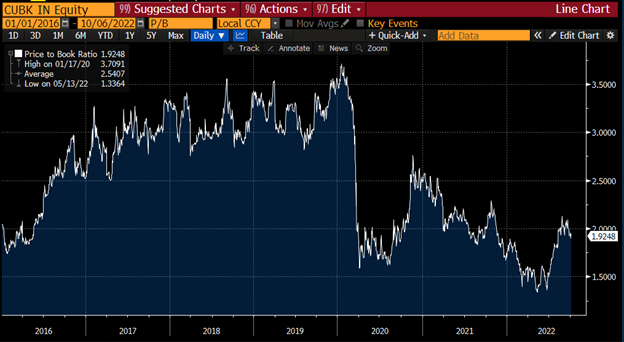
After successfully navigating Covid-led challenges, more significantly within its assessment range, CUBK will be embarking on a higher growth journey hereon. CUBK also enjoys positive tailwinds from increasing capex growth and the financial sector, as explained above. Return on assets should remain at levels of 1.5% (1.46% as of the second quarter), implying return on equity in the range of 15-16%. We think this level of profitability is sustainable for the future, and that’s why valuations are reasonable, both in relation to its history and to other Indian banks. The company has delivered those levels in the past, pre-Covid, which have been stronger than its peers among different business cycles. Net interest margins are steady at 4% and are likely to maintain in that range. Considering the higher proportion of the floating rate book (65% is EBLR linked), asset yields are likely to inch up Q2FY23 onwards. The entire external benchmark based lending rate (EBLR) book is repurchase agreement (repo) linked. With 61% of loan book in working capital loans, repricing is also possible in short intervals. 

Several factors give CUBK a key edge over peers and sustain its profitable expansion. The company has a core expertise in high yield SMEs, the company has also been building relationships with the local business community over the years. Additionally, around 99% of the loan book is secured, with high collateral values ensuring that historical loss given default (LGDs) have remained at 30%. CUBK also enjoys a better granular balance sheet on both the asset and liability side than its peers. Dependence on large corporate deposits is low and retail deposits as a percentage of total deposits is 75% (second highest behind the Federal Bank). On the asset side, there is high granularity, with the top 20 borrowers contributing just 5.72% of total assets. Lastly, the total addressable market maintains a big opportunity. Its long runway for growth as MSME’s lending needs are met by private sector banks that now have access to better data with the introduction of GST.  

Chart 2: City Union bank current trailing PBV and historical valuation

Chart 2: City Union bank current trailing PBV and historical valuation
Source: Bloomberg

[1] Ramesh Jhunjhunwala was a very well-known Indian investor who recently passed away. India’s Prime Minister Narendra Modi tweeted after his death: “Full of life, witty and insightful, he lives behind an indelible contribution to the financial world.”

Large boardroom with a view and empty chairs.

One of the more intricate events that shareholders must assess is a change in CEO or senior management. Turnover is a reality even at the executive level: every year between 10 and 15% of corporations must appoint a new CEO, a number that is steadily increasing as investors become more actively engaged. The average tenure of an American CEO fell by half to an average of five years between 2000 and 2014. Multiple studies on the matter show how the lack of preparedness for a CEO change is costly to investors.

Despite all this, research shows that most boards are ill-prepared to deal with the transition. A survey of 140 public and private companies by Stanford researchers concluded that at least half of the CEOs surveyed were unable to name their successor, should the need arise now. Furthermore, four in ten companies had no one who could immediately replace the CEO internally. This challenge is compounded further by the changing employment landscape where role and employer changes are more frequent. The typical executive today is expected to work for more than five employers during their career, compared to fewer than three in the 1980s.

It is worth noting that the lack of a successor pipeline also means that underperforming CEOs are kept in their roles longer than they should. This creates a potential conflict of interest for CEOs, where there might be an incentive not to have a clear successor to give them leverage with the board. Given the packed governance agendas, this topic has taken a backseat, but can be just as impactful as any other governance issue.

So how does Global Alpha assess CEO changes within its portfolios? There is no one-size-fits-all approach. Understandably, it is difficult to create a policy that would account for all the factors, including the reason for the CEO’s departure, the state in which the departing CEO leaves the business, insider/founder ownership, etc. Nonetheless, Global Alpha’s idea of a successful succession scenario for its holdings includes but is not limited to the following characteristics:

  • The event is anticipated: The process taking place over a long period not only provides clarity and reassurance to investors, but also implies that this is not the result of a scandal or loss of confidence in the CEO.
  • There is a framework in place: CEO succession is (hopefully) not something that happens regularly. Nonetheless, there needs to be an existing framework that prepares potential successors, even if no transition is expected in the near future. Clear communication of the processes also helps setting expectations for the potential successors. It is estimated that only 50% of companies provide onboarding or transition support to new CEOs.
  • The successor(s) is internally groomed: External candidates are not necessarily worse, but are on average paid more disproportionately and do not benefit from the same knowledge transfer compared to a candidate who was groomed internally over multiple years. Trending upward, roughly 25% of companies looking for a CEO replacement hire externally.
  • The business strategy remains consistent: We invest in companies whose business model we believe in. Although we do not see issues with small shifts in tactics, the overall business strategy should be consistent.

One of the benefits of operating in the global small cap universe is that the CEOs of the companies we invest in are often also the founders. By having more “skin in the game” than an appointed CEO, they also have a vested interest in ensuring a successful transition for their own legacy. Additionally, founders often go on to be board members following the appointment of their successor, which is another way of ensuring that the knowledge and expertise are still available to the new management.

Loomis, a holding in our international and global strategies, is a recent case study in CEO transition. Headquartered in Sweden, the company offers cash management services and transit to banks and retailers. Patrick Andersson, its CEO since 2016, announced his resignation from the role in early 2022 along with his intent to quit within the next year. Within a month, the board was able to replace him with an internal candidate named Aritz Larrea who had been with the company since 2014 in various roles, such as President of Loomis US and Loomis Spain. In addition, Larrea was already a part of Loomis’ executive management team. Despite the abrupt nature of the CEO’s resignation, investors noted a strong internal pipeline, as well as a framework in place to ensure continuity, without having to either hire externally or resort to an interim CEO.

The monetary forecast of global recession in late 2022 / early 2023 appears to be playing out. The latest real money data hint at a bottoming out of economic momentum around end-Q1 2023 but there is no suggestion yet of a subsequent recovery. This message dovetails with cycle analysis, with the stockbuilding cycle now turning down and unlikely to enter another upswing until H2 2023 at the earliest. Global industrial output is expected to contract sharply over the next two quarters with labour market data turning decisively weaker. Below-average nominal money growth, meanwhile, continues to signal major inflation relief in 2023-24. The monetary backdrop has improved for high-quality bonds and may turn less hostile for equities by year-end. A possible strategy is to remain overweight defensive sectors but add to quality / growth exposure on confirmation of monetary improvement. Monetary trends are relatively favourable in China / Japan and Chinese “excess” money could shift from bonds to equities if pandemic policy eases.

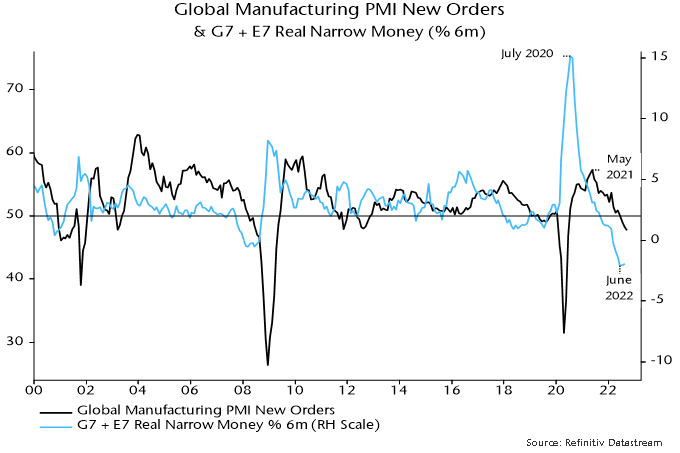
Global six-month real narrow money momentum remains significantly negative but appears to have bottomed in June, edging higher in July / August. Assuming that a June low is confirmed, the suggestion is that global industrial output momentum will bottom around March, based on an average nine-month lead at historical turning points. The global manufacturing PMI new orders index might reach a low a month or two earlier – see chart 1. 

Chart 1

Chart 1 showing Global Manufacturing PMI New Orders & G7 + E7 Real Narrow Money (% 6m)

The base case here is that real money momentum will recover into year-end because of a sharp slowdown in six-month consumer price inflation, which could fall by 1-2 percentage points based on current commodity price levels. 

The risk is that an inflation slowdown will be offset by a further weakening of nominal money growth in response to policy tightening. This is not guaranteed and, if it occurs, may be on a smaller scale than the inflation slowdown. Episodes of rising risk aversion are usually associated with an increase in the precautionary demand for money, reflected in a pick-up in narrow aggregates. This “dash for cash” is a negative coincident influence on markets and the economy but a subsequent release of the monetary buffer can drive recovery. (This process may explain a recent rebound in Eurozone three-month narrow money growth.) 

The baseline monetary scenario would suggest a sharp global recession through Q1 2023 followed by a stabilisation in Q2 and some form of recovery in H2. Lagging indicators such as labour market data would continue to deteriorate during H2. This scenario probably represents a best case. 

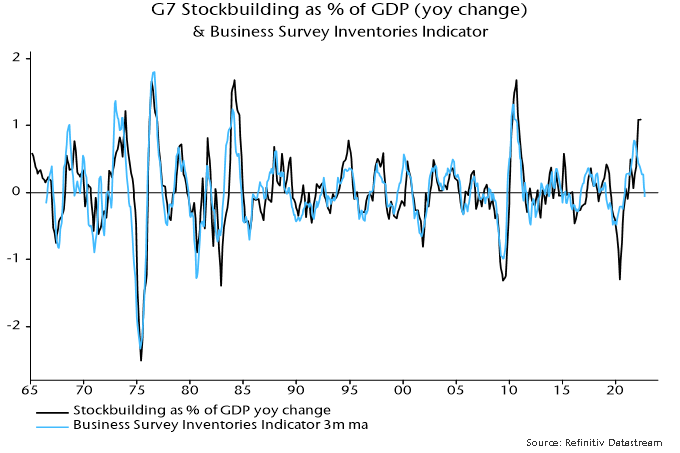
Similar timings with downside risk are suggested by cycle analysis. The stockbuilding cycle, which averages 3 1/3 years measured between lows, is very likely to have peaked in Q2 – the contribution of stockbuilding to G7 annual GDP growth was the highest since 2010 (a cycle peak year) and in the top 5% of historical readings. A business survey inventories indicator calculated here, which is more timely than the GDP stockbuilding data and leads slightly, plunged in July / August, strongly suggesting that a downswing is beginning – chart 2. 

Chart 2

Chart 2 showing G7 Stockbuilding as % of GDP (yoy change) & Business Survey Inventories Indicator

With the last cycle low in Q2 2020, the average cycle length of 3 1/3 years would suggest another trough in Q3 / Q4 2023. The previous cycle, however, was longer than average, raising the possibility of a compensating shorter cycle and an earlier low in Q2 2023. This would dovetail with the suggestion of the baseline monetary scenario of economic stabilisation in Q2 and a recovery later in 2023. 

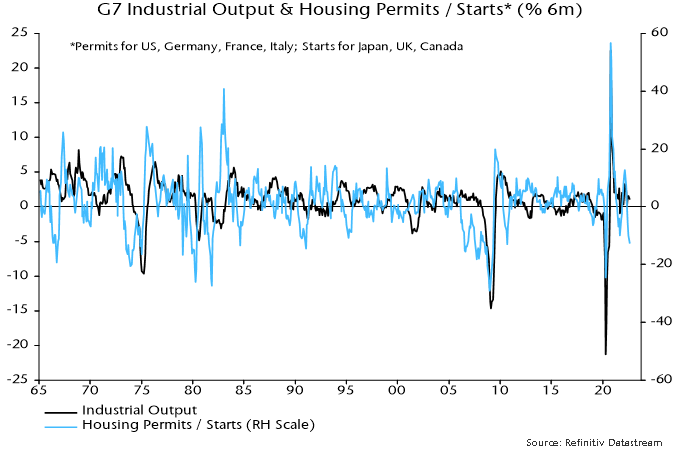
As with the monetary analysis, however, the risk is of a later trough and recovery. The concern from a cycle perspective is that the long-term housing cycle may be peaking early. This cycle has averaged 18 years historically and last bottomed in 2009, suggesting another trough around 2027. Weakness is typically confined to the last few years of the cycle but this was not always the case. This year’s interest rate shock may have brought forward the peak, if not shortened the cycle. Housing permits / starts – a long leading indicator – have fallen sharply and further weakness would suggest that a major top is in – chart 3. 

Chart 3

Chart 3 showing G7 Industrial Output Housing Permits / Starts* (% 6m) *Permits for US, Germany, France, Italy; Starts for Japan, UK, Canada

The risk, therefore, is that housing weakness and its lagged effects on the rest of the economy will offset any recovery impetus later in 2023 from a turnaround in the stockbuilding cycle. A rapid reversal in interest rates may be necessary to avert this scenario. 

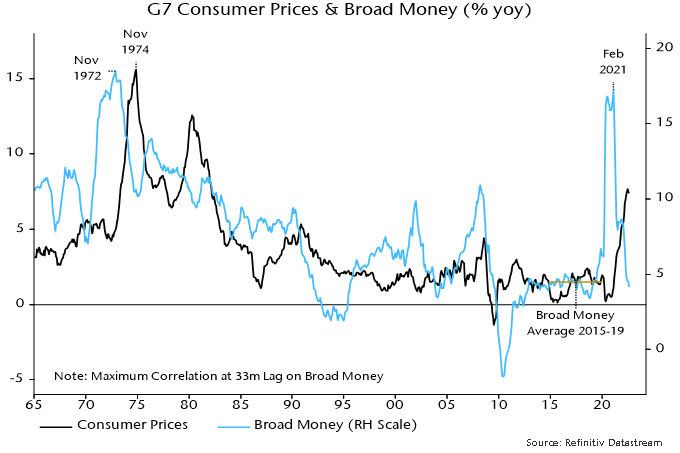
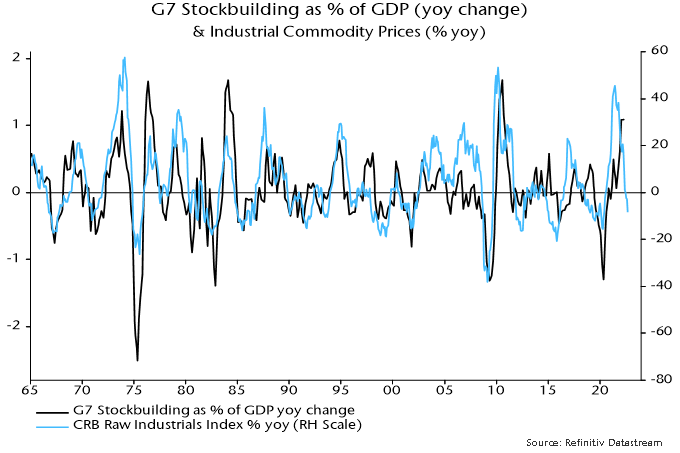
An unambiguous positive message from the monetary and cycle analysis is that inflation is likely to fall sharply in 2023 and return to target – or below – by 2024. G7 annual nominal broad money growth is below its pre-pandemic average, while the correlation of commodity prices with the stockbuilding cycle suggests further falls into a possible mid-2023 trough – charts 4 and 5. 

Chart 4

Chart 4 showing G7 Consumer Prices & Broad Money (% yoy)

Chart 5

Chart 5 showing G7 Stockbuilding as % of GDP (yoy change) & Industrial Commodity Prices (% yoy)

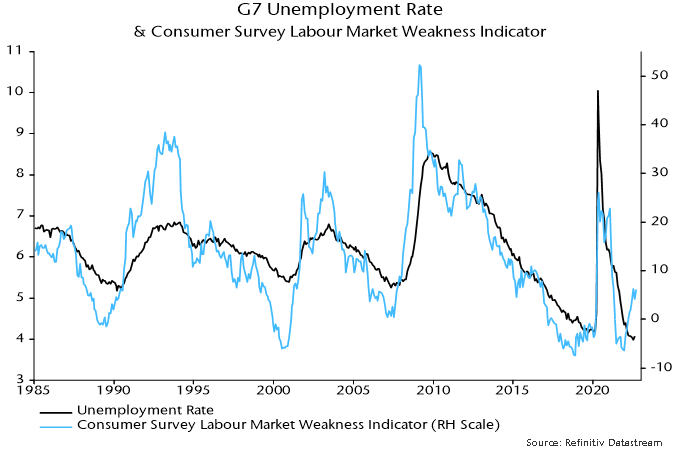
The weakness of nominal money trends argues that central banks have already overtightened policies but the timing and extent of a “pivot” will hinge on labour market data. The suggestion from consumer surveys is that a shift to weakness is imminent. The G7 indicator shown in chart 6 has moved up significantly from a December 2021 low and led unemployment by an average 6-7 months at previous major troughs. The recent unemployment rate low in July, therefore, may prove to be a significant turning point, with a rise of c.1 pp possible by H2 2023. 

Chart 6

Chart 6 showing G7 Unemployment Rate & Consumer Survey Labour Market Weakness Indicator

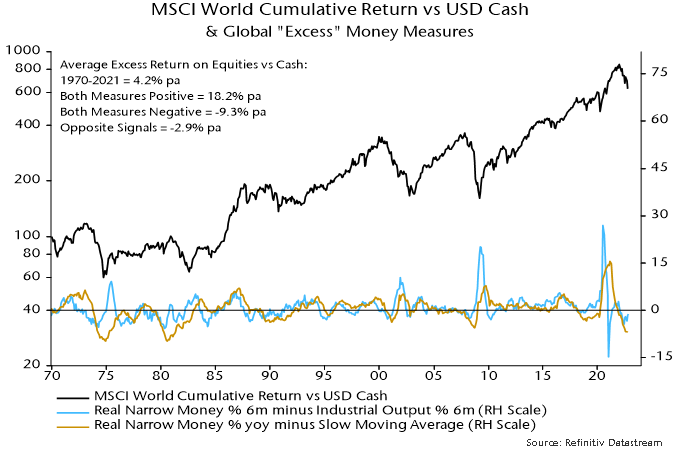
The view of market prospects here is informed by two measures of global “excess” money shown in chart 7 – the differential between six-month changes in real narrow money and industrial output and the deviation of the 12-month change in real money from a long-term average. Both measures remain negative currently, a condition historically associated with significant underperformance of global equities relative to US dollar cash. 

Chart 7

Chart 7 showing MSCI World Cumulative Return vs USD Cash & Global “Excess” Money Measures

The first measure, however, has recovered and – based on the above monetary / economic forecasts – may turn positive by year-end. A rise in this measure, even while still negative, has been associated with US Treasuries outperforming cash on average (a fall signalled underperformance).

The current large shortfall of 12-month real narrow money growth from its long-term average suggests that the second measure will remain negative until well into 2023. The possible combination of positive / negative readings for the first and second measures respectively has been associated with modest underperformance of equities on average, although this conceals significant variation. 

Sector / style performance under this combination has been significantly different from the “double negative” regime, with tech, quality and growth tending to outperform, along with non-energy defensive sectors. The best-performing individual sector was health care with financials the worst. Energy also underperformed. 

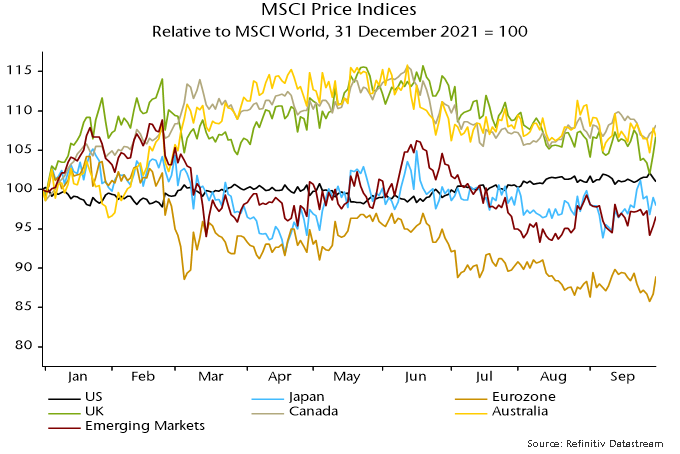
The Canadian, UK and Australian equity markets were the strongest year-to-date performers at end-Q3 – chart 8. In the case of the former two, however, sector weightings have been a key driver: both have higher-than-average exposure to financials and energy, with the UK also heavy in consumer staples – all outperforming sectors. 

Chart 8

Chart 8 showing MSCI Price Indices Relative to MSCI World, 31 December 2021 = 100

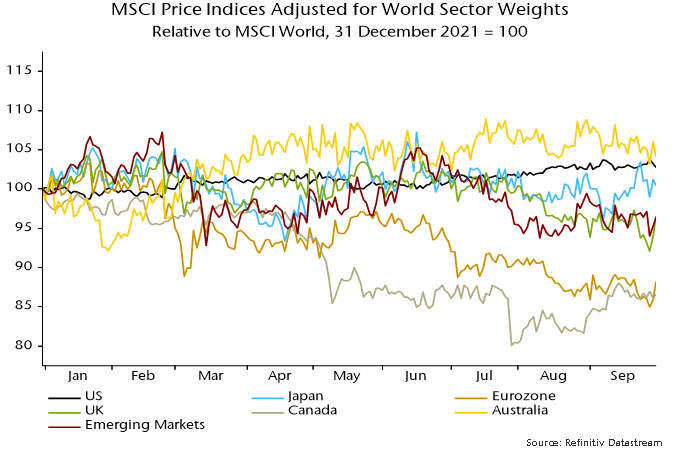
Chart 9 shows the results of recalculating performance using common (MSCI World) sector weights. Canada drops to bottom and the UK is also revealed as an underperformer. 

Chart 9

Chart 9 showing MSCI Price Indices Adjusted for World Sector Weights Relative to MSCI World, 31 December 2021 = 100

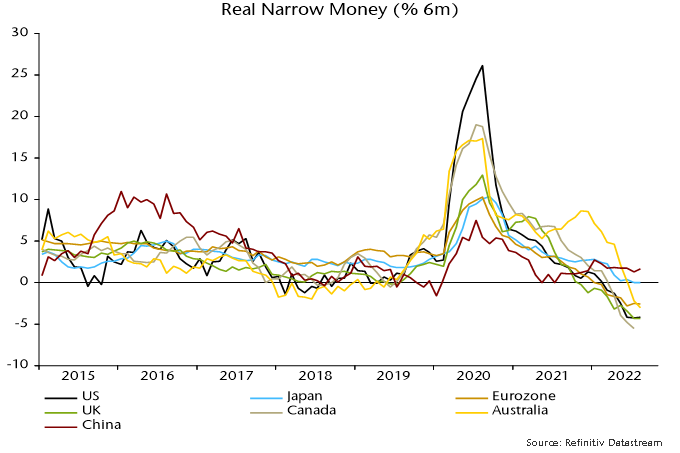
The top performance of Australia is consistent with strong real money growth earlier in the year – chart 10. This support, however, has now fallen away. 

Chart 10

Chart 10 showing Real Narrow Money (% 6m)

Real money trends are relatively favourable in China and, to a lesser extent, Japan. Chinese nominal money growth has picked up, partly reflecting money-financed fiscal expansion, while inflation momentum in both countries is weaker than elsewhere. With Chinese activity depressed by pandemic policy, “excess” money has been supporting government / corporate bonds and could flow into equities if and when economic conditions normalise. A large basic balance of payments surplus, meanwhile, has partially insulated the currency from unfavourable movements in interest rate differentials: the RMB index is currently around the middle of its YTD range and stronger than over 2016-late 2021.


Sydney skyline at twilight, with the Sydney Opera House and Harbour Bridge.

Last week, Fedex released their latest reported earnings, depicting grim views of the economy. As a result of the weak quarterly numbers, its CEO to predicts the coming of a recession. Following what could can be defined as the great Covid-related delivery boom, Fedex’s harsh predicted slowdown is understandable.  

Recession thesis accepted, not all sectors and geographies are created equal and understanding the intensity of the recession is an important factor. Let’s look at country level numbers; the following results for the one-year probability of a recession were recently as disclosed in Bloomberg: China 20%, Australia 25%, Japan 30%, Hong Kong 30% US 50%, UK 60%, France 50% and Canada 40%. As data continues to appear, these numbers may prove conservative on the odds of a recession happening, they could however be insightful to find less affected geographies.  

With low inflation and low yen, it’s understandable why Japan can be seen as a favorable defensive jurisdiction.  We should add low valuations for its equities as well. But why is a country like Australia even lower on the recession risk? In fact, if put together Japan and Australia represent 42% of our EAFE developed markets universe and offer a defensive position as we cycle into recession.  Let’s look a bit more why Australia is faring better than other regions. 

The Reserve Bank of Australia is in the midst of its sharpest tightening cycle in a generation, having raised rates by 2.25 percentage points since May. But it’s now approaching a neutral rate, potentially allowing it to return to smaller, quarter percentage-point moves. That compares with the US Federal Reserve, which may deliver a third straight three-quarter-point increase later this month. 

Australia has also been a rare beneficiary of fallout from Russia’s invasion of Ukraine as disruptions to commodity and energy supplies have sent coal and other prices soaring. The nation posted a record-high monthly trade surplus this year fueled by sales of coal, iron ore and liquefied natural gas. 

Australia has had a tailwind from trade that other countries just don’t have. The export of LNG and coal have been highly beneficial. Unusually, the surge in export prices isn’t being reflected in Australia’s commodity-linked currency, which has averaged 69 US cents over the past three months. A lower currency swells profits from commodity exports priced in dollars and makes the country more appealing to overseas visitors and students.  

Australia’s employment-to-population ratio is near a record high as is its participation rate — both much stronger than many other countries — highlighting the underlying momentum in the labor market. Job vacancies also remain elevated, suggesting that strength will persist. 

Australians still have plenty of savings to tap into to support consumption, having built up a large amount of cash from fiscal stimulus delivered during Covid lockdowns when there were few options to spend.  

If we look at our holdings in Australia, we are able find companies with world class expertise. As an example, with its vast amount of resources, Australia has very large resource extraction complexes that have trained the most capable pool of experts in material transformation at large scale. 

Alumina (AWC:AU) 

Global Alpha holds Alumina, part owner of the world’s largest alumina business which is the main ingredient to produce aluminum. Most of the alumina produced by company is exported to China. Its Middle East competition better serves the European continent. Although the aluminum/alumina markets weaken during a recession, German aluminum facilities could suffer the most under a gas rationed winter of the Russian war. Alumina is also the lowest cost producer globally and produces the greenest alumina (gas vs coal powered). The company offers a 10% dividend yield and aluminum remains a key component of the climate change infrastructure, automotive as well as the rebounding airline industry. 

Furthering our aluminum discussion, we turn to a pop culture question: aluminum cans versus plastic and glass bottles. We all know for taste it goes glass, can, then plastic. Glass is great, but is expensive to transport and recycle. Aluminum cans are therefore the winner in terms of logistics, recyclability, and carbon footprint. 

Orora (ORA:AU) 

We own Orora, the largest producer of aluminum cans for soft drinks in Australia and New Zealand. The company’s facilities are strategically positioned beside its clients and has pass through agreements with clients on material cost fluctuation. Historically, soft drink consumptions only slightly declines during a recession. Further, Orora clients have indicated 5% yearly growth on capacity requirements for the next several years. There is also leverage in the model as capex is added to existing facilities providing great return in investment. Its dividend yield is above 5% in addition to its growth profile. Although both Alumina and Orora are in the materials sector, Orora has very low commodity exposure providing it with more of a staples profile.

Global six-month real narrow money momentum, the key economic leading indicator in the forecasting approach employed here, is estimated to have moved sideways in deep negative territory in August* – see chart 1. Allowing for an average nine-month lead, the suggestion is that an incipient global recession will extend through Q2 2023, at least. 

Chart 1

Chart 1 showing G7 + E7 Industrial Output & Real Narrow Money (% 6m)

More specifically, global six-month industrial output momentum, which crossed below zero in July and is estimated to have weakened further in August, may continue to fall into April / May next year, with no monetary signal yet of a subsequent slowdown in the pace of contraction. 

The lack of recovery in real narrow momentum is disappointing since, as previously discussed, global six-month consumer price momentum pulled back in July / August. This slowdown, however, was offset by a further fall in nominal money expansion – chart 2. 

Chart 2

Chart 2 showing G7 + E7 Narrow Money & Consumer Prices (% 6m)

Nominal money weakness, encompassing broad as well as narrow aggregates, is evidence that monetary policies were already over-restrictive before the latest round of hair-shirt rate hikes. 

What does this monetary backdrop imply for markets? The two measures of global “excess” money calculated here, i.e. the differential between six-month real narrow money and industrial output momentum and the deviation of 12-month real money momentum from a long-term moving average, remained negative in August – chart 3. 

Chart 3

Chart 3 showing MSCI World Cumulative Return vs USD Cash & Global “Excess” Money Measures

Historically (i.e. over 1970-2021), global equities outperformed cash on average only when both measures were positive, with underperformance greatest when both were negative. 

Previous posts suggested that the first measure would turn positive during H2. This remains possible despite the disappointing August monetary data: the measure has recovered since June as industrial momentum has fallen and output may soon be contracting at a faster pace than real money. 

The second measure, however, is likely to remain negative until well into 2023: 12-month real money momentum weakened further in August and the long-term nature of the moving average implies that it will make little contribution to closing the current wide gap.

The projected development of the measures, i.e. the first crossing back above zero but the second remaining negative, would suggest a slowdown but not reversal in the bear market in late 2023. 

The message for government bond markets is more hopeful. Changes in bond yields have been inversely correlated with changes in the first excess money measure historically, i.e. bonds have, on average, rallied when the measure has risen, even while it has remained negative – chart 4**. 

Chart 4 

Chart 4 showing US Real 10y Treasury Yield (6m change) & Global* Real Narrow Money % 6m minus Industrial Output % 6m (6m change, inverted) *G7 + E7 from 2005, G7 before

The six-month change in the excess money measure turned positive in August, having been negative – implying an unfavourable monetary backdrop for bonds – between November 2021 and July. US 10-year Treasuries have outperformed cash by 4.2% pa on average historically following positive readings. 

*The estimate incorporates monetary data covering two-third of the aggregate and complete CPI results.

**The change in the measure is plotted inverted in the chart.

Dentist medical tools - gloved hand pointing to computer displaying X-ray of teeth and jaw

Since the outbreak of Covid-19 in 2020, we have discussed the impact the pandemic has had on our lives, businesses and markets worldwide in several commentaries. The dental industry, like the whole healthcare sector, was no exception, with massive disruptions taking place, especially in the early months when patients were kept from attending routine check-ups.

Fortunately, the importance of the dental practice was well understood, and dentists have been allowed to resume operations with a set of strict protocols. However, delays caused by the pandemic left many people behind in their dental care. The stress and anxiety experienced during endless lockdowns had people grinding their teeth, further aggravating oral health issues. A friendly reminder that a good rule of thumb is to see a dentist twice a year.

During economic downturns, when consumer sentiment weakens, patients might decide to delay elective procedures. However, demand for essential health treatment remains relatively stable. We find that some healthcare companies present attractive investment opportunities, regardless of the macro environment. As the saying goes, teeth are always in style. A good example of such an opportunity is Dentium, a Korean dental implant manufacturer, and one of the top holdings of our Emerging Markets strategy.

In early-summer of 2000, Jung Sung-Min, a practicing dentist running a clinic in South Korea, established Dentium, a small manufacturer of dental implants and related instruments. Little did he expect that over the next two decades, the company would scale up successfully and capture a significant market share to end up ranking as the second largest in South Korea, and the sixth largest worldwide. Although no longer involved in day-to-day operations after stepping down as CEO and Chairman, the founder remains the largest shareholder of the company.

Dentium’s growth strategy to become a global total dental solutions provider is based on ongoing product innovations and expansion overseas. Clinical data accumulated over the years validates the high quality and solid performance of its products. The company has developed a comprehensive product lineup, expanding to digital dental equipment, including CBCT (cone-beam computed tomography), 3D printers, and CAD/CAM (computer-aided-design and computer-aided-manufacturing) systems. Dentium aims to foster package sales of its solutions, spanning from diagnosis to prosthesis procedures.

Although Dentium faces fierce competition from domestic peers, the company has steadily expanded its market share in South Korea, focusing on penetrating primarily newly opened clinics. Once its equipment is installed, recurring orders of dental implants ensure revenue stickiness, growth visibility and margin expansion. With manufacturing facilities located in South Korea, China, Vietnam, and the United States (U.S.), Dentium has established a global footprint. However, China is not only the largest market for the company, accounting for more than half of revenue, but it is also expected to remain the main growth driver in the medium-to-long term. At the same time, we believe that Dentium’s business in India, the Middle East and Southeast Asia will continue growing faster than the industry average.

The dental implant market globally is expected to exceed US $8 billion by 2028, from US $4.8 billion in 2021, implying a compounded annual growth rate of 7.6%. China, with the number of implants placed per 10,000 people equivalent to only one-tenth of the global average, will likely grow at least twice as fast. South Korea has one of the highest penetration rates of dental implants, is expected to grow at a low-to-mid-single digit annually. The global dental implant market is drifting towards an oligopolistic structure, with the seven largest companies (spearheaded by Straumann and Danaher) accounting for over 80% of sales.

In most regions, Dentium caters primarily to the value segment of the market, while providing products of equivalent quality to global industry leaders, but at more attractive price points. Combined with its rich expertise, strong reputation, consistent execution, and adequate capacity, Dentium’s success in developing countries makes total sense. However, the management team shows no signs of complacency and has set in motion an ambitious plan to become a top 3 operator globally in the next 8 to 10 years, ensuring a growth rate of around 15-20% per annum over this period. Operating leverage and growing efficiencies provide a decent uplift to margins. Thus, the operating margin of 30-35% is not only sustainable, but has some upside and compares very favourably to the 17-20% range recorded in the past.

Like many other businesses with a substantial footprint in China, Dentium faces risks primarily of a regulatory nature. The recent announcement made by the National Healthcare Security Administration of China removes lots of uncertainty and solidifies our investment thesis. Aiming to cut elevated prices at public hospitals (which apparently are higher than the average level of private sector) and educate patients, the Chinese government agency defined a set of rules and procedures to ensure central procurement and price controls at public dental clinics. Although this regulation will inevitably impact the general price level of dental implants in the private sector, Dentium caters primarily to private clinics and is expected to benefit at the expense of its U.S. and European peers, as its pricing is more attractive and highly competitive.

Despite having a highly attractive investment case, the company has huge room for improvement in terms of handling their investor relations. At the same time, it is not widely known among foreign investors, partially because it is not covered by any of the big brokerage firms. However, Dentium’s stock performance has been an outlier this year, outperforming its peers year to date.

Chart showing Dentium’s stock performance
Source: Bloomberg

Despite its outperformance, Dentium still trades at an attractive valuation relative to its historical levels…

Chart showing that Dentium still trades at an attractive valuation relative to its historical levels
Source: Bloomberg

…as well as relative to its peers.

Chart showing that Dentium still trades at an attractive valuation relative to its peers
Source: Bloomberg

Following on our last commentary featuring Samsonite (1910 HK), more travel statistics were released confirming the increase in travel. July data shows that Europe, South America and the United States (U.S.) travel spending now exceeds the previous peak of July 2019.

Hotels in Europe saw their revenues per available room (RevPAR) in July grow 78% year-on-year, exceeding July 2019 by 19%. Occupancy rates are still below 2019 by above 5%, but average prices are 25% higher.

Meliá Hotels (MEL SM)

One holding that is very exposed to the European and Caribbean travel market is Meliá Hotels. Meliá is one a leading European hotel groups; it owns and/or manages more than 316 hotels and resorts in 33 countries, mainly in America and Europe, for a total of over 83,772 rooms, 11,854 of which are owned. Of the rooms, 63% are in Europe, 30% in the Caribbean, and 7% in Asia, which is the main reason for future room growth. Resorts account for 60% of hotels (i.e., 100% leisure), with the other 40% are urban, of which half are bleisure (business and leisure) in cities like London, Paris, Rome and Madrid.

Covid has been a huge challenge for companies, particularly in the travel and hospitality business. An important item we look at before investing in any company is the strength of the balance sheet. We want a strong balance sheet with little debt, even if it may appear as not the optimal capital structure. In times of stress, however, that strong balance sheet creates opportunities.  

Let’s contrast two world-class companies in the travel sector — Meliá and Carnival Cruise Line (CCL US):

 Meliá12/201912/2021
Number of hotels326316
Company owned4337
Total rooms83,77883,772
Number of shares outstanding (million)229.7220.5
Total net debt (excl. leases) €M5551,244
Stock price€7.86€6.06 (31/08/2022)
 Carnival Cruise Line11/201911/2021
Number of ships in service105105
Capacity per day248,790248,790
Number of shares outstanding (million)6901123
Total net debt (excl. leases) $M US10,98424,087
Stock price$45.08$9.54 (31/08/2022)
Source: Global Alpha

We can see that Meliá has the same number of rooms and less shares outstanding than at the end of 2019.  The debt, although higher, is still manageable, especially considering that the over 11,000 rooms Meliá owns could be sold and the company could eliminate most or all of the debt outstanding.  As a result, Meliá’s earnings per share, which were €0.64 in 2018, should be higher in 2024.

Meliá’s stock price, although down 23% since the end of 2019, has rebounded 121% since March 18, 2020, and should continue to rebound as results improve.

Carnival Cruise, on the other hand, had to more than double the number of shares outstanding and take on very expensive debt.  As a result, earnings per share, which were $4.49 in 2019, may never reach that level again.  Its stock price has gone down 81% since the end of 2019 and has only rebounded 2.5% since March 18, 2020, most likely a permanent loss of capital.

As investors, we are looking at per share growth. We think like business owners. If we owned the whole business, we would look to grow profits. When we buy shares, we become co-owner of the business and look for the sales and profits attached to each share we own.

Let’s look at this concept of growth per share. Every business is cyclical to a certain extent. What we want is higher highs and higher lows, and we want to avoid a permanent loss of capital.

Brunswick Corp (BC US)

A company we have followed for the last 20+ years and own in our U.S. small cap fund is Brunswick Corp.  Founded in 1845, the company has been manufacturing many recreational products over the years, from pool tables to bowling alleys, before focusing on boats, such as Boston Whaler, Lund or SeaRay and Mercury marine engines.

Source: Bloomberg

Looking at sales figures above, we can see that total sales have only increased slightly since FY2006.

However, shares outstanding have decreased as a result of strong free cash flow used to reduce the number of shares.

Source: Bloomberg

As a result, revenue per share has also increased.

Source: Bloomberg

And so have earnings per share.

Source: Bloomberg

And despite the global financial crisis of 2008 and the Covid pandemic of 2020, owning the shares has been rewarding investors.

Source: Bloomberg
Businesswoman wearing a mask checking the boarding time at a digital timetable at the airport terminal.

Have you been on vacation this summer? It seems everyone is travelling again. Indeed, travel activities have dramatically increased in most regions, except China, as shown by the data conducted by Global Revenue-Passenger Kilometers (RPKs: multiplying the number of paying passengers by the distance travelled).


In previous commentaries, we’ve shared updates on travel-related stocks, such as Melia Hotel (MEL SM) and Autogrill (AGL IM). Both are long-term holdings and niche market leaders. This week, we would like to profile Samsonite, a relatively new holding initiated in November 2020. Although listed in Hong Kong, it is a truly international company present in over 100 countries.

Samsonite International S.A. (1910 HK)

Business Overview

  • Founded in 1910 in Denver, Colorado by the Shwayder Brothers, Samsonite is the world’s largest travel luggage company.
  • It owns many brands, including Samsonite, Tumi, American Tourister, Gregory, High Sierra, Kamiliant, ebags, Lipault, and Hartmann.
  • Before 2012, its business was mainly focused on the Samsonite brand, travel luggage and the wholesale channel. Today, it has a more balanced business with multiple brands through multiple distribution channels.

Target market

Competition

  • A very fragmented market. Other top players are VF Corp, ACE, Delsey, Rimowa, and VIP Industries.
  • Samsonite dominates in most markets, except in India and Japan.

Competitive advantages

  • Samsonite has 17% market share in the global luggage market.
  • Strong brand recognition.
  • A wide range of brands, from mid- to high-end.

Management

  • Kyle Francis Gendreau is the CEO of Samsonite, previously CFO. He joined the company in 2007.
  • Timothy Charles Parker, a turnaround veteran, has been the Chairman since 2011. He owns 3.9% of the company.

ESG

  • Samsonite provides very comprehensive annual ESG reporting.
  • Carbon emission reduction targets: to cut carbon intensity by 15% from 2017 to 2025; to power all operations with 100% renewable energy by 2025.
  • Six out of eight board directors are independent, and one woman sits on the board.

Growth strategy

  • Product: new product innovation.
  • Distribution: focus on Tumi’s international expansion and e-commerce growth.

Recent developments

  • Last week, Samsonite reported very strong 1H earnings, with net sales up 59% year-over-year, driven by North America, Latin America, and Europe.
  • Ample liquidity of US$1.4 billion.
  • It expects a stronger recovery over the rest of 2022, especially from Asia, with price increases and cost savings to help profitability even further.