Image of human hand stacking generic coins over a black background with hexagonal golden shapes. Concept of investment management and portfolio diversification.

As discussed recently, inflation will be supported by low unemployment in 2023. This could be described as a classic inflation gap, as we expect a wave of salary adjustments persisting well into 2023.

Many important factors will keep unemployment at low levels. These include:

  • Demographics, especially in the U.S. where more and more Baby Boomers are accelerating their exit from the workforce, following a difficult COVID period.
  • Many developed countries halted immigration during COVID, causing backlogs compared to normal intakes.
  • Long COVID among many workers has been keeping them out of the workforce for lengthy durations.

As economic data comes out, high interest rates are beginning to affect the economy, as reported by the recent consumer price index (CPI) report. Weakening demand mixed with higher costs will weigh on corporate profits in 2023. The good news is Global and EAFE Small Cap valuations are at their lowest since the 2008-2011 period. These low valuations could provide stock price support as corporations reduce their profit guidance. As well, sentiment is at multi-year low and can only improve.

So, where to position in an economic downturn? Warren Buffet once famously asked, “What was the most popular chocolate bar in 1962?” Snickers, he answered. And what was the most popular chocolate bar in 2020? Snickers. Focus on what is resilient is the moral of this story.

The second anchor in a downturn is balance sheet strength as interest expense for many corporations start to rise. Recent Federal Reserve statements forecast a lengthy period of elevated interest rates. And the recent Carvana debt debacle will not be the only one. We certainly feel that many companies and analysts are too conservative in their medium-term (i.e., two year) interest rate outlook.

A third anchor relies on themes and long-term positive industry trends. Stocks with high exposure to critical, well-supported trends (renewables or onshoring, for example) will certainly help weather markets suffering from consumer demand decelerations.

Our portfolio companies hold substantial net cash war chests, and they have important M&A growth options during a slowdown. Let’s have a closer look at some holdings.

Several of our firms have net cash as a percentage of their market cap at a level greater than 10%. These include: Mabuchi Motor Co., Ltd. (37%), LINTEC Corp. (28%), SEGA SAMMY Holdings Inc. (17%), THK Co., Ltd. (12%), and Globus Medical, Inc. (11%). In addition, Ain Holdings Inc., Sakata Seed Corp. and Daiseki Co., Ltd. are all at 10%. This is only a short list of holdings at or above the 10% mark. Many of our companies have simply no debt.

What is even more reassuring is that a variety of tailwinds benefit our holdings. Let’s take SEGA SAMMY (6460 JT) for example. The Japanese gaming provider has transformed into an integrated entertainment powerhouse. Born from gaming, Sega’s Sonic the Hedgehog brand has been featured in movies, including a recently launched Netflix animated series. Additionally, the entertainment company’s newest 3D Sonic game, Sonic Frontiers, has sold more than 2.5 million copies worldwide since its launch in early November.  

Mabuchi Motor (6592 JT), the leading small motor provider out of Japan, is flush with cash and has no requirement of large expansion capex. Small motors are growing faster than many industrial markets due to increased demand for robotics. Moreover, the market in which Mabuchi operates is highly fragmented. The company can certainly use its cash for highly accretive acquisitions in the future.

At 11% net cash, Globus Medical is a quality anomaly in the medical technology world. The U.S.-based provider of orthopedic devices and robots is clearly a technology leader. Its surgical robots increase productivity four-fold in terms of successful back surgeries. As the company will ultimately see a peak penetration for its robots, it will be in a strong position to accelerate new innovations either by development or acquisitions.

Many of our companies demonstrate three key attributes:

  • product resilience,
  • positive tailwinds, and
  • balance sheet strength.

Product resilience can come in many forms and can be found in types of business models: Software as a Service (SaaS), maintenance services, and long-term fixed agreements, just to name a few. Global Alpha initiated in Reliance Worldwide Inc. (RWC AU). The Australian company is a leading provider of emergency plumbing equipment sold through global retailers such as Home Depot and Lowes. Reliance Worldwide’s sales performed well during the 2009 real estate collapse, and we feel its sales will hold up equally well in current market conditions.

Net cash is not the only way to uncover balance sheet strength. One of our holdings, Meliá Hotels International (MEL SM), recently went through an asset valuation analysis with CBRE. The Spanish hotel owner and operator is presently benefiting from strong volumes from its quality portfolio of hotels. The CBRE valuation of real estate assets came in at € 4 billion. This is against a debt level of € 1.3 billion and a market cap of € 1.1 billion.


Liberty Square in Taipei, Taiwan.

In mid-October 2022, after more than 2.5 years of strict border control measures, Taiwan lifted all its COVID entry restrictions and allowed foreigners free access. As countries returned to their pre-pandemic routine, Taiwan was among the laggards (along with China and Hong Kong) in loosening requirements for visitors to complete a mandatory lengthy quarantine. That is why we welcomed (to say the least) the announcement of easing travel restrictions. And after two weeks of preparation, we landed in Taoyuan International Airport at the beginning of November.

Except for the requirement to wear a mask in all public places including outdoors, lifted only on December 1, life in Taipei looked normal. There was strong traffic in malls, convenience stores, hotels and restaurants. Over the span of a week, we met with 28 corporates engaged in the information technology, consumer, healthcare and industrial sectors.

Our general impression was mixed, with more optimism around healthcare and consumer-oriented companies balanced by a more cautious outlook provided by the technology operators. Overall, most corporates noted quite low visibility going into 2023, with only a handful of companies ready to provide guidance for the next year.

Key takeaways from our meetings:

  • Strong domestic consumption recovery after the reopening in Taiwan.
  • Most of the semiconductor companies are in the midst of weak momentum due to slow demand for consumer electronics and inventory corrections. PC and handset unit sales are expected to decline in 2023.
  • Data servers, automotive and industrial remain the only bright spots for now. The U.S. hyperscaler server market is expected to continue growing at a double-digit rate in 2023, although global enterprise and China server demand are expected to remain weak. Demand for ASIC (application-specific integrated circuit) design remains strong, as does demand for the ABF (Ajinomoto build-up film) substrate despite a correction in the PC market.
  • The impacts so far of U.S. sanctions on the Chinese semiconductor space are limited on Taiwan semiconductor companies because the new rules target only the most advanced technology, and most Chinese IC (integrated circuit) designers are making changes to fall within key thresholds of those sanctions. Moreover, some companies aim to reap benefits on lower competition with Chinese peers in the long term. However, there is a risk of further escalation in U.S.-China relationships, which could disrupt global technology supply chains and impact demand in 2023.
  • Many technology companies pointed out an increased need to de-risk their production facility locations following their customers’ requests for production capacities outside of both China and Taiwan.
  • General supply chain normalization, with remaining tightness in the supply of some key components.

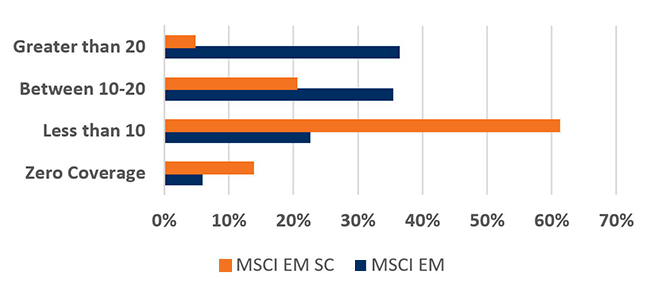
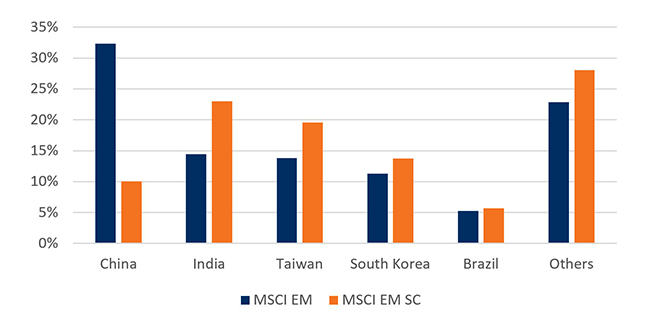
Taiwan is the second largest market for our Emerging Markets strategy (behind India), with about 20% weight in the MSCI EM Small Cap index. It is the only country in the EM universe with a clear sector bias, as information technology accounts for more than half of the country weight in the benchmark. In the first 10 months of the year, Taiwan Small Cap underperformed the EM benchmark by more than 10%, a result mostly driven by derating of the technology sector. However, its performance in November looks like the beginning of a year-end rally on the expectations of semiconductor inventory correction bottoming. Likewise, moderating geopolitical risk may ease following the results of local mayoral elections on November 26, in which the Kuomintang, a party taking a more moderate stance on China, scored a big win over the incumbent Democratic Progressive Party.

Although we remain cautious on the technology inventory correction cycle, as there are multiple risks that might delay the sector recovery (e.g., deep recession in the U.S. and Europe, and broader geopolitical escalation), we acknowledge that some of the corporates in Taiwan are progressing well ahead of their peers. Most of market participants expect that a cyclical bottom in semiconductor demand might occur in the first half of 2023, with sequential improvement starting in the second half of 2023. This could drive a strong recovery in technology stocks. The importance of understanding inventory cycles was discussed in our note published on March 13, 2009. We see similar patterns here and remain alert to understanding where we are in the cycle.

Our EM portfolio is currently in a market-neutral position in Taiwan. We have a balanced roster of technology leaders, dominant operators catering to domestic markets, and exporters benefiting from secular tailwinds.

Here is a description of a sample of our holdings in Taiwan.

Chroma ATE Inc. (2360 TT) is a power and semiconductor testing equipment provider enjoying a leading position among the top-five global IC testers. For instance, NVIDIA uses Chroma testing equipment for all its products. Chroma also enjoys strong growth momentum in the electric vehicle (“EV”) industry. The company is one of the few operators in the technology sector that is less susceptible to industry cyclicality, and it has better visibility into the longer-term growth trajectory of the semiconductor industry.

Universal Vision Biotechnology Co., Ltd. (3218 TT) is the largest ophthalmology chain in Taiwan. The firm offers various eye treatments and related medical services such as laser vision correction and cataract surgeries. It is the leading brand in Taiwan, backed by a 30-year track record of high-quality services and innovation, with a dominant position in advanced eye surgeries such as SMILE (Small Incision Lenticule Extraction) and FLAC (Femtosecond Laser Assisted Cataract Surgery). The company also sells optometry products such as eyeglasses, contact lenses, and orthokeratology lenses at its self-operated eyewear stores. Benefiting from structural demographic tailwinds in Taiwan – due to high prevalence of myopia in the population – UVB is also a beneficiary of China’s COVID reopening, where it derives 25% of revenue. Following the recent easing of COVID restrictions, the company is looking to accelerate clinic openings in China.

Makalot Industrial Co., Ltd. (1477 TT) is one of the major global apparel manufacturing companies with industry- leading design flexibility, lead times, product offering and scale. We believe it is one of the main beneficiaries of the supply chain consolidation trend due to its diversified production sites, aggressive expansion in Indonesia and Bangladesh, and ability to deliver rush orders.

Shibuya Crossing in Tokyo, Japan.

With recession risk concerning many developed countries, it seems there is nowhere to hide. But actually, there is. Japan’s GDP is expected to grow 1.6% this year and 1.8% next year, according to the latest forecast of the Organization for Economic Co-operation and Development (OECD). In contrast, 2023 GDP growth in both the U.S. and the eurozone is expected to be only 0.5%.

We think the following reasons could explain such differences.

  • Extremely loose monetary policy. The Bank of Japan maintained its key short-term interest rate at 0.1% and the 10-year bond yield around 0%.
  • Supportive fiscal policy. An extra economic package of ¥29 trillion (US$208 billion) was recently announced, worth around 5% of GDP. The package aims to bring down inflation by 1.2% between January and September next year.
  • Low inflation. Although Japan’s core CPI hit a 40-year high of 3.6% year over year in October, the pace of change was far slower than in the U.S. or Europe. Wage increases in September 2022 were up by only 2.1% on a year-over-year basis, contributing to Japan’s comparatively low rate of inflation.
  • Reopening catch-up. Japan has lagged the U.S. and Europe in easing COVID policies. Face-to-face services resumed in March 2022, accelerating private consumption. Another boost for consumption came on October 11, 2022, when Japan lifted its border restrictions. In 2019, about 32 million foreign tourists visited Japan and spent a record high of ¥4.81 trillion. Pent-up demand should carry over into 2023.
  • Automotive industry recovery. The manufacturing sector accounts for 20% of Japan’s total GDP, and automotive and ancillary manufacturing remain a substantial segment of that overall sector. As supply chain disruptions subside, automakers are expected to enhance production to fulfill record backlogs.
  • Weak yen. The yen (JPY) has declined this year by more than 20% against the U.S. dollar, to a 32-year-low. In October, Japan’s exports were up 25.3% year over year, led by shipments of chips, electronic parts, and cars. For foreigners, a weak yen and low inflation mean that Japan is a relatively cheap shopping destination.

The Nikkei 225 Index has been whipsawed so far in 2022 and is currently -3% compared to January 1, 2022. Yet there are many positive stories to be found when you dig a little further into the numbers. Based on the September quarterly results of over 1,800 companies on the Tokyo Stock Exchange Prime Market, sales on aggregate are up by 21.9% year over year, operating profits are up by 9.2%, and net profit by 31.6%. Likewise, 64% of companies have reported sales higher than consensus estimates, according to Mizuho Securities.

We invest in a total of 20 Japanese companies in Global and EAFE Small Cap strategies. Below are some common themes from the management of these firms.

  • All companies have benefited from the weak yen and/or reopening of the economy. Sales have been notably robust.
  • Six of our holdings reported very strong results and raised their full-year sales guidance. These are:
    • ASICS (7936.JP): a global sports goods maker best known for its performance running shoes.
    • HORIBA (6856.JP): a global measurement equipment maker specializing in the analysis of small particles in the fields of semiconductors, environment, health and safety.
    • Iwatani (8088.JP): a leading distributor of industrial and household gases in Japan.
    • DMG MORI (6141.JP): the largest machine tool maker in the world.
    • Seiren (3569.JP): a global leader in car seat materials.
    • Kurita (6370.JP): the largest industrial water treatment company in Japan.
  • Margin pressure remains a challenge: cost pass-on might be easier with time, but investment and spending are also rising.
  • Supply chain issues are improving. Compared with western peers, our Japanese holdings have been more conservative in inventory management. They have kept a high raw material inventory to ease supply chain disruption. Long-term relationships with diversified suppliers also contribute to these supply chain improvements.
  • Product prices continue to increase, though domestic increases are more difficult to impose than in overseas market.
  • To our surprise, leaders of our Japanese holdings do not see pressure on wage increases from employees or the Japanese government. Nor are they experiencing a labour shortage issue.
  • Reshoring is on the rise. Back in April 2020, Japan set aside a ¥243.5 billion fund to help manufacturers shift production out of China to avoid supply chain disruption. Recent U.S. restrictions on China to cripple its semiconductor industry should also help Japan attract more investment.

The MSCI Japan Small Cap Index is currently trading at a very attractive level, at 13x P/E. It is not only its lowest level in the past decade, but also lower than U.S. peers at 23x and European peers at 16x. We believe the fundamentals of the Japanese economy are still solid, with low inflation risk.

post last month argued that a pick-in Eurozone broad money M3 growth into September reflected temporary factors that would reverse. October numbers delivered the expected turnaround, with M3 falling by 0.4% on the month. Narrow money measures, meanwhile, lost further momentum, with Italian data particularly weak.

The summer pick-up in M3 growth had been discounted here for two reasons: the numbers had been boosted by rapid and probably unsustainable expansion of financial sector deposits; and the pick-up was inconsistent with the behaviour of the credit counterparts (bank lending to government and the private sector, net external lending etc), instead reflecting a statistical “residual”.

October numbers showed a large drop in financial M3 holdings, correcting earlier strength, while the credit counterparts residual turned negative.

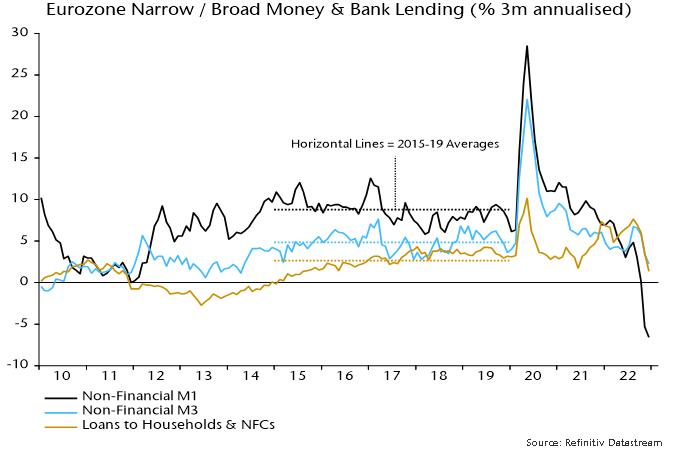
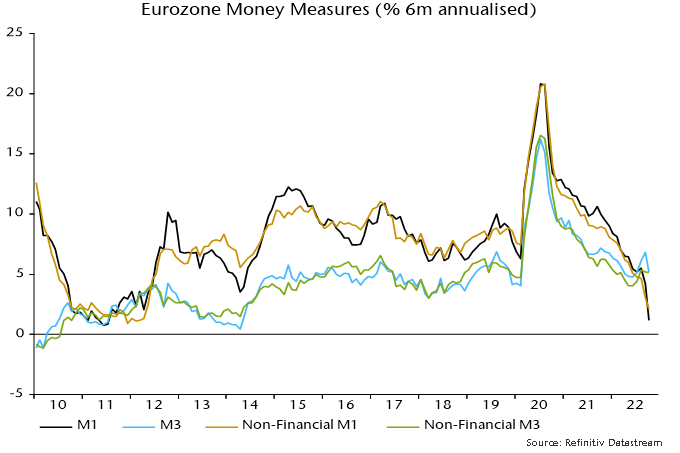
The preferred money measures here exclude financial sector holdings, which correlate poorly with near-term economic performance. Six-month growth of non-financial M3 was stable in October at 5.2% annualised; growth of non-financial M1 slumped further to 2.1% annualised, the weakest since the 2011-12 Eurozone crisis / recession – see chart 1.

Chart 1

Chart 1 showing Eurozone Money Measures (% 6m annualised)

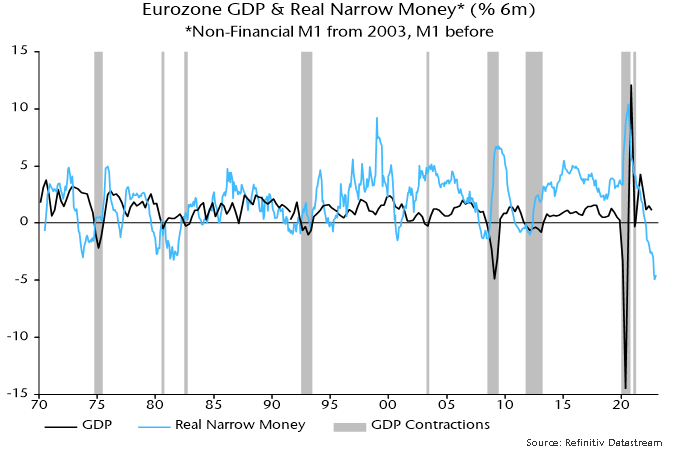
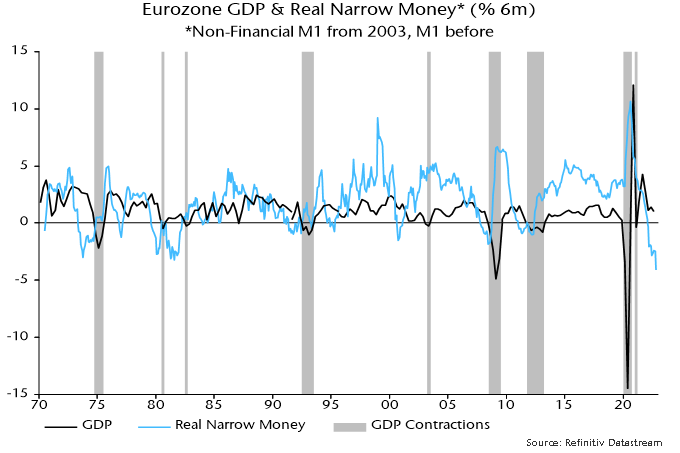
Real narrow money is contracting much faster than during that crisis: the six-month rate of decline reached a new record in data extending back to 1970 – chart 2.

Chart 2

Chart 2 showing Eurozone GDP & Real Narrow Money* (% 6m) *Non-Financial M1 from 2003, M1 before

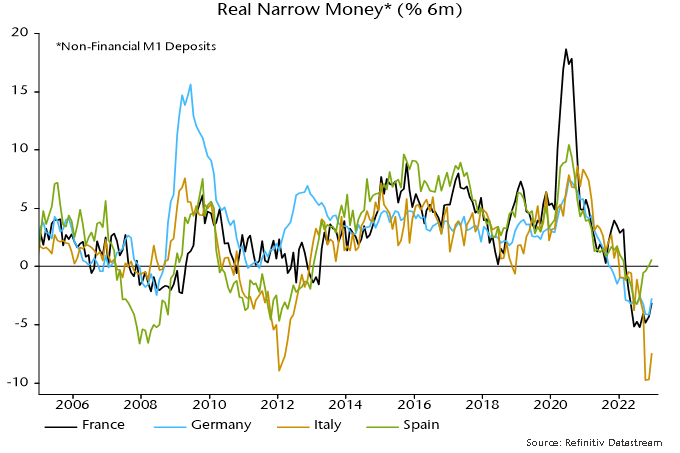
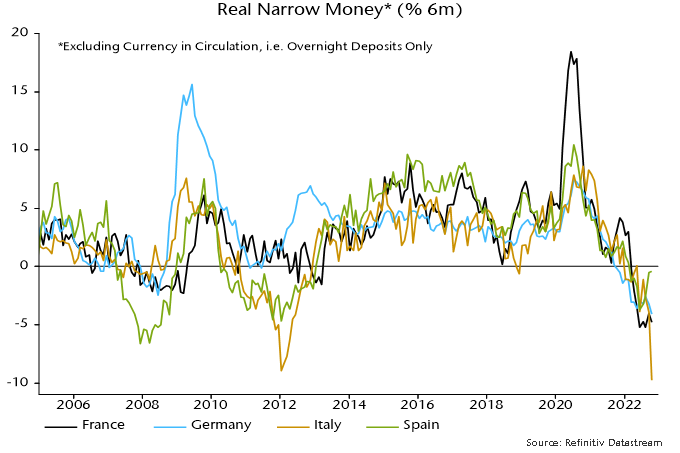
Country data on real overnight deposits (including financial sector holdings) show particular weakness in Italy, reflecting both nominal contraction and a larger recent inflation spike than elsewhere – chart 3.

Chart 3

Chart 3 showing Real Narrow Money* (% 6m) *Excluding Currency in Circulation, i.e. Overnight Deposits Only

The previous post suggested that a lending slowdown would act as a drag on broad money growth. Bank loans to the private sector were unchanged on the month in October.

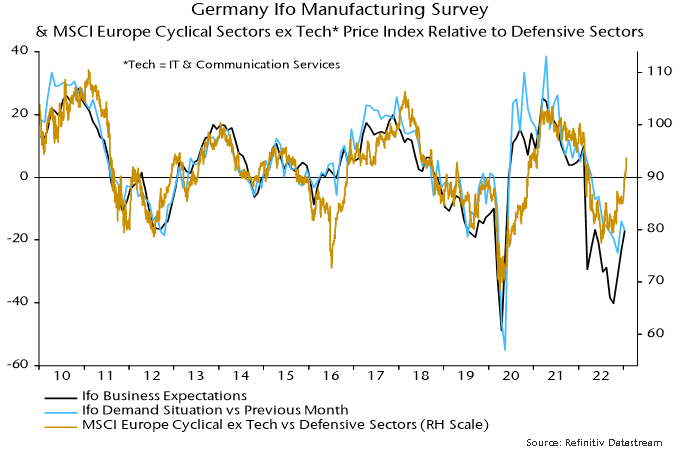
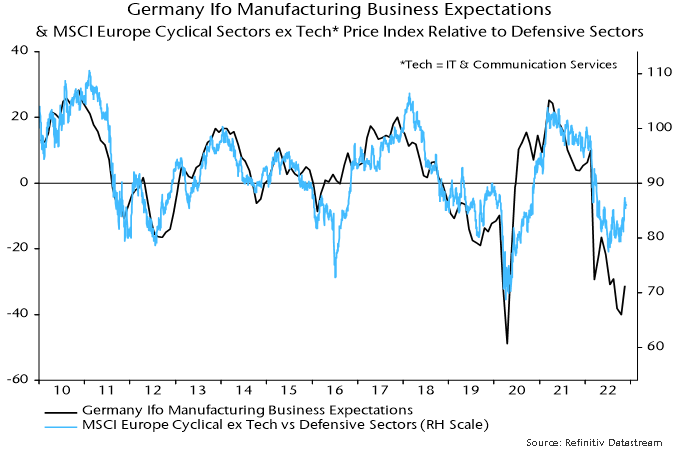
Cyclical sectors of European equity markets have recovered some relative performance recently, possibly reflecting a belief that a grim economic outlook was becoming less dire at the margin. A minor recovery in the expectations component of the German Ifo business survey might be viewed as supporting reduced pessimism – chart 4.

Chart 4

Chart 4 showing Germany Ifo Manufacturing Business Expectations & MCSI Europe Cyclical Sectors ex Tech* Price Index Relative to Defensive Sectors *Tech = IT & Communication Services

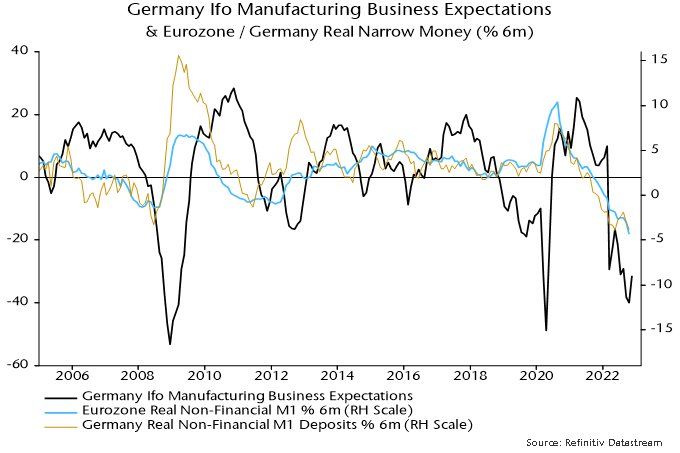
The level of Ifo expectations, however, remains historically weak and a further fall in Eurozone / German six-month real narrow momentum argues that economic stabilisation, let alone a recovery, remains distant – chart 5.

Chart 5

Chart 5 showing Germany Ifo Manufacturing Business Expectations & Eurozone / Germany Real Narrow Money (% 6m)

Nominal money trends and prospects suggest that monetary conditions are already restrictive, contrary to the ECB’s assessment*. Likely policy overtightening is another reason for fading the cyclical rally.

*See speech by Executive Board member Isobel Schnabel.

Image of human hand pointing at touchscreen with business document.

In times of market challenges, companies are taking steps to reduce their cost structure. Over the past weeks, we have seen several layoff announcements. As companies review and adopt their operating budgets for next year, other non-personnel costs could be at risk.

With many economies on the brink of recession, executives could be inclined to decrease their marketing expenditures. As shown in the latest International Business Barometer, more than half of corporations expect to reduce marketing expenditures over the next year in fear of recession.

As seen in previous downturns, companies maintaining their marketing expenditures increase their likelihood of emerging from recessions in a better position than competitors. As the competitive landscape becomes less intense, companies maintaining these expenditures could differentiate themselves and gain market share.

Market research is vital in finding new customers or launching new products. Market research expenditures represent a small proportion of the total marketing expenditures. For that reason, they tend to be more resilient compared to advertising expenditures. For example, P&G spent $7.9 billion on advertising during its fiscal year 2022, as opposed to $2 billion for research and development costs. In our view, market research expenditures could be one of the most strategic expenditures inside marketing budgets. Market research is the starting point for the launch of new projects, and it drives commercialization.

Ipsos, a company we own in our International Small Cap strategy, is one of the largest market research companies globally. The company is active in 90 different markets and employs more than 18,000 people. We believe that Ipsos benefits from secular growth driven by strong demand for reliable information to solve more complex issues. Corporations need to access that information to position themselves in a fast-changing world. The new 2025 plan unveiled by Ipsos aims to have the company grow faster than the market research industry, notably through market share gains and the development of digital and tech-based services.

Market size

  • The global market research services industry is expected to reach $90.8 billion by 2025. That industry is expected to grow 5.3% per annum.

Growth strategy

  • Expanding its client base or grabbing more share of wallet from their existing customers.
  • Adding new tech-based services, such as: SaaS offering, advisory, DIY research, social intelligence.
  • Bolt-on acquisition.

Strengths

  • Recognized as one of the most innovative market research companies, as published in a recent GreenBook Research Industry Trends report.
  • Thanks to its global reach, Ipsos is one of few companies with capacity to manage worldwide market research programs.
  • Well-diversified geographically and by client types. Its exposure to defensive sectors like the pharma and public sectors represents close to 30% of revenues.
  • Long-term client contracts with high recurrency.
  • Strong balance sheet with a low leverage ratio of 0.4x net debt to EBITDA.

Opportunities

  • Fragmented market with lots of opportunities to conduct M&A, especially in DIY research.
  • Digitization trend in the market research industry. Digitization helps bring down costs associated with data collection while providing new source of revenue.
  • Its revenue from new services has grown rapidly over the years. Through these new services, Ipsos has met corporates’ needs in term of data collection in real time, quickly analyzing large amounts of information, leveraging measurement of social media, and providing advice for clients. The company can build on that expertise and experience to increase market share. 
  • With 32% of its revenue being generated in the U.S., Ipsos has room to gain more market share in the biggest market research industry globally. 
  • Emerging markets are expected to outpace the growth in developed markets.

Risks

  • The industry is somewhat exposed to the cyclicality of its clients’ marketing budgets.
  • Failure to develop new services or falling behind on technology would negatively impact its revenue.

According to research by the Bank of America, global risk assets have lost over $35T since November 21, 20211. This should come as no surprise as we are seeing: the co-dependency of Wall Street and the Fed, stop-go economic policies, zero COVID policy in China, headline inflation, political instability, war, oil and food shocks, fiscal excess, and industrial unrest.

Given all this volatility, recession is a common topic of conversation among investors and companies. The general consensus? Avoid small cap stocks and stick to the so-called safer large cap companies.

In today’s weekly, we’re busting this myth by explaining why small cap is back and why exposure to this asset class is your best bet during a recession. We’ll begin with a brief trip down memory lane.

1970s – Small caps shine amid economic volatility

Investors assume that for small cap to outperform, we need economic certainty, lower rates and better credit conditions. But history proves otherwise. The 1970s were one of the best decades for small cap, and yet this era was plagued with a wide variety of economic volatility.

Throughout the 70s, inflation averaged 7.1% with a high of 13.3%. Fed rates peaked at 14% in 1979 from 3.5% in 1971. The economy faced oil shocks, embargoes, and taxes were high. Real economic growth was below the previous decade by 1%, and productivity was even lower. Meanwhile, President Richard Nixon became the first U.S. president to resign, and the dollar abandoned the gold standard and devalued.

Incredibly, in the midst of all this uncertainty, small cap outperformed large. Why?

Table showing stellar performance from US small cap in the latter half of the 70's.
Source: BofA Global Investment Strategy, Bloomberg

Why small cap succeeds during unexpected inflation

What really helped small cap outperform during the 70s was the unexpected inflation. According to Aswath Damodaran, a finance professor at NYU Stern, there are two reasons why unexpected inflation benefits small cap companies.

  1. Nimbleness in price adjustments – Large cap stocks, with their layers of management, have very entrenched pricing models. On the contrary, small cap can quickly change pricing structures to reflect the new inflationary environment. Hence, small cap reports much better margins.
  2. Less long-term investment projects – Large cap generally undertakes investment projects, which can have a 10 to 30-year timeline. They need to think much longer term just to maintain their growth rates. The problem is during high inflationary and interest rate environments, the Net Present Values for the projects drop drastically as cost and revenue inputs change. By contrast, small cap companies are in growth ramp-up mode and have a long runway for potential expansion.

Why is now the time to buy small cap?

With inflation at 8.3%, the probability of a recession in the U.S. is almost certain. Earning season is already indicating lower earnings growth, especially for large caps.

Meanwhile, central banks are raising rates across the globe. It goes without saying, we are in a very uncertain economic environment. So let’s break down the top seven reasons to invest in small cap right now.

1. A history of long-term outperformance – small cap stocks have consistently outperformed large cap over the long term by a considerable amount.

Source: Bloomberg

2. Unexpected inflationary environment – The data shows that small cap consistently outperforms large cap during unexpected periods of inflation.

3. Valuation – Perhaps most compellingly, small cap is very cheap compared to large cap stocks. The below chart shows that the relative P/E of the S&P 600 (which excludes negative P/E stocks) versus the S&P 500 is the lowest since at least 1992.

Chart showing Relative PE Ratio: S&P 600 / S&P 500 based on 12-month trailing EPS.
Source: Bloomberg, William Blair Equity Research

The story is similar if we look at the Russell 2000. The last time it traded at this depressed relative multiple to the S&P 500 was during the dot-com bubble burst. From 10/9/2002 to 10/9/2007, Russell 2000 outperformed the S&P 500 by more than 50%.

Source: Bloomberg

4. Small cap does well from early in the recession – While we do not know exactly when a recession will begin, it certainly feels like we’re getting close. So, getting exposure to small cap now would be a great idea for long-term investors. Small cap stocks have outperformed large cap in each of the previous six recessions that we have data for, going back to 1980.

Chart showing relative performance of Russell 2000 TR vs S&P 500 TR around recessions.
Source: Bloomberg, Willian Blair Equity Research

5. Low exposure – The percentage of small cap in the U.S. equity market now stands below 4%, a level last seen at the COVID bottom. Prior to this point, we must go back to the 1930s to see such little exposure to small cap. As investors will increase their allocation to the asset class, patient investors will be rewarded.

Source: Center for Research in Security Prices (CRSP®), The University of Chicago Booth School of Business; Jeffries

6. M&A is another consistent tailwind for small cap – Small cap represents approximately 95% of all deal volumes globally. The average acquisition premium is in the range of 35-40%.

7. Undercovered – Small cap is far less researched than large cap. Globally, small cap is covered on average by three brokers, versus 16 that cover the average large cap. There are hundreds of small caps in any region still not covered by a single broker. This provides bigger alpha opportunities for investors.

Final thoughts

When it comes to small cap outperforming large cap during recessions, we see the same trends play out across the globe. For example, valuations in Europe have dropped to levels last seen during the Global Financial Crisis (GFC).

So, now is the time to increase exposure to small cap, as most investors are underweight in this asset class. At Global Alpha, we are patient long-term investors who should benefit as small caps return to their historical outperformance and take a market leadership position.

1BoA Securities Global Research: The Flow Show – The Next Big Thing is Small, November 3, 2022

Financial district of London and the Tower Bridge.

The UK has been going through an unprecedented time. From the death of the Queen, to three prime ministers in a little over two months, what the country needs now more than ever is stability and unity from both the new monarch and incumbent governing party.

A disastrous 44 days as prime minister by Liz Truss led to tremendous turmoil in the gilt and sterling markets. The pound hit a record low against the US dollar towards the end of September, forcing the Bank of England to step in and stabilize markets. 

New Prime Minister Rishi Sunak has an unenviable task ahead of him. While being the sole candidate to achieve enough support from MPs to stand for the Prime Minister position prevented further infighting within the Conservative Party, the fact remains that there are still factions and loyalties pitted against each other. With this as a backdrop, it is even more difficult to regain the confidence of voters ahead of the next general election. Latest opinion polls show the Conservative Party facing a 26-point deficit.

Perhaps the most difficult task of all will be to reassure investors and increase credibility concerning public finances. Initial reactions to Sunak’s appointment were positive due to some goodwill built up through his handling of COVID and furlough schemes as Chancellor, a reputation for being fiscally conservative and the belief that he and the current Chancellor, Jeremy Hunt, are both singing from the same hymn sheet. Contrary to his predecessor, Sunak has already stressed the importance of government policy working hand in hand with the central bank to combat inflation, while emphasizing the independence of the Bank of England over interest rate decisions.

The next financial statement, due on November 17, will go a long way to re-establishing some credibility. Difficult, but necessary decisions on increased taxes and spending cuts are to be expected. Even freezing income tax thresholds will see more people enter the income tax system, or into a higher tax band, due to the wage inflation currently being experienced. Only one area has been designated as off limits for cuts – the National Health Service. Other areas such as welfare, education and­—perhaps controversially given the current geopolitical environment, defense—could be in the firing lines, as well as reviewing the HS2 rail project. 

Fiscal responsibility is at odds with regaining the favour of the voting public. Just this week the Bank of England hiked interest rates by 75 basis points to 3%, the largest hike since 1989, and said that the UK is potentially facing its longest ever recession. Unemployment is expected to almost double, albeit from its lowest level in 50 years.

The instability surrounding the UK government and future economic prospects means investors want a discount on UK equities to compensate for current additional risk and uncertainty. However, based on the forward price-to-earnings ratio, the UK is at its lowest valuation versus global peers since records began. The attractive valuations combined with weak sterling and/or strong dollar leads us to believe that there is a significant opportunity for international and more specifically U.S. corporates or financial institutions to increase takeover activity. Longtime holding, Clipper Logistics (CLG.LN), was acquired by U.S. peer GXO Logistics (GXO.US) earlier this year. Current holding, Biffa (BIFF.LN) is being acquired by a private equity firm, with the transaction expected to close by the end of Q1 2023 at the latest.

The larger question is if there remains compelling reasons to own UK equities right now given the warning of a deeper recession than other regions. We would argue that this is a good environment for bottom-up fundamental stock pickers. Some quality international companies are now available at a significant discount. The FTSE 100 derives around 70% of its revenues internationally, while the FTSE 250 is at 50%.

When looking at our holdings in the UK, we have a diverse mix of companies, many of which have diversified their source of revenues away from just the UK. Often the market leaders can capitalize in economic downturns and increase market share while competitors struggle. This could also be the case for our holdings, briefly summarized below.

Our UK holdings with significant overseas revenues include:

Coats Group (COA.LN) is the world’s leading industrial thread manufacturer with market-leading position in apparel and footwear, plus a leading and growing position in performance materials. The company derives the overwhelming majority of its revenues from Asia and the Americas.

IWG Pls (IWG.LN) is the world’s largest provider of hybrid workspace with a network of 3,323 locations across 120 countries. The UK accounted for 16% of group revenues in 2021.

Oxford Biomedica (OXB.LN) is a leading cell and gene therapy group and does not disclose the geographical segmentation of revenues.

Safestore (SAFE.LN) is the UK’s largest self-storage group with 130 stores located in the UK and 48 stores located in Europe, mostly in Paris but with locations in the Netherlands and a growing presence in Spain. Around 25% of revenues come from overseas.

Savills (SVS.LN) is one of the leading real estate advisors in the world with 57% of revenues coming from outside the UK.

Our UK holdings with largely domestic revenues include:

Biffa (BIFF.LN) is a UK-based waste management company whose operations include collection, recycling, treatment, disposal and energy generation. As mentioned above, the company is in the process of being acquired.

CVS Group (CVSG.LN) is one of the largest integrated veterinary services providers in the UK (plus a small presence in the Netherlands and Republic of Ireland). The firm has four main business areas: veterinary practices; diagnostic laboratories; pet crematoria; and e-commerce (non-prescription medicines, pet foods and pet care products).

Onesavings Bank (OSB.LN) is a UK specialist lender which targets market sub-sectors that are underserved by the mainstream banks, most notably the professional landlord buy-to-let market.

Printed circuit board and chip.

In the past year or two, semiconductors have been under the spotlight across industries and countries, even in our everyday conversations. People around the world have started to realize just how much this small component affects their daily lives in significant ways, from long lead times in car purchasing, to being unable to get hold of a PS5 game console. Modern defense capabilities also rely on sophisticated electronics systems powered by advanced semiconductor components. No wonder semiconductors are considered the new oil, given their wide-spread consumer, military, and strategic significance.

However, the key difference is that chipmaking is even more concentrated geographically than oil production. The three biggest oil producing countries, the United States (U.S.), Russia, and Saudi Arabia, accounted for 15%, 13% and 12% respectively of global production in 2021. Taiwan, on the other hand, supplies 20-25% of the world’s semiconductors every year, while the U.S. only accounted for 12% in 2021. When it comes to leading-edge chips (10 nanometers and smaller), Taiwan has 92% of global production capacity. Meanwhile, China is expected to emerge as a leading player in chip manufacturing. The country plans to add about 40% of the global new capacity by 2030 and is expected to reach 24% of world’s total capacity by that same year, according to Semiconductor Industry Association. China’s potential leading position has raised concerns that it might threaten the economic advancement and national securities of other countries, especially the U.S.

In light of these threats, the U.S. government has been tightening regulations on chip exports to China. Last month, on October 7, the U.S. Department of Commerce announced reinforced regulations on cutting-edge semiconductor technology exports to China. Export controls to China already existed before this new round. So what’s new this time, and why has the market been so nervous about it? Well, this new set of restrictions have been broadened substantially. First, the expanded list of restricted exports to China now includes the most cutting-edge chips as well as chips that are one to two generations behind the cutting edge. In addition, the new rule restricts the ability of Americans to support the development or production of Integrated Circuits (ICs) at China-located semiconductor fabrication facilities without a license.

The cumulative effects of these restrictions could have major implications on the industry. For example, many scientists and engineers with U.S. citizenship or permanent residency work in the Chinese semiconductor industry, including several top executives in Chinese companies. The new controls will likely force them to choose between their U.S. citizenship or their jobs.

The new rules will affect Chinese companies the most. Without new supplies of equipment from the U.S., Chinese chipmakers could be unable to expand their production lines and wind up stuck with existing capacity for the time being. Even for existing capacity, they may not be able to get maintenance services from the U.S. suppliers, which could affect the quality of the products.

The global market for wafer fabrication equipment is also expected to be hurt by these regulations. According to Jefferies, total investment value by Chinese companies in this market in 2022 is projected to be US$18 billion. This makes China the largest investor in this global sector by far.[1] However, the impacts of these new regulations on chip exports might affect around US$5 billion of Chinese investments in wafer fabrication.

American companies could suffer as well. China is the largest market for the three biggest U.S. semiconductor equipment manufacturers, accounting for roughly 30% of the revenue at Applied Materials, Lam Research and KLA Corp. Applied Materials declared the new regulations will reduce its fourth quarter net sales by US$250–$550 million, and a similar impact is to be expected for the following quarters. Applied Materials’ 2021 annual sales, as a reference, was about US$23 billion. Similarly, Lam research also warns the U.S. ban could lead to sales loss of US$2–$2.5 billion in 2023 (their 2021 annual sales was about US$17 billion).

Japan also has a major presence in the semiconductor production equipment (SPE) industry. At present, Japanese companies are not subject to regulatory constraints if U.S.-made parts and software are 25% or less of their products. This may potentially give Japanese SPEs a boost versus their U.S. counterparts. However, a regulation-induced slowdown of investment by Chinese companies could eventually diminish overall orders with Japanese SPEs.

What is the potential impact of all this on our portfolio?

While we do not invest in semiconductor manufacturing companies directly, a few companies we invest in Japan do have semiconductor equipment manufacturers as their clients.

Horiba (6856 JP) is a Japan-based manufacturer of measurement equipment. We have introduced their automotive emission measurement business in previous commentaries. Horiba is also a leading supplier of mass flow controllers, with 60% global market share. Their measurement equipment is used to regulate gas and liquid flow rates and is a key component in the production of high-quality semiconductors. Over half of the segment revenue comes from their Japanese customers, but Lam Research and Applied Materials are also among their key customers. The revenue from its semiconductor segment is over 40% of total revenue, the demand for this segment has been strong, and the company has revised up its 2022 guidance as a result. Horiba will report its third quarter result on November 11 and is expected to comment on the impact of the new regulations.

Kurita Water (6370 JP) is a Japanese manufacturer of water treatment equipment and chemicals. There is a growing need in the water treatment industry for advanced, comprehensive solutions, especially in the semiconductor and electronics manufacturing industries. Kurita is the only company in the world that has businesses in both water treatment chemicals and facilities. The company is the leading manufacturer in the water treatment industry in Japan, and over the past several years, Kurita has expanded its presence in the U.S. and European markets. As the semiconductor makers and other U.S. high-tech companies are bringing production bases home, this will present Kurita with business opportunities. There are still many uncertainties on the magnitude of this new set of restrictions and its potential impact. We will provide updates in future communications as we gain more clarity.


[1] Masahiro Nakanomyo, “Impact of Stricter US regulations on Exports to China”, Jefferies, Oct 16, 2022

Close-up of a pile of copper rods.

Recently, we have seen a pullback in commodity prices after the rally they experienced earlier in the summer. As many global economies are forecasted to enter recessionary environments, the demand trajectory for commodities remains uncertain. Over the longer time horizon, we believe some commodities will outperform others due to resilient demand, despite short term volatility. This week, we would like to highlight one metal that we are closely monitoring.

Following the general direction of metal prices this year, copper is down a little under 20% year to date, according to Bloomberg. The recent down trend in copper prices has mainly been attributed to the slowdown in Chinese demand. Economic doubts in the region and many other factors have been attributed to the disruption in the Chinese economy.

The troubles started this summer when the country suffered its worst heatwave in years. Being one of the regions most vulnerable to physical stress, the heatwave in China resulted in many energy generation sources going offline, causing widespread power shortages. Additionally, the country continues to keep tight COVID controls in place, with no end in sight for their zero-COVID policy. As cases spike in certain regions, they have not shied away from locking down affected areas. Finally, Xi Jinping’s political agenda to push greater state control at the expense of the private sector growth cast questions on what rate of GDP growth the country can actually achieve. 

With the rapid acceleration of the Chinese economy in the last decade, their demand for copper followed suit. The outsourcing trend accelerated in the 2000s further bolstered demand in the region. China currently accounts for 53% of the global copper demand, an increase from 38% in 2010. So, it is no surprise that downgrades in the speed of their economic development have caused a nervous sell off in the copper markets.

Traditionally, copper has been highly correlated to economic growth as it is an important material for construction, consumer durables, industrial equipment and ventilation and air conditioning. This type of demand for copper is called traditional demand. We are now seeing a more prominent demand driver for copper emerge, and it stems from the energy transition. Countries committing to net zero goals and setting strategies to achieve these ambitious targets will give copper demand an additional boost. Over 50% of countries around the world have net zero targets. Most are not yet legislated, but momentum is increasing as many feel the firsthand effects of climate change.

Map showing national net-zero targets as of August 2022.

Energy transition enabling technologies are highly reliant on copper. For instance, electric vehicles require three times as much copper as internal combustion engine cars. Additionally, with wind and solar becoming more widely adopted energy generation sources, transmission and distribution lines require an increasing amount of the metal as well. These transport and infrastructure needs will experience a 3.9% compounded annual growth rate between now and 2040, contributing to an overall copper demand growth of 53%.

The supply side, however, is expected to experience a squeeze. Mines have been seeing declining copper grades. Additionally, new mine commissioning takes up to ten years from initial phase to operation as environmental permits, financing and operations are all lengthy processes. Other sources of copper supply will be critical to meet the roughly 14 million tons shortage (BNEF). Solutions such as copper recycling and yield improvement technologies will play a key role.

Aurubis (NDA GR) 

We currently hold Aurubis in our portfolio, a world leading copper smelter and refiner. The company is also one of the largest copper recyclers in the world. As was the case with many European companies, they experienced rising energy costs as a result of the war in Ukraine, weighing on their performance. However, we strongly believe in the positive long-term trend for the industry. Aurubis is extremely well positioned to benefit from the energy transition. Their main smelter is one of the most efficient in the world and the company outperforms its peer group in terms of GHG emission intensity. Suppliers with better performance should benefit as more and more emphasis is put on managing Scope 3 emissions. Additionally, their recycling division is bound to thrive as regulations impose higher recycling rates and natural copper deposits continue to decline. 

We believe that given the strong demand, copper prices should find a floor and stabilize, experiencing a more favorable pricing environment than other metals.

Eurozone money measures are giving mixed signals. Headline broad money M3 rose by a strong 0.7% in September, pushing six-month growth up to 3.3% (6.6% annualised), the highest since December. Narrow money M1, by contrast, contracted on the month, with six-month growth falling further to 1.8% (3.7% annualised) – see chart 1. 

Chart 1

Chart 1 showing Eurozone Money / Bank Lending & Consumer Prices (% 6m)

Broad money reacceleration, on the face of it, suggests an economic recovery towards mid-2023 after a sharp winter recession. The judgement here, however, is that broad money numbers have been boosted by technical / temporary factors and intensifying narrow money weakness is a better representation of current monetary conditions and economic prospects. 

The six-month rate of change of real M3, it should be emphasised, remains negative, with consumer prices (ECB seasonally adjusted series) rising by an annualised 8.2% between March and September. 

The sectoral breakdown of the headline M3 / M1 numbers, moreover, shows a significant recent contribution from rising money holdings of financial institutions. This probably reflects cash-raising related to weak markets and is not an expansionary / inflationary signal for the economy. 

The forecasting approach here focuses on non-financial money measures where available, i.e. encompassing holdings of households and non-financial firms only. Six-month growth of non-financial M3 was 2.6% in September versus 3.3% for M3 and has shown a smaller recent recovery – chart 2. 

Chart 2

Chart 2 showing Eurozone Money / Bank Lending & Consumer Prices (% 6m)

A further reason for playing down the broad money pick-up is that it is not explained by any of the conventional “credit counterparts” – credit to the private sector and government, net external assets and longer-term liabilities. The counterparts analysis shows a positive contribution from unspecified residual items, which behave erratically, suggesting a future reversal – chart 3. 

Chart 3

Chart 3 showing Eurozone M3 & Credit Counterparts Contributions to M3 % 6m

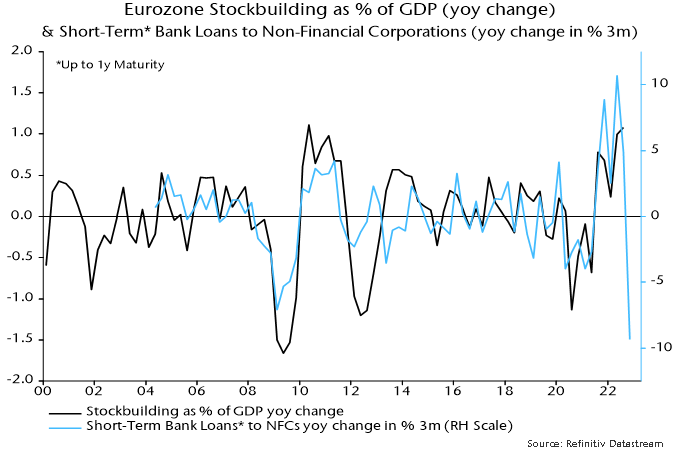
Solid growth of lending to the private sector has been the key driver of recent M3 expansion. The October bank lending survey, however, showed a further plunge in credit demand and supply balances, signalling a future lending slowdown or even contraction – chart 4. 

Chart 4

Chart 4 showing Eurozone Bank Loans to Private Sector (% 6m) & ECB Bank Lending Survey Credit Demand & Supply Indicators* *Average of Balances across Loan Categories

Statistical studies show that real non-financial M1 has the strongest leading indicator properties of the various money and lending measures. Its six-month rate of change remains at the bottom of the historical range, suggesting no economic recovery before H2 2023 – chart 5. 

Chart 5

Chart 5 showing Eurozone GDP & Real Narrow Money* (% 6m) *Non-Financial M1 from 2003, M1 before