Empty theatre seats with 2 bags of popcorn in the two front seats.

January was a strong start to the year for equity markets. In fact, the Nasdaq is off to its best start since 1991. Given that lenders (banks) are building reserves to prepare for a recession, and the money printers (central banks) are trying to cool the economy, the strength of equity markets seems to defy logic. It’s as if financial markets are completely ignoring the recession nipping at our heels. What’s driving this?

You guessed it: much of the January returns were powered by a trash rally. We’re talking about low-quality, high volatility stocks driven up by retail investors and internet frenzy.

Source: Sain Godil’s phone

What defines a trash rally?

Remember the GameStop phenomenon of January 2021? This is a textbook example of a trash rally. A near-bankrupt company saw its stock skyrocket thanks to a bizarre retail trading frenzy and a rash of internet jokes and memes. This resulted in a significant and illogical increase in stock price (trash rally) and the origins of the term “meme stock.”

Meme stocks are defined by several key characteristics:

  • low ROE
  • negative earnings
  • high leverage
  • low market cap
  • high short interest
  • weak leadership

The current trash rally is being fueled by a resurgent risk appetite among some investors. We’re seeing explosive growth in a variety of meme stocks this month after a crushing year for equities, although many analysts are skeptical the most recent moves will last.

A closer look at the data

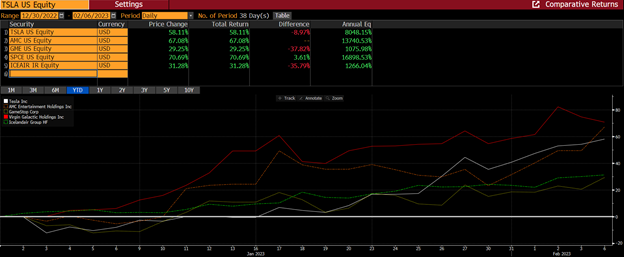
According to JP Morgan, retail market orders reached 23% on Jan 23, 2023. To put things in perspective, when the original GameStop saga began, retail trading peaked at 22%. The result of this euphoria can be seen below with the year-to-date performance of these high beta stocks including some indexes that replicate low-quality stocks.

How has the performance been since January 2022

Source: Global Alpha Capital Management and Bloomberg

How are those meme stocks doing since January 2022?

Two years ago, we were all stuck at home, feeling bored, and getting a false sense of financial security from stimulus checks. With sports events and gambling closed, retail investors made the stock market their casino. While some retail investors made a fortune, unfortunately, many lost a lot. The above charts (blue bars) show how most of the names have been cut in half, if not more.

Management teams of many meme stocks took advantage of the inflated stock prices to issue more equity and improve their finances. According to the Financial Times, meme stocks have raised over $4.7 billion from the hype.

AMC, a poster child for meme stocks, raised $2.8 billion from sales of equity and new debt. Fundamentally their business has not improved with current sales below 2018 revenue, and EBITDA is expected to be half of what they did in 2018. This is despite the fact that Avatar: The Way of Water is close to collecting $2 billion in global box office ($623.5 million in the U.S.).

Here we go again

All signs point to another meme stock rally. Take troubled retailer Bed Bath & Beyond, for example. They missed interest payments on bonds on Jan 29, which may lead to bankruptcy, and yet the stock price appreciated by 129% in just over a week. Carvana, the debt-strapped online used-car retailer is up 143% year-to-date. A meme stock favourite, Carvana was trading at $11.55 at the point of writing, way below its peak of $370 set in August 2021. Despite being down almost 98% from its peak, more than 266,000 call contracts changed hands on January 30, 2023 according to Bloomberg.

Is this just a U.S. Phenomenon?

The Bonusetu (a Finnish Casino) research team combed through Google trends for each European country to find the most Googled stock for each country. Tesla took the top spot in a whopping 28 countries and AMC is most popular in five countries. Below is a screenshot or performance of some other names in the group.

While we understand Google trend data does not necessarily mean Europeans participated in the trades, it’s difficult to imagine an alternative explanation. Was everybody in the UK, Germany, Ireland, and Croatia just purchasing tickets to watch Avatar at an AMC theatre? Or booking their next vacation on Icelandic Air or Virgin Galactic? It seems far more likely they were getting seduced by meme stocks.

Will history repeat itself?

Once again euphoria has set in and everyone is having a good time, gleefully ignoring the well-documented consequences of excessive indulgence. We’ve seen this story play out several times over the last few decades. Think back to 2001. That year, Nasdaq was up 12% in January but fell over 30% in the following 11 months when the dot-com bubble burst. In our February 11, 2021, weekly called The Canary in the Coal Mine we compared the meme stock situation to the tech bubble as well as the 2008 financial crisis.

Portfolio Impact

Popular media is once again helping stir up the meme stock frenzy. As we see a repeat of the same movie (no pun intended, AMC) this may have an unfortunate impact on higher-quality names that could get mispriced lower. The good news? For long-term investors in quality companies, this provides an amazing opportunity to buy quality companies at attractive valuations.

Our ability to be highly selective and nimble in our portfolio holdings leaves us well-positioned to enter a period of great opportunity for fundamental stock pickers. Our focus on high-quality companies with defensible business models and strong balance sheets should help outperform our small-cap benchmark. As we reflect on the state of markets and the fundamentals of our target companies, we are excited about the current environment and future growth opportunities.

The two measures of global “excess” money tracked here remain negative, arguing for a cautious view of equity market prospects. 

Excess (or deficient) money refers to the difference between the actual money stock and the demand for money to support economic transactions. According to “monetarist” theory, a surplus is associated with increased demand for financial / real assets and upward pressure on their prices, assuming no change in supply. 

Excess money is unobservable so two proxies are followed here: the difference between six-month rates of change of global (i.e. G7 plus E7) real narrow money and industrial output; and the deviation of 12-month real narrow money growth from a slow moving average. 

Historically (i.e. over 1970-2021), global equities outperformed US dollar cash on average only when both measures were positive. Unsurprisingly, average performance was worst when both were negative (underperformance of 8.9% pa). These results allow for reporting lags in monetary / economic data. 

The second measure turned negative in October 2021, which was known by end-November. The first measure followed in November, which was known by end-January 2022 (a longer lag because industrial output numbers are released after monetary / CPI data). 

Previous posts noted a recovery in global six-month real narrow money momentum during H2 2022*. With industrial output expected to weaken, it was suggested that the first measure would turn positive, possibly by December. 

The second measure – based on 12- rather than six-month real money momentum – was deeply negative in late 2022, with a switch to positive deemed unlikely before mid-2023. 

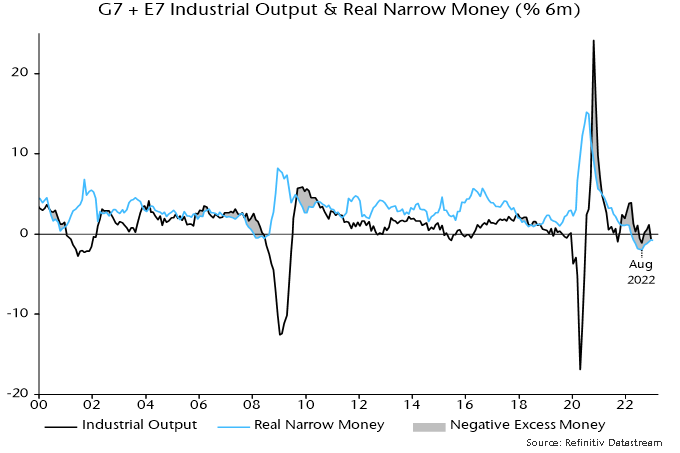
The suggested switch positive in the first measure has yet to occur. The six-month rate of change of industrial output crossed below zero in December but remained just above real narrow money momentum – see chart 1. 

Chart 1

Chart 1 showing G7 + E7 Industrial Output & Real Narrow Money (% 6m) highlighting August 2022

Will a cross-over have occurred in January? Partial data suggest that the recovery in real money momentum stalled last month. A reliable January estimate of industrial output won’t be available until mid-March. A reopening bounce in China could offset weakness elsewhere. 

A further point is that the recovery in global real narrow money momentum since mid-2022 partly reflected a strong pick-up in Russia, which may be of limited global relevance given the country’s enforced economic and financial isolation. 

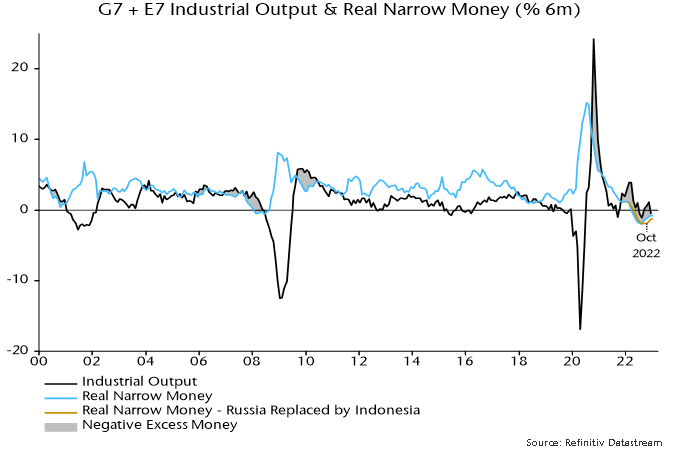
Chart 2 shows the result of replacing Russia with Indonesia in the G7 plus E7 real money calculation from January 2022, before the February invasion of Ukraine**. The trough in real money momentum is placed in October rather than August, with the subsequent recovery even more anaemic. 

Chart 2

Chart 2 showing G7 + E7 Industrial Output & Real Narrow Money (% 6m) highlighting October 2022

*The trough in real money momentum originally occurred in June but is now placed in August, partly reflecting revisions to US CPI seasonal adjustments.

**The other E7 countries (as defined here) are Brazil, China, India, Korea, Mexico and Taiwan.

Salmon fish farm. Bergen, Norway.

This week we will be discussing a new addition to the portfolio, SalMar (Ticker: SALM NO), and the latest developments in the salmon farming industry.

The global salmon market was estimated to be a US $50 billion industry in 2020 and expected to grow at 3.7% a year to reach $76 billion by 2028. The growing disposable income in emerging countries and subsequent changes in dietary habits are some of the main drivers behind this growth. Consumers of salmon are more often from the middle- and upper middle-classes who are generally less sensitive to economic slowdowns and less likely to dramatically change their spending patterns, particularly in food purchases. In addition, the health benefits of eating salmon rich in Omega-3 over red meat are well-documented. As a protein, its feed conversion ratio (i.e., the kilograms of feed needed to increase the animal’s body weight by one kilogram) is one of the best among the protein sectors.

Global Alpha received the SalMar shares as part of the cash and share deal that SalMar made to acquire our previous holding in the portfolio, Norway Royal Salmon. The combined entity creates the second-largest salmon farmer in the world.

Both parties have operations in Northern and Central Norway. With this new acquisition, synergies will come from improved utilization of available biomass i.e. the total weight of the fish. SalMar will implement their best-in-class practices at the existing Norway Royal Salmon operations in Norway to improve biological challenges. Gaining increased access to smolt (juvenile salmon) will give SalMar additional benefits stemming from vertical integration such as increasing the quantity of harvested fish, which will optimize the utilization of the processing facility.

However, before the deal closed, the industry received some unexpected news. On September 28, 2022, the Norwegian government announced the most significant change to date to the salmon industry’s regulatory framework by imposing a 40% resource tax on salmon and trout farming in Norway. This would take the marginal tax rate of producers from 22% to 62% if implemented in the initially proposed form. A resource tax is already levied on oil and gas, hydropower operations, and profits generated using Norway’s natural resources.

The major salmon producers were quick to respond to the government’s proposal:

  • SalMar: “Earlier this year, SalMar bought its relative share available for a fixed price for the capacity adjustment in the traffic light system. 1,223 MAB tonnes for a total consideration of NOK244.6 million. SalMar has chosen to use the opportunity to terminate the purchase. This is due to the resource rent tax the Government has now announced.” 
  • Leroy Seafood (LSG NO): “In 2022 Leroy purchased 614 tonnes maximum allowable biomass under the so-called traffic light system at a total value of NOK123m. Leroy has decided to cancel this purchase. Increasing the tax rate from 22% to 62% creates unreasonable framework conditions for the industry in Norway, changing the scope and incentives for investments in areas other than maintenance capex. All major new investments in the Group’s value chain in Norway must regrettably be put on hold pending the decision of the Storting, the Norwegian parliament.” 
  • Mowi (MOWI NO): “In light of the Norwegian government’s proposal for a 40% resource tax on Norwegian aquaculture, and a resulting total tax of 62%, Mowi is cancelling its acquisition of 914 tonnes MAB for a total value of NOK183m. The government’s tax proposal means that Mowi can no longer justify the purchase price. Mowi respectfully advises the government to reconsider its resource tax proposal.” 

In addition to suspending purchases, the biggest salmon producers were notably absent from the first auction of biomass capacity since the government proposed the resource tax, even though these same producers bought capacity at the previous auction in 2020.

More recently, shares of the Norwegian salmon producers have been reacting to headlines from politicians. They first rose after Geir Pollestad, deputy leader of the Norwegian Center Party, told a local newspaper that the party was open to modifying the tax. However, finance minister Trygve Vedum said shortly afterward that the original proposal of a 40% tax should remain. With the governing parties losing popularity, and amid growing concerns about the over-reliance of regions on the salmon industry for employment, we foresee a compromise will be reached and a modified version of the original proposal will be implemented.

Supply growth should remain muted given increased biological challenges and stricter regulations. We see support for salmon prices and demand for salmon is likely to remain strong despite the challenges. These social and environmental aspects are further reasons why exposure to the salmon industry is attractive and we will continue to follow as developments unfold.

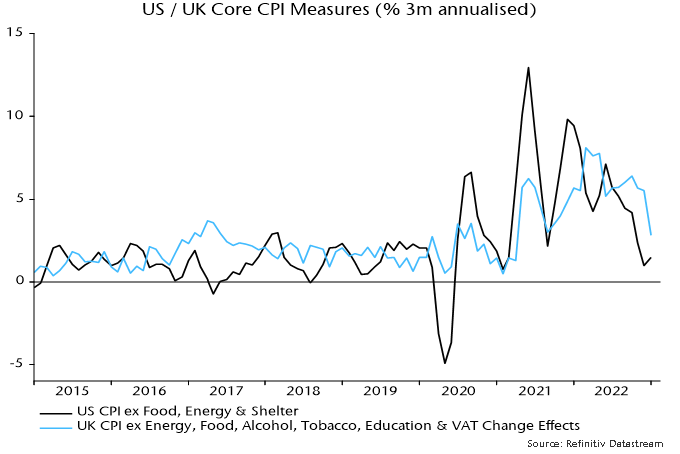
US and UK CPI data this week elicited opposite market reactions but core momentum has recently slowed notably in both cases, consistent with a moderation in money growth rates two years earlier. 

Chart 1 shows three-month annualised rates of change of preferred core measures – CPI ex. food, energy and shelter for the US and CPI ex. energy, food, alcohol, tobacco, education and VAT change effects for the UK. US three-month momentum was just 1.5% in January, while UK momentum fell sharply to 2.8%.

Chart 1

Chart 1 showing US / UK Core CPI Measures (% 3m annualised)

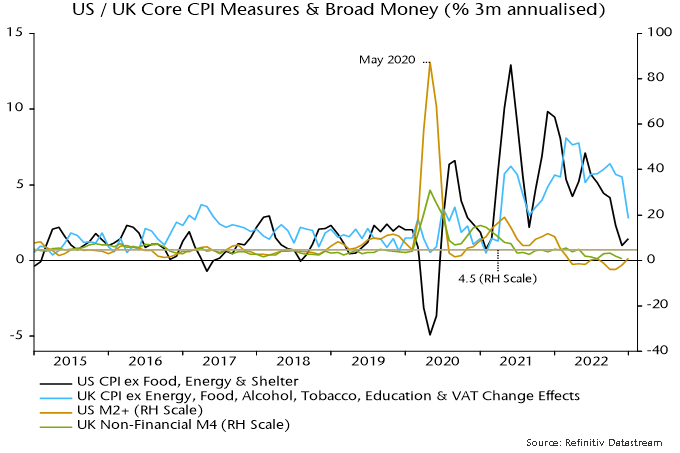
The ”monetarist” rule of thumb is that money leads prices by about two years. Chart 2 superimposes three-month rates of change of broad money. Growth peaked in May 2020. The recent significant declines in core CPI momentum began in June 2022 in the UK and July in the US.

Chart 2 

Chart 2 showing US / UK Core CPI Measures & Broad Money (% 3m annualised)

Average broad money growth of 4.5% pa in both the US and UK over 2010-19 was associated with sub-2% average core CPI inflation. Three-month rates of change of broad money moved below 4.5% annualised on a sustained basis in March 2022 in the US and June in the UK. A reasonable expectation, therefore, is that core CPIs will be rising at a sub-2% by mid-2024 in both cases.

The path lower in money growth from the May 2020 peak was bumpy and core CPI momentum is likely to display similar volatility around a declining trend.

African American Business Data Analyst Woman Using Computer, global map and data on screen

Investors globally have embraced global small cap equities as a source of equity diversification. Despite the name, the universe is largely comprised of companies with a market capitalization greater than US $1 billion and includes a growing number of household names in many of the local markets and some having a global brand recognition.

Key merits of global small cap

Not that small Over 2,600 global small cap companies have a market capitalization greater than US $1 billion
Breadth and depth Largest stock is only 0.2% of the index and there is broader sector diversification compared to other major market indices
Alpha opportunities Global small cap markets are less researched by the analyst community compared with large cap developed equity markets, which creates added value opportunities for independent research by active managers


Background to global small cap

Global small cap stocks offer investors the ability to benefit from a unique opportunity set. The MSCI World Small Cap Index captures small cap representation across 23 developed market countries. Compared to a domestic context, the global small cap opportunities are not that small; there are 2,643 companies with a market capitalization greater than US $1 billion at December 31, 2022. There were only 209 such companies in the S&P/TSX Composite Index.

The largest individual stock in the global small cap index represents only 0.2% of the index. In contrast, the largest individual stock at the end of 2022 in the S&P/ TSX Composite Index represented 6.3% of the index.

Moreover, the largest 15 stocks in the Canadian equity market index account for 45% of the index, while the largest 15 stocks in the global small cap index represent less than 3%. It would require the largest 627 stocks to achieve 45­% index representation in the global small cap index, highlighting the much broader investment opportunity set offered by the global small cap universe.

Many of the stocks in the global small cap universe are household names in their local market, and some have a global brand recognition. For example, L’Occitane, the manufacturer, marketer, and retailer of natural and organic skincare and beauty products; Samsonite, the world’s best-known and largest travel luggage company; and IWG, which offers short-term (and long-term) workspace solutions around the world, including well-known brands such as Regus.

The diversification benefits of global small cap go beyond individual stocks. While the major Canadian indices are heavily skewed to the financial, energy, and material sectors (see Figure 1), the global small cap markets provide representation across a broader range of sectors, including higher exposure to consumer discretionary (e.g., companies in the restaurant, luxury goods and travel industries) and health care.

Figure 1 – Small Cap Sector Diversification Merits

MSCI Global Small Cap Index (%) S&P/TSX Composite Index (%)
Energy 5.0 18.1
Materials 7.6 12.0
Industrials 19.4 13.3
Consumer Discretionary 12.5 3.7
Consumer Staples 4.7 4.2
Health Care 10.7 0.4
Financials 14.3 30.8
Information Technology 10.8 5.7
Communication Services 2.8 4.9
Utilities 3.2 4.4
Real Estate 8.9 2.6
Total 100 100


Source: MSCI and Thomson Reuters Datastream. Data as at December 31, 2022

Over the last 10 years, the global small cap index has achieved the strongest return, albeit with greater volatility (Figure 2). As with all markets, it is important to understand the investment risks.

Figure 2 – 10-Year Risk and Return (Ending Dec. 31, 2022)

Source: MSCI and Thomson Reuters Datastream. Note: Index returns are in Canadian dollars.

Understanding the risks

While active managers can mitigate some of the risks through research and careful selection of individual stocks, when it comes to global small caps, investors should recognize the following:

  • Liquidity risk: It can take longer to trade a small cap stock compared to large cap stocks.
  • Information flow: While higher insider ownership associated with small cap stocks aligns with the interests of investors, it can also lead to less transparency and flow of information common with global large cap investments.
  • Credit access: Small companies do not have the same access to credit markets as larger companies, which can sometimes limit a small company from realizing its potential.

Recognizing the potential benefits

Offsetting the risks are a number of potential benefits of global small cap investments:

  • Growth opportunity: For investors who can identify the next generation of small companies that grow faster and graduate into the large cap segment, the reward is significant.
  • Greater alignment of interest: Global small cap companies tend to have a more focused line of business and higher insider ownership, resulting in greater alignment of interests between the owners and shareholders.
  • Sector opportunity: Investors can benefit from the higher consumer discretionary and health care sector representation offered by the global small cap index. For example, consumer-spending patterns indicate the consumer discretionary sector is likely to perform well over the long term. The health care sector should also benefit from demographic aging in the developed world.
  • Added value opportunity: Small cap companies also tend to be less externally researched by the analyst community. As a result, active managers have a greater opportunity to outperform their index benchmark by identifying companies whose share price does not fully reflect their intrinsic value or growth prospects. Based on the eVestment database, 71% of managers in the active global small cap universe outperformed the MSCI World Small Cap Index over the 5 years ended December 31, 2022.
  • Style offset opportunity: At the end of 2022, over 4,425 companies were in the MSCI World Small Cap Index. The broader opportunity set has led to an increased number of global small cap strategies offered by systematic (quantitative) investment managers. With a systematic approach, an investment manager is able to benefit from a breadth of understanding on a large universe of companies, compared to the depth of understanding associated with fundamental managers, who are focused on selecting a smaller number of companies to invest in. As for other equity markets, investors who can accommodate multiple managers in an asset class can benefit from the complementary systematic and fundamental styles.

Case for global small cap equities

The last several years has witnessed increased concentration in the global large cap developed equity market index. Introducing a global small cap equity component to portfolios can provide a complimentary source of diversification, a broader opportunity set of less externally researched companies, and thereby offering the potential for delivering returns above the index through active management.

View of Mountain Fuji at Shizuoka prefecture, Japan.

Nuclear power is a low-carbon, reliable source of energy. Yet, over the past decade, it has struggled to play a strong role in energy transition. Nuclear power generation has been around since the 1960s, and saw massive growth from the 1970s to 1990s. Since then, however, its share of global electricity production has declined from 17% in the 1990s to the current 10%, largely due to safety concerns following the tragic accidents in Chernobyl in 1986 and Fukushima in 2011.

Chart 1: Share of electricity production by source, World.

Today, nuclear energy’s role in the energy system varies by country. In 2021, for example, nuclear accounted for 69% of total domestic electricity generation in France, 51% in Belgium, 28% in South Korea, 20% in the United States, 12% in Germany, 7% in Japan, and 5% in China.

Amid the global energy crisis following the war in Ukraine, many nations have prioritized efforts to reduce their reliance on imported fossil fuels. Add the backdrop of the global climate crisis, and the search for other sources takes on increased importance. Renewable energy sources have experienced remarkable growth in recent years, yet renewables alone are not sufficient to fully decarbonize the energy grid. This opens the door to an increased role for nuclear power.

According to the International Energy Agency (IEA), global nuclear capacity needs to expand by about 10 gigawatts (GW) per year to be on track with the Net Zero Emissions by 2050 Scenario. In 2022, nuclear energy had an operational capacity of 413 GW in 32 countries, thereby helping reduce reliance on fossil fuels while also avoiding 1.5 gigatonnes (Gt) of global emissions and 180 billion cubic metres of global gas demand a year. Emerging countries accounted for almost all new nuclear capacity added in recent years, while developed economies are catching up.

The UK currently has 5.88 GW of nuclear capacity, accounting for 15.5% of energy generated in 2022. It has set a goal to reach 24 GW by 2050, about 25% of UK’s predicted energy demand.

In the U.S., meanwhile, nuclear energy has consistently provided about 20% of total electricity generated over the past 30 years, and that country’s 93 operating nuclear reactors had a combined capacity of 95 GW at the end of 2021. However, as most of the American nuclear plants are approaching their 40-year design life, capacity will need to be extended or added to achieve the 2050 net zero goal.

Before the Fukushima disaster, Japan sourced about a third of its electricity from 54 nuclear reactors, but only nine are still operational. Following the war in Ukraine and the subsequent energy crisis, Japanese citizens’ sentiment toward nuclear reactors has shifted positively. In December 2022, the Japanese government announced a new nuclear energy policy aimed at maximizing the use of existing nuclear power plants and building next-generation reactors. Nuclear currently accounts for 7% of total power generation in Japan, and their goal is to increase the percentage to 20-22% by 2030. But getting there will require about 26 to 33 operational nuclear reactors.

Two major barriers hindering the growth of nuclear power are safety concerns, and elevated construction and operating costs. However, advancing technologies can help to overcome those barriers. Small Modular Reactor (SMR), for example, can be made in factories and installed on site, reducing both initial costs and construction times. The smaller size also makes economic sense for small electric grids. It is also believed to have enhanced safety characteristics.

Most recently, scientists have achieved a breakthrough by successfully producing a nuclear fusion reaction resulting in a net energy gain, instead of just breaking even as past experiments have done. Nuclear fusion provides carbon-free energy, without the highly radioactive, long lived nuclear waste created by current nuclear reactors. The process is inherently safe as fusion is a self-limiting process, the reaction could come to a halt within seconds. However, it will take years if not decades before fusion can meaningfully contribute to energy transition. The next step is to figure out how to produce more energy from nuclear fusion on a much larger scale, and at a lower cost.

Global Alpha has some holdings in the nuclear power sector that we believe offer good investment value.

For example:

Curtiss-Wright (CW US) supports the global nuclear power industry by providing precision components and highly engineered products and services. The company has an installed base of products at all nuclear plants operating in the U.S., and many operating internationally. Curtiss-Wright designed the world’s most advanced reactor coolant pump for Westinghouse’s AP1000 reactor, one of the safest and most economical nuclear plant designs available worldwide and has been approved or planned at many nuclear plant projects globally, notably in China, India, U.S., and UK. Curtiss-Wright also works with SMR and Advanced Reactors designers to ensure its presence in the future growth of this market. It has the opportunity to secure $10 million to $100 million in content per location.

Horiba (6856 JP) manufactures measurement equipment, specializing in the analytics and measurement of small particles in the field of environment, health, safety, and energy. Among its extensive product lineups, Horiba offers a wide range of measuring instruments and sensors to measure the pH of secondary water in nuclear power plants. For example, measurement of silica is paramount in preventing the problem of scaling, which reduces the efficiency of power generation. Horiba provides silica analyzers to allow for quick and automatic measurement for boiler water, and trace amount of silica present in pure water. 

Eurozone flash PMIs this week were less bad than expected, bolstering a growing consensus that economic prospects are improving. Monetary trends continue to argue the opposite. 

The preferred narrow money measure here – non-financial M1 – fell for a fourth consecutive month in December in nominal terms. Bank lending also contracted on the month, while the broad non-financial M3 measure grew by just 0.1%. 

The three-month rate of contraction in narrow money is a record in data back to 1970. Three-month growth of non-financial M3 is down to 2.3% annualised, less than half its 2015-19 average. Bank loan growth is also now below its corresponding average – see chart 1. 

Chart 1

Chart 1 showing Eurozone Narrow / Broad Money & Bank Lending (% 3m annualised)

Bank lending weakness is being driven by repayment of short-term corporate loans, consistent with a violent downswing in the stockbuilding cycle – chart 2. 

Chart 2

Chart 2 showing Eurozone Stockbuilding as % of GDP (yoy change) & Short-Term* Bank Loans to Non-Financial Corporations (yoy change in % 3m) *Up to 1y Maturity

The six-month rate of decline of real narrow money was little changed from November’s record despite a sharp drop in six-month CPI momentum – chart 3. 

Chart 3

Chart 3 showing Eurozone GDP & Real Narrow Money* (% 6m) *Non-Financial M1 from 2003, M1 before

The rate of contraction of real M1 deposits remains fastest in Italy, reflecting both weaker nominal money trends and higher inflation. Spanish positive divergence is mainly due to a much sharper recent CPI slowdown. 

Chart 4

Chart 4 showing Real Narrow Money* (% 6m) *Non-Financial M1 Deposits

Echoing the better PMI news, German Ifo manufacturing expectations rose for a third month in January. The new demand index, however, has recovered by less and fell back this month – chart 5. European cyclical equity market sectors have outperformed on soft landing hopes and are vulnerable if business surveys now stall, as suggested by monetary trends. 

Chart 5

Chart 5 showing Germany Ifo Manufacturing Survey & MSCI Europe Cyclical Sectors ex Tech* Price Index Relative to Defensive Sectors *Tech = IT & Communication Services
Microphone on stage in an auditorium.

For fans of Seinfeld, the line “What’s the deal with…” reminds us of a particular brand of observational comedy from the 90’s. Well, turns out 90’s humor is still a big deal, as Netflix paid half a billion dollars in 2021 for the streaming rights of Seinfeld. Not bad for a show about nothing. As we kick off a brand-new year, we thought it’s the perfect time to ask ourselves “What’s the deal with EM small cap…?”

For most investors, emerging markets (EM) as an asset class is high on the risk spectrum. They could be forgiven for thinking of small caps within EM to be a step too far. The EM small cap universe (EM SC) for the most part is ignored or misunderstood. We hope to change a few perceptions along the way by shining a light on EM SC as potential ground for adding alpha.

Added value

Before we begin to answer “What’s the deal with EM small caps…” let’s look at how MSCI EM SC has performed compared to its all-cap counterpart, MSCI EM. As seen below, whether on a three year, five year, 10 year or 20 year period, the MSCI EM SC index adds value compared to its all-cap counterpart. At the start of 2023, as we possibly enter a prolonged period of higher inflation and interest rates, we expect small caps to outperform by leveraging the flexibility and nimbleness that comes with smaller size and lower bureaucracy.

% Annualized USD Returns

3 yr5 yr10 yr20 yr
MSCI EM SC5.38%1.32%3.45%9.60%
MSCI EM-2.42%-1.10%1.77%9.04%
Source – Bloomberg. As on 30 Dec 2022.

A big stage

The reasons for its relative outperformance are many. Let’s start off with the fact that the EM SC universe is vast, with plenty of space to find the next big compounder among 11,000 companies, 24 countries and 11 sectors. The benchmark index – MSCI EM SC (MXEFSC) – is constructed with no index weight bias. Also, except for Taiwan, there is no sector bias among the big countries that constitute the index. This size and diversity mean that the EM SC universe offers plenty of scope for portfolio diversification and alpha generation.

Low to no coverage

With big size comes lack of proper coverage. This universe’s vastness, combined with liquidity constraints, means this asset class doesn’t get extensive coverage, despite the value it has added historically. We see under coverage from both the buy side and sell side. This lends perfectly to our process at Global Alpha where we put in the hard yards to travel, meet management in person, and understand local business customs to stay on top of the story.

Analyst Coverage Comparison

Bar chart comparing MSCI EM & MSCI EM SC for analyst coverage, with EM SC being more than twice as much as EM when less than 10.
Source – Bloomberg. As on 30 Dec 2022

Less sino-centric

China dominates the large cap index – making up over 30% of the benchmark – while making up just around 10% of the small cap index,as seen in the graph below. The more balanced construction of the EM SC index helps investors avoid the policy and geopolitical risk that comes with concentrated exposure to a single market. At the same time, this differentiated exposure is a good complement in terms of total portfolio diversification.

EM Index Composition

Bar chart comparing MSCI EM & MSCI EM SC for EM Index Composition, with EM more than twice as much in China, and EM SC higher in India, Taiwan, South Korea, Brazil, and others.
Source – Bloomberg. As on 30 Dec 2022

Tailwinds

After decades of globalization, the pandemic exposed the fragility of the global supply chain system. De- globalization, near shoring and a greater reliance on domestic consumption as an engine of growth could come to define the next decade. EM small caps have greater exposure to consumer-facing sectors like healthcare, industrials, and discretionary and lesser exposure to global cyclicals like IT and energy compared to its all-cap peer.

MSCI EM

Source – Bloomberg. As on 30 Dec 2022

MSCI EM SC

Source – Bloomberg. As on 30 Dec 2022

SOE’s are minor actors

The EM SC benchmark has a lower allocation to State-Owned Enterprises (SOEs) than its large cap counterpart. Our experience informs us that SOEs are the same regardless of the country in which they are domiciled. They suffer from:

  • poor capital allocation,
  • lack of alignment of incentives,
  • slow pace of decision making, and
  • a track record of poor shareholder returns.

On the flip side, many of our small cap names need to be nimble and innovative to survive. Experience has shown that first generation entrepreneurs with skin in the game and properly aligned incentives tend to create shareholder value in the long run.

Being active

Emerging markets is a space where portfolios can look different from benchmarks. Research confirms that the average active share in this space has historically been close to 70%* and that there is a positive and significant relationship between active share and fund performance. Further, being consistently active is a strong predictor of fund performance. In other words, managers who back themselves on their ability to outperform by maintaining a high level of active share do well in the long run.

As we travel around the world, we are also seeing a generational shift in thinking among many of our family-owned companies. There is an openness among them to hire professional management. We also see a willingness to enhance corporate governance standards, and a better appreciation of what constitutes good capital allocation. While we don’t underestimate the challenge of finding the next HDFC Bank or TSMC, we feel the EM SC space offers the best playing field to generate value for our clients in the long run. And in our mind, that’s a big deal.

*Based on 67 emerging market funds that use MSCI Emerging Market Index as their benchmark. Active share is defined as percentage of holdings in a portfolio that differs from its benchmark.

High inflation resulted in poor equity market performance in 2022 despite economic / earnings growth. Inflation relief in 2023 may limit further market weakness despite a global recession.

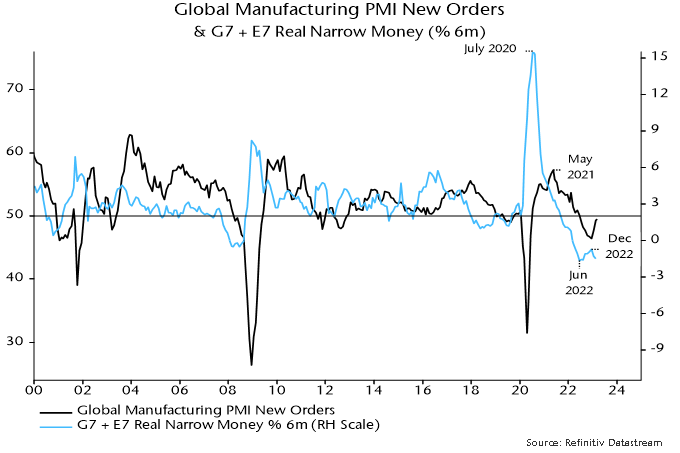
Absent shocks, economic momentum usually reflects real money trends six to 12 months earlier. Global six-month real narrow money momentum turned negative in March 2022, reaching a low in June before recovering slightly into November – see chart 1. This suggests that economic weakness will intensify in early 2023, with no monetary signal yet of a subsequent meaningful rebound. 

Chart 1

Chart 1 showing Global Manufacturing PMI New Orders & G7 + E7 Real Narrow Money (% 6m)

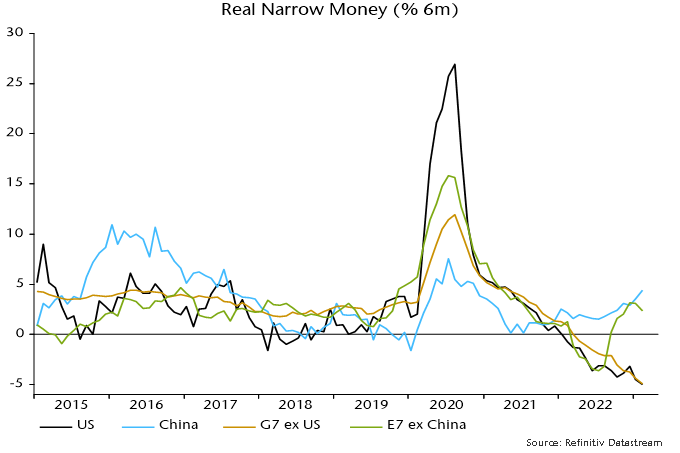
Real money contraction is fastest in the housing bubble / bust economies of New Zealand, Sweden and Canada, although the UK, Eurozone and US are only slightly behind – chart 2. China and Japan are positive outliers, suggesting less unfavourable prospects.

Chart 2

Chart 2 showing Real Narrow Money (% 6m)

Hopes are high that China’s covid policy U-turn will lead to a V-shaped economic recovery, as occurred in G7 economies post reopenings. Strong G7 rebounds, however, followed a surge in money growth. Chinese real narrow money expansion is still modest by historical standards and a rise in money rates in late 2002 may indicate less expansionary PBoC policy, possibly reflecting concern about inflationary effects of rapid reopening. 

Still-negative global real narrow money momentum indicates that a Chinese economic pick-up won’t offset recessions elsewhere. Forecasts of China-driven strength in commodity prices, therefore, are suspect. Additional weakness is more likely, based on an accelerating downswing in the global stockbuilding cycle, a key driver of commodity prices historically – chart 3. 

Chart 3

Chart 3 showing G7 Stockbuilding as % of GDP (yoy change) & Industrial Commodity Prices (% yoy)

The 2021-22 inflation surge was a consequence of central banks applying record monetary stimulus in 2020 as the stockbuilding cycle was tracing out an extreme low. Monetary fuel supercharged the usual cyclical rise in commodity prices. 

The monetary backdrop, like the status of the stockbuilding cycle, is now the opposite of 2020. G7 annual broad money growth crashed to 2.0% in November, below a pre-pandemic (i.e. 2015-19) average of 4.5% and down from a February 2021 peak of 17.3% – chart 4. The monetarist understanding of a roughly two-year lead implies an inflation crash from early 2023. 

Chart 4

Chart 4 showing G7 Consumer Prices & Broad Money (% yoy)

The latest trends, indeed, suggest rising medium-term deflation risk. G7 broad money contracted marginally in the three months to November. Bank loan growth to the private sector had been providing support but is now slowing as higher rates curb mortgage demand and corporate borrowing needs moderate with the stockbuilding downswing. 

The weak economic outlook is, according to the monetarist view, of limited relevance for assessing equity market prospects, which will hinge instead on “excess” money developments.

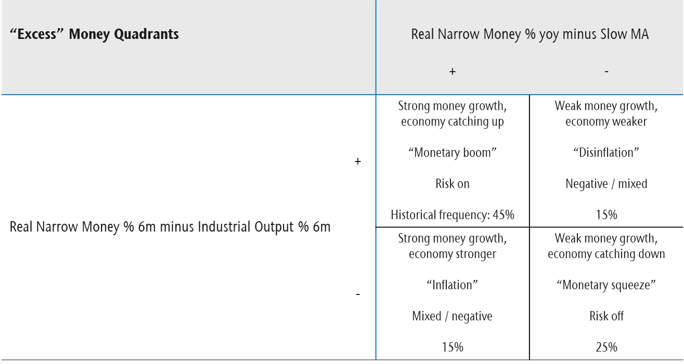
Two global excess money proxies are followed here: the gap between six-month real narrow money and industrial output momentum; and the deviation of 12-month real money momentum from a long-term moving average. The first indicator turned negative in December 2021 (allowing for data reporting lags), with the second following in February 2022. Historically (i.e. over 1970-2021), global equities underperformed cash by 8.9% pa on average when both were negative. The underperformance between end-February and end-December 2022 was larger, at 14.9% pa. 

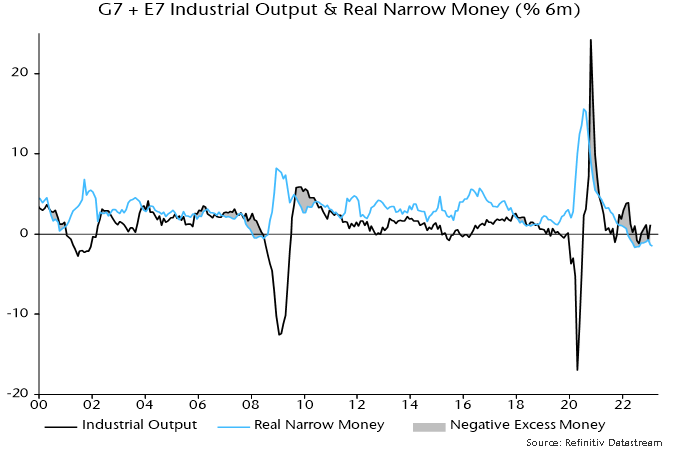
As noted earlier, six-month real narrow money momentum has recovered slightly from a June low. Industrial output momentum, meanwhile, is estimated to have turned negative at end-2022, with further weakness likely. A cross-over, therefore, appears imminent and may even have occurred in December – chart 5. Allowing for the data reporting lag, a December cross-over would imply a shift in sign of the first indicator from positive to negative from end-February. 

Chart 5

Chart 5 showing G7 + E7 Industrial Output & Real Narrow Money (% 6m)

The second indicator – the deviation of 12-month real money momentum from a moving average – is heavily negative and unlikely to turn positive before mid-2023 at the earliest. 

The expected combination of positive and negative readings of the first and second indicators respectively was historically associated with equities underperforming cash by an average 4.5% pa, suggesting retaining a cautious investment stance.

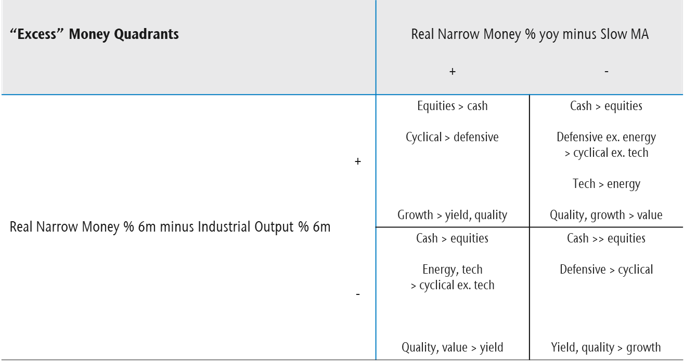
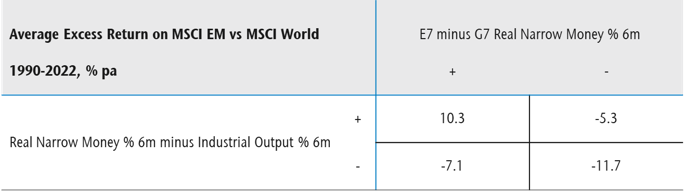
The combination could result in significant sector / style rotation: tech, quality and growth outperformed on average with value and energy underperforming. Non-energy defensive sectors would be expected to continue to outperform non-tech cyclicals. EM equities outperformed developed markets on average.

The suggestion of a reversal of growth underperformance in 2022 is consistent with indications that Treasury yields will decline during 2023 – surging yields contributed to the derating of growth stocks last year.

Equity markets are bullish or bearish depending on whether excess money is positive or negative. Bond markets, by contrast, are sensitive to the rate of change of excess money, rather than its sign. Changes in US real Treasury yields have been inversely correlated with changes in the first excess money measure historically, i.e. yields have fallen when the measure has risen, even while still negative – chart 6. The current / expected improvement in the measure, therefore, suggests an extension of the recent yield decline.

Chart 6

Chart 6 showing US Real 10y Treasury Yield (6m change)

Treasury yields, in addition, usually move down into a low around the same time as the stockbuilding cycle trough – chart 7. Based on the average cycle length of 3 1/3 years, the next low could occur in Q3 or Q4.

Chart 7

Chart 7 showing G7 Stockbuilding as % of GDP (yoy change) & US 10y Treasury Yield

A fall in Treasury yields requires a Fed policy “pivot” but this could be imminent. Chart 8 shows the estimated probability of the Fed tightening policy in a particular month based on the latest data on core inflation, unemployment and supply bottlenecks. The probability estimate fell from 100% in October to 80% in December and currently stands at 75% for the FOMC meeting on 31 January / 1 February, consistent with market speculation of a step down from a 50 to 25 bp hike.

Chart 8

Chart 8 showing US Fed Funds Rate & Fed Policy Direction Probability Indicator

Based on the FOMC’s December median projections, the probability of tightening is forecast to fall below 50% in Q2 and below 10% in Q3. This outlook is consistent with the Fed shifting to an easing bias in Q2 and starting to cut rates in Q3.

Silhouette of working oil pumps on sunset background.

Anyone who’s kept an eye on the markets is aware that the energy sector had a blowout performance in 2022. It started with the war between Russia and Ukraine in February that spiked oil and gas prices, the discussion then shifted to European LNG supply for the following winter, including which countries would be able to absorb Russia’s excess oil supply. Clearly, the energy resurgence in 2022 was a European-driven one.

With that in mind, what is the situation going into 2023? It appears that the worst-case scenario for this European winter has been avoided. Natural gas prices are now back at the pre-Ukraine invasion level, EU gas storage is sitting a comfortable 5% above its five-year trend, and winter weather has been lenient so far.

European Union gas storage levels, 2017 – November 2022

Chart comparing European Union storage levels from 2017 to 2022 vs the
5-year average.
Source: IEA, European Union gas storage levels, 2017-November 2022, IEA, Paris https://www.iea.org/data-and-statistics/charts/european-union-gas-storage-levels-2017-november-2022, IEA. Licence: CC BY 4.0

Governments are now focusing on planning for next winter, and the data points are more mixed. In 2022, Europe benefitted strongly from having Russian LNG flow for most of the summer and from lower LNG demand from China. Both things are unlikely to repeat in 2023. Indeed, a worst-case scenario, where Russian pipelines stop flowing completely for 2023, would represent a gap of nearly 50% of total gas storage requirements for the winter of 2023/24. And there are not many options for Europe to fill this gap elsewhere. Indeed, China’s 2023 LNG imports are expected to reach 2021 levels, which would capture over 85% of the estimated increase in 2023 LNG global supply, with much of that increase already contracted by China.

The market however does not appear to be discounting this. December 2023 futures contract for LNG is sitting around €70 per MWh, three times pre-2021 levels but well below the peak of €345 seen in August. There are certainly some indicators that support this optimism. Between August and November 2022, EU natural gas consumption dropped 20.1%, well above the government self-imposed target of 15% for the period between August 2022 and March 2023. Finland reduced its consumption by as much as 52%. Many countries capped the price for consumers and businesses. These lower prices should help alleviate the size of deficits generated from these programs, allowing those countries to face next winter with a healthier balance sheet. Furthermore, the weather for the rest of the winter will be a key driver of the requirements for next year, as estimates for gas storage levels at the end of the heating season vary between 5 and 35% of full capacity. Clearly it is too soon to predict a worst-case scenario, and Global Alpha does not expect a worst-case scenario to materialize. But the pain is likely to be felt more than markets currently discount.

At Global Alpha we have historically underweighted energy in our portfolios, not because of any macro views, but instead because the team consistently found better stock picking opportunities elsewhere. Indeed, pure oil and gas stocks are often at odds with Global Alpha’s investment philosophy: the quality of their balance sheet is volatile, they depend on macroeconomic factors to outperform, and as such tend to be more momentum based.

So how does Global Alpha get its energy exposure? An example of a name we have owned for many years is Schoeller Bleckmann Oilfield Equipment AG (SBO VIE). The company is the global market leader for high precision drilling components, providing nonmagnetic drill string components to directional drilling oil field service companies. Headquartered in Austria, more than 80% of its business is done in the U.S. and Europe, with high profile clients such as Schlumberger, Halliburton, and Baker Hughes.

With a healthy balance sheet and key market positioning backed by proprietary technologies, Schoeller-Bleckmann provides an attractive exposure to energy prices without being dependent on a few oil and gas projects. Indeed, its stock price has benefited from the pick-up in rig counts since mid-2021, with the firm boasting a book-to-bill ratio consistently above 1x, while at the same time showing its ability to pass on cost inflation to clients. There have also been discussions of green energy diversification, though the strategy remains unclear for now.

SWOT analysis

Strengths

  • +50% market share in most of its products
  • Strong balance sheet supported by low net debt

Weaknesses

  • Dependence on the big three oil services companies

Opportunities

  • Increased geographical diversification
  • Opportunistic M&A

Threats

  • Technological competition in their key plug market
  • Loss of market share in the U.S.

Schoeller-Bleckmann is a perfect example of the type of quality names Global Alpha is looking for in its portfolios: a niche, market leader with global exposure and a clean balance sheet that allows for sustained growth.