
Traditional junk boat sailing across Victoria Harbour, Hong Kong.

Summary

  • EM equities fell over the month, with the MSCI EM Index down -4% over the period.
  • Declines were led by markets with higher exposure to commodities and oil such as Latin America and the GCC.
  • Quality stocks in China outperformed, while value names dominated by State-Owned Enterprises (SOEs) continued to cool following outperformance through the first half of the year. Chinese growth stocks remain laggards.
  • Stocks in Poland rallied hard after former prime minister and European Council president Donald Tusk led a centrist coalition to victory in national elections, promising to restore ties with the European Union.
  • Weakening narrow money momentum over the period suggests downside surprises to economic growth are likely. Our portfolio exposure remains defensive given this backdrop, underweight commodities and oil, favouring high quality and sustainably growing businesses that can weather a downturn.
  • Unexpected economic weakness in the months ahead may force central banks to reconsider tight policy settings.

“It’s never too late to catch the China train – you can still ride the dragon to heaven.”
– Wang Jianjun, China vice-chair of the China Securities Regulatory Commission

Our team visited China and Hong Kong through September and October, seeing over 100 companies, policy makers, strategists and research analysts. The trip provided an opportunity to gauge sentiment on the ground and test our conviction on portfolio companies, while uncovering new risks and opportunities.

It’s safe to say that the team didn’t leave feeling quite as bullish as the vice-chair of China’s securities regulator at a conference we attended (quoted above). It remains difficult to build strong conviction for the longer-term outlook, but our sense is that a slow burn post-pandemic recovery is still in play. We were reminded by several Chinese executives that we are only a little over half a year into this recovery and that it will take time for green shoots to emerge.

Below is a summary of some key headlines which emerged over the trip.

Politics – domestic discontent evident while geopolitical risk stabilising
China’s economic slump marks the first real recession since reform and opening up under Deng Xiaoping in the late 1970s. What is notable is rising dissatisfaction spreading outside of investment circles, with frustration over a lack of visibility or conviction on economic policy direction bubbling up in the middle-class, entrepreneurs and elites. Current economic woes are increasingly blamed on policy missteps as opposed to unfavourable economic conditions.

Public mourning over the death of former premier Li Keqiang in early November provided an outlet for public venting of frustration. Mourners in Li’s home town of Hefei spoke about Li’s more moderate approach to politics, which has been interpreted by many China watchers as thinly veiled criticism of the more authoritarian turn political and economic institutions have taken under Xi.

While geopolitical risks stemming from Sino-US confrontation remain elevated, there are signs of stabilisation. Xi is set to meet US President Biden at the APEC summit in San Franciso in November. This follows dialogue between several members of the US administration and their Chinese counterparts, and an agreement between the US and China to prohibit the development of autonomous AI weaponry.

The CCP’s propaganda arm has also been hard at work. Chinese film Lover’s Grief Over the Yellow River (1999) has started airing on Chinese television recently. The plot centers on the story of a US pilot falling in love with a Chinese woman during the Second World War. It appears that the Party is seeking to keep a lid on anti-US and nationalistic sentiment ahead of the summit.

Source: Lover’s Grief Over the Yellow River, IMDB.

Consumption – fragile recovery remains intact

Trends are incrementally better than in the first half of 2023. Demand for leisure, travel and restaurants remains resilient and travel has exceeded pre-COVID levels. Tier-1/2 city shopping malls are very crowded on weekends, with long queues at popular restaurants. However, there are clear signs of consumption trade-down, e.g., fewer high-ticket item purchases, quiet high-end restaurants, and more subdued spending during online promotional seasons as we see platforms ramp up subsidies/incentives. Overall, consumption appears in line with our expectations and on track for a gradual recovery.

Property – momentum fading but the situation appears manageable
July’s Politburo meeting acknowledged the risks in the property sector and set off an improvement in the policy backdrop. The sector is looking less bearish on the relaxation of the downpayment ratio for property purchases and falling mortgage rates. These measures set off a temporary spike in secondary transaction data but it has since faded. Property prices have not yet reached a clearing price and market participants remain cautious. We found that those with more than one property are looking to sell, and those who want to buy now are only upgrading from their existing home. Speculative demand has evaporated.

Private developers are at risk of further defaults on offshore bonds but the government will not allow for onshore defaults (mainly via restructuring rather than outright capital injections). A systemic crisis appears unlikely, and the backdrop looks set to improve from here in T1/2 cities. Lower tiers will take significantly longer to recover.

Key themes
We found a lack of conviction generally among domestic investors in China, who are focused on high-frequency data and rotating quickly through sectors and stocks. Consensus buy and hold names were rare, and while the SOE reform story had been a popular trade in the first half of 2023, several portfolio managers we spoke to were broadly sceptical of these names. We agree that low valuations and a lack of momentum in other areas are unlikely to be sustainable drivers for these stocks.

While the sentiment among investors remains flat, there are several compelling trends that are likely to shape China’s investment landscape in the years to come.

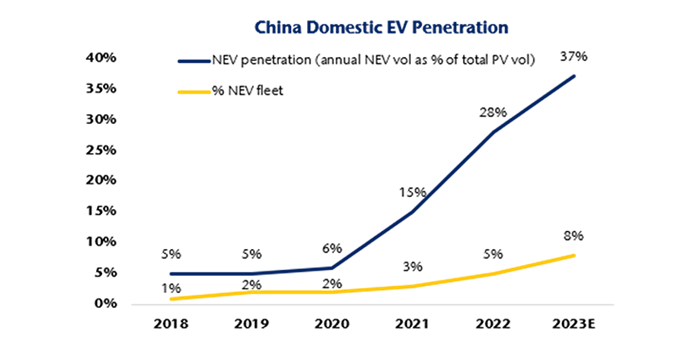
  • EVs – Chinese specialist EV makers (BYD in particular) are playing a different game to the rest. EV penetration of new car sales is already at nearly 40% in China, offering competitive pricing and the potential to go global (with the promise of higher margins in foreign markets).
Source: Bernstein Research, 2023.

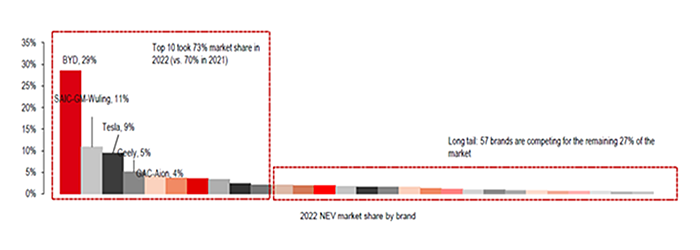
  • BYD stood out as a company working so hard to play down expectations that their IR team almost seemed depressed! They are likely trying to tread softly as they push into more lucrative foreign markets, being very cautious in their communications on growth assumptions and deliberately vague on margin upside outside of China. The company is the dominant player in the mass market segment for EVs, and boasts 37% market share of NEV sales in China (Tesla in 2nd place with 10%, albeit targeting higher-end consumers).
  • Risks include intense levels of domestic competition in a market that is due significant consolidation. On current trends, BYD and Tesla are looking like winners, at the expense of traditional international OEMs that have been slow to pivot to EVs.

Consolidation is on the way
Source: HSBC Research, 2023.

Korean stocks hit by a wave of margins calls

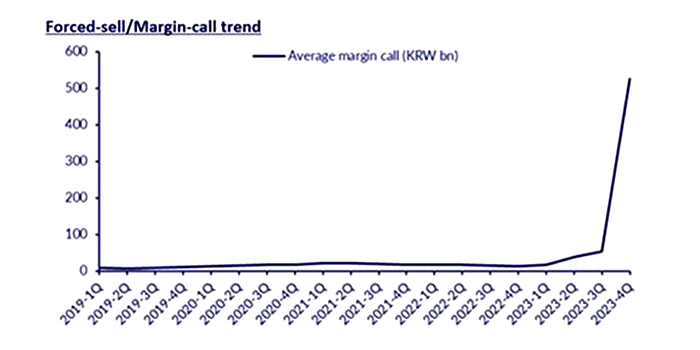
Korean stocks were also hit hard through the month, down -7% in USD terms in part due to forced selling/margin calls as brokers revised up margin loan hurdles. The margin calls exacerbated an already challenged environment for names in the battery supply chain which is working through a downcycle. Stocks favoured by retail investors such as battery materials producer Ecopro (down -31%) and steelmaker POSCO (which is investing in the battery supply chain, down -23%) unwound.
Source: CLSA, 2023.

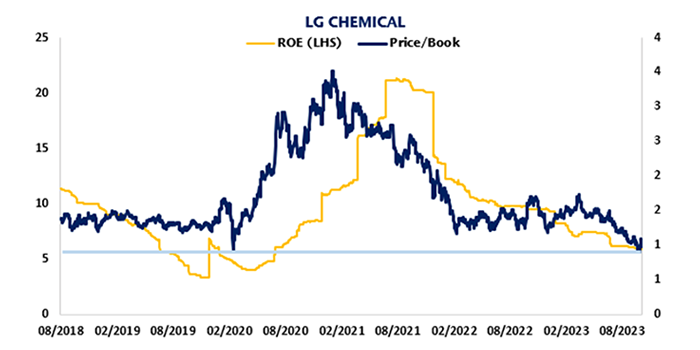
Our exposure to batteries is limited to Materials company, LG Chemical, and its subsidiary, LG Energy Solution, the world’s second-largest battery maker. While we don’t think battery makers are out of the woods just yet (especially as many of the key names are yet to make it through a full cycle since being listed), valuations in the sector are beginning to look tempting.

LG Chemical now trades at <1x price/book, which is its lowest valuation ever. According to JP Morgan, the company’s stock now trades at a 58% discount to its 82% stake in LG Energy Solution, while valuing its petrochemicals, advanced materials and biotech businesses at 0. Recent results also suggest operational performance might be approaching a bottom, with third-quarter results positively surprising. We are maintaining current levels of exposure while looking for more evidence of an upturn in batteries and petrochems.

Source: Bloomberg and NS Partners.

The oil price is telling you something

Brent crude finished October lower despite the outbreak of tensions in the Middle East following the October 7 attacks by Hamas against Israel. While risks of escalation remain, oil is looking like the dog that didn’t bark.

Does this tell us something about the global demand picture? Consumers are responding to high oil prices by curbing consumption, with demand for gasoline and diesel in the US falling.

It may also signal ample supply growth outside of the OPEC cartel. The shale boom continues in the Permian Basin, while the US is lifting embargoes on Venezuelan oil.

How much global production share will OPEC be willing to cede to competitors before abandoning supply discipline? We saw Saudi Arabia do exactly that during the COVID pandemic in response to Russia’s refusal to curb supply, which saw the oil price go negative.

This suits the US just fine, on a view that lower oil prices will squeeze opponents like Russia and Iran while easing inflationary pressures further.

Oil just one indicator of a deteriorating backdrop

The global economy is likely to surprise to the downside while liquidity remains poor. The Materials and Energy sectors were weak through the month, in line with our view that cyclicals look vulnerable here.

Historically, while cyclical sectors can hold up over a short period following the conclusion of a hiking cycle, their underperformance over the medium term is stark. As our Chief Economist Simon Ward has pointed out, cyclical sectors underperformed following the last five US rate peaks, though not always immediately.
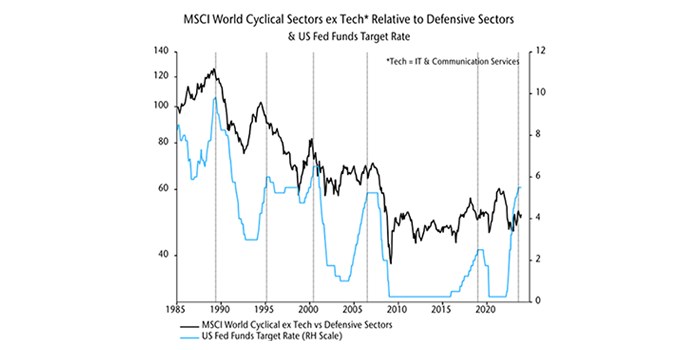
Source: Refinitive Datastream and NS Partners.

While the money numbers have been signalling downside risks to the economy for some time, other leading indicators, including consumer and manufacturing expectations, have slipped. Excessive tightening by central banks is now also feeding through to backward-looking data, such as unemployment and payrolls, which are starting to crack.

Are we on the cusp of central banks beginning to ease? Inflation has been rattling back globally, which is good news. However, in the absence of a financial accident (which is certainly possible given the liquidity backdrop), it has historically been the labour market that has prompted the central banks to start cutting.


Banyan Capital Partners (« Banyan »), une des principales sociétés canadiennes de capital-investissement du marché intermédiaire, est heureuse d’annoncer son acquisition de Second Nature Designs Limited (« Second Nature » ou la « Société »). Second Nature est le deuxième investissement de la plateforme de Banyan effectué par l’intermédiaire de Banyan Committed Capital LP, un instrument de placement permanent établi en décembre 2021.

Fondée en 1994, Second Nature est un fabricant et distributeur de cadeaux et de produits de décoration pour la maison composés de fleurs séchées et d’autres produits botaniques d’origine naturelle de sources durables. La société s’approvisionne en matériaux à l’échelle mondiale et fabrique ses produits à Hamilton, en Ontario. La Société dessert une clientèle reconnue au Canada et aux États-Unis.

Banyan s’associe au président et fondateur de la Société, Steve Koning, qui occupe ce poste depuis 1994. Avec l’équipe de direction, il conservera une participation minoritaire dans la société.

« La philosophie d’investissement à long terme de Banyan cadre avec les objectifs de mon équipe, qui consistent à poursuivre l’expansion de nos activités partout en Amérique du Nord. Nous avons hâte de travailler avec un partenaire qui partage notre vision stratégique et nos valeurs. »

« Depuis la fondation de Second Nature en 1994, Steve et son équipe ont bâti une entreprise remarquable axée sur la prestation de produits et de services exceptionnels à sa clientèle. Cet investissement permet à Banyan de s’associer à une équipe impressionnante pour entamer le prochain chapitre de la croissance de l’entreprise, a déclaré Simon Gélinas, directeur général et associé chez Banyan. »

À propos de Second Nature Designs

Fondée en 1994, Second Nature importe des fleurs séchées et d’autres produits botaniques d’origine naturelle de sources durables pour confectionner des bouquets, des collections de pot-pourris et d’autres produits de décoration pour la maison durables et de grande qualité qui sont vendus dans des magasins à grande surface, par l’entremise de bannières d’épiceries, de grossistes et de détaillants indépendants au Canada et aux États-Unis.

À propos de Banyan Capital Partners

Fondée en 1998, Banyan Capital Partners est une société canadienne de capital-investissement qui effectue des placements en actions dans des sociétés du marché intermédiaire en Amérique du Nord; sa direction est en poste depuis 2008. Grâce à une approche de placement à long terme, Banyan est devenue l’une des plus importantes sociétés de capital-investissement du marché intermédiaire au Canada et elle a fait ses preuves en fournissant des liquidités complètes ou partielles aux fondateurs, aux familles et aux entrepreneurs, pour les aider à faire croître leur entreprise.

Banyan est membre du Groupe financier Connor, Clark & Lunn Ltée., société indépendante de gestion de placements dotée d’une structure multientreprise, dont les sociétés affiliées gèrent collectivement un actif de plus de 110 milliards de dollars pour le compte d’institutions, de clients privés et de particuliers.

Canada Vie

Gestion de placements Canada-Vie, un chef de file des services financiers, s’est engagée à collaborer avec les gestionnaires de placement pour améliorer son offre de produits de gestion de patrimoine. Gestion de placements CC&L a le plaisir d’annoncer sa collaboration à titre de nouveau sous-conseiller pour les produits de gestion de patrimoine de Canada-Vie.

Shop assistant using barcode reader, customer is reaching for product.

Banyan a le plaisir d’annoncer que Purity Life Health Products LP a conclu l’acquisition des actifs d’Indigo Natural Foods Inc., un important distributeur de produits de santé naturels établi à Toronto. Cette transaction élargit le réseau de distribution de Purity Life et améliore son portefeuille avec de nombreuses nouvelles marques.

Afin de faciliter une transition en douceur pour les clients et les partenaires fournisseurs d’Indigo, deux membres clés de son équipe se joignent à Purity Life.

Cette acquisition mise sur la stratégie de croissance interne et par fusions et acquisitions de Purity Life. Elle renforcera l’offre de Purity Life à toutes ses parties prenantes et lui permettra de continuer à servir ses clients et ses fournisseurs avec la meilleure qualité possible.

Stack of folded cloths in an industrial laundry.

Investment opportunities can be found in every industry, though some may be easier to get excited about than others. However, as many astute investors, including Warren Buffett, have noted, “boring” companies and business models can be just as profitable as those flavour-of-the-month stocks. This week, we profile ELIS SA (ELIS FP), a boring company that Global Alpha got excited for.

Based in Europe, Elis specializes in renting and maintaining flat linen, workwear and hygiene appliances. Founded in 1883 in France, Elis operated as a family business for three generations before going through several leveraged buyouts and ultimately going public in 2015. The company has 440 production and distribution centres across 30 countries and a workforce of over 50,000 employees. With 75% of its revenues derived from markets where it leads, Elis is a dominant force.

Elis caters to a broad spectrum of customers, from hospitals needing linen to industrial companies needing uniforms exposed to dirt or chemicals, to small kitchens preferring not to manage towel cleaning in-house. Elis’s full-service solution relieves customers of managing inventory, ordering replacements or cleaning – handling all of the buying, renting and logistics. Customers have the option of variable pricing based on usage and service frequency or a fixed rate, typically under four-year contracts. Revenue is split almost equally between corporate and smaller businesses.

The textile rental market has seen growth, gradually replacing customer-owned textiles in the last decade, driven by cost savings, efficiency, improved hygiene standards and ESG commitments. Elis’s competitive advantage is its scale; its model is most efficient in densely populated areas, optimizing logistics and maintain margins. Elis strategically expands through acquisitions, improving its geographical presence to best utilize its distribution centres. This strategy has been paying off. In 2009, Elis derived 80% of its revenue from France, compared to less than a third today. More recently, it also started operating in Mexico through an acquisition that immediately made it the country’s largest player.

It’s worth taking a moment to explore the sustainability benefits of Elis’s solutions. As companies become increasingly mindful of their energy and resource use, they are also paying more attention to the companies they outsource to. Elis holds up very well under this scrutiny. The company has implemented various initiatives and made commitments to reduce its environmental footprint. For example, it pledged to cut water consumption per kilogram of linen processed by 50% by 2025, using 2010 as a baseline, and it has already achieved a 43% reduction by 2022. The company has also vowed to lower energy consumption by 35%, transitioning its fleet to alternative vehicles and reusing 80% of its end-of-life textiles. None of its clients have the capacity nor the inclination to manage their linen and workwear-related environmental impact as effectively. Furthermore, Elis offers ancillary services that directly help clients in reducing their own footprint, such as reusable scrubs in healthcare facilities that reduce CO2 emissions between 31% and 62% compared to disposable scrubs, or cloth roller hand towels that reduce emissions by 30% compared to disposable paper towels.

What makes Elis an appealing investment for us? It stands out with significant market share, a strong brand and a sustainable competitive advantage. It operates a resilient, non-cyclical industrial service with a business model adaptable to external disruptions. From COVID-19 and energy price shocks to wage inflation, the company has adeptly navigated recent macroeconomic events, maintaining its pricing power and protecting profits. With its strong free cashflow and flexible cost structure, we believe Elis is well-equipped to manage debt, and engage in strategic M&A and share buybacks, positioning it to excel in both bear and bull markets.

While a linen rental business may not intrigue everyone, our focus remains on identifying quality companies at reasonable valuations, no matter the industry.

Geothermal power plant in Iceland. Blue Lagoon.

Following the recent events in Israel, we would like to commend the management of Ormat Technologies for maintaining open lines of communication during this extremely stressful period. Ormat, a portfolio company based in Tel Aviv, entirely produces electricity from alternative sources located outside of Israel, which remain operationally unaffected by the turmoil. Although the company has a geothermal equipment production facility in Israel, it exclusively supplies international clients and equipment sales represent less than 12% of the company’s revenues.  

Economic factors and market dynamics 

Major geopolitical events like we are witnessing in Israel certainly do not help the case for $40 oil. Add  in high levels of government spending, increased regulations and large wage increases and  inflation remains well-supported. As we await a downturn to counterbalance, we can expect volatility in commodities prices, especially with oil, as the Middle East conflict continues.  

As the developed world spends its way toward decarbonization, analysts are attempting to predict peak oil production. The International Energy Agency (IEA) believes we are nearing that point while OPEC expects global demand to reach 116 million barrels per day (bpd) by 2045, up from 99.6 million bpd in 2022. OPEC has also made clear the potential for a higher jump. Growth is likely to be fueled by India, China, other Asian countries, Africa and the Middle East 

North American oil consumption and supply-side economics

Local oil consumption in North America continues to be moderate, as the adoption of electric vehicles and other alternative fuels gain momentum. However, supply-side economics seem to support a buoyant environment for oil service companies. Shale wells in North America offer very poor long-term output performance, with decline rates for oil wells exceeding 35% and losing an additional 0.5% each year. To maintain supply levels, oil companies must continuously explore, plan and drill new wells. As a result, regions such as the Permian Basin in West Texas are likely to remain active hubs for drilling and completion activities, especially if oil prices make exports profitable. In addition, many oil service companies are diversifying into new sustainable segments within the broader energy market, areas such as hydrogen, renewable gases, recycled water, etc. This has led the industry to re-position itself as an energy services provider rather than focusing solely on oil and gas.  

Innovations in energy service companies 

Global Alpha is invested in NOW Inc. (DNOW:US), a company that is using its extensive energy-industrial distribution network to launch its own carbon capture equipment. As well, its new Ecovapor technology reduces flaring while producing much cleaner gas.

Energy service companies are preparing for future market trends that are likely to garner investor attention. One notable event this year was the annual geothermal industry gathering in Reno, which attracted over 1,500 attendees. What set this year apart was the significant presence of oil & gas service industry professionals.  

Geothermal energy: the next frontier 

The concept of “Geothermal Anywhere” or “Geothermal 2.0” is gaining traction. This involves leveraging inexpensive deep, high-temperature wells to operate geothermal plants beyond the Pacific Ocean’s “Ring of Fire” high-temperature zones.  

Estimates suggest that as much as 8% of the US’s entire energy production could come from geothermal sources, provided that feasibility and costs are optimized. Achieving this goal requires overcoming certain technical challenges, such as drilling into 250-degree rock three kilometres underground without causing significant equipment damage. Given the incredible advances in shale drilling technology over the last decade, chances are these issues will be solved.  

The addressable market is sizeable. Currently standing at $7 billion, geothermal capacity is 31 GW within a total 1,293 GW of US energy capacity. According to a 2019 publication by the US Department of Energy, the number of potential geothermal sites could exceed 5,000 GW. If the goal is to increase the share of geothermal energy from 2.3% to 8%, the market opportunity could surpass $25 billion in the US 

Investing in energy service companies 

We have exposure to the oil service industry through our investments in Austria-based Schoeller-Bleckmann (SBO:AV), which specializes in advanced drilling solutions. We also own Helmrich and Payne (HP:US), a leading energy service company in North America. HP has already invested in six  geothermal startups that tackle complex technical issues related to deep geothermal energy.  

It’s important to note that, in the short term, oil and gas service companies remain sensitive to the cyclical nature of drilling activities. The Baker Hughes rig count index, currently at a low of around 600 rigs, suggests that we might be approaching a trough, as these levels are near historical lows. Together with growing decarbonization markets, the new energy service industry is certainly an interesting place to be. 

The future of geothermal and our investment outlook

As markets focusing on reducing carbon emissions continue to expand, the evolving energy services industry is worth watching. If venture capital continues to flow into the Geothermal 2.0 concept and becomes a reality, our long-term holding in Ormat, already the industry leader in geothermal energy production, stands to gain. At present, the company has a robust pipeline of geothermal projects that use its patented shallow-drilling, low-heat technology, known as binary exchange. Even without Geothermal 2.0 as a new market segment, geothermal energy is already experiencing rapid growth, thanks in part to its ability to provide stable, non-peak electricity, complementing the variable output of solar and wind energy. 

As we adapt to a transitioning energy landscape, the confluence of traditional drilling expertise and emerging sustainable technologies may not just redefine the energy sector, but also reshape how we think about long-term investment opportunities. 

Estaiada's bridge night aerial view of São Paulo, Brazil's financial center.

Last week, our Emerging Markets (EM) team attended a fruitful Latin American (LatAm) conference in New York, hosted by BTG Pactual, the region’s leading investment bank. The event showcased a variety of promising investment ideas and featured rich discussions and robust participation. Hundreds of investors from around the world convened to meet with the c-suite executives and founders of about 200 companies, mainly from Mexico and Brazil.

Keynote speaker Stephen Schwarzman of Blackstone shared his view on the global geopolitical landscape and the current state of the US economy. He underscored the importance of constantly reinventing business models and taking risks in pioneering new products and services as a foundation for business durability.

Throughout the three-day conference, we conducted insightful meetings with 22 companies operating in the consumer, industrial, healthcare, financial, technology, energy, materials and real estate sectors providing a wide view of the LatAm economic landscape. In most of the conversations, we sensed cautious optimism, mainly driven by monetary easing and nearshoring trends. While most developed countries are grappling with inflation, many LatAm nations are in a disinflationary environment. Central banks in Chile, Brazil and Peru have already started cutting rates, with Colombia and Mexico expected to follow suit this year.

Nearshoring is a topic we’ve explored in previous writings, and it was a dominant theme among Mexican companies at the conference. Many see nearshoring-driven demand as structural and sustainable, providing ample growth opportunities across multiple sectors as global supply chains move to Mexico.

However, challenges do exist, such as infrastructural inadequacies, both industrial and residential (e.g., power and water availability, housing supply for labour), erratic political and regulatory climates, bureaucratic complexities and looming uncertainties around the upcoming elections in Mexico and the US. A possible spillover effect of “higher for longer rates” in the US also looms as a source of concern, potentially putting pressure on LatAm currencies amid the decoupling of monetary policies and eventual slowdown of the easing cycle in the region. Another area of concern is the ongoing tax reform in Brazil, well-known for its highly complicated tax system requiring nothing less than a PhD in law to properly understand all of its intricacies.

As for the top picks, we identified several promising opportunities that you might read about in our future commentaries, including:

  • Brazil’s largest operator of private oncology clinics and hospitals. The company leverages its strong brand and reputation, running a proven and scalable business model in a massive and dynamically growing market.
  • A fast-growing Brazilian athleisure brand enjoying strong brand awareness, a nimble operating model with great economics and ample white space for expansion.
  • The leading B2B online solutions provider to micro and small businesses, with a promising new product pipeline, well positioned for the digital transformation in Brazil with still low ecommerce penetration.

We also met with some of our LatAm holdings at the conference, including Odontoprev (ODPV3 BZ), which we initiated after our meeting with its management team at last year’s conference. Founded in 1987 by a group of dentists, Odontoprev is Brazil’s largest dental benefits provider, with over 8.4 million members and a cross-country network of 26,000 dentists. The company offers customized products to corporate customers and off-the-shelf products to SMEs and individuals, while leveraging its exclusive distribution network in a partnership with strategic shareholder, Bradesco. Its industry focus, well-established footprint, brand portfolio and proprietary dental tech infrastructure make it a standout among its peers. The company is run by a strong management team with a sound track record and rich industry expertise. Odontoprev has an asset-light business model and a low capex requirement with negative working capital generating high cashflow, resulting in a strong balance sheet in a net cash position. The company is a proven compounder with a 16% and 22% compound annual growth rate of revenue and net income, respectively, since its IPO in 2006.

The dynamics of EM, particularly in LatAm, are as layered as they are compelling. The investment choices we make today, be they cautious or bold, will have lasting implications.

Scheer, Rowlett & Associates Investment Management Limited (« SRA ») a le plaisir de vous informer de l’évolution de son personnel.

Lloyd Rowlett quittera son poste de président de Scheer Rowlett le 31 décembre 2023, dans le cadre du plan de succession à long terme qui a débuté il y a plus de 7 ans, et Ratul Kapur continuera d’exercer ses fonctions de président et de chef des placements de SRA (qui ont débuté le 1er janvier 2023).

« Nous avons fondé la société il y a 27 ans pour gérer l’argent de nos clients en appliquant une philosophie d’investissement axée sur la valeur, et lorsque je regarde en arrière, il est gratifiant de constater que nous sommes restés fidèles à cette approche tout au long de cette période et à travers une grande variété de conditions de marché. Nous avons fait de notre mieux pour que les clients qui nous ont fait confiance soient récompensés par les efforts de notre équipe talentueuse et engagée. Je suis très fier de la qualité des personnes que nous avons attirées dans l’entreprise et dont la mission sera de continuer à faire de leur mieux en utilisant le même processus d’investissement de valeur pour nos clients estimés après mon départ à la retraite. Je suis satisfait des rendements que nous avons enregistrés au cours des dernières années, Ratul ayant assumé une plus grande partie de mes tâches. Je suis également convaincu que, sous sa direction, l’équipe de SRA est très bien placée pour continuer à fournir de solides résultats à nos clients grâce à la même approche d’investissement axée sur la valeur que la société a utilisée depuis sa création », a déclaré Lloyd Rowlett.

La retraite de Lloyd est l’aboutissement d’un processus de planification de la relève soigneusement planifié ayant impliqué la transition progressive de ses responsabilités à Ratul Kapur. Ce dernier a rejoint l’entreprise en 2017, est devenu cogestionnaire en chef en 2020, cochef en 2021 et président et chef des placements le 1er janvier 2023.

« Au nom de toute l’équipe de SRA, nous tenons à remercier Lloyd pour son mentorat, ses conseils au fil des ans et à le féliciter pour sa carrière réussie en tant qu’investisseur. Nous le félicitons également pour avoir permis le succès à long terme de notre entreprise. En tant qu’investisseurs axés sur la valeur, nous demeurons enthousiastes en lien avec les perspectives des portefeuilles de nos clients et nous nous efforcerons d’être à la hauteur de l’exemple que Lloyd nous a donné en matière de discipline, d’engagement et de travail acharné. Nous souhaitons à John une retraite heureuse et en santé ». Ratul Kapur.


Sain Godil, ancienne lauréate d’une bourse d’études, et Global Alpha ont mis en place des bourses de 30 000 $ pour soutenir les étudiantes en finance à l’École de gestion John-Molson de l’Université Concordia, dans le but d’accroître la diversité dans le domaine de la finance et d’aider à éliminer les barrières liées au genre.

Peu importe que vous en ayez conscience ou non, les biais comportementaux et les influences peuvent mener à des réunions de comité et à des résultats inefficaces. Toutefois, le fait de connaître leur incidence peut non seulement contribuer à améliorer le processus décisionnel, mais aussi les rendements du portefeuille. Une combinaison de bons placements et d’un bon comportement est la recette pour obtenir des résultats optimaux.

Les pièges comportementaux peuvent prendre de nombreuses formes, comme le fait de ne pas mesurer pleinement la probabilité d’une occurrence ou d’avoir tendance à ancrer émotionnellement la prise en compte d’autres options à la situation actuelle. Le présent article traite de ces pièges ainsi que d’autres pièges courants.

Pièges

L’un des pièges courants est notre tendance à sous-estimer la probabilité d’une occurrence. Notre évaluation accorde souvent trop de poids aux résultats possibles, alors que nous devrions nous concentrer sur les résultats les plus probables. Un autre piège consiste à ne pas utiliser les enseignements tirés de nos expériences lorsque nous examinons les différentes options. En tirant parti de nos expériences, nous augmentons nos chances de prendre des décisions plus éclairées à l’avenir.

L’ancrage est une technique utilisée par un vendeur d’automobiles lorsque les prix affichés sur les voitures en montre sont beaucoup plus élevés que ce que l’acheteur finit par payer. Le prix affiché « ancre » les négociations pour le vendeur, mais donne à l’acheteur l’impression qu’il a fait une bonne affaire en payant moins que le prix affiché. L’ancrage est l’un des biais qui caractérisent la plupart des comités de placement lorsqu’ils réexaminent la répartition de l’actif. Les changements potentiels sont comparés à la répartition actuelle, ce qui peut rendre difficile, sur le plan émotif, de s’éloigner beaucoup de cette répartition. De plus, un tel attachement émotionnel peut ne pas être optimal pour atteindre les objectifs stratégiques.

La fatigue décisionnelle est un piège que la plupart d’entre nous connaissent, mais dont nous ne sommes pas toujours conscients. Elle survient lorsque le nombre de décisions prises dans une journée épuise notre détermination et que nous reportons des décisions, ou pire, en prenons de mauvaises. L’une des causes de cette fatigue est l’hypoglycémie, qui affecte notre énergie à prendre des décisions.

Quatre ennemis

Dans leur livre « Decisive »[1], Chip et Dan Heath désignent le cadrage serré, le biais de confirmation, l’émotion à court terme et l’excès de confiance comme les « quatre ennemis ». Vous devez prendre une décision, mais à cause d’un cadrage serré, vous passez à côté de certaines options. Le cadrage serré, c’est comme si un projecteur était braqué sur une partie de la scène et que tout ce qui pourrait être important se trouvait dans l’obscurité et n’était donc pas pris en compte.

Lorsque vous analysez différentes options, le biais de confirmation vous amène à collecter des renseignements qui vont dans le même sens que vos convictions. Accorder trop de poids à l’information qui confirme votre point de vue personnel et moins de poids à l’information qui contredit votre point de vue peut conduire à une mauvaise évaluation des risques associés à une décision.

Lorsque vous faites un choix, l’émotion à court terme peut vous pousser à prendre la mauvaise décision. Elle est particulièrement problématique lorsque nous devons prendre des décisions difficiles. Nos sentiments peuvent avoir une incidence défavorable sur la décision, car le cœur l’emporte sur la raison.

En prenant votre décision, vous pouvez avoir un excès de confiance dans le résultat futur. L’excès de confiance est un état d’esprit malheureux qui vous fait croire que vous connaissez l’avenir et qui sous-estime l’incertitude associée aux décisions.

Gérer les biais comportementaux

Les pièges comportementaux ne peuvent pas toujours être évités, mais nous pouvons les gérer.

Figure 1 : Gérer les pièges

Pièges comportementaux Comment les gérer au mieux
Calculer les probabilités Se concentrer sur les résultats probables
Appel à la mémoire Se tenir prêt
Ancrage Être ouvert aux façons de limiter
Fatigue décisionnelle Le plus tôt est le mieux; examiner les points stratégiques en premier, prévoir des pauses et des collations


Lors de l’évaluation des options, il est important d’établir la probabilité des résultats et de concentrer vos efforts et votre énergie sur les résultats probables. Lorsqu’il récupère un souvenir, votre cerveau parcourt à nouveau les voies nerveuses créées lors de la formation du souvenir. La récupération d’informations contribue à renforcer notre mémoire, ce qui souligne l’importance de bien se préparer aux réunions pour profiter des expériences et des apprentissages passés.

Être conscient de l’existence de certains biais peut fortement aider à limiter leur influence. En ce qui concerne d’autres biais comme l’ancrage, il est important d’être ouvert aux façons de réduire les influences. Par exemple, lors de votre prochain examen de la répartition de l’actif, le fait de masquer les différentes répartitions peut vous aider à gérer le risque d’un attachement émotionnel à la répartition actuelle.

La meilleure façon de lutter contre la fatigue décisionnelle est de tenir les réunions tôt dans la journée afin d’optimiser la probabilité de prendre de bonnes décisions. S’il est impossible d’éviter d’avoir des réunions tard dans la journée, les premiers points à l’ordre du jour doivent être les plus importants, afin qu’ils soient traités lorsque les niveaux d’énergie sont élevés. Prévoir une collation pour recharger les niveaux d’énergie améliorera aussi le processus décisionnel.

Gérer les quatre ennemis

Ce processus peut permettre d’aborder chacun des quatre ennemis.

Figure 2 : Gérer les quatre ennemis

Quatre ennemis Comment les gérer au mieux
Cadrage serré Élargissez vos options
Biais de confirmation Testez vos hypothèses dans un environnement réel
Émotion à court terme Prenez de la distance
Excès de confiance Préparez-vous à vous tromper


Élargir vos options peut mettre au jour des idées auxquelles vous n’aviez peut-être pas pensé et permet d’éviter un cadrage serré. Le concept consiste à éloigner par la pensée les projecteurs de la zone précédemment ciblée afin de découvrir des idées ou des options différentes. Par exemple, si votre comité est aux prises avec un défi particulier, communiquez avec un pair du secteur pour savoir comment il a relevé un défi semblable afin d’élargir votre point de vue.

Une approche à adopter face à un biais de confirmation consiste à tester vos hypothèses dans un environnement réel en demandant à quelqu’un de se faire l’avocat du diable pour instaurer une remise en question et des discussions constructives avant de prendre la décision.

Pour gérer l’émotion à court terme, pensez à mettre une certaine distance entre l’étude des options et la prise de décision. L’outil « 10/10/10 » mis au point par Suzy Welch, auteure spécialisée dans le monde des affaires, est une façon élégante de nous obliger à prendre de la distance lorsque nous évaluons des décisions. Imaginer comment nous nous sentirons dans 10 minutes, dans 10 mois et dans 10 ans peut nous aider à atténuer la portée émotionnelle d’une décision, car plus le délai est long, moins l’effet des influences émotionnelles est important.

En cas d’excès de confiance, vous devriez vous préparer à vous tromper, quel que soit votre degré de confiance. Comprendre que les choses pourraient ne pas se dérouler exactement comme prévu peut donner lieu à une prise de conscience importante lors de l’évaluation des options.

Prendre de meilleures décisions

Siéger à un comité de placement est un rôle qui nécessite de prendre de nombreuses décisions. Si vous ne pouvez pas contrôler le rendement des placements, vous pouvez gérer les effets négatifs potentiels des biais et des autres influences sur les décisions. Vous augmenterez ainsi vos chances d’atteindre vos objectifs à long terme.

1 Heath, Chip, et Dan Heath. Decisive: How to Make Better Choices in Life and Work. New York: Crown Business, 2013. Traduit en français en 2017 sous le titre « Comment faire les bons choix » aux éditions Clés des champs.


Abonnez-vous aux mises à jour