Chinese money and credit numbers for December suggest that policy stimulus is becoming effective, warranting an upgraded assessment of economic prospects.

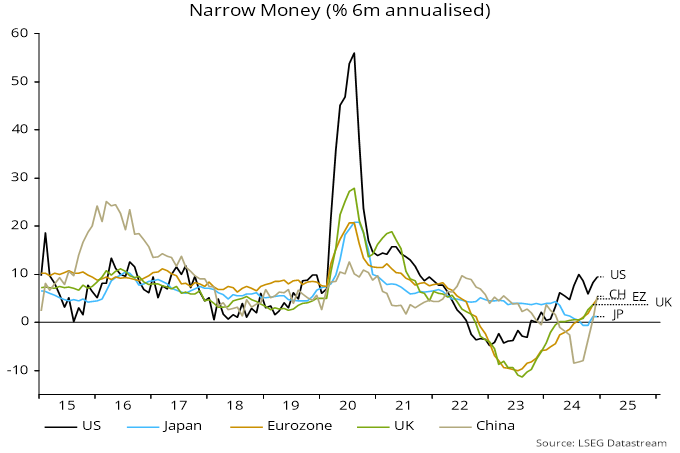
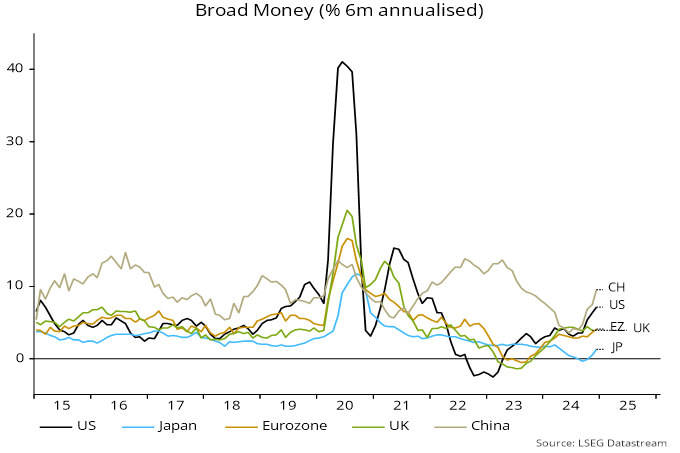
Six-month rates of change of broad / narrow money and broad credit (total social financing) bottomed in June / July but the recovery through November was modest. All three jumped higher in December – see chart 1.

Chart 1

160125c1

Money measures – particularly narrow money – were negatively distorted last spring by regulatory enforcement of deposit rate ceilings*. The revival in six-month momentum partly reflects the dropping out of this effect. Still, December readings should be undistorted and broad money momentum is close to its 2015-19 average, when nominal GDP grew solidly.

Monetary financing of fiscal easing has been a key driver of the money growth pick-up. Banking system net lending to government (including by the PBoC) contributed 2.0 pp (not annualised) to M2 growth in the six months to December, the most since the 2015-16 stimulus episode.

An apparent weak spot in the December release was a further fall in annual bank loan growth (i.e. excluding lending to government). The numbers, however, are being distorted by debt swap operations, involving repayment of bank loans by government-related organisations. Six-month loan momentum has edged up despite this drag, with household lending weakness abating – chart 2.

Chart 2

160125c2

Will the money growth recovery continue? Recent renewed pressure on the currency has been associated with a resumption of f/x sales and a firming of money market rates. The increase in term rates has so far been modest and may be offset by ongoing support from money-financed fiscal easing.

*Lower interest rates on demand deposits resulted in enterprises moving money into time deposits and non-monetary instruments while repaying bank loans.

INFRA_NEWS-Cowboy_2025-01-06_Banner

Richardson, Texas, le 13 janvier 2025 – Connor, Clark & Lunn Infrastructure (« CC&L Infrastructure ») et Bestinver Infra (« Bestinver ») ont annoncé aujourd’hui l’acquisition d’une participation majoritaire dans le projet de logements pour étudiants Northside (« Northside » ou « le projet »), un complexe de résidences étudiantes situé à l’Université du Texas à Dallas (UTD). Le complexe a été construit en quatre phases entre 2016 et 2021, et se compose d’environ 1 200 unités ayant la capacité de loger plus de 2 500 étudiants. Balfour Beatty, le groupe d’infrastructures international, est l’actuel gestionnaire immobilier et conserve une participation minoritaire dans le projet. CC&L Infrastructure et Bestinver ont acquis la totalité de la participation détenue par les fonds gérés par Tikehau Capital North America LLC faisant affaire sous le nom de Tikehau Star Infra.

L’UTD est l’une des universités publiques les mieux classées au Texas. Elle propose plus de 140 programmes universitaires et héberge plus de 50 centres et instituts de recherche, avec un effectif actuel d’environ 30 000 étudiants. Northside exerce ses activités en vertu de baux fonciers à long terme avec l’université, pour une durée moyenne restante de plus de 50 ans pour chacune des installations.

« Nous sommes heureux de diversifier davantage notre portefeuille d’actifs d’infrastructures grâce à l’acquisition de cette participation dans Northside, ce qui marque notre premier placement dans le segment du logement étudiant », a déclaré Matt O’Brien, président de CC&L Infrastructure. « Northside offre un service essentiel à la communauté étudiante de l’UTD, et soutient un nombre d’inscriptions important et croissant. Nous sommes impatients de travailler avec nos partenaires et l’UTD pour assurer le succès de l’exploitation de Northside pour les années à venir. »

« Notre investissement dans Northside souligne l’importance soutenue que nous accordons aux actifs de grande qualité, stables et résilients en Amérique du Nord, et il s’agit du premier d’une série d’investissements que nous effectuerons dans la région par l’intermédiaire de notre Fonds II », a déclaré Francisco del Pozo, chef, Fonds d’infrastructures à Bestinver.

Agentis Capital a agi à titre de conseiller financier, White & Case LLP à titre de conseiller juridique, Deloitte à titre de conseiller comptable et fiscal et Infrata à titre de conseiller technique pour CC&L Infrastructure et Bestinver.

À propos de Connor, Clark & Lunn Infrastructure

CC&L Infrastructure investit dans des infrastructures du marché intermédiaire qui présentent un profil risque-rendement intéressant, une longue durée de vie et un potentiel de production de flux de trésorerie stables. À ce jour, CC&L Infrastructure a accumulé un actif sous gestion de plus de 6 milliards de dollars, couvrant divers secteurs, types d’actif et régions, et compte près d’une centaine d’installations sous-jacentes réparties dans 35 placements individuels. CC&L Infrastructure est membre du Groupe financier Connor, Clark & Lunn Ltée, une société de gestion de placements dotée d’une structure multientreprise et dont les sociétés affiliées gèrent collectivement un actif de plus de 132 milliards de dollars canadiens.

À propos du Groupe financier Connor, Clark & Lunn Ltée

Le Groupe financier Connor, Clark & Lunn Ltée (le « Groupe financier CC&L ») est une société de gestion de placements indépendante dotée d’une structure aux multiples sociétés affiliées qui propose une vaste gamme de solutions de gestion de placements traditionnelles et non traditionnelles aux investisseurs institutionnels et particuliers. Cette structure procure au Groupe financier CC&L une envergure et une expertise considérables qui lui permettent d’assumer des fonctions administratives qui ne sont pas liées aux placements tout en laissant ses gestionnaires de placement se concentrer sur ce qu’ils font le mieux grâce à la centralisation des activités liées aux opérations et à la distribution. Les sociétés affiliées du Groupe financier CC&L gèrent un actif de plus de 132 milliards de dollars. Pour obtenir des précisions, consultez le site cclfg.cclgroup.com/fr.

Personne-ressource
Sonja Weiss
Vice-présidente
Connor, Clark & Lunn Infrastructure
(437) 561-6184
[email protected]

À propos de Bestinver

En tant que membre du groupe Acciona, Bestinver gère des fonds de placement depuis plus de 35 ans et est le principal gestionnaire d’actifs indépendant en Espagne, avec plus de 50 000 investisseurs et plus de 6,8 milliards d’euros sous gestion.

Bestinver a créé la division des fonds d’infrastructures dans le but de gérer des placements non traditionnels d’une valeur de 1 500 millions d’euros au cours des cinq prochaines années. Dans ce segment des placements non traditionnels, Bestinver a intégré Bestinver Infra FCR (« Bestinver Infra »), qui a été le premier fonds de capital-investissement de Bestinver à investir dans les infrastructures.

Suivant le succès de Bestinver Infra, Bestinver a lancé son deuxième fonds qui vise à investir de 350 à 400 millions d’euros dans des infrastructures mondiales (« Bestinver Infra II »).

Les fonds investissent dans des actifs d’installations existantes, nouvelles ou à redévelopper, dans les segments du transport, de l’énergie renouvelable, des services sociaux, des télécommunications et de l’eau, situés en Europe, en Amérique du Nord et dans certains pays d’Amérique latine. De plus, Bestinver se concentre sur la création de valeur à long terme en intégrant des critères ESG à ses processus de placement.

Personne-ressource
Jose Herrero Peña
Bestinver Gestión
[email protected]

CCLIM_NEWS_2025-01-09_Banner

Nous sommes honorés d’avoir été désignés par Greenwich comme un chef de file pour la qualité du service de gestion de placements institutionnels pour 2024. C’est la quatrième fois que nous gagnons ce prix en dix ans, ce qui témoigne de « l’engagement et de la volonté de notre équipe Solutions clients d’offrir un rendement et un service supérieurs à nos clients ». L’obtention de ce prix n’aurait pas été possible sans l’engagement de toute la société – équipes de placement, équipes opérationnelles et tous nos collègues de soutien – Merci à vous!

En savoir plus

*De février à septembre 2024, Coalition Greenwich a mené des entrevues auprès de 115 des plus importants fonds exonérés d’impôt au Canada. On a demandé aux principaux spécialistes de fonds de fournir des évaluations quantitatives et qualitatives de leurs gestionnaires de placement, des évaluations des gestionnaires qui sollicitent leurs affaires et des renseignements détaillés sur les tendances importantes du marché. CC&L n’a versé aucune rémunération à Coalition Greenwich pour ce sondage. Pour de plus amples renseignements sur le rendement, veuillez communiquer avec nous à [email protected].

Éoliennes dans un grand champ et ciel bleu.

Toronto, 7 janvier 2025 – Connor, Clark & Lunn Infrastructure (CC&L Infrastructure) a le plaisir d’annoncer l’acquisition d’une participation importante dans deux projets éoliens en Ontario (les projets) qui représentent environ 330 mégawatts (MW) de capacité brute de Pattern Energy Group LP (Pattern Energy), promoteur et exploitant nord-américain de premier plan d’actifs liés aux énergies renouvelables. Cette acquisition augmente la taille du portefeuille d’énergie renouvelable de CC&L Infrastructure à plus de 2 gigawatts (GW) de capacité brute, diversifiée dans divers marchés de l’énergie, contreparties au contrat, territoires de réglementation et technologies (c.-à-d. énergie éolienne, énergie solaire et hydroélectricité). Pattern Energy maintiendra une participation minoritaire dans les projets et continuera de gérer et d’exploiter les actifs.

Les projets, Armow Wind et Grand Renewable Wind, sont tous deux situés dans le sud de l’Ontario et ont une capacité brute de 180 MW et de 149 MW, respectivement. Ils produisent ensemble de l’énergie équivalant à la consommation annuelle de près de 290 000 Ontariens. Toute l’énergie produite par les projets est vendue en vertu d’accords d’achat d’énergie d’une durée de 20 ans à l’Independent Electricity System Operator (IESO) (notation Aa3 par Moody’s). Les deux actifs utilisent des technologies éoliennes éprouvées et sont en exploitation depuis environ dix ans. Leur fonctionnement est largement conforme aux prévisions de production et de disponibilité d’électricité au cours de cette période.

« Cet investissement dans Armow Wind et Grand Renewable Wind élargira notre portefeuille d’énergie renouvelable pour le porter à plus de 2 GW et nous permet de miser sur notre longue tradition de construction et d’exploitation d’actifs d’énergie propre en Amérique du Nord, a déclaré Matt O’Brien, président de CC&L Infrastructure. Nous sommes très heureux de travailler en partenariat avec Pattern Energy et sommes impatients de mettre à profit nos décennies d’expérience collective en matière d’exploitation sécuritaire et réussie de projets d’énergie renouvelable. »

Les projets contribuent de façon importante aux collectivités dans lesquelles ils sont situés, en générant des millions de dollars en impôts fonciers et en revenus accessoires pour les collectivités locales pendant la durée de vie des actifs. Les projets se sont engagés à verser un total de plus de 25 millions de dollars dans un fonds de retombées pour la collectivité au cours des 20 premières années d’exploitation, et soutiennent des initiatives locales, comme des installations récréatives, des infrastructures publiques et des améliorations à des infrastructures locales.

« L’établissement de ce partenariat avec CC&L Infrastructure, un investisseur expérimenté et actif en infrastructures au Canada, permettra à Pattern d’accroître son impact positif au Canada et d’élargir son portefeuille au pays, a déclaré Hunter Armistead, chef de la direction de Pattern Energy. Pattern est devenue le plus important exploitant d’énergie éolienne au Canada, avec des projets qui produisent suffisamment d’énergie propre pour alimenter en électricité près de 1,5 million de Canadiens. Nous sommes fiers d’avoir créé des milliers d’emplois et distribué des millions de dollars en avantages financiers directs aux collectivités partout au pays au cours des 15 dernières années. »

CC&L Infrastructure et Pattern Energy détiendront les actifs aux côtés de Samsung Renewable Energy (Samsung) et de Six Nations of the Grand River (dans le cas de Grand Renewable Wind). CC&L Infrastructure et Samsung ont déjà travaillé ensemble pour construire et exploiter environ 300 MW de projets d’énergie solaire dans quatre sites en Ontario.

Marchés des capitaux CIBC a agi à titre de conseiller financier de CC&L Infrastructure dans le cadre de la transaction et Torys LLP, à titre de conseiller juridique. BMO Marchés des capitaux a agi à titre de conseiller financier exclusif pour Pattern Energy et Osler, Hoskin & Harcourt LLP, à titre de conseiller juridique.

À propos de Connor, Clark & Lunn Infrastructure

CC&L Infrastructure investit dans des infrastructures du marché intermédiaire qui présentent un profil risque-rendement intéressant, une longue durée de vie et un potentiel de production de flux de trésorerie stables. À ce jour, CC&L Infrastructure a accumulé un actif sous gestion de plus de 6 milliards de dollars, couvrant divers secteurs, types d’actif et régions, et compte une centaine d’installations sous-jacentes réparties dans plus de 35 placements individuels. CC&L Infrastructure est membre du Groupe financier Connor, Clark & Lunn Ltd., une société de gestion de placements dotée d’une structure multientreprise et dont les sociétés affiliées gèrent collectivement un actif d’environ 132 milliards de dollars canadiens.

Personne-ressource
Sonja Weiss
Vice-présidente
Connor, Clark & Lunn Infrastructure
437 561-6184
[email protected]

À propos de Pattern Energy

Pattern Energy est l’un des plus grands promoteurs et exploitants privés de projets éoliens, solaires, de transport et de stockage d’énergie au monde. Son portefeuille opérationnel comprend plus de 30 installations d’énergie renouvelable qui utilisent une technologie éprouvée et de premier ordre, avec une capacité d’exploitation de près de 6 000 MW en Amérique du Nord. Pattern Energy est guidée par un engagement à long terme à servir les clients, à protéger l’environnement et à renforcer les collectivités. Pour de plus amples renseignements, consultez le site http://patternenergy.com/fr.

Personne-ressource
Matt Dallas
Pattern Energy
917 363-1333
[email protected]

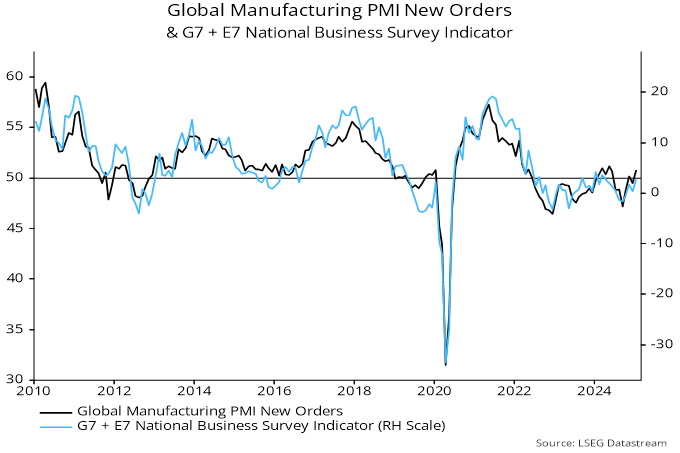
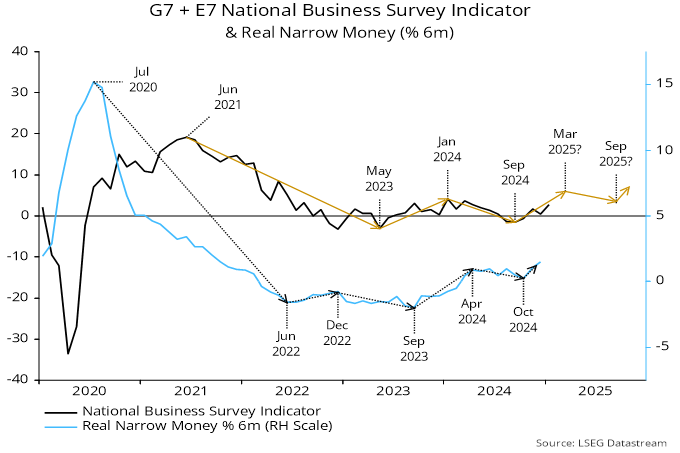
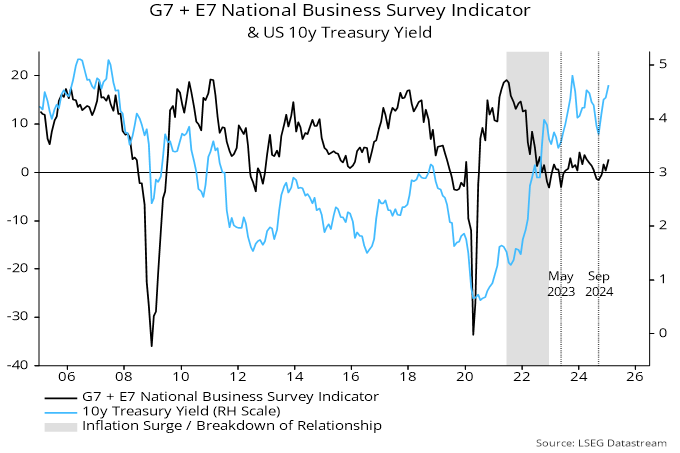
Monetary trends suggest that the global economy will remain soft in H1 2025, while inflation rates will fall further, undershooting targets. Cycle analysis holds out a prospect of economic reacceleration later in the year but risk assets might have limited further upside even in this scenario, although international / EM equities might regain relative performance.

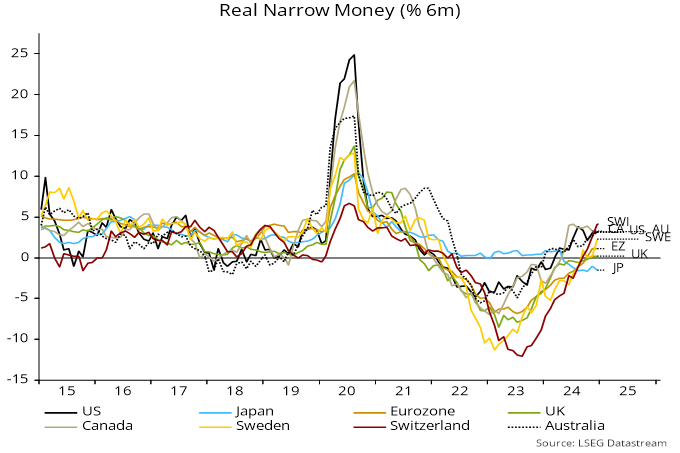
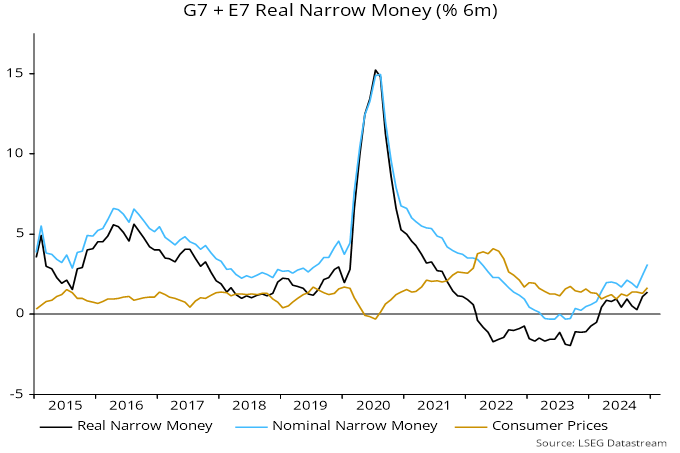
Global six-month real narrow money momentum recovered from a low in September 2023 into Q2 2024 but has since moved sideways at a weak level by historical standards – see chart 1. Based on a normal six to 12 month lead, this suggests below-trend economic growth through Q2 2025, at least.

Chart 1

030125c1

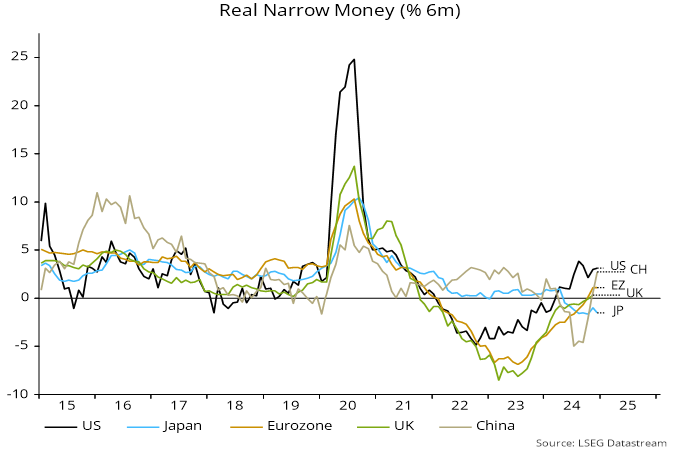
Economies exhibiting monetary weakness are at greater risk from negative policy or other shocks. As an example, a fizzling-out of a recovery in UK six-month real narrow money momentum in H1 2024 signalled an approaching growth stall but the Budget tax shock appears to have tipped the economy into contraction.

With job openings / vacancy rates back in pre-pandemic ranges, below-trend global growth is likely to be associated with greater deterioration in labour markets than in 2024. In economics parlance, a movement down the Beveridge curve may be approaching a gradient shift such that a further fall in vacancies will be associated with a significant unemployment rise.

A further issue for monetary economists is the “false” US recession signal of 2022-23. Most annual contractions in US real narrow money historically were associated with recessions, and all on the scale of the 2023 decline – see chart 2. On three occasions (highlighted), however, the interval between the start of the contraction and the onset of recession was unusually long, i.e. up to 32 months.

Chart 2

030125c2

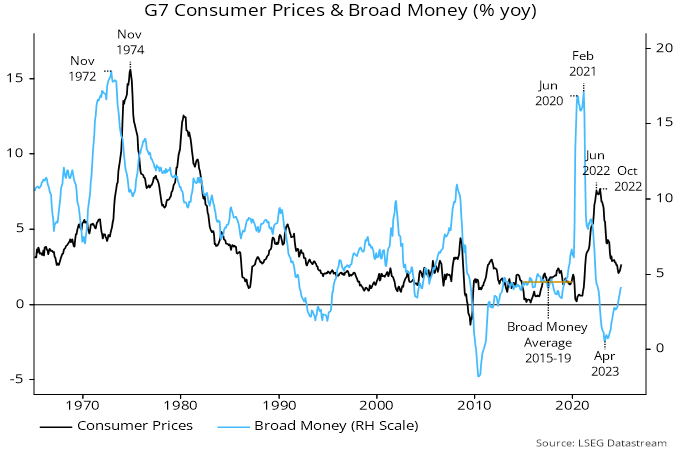
On inflation, the monetarist rule of thumb that price momentum follows the direction of broad money growth roughly two years earlier suggests a further slowdown into undershoot territory in H1 2025. Chart 3 shows the relationship for the Eurozone but the message of headline / core deceleration is the same for the US, Japan and the UK.

Chart 3

030125c3i

Global PMI output price indices in manufacturing and services are close to 2015-19 averages, when headline / core inflation averages were below target.

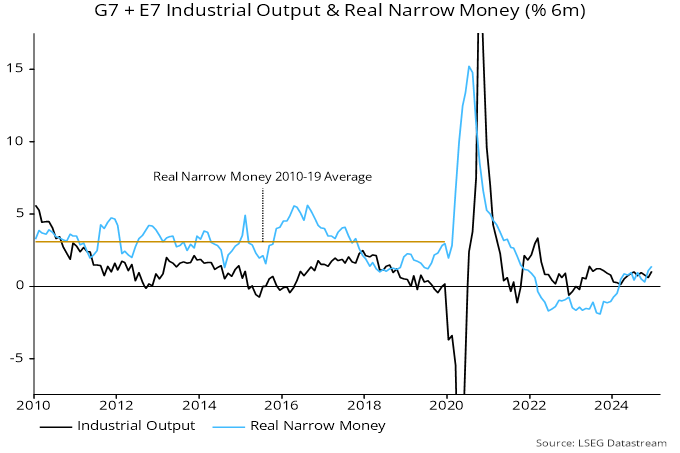
Financial market prospects, on the “monetarist” view, depend on whether there is “excess” or “deficient” money relative to the economy’s needs. Two flow measures of global excess money were used here historically – the gap between six-month rates of change of real narrow money and industrial output, and the deviation of the annual change in real money from a slow moving average. A “safety first” approach of holding global equities only when both measures were positive would have outperformed buy-and-hold significantly over the long run.

The flow measures, however, remained mixed / negative in 2023-24, understating the availability of money to boost markets because they failed to capture a stock overhang from the 2020-21 monetary surge. To assess whether this stock influence remains positive, the approach here has been to use a modified version of the quantity theory in which the money stock is compared with an average of nominal GDP and gross wealth.

Chart 4 shows that an average of US nominal GDP and gross wealth remained below the level implied by the money stock through mid-2024, consistent with a positive stock influence on asset prices / the economy. Equivalent analysis for Japan and the Eurozone shows the same. In all three cases, however, the nominal GDP / wealth average moved ahead of the money stock during H2 2024, implying that stock and flow indicators are now aligned in suggesting a neutral / negative backdrop.

Chart 4

030125c4

While monetary indicators suggest near-term softness, cycle analysis holds out a prospect of stronger economic performance later in 2025 and in 2026. A key consideration is that the stockbuilding and business investment cycles appear some way from reaching peaks, with the next lows unlikely before H2 2026 and 2027 respectively.

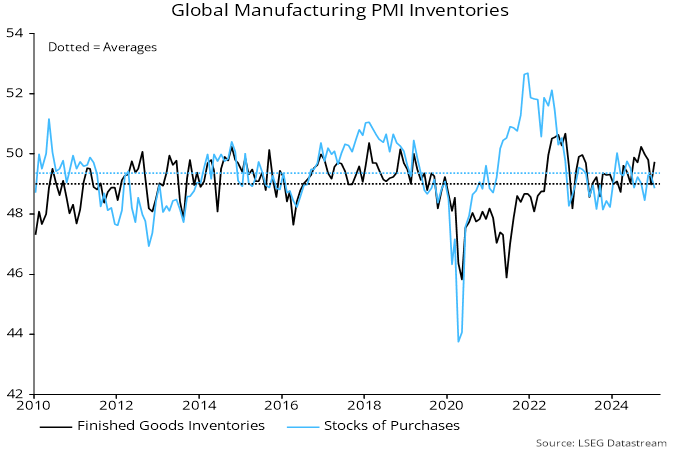
The last trough in the stockbuilding cycle is judged to have occurred in Q1 2023, with national accounts inventories data and business surveys suggesting that the upswing is around its mid-point – chart 5. The previous cycle was shorter than the 3.5 year average, so the current one could be longer, with a low as late as H1 2027. An associated downswing might not start until H1 2026.

Chart 5

030125c5

The 7-11 year business investment cycle appears to have bottomed in 2020, although a case could be made that this was a false low due to the pandemic, with the last genuine trough reached following a mild downswing in 2015-16. On the more plausible former view, the next low is scheduled for 2027 or later, implying potential for a 2026 boom.

The longer-term housing cycle, which bottomed in 2009 and has averaged 18 years, is in the time window for a peak but significant weakness could be delayed until H2 2026 or later.

Monetary and cycle signals could be reconciled if near-term economic weakness / favourable inflation news triggers faster monetary policy easing and a strong pick-up in money growth into mid-year.

Would such a scenario be associated with further significant gains in risk assets? The history of the stockbuilding cycle suggests not.

Risk assets typically rally strongly in the first half of a stockbuilding cycle, partially retracing gains in the run-up to the next trough. Table 1 compares movements so far in the current cycle with averages at the same stage of the previous eight cycles, along with changes over the remainder of those cycles. US equities, cyclical sectors and precious metals have outperformed relative to history, suggesting a stronger likelihood that they will lose ground between now and the next trough.

Table 1

030125t1

Areas that have lagged relative to history include EAFE / EM equities, small caps and industrial commodities, hinting at catch-up potential in the event of a delayed stockbuilding cycle peak and late (H1 2027) trough. This prospect would be enhanced by a reversal of unusual US dollar strength so far in the current cycle.

Still, any such catch-up might be a relative rather than absolute move against a backdrop of a maturing cycle upswing, a possible US market correction and neutral / negative excess money conditions.

GACM_COMM_2024-12-19_Banner

As we look back on 2024, we saw the equity market prove itself to be a testament to resilience, and a return to speculative activity last seen since before the pandemic.

Below is a selection of charts that our team found to be particularly impactful, highlighting the environment we witnessed in 2024 and, more importantly, why we’re excited for 2025.

Speculation

This year has been the year of the US equity markets, particularly the mega cap Magnificent Seven, up over 60% in 2024. The speculative fervour that gripped the United States has reached fever pitch. The best way to measure it may actually not be Bitcoin – even though it has more than tripled this year to trade above $100,000.

Have you heard of Fartcoin? Yes, you read that correctly. Just so you know, the coin is up over 1,000% since the US elections on November 5.

GACM_COMM_2024-12-19_Chart01
Source: CoinGecko

Not bad for a cryptocurrency that allows users to submit fart jokes or memes to claim initial tokens. Over USD60 million is traded every day; with a market cap of $830 million, it is the 189th largest cryptocurrency. We are in uncharted territories.

Regional market concentration

GACM_COMM_2024-12-19_Chart02
Source: BofA Global Investment Strategy, Global Financial Data, Bloomberg

The concentration of the gap in valuation between US stocks and the rest of the world is driving up the valuation of US stocks to extreme levels. Global markets have been tumultuous since the pandemic, but with the rush for AI and technology, the US market has shown to be the most resilient, therefore drawing investors from abroad in droves.

Top ten concentration

GACM_COMM_2024-12-19_Chart03
Source: BofA Global Investment Strategy

Regarding the gap between the top-10 stocks in the S&P 500 and the remaining 490, a similar divergence is taking place when we examine equity market flows. In fact, the best way to measure the fervour is in the investor concentration towards US equities, specifically the S&P 500. With the Magnificent Seven making up nearly 50% of the S&P 500’s gain, this high is volatile. Any earnings slowdown or unfavourable news within this seven could result in outsized impacts on the overall performance.

We will let you judge if this a risky environment or not. To quote Mark Twain, “History doesn’t repeat itself, but it often rhymes.”

Instead of trying to find reasons why this market might correct, allow us to concentrate on what we see as opportunities.

Global opportunities outside of the United States

We’ve written numerous pieces on opportunities within small caps in JapanEurope and emerging markets this year, so it’s no surprise when we say that we believe that the Japanese economy will be the fastest growing developed market economy in 2025.

The country has turned the corner on deflation. The virtuous wage/price spiral has taken hold. Pay rose 3.6% for base pay and 5.17% in total pay in 2024. We expect a similar increase in 2025. Interest rates will probably rise another 0.5%. Japan is a beneficiary of mega trends, from friendshoring to AI, semi-conductor investments to green transition. A newly announced ¥39 trillion fiscal package will help even further. As a result, a stronger economy with a large discount in Japanese companies’ valuations and investor-friendly measures such as M&A and buybacks mean Japan should be the top performing developed equity market in 2025.

In Europe, how a few years make a huge difference. Countries like Spain and Italy should be outperformers, as well as the UK and Sweden as these countries and their economies begin to turn.

For emerging markets, China will deploy fiscal stimulus that is similar to 2008, putting a floor on deflation risks, stimulating consumption and buoying the stock market. Given the underweight of most asset managers, it may mean healthy returns for the Chinese markets.

MSCI EAFE Small Cap minus Russell 2000
GACM_COMM_2024-12-19_Chart04
Source: Global Alpha Capital Management Ltd.

Since fall 2024, there has been a rotation into US small caps, fueled even more by the Trump Trade: Could we see international small caps catch up? One can observe the relative outperformance of EAFE small cap between 2002 and 2010. Seven years of underperformance is unprecedented. And we need to know that Japan is around 33% of the EAFE small cap index. According to the fundamentals and history, if there is a slowdown in the United States, international markets including international small caps could stand to be big beneficiaries.

Mergers and acquisitions

GACM_COMM_2024-12-19_Chart05
Source: Global Alpha Capital Management Ltd.

We have also recently seen a pick-up in M&A activity. A consensus is emerging from advisors like Goldman Sachs, Evercore and others that 2025 will be a record year. M&A activity is projected to be 15% greater 2024, which was already up 15% over 2023.

GACM_COMM_2024-12-19_Chart06
Source: Global Alpha Capital Management Ltd.

Finally, the relative valuations of global and EAFE small caps versus large cap indicate a once-in-a-few-decades opportunity.

Investments are currently overloaded into the US market, with an oversaturation in the Magnificent Seven stocks. But it is clear there is opportunity in small caps – particularly international small caps – therefore, this is an opportunity that excites our team going into 2025.

In closing, the entire team at Global Alpha would like to thank you for your trust, and we want to wish you a beautiful holiday season and a wonderful 2025 ahead.

Chinese money trends are normalising after weakness, suggesting modest economic improvement.

A previous post argued that a recovery in money growth was under way but the extent of reacceleration was uncertain. A revival remains on track but has so far proved lacklustre.

Money numbers were distorted in the spring by regulatory enforcement of deposit rate ceilings, which resulted in corporations switching out of demand deposits into time deposits and non-monetary instruments. Broader money measures were less affected, resulting in a focus here on the “M2ex” aggregate (i.e. official M2 minus deposits of financial institutions, which are volatile and less correlated with future activity / prices).

Six-month M2ex momentum bottomed in June and recovered further in November, though remains below its 2015-19 average – see chart 1.

Chart 1

181224c1

Narrow money momentum is much weaker but has started to normalise as the spring distortion drops out of the six-month comparison. (The “true M1” measure shown approximates to a new official M1 definition to be adopted from January.)

Chinese money momentum has led nominal GDP momentum by two quarters on average historically, so monetary reacceleration since mid-year suggests better economic data from early 2025.

November activity numbers were positive on balance. Six-month rates of change of industrial output, fixed asset investment and home sales rose further but retail sales disappointed – chart 2. Output strength could reflect front-loading ahead of tariffs.

Chart 2

181224c2

The suggestion from monetary trends of improving prospects is supported by the OECD’s composite leading indicator, six-month momentum of which has turned positive, suggesting above-trend growth – chart 3.

Chart 3

181224c3

Real money momentum has led leading indicator momentum by four months on average historically but the low in the latter occurred earlier on this occasion, perhaps reflecting the regulatory distortion to monetary data mentioned above.

MIDSTAR_COMM_2024-12-12_Banner

Private credit volumes reached $1.5 trillion globally at the beginning of 2024 (vs. $1.0 trillion in 2020) and are projected to grow to $2.8 trillion by 2028. The US market makes up ~$1.0 trillion of volume, with the European (including the UK) market accounting for most of the remainder. Private credit has clearly become ubiquitous in the US market and is recognized as an increasingly attractive alternative to traditional US bank debt in the mid-market segment and Term Loan B (TLB)/high-yield bond market within the large cap space.

However, private credit in the Canadian market remains nascent and many of the private credit firms that have formed in Canada have pointed their origination efforts firmly towards the US market given the greater scale of opportunities available.

The obvious question to contemplate is why the Canadian market has not evolved or developed in the same way as that of the United States or Europe. Unique to the Canadian lending landscape is the dynamic of the “Big Six” domestic banks accounting for 80-90% of the lending market. These banks are very well-capitalized, have aligned themselves to balance sheet growth as a key performance metric and are relationship driven. Therefore, the typical Canadian borrower (especially sponsor-backed), can generally operate quite well within the confines of the traditional Canadian loan market. In both the United States and Europe, private credit growth is attributable to regulatory changes and banking sector consolidation that has yet to materialize to the same extent in Canada.

The opportunity for private credit in the Canadian context will likely not be the same as the United States, where it has evolved as the clear alternative to traditional bank debt. However, we expect that the asset class will at least be a largely complementary solution to existing banking relationships in the near-term.

Where private credit in Canada will excel as an alternative term debt provider is in specific situations and at points in time such as:

  • Management buyouts;
  • Growth capital;
  • Facilitating succession;
  • Private equity acquisitions;
  • M&A or business roll-up strategies;
  • Challenged situations; and
  • Where there is a flight of capital from certain industries (e.g. oil and gas).

Private credit in Canada is evolving as a complementary product to the Canadian banks rather than a direct competitor/alternative, and often occupies a segment best termed as “bank market adjacent.” Essentially, private credit is able to provide a solution at a particular stage in a company’s development that provides the necessary flexibility vs. traditional bank appetite/offering. The goal for all parties involved is for that company to eventually grow to a stage that calls for traditional bank debt.

Although the markets are different, the key advantages of private credit seen in the United States and Europe hold just as true in the Canadian context. These borrower preferences, as outlined below, are advantages that many borrowers in the United States and Europe are comfortable paying a premium for:

  • Speed/certainty of execution,
  • Nimble, innovative, and customized solutions,
  • Unburdened by “market convention” on terms & conditions or leverage profile, with the focus instead being on the overall credit – serviceability and sustainability of business performance, and
  • Highly experienced teams with a depth of knowledge through the cycles.

Relationships will always be a key consideration for entrepreneurs/CFOs/CEOs and the perceived risk of moving your lending relationship away from a traditional bank. Questioning lender reaction through a period of underperformance or a situation requiring flexibility are legitimate concerns when entering new relationships. However, many of the Canadian private credit firms are just as relationship-driven as the Canadian banks – another key difference between the Canadian and US/European market evolution. These firms are in the process of carving out a lending niche in a bank-dominated market and, in addition, many of them are financially supported by large Canadian entities who place high value in reputation and relationships within the Canadian market.

In conclusion, private credit in Canada has not reached the levels of growth or relative scale realized in the United States or Europe. Despite the differences in respective banking environments, private credit does serve a purpose in supporting Canadian businesses/entrepreneurs and the asset class will continue to develop and grow in Canada as banking dynamics and borrower preferences evolve.

For further information or to discuss financing for your next opportunity, call the team at MidStar Capital.

Photo du Métro sur la place du marché d'Edinburgh.

Investissements immobiliers Crestpoint Ltée a le plaisir d’annoncer l’acquisition du Edinburgh Market Place à Guelph, en Ontario. Fort d’un emplacement stratégique, ce centre de commerce de détail de 112 875 pieds carrés, dont le locataire principal est une épicerie, est entièrement loué à des locataires nationaux de premier plan, dont Metro, Staples et TD Canada Trust. Situé dans un quartier commercial dominant à l’intersection de Edinburgh Road South et de Stone Road West, tout près de l’Université de Guelph, il constitue une destination de magasinage très visible et bien établie, avec du stationnement en abondance, et attire environ sept millions de visiteurs par année. Crestpoint, au nom de la Stratégie immobilière de base plus Crestpoint (son fonds à capital variable), fera l’acquisition d’une participation de 100 % dans la propriété, qui sera un excellent ajout à notre portefeuille déjà diversifié d’actifs de première qualité.

Sectoral numbers show that recent US money growth has been focused on the household and financial sectors, with business holdings falling.

A recent post noted that US six-month narrow money momentum fell back in September / October, casting doubt on post-election economic optimism. Sectoral money trends revealed in the Fed’s Q3 financial accounts give further grounds for caution.

Chart 1 compares the six-month rate of change of the monthly broad measure calculated here – M2+, which adds large time deposits at commercial banks and institutional money funds to the official M2 series – with the two-quarter change in a domestic money aggregate derived from the financial accounts. The series are closely correlated with end-Q3 readings similar.

Chart 1

131224c1

An advantage of the financial accounts data set is that it allows a breakdown of broad / narrow money between the household, non-financial business and financial sectors. Broad money growth in the two quarters to end-Q3 was driven by households and financial firms, with business money falling – chart 2. The narrow money decomposition (not shown) mirrors this pattern.

Chart 2

131224c2

Business money trends have exhibited a stronger and more consistent relationship with future economic activity than household / financial sector developments historically. Changes in business liquidity can influence decisions about investment and hiring, with employment consequences feeding through to household incomes and money holdings.

The approach here, therefore, is to interpret the signal from a given level of aggregate money growth as more positive – or less negative – when the business component is outperforming (and vice versa).

Chart 3 shows that real business money – on both broad and narrow definitions – is falling on a year-ago basis, suggesting that a slowdown in investment will continue in 2025.

Chart 3

131224c3

The Q3 financial accounts numbers also support an earlier proposition here that asset prices and nominal GDP have – in combination – moved above levels implied by the current broad money stock, i.e. there is no longer an “excess” money tailwind for the economy and markets.

To recap, the “quantity theory of wealth” is a suggested modification of the traditional quantity theory recognising that (broad) money demand depends on wealth as well as income and proposing equal elasticities. Nominal income is replaced on the right-hand side of the equation of exchange MV = PY by a geometric mean of income and wealth.

Using Q4 2014 as a base, the measure of gross wealth used here – the market value of public equities, debt securities (excluding Fed holdings) and the housing stock – had risen by 107% as of end-Q3 versus a 64% increase in nominal GDP. Implied growth of 84% in the geometric average compares with an increase of 80% in broad money over the same period – chart 4.

Chart 4

131224c4

Equity / house price gains, debt issuance / QT and expected respectable nominal GDP expansion suggest that the overshoot will have widened in Q4.