Brazilian economy, a 1 Real coin over a line chart graphic in a newspaper.

Brazil, the largest economy in Latin America, faced a mixed economic outlook in 2024. With low population growth, inflationary pressures and government overspending, the country navigated through significant challenges. However, certain sectors such as agriculture exhibited resilience, and the government, under President Luiz Inácio Lula da Silva (commonly known as “Lula”), worked on implementing policies to manage inflation and drive economic recovery.

In this recap, we will review Brazil’s economic performance, inflation dynamics, the effects on various sectors and explore potential opportunities for 2025.

Population growth and demographic trends

As Brazil’s population growth slows and the proportion of older individuals rises, the country will face a shrinking working-age population. This poses a significant challenge for the labour market as fewer people will be available to fill jobs and contribute to the economy.

Two line graphs illustrating population growth. Graph 1 shows total population growth of Brazil with a predicted growth past 2025. Graph 2 shows population growth of Brazil by broad age groups, with predicted growth per group past 2025.

2024 performance

Brazil went through a tough year in 2024 with a yearly performance of -29.47% (USD) (MSCI Brazil Index). Consumer discretionary performed the worst out of all sectors with -44.23% (USD). The main driver of the weak performance was linked to a weak Brazilian real. Brazil was one of the first countries to start reducing rates back in August 2023, while the United States had just finished increasing rates back in July 2023.

The currency performance against the USD was nearly -22%, and the currency remains under pressure, reflecting investor skepticism over Lula’s ability to address Brazil’s ballooning budget deficit, reaching a high of 10% of GDP in July 2024. The country faced false hopes when attempting to contain inflation as it reversed back in April 2024. Between January and April, inflation decreased by almost 80 bps, only to shoot up by 110 bps (April to December 2024), ending the year at 4.83% as per the Central Bank of Brazil.

MSCS Brazil sector performance

Sector weights
Sectors 01/31/202401/31
2024
12/31/202412/31
2024
2024 Return (USD)
MSCI Brazil Index 100.0% 100.0% -29.47%
Finance 27.4% 35.3% -38.40%
Energy 22.4% 18.8% -27.20%
Materials 17.0% 14.4% -38.60%
Industrials 9.9% 9.9% -24.30%
Utilities 8.0% 9.2% -30.47%
Consumer staples 7.7% 7.1% -32.06%
Healthcare 2.4% 2.0% -41.51%
Communications 2.6% 1.6% -32.18%
Consumer discretionary 1.9% 0.9% -44.23%
Information technology 0.9% 0.8% -37.53%

Source: Bloomberg

Despite signs of inflation increasing, it took the Central Bank of Brazil until September to increase the Selic rate by 25 bps, followed by 50 bps in November and a final increase of 100 bps in December. Starting the year off with a sentiment of rates reducing to a swift change of aggressive increase caught investors by surprise.

MSCI Brazil Index sector weights (2024 – present)
Line graph showing the different MSCI Brazil Index sector weights over 2024 to present day.
Source: Bloomberg

A company we like in Brazil: Vivara Participações S.A. (VIVA3.SA)

Vivara is Brazil’s number one jewelry retailer with around 435 stores and approximately 21% market share. Vivara was launched in 1962, with new segments such as Life by Vivara, watches, accessories and fragrances completing the product range. Vivara enjoys high returns and strong consumer brand recognition.

During 2024 the company suffered a performance of -46.3% (USD). The performance was attributed to a weak consumer and unexpected management changes. The company is reorganizing the selling space (optimizing the stores) and improving customer experience. It also changed the inventory level in order to support the same-store sales growth acceleration seen in recent quarters (Q3 +13.5%, Q2 +11.6%, Q1 +9.4%) and to reduce stockouts.

SWOT analysis
Strengths

  • Market leader, benefiting from scale
  • Brand recognition with over 60 years in the industry
  • Close to 80% of vertical product integration (lower cost)
Weakness

  • Cannibalization of stores between Life and Vivara brands
Threats

  • Macro and political instability
  • High exposure to gold and silver prices
Opportunities

  • Expanding outside Brazil (Latam countries)
  • Rapid adaptability of life brand
  • Store expansion (aiming for 70 in 2025)

SWOT analysis table

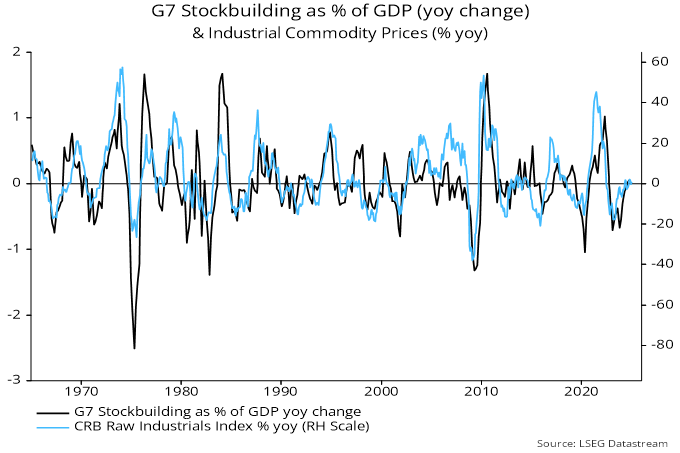
The cycles framework used here suggests a window for global economic strength in H2 2025 / H1 2026 as the stockbuilding and business investment cycles move towards peaks – see previous commentary. This scenario, however, requires confirmation from a pick-up in global real money momentum into mid-2025.

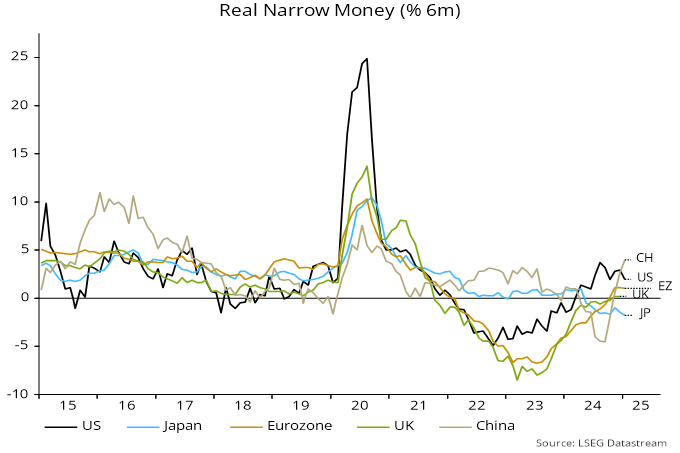
December money numbers are tentatively supportive. Six-month growth rates of narrow and broad money rose across the US, Japan, Eurozone and China – charts 1 and 2.

Chart 1

290125c1

Chart 2

290125c2

Based on monetary data covering 84% of the aggregate, global (i.e. G7 plus E7) six-month real narrow money momentum is estimated to have reached its highest since 2021 (October). The rise in nominal growth in December was partly offset by an energy-driven increase in six-month consumer price momentum – chart 3.

Chart 3

290125c3

Several qualifications are in order. The positive signal from the recent pick-up relates to economic prospects for H2 2025, based on the usual six to 12 months lag. H1 performance is expected to be weak, reflecting stalled real narrow money momentum between April and October 2024.

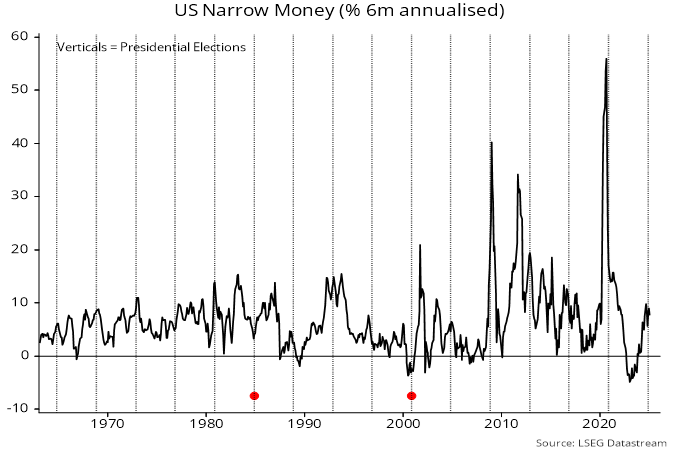
Real money momentum, moreover, remains low by historical standards. A rise at least to the 2010-19 average is necessary to validate a late 2025 / H1 2026 economic “boomlet” scenario – chart 4.

Chart 4

290125c4

The rise in longer-term interest rates in the US and Europe since the start of December, meanwhile, could slow or reverse the money growth pick-up.

Despite rising in November / December, US six-month real narrow money momentum remains below its August peak. With China / Europe catching up, US economic and / or equity market outperformance may fade or reverse – chart 5.

Chart 5

290125c5

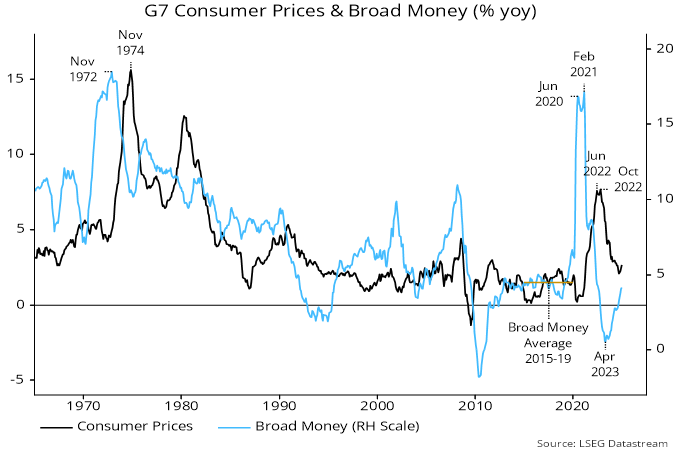
It is much too early to worry about a money growth revival fuelling another inflation pick-up. G7 annual broad money growth is still slightly below its average over 2015-19, a rate of expansion associated with below-target headline / core inflation outcomes – chart 6. The roughly two-year lag in the relationship suggests further downward pressure on inflation in 2025 and no serious upside threat before late 2026 at the earliest.

Chart 6

290125c6

Bab Bou Jeloud gate (The Blue Gate) located at Fez, Morocco at sunset.

MENA equity markets finished the fourth quarter with returns of 0.7% (S&P Pan Arabian Index Total Return), significantly outperforming the MSCI Emerging Markets Index, which was down 8.0% in the same period. For the full year of 2024, MENA equity markets ended up 6.3%, a slight underperformance relative to the MSCI EM Index which was up 7.5%. Through to the end of 2024, MENA markets outperformed the MSCI EM Index by 43.4% and 17.3% over the last five and three years respectively.

Annual return dispersion among the major MENA markets (at the index level) continued to be high this year. The performance differential between the best (Dubai) and the worst (Qatar) market was 29% in 2024. Interestingly, this has also been the quantum range of returns between best and worst in 2023 and 2022. This high level of dispersion is a particularly desirable feature of investing in the region and one we believe is likely to remain given the composition of listed securities in each market (providing different earnings-factor sensitivities), the presence of domestic capital pools dedicated to each market and, more generally, the relatively low levels of foreign ownership in the region.

MENA equities were put to the test this year as they grappled with an escalation in political risk, lower oil price, high interest rates and incremental supply of shares from initial public and secondary offerings. Our view on this was articulated in our fourth quarter letter of 2023 wherein we described our approach to the Saudi market in particular:

Since the end of the first quarter of 2023, we have become more vocal about our concern on valuation levels in Saudi. During this period, we’ve seen an increase in geopolitical risk, persistently high interest rates, and lower oil prices. None of those factors seem (for the time being) to temper local and regional investor enthusiasm for Saudi stocks, particularly mid-caps and IPOs. We believe it is prudent to avoid being overly exposed to situations where, by our estimates, investor positioning and expectations are excessively high. While we remain constructive on the quality of the Saudi-based businesses we own and the country’s structural growth story…we enter 2024 with lower exposure to these stocks. The Saudi market is highly dynamic, and we expect there will be opportunities to rebuild our exposure to those stocks throughout year.

In the same letter, we cited a preference for owning the UAE:

“We are relatively more bullish on the UAE, focusing primarily on banks and quasi-monopoly businesses like utilities and infrastructure. Benign liquidity conditions and strong economic growth favour UAE banks with a solid deposit franchise and strong lending opportunities in 2024.”

Fortunately, that view has largely played out in 2024 (with some exceptions of course), and we now find ourselves in a situation where our relative preference has reversed in favour of Saudi as valuations appear more reasonable. We spoke about this more constructive stance on Saudi in our third quarter letter last year following our trip there in October 2024:

There are three factors working for the strategy at the moment. Firstly, there are growing profit pools resulting from reforms and demographics which is critical to our investing style – growth. Secondly, in the last two months, the market has begun the long-awaited process of recalibrating its expectations of earnings to levels that we deem realistic and interesting – reasonable valuations. Lastly, the strategy has already begun shifting the portfolio to areas where there is a healthy combination of growth, risk-reward and low investor positioning.”

In other markets, we continue to favour Morocco in the portfolio as it represents one of the best structural economic development and equity stories in emerging markets and certainly the region. While the portfolio in Morocco has experienced some turnover in 2024 (primarily due to an exit of a long-held position in the retail sector), we remain committed to our long-term holding in technology and have expanded the portfolio to include companies in healthcare and financial services.

In Qatar and Kuwait, our statement from last year’s letter remains largely relevant today:

We remain selective, with growth remaining constrained, though we see potential in Qatar’s liquified natural gas value chain and are more optimistic about Kuwait following the appointment of a reformist royal as the new Emir in late 2023.

While our optimism on Kuwait may have proven pre-mature, we believe the direction of travel is positive and have continued to build selective exposure over the year, primarily in banks and financial services.

As for Egypt, we expressed an openness to increasing our small ownership last year, subject to the devaluation of currency and a correction of the imbalances in the country’s trade and capital positions.

Egypt remains a wildcard, with an imminent devaluation likely to be the first step in a long journey towards rebuilding policy credibility with investors. That said, we remain open to increasing our ownership in our preferred Egyptian healthcare and technology businesses if opportunities arise later this year.

The Central Bank and the government of Egypt did eventually capitulate and devalued the currency from just above 30/USD to 50/USD. The devaluation came two weeks after the government sealed a mega property deal with one of Abu Dhabi’s sovereign wealth funds. As a result, we felt more comfortable with the medium-term outlook for US dollar returns on Egyptian assets and stepped up our exposure to our technology company by way of a discounted block transaction in June last year that so far has proven rewarding for the portfolio.

In conclusion, the region passed a particularly testing year in 2024. The structural story for the region remains sound and we are confident it will underpin a powerful combination of a multi-year growth in earnings and a low equity risk premium relative to emerging markets. While it is too early to determine what happens in 2025, a strong US dollar, stable oil price and a Trump presidency all bode well for MENA equities.

We wish you a prosperous 2025 and look forward to sharing updates on our strategy with you.

High angle view of illuminated buildings during sunset in Makati City, Philippines.

The strategy focuses on investing in frontier and emerging market companies that our team expects will benefit from demographic trends, changing consumer behaviour, policy and regulatory reform and technological advancements.

Below, we explore several key factors that influenced returns in 2024 and share observations on the portfolio and the markets.

Internet and technology portfolio

The portfolio’s investments in the internet and technology sector propelled returns in 2024. This was driven by FPT Corporation (FPT), the Vietnamese IT services company, which established a relatively early mover advantage in the AI consultancy space. This placed the company firmly in the AI winner camp in 2024 and led to a re-rating of its shares. FPT also benefited from continued IT capex recovery from its traditional markets in the APAC region as well as strong execution in the US and Europe, which drove a ~30% growth in the company’s global IT services revenue in the nine-month period ending September.

The sector also saw strong contribution from Kenya due to improvement in the macroeconomic environment there. This was reflected in a strong appreciation of the Kenyan Shilling and a lower cost of equity that transmitted favourably into the valuation of Safaricom PLC (SCOM) (which we own primarily for its fintech asset, M-Pesa). We took advantage of the macro-induced rally and reduced our exposure to Safaricom in the first half of 2024.

We were also fortunate to have the opportunity to participate in discounted share sales by the private equity owners of Baltic Classifieds Group PLC (BCG), the leading online classifieds group in the Baltics. This helped the strategy increase its investment in the company at attractive prices. BCG continued to flex its market leadership in auto and real estate classifieds through calculated price increases and the introduction of value-added services which translated to an 18% growth in operating profits in the six-month period ending October.

We experienced a drag in returns from our investment in Allegro.eu S.A. (ALE), the leading Polish online marketplace. Allegro’s management provided relatively downbeat commentary in their guidance with their nine-month report which it attributed primarily to competition from Chinese players (mainly Temu). The stock had already come under pressure from the unexpected resignation of Roy Perticucci from his CEO role, and so the incremental negative news on competition put extra pressure on the stock. Fortunately, we decided to reduce exposure to Allegro following the news of the departure of the CEO but the strategy still experienced a drawdown from the stock’s reaction post the nine-month results. We still have a small position in Allegro as we believe it will weather the current competitive pressures given its dominant position in the Polish online marketplace.

While we made changes to our internet and technology portfolio during the year to reflect relative valuation preferences and make room for new ideas, the sector remains the largest bet in the portfolio entering 2025 (the end-of-year exposure to the sector is equal to the average exposure in the year). The combination of improving macro, evolving consumer habits, benign regulatory environment and strong management execution is likely to drive another year of strong earnings growth in 2025.

Retail portfolio

Retail was the second major contributor to returns in 2024, but contribution was top heavy, with the shares of Philippine Seven Corp (SEVN) and Mr D.I.Y. Group (M) Berhad (MRDIY) in Malaysia generating nearly all the returns. With Seven, the resumption of dividend payments (via a special dividend) after a three-year hiatus proved to be a powerful catalyst that woke the market up to the company’s strong fundamentals and growth prospects (14% growth in EPS in the nine-month period ending September 2024 and one of the fastest growing 7-11 convenience store networks in the region).

Mr D.I.Y. Group’s shares benefited from the anticipation of a recovery in demand from the B40 group of Malaysian households (B40 refers to the bottom 40% income group) and the entry of the company in a 49% joint venture with Chinese retailer KKV, as well as a supportive equity market environment in Malaysia last year.

We took decisive action to reduce exposure to this sector in the second half of last year, emboldened by what we deemed to be full valuations following the rally in our core holdings above, and better opportunities emerging inside and outside the sector.

We also saw some pressure on consumer wallets and increased competitive intensity in some areas of the retail portfolio including in the home improvement and grocery categories which we deemed to be persistent and as such triggered selling of underperformers in the portfolio. One such example is Wilcon Depot Inc. (WLCON), the Philippine’s largest home improvement retailer, which is experiencing significant pressure on sales densities as demand for home renovations appear to have stalled after the post-Covid demand pull.

We also exited our long-held investment in Moroccan grocery retailer Label Vie S.A. (LBV) on a combination of slowing growth and concerns on capital allocation decisions that we deemed would be dilutive to minority shareholders.

While we end the year with exposure that is well below the average exposure in the year for the sector, we are bullish on some of the additions we made to the portfolio in the year in UAE grocery retailing and Indonesian variety retail which we hope we can share more information on in 2025.

Fast moving consumer goods portfolio

Consumer goods were the third largest contributor to returns this year, driven by long-term holdings Philippines’ Century Pacific Food Inc. (CNPF) and Indonesia’s Industri Jamu dan Farmasi Sido Muncul Tbk PT (SIDO), or Sido Muncul. Century Pacific’s consistency in delivering on their guidance of low- to mid-teens yearly growth proved to be extremely valuable this year as most other Philippine consumer companies experienced significant headwinds from lower disposable incomes and commodity price pressures. The consistency in delivering is the result of a diversified portfolio of consumer products (mainly canned seafood and meat, and dairy), an exposure to institutional demand from developed markets (mainly canned marine and coconut water) and the large consumer market in the Philippines. This creates natural hedges in the company’s cost structure and foreign currency exposure.

Sido, the herbal medicine company that we have discussed extensively in the past, emerged from a difficult 2023 with operating income growth of ~29% in the nine months ending September. Sentiment on the shares also benefited from a transaction in which the controlling shareholder Irwan family bought out the full 17% stake of Affinity Equity Partners, a private equity investor that had come to the end of its investment cycle in the company. The transaction was done at a 30% premium to the three-month average price, signalling confidence from the family in the prospects of the business, and removing the overhang on the shares that typically arises with late-stage private equity ownership of public companies in our markets.

We remain highly selective in this sector and continue to see pressure on profit pools due to increasing competitive pressures, changing consumer behaviour, and the rise of new distribution channels that are disrupting the competitive advantage that many leading companies have historically enjoyed.

Healthcare portfolio

Healthcare was the fourth largest contributor to returns in the year driven mainly by Morocco’s Aktidal S.A. (AKT) and Turkey’s Medical Parks – MLP Care (MPARK).

Aktidal listed its shares on the Casablanca stock exchange at the end of 2022 and came back to the market for a follow-on offering (USD100 million) last year as growth exceeded the company’s initial expectations. Management at Aktidal expects its bed capacity to increase 2.5x between 2023 and 2026 as it capitalises on the structural undercapacity in the market and a supportive regulatory environment for private healthcare investments that is leading to quick utilisation ramp-ups and strong unit economics.

We invested in MLP early in 2024 as we started seeing encouraging signals from the Turkish government on its intent to reverse course and pursue market-friendly economic policies. MLP benefited from improving sentiment toward Turkish assets as the country received its first credit rating upgrade in over a decade from Moody’s in July. Fundamentally, MLP has established itself as the market leader with a 40% share in the lucrative top-up insurance segment which is the fastest growing payor group in the Turkish healthcare market. MLP has also been making sensible single-site acquisitions which it is successfully integrating into the network.

We experienced some drag in returns from the sector from investments in Indonesia and Thailand where weak equity market sentiment and pressure on payors (insurers and medical tourists in the case of Thailand) led to a de-rating of our stocks at the end of the year. That being said, our position size in that region is relatively small and we are oriented to be buyers of this weakness as growth drivers around demographics and regulations remain intact.

Outlook

We are constructive on the strategy’s positioning in 2025. While the global market environment is uncertain, we believe earnings visibility from our portfolio companies is relatively high in the next two years. As in every year, we reduced valuation risk when appropriate (reducing exposure to areas where share prices ran ahead of fundamentals), and exited underperforming positions where fundamentals are likely to worsen. Positively, we found many areas to invest in and, as a result, find ourselves with low levels of cash relative to the history of the strategy.

We look forward to updating you on the strategy over the rest of the year.

GACM_COMM_2025-01-23_Banner

Amid the overall pessimism toward European economies, one of the reasons provided most often for the underperformance relative to the United States is a lack of innovation and entrepreneurship. Many data points tend to confirm this:

  • Over three times as many patents are filed in the United States annually than the entirety of Europe.
  • Research and development (R&D) is 2.8% of GDP in the United States vs. only 2.2% for Europe.
  • Average time to go through filings to start a business is 3-5 days in the United States and up to multiple weeks in Europe.
  • The United States attracts the lion’s share of global venture capital (VC) investment; over three times of the $50 billion attracted by Europe in 2023.

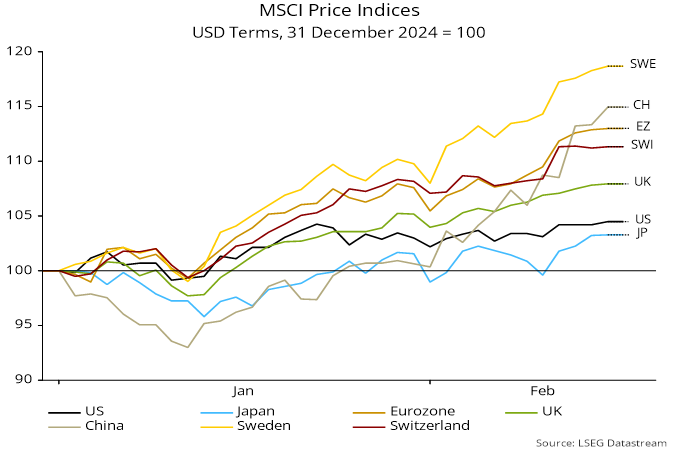
It is worth noting, however, that Europe has one large outlier when it comes to innovation: Sweden. Within Europe, Sweden easily stands out as one of the most entrepreneurial and innovative countries, raising questions from its neighbours as to how their success can be replicated. While entrepreneurship metrics have, by some measures, declined in the United States over the past 30 years, Sweden has seen the opposite trend.

So, what differentiates Sweden from its neighbours, and can it be replicated?

There is a case to be made that part of it stems from a cultural aspect. Swedish demographics have historically been described as high on social trust and cohesiveness, driven by a small historical level of immigration, similar to Japan or South Korea, but it is probably only part of the overall picture. Other likely factors include:

  • Entrepreneurship training in Sweden being taught in high school since 1980, with over 30% of students today participating in such programs. Other Nordic countries, on the other hand, started this type of program only in the mid-1990s and on a much smaller scale than Sweden did.
  • Risk-taking being socially encouraged and celebrated, with a common perception that opportunities are plentiful. Social safety nets also allow for failure and risk-taking.

Possibly as a result of this, Sweden’s VC market is more vibrant than other Nordic countries and has contributed directly to building Sweden’s reputation as a hub for technological innovation through its higher focus on early-stage investments. Furthermore, VC investment is well supported by the government through tax-incentives, grants and funding programs. Consequently, Sweden has the largest private equity capital raised as a share of GDP in Europe, trailing only Luxembourg. On its own, Swedish VC is estimated to have contributed 1.5% of total GDP growth on its own and has had a direct impact on creating more highly skilled, specialized jobs than its neighbouring countries.

GACM_COMM_2025-01-23_Chart01

It is therefore no surprise that Global Alpha is quite positive on Sweden’s long-term prospects and has had no trouble finding quality names for our portfolios. We profile two such names here.

Sdiptech AB (SDIPB SS) is a so-called industrial “serial acquirer,” a unique Sweden-based business model that consists of growth mostly through small, niche acquisitions without necessarily seeking material synergies or trying to integrate with the existing businesses. It acts as a forever-owner of companies where the founder is looking to sell their business, make sure their employees are well taken care of and don’t want to sell to private equity. Sdiptech focuses on acquiring businesses that are already cash-flow generative, as it finances its acquisitions purely through debt and not equity dilution. Its acquired companies operate along one of the four segments of its reporting structure: supply chain & transportation, water & bioeconomy, safety & security and energy & electrification. Most of its sales are aligned with the UN societal development goals. The company also differentiates itself from other serial acquirers through its comparatively strong organic growth profile (in addition to consistent M&As) and its lower leverage than peers, resulting from its smaller scale and more focused end-markets.

Another company we own in Sweden is Biogaia AB (BIOGB SS), a producer of probiotic supplements founded in 1990 by Peter Rothschild and that is present in over 100 markets. Probiotics is a USD71 billion global market with an expected CAGR of 8% over the next five years, driven by higher health awareness and shifting preference toward preventive healthcare. Biogaia differentiates itself from peers on two aspects: its global reach and its science-driven, innovative approach to product development. Biogaia is the only probiotic provider that continuously collaborates with universities globally on research to maintain its differentiated product from more generic peers who usually spend less than 1% of their sales on R&D, allowing it to sell at a premium with less discounting than its competitors.

It is probably an overstatement to say that Sweden is better today at fostering innovation than its North American counterpart. Nonetheless, it is noteworthy that Sweden has been trending more toward a dynamic bottom-up approach to innovating whereas observers tend to agree that the US economy has evolved into an environment that tends to favour incumbents over new entrants, thanks to softer regulations around lobbying and a higher rate of regulatory capture. We remain globally diversified and are optimistic on the growth prospects of both the United States and Sweden going into this new year.

Randonneur regardant le soleil à l'horizon.

L’année 2024 a été une autre année marquante pour Banyan Capital Partners. Nous avons poursuivi notre croissance stratégique en ajoutant de nouveaux placements et en offrant de la valeur à long terme à nos investisseurs.

Nouveautés à Banyan et promotions récentes

Photo of David Beaumont
David Beaumont
devient directeur
Photo of Marat Altinbaev
Marat Altinbaev
devient associé
Photo of Scott Morrison
Scott Morrison
devient directeur
Photo of Igor Verechaka
Igor Verechaka
devient vice-président
Photo of Gordon Yee
Gordon Yee
devient associé
Photo of Miranda Li
Miranda Li
devient associée
Photo of Alizeh Haider
Alizeh Haider
se joint à titre d’analyste principale
Photo of Alex Gelmeych
Alex Gelmych
se joint à titre d’analyste
Photo of Kye Johnston
Kye Johnston
se joint à titre de comptable

Ces promotions et ajouts reflètent notre culture de croissance professionnelle et reconnaissent la contribution des membres de notre équipe. Le renforcement de notre équipe fait partie intégrante de notre succès continu et de notre capacité à repérer et à alimenter les occasions de placement prometteuses et à accroître notre portefeuille de placement.

Apprenez-en plus sur notre équipe et les postes qui y sont associés.

Nouvelle plateforme de placement

Decorative.

Stagevision

Fondée en 1984, Stagevision offre une gamme de services professionnels de production et de gestion audiovisuelle, dont l’aménagement de scènes et de produits intermédiaires, la location à court terme d’équipement audiovisuel, et des services d’interprétation simultanée aux entreprises et aux agences connexes au Canada et aux États-Unis.

Nous nous sommes associés au chef de la direction de Stagevision, Scott Tomlinson, qui occupe ce poste depuis 2021, afin de mettre en œuvre la prochaine phase de croissance interne et des fusions et acquisitions de l’entreprise.

Pleins feux sur le portefeuille

BCP_Current-investments_Purity-Life_175w175h_v1.7

Oakcreek

En novembre 2024, Oakcreek a eu le plaisir d’annoncer la promotion de Patrick Nolan au poste de président et chef de la direction. Patrick, qui était auparavant chef des finances de la société, succédera à Barrie Carpenter, qui assumera la présidence du conseil d’administration.

Decorative.

Second Nature Designs

En janvier 2024, Second Nature a eu le plaisir d’annoncer la nomination de Guido Romagnoli au poste de président et chef de la direction. Guido était auparavant chef de l’exploitation de Hunter Amenities International, un fabricant mondial de produits de santé et de beauté.

Apprenez-en plus sur notre portefeuille de placement actuel.

Perspectives

À l’aube de 2025, nous continuons de mettre l’accent sur la recherche de nouveaux placements dans les sociétés du marché intermédiaire en Amérique du Nord, tout en maintenant notre engagement à l’égard de la création de valeur à long terme. Nous continuerons de tirer parti de notre expertise et de notre réseau pour favoriser des partenariats stratégiques, assurant ainsi le succès durable de nos sociétés en portefeuille et de nos investisseurs.

Nouveaux placements

Nous continuons de chercher activement à investir dans des sociétés dont le BAIIA est d’au moins 5 millions de dollars.

Avez-vous une occasion en tête? Découvrez nos critères de placement ou communiquez avec nous dès aujourd’hui.

Whisper it softly but Eurozone economic prospects are improving.

Six-month momentum of real non-financial M1 turned positive in October, reaching a three-year high in November. The recovery has been broadly-based across countries, with German momentum slightly above the Eurozone average – see chart 1.

Chart 1

220125c1

The sectoral breakdown shows that real M1 deposits of both households and non-financial corporations have returned to growth – in contrast to the UK, where corporate narrow money is still contracting, in nominal as well as real terms.

Economic news supports further policy easing. Six-month headline / core CPI momentum is close to target (2.1% / 2.2% annualised respectively in December) and there are signs of labour market softening, including a pick-up in consumer unemployment expectations – chart 2.

Chart 2

220125c2

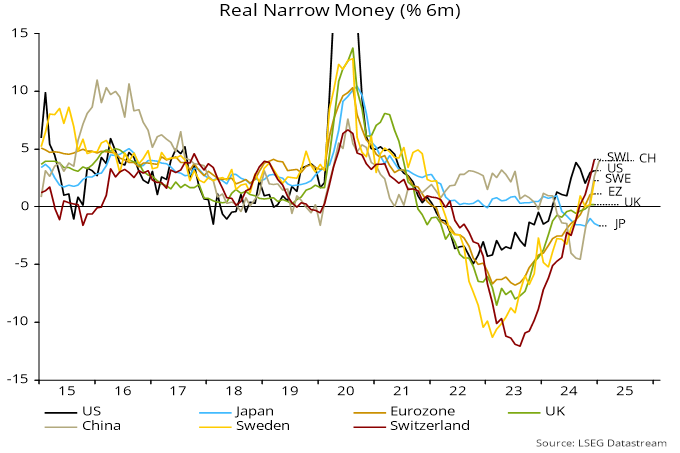
The Swiss National Bank started cutting rates in March, three months before the ECB, with the cumulative reduction now 125 bp versus 100 bp in the Eurozone. Swiss six-month real narrow money momentum is stronger and likely to be matched by the Eurozone soon – chart 3.

Chart 3

220125c3

The UK is lagging because the backward-looking MPC started later with cuts of only 50 bp. A stall in six-month real narrow money momentum from last spring signalled that the economy was heading for renewed stagnation well before the end-October Budget.

Improving Eurozone economic prospects may partly explain a spate of upgrades to corporate earnings forecasts by equity analysts. A positive January revisions ratio contrasts with negative readings in the US / UK and supports the monetary suggestion of a recovery in manufacturing surveys – chart 4.

Chart 4

220125c4i

Gambling hand holding two playing cards.

This month, NS Partners fund manager Luis Alves de Lima writes on navigating a volatile backdrop in Brazilian equities, and the huge potential this market offers if political risks ease.

Imagine a game of blackjack. Not your typical duel in the bowels of a dark casino, but a game of chance steeped in the vibrant hues of Brazil’s economic landscape. This is a game where the potential rewards are tantalizingly high, but the risks, like the Amazon rainforest, are dense and unpredictable. Like a card counter, we watch carefully as each card is dealt – investigating companies and assessing the macro backdrop – to formulate a running count of the deck and calculate our odds of hitting 21.

The ace in this deck represents the transformative power of political change. A conservative victory in the 2026 federal elections could usher in an era of fiscal responsibility, market-friendly policies and renewed investor confidence. Drawing this ace could yield a multi-bagger return as Brazil sheds its « risk premium » and the investment narrative flips from basket case to market darling. That doesn’t mean you won’t be wiped out before the ace arrives.

As we count, the deck is stacked with low number cards (2-6) – embodiments of lurking macro uncertainties – with the ability to wipe out your hand. Brazil’s fiscal deficit, stubbornly high cost of capital and the ever-present spectre of political volatility loom large. Playing aggressively to a deck loaded with low number cards favours the dealer’s odds, much like the potential downside risks that could erode investment value when macro is deteriorating, but valuations are yet to catch down.

The high cards (10, Jack, Queen and King), represent the underlying strengths of the Brazilian economy (all high cards are worth 10 points, with the ace either 11 or 1 depending on what’s best for the player’s hand). These cards increase your chances of winning if low number cards are dealt out of the deck and the proportion of high cards increases. The low cards in Brazil are coming out as the clock ticks on socialist president Lula’s term, with elections in 2026. While an increasing proportion of high cards does not offer an immediate payout in our game, it does suggest an investment environment where the player/investor can soon lift their bets in line with improved conditions and chances of upside surprise increasing.

Investing in Brazil today is a calculated gamble with ever-shifting odds. While the macro and political backdrop seems daunting, low cards are exiting the deck as pessimism runs to an extreme and fails to reflect the true potential of the market. While future outcomes remain uncertain, we see a disconnect between strong company fundamentals and depressed valuations. The “true count,” the extent to which a deck favours the dealer or player (investor), will swing in the latter’s favour as political risks ease. The probability of making it to that elusive ace rises.

My recent virtual roadshow with 20 Brazilian companies painted a picture of resilience and growth. Companies like Grupo GPS, Rede D’Or and Lojas Quero-Quero are demonstrating robust financials, exceeding growth expectations and trading at inexplicably low valuations. I have also planned a trip to Brazil next month to continue the mission of finding when the ace might appear in this high-stakes game. It’s an opportunity to delve deeper into the dynamics of the Brazilian market, gather firsthand information and assess the true probabilities beyond the abstract numbers.

Investing in Brazil today requires a contrarian mindset; an ability to understand the macro risks and direction of travel and weigh this against what we are seeing on the ground as we engage with companies. It’s a game for those who understand risk and can calibrate their bets as the odds shift for or against them. As any seasoned player knows, ignoring the headlines and acting with conviction when the true count tilts in your favour is when the most lucrative bets can be made.

Une personne sautant d'une falaise abrupte à une autre sous un ciel de coucher de soleil.

Après une bonne année pour les marchés, nous avons amorcé 2024 dans un contexte de risques géopolitiques et d’inflation élevée au premier plan des préoccupations des investisseurs, accompagnés d’une myriade de préoccupations quant à ce qui pourrait mal tourner. Malgré certaines turbulences en cours de route, les marchés ont défié les inquiétudes, les marchés boursiers américains et mondiaux affichant des rendements particulièrement élevés pour 2024. Cette revue examine le rendement des principales catégories d’actif, ainsi que les facteurs à prendre en compte pour 2025 et à long terme.

Actions – les titans technologiques foncent

Une fois de plus, les manchettes sur les rendements boursiers ont été dominées par les titres technologiques américains des sept magnifiques : Alphabet (Google), Amazon, Apple, Meta Platforms, Microsoft, Nvidia et Tesla continuent d’orienter les marchés boursiers américains et mondiaux, grâce à l’exubérance des investisseurs face aux avantages de l’intelligence artificielle. Au cours de la dernière décennie, la capitalisation boursière de ces sept titres a considérablement augmenté, leur représentation dans l’indice S&P 500 ayant plus que triplé par rapport à il y a dix ans (figure 1).

Figure 1 – Croissance des sept magnifiques en pourcentage de l’indice S&P 500

Diagramme à barres montrant la croissance des sept magnifiques en pourcentage de l'indice S&P 500.
Sources : Bloomberg & S&P

Les actions américaines représentent la composante individuelle la plus importante de la plupart des portefeuilles des investisseurs, de sorte qu’avec l’augmentation du niveau de concentration, la gestion du risque de portefeuille devrait demeurer une priorité pour les investisseurs à l’approche de 2025. Cela ne veut pas dire que le secteur américain des technologies de l’information ne continuera pas à bien se comporter, mais 2022 nous a rappelé que les titres technologiques peuvent enregistrer des rendements nettement inférieurs dans des conditions moins favorables. Les sept magnifiques sont passés de près de 27 % de la part de l’indice S&P 500 à la fin de 2021 à 20 % à la fin de 2022.

Dans l’ensemble, les actions produisent de bons rendements

La figure 2 résume les rendements en dollars canadiens de plusieurs grands indices boursiers pour l’année civile 2024.

Figure 2 – Rendements des actions en 2024 (%)
Actions canadiennes Indice composé plafonné S&P/TSX 21,7
Actions américaines Indice S&P 500 36,4
Actions internationales Indice MSCI EAEO (net) 13,2
Actions de marchés émergents Indice MSCI Marchés émergents (net) 17,3
Actions mondiales des pays développés Indice MSCI Monde (net) 29,4
Actions mondiales Indice MSCI Monde tous pays (net) 28,1
Actions mondiales à petite capitalisation Indice MSCI Monde à petite capitalisation (net) 18,0

Sources : Bloomberg, S&P & MSCI

Le marché boursier américain a devancé de loin les autres grands marchés développés et a enregistré un rendement de 22,5 % en 2023. Pour mettre les choses en contexte, la dernière fois que le marché boursier américain a clôturé une deuxième année civile consécutive avec un bond d’au moins 20 % remonte à 1997-1998. La vigueur du marché boursier américain s’est également traduite par une représentation accrue des indices de référence d’actions mondiales, comme l’indice MSCI Monde. Le marché boursier international a été à la traîne des autres grands marchés en 2024, plombé par les rendements plus faibles du Royaume-Uni et de l’Europe, qui ont contrebalancé les rendements supérieurs des actions japonaises. Même si les marchés émergents ont inscrit un rendement de 17,3 % pour l’année, les actions chinoises ont été particulièrement performantes dans la région, progressant de plus de 30 %.

Titres à revenu fixe – effet négatif de la durée

En 2024, les manchettes sur les marchés des titres à revenu fixe étaient axées sur la façon dont les banques centrales mondiales réagiraient à la réduction des taux d’intérêt pour s’attaquer à la hausse de l’inflation. Les conditions économiques ont entraîné plusieurs baisses de taux tout au long de l’année. Toutefois, à divers moments de l’année, les taux des titres à revenu fixe ont rebondi en raison des préoccupations à l’égard du niveau d’inflation. La figure 3 résume les rendements de plusieurs indices de titres à revenu fixe pour l’année civile 2024.

Figure 3 – Rendements des titres à revenu fixe en 2024 (%)
Liquidités Indice des bons du Trésor à 91 jours FTSE Canada 4,9
Obligations universelles Indice des obligations universelles FTSE Canada 4,2
Obligations à long terme Indice des obligations globales à long terme FTSE Canada 1,3
Obligations à rendement élevé Indice Merrill Lynch US High Yield Cash Pay BB 10,5

Source: Bloomberg, S&P, Merrill Lynch & FTSE

Les stratégies à rendement élevé ont mené le bal des rendements des titres à revenu fixe publics par année civile. Malgré la baisse des taux à court terme au cours de l’année, les marchés des liquidités ont inscrit de très bons rendements, l’indice des bons du Trésor à 91 jours FTSE Canada progressant de 4,9 %. Du côté des titres à revenu fixe, les investisseurs, comme les fonds de dotation, les fondations et les fiducies autochtones investissent habituellement dans une combinaison de titres à revenu fixe à court, à moyen et à long terme, comme des stratégies étalonnées sur l’indice des obligations universelles FTSE Canada. L’indice des obligations universelles a enregistré un rendement de 4,2 % pour l’année civile.

Une baisse du rendement à long terme à l’horizon

Le rendement actuel de l’indice des obligations universelles fournit un indicateur raisonnable des rendements attendus à long terme. La figure 4 illustre le rendement des obligations universelles au fil du temps (ligne bleu pâle) ainsi que les rendements réels absolus subséquents sur 10 ans (ligne bleu foncé). Il existe une forte corrélation entre les deux lignes, ce qui donne à penser que le taux de 3,6 % à la fin de 2024 est un indicateur raisonnable du rendement prévu des obligations universelles au cours des 10 prochaines années.

Figure 4 – Rendements des obligations universelles et rendements subséquents sur 10 ans
Graphique linéaire montrant let rendements des obligations universelles et rendements subséquents sur 10 ans.
Sources : Bloomberg & FTSE

Du point de vue du rendement, compte tenu du potentiel de rendement plus faible de l’indice des obligations universelles à long terme, les stratégies à rendement plus élevé, comme les titres de créance à rendement élevé, les titres de créance des marchés émergents, les prêts hypothécaires commerciaux et le crédit privé pourraient susciter un intérêt accru de la part des investisseurs qui cherchent à améliorer les rendements des titres à revenu fixe.

Du point de vue de la gestion du risque, nous nous attendons à un intérêt continu pour les solutions de titres à revenu fixe à rendement absolu. Elles sont conçues pour produire des rendements supérieurs à ceux des liquidités sans être assujettis à la volatilité que les stratégies d’obligations universelles ont connue en 2024 (ainsi qu’au cours des deux années civiles précédentes); elles ne sont pas tributaires d’un niveau de durée de l’indice de référence et des fluctuations connexes aux variations des taux.

La dynamique des régimes à prestations déterminées

La situation est différente pour les régimes de retraite à prestations déterminées (PD) dont les titres à revenu fixe sont davantage axés sur la gestion du risque que sur la production de rendement. Les régimes à PD ont généralement une pondération importante en titres à revenu fixe à long terme pour couvrir le risque de taux d’intérêt associé aux variations de la valeur de leurs passifs. Les facteurs qui déterminent les taux à long terme sont moins influencés par la politique des banques centrales et, en 2024, ont enregistré des rendements beaucoup plus faibles que ceux des liquidités et des obligations universelles, en raison de la légère hausse des taux à long terme au cours de l’année.

L’amélioration importante de la capitalisation des régimes à PD au cours des dernières années a conduit de nombreux régimes à augmenter le niveau de couverture du risque de taux d’intérêt afin de réduire les fluctuations du niveau de financement. Les mesures spécifiques dépendent du type de régime à PD (p. ex., d’entreprise, universitaire ou public), des mesures de passif actuarielles qui dictent l’évaluation du risque, et de facteurs tels que l’ouverture ou la fermeture du régime à de nouveaux participants et l’échéance du régime (p. ex., pourcentage de participants actifs par rapport aux retraités et aux participants bénéficiant de droits différés).

Une autre tendance en matière de gestion du risque qui s’est poursuivie à un rythme élevé en 2024 avec les plans d’entreprise a été la réduction des risques au moyen d’achats de rentes auprès de compagnies d’assurance. De plus en plus appelé « transfert du risque de retraite » (TRR), l’achat de rentes permet à une société de réduire le passif en dollars de son bilan en transférant des actifs et des passifs à la compagnie d’assurance. Selon les estimations, le marché canadien des TRR en 2024 sera supérieur au record de 2023, qui était tout juste inférieur à 8 G$ CA. Le marché des TRR a considérablement évolué depuis qu’il a participé personnellement au premier rachat de rentes modernes par un régime de retraite canadien en 2009. À l’époque, la valeur annuelle du marché des rentes collectives était d’environ 1 G$ CA, la plupart des opérations étant effectuées pour des régimes de retraite qui étaient en liquidation et qui utilisaient des rentes pour régler leurs passifs de prestations de retraite plutôt que comme solution de transfert de risque populaire aujourd’hui.

Des expériences contrastées sur les marchés privés

Au cours des 10 dernières années environ, les marchés privés ont enregistré d’importantes entrées de fonds en provenance des investisseurs institutionnels. Selon PwC, l’actif sous gestion (ASG) mondial devrait atteindre 145 000 milliards de dollars américains en 2025, soit presque le double de près de 84 900 milliards de dollars américains en 2016.1 La même recherche prévoit que les placements non traditionnels dépasseront les 21 000 milliards de dollars américains d’ici 2025, ce qui représente 15 % de l’ASG total.

En ce qui concerne les marchés privés, il est difficile d’établir des généralités, car les rendements et les perspectives dépendent fortement de la stratégie de placement spécifique. Toutefois, les rendements des divers marchés privés ont été contrastés en 2024. Les stratégies de titres de créance privés et d’infrastructures ont produit des rendements convenables. Les infrastructures continuent de susciter l’intérêt des investisseurs en raison de leur rôle essentiel dans les efforts mondiaux visant à gérer le risque climatique au moyen de projets d’énergie propre, comme en témoigne le nombre croissant de stratégies axées sur la transition énergétique. Le crédit privé devrait également jouer un rôle croissant dans le financement des projets de transition énergétique.

L’immobilier commercial et le capital-investissement ont tiré de l’arrière sur les marchés privés, même si la confiance s’améliore. En période de tensions sur les marchés et de baisse des valorisations, il y a aussi des occasions, comme celles offertes par l’immobilier commercial et le lancement de diverses stratégies opportunistes.

Les fonds de couverture sont une option de placement non traditionnel souvent négligée. Il existe de nombreuses stratégies différentes, alors, encore une fois, il est difficile de généraliser. Peu de fonds de couverture auraient été en mesure de suivre le rendement de l’indice S&P 500 en 2024. La combinaison de la hausse des rendements des actions négociées en bourse, de la complexité accrue et des frais de gestion de placement plus élevés associés aux fonds de couverture peut compliquer la tâche de nombreux investisseurs qui cherchent à les intégrer à leur portefeuille. Toutefois, les marchés boursiers ne seront pas toujours aussi vigoureux et les fonds de couverture peuvent offrir une importante diversification de portefeuille dans certains contextes difficiles.

Les investisseurs canadiens ont profité des devises et des matières premières

Le dollar canadien a reculé de plus de 8 % sur 12 mois par rapport au dollar américain, ce qui a contribué à stimuler les rendements boursiers américains pour les investisseurs canadiens non couverts. La figure 5 montre la variation des taux de change depuis 1970 et illustre donc le contexte associé aux fluctuations du dollar canadien par rapport au dollar américain à l’ère moderne. Au cours de la période, le dollar canadien a connu trois baisses importantes. Du sommet au creux, ces replis ont chacun totalisé un peu plus de 30 %. Les deux premières baisses ont duré environ 10 ans, tandis que la plus récente a été la baisse la plus rapide, en raison en partie de l’effondrement brutal des prix du pétrole.

Depuis le dernier creux de 2016, le dollar canadien a continué de fluctuer dans une fourchette relativement étroite, et ce, malgré l’incertitude associée à la pandémie de COVID-19 et les niveaux élevés de l’inflation. Le dollar canadien se situait à 69,53 cents américains à la fin de 2024, se rapprochant ainsi du niveau de 68,68 cents américains pour toucher ce qui était considéré comme le creux de la dernière baisse.

Figure 5 – Historique du taux de change entre le dollar américain et le dollar canadien
Graphique linéaire montrant l'historique des taux de change entre le dollar américain et le dollar canadien.
Source : Bloomberg

Bien qu’il ne s’agisse pas actuellement d’un placement populaire auprès des investisseurs institutionnels, la valeur du bitcoin a considérablement augmenté. Grâce à la baisse des taux, elle a particulièrement progressé après la victoire de Donald Trump aux États-Unis. Le bitcoin a terminé l’année à plus de 90 000 $ US, comparativement à un placement inférieur à 16 000 $ US il y a à peine deux ans, après l’effondrement de l’indice FTX, une bourse de cryptomonnaie.

Les guerres partout dans le monde ont contribué à stimuler la demande pour les placements considérés comme une valeur refuge, comme l’or. De plus, l’or, qui a profité des réductions de taux d’intérêt de la Fed, a dégagé un rendement de 27 % pour l’année. La pondération plus élevée de l’or par rapport aux autres grands marchés boursiers a permis au marché boursier canadien de profiter du rendement élevé de l’or.

Du déjà vu pour 2025?

En ce début de 2025, plusieurs des préoccupations et des incertitudes qui existaient au début de l’an dernier persistent. Un deuxième mandat de M. Trump à la présidence des États-Unis et l’absence de leadership officiel à la barre du Canada pourraient également être des sources de distraction. Malgré les incertitudes au début de 2024, l’expérience a été positive. À l’aube de 2025, il est important de se rappeler que les marchés sont difficiles à prévoir à court terme; les investisseurs ne doivent donc pas négliger l’importance de la gestion du risque de portefeuille, y compris le rééquilibrage rigoureux et la prise en compte de sources supplémentaires de diversification du portefeuille afin d’optimiser le rendement du portefeuille.

1. Rapport de PwC intitulé « Asset & Wealth Management Revolution: Embracing Exponential Change »

GACM_COMM_2025-01-16_Banner

As we turn the page on another year, the investment landscape is poised for transformative shifts. Despite the narratives suggesting a retreat, Environmental, Social and Governance (ESG) considerations remain at the forefront of corporate and investor agendas. These factors are not just influencing how businesses operate, but are also reshaping how capital flows, decisions are made and risks are assessed globally.

In this commentary, we highlight five ESG trends set to shape the year ahead, revealing both challenges and opportunities for investors and businesses alike.

1. Enhanced regulatory frameworks and mandatory reporting

The era of voluntary ESG reporting is coming to an end. Governments and regulatory bodies worldwide are tightening disclosure requirements, aiming for greater transparency and accountability. For instance, over 50,000 companies globally will start publishing reports in line with the EU’s Corporate Sustainability Reporting Directive (CSRD), effective as of the 2024 financial year. In the United States, despite the polarization of ESG, the California climate disclosure laws will impose strict climate-related reporting obligations for businesses to report climate-related information, while Canada’s Sustainability Standards Board (CSSB) has just published the first sustainability disclosure standards, signaling a move towards harmonized ESG standards.

These regulatory shifts demand readiness from companies to avoid fines and maintain competitiveness, offering investors richer datasets to assess ESG risks and opportunities.

2. The energy security and decarbonization nexus

Geopolitical instability and growing energy demands have elevated energy security to a strategic priority. At the same time, the global race to decarbonize continues to accelerate. Renewable energy investments, energy storage solutions and the deployment of innovative carbon capture technologies are central themes driving this dual agenda.

Many of our holdings are benefiting from this trend. One such example is Landis+Gyr Group AG (LAND SE), a leader in smart metering, grid edge intelligence and smart infrastructure technology, who is helping companies decarbonize their operations. In 2023 alone, Landis+Gyr’s smart metering technology helped to enable a reduction of 8.9 million tons of direct CO2 emissions among customers, while contributing to the company’s growth.

3. Climate adaptation finance continues gaining momentum

While decarbonization remains critical, the rising frequency of climate-induced disasters has underscored the need for climate adaptation strategies. 2024 saw insurance companies suffer $10.6 billion of climate-attributed losses, according to Insure our Future. Investments in climate-resilient infrastructure, disaster recovery, ecosystem restoration and sustainable agriculture are gaining prominence as businesses recognize the economic benefits of adaptation alongside mitigation.

Companies that proactively address physical risks and implement strategies to safeguard operations are becoming more attractive to investors, as they represent opportunities for long-term sustainable growth and stability. Such an example is our holding Installed Building Products Inc. (IBP US), an insulation and building products company whose portfolio includes sustainable insultation, waterproofing, fire-stopping and fireproofing products. In addition to helping companies adapt to physical risks, IBP is aiming to reduce its carbon producing electricity usage by 50% from 2020 by 2030.

4. ESG integration into core business strategies

ESG as a standalone acronym may be fading, but its principles are permeating every aspect of corporate strategy. Businesses are embedding ESG considerations into supply chains, workforce management and product innovation, aligning with stakeholder expectations while mitigating risks.

For example, procurement strategies now emphasize circularity and resource efficiency, while governance practices are evolving to enhance transparency and build investor trust. This shift from a compliance-driven approach to a strategic imperative positions companies with robust ESG frameworks as long-term winners in the eyes of investors.

5. Digital infrastructure and resilience

In an increasingly interconnected world, digital infrastructure has become the backbone of economic and societal resilience. The rapid shift towards digitalization, coupled with the rising frequency of cyberattacks and natural disasters, underscores the need for robust and adaptive digital systems. Investments in secure data centers, resilient cloud services, and advanced cybersecurity measures are gaining momentum as businesses and governments prioritize safeguarding critical digital assets.

Furthermore, integrating digital infrastructure with renewable energy sources and smart grids enhances both energy efficiency and reliability. Companies advancing in digital resilience – those equipped to withstand and recover from disruptions – are increasingly attractive to investors seeking stability and innovation in the face of growing uncertainties.

Conclusion

The ESG trends shaping the new year highlight the dynamic intersection of sustainability and business resilience. For investors and companies alike, staying ahead of these trends is not just about compliance but about seizing opportunities for growth, innovation and competitive advantage in a rapidly transforming world.