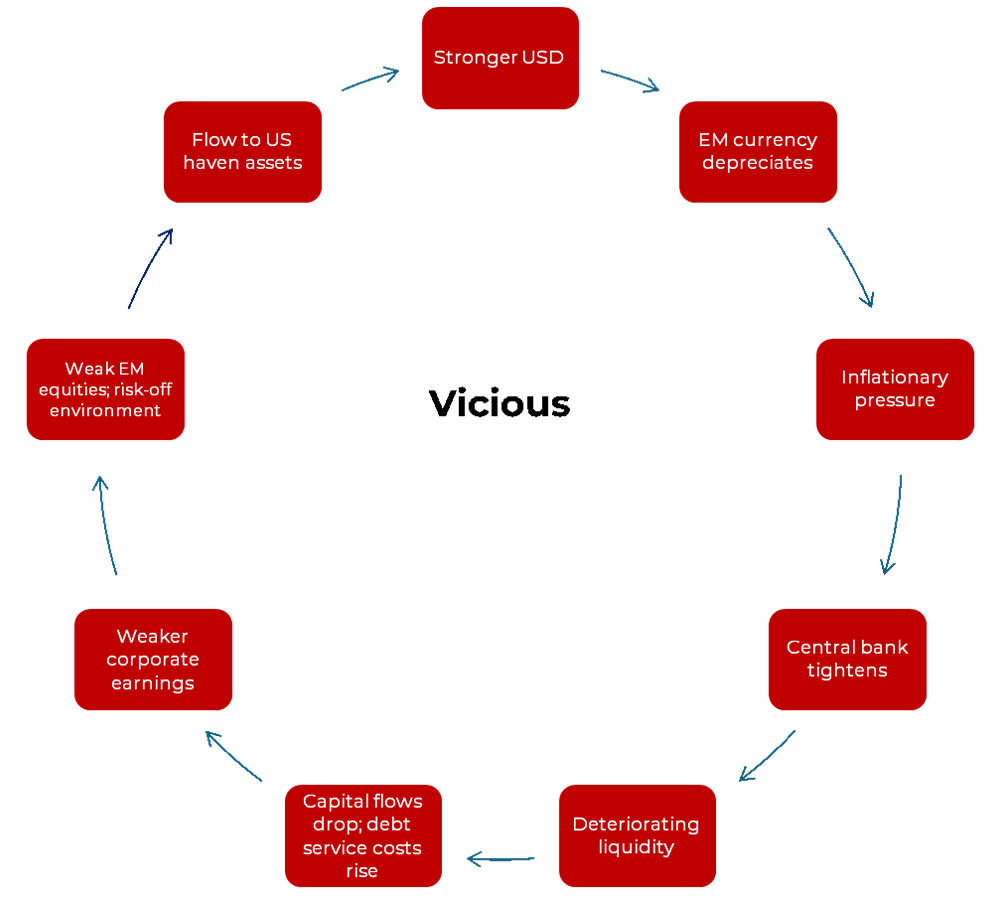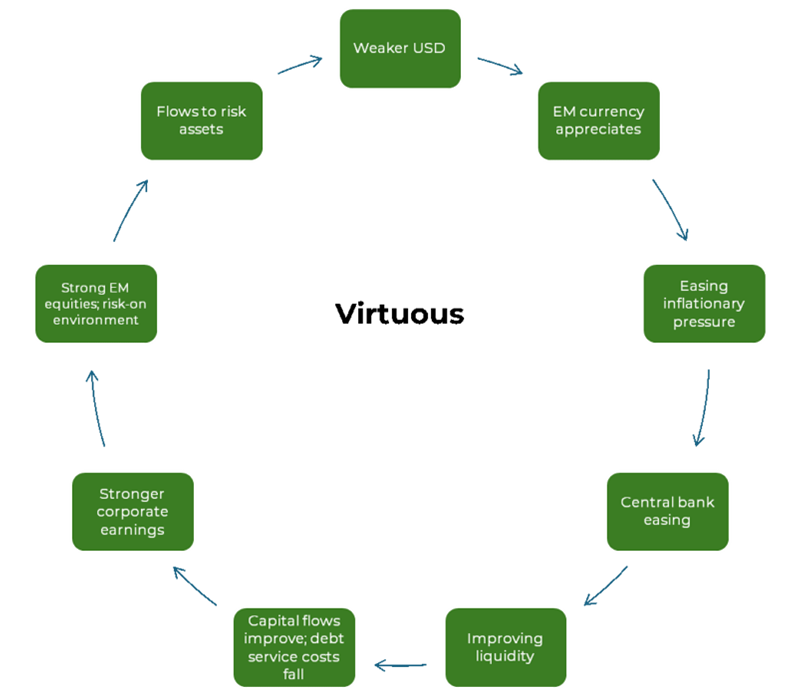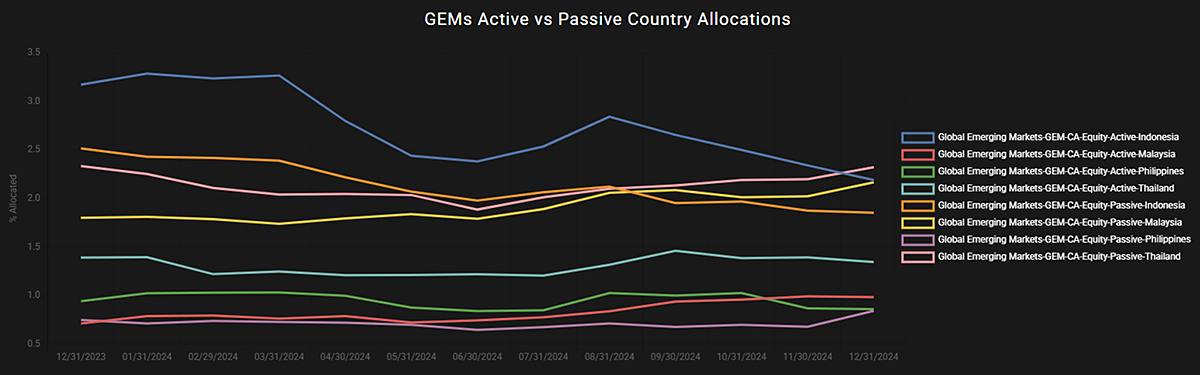
MSCI indices for continental Europe and China have outperformed year-to-date – see chart 1.

Chart 1

190225c1

The pattern of returns echoes monetary trends: six-month real narrow money growth has picked up in China and continental Europe while moving sideways in the US, with Japan and the UK lagging – chart 2.

Chart 2

190225c2

A previous post noted that Chinese money / credit numbers strengthened significantly in December. The pick-up was sustained in January: six-month growth rates of the narrow / broad monetary aggregates followed here rose further and are back around the middle of recent historical ranges – chart 3.

Chart 3

190225c3

The official M1 definition has been revised to include personal demand deposits, aligning it with international practice. The new measure is close to the “true M1” aggregate used here historically.

Annual growth of official M2 eased from 7.3% in December to 7.0% in January. The slowdown, however, reflected a fall in bank deposits held by non-bank financial institutions – movements in such deposits are less informative about economic prospects. Annual and six-month growth of non-financial M2 rose further in January.

The sharp turnaround in six-month narrow money momentum has been mirrored by a “credit impulse” measure based on the six-month flow of total social financing – chart 4.

Chart 4

190225c4

The turnaround in money / credit momentum partly reflects the negative impact of regulatory changes last spring dropping out of six-month calculations. Seasonal adjustment is more uncertain in January / February because of New Year timing effects. Money / credit growth is not yet strong by historical standards.

Still, money trends warrant increased confidence that domestic demand growth will recover sufficiently to offset any loss of support from net exports due to trade conflict.

MSCI China remains on a steep valuation discount to the rest of EM despite recent outperformance – chart 5. Chinese six-month real narrow money momentum is now stronger than in most other EMs – chart 6.

Chart 5

190225c5

Chart 6

190225c6

Aerial view of Hoai river with boat traffic at night in Vietnam.

Much ink has been spilt recently on the falling fortunes of the Chinese economy. While the OG dragon of Asia struggles with the malaise of a weak economy and declining population, a smaller dragon in the neighbourhood has been making quiet economic strides earning the moniker “Ascending Dragon” owing to its geographical shape.

Vietnam is formally classified as a frontier market, but it looks and feels like an emerging market economy that has arrived. In 2024, we saw a parade of high-profile executives from Tim Cook to Jensen Huang announce billions of dollars’ worth of investments. Sure, it has challenges, with the coming threat of tariffs and the recent turmoil in the property and corporate bond market. But with a new leadership and the upcoming prospect of being upgraded to an emerging market, Vietnam could very well consolidate its position as ASEAN’s newest growth engine.

The story of Vietnam’s rise parallels to some extent the timeline of China’s rise. After the ravages of the Vietnam War with its GDP per capita stagnating at $300, the government decided to introduce the “Doi Moi” reforms in 1986 to reorient the economy from the existing soviet central planning model to a “socialist market oriented” economy. It’s easy to forget that until as recently as 1994, Vietnam was under a US-led trade embargo.

With the embargo lifted, tailwinds from globalization in the 1990s and early 2000s boosted the economy as it joined the ASEAN free trade zone in 1995 and the World Trade Organization in 2007. Investments in primary education and infrastructure to equip a young and restless population (now approaching 100 million) has paid off handsomely. The result has been an average GDP growth rate of 6.8%, far ahead of its ASEAN peers as seen below.

ASEAN-6: GDP growth
Line graph illustrating Vietnam's recorded and projected growth compared to other ASEAN countries.
Source: Oxford Economics

What makes Vietnam interesting in our opinion is its positioning as a neutral player in the current geopolitical climate. As key trading partners like the United States have looked to diversify their supply chain from China, Vietnam has received foreign direct investment (FDI) from both the United States and China while also receiving FDI from big players like Korea and Japan. Geographical proximity, its strategic maritime location and similar culture make it an easy choice for global companies to relocate their factories. The World Bank expects Vietnam to grow at 6.7% in 2025, making it the second fastest growing economy behind India.

It also expects to draw $25 billion in additional capital into the stock market by 2030 if it gets classified by the FTSE as an emerging market later this year. Vietnam took an important step in this direction last year when it eliminated “prefunding,” the practice of ensuring investors have sufficient funds before purchasing a security. In a market that is 90% retail driven, we expect institutional participation to lift trading multiples, leading to better liquidity and market efficiency. Finally, crossing the much higher hurdle of the MSCI’s criteria for emerging market classification (expected between 2026-28) means Vietnam would get the full attention it deserves as the ascendant dragon of Asia.

One of the holdings in our portfolio that is a beneficiary of the rise of the Vietnamese consumer is Phu Nhuan Jewelry JSC (PNJ VN). With over 400 stores, PNJ is the market leader in branded jewelry space in Vietnam. It caters to the mid- and high-end consumer, offering everything from gold bars to value-added jewelry and high-end watches. It has a longstanding relationship with traditional artisans, allowing it to manufacture up to 4 million pieces of jewelry every year making it fully vertically integrated.

The beauty of investing in emerging markets is seeing parallels in themes, customs and market dynamics across disparate markets. Similar to India, the Vietnamese consumer has a deep love for gold for reasons both material and spiritual. Besides bringing health and good luck, a history of war, foreign occupation and hyperinflation means gold remains top of mind as a store of value vs. the more recently introduced Vietnamese Dong. We also see similarities to India with regard to formalization of the economy with over 70% of the jewelry sector in Vietnam operating in the unorganized space, providing a long runway of growth for PNJ.

INFRA_NEWS_2025-01-31_Banner

L’année 2024 a été marquée par une croissance record pour CC&L Infrastructure à l’échelle de notre portefeuille, de notre équipe et de notre clientèle.

Points saillants de 2024

Graphique présentant les points saillants de 2024 - 1. Augmentation de plus de 1,4 milliard de dollars ou plus de 25 % de l’actif sous gestion brut. 2. Conclusion de quatre nouveaux placements de grande qualité. 3. Capacité brute de production d’énergie propre de notre plateforme d’énergies renouvelables supérieure à 2 GW. 4. Croissance de notre équipe de plus de 20 % sur 12 mois avec l’ajout de huit nouveaux membres au sein de nos équipes de placement, de gestion d’actifs et des finances. 5. Plus de 100 actifs sous-jacents dans notre portefeuille diversifié d’infrastructures.

Un rythme de déploiement accéléré dans les secteurs nouveaux et existants, ce qui diversifie davantage notre portefeuille d’infrastructures

CC&L Infrastructure a déployé un montant record d’environ 600 millions de dollars en 2024, entièrement lié à des occasions repérées de façon bilatérale, hors des processus généraux de ventes aux enchères. Les nouveaux investissements couvrent les segments de l’énergie renouvelable, du transport et des infrastructures sociales. Ils comprennent notre premier investissement dans le secteur du logement étudiant. Ces ajouts ont élargi la taille de notre portefeuille d’infrastructures à plus de 100 actifs, diversifiés entre les secteurs et principalement situés en Amérique du Nord.

Infra-Update-20250203-windturbines

Parc éolien de Sharp Hills

Située dans le sud-est de l’Alberta, il s’agit l’un des plus grands parcs éoliens terrestres au Canada, sa capacité étant d’environ 300 MW, ce qui représente une production d’énergie propre équivalant à la consommation d’électricité de plus de 160 000 foyers en Alberta.

Infra-Update-20250203-schoolbuses

Twin City Transportation

Cet investissement dans un important fournisseur de services de transport en éducation spécialisée au Minnesota, est un ajout à la plateforme élargie de transport pour étudiants Landmark, qui comprend plus de 250 itinéraires desservis par environ 175 véhicules.

Infra-Update-20250203-windturbinesinwinter

Actifs éoliens en Ontario

Deux projets éoliens dans le sud de l’Ontario, Armow Wind et Grand Renewable Wind, ont une capacité brute totale d’environ 330 MW et produisent de l’énergie équivalant à la consommation annuelle de près de 290 000 Ontariens.

Infra-Update-20250203-studenthousing

Logements pour étudiants Northside

Quatre résidences pour étudiants situées à l’Université du Texas à Dallas. Le complexe a été construit entre 2016 et 2021, et se compose de 1 200 unités ayant la capacité de loger environ 2 500 étudiants. Les baux fonciers à long terme de Northside avec l’université ont une durée restante moyenne de plus de 50 ans.

Stratégie de placement rigoureuse

CC&L Infrastructure met l’accent sur les placements dans des infrastructures de qualité supérieure du marché intermédiaire en Amérique du Nord qui offrent des services essentiels et créent de la valeur pour les parties prenantes, y compris nos clients, nos partenaires et les collectivités locales dans lesquelles nos projets sont situés.

Infra-Update-20250203-solarpanels

.

Notre approche différenciée :

  • La structure à capital variable donne aux investisseurs un accès immédiat à un portefeuille important et diversifié d’actifs d’infrastructures
  • Portefeuille établi affichant de solides antécédents sur près de 15 ans2
  • Base d’actifs largement composée de projets faisant l’objet de contrats à long terme conclus avec des acheteurs de grande qualité3
  • Équipe interne attitrée de gestion d’actifs possédant une solide expérience en construction et en exploitation et qui assure une surveillance stratégique pour améliorer le rendement

À propos de CC&L Infrastructure

CC&L Infrastructure investit dans des infrastructures du marché intermédiaire qui présentent un profil risque-rendement intéressant, une longue durée de vie et un potentiel de production de flux de trésorerie stables. À ce jour, CC&L Infrastructure a accumulé un actif sous gestion de plus de 7 milliards de dollars4, couvrant divers secteurs, types d’actif et régions, et compte une centaine d’installations sous-jacentes réparties dans plus de 35 placements individuels. CC&L Infrastructure est membre du Groupe financier Connor, Clark & Lunn Ltd., une société de gestion de placements dotée d’une structure multientreprise, dont les sociétés affiliées gèrent collectivement un actif de plus de 139 milliards de dollars.

Pour en savoir plus sur la stratégie, le portefeuille et les critères de placement de Connor, Clark & Lunn Infrastructure, communiquez avec :

MONTAGE ET EXÉCUTION DES PLACEMENTS
Photo of Matt O'Brien

Matt O’Brien

Président

T: +1 (416) 360-7382

E: [email protected]

Photo of Ryan Lapointe

Ryan Lapointe

Transport

T: +1 (416) 216-3545

E: [email protected]

Photo of David Chatburn

David Chatburn

Énergie

T: +1 (416) 862-6169

E: [email protected]

Photo of Eric Reidel

Eric Reidel

Énergie

T: +1 (416) 862-6125

E: [email protected]

Photo of Andrew Parkes

Andrew Parkes

Numérique

T: +1 (416) 956-9384

E: [email protected]


RELATIONS AVEC LES INVESTISSEURS
Photo of Kaitlin Blainey

Kaitlin Blainey

Directrice générale

T: +1 (416) 216-8047

E: [email protected]

Photo of Sonia Weiss

Sonja Weiss

Vice-présidente

T: +1 (437)-561-6184

E: [email protected]


1. Représente la croissance de la valeur évaluée au marché du capital investi par CC&L Infrastructure et ses clients, y compris le capital d’investissement et de co-investissement et la quote-part de CC&L Infrastructure dans la dette connexe au 31 décembre 2024.

2. Le rendement historique de la stratégie de CC&L Infrastructure est celui du composé de CC&L Infrastructure, qui comprend le rendement des séries des fonds en gestion commune du Portefeuille d’infrastructures – Client privé, des séries des fonds en gestion commune du Portefeuille institutionnel de CC&L Infrastructure et des séries en gestion commune du Fonds institutionnel de CC&L Infrastructure imposable. Le composé a été créé en mars 2014 et les rendements remontent à septembre 2011.

3. Principalement des contrats de 20 à 40 ans avec des contreparties gouvernementales ou d’autres contreparties solvables. De nombreux contrats comportent également des caractéristiques avantageuses, notamment des ententes d’achat ferme et une indexation à l’inflation.

4. Représente la valeur évaluée au marché du capital investi par CC&L Infrastructure et ses clients, y compris le capital d’investissement et de co-investissement et la quote-part de CC&L Infrastructure dans la dette connexe au 31 décembre 2024.

Sauf indication contraire, toutes les données sont en date du 31 décembre 2024 et exprimées en dollars canadiens ($ CA). Source : Groupe financier Connor, Clark & Lunn Ltd. Le présent document, y compris les pièces jointes, vous est fourni à titre de renseignement uniquement, et l’information qu’il contient est privée et confidentielle. Il est destiné exclusivement au destinataire et son contenu ne peut être utilisé, diffusé, distribué, reproduit ou copié de quelque manière que ce soit, en totalité ou en partie, sans une autorisation écrite préalable expresse de CC&L Infrastructure. Certains renseignements contenus aux présentes se fondent sur des informations obtenues de sources tierces que CC&L Infrastructure considère comme étant fiables. Nous considérons que ces renseignements sont fiables, mais CC&L Infrastructure ne fournit aucune assurance et décline toute responsabilité quant à l’exactitude, à l’impartialité ou à l’exhaustivité des renseignements provenant de tiers et qui sont contenus aux présentes. Le rendement passé n’est pas une indication du rendement futur, les rendements ne sont pas garantis et une perte de capital est possible. Les opinions, les estimations et les prévisions que contient le présent document représentent l’avis de CC&L Infrastructure en date du présent document et peuvent changer sans préavis. Le présent document a été préparé sans que soient pris en compte la situation financière et les objectifs particuliers des personnes qui le reçoivent, et il ne vise pas à fournir des conseils de nature juridique, comptable ou fiscale ni à offrir des conseils de placement personnalisés. Ainsi, les personnes qui lisent le présent document devraient consulter des professionnels indépendants pour obtenir des conseils adaptés à leur situation particulière. Les renseignements contenus dans le présent document ne constituent ni une offre d’achat ni une sollicitation de vente de titres et ne doivent pas être utilisés comme outil de communication de vente.

The Bank of England expects rises in regulated prices and taxes to push headline CPI inflation up to 3.5% by June but the forecast likely underestimates disinflationary pressure from monetary weakness.

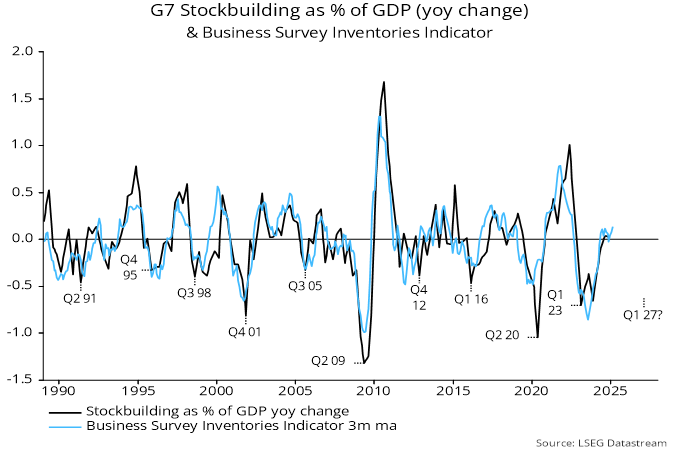
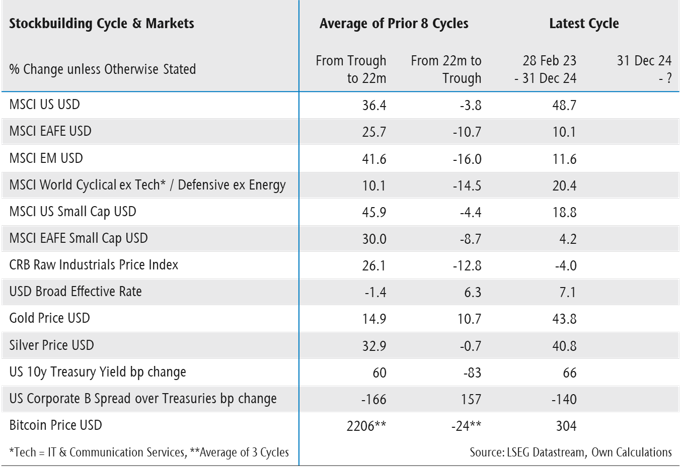
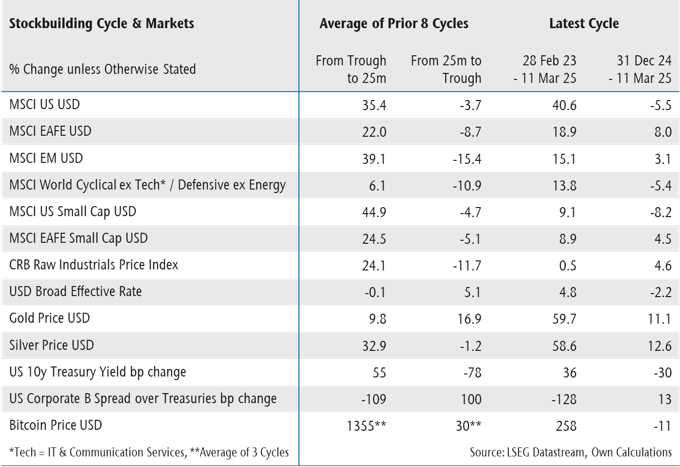
The near-term inflation outlook globally is subject to cross-currents. Earlier monetary weakness is bearing down on underlying pressures but the position of the stockbuilding cycle suggests a rise in commodity prices: the cycle appears to be mid-upswing and industrial commodity prices typically climb into the peak – see chart 1.

Chart 1

120225c1

Higher tariffs, meanwhile, will have a one-off direct impact on measured prices and indirect effects via increased costs and supply disruption.

The UK near-term inflation profile is being additionally boosted by the imposition of VAT on school fees and large rises in some regulated prices. The Bank of England estimates that changes in the energy price cap will lift annual CPI inflation by 0.6 pp between December 2024 and June 2025, with the VAT effect and rises in regulated prices – including an average 26% increase in water bills – adding a further 0.45 pp.

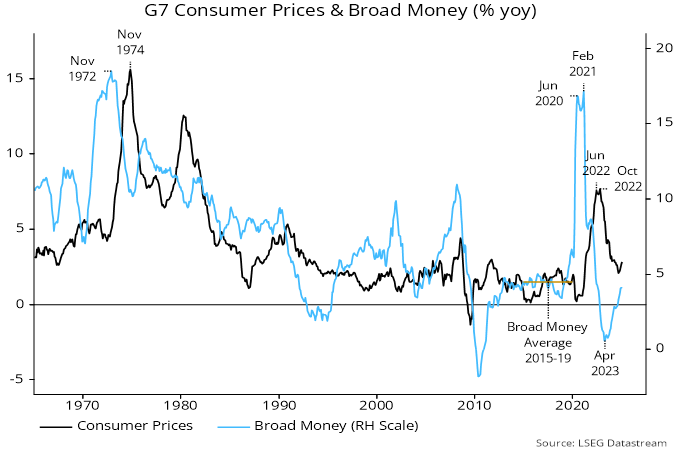
Central banks, including the MPC, worry that a near-term inflation bump due one-off influences will dislodge expectations and become embedded. Monetarists argue that ample money growth is required for such “second-round” effects to emerge. G7 annual broad money growth continues to recover but is currently still below its pre-pandemic (i.e. 2015-19) average, which was associated with below-target headline and core inflation averages – chart 2. The same is true in the UK.

Chart 2

120225c2

Coming UK inflation numbers will require careful interpretation. The conventional core rate – excluding energy, food, alcohol and tobacco – will overstate underlying pressures because of the above policy effects. A “true” core measure should, at a minimum, exclude the impact of the VAT change and rises in bus fares and water bills.

The Bank of England staff forecast implies a rise in the conventional core rate from 3.2% in December 2024 to 3.6% by June 2025. Calculations here suggest that this would be consistent with the above “true” core measure slowing from 3.2% to 2.8% over the same period – chart 3.

Chart 3

120225c3

The monetarist rule of thumb of a roughly two-year lag between monetary and price developments suggests strong downward pressure on underlying inflation in 2025. “True” core inflation may fall by significantly more than the Bank expects.

Charts 4 and 5 show a long-term history of annual broad money growth and an adjusted core inflation measure (based on RPI rather than CPI in earlier years). The charts respectively highlight paired peaks and troughs in the series. The mean and median lags at all the highlighted turning points were 26 and 28 months, i.e. slightly longer than posited by the rule of thumb. With broad money growth bottoming in October 2023, the suggestion is that a downtrend in underlying inflation could extend into early 2026.

Chart 4

120225c4i

Chart 5

120225c5i

The historical variability of the money growth / inflation lag in the UK mainly reflects the influence of the exchange rate. The favourable assessment of underlying inflation prospects above is conditional on avoidance of significant sterling depreciation.

Person using phone in a bright room full of colourful lights.

This month we dig into the frenzy over China’s DeepSeek and ask whether this has punctured the narrative of US tech supremacy.

Has DeepSeek just punctured the market narrative of American tech supremacy? We think that is a stretch, but the revelation of DeepSeek’s ability to innovate in AI with shocking efficiency is a reminder that there are only two contenders in this battle to build artificial general intelligence – China and the United States.

DeepSeek has unveiled two new models – DeepSeek-V3 and DeepSeek-R1, as well as instructions called R1 Zero – that deliver performance on offerings from OpenAI and Anthropic. These models have set off a media and market frenzy, both because they appear to match or exceed the capabilities of more famous systems, and because DeepSeek is offering API access at a fraction of the cost.

Highlights:

  1. DeepSeek uses a method called reinforcement learning. Essentially, the models are allowed to solve the problems themselves with few guidelines and limited example solutions. Remarkably, this was accomplished using only 8,000 math problems, whereas other research groups often need millions.
  2. DeepSeek has managed to compress memory usage, circumventing the need for loads of expensive GPUs.
  3. DeepSeek has shown that AI models can work remotely and on edge computing very effectively without needing the power of data centres.

Overall, DeepSeek demonstrated that you don’t have to invest massive amounts (exactly how much is debatable) of money, hardware or human oversight to build an AI that excels at difficult tasks. The arguments about how much money they spent to get here are irrelevant: by relying on focused reinforcement learning and efficiency-boosting techniques, DeepSeek proved that powerful models can be created with fewer resources.

All training steps and code have been shared so others can also try it and change things, making concerns over “censorship” entirely moot. The result was a model that can rival Anthropic and OpenAI, even when turned into a much smaller version that can be run locally on a pair of Mac Minis! (Which use ARM architecture: the M4 Pro uses TSMC 3nm, and runs at 80W.)

The team behind DeepSeek is open about its own limitations. First, the model is akin to a brilliant scientist but would struggle to write a poem as it lacks “creativity.” Second, it doesn’t deal with languages beyond English and Chinese very well. And third, it lacks the experience in building large-scale software projects.

Implications

Anyone who has followed this story is probably now aware of Jevons Paradox. Originating from the work of economist William Stanley Jevons in 1865, the observation suggests that as technological advancements make a resource more efficient to use, the overall consumption of that resource may increase rather than decrease. This paradox occurs because increased efficiency often lowers the cost of using the resource, leading to greater demand and, ultimately, higher total consumption.

Applying Jevons Paradox to AI tools, as these technologies become more efficient and cheaper, their usage is likely to grow significantly. Just as more-efficient cars led to wider adoption over horses, more-efficient and cost-effective AI models like DeepSeek’s will encourage broader usage across various industries. This greater adoption can drive further innovation, but it also means that the demand for AI resources, such as data and computing power, will continue to rise.

As a result, businesses and developers will need to consider the implications of widespread AI deployment, including potential increases in energy consumption and the need for sustainable practices in AI development and usage.

To summarise:

  1. Large language models (LLM) have become commoditized. For instance, Meta’s Llama (an LLM) is open-source and therefore free. The key takeaway here is that the cost and compute requirements to run these models could potentially be reduced significantly.
  2. The implication is that demand for AI infrastructure including computer chips, the semiconductor supply chain and power requirements (particularly for AI training) may be lower than first thought.
  3. However, as highlighted by Jevons Paradox, history shows that for most technological advancements, reduced costs are almost always offset by increased demand.

What does this mean for the stocks of different global tech leaders?

It’s still early days, but how could the broad adoption of DeepSeek models impact global tech leaders’ stock prices?

Type of tech company Stock impact
AI infrastructure and some semiconductor companies
Jevon’s paradox will likely spur more AI applications, with the end result potentially being greater demand for compute down the line. However, the market is questioning the margins of semiconductor players and infrastructure solution providers (i.e. cooling tech). We need to see the mix of LLMs vs. “distilled models” and, more importantly, inferencing vs. training. Training requires much less compute power than inferencing.
Unclear
Hyperscalers
On one hand, processing AI could become significantly cheaper which will reduce their cost/capex. On the other, their moat could be lowered if AI workloads can be run on less powerful data centres. Microsoft has already stated that it is prioritizing enterprise inference workload over AI training for its Azure business. That is why OpenAI went to Oracle/Softbank/Project Stargate for compute because Microsoft won’t sell them all the compute OpenAI demanded.
Neutral/unclear
Application-specific integrated circuit (ASIC) companies
Possibly beneficial for custom ASICs as chip architecture diversifies/specialises.
Neutral/unclear
Applications, such as software, with access to proprietary data
This is where I believe the most significant AI equity value will be created over time. Lowering AI costs is unlikely to negatively impact these companies. In fact, it could even be a positive development. The moat is in the access to data. Compute is a cost item.
Positive/unclear
Specialised edge computer chip companies Positive/unclear

In emerging markets, we believe major positions like Taiwan Semiconductor Manufacturing Company (TSMC), Mediatek and select niche names (in custom chip design and energy efficiency) remain well positioned for growth in overall demand for AI. We doubt that DeepSeek will change the demand for the highest performance chips running at the lowest possible power. In that regard, TSMC’s dominance in leading-edge production processes and advanced packaging solutions remain an intact competitive moat. We expect that their customer mix may change, but the demand for their capabilities will be resilient.

We are more cautious on data centre assemblers and memory, and see potential for an improving sentiment in software, with several high-quality names in the portfolio and on our watchlist in China, ASEAN and Latin America.

Un papier adhésif avec l'inscription « N'oubliez pas ! » accroché à une corde à l'aide d'une pince à linge.

Les actions canadiennes ont été délaissées au profit des actions mondiales, phénomène qui a coïncidé avec l’émergence de placements en actions mondiales à petite capitalisation, lesquels visaient à améliorer davantage la diversification du portefeuille. Combinés, ces changements ont fait en sorte que les actions canadiennes à petite capitalisation sont devenues une catégorie d’actif oubliée. Bien que la pondération des actions canadiennes ait été réduite, nombreux sont les investisseurs qui ont une répartition importante dans cette catégorie d’actif. Cet article traite des avantages qu’offrent les actions canadiennes à petite capitalisation et de la façon dont les investisseurs peuvent éventuellement en profiter.

Vue d’ensemble des actions canadiennes à petite capitalisation

En règle générale, les sociétés à petite capitalisation offrent aux investisseurs un plus grand potentiel de croissance, mais elles sont aussi sujettes à un risque et une volatilité plus élevés que les sociétés à grande capitalisation. L’indice des titres à petite capitalisation S&P/TSX est un indice pondéré en fonction de la capitalisation boursière et rajusté en fonction du flottant. Il a été conçu comme un indice de référence de premier plan pour les détenteurs de titres à petite capitalisation du marché boursier canadien.

À la fin de septembre 2024, l’indice comptait 246 sociétés dont la capitalisation boursière totale s’élevait à 279 G$ CA. La capitalisation boursière moyenne des sociétés constituant l’indice était de 1,1 G$ CA, mais la taille des sociétés variait dans une fourchette assez large, la plus petite étant évaluée à 97 M$ CA et la plus importante, à 4,0 G$ CA. À titre de comparaison, la Banque Royale du Canada, la plus importante société de l’indice composé S&P/TSX, a une capitalisation boursière supérieure à 170 G$ CA.

L’indice composé S&P/TSX comprend les titres d’un petit nombre de sociétés. Les dix plus grandes sociétés représentaient plus de 35 % de l’indice à la fin de septembre 2024, la Banque Royale du Canada à elle seule représentant 6,9 % de l’indice. En revanche, l’indice des titres à petite capitalisation est plus diversifié, les 10 principales sociétés en représentant moins de 15 %. Le titre le plus important a été celui de Bausch Health Cos Inc., qui représentait 1,4 % de l’indice des titres à petite capitalisation.

Comparaison des rendements des actions à petite et à grande capitalisation

Les rendements des petites et des grandes sociétés varient au fil du temps en fonction de la conjoncture économique générale. Au cours des 40 dernières années, il est apparu de façon relativement constante que les titres à petite capitalisation ont tendance à reculer davantage que les titres à grande capitalisation en période de marché baissier, mais qu’ils rebondissent plus fortement lorsque l’humeur des investisseurs change.

Deux illustrations récentes de cet état de fait sont la crise financière mondiale et la pandémie de COVID-19 (figure 1). Au cours de ces deux périodes, les actions à petite capitalisation ont inscrit des rendements inférieurs lorsque les marchés ont reculé, mais nettement supérieurs aux actions à grande capitalisation à l’étape de la reprise.

Figure 1 – Comparaison entre le rendement relatif de l’indice MSCI Monde à petite capitalisation et celui de l’indice MSCI Monde*
Graphique comparant la performance relative du MSCI World Small Cap par rapport au MSCI World pendant la crise financière mondiale et le COVID-19.Sources : MSCI, FTSE Russell et Thomson Reuters.

La figure 2 illustre clairement l’ampleur de la reprise des petites capitalisations en 2020, en particulier celle des petites capitalisations canadiennes. Elle montre que l’indice canadien des titres à petite capitalisation a progressé de plus de 80 % au cours des neuf derniers mois de 2020, ce qui lui a permis de dégager un rendement pour l’ensemble de l’année civile plus de deux fois supérieur à celui de l’indice composé S&P/TSX. La situation a été la même pour les sociétés mondiales à petite capitalisation des marchés développés par rapport aux sociétés à grande capitalisation.

Figure 2 – Rendements des indices en 2020 (en $ CA)

Catégories d’actif Indice du marché Rendement au T1 (%) Période de neuf mois terminée le 31 décembre 2020 (%) Année civile 2020 (%)
Actions canadiennes Indice composé S&P/TSX -20,9 33,5 5,6
Actions canadiennes à petite capitalisation Indice des titres à petite capitalisation S&P/TSX -38,1 82,4 12,9
Actions mondiales Indice MSCI Monde -13,2 31,9 14,4
Actions mondiales à petite capitalisation Indice MSCI Monde à petite capitalisation -23,1 48,1 13,9

Sources : MSCI, FTSE Russell et Thomson Reuters.

Avantages potentiels

Bien que les actions à petite capitalisation soient généralement plus volatiles, elles présentent plusieurs avantages qui compensent cet inconvénient.

Potentiel de croissance : Les sociétés de petite taille ont tendance à disposer d’une plus grande souplesse pour saisir les occasions ou faire face à l’adversité, et lorsqu’elles offrent un produit ou un service très recherché, leur croissance potentielle s’en trouve nettement prolongée. Les grandes sociétés commencent petites. Si vous êtes en mesure de repérer la prochaine génération de petites sociétés qui connaissent une croissance rapide et qui deviennent de grandes sociétés, vous serez largement récompensé. On oublie facilement que la capitalisation boursière de Shopify, qui est évaluée à plus de 220 G$ CA, était inférieure à 1,5 G$ CA en juin 2015 (Macrotrends.net). En règle générale, les petites sociétés exercent aussi leurs activités dans des secteurs plus spécialisés, et les initiés y détiennent une participation plus élevée, de telle sorte que les propriétaires et les actionnaires partagent les mêmes intérêts.

Différences sectorielles : L’indice des titres à petite capitalisation S&P/TSX n’est pas une version miniature de l’indice composé S&P/TSX. Par conséquent, les investisseurs peuvent profiter de la représentation sectorielle différente dans l’indice des titres à petite capitalisation, lequel offre ainsi des occasions qui pourraient ne pas exister dans le segment des titres à grande capitalisation du marché (figure 3). Par exemple, au cours des neuf premiers mois de 2024, le secteur des services de communications de l’indice composé S&P/TSX a reculé de 2,5 %, tandis que le secteur des services de communications de l’indice des titres à petite capitalisation S&P/TSX a progressé de 18 % au cours de la même période.

Les sociétés de petite taille ont tendance à disposer d’une plus grande souplesse pour saisir les occasions ou faire face à l’adversité, et lorsqu’elles offrent un produit ou un service très recherché, leur croissance potentielle s’en trouve nettement prolongée. 

Figure 3 – Répartition sectorielle des actions canadiennes

Sector Indice composé S&P/TSX (%) Indice des titres à petite capitalisation S&P/TSX (%)
Énergie 16,7 19,1
Matériaux 12,5 30,7
Industrie 13,0 12,0
Consommation discrétionnaire 3,4 3,4
Biens de consommation de base 4,1 2,9
Santé 0,3 6,2
Finance 32,2 6,5
Technologies de l’information 8,5 5,2
Services de communication 3,1 1,5
Services aux collectivités 4,0 1,5
Immobilier 2,3 10,8
Total 100,0 100,0

Source: MSCI, FTSE Russell et Thomson Reuters.

Visées par moins de recherches : Les sociétés à petite capitalisation font généralement l’objet de moins de recherches de la part des analystes externes. Le nombre d’analystes de recherche couvrant à la fois les actions à grande et à petite capitalisation a diminué au cours des 10 dernières années et celui des analystes couvrant les sociétés à petite capitalisation est nettement inférieur (figure 4).

Figure 4 – Nombre d’analystes couvrant les sociétés de l’indice S&P/TSX
Graphique à barres illustrant le nombre d'analystes couvrant les sociétés à grande capitalisation de l’indice S&P/TSX par rapport aux sociétés à petite et moyenne capitalisation de l’indice S&P/TSX.
Source : Bloomberg

Souvent, les analystes de recherche qui couvrent les sociétés à petite capitalisation sont moins expérimentés que ceux qui couvrent les sociétés à grande capitalisation. Ces différences créent de meilleures occasions pour les gestionnaires actifs de surpasser l’indice de référence en procédant à une vérification diligente indépendante de ces sociétés moins bien documentées et dont le cours de l’action peut ne pas refléter pleinement leur valeur intrinsèque ou leurs perspectives de croissance.

Collectivement, les gestionnaires actifs d’actions à petite capitalisation ont généré une valeur ajoutée dépassant celle de l’indice des actions à petite capitalisation. Plus des trois quarts des gestionnaires actifs ont enregistré un rendement annuel supérieur d’au moins 1,9 % à celui de l’indice pour la période de 10 ans terminée le 30 septembre 2024. La valeur ajoutée médiane sur 10 ans était de 3,5 % par année (figure 5).

Figure 5 – Rendements excédentaires générés par la gestion active
Graphique à barres illustrant le rendement excédentaire annualisé des gestionnaires actifs de petites et moyennes capitalisations par rapport à l'indice S&P/TSX à petite capitalisation.Source : eVestment

Collectivement, les gestionnaires actifs d’actions à petite capitalisation ont généré une valeur ajoutée dépassant celle de l’indice des actions à petite capitalisation. 

Pourquoi investir dans les actions canadiennes à petites capitalisations

Malgré une réduction générale de la pondération des actions canadiennes, beaucoup d’investisseurs institutionnels détiennent une répartition importante dans cette catégorie d’actif. En incluant les actions canadiennes à petite capitalisation, les investisseurs peuvent exploiter un type différent d’exposition au marché ainsi que le potentiel de valeur ajoutée découlant de la gestion active.

Silhouette of a passenger waiting in an airport.

When the COVID-19 lockdowns happened, it was no surprise that travel-related stocks were among the hardest hit. However, as the world emerged from the pandemic, these stocks saw an impressive recovery as people were eager to start traveling again. With tourists armed with excess savings accumulated during the pandemic, tourism and business travel rebounded, filling planes, hotels and rental cars around the globe.

Now, fast forward to 2025, the post-pandemic recovery is behind us and the picture looks very different. Consumer spending data indicates a slowdown as higher interest rates and the potential return of inflation are putting a pinch on consumers. Even though personal savings are now back down below pre-pandemic levels, it’s important to focus on absolute wage growth, which remains strong in many regions. In other words, people are earning more, but also need to spend more just to maintain their lifestyles.

US disposable personal income and personal savings
Line chart comparing household disposable income and personal savings in the US.Source: The Fed – An update on Excess Savings in Selected Advanced Economies

With the weak outlook for consumer spending, the question arises: should we really be viewing all categories of discretionary spending the same way? In a market that’s constantly swayed by daily news and short-lived noise, it’s crucial to look past the temporary trends or « hype. » Instead, we should focus on identifying secular trends – those underlying shifts – that will remain resilient, no matter where we are in the economic cycle. From our perspective, travel and leisure is certainly an industry that will benefit from one of these secular shifts in the years to come.

  • One trend we’ve been seeing is a shift from spending on goods to a growing preference for experiences. With wage growth remaining strong across developed markets, there comes a point where consumers naturally pivot – there’s only so much you can buy, but experiences, like travel, have no limits. That’s exactly what we’re seeing play out: higher-income groups in developed markets are showing a strong appetite for travel, and consumer surveys are backing this up with increasing indications of a preference for experiences over material goods.

Young affluents show stronger appetite for travel post-pandemic
Bar chart showing % of global consumers who agree with the statement, "Travel has become more important since the pandemic."
Source: Understanding affluent travel behaviors and aspirations

  • Another key tailwind for the resilience of travel, even in a weak consumer spending environment, is the rising demand from the emerging market middle class. As some emerging economies such as India, China, Korea, Mexico and Brazil continue to develop, their expanding middle class is increasingly seeking travel experiences, both domestic and international. The World Economic Forum estimates that by 2030, Asia – home to three of the world’s five most populous countries (India, China and Indonesia) – will have 3.5 billion people in its middle class, making up two-thirds of the global middle class. Furthermore, a travel survey by Skift found that these travelers plan to allocate an average of 23% of their income to travel in the next year, with 81% stating that it remains a priority despite economic challenges.

India: Change in passenger arrivals vs. 2019 levels, by destination country

Line graph showing that Japan, the United States and Vietnam are seeing increasing numbers of visitor arrivals originating from India.
Source: Travel Trends 2024: Breaking Boundaries

  • Greater mobility is another key tailwind for travel-related companies. With remote work still prevalent worldwide, we’re seeing the rise of a new generation of digital nomads – individuals who leverage flexible work arrangements to explore the world. This shift toward a “work from anywhere” model is reshaping travel patterns and creating lasting demand for the travel and leisure industry.

Given our strong conviction in travel and leisure, here are some of the key plays in our portfolios and why we hold them.

Founded in 1912 by Martin Sixt, and managed by the family since, Sixt SE (SIX2 DE) is one of the oldest car rental companies in the world. The company is headquartered in Germany and operates across more than 110 countries. It differentiates itself from competitors through its premium car offering, thanks to its German heritage and strong relationship with German carmakers. Its motto is “Don’t rent a car, rent THE car.”

After becoming a top two player in Europe, Sixt has expanded in the United States by prioritizing a presence in the busiest airports, which has yielded above average results, but has brought some challenges along with it. The key difference between the US and European car rental business models lies in the accounting of fleet ownership. In the United States, rental companies primarily assume the risk of lease or buyback agreements, meaning they bear the depreciation risk.

Sixt experienced that risk first-hand in early 2024 when the resale value of electric vehicles fell as much as 20% and the company had to book accelerated depreciation in its book which sent the stock price down close to 30% over Q2. We took that opportunity to initiate a position in this high-quality name as we expect the impact of depreciation to be short term in nature as the management has taken steps to accelerate the rotation of its fleet. We remain confident in the company’s ability to successfully execute its US expansion plans and take market share from competitors such as Hertz and Avis.

Founded in 1995, easyJet plc (EZJ UK) is one of Europe’s leading low-cost carriers (LCC), offering a pan-European point-to-point flight network at a cost advantage to legacy and charter airlines. With a strong brand recognition, the company has grown notable presence at capacity-strained airports. Unlike ultra-low-cost-carrier (ULCC) peers, easyJet differentiates itself by operating from major primary airports rather than secondary hubs, prioritizing customer experience and maintaining competitive, flexible service offerings that command significant brand loyalty from its passengers. easyJet also benefits from a streamlined cost structure and ability to rapidly adjust capacity to market conditions, giving them a competitive advantage in times of sector disruption. Additionally, the company is taking market share from traditional full-service carriers by extending its reach beyond standard short-haul flights through its easyJet Holidays business, tapping into the roughly $80 billion European package holiday market. easyJet’s focus on cost efficiency, network optimization, diversifying revenue streams and gaining market share from legacy carriers positions it as a long-term winner in European aviation.

Meliá Hotels International S.A. (MEL ES) is a leading global hospitality group founded in Spain in 1956. As the second-largest hotel group in Latin America and the third largest in Europe, Meliá has expanded to over 390 hotels across 40 countries with 63 new hotels in the pipeline. The company operates through a multi-brand portfolio spanning the premium, upscale and midscale segments. Meliá caters to a diversified mix of leisure and business travelers in key resort destinations across the Americas, Spain and EMEA. Their strategy to increasingly adopt an asset-light model – more than half of their portfolio consists of managed and franchise properties – reflects their focus on scalability and margin improvement. Meliá differentiates itself with a strong brand portfolio, a high Global Reputation Index score, and growing direct-to-consumer sales, which enhance margins and strengthen customer loyalty. With an established presence in high-growth markets, along with its ongoing upscale repositioning and expansion pipelines, the company is well positioned for continued growth.

Founded in Denver, Colorado, Samsonite International S.A. (SMSEY) is the world’s largest lifestyle bag and travel luggage company. Its broad, high-quality broad portfolio includes Samsonite, Tumi, American Tourister, Gregory, High Sierra, Kamiliant, eBags, Lipault and Hartmann, collectively sold in over 100 countries through more than 1200 company-owned stores. Samsonite’s business model is centered on brand management, product design, and marketing, with 95% of its manufacturing outsourced to a global network of around 1,500 third-party facilities.

Samsonite’s asset-light structure allows them to prioritize brand building and innovation, reflected in their eco-friendly collections and omnichannel expansion, including a fast-growing e-commerce segment. The company is well positioned compared to its peers thanks to its scale-driven brand power and global presence resulting in a strong 17% market share of a roughly $22 billion luggage market. Additionally, their focus on cost control and supply-chain diversification reduces tariff risk and further supports margins, strengthening their position to achieve sustainable long-term growth.

Vue aérienne d'une foule de personnes marchant dans des directions différentes.

Peter Muldowney, vice-président principal et chef, Stratégie institutionnelle à catégories d’actifs multiples, discute avec Benefits and Pension Monitor. Dans l’article intitulé « The leading players in global equities », M. Muldowney rappelle aux lecteurs que, quelle que soit la catégorie d’actif, la diversification est la clé pour atteindre le résultat visé.

The forecast of global manufacturing acceleration into H1 2025 is playing out but lagged money trends suggest that the pick-up will stall over the spring / summer before resuming in late 2025. A trade war could turn a stall into a more serious set-back.

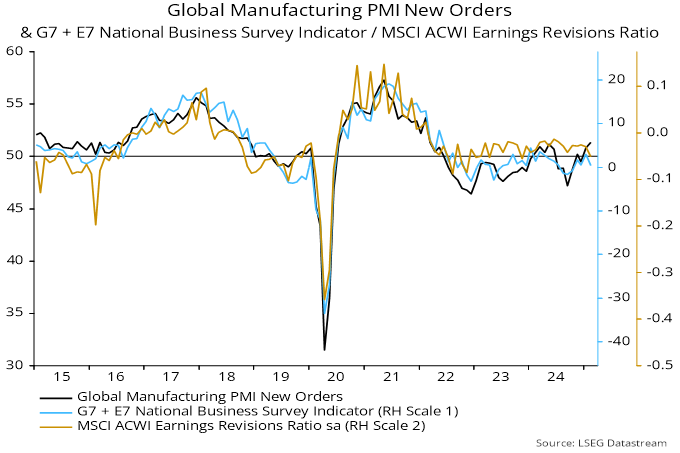
The global manufacturing PMI new orders index crossed back above the 50 level in January, reaching its highest level since May. An alternative indicator combining new orders or output expectations components of national business surveys (ISM for the US, Ifo for Germany, CBI for the UK etc) mirrored the PMI increase – see chart 1.

Chart 1

050225c1i

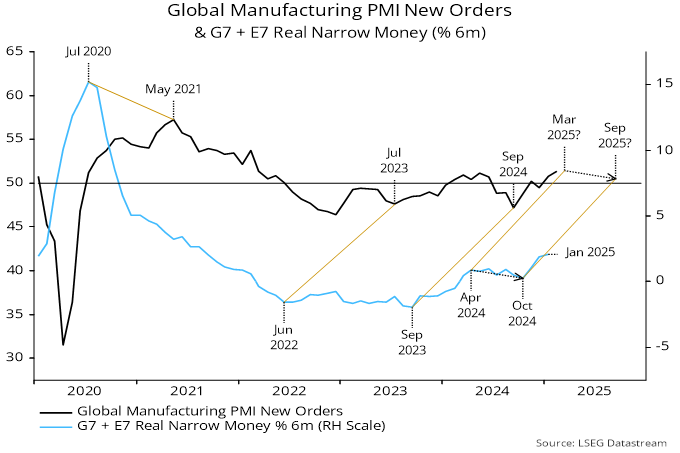
The forecast of a pick-up was based on a rise in global six-month real narrow money momentum from September 2023 through April 2024. Turning points in real money momentum have led survey turning points by 11-13 months in recent years. The survey lows in September 2024 arrived on schedule – chart 2.

Chart 2

050225c2

The leading relationship had been the basis for an earlier forecast of a “double dip” in the survey indicators into H2 2024.

The upswing in six-month month real narrow money momentum, however, stalled between April and October 2024, before resuming in November / December. Based on recent lead times, this suggests a local peak in PMI new orders / the alternative indicator around March 2025 and a minor fall through Q3.The latest money numbers are giving a positive signal for late 2025.

This profile, of course, takes no account of possible trade disruption from a US-led global tariff war, which could accentuate mid-year weakness and might also affect monetary prospects (to the extent that negative confidence effects cause households and firms to defer spending, reducing their demand to hold narrow money).

An alternative explanation for the recent manufacturing pick-up is that demand / production has been pulled forward as importers stockpile ahead of new or higher tariffs. Inventories components of business surveys, however, don’t currently suggest unusual behaviour – chart 3.

Chart 3

050225c3

The forecast of a minor peak in global manufacturing momentum this spring could imply relief for US Treasuries.

The low / stable inflation environment of the 2010s was associated with a strong positive correlation between Treasury yields and economic momentum. This broke down in 2021-22 as surging inflation became the dominant driver of yields – chart 4.

Chart 4

050225c4

With inflation normalising, the 2010s relationship may be returning. Lows in the business survey indicator in May 2023 and September 2024 were reflected in nearby lows in Treasury yields.

An approaching local peak in the survey indicator coupled with expected further favourable inflation news could open up downside for yields into H2.

UK money trends remain relatively weak, arguing that the MPC bears significant responsibility for economic underperformance.

Narrow and broad money – as measured by non-financial M1 / M4 – rose by 0.4% and 0.3% respectively in December, below gains of 0.9% and 0.6% for equivalent Eurozone measures,

UK six-month real narrow money momentum was static and barely positive in December, in contrast to higher and rising momentum in the Eurozone, Sweden and Switzerland, where policy rates fell by 100-150 bp during 2024 versus the UK’s 50 bp – see chart 1.

Chart 1

310125c1

Six-month growth of (nominal) broad money is similar in the UK and Eurozone (4.1% and 4.0% annualised respectively) but the UK sectoral breakdown is unfavourable – the increase was entirely attributable to households, with corporate money holdings stagnant.

The narrow money decomposition is worse. Six-month momentum of corporate real narrow money remains negative and has weakened since July. Eurozone momentum, by contrast, turned positive in October, rising further into year-end – charts 2 and 3.

Chart 2

310125c2

Chart 3

310125c3

Corporate money weakness suggests that companies were under financial pressure to retrench before the Budget national insurance raid.

The contention here is that household money holdings were boosted by asset sales in anticipation of possible tax changes in the Budget – see previous post. This effect may still be inflating six-month household and aggregate broad money growth.

Households, in any case, are unlikely to be in the mood to spend « excess » money holdings against a backdrop of corporate gloom and rising job losses – unless the MPC accelerates rate cuts.

The MPC’s inappropriately restrictive stance encompasses its QT operations as well as rate policy. The Bank of England’s gilt holdings fell by the equivalent of 3.2% of the broad money stock in the 12 months to December versus comparable reductions of 1.8% and 2.0% respectively in the US and Eurozone (i.e. in Fed holdings of Treasuries and Eurosystem holdings of Eurozone government securities).

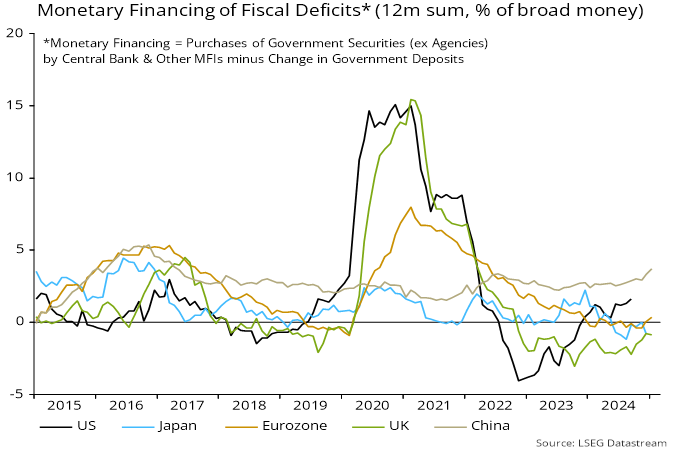
Monetary financing of the fiscal deficit (i.e. taking into account commercial banking system transactions in securities and changes in fiscal deposits as well as QE / QT) subtracted from broad money growth in the UK in the latest 12 months versus a neutral impact in the Eurozone / Japan and a significant positive contribution in the US – chart 4.

Chart 4

310125c4