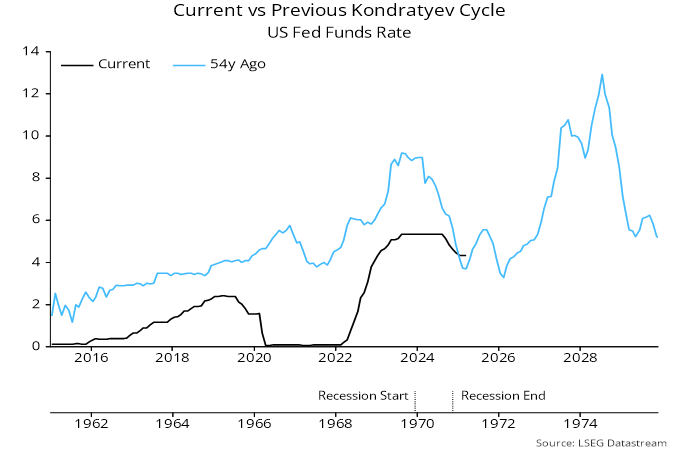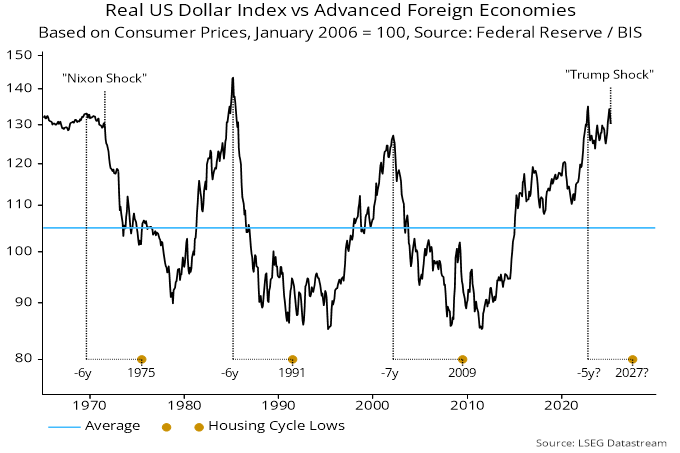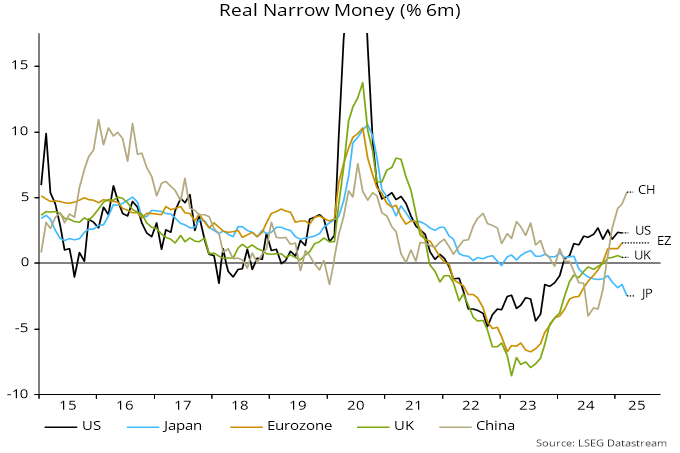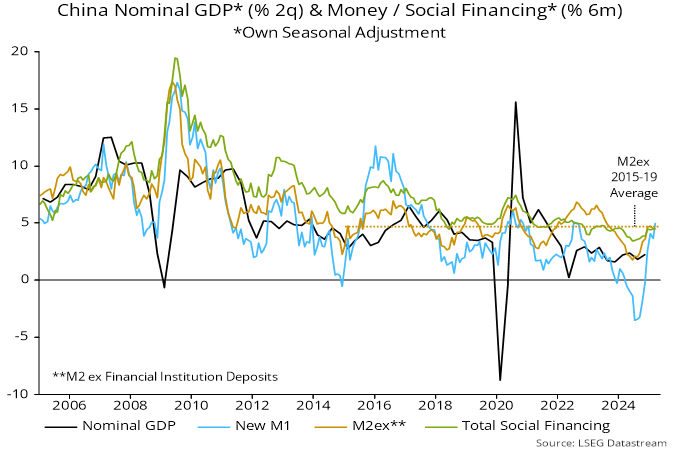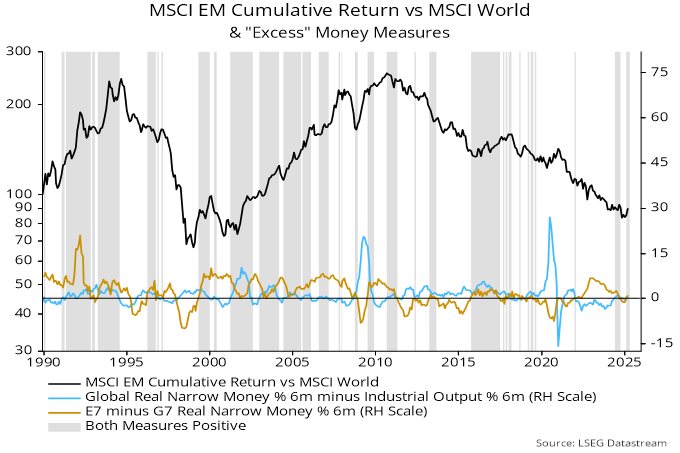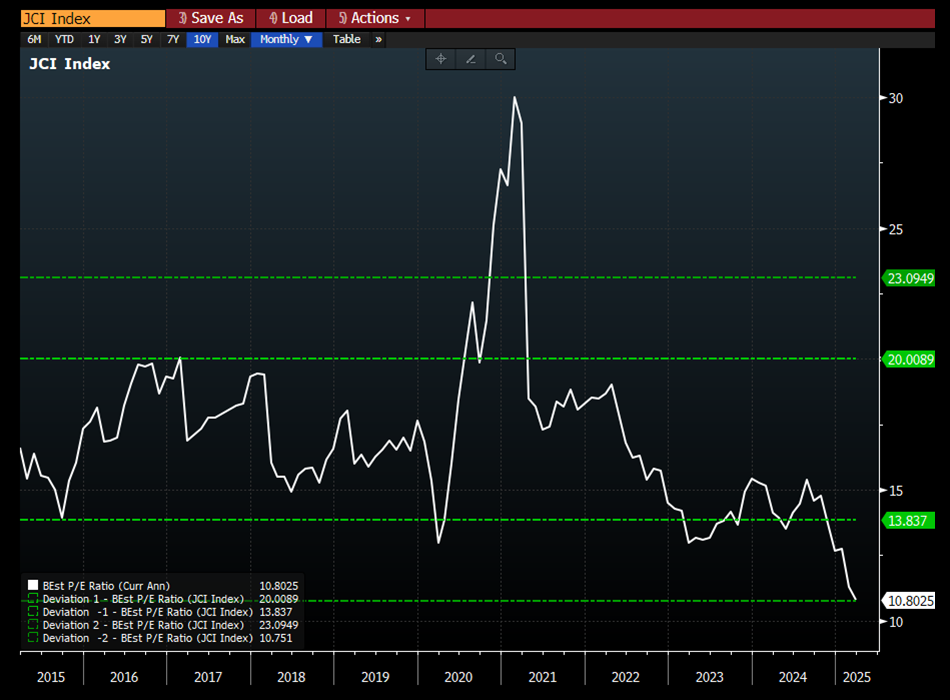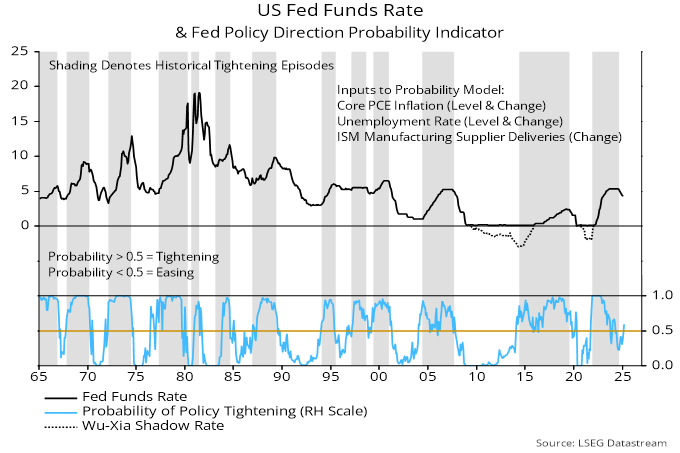
Recent outperformance of non-US equity markets may be a signal of the end of the bull market rather than a harbinger of broadening strength.

Previous analysis comparing returns in the current stockbuilding cycle with history suggested weaker prospects for risk assets, a reversal of US equity market / cyclical sector outperformance, a decline in the US dollar, stronger industrial commodity prices and a correction in precious metals. Several of these themes are playing out and appear to have potential to extend.

The stockbuilding cycle averages 3.5 years in length and last bottomed in Q1 2023, suggesting another low in H2 2026. The previous view here was that the current cycle would be longer than normal, to balance a shorter previous cycle (2.75 years) and to harmonise with the business investment cycle, which isn’t scheduled to bottom before 2027.

There is, however, anecdotal evidence of firms / importers stockpiling inputs / finished goods to avoid tariffs, raising the possibility of an earlier cycle peak and start to the downswing.

The cycle indicators followed here do not currently support this alternative scenario. The annual change in G7 stockbuilding, expressed as a percentage of GDP, is usually significantly positive at cycle peaks but stalled just above zero in Q4. A more timely indicator based on business surveys was little changed through February – see chart 1.

Chart 1

130325c1

The previous view – that a cycle peak is still several quarters away and a downswing will be delayed until 2026 – will, therefore, be maintained. This assessment is consistent with a recent rise in global six-month real narrow money growth, suggesting a recovery in economic momentum in late 2025 following Q2 / Q3 weakness – see previous post.

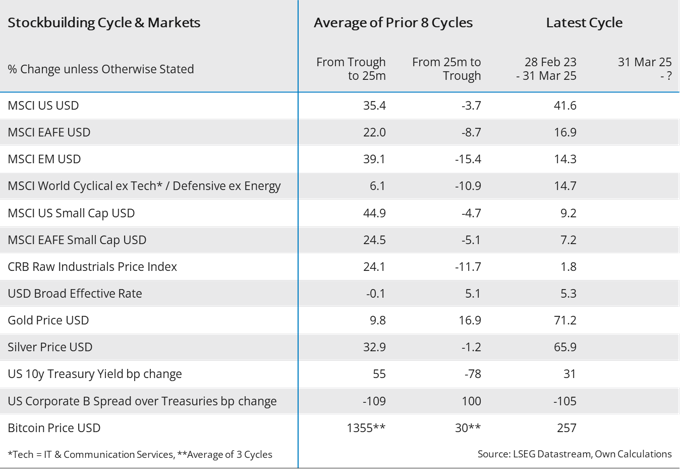
Risk assets typically rally strongly in the first half of a stockbuilding cycle, partially retracing gains in the run-up to the next trough. Table 1, reproduced from the earlier post, compares movements in the current cycle through end-2024 with averages at the same stage of the previous eight cycles, along with changes over the remainder of those cycles.

Table 1

130325t1i

US equities, cyclical sectors, the US dollar and precious metals had outperformed relative to history, suggesting a stronger likelihood that they would lose ground between end-2024 and the next trough. Areas that had lagged and appeared to have catch-up potential included EAFE / EM equities, small caps and industrial commodities.

Table 2 updates the comparison through 11 March. The US market correction and rallies in Europe / China have narrowed the US / EAFE and US / EM performance gaps but they remain wide relative to history. Other moves in the “right” direction with apparent potential to extend include weakness in cyclical sectors, a decline in the US dollar and a rise in industrial commodity prices.

Table 2

130325t2i

By contrast, there has been no correction of the “anomaly” of small cap underperformance, while unusual strength in precious metals has extended further.

The larger message is that, even assuming a delayed peak, the stockbuilding cycle has entered the mid to late stage that has been unfavourable for risk assets historically.

Recent policy upheavals may eventually prove inflationary but near-term risks are judged here to remain on the downside.

In common with conditions preceding the 2021-22 inflation upsurge, recent developments combine elements of a negative supply shock (tariffs, supply chain disruption, reduced US labour supply) with a potentially major demand boost (ramped-up European defence / infrastructure spending, US tax cuts).

The difference is that the earlier episode involved an immediate surge in money growth as fiscal blowouts were financed by money creation and central banks added fuel to the fire by slashing rates and launching large-scale QE.

Current fiscal developments will plausibly boost money growth as deficit financing needs expand and / or central banks and commercial banking systems are required to provide a greater proportion of funding to limit upward pressure on government borrowing costs. Unlike 2020, this will play out over years rather than months, however. Monetary financing is currently contributing little to G7 broad money growth, though has picked up in China – see chart 1.

Chart 1

070325c1

Central banks, meanwhile, have turned more cautious rather than stepping on the gas, and policy uncertainty is suppressing business / consumer confidence, which may be reflected in less money growth support from private sector credit demand.

G7 annual broad money growth recovered further in January but, at 4.1%, is still below its 2015-19 average, which was associated with sub-2% headline / core inflation averages – chart 2.

Chart 2

070325c2

Six-month growth is stronger, at an annualised 5.2%, but hardly ringing inflationary alarm bells.

Has potential economic growth fallen since the 2010s, so that a given level of money expansion is more inflationary than then? Arguments are mixed – possibly weaker labour supply expansion versus AI deployment and higher European investment spending.

The monetarist rule of thumb of a roughly two-year lag between changes in money growth and their maximum impact on inflation conceals significant historical variation but has worked near perfectly in recent years.

With annual money growth bottoming in H1 2023 and only now returning to a “normal” level, the suggestion was that annual inflation rates would fall further in 2025 and remain low through 2026.

Tariff hikes will have a price level impact but second-round effects are unlikely given the restrictive influence of earlier monetary weakness. A (small) lift to annual inflation this year should, therefore, reverse in 2026, raising the possibility that the lag between the H1 2023 money growth low and associated inflation low will extend to around three years on this occasion (still well within the historical range).

GACM_COMM_2025-03-05_Banner

The « Magnificent 7 » – Apple, Microsoft, Alphabet, Amazon, Nvidia, Meta and Tesla – have long dominated markets, driving index returns and capturing investor attention. Their leadership in AI, cloud computing and consumer tech has fueled impressive growth, but with stretched valuations and increasing regulatory pressures, the question remains: Are they still the best opportunities?

Meanwhile, European banks have quietly outperformed these tech giants, benefiting from rising interest rates, strong capital positions and attractive valuations. These financial institutions are delivering solid earnings growth, improving margins and returning capital to shareholders. This week, we highlight how investing in so-called « boring » businesses can still generate market-beating returns – even against the strongest stocks.

Banks in Europe? That’s boring, right?

European banks, often viewed as « boring » investments, have faced years of stringent regulations since the Global Financial Crisis (GFC), designed to bolster stability and reduce systemic risk. While these measures have limited growth compared to more dynamic sectors like tech, they have also fostered steady earnings, lower risk and more attractive valuations. Despite Europe’s slow GDP growth, driven by factors such as an aging population and geopolitical instability, European banks have outperformed expectations. Benefiting from rising interest rates, improving credit conditions and a stable regulatory environment, these institutions have offered investors a more resilient, low-volatility alternative to today’s high-growth stocks.

European banks dominate the Magnificent 7

As we look at the performance comparison between European banks and the Magnificent 7, the data speaks for itself. While the tech giants have had their moments of dominance, European banks have quietly outperformed. This chart highlights how these so-called « boring » financial institutions have consistently delivered stronger returns, offering an intriguing investment opportunity for those seeking stability and growth in today’s market.

GACM_COMM_2025-03-06_Chart01
Source: Bloomberg

Introducing BAWAG: A strong performer in our portfolio

Now, let’s explore how our portfolio has positioned itself in relation to standout European banks, with a focus on BAWAG Group (BG VI), a key holding. As one of Austria’s leading banks, BAWAG has shown remarkable resilience and growth, driven by its solid capital position, cost efficiency and attractive valuation. In this section, we’ll discuss how BAWAG’s performance compares to our broader portfolio and whether it has contributed to our outperformance in the current market environment.

A turbulent history: BAWAG’s path to recovery and growth

BAWAG has a storied history marked by periods of both innovation and turbulence. Founded in 1922 by a former Austrian chancellor, the bank’s initial mission was to offer favourable credit terms to lower- and middle-income individuals under the name « Austrian Worker’s Bank. » The bank was forced to close in 1934 due to political reasons, but reopened in 1947, reestablishing close ties with Austrian trade unions.

In 2005, BAWAG merged with PSK, the Austrian Postal Savings Bank, founded in 1883. However, the bank faced a major setback in 2006, requiring a state bailout after an accounting scandal tied to the bankruptcy of US broker Refco. Several BG executives, including the CEO, were found guilty of fraud following subsequent investigations. In 2007, BAWAG was sold to a consortium led by Cerberus Capital Management, but another round of state aid was needed in 2009 due to the GFC.

The years following saw extensive restructuring as Cerberus took full control. BAWAG underwent significant cost-cutting and streamlined operations, which ultimately paved the way for a recovery. The bank was recapitalized in 2013 and again in 2014, with GoldenTree Asset Management acquiring an equity stake through a debt-for-equity swap. By the end of 2017, BAWAG went public, marking the culmination of its recovery and transformation.

Today, BAWAG stands as a testament to resilience, having overcome significant challenges to become one of Europe’s more efficient banks. The heavy restructuring and focus on capital efficiency and cost-cutting have allowed BAWAG to achieve one of the highest returns on tangible equity (RoTE) in the sector. This transformation has set the foundation for the modern BAWAG, which today continues to thrive in a competitive European banking landscape.

What BAWAG does with its significant capital

BAWAG has made strategic moves to deploy its substantial capital, further solidifying its position in the European banking landscape. Recently, BAWAG announced two key M&A deals aimed at expanding its footprint and capabilities. These include the acquisition of Knab, a fully online bank in the Netherlands, and the purchase of Germany-based Barclays Consumer Bank Europe.

Knab, previously known as Aegon Bank N.V., has long focused on serving the self-employed and was the first fully online bank in the Netherlands. After being acquired in 2023 by ASR Nederlands N.V., a Dutch insurance company, Knab was sold to BAWAG in February 2024. This acquisition allows BAWAG to tap into a growing digital banking market and broaden its customer base in the Netherlands, especially among self-employed individuals, a demographic that aligns with BAWAG’s growth strategy.

In addition to this, the purchase of Barclays Consumer Bank Europe in Germany strengthens BAWAG’s presence in a key European market, expanding its retail banking offerings and customer base. These strategic investments show how BAWAG is using its capital to strengthen its position in both digital banking and consumer markets, positioning itself for future growth across the continent.

It’s all about management

BAWAG’s success is driven by its highly effective and aligned management team. Widely regarded as one of the best communicators in European banking, the team is deeply invested, owning 3.9% of shares outstanding – more than any investment of another management team or board in the sector. This substantial ownership ensures strong alignment with shareholder interests.

Scott Antoniak

Crestpoint a le plaisir d’annoncer la nomination de Scott Antoniak à titre de nouveau vice-président directeur et chef des placements. Fort de plus de 30 ans d’expérience dans tous les aspects du secteur immobilier, il a participé au montage de transactions, à la souscription et à l’exécution de transactions, et a supervisé la croissance et l’expansion soutenues du portefeuille dans ses anciennes fonctions.

Au cours de sa carrière, il a occupé plusieurs postes de direction, dont ceux de directeur général, Financement des sociétés, Services immobiliers à Marchés des capitaux CIBC, de directeur général de Slate Asset Management et de chef de la direction de Slate Office REIT. Relevant directement de Kevin Leon, président et chef de la direction, et travaillant de concert avec le reste de l’équipe de la haute direction de Crestpoint, Scott Antoniak se concentrera sur la direction de notre équipe de placement et la croissance de notre portefeuille d’actifs immobiliers. Son expertise et son leadership seront inestimables pour améliorer notre orientation, notre agilité et l’exécution efficace de nos activités.

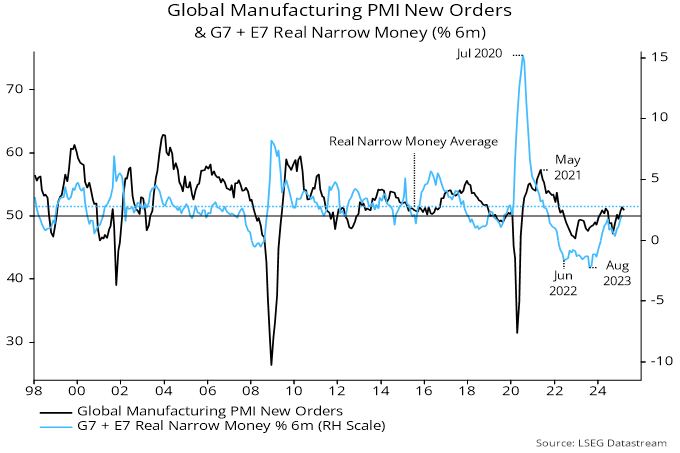
The forecast of a local peak in global industrial momentum – proxied by the manufacturing PMI new orders index – around end-Q1 appears to be on track. Monetary trends suggest a modest pull-back over Q2 / Q3 followed by renewed strength in late 2025. US policy actions threaten more pronounced and sustained weakness.

Global manufacturing PMI new orders rose further in February, moving above last year’s May peak to reach the highest level since March 2022 – see chart 1.

Chart 1

040325c1

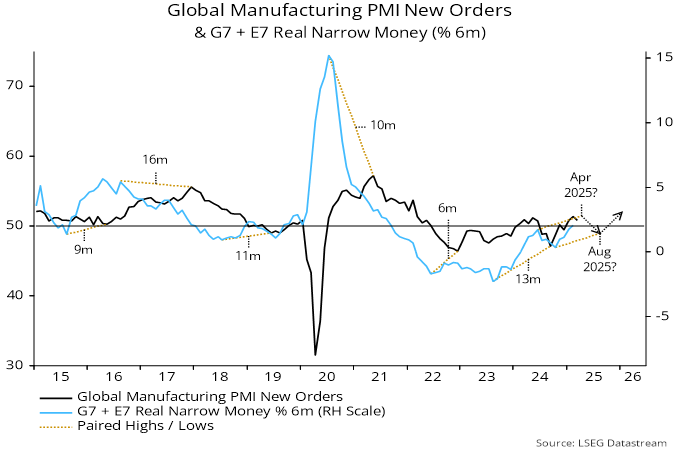
The upswing from a low last September, on the view here, reflects a rise in global six-month real narrow money momentum between September 2023 and April 2024 – turning points in money momentum have led the PMI by 10-13 months in recent years.

Real money momentum, however, eased between April and October 2024 before rising to new highs more recently. The suggestion was that the industrial pick-up would pause over spring / summer 2025 but strengthen further into 2026.

The view that the PMI new orders index is at or close to a peak is supported by a February fall in an alternative indicator combining forward-looking components of national business surveys (ISM for the US, NBS for China, Ifo for Germany etc.) – chart 2.

Chart 2

040325c2

The global earnings revisions ratio also exhibits a contemporaneous correlation with the PMI and declined last month.

The baseline scenario of a modest PMI correction followed by renewed strength has, of course, been called into question by recent US policy actions.

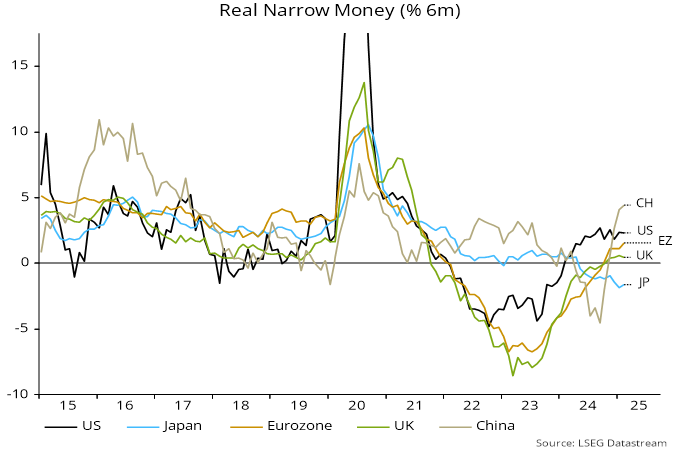
Monetary trends are, for the moment, still giving a reassuring message, with global six-month real narrow money momentum rising slightly further in January – chart 1.

This increase, however, was due to additional strength in China, with US / Eurozone narrow money measures stalling in January, as previously discussed. In contrast to the global (i.e. G7 plus E7) measure, G7 six-month real money momentum has been moving sideways since August – chart 3.

Chart 3

040325c3

A recent back-up in Chinese money market rates, meanwhile, could presage less upbeat monetary data – chart 4.

Chart 4

040325c4

A renewed fall in global real narrow money momentum would suggest more lasting / self-reinforcing damage from the US policy shock.

Reciprocal tariffs represent an indirect tax rise on cross-border trade in goods.

The US might be expected to suffer less damage from a global rise in tariffs than China and the EU because trade is a lower share of GDP.

Such logic, however, does not apply currently because conflict is occurring in US bilateral relationships rather than globally. So the share of GDP potentially affected by tariffs is larger for the US than China / the EU.

Goods imports from countries currently on President Trump’s tariffs hit list represent about 7% of US GDP, with a suggested 20% blended hike implying an effective tax rise of 1.4% of GDP ($410 bn) – see chart 1.

Chart 1

280225c1

Assuming full reciprocity, Chinese and EU tariffs will affect imports accounting for less than 1% and less than 2% of their GDPs respectively – chart 2.

Chart 2

280225c2

By contrast, Canada and Mexico will impose a much larger effective tax rise than in the US if they reciprocate Trump’s tariff rates (which is why they won’t) – chart 3.

Chart 3

280225c3

A reasonable baseline assumption is that tariff burdens will be shared equally between domestic consumers and foreign producers. Assuming full reciprocity, the US would suffer more than China / the EU (but much less than Canada / Mexico) – see table.

280225t1

Advocates of tariffs claim that their imposition will boost the dollar, resulting in an improvement in the terms of trade that offsets the effective tax rise on consumers. Tariff revenues will be available to cut taxes or reduce the deficit, for a net economic gain.

This is magical thinking and begs the question of why tariff-raising has not previously been recognised as an optimal economic strategy. Equally plausible is that tariffs will undermine US economic outperformance and weaken the dollar / terms of trade, compounding the hit to domestic purchasing power.

GACM_COMM_2025-02-27_Banner

We are approaching March and the time of year that many people abandon New Year resolutions. A Forbes poll showed that around 30% of those surveyed had abandoned theirs after just two months. However, Global Alpha’s company fitness drive continues as a small, dedicated band keeps up regular visits to the gym! Exercising is all well and good for your health, but the importance of nutrition also needs some focus.

Nutrition plays an essential role in sports and fitness. It helps optimize training outcomes, shortens recovery periods, minimizes the risk of injuries and ensures performance consistency. Many are aware of the importance of nutrition: how it supports a healthy and active lifestyle as well as boosting mental health. Consumption of fortified foods and beverages continues to increase among people wanting to supplement their diets with nutrients that not only boost the immune system but also improve their energy levels and health.

The global sports nutrition market is estimated to be worth USD40 billion. The United States is by far the largest sports nutrition market, with USD22.3 billion in sales and expected to grow at 4.6% a year through to 2027. Sports protein powder is the largest segment at USD21.1 billion and remains one of the fastest growing segments at 5.9%. Meal replacements is the second largest category, followed by non-protein products (e.g. pre-workout and amino acid supplements). Protein bars and the ready-to-drink category are both expected to grow around 5% a year.

Glanbia plc (GLB ID) is a recent addition to the International Strategy that is exposed to these trends. The origins of Glanbia are in Irish dairy farming; producing milk, butter and cheese. After many co-operatives were combined to form a larger entity, the company changed its name to Glanbia, which means “pure food” in Irish. Glanbia has since forayed into the sports nutrition market through their production of whey protein.

Why would a dairy company be an ideal candidate for whey protein nutrition?

Whey protein production starts when whey is separated from milk during cheese production. Liquid whey is filtered to remove fats and lactose. Protein concentrates typically have 70% to 85% protein content, while isolates are 90% or above due to more extensive filtering. Whey protein isolate is created by using additional filtering to attain a higher purity level. The primary benefit of whey protein is its quick absorption rate. This means it is ideal for post-workout recovery as it contains all the essential amino acids needed for muscle repair and growth. Once the qualities of whey became more well-known, it was an obvious opportunity for Glanbia to participate.

The company comprises three divisions – Glanbia Performance Nutrition, Glanbia Nutritionals, and cheese joint venture operations. Glanbia’s expertise is in protein nutrition, and they own the Optimum Nutrition brand, the leading sports nutrition brand in the world, and there is a strong complementary thread of protein nutrition expertise across both segments.

Glanbia Performance Nutrition division

Glanbia Performance Nutrition is a portfolio of leading brands in performance and lifestyle nutrition. Optimum Nutrition is part of that portfolio and is the leading sports nutrition brand in the world by sales. It was acquired in 2008 and has a reputation for high quality, innovative products across protein and energy using the very best ingredients and manufacturing processes. Optimum Nutrition consumers are typically highly engaged in the category, working out 80% more than the average buyer in the category. They are typically more affluent and spend more on sports nutrition products, seeing it as an “essential” spend.

Growth opportunities for Optimum Nutrition still exist in the United States, despite it being the most mature market, as household penetration remains below 5%. Unlike peers that have sales skewed to the United States, Glanbia is more global. It has scaled in ten markets, is present in another thirteen countries, and is among the category-share leaders in each geography. Glanbia’s international expansion strategy is measured. The buildout leverages local market resources until scale justifies a larger expansion, at which point Glanbia typically acquires local distribution capabilities and invests in local teams.

Glanbia Nutritionals division

Glanbia Nutritionals is a leading provider of customized premix solutions and whey protein isolate. Consumer interest in supplementation is growing and this division’s ingredient solutions improve the nutritional profile of the product through protein for powders, bars or beverages, or micro-nutrients to be included in vitamin and mineral pre-mix blends, powders, gummies, capsules or tablets. In addition to the health and fitness industry, this division serves the mainstream food and beverage industry via avenues such as infant nutrition, clinical nutrition, fresh dairy and yogurts.

Alongside these two divisions, Glanbia is also the number one supplier of American-style cheddar cheese.

Ready to refocus

It’s not always been blue skies for Glanbia, though. In 2018, Glanbia acquired SlimFast to expand the portfolio’s weight management products and bring scale to the ready-to-drink format. Since then, the weight management segment as whole has been under pressure as consumers reduce their consumption or migrate to nutrition brands not overtly associated with dieting. SlimFast faced a significant headwind in the decline of keto-oriented products when compared to another mainstream lifestyle brand such as Atkins which has developed an image as a “low carb” alternative. Glanbia is attempting to refocus SlimFast on core high-protein meal replacement shakes, in ready-to-drink and ready-to-mix formats. If this proves to be unsuccessful, existing shakes capacity can be re-positioned to support growth of Optimum Nutrition in a capacity-constrained market.

To summarize, the greater focus on healthy living and the mass appeal of protein and fortified foods should mean continued structural growth of sports nutrition and, as market-share leader, Glanbia gives us the desired exposure to this industry.

US / Eurozone January money numbers suggest that US policy chaos is damaging economic prospects.

The narrow money measures followed here – US M1A and Eurozone non-financial M1 – were unchanged and fell on the month respectively. Narrow money weakness can reflect reduced confidence and spending intentions.

US six-month real narrow money momentum fell between August and October, partially recovered into year-end but has now returned to the October level – see chart 1. The slowdown since August signalled recent softer economic data – see previous post.

Chart 1

270225c1

A recovery in Eurozone six-month real narrow money momentum stalled in December / January but the gap with the US has narrowed significantly since August, suggesting better relative performance.

US narrow money momentum may weaken further. Policy chaos may cause spending to be deferred, reducing demand for transactions money.

The Fed has gone on hold with rates judged still to be in restrictive territory. The ECB has cut by more, is still in easing mode and may be closer to “neutral”.

A further consideration noted previously is that US narrow money growth has tended to rise into presidential elections but reverse shortly before or after the poll date – chart 2. (1984 and 2000 were notable exceptions.)

Chart 2

270225c2

Decoration.

Dans le dernier épisode du balado The Private Equity Podcast, Jeff Wigle, directeur général et chef de groupe à Banyan Capital Partners, nous fait part de ses points de vue et de son expertise sur la transition des sociétés en portefeuille pour la croissance. M. Wigle souligne l’importance de la création de valeur à long terme, de l’utilisation de la technologie et de la gestion des changements culturels pour éviter les pièges courants liés au capital-investissement et prendre des décisions fondées sur les données.

Écoutez l’épisode complet du balado The Private Equity Podcast mettant en vedette Jeff Wigle.

GACM_COMM_2025-02-20_Banner

Who doesn’t love the smell of freshly brewed coffee in the morning? Coffee is an essential part of the morning routine for many millions of people worldwide.

With over 437 million posts on TikTok related to coffee, it’s no surprise that coffee demand has been soaring over the last couple of years. According to the National Coffee Association, 67% of Americans consumed a cup of coffee every day; this is more than any other beverage of choice. Much of the growth is driven by younger generations who have embraced coffee as part of their daily routines. As these generations enter the workforce – specifically Gen Zers – they are estimated to hold USD360 billion of disposable income and coffee companies around the world have been harnessing their spending power. Some of the key elements that differentiate the winners and losers in the coffee market is product innovation, creativity and connecting with consumers.

Both Europe and North America are big consumers of coffee – in fact, Finland is the country that consumes the most coffee globally. The average Finn consumes about 12 kg of coffee per year, which is the equivalent of 4 cups of coffee a day. In the United States, the average American consumes about 4.2 kg of coffee per year. Global coffee production in 2023 reached a staggering 178 million 60 kg bags. These production volumes cumulate to USD473 billion.

De’Longhi

One of Global Alpha’s holdings, De’Longhi S.p.A. (DLG MI), is significantly benefiting from the latest growth in the coffee market. A well-known Italian manufacturer and distributor of small domestic appliances, De’Longhi primarily sells all kinds of coffee machines for personal use. In addition to capitalizing on the at-home coffee market generating over 50% of their revenue from this segment, De’Longhi recently acquired two additional companies that specialize in the professional markets: La Marzocco and Eversys. This will allow the company to also benefit from coffee consumption outside of the home too.

The company saw an acceleration in sales in 2024, with organic revenue growth up 14% versus the previous year. The mid-teen growth in sales was mostly driven by at-home coffee machines. Its professional segment will be an interesting growth driver for many years ahead.

To maintain a competitive edge, the company has a strong track record of fostering innovation and driving new product development. De’Longhi spends 2.4% on average* of sales on R&D annually. This commitment not only enhances De’Longhi’s market position, but it also enables it to respond effectively to evolving customer needs and industry trends. The most recent example would be the launch of its Rivelia automatic coffee machine which features a cold coffee extraction feature to cater to the growing popularity of cold coffee beverages. As the company navigates the continuously changing landscape of the industry, its dedication to product innovation will undoubtedly lead to sustained growth and solidify its position as a leader in the market.

*Geoffrey D’Halluin, “What’s brewing?’’, BNP Paribas, 19 September 2024.