Strawberries and oranges displayed at a fruit stand in a market in London, England.

One of the greatest disruptions in recent years to the global grocery market has been the rising popularity of discount retailers like Lidl and Aldi. The two German-based supermarket chains have expanded rapidly, challenging the incumbent grocery players to rethink their strategies.

Lidl and Aldi have consistently taken market share in key markets. In the United States, Lidl and Aldi had a combined market share of 10% in 2024. It is a similar story in the UK where the two now account for around 18% of the grocery market, up from just 4% in 2008.

Line graph showing the percentage of market share for different grocers in Great Britain.

Source: Grocery Market Share – Kantar

The recipe for their massive success is well known: a low-cost business model that aims to offer customers high-quality products at lower prices compared to traditional grocery chains.

The Global Alpha team recently added B&M European Value Retail SA (BME LN) to the portfolio to gain exposure to the discount retailer trend. B&M is the UK’s leading variety goods value retailer. The main brand, B&M itself, offers grocery, fast-moving consumer goods (FMCG) and general merchandise in a variety of stores, located in out-of-town, suburban retail parks or, more recently, town centers.

B&M has a similar playbook to when Aldi and Lidl first entered the UK market, with an everyday-low-cost operating model leading to an everyday-low-price offering. Where B&M differs from Aldi and Lidl is that they offer a more targeted range of branded convenience grocery products such as shelf-stable food, soft drinks, confectionery and alcohol, in addition to FMCG categories such as toiletries and cleaning products.

Aldi and Lidl’s success has been built largely on the back of private-label products. Aldi stocks its stores with around 90% private-label products across all categories. B&M sells the well-known brands that families have been accustomed to using for years, sometimes generations, often at a 15% to 20% discount to the traditional grocer. B&M can do this as they have a disciplined approach to which stock keeping units (SKUs) they keep in store. By focusing on the top sellers, the volume demanded for a particular SKU creates buying power and more advantageous buying terms.

An easy way to visualize what B&M offers is to think of the middle aisles of a supermarket. B&M’s offering should be seen as complementary to, rather than a substitute for, a fresh grocery shop. Management has even communicated that some of their better performing stores are located next to an Aldi or Lidl; a customer will shop for fresh or frozen items in Aldi or Lidl, then completes the shopping in a B&M store.

In addition to the focused grocery offering, B&M offers higher-ticket general merchandise products that cover product categories such as homewares, electrical, gardening, toys and DIY. As customers wander the aisles, there is a “treasure hunt” browsing experience that often leads to impulse purchases. The general merchandise products are more aligned to seasonal trading patterns – the spring/summer seasons will see more garden and outdoor living products, whereas the autumn/winter seasons will see more toys and Christmas decorations.

The low-cost sourcing discipline is key to maintaining a price advantage over the competition. The reduced complexity of the supply chain helps keep costs low. Selling no fresh or frozen products means no need for refrigeration or freezers either on the shop floor or in storage areas. There is also less waste and the need to reduce prices to clear fresh produce approaching expiration date. B&M does not have an online or click-and-collect operation. As well as being historically lower profitability than offline purchases, it also adds a layer of complexity.

When shopping for groceries, a little bit of planning can go a long way. B&M has increasingly become a part of the weekly routine for budget-conscious shoppers. B&M will be a long-term beneficiary of the discount retailer trend and shows that growth can be found in “value.”

Like-for-like growth is typically highly profitable and the most desirable form of growth. B&M themselves state that 1% in LFL sales growth is the same as opening over seven new stores, but without the associated capex or increase in fixed costs. This can be achieved by taking a bigger share in existing catchment areas by offering a great value proposition. But B&M has a parallel growth strategy. The company expects to increase store numbers by at least 60% to reach no less than 1,200 B&M stores in the UK. This represents a decade-long growth runway at the current pace of openings. The new stores tend to be larger and often with a garden centre attached, so underlying sales are expected to grow ahead of the 60% increase in stores. More stores equal more volumes and, in turn, greater benefits to buying and productivity.

France is another avenue of growth. B&M entered the French market in 2018 via an acquisition, but all stores now operate under the B&M fascia. B&M currently operates 124 stores in France which has a population like that of the UK where B&M is targeting over 1,200 stores. Despite the upside potential in new stores, the pace of the rollout is slower than in the UK, opening around 10 new stores per year, due to a focus on profitable growth rather than rapid expansion.

The traditional top four UK grocers are not idly standing by while the discounters take market share. Asda was the first to come out and promise price cuts to be more competitive. Tesco PLC (TSCO LN), the market leader, expects a significant reduction in profitability owing to “a very competitive market.” J Sainsbury PLC (SBRY LN) then announced price cuts to compete with Tesco and Asda.

Price war or not, discount retailers are here to stay, and we believe B&M has a long cycle of growth ahead.

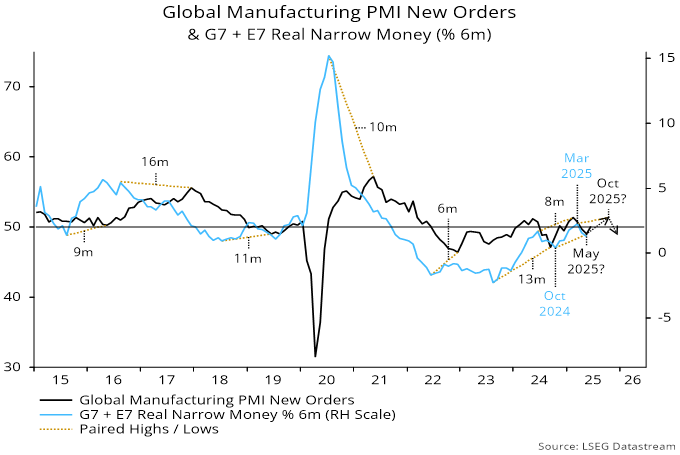
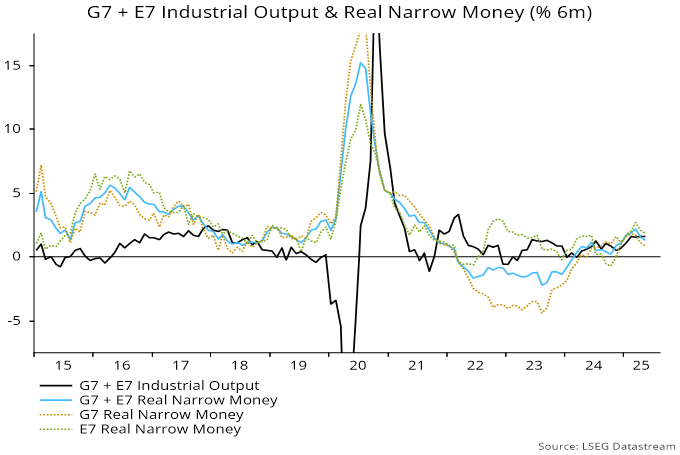
Global manufacturing PMI new orders – a timely coincident indicator of industrial momentum – fell for a third month in May. The decline from a February peak is consistent with a slowdown in global six-month real narrow money momentum between June and October 2024 – see chart 1.

Chart 1

050625c1

The PMI fall started slightly earlier than had been expected here. The eight-month interval between the June peak in real money momentum and the February PMI peak compares with an average lag of 11 months at prior turning points since 2015.

Monetary considerations alone would suggest that the PMI will decline further into mid-year before recovering to another local high around end-2025 – the dotted arrows in the chart show a possible path.

The US trade policy shock, however, is likely to impart a negative skew to this profile, as recent demand front-loading reverses and spending decisions remain on hold until tariff uncertainty abates.

Accordingly, the current PMI decline could extend further than indicated with only a minor H2 recovery. Weak April money numbers, moreover, suggest darkening prospects for end-2025 – see previous post.

Global (i.e. G7 plus E7) six-month real narrow money momentum – a key leading indicator in the approach followed here – fell sharply in April, to its lowest level since December. The relapse douses hope generated by a pick-up into March, which suggested a bounce-back in the global economy later in 2025, assuming no further negative “shocks”.

The April fall was driven by a slowdown in nominal money growth to its weakest since November. Six-month consumer price momentum eased slightly further to match its 2024 low (2.0% annualised) – see chart 1.

Chart 1

040625c1

To recap, a fall in real narrow money momentum between June and October 2024 was expected here to be reflected in a global economic slowdown in Q2 / Q3 2025, which the US trade policy shock will amplify.

Subsequent monetary reacceleration into March held out the hope of an economic recovery in late 2025, by which time negative tariff effects could be starting to fade.

The April money growth fall, however, suggests that a negative feedback loop is developing, with reduced confidence due to US policies resulting in increased risk aversion and a tightening of monetary conditions, despite most central banks remaining on an easing path.

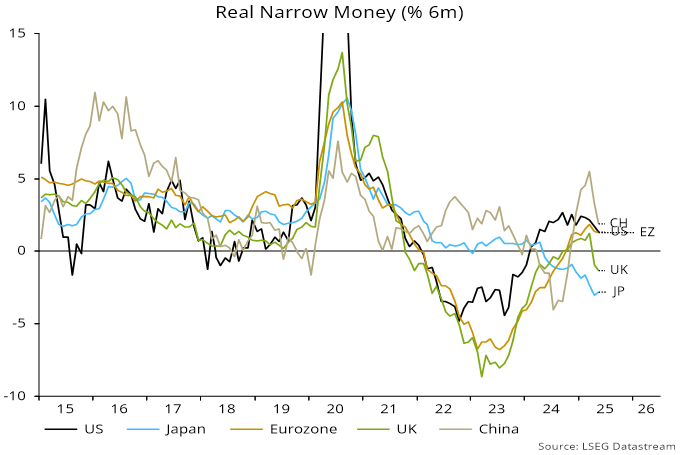
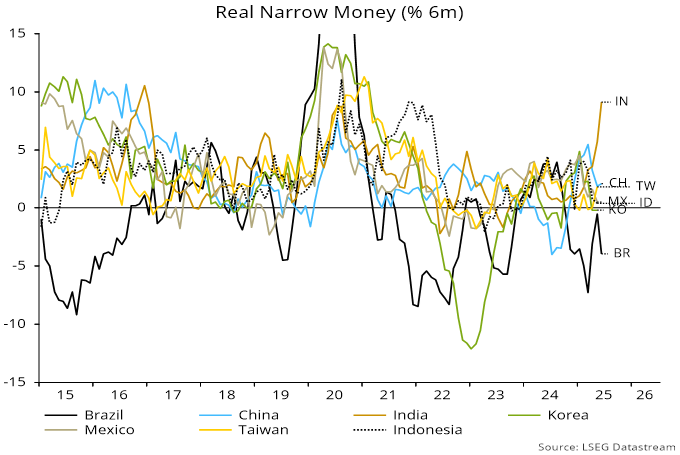
The April decline reflected falls across major economies, reinforcing the negative signal – chart 2.

Chart 2

040625c2

Economic momentum has been supported by demand front-loading but payback is arriving.

A surge in US goods imports boosted GDP in the rest of the world by 0.25-0.5% in Q1 but April advance numbers suggest a full reversal – chart 3.

Chart 3

040625c3

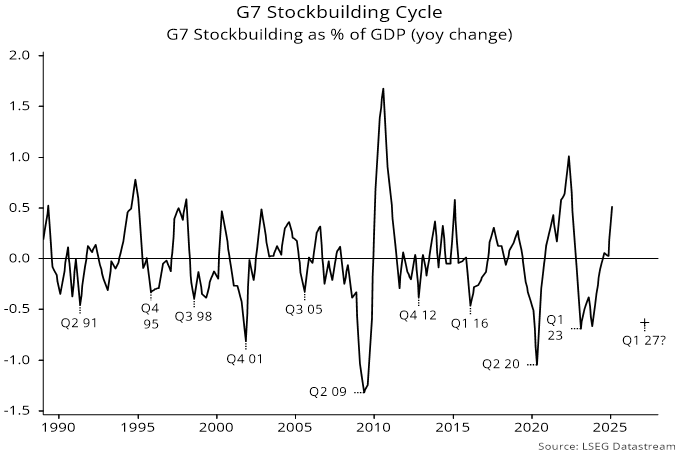
Inventory accumulation isn’t just a US story. Stockbuilding as a percentage of GDP rose similarly or by more in major European economies in the year to Q1 – chart 4.

Chart 4

040625c4

Economic growth depends on the change in stockbuilding, so even a stabilisation at its recent pace would suggest a significant loss of output momentum.

Drapeaux de l'Union européenne flottant devant la Commission européenne.

Le Groupe financier Connor, Clark & Lunn (« Groupe financier CC&L ») a annoncé l’expansion récente de l’ICAV OPCVM Connor, Clark & Lunn par l’ajout d’une stratégie d’actions mondiales à petite capitalisation et d’une stratégie d’actions mondiales. Les deux stratégies sont sous-conseillées par l’équipe des stratégies quantitatives d’actions de Gestion de placements Connor, Clark & Lunn Ltée (« Gestion de placements CC&L »).

La stratégie d’actions mondiales à petite capitalisation et la stratégie d’actions mondiales utilisent le processus de placement quantitatif de Gestion de placements CC&L. Les deux stratégies visent à surpasser leur indice de référence, l’indice MSCI Monde tous pays à petite capitalisation (net) et l’indice MSCI Monde tous pays (net), respectivement, sur un cycle de marché.

Gestion de placements CC&L est la plus ancienne et la plus importante société affiliée du Groupe financier CC&L, dont le siège social est situé à Vancouver, au Canada. Fondée en 1982, la société offre des solutions de placement qui comprennent des actions, des titres à revenu fixe et des placements non traditionnels, notamment des stratégies à alpha portable, neutres au marché et à rendement absolu.

Les stratégies de placement systématiques de l’équipe des stratégies quantitatives d’actions (« équipe Q ») visent à ajouter de la valeur dans différentes conjonctures de marché. Le processus de placement quantitatif de l’équipe Q évolue continuellement grâce à de nouveaux points de vue relatifs à l’alpha et à des solutions technologiques novatrices. L’équipe Q compte 80 professionnels des placements et est codirigée par Jennifer Drake et Steven Huang. « Nous gérons des portefeuilles quantitatifs depuis plus de 20 ans, renforçant constamment notre processus dans le but de produire des résultats pour les clients, affirme Jennifer Drake. Nous sommes heureux d’élargir notre plateforme et d’offrir un plus grand nombre de nos stratégies aux investisseurs européens. »

À propos de Gestion de placements Connor, Clark & Lunn Ltée

Gestion de placements Connor, Clark & Lunn Ltée (Gestion de placements CC&L) est l’une des plus importantes sociétés de gestion de placements indépendantes au Canada (elle appartient à ses associés). Fondée il y a plus de quatre décennies, elle propose une gamme diversifiée de solutions de placements traditionnels (actions, titres à revenu fixe et placements équilibrés) et non traditionnels (stratégies neutres au marché, à alpha portable et à rendement absolu). Gestion de placements CC&L est un gestionnaire de placement affilié du Groupe financier Connor, Clark & Lunn Ltée, dont l’actif sous gestion dépasse les 54 milliards de dollars américains.

À propos de Groupe financier Connor, Clark & Lunn Ltée

Le Groupe financier Connor, Clark & Lunn Ltée (le « Groupe financier CC&L ») est une société de gestion de placements indépendante dotée d’une structure aux multiples sociétés affiliées qui propose une vaste gamme de solutions de gestion de placements traditionnelles et non traditionnelles aux investisseurs institutionnels et particuliers. Cette structure procure au Groupe financier CC&L une envergure et une expertise considérables qui lui permettent d’assumer des fonctions administratives qui ne sont pas liées aux placements tout en laissant ses gestionnaires de placement, comme Gestion de placements Connor, Clark & Lunn Ltée, se concentrer sur ce qu’ils font le mieux grâce à la centralisation des activités liées aux opérations et à la distribution. Les sociétés affiliées du Groupe financier CC&L gèrent un actif de plus de 99 milliards de dollars américains. Pour obtenir des précisions, consultez le site cclgroup.com.

Ce document est distribué à titre informatif seulement et ne doit pas être considéré comme une recommandation ou une offre d’achat ou de vente d’un produit ou d’un service auquel ces renseignements peuvent se rapporter. Certains produits et services peuvent ne pas être offerts à toutes les entités ou à toutes les personnes.

### 

Un investissement dans le fonds comporte un risque; le capital peut être perdu. Rien ne garantit que les objectifs de placement du fonds seront atteints. La valeur des actions et des titres à revenu fixe peut diminuer considérablement sur de courtes ou de longues périodes. Le prospectus du fonds comprend plus de renseignements sur ces considérations liées au risque ainsi que sur les autres risques auxquels le fonds est exposé, comme les risques liés à la concentration/non-diversification et à la stratégie de placement.

La présente décharge ne constitue pas une offre, une sollicitation, une recommandation ou un conseil de placement à l’égard de l’achat du fonds décrit aux présentes ou de tout titre. Les investisseurs potentiels doivent examiner attentivement les objectifs, les risques, les frais, les considérations fiscales et les dépenses du fonds ainsi que d’autres renseignements pertinents avant d’investir. Pour obtenir plus de renseignements sur l’ICAV OPCVM Connor, Clark & Lunn, veuillez demander un prospectus et le lire attentivement avant d’investir. Les investisseurs potentiels doivent également consulter leurs conseillers professionnels pour savoir si un placement convient à leur situation particulière et à leur citoyenneté, à leur résidence ou à leur domicile.

Les actions de tout fonds OPCVM sous-conseillé par Gestion de placements CC&L ne sont offertes qu’à certaines personnes non américaines dans le cadre de certaines transactions effectuées à l’extérieur des États-Unis ou, dans des circonstances limitées, autrement dans le cas de transactions exemptées des exigences d’inscription de la United States Securities Act of 1933, dans leur version modifiée conformément au règlement intitulé Regulation S et aux autres lois américaines applicables. La présente communication ne s’adresse pas aux personnes des États-Unis, qui ne sont pas admissibles à investir dans des produits OPCVM sous-conseillés par Gestion de placements CC&L.

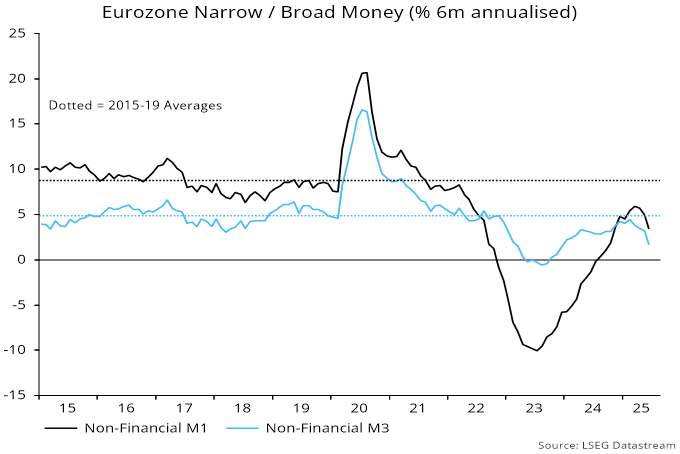
US money growth is slowing, suggesting less support for the economy and improving prospects for rate cuts.

Six-month growth of the preferred narrow and broad aggregates here fell to 6.6% and 5.6% annualised respectively in April, down from recent peaks of 8.6% and 6.7% – see chart 1.

Chart 1

300525c1

Chart 2 shows key influences on broad money expansion. Strength in late 2024 / early 2025 was driven by monetary deficit financing initiated by the Treasury (“Treasury QE”). The six-month running total of such financing, however, fell sharply in April, reflecting a recent reduction in the stock of Treasury bills coupled with a rebound last month in the Treasury’s cash balance at the Fed.

Chart 2

300525c2

Another significant contributor to the monetary slowdown has been a decline in commercial banks’ net external assets. Changes in such assets are the counterpart of the basic balance of payments position. This position has weakened as tariff front-running has boosted the trade deficit, while negative and chaotic policies have discouraged portfolio capital inflows.

Fed QT has remained a drag on broad money growth but the six-month impact is moderating, reflecting the April taper.

The monetary slowdown has also been mitigated by a pick-up in bank loan growth.

A consideration of prospects for these influences suggests that money growth will moderate further.

As previously discussed, the Treasury’s financing plans, based on a lifting of the debt ceiling, imply a sizeable negative impact in the six months to September as issuance resumes and the Treasury’s balance at the Fed is restored to its prior level – chart 3.

Chart 3

300525c3

The Fed could taper QT further to ease associated pressure on bank reserves but may not fully offset the Treasury drag.

The basic balance of payments may remain weak as foreign investors diversify away from US exposure.

The recent pick-up in bank loan growth, meanwhile, partly reflects tariff-related stockbuilding and may slow as this moderates. Acceleration was signalled by the Fed’s senior loan officer survey but corporate credit demand balances fell back in the latest (April) report.

Greek yogurt, blueberries and cantaloupe.

“You are what you eat.”

The importance of gut health has been gaining a lot of attention in the last couple of years. There has been research highlighting the importance of gut health and how it contributes to the better overall health of an individual. More research is emerging, but many experts believe that we are still at the tip of the iceberg in terms of understanding the incredible role that the gut has to play in our bodies.

The gut is responsible for breaking down the food that we eat and absorbing nutrients. The trillions of microorganisms that live inside the gut are meant to help boost the immune system, help with weight management and stabilize the body’s blood sugar levels, among many other functions. These microorganisms are impacted by the foods we ingest; eating nourishing whole foods rather than processed foods can promote greater colonization and multiplication of the gut bacteria, improving overall health. Numerous studies have shown that ultra-processed foods – typically high in fat, sugar and additives like emulsifiers – can alter the gut microbiome and trigger chronic inflammation. Since the discovery of the gut microbiota’s role in health, research on how diet affects it has grown significantly.

Ultra-processed foods are industrially manufactured, highly palatable and convenient, but they often have poor nutritional value. Their consumption is especially high in high-income countries where they contribute a substantial portion of daily energy intake. As incomes rise, dietary patterns shift toward these types of foods, leading to increased rates of non-communicable diseases such as obesity, type 2 diabetes and cardiovascular conditions. This rise in disease burden in wealthier nations is closely linked to both changes in diet and lifestyle, including more sedentary behaviour and urbanization.

Given the negative impact of ultra-processed foods on gut health and their association with chronic diseases in high-income countries, there is growing interest in strategies to support and restore a healthy gut microbiome. One such approach is the use of probiotics which are live microorganisms that help increase the diversity of the gut microbiome and enhance overall gut health. With rising consumer awareness of gut health’s importance, probiotics have gained popularity as a vital component of dietary supplements and functional foods. Beyond gut health, probiotics contribute to a stronger immune system.

A significant portion of the body’s immune cells lives in the gastrointestinal tract, and a healthy microbiome is essential for optimal immune function. Probiotics can enhance immune response, reduce the incidence of respiratory infections and may even help manage allergic conditions. Furthermore, emerging research suggests potential mental health benefits linked to the gut-brain axis, indicating that probiotics might help alleviate anxiety and depression symptoms. Among the companies leading this movement, BioGaia stands out due to its strong scientific foundation, innovative products and dominant market presence.

BioGaia

BioGaia AB (BIOGB SS), a Swedish biotechnology company, has positioned itself as a global leader in probiotic development, specifically in the medical-grade and pediatric segments. With over 30 years of research, BioGaia focuses on developing probiotic products based on robust scientific research. Their flagship strain, L. reuteri DSM 17938, is backed by numerous clinical studies demonstrating its effectiveness in treating infant colic, reducing diarrhea in children and improving oral health.

One of BioGaia’s key strengths is its commitment to science and partnerships with academic institutions and healthcare professionals. Unlike many supplement companies that rely on generalized claims, BioGaia ensures its probiotics are clinically tested and validated for specific health conditions. This evidence-based approach has earned the company credibility and trust among pediatricians, dentists and gastroenterologists worldwide.

Additionally, BioGaia has achieved a strong market presence through strategic global distribution. Its products are available in over 100 countries, either under the BioGaia brand or through licensing partnerships with pharmaceutical companies. This extensive reach, combined with a focus on high-quality, well-researched products, has helped BioGaia capture significant market share in the growing probiotics industry.

UK April inflation numbers were much less bad than reported.

Annual headline and core CPI inflation rose by 0.9 pp and 0.4 pp respectively from March, to 3.5% and 3.8%. These increases, however, were entirely attributable to hikes in government-controlled prices and vehicle excise duty (VED).

Water and sewerage charges rose by 26% in April versus 8% a year earlier, boosting annual headline and core rates by 0.18 pp and 0.23 pp respectively.

“Other services for personal transport equipment” – a category dominated by VED – rose by 19% versus 4% a year ago, adding 0.22 pp and 0.28 pp to headline and core rates.

The household energy price cap was raised by 4.7% versus a 12.4% fall in April 2024, boosting the headline rate by 0.65 pp.

Summing the above, official actions added 1.05 pp to the headline rate and 0.51 pp to core – more than the actual March-April increases.

Accordingly, the adjusted core rate calculated here fell from 3.2% in March to 3.1%, equalling its recent low (in December and September 2024) – see chart 1.

Chart 1

Chart 1 showing UK Consumer Prices (% yoy)


This measure, moreover, takes no account of Easter timing effects, which may have further inflated the April outturn. For example, air fares rose by 27% last month versus 7% in April 2024, implying a 0.13 bp lift to annual core.

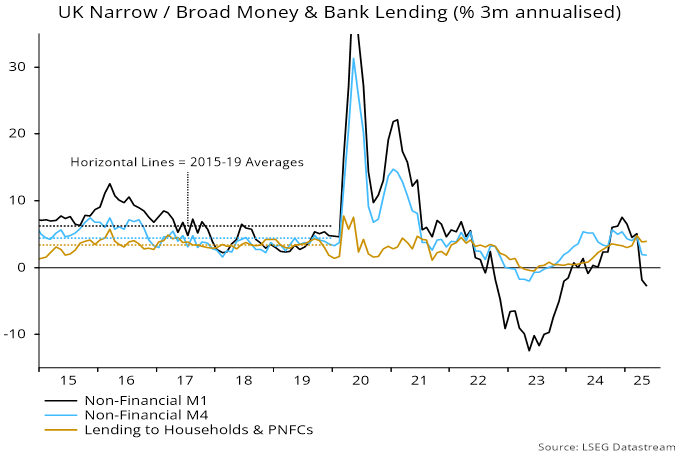
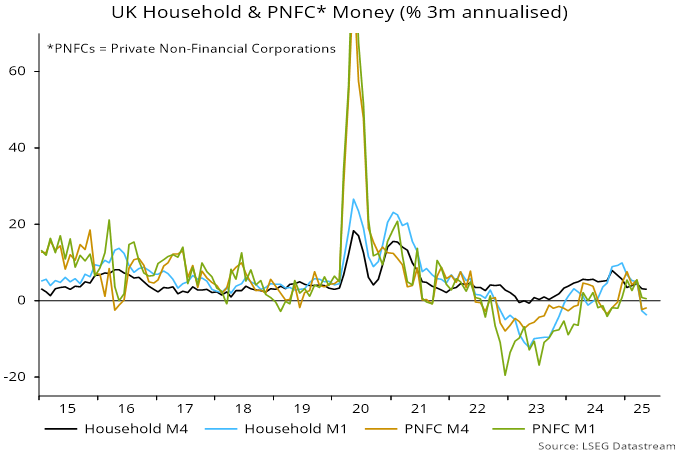
Underlying softening is consistent with lagged money trends and sterling appreciation – the effective rate is currently 3% above its 2024 average level and 7% higher than in 2023.

The MPC is concerned that another inflation pick-up, although unrelated to monetary policy, will generate “second-round” effects. Still-subdued money growth, currency strength and a weakening labour market argue for a relaxed view.

Photo d'une tondeuse Toro Reelmaster 3555-D sur un terrain de golf.

CALGARY (ALBERTA), le 23 mai 2025 – Oakcreek Golf & Turf LP (« Oakcreek »), un important distributeur d’équipement de gazon commercial Toro, a annoncé aujourd’hui l’acquisition de L.L Johnson Distributing Company, Inc. (« LL Johnson ») et de Midwest Turf & Irrigation (« Midwest Turf ») qui, ensemble, représentent la quasi-totalité des actifs de Pattlen Enterprises, Inc. Les modalités de la transaction n’ont pas été divulguées.

Depuis 50 ans, LL Johnson de Denver au Colorado et Midwest Turf d’Omaha au Nebraska sont reconnus comme d’importants distributeurs d’équipement, de systèmes et de pièces pour l’entretien et l’irrigation de gazon commercial auprès de sa clientèle des Rocheuses et du Midwest des États-Unis. Ils sont distributeurs de l’équipement Toro, ainsi que d’un large éventail d’équipement et de solutions d’autres fabricants de premier plan. Ces produits sont utilisés dans divers marchés finaux, notamment les terrains de golf, les complexes et les stades sportifs, les municipalités, et sont utiles à d’autres fins commerciales et résidentielles.

« Nous sommes heureux d’accueillir LL Johnson et Midwest Turf au sein de la famille Oakcreek », a déclaré Patrick Nolan, chef de la direction d’Oakcreek Golf & Turf LP. « Leurs connaissances du secteur, leurs relations avec la clientèle et leur équipe talentueuse cadrent parfaitement avec notre objectif à long terme de devenir le meilleur distributeur de notre catégorie pour nos partenaires fabricants d’équipement d’origine (FEO). Ensemble, nous avons hâte d’offrir une valeur encore plus grande à notre clientèle. »

« Je suis très heureux de voir notre entreprise, bâtie au fil des décennies par une équipe exceptionnelle, être acquise par Oakcreek », a déclaré Jim Johnson, chef de la direction de Pattlen Enterprises, Inc. « La mentalité de Oakcreek, qui place le client au cœur de ses priorités, s’harmonise parfaitement avec la nôtre. Je suis convaincu que ce partenariat se traduira par un succès continu au cours des prochaines décennies. »

Simon Gélinas, directeur général de Banyan Capital Partners, a déclaré : « Jim a bâti une entreprise formidable avec LL Johnson et Midwest Turf, et nous sommes privilégiés de soutenir la prochaine phase de son parcours. L’objectif de Banyan est de créer des sociétés chefs de file du secteur, et nous croyons que celle-ci est une candidate idéale. »

LL Johnson et Midwest Turf continueront de fonctionner sous leurs noms actuels, ce qui assurera une transition en douceur pour les employés, la clientèle et les partenaires. Le processus d’intégration devrait être terminé au cours des prochains mois, et l’accent sera mis sur la continuité et sur le renforcement de notre offre collective.

À propos de Pattlen Enterprises, Inc.

Pattlen Enterprises, Inc., distributeur à services complets d’équipement commercial Toro, comprend deux entités : LL Johnson à Denver, au Colorado et Midwest Turf à Omaha, au Nebraska.

La société LL Johnson (anciennement appelée Barteldes Seed Company) de Denver a été fondée par Leonard et Patt Johnson en 1976. Peu après, la société Midwest Turf & Irrigation d’Omaha (anciennement Midwest Toro), a été intégrée à l’automne 1980. Ces deux sociétés de distribution ont ensuite été combinées sous le nom de Pattlen Enterprises. En 2005, le fils de Leonard Johnson, James, a acheté la société.

À propos d’Oakcreek Golf & Turf LP

Oakcreek Golf & Turf LP est un distributeur à services complets de l’ouest du Canada d’équipement d’entretien de gazon commercial Toro, d’équipement d’irrigation pour le golf Toro, de voiturettes de golf Yamaha et d’équipement Kӓssbohrer (PistenBully) de damage des pistes. Le siège social d’Oakcreek est situé à Calgary, en Alberta, et des installations sont situées dans l’Ouest canadien. En 2017, Oakcreek a étendu sa couverture au sud-ouest des États-Unis en acquérant Simpson Norton Corporation, société implantée à Phoenix, en Arizona. Oakcreek appartient à Banyan Capital Partners, une société canadienne de capital-investissement, et à son équipe de direction. www.oakcreekgolf.com

À propos de Banyan Capital Partners

Fondée en 1998, Banyan Capital Partners est une société canadienne de capital-investissement qui effectue des placements en actions dans des sociétés du marché intermédiaire en Amérique du Nord; sa direction est en poste depuis 2008. Grâce à une approche de placement à long terme, Banyan est devenue l’une des plus importantes sociétés de capital-investissement du marché intermédiaire au Canada et elle a fait ses preuves en fournissant des liquidités complètes ou partielles aux fondateurs, aux familles et aux entrepreneurs, pour les aider à faire croître leur entreprise. Pour obtenir des précisions, consultez le site banyancapitalpartners.com.

Banyan est membre du Groupe financier Connor, Clark & Lunn Ltée, une société indépendante de gestion d’actifs multientreprise appartenant à ses employés et comptant plus de 40 ans d’expérience et des bureaux au Canada et aux États-Unis, au Royaume-Uni et en Inde. Le Groupe financier CC&L et ses sociétés affiliées, qui gèrent collectivement un actif de plus de 142 milliards de dollars canadiens, offrent une gamme diversifiée de produits et de solutions de placement traditionnels et non traditionnels aux clients institutionnels, aux clients fortunés et aux particuliers. Pour obtenir des précisions, consultez le site cclgroup.com/fr/.

Personnes-ressources pour les médias

Banyan Capital Partners
Simon Gélinas
Directeur général
Banyan Capital Partners
(416) 291-0029
[email protected]

Alkaline batteries with focus on a single red battery in the middle.

One of the joys of investing in the world of small caps is discovering a company that has carved out a niche in the most unexpected of markets. Most of these companies go unnoticed as part of a larger value chain, their products often hidden from the eyes of the end consumer. The idea of a “hidden champion” toiling away in deliberate obscurity while quietly dominating a niche sector or technology was first highlighted by renowned management consultant Hermann Simon in his book – “Hidden Champions of the Twenty First Century.”

What is a hidden champion, one might ask? According to Simon, hidden champions have the following three attributes:

  1. They are in the top three of their chosen global niche.
  2. They generate revenue between $5 million and $5 billion.
  3. They maintain obscurity in terms of brand recognition (B2B in most cases).

Some of the attributes that define them are also what makes them successful. The key lessons we can take from observing hidden champions are:

  • Ambition: Despite their size, they set extremely ambitious goals. It is market leadership or bust. Goals are invariably long-term focused with decades in mind.
  • Specialization: Their preference is both extreme focus and depth of focus. They identify narrow markets and specialize in them.
  • Globalization: Their specialization is then unleashed on global markets. They aggressively hunt for new markets and prefer to serve those markets with their own subsidiaries instead of getting tied up with third parties.
  • Innovation: Scarcity of resources due to their small size means they need to be much more effective with R&D. Thinking outside the box means you need to innovate not just products, but processes as well.
  • Customer closeness: Large customers can be demanding and often want the lowest price. Hidden champions respond by engaging closely with customers. Providing advice and system integration services by closely engaging with customers creates stickiness and deep moats.
  • Financing: Most hidden champions are self-financed with ownership that is long-term oriented and conservative with capital allocation.
  • Culture: Culture is high performance with more work to go around than headcount. Turnover is low and managers tend to have long tenures.

Hidden champions tend to be everywhere in the world of small caps, including in emerging markets. In our emerging market small cap portfolio, we have a good representation of hidden champions serving a diversity of end markets. Take Hongfa Technology Co. Ltd. (600885 CH), a Chinese company which has carved out a niche in power relays and is the global leader with over 20% market share. Power relays are a crucial component of any electric equipment that is a part of modern life. They convert a low power input into a high power outcome. From home appliances to industrial equipment, alarms and automobiles, its relays form a ubiquitous part of our lives. As the world upgrades its power grids and AI drives higher power consumption, Hongfa’s high-voltage products should see enhanced demand in the coming years.

Similarly, we own a company in Korea called Vitzrocell Co. Ltd. (082920 KS) which is among the top three players globally in manufacturing primary batteries. Primary batteries have high energy densities, a low discharge rate (allowing them to run for 10 years and beyond) and a wide operational temperature range (-55°C–+85°C). This makes them ideal for use in harsh conditions that require extremely high reliability like oil and gas equipment, rockets and utility meters.

Finally, over in India, we own Suprajit Engineering Ltd. (SEL IN), which is the second largest global manufacturer of control cables and third largest manufacturer of halogen lamps. Suprajit makes over 15,000 types of control cables used in passenger vehicles, two- and three-wheelers and off-highway vehicles like tractors and recreational vehicles. Control cables, as the name suggests, transmit control signals to control equipment versus power cables that transmit high voltage power.

Suprajit is the textbook example of a hidden champion with their stated goal of being a leader in control cables, growing a global manufacturing footprint, deep relationships with leading OEMs and nimble, low-cost R&D efforts leveraging talent in India. With most of global manufacturing now located in emerging markets, we see a landscape littered with hidden champions waiting to be uncovered.

Taiwan city skyline and skyscrapers.

Currency intervention across Asia in recent weeks may be yet another signal that we are entering a new investment order. We have written to clients previously that a secular peak in the USD likely occurred at the end of 2022.

Looking back to previous peaks in the 1970s and 1980s under Nixon and Reagan respectively, the dollar provided a powerful signal to investors that the US economy was experiencing major distortions that would force policy intervention.

President Trump’s Liberation Day tariff shock is part of a broader play to reinvigorate the competitiveness of American manufacturing. Another key pillar of the strategy is the desire for a weaker dollar. We are now starting to see this play out in Asian currency markets.

The most dramatic moves were in the Taiwan dollar, which surged by 9% over two trading days, reaching three-year highs and logging its sharpest daily gains since at least 1981.

East Asia currencies vs US dollar
31 December 2024 = 100
Graph showing the value of East Asia currencies versus the US Dollar over time since January 2025.Source: NS Partners and LSEG (May 2025)

Currency tremors may signal the start of a broader shift in global capital that could have big implications for which markets out- or underperform going forward. As the Financial Times reported in “The Coming Asian FX ‘avalanche’” (7th of May 2025) quoting Eurizon’s Stephen Jen:

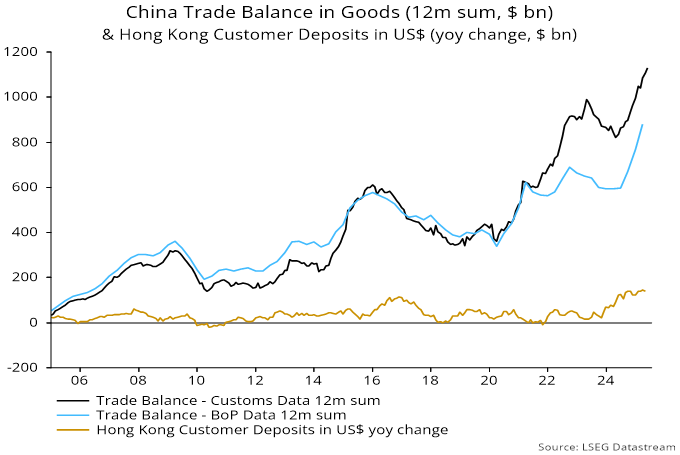
“We have long warned about the ‘Avalanche’ risk for the dollar. There could be USD2.5 trillion worth of ‘snow’ in China and more from the likes of Taiwan, Malaysia and Korea, rising at a pace of USD500 billion a year – we conservatively guesstimate. Only a modest proportion of the very large trade surpluses these countries have earned have been repatriated back home, with the bulk of the export earnings being hoarded by exporters in USD deposits.

“Like in actual avalanches, ex-ante, many might dismiss the warnings, but ex-post, all would admit that it was an obvious risk. We are still waiting for more triggers, but we see the sharp sell-off in USDTWD this week from this Avalanche perspective. We predict there will likely be other sudden lurches lower in USDAsia in the coming quarters. Corrections in USDAsia could pacify the US, as Asia accounts for more than half of all US trade deficit, making this a fundamentally benign development, except for those caught long dollars.

“The overhang of liquid dollar holdings is just too large if the dollar weakens, the Fed cuts interest rates, and China stages a cyclical rebound. In other words, both the push and pull factors that kept the export earnings in dollars outside the home countries in the past years will potentially flip signs in the coming quarters. At the same time, many of those holding long-dollar exposures know very well that the dollar is over-valued.”

Emerging markets love a falling dollar, which is an environment we’ve not seen in over 13 years.

Two line graphs side by side. The first illustrates the similarity of the current US trade policy shock with the "Nixon Shock" of 1971. The second illustrates the outperformance of emerging markets at the same times as these policy "shocks."Source: LSEG Datastream

Historically, this has seen EM outperform DM, while the winners and losers within the asset class also rotate. For instance, while the strong dollar environment typically favoured EM exporters, a weak dollar would be a shot in the arm for domestic consumers.

Other markets which could surge are those which the United States permits to manage their currencies against a falling dollar by easing monetary policy. There are a number of other smaller EM economies with managed exchange rates which could enjoy surging liquidity that feeds bull markets in financial assets.

The cleanest example of this currency-liquidity transmission is the Hong Kong dollar peg. When the USD falls, the Hong Kong Monetary Authority intervenes to maintain the HKD peg by buying USD and selling HKD, increasing HKD supply. This surge in liquidity lowers interest rates, stimulates economic activity and can lead to higher asset prices (and inflationary pressures).

Our liquidity analysis should be a powerful tool for identifying the risks of both booms and busts if this trend continues.

It’s all about pricing power for the export winners

While exporter stock prices may pop in the coming months on better tariff news, currency dynamics could be important drivers of future outperformance. Let’s use Taiwan Semiconductor Manufacturing Company (TSMC) as an example at the stock level. The company has previously given clear guidance that every 1% of appreciation in the TWD against the USD is a 0.4 ppt hit to OPM. We roughly model this impact out below to illustrate the currency risk to earnings:

EPS Q1 25a Q2 25e Q3 25e Q4 25e 2025 Implied PE Implied share price with 17x Fr current
share px
Consensus 13.9 14.8 15.7 15.5 60.0 15.4 1019 11%
FX Impact (10%+) 13.9 13.7 12.7 12.1 52.4 17.5 891 -3%
FX Impact (15%+) 13.9 13.1 12.1 11.5 50.6 18.2 861 -6%
FX Impact (20%+) 13.9 12.5 11.5 10.9 48.8 18.8 830 -10%

If we assumed a further appreciation of TWD/USD to 25 – a 20% appreciation from where TSMC recently guided (when TWD/USD was 33) – the hit to TSMC’s EPS is around 23%.

If we apply a mid-cycle PE (17x) to the company and factor in the earnings hit from the currency shift, that would take us to a stock price of TWD830 from the TWD950 at the start of May.

Adding to the risk is the unpredictability of tariffs negotiations between the United States and Taiwan. Tariffs above 20% on Taiwan semiconductor exports could be a meaningful hit to earnings. Perhaps authorities in Taiwan are allowing the TWD to appreciate as part of a pitch to avoid tariffs.

Mitigating the risks is TSMC’s immense pricing power. We believe robust demand will persist for the leading-edge chips enabling AI where it has a monopoly status. This positions TSMC to pass through a significant portion of price increases to its customers.

However, players in the more commoditised segments of the semiconductor industry which lack the moats and pricing power will be more vulnerable to hits from tariffs and currencies.