Why believe the “monetarist” forecast that recent G7 monetary weakness will feed through to low inflation in 2024-25? 

Monetary trends correctly warned of a coming inflationary upsurge in 2020 when most economists were emphasising deflation risk. 

The forecast of rapid disinflation is on track in terms of the usual sequencing, with commodity prices down heavily, producer prices slowing sharply and services / wage pressures showing signs of cooling. 

A further compelling consideration is that the monetary disinflation expected in G7 economies has already played out in emerging markets. 

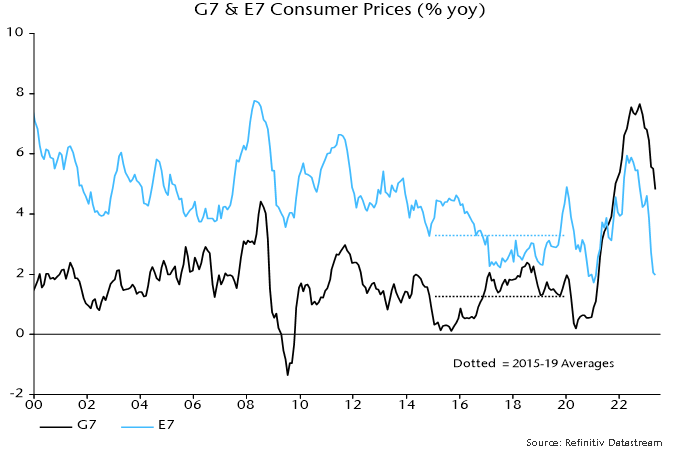
A GDP-weighted average of CPI inflation rates in the “E7” large emerging economies* crossed below its pre-pandemic (i.e. 2015-19) average in March, falling further into May – see chart 1. 

Chart 1

G7 & E7 Consumer Prices (% yoy). Source: Refinitiv Datastream.

The E7 average is dominated by China but inflation rates are also below or close to pre-pandemic levels in Brazil, India and Russia. 

Inflation rose by much less in the E7 than the G7 in 2021-22, opening up an unprecedented negative deviation that has persisted. 

The recent plunge in the E7 measure reflects a significant core slowdown as well as lower food / energy inflation. 

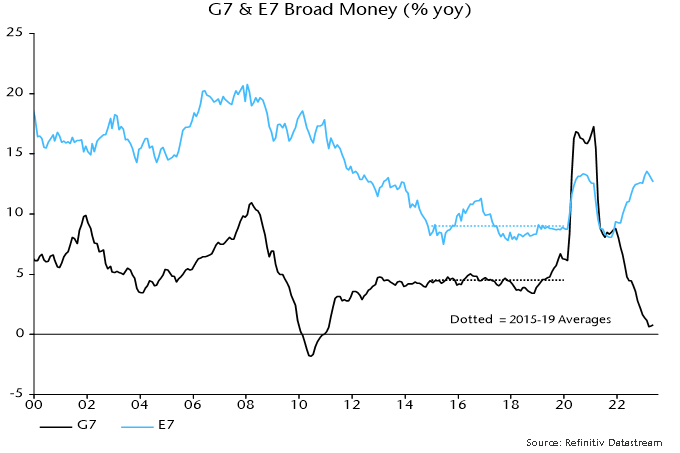
The divergent G7 / E7 experiences are explained by monetary trends. Annual broad money growth rose by much less in the E7 than the G7 in 2020 and returned to its pre-pandemic average much sooner – chart 2. 

Chart 2

G7 & E7 Broad Money (% yoy). Source: Refinitiv Datastream.

E7 broad money growth crossed below the pre-pandemic average in May 2021. CPI inflation, as noted, followed in March 2023, i.e. consistent with the monetarist rule of thumb of a roughly two-year lead from money to prices. 

G7 broad money growth crossed below its pre-pandemic average in August 2022 and has yet to bottom, suggesting a return of inflation to average in summer 2024 and a subsequent undershoot. 

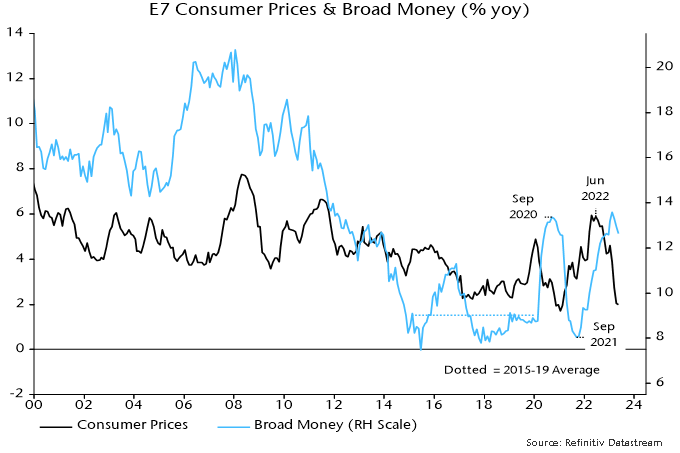
E7 disinflation, however, may be close to an end. Annual broad money growth has recovered strongly from a low in September 2021, signalling a likely inflation rebound during 2024 – chart 3. Broad money acceleration has been driven by China, Russia and Brazil. 

Chart 3

E7 Consumer Prices & Broad Money (% yoy). Source: Refinitiv Datastream.

E7 annual broad money growth is around the middle of its longer-term historical range and has eased since February. Chinese numbers may have been temporarily inflated by a shift in banks’ funding mix in favour of deposits. 

The expected rise in E7 inflation may not extend far but restoration of a positive E7 / G7 differential is likely in 2024.

*E7 defined here as BRIC + Korea, Mexico, Taiwan.

Piles de pièces assises sur un fond de graphique financier.

Les investisseurs institutionnels sont souvent confrontés à la décision de protéger ou non leurs placements étrangers contre les fluctuations des taux de change. La vigueur ou la faiblesse d’une devise par rapport à une autre, comme le dollar canadien par rapport au dollar américain, est une préoccupation courante. Plusieurs mythes concernant les devises peuvent influencer les décisions de placement.

Mythe 1 – Les fluctuations des taux de change ont le même effet sur toutes les sociétés.

Bien que la majorité des sociétés des marchés boursiers mondiaux payent des coûts et génèrent des revenus dans différentes devises, les fluctuations des taux change n’ont pas la même incidence dans tous les cas. Les sociétés des marchés boursiers mondiaux peuvent être réparties en quatre grandes catégories.

Multinationales Ressources naturelles Exportateurs Centrées sur le marché intérieur
Coca-Cola Shell Nissan Itau
Unilever AngloGold Ashanti Swatch Unibanco
Multinationales Coca-Cola Unilever
Ressources naturelles Shell AngloGold Ashanti
Exportateurs Nissan Swatch
Centrées sur le marché intérieur Itau Unibanco
 

Dans la catégorie la plus importante, les sociétés multinationales, les coûts et les revenus sont exprimés dans plusieurs devises. Les fluctuations du taux de change de la monnaie nationale auront donc une incidence sur le rendement et la volatilité des sociétés individuelles.

Dans le cas des entreprises liées aux ressources naturelles, comme celle des secteurs de l’énergie et des mines, le facteur qui a le plus d’effet sur le rendement et la volatilité est la variation du prix du produit de base qu’elles exploitent.

Les exportateurs génèrent la plus grande partie de leur chiffre d’affaires à l’étranger, par conséquent, la faiblesse de la monnaie nationale peut être avantageuse, parce qu’elle rend leurs produits plus concurrentiels, tandis qu’une monnaie forte peut avoir l’effet inverse.

Les entreprises centrées sur leur marché intérieur œuvrent principalement sur leur marché national, donc, les fluctuations des taux de change ont une faible incidence sur le rendement et la volatilité.

Mythe 2 – Les gestionnaires de placement s’occupent de gérer le risque de change.

Les méthodes de gestion des taux de change varient selon le style et le processus de chaque gestionnaire de placement. En règle générale, la première considération est propre au titre : les entreprises sont classées en grandes catégories, comme cela est décrit dans le Mythe 1, afin d’évaluer comment chaque société gère les répercussions des taux de change sur ses activités, ce qui permet au gestionnaire de placement de déterminer le risque de change « réel » de chaque société.

Les gestionnaires de placement qui privilégient une approche fondamentale analysent la surpondération de certaines devises résultant du processus de sélection d’actions et de répartition sectorielle, afin de déterminer si une couverture est nécessaire pour se rapprocher de la répartition de l’indice de référence. Cette analyse n’entraîne pas toujours l’adoption d’une couverture.

En revanche, les gestionnaires systématiques (quantitatifs) perçoivent souvent une exposition au risque de change différente de celle de l’indice de référence comme un risque non compensé et les différences de change engendrées par le processus de sélection des titres sont couvertes, afin qu’elles aient un effet globalement neutre par rapport à l’indice de référence, après avoir examiné les coûts associés à la couverture.

Mythe 3 – Les actions mondiales sont plus volatiles que les actions canadiennes.

Sur des périodes plus courtes (p. ex., périodes mobiles de trois ans), le rendement des actions mondiales a généralement été moins volatil que celui des actions canadiennes, malgré l’exposition au risque de change. Toutefois, sur de courtes périodes, les actions mondiales peuvent être plus volatiles. La figure 1 présente la volatilité relative des rendements des actions canadiennes (représentées par l’indice S&P/TSX) sur des périodes mobiles de trois ans par rapport aux actions mondiales (représentées par l’indice MSCI Monde non couvert). Lorsque la courbe de volatilité dépasse la ligne horizontale de 0 %, cela indique que les actions canadiennes ont été plus volatiles. À l’inverse, lorsque la courbe de volatilité descend en dessous de la ligne horizontale, cela indique que les actions mondiales ont été plus volatiles. En général, les actions canadiennes ont été plus volatiles.

Figure 1 : Volatilité relative des actions canadiennes et mondiales

Source : Bloomberg and MSCI

Toutefois, l’analyse à long terme (rendements sur des périodes mobiles de 10 ans) montre que les actions mondiales ont été presque systématiquement moins volatiles que les actions canadiennes (figure 2), car les occasions de placement sont plus diversifiées.

Figure 2 : Volatilité des rendements absolus des actions canadiennes et mondiales

Source : Bloomberg and MSCI

Mythe 4 – Couvrir le risque de change réduit la volatilité des actions mondiales.

Comme les investisseurs institutionnels détiennent souvent des portefeuilles diversifiés comprenant des actions mondiales, l’exposition aux taux de change est un facteur important. Même si la couverture des taux de change est souvent perçue comme nécessaire pour réduire la volatilité, les recherches montrent que ce n’est peut-être pas toujours la meilleure approche. La figure 3 montre que la volatilité des rendements sur des périodes mobiles de trois ans a généralement été plus faible sans couverture des taux de change, surtout depuis le milieu des années 1990. Cela s’explique par le fait que les fluctuations des taux de change peuvent compenser les fluctuations du rendement, ce qui réduit la volatilité globale des placements. Lorsque la courbe de volatilité relative dépasse la ligne horizontale de 0 %, la couverture du taux de change des actions mondiales a réduit la volatilité du rendement. Sous la ligne horizontale de 0 %, les placements en actions mondiales non couverts ont produit des rendements moins volatils.

Ne pas couvrir le risque de change peut avoir des avantages, comme la capacité de tirer parti des fluctuations de change favorables. Toutefois, le risque de change peut aussi accroître le risque global d’un portefeuille et doit être surveillé et géré avec soin pour s’assurer qu’il demeure acceptable pour chaque investisseur.

Figure 3 : Actions mondiales couvertes et non couvertes

Source : Bloomberg and MSCI

Mythe 5 – Couvrir le risque de change à 50 % est la stratégie optimale.

Les recherches indiquent souvent qu’un ratio de couverture de 50 % est optimal. Toutefois, la décision de couvrir le risque de change dépend de l’investisseur et de sa perspective concernant le risque, ainsi que du risque de change d’un portefeuille. Par exemple, les stratégies de couverture doivent être adaptées au portefeuille de l’investisseur. La figure 4 montre que le niveau de couverture nécessaire dépend du risque de change total du portefeuille d’un investisseur. Les portefeuilles des investisseurs A et B ont une exposition nette de 30 % au risque de change, même s’ils ont des ratios de couverture très différents.

Figure 4 : Conséquences d’un ratio de couverture de 50 %

  Exposition au risque de change (a) Ratio de couverture (b) Net currency exposure (a-b)
Investisseur A 60 % 50 % 30 %
Investisseur B 30 % 0 % 30 %
  Investisseur A Investisseur B
Exposition au risque de change (a) 60 % 30 %
Ratio de couverture (b) 50 % 0 %
Exposition nette au risque de change (a-b) 30 % 30 %
 

Du point de vue du risque, un ratio de couverture de 50 % peut être recommandé pour gérer le « risque de regret », c’est-à-dire le regret qu’un investisseur éprouvera s’il décide de complètement couvrir ou de ne pas couvrir du tout le risque de change et que cette décision s’avère ne pas être la bonne.

La figure 5 compare le rendement des actions américaines non couvertes sur des périodes mobiles de trois ans moins le rendement des mêmes actions entièrement couvertes (ligne orange), ainsi que le rendement non couvert moins le rendement obtenu avec un ratio de couverture de 50 % (ligne verte). Lorsque le rendement relatif sur une période mobile de trois ans est au-dessus de la ligne horizontale de 0 %, la décision de ne pas couvrir le risque de change a permis d’enregistrer un meilleur rendement. Lorsque le rendement relatif est en dessous de la ligne horizontale, la décision de couvrir le risque de change a permis d’enregistrer un meilleur rendement.

Figure 5 : Regret lié à la gestion du risque de change

Source : Bloomberg and MSCI

La stratégie de couverture à 50 % visant à gérer le « risque de regret » minimise les rendements relatifs extrêmes, ce qui peut être avantageux pour certains investisseurs.

Dans un monde idéal, les investisseurs préféreraient une approche dynamique de la gestion des taux de change leur permettant de ne pas couvrir le risque de change lorsque le dollar canadien perd de la vigueur et de couvrir ce risque lorsque le dollar canadien prend de la vigueur.

Fixer des seuils qui déclencheront la couverture et son montant en fonction de la vigueur ou de la faiblesse relative de la devise pourrait être une option. La figure 6 ci-dessous donne un exemplede seuils pouvant être utilisés pour un portefeuille indiciel d’actions américaines.

Figure 6 : Seuils dynamiques

Taux de change ($ USD pour 1 $ CA) % d’actions américaines à couvrir
Supérieur à 0,90 $ 0 %
De 0,85 $ à 0,90 $ 20 %
De 0,75 $ à 0,85 $ 40 %
Inférieur à 0,75 $ 60 %
Taux de change
($ USD pour 1 $ CA)
% d’actions américaines à couvrir
Supérieur à 0,90 $ 0 %
De 0,85 $ à 0,90 $ 20 %
De 0,75 $ à 0,85 $ 40 %
Inférieur à 0,75 $ 60 %
 

Selon l’analyse du rendement relatif sur une période mobile de trois ans, la figure 7 montre la différence entre le rendement produit avec un ratio de couverture fixe de 50 % et celui produit avec une approche dynamique fondée sur des seuils. L’approche dynamique n’offre pas systématiquement un avantage et, en fait, la stratégie de couverture fixe a produit le meilleur rendement relatif, de 2005 à 2013. L’analyse ne tient pas compte du coût de la couverture. Étant donné que l’approche dynamique exige plus de temps et de surveillance, et qu’il faut des décennies pour produire un avantage significatif, il est probable qu’elle serait abandonnée au profit d’autres stratégies potentiellement plus rentables.

Figure 7 : Couverture fixe ou dynamique (rendements relatifs)

Source : Bloomberg and MSCI

Abonnez-vous aux mises à jour
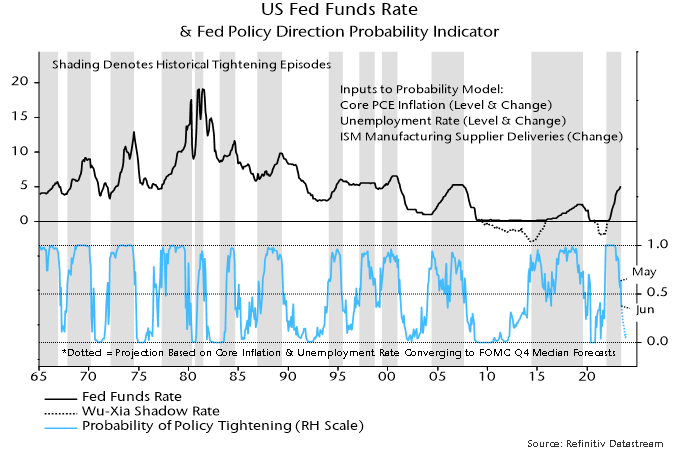
The FOMC’s updated economic forecast for the remainder of 2023 is inconsistent with Committee members’ median expectation of a further 50 bp rise in official rates during H2, according to a model based on the Fed’s past behaviour. Policy is more likely to be eased than tightened if the forecast plays out. 

The model estimates the probability of the Fed tightening or easing each month from current and lagged values of core PCE inflation, the unemployment rate and the ISM supplier deliveries index, a measure of production bottlenecks. It provides a simple but satisfactory explanation of the Fed’s historical decision-making, i.e. the probability estimate was above 50% in most tightening months and below 50% in most easing months – see chart. 

US Fed Funds Rate & Fed Policy Direction Probability Indicator.

The probability of the Fed tightening at yesterday’s meeting had been estimated by the model at 36%, the first sub-50% reading since September 2021. (The FOMC started to taper QE at the following meeting in November.) 

The FOMC’s median forecast for core PCE inflation in Q4 was revised up to 3.9% from 3.6% previously (currently 4.7%). The unemployment rate forecast was lowered to 4.1% from 4.5% (currently 3.7%). 

The model projections shown in the chart assume that core PCE inflation and the unemployment rate converge smoothly to the Q4 forecasts, while the ISM supplier deliveries index remains at its current level. Despite the revisions, the probability estimate still falls to below 10% in Q4, consistent with the Fed beginning to ease by then. 

The projections highlight the Fed’s historical sensitivity to the rates of change of core inflation and unemployment as well as their levels. It would be unusual for policy-makers to continue to tighten when inflation and unemployment are trending in the “right” directions, especially given the magnitude of the increase in rates to date. 

One difference from the past is that Fed now forecasts its own actions. Has yesterday’s guidance that rates have yet to peak boxed policy-makers into at least one further rise? This may mean that the model’s probability estimate for July – currently 29% – is too low. Still, next month’s decision will hinge on data, with inertia plausible barring stronger-than-expected news.

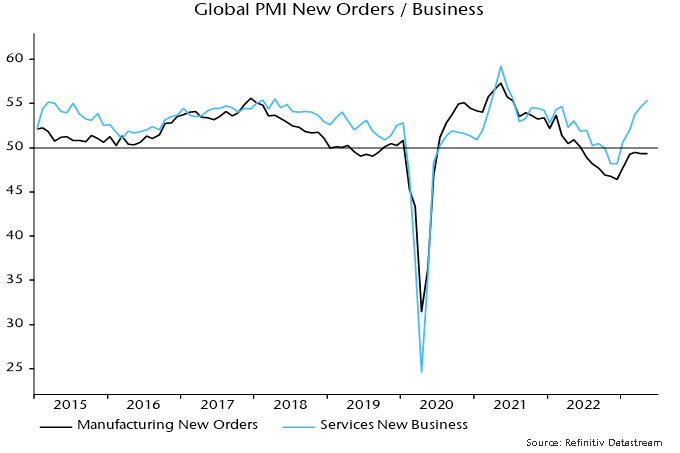
Global growth optimists expect continued solid services sector expansion to offset manufacturing weakness. PMI results for May appear, on first inspection, to support this view: services activity and new business indices rose further to 18- and 22-month highs respectively even as manufacturing new orders remained stalled below 50 – see chart 1. 

Chart 1

Chart 1: Global PMI New Orders /  Business. Chart compares manufacturing new order vs. services new business from 2015 to 2023. Source: Refinitiv Datastream.

There are, however, several reasons for discounting the strong headline services readings. 

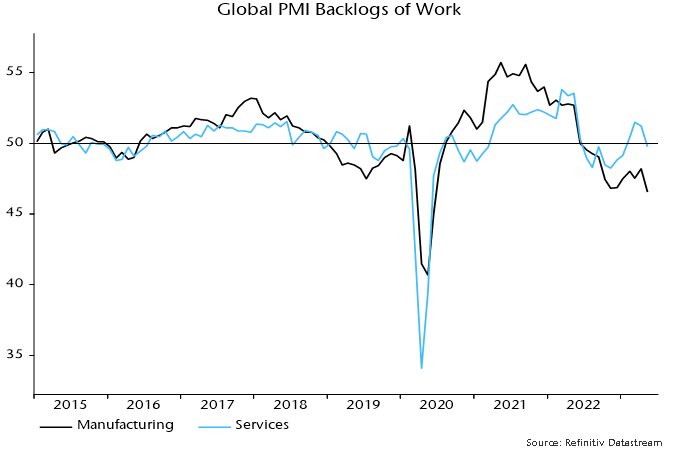
First, backlogs of services work fell sharply to a four-month low despite stronger new business – chart 2. This suggests that current output is running ahead of incoming demand, in turn implying a future adjustment lower unless demand picks up further. 

Chart 2

Chart 2: Global PMI Backlogs of Work. This chart compares manufacturing vs. Services from 2015 to 2023. Source: Refinitiv Datastream.

Manufacturing backlogs also fell sharply last month, breaking below their November 2022 low. 

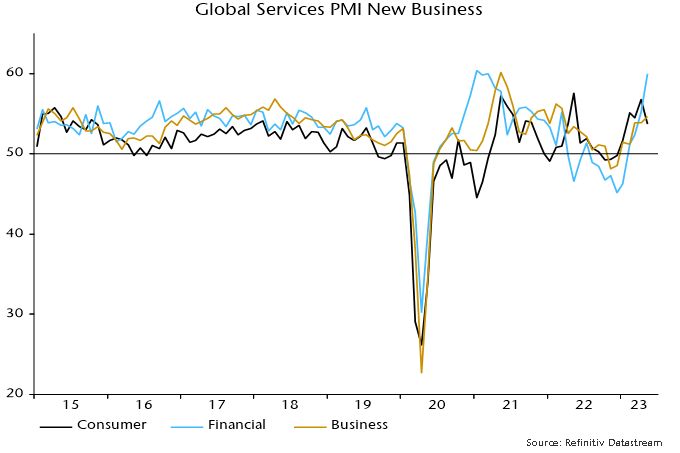
Secondly, the sectoral breakdown of the activity and new business indices shows that May rises were driven by a surge in financial services – chart 3. Consumer services indices eased on the month. Financial services strength is difficult to understand given monetary stagnation, slowing bank lending and flat trading volumes, so may prove short-lived. 

Chart 3

Chart 3: Global Services PMI New Business. This chart compares consumer, financial, and business from 2015 to 2023. Source; Refinitiv Datastream.

Thirdly, the high May readings of the global activity and new business indices reflect strong contributions from the US and Chinese components but national services surveys are significantly weaker. 

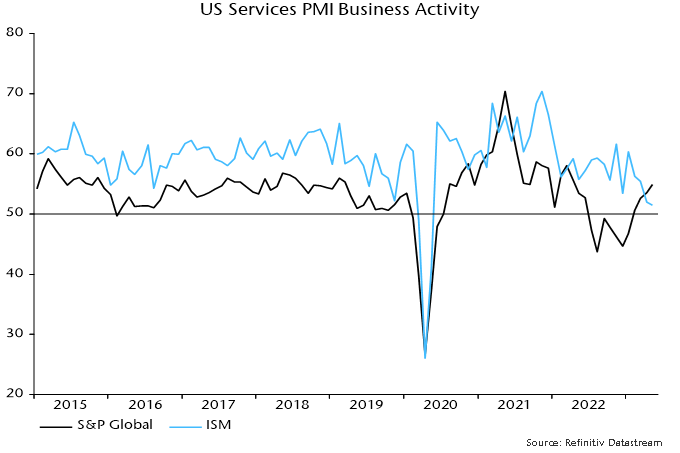
The US ISM services activity index fell to a three-year low in May even as the S&P Global equivalent series reached a 13-month high – chart 4. 

Chart 4

Chart 4: US Services PMI Business Activity. This chart compares S&P Global vs ISM from 2015 to 2023. Source: Refinitiv Datastream.

The Chinese NBS non-manufacturing new orders index moved below 50 in April and fell further in May, in puzzling contrast to the S&P Global / Caixin services new business index, which reached its second-highest level since November 2020. 

The global manufacturing new orders and services new business indices have been strongly correlated historically but statistical tests indicate a tendency for manufacturing to lead services rather than vice versa*. With global monetary trends continuing to give a negative economic signal, the current unusually wide gap is more likely to be closed by services weakness than a manufacturing revival. 

*In regressions using monthly data with three lags, lagged manufacturing new orders terms are significant in the regression for services new business, but lagged services new business terms are insignificant in the regression for manufacturing new orders.

Monetary trends continue to give a negative message for global economic prospects, suggesting that European / US weakness will outweigh resilience in major EM economies. 

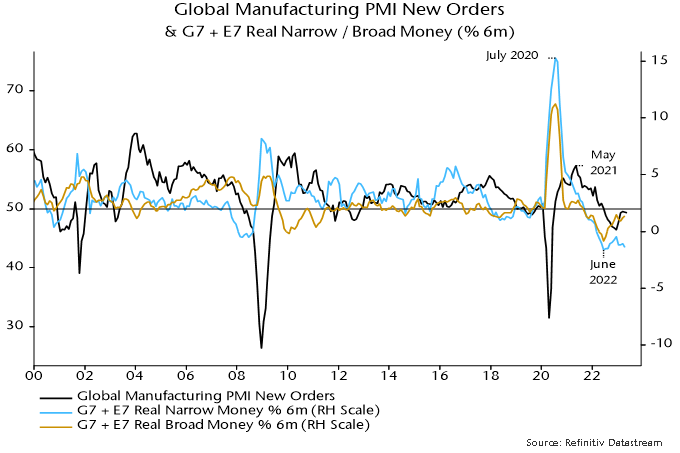
G7 plus E7 six-month real narrow money momentum fell again in April, extending a move down from a local peak in December and suggesting a decline in economic momentum through late 2023 – see chart 1. 

Chart 1

Chart 1 showing Global Manufacturing PMI New Orders & G7 + E7 Real Narrow / Broad Money (% 6m)

A revival in real narrow money momentum in H2 2022 was reflected in a recovery in global manufacturing PMI new orders between December and March. The recovery stalled in April / May and the forecast here remains for a relapse and possible retest of the December 2022 low during H2 2023. 

Narrow money has outperformed broad money as a leading indicator historically, in terms of reliability in signalling turning points in economic momentum. Narrow money usually weakens relative to broad money when interest rates rise as depositors are incentivised to shift funds to less liquid accounts. This is an important feature of the transmission mechanism and one of the reasons narrow money outperforms as a forecasting indicator. 

An argument, however, has been made that the unusual speed of the rise in interest rates over the past year, coupled with worries about deposit safety following recent bank failures and an associated switch into money market funds, may have exaggerated narrow money weakness relative to “true” economic prospects. This would suggest giving greater weight to broad money trends at present. 

As chart 1 shows, global six-month real broad money momentum recovered more strongly during H2 2002 and has stalled rather than fallen back since December. Still, the message for economic prospects is weak, suggesting no growth revival before 2024. 

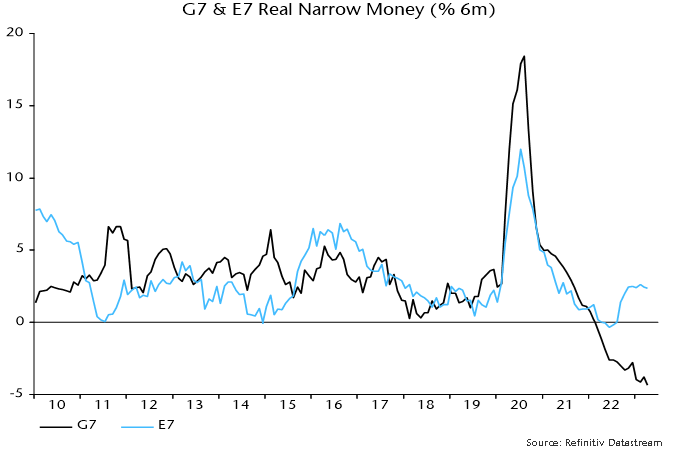
A marginal decline in global manufacturing PMI new orders in May reflected a notable weakening of the DM component offset by stronger EM results. EM resilience is consistent with recent stronger E7 real money momentum (broad as well as narrow) – chart 2. 

Chart 2

Chart 2 showing G7 + E7 Real Narrow Money (% 6m)

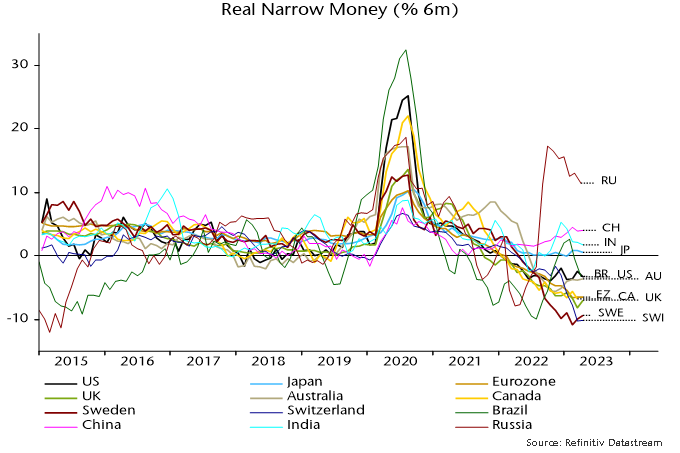
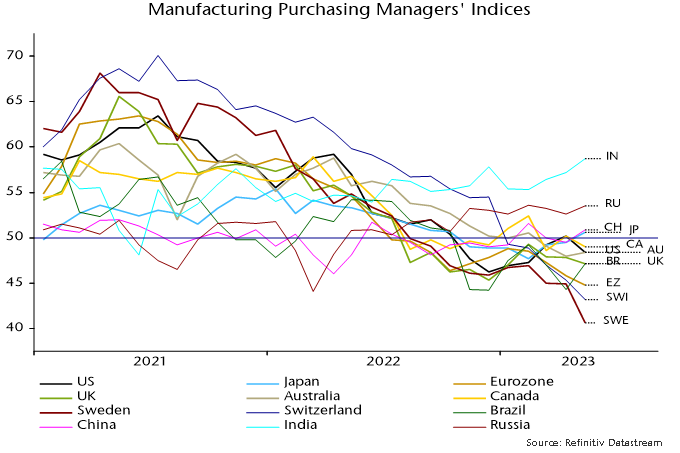
Charts 3 and 4 show six-month real narrow money momentum and manufacturing PMIs in selected major economies. Russia, China and India top the real money momentum ranking with weakness focused on Europe – particularly Switzerland and Sweden. The latest PMI results mirror the real money ranking (rank correlation coefficient = 0.85), with recessionary readings in the Eurozone, Switzerland and Sweden contrasting with Indian / Russian strength. 

Chart 3

Chart 3 showing Real Narrow Money (% 6m)

Chart 4

Chart 4 showing Manufacturing Purchasing Managers’ Indices

The stockbuilding cycle is on course to bottom soon and upturns have historically been associated with a procyclical shift in market behaviour. Several considerations, however, argue for caution about positioning for such a shift now. 

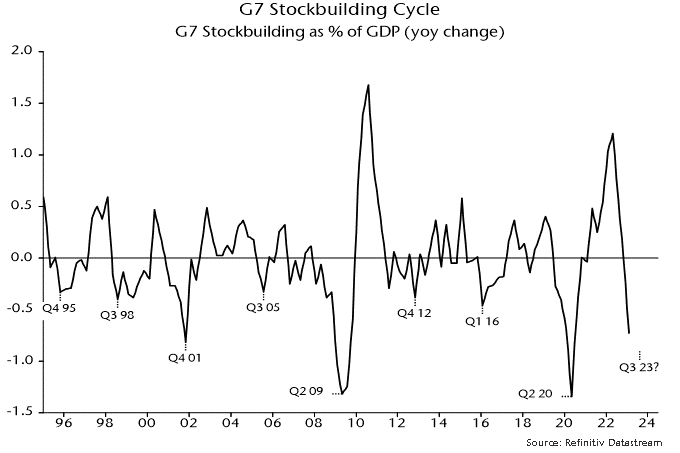
The key indicator used to monitor the cycle here is the annual change in G7 stockbuilding expressed as a percentage of GDP, shown in chart 1. Lows were reached every 3 1/3 years on average, which matches the 40-month periodicity reported by the “discoverer” of the cycle, Joseph Kitchin, in 1923. 

Chart 1

Chart 1 showing G7 Stockbuilding Cycle G7 Stockbuilding as % of GDP (yoy change)

The stockbuilding cycle is a key driver of industrial fluctuations: the correlation coefficient of the above series and contemporaneous G7 annual industrial output growth over 1965-2019 was 0.75.

The last cycle low was in Q2 2020 so the next could occur in H2 2023, based on the average cycle length. Partial Q1 information – an estimate is included in chart 1 – indicates that the downswing is well advanced, consistent with the cycle entering a window for a low. 

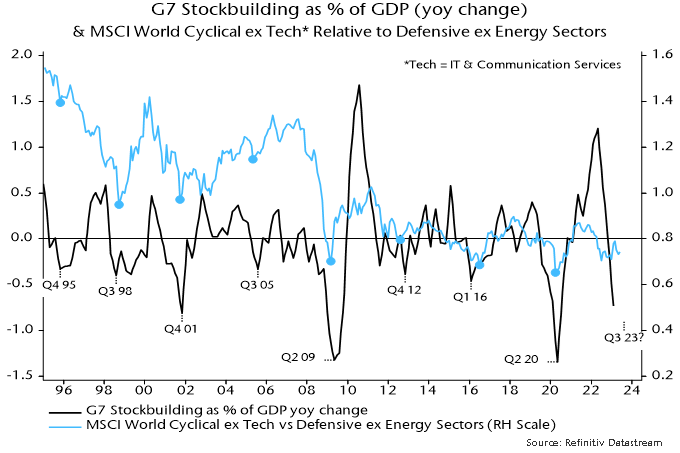
Cycle lows often mark a change in the market environment from risk-off / defensive to risk-on / cyclical, e.g. the price relative of cyclical equity market sectors versus defensive sectors has bottomed around the same time as the cycle historically – chart 2. 

Chart 2

Chart 2 showing G7 Stockbuilding as % of GDP (yoy change) & MSCI World Cyclical ex Tech* Relative to Defensive ex Energy Sectors *Tech = IT & Communication Services

So should investors start adding cyclical exposure? There are several reasons for caution. 

First, stockbuilding has fallen sharply but only to a “normal” level by historical standards. Further weakness seems likely given the extent of overaccumulation in 2021-23. 

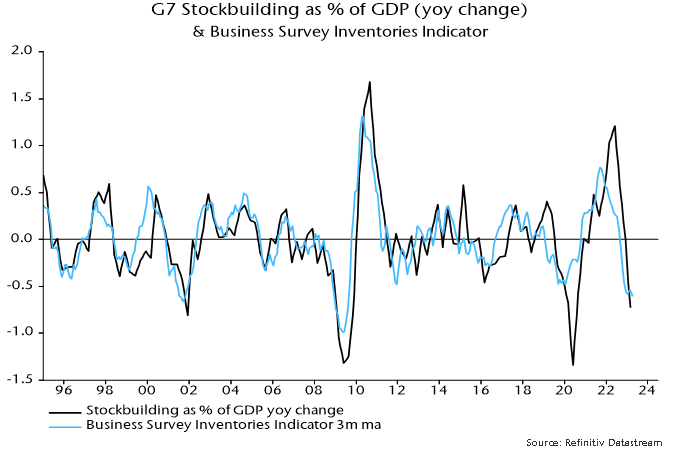
Second, a monthly inventories indicator derived from business surveys, which is more timely and usually leads by several months, has yet to signal a turning point – chart 3. 

Chart 3

Chart 3 showing G7 Stockbuilding as % of GDP (yoy change) & Business Survey Inventories Indicator

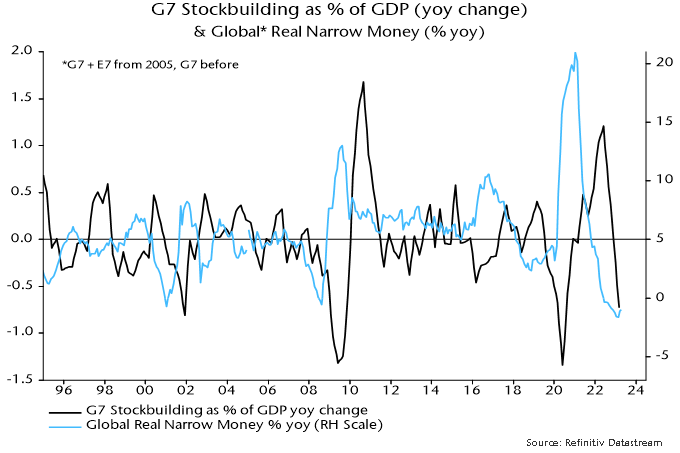
Third, and most importantly, stockbuilding cycle recoveries historically were preceded by a pick-up in real narrow money momentum, which remains very weak – chart 4. 

Chart 4

Chart 4 showing G7 Stockbuilding as % of GDP (yoy change) & Global* Real Narrow Money (% yoy) *G7 + E7 from 2005, G7 before

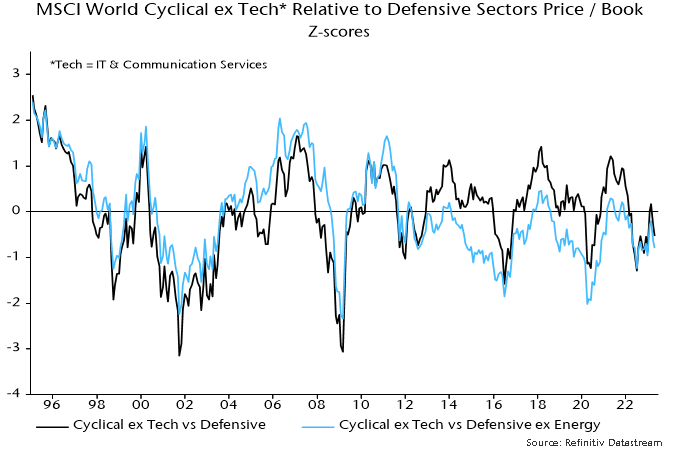
The price to book relative of non-tech cyclical sectors versus defensive sectors is below its long-run average but the divergence is smaller than at most recent stockbuilding cycle lows – chart 5. 

Chart 5

Chart 5 showing MSCI World Cyclical ex Tech* Relative to Defensive Sectors Price / Book Z-scores *Tech = IT & Communication Services

There is a risk of another bout of market weakness / cyclical underperformance as the stockbuilding cycle moves into a trough. The judgement here is that a revival in real money momentum is necessary to signal that a cycle low will be followed by a sufficiently solid recovery to boost cyclical assets.

The global manufacturing PMI new orders index – a timely indicator of global goods demand – was little changed below 50 (49.4) in April, a weaker result than had been suggested by DM flash results. 

Inventories indices for finished goods and production inputs, meanwhile, rose further to their highest levels since November. Accordingly, new orders / inventories differentials – which often lead at turning points – fell for a second month. 

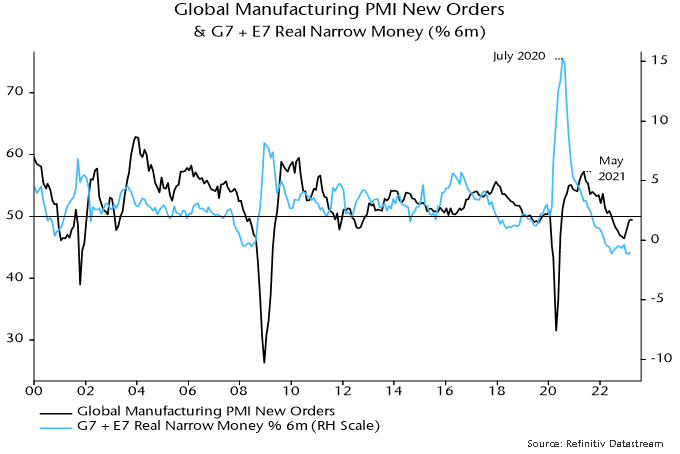
These results are consistent with the forecast here that a recovery in PMI new orders since December 2022 would fizzle out in H1 and reverse into H2, with a possibility of a break below the December low. The basis for the forecast was a relapse in global (i.e. G7 plus E7) six-month real narrow money momentum around end-2022. Real money momentum moved sideways in March at around its June 2022 low – see chart 1.

Chart 1

Chart 1 showing Global Manufacturing PMI New Orders & G7 + E7 Real Narrow Money (% 6m)

A downswing in the stockbuilding cycle was a key driver of earlier PMI weakness. A further drag is in prospect but the down phase of the cycle is well advanced, with incoming data and average cycle length suggesting a low during H2. 

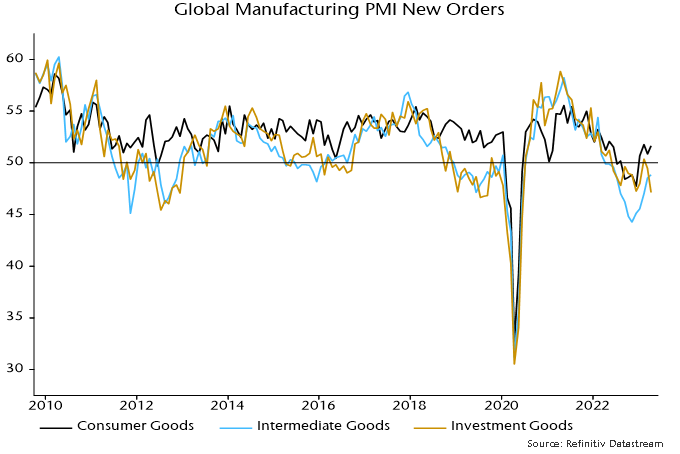
Business capex is emerging as a new source of global goods demand weakness. The capital goods component of PMI new orders reached a new low in April – chart 2. 

Chart 2

Chart 2 showing Global Manufacturing PMI New Orders

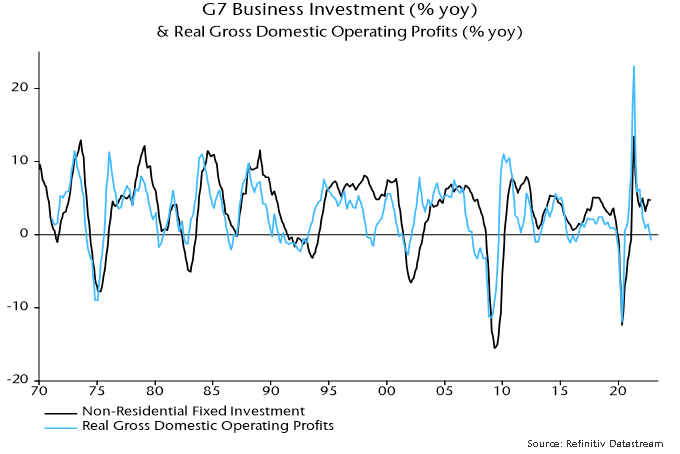
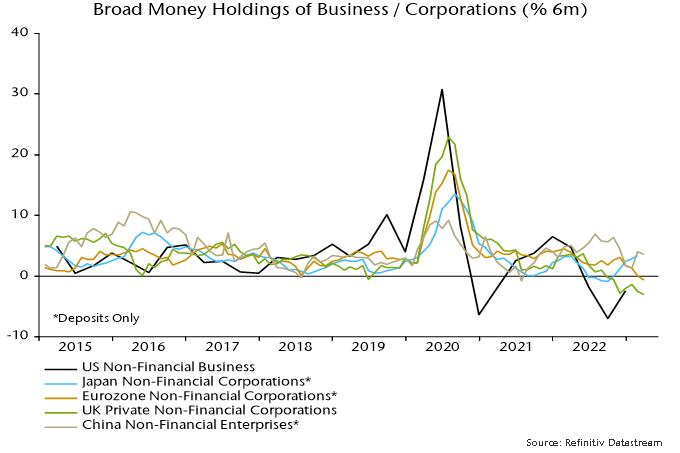
A contraction in business investment is consistent with a squeeze on real profits in late 2022 – chart 3 – and weak corporate money trends: business broad money holdings have fallen in nominal terms recently in the US, Eurozone and UK – chart 4. 

Chart 3

Chart 3 showing G7 Business Investment (% yoy) & Real Gross Domestic Operating Profits (% yoy)

Chart 4

Chart 4 showing Broad Money Holdings of Business / Corporations (% 6m)

Other evidence of a capex downturn includes: 

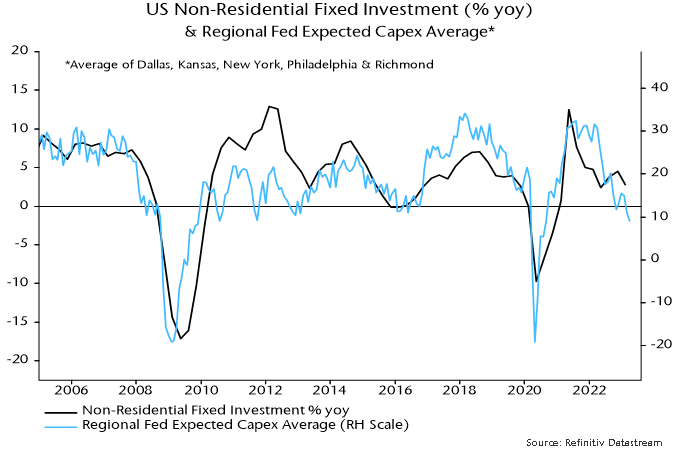
  • Weak capex intentions in regional Fed manufacturing surveys (and the NFIB small firm survey) – chart 5.  
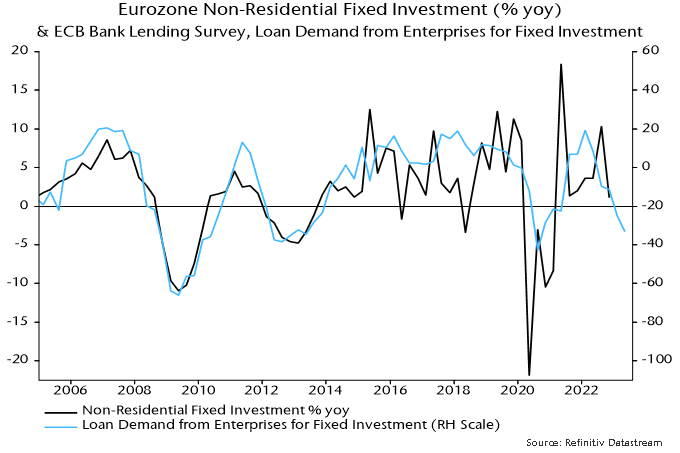
  • Weak enterprise loan demand for fixed investment in the ECB bank lending survey – chart 6.  
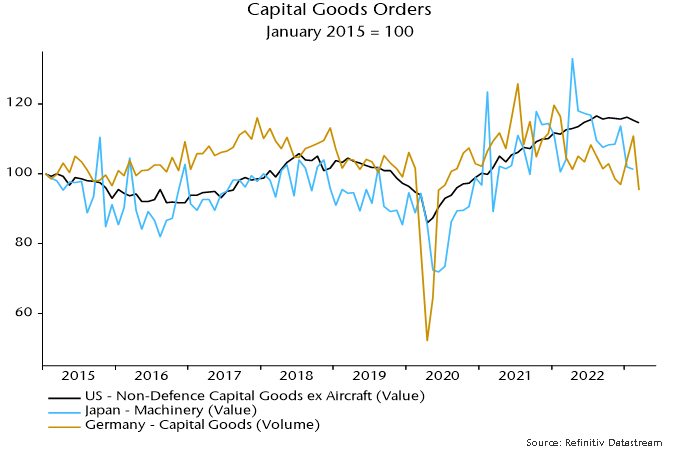
  • Falling capital goods / machinery orders in the US, Japan and Germany – chart 7.

Chart 5

Chart 5 showing US Non-Residential Fixed Investment (% yoy) & Regional Fed Expected Capex Average* *Average of Dallas, Kansas, New York, Philadelphia & Richmond

Chart 6

Chart 6 showing Eurozone Non-Residential Fixed Investment (% yoy) & ECB Bank Lending Survey, Loan Demand from Enterprises for Fixed Investment

Chart 7

Chart 7 showing Capital Goods Orders January 2015 = 100

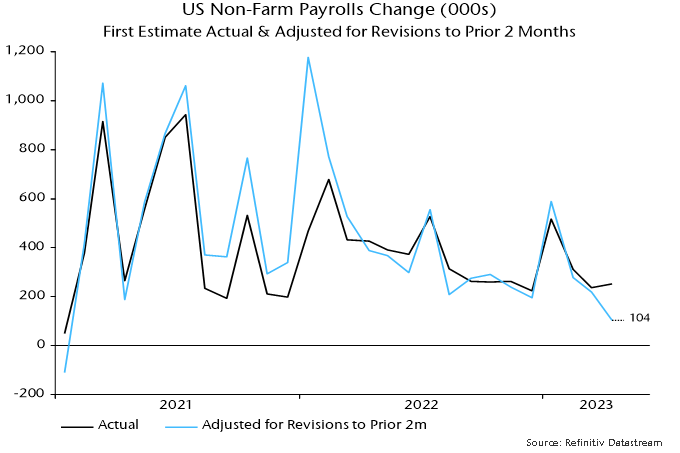
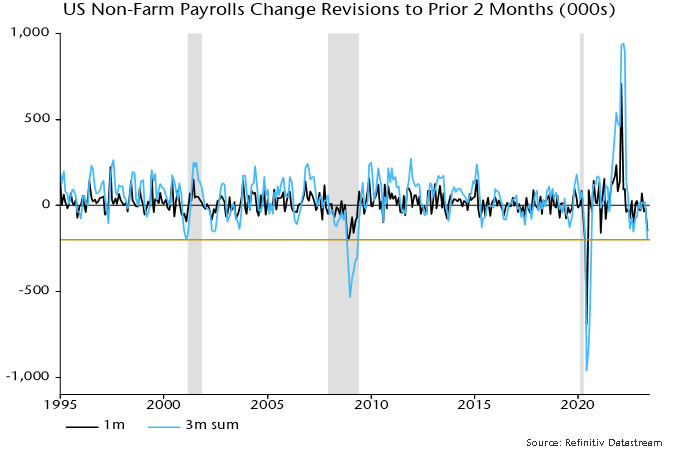
Capex retrenchment is usually accompanied by a fall in labour demand. Adjusted for negative revisions to the prior two months, the addition to US non-farm payrolls in April was 104,000, the smallest since January 2021 – chart 8. Revisions in the last three reports cumulate to -200,000, a level rarely reached outside recessions – chart 9.

Chart 8

Chart 8 showing US Non-Farm Payrolls Change (000s) First Estimate Actual & Adjusted for Revisions to Prior 2 Months

Chart 9

Chart 9 showing US Non-Farm Payrolls Change Revisions to Prior 2 Months (000s)

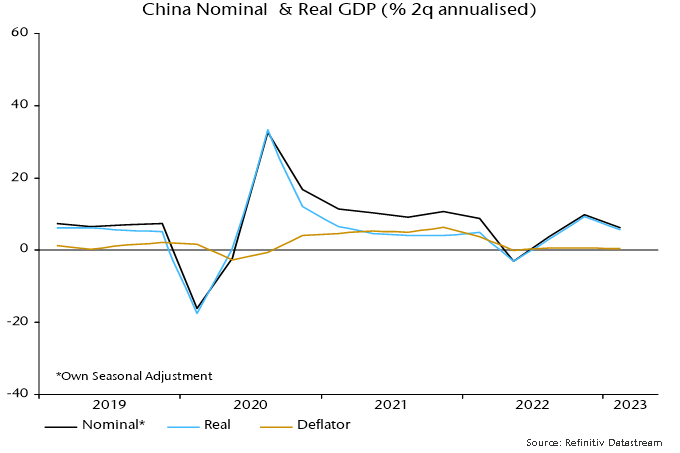
The Chinese economy has bounced back since reopening but the pick-up has arguably been underwhelming. GDP grew at a 9.1% annualised rate in Q1, according to official data, but this partly represents payback for a weak Q4. Growth averaged an unexceptional (by Chinese standards) 5.7% over the two quarters. 

Inflationary pressures remain weak despite the activity rebound. Nominal GDP expansion was only marginally higher than real in Q4 / Q1 combined: the GDP deflator rose by just 0.4% annualised – see chart 1**. 

Chart 1

Chart 1 showing China Nominal & Real GDP (% 2q annualised)

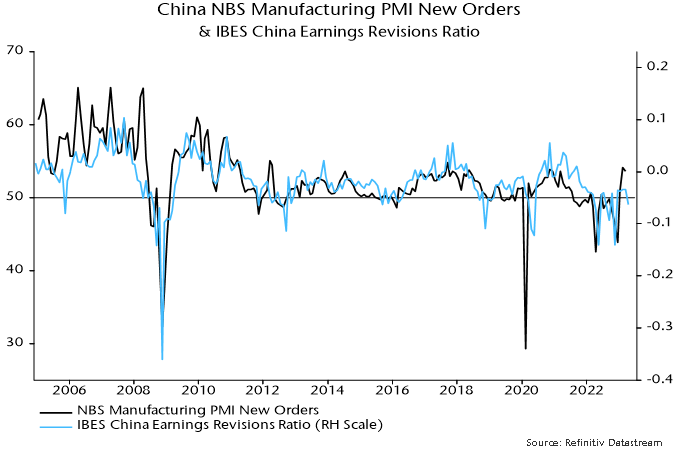
Muted nominal GDP growth has contributed to lacklustre profits, with the IBES China earnings revisions ratio diverging negatively from recent stronger official PMIs, questioning the sustainability of the latter – chart 2. 

Chart 2

Chart 2 showing China NBS Manufacturing PMI New Orders & IBES China Earnings Revisions Ratio

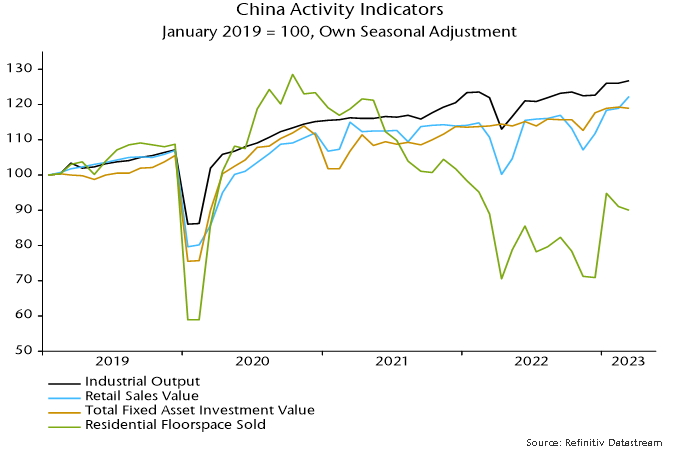
Monthly activity numbers for March were mixed and don’t suggest a pick-up in momentum at quarter-end. Retail sales were a bright spot but strength in industrial output, fixed asset investment and home sales has faded after an initial reopening bounce – chart 3. 

Chart 3

Chart 3 showing China Activity Indicators January 2019 = 100, Own Seasonal Adjustment

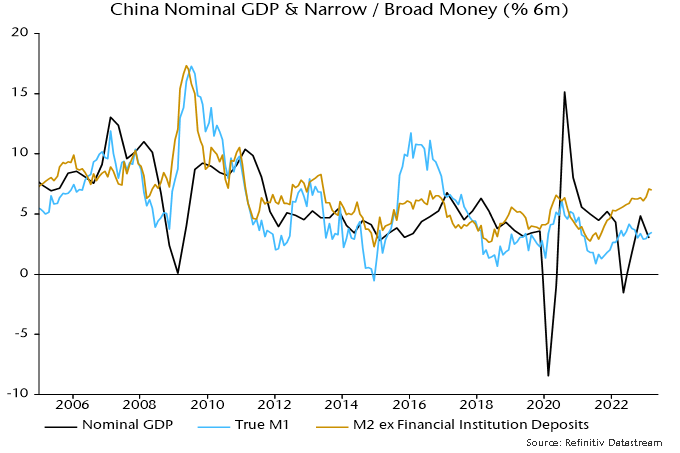
Moderate nominal GDP expansion is consistent with recent narrow money trends: six-month growth of true M1 (which corrects the official M1 measure to include household demand deposits) remains range-bound and slightly below its 2010s average – chart 4**. 

Chart 4

Chart 4 showing China Nominal GDP & Narrow / Broad Money (% 6m)

Broad money growth, as the chart shows, is significantly stronger. However, examination of the “credit counterparts” indicates that a rise since late 2021 has been driven mainly by banks switching to deposit funding and reducing other liabilities – domestic credit expansion has been stable. 

The judgement here is to place greater weight on narrow money trends, which currently suggest a moderate recovery that probably requires additional policy support to offset external headwinds. 

*Official unadjusted nominal GDP seasonally adjusted here; GDP deflator derived from comparison with official seasonally adjusted real GDP.

**March true M1 estimated pending release of demand deposits data.

The “monetarist” forecast is that G7 inflation rates will fall dramatically into 2024, mirroring a collapse in nominal money growth in 2021-22.

G7 annual broad money growth returned to its pre-pandemic (2015-19) average of 4.5% in mid-2022. Based on the rule of thumb of a two-year lead, this suggests that annual inflation rates will be around pre-pandemic levels in mid-2024. More recent broad money stagnation signals a likely undershoot.

Pessimists argue that inflation will prove sticky because of high wage growth. Wages are a coincident element of the inflationary process. Low (but rising) wage growth didn’t prevent the 2021-22 inflation surge and high (but moderating) growth isn’t an obstacle to a substantial fall now.

The 2021-22 inflation surge was initially driven by excess demand for goods, due to a combination of covid-related supply disruption, associated precautionary overbuilding of inventories, a spending switch away from services and – most importantly – excessive monetary / fiscal stimulus.

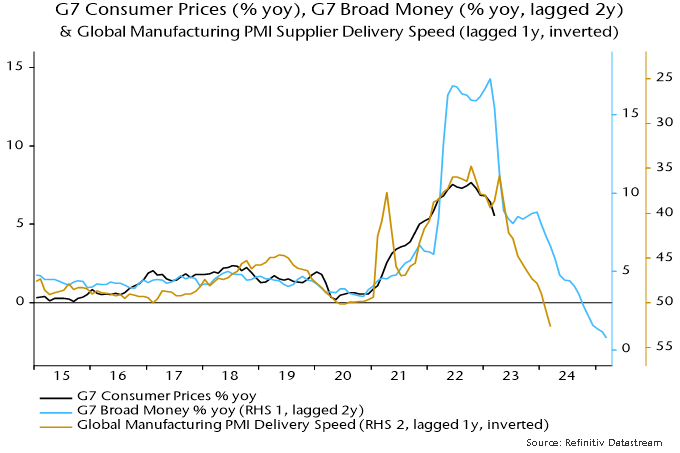
Excess goods demand was reflected in a plunge in the global manufacturing PMI supplier delivery speed index to a record low. This plunge predated the inflation surge by about a year versus a two-year lead from money – see chart 1.

Chart 1

Chart 1 showing G7 Consumer Prices (% yoy), G7 Broad Money (% yoy, lagged 2y) & Global Manufacturing PMI Supplier Delivery Speed (lagged 1y, inverted)

The reverse process is now well-advanced, with supply normalising, firms running down excess inventories, the services spending share rebounding and monetary policies far into overrestrictive territory. The PMI delivery speed index is at its highest level since the depths of the 2008-09 recession, signalling substantial excess goods supply.

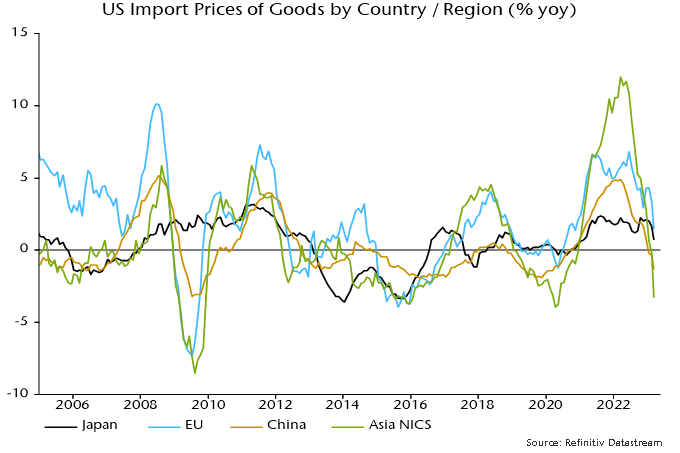
Global goods prices are heading into deflation. Chinese reopening has added to excess supply and Asian exporters are already lowering prices in the US – chart 2. Chinese producer prices are falling and the renminbi is competitive, with JP Morgan’s PPI-based real effective rate at its lowest level since 2011. Other Asian currencies are similarly weak.

Chart 2

Chart 2 showing US Import Prices of Goods by Country / Region (% yoy)

The global manufacturing PMI output price index lags and correlates negatively with the delivery speed index. It has plunged from 64 to 53 and is likely to cross below 50 soon. The current prices received balance in the US Philadelphia Fed manufacturing survey turned negative (equivalent to sub-50 in PMI terms) in April, the weakest reading since the 2020 recession.

Global goods deflation will squeeze profits and wage growth in that sector, with knock-on effects on services demand, pay pressures and pricing.

Central bankers are once again asleep at the wheel, pursuing procyclical polices that amplify economic volatility and impose unnecessary costs.

US February job openings were 17% below their March 2022 peak. Historically, a decline of this magnitude in vacancies – job openings or, for earlier years, help-wanted advertising – was always associated with a payrolls recession. 

Job openings numbers are available back to 2000. Regis Barnichon, now at the San Francisco Fed, constructed a proxy series – composite help-wanted advertising – for earlier decades. The Barnichon series adjusts historical data on newspaper advertising for a rising share of online job postings, modelled by an S-curve. 

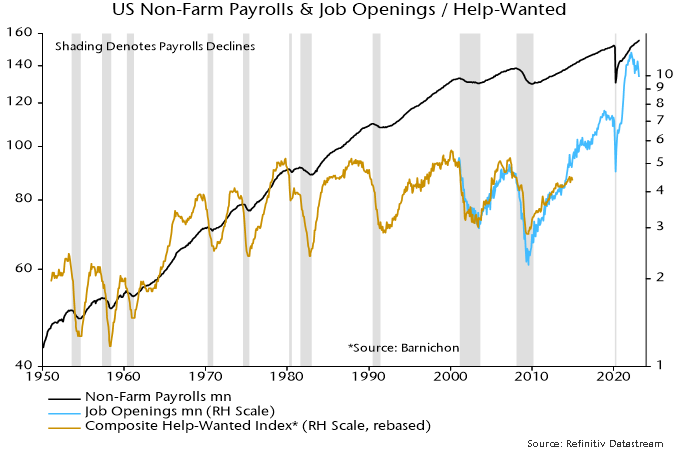
The official and Barnichon series (which is no longer updated) can be spliced together to create a continuous vacancies series extending back to the early 1950s, a period encompassing 11 recessions involving sustained payrolls declines – see chart 1. 

Chart 1

Chart 1 showing US Non-Farm Payrolls & Job Openings / Help-Wanted

Every payrolls decline was preceded by a fall in vacancies but several vacancies declines were followed by slowdowns in payrolls rather than outright weakness (e.g. 1966). 

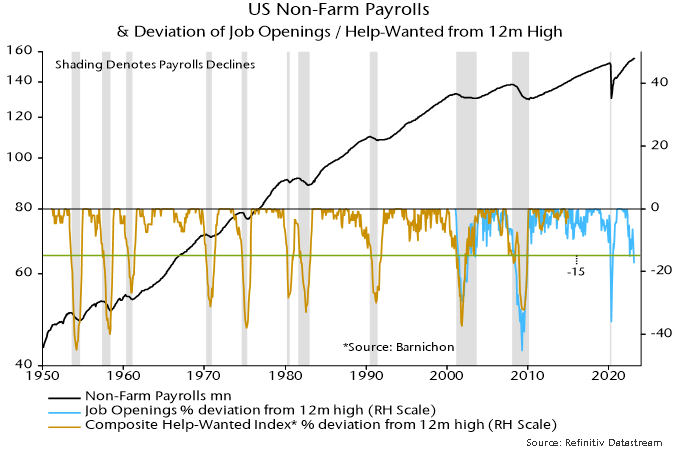
A sufficient condition for a payrolls recession was a fall of more than 15% in vacancies from their peak level in the latest 12 months – chart 2. This condition was met in February job openings numbers released last week. 

Chart 2

Chart 2 showing US Non-Farm Payrolls & Deviation of Job Openings / Help-Wanted from 12m High

Historically, the 15% threshold was reached around the time that payrolls started to decline. In six of the 11 cases, payrolls had already peaked, although this was not always known at the time. 

As an example, current data show a 1974 payrolls decline beginning in August, one month before the vacancies fall reached the 15% trigger. In real-time data, however, a payrolls peak was delayed until October.