Eurozone / UK July money numbers offer further support to the assessment here that ECB / Bank of England policy tightening has been excessive and – unless reversed swiftly – will cause unnecessarily severe economic weakness and a medium-term inflation undershoot. 

The latest releases are astonishing in several respects. 

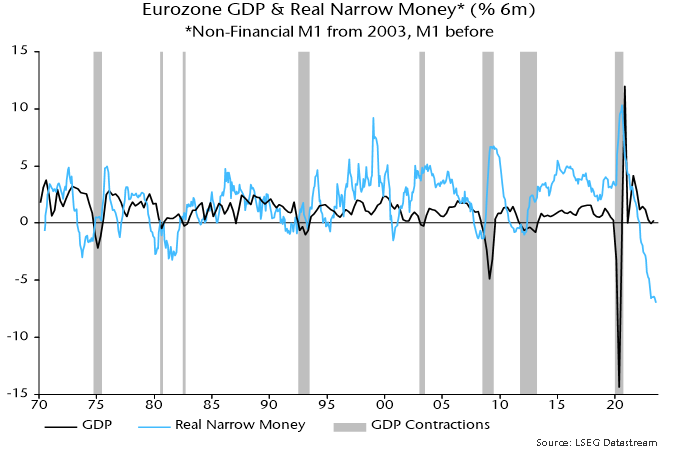
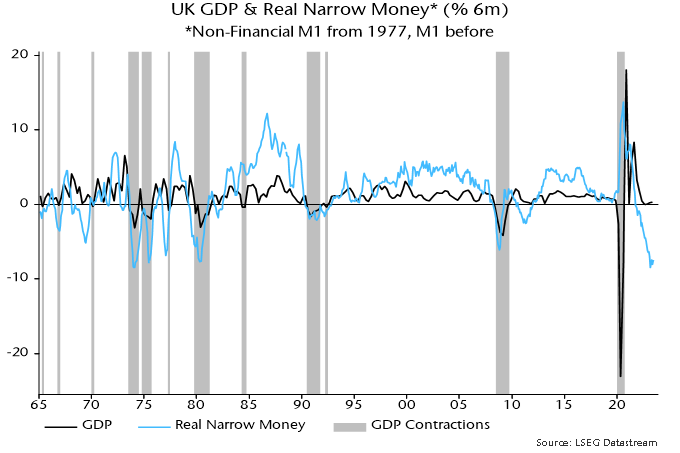
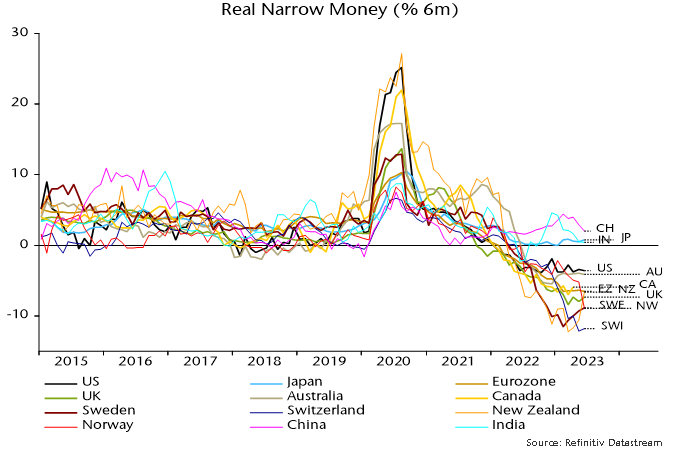
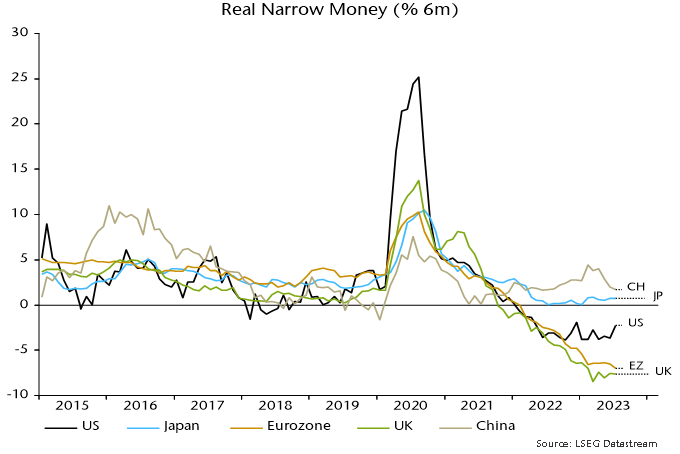
Six-month real narrow money momentum hit a new low in the Eurozone in July and is even weaker in the UK despite a recent boost from falling six-month CPI inflation. Readings are much worse than elsewhere and historically extreme – see charts 1-3. 

Chart 1

Chart 1 showing Real Narrow Money (% 6m)

Chart 2

Chart 2 showing Eurozone GDP & Real Narrow Money* (% 6m) *Non-Financial M1 from 2003, M1 before

Chart 3

Chart 3 showing UK GDP & Real Narrow Money* (% 6m) *Non-Financial M1 from 1977, M1 before

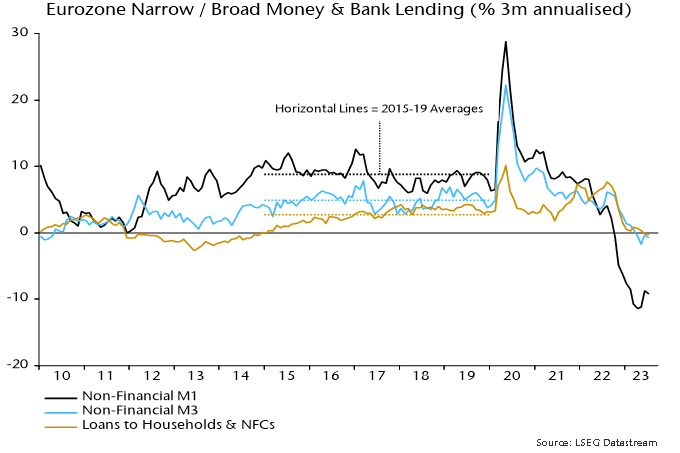
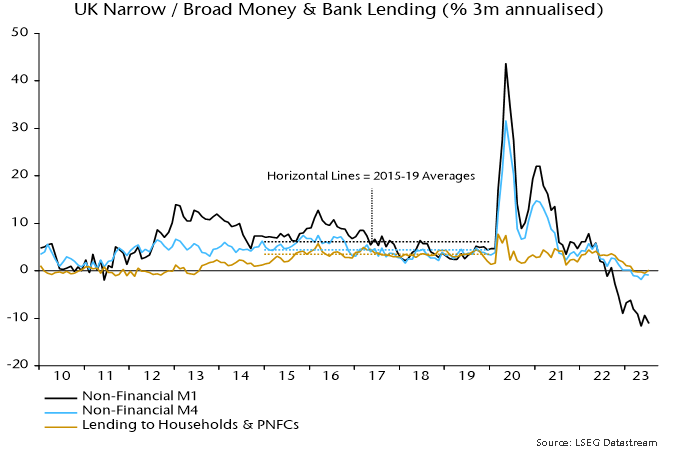
Broad money has followed narrow into nominal contraction. The preferred broad measures here, i.e. Eurozone non-financial M3 and UK non-financial M4, fell at annualised rates of 0.8% and 0.9% respectively in the three months to July – charts 4 and 5. 

Chart 4

Chart 4 showing Eurozone Narrow / Broad Money & Bank Lending (% 3m annualised)

Chart 5

Chart 5 showing UK Narrow / Broad Money & Bank Lending (% 3m annualised)

Broad money declines are rare: since 1970, the Eurozone / UK three-month changes were negative only for a brief period around the GFC, with the falls of similar magnitude to recently. 

Money leads the economy while credit is coincident / lagging. Bank lending to households and non-financial firms is starting to contract, consistent with recessions being under way – charts 4 and 5. 

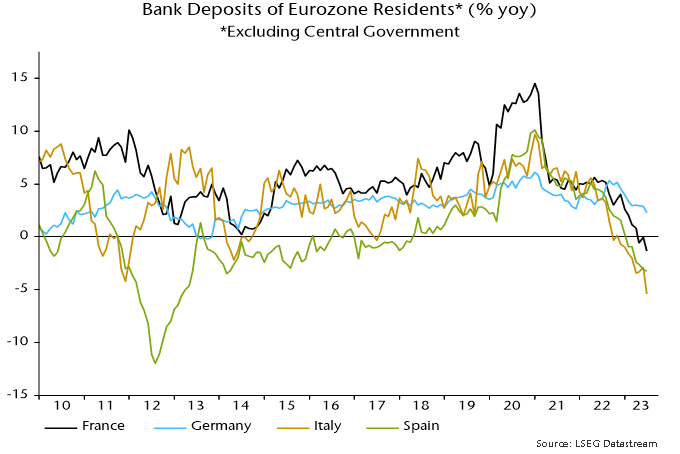
A further notable feature of the Eurozone data is a widening divergence between still-rising bank deposits in Germany and falls elsewhere – chart 6. 

Chart 6

Chart 6 showing Bank Deposits of Eurozone Residents* (% yoy) *Excluding Central Government

A similar core / periphery monetary divergence in 2011 warned of an escalating Eurozone crisis. The driver then was capital flight from the periphery, reflected in a ballooning of national central bank TARGET deficits / surpluses. 

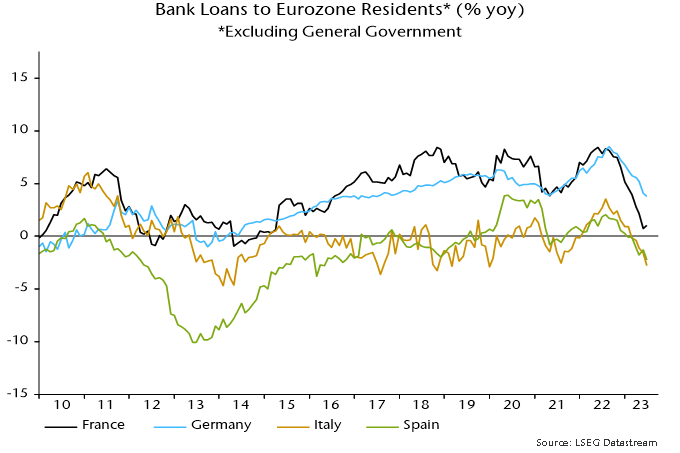
The Bundesbank’s TARGET surplus has fallen recently. Rather than capital flows, the relative resilience of German broad money is explained by less pronounced weakness in bank lending – chart 7. 

Chart 7

Chart 7 showing Bank Loans to Eurozone Residents* (% yoy) *Excluding General Government

So money / credit trends suggest that economic prospects in the rest of the Eurozone are at least as bad as in Germany. 

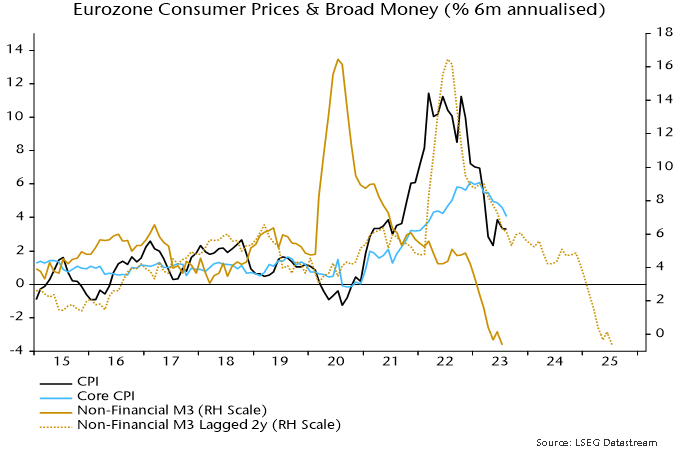
Eurozone six-month CPI momentum, meanwhile, continues to track a simplistic monetarist forecast based on the profile of broad money growth two years earlier – chart 8. Six-month headline momentum was unchanged at 3.3% annualised in August but core slowed further to 4.0%, a 17-month low. 

Chart 8

Chart 8 showing Eurozone Consumer Prices & Broad Money (% 6m annualised)

The suggestion is that six-month headline momentum will reach 2% next spring, with the annual rate following during H2. A subsequent significant undershoot is indicated unless recent monetary weakness is reversed.

Why have global government bond yields picked up over the summer despite weakening PMIs and neutral / favourable inflation news? 

The rise is attributed here to a further deterioration in the global “excess” money backdrop driven partly by unexpected output strength as an easing of supply constraints has allowed firms to work off order backlogs. Output is expected to realign with weak / falling incoming demand during H2, suggesting a reversal of liquidity tightening. 

The rise in nominal yields has been driven by the real component with inflation expectations little changed. 

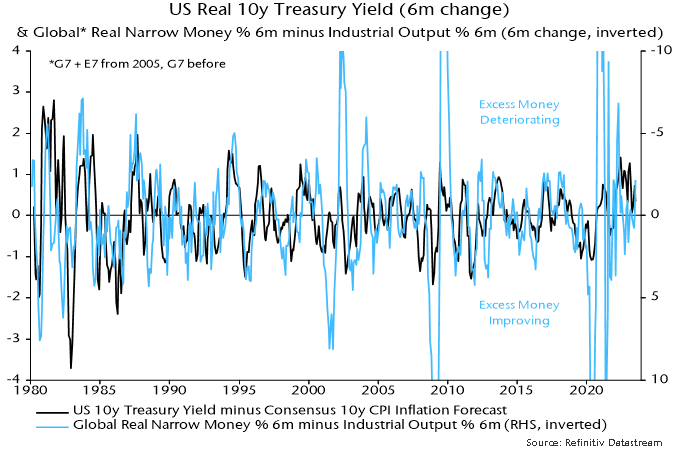
Changes in real yields have been inversely correlated historically with changes in global “excess” money momentum, as measured by the differential between six-month rates of change of real narrow money and industrial output – see chart 1. 

Chart 1

Chart 1 showing US Real 10y Treasury Yield (6m change) & Global* Real Narrow Money % 6m minus Industrial Output % 6m (6m change, inverted) *G7 + E7 from 2005, G7 before

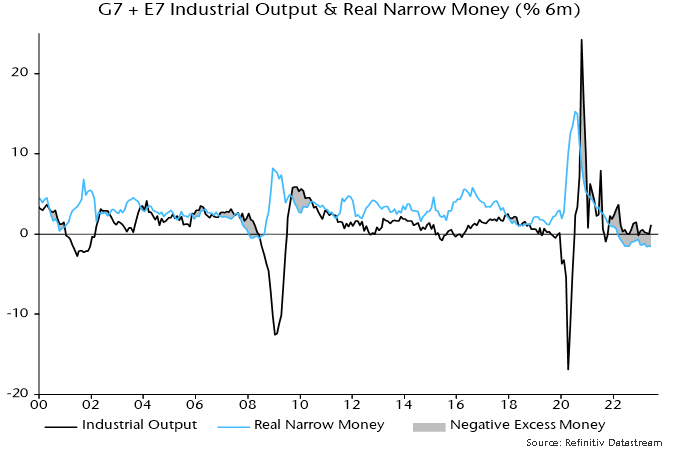
This differential has been negative since early 2022 but was expected to narrow as monetary tightening fed through to weaker economic activity and slowing inflation lifted real money momentum. Instead, industrial output growth rose to a seven-month high in June while nominal money weakness has offset a disinflation boost to real momentum – see chart 2. 

Chart 2

Chart 2 showing G7 + E7 Industrial Output & Real Narrow Money (% 6m)

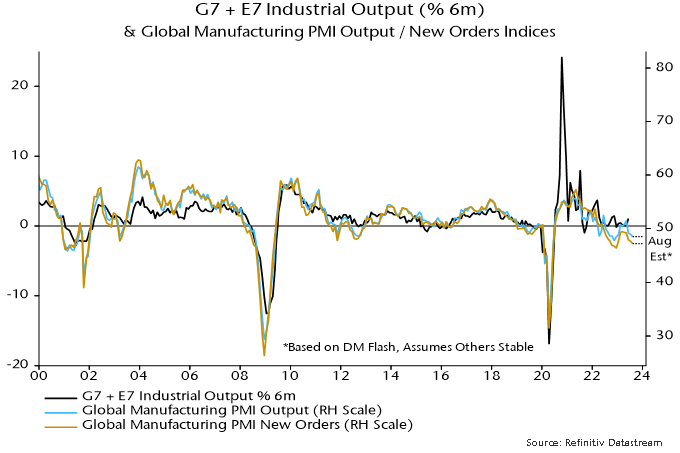
Production resilience was signalled by a recovery in the global manufacturing PMI output index, which crossed 50 in February on the way to a May high. It moved back below breakeven in June / July, however, with August flash results suggesting a return to the December 2022 level or lower – see chart 3. 

Chart 3

Chart 3 showing G7 + E7 Industrial Output (% 6m) & Global Manufacturing PMI Output / New Orders Indices

Covid-related supply disruption resulted in the PMI output index lagging the new orders index in 2021 / H1 2022, but the position has reversed over the past year as production bottlenecks have eased, allowing firms to fulfil outstanding orders. 

With the PMI delivery speed index – an inverse indicator of bottlenecks – hitting a 14-year high in May, the supply catch-up is probably ending, suggesting that the PMI output index – and hard production data – will converge with weaker new orders. At the current level of the latter index, this would imply output contraction. 

The real narrow money / industrial output momentum differential, therefore, is likely to narrow unless nominal money data weaken further and / or consumer price inflation rebounds (unlikely). While G7 tightening is still feeding through, stable / easier monetary policies are expected to promote money growth recoveries in EM. 

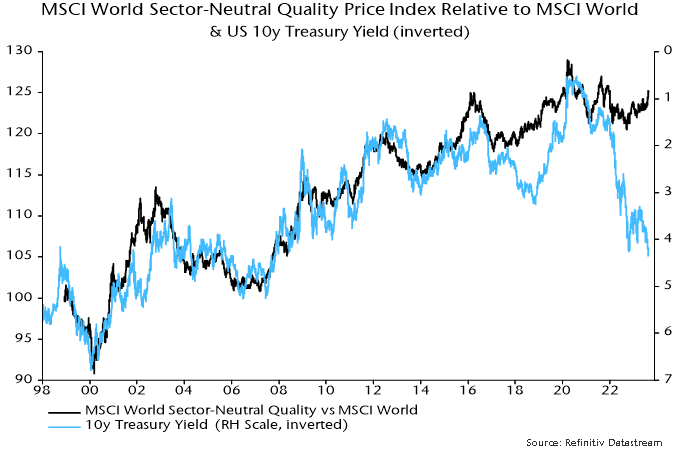
Commentaries here have suggested that the monetary / economic backdrop would favour quality stocks in 2023. The MSCI World quality index is 7.1% ahead of MSCI World in price terms year-to-date (as of yesterday’s close). This mainly reflects a high weighting in tech, but the sector-neutral quality index (which imposes MSCI World sector weights) is also now outperforming the main index and has reversed its relative weakness in 2022 – see chart 4. 

Chart 4

Chart 4 showing MSCI World Sector-Neutral Quality Price Index Relative to MSCI World & US 10y Treasury Yield (inverted)

The recent relative gain is striking against the backdrop of rising Treasury yields, with which the style has been inversely correlated historically, as the chart shows. The divergence is reminiscent of 2018, when the quality relative embarked on a sustained rise in February but a fall in Treasury yields was delayed until November. This year’s quality rally also started in February, suggesting a resolution of the current disconnect with yields by year-end.

Pessimistic commentators argue that the Chinese economy has entered a “liquidity trap” and faces Japan-style deflation. This assessment is not shared here: a recent monetary slowdown can be explained by misguided policy tightening around end-2022, which is now being reversed, while broad money growth would need to fall much further to suggest a sustained decline in prices. 

A review of monetary policy in recent years is helpful in understanding current conditions. An important consideration is that – like the Fed decades ago – the PBoC does not announce changes in its policy stance, which often become apparent only after the event in movements in money market rates and credit / monetary trends. 

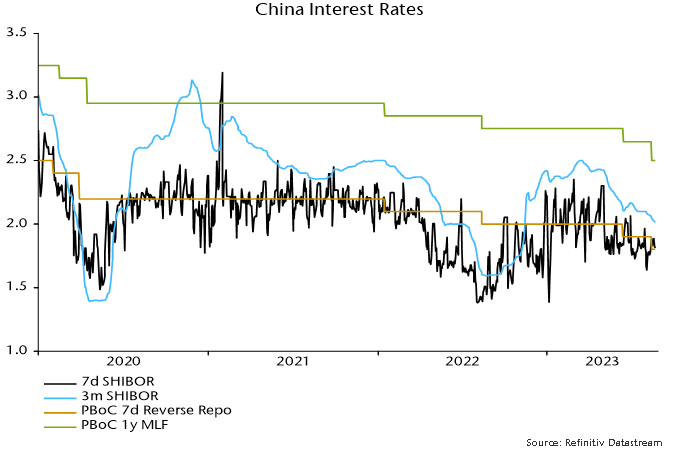
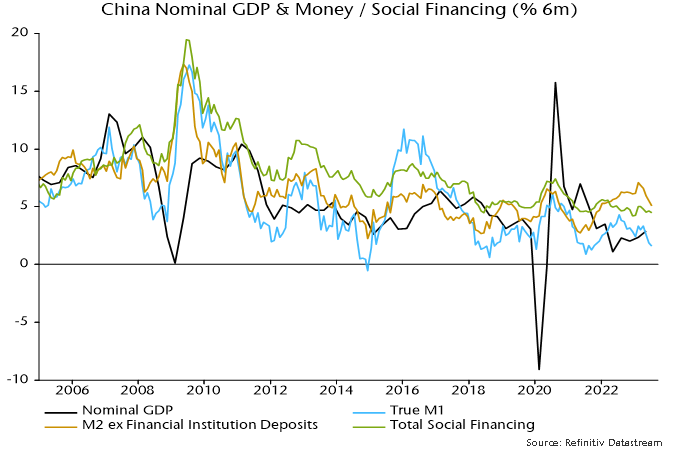
The PBoC eased policy between late 2020 and summer 2022 to cushion covid-related economic weakness. Three-month SHIBOR fell from over 3% to 1.5%, while six-month growth rates of money and credit began to pick up from mid-2021 – see charts 1 and 2. 

Chart 1

Chart 1 showing China Interest Rates

Chart 2

Chart 2 showing China Nominal GDP & Money / Social Financing (% 6m)

Narrow and broad money measures continued to accelerate in H1 2022, laying the foundations for a solid post-reopening economic recovery in H1 2023 – real GDP grew by 6.1% annualised between Q4 2022 and Q2 2023. 

The PBoC, however, blotted its copy book in late 2022, tightening policy on misplaced concern about a reopening-driven inflation pick-up, although narrow money and credit growth were by then cooling and the ratio of broad money to nominal GDP was close to trend (in contrast to the US / Europe, where a large monetary overhang fuelled strong price pressures). 

Three-month SHIBOR rebounded from 1.7% in September to 2.4% by year-end, rising further to 2.5% in March. The consensus view at the time – not shared here – was that the rise in money rates reflected stronger money demand due to reopening, i.e. the increase was “endogenous” rather than policy-driven and would not threaten economic prospects. 

Policy tightening has resulted in six-month narrow and broad money growth falling to late 2021 levels, although credit expansion has declined by less (despite a very weak July flow number) – chart 2. The monetary slowdown suggests a loss of economic momentum through late 2023.

The PBoC has, at least, been swift to recognise its error, resuming easing in early Q2. Three-month SHIBOR has retraced half of its August-March rise but may need to return to the low to offset recent monetary damage. 

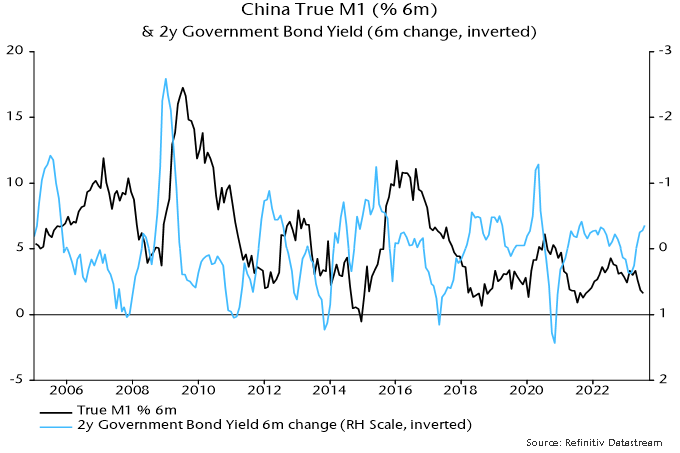
Chart 3 illustrates the inverse leading relationship between changes in interest rates (in this case the two-year government yield) and narrow money momentum. The reversal in rates suggests a bottoming out and revival in money momentum, although timing is uncertain. 

Chart 3

Chart 3 showing China True M1 (% 6m) & 2y Government Bond Yield (6m change, inverted)

Why did Japan enter a sustained deflation in the early 1990 and are there parallels with current Chinese conditions? 

From a monetary perspective, a deflationary environment requires (broad) money growth to fall below the sum of trend real GDP growth and the trend rise in the money / nominal GDP ratio. 

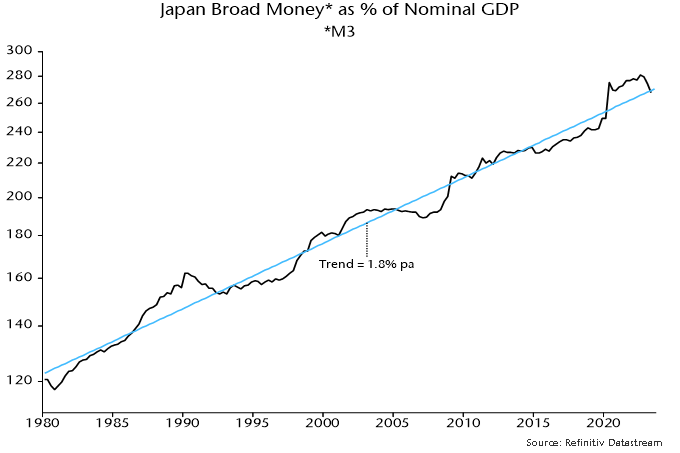
The ratio of Japanese broad money M3 to nominal GDP has risen by 1.8% pa on average over the long run – chart 4. Trend real GDP growth was running at about 2% in the early 1990s, so broad money needed to expand by about 4% pa to maintain stable prices. Annual growth fell below this level in 1991 on the way to zero in 1992, averaging 2.7% over 1991-2000. 

Chart 4

Chart 4 showing Japan Broad Money* as % of Nominal GDP *M3

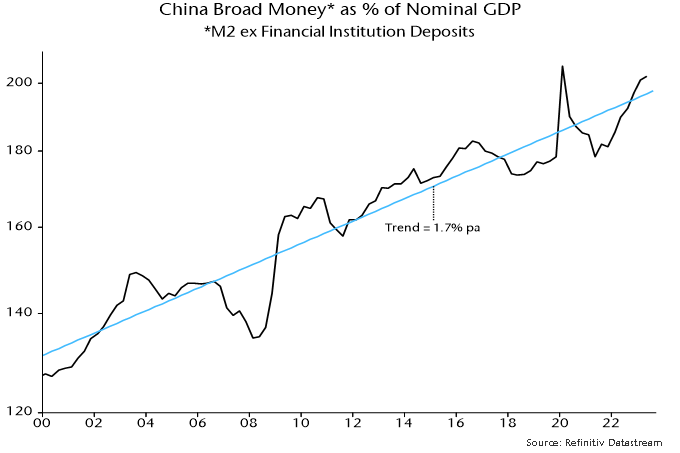
China’s broad money to nominal GDP ratio has risen at a similar trend rate of 1.7% pa – chart 5. If trend real GDP growth is assumed to be about 5%, broad money expansion needs to stay above about 7% to avoid a deflationary scenario. Annual growth is currently 11.6%, with the six-month rate of increase at 10.4% pa. 

Chart 5

Chart 5 showing China Broad Money* as % of Nominal GDP *M2 ex Financial Institution Deposits

A recovery in global economic momentum into the spring has gone into reverse, with monetary trends suggesting that weakness will intensify during H2. 

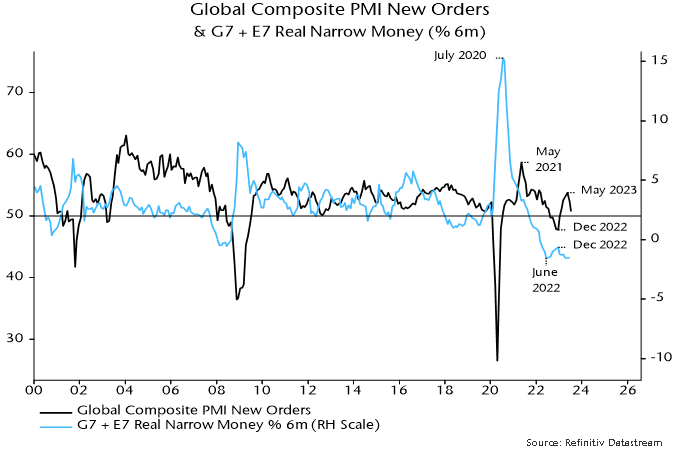
The global composite PMI new orders index fell sharply again in July and has now retraced half of its December-May rise – see chart 1. The relapse was foreshadowed by a decline in global six-month real narrow money momentum from a local peak in December 2022. Real money momentum retested its June 2022 low in April and has since moved sideways, suggesting a further slide in the PMI index into early Q4 followed by stabilisation.

Chart 1

Chart 1 showing Global Composite PMI New Orders & G7 + E7 Real Narrow Money (% 6m)

The December-May recovery in global PMI new orders was boosted by several non-monetary factors, including release of pent-up demand for services, China’s reopening and gas price relief in Europe. With similar tailwinds unlikely during H2, the orders index may retest or break the December 2022 low. 

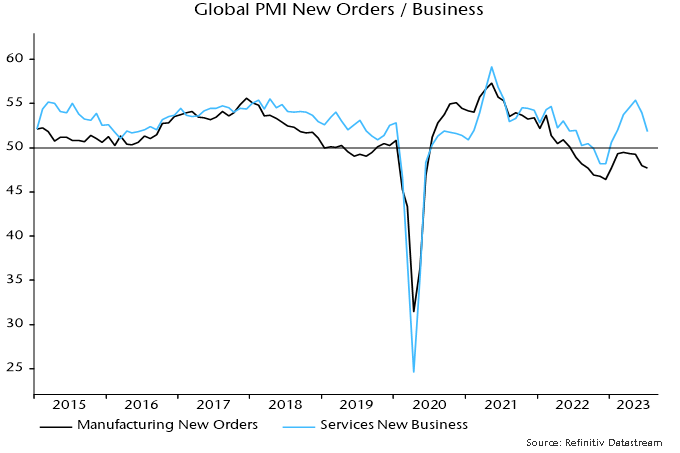
The July orders decline was paced by a slowdown in services new business, although manufacturing demand also weakened further – chart 2. The services-manufacturing gap remains wide and is expected to close via the former moving into contraction, with manufacturing possibly stabilising as the stockbuilding cycle bottoms. 

Chart 2

Chart 2 showing Global PMI New Orders / Business

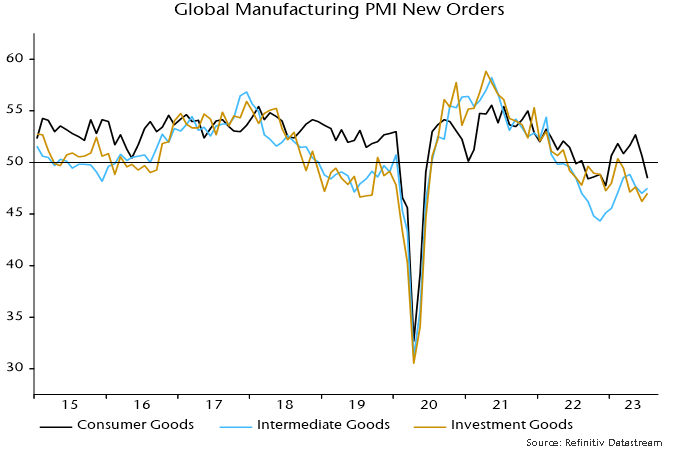
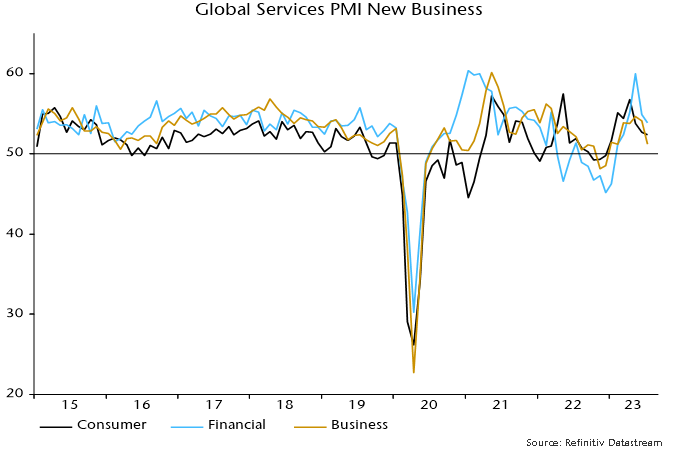
The July PMI orders decline was broadly based across sectors. Within manufacturing, consumer goods joined investment and intermediate goods in contraction – chart 3. Services demand slowed across consumer, financial and business segments – chart 4. 

Chart 3

Chart 3 showing Global Manufacturing PMI New Orders

Chart 4

Chart 4 showing Global Services PMI New Business

Six-month real narrow money momentum remains weakest in Europe and has slowed in China and India – chart 5. With policy tightening still feeding through, and recent oil price strength acting to slow a decline in six-month CPI momentum, global real money momentum may fail to recover during Q3. 

Chart 5

Chart 5 showing Real Narrow Money (% 6m)

Eurozone CPI numbers for July were deemed disappointing because annual core inflation – excluding energy, food, alcohol and tobacco – stalled at 5.5%. 

Or did it? The annual rise in the ECB’s seasonally adjusted core series slowed to 5.3%, below the consensus forecast of 5.4% for the Eurostat unadjusted measure. The two gauges rarely diverge to this extent (they both recorded 5.5% inflation in June). 

The six-month rate of increase of the ECB series eased to 4.7% annualised in July, the slowest since June 2022 and down from a December peak of 6.2%. Six-month headline momentum was lower at 3.4%. 

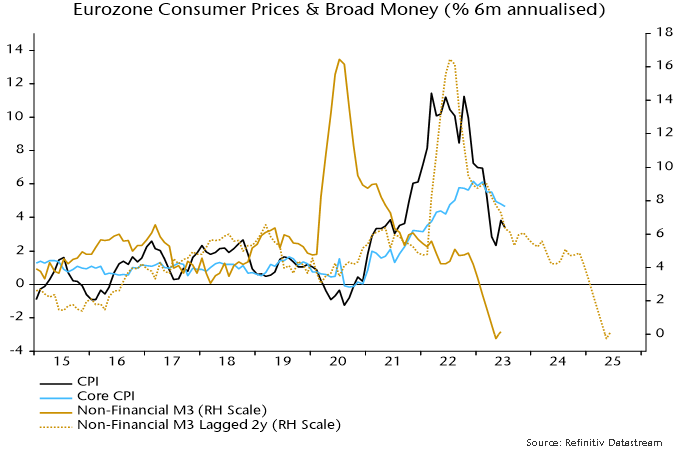
As in the UK, six-month headline inflation is tracking a simplistic “monetarist” forecast based on the profile of broad money momentum two years earlier – see chart 1. This relationship suggests that six-month CPI momentum will be back at about 2% in spring 2024, with the annual rate following during H2. 

Chart 1

Chart 1 showing Eurozone Consumer Prices & Broad Money (% 6m annualised)

The projected return to 2% next spring is a reflection of a fall in six-month broad money momentum below 5% annualised in spring 2022. A subsequent decline in money momentum to zero suggests an inflation undershoot or even falling prices in 2025. 

The shocking implication is that monetary trends were already consistent with a return of inflation to target before the ECB started hiking rates in July 2022. The 425 bp rise since then represents grotesque overkill, confirmed by recent monetary stagnation / contraction. 

The corollary is that a huge and embarrassing policy reversal is likely to be necessary over the next 12-24 months, unless some other factor causes broad money momentum to recover to a target-consistent pace. 

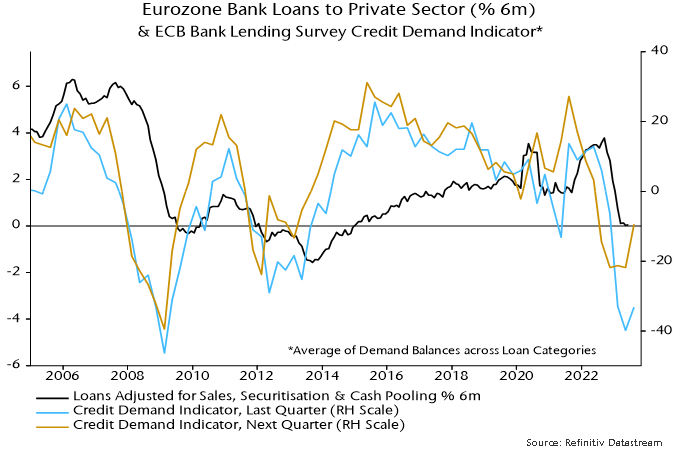
That seems a remote possibility, based on consideration of the “credit counterparts”. Loan demand balances in the latest ECB bank lending survey were less negative but still suggestive of negligible private credit expansion – chart 2. 

Chart 2

Chart 2 showing Eurozone Bank Loans to Private Sector (% 6m) & ECB Bank Lending Survey Credit Demand Indicator* *Average of Demand Balances across Loan Categories

Credit to government may contract given QT, withdrawal of TLTRO funding and inverted yield curves. (Banks previously used cheap TLTRO finance to buy higher-yielding government securities.) Redemptions of public sector debt held under the ECB’s Asset Purchase Programme amount to €262 billion over the next 12 months, equivalent to 1.6% of M3. 

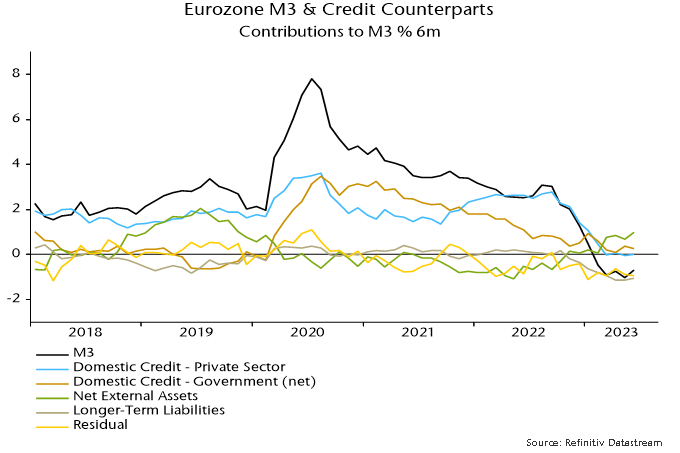
Broad money momentum has been supported recently by an increase in banks’ net external assets, reflecting a strengthening basic balance of payments (current account plus non-bank capital flows) – chart 3. This could accelerate as a Eurozone recession swells the current account surplus but is unlikely to outweigh domestic credit weakness. 

Chart 3

Chart 3 showing Eurozone M3 & Credit Counterparts Contributions to M3 % 6m

A bottoming out of the global stockbuilding cycle could be associated with a near-term recovery in manufacturing survey indicators. Money trends suggest that any revival will be modest / temporary and offset by wider economic weakness. 

Economic news has been unusually mixed since end-2021, with GDP weakness contrasting with labour market strength and manufacturing deterioration offset by services resilience. Confusing signals have contributed to market hopes of a “soft landing”. 

Sectoral and regional divergences may persist in H2 2023. The expectation here is that manufacturing survey weakness will abate but labour market data will worsen significantly. Money trends continue to cast strong doubt on soft landing hopes. Europe is likely to underperform the US. 

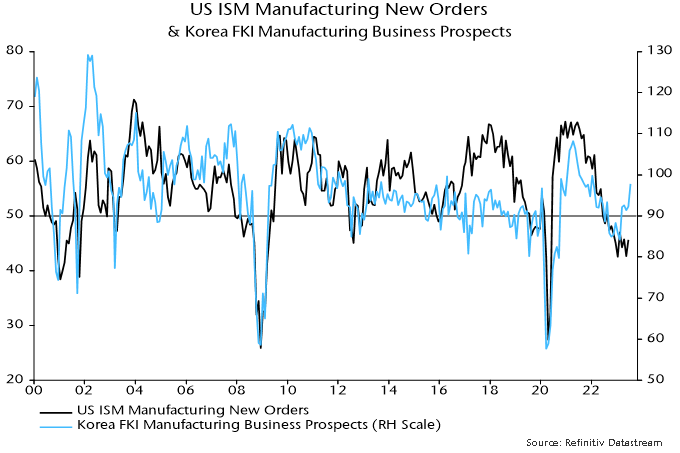
The US ISM manufacturing new orders index – a widely watched indicator of industrial momentum – hit a low of 42.5 in January and retested this level in May before recovering to 45.6 in June. 

Reasons for expecting a further rise include: 

  • The index has been in the 40s since September 2022 and the mean duration of sub-50 periods historically was eight months (ignoring episodes of three months or less). 
  • The global stockbuilding cycle remains on track to bottom out during H2 2023 and lows historically were usually preceded by a recovery in US / global manufacturing new orders. 
  • Recent price falls for raw materials and other production inputs may further incentivise firms to step up purchasing to maintain or replenish inventories.

Korean manufacturing is a bellwether of US / global trends and the latest Federation of Korean Industries survey reported a marked improvement in optimism, consistent with ISM new orders moving back above 50 – see chart 1. 

Chart 1

Chart 1 showing US ISM Manufacturing New Orders & Korea FKI Manufacturing Business Prospects

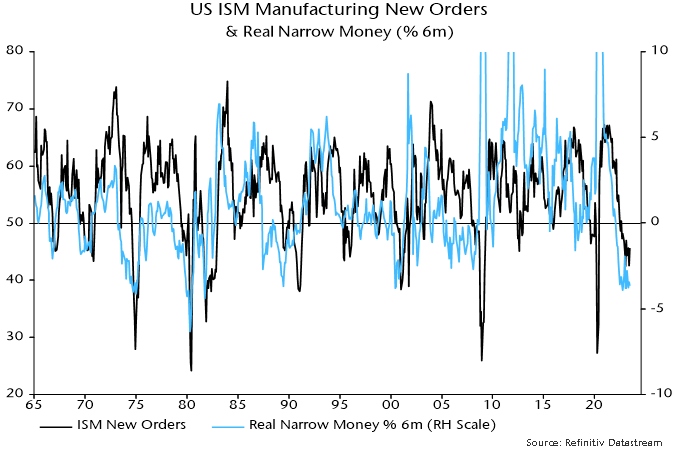
Sustained recoveries in ISM new orders from the mid 40s into expansionary territory historically occurred against a backdrop of positive and / or rising six-month real narrow money* momentum. Current trends are unfavourable, with momentum still significantly negative and moving sideways – chart 2. 

Chart 2

Chart 2 showing US ISM Manufacturing New Orders & Real Narrow Money (% 6m)

Examples of recoveries to above 50 without a supportive monetary backdrop include 1970 and 1989-90. In both cases the rise was modest (peaking below 55), short-lived and followed by a decline to a lower low. The recovery in 1970 occurred within an NBER-defined recession and in 1989-90 just before one. 

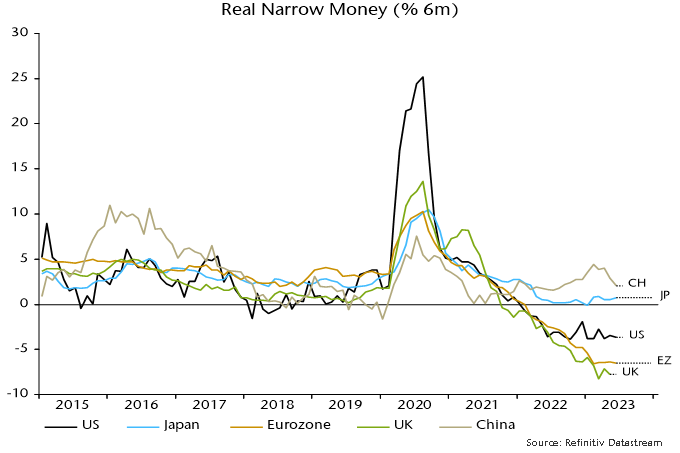
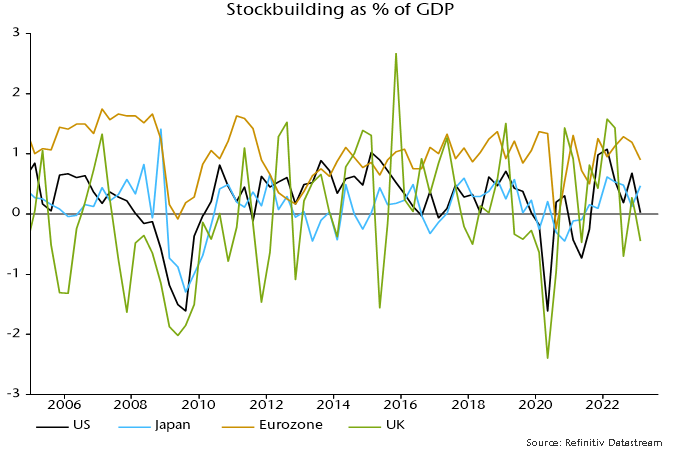
An ISM rebound might not be mirrored by much if any revival in European manufacturing surveys. Money trends are even weaker than in the US, while the stockbuilding adjustment started later in the Eurozone and probably has further to run – charts 3 and 4. 

Chart 3

Chart 3 showing Real Narrow Money (% 6m)

Chart 4

Chart 4 showing Stockbuilding as % of GDP

*Narrow money definition used here = M1A = currency + demand deposits.

Young professional looking concerned while working at her desk late at night.

Même si nous évoluons toujours en période d’incertitude lorsque nous prenons des décisions en matière de placement, certaines périodes, comme 2022, sont beaucoup plus difficiles que d’autres. Cet article présente cinq lignes directrices essentielles pour aider les comités de placement à gérer l’incertitude et à limiter les influences négatives dans le processus décisionnel.

Comprendre l’incertitude

Dans son livre Thinking in Bets, Annie Duke aborde le sujet de l’incertitude. Annie Duke est titulaire d’un doctorat en psychologie. Elle a été l’une des meilleures joueuses de poker au monde. S’appuyant sur son expérience de joueuse de poker, elle souligne à quel point les bons joueurs de poker et les bons décideurs sont à l’aise avec l’incertitude mondiale. Au lieu de se concentrer sur la prise de décision, ils tentent de déterminer leur degré d’incertitude, ce qu’Annie Duke suggère de faire pour prendre de meilleures décisions.

Le risque et l’incertitude vont de pair. Pour David Hillson, consultant international en gestion du risque, tous les risques peuvent être qualifiés d’incertains, mais les incertitudes ne sont pas toutes des risques. » Par exemple, si les prévisions météorologiques laissent entrevoir un risque de pluie, cela suppose une incertitude plutôt qu’un risque, que l’on peut régler simplement en apportant un parapluie.

Selon David Hillson, le risque est une incertitude qu’il ne faut pas négliger. Cela nous amène naturellement à nous demander comment reconnaître ce à quoi il faut accorder de l’importance. L’important est de comprendre la probabilité que le risque se concrétise et à quel point les conséquences pourraient être importantes si les choses ne se déroulent pas comme prévu. Si un événement a une forte probabilité de se produire et que le risque est important, il faudra certainement y accorder de l’importance et s’y attaquer.

Gérer l’incertitude

Que peut-on faire pour gérer l’incertitude? La première ligne directrice est de reconnaître qu’il existe de l’incertitude, tandis que les autres lignes directrices présentent une approche claire pour s’y retrouver efficacement.

Ligne directrice 1 : Prendre des décisions en gardant les yeux ouverts.

Cette ligne directrice est cruciale et dépend de la reconnaissance de la nature imprévisible des décisions pour lesquelles il existe des risques qui peuvent – ou non – être contrôlés. Il est également nécessaire d’évaluer le niveau et la probabilité du risque. Par exemple, si on s’attend à ce qu’un risque associé à un portefeuille de placement ait une incidence minimale et une faible probabilité de se produire, un comité peut décider qu’il s’agit d’un risque acceptable à assumer. Toutefois, pour les risques importants et dont la probabilité est plus élevée, un comité cherchera à atténuer le risque, notamment en améliorant la diversification du portefeuille.

Two purple onions, one is halved revealing its layers.

Ligne directrice 2 : Décomposer le problème pour le rendre plus gérable.

Cette ligne directrice s’appuie sur l’analogie avec les pelures d’oignon. En décomposant un problème en éléments plus petits, on le rend plus facilement gérable. Comme lorsqu’on épluche un oignon, l’évaluation des diverses couches d’une situation peut fournir des renseignements utiles qui n’étaient peut-être pas évidents à première vue.

L’un de ces éléments est le cadre, qui reconnaît qu’il existe des types distincts d’incertitude qui sont parfois considérés comme identiques. Par exemple, une connaissance limitée peut être attribuable à l’imprévisibilité d’un résultat, comme l’incidence de la volatilité des marchés boursiers. Par ailleurs, une connaissance limitée pourrait s’expliquer par le fait qu’un comité dispose de peu d’information sur un nouveau sujet, comme le rôle des marchés privés. La réponse serait différente pour chacun.

Une autre couche consiste à apprécier les différents groupes, personnes et organisations liés à la décision et à identifier les parties prenantes qui ont une influence sur la décision, celles qui ont l’expertise nécessaire pour la soutenir et celles qui seront touchées par celle-ci.

Il est également important de faire la distinction entre les faits et les hypothèses. Par exemple, une hypothèse de rendement annualisé de 7 % à long terme est simplement la meilleure estimation du rendement attendu et pas nécessairement le rendement qui sera réalisé.

Ligne directrice 3 : Être conscient des avantages et des limites des modèles.

La gestion de l’incertitude peut comprendre l’appréciation des avantages et des contraintes des modèles utilisés pour faciliter la prise de décisions. Voici ce que dit le statisticien britannique George Box :

« Tous les modèles sont erronés; certains modèles sont utiles. »

L’un des avantages les plus utiles des modèles est qu’ils peuvent favoriser une meilleure compréhension. Dans la construction d’un nouvel immeuble, un modèle architectural à petite échelle sert de représentation visuelle de la conception finale du bâtiment. En donnant une image plus claire et une impression générale du projet, on peut aider à repérer et à corriger les défauts de conception potentiels, ce qui permet de réduire les coûts des matériaux pendant la construction.

Les modèles statistiques sont souvent utilisés pour examiner la répartition de l’actif à long terme des investisseurs. Le rôle de ces modèles est de favoriser une meilleure compréhension des avantages relatifs des différentes répartitions de l’actif possible avant de les appliquer au portefeuille en tant que tel. Bien que ces types de modèles statistiques soient utiles pour regrouper des renseignements très complexes afin de faciliter la prise de décisions, ils ne sont que des outils et ne fournissent aucune garantie quant au résultat réel.

Ligne directrice 4 : Ne pas se laisser berner par les biais comportementaux.

Au moment de prendre des décisions, il est important d’être conscient des biais comportementaux qui peuvent influencer inconsciemment ses choix. Ces biais posent souvent des défis aux comités de placement.

Biais courants dans la prise de décision

Appel aux probabilités 
Être trop axé sur les résultats
Cadrage serré 
Ne pas envisager toutes les options
Ancrage 
Difficulté à se départir de sa première impression
Biais de confirmation 
Tendance à rechercher l’information qui confirme sa manière de penser
Fatigue décisionnelle 
Détérioration de la qualité des décisions
Émotion à court terme 
Les émotions peuvent influer sur les décisions
Appel à la mémoire 
Tirer parti des expériences passées
Excès de confiance 
Tendance à trop croire en un résultat

Dans leur livre, Decisive, Chip et Dan Heath font référence à quatre de ces biais qu’ils désignent comme les « quatre vilains » en expliquant comment ils peuvent influencer les décisions et les façons de réduire leur incidence.

  • Cadrage serré : Ce biais limite notre point de vue en concentrant notre attention sur un domaine précis, comme un projecteur qui éclaire une partie d’une scène tout en laissant tout le reste dans le noir. Un cadrage serré peut nous amener à négliger des possibilités et des points importants. Pour surmonter ce biais, il est important d’élargir nos perspectives, en éclairant différentes parties de la scène afin de découvrir de nouvelles idées et de nouvelles possibilités.
  • Biais de confirmation : Ce biais nous amène à rechercher et à privilégier l’information qui confirme nos convictions. Il peut en résulter une collecte de renseignements qui vont dans le même sens que nos convictions et une sous-estimation des risques associés à la décision. Pour contrer le biais de confirmation, il est utile de tester la réalité de nos hypothèses. Une façon d’y arriver est de demander à quelqu’un de se faire l’avocat du diable, de remettre en question nos idées et de formuler des critiques constructives avant de prendre la décision.
  • Émotion à court terme : Ce biais fait référence à l’influence des émotions immédiates sur la prise de décision. Cela peut nous amener à faire des choix impulsifs sans tenir pleinement compte des conséquences à long terme. Pour atténuer l’incidence de l’émotion à court terme, il peut être avantageux de conceptualiser les répercussions de nos décisions dans un avenir rapproché. En imaginant ce qu’on pourrait ressentir au sujet de la décision six mois plus tard, on peut réduire l’influence des émotions immédiates.
  • Excès de confiance : Ce biais consiste à avoir trop confiance dans l’issue probable de nos décisions. Nous avons tendance à croire que nos jugements et nos prévisions sont plus exacts qu’ils ne le sont. Pour remédier à l’excès de confiance, il faut reconnaître l’incertitude inhérente à la prise de décisions. Il faut être prêt à accepter que l’on a peut-être tort et à comprendre les risques de baisse potentiels associés à ses choix.

Être conscient de ces biais et mettre en place des stratégies pour les éviter peut aider à prendre des décisions éclairées et rationnelles.

Ligne directrice 5 : Obtenir la contribution de tout le monde.

La dernière ligne directrice pour gérer l’incertitude souligne l’importance de faire participer toutes les parties prenantes au processus décisionnel. Lorsqu’une nouvelle idée est présentée lors d’une réunion, il est courant de ne pas l’accueillir immédiatement et de résister à ce qui est proposé. Les nouvelles idées font souvent l’objet de réactions négatives, peu importe la qualité de l’information présentée.

Il est utile de déterminer les moments où il y a de la résistance et de permettre aux parties prenantes d’exprimer leurs préoccupations et, ce faisant, d’établir un lien de confiance avec les différentes parties prenantes. La communication est également essentielle pour provoquer des changements. En s’assurant qu’il y a une discussion à chaque étape de l’examen, on peut éviter d’arriver à la fin pour découvrir que l’on a perdu l’avis de décideurs clés en cours de route.

Comment être un décideur plus efficace

Aussi décourageant que cela puisse être, il est nécessaire de prendre des décisions en matière de placement en période d’incertitude. En suivant un processus rigoureux et en étant conscient des influences qui peuvent faire dérailler le processus, on peut être un décideur plus efficace.

Se démarquer face à l’inconnu

  • Être à l’aise avec l’incertitude associée aux placements.
  • Prioriser les risques les plus pertinents pour ses objectifs.
  • Reconnaître et accepter la nature imprévisible des décisions.
  • Décomposer les décisions complexes en éléments gérables pour en faciliter l’analyse.
  • Utiliser les modèles comme outils pour mieux comprendre les options possibles, tout en sachant qu’ils ne garantissent pas un résultat réel.
  • Être attentif aux biais comportementaux qui peuvent influer sur la prise de décision et prendre des mesures pour gérer leur influence.
  • Favoriser une communication efficace pour faciliter le changement et assurer une prise de décision éclairée.

Lorsqu’on doit prendre des décisions en matière de placement, il faut savoir maintenir le cap en période d’incertitude en gardant le contrôle de soi, appliquer des stratégies rigoureuses, avoir une communication ouverte et gérer les biais de façon à faire des choix éclairés et de réussir malgré la complexité.

Abonnez-vous aux mises à jour
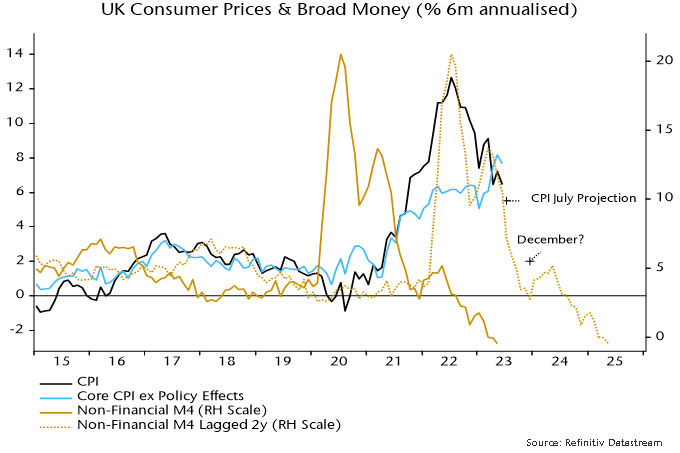
UK headline CPI momentum continues to track a simplistic “monetarist” forecast based on the profile of broad money momentum two years earlier. 

Six-month growth of headline prices, seasonally adjusted, peaked at 12.7% annualised in July 2022 and had halved to 6.5% as of June. This mirrors a halving of six-month broad money momentum from a peak of 20.5% annualised in July 2020 to 10.5% in June 2021 – see chart 1. 

Chart 1

Chart 1 showing UK Consumer Prices & Broad Money (% 6m annualised)

Broad money continued to slow sharply during H2 2021, with six-month momentum down to 2.7% by December, suggesting a fall in six-month CPI momentum to 2% annualised or lower by late 2023 / early 2024. 

A 2% rate of increase of prices during H2 2023 could be achieved by the following combination: 

The energy price cap falling by a further 10% in October, in line with current estimates based on wholesale prices, following the 17% July reduction. 

Food, alcohol and tobacco prices slowing to an 8% annual inflation rate by December from 14.9% in June. 

Core prices rising at a 4% seasonally adjusted annualised rate during H2 2023, down from 7.7% in H1. 

The latter two possibilities are supported by producer output price developments – annual inflation of food products is already down from a 16.8% peak to 8.7%, while core output prices flatlined during H1, following a 6.4% annualised rise during H2 2022. 

A 2% annualised CPI increase during H2 2023 would imply a headline annual rate of about 4% by year-end, well with PM Sunak’s target of a halving from 10%+ levels, although he will have made no contribution to the “success”. 

Why has UK CPI inflation exceeded US / Eurozone levels, both recently and cumulatively since end-2019? 

The assessment here is that the divergence reflects relatively weak UK supply-side economic performance and a larger negative terms of trade effect, rather than more egregious monetary excess. 

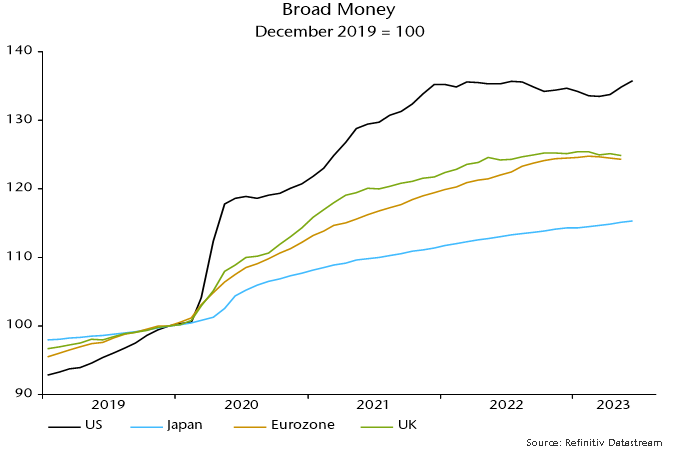
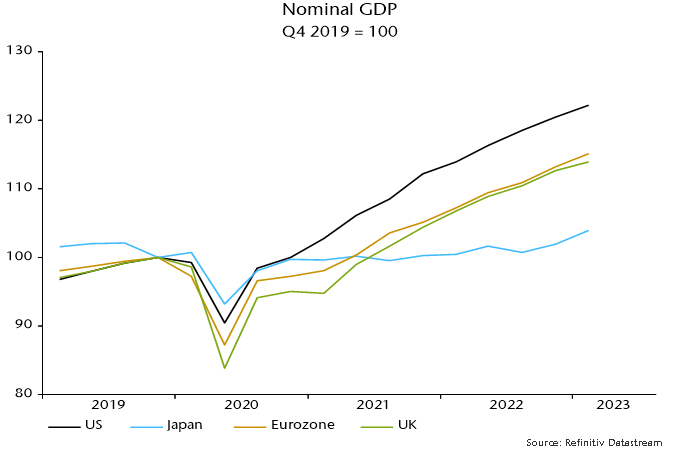
Charts 2 and 3 show that UK / Eurozone broad money expansion since end-2019 has been similar and less than in the US, with the relative movements mirrored in nominal GDP outcomes. 

Chart 2

Chart 2 showing Broad Money December 2019 = 100

Chart 3

Chart 3 showing Nominal GDP Q4 2019 = 100

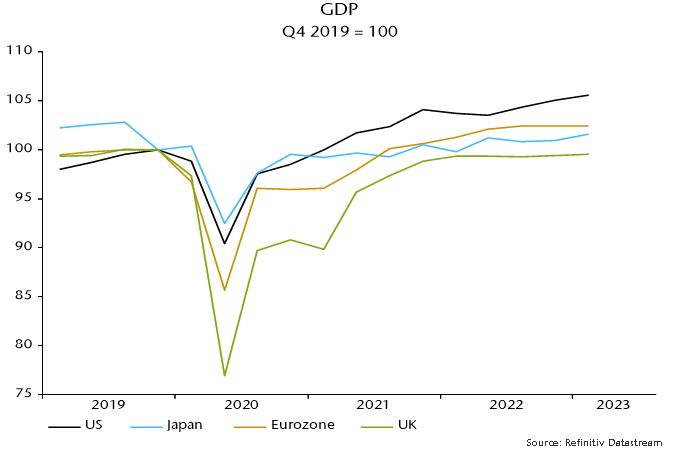
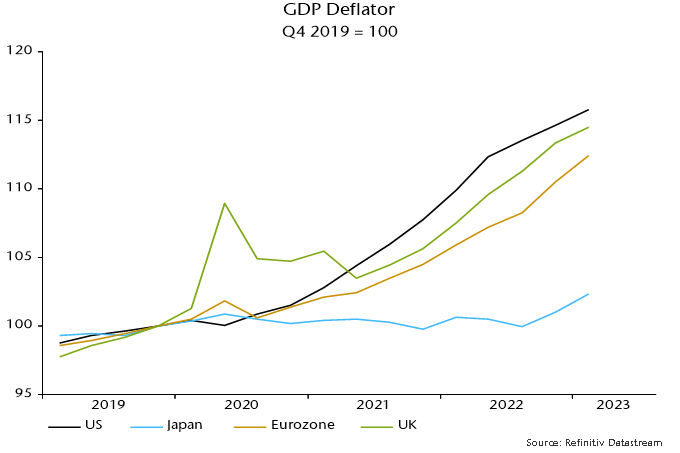
The UK has, however, underperformed the US and Eurozone in terms of the division of nominal GDP expansion between real GDP and domestically-generated inflation, as measured by the GDP deflator – charts 4 and 5. 

Chart 4

Chart 4 showing GDP Q4 2019 = 100

Chart 5

Chart 5 showing GDP Deflator Q4 2019 = 100

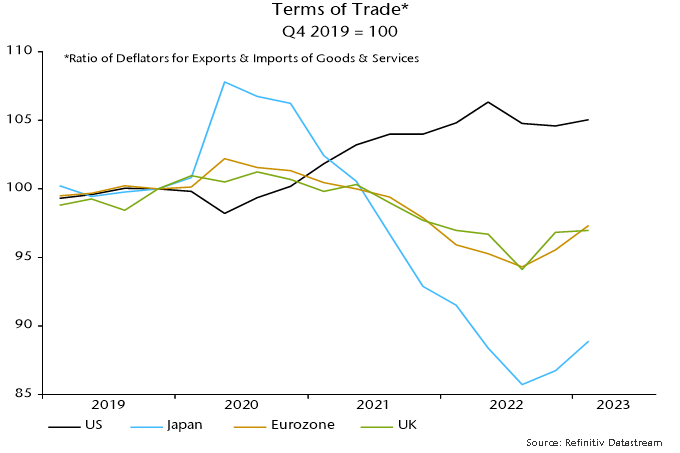
UK consumer prices were additionally boosted relative to the US by opposite movements in the terms of trade (i.e. the ratio of export to import prices), reflecting different exposures to energy prices as well as currency movements (i.e. a strong dollar through last autumn) – chart 6. 

Chart 6

Chart 6 showing Terms of Trade* Q4 2019 = 100 *Ratio of Deflators for Exports & Imports of Goods & Services

UK supply-side weakness may be structural but monetary and terms of trade considerations suggest an improvement in UK relative inflation performance – annual broad money growth is now similar to the US and below the Eurozone level, while sterling appreciation since late 2022 may extend a recent recovery in the terms of trade.

The Sahm rule states that the (US) economy is likely to be in recession if a three-month moving average of the unemployment rate is 0.5 pp or more above its minimum in the prior 12 months. 

The rule identified all 12 US recessions since 1950 but gave two false positive signals based on current (i.e., revised) unemployment rate data (1959 and 2003) and four based on real-time data (additionally 1967 and 1976). 
The signal occurred after the start date of the recession in all 12 cases, with a maximum delay of seven months* (in the 1973-75 recession). 

The Sahm condition hasn’t yet been met in the US – the unemployment rate three-month average was 3.6% in June versus a 12-month minimum of 3.5%. 

The rule has, however, triggered a warning in the UK, where the jobless rate averaged 4.0% over March-May, up from 3.5% over June-August 2022. 

UK Sahm rule warnings occurred on nine previous occasions since 1965, six of which were associated with GDP contractions. 

The Sahm signal is another indication that the UK economy is already in recession – see previous post – but a stronger message is that earnings growth is about to slow. 

Annual growth of average earnings fell after the Sahm signal in eight of the nine cases, the exception being the 2020 covid recession, when earnings numbers were heavily distorted by composition effects – see chart 1. 

Chart 1

Chart 1 showing UK Average Earnings (3m ma, % yoy) & Rise in Unemployment Rate (3m ma) from 12m Minimum

Previous generations of monetary policy-makers understood the dangers of basing decisions on the latest inflation and / or earnings data, which reflect monetary conditions 18 months or more ago. 

The current reactive approach, apparently endorsed by the economics consensus, may partly reflect mythology about a 1970s “wage / price spiral”. Rather than causing each other, high wage growth and inflation were dual symptoms of sustained double-digit broad money expansion. 

The monetarist case is summarised by chart 2, showing that earnings growth is almost coincident with core inflation whereas broad money expansion displays a long lead. (The correlations with core inflation are maximised with lags of four months for earnings growth and 24 months for money growth.) 
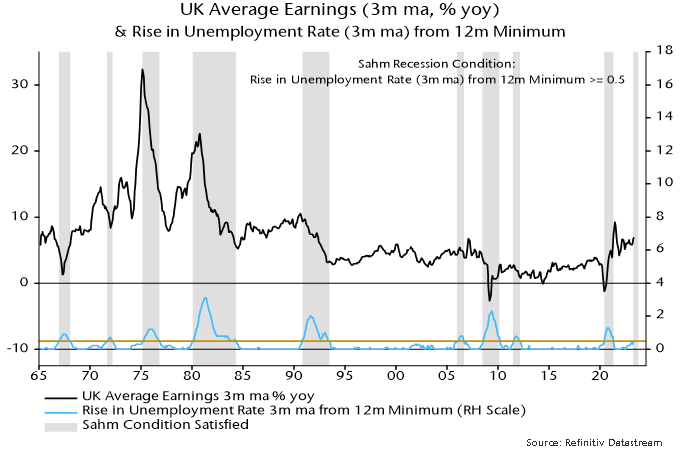
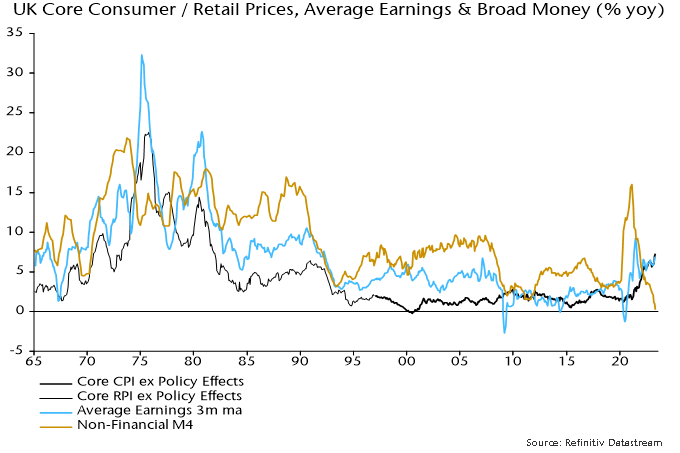
Chart 2 

Chart 2 showing UK Core Consumer / Retail Prices, Average Earnings & Broad Money (% yoy)

Recent monetary weakness argues that core inflation and wage growth will be much lower by late 2024; the Sahm rule signals that the decline is about to start.

*Eight months taking into account a one-month reporting lag.

DM flash results released last week suggest that the global manufacturing PMI new orders index fell sharply in June, having moved sideways in April and May following a Q1 recovery – see chart 1. 

Chart 1

Global Manufacturing PMI New Orders, & G7 + E7 Real Narrow Money (% 6m). Source: Refinitiv Datastream.

The relapse is consistent with a decline in global six-month real narrow money momentum from a local peak in December 2022. A recovery in real money momentum during H2 2022 had presaged the Q1 PMI revival. 

Real narrow money momentum is estimated to have fallen again in May, based on partial data, suggesting further PMI weakness into late 2023. 

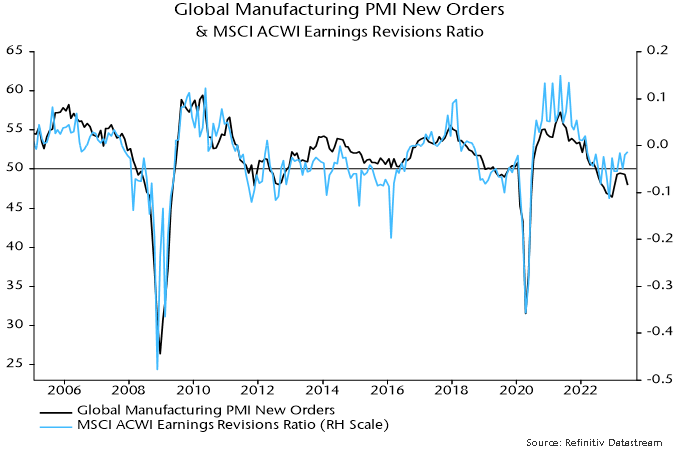
The global earnings revisions ratio has been contemporaneously correlated with manufacturing PMI new orders historically but remained at an above-average level in June, widening a recent divergence – chart 2. 

Chart 2

Global Manufacturing PMI New Orders, & MSCI ACWI Earnings Revisions Ratio. Source: Refinitiv Datastream.

Based on monetary trends, a reconvergence is more likely to occur via weaker earnings revisions than a PMI rebound. 

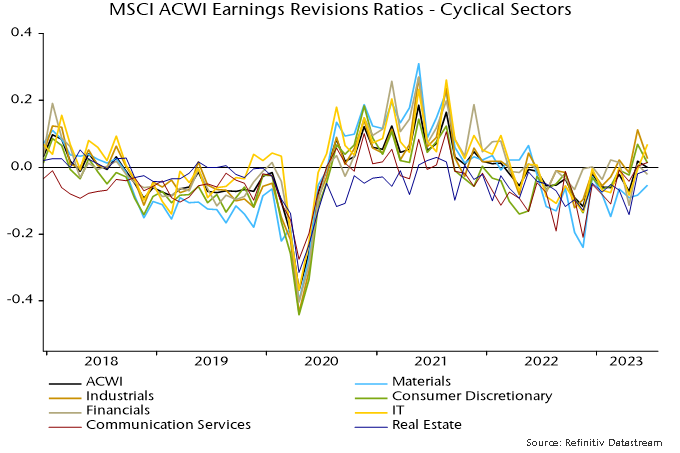
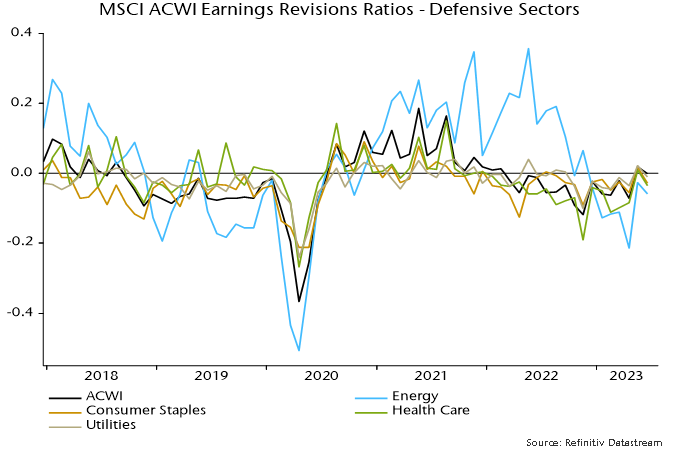
Charts 3 and 4 show that revisions resilience has been driven by cyclical sectors – in particular, IT, industrials and consumer discretionary. Notable weakness has been confined to the materials sector. Cyclical sectors may be at greater risk of downgrades if the global revisions ratio heads south. 

Defensive sector revisions have underperformed recently but are likely to be less sensitive to economic weakness. 

Chart 3

MSCI ACWI Earnings Revisions Ratios - Cyclical Sectors. Source: Refinitiv Datastream.

Chart 4

MSCI ACWI Earnings Revisions Ratios - Defensive Sectors. Source: Refinitiv Datastream.

The positive divergence of earnings revisions from the PMI may reflect firms’ ability to push through price increases to compensate for slower volumes. The deviation of the global revisions ratio (rescaled) from manufacturing PMI new orders – i.e. the gap between the blue and black lines in chart 2 – has displayed a weak positive correlation with the PMI output price index historically (contemporaneous correlation coefficient = +0.41). 

Any earnings support from pricing gains is now going into reverse: the output price index has crashed from an April 2022 peak of 63.8 to 49.8 in May, with DM flash results suggesting a further fall last month.