Monetary trends continue to give a negative message for global economic prospects, suggesting that European / US weakness will outweigh resilience in major EM economies. 

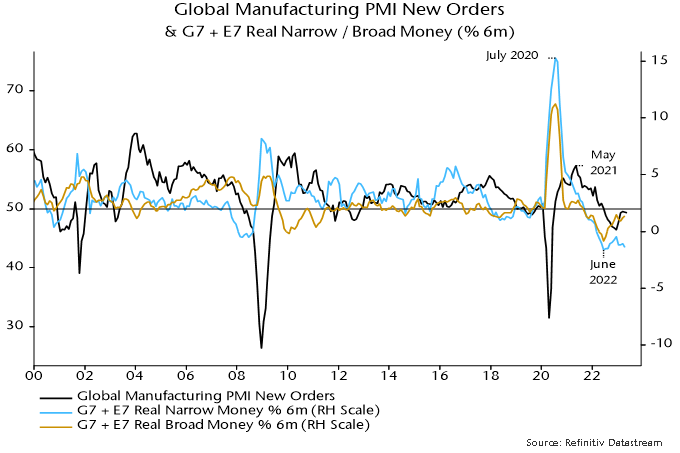
G7 plus E7 six-month real narrow money momentum fell again in April, extending a move down from a local peak in December and suggesting a decline in economic momentum through late 2023 – see chart 1. 

Chart 1

Chart 1 showing Global Manufacturing PMI New Orders & G7 + E7 Real Narrow / Broad Money (% 6m)

A revival in real narrow money momentum in H2 2022 was reflected in a recovery in global manufacturing PMI new orders between December and March. The recovery stalled in April / May and the forecast here remains for a relapse and possible retest of the December 2022 low during H2 2023. 

Narrow money has outperformed broad money as a leading indicator historically, in terms of reliability in signalling turning points in economic momentum. Narrow money usually weakens relative to broad money when interest rates rise as depositors are incentivised to shift funds to less liquid accounts. This is an important feature of the transmission mechanism and one of the reasons narrow money outperforms as a forecasting indicator. 

An argument, however, has been made that the unusual speed of the rise in interest rates over the past year, coupled with worries about deposit safety following recent bank failures and an associated switch into money market funds, may have exaggerated narrow money weakness relative to “true” economic prospects. This would suggest giving greater weight to broad money trends at present. 

As chart 1 shows, global six-month real broad money momentum recovered more strongly during H2 2002 and has stalled rather than fallen back since December. Still, the message for economic prospects is weak, suggesting no growth revival before 2024. 

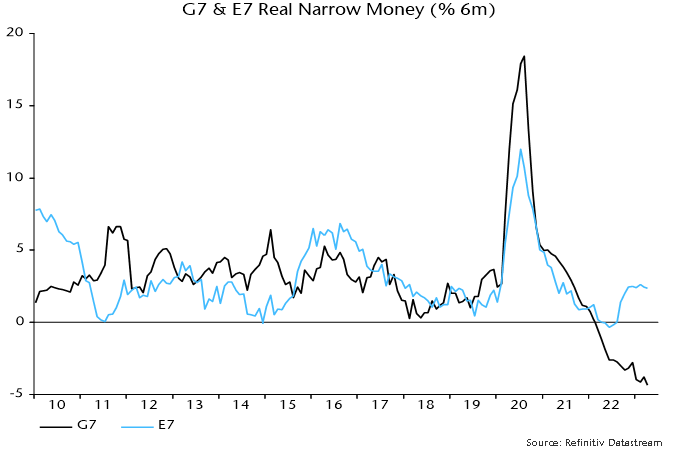
A marginal decline in global manufacturing PMI new orders in May reflected a notable weakening of the DM component offset by stronger EM results. EM resilience is consistent with recent stronger E7 real money momentum (broad as well as narrow) – chart 2. 

Chart 2

Chart 2 showing G7 + E7 Real Narrow Money (% 6m)

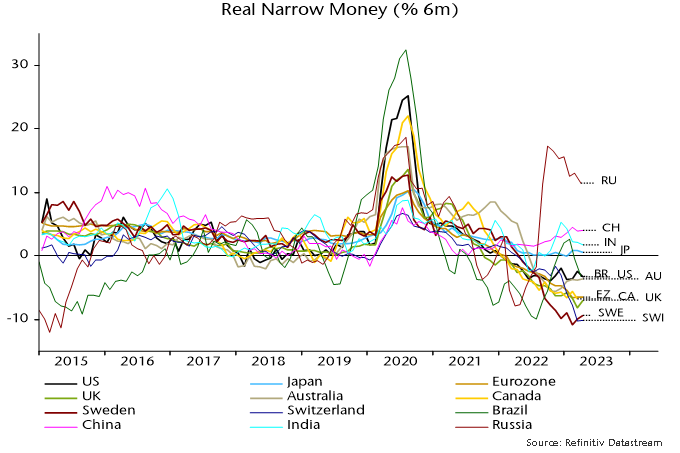
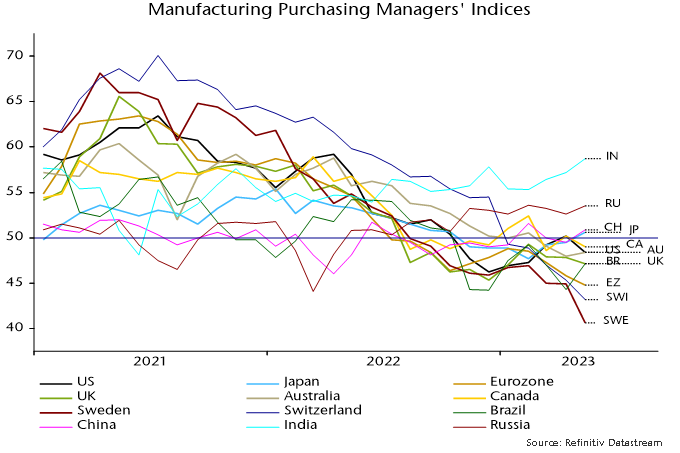
Charts 3 and 4 show six-month real narrow money momentum and manufacturing PMIs in selected major economies. Russia, China and India top the real money momentum ranking with weakness focused on Europe – particularly Switzerland and Sweden. The latest PMI results mirror the real money ranking (rank correlation coefficient = 0.85), with recessionary readings in the Eurozone, Switzerland and Sweden contrasting with Indian / Russian strength. 

Chart 3

Chart 3 showing Real Narrow Money (% 6m)

Chart 4

Chart 4 showing Manufacturing Purchasing Managers’ Indices
Cityscape of Guiyang at night, Jiaxiu Pavilion on the Nanming River. Located in Guiyang City, Guizhou Province, China.

Summary

  • EM equities were weak through April as the global economic backdrop continues to deteriorate.
  • Negative global excess money continues to feed a slowdown globally, along with falling inflation.
  • The global liquidity backdrop should become less negative as yields peak and industrial output begins to bottom. This should increasingly favour quality growth, tech and defensive (excluding energy) names.
  • China’s economy continues to buck the trend, enjoying a modest reopening bounce. However, this recovery may not be enough to offset weakness elsewhere in the world.
  • Chinese equities were down through the month and are flat for the year. Leading names in China this year have typically been SOEs boosted by government reform initiatives, banks and some energy names. Our favoured quality growth names have underperformed despite benefiting from the reopening and continue to trade at compelling valuations.
  • General elections in Thailand approach, with pro-democratic opposition parties poised to oust the military-linked conservative coalition.
  • Turkey is also set to hold presidential and parliamentary elections in May. President Erdogan is likely to face a stiff test from opposition coalition leader Kemal Kilicdaroglu, who has pledged to restore economic orthodoxy to address a deepening economic crisis. Political risk is high, with a return to Erdogan likely to court a currency crisis and add further pressure to the country’s strained banking system. 

Mixed signals from China’s reopening

The modest recovery in consumer spending and industrial activity this year has fallen short of investor expectations, with Chinese equities flat for the year. We agree recovery signals have been mixed, which aligns with our previous commentary flagging that authorities in China have been content with a gradual pick up as opposed to the V-shape boom that we saw in the West. Beijing is clearly wary of pouring excessive fiscal and monetary stimulus on the recovery lest it spark an outbreak of inflation.

The government has done little other than offer rhetorical support for business. The Politburo met in late April, with President Xi noting weak economic momentum and subdued demand. Policymakers kept their options open with respect to fiscal and monetary support, pledging a “forceful and effective” approach while reiterating that curbing speculation in property and taming local government debt remained high priorities. Following on from the two sessions last month where new Premier Li Qiang touted the party’s support of business, the Politburo provided another forum to pledge to restore business confidence through the “[elimination of] any legal, regulatory or hidden barriers preventing the fair competition and common development of enterprises of all ownership forms.” 

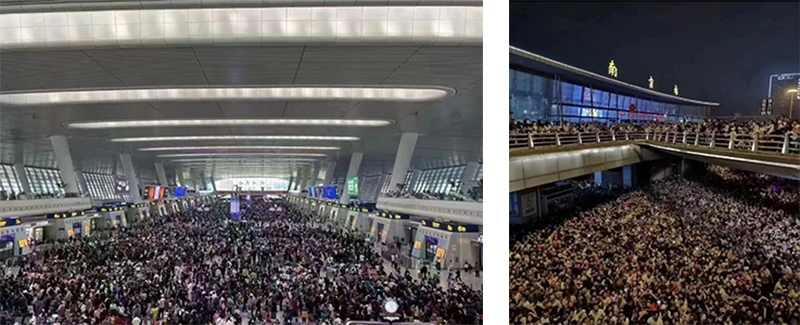
While the policy restraint may frustrate some China bulls, data from China’s Labour Day holiday at the end of April into early May suggests that Chinese consumers are back travelling and dining with a vengeance.

  • China Daily reported that on Friday, April 28, the day before the holiday started, train tickets departing Shanghai Hongqiao station to destinations nationwide were sold out.
  • Over the first three days of the holiday, approximately 160 million people travelled by air, road or waterway, an increase of over 162% versus the same period in 2022 (China Daily).
  • More than 240 million people were estimated to have travelled over the full five-day break, double the pre-COVID level in 2019 (Jefferies).
  • Domestic flights during the period are over 4x above 2022 levels (Jefferies).
  • Sales growth over the holiday period across catering, apparel, jewellery and tobacco were up 21.4%, 20.9%, 17.4% and 16.8%, respectively, versus 2022 (Jefferies).

NS Partners analyst Michael Zhang is currently travelling in China and sent us some photos of what he calls “revenge travel” over the holiday break.

The trend is positive but fragile – consumers are getting out but overall spending is still relatively weak – and monetary data remains supportive with additional scope for further easing should deflation risk emerge and external headwinds build.

Chile’s president looks to cash in on battery boom through lithium nationalisation

Chile’s government announced that it would seek to capitalise on the global battery boom by nationalising its lithium industry. The stocks of the two main Chilean lithium players, SQM and Albemarle, were hit by the news, with some investors fearing a repeat of the nationalisation of Chilean copper mines in 1971 by the socialist Allende government, where assets were seized from foreign miners without negotiation. The move was a disaster, as foreign engineers and investors left Chile, and just as a global recession in 1973 was about to precipitate a collapse in copper prices. Allende was ultimately ousted in a CIA-backed coup, and replaced by right-wing despot Augusto Pinochet.

This proposal illustrates the importance of factoring political risk and institutional quality into our process. While Boric risks kicking an own goal here, our analysis makes us relatively sanguine about prospects for the Chilean miners SQM and Albemarle, as the president must ultimately pass the law through a centre-right leaning Congress. The legislature is a key check on the ambitions of the president, illustrated by the rejection of a tax reform proposal in March and failure to implement a progressive constitutional reform in a plebiscite last year, with opposition led by right-wing congressional figures.

If the nationalisation plans were to pass through Congress, the government has committed to honouring existing contracts (SQM’s runs to 2030 and Albemarle’s to 2043), while encouraging the miners to negotiate state participation before expiry. It is likely that the miners will engage in and drag out negotiations on state participation as much as possible, while they generate supernormal profits at these elevated lithium prices.

While the market reaction on the news was an overshoot, we were not tempted to add to our exposure. Lithium price strength will ultimately incentivise significant new supply to come online across South America and Australia in the coming years. Additionally, we are happy to maintain an underweight to commodities broadly, based on our outlook that weak global liquidity will feed an economic hard landing that drags on commodities.

PETRONAS Twin Towers in Kuala Lumpur, Malaysia.

The strategy saw strong contributions from holdings in ASEAN (Indonesia, Malaysia, and the Philippines) and the Middle East in the quarter. However, this was offset by losses in the Africa portfolio. As we have written about in previous letters, we have been actively reducing the strategy’s exposure to Africa (specifically Egypt and Kenya) and increasing it in ASEAN and the Middle East (Saudi Arabia and the United Arab Emirates). African economies are undergoing severe macroeconomic headwinds that have overwhelmed equity returns and exerted pressure on earnings. Conversely, ASEAN and Middle Eastern economies have been performing reasonably well, allowing us to harvest healthy USD equity returns through earnings growth and multiples expansion.  

Continuing with the above theme, we decided to fully tender out the strategy’s shares in East African Breweries Ltd. (EABL) to Diageo PLC at a price of Ksh192/share (compared to the Ksh170/share price as of the date of this letter). While Diageo paid a premium of 35% versus the one-year average (at the time of the “intention to acquire” announcement in October 2022), the deal multiples were highly favourable to Diageo at ~14x 2023 earnings, a substantial discount to emerging and frontier market brewers. We tendered out at these low multiples due to two factors: first, there are limited incremental buyers for EABL given the macroeconomic environment and stock market illiquidity in Kenya; second, the Diageo bid presented a relatively lucrative way for us to reduce exposure to Africa, in line with our strategy. Following the deal, EABL will remain listed on the Nairobi Stock Exchange with Diageo’s ownership now up to 65%, from just over 50% pre-tender. We will continue to monitor EABL and potentially re-enter the stock once the economic environment in Kenya settles.  

The strategy was very active during the quarter in both ASEAN and the Middle East. In ASEAN, we invested in CTOS, Malaysia’s leading private credit reporting agency, which holds over 70% of the country’s credit reporting market. Due to the high barriers to entry in this industry, market leaders like CTOS are likely to sustain their position as they continue to compound their data sets and create new use cases for their customers. Malaysia is a particularly underpenetrated market for credit reporting, as financial institutions still rely heavily on their internal data to underwrite credit. Malaysia is interesting because financial inclusion is high at around 95%, yet 65% of the population still does not have a regulated credit account. As financial sophistication grows and credit compliance requirements tighten, demand for CTOS’s services should increase significantly. With scale and technology that enables it to generate operating income margins of ~40%, we expect CTOS to achieve ~20% growth for the next few years. We have followed CTOS since it listed on the Bursa Malaysia in July 2021, but had reservations on its valuation and the previous management team, who we thought were brought on just to list the company rather than the focus on generating long-term value. When the previous CEO left the company, we went to Kuala Lumpur to meet with the new CEO, Erik Hamburger, a former executive at Experian, who articulated a growth strategy around product development, digital strategy, and sales initiatives that we thought, if well executed, would unlock tremendous value for shareholders. With a positive view on the company and management, it was a case of waiting for a valuation opportunity to open, which finally happened in this quarter.  

The strategy also invested in Al Ansari Financial Services (AFS), a UAE-based remittance and currency exchange house. AFS is a leader in the second-largest market remittance market globally (after the U.S.). The company generates revenues from facilitating the remittance of money flow from the UAE to countries in Asia (example: Philippines), Sub-continent (India and Pakistan), and the Middle East and North Africa (Jordan and Egypt). AFS focuses primarily on small ticket remittance, a market that banks are strategically not interested in, and that fintechs have found difficult to penetrate. For context, the company reports that 67% of the remittances it facilitates are less than $400 per transaction. AFS has a robust offline network in 226 carefully selected locations across the UAE, which captures monthly remittance flows from blue-collar and underbanked white-collar workers. This offline network is supported by a strong online presence, where it has a top ranked app that processes 41% of personal digital outward remittances among exchange houses. AFS’ management have executed well, deepening the company’s competitive advantage, and translating that to operating margins of ~50%, on healthy mid-teens top line growth.  

Despite the softer performance during the first quarter, we remain constructive on the strategy’s outlook. We believe the current environment is ripe for stock pickers, with valuations as attractive as they’ve been since we launched the strategy in 2018. Moreover, the economic environment is expected to deepen the competitive edge of portfolio companies in their respective markets.

As we have done in previous letters, we sign off by reminding our investors that our objective is to deliver differentiated returns that are attributed to investing skill (alpha) rather than market directionality (beta). We believe there are abundant alpha opportunities in frontier and emerging markets, which we choose to express through a concentrated but geographically diverse portfolio of companies with idiosyncratic earnings drivers and share-price catalysts. Naturally, this should result in significant deviations from global and emerging market indices in certain periods, but hopefully provide a superior risk-adjusted return profile to investors in the long term.

Vergent Asset Management LLP

Night View of Dubai Architecture Complex.

Gulf equity markets underperformed their emerging market peers (as measured by the MSCI Emerging Markets Index) for the second consecutive quarter. This weaker market performance can be attributed to some of the same factors we highlighted in the Q4 2022 Manager Letter namely, higher interest rates and lower oil prices. These factors present a headwind to earnings growth for the banking, energy, and materials sectors, which together constitute 69% of the S&P Pan Arab Composite Index. Banks have been a particularly sore area for the market, with profitability ratios starting to crack under the pressure of higher rates and concerns about capital allocation and corporate governance at two large banks in Saudi Arabia and the UAE. The news of indirect exposure to Adani Group companies and a potential acquisition of Standard Charter Group at First Abu Dhabi Bank, combined with the write-down of the unfortunate Credit Suisse investment at Saudi National Bank, provided further reasons for the sector’s underperformance this quarter.   

However, if we look beyond the Index’s major sector constituents, the overall market sentiment is clearly bullish. For example, in Saudi Arabia, out of the 229 stocks comprising the Tadawul All-Share Index, 174 stocks generated positive returns in the quarter. In the UAE, IPO activity has been robust and share prices of recent entrants such as Salik Co., Emirates Central Cooling Systems Corp. and ADNOC Gas are well above their offer prices. While the performance divergence between the broader market and the Index is easy to attribute, the magnitude of the divergence (in favour of the former) is noteworthy. It is evident that investors are increasingly reducing their exposure to banks and materials while increasing their exposure to other sectors, such as consumer, healthcare, and technology, where liquidity is relatively less accommodative and therefore prone to larger stock price moves.    

The context is important in partially explaining the strategy’s outperformance in the quarter. The aforementioned dynamics led to meaningful valuation multiples expansion for the strategy’s key portfolio companies. However, we also anticipate a robust earnings growth outlook for many of our core portfolio companies. For example, National Co. for Learning and Education (NCLE), a prominent Saudi K-12 school operator, reported year-on-year revenue and net income growth of 48% and 50%, respectively, in its last quarterly reporting period. Our team spent a day touring various NCLE-operated schools with the CEO in Riyadh and we were thoroughly impressed with the quality of the staff, facilities, and unique culture preserved by management dating back to NCLE’s roots as a family-run enterprise. 

The strategy’s returns also benefited from a sizeable position we have been building in Saudi Telecom Co. (STC), Saudi Arabia’s leading telecommunications provider. Our thesis on STC has been largely driven by valuation, which has been developing since the Public Investment Fund (PIF) offloaded a 6% stake in STC in December 2021. This event stoked fears of future sell-downs in the stock from the PIF, which currently owns 64% of the company. While we cannot be sure that the PIF will not sell more shares of STC in the future, we found that valuations were becoming increasingly attractive for such a dominant business, with free cash flow yields exceeding 10% for 2023. Our thesis received a strong boost from STC collecting nearly $4bn of outstanding receivables from government clients in the fourth quarter of 2022, which represented 8% of its market capitalisation at the time. We met with STC’s management at an investment conference in Dubai and were encouraged by their efforts to improve disclosure and transparency for the investor community.  

As mentioned earlier in the letter, banks have lagged Gulf equity markets. This is a phenomenon that also played out in the strategy, with five of the eight negative return stocks in the quarter coming from the sector. While we have a significant underweight in banks, the strategy’s absolute returns experienced a drag from Saudi and Qatari banks, where pressures on profitability are building up as cost of funds increases at a higher rate than yields on assets.   

The strategy also experienced underperformance in its North African portfolio, and particularly in Egypt, where severe macroeconomic headwinds have overwhelmed USD equity returns. We have been reducing the strategy’s exposure to Egypt over the last year but opted to keep a level of investment in our highest conviction portfolio companies there. 

Looking ahead, we continue to see favourable opportunities for the strategy. The macroeconomic backdrop remains supportive, with healthy FX reserves and balance of payments positions across most of the Gulf. While still early days, the Saudi-Iranian reproachment is a key event that warrants our attention, as any progress there can lead to a lower geopolitical risk premium on regional assets. OPEC+ is committed to maintaining high oil prices to support government spending plans, which could benefit equity markets. We also note that positioning from global emerging market funds remains light and governments in the region are intent on growing their share in the emerging market capitalisation, which we believe will end up manifesting itself in a quasi-short squeeze on those funds.  

The environment is highly dynamic in the region, and as active managers, we are willing to make bold decisions to ensure that the strategy continues to provide investors with attractive opportunities in the MENA region.

Vergent Asset Management LLP

Bamboo forest in Kyoto, Japan.

At Global Alpha we are macro aware but don’t make macro calls. Being macro aware helps us evaluate investment opportunities through the lens of a country’s economic indicators, politics and regulatory landscape. It can also be an important risk management tool, especially in emerging markets.

Macro awareness also comes from understanding a country’s policy choices on its path to success or failure. An exceptionally interesting book called “How Asia Works” by Joe Studwell, provides unique insights into why North Asian countries (Japan, Korea, Taiwan and China) have managed to achieve sustained economic growth while South Asian countries (Thailand, Malaysia, Indonesia and the Philippines) seem to have stalled on their way to economic success. The book answers several questions including:

  • Why successful industrial brands like Haier, TSMC and Hyundai emerged from North Asia and not South Asia.
  • How the Philippines went from being twice as rich as Korea to 11 times poorer in half a century.
  • Lessons that other emerging markets can learn from ones that have experienced growth and success.

The last point is particularly useful to our investment process. If there was a common thread (or formula for success) across North Asian economies, it would be the following.

Step 1 – Small gardens beat large ranches (Land reforms)

This is the crucial initial step, yet also the stage at which most countries falter. Achieving sustained economic growth of 7% to 10% over a significant period requires making tough political decisions, such as redistributing land in a peaceful manner. Following WWII, many North Asian economies were poor and had a surplus of labour in rural areas. However, land ownership was concentrated in the hands of a few wealthy and connected landlords.

The key to unlocking growth in this situation was to peacefully redistribute land from these connected landlords to small rural farmers and peasants. This approach is counterintuitive to what neo-classical economists might recommend, which is to establish massive, mechanized farms to maximize profit per acre. Instead, an intensive gardening approach on a small plot can deliver maximum crop yield.

The effect of this type of reform is that it fully employs the abundant labour available in rural areas. Increased agricultural output leads to sharp increases in purchasing power, waves of consumption and the resources to pay for basic manufacturing technology. Another significant effect of this reform was the social and economic mobility that it enabled, which in turn led to the emergence of a new middle class and a new cohort of entrepreneurs. For instance, the founder of Hyundai (Chung Ju Yung) in Korea and the founder of Formosa Plastics (Wang Yung Ching) in Taiwan were both sons of farmers.

Step 2 – Export or die (Carrot and stick approach to manufacturing)

As agriculture begins to create a new generation of entrepreneurs, returns from agricultural reforms start to taper off after a decade. The challenge then lies in redirecting entrepreneurial energy towards export-oriented manufacturing instead of services. Manufacturing is preferable to services because significant productivity gains can be achieved with low-skilled workers, and manufactured goods are more freely traded across the world.

Where policy differs from the consensus neo-classical approach is in offering protection to domestic manufacturers in the early stages of a country’s development, in the form of subsidies, while keeping international competition out of the domestic market with high tariffs. In exchange for this protection, domestic firms are required to maintain strict “export discipline.” This means that the more a domestic business exports and competes in the international market, the more subsidies and financing it receives.

A positive side effect of this policy is that businesses in North Asia were compelled to rapidly climb the technology learning curve to produce high-quality products. Those that failed to be export competitive were cut off from cheap credit and subsidies and were forced by the government to shut down or merge with successful companies. Instead of picking winners, the government weeded out the losers.

For example, Korea’s government encouraged a dozen conglomerates, including Samsung, Daewoo and Shinjin, to master car manufacturing in a market that was just 30,000 units in size. Vehicle imports were prohibited until 1988 and the import of Japanese cars until 1998, allowing domestic manufacturers to compete for survival. As a result of this policy, a single world-beating colossus in the form of Hyundai-Kia remains.

In contrast, Malaysia decided to master car manufacturing with a single state-owned enterprise (Proton) instead of encouraging private enterprise. With no export discipline or internal development of technology, Proton has mostly found success in the domestic market. In 2022, Proton sold approximately 141,000 cars, while Hyundai Kia sold over 6.8 million.

Step 3 – Targeted finance (Saying no to short-term profits)

The final step is to ensure that domestic financial institutions are fully aligned with the agricultural and industrial policy goals outlined above. Banks are kept under government control via the central bank and “directed” to lend to industrial and agricultural projects that may not necessarily yield the highest short-term returns but have the potential to earn long-term profits by nurturing infant industries. Capital controls are implemented to ensure that citizens’ savings remain in the country to finance national development projects.

The key is to avoid premature deregulation of the financial sector as with what led to the 1997 Asian financial crisis. Deregulation and capital market development as promoted by the World Bank and International Monetary Fund came much later in the industrialization process in Taiwan and Korea. In South Asia, premature deregulation of the financial system led to the issuance of new bank licenses to a cozy group of entrepreneurs who financed their own business activities and short-term speculative investments, like luxury real estate, instead of projects of national importance.

This historic review of North Asian success may seem both contrarian and counterintuitive due to its prescription of financial repression, tariffs and political intervention. However, it helps us at Global Alpha identify countries or sectors that might be on an unconventional path to success. For example, when we were in Vietnam late last year, we couldn’t help but wonder if its combination of an export-driven model and capital controls resembles the Korea or Taiwan of 1970s and 1980s.

Similarly, when Korea announced in 2022 its plans to develop its carbon composite industry as its second steel industry, we saw parallels with how it mastered the art of steelmaking with POSCO, now one of the world’s most efficient steelmakers. In fact, we have exposure to the advanced materials space in Korea through Hansol Chemical (014680 KS), which plans to invest ₩85 billion in silicon anode production as a solution to increasing the energy density of EV batteries while reducing charging time. If history is any guide, we can expect plenty of support from the Korean government to nurture this industry of the future.

Macro awareness can help you succeed

The success of emerging markets isn’t just about individual companies, but also about the broader economic and political context in which they operate. Being macro aware and having a solid understanding of the broader context can help investors make better informed decisions, mitigate potential risks and maximize their returns.

Man looking ahead at the Shanghai skyline.

Summary

  • Emerging market equities notched a positive month despite the fears over cracks appearing in developed market banking systems with the failure of Signature Bank, Silicon Valley Bank and the UBS takeover of Credit Suisse.
  • Chinese equities steadied in March, slightly up as the two sessions (China’s equivalent of parliament) rubber stamped Xi’s unprecedented third term as leader, and Li Qiang’s ascent to the role of Premier. Li was keen to tout China’s business-friendly credentials in his first remarks as premier.
  • This was followed later in the month by Jack Ma’s return to Hangzhou, China, the home of Alibaba HQ. This was followed shortly after by an announcement by the company that it would be split into six units. According to Alibaba CEO Daniel Zhang, the units will be able to “pursue independent fundraising and IPOs when they are ready.”
  • This provided a major boost to large cap Chinese tech stocks, with investors interpreting the announcement as further confirmation that regulatory headwinds for the sector were easing.
  • Portfolio names Alibaba, Tencent and Netease all rallied sharply.
  • Stocks in Taiwan and South Korea were stronger, in part due to some optimism that the deep downcycle across the semiconductor industry is starting to bottom.
  • Brazil underperformed wider emerging markets. Despite falling inflation and scope for the central bank to consider rate cuts, political risks continue to curb investor enthusiasm. President Lula’s scepticism of central bank independence and a free spending fiscal agenda are key concerns which muddle a potentially compelling opportunity for investors.
  • Gulf markets were weak, as headwinds build for energy prices and other commodities given the deteriorating global economic outlook.

Navigating booms and busts in China

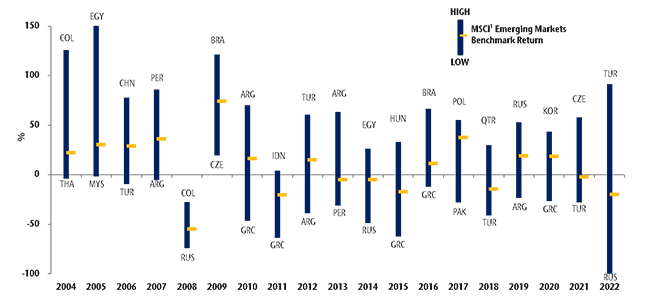
Given the wide dispersion of country returns in emerging market equities each year, we know that outperformance hinges on finding the right stock in the right country. As the below chart illustrates, great stock fundamentals can be wiped out by poor macro.

Dispersion of EM country returns

Chart 1: Emerging market returns by country from 2004 to 2022.
Source: Thomson Datastream.

The opportunity to gain exposure to high-quality companies operating in an economy delivering structural outperformance – such as India at present – is a key attraction of emerging market equities. However, experience teaches us that it is through avoiding big negative macro shocks in EM that we can sustainably tilt the odds in our favour.

Our approach to country analysis centres on two elements: 1) hard data inputs with monetary aggregates at the heart of this; and 2) qualitative macro analysis incorporating an assessment of shorter-term factors such as political risk and longer-term structural factors like institutional quality.

This piece will focus on the quantitative element, and specifically the role that the Liquidity Theory of Asset Prices plays in country selection.

Emerging markets and the Liquidity Theory of Asset Prices

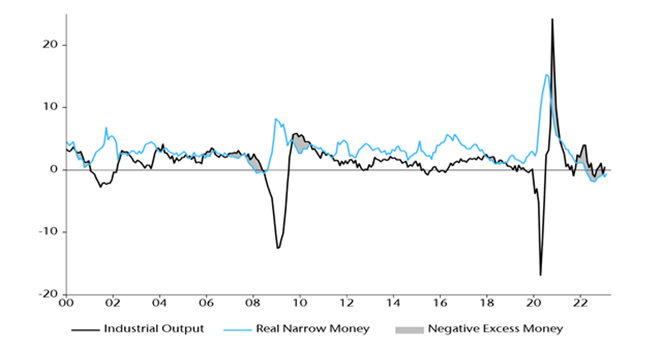
Analysis of monetary (or liquidity) data is a key input in our process for determining country weightings. This is based on the insight that, while we know that monetary trends lead the economy, “excess” money – the difference between the growth of real money supply and industrial output – moves markets even earlier. Broadly speaking, when narrow money is growing above industrial production, you are probably in a bull market somewhere as money not put to use in the real economy finds its way into bonds, stocks, property and other assets. The reverse also applies, with current weakness in financial markets reflecting a deteriorating liquidity picture as hot inflation and tight monetary policy suck money out of markets.

G7 + E7 industrial output & real narrow money (% 6m)

Chart 2: Graph showing G7 and E7 industrial output relative to real narrow money from 2000 to 2022.
Source: Thomson Datastream.

Applying Liquidity Theory in EM equities

We have found this to be a powerful leading indicator and tool for assessing the optimal country exposure through economic and market cycles. In emerging markets this works particularly well as we analyse liquidity country by country in a wide and diverse opportunity set.

Over the decades our team has compiled data on the sensitivity of individual countries in EM to varying liquidity environments. This helps us gauge whether the tide is coming out or in for a country’s financial markets. While this data provides signals for which markets might be winners over the medium term, we find that it adds the most value in providing warning signs of vulnerabilities that precipitate market shocks. You do not want to be around in a country like Argentina or Turkey when the liquidity tap shuts off.

Key input for managing China exposure

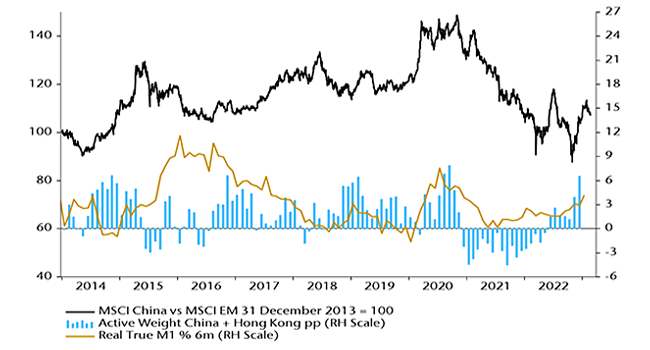
Liquidity analysis has been central to managing our portfolio exposure in China. As the chart illustrates below, observing the change in real narrow money growth is a key input for anticipating periods of out- or underperformance for the largest component of the EM benchmark. This is married up with qualitative macroeconomic research and in-depth economic value added stock analysis to determine exposure that aligns with our level of conviction.

MSCI China price index relative to MSCI EM & NS Partners’ active weight in China + Hong Kong

Chart 3: MSCI China Price Index relative to MSCI Emerging Markets Index and NS Partners’ active weight in China and Hong Kong from 2014 to 2022.
Source: Thomson Datastream.

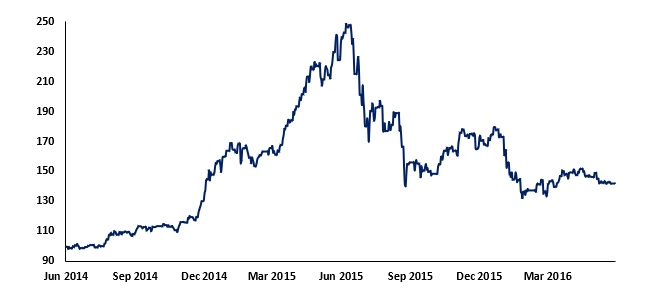
Successfully navigating the violent boom and bust of Chinese equities from 2014 through to mid-2016 demonstrates the effectiveness of this approach. Improving narrow money through the beginning of 2014 preceded a lift in exposure to China as the market began to outperform. Conversely, money numbers deteriorated from mid-2014, a warning sign that the rally was on borrowed time. This formed part of our decision to begin cutting exposure ahead of the market peak in June 2015. Highly leveraged retail investors had fuelled the final euphoric stages of the rally. News of a softening economy saw sentiment for Chinese equities wane, with initial modest stock declines triggering a wave of margin calls that precipitated a frenzied sell-off.

CSI 300 index (rebased to 100)

Chart 4: CSI 300 Index performance from 2014 to 2016.
Source: Bloomberg.

Fearing the slump would trigger a major financial crisis, Chinese authorities stepped in to introduce short selling bans and stock “circuit breakers”, while loosening margin requirements to allay fears of further defaults. Lock-up periods were enforced for owners of more than 5% of a company’s tradeable stock, and mutual funds and pension funds were compelled to support the market. Critically, the PBoC stepped in to slash rates, providing a significant boost to money numbers. Sentiment remained fragile through the beginning of 2016 with investors concerned about the ability of Beijing to rebalance a structurally slowing economy with bad debts without triggering capital flight. We were more constructive than consensus and gradually lifted exposure to overweight, encouraged by money numbers signalling a stronger economy ahead and judging that authorities had the tools to keep forex and balance of payments risks in check.

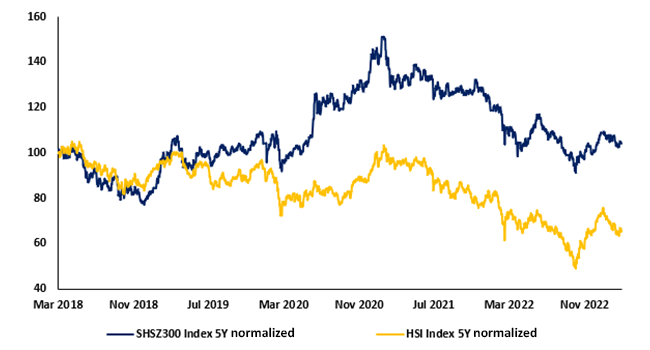
More recently, having been significantly underweight through the brutal selloff in Chinese equities in 2021, we began lifting exposure at the end of that year in response to improving liquidity data, reaching a neutral weight by the middle of 2022. This was subsequently raised to overweight later in the year as money numbers improved further, some political headwinds eased and Beijing’s COVID-zero approach to the pandemic was rapidly abandoned. The weighting shift provided a boost to portfolio performance as Chinese equities rallied hard on the “reopening trade”.

CSI 300 & HSI index (rebased to 100)

Chart 5: CSI 300 and HSI Index performance from 2018 to 2022.
Source: Bloomberg.

Looking ahead, we remain modestly bullish on Chinese equities but believe that current monetary trends signal that the authorities are determined to avoid overstimulating and sparking a Western-style inflation surge, which would risk social disruption. This should support a gradual but more sustainable economic recovery favouring quality names, as opposed to more cyclical parts of the market and derivative plays in materials and energy. 

As outlined above, in addition to quantitative inputs to our process, we also consider shorter term political risks along with longer term measures of institutional quality. China faces major challenges on both of these fronts as the Sino-U.S. dispute intensifies and as Xi Jinping consolidates power at the expense of the intra-party pluralism established under Deng Xiaoping. It means that while a monetary and economic recovery provides a supportive backdrop, our qualitative assessment of political and policy risks limits our conviction and consequent portfolio exposure to China.

A welder working on steel plates.

Summary

Emerging market equities fell in February (the MSCI EM Index was down 6% in USD terms) as investors took profits in China, and with strong wage, consumption and services data in the U.S. fuelling fears of persistent inflation and risks that the US Federal Reserve would press on with monetary tightening for longer than anticipated. This supported a modest bounce back in the dollar after a sharp decline through Q4 last year, which was an added headwind for EM.

The reopening trade was the catalyst for the biggest rebound for Chinese equities outside of the Global Financial Crisis. Higher beta H-share names were beneficiaries of extreme flows buying into laggards. These stocks were softer through February, with Alibaba and China Education Group leading portfolio detractors.

We wrote last month that A-shares across a number of sectors were attractive given their underperformance relative to H-shares since November. Despite posting slightly negative returns in February, it was pleasing to see A-share names like heavy equipment maker Sany Heavy, industrial automation leader Shanghai Baosight, and Spring Airlines post positive relative performance at the country level.

Investors are now looking to the two sessions in March, namely the National People’s Congress and the Chinese People’s Political Consultative Conference, for major announcements and key government appointments to gauge policy direction. Brazil and Saudi Arabia continued to underperform with South Africa joining them, reflecting our view that poor global liquidity data signals a deteriorating economy that is set to drag on more cyclical markets. Reopening in China will not match the boom we saw in the West as monetary and fiscal policy remains conservative. Weak global demand will also weigh on China’s export markets. Therefore, while we are encouraged by the recovery in China’s economic activity, we are not playing derivatives of the reopening through commodities.

Modi silent on Adani

Last month we flagged that the fallout from allegations of fraud and stock manipulation levelled against the Adani Group would test India’s ascent up the development ladder. Prime Minister Narendra Modi has been the driving force for a number of crucial reform initiatives, including the electrification of poor villages, providing better sanitation in rural areas, the introduction of a bankruptcy code, a nationwide goods and services tax, and establishing digital land records and biometric identification which together underpin a virtuous circle of development. With general elections approaching in 2024, it was hard to see how Modi would lose, particularly given weak and fragmented opposition.

The fallout from Hindenburg’s short report on the Adani Group presents a key test for PM Modi, as his rise, along with that of Adani and India itself are in many ways intertwined. Modi forged his reputation as a pro-business Chief Minister of the Gujarat province in the early 2000s, with rapid economic modernisation and growth propelling rising industrialists such as Adani to the forefront of India’s growth story. As Modi rose to the office of PM, Adani was a key supporter and beneficiary of the government’s nation-building plans, enabling him to build an industrial empire across ports, power plants, resources, renewable energy and airports. India’s opposition parties, who have accused Modi of crony capitalism through helping Adani secure lucrative projects across a host of sectors, have seized on the report as evidence of corruption. Modi on the other hand has kept quiet while his spokespeople characterise the accusations as an attack by elites in Congress and the media on the BJP’s pro-growth agenda. Our view at this early stage is that the risks appear unlikely to be systemic. Hindenburg’s report outlines what looks to be a stock “ramp,” with shell entities buying up stock to lock up free float while hiding this from index providers. Ostensibly meeting liquidity and market-capitalisation requirements enabled index inclusion with a disproportionately large weighting for thinly traded Adani stocks, which was in turn fuel for a massive rally across the Adani Group. While high debt levels are a concern, the collateral tied to many of the loans are high-quality infrastructure assets, with state banks and foreign lenders bearing much of the counterparty risk. Should fallout be contained, the controversy could present a buying opportunity in some of our favoured names while encouraging better corporate governance in India.

Globalisation is not over

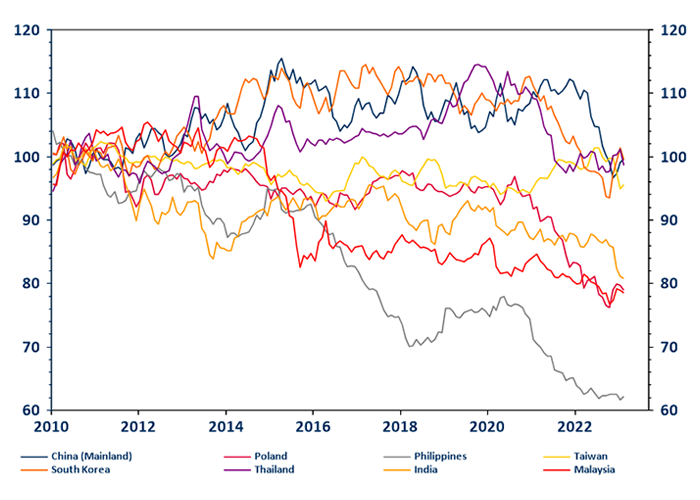
While globalisation is clearly changing, we can’t see it reversing. China’s export machine continues to power ahead, while developed countries wisely diversify supply chains to the benefit of other rising export players such as Vietnam, Indonesia and India. Indeed, the combination of incredibly tight labour markets in the West (the U.S. in particular) and extremely cheap real effective exchange rates across a number of emerging markets make these countries incredibly attractive investment destinations in our view. Real effective exchange rates incorporate relative levels of inflation and “trade weights” to account for a country’s largest trading counterparties. As per the following chart, some EMs are more competitive than they have been for a decade or more.

Real Effective Exchange Rate

Chart showing the real effective exchange rate of emerging markets from 2010 to 2022.

Source: Refinitiv Datastream

Chinese EVs are beginning to go global

Leading Chinese electric vehicle (EV) stocks have been sold heavily over the past 12 months, with the pandemic disrupting supply chains and sapping consumer demand. Premium EV manufacturers were hit particularly hard as sentiment soured on reports of missed delivery targets in late 2022, along with a soft outlook for the next quarter or so. Despite the setbacks, the industry’s long-term prospects remain bright. The core investment case revolves around the following factors:

  • EVs are approaching purchase-cost parity with internal combustion vehicles (ICEs); 
  • a long runway for EVs to take share from ICEs;
  • increasing battery density and longer-range;
  • build out of charging infrastructure; and
  • domestic EV players successfully positioning themselves as leading premium brands in China.

What makes this a particularly attractive opportunity is the potential for Chinese EV companies to scale up in a continental-sized market. As this plays out, industry leaders will emerge within China that possess the scale and technology to go global and potentially dominate foreign markets. This is starting to play out now from a low base, with China becoming a net exporter of autos for the first time in 2022, led by EV manufacturers (HSBC Research, February 2023).

Share of NEVs as a % of China passenger vehicle exports

Source: CAAMM, QIANHAI Securities

2022 global EV volume mix

Source: EV-Volumes, HSBC Qianhai Securities

China exported 2.5 million EVs in 2022, up 57% year-on-year. Chinese brands are in the early stages of establishing themselves in foreign markets (particularly in Europe), which are less competitive than China. While a compelling story, investors need to keep expectations in check. It is likely to take years for Chinese EV players to build meaningful traction through increased brand familiarity, localising some production and distribution as well as navigate growing protectionism. If brands like NIO and BYD can manage these risks, they will be set to challenge foreign rivals by drawing on the largest EV production market in China and the strongest battery supply chain globally.

View of Abu Dhabi Skyline at sunset, United Arab Emirates

 Gulf equity markets rolled over in the fourth quarter and materially underperformed emerging markets. This marks a stark but predictable (as we wrote in our last Q3 letter) reversal in fortunes, with tailwinds of the outperformance in the last 18 months turning to headwinds. We summarize the key drivers of the weakness in Gulf equity markets in the fourth quarter below:

  1. Lower oil price and a different transmission mechanism – Gulf economies are highly levered to oil prices. While a Brent oil price of $80 is healthy for most Gulf economies, surpluses will naturally be lower as prices come down and barrels produced and sold remain static. Moreover, and focusing on Saudi Arabia, the share of oil revenue proceeds going into the banking system has come down considerably as the government allocates an increasing proportion of oil revenue to its sovereign wealth fund where the trickle down to economic activity is seemingly less visible (for now).
  1. Higher interest rates – Gulf currencies are effectively pegged to the U.S. dollar and central banks have had to adjust to the Fed’s four rate hikes of 75 basis points in 2022. The relative attraction of owning equities with three months SIBOR rates reported at 5.59% is understandably low. Gulf investors have more alternatives than ever before to invest their money, with the recent Al Rajhi Bank Sukuk proving to be particularly popular among retail investors. Higher rates are also putting pressure on the net interest margins of banks as they compete to attract deposits. This phenomenon is likely to be especially acute in Saudi Arabia, where the liquidity environment has tightened n the fourth quarter of 2022. Saudi banks represent ~23% of most MENA indices and so the aforementioned profit margin compression has a material impact on the market’s aggregate EPS growth expectations for 2023. In other Gulf markets like the UAE and Qatar, state and quasi-state companies have been pre-paying debt at a rapid pace to avoid higher interest rates, leading to anemic corporate loan growth and further pressure on profitability.
  1. Weaker USD – Gulf equities are effectively US dollar-denominated assets and are generally more attractive for global investors when the U.S. dollar is appreciating. This relationship has become stronger since Gulf equity markets became a large component of emerging market indices. Active Global Emerging Market (GEM) investors are not incremental buyers of Gulf equities in a weaker USD environment and their current underweight exposure to the region suggests they prefer to own assets denominated in non-pegged currencies.
  1. Valuations – Gulf equity markets are coming off excessive valuation levels that reflected over-optimism on the degree and timing of the impact of reform program announcements, and robust foreign inflows following the deletion of Russia from the emerging market universe in March 2022, which we discussed in our second quarter letter.
  1. A wall of offerings – 2022 was a record year for capital raised through primary and secondary transactions and the number of deals closed in the region with 47 listings raising a total of $26.5 billion. A large number of deals and the prospect of share sales by government and quasi-government shareholders took the air out of the market. We think it is wise for government funds to reduce or float their stakes in strategically listed companies given the level of ownership is far above what is required to retain control. However, this is likely to weigh on the share prices of many of the large-cap companies in the market where those entities are key shareholders. On a lighter note, overexcited bankers salivating at the prospect of fees from investment banking deals continue to be a reliable indicator of negative future market performance.

 As for the strategy, we managed – to a large extent— to avoid the significant drawdown that the region experienced in the fourth quarter. Three factors helped us achieve this outperformance:

  1. Sticking to high conviction portfolio companies like Saudi Dairy and Food Co. (SADAFCO) where management execution and weaker competition are leading to significant earnings growth that the market has been behind on for a few quarters now. 
  1. Adding to high conviction portfolio conviction companies that we believe are likely to experience an improvement in an operating environment like the National Company for Learning & Education (NCLE). NCLE’s eleven K-12 schools are experiencing a noticeable increase in utilization as students return to in-person learning in Saudi Arabia and management’s various initiatives (which focus primarily on quality of education in existing schools, M&A and greenfield for new schools) bear fruit.
  1. Reducing or exiting portfolio companies we believe have reached valuation levels that are no longer attractive. A good example of this is Saudi Tadawul Group (STG), the country’s stock exchange which we exited at nearly peak average daily traded value. Over 60% of STG’s revenue is linked to traded values on the stock exchange and our exit decision reflected an understanding that traded values cannot just continue to go up, a view that the market is only getting around now as traded values have dropped 50% y-o-y in recent months.

 We continue to see a strong opportunity for the strategy as the market begins to reflect the “bad news” in the price of assets we like, and as investments in companies we’ve made in the last 6-12 months or earlier continue to deliver. 

 While we acknowledge that the environment has been favourable for the strategy, and decisions we made have on the whole been good ones, we are not resting on our laurels and will endeavor to continue delivering differentiated value-added returns for our clients looking to access the growing investable opportunity in the MENA region. 

Vergent Asset Management LLP

Early evening shot of Makati skyline. Makati, Metro Manila, Philippines.

As this quarter marks the final letter for the year 2022, we thought it will be helpful to reflect on the key events that shaped the performance of the strategy in the year.

Economics 

The war in Ukraine, and the resulting spillover into higher energy and food prices, exposed structural imbalances that resulted in spiraling inflation and currency depreciation across most markets. Our focus on African and Asian companies and through-the-cycle underwriting process put us at a disadvantage as food and oil prices experienced sharp and sustained inflation.

The consumer basket in our markets is over-indexed to those basic commodities, and the fiscal and balance of payment dynamics of most developing countries (where we exclusively invest) are inversely correlated to commodity prices. In response, we identified the most vulnerable countries in the portfolio and made decisions to exit two companies in Egypt and one in Pakistan, and selectively reduce exposure to Kenya. We highlighted in our third quarter letter that our portfolio companies experience a net positive carry in a higher rate environment, as most hold more cash than debt. Where there is debt, it is mostly in local currency or otherwise matched with foreign currency income. Of the top ten companies in the portfolio, seven enjoy a net cash position.

Despite active portfolio management that reduced exposure to the most vulnerable countries, and defensive portfolio attributes, returns were still dramatically overwhelmed by the impact of currency moves. Around 47% of the strategy’s returns in the year can be explained by foreign currency depreciation against the US dollar, with notable currency devaluation in the Egyptian pound, Pakistani rupee, and the Ghanaian cedi.

Politics

The strategy experienced volatility from the onset as political unrest in Kazakhstan in January led to a meaningful drawdown in the share price of Kaspi.Kz, a fairly sizable position for the strategy. Since then, Kazakhstan’s political outlook has materially improved. On the domestic front, Kassym-Jomart Tokayev secured a second term in a snap election held in November, cementing his position against political rivals from the previous regime. On the foreign policy front, Tokayev seems to have navigated the Russian-Ukraine crisis as well as anyone expected, striking a neutral position that preserved his country’s deep-rooted ties to Russia, while constructively increasing diplomatic and economic engagement with the West and China. Our team visited Kazakhstan in May where we visited with Kaspi.Kz management, their main bank competitor, and other relevant stakeholders. Our visit was instrumental in reinforcing our constructive thesis on Kaspi.Kz, which we then translated into opportunistic buying of the shares at what we deemed to be deeply discounted valuations. Fortunately, this helped turn a 38% drop in the share price of Kaspi.KZ in 2022 to a flat performance contribution to the strategy in the same year. 

Kenya and the Philippines, key markets for the strategy, also held presidential elections this year. In Kenya, a peaceful election held in September saw power seamlessly transition to President-elect William Ruto, a testament to the democratic process, and the strength of institutions, in the East African country. President Ruto’s policy priority to reduce debt and improve Kenya’s fiscal position is negative for near-term growth but essential for sustainable long-term economic growth. His pro-trade stance, and his visit to neighbouring Addis Ababa for the national launch of Safaricom’s operations in Ethiopia, signal a commitment to preserving and expanding Kenya’s role as an economic and diplomatic hub for the region. It is worth noting that this political progress has not had the hoped-for effect on Kenyan equities, where weak macroeconomic conditions and dwindling stock market liquidity are prevailing. In the Philippines, Ferdinand Marcos Jr., the namesake son of the late dictator, was elected President in an election held in May. While many Filipinos are skeptical of Macros Jr.’s abilities and are understandably wary of his family’s history, his appointment of well-regarded technocrats in key economic roles has been a bright spot. While policy under Marcos, just like his predecessor Rodrigo Duterte, is probably going to remain uninspiring, it is fair to conclude that a Marcos presidency is, on the whole, positive for Filipino equities. 

Earnings vs. Valuations

Reassuringly, earnings from key portfolio companies remained resilient in the year, reflecting elements of quality we expected when we underwrote those investments. We calculate that the strategy’s top 10 holdings experienced an average of 17% growth in revenue and earnings per share in the first nine months of 2022, compared to the same period in 2021. Even when there were setbacks in earnings, operating metrics were exceptionally strong for certain portfolio companies. Take Safaricom as an example; while EBITDA and EBIT were down 4% and 11% year-on-year respectively, the company’s M-Pesa ecosystem continued to grow from strength to strength, producing 32% growth in transaction volumes and signalling continued adoption by Kenyan consumers of M-Pesa in their daily lives. More importantly, most portfolio companies are guiding for a better year ahead, which bodes well for earnings visibility in the next six to twelve months. 

With earnings being resilient and share prices coming down, multiples on the portfolio have come down to the level of ~10x Price to Cash Flow (P/CF). This multiple should be put in the context of a Return on Equity (ROE) that is well above 30% for the overall portfolio. This undervaluation has not gone unnoticed by the insiders of some portfolio companies; insider buying in the shares of Integrated Diagnostics Holdings in the third quarter, share buybacks from Kaspi.Kz in the last nine months, and a tender offer from Diageo for the minorities in East African Breweries in October (at a 30% premium) are all evidence of value recognition by the ultimate insiders.

Outlook

We are optimistic on the strategy’s performance in 2023. We highlight four key factors we believe can shape the outlook for performance:

With the U.S. dollar appreciation cycle potentially peaking, the pressure on currencies in most of our markets has abated, and we think it is unlikely we will see any meaningful negative contributions from currencies like the Indonesian rupiah, the Filipino peso, and the Moroccan dirham. In vulnerable countries like Egypt and Pakistan – where the strategy does not have much exposure— central banks are doing away with unhealthy currency management and letting market forces be the primary driver of the FX rate. This is a positive move that will open investment opportunities for the strategy in 2023.

Inflationary pressures have abated on food and certain commodities. While prices remain high by historical standards, we believe consumers, businesses, and governments have taken the brunt of the pain in 2022. The normalization of supply chains from the reopening of China should result in lower supply-side inflation and release the pressure on some of our companies to hold larger than normal inventory levels, which will increase cash conversion.

The domestic political picture is fairly stable after a busy 2022. This bodes well for policy visibility in 2023 and beyond. We expect policy to generally be pro-business and positive for equities. Looking forward, we expect the Indonesian general elections in February 2024 to be a positive catalyst for the strategy’s Indonesian portfolio in the second half of 2023.

The starting point for valuations is considerably low relative to the earnings power and visibility of portfolio companies. In other words, there is a fair amount of downside that is priced in. We are seeing insiders act on those valuation levels and consider that to be a strong bullish signal.

Finally, it is worth reminding readers that our objective is to deliver differentiated returns that can be attributed to the skill of investing (alpha) over the directionality of markets (beta). We believe there is an abundant alpha opportunity in frontier and emerging markets, which we choose to express through a concentrated but geographically diverse portfolio of companies with idiosyncratic earnings drivers and share price catalysts. Naturally, this should result in significant deviations from global and emerging market indices in certain periods, but hopefully provide a superior risk-adjusted return profile to investors in the long term.

Vergent Asset Management LLP

Group of Sikh pilgrims walking by the holy pool, Golden Temple, Amritsar, Pun jab state, India.

Sparked by China’s rapid reopening, emerging market equities staged a sharp recovery from the lows of last October with the MSCI EM Index up nearly 23% (in USD terms) since the end of October, led by China which is up 54%.

The Institute of International Finance reported that January flows into EM equities and debt were the second strongest on record — the strongest being post-lifting of lockdowns in late 2020.

Buoyant sentiment in India is set to be tested with the collapse of Adani Group’s follow on public offer (FPO) after a report by U.S. short seller Hindenburg Research accusing the conglomerate of “brazen stock manipulation and accounting fraud over decades.”

The news drowned out positive press on the Indian federal government’s budget, with tax relief for India’s middle class expected to boost consumption, alongside a drive to slash regulations and improve the ease of doing business across the country.

The Bank of Korea is raising rates aggressively, pressuring equities and property markets. There is also added pressure from the downswing in the semiconductor cycle hitting DRAM giants Samsung Electronics and SK Hynix. Macro in Korea is a drag but longer-term the U.S. Inflation Reduction Act will provide a meaningful tailwind for the economy, particularly for those companies operating in the EV and renewables supply chains. There is also added pressure from the downswing in the semiconductor cycle hitting DRAM giants Samsung Electronics and SK Hynix but both are guiding for a H2 recovery and a strong 2024 outlook.

Similarly in Taiwan, there are signs that the semi cycle is bottoming. TSMC reported results with management expecting a H2 rebound in demand driven by increasing demand from data centres/hyperscale servers/AI applications, along with greater penetration in EVs.

Money numbers in a number of major EM countries outside of Asia are picking up. In Brazil, inflation has fallen and there should soon be some scope for central bank easing (after pausing hikes at 13.75% last September). However, we are cautious of the impact of weakening commodities and political risk. In mid-January President Luiz Inácio Lula da Silva gave a TV interview where he stated that the formal independence of the central bank (enshrined into law in 2021) was “nonsense”. This was likely retaliation to comments from central bank governor Robert Neto that a spending boom by Lula’s government posed an inflationary risk. Tempering this political risk is a divided and right-leaning Brazilian Congress which should force Lula to moderate.

Can the EM bounce be sustained?

While 2022 was a painful year for EM equities (following a disappointing decade), the outlook is increasingly positive as a number of headwinds abate.

  • Inflation – superior monetary policy and greater fiscal discipline in EM is the foundation for falling inflation, which opens the door to policy easing as the Federal Reserve approaches the end of its tightening cycle.
  • Economic growth – global economic weakness remains a headwind. However, EM is forecast to outpace growth in the West, led by China reopening. GDP in EM economies is expected to grow by 3 ppts more than the rate in the U.S. over 2023 and 2024, versus even in 2022 (Morgan Stanley).
  • Earnings momentum – the relative profitability gap between EM and DM is set to close, as companies benefit from the end of an extended deleveraging cycle and the recent period of global monetary tightening. On the other hand, profit margins in the U.S. sit at all-time record levels, a significant hurdle in the face of higher labour and other input costs.
  • Valuations – attractive relative to history and to DM, with positioning in EM equities among global allocators currently at depressed levels (Copley Fund Research).
  • Dollar – the dollar slumping into year-end 2022 was a tailwind for EM, but we are sceptical that the slide will continue at this rate in the near-term. Positive catalysts for a weaker dollar will include inflation continuing to fall, thereby increasing the odds of a Fed pause, and improving EM growth relative to DM.

China rally – is it time for a breather?

Chinese equities have run up a long away over the last two months following Xi’s pivot to more pragmatic policy on COVID, property, tech regulation and foreign relations. Abandoned by foreign investors earlier in 2022, H-shares rallied hard while A-shares lagged.

Chart 1: CSI 300 & HSI Index P/E
Source: Bloomberg
Chart 2: CSI 300 & HSI Index (Normalised)
Source: Bloomberg

Valuations across Chinese equities remain supportive, although our view is that the “reopening trade” is now largely reflected in valuations. From here we see support for continued outperformance by Chinese stocks on an economic growth and corporate earnings recovery, along with positive money numbers. Consumption data over the Chinese New Year period were generally better than expected, with retail sales, passenger trip volumes, domestic tourism, box offices sales and restaurant sales up significantly and in many cases exceeding pre-COVID numbers.

That said, we do not expect a repeat of the reopening boom (in markets and the economy) that took place in the West when lockdowns ended. In the U.S. and Europe there were huge excess money balances and pent-up demand, to a far greater degree than what we currently see in China. On the latter, China was not subject to countrywide lockdowns, instead, harsh restrictions were applied on a regional basis to stamp out spikes in case numbers. In addition, the PBoC appears to be far less expansionary than Western counterparts, wary of setting off a wave of inflation as a result of pumping too much monetary stimulus. The weakness in the Chinese property market will also weigh on recovery as a negative wealth effect will hit consumer sentiment. Markets will be watching for additional government support to quash lingering structural risks in the sector. 

Adani to test “India Inc.”

U.S. short-seller Hindenburg released a damaging short report claiming that giant Indian conglomerate Adani Group (with businesses across healthcare, energy, food and infrastructure) has been involved in “brazen stock manipulation and accounting fraud over decades.” The report argues that the group operated an elaborate web of shell companies across numerous tax havens, which were used as instruments to inflate Adani stock which in turn would be pledged as collateral for loans and thus placed the group on a “precarious financial footing”.

Hindenburg alleges the fraud enabled founder and Chairman Gautam Adani – who rose to prominence in Gujarat at the same time Prime Minister Narendra Modi was the state’s chief minister – to amass a personal fortune of over US$120 billion. Much of the wealth is owing to an 800% appreciation in stock prices across the Group’s seven listed companies over the last three years.

The release of the short report and subsequent collapse of Adani Enterprises’ stock has scuttled plans to raise over US$2 billion via a follow on public offer. Attention now turns to the Modi government and the Securities and Exchange Board of India to investigate any wrongdoing. Given both the close ties between Modi and Gautam Adani, and a business that lies at the heart of India’s economy, this will be an important test of institutional credibility.

We have written to clients extensively on India’s steady progress up the development ladder and opportunity this presents to investors. How authorities deal with this situation will provide an indicator of this progress – they will have to catch up to the local investment industry which has viewed Adani with suspicion for years. Hindenburg notes in its report that despite the Adani Group’s size, there is a dearth of reputable sell-side coverage on the companies, and no local active funds willing to hold these stocks in any meaningful size. We will watch on with interest to see how the government and the SEBI engage with the accusations – and hope for a tough response should they hold water.

We are sanguine with respect to the potential for systemic fallout in India should Adani collapse. India’s state banks would bear the brunt, however, it is likely that the viability of projects tied to Adani loans should cushion the blow. Indeed, should the market narrative around India’s rise lose some sheen in the coming months, we may see some emerging opportunities to add exposure to some names that we believe are long-term winners.