Oil pumpjacks in silhouette at sunset.

Much of the initial spike in inflation that the Federal Reserve (the Fed) is now working so hard to curb came from strong energy prices. After WTI crude crossed $120 a barrel, energy prices are back in the $70 range. Today’s bear case for oil is widely discussed – from an impending recession to China’s tepid economic rebound and the eventual transition to EV vehicles. These are sensible arguments, but the oil and gas industry has undergone some structural changes. The seeds of these changes can be traced back to the last big run up in oil prices in 2008 when oil peaked at close to $140 a barrel.

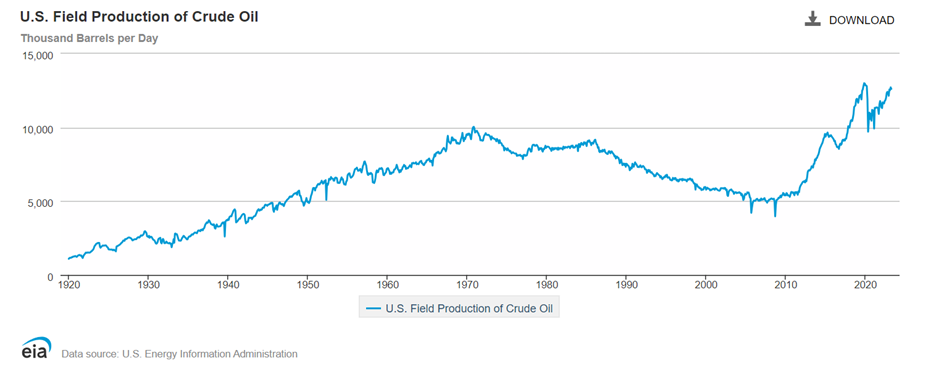
After the demand-driven boom that peaked in 2008, encouraged by the recent high prices oil, drillers in the US began exploring ways to reach previously untouchable deposits using fracking and horizontal drilling. While fracking and horizontal drilling had been around since 1998, the spike in oil prices incentivized US producers to leverage this technology. The result was a shale boom with US production that had been in terminal decline since the 1960s, doubling from about five million barrels per day in 2008 to 10 million per day over the next 10 years.

Line graph illustrating growth in US field production of crude oil, 1920 to today.

With OPEC unwilling to cede market share to a new generation of American drillers, elevated rates of supply eventually led to a fall in prices in 2014-15. In retrospect, this marked the beginning of the end of the US shale boom. Then came the one-two punch of slowing demand from China (the largest driver of incremental demand for oil) and COVID-related lockdowns that caused oil prices to hit lows of $20 per barrel in 2020 after a brief reprieve in 2018-19.

The two price shocks that occurred over a short period led to two changes in behaviour that we think has structurally changed the industry.

  • First, a new base of conservative investors replaced the more growth-oriented cohort from the shale boom. The new investor base now pushed for an end to risky new projects, instead focusing on debt reduction and returning excess cash in the form of buybacks and dividends.
  • Second, taking a cue from their investor base, management of companies that survived this boom-bust cycle vowed to be conservative with their capital expenditure programs and promised to divert their future capex to more renewable projects.

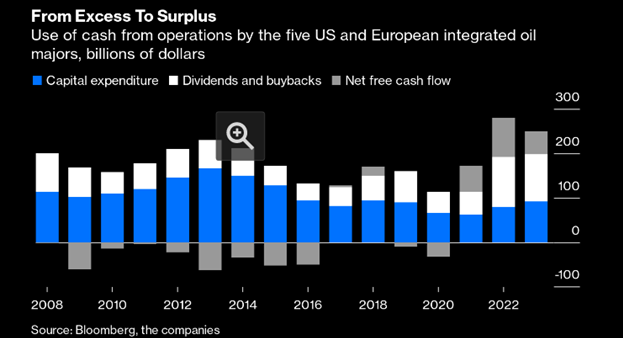
In the past, for every dollar of dividends and buybacks, oil companies would reinvest $3 to $4 back in the business. Now as we can see in the following chart, every $1 of reinvestment is matched by $1 of buybacks and dividends.

Bar graph illustrating decline in level of share buybacks by oil companies since 2008.

The result of this structural change in the market is that big oil producers will continue to be conservative with projects that take a decade or more to earn returns on investment. We are now in a situation where supply is tight due to both long-term factors, such as limited new exploration projects, and short-term factors like replenishment of the Strategic Petroleum Reserve (SPR) by the US, increasing from current levels of 350 million barrels to 650 million barrels. Adding to this, OPEC has committed to restricting supply until the end of 2023 by cutting 1.16 million barrels per day.

On the demand side, we are seeing record demand in 2023 at 101.9 million barrels per day, an increase of two million barrels from last year. While we anticipate an eventual transition away from oil, the combination of tight supply and persistent rising demand could lead to a messy transition with price spikes near-term volatility.

We think this new normal allows small and nimble players to quickly respond to a stronger pricing environment with ramped up spending. A good example of such a player is Parex Resources (PXT CN), which is part of our emerging markets portfolio.

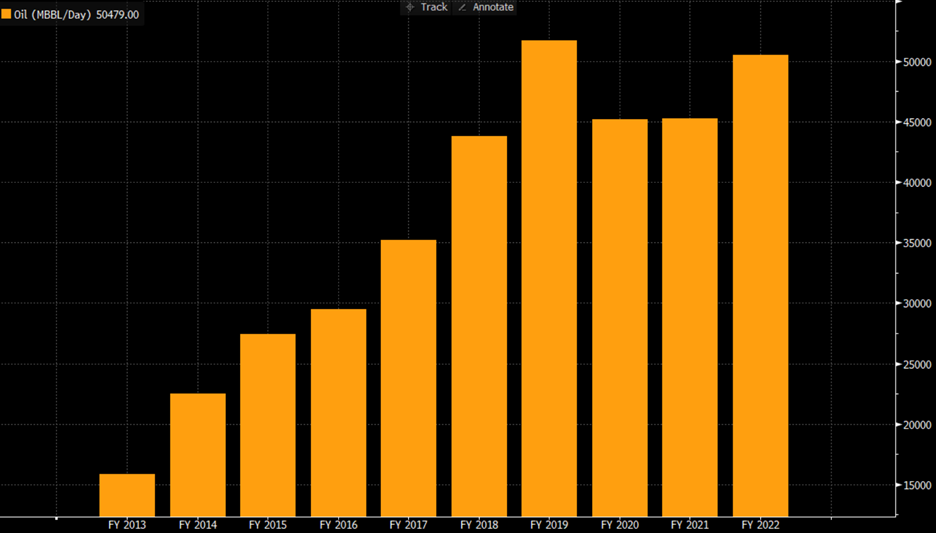
Parex is the largest independent oil and gas exploration company in Colombia sitting on over 200 million barrels of reserves and exploration opportunities. In 2023, it added 18 new blocks and expanded its exploration land by four million acres over the last five years. Currently, it produces 60,000 barrels of oil equivalent (BOE) per day and its production has grown at an 8% CAGR over the last five years, as seen in the following chart. Absolute proved developed producing (PDP) reserves have registered a 10% CAGR over the same period.

Consistent growth in oil production (barrels per day)

Bar graph illustrating growth in CAGR of Parex Resources, 2013 to 2022.

If we were to sum up our thesis on Parex, it would be capital efficiency with best-in-class execution. All of this in a country that has faced its fair share of curveballs with natural disasters, political uncertainty and infrastructure bottlenecks. To elaborate further:

  • We like Parex’s transition from a single-asset operator to a countrywide operation, with new asset acquisitions and an MOU with state giant EcoPetrol.
  • This had led to product diversity, moving from heavy oil to adding light oil, gas and condensates.
  • Parex has a track record of using of proven exploration technologies from the West to tap into easy-to-produce reservoirs with low risk.
  • We appreciate the management team’s commitment to adding shareholder value while maintaining strict cost control.
  • Finally, Parex has shown consistent growth that has been self-funded, with zero debt on the balance sheet.

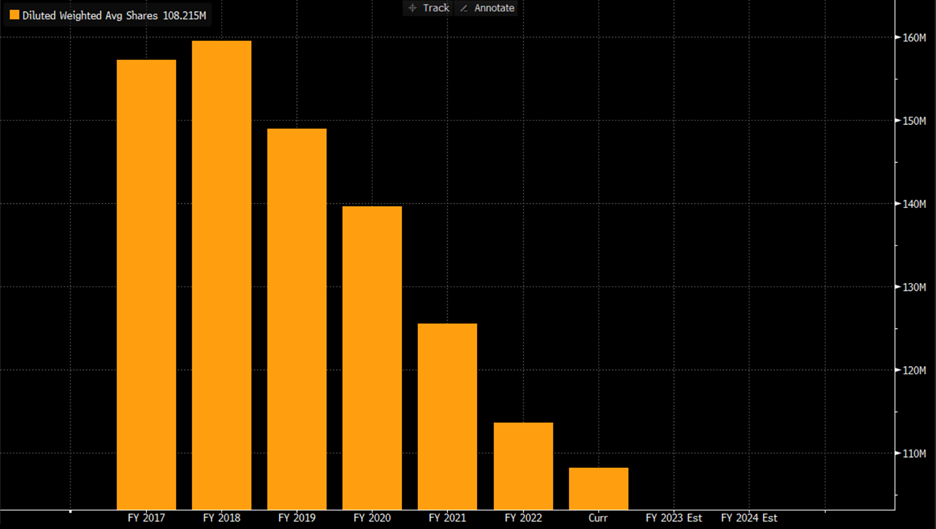
Parex has maintained a simple and consistent capital allocation framework. A full two-thirds of its funds from operations are reinvested into the business, while the remaining one-third is returned to shareholders. As seen in the chart below, Parex has reduced its free float of shares by 33% over last five years and returned $1.3 billion back to shareholders. In 2021, it announced a dividend policy to further reward shareholders, with the company offering a 5% dividend yield at current prices.

33% reduction in shares outstanding

Bar graph illustrating 33% reduction in free float of Parex Resources shares since 2017.

Parex also scores well on our ESG framework. It has reduced GHG intensity by 43% since 2019, linked executive compensation to ESG metrics and has a diverse and independent board. With a low cash cost, Parex has performed well even at today’s subdued oil prices. If a sustained period of high oil prices does materialize as we anticipate, we expect Parex to continue delivering shareholder value from a position of strength.

Several boats along the coast line of the fishing village of Jamestown, Accra, Ghana.

While the headline returns were negative for the quarter, there were several encouraging signals in the underlying performance drivers that give us confidence in the future:

  1. The strategy’s Africa portfolio has finally contributed positively to returns after being the main drag on returns over the past 18 months.

    While there are still high levels of uncertainty looming over the economies of Egypt, Kenya, and Ghana, the prices of the securities we own there appear to have stabilised. We attribute this to valuations (a lot of bad news is in the price, in our opinion), apparent flushing out of forced foreign sellers, and early signs that these countries are emerging from their respective economic crises. We observed a tightening of credit spreads across the three African countries amid a weaker US dollar, moderating food and energy inflation, and signs that policy makers are starting to address some of the structural issues that have plagued their countries’ balance sheets and impaired the functioning of their foreign currency markets. We did not mention Morocco in the above list of countries, despite it being the strategy’s largest African country exposure. Morocco’s diverse economy helped it navigate the challenges that most countries in the continent have been dealing with, and so has not been a source of drag on the strategy’s returns.   
  2. The negative quarterly returns were generated from two core holdings that we remain fundamentally bullish on in the medium to long term.

    In our previous letters, we discussed our investment thesis on Wilcon Depot (the leading Philippines-based home improvement retailer), and Indonesia’s Sido Muncul (an herbal medicine manufacturer). While the share prices of both companies were under pressure in the quarter, we see no fundamental reason to change our constructive view on these businesses. In other words, we are more bullish on these investments at current levels.
  3. Our companies continue to invest in their markets, and insiders are buying stock.

    Across most of the portfolio, capital spending is growing at a faster rate than inflation and depreciation, and management teams are hiring and adding new products and services to further their value proposition to customers.

    A good example of this is HPS, the Morocco-listed payments technology company, which has just released version 4.0 of its flagship payment software product, PowerCard. Another example is Abdullah Al Othaim Markets, the Saudi discount grocery retailer that is winning the ~$40 billion size market by doubling down on its value-for-money proposition through the opening of 10 store a quarter, to take advantage of weakening competition, a shift in shopping behaviour to more value-for-money options, and the general growth in population in the central region, to which Al Othaim is over-indexed.

    In Malaysia, we were pleased to see buying by Tan Yu Ye, the founder and executive chairman of MRDIY, the value variety store chain that has seen a weakness in share price year-to-date on a souring of consumer stocks in the country, and a technical overhang from previous private equity ownership.

After nearly two years of unprecedented dislocation in frontier and certain emerging markets, we are seeing early signs that the opportunity set for the strategy is opening again. While these are early days, we are encouraged by the IMF’s approval of a $3 billion stand-by arrangement for Pakistan, Sri Lanka’s domestic debt restructuring, Egypt’s state asset sale program, Turkey’s market-friendly appointments at the Ministry of Finance and Central Bank, and its backing of Sweden’s NATO membership bid. In Nigeria, the abrupt removal of the crippling fuel subsidies and the liberalisation of the dislocated FX market by newly elected President Bola Tinubu are necessary remedies on the long road to restoring credibility with the market. These policy developments, along with early signs of a macroeconomic bottoming in the strategy’s core markets, and historically low valuations on a few portfolio companies, bode well for our ability to deploy capital, and for the strategy to seize on the long-term growth opportunities that these markets offer.

Vergent Asset Management LLP

Beautiful morning sunrise in seaside Dammam, Saudi Arabia.

Gulf equity markets broke a streak of four consecutive negative quarterly returns in the second quarter of 2023, and materially outperformed the MSCI Emerging Markets Index.  

In Saudi, the market performed impressively, with the MSCI Saudi Index posting a 5.5% gain in the second quarter, despite the backdrop of softer oil prices and lower production through OPEC+, muted earnings expectations from the banking sector (~35% of the Saudi index), and weak Chinese data that tempered hopes of a recovery in petrochemical earnings (~15% of the Saudi index).  

The mid-cap run in Saudi that we highlighted in our last letter continued to gain strength in the second quarter, with the MSCI Saudi Midcap Index up 9.9%, building on a 7.7% gain in the first quarter. The Saudi mid-cap space has been responsible for a significant proportion of the market’s year-to-date returns, as large index sectors like banks and materials underperformed. The sustainability of the mid-cap rally is currently the subject of intense debate. On the one hand, the bar for earnings to meet the expectations embedded in the price of many mid-cap securities has meaningfully risen. On the other hand, there is increasing evidence that the opportunity for multi-year earnings growth underpinned by Vision 2030 reforms – is most visible in mid-cap sectors such as education, healthcare, tourism, transport, and technology. This setup is a challenge for our investment process, as we aim to balance growth expectations with a price at which we believe this growth will generate attractive returns on our cost basis. 

We talked in our previous letter about our willingness to make bold decisions to preserve a relatively attractive return profile for the strategy. During the second quarter, this involved the following actions: 

  1. Continuing to back companies that trade at high near-term multiples, but that we believe will grow into those multiples over time. The best example of this is Abdullah Al Othaim Markets, the discount grocery retailer that is capturing significant share of its ~$40 billion market by doubling down on its value-for-money proposition to take advantage of weakening competition, a shift in shopping behavior to more value-for-money options, and the general growth in population in the central region, to which Al Othaim is over-indexed.
  2. Reducing or exiting positions where we believe valuations have all but caught up with the blue-sky scenario in our forecasts. This is a painful but necessary decision, as it often means parting ways with companies (and management teams) we admire, but which we can no longer justify owning at current valuations. A good example here is National Company for Learning and Education, a K-12 owner/operator with a market capitalisation of $1.2 billion based on an operating income of less than $30 million. 
  3. Buying companies with highly defensive characteristics, or those where we believe the market has left valuation room for earnings to surprise to the upside in the next six to 12 months. A good example of the former is Qatar Gas Transport, the sole distributor of Qatari liquified natural gas exports, whose vessels are chartered on long-term fixed-rate contracts, with growth optionality from Qatar’s North Field expansion project. While we will refrain from sharing examples of the latter at this stage, our focus is on high-quality businesses where near-term growth rates are moderate, but whose characteristics support a high level of free cash-flow generation relative to market capitalisation.   

Our outlook statement from the last letter remains largely unchanged, but we have introduced new language in the last paragraph regarding our thinking around valuations. We continue to see favourable opportunities for the strategy. The macroeconomic backdrop remains supportive, with healthy FX reserves and balance-of-payments positions across most of the Gulf. While still early days, the Saudi-Iranian reproachment is a key event that warrants our attention, as any progress there can lead to a lower geopolitical risk premium on regional assets. OPEC+ remains committed to maintaining high oil prices to support government spending plans, which could benefit equity markets. We also note that positioning from global emerging market funds remains light and governments in the region are intent on growing their share in the emerging market capitalization, which we believe will end up manifesting itself in a quasi-short squeeze on those funds.  

We believe that valuations in the region – particularly in Saudi – will continue to remain elevated relative to their historic levels. The political will to push through an unprecedented and transformative socioeconomic agenda, coupled with enormous financial capacity, is likely to unlock significant growth opportunities for public market companies for years to come in our view. Furthermore, governments in the region have never been more vocal about the role that their stock markets will play in crystalising their growth agendas. This is a powerful combination that, if successful, can reduce the historical oil price-induced economic and asset price volatility that has long been a characteristic of investing in the region, and consequently underpins above-average valuations through cycle. We do not, however, believe this is a tide that will lift all boats. Adhering to our investment principles will be key to identifying winning companies that can deliver attractive returns to our investors.

Vergent Asset Management LLP

Beautiful view of a Puerto Vallarta beach on the Pacific coast of Mexico.

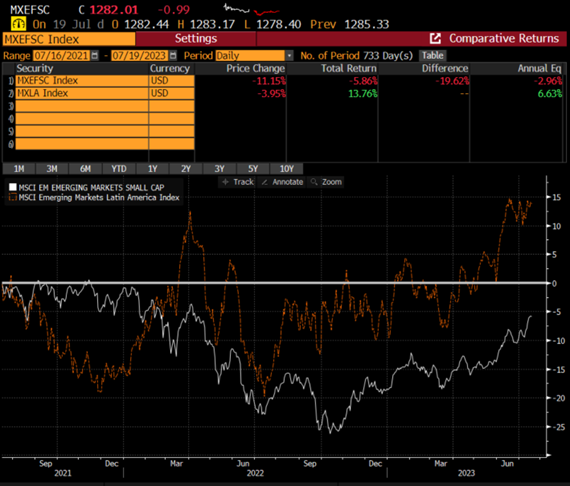
Latin America has outperformed other emerging markets over the past two years and this positive performance can be attributed to several key factors. However, the challenge lies in sustaining this momentum and ensuring it is not merely temporary.

MSCI World Small Cap Index vs MSCI Emerging Markets Latin America Index, 2021 to 2023

Graph showing the outperformance of the Latin America small cap index relative to its global peers between June 2021 and June 2023.

Source: Bloomberg

Notably, the combination of currency rallies among some Latin American countries and an emerging markets rally is uncommon. Reasons for this mismatch include:

  • Latin America leads the way in interest rate hikes worldwide. Starting in the first half of 2021, Chile and Brazil raised rates, helping control inflation levels, although they are still high but manageable. Chile will likely start its easing process next week, followed by Brazil within the year. This has boosted their respective stock markets, which were already undervalued in our view.
  • Additionally, Mexico has benefitted from the “nearshoring” theme. Nearshoring is nothing new to local investors, having been present in the region for decades. What is new is the level of intensity and amount of investment expected over the next three to five years. This has resulted in increased earnings per share (EPS) of 15% to 20% CAGR in the near term for some Mexican companies, outperforming the MSCI Emerging Markets Small Cap Index and contributing to higher valuations in Mexico’s market compared to its Latin American peers. However, there are questions about whether Mexico’s growth is comparable to its peers or to countries like Indonesia or Vietnam that are also heavily dependent on US imports.
  • Commodities also play a significant role in the region’s performance. Despite a global slowdown, certain commodities, like copper, have maintained high prices due to supply constraints. We believe the anticipated electric vehicle (EV) boom will further drive copper demand, ensuring a deficit in the market from 2026 onwards. For example, every EV, which weigh approximately two tons each, consumes around 60 additional kilos of copper.
  • Furthermore, the region has demonstrated better fiscal discipline, with countries like Chile and Mexico ending 2022 with fiscal surpluses or manageable deficits, respectively. This responsible fiscal approach has also supported their currencies. There is always the potential for Brazil to surprise on the downside due to its high fiscal spending and debt levels; however, the country has seen no “disruptive” events lately.
  • US rates hikes have favoured value over growth factors in emerging markets, benefitting markets like Latin America’s over countries perceived as growth-driven, such as Korea or India.
  • Innovation has not been a main driver for Latin America, but that is starting to slowly change. Moreover, the market has begun recognizing and crediting good companies with sustained growth expectations, which has historically been uncommon in the region. This trend in recognizing innovation and good companies is crucial for bottom-up investors like us who prioritize companies with solid balance sheets, strong cash flow generation and sustained competitive advantages. More Latin American companies have started to share these characteristics.

Latin America is still a small region relative to the rest of the world and it is dominated by, and benefits from, global trends, even though its politics are not always market friendly. However, sustained positive factors like the commodities momentum and nearshoring may make global investors more indifferent to the region’s internal dynamics.

What needs to happen for long-term compounder growth stories to emerge, like Nestle in India or TSMC in Taiwan? To maintain sustainable growth, we believe the region needs to align with external factors and foster strong domestic sectors and companies that promote growth. Improving innovation and adapting to rapidly changing environments are also key. For example, the financial sector in Mexico and Chile remains solid, while the transport-logistics sector in Mexico offers interesting opportunities. Brazil’s large population presents significant potential for emerging middle-class growth, creating opportunities in various sectors.

Latin America has growth engines and the key is to identify the best companies capable of maintaining a sustained differentiation over time. By focusing on these opportunities, our portfolio is well-positioning to capture their potential growth.

Company example

JSL (JSLG3 BZ) has the largest portfolio of logistics in Brazil, with long expertise operating in a variety of sectors and a nationwide scale of services. The company has long-lasting business relationships with clients that operate in several economic sectors, including pulp and paper, steel, mining, agribusiness, automotive, food, chemical and consumer goods, among others. JSL also has a unique position in the Brazilian highway logistics market, as leader for 19 years and much larger than its nearest competitor.

The logistics industry in Brazil is highly fragmented, with a high level of informality and low capitalization among players. This creates opportunities for further consolidation, especially for companies with structured businesses. According to Citibank, the top 10 companies have close to a 2% market share. JSL has roughly 1% market share (almost 5x the second-largest player) and is well placed to continue consolidating the industry. JSL also has a favourable M&A track record, which has been a growth driver in recent years. JSL has acquired seven companies since its re-IPO in October 2020 implying c20% annual organic growth and c60% EBITDA growth considering the acquisitions, maintaining strong returns. 

We also expect JSL to continue expanding its ROIC going forward, driven by the ongoing consolidation of new acquisitions into JSL’s financials, the company’s strategy to becoming a less capital intensive, asset light business, and strong revenue growth to maintain gaining scale and operating leverage. The logistics industry offers a lot of opportunities to implement tech-driven innovation, and we see JSL well-positioned to use its sector platform and status as a leading tech player. The stock has performed very well this year, partially driven by rate cut expectations and also strong earnings. We expect the company to continue delivering good results in upcoming quarters amid a highly fragmented sector, creating both organic and inorganic growth engines.

DM flash results released last week suggest that the global manufacturing PMI new orders index fell sharply in June, having moved sideways in April and May following a Q1 recovery – see chart 1. 

Chart 1

Global Manufacturing PMI New Orders, & G7 + E7 Real Narrow Money (% 6m). Source: Refinitiv Datastream.

The relapse is consistent with a decline in global six-month real narrow money momentum from a local peak in December 2022. A recovery in real money momentum during H2 2022 had presaged the Q1 PMI revival. 

Real narrow money momentum is estimated to have fallen again in May, based on partial data, suggesting further PMI weakness into late 2023. 

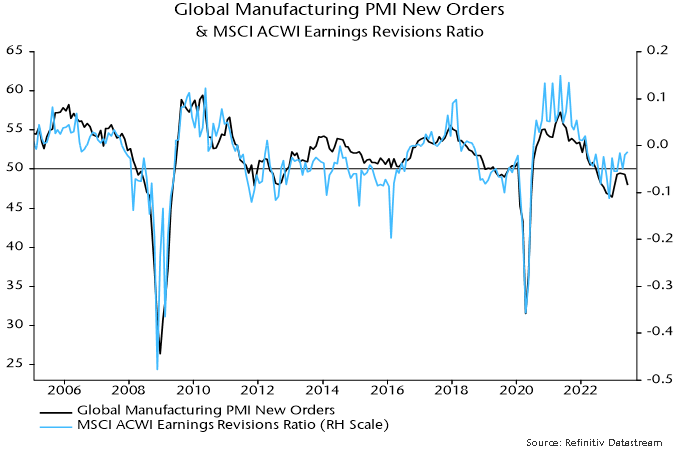
The global earnings revisions ratio has been contemporaneously correlated with manufacturing PMI new orders historically but remained at an above-average level in June, widening a recent divergence – chart 2. 

Chart 2

Global Manufacturing PMI New Orders, & MSCI ACWI Earnings Revisions Ratio. Source: Refinitiv Datastream.

Based on monetary trends, a reconvergence is more likely to occur via weaker earnings revisions than a PMI rebound. 

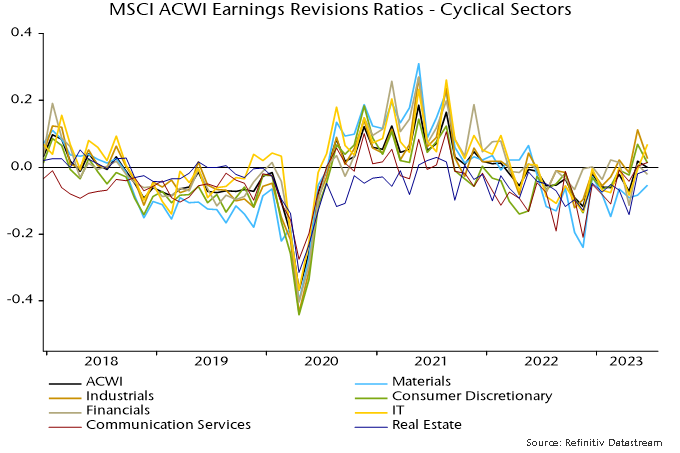
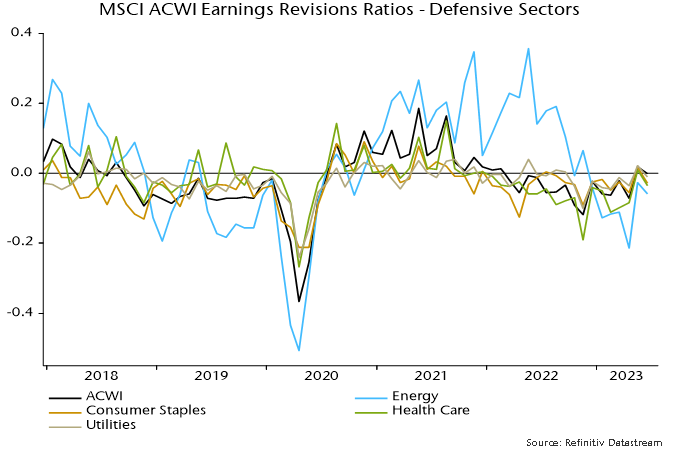
Charts 3 and 4 show that revisions resilience has been driven by cyclical sectors – in particular, IT, industrials and consumer discretionary. Notable weakness has been confined to the materials sector. Cyclical sectors may be at greater risk of downgrades if the global revisions ratio heads south. 

Defensive sector revisions have underperformed recently but are likely to be less sensitive to economic weakness. 

Chart 3

MSCI ACWI Earnings Revisions Ratios - Cyclical Sectors. Source: Refinitiv Datastream.

Chart 4

MSCI ACWI Earnings Revisions Ratios - Defensive Sectors. Source: Refinitiv Datastream.

The positive divergence of earnings revisions from the PMI may reflect firms’ ability to push through price increases to compensate for slower volumes. The deviation of the global revisions ratio (rescaled) from manufacturing PMI new orders – i.e. the gap between the blue and black lines in chart 2 – has displayed a weak positive correlation with the PMI output price index historically (contemporaneous correlation coefficient = +0.41). 

Any earnings support from pricing gains is now going into reverse: the output price index has crashed from an April 2022 peak of 63.8 to 49.8 in May, with DM flash results suggesting a further fall last month.

Why believe the “monetarist” forecast that recent G7 monetary weakness will feed through to low inflation in 2024-25? 

Monetary trends correctly warned of a coming inflationary upsurge in 2020 when most economists were emphasising deflation risk. 

The forecast of rapid disinflation is on track in terms of the usual sequencing, with commodity prices down heavily, producer prices slowing sharply and services / wage pressures showing signs of cooling. 

A further compelling consideration is that the monetary disinflation expected in G7 economies has already played out in emerging markets. 

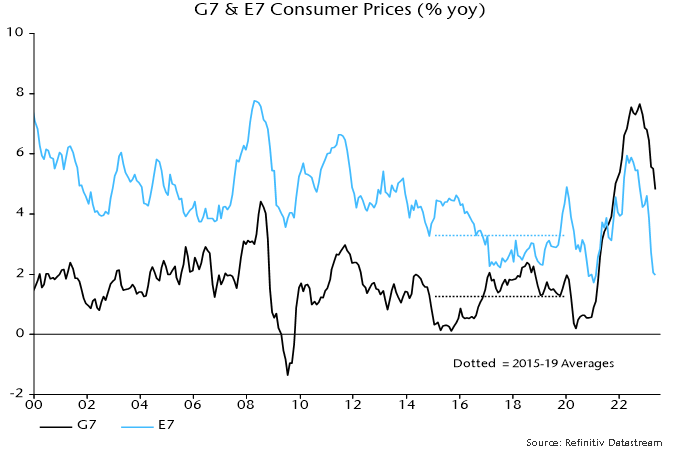
A GDP-weighted average of CPI inflation rates in the “E7” large emerging economies* crossed below its pre-pandemic (i.e. 2015-19) average in March, falling further into May – see chart 1. 

Chart 1

G7 & E7 Consumer Prices (% yoy). Source: Refinitiv Datastream.

The E7 average is dominated by China but inflation rates are also below or close to pre-pandemic levels in Brazil, India and Russia. 

Inflation rose by much less in the E7 than the G7 in 2021-22, opening up an unprecedented negative deviation that has persisted. 

The recent plunge in the E7 measure reflects a significant core slowdown as well as lower food / energy inflation. 

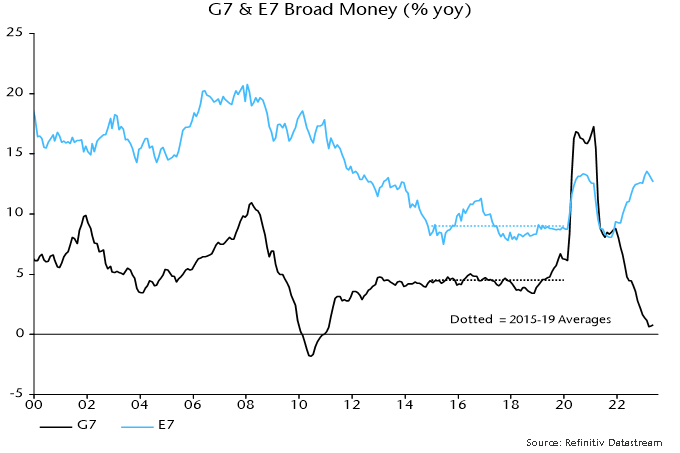
The divergent G7 / E7 experiences are explained by monetary trends. Annual broad money growth rose by much less in the E7 than the G7 in 2020 and returned to its pre-pandemic average much sooner – chart 2. 

Chart 2

G7 & E7 Broad Money (% yoy). Source: Refinitiv Datastream.

E7 broad money growth crossed below the pre-pandemic average in May 2021. CPI inflation, as noted, followed in March 2023, i.e. consistent with the monetarist rule of thumb of a roughly two-year lead from money to prices. 

G7 broad money growth crossed below its pre-pandemic average in August 2022 and has yet to bottom, suggesting a return of inflation to average in summer 2024 and a subsequent undershoot. 

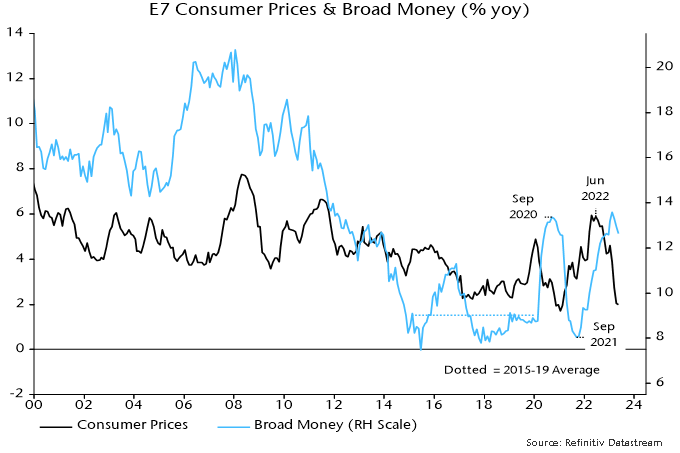
E7 disinflation, however, may be close to an end. Annual broad money growth has recovered strongly from a low in September 2021, signalling a likely inflation rebound during 2024 – chart 3. Broad money acceleration has been driven by China, Russia and Brazil. 

Chart 3

E7 Consumer Prices & Broad Money (% yoy). Source: Refinitiv Datastream.

E7 annual broad money growth is around the middle of its longer-term historical range and has eased since February. Chinese numbers may have been temporarily inflated by a shift in banks’ funding mix in favour of deposits. 

The expected rise in E7 inflation may not extend far but restoration of a positive E7 / G7 differential is likely in 2024.

*E7 defined here as BRIC + Korea, Mexico, Taiwan.

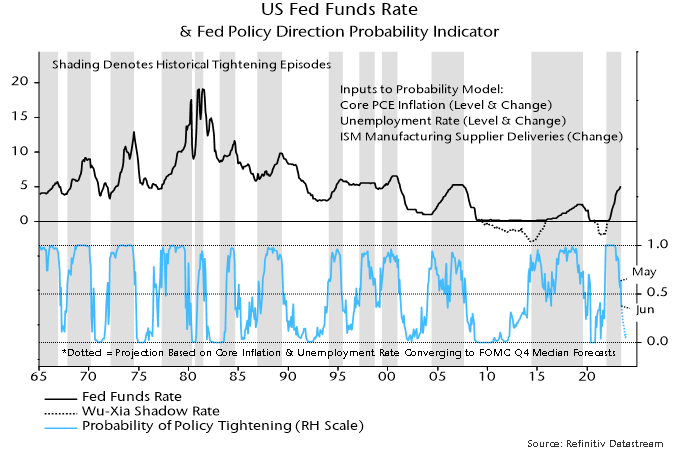
The FOMC’s updated economic forecast for the remainder of 2023 is inconsistent with Committee members’ median expectation of a further 50 bp rise in official rates during H2, according to a model based on the Fed’s past behaviour. Policy is more likely to be eased than tightened if the forecast plays out. 

The model estimates the probability of the Fed tightening or easing each month from current and lagged values of core PCE inflation, the unemployment rate and the ISM supplier deliveries index, a measure of production bottlenecks. It provides a simple but satisfactory explanation of the Fed’s historical decision-making, i.e. the probability estimate was above 50% in most tightening months and below 50% in most easing months – see chart. 

US Fed Funds Rate & Fed Policy Direction Probability Indicator.

The probability of the Fed tightening at yesterday’s meeting had been estimated by the model at 36%, the first sub-50% reading since September 2021. (The FOMC started to taper QE at the following meeting in November.) 

The FOMC’s median forecast for core PCE inflation in Q4 was revised up to 3.9% from 3.6% previously (currently 4.7%). The unemployment rate forecast was lowered to 4.1% from 4.5% (currently 3.7%). 

The model projections shown in the chart assume that core PCE inflation and the unemployment rate converge smoothly to the Q4 forecasts, while the ISM supplier deliveries index remains at its current level. Despite the revisions, the probability estimate still falls to below 10% in Q4, consistent with the Fed beginning to ease by then. 

The projections highlight the Fed’s historical sensitivity to the rates of change of core inflation and unemployment as well as their levels. It would be unusual for policy-makers to continue to tighten when inflation and unemployment are trending in the “right” directions, especially given the magnitude of the increase in rates to date. 

One difference from the past is that Fed now forecasts its own actions. Has yesterday’s guidance that rates have yet to peak boxed policy-makers into at least one further rise? This may mean that the model’s probability estimate for July – currently 29% – is too low. Still, next month’s decision will hinge on data, with inertia plausible barring stronger-than-expected news.

India Gate, New Dehli, India.

Summary

  • EM equities were down through the month, with China the key drag as investors were disappointed by weaker than expected consumption figures.
  • Cyclical markets exposed to energy and commodities including the Gulf states and South Africa posted negative returns. Our view is that these parts of the market will remain vulnerable as the global economy deteriorates on the back of very weak money numbers.
  • Pro-democracy parties swept Thailand’s national elections, led by the progressive Move Forward Party which is set to form a governing coalition with Pheu Thai and four other smaller parties. However, a Senate dominated by figures appointed by the military government that seized power in a 2014 coup threatens to delay the appointment of the governing coalition and the appointment of Move Forward’s leader Pita Limjaroenrat as Prime Minister. Uncertainty will hang over Thai equities as the tussle between the coalition and the Senate plays out in the coming months.
  • Despite unorthodox economic policy sparking surging inflation and a collapsing economy, Turkish President Recep Tayyip Erdogan secured a third decade in power, winning a second round run-off against opposition coalition leader Kemal Kilicdaroglu.
  • Semiconductor names in Taiwan and Korea surged on the investor frenzy over AI technology sparked by Nvidia reporting Q1 sales and management guidance which were streets ahead of sell-side expectations.

India remains one of the best structural stories in EM

NS Co-CIO Ian Beattie returned from a research trip in India this month, and he was keen to emphasise that the story of India’s rapid rise is still on:

“My thesis that this still feels like China 30 years ago is intact. Now imagine that with strong institutions and democracy. Of course, we are dealing with a massive and diverse country you have to embrace the mess, chaos, bureaucracy, the riots, shocking Gini coefficient and all that entails. BUT, it is improving in almost all of the important areas. And you make money on the delta, don’t you?

India as the fastest growing major economy has grabbed headlines but it is ongoing. Structural reform, societal change (slow), tax and social reform (incredible), it feels like a virtuous circle. United Payments Interface (UPI) is now a success on a global scale.

Sustained progress buttressed the popularity of Prime Minister Modi, liked by the poor as well as the shopkeepers. The poor and middle classes are getting wealthier and feel that there is less skimming from the top.

Infrastructure is improving, employment is up. Tax collection is up. It feels like things are improving for almost everyone.

I am seeing first-hand the increasing aspirations in younger generations. Though it will be a challenge for the government to stay ahead of this I imagine it opens up a completely new political landscape and many opposition parties will be unable to resort to traditional tactics.

Indian stocks are relatively less expensive than on my last visit, having traded lower and recovered to similar levels, whilst very strong GDP growth and good earnings have come through.

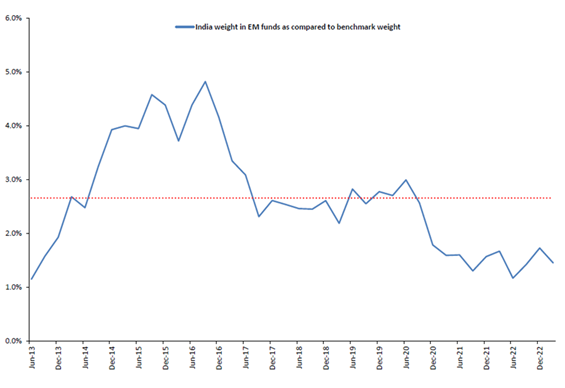
Foreign investors in Indian equities are back to a very small overweight, while locals fear a retreat by retail investors as positive momentum has faded.

Foreign investor positioning modest overweight

Chart showing India weight in EM funds as compared to benchmark weight.

Source: Jefferies, 2023.

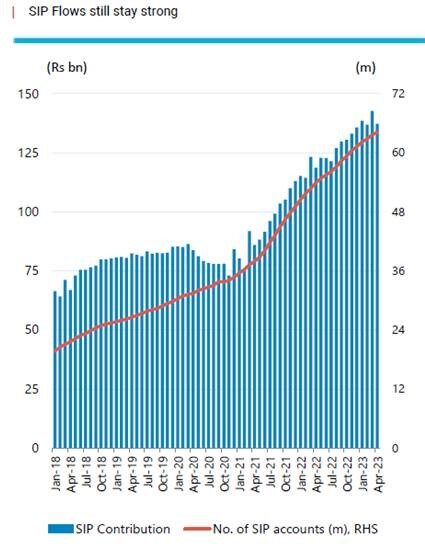
However, this misses the structural story at play which is becoming increasingly important – that is the rising importance of domestic flows from local mutual funds seeing inflows from Systematic Investment Plans (SIPs).

Structural change in EM can be a key return driver

Chart showing SIP contribution compared to number of SIP accounts (m), RHS from January 2018 to April 2023.

Source: Jefferies, 2023.

Flows from a young and growing cohort into domestic mutual funds are boosting local liquidity, with long time horizons suited to equities exposure and more incentivised than foreign investors to push on Indian corporates to improve governance.

Be careful of relying too much on your mean reversion tables when structural change like this is underway. Prices are no longer set in London or New York, but rather in Delhi or Mumbai.”

India’s embrace of digital payments infrastructure is supercharging its development

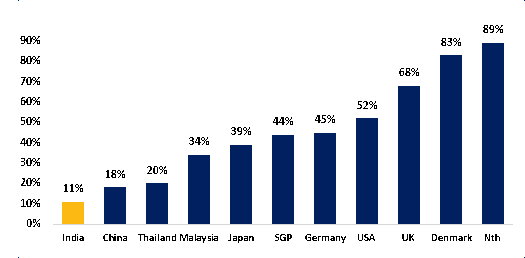
India is a country of 1.4 billion people, 22 languages, 1 billion mobile connections and 800 million internet users. Yet only 6% are income taxpayers and only 6% transact digitally for commerce.

Leveraging technology and widespread connectivity is seen by policymakers as a massive development opportunity to draw more people into the formal economy while supporting innovation and relieving economic bottlenecks in India.

Enabling access to banking is an early example of how digital technology is being utilised – banking penetration went from 20% of the population in 2008 to 100% by 2017/18. During the pandemic, banking access – linked up to the Aadhaar digital identification program and the United Payments Interface (UPI) was pivotal in enabling the swift and targeted transfer of around $4.5 billion worth of benefits to 160 million beneficiaries.

India has emerged as a leader in the development of Digital Public Infrastructure (DPI), which is pervasive and inclusive with 1.36 billion unique digital IDs, facilitating tens of billions of payments each year, and covering 10 million GST-registered companies.

At the heart of this is UPI, a real-time payments system established in 2016 which has quickly become the world’s largest real-time digital payments market. In 2020, 25.5 billion transactions were registered on UPI. The technology allows users across India to use their smartphones to quickly set up and transact using cardless accounts accessed using personalised QR codes, and utilise services including overdrafts, autopayments and voice-based payments. The system is even being expanded internationally, enabling free and instant cross-border transactions (versus pricey transactions via SWIFT) in a number of different currencies to and from India, which is the world’s largest remittances market – worth over US$100 billion in 2022 (World Bank). 

This has been a game-changer for India. Besides our oft-quoted reforms (bankruptcy law, demonetisation, clean water and electricity roll out, infrastructure spending, public toilets in rural areas, etc.), UPI has proven incredibly successful and has been crucial in ensuring welfare payments get to the right people, reducing waste and corruption, increasing tax revenues and giving more people bank accounts and phones.

What does this all mean for investors in emerging markets? While positive, initiatives like UPI, bankruptcy reform or sanitation may seem relatively trivial in isolation. However, it is the compounding effect of these incremental steps over a sustained period that can create a virtuous circle that unlocks the next upward shift on the development ladder. For a country the size of India, that progress will see several hundred million Indians join the formal economy and accumulate wealth, which can in turn present a host of opportunities for investors with the framework to harness these structural tailwinds.

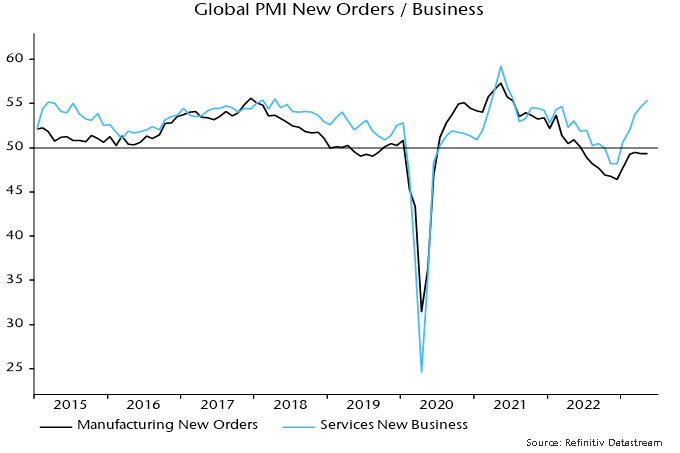
Global growth optimists expect continued solid services sector expansion to offset manufacturing weakness. PMI results for May appear, on first inspection, to support this view: services activity and new business indices rose further to 18- and 22-month highs respectively even as manufacturing new orders remained stalled below 50 – see chart 1. 

Chart 1

Chart 1: Global PMI New Orders /  Business. Chart compares manufacturing new order vs. services new business from 2015 to 2023. Source: Refinitiv Datastream.

There are, however, several reasons for discounting the strong headline services readings. 

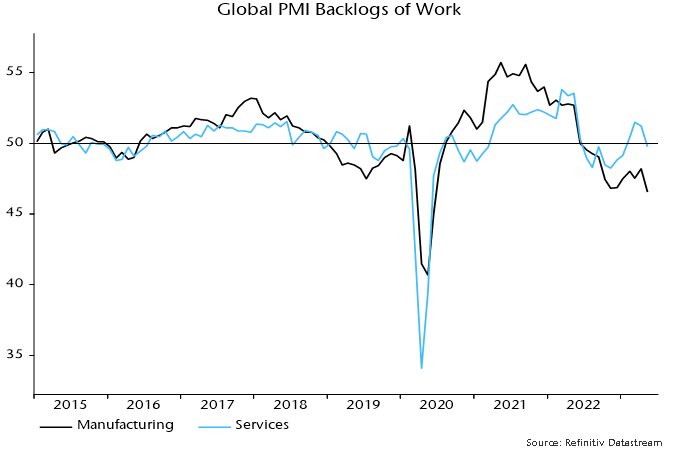
First, backlogs of services work fell sharply to a four-month low despite stronger new business – chart 2. This suggests that current output is running ahead of incoming demand, in turn implying a future adjustment lower unless demand picks up further. 

Chart 2

Chart 2: Global PMI Backlogs of Work. This chart compares manufacturing vs. Services from 2015 to 2023. Source: Refinitiv Datastream.

Manufacturing backlogs also fell sharply last month, breaking below their November 2022 low. 

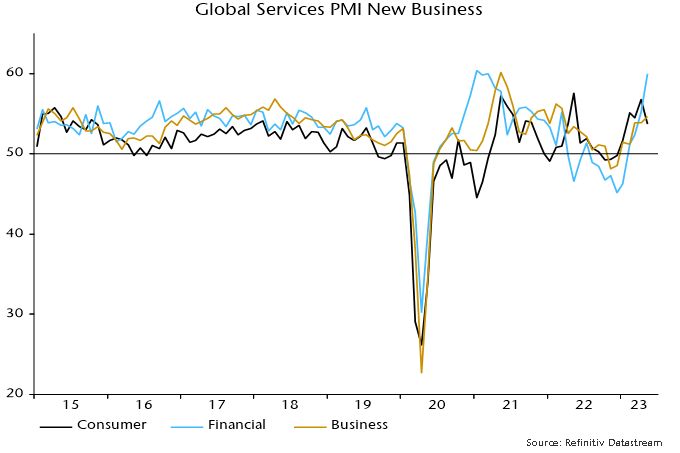
Secondly, the sectoral breakdown of the activity and new business indices shows that May rises were driven by a surge in financial services – chart 3. Consumer services indices eased on the month. Financial services strength is difficult to understand given monetary stagnation, slowing bank lending and flat trading volumes, so may prove short-lived. 

Chart 3

Chart 3: Global Services PMI New Business. This chart compares consumer, financial, and business from 2015 to 2023. Source; Refinitiv Datastream.

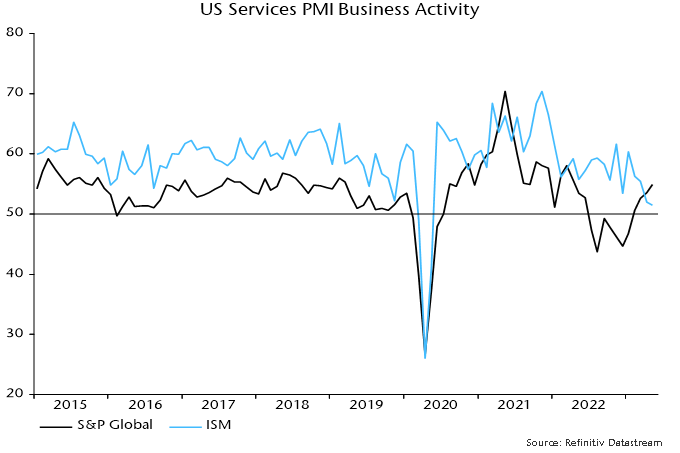
Thirdly, the high May readings of the global activity and new business indices reflect strong contributions from the US and Chinese components but national services surveys are significantly weaker. 

The US ISM services activity index fell to a three-year low in May even as the S&P Global equivalent series reached a 13-month high – chart 4. 

Chart 4

Chart 4: US Services PMI Business Activity. This chart compares S&P Global vs ISM from 2015 to 2023. Source: Refinitiv Datastream.

The Chinese NBS non-manufacturing new orders index moved below 50 in April and fell further in May, in puzzling contrast to the S&P Global / Caixin services new business index, which reached its second-highest level since November 2020. 

The global manufacturing new orders and services new business indices have been strongly correlated historically but statistical tests indicate a tendency for manufacturing to lead services rather than vice versa*. With global monetary trends continuing to give a negative economic signal, the current unusually wide gap is more likely to be closed by services weakness than a manufacturing revival. 

*In regressions using monthly data with three lags, lagged manufacturing new orders terms are significant in the regression for services new business, but lagged services new business terms are insignificant in the regression for manufacturing new orders.

Road intersection illuminated by neon lights in downtown Shanghai at night.

With the economic recovery slowing, one of the few central banks reducing rates due to deflation fears, increasing trade tensions and geopolitical escalation, risk-averse foreign investors are reducing their weighting of China’s financial markets. This decline in investment is driving down both stock prices and the value of the yuan.

The real estate sector, which combined with related industries accounts for 20% to 30% of China’s GDP, has not rebounded as expected. China’s new home sales by area fell 11.8% on the year in April, following a drop of 3.5% in March.

I recently spent close to a month in China, visiting relatives and friends for the May Day holiday that runs from April 29 to May 3. I also had the opportunity to meet many entrepreneurs, government officials, professionals and students as well as many of our holdings and companies we are interested in.

I spent a few weeks in Jiangsu province, a province about the size of Portugal or Kentucky that borders Shanghai. It is a province of 85 million people that has the second-highest GDP per capita (US$21,647 nominal), again higher than Portugal or Greece. If it were a country, it would be the 10th-largest economy in the world, just behind Canada and ahead of Brazil. As a US state, it would be the fifth-largest by nominal GDP, just behind Florida.

I also spent a week in Sichuan and its capital Chengdu, a modern metropolis of 26 million people, the fourth-largest city in China. The country’s so-called Western capital, Chengdu’s history dates back over 5,000 years. Nowadays, it is recognized by UNESCO as a city of gastronomy and is most often associated with the giant panda that makes the region its home. Although 1,700 km away from Shanghai, it is considered a beta+ (global second-tier) city, together with places like Washington DC, Miami, Houston, Berlin and Barcelona. More than 300 Fortune 500 companies have operations in Chengdu.

I spent my last week in Shanghai which needs no introduction, a global metropolis of 34 million people.

I will share my observations in no order of importance.

Geopolitics

During my stay, I did not witness or hear much about trade issues and other tensions that North American news outlets tend to cover. There is almost no coverage of the war in Ukraine. Most ordinary citizens have neither a pro-Russia nor pro-Ukraine view. Instead, news coverage focuses on the positives. Examples include projects or investments, cooperation deals and cultural exchanges between China and the rest of the world, from Morocco to Malaysia.

I did not feel any animosity towards me, a Caucasian man from North America. I found going through customs and travelling across China easier even than before COVID.

I also noticed much fewer foreigners. I was told that the Germans and Japanese still have an important presence, but Americans are seemingly gone. Also noticeable is the number of African businesspeople and students.

COVID and its aftermath

COVID has had a profound effect on the Chinese population. From mid-2020 to mid-2022, the country was isolated. There were almost no cases and life continued almost normally while much of the rest of the world was under some restrictions. Then the world reopened and China implemented the harshness measures of confinement and quarantine. In Shanghai, people were restricted from leaving their apartments for over two months. Hospital doctors and nurses stayed at work knowing that if they left, they could not return. People have been traumatized. More on this later.

After reopening last Fall, life today is largely back to normal. Except for an antigen test required for arrivers to China, there are almost no COVID measures. Maybe 10% of people wear masks, but they are not compulsory anywhere, even in hospitals. For foreigners, the country accepts valid visas that were issued before COVID and has resumed issuing new 10-year travel visas.

Most Chinese people have caught COVID, often more than once. 

The strength of the economy

China’s economy is the world’s largest by GDP based on purchasing power and second by nominal GDP. In August 2021, President Xi Jinping first introduced the concept of common prosperity. The goal is to reduce inequalities and make regional development more balanced and people centered.

Chart 1: chart showing largest economies in the world by PPP GOP in 2023, according to International Monetary Fund estimates.

Barring a more significant decoupling from the US and some European economies, the Chinese economy is on a path to expand modestly over the next few years – the government’s goal is 4% to 5%. Is it achievable? Even if growth did not reach these levels, we believe the country still presents many opportunities. Let’s review important sectors of its economy.

The real estate sector

Foreign investors have called the Chinese real estate market a bubble for at least 20 years. It probably was to a certain extent, but it had solid underpinnings including China’s rapid urbanization. For example, Chengdu more than doubled its population between 2000 and 2020.

A foreigner visiting China for the first time might think that construction is booming. For myself, a regular traveller to China since 2000, construction has never seemed so slow. The number of new projects is the lowest I have ever seen. The number of stalled projects in every city is noticeable.

What does that mean? A recession in China and a collapse that resembles the Great Financial Crisis of 2008?

Given the importance of the real estate sector in China, a slowdown will have a large impact on its economy. But also on many commodity-producing countries. 

A full-blown financial crisis? I do not think so! Why? 

In China, more than 90% of households own their home, probably the largest percentage in the world.  Housing is 59% of household total assets. However, just 18% of households have a mortgage. That compares with more than 50% in the US and Canada. Most mortgages are variable rate and rates have declined recently. A decline in property prices would not bankrupt people but a negative wealth effect would be felt.

The same can’t be said for property developers. We have already seen the world’s largest, China Evergrande Group, default on some of its debt obligations and struggle to restructure its more than US$300 billion debt load.

Who will lose? Bond holders, including US-based. Now, the default rate of US-dollar real estate bonds in China has risen to over 50% for a loss of over US$40 billion so far.

The big Chinese banks, all government controlled, will absorb much of the losses. It may explain why the world’s largest bank, Industrial and Commercial Bank of China (ICBC), a bank twice the size of JP Morgan Chase and four times the size of Royal Bank of Canada by assets is trading at 4.8x earnings (P/E) and pays a dividend of 6.24%. So, we see the risk of a full-blown financial crisis as small to moderate.

Why do we think real estate will probably never recover to its prior levels? Demographics is a main reason. China’s working population stopped growing about 10 years ago. Its actual population declined for the first time in 2022. However, its urbanization rate is still a positive driver. Now at 65%, it is expected to reach 80% by 2035, which means an additional 200 million people moving to urban areas in the next 10 to 15 years. 

I have found the psychology around owning a house very different from my previous trips to China. Following the quote by Xi Jinping that houses are for living and not speculating, Chinese people are not so certain anymore that house prices can only rise. With the establishment of the property register and the expected real estate tax system being implemented soon, it will no longer cost anything to carry an empty house. Ownership of multiple empty apartments, which by some estimates exceeds 100 million, indicates there are more sellers than buyers. There are more ways for Chinese people to accumulate wealth, including an expanded stock market and other options for international investing. Finally, I have observed that the younger generation seems less interested in home buying, probably expecting to inherit one of many from their families as most are only children with two parents and four grandparents who are likely homeowners.

Reasons for China’s youth unemployment problem? 

Not unlike many countries, there is a mismatch between the needs of the job market and the expectations of graduates. Joblessness among young people aged 16 to 24 rose to a record 20.4% in April, far above the pre-pandemic rate high of 13% through much of 2019.

The rise was more surprising given that China’s urban unemployment overall fell to 5.2% as of April, compared with 6.1% a year earlier. The government is trying to encourage state-owned enterprises to hire new graduates. It is also running a campaign to promote job opportunities in more manual and technical professions. 

Talent Boom - number of new university graduates in China. Note: 2022 and 2023 figures are estimates.
Sources: China’s National Bureau of Statistics, China’s Ministry of Education.

Will the “lying flat” generation rise? It certainly represents a huge pool of talent and given the relatively young retirement age (55 for women, 60 for men) and the lower birth rate, we believe this issue should get resolved relatively soon.

Where will growth come from?

So, what sectors may take the baton and contribute to future growth?

Like most mature economies, China is experiencing an enormous need for services sectors, from hospitality and tourism to healthcare.

One sector that continues to grow and benefits from investments is infrastructure.

The infrastructure sector

In its latest five-year plan, China aims to expand its expressways to 130,000 kms by 2027, up 11% from the end of 2021. This will add to what is already the biggest such network in the world. By comparison, the US had about 98,000 kms of expressways as of 2020 based on data from the Federal Highway Administration.

China’s high-speed rail network, run by state-owned China State Railway Group, spanned 42,000 kms at the end of 2022 – the longest in the world, and 13 times the size of Japan’s shinkansen bullet train network. The five-year plan will expand it by another 26% to 53,000 km in 2027. And North America still has zero kilometres.

More airports will be built, bringing the total to around 280 from 254 as of 2022.

Nationwide fixed-asset investment in transportation reached a record ¥3.8 trillion (US$537 billion) in 2022 and is set to remain about the same each year for the next five-year plan.

Again, as a comparison, the bipartisan infrastructure bill passed by President Biden at the end of 2021 authorizes up to $108 billion to support transportation projects between 2022 and 2026.

Tourism – another growing sector

One sector that China counts on to stimulate its economy and create millions of jobs particularly in remote regions is tourism. China’s domestic tourism sector is the largest in the world and China was the third most visited country by foreigners in 2019. The World Travel & Tourism Council (WTCC) expects the tourism sector to create over 30 million jobs in the next decade for a total of over 107 million people employed in tourism. Travel and tourism is expected to grow at an average of 9.7% over the next 10 years, twice the expected growth of the country overall, representing 14% of the economy.

To give you a sense of numbers, during the May Day holiday period, the first holiday after three years of strict COVID controls, more than 270 million domestic trips were made by car, rail, airplane and waterways, up 163% from last year, according to the Ministry of Transport. Railway and airplane trips exceeded 2019 pre-pandemic levels by 22.1% and 4.2% respectively, according to the ministry.

We believe that the tourism sector, which was growing faster than GDP before COVID, will continue its growth trajectory in China and elsewhere. « YOLO » seems to be one of the lasting effects of COVID.

Innovation as a growth engine

Of the 8.3 million students who graduated in China in 2021, more than half earned science, technology, engineering or mathematics (STEM) degrees. That compares to about 450,000 degrees in similar disciplines in the US.

According to the World Intellectual Property Organization (WIPO), China accounted for 46.6% of all patents issued in 2021, or 1.6 million patents, up 6% from the year before. The US was second at 17.4% or 591,000, down 1% from 2020. It was followed by Japan at 8.5% and the Republic of Korea at 7%. India was far behind with 61,000 patents.

This innovation can be seen everywhere in China. In consumer electronics for example, Apple has been stuck at around 20% market share for the last few years. In Shanghai, I saw a lot more people in the Huawei store than in the Apple store across the street. 

Why are Chinese brands across industries such as consumer electronics, appliances and apparel gaining market share in China? Unlike global brands, they are often specifically made for Chinese customers, understanding their preferences.

A sector where innovation and the rise of Chinese brands is particularly visible is electric vehicles (EVs).

One of the first things I noticed when I landed at most airports or ordered Didi (the equivalent of Uber) is that most cars in China are electric. Electric cars have a green license plate whereas gasoline-powered cars have blue plates.

In 2009, China became the world’s largest car market. In 2023, it will become the second-largest car exporter, behind Japan and ahead of the US and South Korea. In 2022, 27 million vehicles were sold in China compared to 14 million in the US. In China, 7 million of the cars sold were EVs. That’s 25% of the market. In the US, 750,000 were sold, or 5.6% of the market.

Much like the US in the 1920s, there are over 100 EV car manufacturers in China. In the US, by the 60s, the big 3 dominated. We can expect the Chinese market to have four or five dominant brands in 10 years.

China top 5 EV maker sales share in 2022

BYD (Build Your Dream), the company Warren Buffett invested in, had 29.7% market share in 2022, up from 18% in 2021. Six of the top-10 EV models sold in China in 2022 were BYD. And the company is at the top of the list when I asked people what EV car they would buy.

GM, which includes the joint venture with SAIC, had 8.9% market share. I saw many Buick electric models in China that are not available elsewhere.

Tesla is third at 8.8% market share, down from around 14% in 2021. Interestingly, when discussing cars, most people still associate luxury and aspirational brands as German, with names like Audi, Mercedes and Porsche. Tesla is not viewed as a luxury brand in China, but just another EV car brand. And with questionable quality and inferior software, a very different impression from the typical North American view. Its market share continues to drop in 2023, despite drastic price cuts.

In fourth place and growing fast is Geely, which also owns Volvo and Polestar, with 5.2% market share.

And in fifth place, Changan with 4.5%, market share and also growing.

Looking at January 2023, here are the top-15 models sold that month.

Chart showing Top selling electric vehicles in China (as of January 2023).
Source: Cleantechnica.

When looking at the lead Chinese EV makers, could the rest of the world catch up? The answer is probably not. Looking below at the battery supply chain explains that even with battery gigafactories built by most western automakers, the dominance of Chinese companies is structural.

Diagram showing the process of cobalt mining & refining, cathodes, adodes and battery cells for electric cars.
Source: Cleantechnica.

This note may seem optimistic and I am. I also visited China’s largest publicly listed funeral services company, Fu Shou Yuan (1448 HK). We own it in our emerging markets fund. Last year, the company assisted over 74,000 families to honour their deceased family members.

I also visited Raffles Medical Shanghai Hospital (RFMD SP), a brand new, 400-bed tertiary hospital in the heart of the fastest growing new area of Shanghai. We have owned Raffles Medical, a Singapore-based healthcare company building a network of clinics across Asia and China, in our global and EAFE fund for the last seven years and profiled it before in these weekly comments.

There are a lot of opportunities in China, despite the rhetoric that it is un-investible.

In the last few weeks, the CEOs of JP Morgan, Starbucks, Volkswagen, Tesla and many others have gone to China and reiterated the importance of globalization and cooperation, not decoupling from China.

If, however, the situation deteriorates further, our role will be to navigate these risks and identify opportunities for our clients.

If you would like to discuss more, do not hesitate to contact us at Global Alpha.