Senior couple walking and holding hands on beach at sunset.

It’s no secret that public finances in most of the markets Global Alpha covers are in a dire state, and one of the common culprits is usually pensions and other retirement benefits. Countries such as France and Italy spent roughly 15% of GDP over each of the last two years and are on average the second largest item after health care. Many countries are having to increase retirement age to alleviate the strain, and less than 30% of Gen Z expect to retire with similar retirement benefits than older generations.

In the 90s, Australia took its own unique approach to ensuring retirement-system sustainability through the development of the superannuation system. It is a mandatory savings scheme where employers are required to fund a minimum percentage of an employee’s salary into a superannuation fund on their behalf. Employees are then able to invest the amount on their own if they choose to and start withdrawing it at 65. This simple approach created one of the largest pension systems in the world with $4.1 trillion in assets, where employers contributed $147 billion in the last year. The Super Guarantee threshold, the percentage of salary employers must deposit, has once again increased this year to 12%.

Given the high expected retirement assets, it’s no surprise that Australian retirees have had a willingness to tolerate higher risk in their asset allocation while asset classes like annuities have seen a lower adoption rate compared to other developed economies. While the population is overall still young compared to the United States, there is a growing concern among experts that too much risk is being taken by individuals that cannot afford it. Regulators and policymakers in recent years have taken several steps to attempt to address the problem:

  • Implementation of Retirement Income Covenant in 2022 requiring superannuation trustees to put additional emphasis on diversification and flexibility and increase educational resources.
  • Friendlier mean-test treatment for lifetime income streams to improve middle-class retirees’ wealth and therefore reduce the need for risk-taking to reach retirement goals.
  • Consultation on potential changes to capital settings and requirements for annuity products, with the aim of reducing capital intensity of insurers and allowing for more competitive pricing and supply, therefore making the product more attractive as part of an asset allocation.

We recently initiated a name that gives us exposure to this dynamic: Challenger Limited (CGF AU). The company operates both an APRA‑regulated life division (annuities and related longevity solutions) and a multi‑manager funds management arm (Fidante and Challenger Investment Management). Challenger manages $130 billion in assets.

As mentioned, annuities as an investment product in Australia has some of the lowest adoption rates of all developed countries at 2% vs. 15% for Japan and 20% for the United States. While some of this difference can be explained by demographics, the reality is that regulatory capital intensity for annuity providers has been much higher than other countries (meaning their pricing ends up worst) and education on the product has been lacklustre. What piqued our interest in the Challenger story is that the Australian Prudential Regulation Authority (APRA) has announced steps to address these problems as it seeks to encourage workers to include an annuity allocation in their retirement savings account. Some of the steps proposed by APRA to reduce capital intensity are now clearer. In 2025, APRA confirmed a consultation to change the treatment of the illiquidity premium, with the stated intent to lower capital requirements for annuity products when risk controls and asset‑liability matching are robust. If implemented as outlined, this would make pricing more competitive and broaden supply without compromising solvency standards.

As the dominant player in the annuity market, with a market share estimated around 90-95%, Challenger has been one of the more influential and proactive companies in providing feedback to the regulators and there are reasons to believe that regulators are using Challenger’s data to evaluate the impact of potential changes.

Even without betting on regulatory changes, Challenger has plenty of things going for it. The core annuity business in Australia is growing nicely as they are consistently landing new mandates with super annuities (which are being urged to provide their members with more guaranteed income products), the annuity book duration is increasing (allowing for higher margin/investment return), their unique Japan exposure is showing strong momentum (and they are expected to land another distributor in the near future) and the firm is launching new products both on the annuity and investment side which appear to be showing initial success.

One of the advantages of taking a global view on investing is that it allows us to find differentiated stories in a space we typically would not be overly excited about. Life insurance companies in Europe or the United States tend to exhibit bond-like features, being highly defensive and providing decent cash-flow. Meanwhile, Australia built one of the most successful retirement savings engines globally and is set to benefit from a large demographic tailwind that should see life insurers like Challenger benefit over the next decade, in addition to having regulatory tailwinds and policymakers’ support.


Plaça d'Espanya in Barcelona, Spain at night.

The Spanish economy has been the star performer in Europe recently, and consequently its principal stock exchange has also produced the best returns. In this week’s commentary, we look at the underlying reasons behind the performance of both the economy and stock market, as well as some of Global Alpha’s holdings in the country.

The Spanish economy grew over 3% in 2024, and another 2.7% of growth is forecast for 2025 which is significantly more than other advanced economies in Europe. The European Central Bank is forecasting 1.2% growth for the euro zone this year. Spain has seen its credit rating upgraded in recent weeks, in stark contrast to other large, developed economies such as the United States and France, which have recently seen their credit ratings downgraded.

A significant factor of this star performance is how the demographic situation in Spain is different from its peers. While the general movement in Europe has been toward more restrictive policies on immigration, Spain’s border has remained more open. The majority of the 600,000 average annual net inflow of immigrants are of working age which has resulted in record levels of employment (yet still the EU’s highest unemployment rate) and means Spain is not experiencing the labour shortage found elsewhere in Europe. A secondary effect is the increase in domestic consumer spending. Given that most immigrants are coming from Latin America, a shared language and culture have been key in the integration and, more importantly, acceptance into society. Most of the jobs being filled by migrants are in hospitality and construction, so there is more to be done to attract workers in high-end service sectors.

Spain has been, and continues to be, a prime beneficiary of the EU’s Recovery and Resilience Fund (RRF); only Italy has received more. The RRF provides loans and grants to EU member states for reforms and investments to make economies greener, more digital and ultimately more resilient. Spain received over €20 billion as recently as August for investment in renewable energy, rail and cybersecurity. The push into renewable energy because of the funds received from the RRF has reduced energy cost pressure and increased industrial competitiveness.

A final reason why the Spanish economy has performed so well has been the resiliency of tourism. Tourism accounts for approximately 12% of Spain’s GDP. Spain had a record number of visitors in 2024, an increase of 10% compared to 2023, and that record is expected to be beaten once again in 2025.

Combining the strength of the economy, investments and improved credit rating leads to the Spanish stock market outperforming. The outperformance is also helped by the composition of the IBEX 35, which has a large exposure to banks and financial institutions. The banks have outperformed on the back of the strong macroeconomic backdrop and improved asset quality post structural reforms. Spanish banks have low US tariff exposure, as do other domestic focused industries such as utilities and telecommunication companies.

Global Alpha counts three Spanish companies in its portfolios that give exposure to Spanish tourism, the resilient labour environment and domestic spending. Meliá Hotels International S.A. (MEL ES) owns and manages hotels and resorts. Meliá operates luxury, upscale and mid-scale hotels and resorts. Meliá operates hotels in Europe, Asia and the Americas. With fiscal spending increasing in Europe, consumer sentiment should improve, and leisure spending continues to show resilience. The demand in Spain means rates should remain strong and Meliá is well placed to benefit. Meliá has a much-improved balance sheet that trades at an attractive valuation.

Fluidra S.A. (FDR SM) is a global leader in the pool and wellness industry. They design and manufacture a range of products for residential and commercial swimming pools. The products include pumps, valves, heaters, filters, pool-cleaner robots, chemicals, and devices for pool IoT devices. Around 70% of Fluidra’s sales are to the residential end-market, and aftermarket accounts for the majority of Fluidra’s sales over the cycle, providing resilience while the industry waits for new-build activity to recover. Fluidra continues to trade at a discount to its US peers.

Merlin Properties Socimi S.A. (MRL SM) is the largest Spanish commercial REIT. It operates a 100% Iberian portfolio centred around offices, shopping centres, logistics, and most recently, data centres. Most of its assets are in the prime cities of Madrid, Barcelona, and Lisbon. The recent investment in data centres will start to contribute meaningfully to rental income by 2028 and represents the next leg of growth.

A headwind for Spain’s continued prosperity is that the minority government has been unable to pass much legislation. It has, however, avoided much of the turmoil seen in France. The challenge now is to capitalize on the domestic demand, robust tourism and EU recovery funds to continue to outperform its European peers.

Raw salmon on a wooden board.

In a world increasingly focused on wellness and sustainability, fish sits at the intersection of health and investment opportunity. From the cardiologist’s clinic to the equity analyst’s desk, the case for seafood has never been stronger. Whether you’re measuring omega-3 levels or return on equity, the numbers tell a similar story: balance, resilience and long-term growth.

In recent years, a quiet revolution has taken hold in nutrition circles: protein is back in the spotlight. Supermarkets and social media alike now highlight “high-protein” products, from snack bars and shakes to reformulated staples. What was once the domain of bodybuilders is fast becoming mainstream wellness. Major food industry reports confirm that the appetite for protein is real and broadening with 61% of US consumers increasing their protein intake in 2024, up from 48% in 2019. We all know the reasons: protein builds muscle, keeps you satisfied and supports overall health. What’s new is how it’s gone mainstream; it’s not just for athletes anymore.

This trend ties in perfectly with the growing focus on fish as a cornerstone of a healthy diet. As consumers shift toward protein-forward diets, seafood – long praised for its rich omega-3s – now gains even more appeal for its dual role: premium protein plus cardiovascular benefit.

Salmon isn’t just known for its omega-3s; it is a robust, high-quality protein source, and that amplifies its value in a protein-conscious world.

  • Rich protein density: An 85 g portion of raw wild salmon contains about 17 g of protein, nearly all essential amino acids, making it a “complete” protein.
  • Lean, but nutrient-dense: Compared to many red meats or processed protein sources, salmon provides its protein alongside healthy fats (primarily EPA/DHA), vitamin D, selenium and minimal saturated fat.
  • High bioavailability and recovery support: The amino acid profile (especially leucine) in fish proteins supports muscle protein synthesis and recovery which is a benefit that complements the anti-inflammatory effects of omega-3s.
  • Lower contaminant risk (relative to larger predators): While mercury and PCBs remain valid concerns for some species, salmon – particularly well-managed farmed or wild-caught types – tends to lie at the safer end of the spectrum, making it a smart choice within a diversified seafood diet.

This health-driven demand story is not only reshaping dietary habits, it’s also powering an investment opportunity. As one of the world’s largest salmon farmers, SalMar ASA (SALM NO) sits at the forefront of this global protein transition. The company’s scale, cost control and sustainability credentials make it a standout in the seafood sector.

SalMar is one of Norway’s leading salmon producers, and one of the highest-quality names in the global aquaculture industry. Based along Norway’s pristine coastline, SalMar combines decades of experience with innovative farming technology to produce salmon that’s both sustainable and consistently high in quality. The company’s strengths lie in its efficient operations, prime farming locations and focus on biological control, which keep production costs low while maintaining excellent fish health and environmental standards. With operations stretching from central to northern Norway and growing exposure in Iceland and Asia, SalMar is well-positioned to meet rising global demand for healthy protein.

Norwegian farmed salmon, more broadly, has become a gold standard for sustainable seafood. The cold, clean waters of Norway provide the perfect environment for salmon to grow naturally, while strict national regulations ensure traceability, low antibiotic use and responsible feed sourcing. Compared to other animal proteins, salmon has a smaller carbon footprint, delivers high-quality omega-3 fats and provides a complete source of lean protein making it a smart choice for both consumers and investors focused on health, sustainability and long-term value.

If consumers continue reprioritizing protein, salmon producers like SalMar, that manage costs, traceability and scale will enjoy structural growth beyond the broader seafood category. For our portfolio, the protein trend adds an extra degree of optionality of not just health credibility, but a narrative anchored in a “protein-first” consumer future.

Two scientists looking through microscopes.

The foundation of traditional Chinese medicine is Qi – the life force or energy that flows through a body. If, for any reason, the Qi in your body was to go out of balance or get blocked, one would end up falling ill. A wide range of plant- and animal-based medicines would then be used to unblock those pathways and to restore the balance of Yin and Yang in the body.

While traditional Chinese medicine techniques like cupping and acupuncture gain popularity both at home and abroad, China has been quietly making giant strides in the traditional pharmaceutical and biotechnology sectors. In the past, it applied the principles of scale and an integrated supply chain to manufacture inexpensive generics faster and cheaper than its competitors.

Cut to present day, China’s pharmaceutical industry is on the cusp of becoming a global leader in both drug discovery and development. According to Morgan Stanley, annual revenues from drugs originating in China could reach USD$34 billion by 2030 and USD$220 billion by 2040. Currently, drugs from China account for only 5% of all USFDA approvals, but that is estimated to rise to 35% by 2040. So how did China go from a middling pharma player to the hot house of innovation and manufacturing that we see today?

Broadly, we can trace three key factors that are fueling this boom:

  1. Reforms – The comprehensive series of reforms needed to move the needle in this space did not happen overnight. Over the last decade, China has made a deliberate push to move from a large-scale generics manufacturer to an innovation powerhouse by pushing through the following reforms.
    • Increasing innovative drug approvals – In 2017, measures were introduced to reduce the review timeline of innovative drugs to 60 days, increasing the efficiency of the drug development process. The result has been a record 93 drugs receiving first approval from the National Medical Products Administration (NMPA) in China in 2024 with China surpassing Europe and Japan as the second largest country to receive first approvals.
    • Investment inflows – Funding is crucial for innovation and reforms such as 18A listing rules in Hong Kong and the launch of STAR Market (touted as Shanghai’s equivalent to NASDAQ) allowed pre-revenue biotech companies to list and raise money.
    • Globalization – In response to intense competition at home, Chinese pharmaceutical companies have started to spread their wings abroad through strategic partnerships. This is being executed by applying for global approvals for drugs developed in China and through so called out-licensing agreements, where Chinese companies further the development of their unique IP by leveraging the R&D and commercialization network of western pharma giants.
  1. Speed – To accelerate development of novel drugs, China’s regulator is proposing to further cut the clinical trial review period from 60 to 30 working days, matching the time line of USFDA. The presence of large pools of patients in Chinese cities further expedites the go-to-market process.
  2. Talent – China graduates around five million science, technology, engineering and mathematics (STEM) graduates every year. The recent crackdown in immigration in the United States has led many talented Chinese scientists and professionals (nicknamed “sea turtles”) to return home. The recent announcement by the Chinese government of the K visa program could further accelerate this trend.

This combination of speed, abundance of talent and structural reforms could throw up multiple opportunities in the Chinese pharma space. It is next to impossible to predict which company could win the next out-licensing deal. Similarly, picking the next big biopharma product requires a high degree of technical expertise. Hence our investment in Sunresin New Materials Co. Ltd. (300487 CH) takes a picks and shovel approach to this space.

Sunresin is a specialty resin manufacturer, making more than 200 different types of resin for a variety of applications from purifying water, extracting lithium to serving as an enzyme carrier for drug development including GLP-1 drugs. While its life sciences business makes up about a fourth of its revenue, given the trends discussed above, the growth opportunities and potential runway could be enormous.

The consumables that Sunresin manufactures have high barriers to entry, more stable risk profiles vs. betting on winning drugs and underlying high growth in total addressable market. Its products are used both for upstream synthesis of various active pharmaceutical ingredients (APIs) and for downstream separation and purification that determines the final quality of the drug.

Key trends that underpin Sunresin’s growth include:

  1. Growth of the biologics (large molecules) market that is growing faster than the chemical drug (small molecules) market. Biologics production has an upstream API synthesis phase that requires carriers and a downstream purification phase that requires chromatographic media (CM) to capture target molecules.
  2. Sunresin produces both upstream carriers (for both large and small molecules) and downstream chromatographic media. Entry barriers are high as both products can make up 15–40% of production cost and are crucial to the final quality of the drug. Switching suppliers by commercial drug makers can be costly and time consuming.
  3. Rise of import substitution in China and rise of overseas opportunities from out-licensing deals could further underpin growth.
  4. Build out of new high-end life sciences capacity that could support 10x of current sales.

Between its proven products, new capacities and tailwinds from the growth of biologics and the larger China bio pharma sector, we see Sunresin as a key winner in the race to find the new blockbuster drugs on the back of China’s booming pharmaceutical sector.

Brazil and Mexico flags.

During a research trip to São Paulo this summer, our team met with the management teams of some of our holdings, with prospective investments and with local investors. We observed that consumer demand in Brazil is stronger than expected, particularly in higher-end categories. Companies we like such as Vivara Participações S.A. (VIVA3 SA) and Track & Field Co S.A. (TFCO4 SA) benefit from this consumer strength and offer a compelling risk reward given where these stocks traded during beginning of the year.

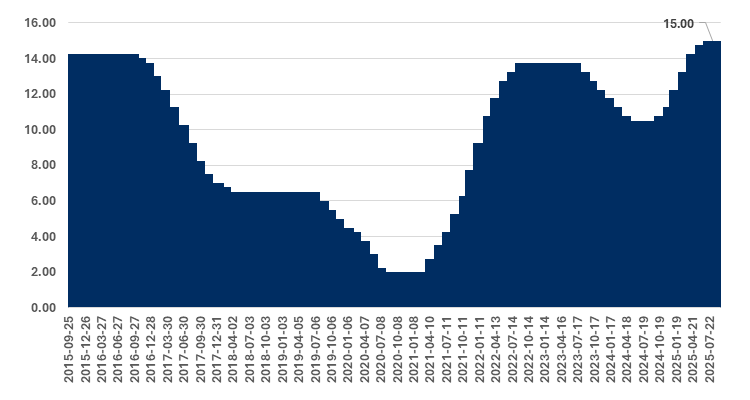
Local market behaviour remains distinctly short term, with high turnover and a focus on the next-quarter results. This is largely driven by the elevated Selic policy rate, currently at 15%, which leads investors to assess opportunities on an absolute-return basis rather than seeking alpha. With inflation near 5%, real yields approach 10%, creating a persuasive risk-free alternative that diverts capital from equities. In turn, local equity managers are adjusting their styles to retain AUM.

Banco Central do Brasil Target for Federal Funds rate (Selic)
A bar graph illustrating Central Bank of Brazil target for federal funds rate (Selic) over the last decade.
Source: Banco central do Brasil

These dynamics reinforce our long-term approach: concentrating on high-quality businesses with durable earnings power and consistent EPS expansion. Looking ahead, with elections approaching and potential rate cuts on the horizon, we expect a reallocation of flows from fixed income back into equities, benefiting companies with strong fundamentals and clear earnings visibility.

Key players in Brazil’s political landscape

Brazil’s political landscape is already taking shape as the country heads toward the 2026 elections. One of the most significant developments is the exclusion of Jair Bolsonaro from contention. His ineligibility through 2030, reinforced by a conviction earlier this month, effectively removes the most polarizing figure on the right. In his absence, the centre-right governor of São Paulo, Tarcísio de Freitas, is emerging as the most likely challenger to President Luiz Inácio Lula da Silva (also known as “Lula”) in a potential second-round runoff. This dynamic sets up a more conventional contest between a centre-left incumbent and a pragmatic, reform-minded conservative.

For Lula, the current year has been a test of political resilience. His approval ratings hit a low point of around 24% in February 2025, but have since rebounded modestly, reaching roughly 33% by September according to Datafolha surveys. The recovery suggests some stability, though his support remains fragile, reflecting persistent dissatisfaction with the pace of economic recovery and concerns about fiscal policy. Nevertheless, the directional improvement offers the president some breathing room as he navigates the second half of his term.

From the perspective of markets, the electoral outlook carries important implications. A Lula re-election would imply continuity in the Workers’ Party approach: a more active state role in economic management, coupled with efforts to demonstrate adherence to Brazil’s new fiscal framework. Investor reaction would likely hinge on whether the government can maintain a credible path to primary balance and on its stance toward state-controlled enterprises such as Petrobras, where governance remains a focal concern. By contrast, a victory for a centre-right figure like Freitas would be interpreted as a more reformist and privatization-friendly outcome. Such a scenario could lower perceived political risk, reduce risk premia and prove supportive for equities and local rates markets.

Mexico rates, USMCA and tariffs

Headline inflation in Mexico remained relatively stable, with the Consumer Price Index (CPI) registering a 3.57% year-over-year increase in August. Preliminary mid-September data suggests a slight acceleration to approximately 3.7%. Inflation expectations continue to trend downward. The Bank of Mexico’s (Banxico) August private-sector survey shows a further decline in median inflation forecasts for both 2025 and 2026, signaling growing confidence in price stability.

On September 25, Banxico lowered its policy rate to 7.50%, executing a 25 basis point cut. The decision was not unanimous, reflecting differing views within the board. Forward guidance remains cautious, as core inflation is decelerating only gradually. Reuters notes that while the easing cycle supports domestic demand and longer-term fixed income instruments, external factors – particularly the pace of US Federal Reserve rate cuts or potential tariff shocks – will ultimately drive risk premiums in Mexican assets.

In 2026, the United States–Mexico–Canada Agreement (USMCA) is scheduled for its first mandatory joint review. At that point, the three countries must decide whether to extend the agreement for another 16 years, renegotiate its terms or allow it to transition into annual reviews. The outcome will directly affect trade certainty and tariff exposure in North America. Currently, approximately half of Mexico’s exports to the United States do not qualify under USMCA’s origin requirements and are therefore vulnerable to a 25% US tariff. Goods meeting the agreement’s rules of origin continue to benefit from duty-free treatment, but non-compliant products face higher costs and stricter enforcement.

In parallel, Mexico has recently imposed tariffs of between 10–50% on a wide range of imports from China, including auto parts, textiles, steel and consumer goods. This move underscores Mexico’s effort to shield domestic industries from low-cost Chinese competition, but also adds a layer of complexity to supply-chain strategies for companies operating across the region.

The 2026 review will thus be a critical inflection point: it could either reaffirm the stability of North American trade or introduce uncertainty through renegotiation and tariff escalation.

Group bicycle ride at dawn.

If you want to go fast, go alone. If you want to go far, go together. – African proverb

At Global Alpha, we truly believe in having strong, connected teams because we’ve seen how it translates into better performance at work. When team members trust each other, we can push boundaries, test new ideas and endure more uncertainty. So, when we’re looking for team-building activities we look for unique activities that feel relevant, challenging and outside of the box.

This year we did a couple of truly extraordinary events that brought our team together in new ways – like a crash course in sailing with future Olympians! – but the real standout was our participation in the Grand défi Pierre Lavoie. It’s an epic annual four-day, 1000 km relay race that unites thousands of cyclists to promote healthy living and fundraise to support research into rare diseases.

No one person completes the défi alone, just as no one person can run a successful investment firm alone. It takes a cohesive group of skilled team members who can trust and count on each other, especially in volatile times – this challenge was not only a test of physical endurance and teamwork, but also a metaphor for the long-haul journeys that define our success as investment professionals.

Building strength through trust and teamwork

Picture the starting line of the Grand défi Pierre Lavoie: the sun rising, nerves jangling, teammates poised for the first pedal stroke of a 1,000 km adventure. It’s daunting. The finish feels distant, almost impossible. But there are steady wheels on all members of this team – the kind of company that makes every bitter wind lighter and every small victory sweeter.

When you’re part of a team, you’re working toward achieving a common goal, whether it be crossing a finish line 1,000 km away or producing positive returns at the end of a volatile year. As with any team, there are different strengths to be found in each of its members. For the Grand défi Pierre Lavoie, some riders were fast on the straightaways, some were strong up the hills, some were daring through the turns. In our investment team, there are curious researchers, strong risk managers, detailed analysts and more, each of whose skills differ from the others.

On the race path or in the office, the Global Alpha team leans into the grind together, trading stories, picking each other up, finding the opportunities in setbacks. Making these journeys together, especially when there are struggles, builds grit. Over time, the team learns how to support the other members and how to play to their strengths.

There are challenges – sore legs, broken chains, missed targets, sour news, a string of rough quarters or market turmoil, but because of the trust within the team, these are not seen as failures. Instead, the team regroups. An injection of humour gives that second wind that pulls the team through a headwind; one rider’s encouragement or a colleague’s fresh perspective is the spark that keeps everyone moving forward.

But in both environments, there’s an important lesson to be learned: real breakthroughs come after being stretched to the limit.

Going the distance together

During a tough market or a rough patch in life, it can be easy to doubt the journey. During the Grand défi Pierre Lavoie, there are long, quiet stretches where progress feels invisible. Despite pedaling hard, the scenery barely changes. In investing, some days are just as sluggish – despite strong investment principles and proven strategies, the returns can still seem lacklustre.

But these stretched-out moments are where the magic actually happens.

Short-term lulls aren’t proof that nothing’s working – they’re part of playing the long game. It’s easy to chase quick wins or get spooked by setbacks. But by trusting the process, working as a team and continuing to move – one kilometre, one quarter, one decision at a time – perseverance and endurance will deliver quiet rewards and lasting success that go well beyond numbers or market cycles.

Endurance is at the heart of long-term investing because the real rewards come to those who stay disciplined through every market storm and quiet patch. Team endurance wins in investing by combining diverse strengths, steady encouragement and a shared commitment – making it possible to persist, adapt and thrive when others might falter or give up.

Here’s the heart of it: the real win isn’t found at the finish line, but in the journey itself.

  • Riding together, sailing together, investing together – it’s never just about the numbers.
  • It’s the camaraderie, shared resilience and group celebration after the slog, when you see how far you’ve come, thanks to each other.
  • Teams carry everyone through the silent, invisible stretches when progress is slow and doubt is loud.

It’s not about quick wins or epic heroics. It’s about the discipline to show up, the courage to trust the team and the humility to lean on each other for a reset. After every breakdown – on the bike, on the water, in a tough portfolio review – the team draws closer. What once felt like a failure becomes a shared memory, a lesson, a source of strength.

Final thoughts and what we’re doing next

Global Alpha Capital Management stands out because the same teamwork, grit and appetite for challenge that drive us in events like the Grand défi Pierre Lavoie also fuel our investment success. Our edge lies in superior stock picking, shaped by deep, bottom-up research and a thematic, fundamental approach to finding quality companies with real growth potential.

We’re equally relentless in risk management, applying robust analytical frameworks to ensure every investment is weighed wisely no matter how uncertain the market gets. Just as our team perseveres together through endurance events – adapting, supporting and trusting the collective process – we do the same for our clients, aiming for long-lasting performance in turbulent times.

What’s up next for Global Alpha team members? A 30 km trail run on Mont Tremblant – another chance for us take on an uphill challenge and cross a finish line, together.

Chureito Pagoda and Mount Fuji in Fujiyoshida, Japan, during autumn.

The Global Alpha team has just attended a pair of conferences in Japan. The BofA Japan Conference and the Mizuho Japan Alpha Conference. We attended numerous panel discussions on topics ranging from trade and tariffs to the changing geopolitical and defence world order to the AI boom. We met with over 40 Japanese companies including many of our holdings and completed a few onsite visits.

At the time of writing, Prime Minister Ishiba announced his resignation, less than a year after succeeding Kishida. His position was untenable after the humiliating defeat of his party in the spring. Political instability is not new in Japan, nor in most countries these days – something investors do not seem to have yet fully factored into risk premiums. And the rise of extremism, both right and left, is further colouring political landscapes globally.

Here are some takeaways from the conference:

  • Inflation in Japan continues to exceed 2% and the country is very unlikely to fall back in deflation. After over fifteen years of fighting to achieve sustained 2% inflation. It breached it in 2023–24, and 2025–26 will see inflation above that number. Dismissed is the risk of runaway inflation, which could happen and is one of the reasons for the defeat of the Liberal Democratic Party.
  • As a result of inflation rising, interest rates are going up. The Japan 30-year bond is at its highest since 1993 and now exceeds 3%. The Bank of Japan is expected to continue raising short-term interest rates. This has been an important positive for the financial sector. One of our largest holdings is Concordia Financial Group Inc.(7186 JP), a super regional bank in the Kanto region of Tokyo.
  • Japanese retail investors still only have about 2.5% of their savings invested in the Japanese stock market. Over 90% is in bank deposits which represents over USD6 trillion.
  • Spring wage negotiations in 2025 yielded a record wage increase of 5.1% after another record of 5% in 2024. The companies we met all indicated that 2026 will be equal or higher than 2025 as an acute shortage of workers is felt.
  • We met many real estate companies operating in office, retail, hospitality as well as residential. New leases are seeing price increases averaging 7 to 10%.
  • Most of the companies we met indicated that they need to raise prices and likely face little push back.
  • The pace of reforms being brought by the government, the Tokyo Stock Exchange and companies themselves is accelerating.
  • Overall, the sentiment was positive. Both conferences saw record attendance from foreign investors.

However, the inspiration for this week’s commentary came from a meeting with a Japanese forest product company called Oji Holdings. The company was established in 1873 and over the next one hundred years became a leader in the production of newsprint and printing paper.

We well know what happened to the Canadian and US forest industries. To respond to a secular decline in newsprint demand, they merged and eventually went bankrupt, with assets being closed or sold. No company can shrink to greatness.

Oji is not immune to the decline in newsprint and paper demand. However, in the seventies, it started migrating to tissue and packaging. And more recently, it accelerated its diversification, still using its expertise transforming wood to pulp, but using that pulp for sustainable packaging and to make biomass plastics from the green ethanol produced. The company is also using biomass to produce advanced semiconductor photoresist, eliminating all perfluorinated substances commonly used by current processes. Oji also established Oji Pharma in 2020 to develop and commercialize plant-based medicinal products such as Heparin, currently produced with animal proteins and banned in many Muslim countries. By 2030, these new divisions will have grown more than the decline in paper.

Including Oji, there are over 20,000 companies in Japan that are more than one hundred years old. Even more impressive, over 3,000 companies are more than two hundred years old and around six hundred are more than three hundred years old.

With regard to company longevity, over 50% of the companies in Japan are over one hundred years old. Europe follows with its number of century-old companies. The United States has less than 5%.

The oldest known, continuously operating company in the world is a Japanese construction firm specializing in Buddhist temples and shrines called Kongo Gumi. It was established in 578 AD and operated for over 1,400 years before becoming a subsidiary of a larger group in 2006.

Why are there so many century-old companies in Japan?

This incredible longevity is attributed to a combination of cultural, business and historical factors, but most important is the emphasis on continuity and legacy. This comes from fostering a long-term perspective and not necessarily maximizing short-term profit. Other factors contributing to longevity success are the focus on core competency, resilience and adaptation, as demonstrated by Oji.

It will be interesting to see how Japanese companies can continue to adopt this long-term focus yet at the same time respond to shorter-term shareholder objectives.

Creek Street in Ketchikan, Alaska.

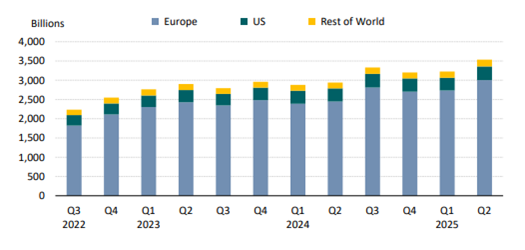
According to Morningstar, global sustainable funds attracted an estimated net USD4.9 billion in Q2 2025. With 72 new sustainable funds launched in just one quarter, total assets in global sustainable strategies have now reached USD3.5 trillion.

Sustainable investing is booming – and getting harder to navigate.

Quarterly global sustainable fund assets (USD billion)
Graph comparing quarterly global sustainable fund assets in billions of USD between Europe, the United States and the rest of the world.
Source: Morningstar Direct. Data as of June 2025.

To differentiate themselves, funds increasingly segment by theme – from “climate leaders” and “net-zero transition” to “socially responsible” and “impact” strategies. The United Nations Sustainable Development Goals (UN SDGs) have become the most common reference point for defining what is “sustainable.” But as SDG labels become more common, investors face a critical challenge: How can you tell the difference between real contribution and clever branding?

The answer lies in applying core principles borrowed from the field of impact investing – even when the investment strategy itself isn’t “impact” by design. Three key concepts help sharpen the lens and assess sustainable outcomes in the real world:

  • Intentionality: Are the investee companies actively seeking to contribute to a positive social or environmental outcome through their core business or are the outcomes unintended?
  • Additionality: Would these outcomes have happened without the companies’ products or services? This helps determine the companies’ real contribution.
  • Measurability: Are there clear metrics to track and report how the outcomes affect the end beneficiary?

Take a firm that installs solar panels only to offset its own energy use – essentially fixing a problem of its own making. While this could be marketed as a “sustainable outcome” by many, this is risk management: no additionality, no broader SDG contribution and no real benefit beyond the company’s operations.

At the aggregate level, thinking like an impact investor can sharpen how equity investors assess credibility of sustainability claims. A useful tool is a theory of change – a framework that maps how a company’s core activities lead to specific outputs (e.g. products or services), which in turn generate measurable outcomes. Applying this lens helps investors move beyond marketing language to identify businesses whose growth is directly tied to delivering credible, positive, real-world outcomes alongside financial performance.

At Global Alpha, our Sustainable Global Small Cap Strategy applies these principles as a framework – not to make impact investments, but to ensure that the companies we invest in generate credible, positive contributions to the SDGs through the sale of their products and services. Our aim remains financial performance, which we do by delivering real-world, positive outcomes, as evidenced in our 2024 Sustainable Global Small Cap Annual Report.

Portfolio spotlight: The North West Company

The North West Company Inc. (NWC CN) is a leading retailer serving remote and underserved communities in Canada, Alaska, the Caribbean and the Pacific. In regions where reliable access to goods and services is limited, NWC delivers food, household essentials and health products – often as the sole provider.

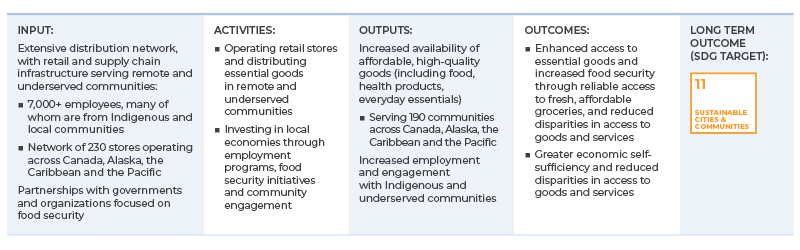
NWC’s impact begins with its extensive distribution network, retail infrastructure and partnerships with governments and organizations focused on food security. Through 230 stores and over 7,000 employees – 44% of which are from Indigenous groups – it delivers affordable, high-quality goods, supports local employment and invests in community initiatives.

Its business model demonstrates:

  • Intentionality: NWC’s core strategy targets underserved and rural communities.
  • Additionality: In many locations, it operates where no comparable services exist.
  • Measurability: Metrics include the number of communities served and local employment created.

The below theory of change showcases how NWC’s activities aim to increase access to essential goods across 190 communities, reduce disparities in access to services and enhance economic self-sufficiency, directly contributing to SDG 11 – Sustainable Cities and Communities.

Example of the theory of change for NWC, illustrating the input, activities, outputs, outcomes and the UN SDG impacted.
Source: 2024 Sustainable Global Small Cap Annual Report

NWC exemplifies how small caps can deliver meaningful real-world outcomes in addition to financial returns – and why thoughtful sustainability analysis matters.

Top down view of LNG (Liquified Natural Gas) tanker anchored in small gas terminal island.

The explosion of cloud computing and especially AI training requires enormous amounts of power. A single, large data centre can use as much electricity as a mid-sized city. The Southeast United States (Georgia, Virginia, Texas) is seeing the heaviest concentration of new projects, but it’s spreading nationwide. Hence, utilities in the United States have more than doubled their planned gas turbine installations for 2030 – from about 25 GW at the end of 2021 to over 45 GW by the end of 2024 with nearly 100 GW of new gas-fired capacity in pre-construction.

The US Energy Information Administration (EIA) reports that US marketed natural gas production in 2024 averaged about 113 billion cubic feet per day (Bcf/d).

Gas demand increase

The production of 100 GW of energy requires about 2.3 Bcf/day of natural gas – this adds a 2% bump to national gas requirements. A larger increase in gas demand, however, comes from liquified natural gas (LNG) exports. By 2028, US LNG export capacity is forecast to nearly double, increasing from around 11.6 Bcf/d to 24.4 Bcf/d, thanks to approximately ten LNG infrastructure projects under construction.

Pushed by international buyers, gas demand will increase in the fall of 2025 as the Golden Pass LNG terminal, located in Sabine Pass, Texas, comes on-line with an approximate transportation total of 2.57 Bcf/d of natural gas. This adds to the large Plaquemines project in Louisiana at 2.6 Bcf/day that began in 2024, and LNG Canada’s new Kitimat facility with capacity of 1.1 Bcf/day.

Key growing importers of LNG remain Europe at 14.4 Bcf/day and China at 9.5 Bcf/day.

It is sensible to form a positive opinion on natural gas prices in the midterm as we fill up these new, large LNG terminals. US gas inventory is not very big so it can show volatility in the short term. Due to high turnover of inventory, seasonal weather conditions impact short-term pricing of gas demand, causing more price fluctuation.

Because LNG is becoming such an important demand driver, competing electricity-producing energy technologies do not represent short- or mid-term risk to natural gas demand. For example, US lithium-ion battery capacity stands at a mere 26 GW.

However, the future does include other technologies. We recently met a nuclear power company with a project cost estimated at $3 million per megawatt for nuclear fission – we await their final feasibility with anticipation. And as we have written in the past, we remain positive on geothermal energy. Recent developments continue to drive down costs to make geothermal anywhere a reality.

We remain exposed to natural gas producers who will profit from the incumbent LNG export demand.

Gulfport Energy Corp. (GPOR US)

Gulfport Energy is an independent exploration and production company, primarily operating in Eastern Ohio’s Utica and Marcellus Shales in the Appalachian Basin.

The Marcellus Shale is the largest gas field in the USA and stands out as it combines huge scale, low costs, proximity to markets and strong infrastructure. It is often described as the “workhorse” of US gas supply. Although the Haynesville Shale is closer to Louisiana LNG facilities, the Mountain Valley Pipeline (2Bcf/day) which started in 2024, is opening up important markets to Marcellus operators. The Marcellus field is especially suited for higher priced areas in the Northeast which include many high-tech hubs and data centre activity.

Gulfport Energy foresees excess EPS growth in 2026 as strong cash flows support share buybacks. Breakeven under USD2/Mcf suggests strong resilience to price volatility.

Advantage Energy Ltd. (AAV CN)

Advantage Energy is the lowest-cost producer in Western Canada. Advantage Energy’s Montney Shale gas basin (Alberta side) has some of the lowest supply costs in North America. It regularly reports supply costs in the CAD1.00–1.20 per Mcf range, which means they can stay profitable even in weak gas markets where others struggle.

Advantage Energy does not just sell raw natural gas. The company is also invested in natural gas liquids (NGLs) production, which gives uplift when gas prices are soft.

In addition, Advantage Energy created and owns a cleantech arm, Entropy Inc., that is working on post-combustion carbon capture and solvent tech. This gives the company an ESG angle and potential new revenue stream.

Market access and hedging

Many Western Canadian producers get stuck selling into AECO, often at a discount versus Henry Hub in the United States. Advantage Energy has firm transport and hedges that give it access to the Chicago, Dawn and US Midwest hubs, narrowing basis differentials and cushioning cash flow volatility.

Subsea 7 SA (SUBC NO)

As gas exports reach ports of Europe, an entire infrastructure is being built.

Subsea 7 is a global leader in laying subsea pipelines for oil and gas, including natural gas export lines that run from offshore fields back to shore or to floating facilities. Their fleet includes specialized vessels that can handle gas export pipelines from deepwater fields, flowlines, umbilicals and risers.

If a big offshore gas project needs its subsea network built and tied back to shore or an LNG hub, Subsea 7 is often one of the short-list contractors called in to lay those pipes.

Subsea 7 also serves other growing energy segments such as offshore wind, carbon capture and hydrogen.

Clean Energy Fuels Corp. (CLNE US)

Clean Energy is North America’s largest provider of natural gas and renewable natural gas for transportation, operating over 600 fueling stations across the United States and Canada. Clean Energy has forged meaningful alliances with heavyweights like TotalEnergies, BP, Walmart, Amazon, UPS and others, enhancing both market access and credibility.

The company is set to grow rapidly as the transportation industry adopts a novel natural gas truck engine that will use a natural gas instead of diesel.

Facial sheet mask with different cosmetic products and flowers on pink background.

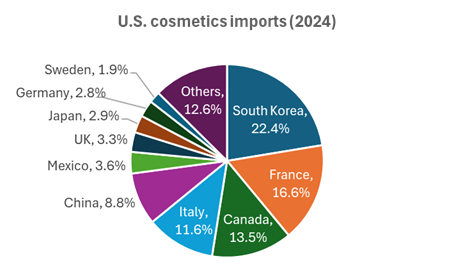
In the world of cosmetics, France has been the undisputed number one with its array of global brands: L’Oréal, Lancôme, Sisley, Vichy, Clarins…the list goes on. But with the emergence of Gen Z consumers (born between mid-1990s and early-2010s), whose purchasing behaviour is influenced by social media and are known to be intrepid in trying out new products (less brand loyalty), and the greater acceptance of Korean culture, or “K-culture” abroad, K-cosmetics have gained a foothold in the global market. In 2024, Korea became the number one exporter of cosmetics to the United States with USD1.7 billion (22.4% market share) surpassing France at USD1.3 billion.

Korea maintained its position as the top exporter of cosmetics to Japan, the world’s third-largest cosmetics market, for the third year in a row. Korea also became the third-largest exporter of cosmetics in the world last year, surpassing Germany (USD9.1 billion) and after France (USD23.3 billion) and the United States (USD11.1 billion). Korea is expected to surpass the United States as the second-largest exporter of cosmetics by the end of this year or next year.

Pie chart illustrating how much and from where the United States imports cosmetics.
Source: IHS Markit Connect Global Trade Atlas (June 10, 2025)

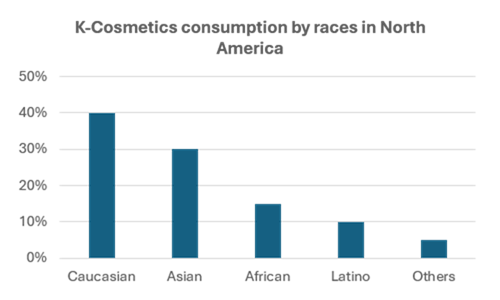
Consumers of Korean cosmetics outside of Korea are no longer confined to Asians. K-cosmetics now have a wider acceptance across race and ethnicity.

Bar graph illustrating the consumption of K-cosmetics in North America by race.
Source: Ministry of Food and Drug Safety (South Korea)

China remains the largest market for K-cosmetics, but not by far, followed by Asia ex-mainland China, the United States and the European Union, the latter of which has been seeing strong growth.

Line graph illustrating the amount of K-cosmetics exported to various markets globally.
Source: Korea International Trade Association
Note: EU5 includes Germany, France, Italy, Spain and the UK

What explains K-cosmetics’ success?

  • Product innovation: In 2008, Amorepacific Corporation (090430 KS) released the “Air Cushion,” the world’s first multifunctional, cushion-type cosmetics delivery mechanism that forever changed how foundations are applied on to the skin. More recently, there was the innovation of the “Reedle Shot” – a skincare treatment that utilizes micro-needling to deliver active ingredients deeper into the skin. It does not use actual needles – it is a cream that can be applied directly on skin, first commercialized by VT Cosmetics (under VT Corp. Ltd.) (018290 KS).
  • High quality for the price: When it comes to taking care of the skin, Korean women are known to be meticulous. They have very high standards for quality and this is why Korea is often the testbed for global cosmetics brands before their global launch of new products.
  • Product variety: As of December 2024, there were over 30,000 indie cosmetics brands in Korea. When it comes to skincare, there is no “one size fits all.”
  • Digital marketing: People have different skin types and most indie brands are sold online. This is where marketing via social media and leveraging the power of influencers or KOLs (key opinion leaders) comes into play. One can have a vicarious “try-me” experience by watching others use a product. After all, these indie brands cost a fraction of L’Oréal and Gen Zs are not afraid to try new products.

Product innovation, high quality, reasonable prices and product variety are enabled by K-cosmetics’ supply chain that has developed and grown over the years. Korea is home to the world’s largest cosmetics ODM (original design manufacturer), Cosmax Inc. (192820 KS), and Kolmar Korea Co. Ltd. (161890 KS) in the top five.

Cosmetics ODM is a picks-and-shovels business, making it less risky than investing in a particular cosmetics brand itself. Not surprisingly, there are a fewer number of ODMs compared to cosmetics brands. Playing an equally important role in the K-cosmetics supply chain, having the same business model, but in a more consolidated space, are container manufacturers.

Investment spotlight: Pum-Tech Korea

Pum-Tech Korea Co. Ltd. (251970 KS) in our portfolio is the largest cosmetics container ODM in Korea. As the name begins to insinuate, the company is known for its pump technology (tubes and other applications) and was the first to develop pump tubes in Korea in 2002. In 2009, not long after Amorepacific’s Air Cushion, Pum-Tech developed “Airless Compact” that utilized a small hole in the compact to control the amount of foundation per use and prevent contamination of foundation from air. The container for Shiseido’s roll-on sunscreen (“sun stick”) was also developed by the company.

Since its establishment in 2001, Pum-Tech has never had a down year in revenue driven by innovative products. The company owns approximately 5,000 stock moulds (in addition to custom moulds for specific customers), combinations among which offer customers containers of all sizes and shapes to choose from. The company currently serves over 500 brands globally, including L’Oréal, Estée Lauder and Shiseido. Pum-Tech’s manufacturing process boasts high levels of automation, and new capacity is expected to come online in H2 2025 and next year to meet increasing demand.