Banyan Capital Partners (« Banyan »), une des principales sociétés canadiennes de capital-investissement du marché intermédiaire, est heureuse d’annoncer son investissement dans Innovative Surface Solutions LP (« Innovative » ou la « Société »), un chef de file de la distribution de solutions de surface liquides en Amérique du Nord. Il s’agit du premier investissement effectué par l’intermédiaire de Banyan Committed Capital LP, un instrument de placement permanent pour lequel Banyan vient de lever une première tranche de capitaux engagés de 216 millions de dollars.

Fondée en 1986, Innovative distribue des solutions de surface liquides à de grands partenaires du secteur du sel traité, à des clients commerciaux, à des clients dans le secteur du traitement des eaux et à des organismes gouvernementaux partout en Amérique du Nord. À partir de son siège social situé à Ajax, en Ontario, et de son siège américain à Glenmont, dans l’État de New York, la Société exploite sept terminaux pouvant stocker plus de 200 000 tonnes métriques de produits liquides et en traiter plus de 300 000 annuellement. Son réseau de distribution de liquides est le plus vaste de l’est du Canada et du nord-est des États-Unis.

Banyan s’associe au chef de la direction d’Innovative et propriétaire majoritaire actuel, Greg Baun, qui occupe ce poste depuis 1994, afin de faciliter la prochaine phase de croissance de l’entreprise. M. Baun demeurera chef de la direction après l’investissement de Banyan et conservera une participation importante dans la Société.

« Je suis très heureux de travailler en partenariat avec Banyan Capital Partners », a-t-il affirmé. « La philosophie d’investissement à long terme de Banyan cadre avec les objectifs de mon équipe, qui consistent à poursuivre l’expansion de nos activités partout en Amérique du Nord ».

« Innovative occupe une position unique sur la côte est du Canada et des États-Unis, proposant à ses clients des solutions essentielles en matière de sécurité routière et de produits industriels pour des années à venir. Nous avons hâte de travailler avec M. Baun et son équipe dans le cadre de cette prochaine phase de croissance », a déclaré Matthew Segal, directeur général et associé chez Banyan Capital Partners.

À propos d’Innovative Surface Solutions

Fondée en 1986, Innovative distribue des sels liquides, principalement du chlorure de magnésium et du chlorure de calcium, combinés à des additifs pour le déglaçage, le contrôle de la poussière et diverses applications industrielles. La Société offre ses services à une clientèle diversifiée, notamment d’importants partenaires du secteur du traitement des sels, des clients commerciaux, des clients du secteur du traitement des eaux et des organismes gouvernementaux, dont des municipalités régionales, des cantons et des comtés. À partir de son siège social situé à Ajax, en Ontario, et de son siège américain à Glenmont, dans l’État de New York, la Société exploite sept terminaux pouvant stocker plus de 200 000 tonnes métriques de produits liquides et en traiter plus de 300 000 annuellement.

À propos de Banyan Capital Partners

Fondée en 1998, Banyan Capital Partners est une société canadienne de capital-investissement qui effectue des placements en actions dans des sociétés ouvertes et fermées du marché intermédiaire en Amérique du Nord; sa direction est en poste depuis 2008. Grâce à une approche de placement à long terme, Banyan est devenue l’une des plus importantes sociétés de capital-investissement du marché intermédiaire au Canada et elle a fait ses preuves en fournissant des liquidités complètes ou partielles aux fondateurs, aux familles et aux entrepreneurs, pour les aider à faire croître leur entreprise. Banyan est membre du Groupe financier Connor, Clark & Lunn Ltée., société indépendante de gestion de placements dotée d’une structure multientreprise, dont les sociétés affiliées gèrent collectivement un actif de plus de 100 milliards de dollars pour le compte d’institutions, de clients privés et de particuliers.

Contact:

Jeff Wigle
Directeur général
Banyan Capital Partners
(416) 564-0737
[email protected]
Banyan Capital Partners (“Banyan”), a leading Canadian middle market private equity firm, is pleased to announce it has closed the fundraising for its first tranche of committed capital at $216 million in a newly created evergreen fund, Banyan Committed Capital LP (“The Fund”).  Funding was provided by high net worth investors of Connor Clark & Lunn Private Capital Ltd., Connor, Clark & Lunn Financial Group Ltd., and the principals of Banyan. With this first committed capital raise, Banyan aims to build a sustainable, diversified portfolio of value-oriented private equity investments.

Banyan will continue with the long-term, partnership-focused investment philosophy and approach which has led to its success since 2008. Unlike traditional private equity firms, Banyan has the ability to hold its investments for up to 50 years.  

Banyan will seek to make equity investments in the range of $10 million to $50 million in businesses with an established track record of generating annual EBITDA in the general range of $5 million to $15 million.  Additional fundamental characteristics of targeted businesses include; a Canadian or U.S. headquarters, a clear competitive advantage, identifiable growth opportunities and the existence of, or potential to, generate significant free cash-flow.

Since 2008, Banyan has invested over $190 million across seven platform investments and completed an additional 10 add-on acquisitions across a breadth of industries.  For more information on Banyan, please see www.banyancapitalpartners.com.

About Banyan Capital Partners

Founded and under current management since 2008, Banyan Capital Partners is a Canadian based private equity firm that makes equity investments in middle market private and public companies throughout North America. Through a long-term investment approach, Banyan has developed into one of Canada’s leading middle market private equity firms with an established track record of success in providing full or partial liquidity to founders, families and entrepreneurs and helping them take their business to the next level. Banyan is part of Connor, Clark & Lunn Financial Group Ltd., an independently owned multi-boutique asset management firm whose affiliates are collectively responsible for over $100 billion in assets under management on behalf of institutional, private and retail clients.

Contact:

Jeff Wigle
Managing Director
Banyan Capital Partners
(416) 564-0737
[email protected]

Banyan Capital Partners (« Banyan »), une des principales sociétés canadiennes de capital-investissement du marché intermédiaire, est heureuse d’annoncer qu’elle a clôturé la collecte de fonds pour sa première tranche de capitaux engagés à 216 millions de dollars dans un nouveau fonds permanent, Banyan Committed Capital LP (le « Fonds »). Le financement a été fourni par des investisseurs fortunés de Gestion privée Connor, Clark & Lunn Ltée, du Groupe financier Connor, Clark & Lunn Ltée et des directeurs principaux de Banyan. Avec cette première mobilisation de capitaux engagés, Banyan vise à bâtir un portefeuille durable et diversifié de placements dans le capital-investissement axés sur la valeur.

Banyan maintiendra sa philosophie et son approche de placement axées sur le partenariat et sur le long terme, qui font sa réussite depuis 2008. Contrairement aux sociétés de capital-investissement traditionnelles, Banyan peut conserver ses placements pendant 50 ans.

Banyan cherchera à effectuer des placements en actions de l’ordre de 10 M$ à 50 M$ dans des entreprises qui ont fait leurs preuves en générant un BAIIA annuel de l’ordre de 5 M$ à 15 M$. Parmi les autres caractéristiques fondamentales des sociétés qui seront ciblées, mentionnons un siège social au Canada ou aux États-Unis, un avantage concurrentiel manifeste, des occasions de croissance identifiables et l’existence d’importants flux de trésorerie disponibles ou le potentiel d’en générer.

Depuis 2008, Banyan a investi plus de 190 millions de dollars dans sept plateformes de placement et a effectué dix acquisitions complémentaires dans un large éventail de secteurs. Pour obtenir de plus amples renseignements sur Banyan, veuillez consulter le site www.banyancapitalpartners.com.

À propos de Banyan Capital Partners

Fondée en 2008 par une direction toujours en poste aujourd’hui, Banyan Capital Partners est une société canadienne de capital-investissement qui effectue des placements en actions dans des sociétés ouvertes et fermées du marché intermédiaire en Amérique du Nord. Grâce à une approche de placement à long terme, Banyan est devenue l’une des plus importantes sociétés de capital-investissement du marché intermédiaire au Canada et elle a fait ses preuves en fournissant des liquidités complètes ou partielles aux fondateurs, aux familles et aux entrepreneurs, pour les aider à faire croître leur entreprise. Banyan est membre du Groupe financier Connor, Clark & Lunn Ltée., société indépendante de gestion de placements dotée d’une structure multientreprise, dont les sociétés affiliées gèrent collectivement un actif de plus de 100 milliards de dollars pour le compte d’institutions, de clients privés et de particuliers.

Contact:

Jeff Wigle
Directeur général
Banyan Capital Partners
(416) 564-0737
[email protected]
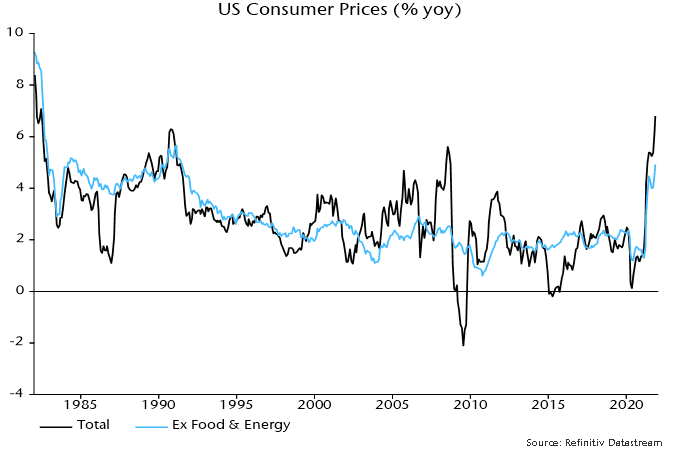
US core consumer price momentum is likely to slow sharply in early 2022 but monetary trends appear inconsistent with inflation returning to its pre-pandemic level.

Headline and core (i.e. ex. food and energy) annual inflation rates rose to their highest levels since 1982 and 1991 respectively in November (6.8% and 4.9%) – see chart 1.

Chart 1

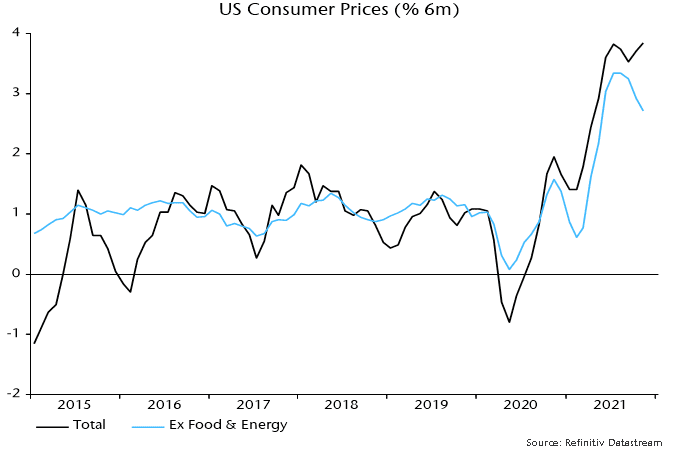
On a six-month rate of change basis, however, core momentum eased for a third month, albeit remaining high at 2.7% or 5.5% annualised – chart 2. Headline momentum was boosted by a further acceleration of food prices.

Chart 2

The moderation in core momentum mirrors a slowdown in six-month growth of broad money 14 months earlier – chart 3. The apparent relationship suggests a further significant fall in six-month core inflation.

Chart 3

A 14-month lead is notably shorter than the average in historical studies of the relationship between money and prices. The judgement here is that supply disruption due to the pandemic has accelerated the transmission mechanism.

While core momentum could slow faster than expected in early 2022, broad money trends argue against a return to the pre-pandemic level: core inflation averaged 2.0% over 2015-19. Six-month growth of the broad measure calculated here* is running at an annualised rate of about 9% versus a 2015-19 average of 5%.

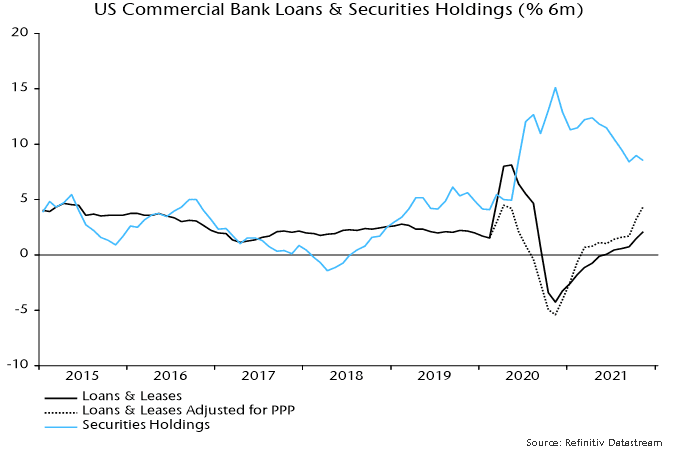
Broad money growth is being boosted by strong expansion of commercial bank assets as well as ongoing QE. Adjusting for PPP loan forgiveness, banks’ lending book grew by about 9% annualised in the six months to November, with securities holdings rising by 18% – chart 4.

Chart 4

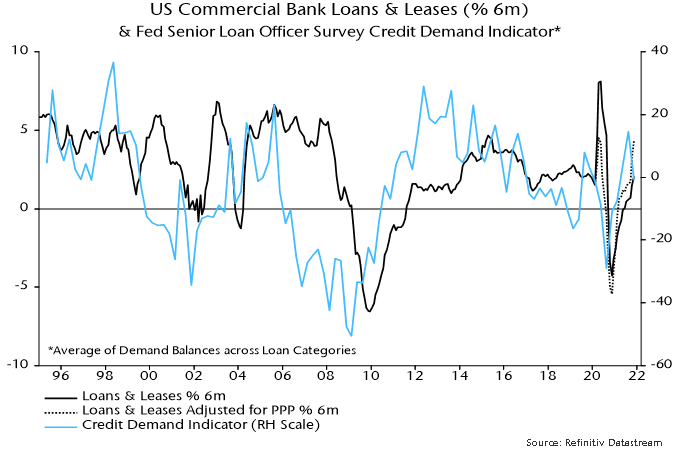
Banks are well capitalised and highly liquid but the October Fed loan officer survey suggested a cooling of credit demand – chart 5. Securities purchases, meanwhile, could slow as QE tapering and a rebound in the Treasury’s cash balance at the Fed following Congressional approval of a rise in the debt ceiling relieve upward pressure on bank reserves.

Chart 5

*M2+ = M2 + large time deposits at commercial banks + institutional money funds.

These are the views of the author at the time of publication and may differ from the views of other individuals/teams at Janus Henderson Investors. Any securities, funds, sectors and indices mentioned within this article do not constitute or form part of any offer or solicitation to buy or sell them.

Past performance does not predict future returns. The value of an investment and the income from it can fall as well as rise and you may not get back the amount originally invested.

The information in this article does not qualify as an investment recommendation.

Marketing Communication.

In the early days of the Covid-19 pandemic, the banking industry faced great challenges when the economy came to an abrupt stop. However, banks have weathered the pandemic well so far, and proven their value and contribution to the economy and society by ensuring ongoing funding to businesses and households. Unlike previous economic crises, banks’ profitability held up well. The largest lenders in the United States being JP Morgan Chase, Bank of America, Wells Fargo, Citigroup, and Morgan Stanley, have all beaten earnings expectations in the latest quarter and expect continuing economic rebound from the pandemic, despite many challenges the world is still facing.

While large banks help keep financial markets moving and support large company debt, the thousands of community and regional banks are a crucial source of funding for families and small businesses in the U.S. Small businesses are key to the U.S. economy, representing the vast majority of all businesses, and employing almost half of the private sector workforce. As of the end of 2019, the U.S. had 4,750 community banks with more than 29,000 branches throughout the country. Together, they represent 15% of the banking industry’s total loans, but make 36% of all small business loans and 70% of all agricultural loans, according to the FDIC’s 2020 Community Banking Study.

Many big and profitable companies obtained loans from the Paycheck Protection Program (PPP), which was intended to help small businesses keep employees on their payroll. Yet, many small businesses were let down by large banks’ slow responses and complicated application processes. Community and regional banks, on the other hand, responded quickly and proactively. In the first round of the PPP, community banks processed 60% of the program’s funding. Even after the large banks began to participate in the second round, community banks still accounted for 45% of the funding. As a result, many community and regional banks have fortified their relationships with clients and gained new customers during the pandemic.

Wintrust Financial Corporation (WTFC US)

Wintrust Financial Corporation (a holding in our portfolios), has over 150 Wintrust Community Bank locations, primarily in the Chicago metropolitan area, southern Wisconsin, and northwest Indiana through its 15 community bank subsidiaries. The company was founded in 1991 by current CEO Edward J. Wehmer, with the goal to provide an alternative to big banks. Over the years, they stayed true to their mission. In 2020, less than a week after the launch of the PPP, Wintrust built a customer-facing loan inquiry system, and created a new underwriting process to meet businesses’ needs. In the first week, the company took in 7,700 inquiries for $3.1 billion worth of loans. By the end of June 2021, it funded over 19,400 PPP loans for $4.8 billion. Despite the global pandemic, Wintrust had their record growth in 2020, total assets increased by 23% compared to 2019, and total loans increased by 20%. The bank’s consistent and conservative approach to credit and liquidity helped the company remain resilient during the tough times, and the nonperforming loan ratio actually improved to 0.4% in 2020, from 0.44% in 2019.

UMB Financial Corporation (UMBF US)

We also own UMB Financial Corporation in our portfolios. Headquartered in Kansas City, Missouri, UMBF offers commercial, personal, and institutional banking. Regional banking accounts for 37% of its total deposits. Its loan mix is more diversified than peers, across commercial & industrial, commercial real estate, residential real estate, and others. In 2020, its total loans increased by 10.4%, much faster than peer median loan growth of 2%. During the pandemic, the company works actively with customers by offering payment deferrals and loan modifications. The company also recorded over 5,000 loans totaling $1.5 billion under the PPP. Nonperforming loan ratio remained low at 0.55%, below peer average of 0.79%. With over 50% of its loans being variable, UMBF is well positioned to benefit from the eventual rate hikes projected in 2022.  

A major trend accelerated by the pandemic is the adoption of digital banking. As a result, the industry has seen an accelerated number of bank branch closures. In the U.S., there were 2,284 net closures in 2020, up from 1,391 in 2019, leaving the total number of branches to 74,928. In the United Kingdom (UK), 368 branches were shut down in 2020. 736 bank branches have closed permanently so far in 2021, and another 220 are already planned for 2022. The situation is no different in Japan. Mitsubishi UFJ Financial Group, Inc. (MUFG), the country’s largest lender by assets, plans to close 40% of its domestic branches by 2023 to cut costs. With the declining number of branches, ATMs have become an even more important touch point with end users. To improve operational efficiency, banks are increasingly sharing their ATM infrastructure or outsourcing the ATM operations.

Seven Bank (8410 JP)

Seven Bank (a holding in our portfolios), an ATM bank, is a beneficiary of this trend. It has the largest ATM network in Japan, with over 25,000 ATMs installed across the country. It also has over 9,000 ATMs in the U.S., 1,400 ATMs in Indonesia and close to 700 in the Philippines. With respect to ATMs, people may simply think of cash deposits or withdraws as transactions, as commonly seen in North America. However, Seven Bank ATM is a lot more than that. The company is upgrading all of its ATMs to the fourth generation, which incorporates advancements in biometrics, artificial intelligence (AI), Internet of Things (IoT), and other technologies. The next-generation ATM is capable of face recognition for identity verification, settlement with QR codes, optimized operations through AI and IoT, and there is a 40% decrease in electricity usage and CO2 emissions. Seven Bank is also partnering with banks and non-bank institutions to provide financial services, including topping up e-money cards, international money transfers, refund issuances, bill payments, advancing wages, and much more. For example, during the pandemic, many musical and sports events were cancelled, and customers were able to get a refund through Seven Bank’s ATMs; residents in Japan were also able to get Covid-19 cash handout from the government through these ATMs. With the digitalization of the economy, ATMs are not becoming obsolete, but proving to be indispensable.

As this will be our last weekly commentary of the year, we would like to thank you for your continued support, and wish you a joyful and prosperous 2022.

Happy Holidays!

The Global Alpha team

Connor, Clark & Lunn Financial Group (CC&L Financial Group) is pleased to announce that John Ricketts has joined the Institutional Sales team as Senior Vice President and Co-Head, Institutional Sales, USA.

With over 20 years’ experience in the asset management industry, John brings extensive knowledge and expertise to the firm’s institutional business. “Our multi-affiliate presence in the US continues to grow in size and scope.  Having someone of John’s caliber as co-lead will help us accelerate our growth in this important market. We are excited to have John as part of the team,” said Eric Hasenauer, Senior Vice President and Co-Head, Institutional Sales, USA, CC&L Financial Group. 

About the Connor, Clark & Lunn Financial Group

Connor, Clark & Lunn Financial Group Ltd. (CC&L Financial Group) is a multi-boutique asset management firm that provides a broad range of investment management products and services to institutional investors, high net worth individuals and advisors. We bring significant scale and expertise to the delivery of non-investment management functions through the centralization of all operational and distribution functions, allowing our talented investment managers to focus on what they do best. With offices across Canada, and in Chicago and London, CC&L Financial Group’s affiliates manage over $100 billion in assets. For more information, please visit www.cclgroup.com.

Contact:

Eric Hasenauer
Senior Vice President, Co-Head of Institutional Sales, USA
Connor, Clark & Lunn Financial Group Ltd.
(917) 232-3550
[email protected]

John Ricketts
Senior Vice President, Co-Head of Institutional Sales, USA
Connor, Clark & Lunn Financial Group Ltd.
(203) 615-4847
[email protected]

The expectation here has been that monetary policy easing since Q2 would result in a recovery in Chinese money growth into end-2021, in turn presaging better economic performance in 2022. The Evergrande default threatened to derail the scenario by triggering an endogenous tightening of credit conditions but November money data suggest that it remains on track.

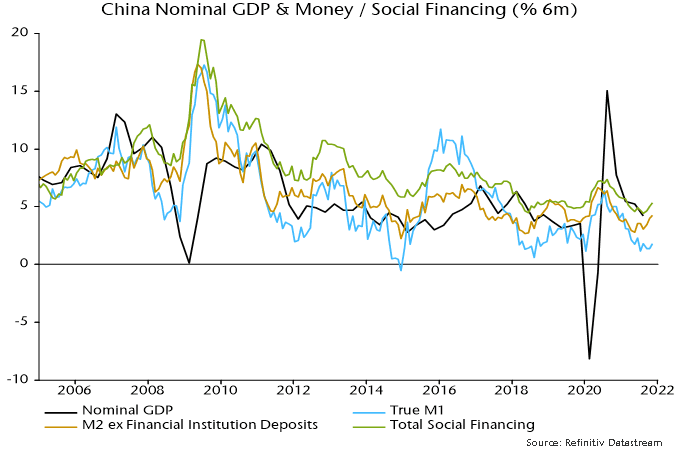
A disappointing feature of the November numbers is that six-month growth of narrow money – as measured by “true” M1, which includes household as well as corporate demand deposits – appears* to have risen only slightly and has yet to break away decisively from a July low. Growth of the broader non-financial M2 measure and aggregate credit, however, increased further, in the former case to a 12-month high – see chart 1.

Chart 1

The forecasting approach here generally places greater weight on narrow than broad money for assessing directional changes in economic momentum. In China’s case, however, the signals from the measures have been similar; indeed, there are several examples of broad money growth leading narrow money growth at lows (e.g. 2008, 2011-12, 2018).

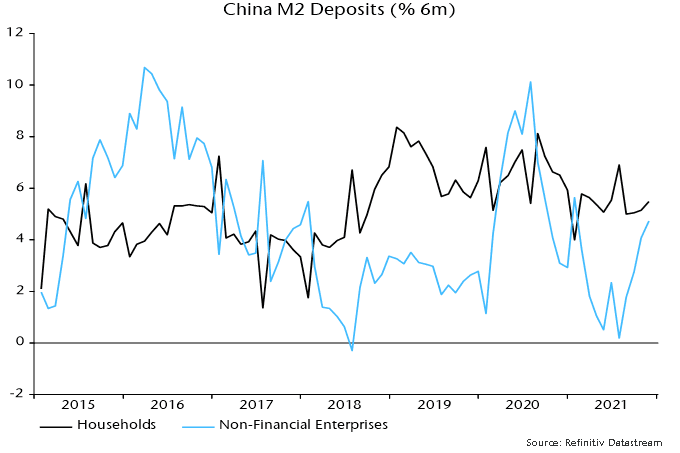
Sectoral data show a pick-up in M2 deposit growth of non-financial enterprises and continued solid household expansion – chart 2.

Chart 2

The judgement here is that the broad / narrow money divergence reflects current low economic confidence – the monetary position of households and firms has improved but this has yet to feed through to spending intentions and an associated switch out of time into demand deposits. The delayed transmission of money to the economy may reflect covid restrictions and property sector uncertainty but should proceed barring further negative shocks.

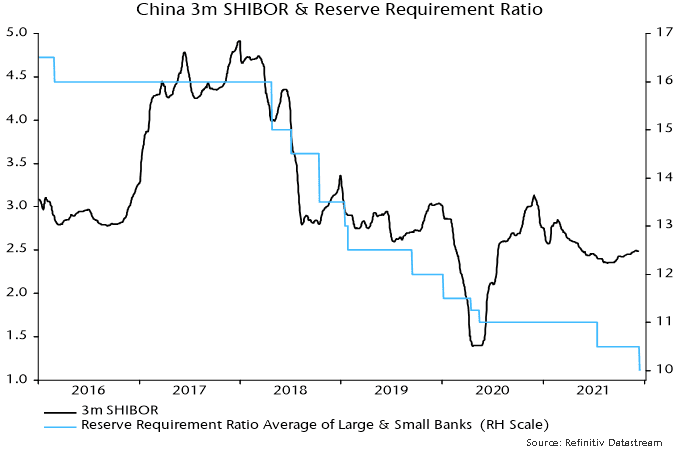
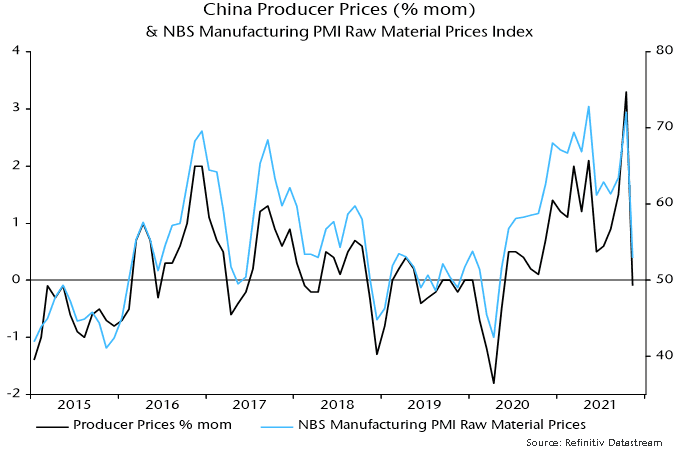
The case for optimism would be strengthened if three-month SHIBOR were to resume a decline following the latest cut in reserve requirement ratios. A July cut did not feed through to lower rates partly because the PBoC offset the impact in other money market operations – chart 3.  Easing inflationary pressures – chart 4 – and property sector weakness suggest that the latest reduction is more likely to represent a genuine policy loosening.

Chart 3

Chart 4

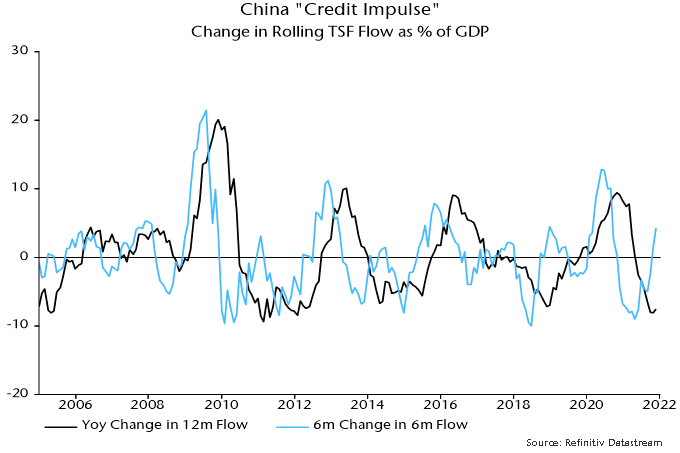
Consensus views about Chinese economic prospects are influenced by the “credit impulse” – the change in the flow of credit expressed as a percentage of GDP. Previous research here analysing long-term G7 data found that the credit impulse underperformed real narrow money growth as a leading indicator, partly because it gave more false turning point signals. Regardless, some economists / strategists are likely to call attention to a bottoming-out of the 12-month impulse and a sharp recovery in the six-month version – chart 5.

Chart 5

*The household demand deposit component is currently estimated.

These are the views of the author at the time of publication and may differ from the views of other individuals/teams at Janus Henderson Investors. Any securities, funds, sectors and indices mentioned within this article do not constitute or form part of any offer or solicitation to buy or sell them.

Past performance does not predict future returns. The value of an investment and the income from it can fall as well as rise and you may not get back the amount originally invested.

The information in this article does not qualify as an investment recommendation.

Marketing Communication.

Recent headlines have been focused on the energy sector to lead the global transition to a low-carbon economy. However, one sector that hasn’t been getting the attention it deserves is the consumer discretionary space. Current consumer spending habits are responsible for about 60-70% of global emissions. Consumerism has been deeply rooted in the current culture, but perhaps it’s time for some change. During the most recent Paris Fashion Week, a climate activist walked out onto the runway holding a banner stating consumerism = extinction. Although this might be a bold statement and doesn’t necessarily represent consumer sentiment, shoppers are in fact looking for more responsible alternatives in their day-to-day purchases. Consumers will thus need to have access to more recycled and reused products to satisfy their desire to make a difference and contribute to the circular economy.

The fast-fashion industry has been growing at a rapid pace and is expected to increase by 63% in 2030, which would be the equivalent to producing 500 billion t-shirts.1 The excess production is largely due to shorter wearing cycles. On average, consumers are buying about 60% more goods and are wearing them for 50% less time. As a result, they are simply thrown away, and 85% ends up in landfills.2 The Global Fashion Agenda recently published a new report about scaling the circular economy and the need to reduce barriers to mass recycling programs, specifically for textiles. In order to achieve this, fashion manufacturers need to focus on the following factors: their materials need to be used more, made to be made again, and made from safe and recycled or renewable inputs.

“Used more” entails producing goods that have greater longevity. It has long been known that certain companies count on planned obsolescence to push consumers to purchase more and boost sales consistently. However, there are benefits to higher quality and lower production volumes. Inventory levels can be limited, thus requiring less storage capacity and less inventory is thrown away or destroyed, minimizing fees paid to landfills and incineration facilities.

“Made to be made again” is a class of products that are manufactured to be disassembled at the end of their life-cycle with the aim of being repurposed or reused. The packaging component of the product is also meant to be minimal to avoid additional waste generation. Alternatively, it may be produced from reusable materials.

“Made from safe and recycled or renewable inputs” involves production that uses these inputs efficiently by optimizing resource consumption, as well as limiting or avoiding hazardous waste. Hazardous waste is often discharged into the environment, causing harm to both humans and ecosystems. Limiting the use of virgin materials is a key component, because it often leads to the irreversible degradation of the world’s limited natural capital.

Global Alpha currently holds two companies who are leading the way by innovating in the circularity of the fashion industry.

Asics

Asics is a global sports and lifestyle brand that manufactures a wide range of products. Since its beginning, the company’s ethos has been, A Sound Mind in a Sound Body.To achieve this, the company is also focusing on a sound environment. Earlier this year, Asics launched their Earth Day Pack, a collection of shoes made from recycled plastics using a circular manufacturing process. Through this method, the company was able to use the equivalent of 25,000 t-shirts to produce the entire shoe collection. Today, 95% of their new running shoes already contain some recycled materials. By incorporating circular manufacturing processes, they are able to help reduce their own footprint, while reducing the amount of waste sent to landfills. In the company’s most recent materiality assessment, stakeholders identified circularity as one of their top concerns in which Asics will use this as a guiding target to improve and shift their strategy to a cleaner and more sustainable one. Their VISION 2030 roadmap will help them achieve these specific goals. Some of these ambitions include creating a circular business model, both internally and externally with suppliers, as well as increasing the percentage of recycled materials within each of their products.

Coats

As a leading industrial thread manufacturer, Coats has been an example of what a company in the textile industry should strive to achieve. Sustainability is a core part of their operations, and as a key input for more than 30,000 apparel and footwear manufactures around the world, they are able to make a positive impact in numerous supply chains. Plastics account for a large part of their footprint, and this is where they are looking to make the biggest difference. Currently, the company’s threads are manufactured using 95% virgin plastic, but by 2024, they are looking to completely switch to 100% recycled plastic inputs. Additionally, they want to switch their energy consumption throughout their global operations to largely come from renewable sources.

Due to the company’s dedication to sustainability, they have been attracting many new customers who are looking to improve the quality of their suppliers. The company’s EcoVerde line, which came out in 2018, offers 100% recycled alternatives to virgin polyester by reusing PET water bottles. Since the line’s inception, they have recycled 240 million plastic bottles and avoided about 5600 tonnes of CO2 in the process.5 Now that’s impressive! In our February 4, 2021 commentary, Untangling the threads of sustainability in fashion, we further highlight Coats’ focus on sustainability in fashion.

ESG is an integral part of Global Alpha’s company assessment and we reward companies that show excellent practices and take initiative to advance their sustainability journey. We will continue to look for leaders paving the way in the consumer discretionary industry, fighting climate change, and contributing to a positive future.

Have a nice day.

The Global Alpha team

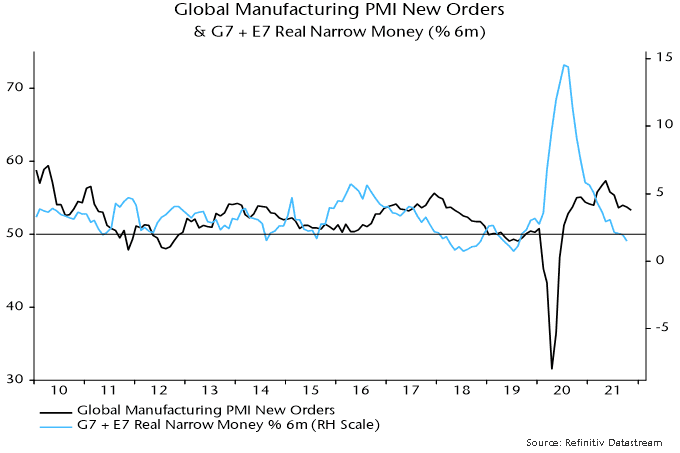
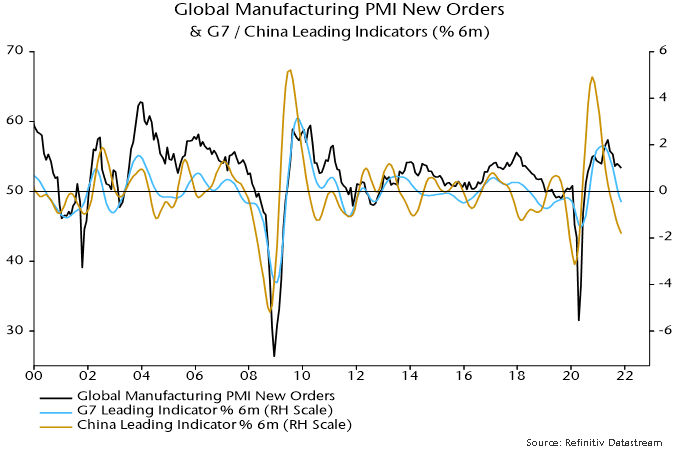
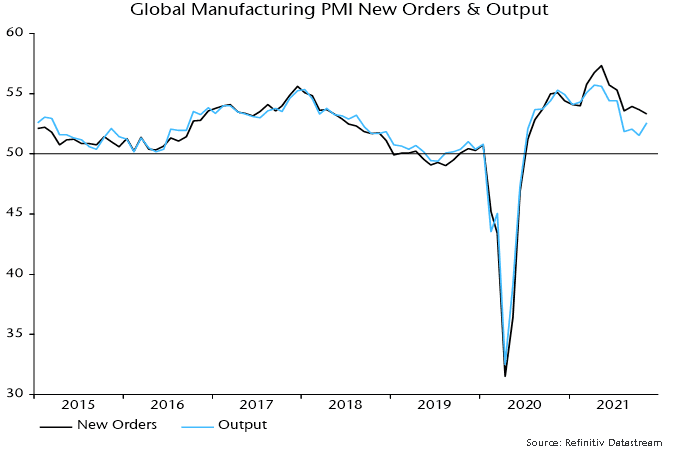
The global manufacturing PMI new orders index – a timely indicator of industrial demand momentum – eased to a 15-month low in November, continuing its decline from a May peak that was signalled by a July 2020 top in six-month real narrow money growth. With additional October data confirming a further fall in real money growth, the PMI orders slide is expected to extend into Q2 2022, at least – see chart 1.

Chart 1

The monetary slowdown signal is supported by the OECD’s leading indicators, November estimates of which are included in chart 2. The OECD indicators mostly exclude monetary aggregates and display a shorter lead time than money.

Chart 2

The November decline in global new orders reflected a slight firming in developed markets offset by EM weakness driven by a relapse in China.

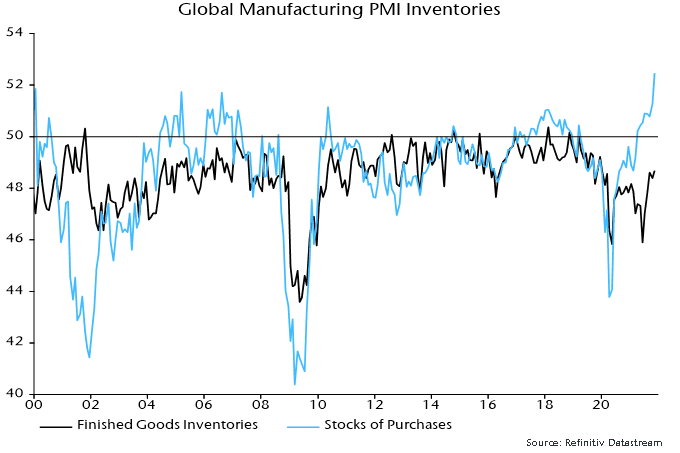
The most striking feature of the global report was a further surge in the stocks of purchases index – a gauge of the pace of input stockpiling – to a record. Finished goods inventory accumulation, by contrast, remains “normal” – chart 3.

Chart 3

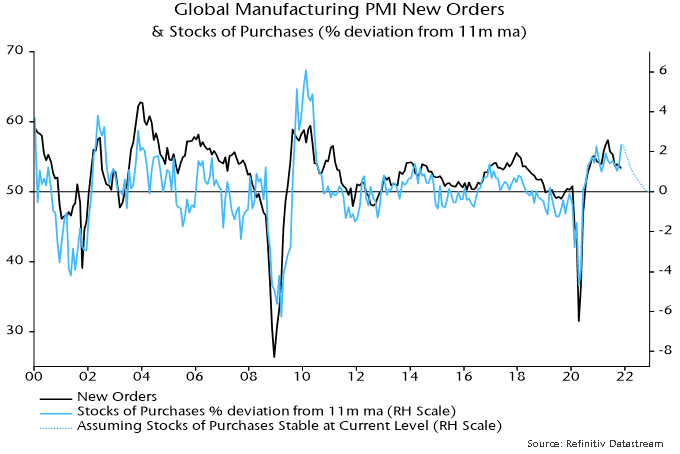
Input purchases by downstream manufacturers have boosted order flow for firms higher up the production chain. Such stockbuilding, however, is peaking and even a stabilisation at the current extreme pace would imply a drag effect on new orders – chart 4.

Chart 4

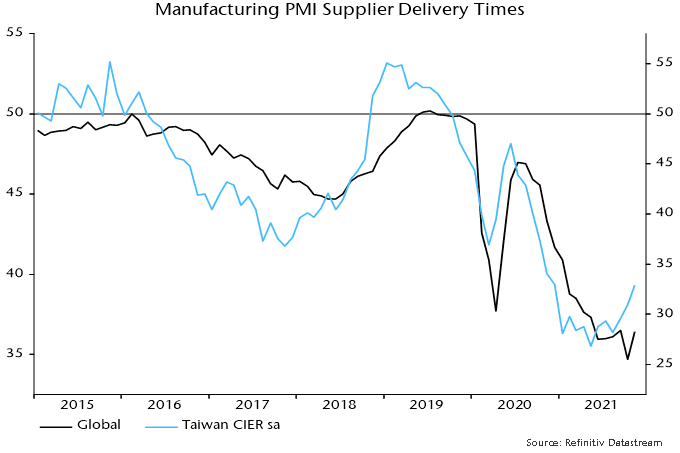
Cooling demand is starting to feed through to an easing of supply pressures. The supplier delivery times index recovered from an October record low (rise = faster), with an extension of an earlier turnaround in Taiwan, which typically leads, suggesting further improvement – chart 5.

Chart 5

Easing supply problems and a possible pick-up in finished goods inventory accumulation suggest that the PMI output index will catch up with and temporarily overtake new orders – chart 6. An improved supply / demand balance should also be associated with moderating price indices, which probably topped in October.

Chart 6

The judgement here is that markets will focus on softening demand / price momentum and “look through” a temporary output pick-up. Any reignition of the cyclical / reflation trade is likely to require a prior rebound in global real money growth.

These are the views of the author at the time of publication and may differ from the views of other individuals/teams at Janus Henderson Investors. Any securities, funds, sectors and indices mentioned within this article do not constitute or form part of any offer or solicitation to buy or sell them.

Past performance does not predict future returns. The value of an investment and the income from it can fall as well as rise and you may not get back the amount originally invested.

The information in this article does not qualify as an investment recommendation.

Marketing Communication.

Since the global COVID-19 pandemic began 17 months ago, we have seen a dizzying parade of investment themes (and memes) that have caught the imagination of investors big and small. From Electric Vehicles (EVs) to the latest canine-inspired crypto currency, and now NFTs (Non-Fungible Tokens) and the metaverse, where one can escape the harsh inflationary realities of post-pandemic life. At Global Alpha, we are not thematic investors, but we do rely on themes to offer tailwinds to companies that have been carefully vetted around our investment process.

Themes themselves can be broad-based and structural, or narrow and niche, fueled by the latest fad or trend. We tend to favour the former, which tends to last longer and influence a broad swath of the economy, cutting across sectors. Within emerging markets (EM) for example, a broad structural theme that is currently playing out is the increasing formalization of their economies. As per the International Monetary Fund (IMF), over 60% of the world’s adult labour force participates in the informal economy and accounts for around 35% of the GDP of emerging economies.

Also, informality is not evenly spread across the EM world; Latin America and Africa have higher levels of informality in comparison to East Asia. Emerging markets with large informal sectors tend to underperform and punch much below their weight. Several countries within our EM universe have been actively trying to remedy the situation in order to increase their overall economic productivity, increase the size of their tax base, and lift the living standards of their populations. One country that has really stood out in its push towards greater formalization of its economy has been India.

In the last five years, India has enacted three key measures to push its economy towards greater formalization. Firstly, demonetization of Rs 1,000 and Rs 500 notes in 2016 forced many informal workers to join the formal work force. Secondly, the implementation of Goods and Sales Tax (GST) forced unregistered firms operating in the cash economy to get registered and enter the formal economy. Finally, the first two measures acted as a tailwind for the rapid adoption of digital payments via the Unified Payments Interface (UPI) platform rolled out by the government. The net result, as per a recent report by the State Bank of India (SBI), is that the informal economy has now shrunk to 15-20% of GDP in 2020-2021, versus 52% of GDP in 2017-2018.

This recent shift towards formalization is a generational change and is impacting every sector of the economy. For the discerning investor, it offers an opportunity to identify winners and losers of this massive shakeout that is leading to consolidation and an increase in market power of a select few companies. A great example of this consolidation is the luggage industry in India, which is estimated to be worth around US$3 billion, of which only 25% is organized. The Indian luggage industry is projected to grow in the high teens, and this growth outlook is propelled by four interesting underlying trends.[3]

  1. Indians are travelling more and are making on average three trips every year as air traffic grew in double digits up to 2018.
  2. There is a rise in brand consciousness and luggage is now seen as a fashion statement rather than a mere utilitarian product.
  3. There is a higher spending on Indian weddings, where luggage is now included as part of the wedding trousseau.
  4. Replacement cycles have been reduced, with Indians replacing their luggage in four to five years (vs 10 years earlier) and their backpacks in two years (vs three to four years earlier).[5]

VIP Industries (VIP IN)

For us, a clear beneficiary of this trend has been VIP Industries (a portfolio holding), which, along with Safari Industries (SII IN; not a portfolio holding) and Samsonite (1910 HK; a portfolio holding), control more than 90% of the organized luggage space. VIP, however, is the clear market leader with a 52% market share, having been the number one brand in India for the last 50 years. VIP started in the 1970s, making briefcases for office goers, and the name VIP was meant to give its customers an aspirational tag. The company now makes hard and soft luggage, backpacks, and handbags.

With the entry of Samsonite in India, VIP was forced to rebrand and reinvent itself to cater to a younger and trendier demographic. The company decided to mimic Samsonite’s own successful international turnaround by focusing on clearly segmenting their brands, expanding distribution, cutting costs, and spending heavily on branding. In addition to this, the company decided to switch from a promoter-led entity to hiring professional management.

The combination of these company-specific changes and macro tailwinds, coming from the shift to the organized sector, has led to remarkable results for VIP. If one were to look at their financial performance from 2016, which marked the acceleration of the shift towards formalization, up to the end of 2019, before the pandemic, we see that the company’s EBITDA and net income has more than doubled. With zero debt, their return on invested capital (ROIC) grew from 19.5% in 2016 to 25% in 2019, as VIP decided to rely less on imports from China, and invest in their own manufacturing units in India and low-cost Bangladesh.

While the pandemic disrupted travel and led to a sharp drop in business at VIP, our discussions with management indicate that demand has rebounded sharply with pent up demand for travel and discretionary spending, such as weddings, leading to higher volumes. VIP intends to take advantage of the dislocations in Chinese manufacturing resulting from power outages by leveraging its new manufacturing capacities while launching new SKUs to capture the market share across segments. As the market and the Indian consumer slowly moves away from the unorganized market, we see VIP further consolidating its position as a market leader.

At Global Alpha, we remain committed to separating themes from memes and identifying winners who can clearly benefit from these once-in-a-lifetime shifts in emerging economies.

Have a nice day.

The Global Alpha team


[3] Ambit Capital Research

[5] Ambit Capital Research