A pull-back in US narrow money momentum casts doubt on post-election economic optimism.

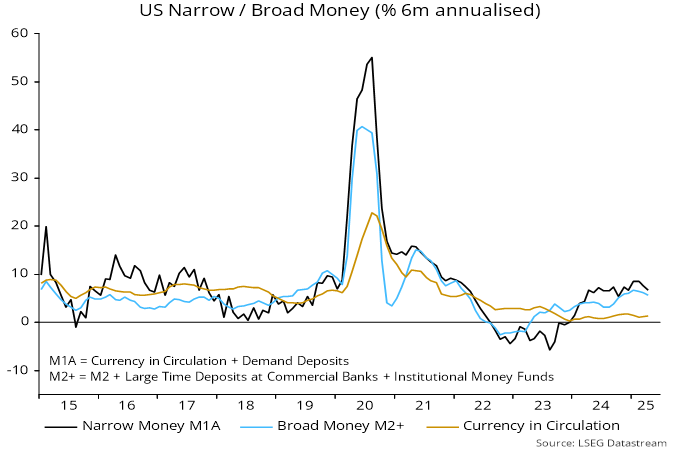
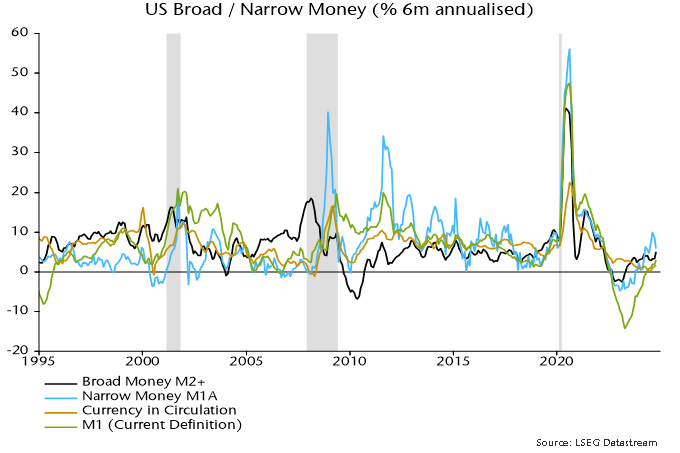
Six-month growth of M1A (comprising currency in circulation and demand deposits) eased to 5.7% annualised in October, down from an August peak of 10.0% – see chart 1.

Chart 1

Chart 1 showing US Broad / Narrow Money (% 6m annualised)

Growth of the broad M2+ measure, by contrast, rose to 5.1% annualised, the fastest since March 2022. (M2+ adds large time deposits at commercial banks and institutional money funds to the official M2 measure.) Narrow money, however, has a better record of signalling turning points in economic momentum.

Six-month expansion of official M1 is weaker, at 2.9%. M1 is no longer a narrow money measure, following its redefinition in 2020 to include savings accounts.

post in September expressed doubt that a pick-up in M1A growth would be sustained, partly because it had occurred before any rate cuts. In addition, the rise had been driven solely by the demand deposit component, with currency momentum unusually weak.

Six-month growth of currency has recovered but was still only 1.7% annualised in October – chart 1.

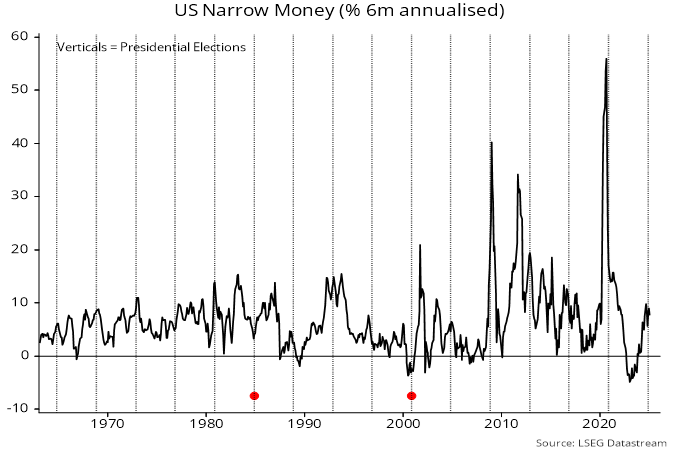
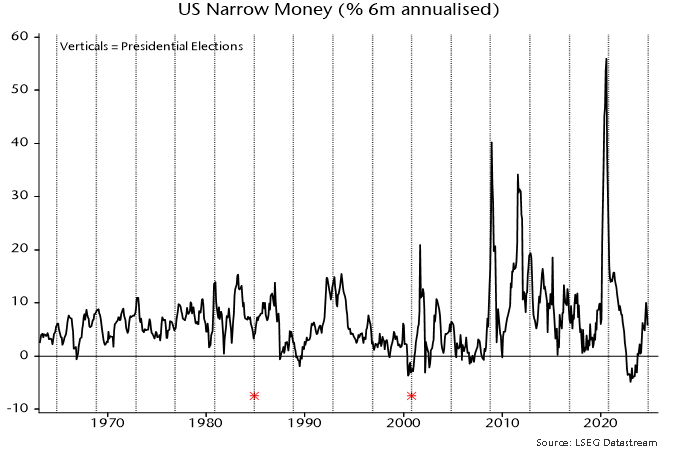
A further consideration, noted in a post last month, is that narrow money growth has tended to rise ahead of presidential elections but reverse shortly before or after the poll date – chart 2. (1984 and 2000 were notable exceptions.)

Chart 2

Chart 2 showing US Narrow Money (% 6m annualised)

The pull-back to date has been modest but could become more serious, especially if the Fed delays further rate cuts.

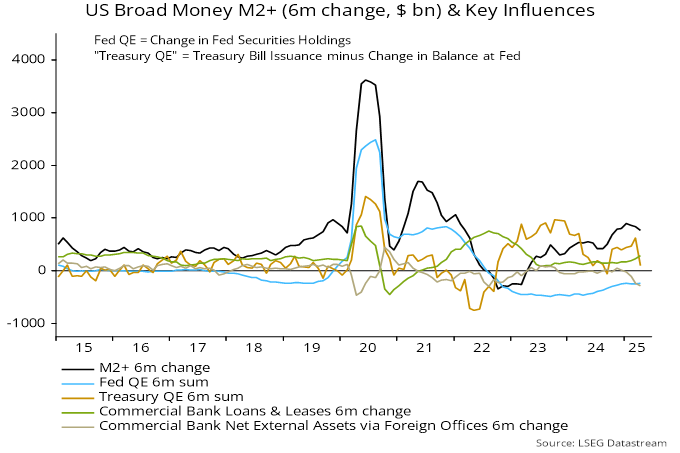
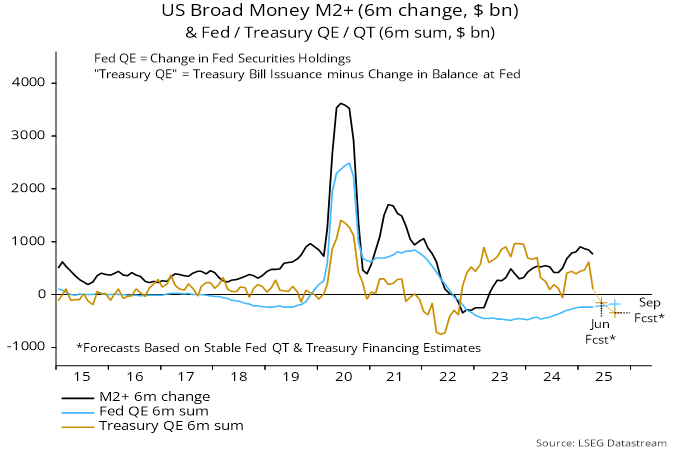
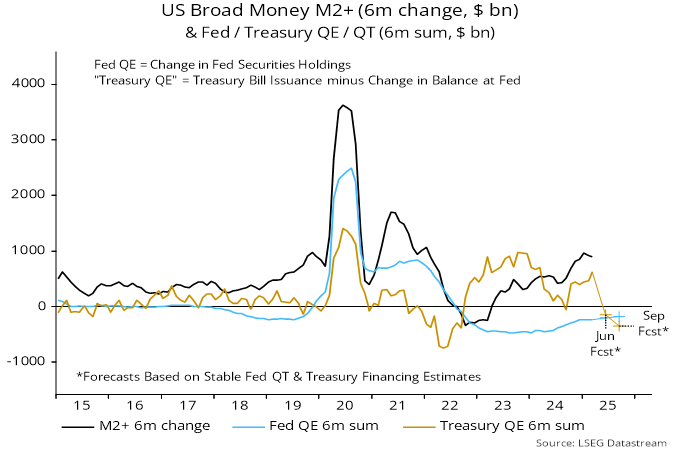
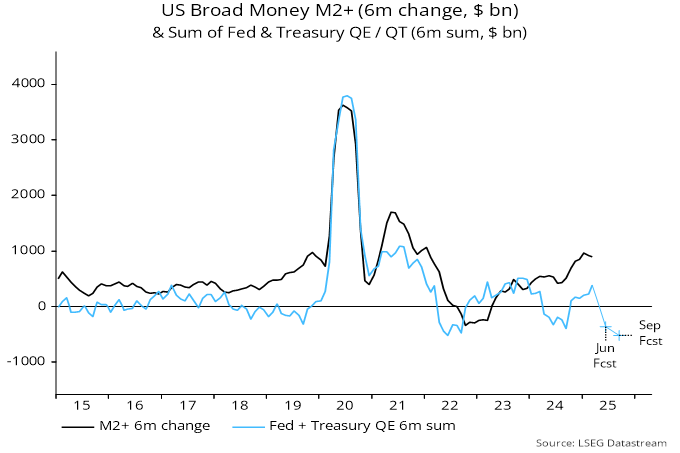
Broad money growth, however, could be supported by increased monetary financing of the fiscal deficit, based on Treasury plans for higher bill issuance in Q4 and Q1 (given that these are mostly purchased by money funds and banks).

Narrow / broad money divergences can reflect shifts in confidence and spending intentions affecting broad money velocity. (Such shifts are associated with movements between low-velocity broad money components and high-velocity narrow money.) Relative narrow money strength into the summer was a positive signal for the economy; the reversal suggests fading prospects.

A pick-up in US narrow money momentum is a hopeful signal for 2025 but requires confirmation and does not preclude near-term economic deterioration.

The measure of narrow money tracked here (M1A, comprising currency in circulation and demand deposits) rose by 0.8% in August, pushing six-month annualised growth up to 10.5% – see chart 1.

Chart 1

Chart 1 showing US Broad / Narrow Money (% 6m annualised)

The broad M2+ measure (which adds large time deposits at commercial banks and institutional money funds to the official M2 aggregate) also rose solidly in August, by 0.5%, but six-month growth remains subdued and within the recent range, at 3.5% annualised.

Six-month expansion of official M1 is weaker, at 2.1%. M1 is no longer a narrow money measure, following its redefinition in 2020 to include savings accounts.

Narrow money outperforms broad as a leading indicator of economic direction. The recent pick-up suggests that demand and activity will be gaining momentum by mid-2025. It does not, however, preclude – and may be consistent with – current economic deterioration.

Six-month narrow money momentum similarly recovered from negative to 10% annualised in September 2001 and September 2008. In both cases, the economy was within a recession that the NBER had yet to recognise.

Those narrow money rebounds may have partly reflected a rise in liquidity preference associated with an increase in saving, i.e. they may have been a signal of a reduction in current demand. They also, however, implied potential for future economic reacceleration when liquidity preference normalised and money balances were redeployed.

The 2001 / 2008 experiences were atypical: in earlier recessions, six-month narrow money growth rose strongly only at the end of – or after – the period of economic contraction.

A reasonable assessment, therefore, is that a pick-up in narrow money momentum is a neutral or negative signal for current economic momentum but positive for prospects six to 12 months ahead.

The current positive message is tempered by several considerations.

First, six-month momentum is likely to fall back in September / October because of negative base effects: narrow money rose by a whopping 3.1% (20.0% annualised) in March / April combined.

Secondly, the currency and demand deposit components of narrow money have been individually correlated with future activity historically but the recent pick-up has been solely due to the latter, with currency momentum unusually weak – chart 1.

Thirdly, the Fed funds target rate had been cut by 350 bp and 325 bp respectively by the time six-month narrow money momentum reached 10% annualised in 2001 and 2008. The Fed’s tardiness has increased the risk of a monetary relapse.