Eurozone and UK money trends have shown disappointingly small responses to policy easing, suggesting that rates remain in restrictive territory and casting doubt on hopes of stronger economic growth.

The preferred monetary aggregates here are “non-financial”, covering households and non-financial corporations. Money holdings of financial institutions are volatile and less informative about near-term economic prospects.

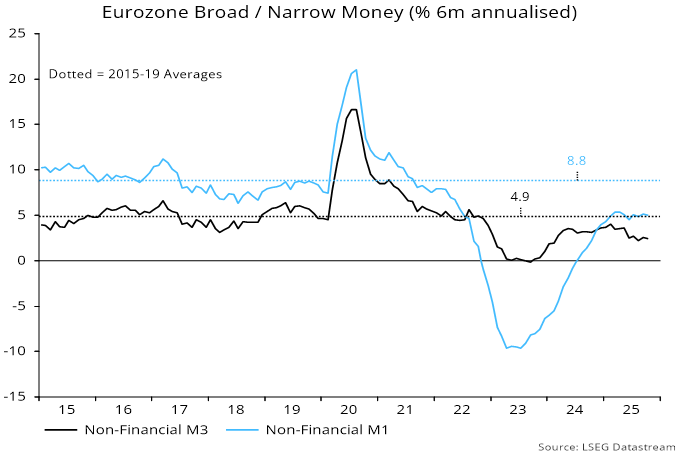
A recovery in six-month growth rates of Eurozone narrow and broad money stalled in early 2025 despite the ECB continuing to cut rates through June, with both well below pre-pandemic averages – see chart 1.

Chart 1
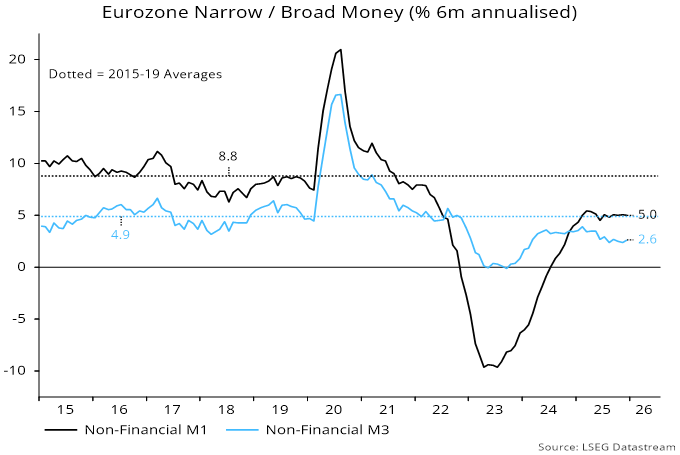
Chart 1 showing Eurozone Narrow / Broad Money (% 6m annualised)

The UK profile is different. The laggardly pace of rate cuts appears to have contributed to a relapse in growth rates in H1 2025 but these recovered into November, moving sideways in December – chart 2.

Chart 2
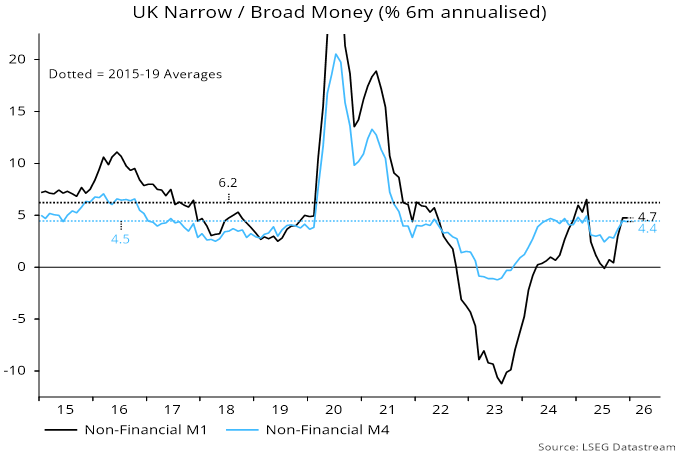
Chart 2 showing UK Narrow / Broad Money (% 6m annualised)

While suggesting UK relative improvement, narrow money expansion remains beneath its pre-pandemic average (and the Eurozone level), with annual broad money growth a below-par 3.8% (versus 2.7% in the Eurozone).

One reason for the disappointing responses is that policy rate cuts have yet to translate into a decline in longer-term yields. Relatedly, UK QT has been a significant and unnecessary drag.

A hopeful scenario is that low inflation implied by weak broad money trends will allow longer-term yields to subside. Still, additional policy adjustment will likely also be required to generate a monetary response sufficient to warrant economic optimism.
Eurozone monetary trends suggest that interest rates remain above a “neutral” level.

The ECB’s deposit rate has been stable at 2.0% since June, following a 200 bp reduction over the prior 12 months. Lower rates should be feeding through to money trends by now.

Six-month growth of non-financial M3, however, was 2.4% annualised in October, half its average in the five years before the pandemic and slightly below the level when rate cuts started.

Chart 1

Chart 1 showing Eurozone Broad / Narrow Money (% 6m annualised)

Non-financial M3 comprises broad money holdings of households and non-financial corporations (NFCs). Six-month growth of headline M3, including volatile financial sector money, was even weaker, at 1.8% annualised.

Narrow money growth – as measured by non-financial M1 – is stronger but also below its pre-pandemic average.

There is no sign of acceleration in the latest numbers, with three-month rates of change close to six-month levels.

Broad money probably needs to expand by at least 4% pa to accommodate potential growth of about 1.25% pa and 2% inflation, allowing for a long-run decline in velocity. (The ratio of nominal GDP to non-financial M3 fell by 1.9% pa on average over 2000-19.)

Money growth below this level implies downward pressure on output relative to trend and / or inflation – inconsistent with rates being at “neutral”.

Slow broad money growth is partly attributable to sluggish credit trends: lending to households and NFCs rose by 2.8% annualised in the six months to October, with momentum stable recently.

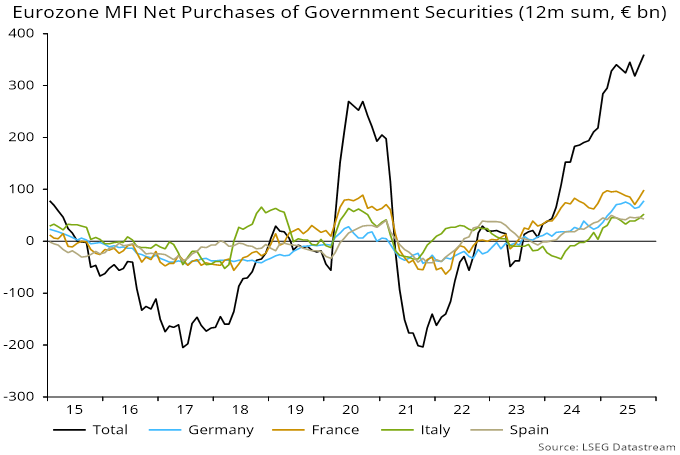
A drag from ECB QT, meanwhile, has been fully offset by solid buying of government bonds by banks. Purchases have been spread across countries but were largest in France over the past 12 months – chart 2.

Chart 2

Chart 2 showing Eurozone MFI Net Purchases of Government Securities (12m sum, £ bn)

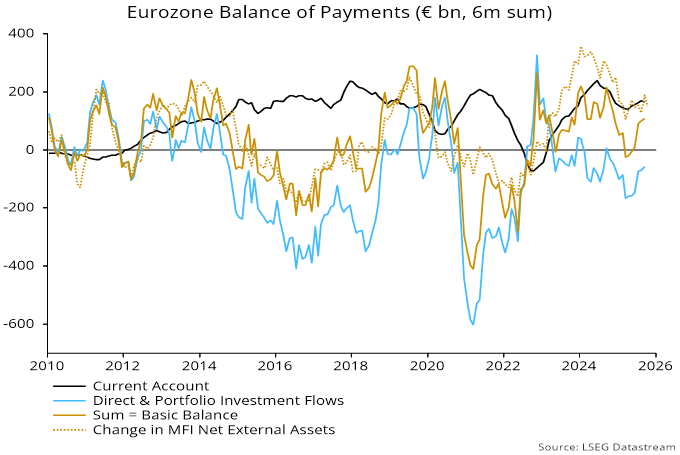
Money growth would have been weaker without support from external inflows, reflecting a basic balance of payments surplus and a corresponding rise in banks’ net external assets – chart 3.

Chart 3

Chart 3 showing Eurozone Balance of Payments (£ bn, 6m sum)

Eurozone narrow and broad money measures rose respectably on the month in September but six-month momentum remains sluggish, at roughly half the pre-pandemic pace – see chart 1.

Chart 1

Chart 1 showing Eurozone Narrow / Broad Money (% 6m annualised)

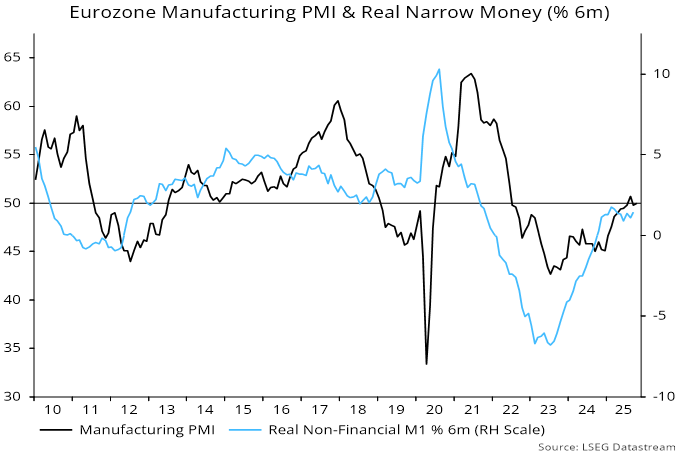
Six-month real narrow money momentum is below a peak reached in February, consistent with a stalled recovery in the manufacturing PMI – chart 2. A recent pick-up in services results may prove short-lived.

Chart 2

Chart 2 showing Eurozone Manufacturing PMI & Real Narrow Money (% 6m)

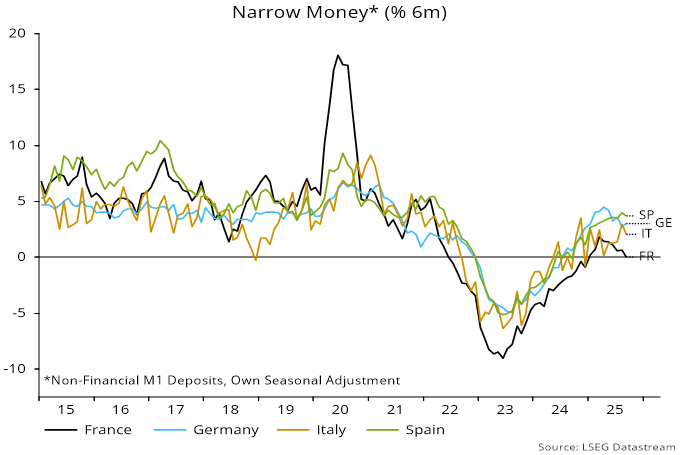
Country details show French relative weakness, with M1 deposits of households and non-financial firms stagnant in nominal terms over the last six months, implying real contraction – chart 3.

Chart 3

Chart 3 showing Narrow Money* (% 6m) *Non-Financial M1 Deposits, Own Seasonal Adjustment

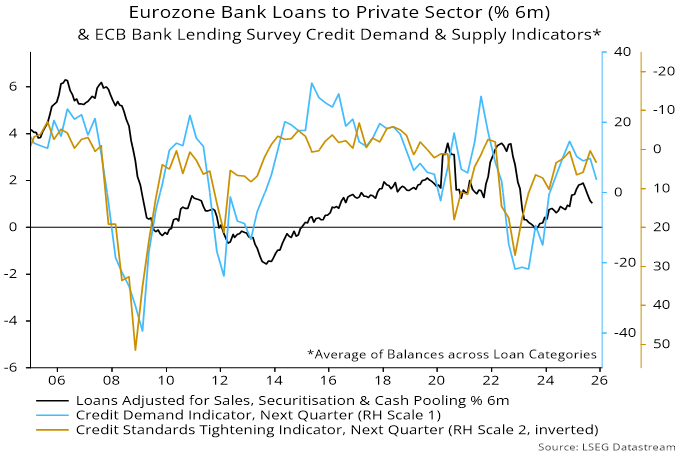
Six-month bank lending growth has cooled, with expected credit demand balances in the latest ECB loan officer survey suggesting a further slowdown – chart 4.

Chart 4

Chart 4 showing Eurozone Bank Loans to Private Sector (% 6m) & ECB Bank Lending Survey Credit Demand & Supply Indicators* *Average of Balances across Loan Categories

Bullish economic hopes rest on German fiscal easing but restriction elsewhere will temper the impact. The Eurozone cyclically adjusted fiscal deficit is projected by the IMF to widen by a modest 0.3% of GDP in 2026, after no change this year.

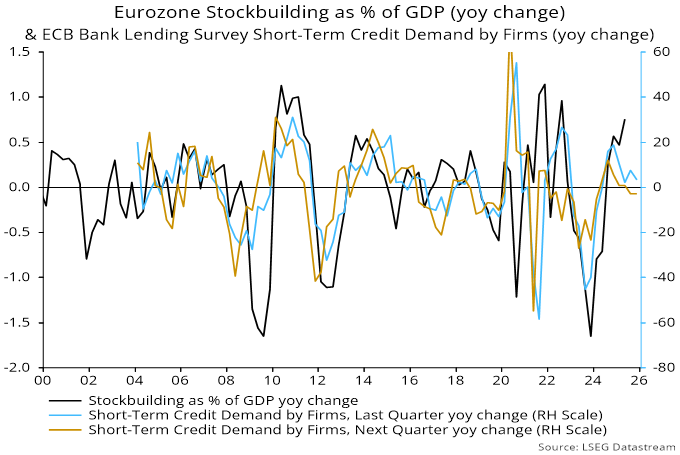
A downturn in the stockbuilding cycle could more than offset fiscal support. A rise in stockbuilding accounted for 0.8 pp of GDP growth of 1.5% in the year to Q2 2025. (The “true” contribution will have been smaller because of an associated increase in imports.)

Stockbuilding is a key influence on firms’ demand for short-term credit. Year-on-year changes in credit demand balances in the bank lending survey have weakened, consistent with a prospective stockbuilding downswing – chart 5.

Chart 5

Chart 5 showing Eurozone Stockbuilding as % of GDP (yoy change) & ECB Bank Lending Survey Short-Term Credit Demand by Firms (yoy change)

Eurozone money trends have been giving a downbeat signal for economic prospects. Incoming evidence is consistent with a loss of momentum.

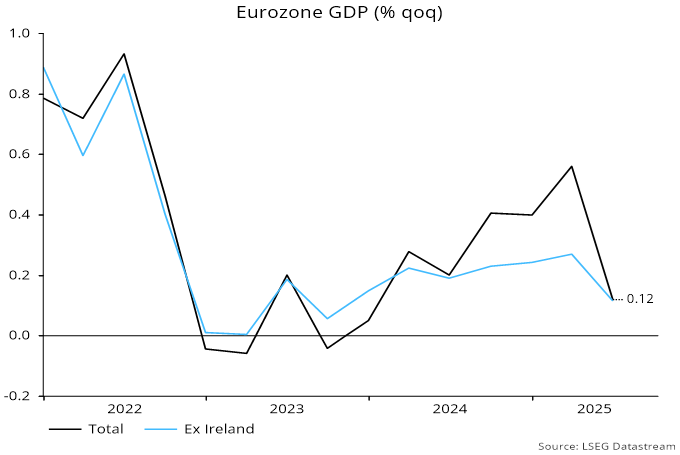
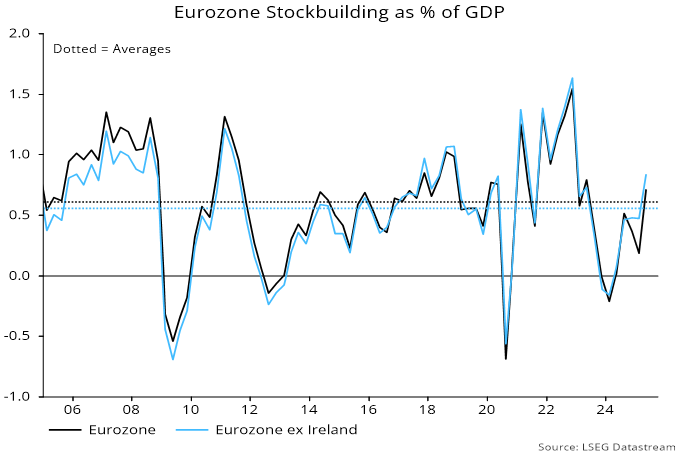
Eurozone GDP rose by only 0.8% at an annualised rate during H1 excluding distorted Irish numbers – see chart 1. Growth was dependent on an increase in stockbuilding, to an above-average level as a percentage of GDP – chart 2.

Chart 1

Chart 1 showing Eurozone GDP (% qoq)

Chart 2

Chart 2 showing Eurozone Stockbuilding as % of GDP

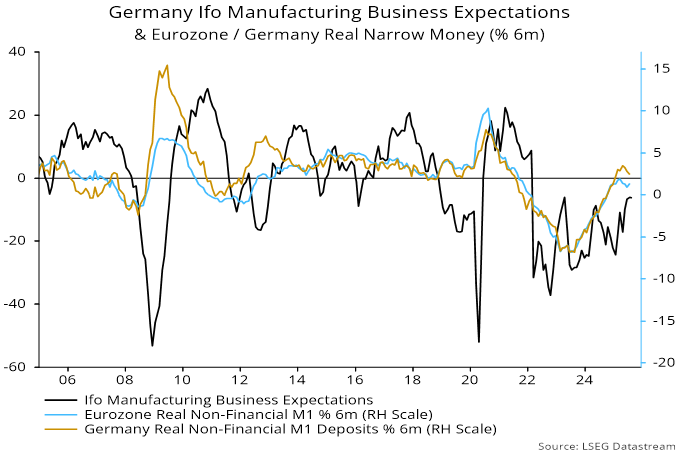
Rises in bond yields and the euro exchange rate have tightened monetary conditions, offsetting ECB rate cuts. Six-month Eurozone real narrow money momentum peaked in March, although the subsequent reversal has been modest – chart 3.

Chart 3

Chart 3 showing Germany Ifo Manufacturing Business Expectations & Eurozone / Germany Real Narrow Money (% 6m)

German Ifo manufacturing business expectations – closely correlated with Eurozone / German manufacturing PMIs – reached a two-year high in July, consistent with earlier monetary acceleration. Expectations moved sideways in August, with the March peak in real money momentum suggesting an inflection weaker soon.

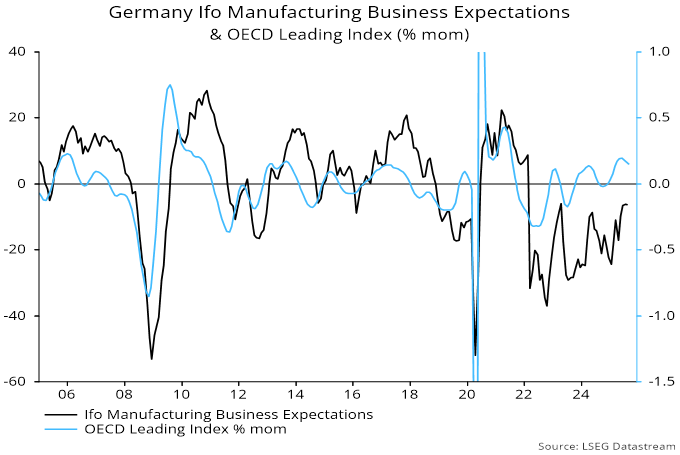
Other evidence supports this forecast. The one-month change in the OECD’s German leading index also anticipates turning points in Ifo expectations and has eased since May – chart 4.

Chart 4

Chart 4 showing Germany Ifo Manufacturing Business Expectations & OECD Leading Index (% mom)

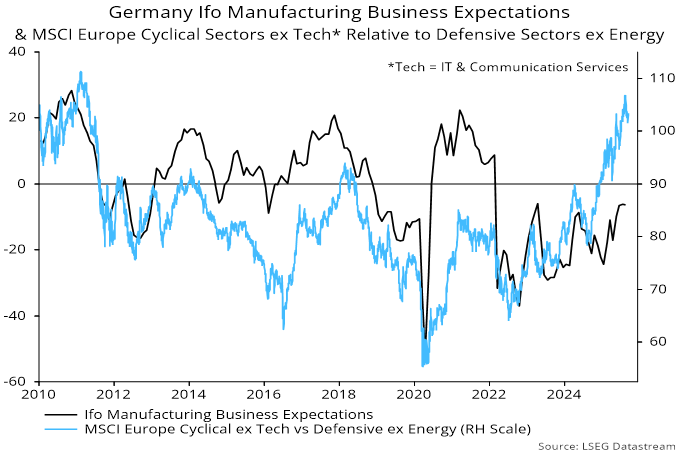
European cyclical sector equities often start to lag as business surveys inflect weaker and have given back some outperformance since mid-August – chart 5.

Chart 5

Chart 5 showing Germany Ifo Manufacturing Business Expectations & MSCI Europe Cyclical Sectors ex Tech* Relative to Defensive Sectors ex Energy *Tech = IT & Communication Services

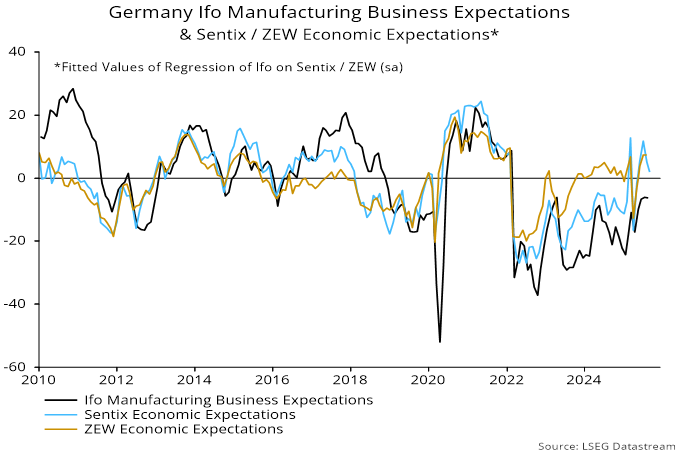
The Sentix and ZEW surveys of financial analysts correlate with Ifo results, with Sentix September numbers already available and showing a second monthly decline – chart 6.

Chart 6

Chart 6 showing Germany Ifo Manufacturing Business Expectations & Sentix / ZEW Economic Expectations* *Fitted Values of Regression of Ifo on Sentix / ZEW (sa)

The slowdown in Eurozone / German real money momentum is not yet alarming and may prove temporary, particularly if bond yields and the euro subside. Still, the ECB’s move to the sidelines was premature, with near-term data likely to bolster the case for further easing.

Recent Eurozone money trends cast doubt on economic optimism based on German / regional fiscal expansion. Weakening job openings suggest that a negative economic scenario is already starting to crystallise.

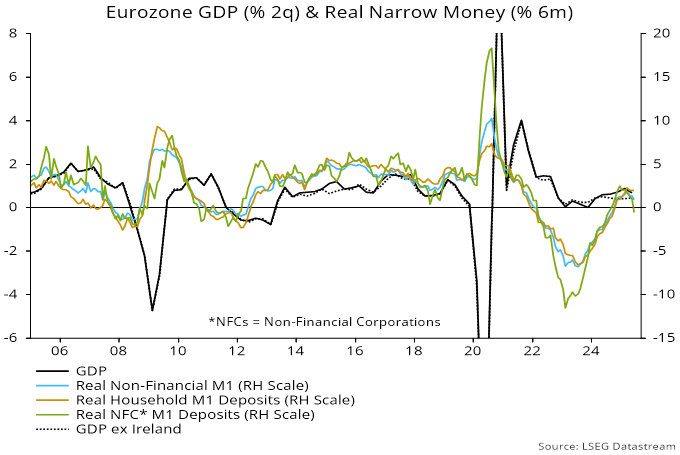
Six-month real narrow money momentum peaked in March at a modest level by historical standards, declining into June. The fall was driven by weakness in corporate deposits, suggesting that firms would cut back investment and hiring – see chart 1 and previous post for more discussion.

Chart 1

Chart 1 showing Eurozone GDP (% 2q) & Real Narrow Money (% 6m)

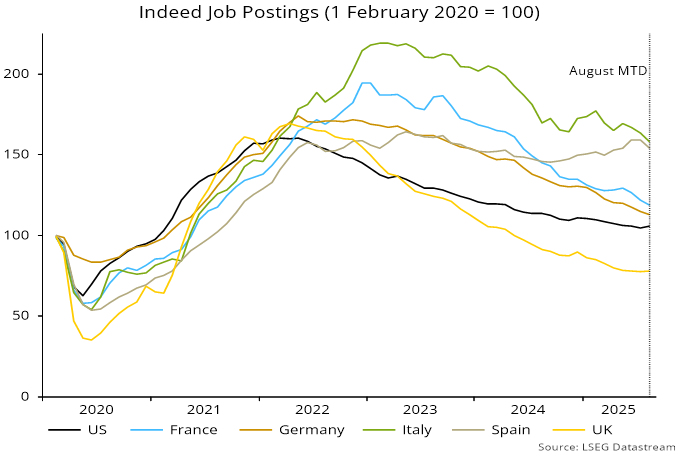
Indeed numbers on job postings are a timely coincident indicator of labour demand and appear to display less volatility than official survey-based measures of job openings or vacancies. The level and rate of decline of the UK Indeed series signalled recent job losses – chart 2.

Chart 2

Chart 2 showing Indeed Job Postings (1 February 2020 = 100)

The latest numbers show signs of stabilisation in the UK / US. By contrast, job postings in Germany and France are falling rapidly, with the Italian series breaking below its late 2024 low and even Spain rolling over.

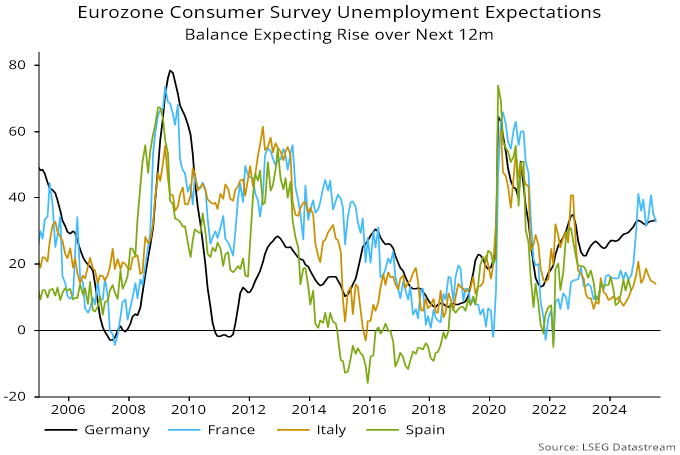
The German / French results chime with elevated consumer expectations of a rise in unemployment – chart 3*.

Chart 3

Chart 3 showing Eurozone Consumer Survey Unemployment Expectations
Balance Expecting Rise over Next 12m

Why haven’t ECB rate cuts and German fiscal expansion energised the Eurozone economy? The initial impact of the fiscal news has been to push up longer-term yields and the euro, offsetting ECB stimulus.

Fiscal expansion, even if well-executed, will play out over the medium term, with growth implications dependent partly on the extent of monetary financing. The direct and confidence effects of the unfavourable US-EU trade “deal”, meanwhile, are a further near-term negative.

*The Spanish series has been suspended.

June money numbers cast doubt on ECB President Lagarde’s assertion that policy-makers – and by extension the Eurozone economy – are “in a good place”.

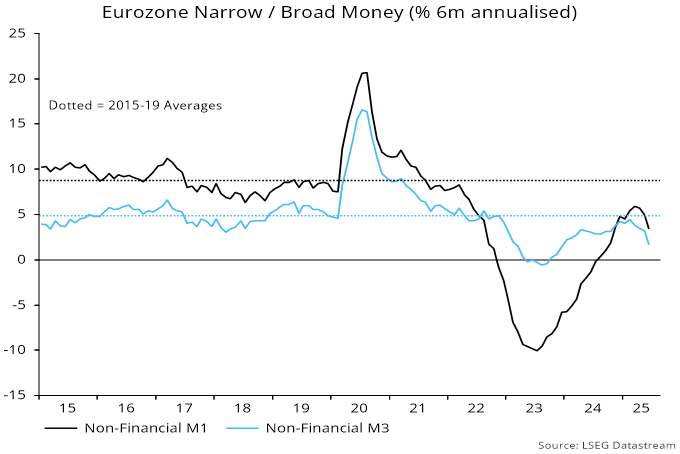
Six-month growth of the preferred narrow / broad money measures here – non-financial M1 / M3, comprising holdings of households and non-financial corporations (NFCs) – fell further to 3.4% and 1.6% annualised respectively last month. The latter is the slowest since December 2023 and compares with a 4.9% average over 2015-19 – see chart 1.

Chart 1

Chart 1 showing Eurozone Narrow / Broad Money (% 6m annualised)

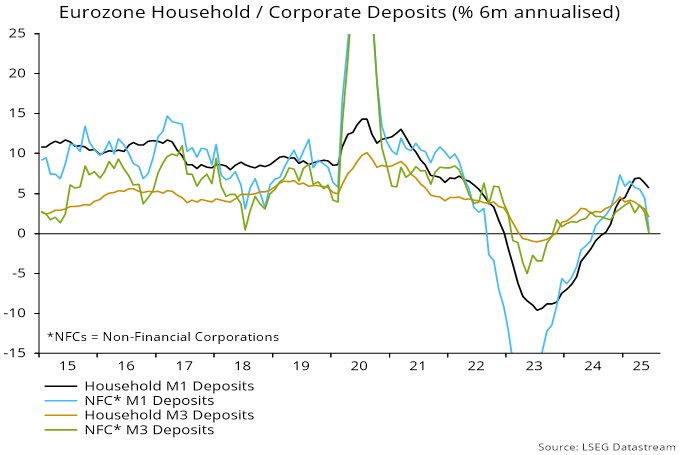
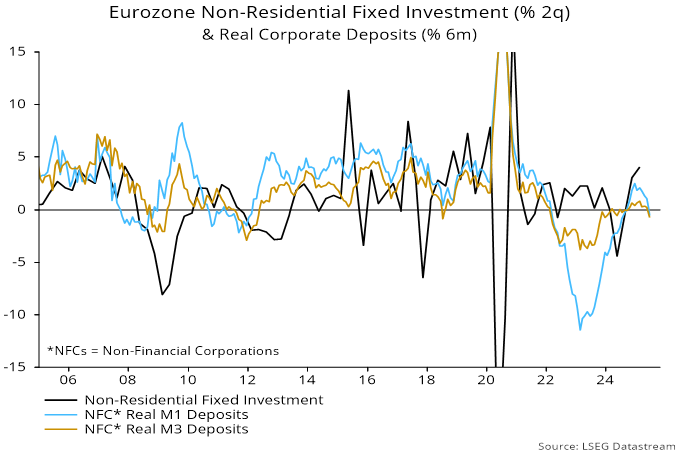
Weakness is focused on the corporate sector: NFC M1 / M3 deposits rose by only 0.5% and 0.1% annualised respectively in the six months to June, implying real terms contraction – chart 2.

Chart 2

Chart 2 showing Eurozone Household / Corporate Deposits (% 6m annualised)

Corporate liquidity deterioration suggests that companies are under increased financial pressure and will rein in expansion plans – chart 3. A contraction in UK real corporate money preceded recent employment cut-backs.

Chart 3

Chart 3 showing Eurozone Non-Residential Fixed Investment (% 2q) & Real Corporate Deposits (% 6m)

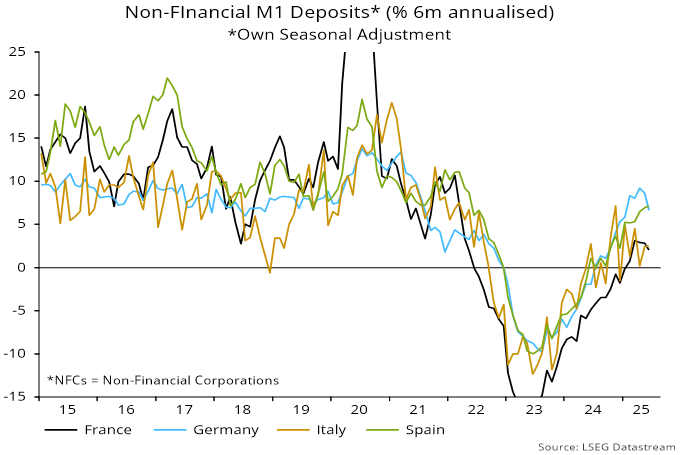
Six-month narrow money momentum is notably weaker in France / Italy than Germany / Spain, although German growth has fallen back since April – chart 4.

Chart 4

Chart 4 showing Non-Financial M1 Deposits* (% 6m annualised) *Own Seasonal Adjustment

Consensus commentary focuses on bank lending, which, as an empirical matter, lags money trends. Adjusted loans to households and NFCs rose by a solid 0.4% on the month but six-month growth eased from 3.0% to 2.8% annualised. The “credit impulse”, in other words, may be rolling over.

Recent rate cuts are feeding through and it is possible that monetary weakness will prove temporary. Still, ECB officials should be concerned by the slowdown and signalling an openness to further easing rather than projecting complacency.

Eurozone / UK money growth has weakened despite rate cuts, suggesting that central banks – particularly the MPC – have more work to do to sustain economic expansion and prevent inflation undershoots.

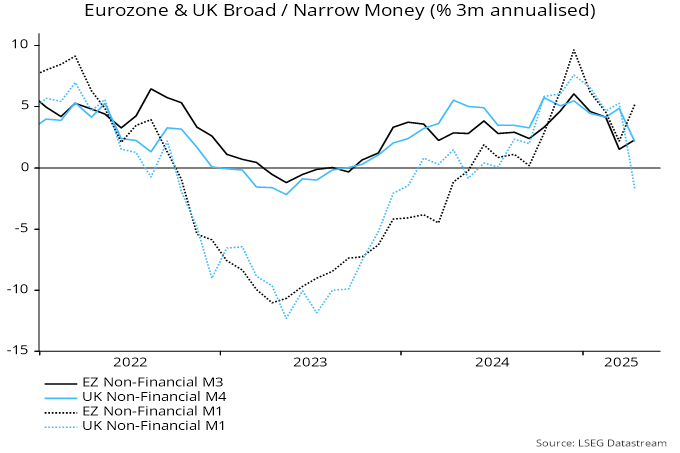
Preferred broad money aggregates – Eurozone non-financial M3 and UK non-financial M4 – grew by 2.3% and 2.1% annualised respectively in the three months to April, down from 4.6% and 4.4% in the prior three months – see chart 1.

Chart 1

Chart 1 showing Eurozone & UK Broad / Narrow Money (% 3m annualised)

Concern about the Eurozone slowdown is tempered by still-respectable narrow money growth – non-financial M1 rose by 5.2% annualised between January and April versus 6.2% in the prior three months.

UK non-financial M1, by contrast, contracted by 1.7% annualised in the latest three months, following 6.5% growth in the three months to January.

The slump in UK momentum was driven by a month-on-month fall of 1.0% (not annualised) in April, mostly due to the household component. This may have been related to the end of the stamp duty holiday on 31 March – a bunching of transactions and mortgage borrowing ahead of the deadline may have been associated with a temporary rise in demand for sight deposits, which reversed in April as activity normalised.

An additional possibility is that individuals who sold assets in anticipation of tax rises in the October Budget delayed reinvesting the proceeds until the start of the 2025-26 tax year.

Household broad money rose by 0.2% in April despite the big fall in sight deposits, reflecting a record £14.0 billion inflow to cash ISAs.

Still, the movement of money out of current accounts is a negative signal for the economy, suggesting low spending intentions and a preference for saving.

UK corporate broad money, meanwhile, resumed a decline in the latest three months, suggesting that firms remain under financial pressure to cut jobs and investment.

Eurozone March money numbers were mixed, suggesting that further ECB policy easing will be required to insulate the economy from global weakness.

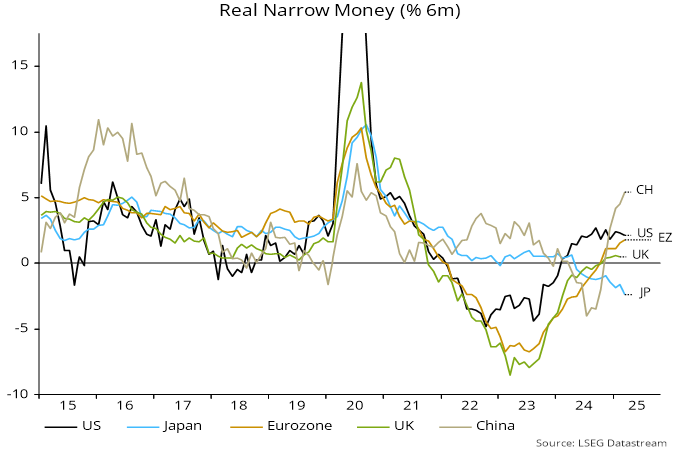
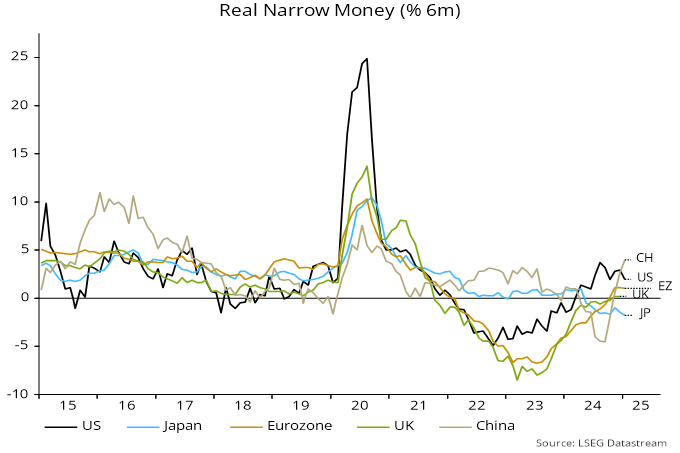
Positively, six-month real narrow money momentum rose further in March, almost closing the gap with the US – chart 1.

Chart 1

Chart 1 showing Real Narrow Money (% 6m)

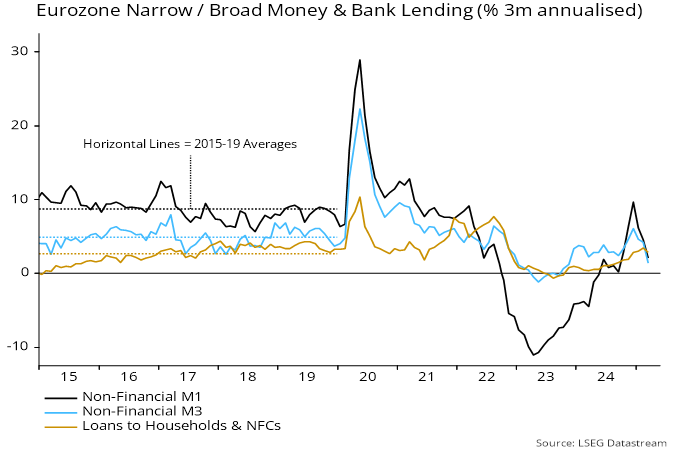
The six-month change, however, conceals a pull-back in growth in the latest three months, with broad money also slowing. Bank loan expansion has retained momentum but is a coincident / lagging indicator, while money leads – chart 2.

Chart 2

Chart 2 showing Eurozone Narrow / Broad Money & Bank Lending (% 3m annualised)

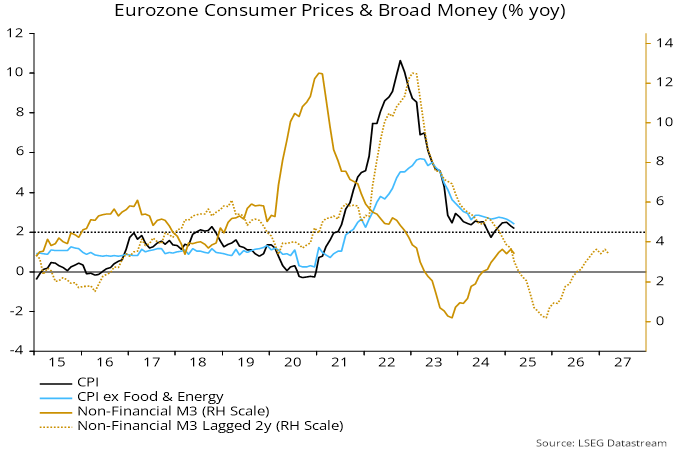
Annual broad money growth has stalled well below a level likely to be consistent with achievement of the 2% inflation target over the medium term – chart 3.

Chart 3

Chart 3 showing Eurozone Consumer Prices & Broad Money (% yoy)

Weaker narrow money growth in the latest three months may reflect a downward revision of spending intentions in response to US policy news. A Q1 rise in longer-term bond yields may also have acted as a dampener, though has since reversed.

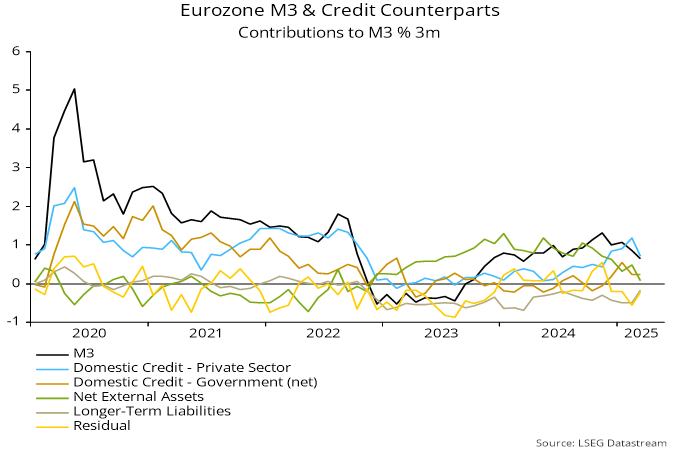
The fall in broad money growth was driven mainly by a slowdown in banks’ net external assets, according to the credit counterparts analysis. The government contribution has been positive recently, with the ECB’s passive QT more than offset by securities purchases by banks – chart 4.

Chart 4

Chart 4 showing Eurozone M3 & Credit Counterparts Contributions to M3 % 3m

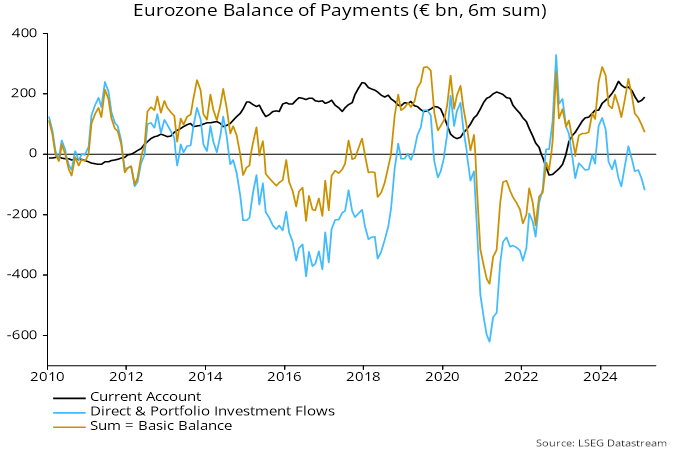
Conceptually, the change in banks’ net external assets is the counterpart of the basic balance of payments position (current account plus net direct and portfolio investment). The basic balance surplus has fallen back as the current account surplus has moderated and a deficit on the direct / portfolio capital account has widened – chart 5.

Chart 5

Chart 5 showing Eurozone Balance of Payments (£ bn, 6m sum)

The capital account deterioration mainly reflects transactions in short-term debt securities, possibly motivated by changes in interest rate differentials.

Changes in the basic balance have been weakly correlated with exchange rate movements historically. Still, the fall in the surplus casts doubt on forecasts of further euro strength.

US / Eurozone January money numbers suggest that US policy chaos is damaging economic prospects.

The narrow money measures followed here – US M1A and Eurozone non-financial M1 – were unchanged and fell on the month respectively. Narrow money weakness can reflect reduced confidence and spending intentions.

US six-month real narrow money momentum fell between August and October, partially recovered into year-end but has now returned to the October level – see chart 1. The slowdown since August signalled recent softer economic data – see previous post.

Chart 1

Chart 1 showing Real Narrow Money (% 6m)

A recovery in Eurozone six-month real narrow money momentum stalled in December / January but the gap with the US has narrowed significantly since August, suggesting better relative performance.

US narrow money momentum may weaken further. Policy chaos may cause spending to be deferred, reducing demand for transactions money.

The Fed has gone on hold with rates judged still to be in restrictive territory. The ECB has cut by more, is still in easing mode and may be closer to “neutral”.

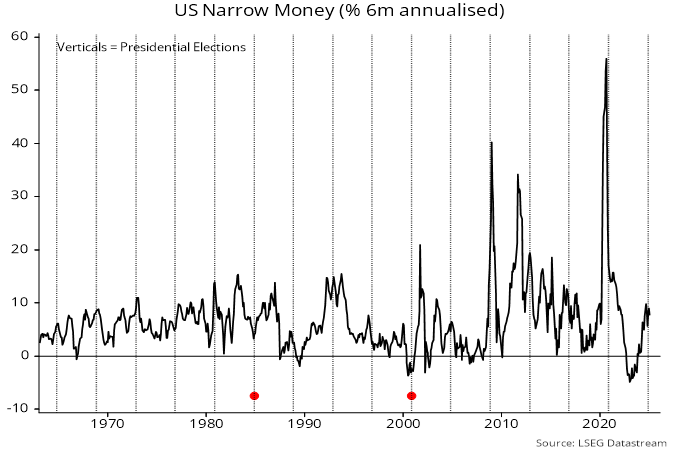
A further consideration noted previously is that US narrow money growth has tended to rise into presidential elections but reverse shortly before or after the poll date – chart 2. (1984 and 2000 were notable exceptions.)

Chart 2

Chart 2 showing US Narrow Money (% 6m annualised)

Whisper it softly but Eurozone economic prospects are improving.

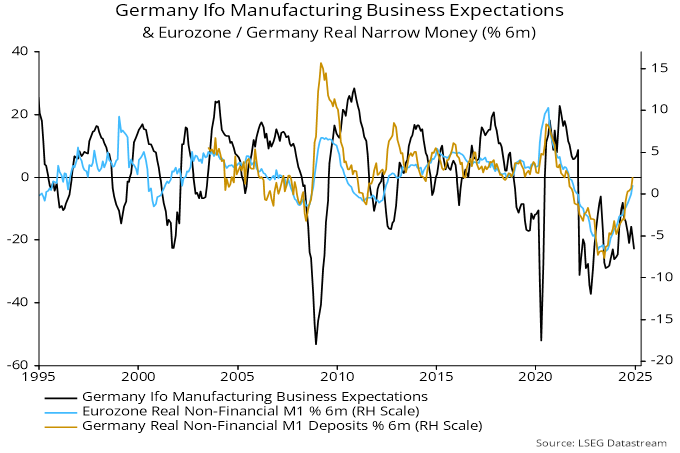
Six-month momentum of real non-financial M1 turned positive in October, reaching a three-year high in November. The recovery has been broadly-based across countries, with German momentum slightly above the Eurozone average – see chart 1.

Chart 1

Chart 1 showing Germany Ifo Manufacturing Business Expectations & Eurozone / Germany Real Narrow Money (% 6m)

The sectoral breakdown shows that real M1 deposits of both households and non-financial corporations have returned to growth – in contrast to the UK, where corporate narrow money is still contracting, in nominal as well as real terms.

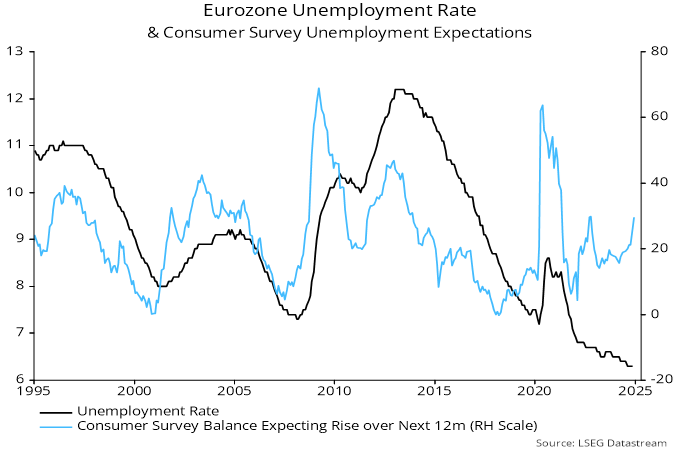
Economic news supports further policy easing. Six-month headline / core CPI momentum is close to target (2.1% / 2.2% annualised respectively in December) and there are signs of labour market softening, including a pick-up in consumer unemployment expectations – chart 2.

Chart 2

Chart 2 showing Eurozone Unemployment Rate & Consumer Survey Unemployment Expectations

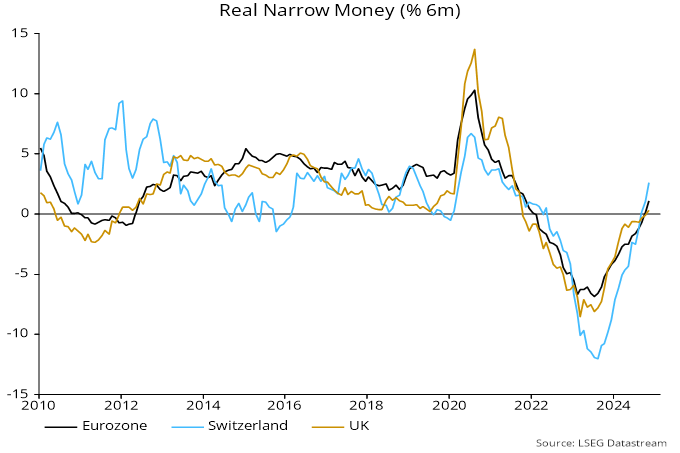
The Swiss National Bank started cutting rates in March, three months before the ECB, with the cumulative reduction now 125 bp versus 100 bp in the Eurozone. Swiss six-month real narrow money momentum is stronger and likely to be matched by the Eurozone soon – chart 3.

Chart 3

Chart 3 showing Real Narrow Money (% 6m)

The UK is lagging because the backward-looking MPC started later with cuts of only 50 bp. A stall in six-month real narrow money momentum from last spring signalled that the economy was heading for renewed stagnation well before the end-October Budget.

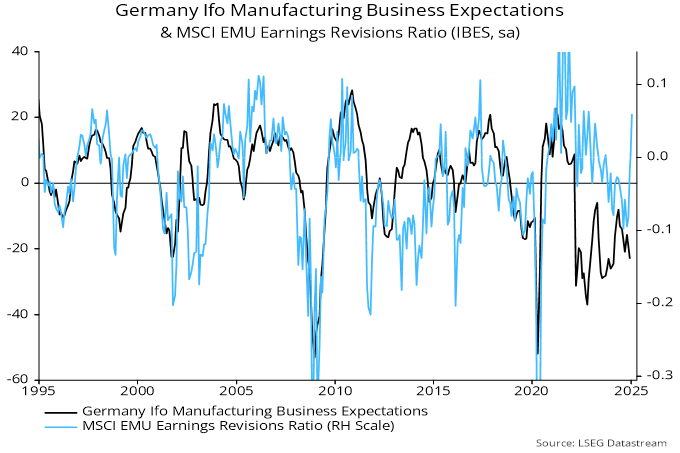
Improving Eurozone economic prospects may partly explain a spate of upgrades to corporate earnings forecasts by equity analysts. A positive January revisions ratio contrasts with negative readings in the US / UK and supports the monetary suggestion of a recovery in manufacturing surveys – chart 4.

Chart 4

Chart 4 showing Germany Ifo Manufacturing Business Expectations & MSCI EMU Earnings Revisions Ratio (IBES, sa)