Global monetary trends appear inconsistent with economic expansion and recent levels of financial asset prices. Central banks are likely to be forced to reconsider policy stances, by market / financial instability and / or unexpected economic weakness.

Key developments during Q3 included:

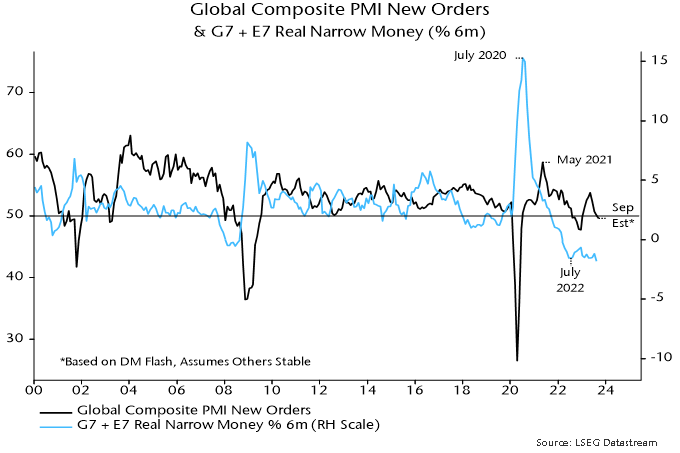
  • Global composite PMI new orders – a timely indicator of economic momentum – extended a decline from a local peak in May.
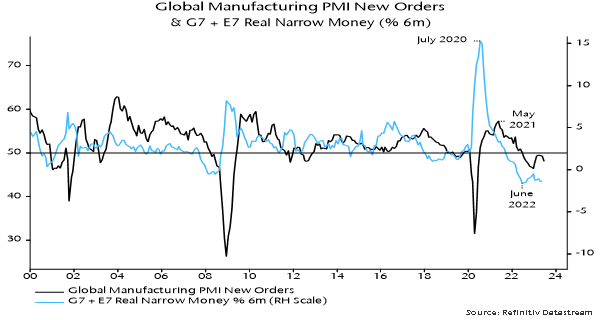
  • Global six-month real narrow money momentum fell to a new low, suggesting a further PMI slide into early 2024 – see chart 1.
  • Inflation news was favourable, with US and Eurozone core momentum slowing significantly.
  • Major central banks ignored these developments, tightening policies further and signalling “higher for longer”.
  • Hopes that Chinese easing would act as a counterweight to G7 restriction were dashed by the PBoC allowing money rates to firm significantly into quarter-end, perhaps reflecting concern about capital outflows.
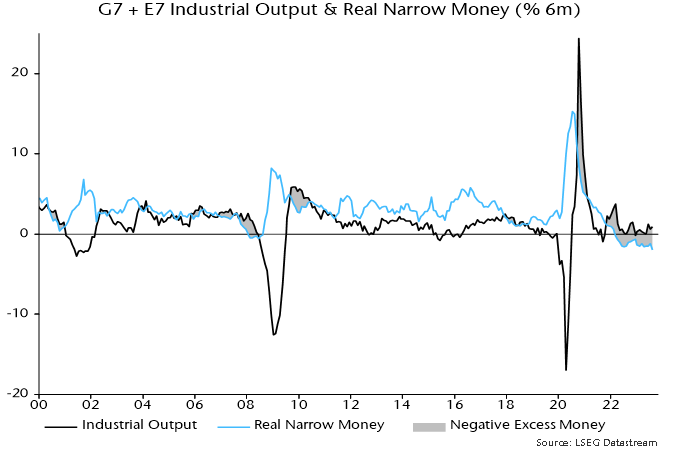
  • Global “excess” money momentum, as measured by the differential between six-month rates of change of real narrow money and industrial output, became more negative – chart 2.
  • The stock of excess money, i.e. the ratio of real narrow money to industrial output, fell to its lowest level since February 2020 before the covid policy response and associated monetary surge.
  • US real Treasury yields extended a third major move higher since late 2021, interpreted here as reflecting the intensified excess money squeeze coupled with higher for longer guidance.
  • Global equities gave back most of their Q2 gain as higher real yields dragged valuations lower.
  • The yield surge contributed to underperformance of growth and non-US quality while restraining outperformance of defensive sectors.

Chart 1
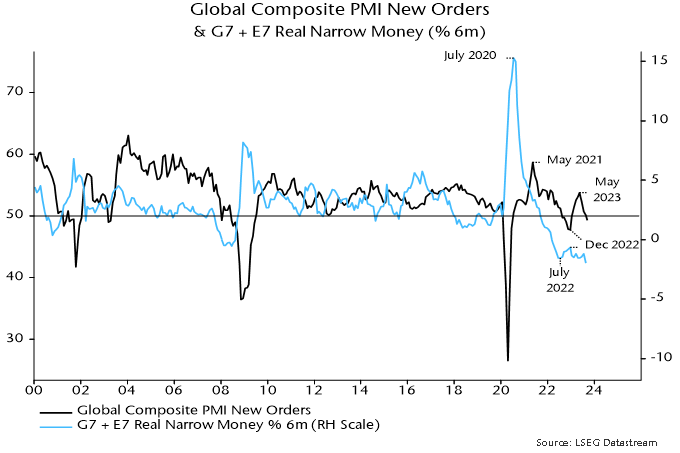
Chart 1 showing Global Composite PMI New Orders & G7+ E7 Real Narrow Money (% 6m)

Chart 2

Chart 2 showing G7 + E7 Industrial Output & Real Narrow Money (% 6m)

Current and prospective monetary trends appear too weak to support recent levels of economic activity and market wealth. Two scenarios for relieving the monetary shortage may be considered.

In the better scenario, a further fall in inflation coupled with modest weakness in activity results in global excess money contraction moderating into end-2023, with an associated reversal lower in real yields. (Equity market performance is related to the sign of the level of excess money momentum while yield movements are related to the sign of the rate of change.)

Inflation progress and softer labour market data prompt central banks to retract higher for longer guidance and cut rates in early 2024, extending the move lower in yields. Falling yields support growth and quality, limiting weakness in equity indices.

Lower rates revive nominal money momentum in H1 2024, laying the foundation for an economic recovery during H2. Inflation continues to fall as core / wage pressures fade, moving to an undershoot in late 2024 / 2025 in lagged reflection of monetary weakness in 2022 / 2023.

Equity markets recover during H1 2024 as excess money momentum turns positive. Near-term outperformance of defensive sectors reverses as improving economic prospects for late 2024 / 2025 lift cyclical areas.

The suggestion in this scenario of modest / short-lived economic contraction is consistent with the cyclical analysis framework employed here: major downturns in the housing and business investment cycles are not expected before 2025, while the stockbuilding cycle is scheduled to recover in 2024.

In the worse scenario, recent policy tightening and surging yields result in a further fall in nominal money momentum, offsetting the impact of lower inflation and declining activity on real / excess trends.

Real yields are stickier and equity markets fall further, with defensive sectors outperforming significantly.

Intensified economic weakness and an ongoing monetary shortage trigger one or more credit “events”, raising financial stability concerns. Central banks cut rates but are viewed as having lost control. Investors price in a tail risk of excessive easing and another inflation surge later in the decade.

Inflation falls faster and further than in the better scenario, contributing to a larger eventual decline in rates and Treasury yields. The beneficial effect on monetary trends, however, is delayed by “endogenous” tightening via wider credit spreads and wealth losses.

The suggestion in this scenario of significant multi-quarter G7 recessions could be reconciled with the cycles framework by arguing that the rate shock advanced the housing cycle peak expected around 2025, i.e. the downswing will play out over 4-5 years rather than a more normal 2-3.

The subjective probabilities assigned here to the two scenarios will be adjusted in response to incoming nominal money data.

The further fall in global six-month real narrow money momentum in Q3 was mainly attributable to declines in China and India, confirming a need for PBoC easing and questioning consensus optimism about Indian economic prospects. Momentum remains weaker in Europe than the US – chart 3.

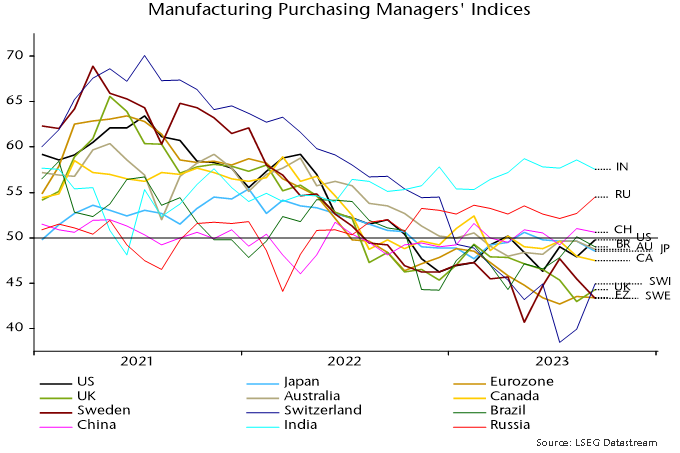
September manufacturing PMI results are broadly consistent with the real money momentum ranking – chart 4 (rank correlation coefficient = 0.76). Minor anomalies include India, Brazil and Switzerland (downside risk to current PMI ranking suggested by money trends), and Japan and Sweden (upside).

Chart 3
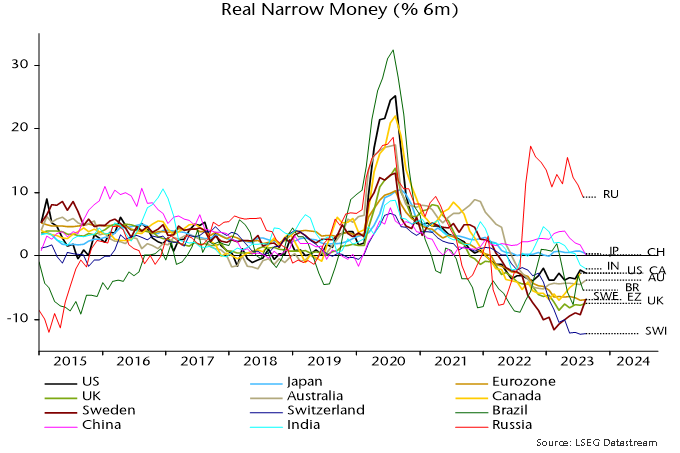
Chart 3 showing Real Narrow Money (% 6m)

Chart 4

Chart 4 showing Manufacturing Purchasing Managers’ Indices
China digital display of stock market charts.

Summary

  • EM equities were down through the month, with Chinese equities continuing to drag.
  • Foreign investors dumped over US$3 billion of Chinese stocks through the month, despite better-than-expected retail sales figures (up 4.6% year on year) and industrial production numbers (up 4.5% year on year) for August.
  • Manufacturing PMIs also ticked up to 49.7 from 49.3 (above 50 points signals expansion).
  • New issues from Chinese banks also surged, beating expectations.
  • Industrials, staples and communications names in India outperformed wider EM, as did AI-linked semiconductor names in Taiwan and Korea.

Don’t look down

Is this the Wile E. Coyote over the canyon moment for markets? The delayed impact of vertiginous rate hikes across DMs on all maturing debt is now hitting consumption and investment. Yet central banks continue to talk tough and market pundits fret over the implications of “higher for longer rates.” It certainly feels like we are in a critical juncture for markets and the economy. Resilience of assets outside of fixed income appear out of step with the reality of higher rates and a weakening global economy, as illustrated by global PMIs falling for a fourth consecutive month.

Global Manufacturing PMI New Orders & G7 + E7 Real Narrow Money (% 6m). Source: Refinitiv Datastream.

Poor money numbers globally suggest that further economic contraction is likely. Despite this, central banks continue to talk tough on rates and many investors cling to hopes of a no landing/immaculate disinflation scenario unfolding, despite the cracks emerging in the global economy. 

Echoes of the GFC

Some market commentators are comparing the complacency in markets to the 2006-7 period where investors bought into the idea of a soft landing, just as the lagged effect of excessive interest rate hikes began to roll through the economy.

JP Morgan’s Marko Kolanovic was quoted in the UK’s Financial Times noting the magnitude of change in interest rates in this cycle is around 5x the increase over 2002-2008 (FT Alphaville: Is it good when Wall Street compares today to 2007?). Kolanovic also pulled archive strategy commentary from 2007 which speaks to some of the risks markets face today:

“The economy provides compelling evidence that it is more resilient than many had earlier believed. … [R]enewed momentum is confirmed as economic data over the balance of December 2006 and January 2007 show an economy shaking off the effects of higher interest rates and high commodity prices. Market participants give up the ghost on their hopes for easings, accept that the Fed has engineered a soft landing, and buy (literally) into the view that a Goldilocks economy is in the making. Economic growth is solid at around 3% and led by a reinvigorated consumer; the residential housing sector slowly stabilises; corporate earnings growth moderates but doesn’t collapse; and inflationary pressures ease off but do not dissipate. Risky assets trade at full valuations and remain in a narrow, low vol range. We’ll call this the “head fake” phase — everything feels too good to be true because it is. In case you didn’t notice, this is where we are right now.”

As the article notes, history tends to rhyme rather than repeat and the availability heuristic of taking short cuts through sketchy historical analogies to explain the situation today can lead investors astray.

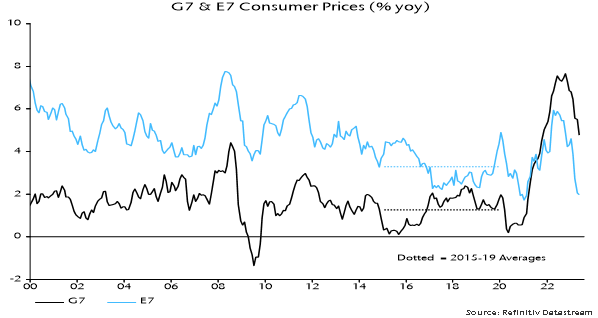
Indeed, the 1970s were a far from perfect comparison to post-pandemic inflation – we were flagging last year that a crash in broad money numbers would see inflation rattle back and even undershoot in 2024 (see chart below). This forecast remains on track despite the anxiety over rising energy prices. In contrast, broad money (our primary leading indicator for inflation) remained persistently high in the 70s.

G7 & E7 Consumer Prices (% YOY). Source: Refinitiv Datastream.

In the pre-GFC era, central banks were signalling their commitment to keeping inflation in check while acknowledging that stresses in the system were starting to materialise. Talking tough today about “higher for longer” rate settings looks to us like the equal and opposite error to the excessively loose policy coming out of COVID lockdowns.

We question the widely held assumption that the global economy can muddle through without any shift in monetary policy in the months ahead. Our best bet is that global economic growth is likely to surprise to the downside in the next 3-6 months.

Green shoots

However, there is a silver lining. Unlike in 2007, most of the debt resides with governments and central banks rather than corporates and households. Price insensitive authorities can “extend and pretend”, socialising losses and thus providing some cushion to the impact of rate hikes. It may suggest why rapid rate increases haven’t yet bitten as hard as we initially expected.

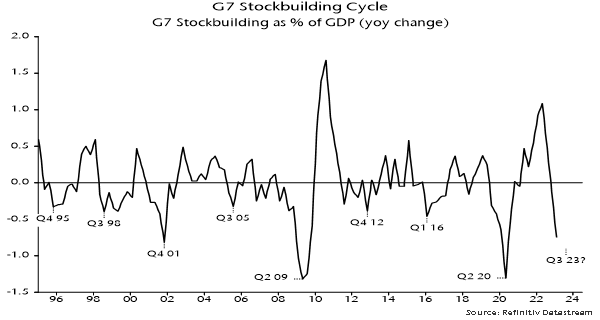
Another positive trend (particularly for EM) is a likely bottoming in the global stock building cycle.

G7 Stockbuilding Cycle. G7 Stockbuilding as % of GDP (YOY change). Source: Refinitiv Datastream.

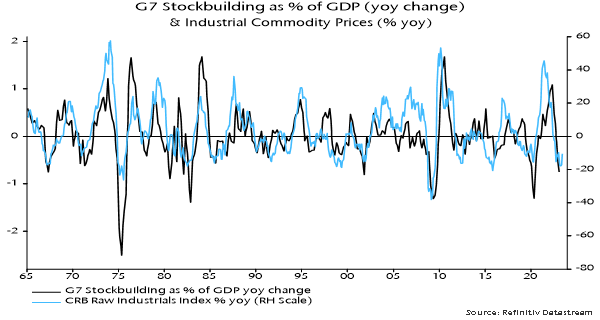
Excessively high inventories in industries from semiconductors to apparel have been in a clean out phase amid weaker consumer demand, which in turn puts downward pressure on commodities prices.

G7 Stockbuilding as & of GDP (YOY change) & Industrial Commodity Prices (% YOY). Source: Refinitiv Datastream.

Emerging markets provide the bulk of these goods and commodities, and will therefore benefit from a bottoming out of this downcycle in the next few months.

In Taiwan and Korea, we have seen semiconductor names rallying on reports that the sharp post-COVID inventory destocking cycle is approaching its end, and boosted by demand for high performance chips that power AI. In apparel, Nike recently reported a US$9 billion decline in inventories (down -10% year on year). Nike has up until now been forced to rely on discounts and promotions to clear inventory amid a period of subdued demand and higher competition from rivals like Adidas. Nike will now start to restock with new lines to be sold at higher prices, boosting profitability. Competitors are likely to follow suit, which collectively will boost EM companies that dominate the apparel supply chain.

The long term picture is bright for EM

While the near-term risks brought about by a global slowdown underpin our cautious positioning, there are compelling reasons to expect EM to outperform DM on the other side of this slowdown. Low inflation and higher rates in EM will open the door to rate cuts, while valuations and earnings are supportive. China looks oversold and could rally on more meaningful stimulus. Growth elsewhere, in Southeast Asia and countries like India, look set to outstrip their developed counterparts. As inflation continues to fall and the tightening cycle ends, global money numbers can revert into positive territory. This will be the key ingredient for an emerging market resurgence, as excess liquidity will flow to the superior fundamentals on offer in EM.

This is the second in a series of short posts focusing on whether incoming economic news supports or contradicts the forecast of a global “hard landing” suggested by monetary trends.

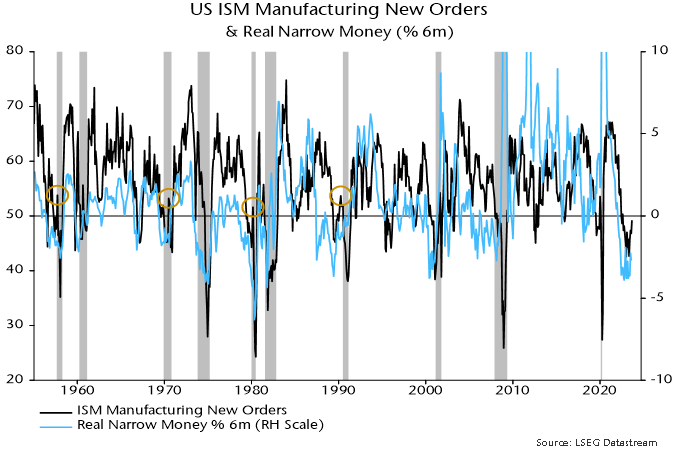
The US ISM manufacturing new orders index rose to a 13-month high of 49.2 in September, apparently supporting soft landing hopes.

post in July flagged the possibility of a near-term rebound but suggested that this would prove to be a “head fake” preceding a move back below 45. 

The main reason for expecting a recovery was that the stockbuilding cycle was judged to be moving towards a low, i.e. a drag on new orders from customer inventory adjustment was likely to abate. 

The reason for expecting the recovery to be brief and followed by a relapse was that US real narrow money momentum remained heavily negative, suggesting that a stockbuilding boost would be outweighed by weakness in final demand. 

Historical instances of ISM new orders recovering through 50 when real money contraction was negative include 1957, 1970, 1980 and 1990. The orders index subsequently fell back below 45, with the relapses associated with recessions – see chart 1. 

Chart 1

Chart 1 showing US ISM Manufacturing New Orders & Real Narrow Money (% 6m)

Six-month real narrow money momentum has recovered since mid-year but remains significantly negative. 

The earlier suggestion of a recovery in ISM new orders was supported by a sharp rebound in Korean FKI manufacturing expectations between February and July – Korean exports are sensitive to changes in global industrial momentum. FKI expectations relinquished most of the February-July gain in August / September. 

Verdict: inconclusive.

french

The CC&L Foundation is pleased to announce a contribution to Canadian Blood Services, exemplifying our commitment to community and creating a positive impact. With the successful conclusion of our August blood drive, we extend our appreciation to participants who supported this important initiative, led by one of our own employees Mohammad Shakeri. 

Mohammad is a Specialist on the Corporate Actions team at Connor, Clark & Lunn Financial Group in Vancouver and is passionate about blood donation. He has been a blood donor for ten years, and like over half of Canadians, his close friends and family have been recipients of blood transfusions in the past. Mohammad championed the Partners for Life collaboration between the CC&L Foundation and Canada Blood Services, raising awareness of this service that can affect so many. This was the first blood donation activity at CC&L in recent years and the participation reinforces our firm-wide dedication to giving back to the communities we live and work in.

Quick facts

  • Each blood donation can save up to three lives
  • It can take multiple donors to save a patient’s life.
  • Given that each process requires less than 30 minutes of each donor’s time, this an excellent investment.

There is a constant demand for blood and blood products. Rolling up your sleeves to donate at anytime is appreciated. As active participants in the Partners for Life program, our collaboration with Canadian Blood Services further strengthens our dedication to community support.

Learn more about the CC&L Foundation.

Norwegian fish farm for salmon growing in natural environment.

Regulatory risk is nothing new to investors, but it has gained prominence in the current geopolitical climate. Companies globally, especially those with operations or manufacturing facilities in China, are  closely monitoring actions their government might take to undermine diplomatic relations. In the banking sector, the situation with SVB has led analysts to expect stricter regulatory frameworks for regional banks. Additionally, the ongoing Hollywood strikes have spotlighted AI as a contentious issue; actors are advocating for regulations that restrict studios from using their likeness for AI-generated content. And the list goes on.

In the 1990s and early 2000s, a laissez-faire attitude prevailed in developed countries, particularly in the US. It was the proof that the capitalist business model was sustainable, a perception supported by the slow pace of regulation during the quickly developing dotcom bubble and the pre-financial crisis housing market. In a hegemonic global environment, smaller nations found few reasons not to strategically align themselves with dominant powers, leading to accelerated deregulation in many developed countries. However, this framework began to shift as the US-led global world order faced challenges from competing political and economic ideologies.

As the US initiated a trade war with China and raised tariffs on various goods, many allied nations started reassessing their global trade strategies to safeguard their own economic interests. We believe the growing rift between the US and China will eventually force every government to choose sides and evaluate their dependencies on either power. Germany, for example, is reconsidering its longstanding industrial relationship with China and taking steps to reduce that reliance.

Enter the cycle of protectionism. The consequences of protectionism are well-documented: higher prices due to lack of competition, which leads to persistent inflation; weaker economic growth since international trade isn’t fully offset by domestic consumption, and a more fragile labour market as a result. When various stakeholders voice their discontent with a worsening economic environment, democratic governments often respond by enacting policies, introducing regulations or applying other short-term solutions in an attempt to alleviate the problems they created. These often penalize high-performing industries or companies and may involve levying taxes or setting price ceilings. Such changes catch both company management and shareholders off-guard.

Our clients know that Global Alpha uses a bottom-up approach to stock picking. However, our team also recognizes the increasing need in being risk aware about changes in regulatory frameworks, both at the industry and company levels.

A striking example occurred around this time last year with one of our holdings, Norway Royal Salmon (NRS). The Norwegian government unexpectedly announced a 40% tax rate on resources, which included salmon. Although the company had a solid business model and shareholder satisfaction was high, the stock dropped over 20% in a day, making it one of our worst performers for that quarter. Nevertheless, it was widely understood that NRS was set to merge with one of its competitors, Salmar. We believed this merger would provide for shareholders as it would create one of the largest players worldwide in fish farming and significant advantages, especially given that the larger entity could more effectively adapt to this new tax than smaller competitors. As of March 2023, the Norwegian government lowered its proposed tax rate to 35% to facilitate legislative approval, and we remain happy shareholders of Salmar.

Another recent case involves CVS Group (CVSG LN), a UK-based integrated provider of veterinary care. In early September, the UK Competition and Markets Authority (CMA) announced its review of competitiveness in the veterinary sector, causing CVSG stock to drop more than 25%. Investors immediately assumed that CVS, as the largest player in the space, would be the review’s primary focus. However, our analysis suggests these concerns may be exaggerated. Reviews by the CMA do not always lead to material industry impacts, as shown by its review of UK grocers earlier this year. Furthermore, while CVS has been a major player in consolidating the UK veterinary industry, it has not led to unreasonable price hikes. Average increases for CVS products and services hover around 3% net, which is unlikely to be seen as an outlier. There are minor areas, like lack of transparency in cross-selling and customer awareness regarding chain ownership, where CVS might face some hurdles, but we do not anticipate a substantial impact on the business model.

Lastly, it is worth noting that regulatory and policy shifts can provide positive effects. The waste management industry is expected to benefit as recycling becomes increasingly crucial in creating more sustainable societies. Our portfolios include waste management companies like Casella Waste (CWST US) and Renewi (RWI LN). We expect that new recycling requirements across various commodities will improve margins in what has historically been a low-margin industry.

While no one on Global Alpha’s investment team is a policy expert, our job requires us to consider two important angles: the potential threats to a business model arising from policy shifts, and the actual impact on our investment thesis when a regulatory change happens. One reason for our cautious stance on AI investment opportunities is the level of uncertainty regarding when and how governments will implement regulations. Salmon farming and veterinary care may not capture the public imagination like AI does, but we are confident in our ability to navigate regulatory risks in these industries more successfully.

Aerial view of Wind River Hydro project in Ontario
White River Hydro Project, Ontario, Canada

An Opportunity to Foster Mutual Benefit and Support Sustainable Development

This article was originally published in Issue 33 of the Journal of Aboriginal Management (JAM), it focuses on the theme Infrastructure: Building a Better Tomorrow.


ABOUT THE AUTHOR

Photo of Peter Muldowney

Peter Muldowney
Head of Institutional and Multi-Asset Strategy at Connor, Clark & Lunn Financial Group

Peter Muldowney is Head of Institutional & Multi-Asset Strategy at Connor, Clark & Lunn Financial Group, and heads the firm’s Strategic Exchange initiative. Peter has over 20 years of investment experience in Canada, the U.S., and the United Kingdom. Prior to joining the firm in 2011, he spent his earlier years in consulting, which included leading two of the major Canadian firms and then moving to the investment management business in 2008, when he established a new investment operation for a Canadian insurance company. Peter completed both the 4 Seasons of Reconciliation from First Nations University of Canada and the Sustainable Investment Professional Certification (SIPC) from Concordia University in 2022.


Indigenous participation in infrastructure projects promotes the economic empowerment of communities while also contributing to a project’s overall success and sustainability. In this article, we delve into some of the ways Indigenous communities can participate in infrastructure investments, and we highlight the benefits that such partnerships can create.

Responsible Investment Requires Inclusive Stakeholder Engagement

Infrastructure projects are typically large-scale physical assets that meet a basic human need. These assets are essential to the well-being of communities and critical to the functioning of local economies. Infrastructure encompasses projects such as roads, bridges, schools, hospitals, water distribution and treatment as well as power generation and electricity transmission. The development and construction of these assets require significant investment and involve numerous stakeholders. The importance of infrastructure projects to communities, and their long-term nature and size, necessitate a responsible investment approach to secure and maintain a social license to operate.

Stakeholder engagement plays a pivotal role in ensuring that investments incorporate a wide range of perspectives and create positive outcomes. Ultimately, responsible investment is about generating financial returns while also considering the broader impact on society and the environment. An inclusive approach to engagement is essential in ensuring that all relevant parties are consulted.

There is a growing recognition of the importance of including Indigenous peoples as key stakeholders in infrastructure projects, ensuring their rights, cultural heritage, and economic interests are respected and supported. This is particularly critical in countries such as Canada where many infrastructure projects directly impact Indigenous lands and territories, as well as their peoples and communities.

This increased awareness – combined with more intentional inclusivity on behalf of government and business – should help to facilitate greater participation in the responsible development of further sustainable infrastructure projects in Canada. However, it is important that these efforts are focused on a desire for true understanding of Indigenous perspectives and priorities, as well as genuine relationship building that seeks to achieve mutual benefit. Such an approach fosters transparency while also promoting collaboration and consensus-building, which can lead to better decision-making and outcomes.

Collaboration Fosters Mutual Benefits and Sustainable Development

Positive partnerships provide a promising path towards more inclusive investment opportunities that facilitate the economic empowerment of Indigenous communities while also supporting the development, construction, and operation of high-quality and sustainable infrastructure projects.

Increased Indigenous participation can contribute to reconciliation efforts by encouraging Indigenous business development, self-determination, and positive socio-economic outcomes. The steady cash flows generated by infrastructure investments can provide Indigenous partners with funds to address any number of objectives such as housing, healthcare, education, recreational facilities, community centers, economic development and cultural revitalization – or anything that the community values and sets as a priority.

Engaging Indigenous communities also helps to protect the value of infrastructure investments by mitigating some of the associated risks, helping to avoid or address conflicts and legal challenges early while supporting smoother and more efficient project development and operations.

Scott Munro, Deputy Chief Executive Officer of the First Nations Financial Management Board, highlighted this well in his article on evolving ESG standards (JAM 32): “How well a business considers and respects Indigenous rights will determine how its enterprise value is impacted. As well intended and beneficial as these projects maybe, if corporations fail to demonstrate to investors and lenders that they have the free, prior, and informed consent of the Indigenous people who are being impacted, conflict is a certain outcome. Projects may get delayed or encounter costly litigation, and businesses will face reputational loss and discontent shareholders.”

In addition to mitigating some of the risks associated with infrastructure projects, the active involvement of Indigenous communities from the beginning stages of project planning brings valuable local knowledge and perspectives to the table. Indigenous communities possess deep understanding of their lands, resources, and traditional practices. These perspectives contribute to better project design, deeper insight into areas of archaeological significance, sustainable resource management, biodiversity preservation, and more robust environmental impact assessments while also promoting effective environmental monitoring and maintenance.

Collaboration enhances the sustainability of projects and strengthens stewardship efforts by incorporating Indigenous perspectives and practices that have been proven to be environmentally harmonious and resilient over generations. It can lead to more successful outcomes for both the project and the communities involved, fostering collaboration, trust, and shared prosperity.

Indigenous Opportunities in Infrastructure

There are several different ways in which Indigenous communities can participate in infrastructure projects. This includes direct involvement through equity ownership stakes, revenue sharing and other mutually beneficial arrangements, as well as less direct participation through financial investments in public infrastructure companies or private infrastructure funds.

Most commonly, participation is formalized through some form of a negotiated benefit agreement that governs the relationship between the Indigenous community and the infrastructure project. These agreements outline specific benefits and compensation that Indigenous communities will receive in exchange for their support or consent for a project, ensuring their interests are codified and acknowledged as part of the project’s ongoing operations. Successful agreements facilitate community consultation and approval by addressing community social, economic and environmental objectives while also ensuring an equitable distribution of project costs and benefits. Benefits can include financial compensation, employment opportunities, skills training, and community development initiatives.

Equity ownership stakes provide a means for Indigenous communities to share directly in the economics of infrastructure investments. By having ownership in a project, communities receive profits and participate in aspects of the decision-making processes. Revenue sharing agreements are another way in which Indigenous communities can participate in a share of the profits generated by an infrastructure project and can provide an important source of revenue. Both of these types of agreements can empower Indigenous communities economically, foster job creation, and improve resource access.

In addition to equity ownership stakes and royalty payments, there may also be other mutually beneficial arrangements that can be explored. It’s important to recognize that the needs, values and ambitions of each Indigenous community are unique in the same way that each infrastructure project is distinct. While there are benefits to leveraging past experience and best practices, there is no one-size-fits-all approach. Each discussion needs to begin from a place of respect for Indigenous communities and a willingness for open dialogue to reach a place of understanding and productive collaboration.

CC&L Infrastructure’s Focus on Shared Value and Strong Partnerships

CC&L Infrastructure invests in infrastructure assets with attractive risk-return characteristics, long lives, and the potential to generate stable cash flows on behalf of a wide variety of clients — including Indigenous trusts, public and private pension funds, life insurance companies, financial institutions, foundations and endowments, and high-net worth individuals.

As long-term asset owners and stewards of client capital, CC&L Infrastructure focuses on managing its assets responsibly. This includes a systematic approach to evaluating material environmental, social, and governance factors. We believe this approach improves our ability to manage risk, protect the value of our investments, and enhance long-term investment returns.

Our firm has a long history of working alongside Indigenous partners. We worked with local First Nations on our first investment more than 15 years ago, and today over half of the Canadian infrastructure assets in our portfolio collaborate with Indigenous communities in some fashion. This includes several run-of-river hydroelectric facilities and solar projects where our Indigenous partners have a direct equity investment alongside us.

CC&L Infrastructure is a part of Connor, Clark & Lunn Financial Group Ltd., an employee-owned, multi-boutique asset management firm whose affiliates collectively manage over CAD$110 billion in assets.

This is the first of a series of short posts focusing on whether incoming economic news supports or contradicts the forecast of a global “hard landing” suggested by monetary trends. 

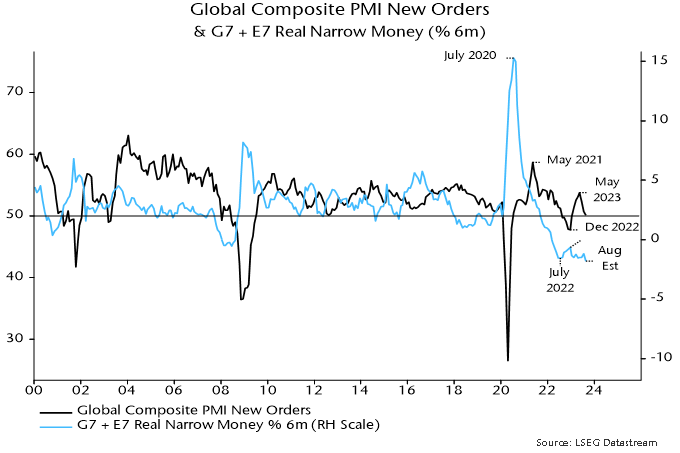
Flash results suggest that the global composite PMI new orders index – a timely indicator of demand momentum – fell for a fourth month in September, consistent with the monetary signal of a slide into early 2024, at least. 

The flash results, available for the US, Japan, Eurozone, UK and Australia, imply a decline through 50 to the lowest level since December, assuming no change in all other countries in the global aggregate – see chart 1. 

Chart 1

Chart 1 showing Global Composite PMI New Orders & G7 + E7 Real Narrow Money (% 6m)

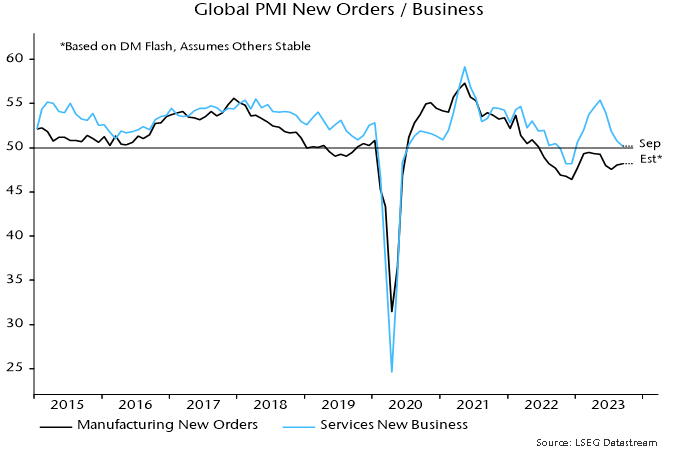
Weakness in the flash surveys was driven by a further slowdown in services new business, with manufacturing new orders little changed – chart 2.

Chart 2

Chart 2 showing Global PMI New Orders / Business

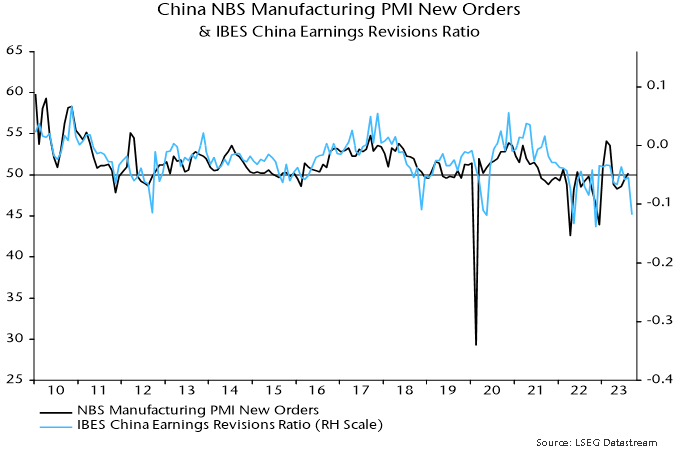
Any hopes of manufacturing stabilisation, however, may be dashed by full September results incorporating China and other emerging economies. The equity analysts’ earnings revisions ratio correlates with Chinese manufacturing PMI new orders and weakened sharply this month – chart 3. 

Chart 3

Chart 3 showing China NBS Manufacturing PMI New Orders & IBES China Earnings Revisions Ratio

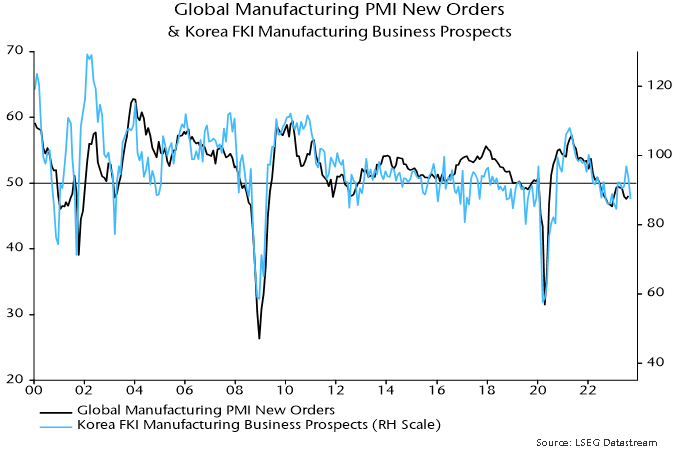
Renewed deterioration in Chinese / Asian manufacturing is also suggested by the Korean FKI survey for September, showing a relapse in the assessment of business prospects to the weakest since February – chart 4.

Chart 4

Chart 4 showing Global Manufacturing PMI New Orders & Korea FKI Manufacturing Business Prospects
A young kitten rubbing up on her adopted mama dog,

The profound and enduring love people feel for their pets is a testament to the unique and cherished bond between humans and animals. Across cultures, generations and geographies, this affection runs deep and is driving unprecedented demand for high-quality pet care, products and services. There is no doubt that pets occupy a special place in our hearts. But should they also occupy a special place in your investment portfolio?

When it comes to investment strategy, recognizing the remarkable growth within the pet industry is paramount. At Global Alpha, our preference is to invest in large and growing markets, and the pet industry perfectly aligns with this approach. As part of our meticulous investment process, it is essential to delve into the underlying factors propelling this industry’s expansion, as these drivers often vary by theme – such as demographics, innovation and environment.

How big is the pet market in North America?

As of 2023, data from the American Pet Products Association reveals that pet ownership in the United States has reached a remarkable milestone, with 66% of households, equivalent to 86.9 million homes, proudly welcoming pets into their lives. This figure marks a substantial increase from the 56% recorded in 1988, underscoring the enduring trend of pet ownership. So, how important are these pets to their owners? An astounding 85% of dog owners and 76% of cat owners affirm that their pets hold a special place as bona fide members of their families.

In 2022, Americans alone spent $136.8 billion on their pets. Back in 1996, that number was just $21 billion. Even more fascinating is that millennials comprise the highest percentage (33%) of pet owners in the US, followed by Gen X at 25% and baby boomers at 24%.

In Canada, pet industry spending reached $12.9 billion in 2022, up a whopping 486% from $2.2 billion in 1994 according to Statistics Canada.

How is the pet market different internationally?

While the US is the clear leader when it comes to spending on pets, other countries are also seeing the market grow. In the UK, the vet market is worth more than £2 billion ($2.5 billion USD) with almost two thirds of households owning a pet.

China has become the second-largest market, even though only 23% of Chinese households have pets. China’s pet industry is expected to reach $66.1 billion by the end of this year, which is 10 times the size it was a decade ago. 

At the same time, there are more than 31 million pets in India and this number is growing at an annual rate of over 12%. According to a Bonafide Research report, India’s pet care industry is expected to reach close to a billion dollars by 2025, with a CAGR of more than 19%.

How have our pet industry holdings performed?

Since inception in 2008, we have continuously maintained exposure to the animal health industry. Below are a few highlights.

VCA Antech: Profiled in our February 28, 2012 weekly

  • Founded in 1986, VCA Antech is a leading animal healthcare services company
  • The company provides lab testing for over 17,000 animal hospitals with over 30,000 veterinarians
  • Provided exposure to animal hospitals and pet diagnostics
  • Exited in Q2, 2016 as the market cap crossed the upper limit of the benchmark – the company was acquired by Mars in September 2017

Heska:

  • HSKA is a veterinary diagnostic company
  • It has 162 US patents and 139 foreign-issued patents
  • Provided exposure to veterinary diagnostics
  • Exited in Q1, 2017 as it had reached our fair value

Greencross: Highlighted in our June 3, 2016 weekly

  • Australian pet health company, founded in 1994
  • Number one pet care specialist in Australia, providing both retail and veterinary services
  • Provided exposure to animal clinics and pet retail stores
  • Exited in Q1, 2019 as it was acquired by private equity group, TPG Capital

Our current exposure to the pet industry

We are currently invested in UK pet health company, CVS Group. Founded in 1999, the company went public in October 2007.

Business overview

Headquartered in Norfolk, CVS is one of the leading veterinary services providers in the UK with about 10% market share. As of 2022, CVS has about 500 practices across its three markets, including eight specialist referral hospitals and 37 dedicated out-of-hours sites. The company also runs three laboratories, seven crematoria and an online retail business called Animed.

CVS recently entered the Australian market with a small number of acquisitions, bringing the total number of practices outside the UK to 35.

Target market

The total addressable market in the UK for veterinary products and services is over £2 billion. The market consists of six large chains and a number of independent/small chains representing 45% of the market.

On the other hand, according to IbisWorld, Australia has a $5.3 billion addressable market which is growing at 6% per annum. The level of consolidation in the Australian market is just 20% when compared to the UK, adding for future potential growth via M&A.

Competitive advantages

  • Largest and most comprehensive provider of vet services in the UK, meeting all customer needs
  • Scale – has developed shared facilities and opportunities to cross sell its products, like lab testing, generic medicines, loyalty schemes, specialist surgeries and pet cremation

Growth strategy

  • Consolidate large-animal vet practices (delivering equine & livestock care), which is more fragmented
  • Their laboratory diagnostic business could enter the farm animal diagnostics market
  • International expansion continues like their latest entry in Australia

Where we’re looking next?

We have our eyes on a few interesting companies operating in the animal health space, ranging from pet insurance and fresh pet food to a diagnostics company. Our ability to be highly selective and nimble in our portfolio holdings leaves us well-positioned to add some exposure to the animal health industry at attractive valuations.

So just one question remains: How much are you spending on your pet?

The Godil family cat

Global six-month real narrow money momentum is estimated to have broken to a new low in August, reinforcing pessimism here about economic prospects and casting strong doubt on now widely-held “soft landing” hopes. 

Real money momentum bottomed in July 2022, recovered during H2 but suffered a relapse in early 2023, retesting the 2022 low in April. The relapse has been reflected in a renewed downswing in economic momentum, as proxied by global composite PMI new orders – see chart 1. 

Chart 1

Chart 1 showing Global Composite PMI New Orders & G7 + E7 Real Narrow Money (% 6m)

A tentative stabilisation of real money momentum over the summer suggested that PMI new orders would bottom out around year-end. The further move down in August, if confirmed, signals deeper and more extended economic weakness. 

The August estimate is based on monetary data covering 70% the global (i.e. G7 plus E7) aggregate and near-complete CPI results. 

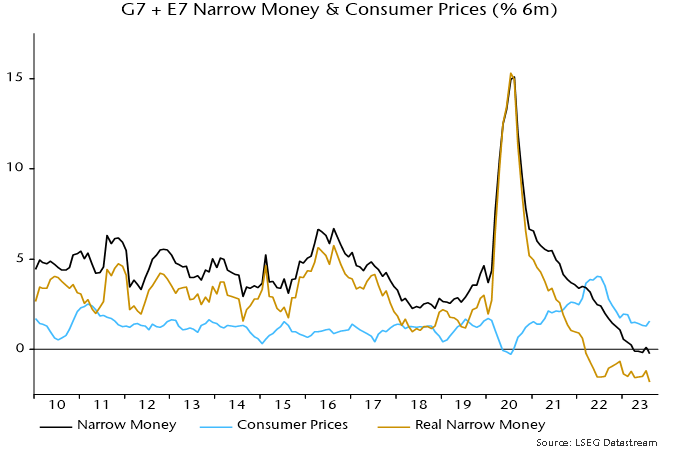
The suggested fall to a new low reflects both additional nominal money weakness and an oil-price-driven recovery in six-month CPI momentum – chart 2. 

Chart 2

Chart 2 showing G7 + E7 Narrow Money & Consumer Prices (% 6m)

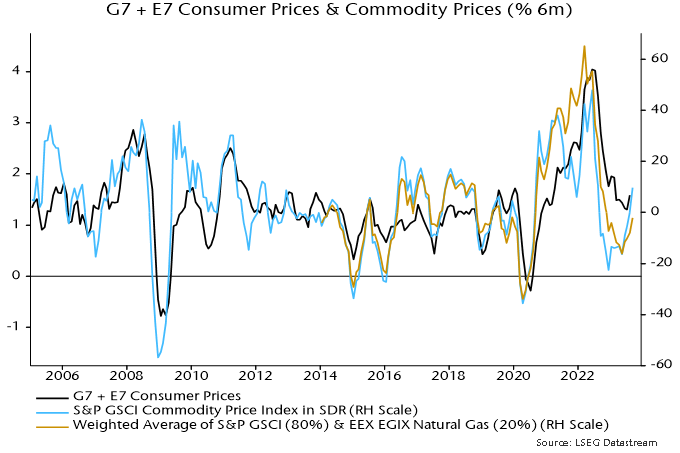
The ongoing oil price rally suggests a further near-term rise in headline CPI momentum – chart 3. A core slowdown, however, is expected to continue and may accelerate as higher oil costs squeeze spending on other items. 

Chart 3

Chart 3 showing G7 + E7 Consumer Prices & Commodity Prices (% 6m)

The further fall in real narrow money momentum has been driven mainly by China and India – chart 4. An earlier post attributed Chinese monetary weakness to misguided policy tightening in late 2022, which has since been partially reversed. Chinese August money numbers suggest greater damage from the misstep than previously assumed, implying a more urgent need for additional policy easing. 

Chart 4

Chart 4 showing Real Narrow Money (% 6m) Early Reporters

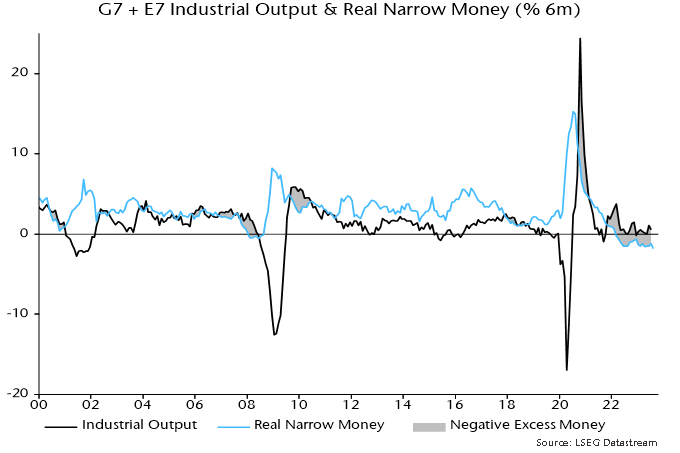
An August estimate of global industrial output is not yet available but a large negative differential between six-month rates of change of real narrow money and output is likely to have persisted – chart 5. 

Chart 5

Chart 5 showing G7 + E7 Industrial Output & Real Narrow Money (% 6m)

As previously noted, global equities have underperformed cash since this differential turned negative in early 2022 (allowing for reporting lags), despite a rally over the last 12 months. 

Why was weakness compressed into the first nine months of 2022, with a subsequent strong rebound? 

One explanation is that the Ukraine invasion and associated immediate further upward pressure on energy prices exaggerated the market response to monetary deterioration. Positioning and sentiment reached oversold extremes in late 2022, creating the potential for a relief rally as energy markets adjusted and prices fell back. 

Another possibility – admittedly difficult to assess – is that the “excess” money backdrop has been less unfavourable than suggested by the six-month momentum differential shown in chart 5, because of the existence of an overhang from the 2020-21 monetary surge. An excess stock of money, in other words, may have persisted despite the flow turning negative. 

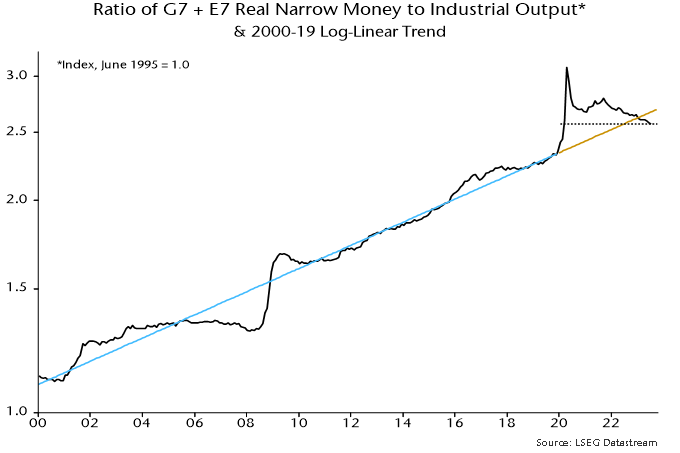
The ratio of the stock of real narrow money to industrial output has trended higher over time, with the increase reflected in rising real asset prices and wealth – chart 6. 

Chart 6

Chart 6 showing Ratio of G7 + E7 Real Narrow Money to Industrial Output* & 2000-19 Log-Linear Trend *Index, June 1995 = 1.0

A huge overshoot in 2020-21 has been correcting since late 2021 but the ratio was still above its pre-pandemic trend at end-2022, i.e. the negative flow differential had not fully offset the prior period of excess.

The stock and flow signals, however, are now aligned: the real money / output ratio moved below trend in early 2023 and its July level was the lowest since February 2020 before the policy response to the pandemic and subsequent monetary surge.