China’s economic woes partly reflect restrictive monetary policy. The latest money numbers suggest still-deteriorating prospects and urgent need for a policy reversal. It is unclear whether such a pivot is under way.

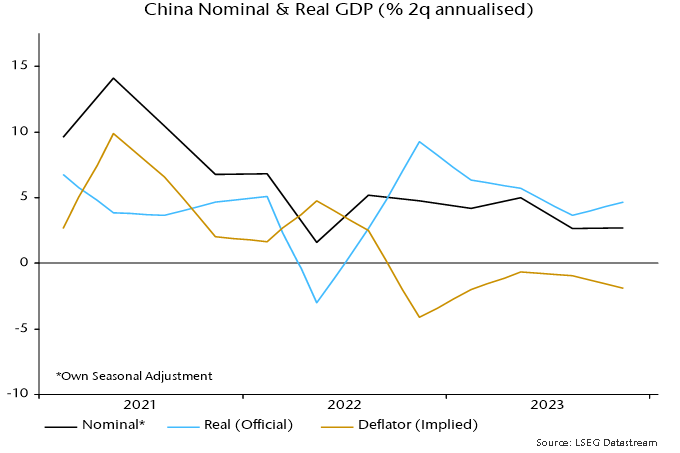
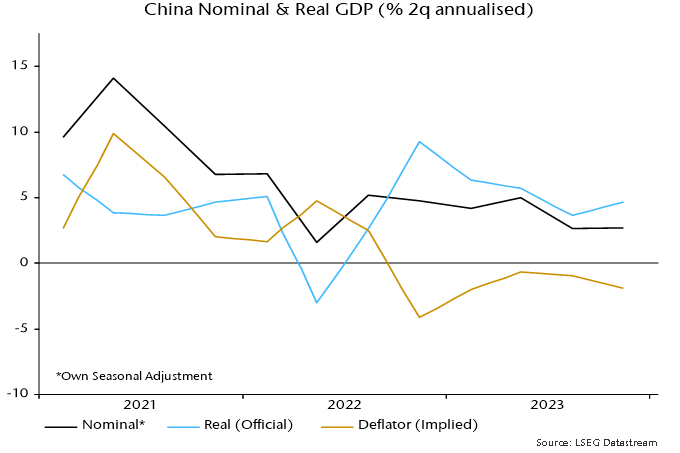
Two-quarter growth of nominal GDP (own seasonal adjustment) remained historically weak at 2.7% annualised in Q4, after 2.6% in Q3. Official real GDP numbers show a recovery in two-quarter growth from 3.6% annualised to 4.7%, so the implication is that GDP prices fell at a faster rate (1.9% annualised versus 1.0%) – see chart 1.

Chart 1

Chart 1 showing China Nominal & Real GDP (% 2q annualised)

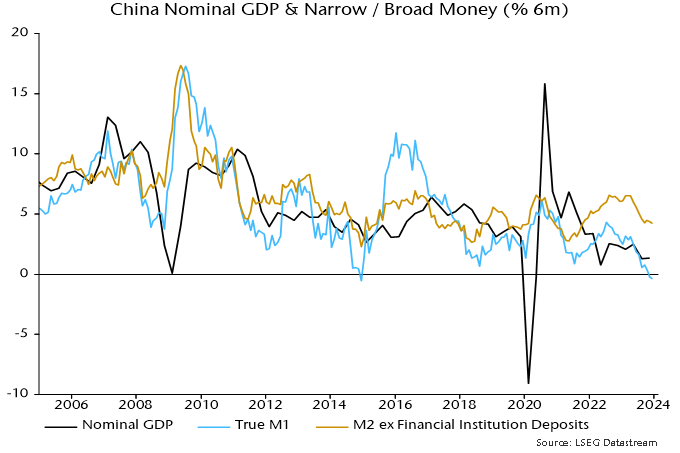
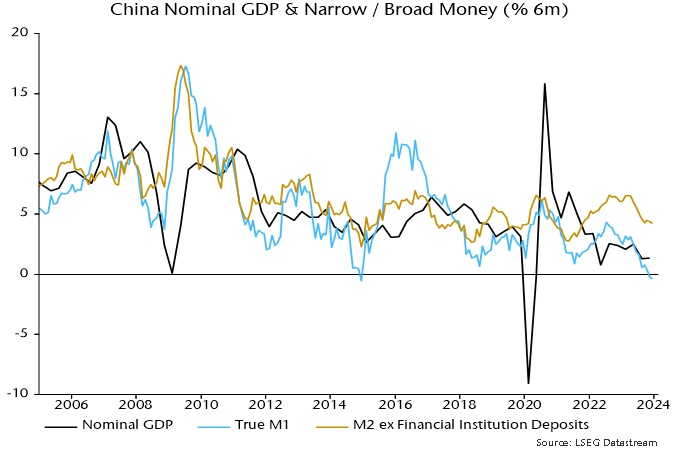
The stabilisation of two-quarter nominal GDP growth in H2 2023 mirrors sideways movement of six-month narrow and broad money growth during H1. Money trends, however, weakened sharply during H2, suggesting a further slowdown in nominal / real GDP in H1 2024 – chart 2.

Chart 2

Chart 2 showing China Nominal GDP & Narrow / Broad Money (% 6m)

Six-month narrow money momentum turned negative in late 2023 and is challenging the record low reached at end-2014. Weakness then rang policy alarm bells, contributing to an aggressive easing shift in 2015 that succeeded in reflating the economy and stocks.

Monetary optimists note that broad money growth is above the level reached then and in the middle of its range in recent years. A widening narrow / broad money divergence, however, suggests a faster rate of decline of broad money velocity, plausibly related to structural weakness in real estate and lack of confidence in policy.

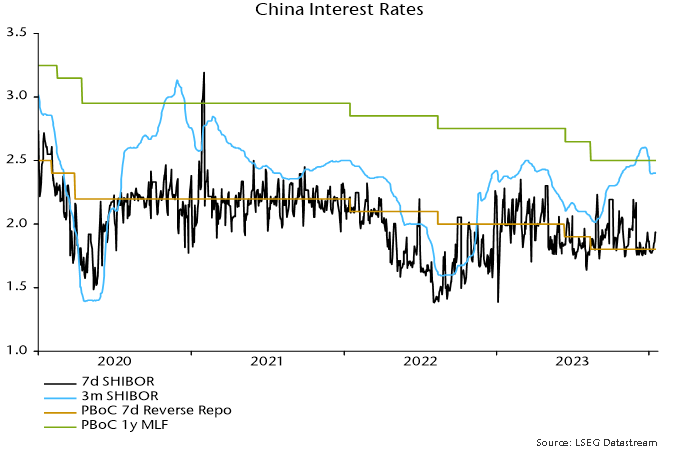
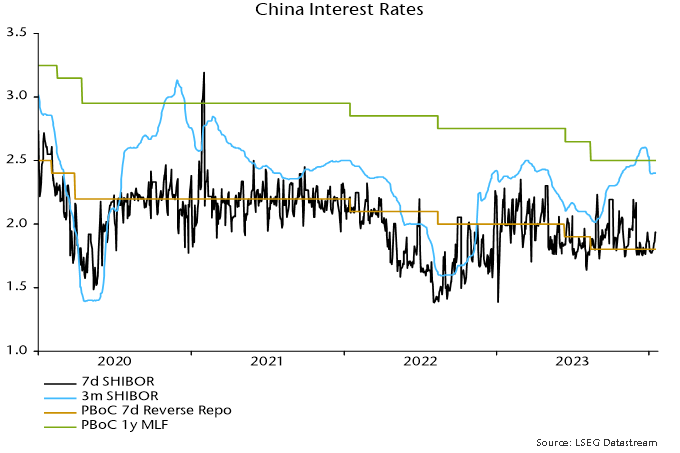
Will the economy and markets be rescued by 2015-style easing? Developments in 2023 don’t inspire hope. The PBoC loosened policy during H1 but a new upswing in term money rates began soon after the appointment of new Governor Pan Gongsheng in July, with three-month SHIBOR closing 2023 at a 32-month high – chart 3.

Chart 3

Chart 3 showing China Interest Rates

Another change under Governor Pan has been the suspension of publication of the PBoC’s informative quarterly surveys of entrepreneurs, consumers and bankers – the Q3 surveys were never released and Q4 results would normally have appeared by now.

A possible interpretation is that the PBoC has switched to prioritising currency stability, managing rates higher to discourage capital outflows while passing the baton of economic support to fiscal policy (and withdrawing from providing information on economic developments).

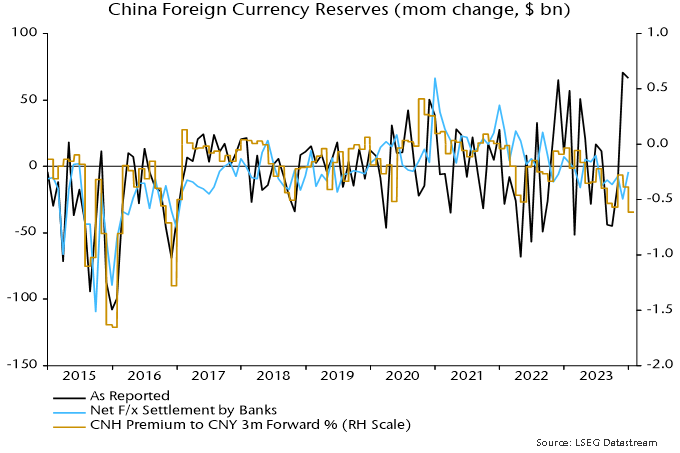
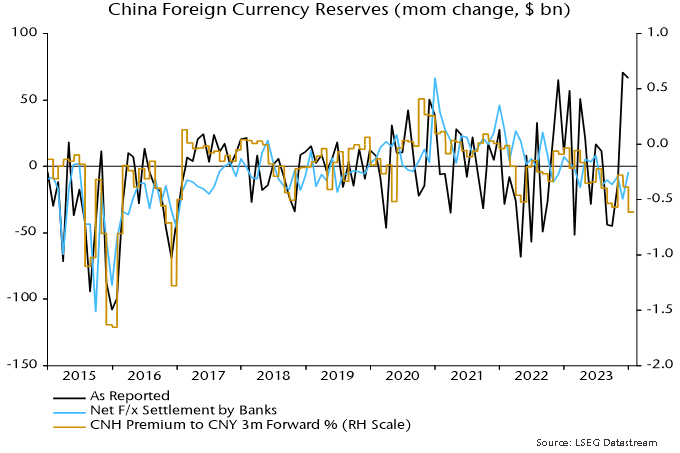
Foreign exchange reserves were boosted by valuation effects in late 2023 (weaker US dollar, rally in Treasuries) but settlements data suggest sustained intervention to support the currency during H2, consistent with a persistent sizeable forward discount on the offshore RMB – chart 4.

Chart 4

Chart 4 showing China Foreign Currency Reserves (mom change, $ bn)

Fiscal stimulus focused on government-directed investment is unlikely to be sufficient to reverse economic weakness without accompanying monetary accommodation to lift private sector confidence and broad money velocity.

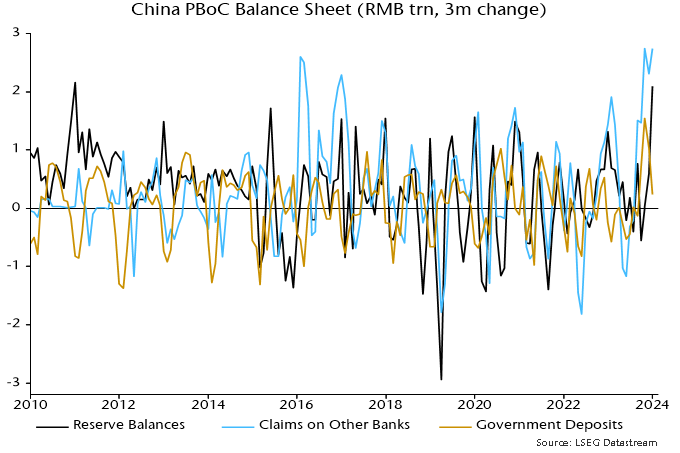
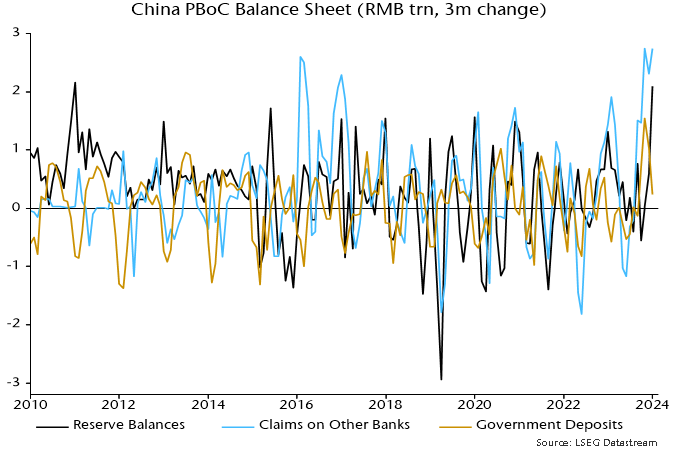
Are there any signs of the PBoC pivoting back to easing? One glimmer is that its lending to the banking system continued to expand rapidly in late 2023, which, together with a slower rise in government deposits at the PBoC, resulted in the second-largest quarterly rise in bank reserves on record – chart 5.

Chart 5

Chart 5 showing China PBoC Balance Sheet (RMB trn, 3m change)

The PBoC’s injections, however, may have been intended to moderate rather than reverse the rise in money rates. Three-month SHIBOR eased in early January but has stalled since – chart 3. Recent renewed US dollar strength may bolster the hard-liners.

Aerial view of downtown Taipei, Taiwan. Financial district and business area with intersection or junction with traffic.

Summary

  • EM underperformed US and international markets through 2023 – posting a 10.3% return in USD terms versus 26.3% for the US, 18.9% for EAFE and 22.7% for Europe ex-UK.
  • China was down 11% for the year, while Taiwan was up 31.3%, India 21.3%, Brazil 31.5% and Mexico 41.6%.
  • EM equities trade at 11.9x next 12m P/E against a 20-year average of 12.6x, while China trades at 9.3x against a 20-year average of 12.5x.
  • Brent crude closed the year at US$80 per barrel, pulling back sharply from its spike above US$90 in October following the outbreak of conflict between Israel and Hamas.
  • China held its Central Economic Work Conference in December, with top officials and economic advisers meeting to set growth targets for 2024. Government advisers have told the press that officials are targeting a range between 4.5% and 5.5%, with most favouring around 5% (the same as for 2023). The official target is set to be officially endorsed at the Two Sessions in March.
  • As reported in the Financial Times, BYD sold a record 526,000 battery-only EVs to Tesla’s 484,000 during the fourth quarter of 2023. This is the first time BYD has surpassed Tesla in quarterly sales.

“Goldilocks thinking”

Earlier this year, we emphasised our caution with respect to market expectations for the economy and inflation, warning that a Wile E. Coyote moment was a real risk for investors lured into the idea of a “miraculous disinflation” or “no landing” scenario. Bets on the combination of falling inflation, a resilient economy and rate cuts in 2023 were the fuel for a Santa rally propelling tech stocks and cyclicals.

In line with our forecasts, inflation has fallen rapidly as suggested by broad money growth with the usual two-year lag. What has surprised us is the resilience of the US economy despite monetary tightening, which appears partly to reflect consumption driven by savings built up during the pandemic. Improvements in the global supply chain have also supported industrial production.

G7 inflation rates fell by more than most expected during 2023, mirroring a big decline in money growth during 2021 – inflation heading for an undershoot by end 2024

Source: NS Partners & Refinitiv Datastream.

Better inflation news has allowed the Fed to stay on hold since July despite strong Q3 GDP growth and a still-tight labour market. With inflation likely to continue to fall, investors are more hopeful of a soft landing coupled with rate cuts in 2024 and have rerated risk assets accordingly.

Based on the monetary and economic data that we track, our view is that market sentiment is excessively bullish and at risk of a correction. In his latest memo, Easy Money, published on January 9, Oaktree’s Howard Marks struck a similar tone, warning against “Goldilocks thinking”:

“At present, I believe the consensus is as follows:

  • Inflation is moving in the right direction and will soon reach the Fed’s target of roughly 2%.
  • As a consequence, additional rate increases won’t be necessary.
  • As a further consequence, we’ll have a soft landing marked by a minor recession or none at all.
  • Thus, the Fed will be able to take rates back down.
  • This will be good for the economy and the stock market.

Before going further, I want to note that, to me, these five bullet points smack of “Goldilocks thinking”: the economy won’t be hot enough to raise inflation or cold enough to bring on an economic slowdown.”

We certainly agree. While our analysis suggests that inflation has further to fall and rate cuts should be coming this year, global manufacturing PMI new orders are likely to decline further. Additionally, money trends are yet to suggest a significant subsequent recovery.

Economic “resilience” partly reflected pandemic catch-up effects, but is consistent with historical experience following monetary tightenings, suggesting greater H1 weakness

Source: NS Partners & Refinitiv Datastream.

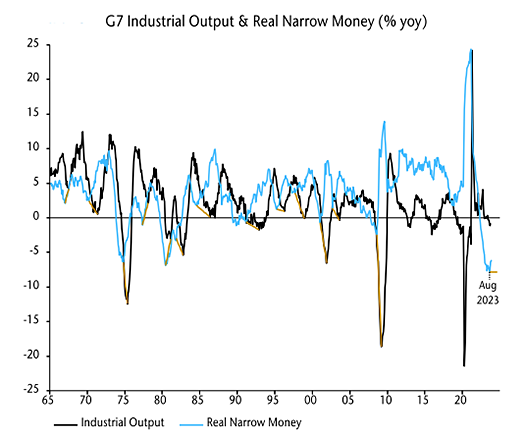
G7 annual real narrow money momentum led industrial output momentum by an average 12m at major lows historically, suggesting that the full impact of recent weakness won’t be apparent until mid-2024.

We continue to believe that hard landings are possible in the US / Europe, with resilience to date not inconsistent with historical lags for monetary weakness and yield curve inversion. Against this backdrop, we expect quality and defensive sectors to outperform in the near term on a view that hopes of a soft landing may prove to be premature.

Taiwan’s DPP returned to the presidency but lose the legislature

Taiwan held elections on January 13, with William Lai Ching-te of the Democratic Progressive Party (DPP) winning the presidency, taking 40% of the vote against 33% for Hou Yu-ih of the Kuomintang (KMT) and 26% for Ko Wen-je of the Taiwan People’s Party (TPP).

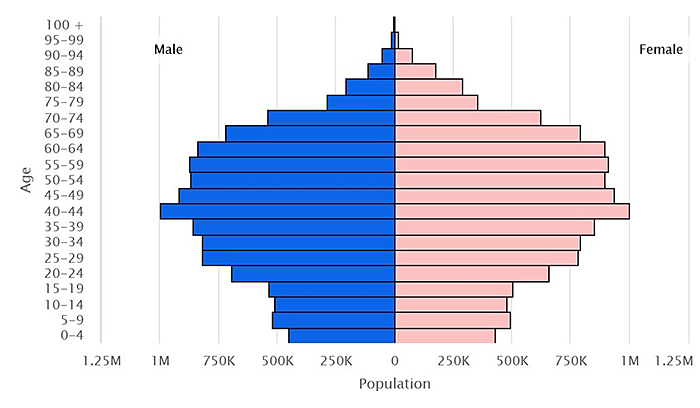
Credibility on management of cross-strait relations to safeguard Taiwan’s democracy was a key issue, and the key factor behind the DDP presidency win. However, voters (particularly younger generations) expressed their dissatisfaction with the DDP on a host of domestic issues that cost the party its hold over the legislature, now controlled by the KMT. Issues include prohibitively expensive property prices, a rapidly ageing population (see chart below), stagnant wage growth and debate over the length and quality of military conscription.

Taiwan faces demographic headwinds

Source: CIA Factbook 2024.

In addition, a host of DPP officials have been caught up in scandals in recent years, including misuse of party funds, academic plagiarism by a legislator subsequently promoted by President Tsai to vice president of the government and an extramarital affair forcing another legislator to step down.

What does China make of it? While China has repeated the rhetoric that “reunification is inevitable”, the election result is unlikely to provoke any material military response from Beijing in the near term, although some PLA muscle-flexing is to be expected in the coming months. Predictably, the Party is claiming the result as a win from its perspective, pointing out that the result signals voter dissatisfaction in the electorate after eight years of DPP rule, with Lai’s win in part owing to Taiwan’s first past-the-post electoral system. The majority of voters went for the KMT (Beijing’s favoured candidate) and political upstart TPP.

Perhaps the most notable development was the rise of the TPP, founded less than five years ago by prominent surgeon and quirky political pragmatist Ko Wen-je. Clever rhetoric and deft use of social media was key for Ko to connect with younger voters, to foreground domestic issues in his campaign over relations with China, effectively counter-positioning with the DPP and KMT.

On China, Ko has shifted over the years from alignment with the DPP towards the KMT, arguing that Taiwan is part of a greater China while disagreeing with Beijing over which state should rule the territory.

Over the next term, Ko and his party have eight seats in the legislature, setting the TPP up as kingmaker to either the KMT with 52 seats or DPP with 51, and a pivotal player on issues such as energy policy, defence expenditure and kickstarting wage growth in the service sector.

Looking further ahead, the TPP may signal the breakdown of old, inherited voting patterns and the emerging base of young voters who identify primarily as Taiwanese but, at least for now, are more focused on domestic economic, social and political issues.

Hand flipping wooden blocks from 2023 to 2024, text on table.

The start of 2023 was marked by caution, largely influenced by the prior year’s market environment that witnessed several firsts. 2022 was the first time investors faced double-digit negative returns from both equity and traditional fixed income investments in a calendar year. Many defined benefit (DB) pension plans also experienced a rapid change in their financial health, moving from deficits to meaningful surpluses despite the challenging markets. Returns in 2023 have bounced back strongly, though not without many twists and turns. This article reflects on 2023 and offers insights for the year ahead.

Interest rate surprise

The rapid rise in interest rates surprised many investors and the impact varied among investor types. Investors with a total-return goal, such as endowments, foundations and Indigenous trusts, saw portfolio market values drop in 2022 due to negative returns in both equities and fixed income. In contrast, despite negative asset returns, many DB pension plans saw their deficits replaced by surpluses as the decrease in liabilities outpaced asset declines.

Higher yields implied more favourable longer-term returns for fixed income, and discussions in 2023 shifted from the past focus of reducing fixed income allocations towards assessing the merits of increasing allocations for all investor types.

Balancing act

For total return-oriented entities like endowments, foundations and Indigenous trusts, an improved fixed income outlook was welcome. However, historical data suggests that higher fixed income yields can indicate lower equity market returns (see “crystal ball challenge” below).

Registered charities are dealing with the added impact of an increase in the minimum annual distribution quota (DQ) requirement from 3.5% to 5.0% introduced in 2023. This change could lead charities to target higher returns or accept a lower margin of additional return to meet the higher DQ.

The prospect of higher fixed income returns and potentially lower equity returns provided an opportunity for investors to reassess their asset mix strategy to ensure alignment with their goals, particularly if their fixed income allocation has been historically low or well below target allocations.

Opportunity knocks

The start of 2023 brought significant improvement to the financial well-being of many DB plans, after decades of additional contributions to counteract the adverse effects of declining interest rates and subsequent stronger growth of the liabilities compared to the asset growth. The better financial position provided an opportunity to revisit long-term asset mix strategies and risk levels.

The specific actions of DB plans depend on the plan type (e.g., corporate, university or public), actuarial liability measures that drive risk assessments, and other factors such as whether the DB plan is open or closed to new members, and plan maturity (e.g., percentage of active members versus retiree and deferred members). At a minimum, for plans that found themselves in a healthier funded position, there was a strong case for discussing the merits and trade-offs of de-risking.

While it’s unclear to what extent DB plans took the opportunity to de-risk and shift towards higher fixed income allocations, there was an uptick in fixed income search activity in the latter part of 2023, possibly indicating a trend by committees towards reassessing their asset mix strategy. However, the market roller coaster ride in 2023 was evident in both fixed income and equities. Longer-term bond yields experienced further increases at the end of the third quarter and into the start of the fourth quarter, but then yields subsequently declined leading to longer-dated fixed income investments bouncing back very strongly and achieving returns higher than major equity markets. The higher fixed income returns are likely a reflection that liabilities over the fourth quarter increased more than the assets and reduced some of the previous improvement in DB plans’ funded position.

One form of risk management that has continued unabated is de-risking through annuity purchases, especially in corporate DB plans, where the transaction can reduce the impact of DB plans on a company’s balance sheets. Many companies that chose the annuity purchase route for de-risking did so when inflation was low. Depending on the extent of built-in inflation-related pension increases, these companies might face pressure from retirees for ad-hoc pension increases given the higher inflation environment. Under a buy-out annuity, the structure is such that post-transaction there’s no longer a dedicated pool of assets with the plan sponsor for members captured under the buy-out, implying the only source of funding for ad-hoc increases would be the company’s balance sheet.

Tech titans increase market concentration

In 2023, equity returns were dominated by U.S. mega-cap stocks, particularly in the information technology sector, which benefited from investor exuberance around artificial intelligence (AI) and added to the concentration challenges of the bellwether S&P 500 Index. As shown in Figure 1, the S&P 500 Index’s top-10 holdings represented almost a third of the Index at the end of 2023.

Figure 1: Weight of top-10 holdings in the S&P 500 Index

Source: Connor, Clark & Lunn Financial Group and S&P Global Market Intelligence.

U.S. equities typically represent the largest individual component of many investors’ portfolios. Upcoming committee meetings should include discussions on the increasing concentration in the U.S. equity market. This isn’t to say the U.S. technology sector won’t continue to perform well over the next decade. However, it’s prudent to consider the benefits of diversifying the portfolio and to evaluate options for managing potential downside risks should negative outcomes unfold.

While diversification within equity markets is one option, such as leveraging the lower correlation merits of emerging markets compared to developed markets or pairing a value investment style with a growth portfolio, diversifying through fixed income and private market investments may be more advantageous. Therefore, any diversification strategy should include a broad set of investment opportunities and extend beyond equities.

Mixed experience from private markets

Over the past 10 years or so, private markets have experienced significant inflows from institutional investors. In 2023, the returns across various private markets have been mixed. Commercial real estate made most of the headlines for two reasons. First, there was the lingering impact from the COVID-19 pandemic on the office sector, leading to decreased market valuations. Secondly, some commercial real estate managers had liquidity issues, delaying divestiture requests. Other real estate sectors performed well, helping to offset office sector declines in diversified portfolios and contributing to a more optimistic market outlook for 2024 and longer term.

Private equity markets were also challenged in 2022/2023, but the forecast for 2024 and beyond is much more positive. In contrast, the infrastructure market was a standout performer in 2023 and appears well-positioned for the future. Infrastructure is increasingly seen as crucial for supporting clean energy projects and reducing reliance on carbon-intensive assets as part of global efforts to address climate risk. A successful energy transition will require extensive new infrastructure globally, focused on renewable energy sources.

The crystal ball challenge

Forecasting returns is no easy task. For example, a Horizon Actuarial Services survey of U.S. investment managers and consultants found that they significantly underestimated the strength of the U.S. equity market for the 10-year period ending December 31, 2022, and overestimated the weaker returns of emerging markets. The average annualized U.S. equity return projection was 5.9%, compared to the actual return of 12.6%. Emerging market equities were expected to return 7.5% but delivered just 1.8% (all returns in U.S. dollars).

There is, however, a historical correlation between yield levels and the outlook for equity market returns. Figure 2 illustrates the distribution of 10-year historical returns for the S&P 500. The green bars represent periods where U.S. government 10-year bond yields at the start of the 10-year period were below 3.5%, while the gold bars show returns when starting yields were between 3.5% to 5%. For example, when the yields were below 3.5%, around 20% of returns were around 17.5%. The overall average annualized S&P 500 return when yields were below 3.5% was 10.8%. Conversely, when yields were higher, such as the end of 2023, the average annualized Index return was 6.7%.

Figure 2: U.S. equity returns depending on the level of fixed income yields

Source: Connor, Clark & Lunn Financial Group.

Despite the recent decline in yields, longer-term return expectations for fixed income remain higher than what we’ve seen in a while. The level of yield at the time of writing also indicates the potential for lower long-term equity returns compared to previous strong performance.

For private markets, it is difficult to generalize since the outlook is heavily influenced by the specific strategy in which you’re invested. It’s therefore important to engage with your private market managers to understand their return expectations and assess the risk of liquidity constraints, like those recently seen in some commercial real estate strategies.

In other private markets, such as private debt, the current environment has likely enhanced its relative return potential, possibly attracting increased interest from all investor types. As noted earlier, the emphasis on energy transition to address climate risk will likely boost interest in specialized energy infrastructure strategies. Present conditions also provide an opportunity to consider more liquid, higher-yielding assets, such as commercial mortgages, that can take advantage of current higher rates.

2024: Steering through uncertainty

As your committee reviews 2023 performance, there should be welcome relief from strong positive total portfolio returns. For DB plans considering a de-risking strategy, the fourth quarter was a reminder that the opportunity to take advantage of a healthier financial position was not timeless and that there are scenarios where lower yields (and subsequent increases in liabilities) could prevail.

The top-performing market in 2023 was the U.S. equity large-cap market that was a beneficiary from the enthusiasm around AI. While the positive impact of technological innovation may persist, it’s up against a challenging economic, social and political backdrop, along with associated uncertainties. Geopolitical risks, including the U.S. election, conflicts in the Middle East and Europe, and the U.S.-China rivalry could significantly affect shorter-term market outlooks in 2024.

Given the various dynamics highlighted, ensure that committee meeting discussions focus on confirming whether your risk-return profile aligns with your objectives.

Subscribe for updates
The money and cycles forecasting approach suggested that global inflation would fall rapidly during 2023 but at the expense of significant economic weakness. The inflation forecast played out but activity proved more resilient than expected. What are the implications for the coming year?

One school of thought is that economic resilience will limit further inflation progress, resulting in central banks disappointing end-2023 market expectations for rate cuts, with negative implications for growth prospects for late 2024 / 2025.

A second scenario, favoured here, is that the economic impact of monetary tightening has been delayed rather than avoided, and a further inflation fall during H1 2024 will be accompanied by significant activity and labour market weakness, with corresponding underperformance of cyclical assets.

The dominant market view, by contrast, is that further inflation progress will allow central banks to ease pre-emptively and sufficiently to avoid material near-term weakness and lay the foundation for economic acceleration into 2025.

On the analysis here, the second scenario might warrant a two-thirds probability weighting versus one-sixth for the first and third. This assessment reflects several considerations.

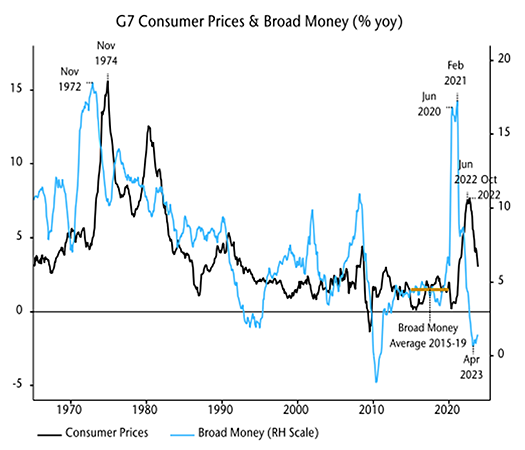
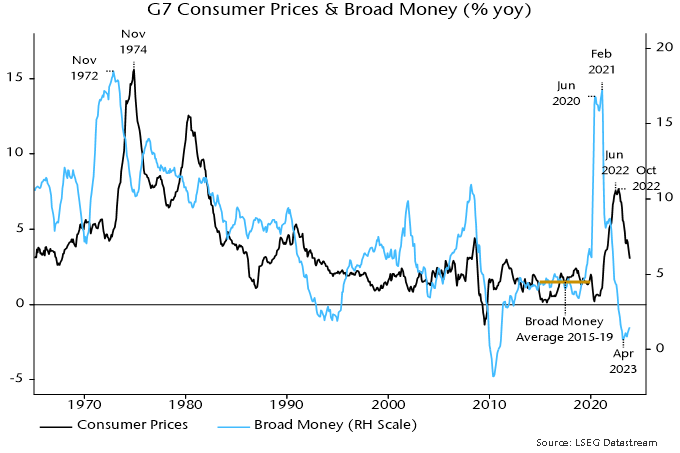
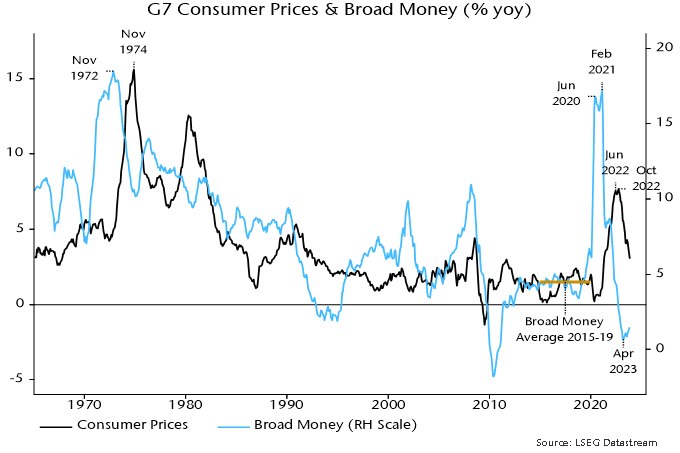
First, on inflation, developments continue to play out in line with the simplistic “monetarist” proposition of a two-year lead from money to prices. G7 annual broad money growth formed a double top between June 2020 and February 2021 – mid-point October 2020 – and declined rapidly thereafter. Annual CPI inflation peaked in October 2022, falling by 60% by November 2023 – chart 1.

Chart 1

Chart 1 showing G7 Consumer Prices & Broad Money (% yoy)

Broad money growth returned to its pre-pandemic average in mid-2022 and continued to decline into early 2023. The suggestion is that inflation rates will return to targets by H2 2024 with a subsequent undershoot and no sustained revival before mid-2025.
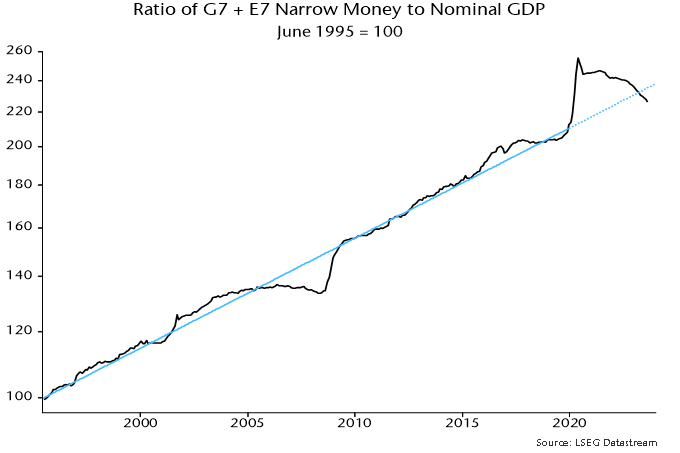
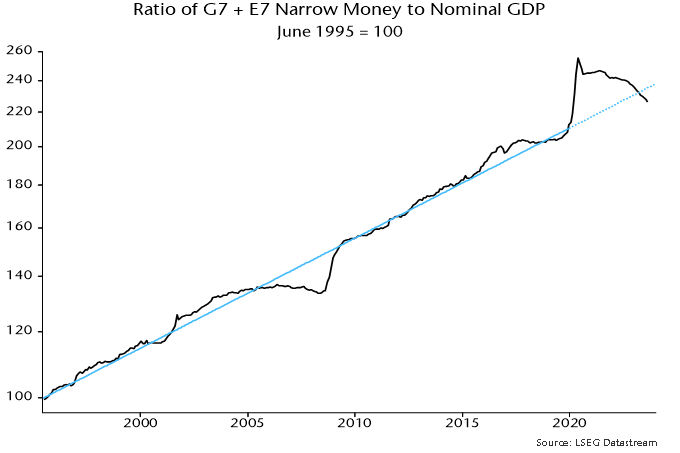
Secondly, economic resilience in 2023 partly reflected post-pandemic demand / supply catch-up effects. On the demand side, an analytical mistake here was to downplay the supportive potential of an overhang of “excess” money balances following the 2020-21 monetary explosion. Globally, this excess stock has probably now been eliminated – chart 2.

Chart 2

Chart 2 showing Ratio of G7 + E7 Narrow Money to Nominal GDP June 1995 = 100

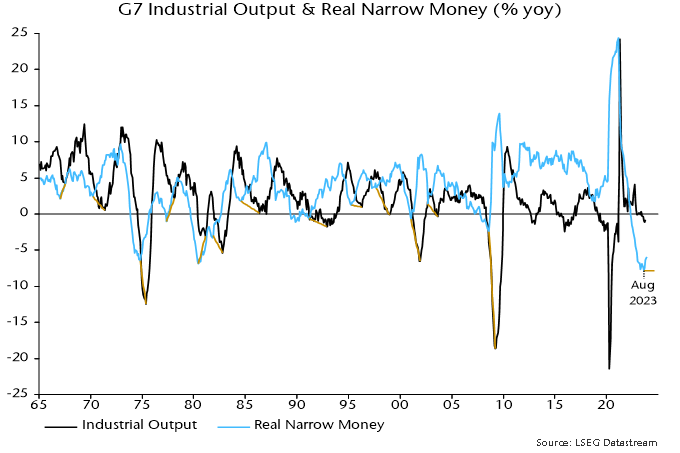
The moderate economic impact of monetary tightening to date, moreover, is consistent with historical experience. Major lows in G7 annual real narrow money momentum led lows in industrial output momentum by an average 12 months historically – chart 3. With a trough in the former reached as recently as August 2023, economic fall-out may not be fully apparent until H2 2024.

Chart 3

Chart 3 showing G7 Industrial Output & Real Narrow Money (% yoy)

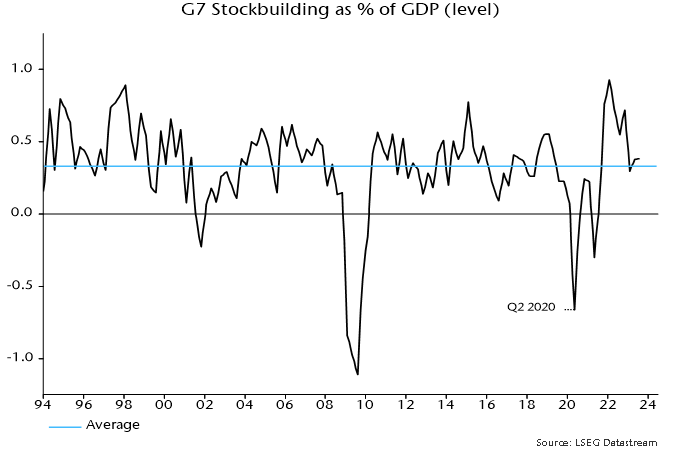
The suggestion that economic downside is incomplete is supported by a revised assessment of cyclical influences. The previous hypothesis here was that the global stockbuilding cycle would bottom out in late 2023 and recover during 2024. Recent stockbuilding data, however, appear to signal that the cycle has extended, with a recovery pushed back until H2 2024.

The assumption of a late 2023 trough was based on a previous low in Q2 2020 and the average historical cycle length of 3 1/3 years. This seemed on track at mid-2023: G7 stockbuilding had crossed below its long-run average in Q1, consistent with a trough-compatible level being reached in H2 – chart 4. The downswing, however, was interrupted in Q2 / Q3, with a further decline likely to be necessary to complete the cycle and form the basis for a recovery.

Chart 4

Chart 4 showing G7 Stockbuilding as % of GDP (level)

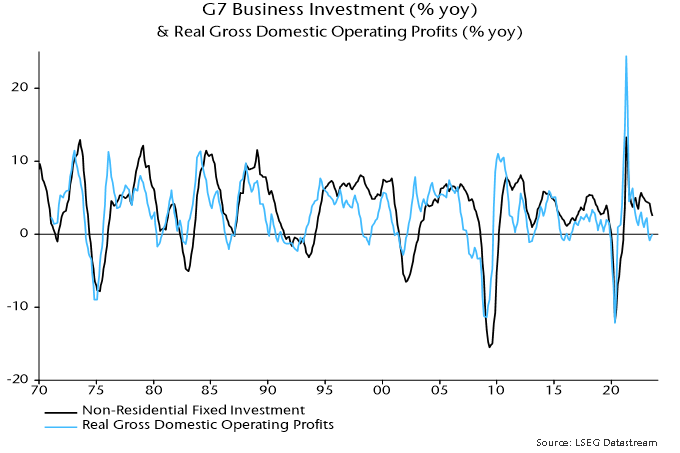
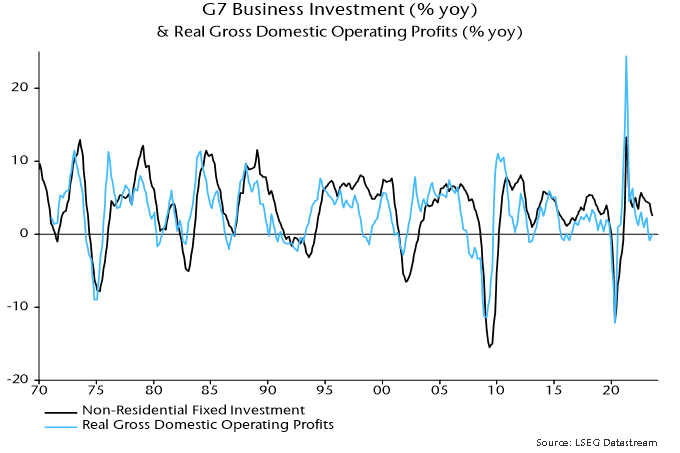
A resumed drag from stockbuilding may be accompanied by a further slowdown or outright weakness in business investment, reflecting recent stagnation in real profits – chart 5. Capex is closely correlated with hiring decisions, so this also argues for a faster loosening of labour market conditions.

Chart 5

Chart 5 showing G7 Business Investment (% yoy) & Real Gross Domestic Operating Profits (% yoy)

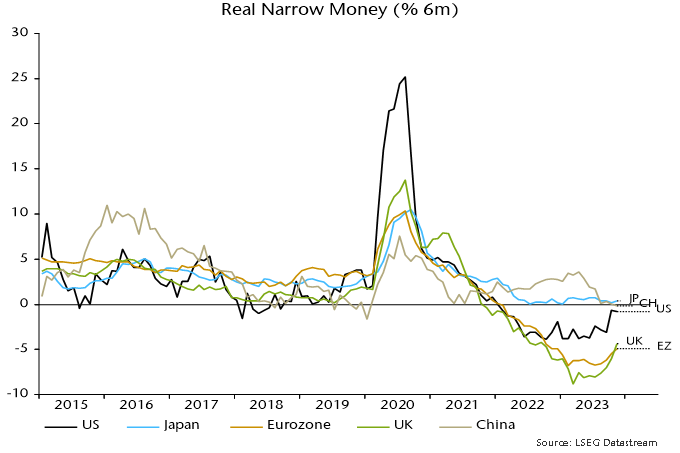
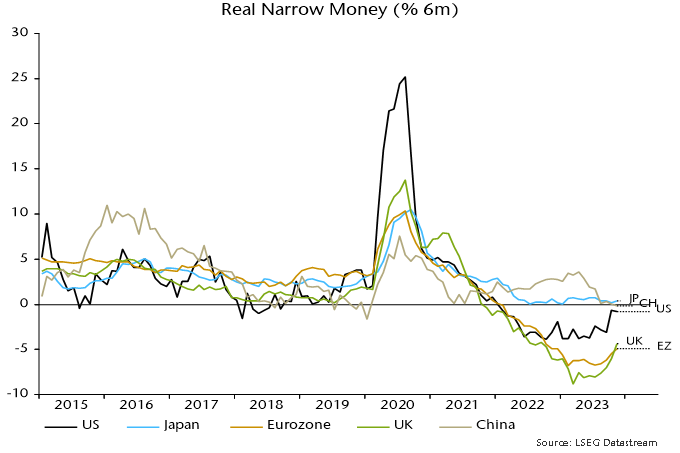
Real narrow money momentum remains weaker in Europe than the US, suggesting continued economic underperformance and a more urgent need for policy relaxation – chart 6. Six-month rates of change are off the lows but need to rise significantly to warrant H2 recovery hopes. Globally, the US / European revivals have been partly offset by a further slowdown in China, suggesting still-weakening economic prospects.
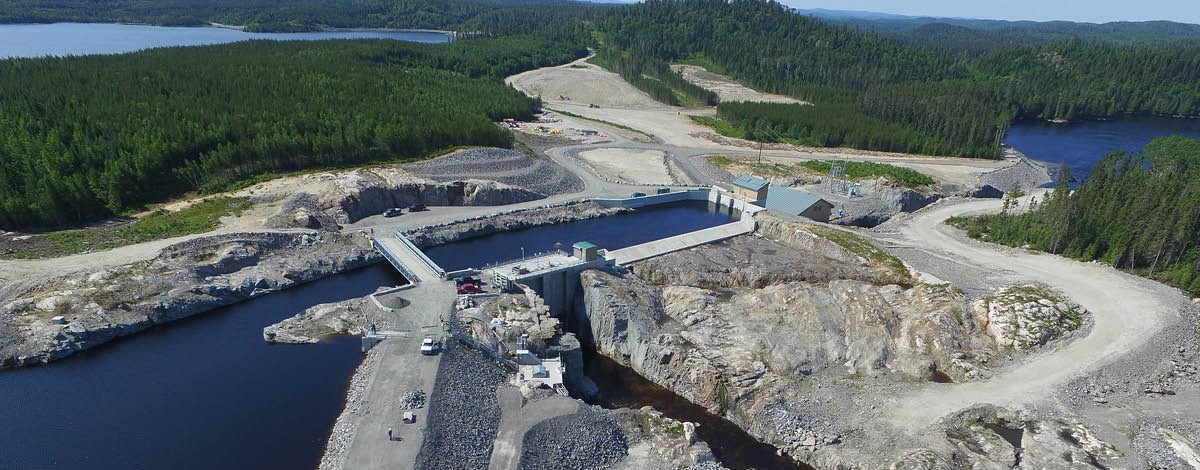
Chart 6

Chart 6 showing Real Narrow Money (% 6m)

The frenetic rally of the final two months resulted in global equities delivering a strong return during 2023 despite the two “excess” money indicators tracked here* remaining negative throughout the year. The indicators, however, started flashing red around end-2021, since when the MSCI World index has slightly underperformed US dollar cash.

Historically (i.e. since 1970), equities outperformed cash on average only when both indicators were positive, a condition unlikely to be met until mid-2024 at the earliest.

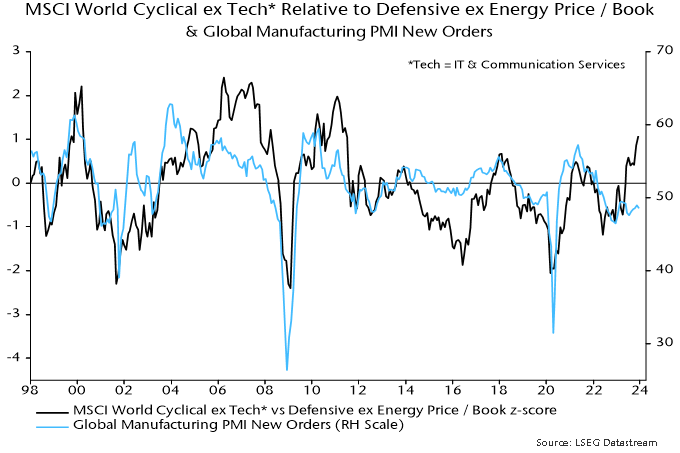
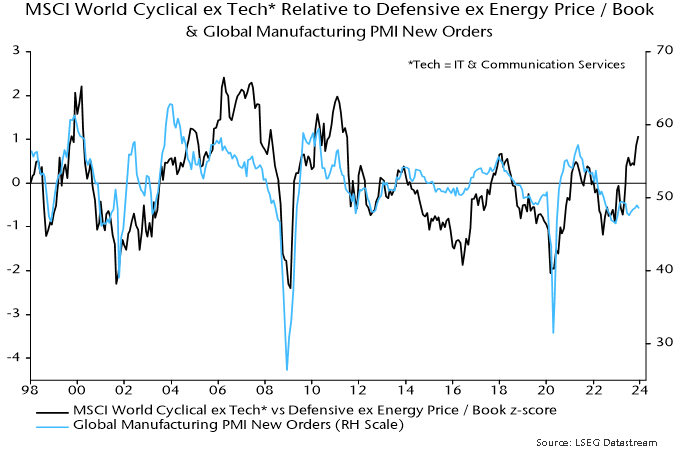
The late 2023 rally was led by cyclical sectors as investors embraced a “soft landing” scenario. Non-tech cyclical sectors ended the year more than one standard deviation expensive relative to history versus defensive ex. energy sectors on a price / book basis – chart 7. Current prices appear to discount an early / strong PMI recovery, which the earlier discussion suggests is unlikely.

Chart 7

Chart 7 showing MSCI World Cyclical ex Tech* Relative to Defensive ex Energy Price / Book & Global Manufacturing PMI New Orders *Tech = IT & Communication Services

Quality stocks outperformed during 2023, reversing a relative loss in 2022 and consistent with the historical tendency when “excess” money readings were negative. Earlier underperformance partly reflected an inverse correlation with Treasury yields, a relationship now suggesting further catch-up potential.

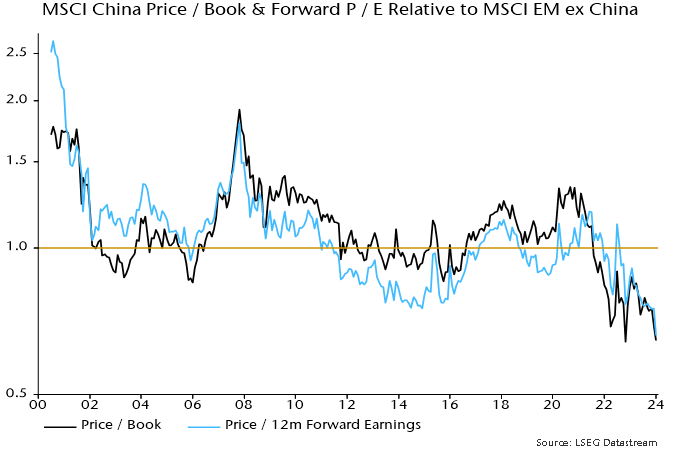
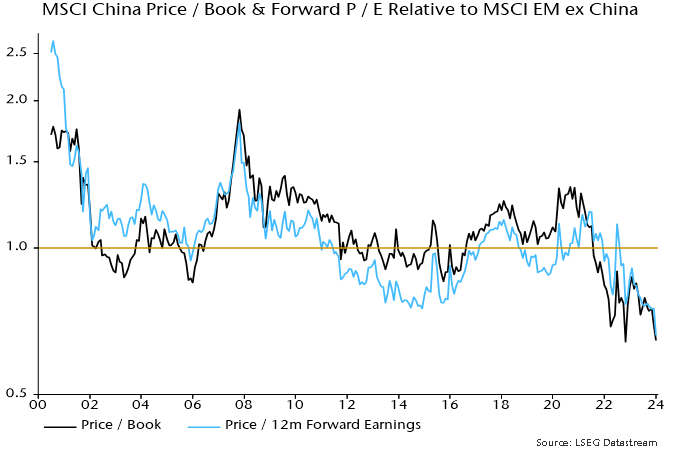
Contributing factors to the dramatic underperformance of Chinese stocks during 2023 include excessively optimistic post-reopening economic expectations at end-2022 and unexpectedly restrictive monetary / fiscal policies. MSCI China is at a record** valuation discount to the rest of EM – chart 8 – while monetary / economic weakness suggests an early policy pivot.

Chart 8

Chart 8 showing MSCI China Price / Book & Forward P / E Relative to MSCI EM ex China

A key issue for 2024 is the extent to which central bank policy easing will revive money growth. While inflation is expected to trend lower into early 2025, the cycles framework suggests another upswing later this decade – the 54-year Kondratyev price / inflation cycle last peaked in 1974. Aggressive Fed easing 54 years ago – in 1970 – pushed annual broad money growth into double-digits the following year, creating the conditions for the final Kondratyev ascent. Signs that a similar scenario is playing out would warrant adding to inflation hedges.

*The differential between G7 plus E7 six-month real narrow money and industrial output momentum and the deviation of 12-month real narrow money momentum from a long-term moving average.

**Since June 2000. MSCI China included only B-shares through May 2000, when red chips and H-shares were added.

Corporate businesspeople shaking hands in an office.

Recent market movements have been driven by a decline in bond yields and a repricing of a more optimistic scenario, where growth is resilient and inflation figures are falling fast. While mid-term trends look supportive, persistently high inflation could point to later interest rate cuts than markets currently expect.

Small caps shine in Europe

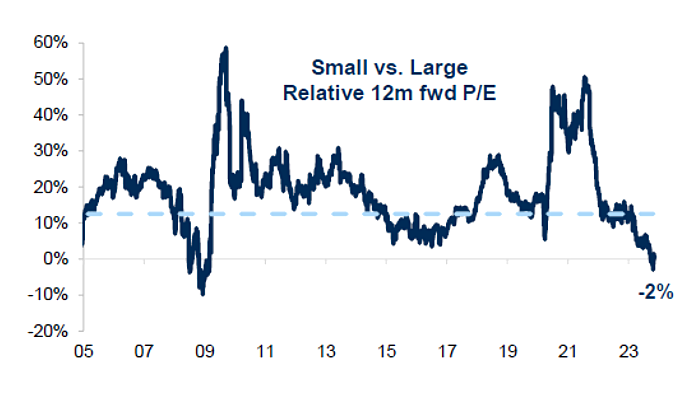
We believe that growth will remain steady in 2024 despite potential economic contractions in some regions during the first half of the year. European small caps continue to look attractive compared to their larger counterparts. As illustrated below, small caps are near their largest historical discount relative to large caps. Several industries still trade at very low valuations and could benefit from a potential re-rating. We believe the end of the destocking phase combined with lower interest rates should help in regaining momentum for European small caps.

P/E of STOXX small caps vs STOXX large caps

Source: Goldman Sachs.

Wage growth: a silver lining

Real wage growth is another indicator showing positive signs. An increase in wage growth could be beneficial for consumers and the broader economy. Companies’ responses to growing labour costs will be a key determinant for financial markets in 2024. Companies with strong pricing power should be able to raise prices again. Others might scale back labour, cut investments or accept lower profits. In summary, we expect earnings growth to be erratic and modest in 2024.

Factor investing in a dry liquidity climate

Regarding factor investing, liquidity has dried up in 2023 and small caps are underinvested in compared with other asset classes. According to JP Morgan, small caps in Europe have experienced their worst 23-month outflows in the last 15 years. However, November’s positive inflows may indicate a shift toward a more optimistic sentiment. A return to more normalized monetary policy should gradually improve liquidity and investment flows during 2024. Much like the adage “cash is king,” investors are likely to continue rewarding companies with decent dividends and buybacks.

M&A: the untapped potential for small caps

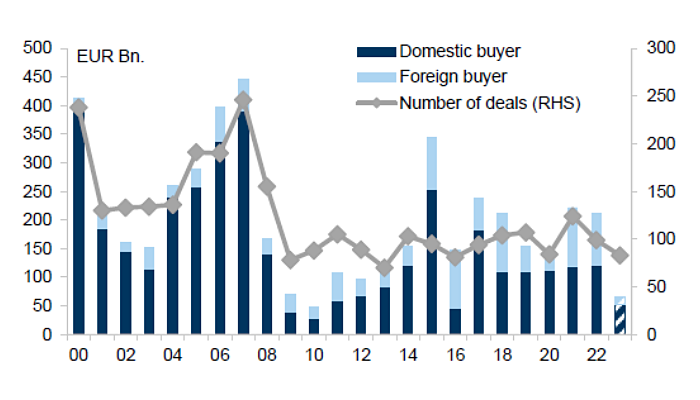
M&A activity is another potential catalyst that would favour smaller companies. M&A in 2023 has been low, as shown by the chart below, with a 70% decrease primarily due to fewer foreign buyers. Corporate sentiment, equity valuations and monetary conditions are key drivers of M&A activity. Reasonable equity valuations along with a normalizing monetary policy should enhance corporate sentiment toward M&A. With positive sentiment and plenty of balance sheet resources, a potential pickup in M&A could greatly benefit smaller companies.

Sources: Goldman Sachs, Bloomberg.

Navigating tomorrow’s market

As small caps gain traction and M&A activity hints at resurgence, the market presents a complex puzzle. The real insight emerges in piecing together these fragments to understand where the next wave of growth will come from.

New house under construction is insulated with spray foam.

As winter approaches, homeowners are confronted with the need to turn on their heating systems and the higher costs of additional heating. This winter, many US consumers will likely pay even more to heat their homes because of surging fuel prices and colder weather forecasts.

The National Energy Assistance Directors Association predicts increased winter heating expenditures across the board, with electricity up 1.2%, propane 4.2% and heating oil 8.7%. Natural gas is expected to be down 7.8%. Air conditioning and heating are by far the biggest sources of home energy use, comprising 51% of household energy bills. A main reason energy bills spike in winter is due to inadequate insulation.

This is where Installed Building Products (IBP) comes in – and why we’ve invested in this company. This week, we’ll share insights into our investment process and approach to selecting companies like IBP that we believe are poised to generate shareholder value.

Who is Installed Building Products (IBP)?

Founded in 1977 and based in Columbus, Ohio, IBP is one of the largest insulation installers in the US. In the late 1990s, the company embarked on an ambitious acquisition strategy to expand its reach nationally. IBP went public in 2014, at which point it was generating $432 million in revenue with earnings of 2 cents a share. Last year, its revenue reached $2.6 billion with adjusted earnings of $8.95 per share.

Besides insulation, which makes up 60% of its revenue, IBP has diversified into complementary building products (waterproofing, fireproofing, garage doors, rain gutters and more) for both the residential and commercial construction markets.

Target market

  • Combined single family and multifamily insulation market has a ~$6 billion total addressable market (TAM).
  • Complementary products add another $4 billion TAM ($1.4 billion for garage doors, $1.1 billion for shower shelving and mirrors, $800 million for window blinds and $700 million for gutters).
  • Amount of insulation per home is increasing due to a greater focus on energy efficiency and stricter energy codes.
  • IBP’s largest competitor is TopBuild (they each rank #1 or #2 in different markets).

IBP has a cost advantage

Industry suppliers lack power. The fiberglass insulation manufacturing industry is highly consolidated, with four players accounting for all sales (Owens Cornings 40%, CertainTeed 20%, Knauf 20%, Johns Manville 20%). While the supplier concentration would suggest high pricing power, insulation manufacturing is a capital-intensive business with high fixed costs. Ovens cannot be easily shut on and off. As a result, manufacturers are incentivized to run their lines at high capacity to cover their fixed costs and get leverage. This makes the industry more competitive despite its concentration. Given IBP’s scale, it can buy insulation foam at a larger discount than smaller competitors and save big on costs.

IBP’s growth strategy

  • Organic growth is achieved through increasing penetration in developing markets.
  • On average, an established IBP branch generates ~$4,400 per residential permit versus $2,200 for a new developing branch.
  • Inorganic – M&A is part of IBP’s expansion story and it aims to acquire ~$100 million of revenue annually.

Strengths

  • Leading positions in insulation installation, with a 28% market share up from 5% in 2005.
  • M&A has been a part of its growth strategy since 1990.
  • Scale = ability to buy product cheaper than smaller competitors.

Weaknesses

  • Distribution arm is relatively small when compared to peer TopBuild.
  • No centralized ERP = branches could be competing for the same business.
  • Complementary products have lower margin due to current lack of scale.

Opportunities

  • Complementary products.
  • Capacity to penetrate developing markets.
  • Increasing residential building codes = higher revenue per unit.

Threats

  • Weakness in US residential markets.
  • Current supply constraints cap organic growth.
  • Supply shortage (COVID-19 period) or explosion/fire at a supplier plant (2018) can temporarily increase cost of raw material.

IBP management

IBP’s management, led by CEO Jeff Edwards since 2004, is a key part of the business’s success. Edwards, who joined the company in 1994 and became chairman in 1999, is one of its largest shareholders.

When we first spoke to Jeff and he walked us through how he built the business, we quickly realized he was a visionary leader with a solid plan for future growth.

He told us how he saw potential in the niche sideline of foam insulation. His rational was simple: every home, every building, needs insulation. He was not looking to reinvent the industry, but rather focused on delivering the best service to builders while acquiring successful businesses in various cities. The sales pitch to targets was also simple: being part of IBP means they can do what they like and not be bogged down by functions that aren’t core to their business, like insurance, human resources, accounting and payroll.

In 1994, IBP made its first acquisition with Freedom Construction in Columbus, Ohio, followed by several more in the ensuing years. The rest as they say is history.

Unseen value beyond the walls

Investment potential often lies hidden in plain sight, like the insulation in our walls. IBP has all the characteristics we look for in an investment: a small-cap company with what we believe to be tremendous growth potential with low debt, rapid revenue and earnings growth compared to its industry, and strong management.

Insulation may not be exciting, but not only does it conserve energy and reduce bills, it also represents a notable sector in our investment landscape. How often do investors overlook the potential in the ordinary and what opportunities might we uncover by paying closer attention to what others may miss?

 Buenos Aires Financial District.

Summary

  • Treasury yields retreated through the month on inflation data that undershot market expectations (in line with our forecasts), with stocks and bonds celebrating the news.
  • We remain cautious and view the exuberance with scepticism, and expect a weakening global economy and earnings downgrades to test the bulls.
  • On a brighter note, rapid disinflation and the prospect of rate cuts in 2024 will precipitate a recovery in money numbers that could be the signal to tilt away from current defensive positioning.

Institutional quality is key to unlocking development

Analysis of qualitative macro factors in emerging markets is a cornerstone of our process, which is critical to identifying the potential for downside shocks that can wipe out investor returns (irrespective of how attractive a company’s fundamentals may appear). Given the relative fragility of institutions in EM, politics can have an outsized impact on a country’s progress up (or down) the development ladder, with elections often serving as critical junctures.

This month we saw the conclusion of national elections in Argentina, with right-wing libertarian and economist Javier Milei crushing the incumbent Perónists on a platform of radical economic reform. While markets have celebrated the development, does Milei’s election truly represent a structural turning point given the institutional forces that stand in his way?

Argentina a case study of the vicious cycle

A hundred years ago, Argentina was one of the richest countries on the planet, with the young and dynamic South American country outstripping the likes of even France and Germany. The rise and dominance of the left-wing populist Perónists in the 20th and 21st centuries (interrupted by a succession of military juntas in the 1970s and 80s) put an end to this.

For us, Argentina’s downward spiral from such an enviable position to today underlies the importance of institutional quality as the key determinant of whether a country climbs or slides down the development ladder. Vicious and virtuous circles of development (where political and economic institutions become either more extractive or inclusive) can form momentum that is hard to break. For EM investors in particular, who deal with countries with relatively more fragile institutions than DM counterparts, it pays to be mindful of what kind of cycle is at play in a country.

The book “Why Nations Fail” by Acemoglu and Robinson provides an excellent summary of these vicious/virtuous circles:

“Rich nations are rich largely because they managed to develop inclusive institutions at some point during the past three hundred years. These institutions have persisted through a process of virtuous circles. Even if inclusive in a limited sense to begin with, and sometimes fragile, they generated dynamics that would create a process of positive feedback, gradually increasing their inclusiveness. England did not become a democracy after the Glorious Revolution in 1688. Far from it. Only a small fraction of the population had formal representation, but crucially, she was pluralistic. Once pluralism was enshrined, there was a tendency for institutions to become more inclusive over time, even if this was rocky and uncertain process.” (Why Nations Fail, p364)

Clearly nothing of the sort occurred in Argentina over the last century. Instead, a confluence of economic and political crises from the 1930s onwards saw the country follow nearly half a century of growth with a lapse into domestic upheaval, the rise of Perónism and extreme political choices that fuelled a vicious circle causing Argentina to backslide.

Rise of the Perónists

While it is possible for countries to grow under extractive institutions, this will begin to falter at more advanced levels of development. Improving institutional quality is essential to break through to the next level.

“It is true that Argentina experienced around fifty years of economic growth, but this was a classic case of growth under extractive institutions. Argentina was then ruled by a narrow elite heavily invested in their agricultural export economy … [involving] no creative destruction and no innovation. And it was not sustainable.” (Why Nations Fail, p385)

Becoming Minister of Labour in 1943 following a military coup, Juan Domingo Perón was elected president in 1946. He then set about attacking Argentina’s institutions much as the previous military junta had done before him. He started by gutting the Supreme Court to remove any checks to his power, and sidelined the main opposition party by arresting its leader. The Perónists emerged as a new elite which shaped extractive institutions to their benefit.

“The Perónists won elections thanks to a huge political machine, which succeeded by buying votes, dispensing patronage, and engaging in corruption, including government contracts and jobs in exchange for political support. In a sense this was a democracy, but it was not pluralistic. Power was highly concentrated in the Perónist Party, which faced few constraints on what it could do, at least in the period when the military restrained from throwing it from power.” (Why Nations Fail, p385)

Is Milei’s election a critical juncture?

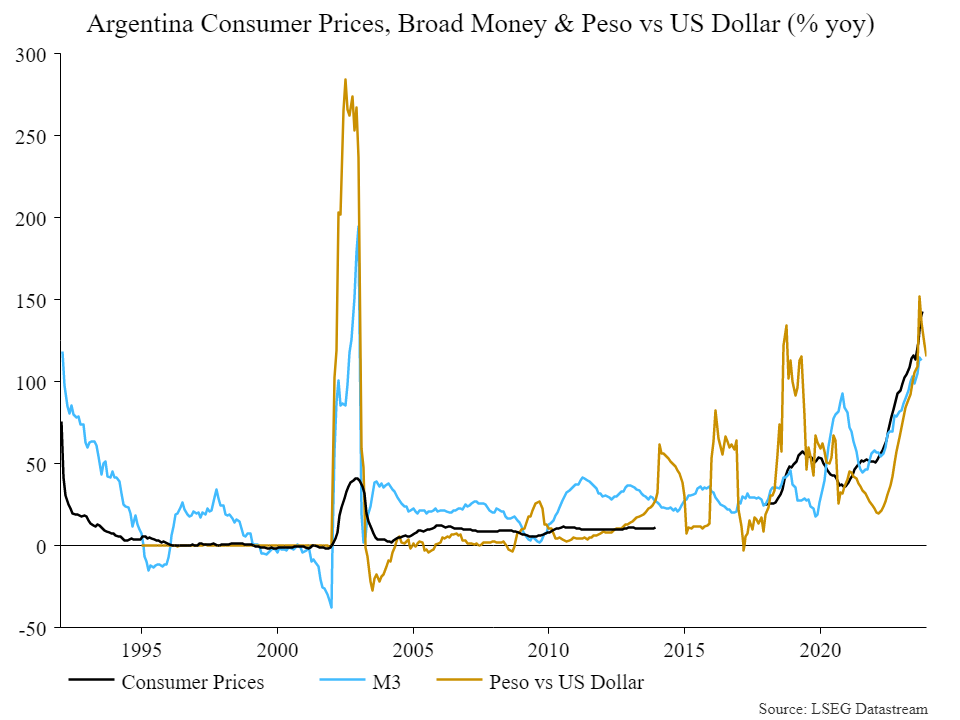
Following 28 of the last 40 years under Perónist rule, the country today battles its worst economic crisis in two decades as inflation spirals, poverty rates climb and – in the words of President-elect Javier Milei – the peso “melts like ice cubes in the Sahara.” Such is public frustration for perpetual economic catastrophe that Argentinian voters dumped the incumbents for libertarian rockstar economist Milei, who attracted 56% of the second-round vote, the most votes garnered by any candidate since 1983.

Argentina Consumer Prices, Broad Money & Peso vs. US Dollar (% yoy).

Source: NS Partners & LSEG Datastream

Milei campaigned on the promise of radical change and economic shock therapy. This includes dollarising the economy and eliminating the politicised central bank, putting the “chainsaw” to public spending, privatising state-owned companies, along with a host of controversial conservative social and libertarian reforms. Clearly, breaking the vicious cycle in play in Argentina will require radical policy change. Well implemented dollarisation could indeed work (with a deep recession) to restore economic order, working to reduce inflation, increase consumer buying power, and stabilise the economy in a way that enables better long-term economic planning while attracting foreign investment.

This sounds great in theory and markets have cheered the election results, but can Milei actually translate his victory into policy that passes through parliament when his party holds just 39 of 257 seats in the lower house and 8 of 72 in the senate? An alliance with centre-right former president Macri and his Republican Proposal party still won’t constitute a governing majority, but it will boost the chances of pushing through the reform agenda. For this to happen, however, it is likely that compromises will need to be made with Macri’s moderates and other neutrals. Will Milei, a libertarian firebrand who has gained so much popularity from demonising the political elite, be able to stomach a watered-down agenda?

How do we implement development theory in EM investing?

Our approach to macro analysis is not to place bets on such uncertain outcomes, but instead to assess the direction of travel and mark conviction in that country up or down accordingly. If Milei can beat the odds, then Argentina may gradually emerge as a hunting ground for investment opportunities.

For now, the reality is that powerful structural forces suffocate the country’s potential and make for a fragile environment that can easily wipe out investors lacking a robust approach to accounting for macro risk.

Aerial view of Wind River Hydro project in Ontario
White River Hydro Project, Ontario, Canada

An Opportunity to Foster Mutual Benefit and Support Sustainable Development

This article was originally published in Issue 33 of the Journal of Aboriginal Management (JAM), it focuses on the theme Infrastructure: Building a Better Tomorrow.


Indigenous participation in infrastructure projects promotes the economic empowerment of communities while also contributing to a project’s overall success and sustainability. In this article, we delve into some of the ways Indigenous communities can participate in infrastructure investments, and we highlight the benefits that such partnerships can create.

Responsible Investment Requires Inclusive Stakeholder Engagement

Infrastructure projects are typically large-scale physical assets that meet a basic human need. These assets are essential to the well-being of communities and critical to the functioning of local economies. Infrastructure encompasses projects such as roads, bridges, schools, hospitals, water distribution and treatment as well as power generation and electricity transmission. The development and construction of these assets require significant investment and involve numerous stakeholders. The importance of infrastructure projects to communities, and their long-term nature and size, necessitate a responsible investment approach to secure and maintain a social license to operate.

Stakeholder engagement plays a pivotal role in ensuring that investments incorporate a wide range of perspectives and create positive outcomes. Ultimately, responsible investment is about generating financial returns while also considering the broader impact on society and the environment. An inclusive approach to engagement is essential in ensuring that all relevant parties are consulted.

There is a growing recognition of the importance of including Indigenous peoples as key stakeholders in infrastructure projects, ensuring their rights, cultural heritage, and economic interests are respected and supported. This is particularly critical in countries such as Canada where many infrastructure projects directly impact Indigenous lands and territories, as well as their peoples and communities.

This increased awareness – combined with more intentional inclusivity on behalf of government and business – should help to facilitate greater participation in the responsible development of further sustainable infrastructure projects in Canada. However, it is important that these efforts are focused on a desire for true understanding of Indigenous perspectives and priorities, as well as genuine relationship building that seeks to achieve mutual benefit. Such an approach fosters transparency while also promoting collaboration and consensus-building, which can lead to better decision-making and outcomes.

Collaboration Fosters Mutual Benefits and Sustainable Development

Positive partnerships provide a promising path towards more inclusive investment opportunities that facilitate the economic empowerment of Indigenous communities while also supporting the development, construction, and operation of high-quality and sustainable infrastructure projects.

Increased Indigenous participation can contribute to reconciliation efforts by encouraging Indigenous business development, self-determination, and positive socio-economic outcomes. The steady cash flows generated by infrastructure investments can provide Indigenous partners with funds to address any number of objectives such as housing, healthcare, education, recreational facilities, community centers, economic development and cultural revitalization – or anything that the community values and sets as a priority.

Engaging Indigenous communities also helps to protect the value of infrastructure investments by mitigating some of the associated risks, helping to avoid or address conflicts and legal challenges early while supporting smoother and more efficient project development and operations.

Scott Munro, Deputy Chief Executive Officer of the First Nations Financial Management Board, highlighted this well in his article on evolving ESG standards (JAM 32): “How well a business considers and respects Indigenous rights will determine how its enterprise value is impacted. As well intended and beneficial as these projects maybe, if corporations fail to demonstrate to investors and lenders that they have the free, prior, and informed consent of the Indigenous people who are being impacted, conflict is a certain outcome. Projects may get delayed or encounter costly litigation, and businesses will face reputational loss and discontent shareholders.”

In addition to mitigating some of the risks associated with infrastructure projects, the active involvement of Indigenous communities from the beginning stages of project planning brings valuable local knowledge and perspectives to the table. Indigenous communities possess deep understanding of their lands, resources, and traditional practices. These perspectives contribute to better project design, deeper insight into areas of archaeological significance, sustainable resource management, biodiversity preservation, and more robust environmental impact assessments while also promoting effective environmental monitoring and maintenance.

Collaboration enhances the sustainability of projects and strengthens stewardship efforts by incorporating Indigenous perspectives and practices that have been proven to be environmentally harmonious and resilient over generations. It can lead to more successful outcomes for both the project and the communities involved, fostering collaboration, trust, and shared prosperity.

Indigenous Opportunities in Infrastructure

There are several different ways in which Indigenous communities can participate in infrastructure projects. This includes direct involvement through equity ownership stakes, revenue sharing and other mutually beneficial arrangements, as well as less direct participation through financial investments in public infrastructure companies or private infrastructure funds.

Most commonly, participation is formalized through some form of a negotiated benefit agreement that governs the relationship between the Indigenous community and the infrastructure project. These agreements outline specific benefits and compensation that Indigenous communities will receive in exchange for their support or consent for a project, ensuring their interests are codified and acknowledged as part of the project’s ongoing operations. Successful agreements facilitate community consultation and approval by addressing community social, economic and environmental objectives while also ensuring an equitable distribution of project costs and benefits. Benefits can include financial compensation, employment opportunities, skills training, and community development initiatives.

Equity ownership stakes provide a means for Indigenous communities to share directly in the economics of infrastructure investments. By having ownership in a project, communities receive profits and participate in aspects of the decision-making processes. Revenue sharing agreements are another way in which Indigenous communities can participate in a share of the profits generated by an infrastructure project and can provide an important source of revenue. Both of these types of agreements can empower Indigenous communities economically, foster job creation, and improve resource access.

In addition to equity ownership stakes and royalty payments, there may also be other mutually beneficial arrangements that can be explored. It’s important to recognize that the needs, values and ambitions of each Indigenous community are unique in the same way that each infrastructure project is distinct. While there are benefits to leveraging past experience and best practices, there is no one-size-fits-all approach. Each discussion needs to begin from a place of respect for Indigenous communities and a willingness for open dialogue to reach a place of understanding and productive collaboration.

CC&L Infrastructure’s Focus on Shared Value and Strong Partnerships

CC&L Infrastructure invests in infrastructure assets with attractive risk-return characteristics, long lives, and the potential to generate stable cash flows on behalf of a wide variety of clients — including Indigenous trusts, public and private pension funds, life insurance companies, financial institutions, foundations and endowments, and high-net worth individuals.

As long-term asset owners and stewards of client capital, CC&L Infrastructure focuses on managing its assets responsibly. This includes a systematic approach to evaluating material environmental, social, and governance factors. We believe this approach improves our ability to manage risk, protect the value of our investments, and enhance long-term investment returns.

Our firm has a long history of working alongside Indigenous partners. We worked with local First Nations on our first investment more than 15 years ago, and today over half of the Canadian infrastructure assets in our portfolio collaborate with Indigenous communities in some fashion. This includes several run-of-river hydroelectric facilities and solar projects where our Indigenous partners have a direct equity investment alongside us.

CC&L Infrastructure is a part of Connor, Clark & Lunn Financial Group Ltd., an employee-owned, multi-boutique asset management firm whose affiliates collectively manage over CAD$110 billion in assets.

Round checkboxes on white paper and an orange ballpoint pen.

2024 is shaping up to be a historically significant year for elections, with around half of the world’s population having the opportunity to vote. An estimated 76 countries will hold elections in 2024, including eight of the 10 most populated (Bangladesh, Brazil, India, Indonesia, Mexico, Pakistan, Russia and the US). Europe will witness the most election activity, with 37 countries voting, followed by Africa with 18.

US elections: The world watches

The US election in November, when voters will choose the next president, the entire House of Representatives and a third of the Senate, is expected to dominate headlines. The most likely scenario is a rematch between President Joe Biden and Donald Trump.

The shifting focus of Europe’s political landscape

The European Parliament elections are in June and the topic of migration will likely be at the forefront of debates. If current trends persist, the EU could see the highest number of asylum applications since the 2015-16 refugee crisis. Once thought of as a solution to labour shortages, migrants are increasingly being viewed by some European politicians as a security threat, despite ongoing worker shortages. This could lead to a meaningful political shift toward stricter immigration controls.

Dutch elections: A sign of the times?

The Netherlands’ snap elections on November 22 were perhaps a glimpse of what is to come, with the far-right Freedom Party led by Geert Wilders winning unexpectedly. No party achieved more than 25% of the vote, necessitating coalition talks that could stretch well into 2024. In addition to a strict stance on immigration, the Freedom Party campaign included higher taxes on banks, which negatively impacted Dutch bank stocks the following day. However, the Amsterdam Stock Exchange remained stable after the election due to the pending coalition formation.

Poland’s election results as a market catalyst

Poland’s October elections saw a major upheaval, with the long-ruling nationalist party being replaced by pro-Europe parties, lifting Polish markets the following day.

From voting booths to market trends

That is not to say all elections wield the same influence. Russia’s elections are unlikely to challenge Vladimir Putin’s stronghold. Brazil and Turkey will hold local or municipal elections, while the EU will elect its next parliament.

India, the world’s largest democracy, is likely to see Modi’s party re-elected in May despite some recent discontent. Indonesia will also hold elections early in the new year.

Taiwan’s January elections, important for their geopolitical implications, are expected to see the pro-independence party maintain control. It remains to be seen how the country’s relationship with China will develop from there.

Understanding the election effect on markets

US Bank reports that the S&P 500 Index typically experiences lower returns due to investor uncertainty before US presidential elections, with stronger returns in the following year regardless of the election outcome. Notably, returns tend to be higher when an incumbent party is re-elected and when one party wins decisively, suggesting larger policy changes.

Investing smart in election years

We believe our diversified portfolio is especially critical in periods of uncertainty. Election outcomes can heavily influence economic policies, affecting taxation, regulations and economic reforms. These changes have the power to shape various sectors and industries in profound ways. Safeguarding your investments by diversifying across different securities and industries is a wise strategy.

The role of quality companies

Quality companies that demonstrate enduring strength, guided by capable management and driven by long-term secular trends are well-equipped to weather the market’s ups and downs. Their resilience and adaptability often become key to their sustained success, offering a more grounded perspective for investors looking beyond the immediate horizon of shifting politics.