Panoramic view of Kuwait city at sunset.

MENA equity markets had a weak second quarter of 2024 with returns of -4.2% (for the S&P Pan Arabian Index Total Return), trailing the MSCI Emerging Markets Index which was up 5% in the same period. For the first half of 2024, MENA equity markets are up 3.0% compared to 7.5% for the MSCI EM index.

The performance drag in the quarter can be partly attributed to a surge in equity capital market activity that led investors to sell existing positions to fund a long list of initial public offerings and secondary sales. Top of the list was the $12bn secondary share sale of Saudi Aramco, which drew strong demand from foreign and local investors and was reportedly multiple times oversubscribed. For context, the Saudi Aramco equity raise is equivalent to 5.5x the average daily traded value for the entire Saudi market in the second quarter of 2024 and resulted in an increase of ~3% in the market’s aggregate free float market capitalisation. (Note: much more money was actually drained out of the market given oversubscription levels).

In November 2019, when Saudi Aramco first listed, foreign investors were demonstrably absent from the deal, as many viewed both the company and the country as non-core and even un-investable. Less than five years later, foreign investors are reported to have accounted for over 60% of the $12bn Aramco share placement. This is a strong vote of confidence in the Saudi market, and an indication of the credibility that it has deservedly earned with foreign investors in a short period of time. Excluding Aramco, seven other transactions concluded in Saudi and the UAE in the second quarter, with an aggregate amount raised of $3.4bn. While this pace of capital raising is typically associated with a rich valuation environment (i.e., a low cost of equity and high multiples), we believe it serves the strategy well as it strengthens our long-term thesis on capital market development in the region.

As discussed in previous letters, we believe the region’s share of global market capitalisation will steadily increase over time and we have expressed that theme through an investment in Saudi Tadawul Group, the country’s stock exchange holding company. Moreover, the combination of new listings and higher free floats is deepening the strategy’s investable universe and opening opportunities for the strategy to invest in strong businesses in healthcare, technology, and infrastructure, sectors that have not been well represented in MENA public markets historically.

Two key, related events in the quarter were the dissolution of the Kuwaiti National Assembly and the suspension of certain articles in the Constitution related to legislative powers in the country. This surprise announcement was made in a televised speech on Friday May 10th by Kuwait’s Emir Sheikh Meshal Al Ahmad Al Sabbah. The Emir came to power in December 2023 after the passing of his predecessor. His televised speech demonstrated clear intentions to break the cycle of policy paralysis and deadlock that has plagued the country due to the hostile and volatile relationship between parliament and government.

Kuwait has had four elections in the last five years and its economy has suffered from very low economic growth, a bloated public sector, rising levels of corruption, and crumbling infrastructure (most recently on display in late June when the country announced power cuts due to peak seasonal demand in the summer). The decision by the Emir to strip parliament of nearly all its powers and transfer control to the government will likely mean that stalled and much-needed economic policy legislations like the debt and mortgage laws, approval of national development plans, and fiscal reforms will now see the light of day.

This is a significant development for Kuwait that we expect will unlock a capex cycle that will have to catch up on nearly twenty years of significant under-investment. To position for this, the strategy invested in National Bank of Kuwait (NBK), the country’s largest corporate bank with over 30% share of system loans. We believe NBK’s strong deposit franchise and market leadership puts it in a strong position to benefit from a multi-year loan growth cycle that we expect will commence in the second half of 2025.

Our team spent some time in Morocco this quarter meeting with portfolio and prospective companies. The primary objective of this trip was to validate the strategy’s investment in Aktidal Group (AKT), a leading healthcare provider in the country with ~15% of the private bed capacity in the country. (Note: the private sector accounts for ~30% of total bed capacity). AKT operates 2,532 beds in 23 sites spread across 11 cities. The clinics managed by AKT are reputed for their quality of care and are known for the strength of their oncology department (~30% of consolidated revenue). The Moroccan healthcare market is severely under-served, with bed and physician per 1,000 persons below regional averages and well below WHO recommended levels. (A WHO study ranks Morocco 79th of 115 countries in doctors per capita). To address this shortage, the Moroccan government embarked on a series of reforms including the rolling out of a universal healthcare scheme and the removal of a restriction that allowed only doctors to invest in the sector. AKT is at the forefront of the growth in the sector, as has been validated in its 2023 results which showed revenue and operating profit growth of 84% and 86% respectively. Site visits and meetings with Moroccan doctors and competitors of AKT during our trip validated the company’s brand and reputation in the market, and highlighted the growth opportunity that lies ahead for the company.

We look forward to continuing to update you on the strategy in the next letter.

post in June suggested that a recovery in the OECD’s US composite leading indicator was ending. A calculation based on the latest input data confirms a reversal lower.
The historical performance of the OECD indicator compares favourably with the Conference Board leading index. The OECD indicator recovered from early 2023, signalling that recession risk was (temporarily?) receding, while the Conference Board measure continued to weaken.

The latest published data point, for June, was released in early July. The next update is due on 5 September and will provide July / August numbers.

Chart 1 shows the published series (black), a replica series calculated here based on data available in early July (blue) and an updated replica incorporating an additional month of input data (gold). The updated series has fallen sharply from an April peak.

Chart 1

Chart 1 showing OECD US Leading Indicator Relative to Trend

The decline reflects weakness in four components: consumer sentiment, durable goods orders, the manufacturing PMI and housing starts. The two financial components – stock prices and the 10-year Treasury yield / fed funds rate spread – were still marginally positive in July but levels so far in August imply a turn lower.

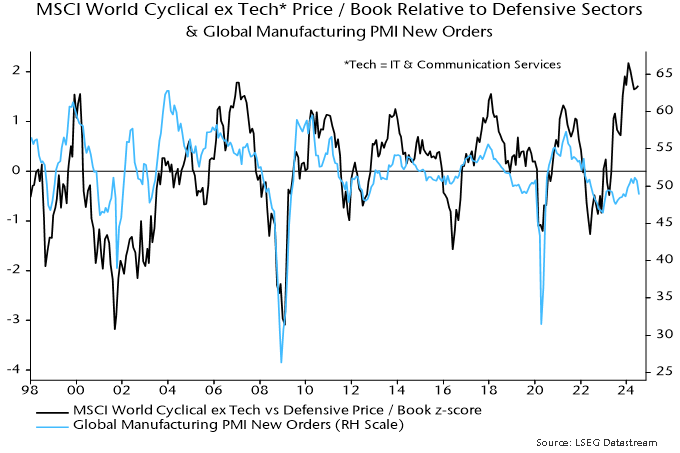
The price relative of MSCI World cyclical sectors, excluding tech, versus defensive sectors has mirrored movements in the OECD US leading indicator historically – chart 2. Relative valuation is high versus history and has diverged from a weakening global manufacturing PMI – chart 3.
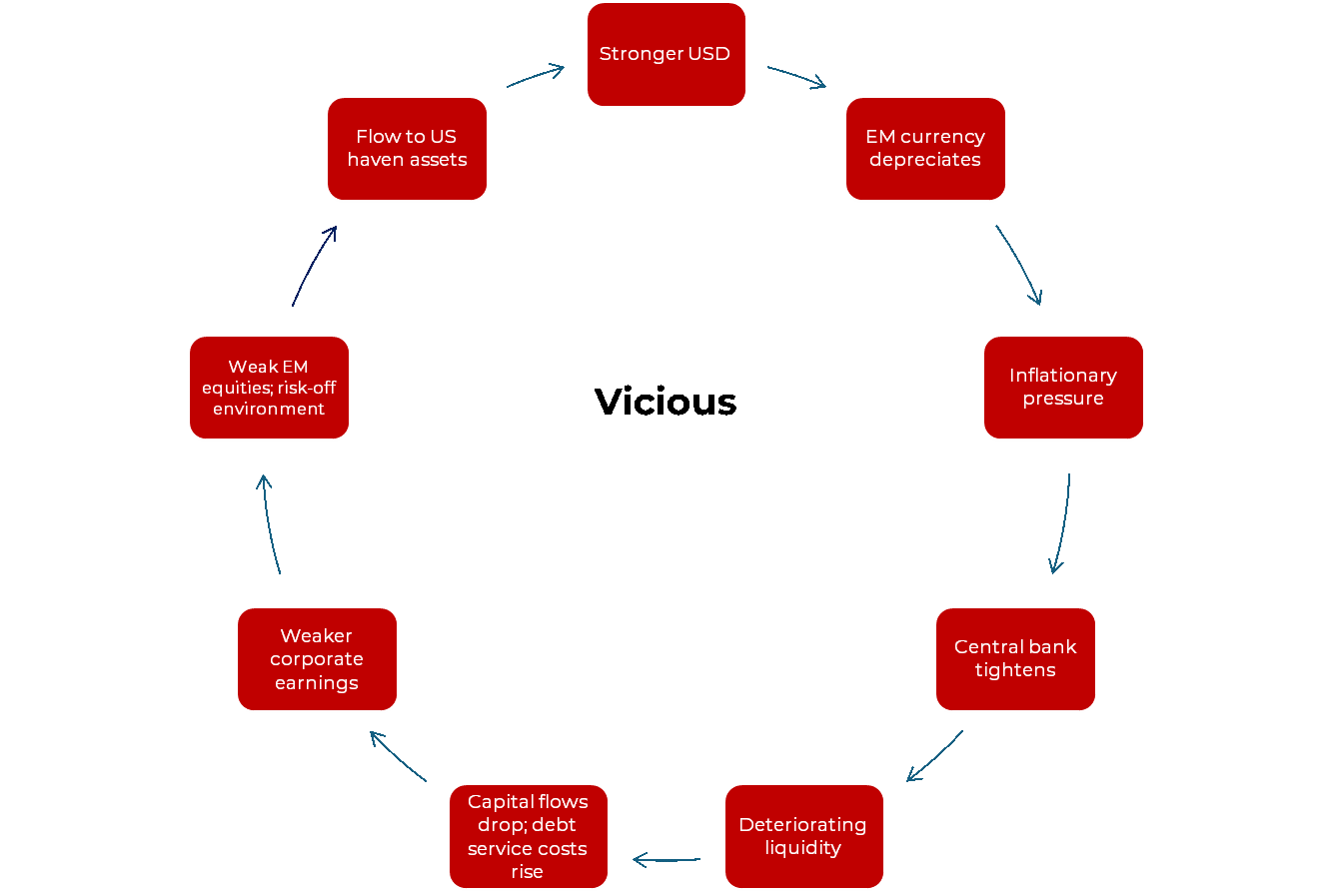
Chart 2

Chart 2 showing OECD US Leading Indicator and MSCI World Cyclical Sectors ex Tech Relative to Defensive Sectors

Chart 3

Chart 3 showing MSCI World Cyclical Ex Tech Price/Book Relative to Defensive Sectors and Global Manufacturing PMI New Orders

Manufacturing PMI results for July support the forecast of a global “double dip” into early 2025.

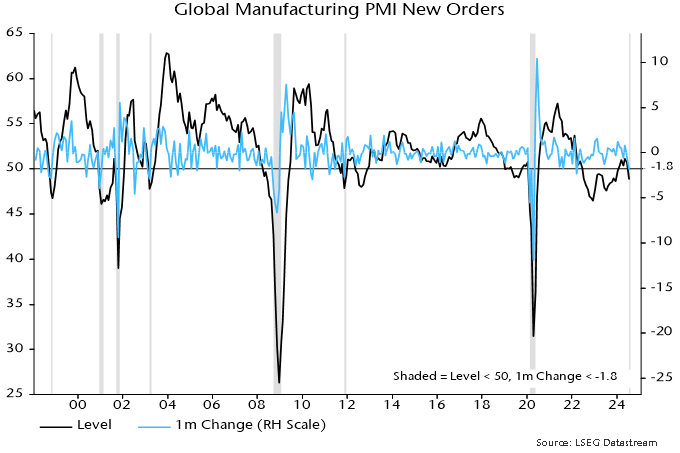
The global manufacturing PMI new orders index plunged by 1.9 points from June to 48.8, a seven-month low. The combination of a one-month fall of this magnitude or greater and a sub-50 reading occurred in only 14 months since 1998, highlighted by shading in chart 1.

Chart 1

Chart 1 showing Global Manufacturing PMI New Orders

In chronological order, those months were:

  • October 1998 (Asian / Russian / LTCM crises)
  • December 2000 / January 2001 (start of US / global recession)
  • September / October 2001 (911 terrorist attack)
  • March 2003 (Iraq invasion)
  • September through December 2008 (GFC climax)
  • November 2011 (Eurozone crisis / recession)
  • February through April 2020 (covid recession)

So the current signal suggests significant economic weakness and risk-off markets, at least until policy-makers respond.

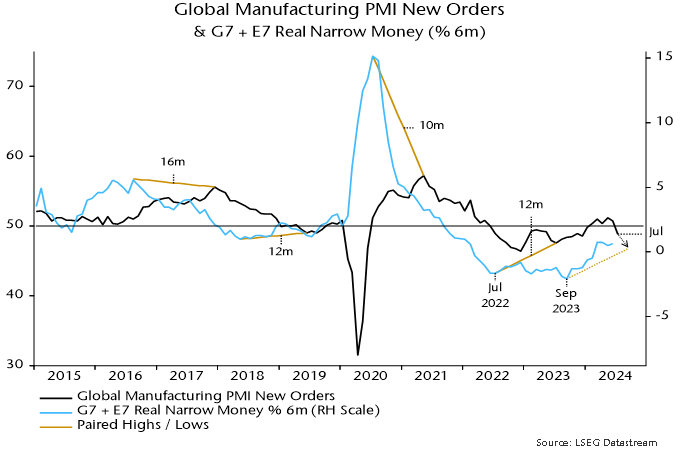
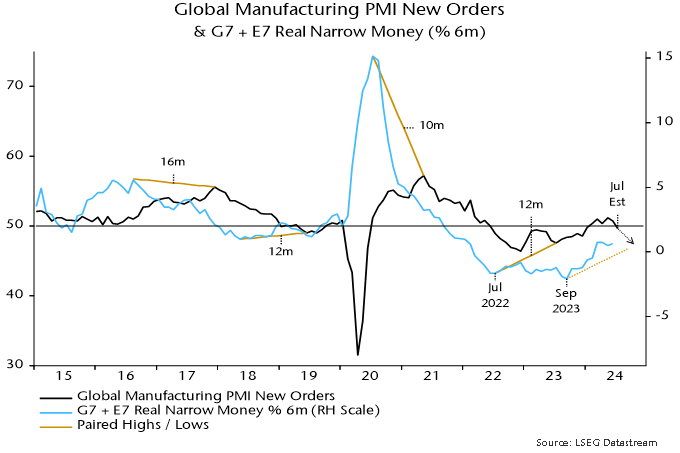
The forecast that global economic momentum would weaken in H2 2024 was based on a fall in six-month real narrow money momentum into a low in September 2023 and an observation that the money-activity lag has recently extended to a year or more – chart 2.

Chart 2

Chart 2 showing Global Manufacturing PMI New Orders and G7 plus E7 Real Narrow Money

The September 2023 real money momentum low suggests that PMI new orders will reach a low by January 2025. With money trends still weak, however, a recovery may be lacklustre.

Could PMI new orders break below the low of 46.5 reached in December 2022? The low in six-month real narrow momentum in September 2023 was beneath the preceding low in July 2022 – chart 2. Current weakness is more likely to spill over into labour markets, creating negative feedback loops.

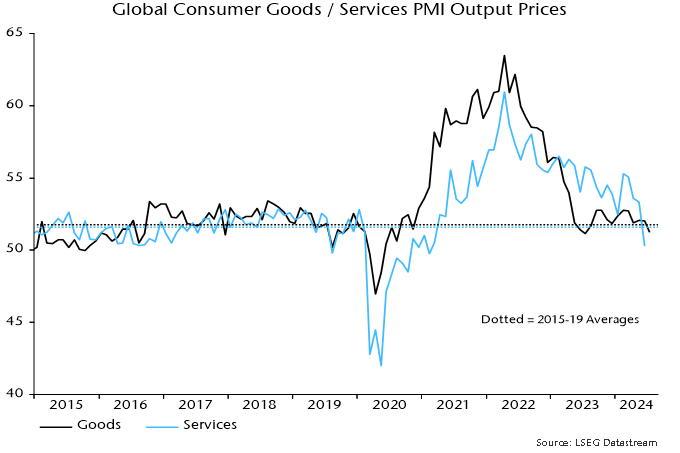
“Surprise” economic deterioration is forecast to be accompanied by sharply weaker inflationary pressures, reflecting broad money stagnation in H2 2022 / H1 2023. The consumer goods PMI output price index fell back below its pre-pandemic average in July, following a plunge in the consumer services index the prior month – chart 3.

Chart 3
Chart 3 showing Global Consumer Goods / Services PMI Output Prices

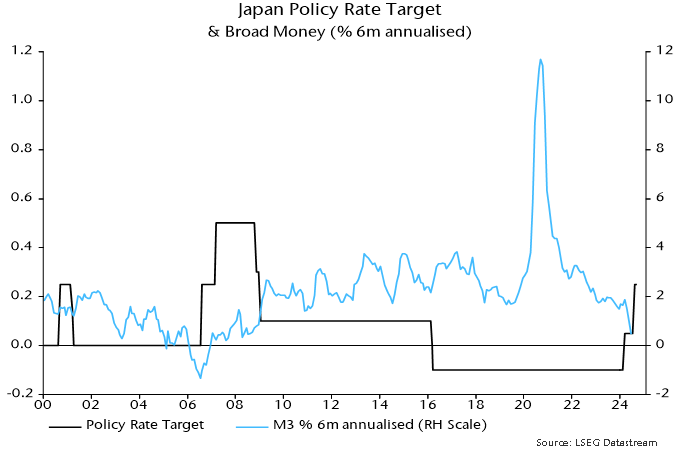
Will the Bank of Japan’s latest attempt to exit ZIRP prove any more successful than its previous two efforts, in 2000 and 2006?

The monetary backdrop is no more promising. The six-month rate of change of broad money M3 was 0.5% annualised in June compared with 1.3% and -1.1% respectively before the August 2000 and July 2006 rate hikes – see chart 1.

Chart 1

Chart 1 showing Japan Policy Rate Target & Broad Money (% 6m annualised)

Money growth, admittedly, has been depressed by recent record intervention to support the yen. The judgement here is that the authorities have marked out a major low in the currency – see previous post – so f/x sales are likely to slow / end.

A reduced intervention drag, however, will be offset by a contractionary monetary influence from QT. The announced phased reduction in monthly purchases implies that the BoJ’s JGB holdings will fall by about ¥8 trn during H2 2024, equivalent to an annualised 1.0% of M3.

Credit developments are superficially more supportive of policy tightening. The six-month rate of change of commercial banks’ loans and leases was 3.5% annualised in June compared with -1.9% and 2.8% before the 2000 / 2006 hikes.

Bank lending, however, is usually a lagging indicator of economic momentum, suggesting a slowdown ahead in response to recent activity weakness.

The BoJ “will … continue to raise the policy interest rate” if its outlook for economic activity and prices is realised. Headline and core CPI inflation are projected to be close to the 2% target in fiscal years 2025 and 2026 based on the output gap turning positive and a “virtuous cycle between prices and wages continuing to intensify”.

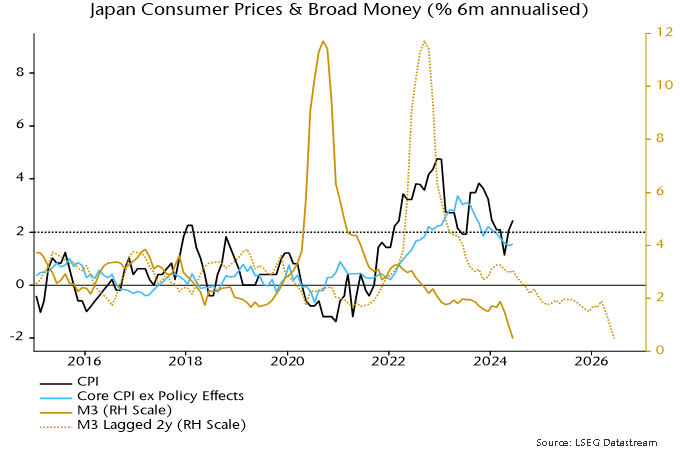
The “monetarist”  forecast, by contrast, is that inflation is heading for a big undershoot. Six-month core CPI momentum was 1.5% annualised in June*, with lagged broad money growth suggesting a further decline into 2025 – chart 2.

Chart 2

Chart 2 showing Japan Consumer Prices & Broad Money (% 6m annualised)

Coming Japanese inflation experience will be another test of forecasting approaches. Simplistic monetarism has trounced new Keynesian orthodoxy so far this decade. Another win for monetarist simpletons will spell third time unlucky for the BoJ.

*Own estimate adjusting for policy effects and seasonals.

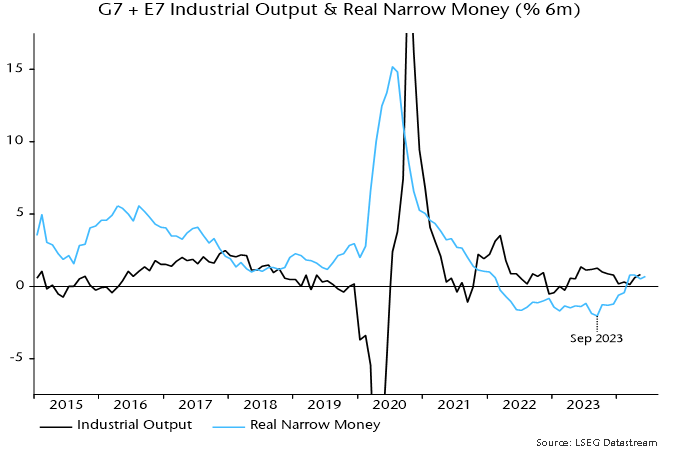
Global six-month real narrow money momentum – a key indicator in the forecasting process followed here – is estimated to have moved sideways for a third month in June, based on monetary data covering 85% of the aggregate.

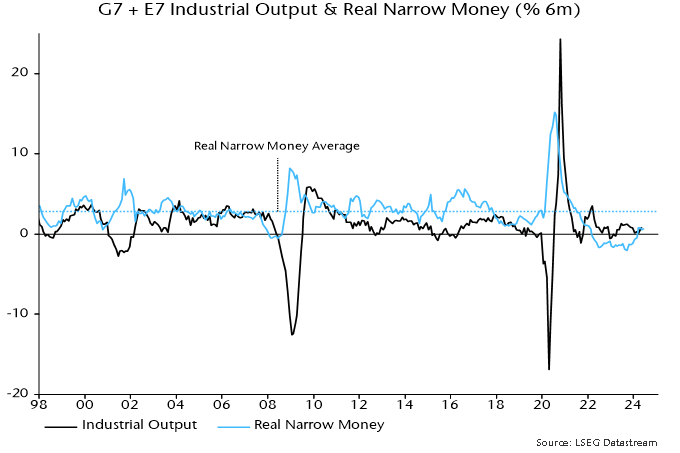
Real money momentum has recovered from a September 2023 low but remains below both its long-run average and the average in the 10 years preceding the GFC, when short-term interest rates were closer to recent levels – see chart 1.

Chart 1

Chart 1 showing G7 + E7 Industrial Output & Real Narrow Money (% 6m)

The expectation here has been that the fall into the September 2023 low would be reflected in a weakening of global industrial momentum into late 2024. DM flash PMI results for July support this forecast, implying a fall in global manufacturing PMI new orders from 50.8 in June to below 50, assuming unchanged readings for China / EM.

Chart 2

Chart 2 showing Global Manufacturing PMI New Orders & G7 + E7 Real Narrow Money (% 6m)

The stalling-out of real money momentum at a weak level suggests that economic expansion will remain sub-par in early 2025.

Global six-month industrial output growth, meanwhile, recovered in April / May, crossing back above real money momentum – chart 3. The implied negative shift in “excess” money conditions may partly explain recent market weakness / rotation.

Chart 3

Chart 3 showing G7 + E7 Industrial Output & Real Narrow Money (% 6m)

Global six-month real narrow money momentum was held back in May / June by weakness in China and Japan, discussed in recent notes. A US slowdown is a risk going forward.

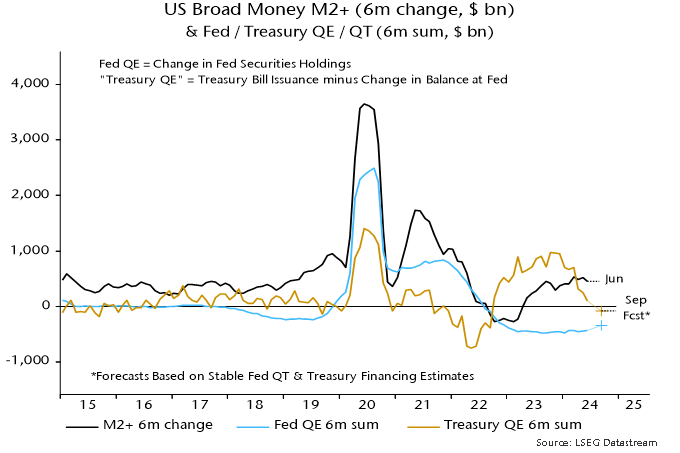
note in February argued that expansionary deficit financing operations – “Treasury QE” – have more than offset the monetary drag from Fed QT. Specifically, the Treasury relied on running down its cash balance at the Fed and issuing Treasury bills to fund the deficit in H2 2022 and 2023. The former represents a direct monetary injection while bill issuance is likely to expand broad money because bills are mostly purchased by money funds and banks. (A recent paper from Hudson Bay Capital makes a similar point, referring to variations in the maturity profile of debt sales as “activist Treasury issuance”.)

The February article and an update in May, however, noted that Treasury financing estimates implied that the six-month running total of Treasury QE would slow sharply in Q2 and turn negative in Q3. With Fed QT continuing, albeit at a slower pace, the joint Treasury / Fed impact on broad money was on course to become significantly contractionary.

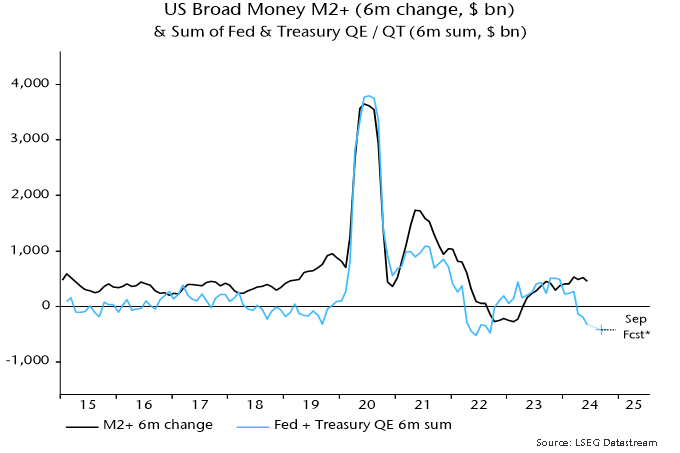
Treasury QE has fallen as expected and the joint contribution has become negative – charts 4 and 5. Six-month broad money momentum has yet to slow significantly, although three-month growth in June was the weakest since November. Money momentum lagged when the joint impact swung from negative to positive in late 2022 / early 2023.

Chart 4

Chart 4 showing US Broad Money M2+ (6m change, $ bn) & Fed / Treasury QE / QT (6m sum, $ bn)

Chart 5

Chart 5 showing US Broad Money M2+ (6m change, $ bn) & Sum of Fed & Treasury QE / QT (6m sum, $ bn)

The approach here places greater weight on narrow than broad money for short-term forecasting. A US broad money slowdown, in theory, could be accompanied by stable or stronger narrow money expansion, for example if rising confidence leads to an increase in broad money velocity, with an associated portfolio shift into demand deposits. Such a scenario, however, is less likely the longer the Fed delays significant rate cuts.

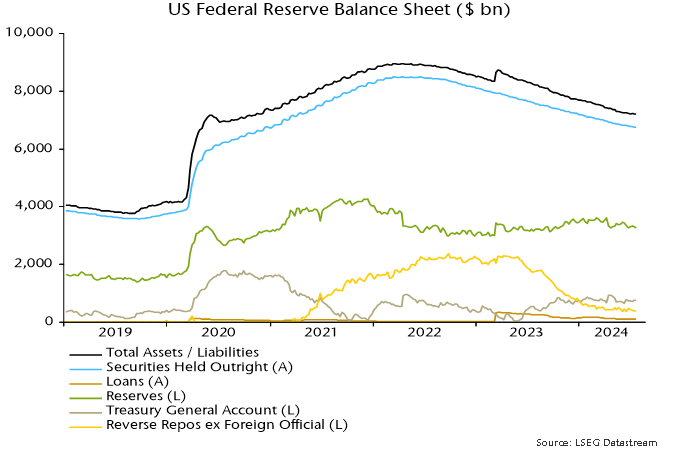
The slowdown in Treasury QE explains a reversal lower in US bank reserves since April – chart 6. The prior rise in reserves, despite ongoing Fed balance sheet contraction, occurred because money funds were moving funds out of the overnight reverse repo facility in order to buy newly-issued Treasury bills, with the Treasury reinjecting the cash via the deficit.

Chart 6

Chart 6 showing US Federal Reserve Balance Sheet ($ bn)

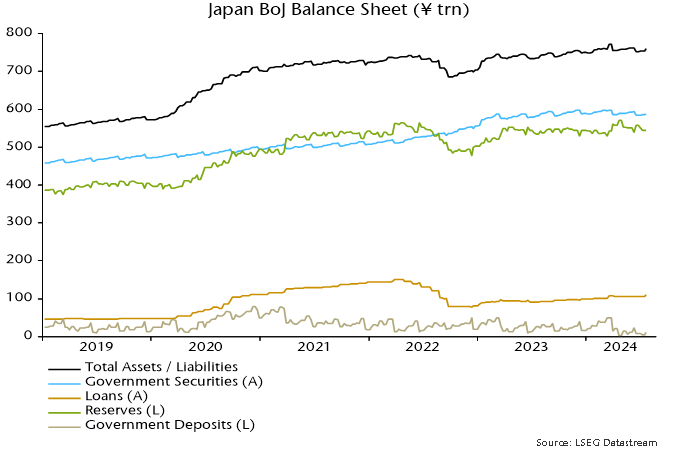
Japanese bank reserves are also on course to fall as the BoJ embarks on QT – chart 7. Market speculation is that the MPC will announce a reduction in gross JGB purchases to ¥3 trn per month at next week’s meeting, from an average ¥5.7 trn in H1. With redemptions averaging ¥6.5 trn over the last year, this suggests monthly QT of ¥3.5 trn ($23 bn), equivalent to 2.6% of broad money M3 at an annualised rate.

Chart 7

Chart 7 showing Japan BoJ Balance Sheet (¥ trn)

Podium lectern with two microphones and French flag in background

The reporting season of our international holdings gets underway in the weeks ahead. After a particularly strong Q1 reporting season, forward earnings per share estimates for the STOXX 600 have been flat since June. Some sectors, like in travel and leisure have observed an increase in their earnings revision while others, like in luxury or in construction and materials have obtained a lower-than-expected earnings revision. On the revenue side, we saw a weaker forward sales revision lately, a potential signal that the macroeconomic trends might remain complicated for the second half of 2024. On a sector basis, consumers and technology seems to be experiencing a soft patch. When not impacted by delay, new order intakes seem to be coming through but the cadence in manufacturing is progressing at a slow pace.

Political risk is back

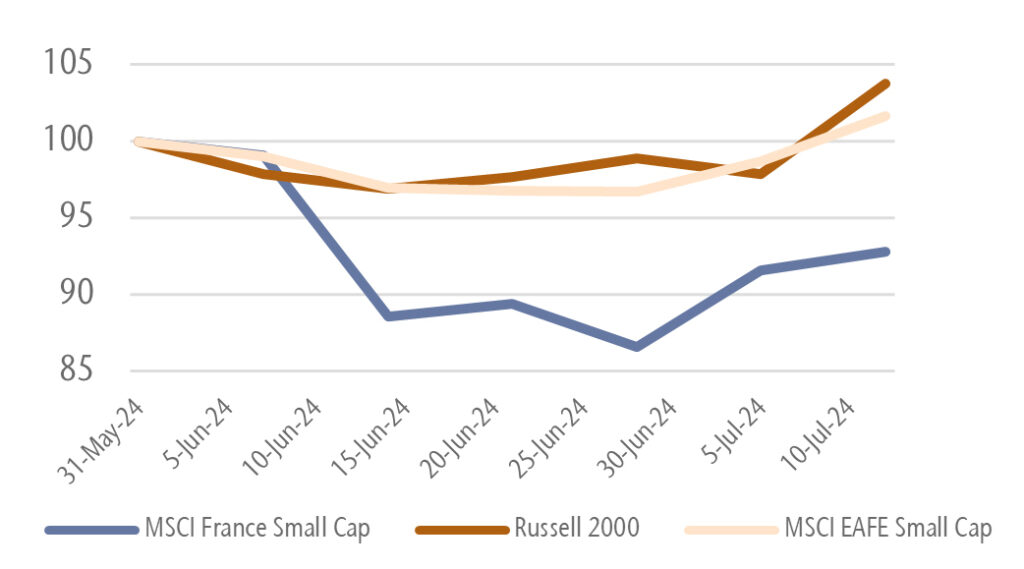
Index performance rebased to 100 (USD)

Chart showing Index performance rebased to 100 (USD)

Source: Bloomberg, MSCI.

Volatility spiked last month due to a political risk resurgence in Europe. The French election caught investors off guard and prompted many to de-risk and reallocate elsewhere. French bond yield has narrowed since the end of June, but equity hasn’t recovered much. French equities have suffered and have trailed other benchmarks since early June.

The left-wing alliance unexpectedly won the election, beating both the presidential and far-right party. Now, attention turns to the election of a new President of the National Assembly in July. The balance of power seems to have shifted towards the center-left alliance and this could be the best-case scenario for markets. The formation of a technocracy cannot be ruled out either.

The first real test for the new government will probably be to vote on the upcoming preliminary budget that needs to be submitted to the European Commission by mid-October. Last month the European Commission signaled that France should be put under excessive deficit procedure. If that proposition is adopted by the European Council, France will have to meet the requirement of the European Union’s (EU) fiscal rules. The incoming government will have little room to maneuver from a fiscal point of view. Considering that the last time France recorded a surplus was in 2001, the challenge is colossal.

Political uncertainty adversely affects the decision-making processes of companies. It will be interesting to track how companies intend to reallocate capital in the upcoming months.

Investors positioning

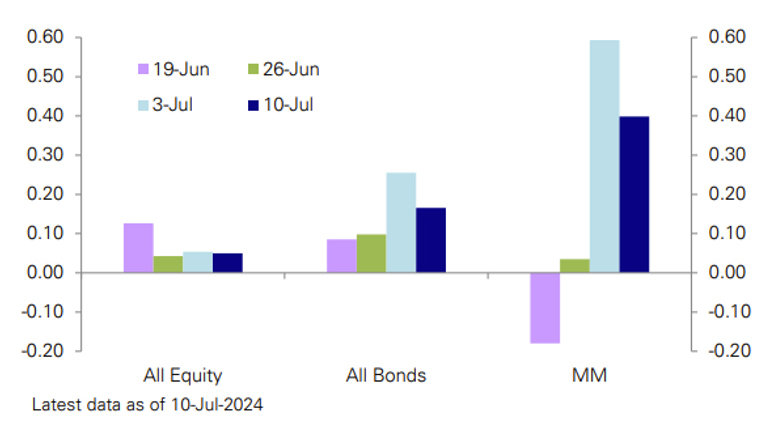
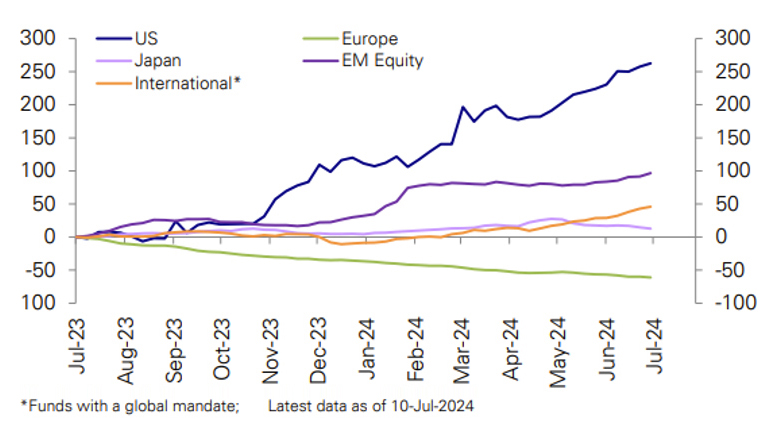
Fund flows are trending towards bonds and money market funds. US equity fund inflows remain high but have slowed, reflecting cautious investor sentiment. In Europe, equity funds are experiencing outflows, while Asia ex-Japan sees significant inflows, particularly in China and India. Technology remains the top sector, while materials and consumer sectors show muted interest. Shares of small caps in the US have recently surged, with the Russell 2000 Index hitting a 2024 high, fueled by optimism regarding the federal reserve’s advancements in combating inflation and the increased likelihood of interest rate cuts.

Fund Flows (last 4 weeks, % of assets)

Chart showing Fund Flows (last 4 weeks, % of assets)

Source: Deutsche Bank.

Cumulative equity flows (last 12m, weekly, $bn)

Chart showing Cumulative equity flows (last 12m, weekly, $bn)

Source: Deutsche Bank.

Small caps is a key beneficiary of the expected lower rates, and given they continue to trade at a 20-year low valuation versus their larger counterparts, we believe now is an interesting time to own small caps.

Rendering of building at 1218 Thurlow Street, Vancouver

Crestpoint Real Estate Investments Ltd., one of Canada’s leading commercial real estate equity and debt managers, is pleased to announce the launch and initial funding of the Crestpoint Opportunistic Real Estate Strategy (the “Fund”), its first closed-end product.

The Fund, with a twelve-month capital raising period and an eight-year total term, aims to invest in a range of opportunistic Canadian real estate investments and has a gross annualized return target of 15% to 18%. Returns achieved, will be primarily through capital appreciation delivered through a combination of selective, strategic acquisitions and Crestpoint’s active, hands-on approach to asset management.

Coinciding with the launch and initial closing, Crestpoint is also pleased to announce that the Fund has completed its first investment, 1318 Thurlow Street, a 0.4 acre development site located on the southwest corner of the intersection of Thurlow and Burnaby streets in the popular West End neighbourhood of downtown Vancouver, B.C. When completed, this 32-storey, concrete, purpose-built multi-family rental building, comprised of 300 units including a mix of studio, 1-, 2- and 3-bedroom suites, with a range of indoor and outdoor amenity space, will offer tenants impressive views. With a Walk Score® of 96, the property is strategically located in a transit-oriented community in close proximity to restaurants, shopping, Sunset Beach, the downtown business district, hospitals and universities. Partnering with Anthem Properties Group Ltd., Crestpoint, on behalf of the Fund, has acquired a 77% interest in the property with Anthem Properties owning the remaining 23% interest.

“Since Crestpoint’s inception in 2010, some of our best investments have been in periods characterized by the market volatility and dislocation we see today,” said Kevin Leon, CEO of Crestpoint. “We believe it’s a compelling investment environment. We expect to use multiple strategies to create and capture value, including repositioning undermanaged assets, recapitalizing properties with weak balance sheets and renovating existing buildings to higher standards.”

The Fund, focusing on capital appreciation, is designed for institutional clients seeking access to a higher potential return portfolio than available in core real estate, providing them with additional choice and an opportunity for diversification. This strategy complements Crestpoint’s existing flagship, $5.3 billion open-end Core Plus Real Estate Strategy, which has been one of the top-performing core/core plus funds in Canada since its inception in 2011. In 2022, Crestpoint launched the Crestpoint Real Estate Debt Strategy, an open-ended mortgage fund that has outperformed its benchmark since inception.

Max Rosenfeld, EVP and Head of Asset Management at Crestpoint, added, “This new strategy leverages our management expertise and deep relationships within Canada’s real estate investment community, strengths that have enabled us to successfully complete over $3 billion in value-add and opportunistic investments over the last 13 years.”

Following the success of this initial capital raise, the Fund will hold subsequent closings to allow additional investors to participate, with the next close expected to be in Q4 2024.

Learn more about this exciting new offering in a video with Crestpoint’s CEO, where he highlights the details and opportunities ahead. Watch the video here.

About Crestpoint

Crestpoint Real Estate Investments Ltd. is a commercial real estate investment manager dedicated to providing investors with direct access to a diversified portfolio of commercial real estate equity and debt investments. With over $10 billion under management, Crestpoint is an affiliate of the Connor, Clark & Lunn Financial Group, one of Canada’s largest private, independently held multi-boutique asset management firms with offices throughout the country and in the US, the UK and India. CC&L Financial Group and its affiliates collectively manage over C$133 billion in assets across a broad range of traditional and alternative investment products and solutions for institutional, high-net-worth and retail clients. For more information, please visit crestpoint.com.

Contact

Elizabeth Steele
Director, Client Relations
Crestpoint Real Estate Investments Ltd.
(416) 304-8743
[email protected]

Chinese money trends are puzzling but ominous, suggesting – at a minimum – that the economy will remain weak through H2.

Q2 real GDP growth came in below expectations but there was better news on the nominal side: two-quarter nominal GDP expansion rose for a second quarter as the GDP deflator stabilised – see chart 1.

Chart 1

Chart 1 showing China Nominal & Real GDP (% 2q annualised)

This improvement tallies with a recovery in six-month rates of change of narrow money and broad credit around end-2023. Money and credit momentum, however, has since slumped, reaching a new record low in June – chart 2.

Chart 2

Chart 2 showing China Nominal GDP & Money / Social Financing (% 6m)

post a month ago noted that money – and to a lesser extent credit – numbers have been distorted by a regulatory clampdown on the practice of banks paying supplementary interest. This has resulted in non-financial enterprises (NFEs) moving money out of demand deposits into time deposits and non-monetary instruments such as wealth management products (WMPs), as well as repaying some debt.

The post suggested discounting narrow money weakness and focusing on an expanded broad money aggregate including WMPs. The six-month rate of change of this measure had slowed significantly but was still within – just – the historical range of six-month broad money growth.

That is no longer the case. CICC numbers on WMPs show an outflow in June. Six-month growth of the expanded measure has converged down towards that of conventional broad money – chart 3.

Chart 3

Chart 3 showing China Narrow / Broad Money with Adjustment for WMPs (% 6m)

F/x intervention to support the yuan has contributed to monetary weakness but the effect has been minor. Net f/x settlement by banks – which captures spot intervention using the balance sheets of state banks and other institutions – amounted to CNY590 bn ($83 bn) or 0.2% of broad money in the six months to May (a June number is due this week).

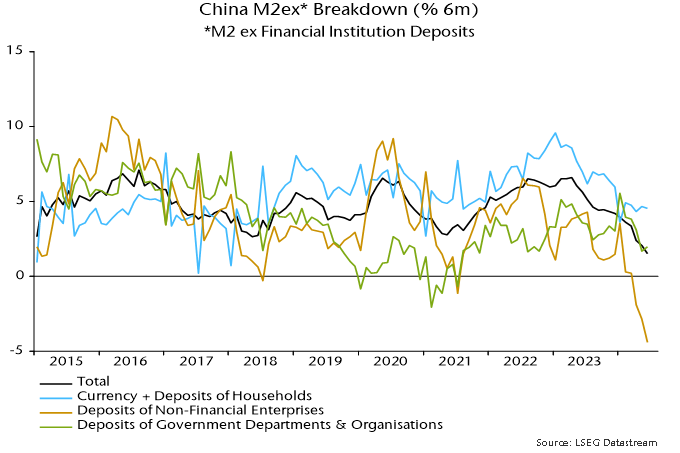
Household money growth, it should be emphasised, is stable and respectable: broad money weakness is entirely attributable to a loss of NFE deposits – chart 4. The puzzle is the destination of the “missing” NFE money. Only a small portion is likely to have been used to repay debt: banks’ short-term corporate lending fell in April / May but rebounded to a new high in June.

Chart 4

Chart 4 showing China M2ex* Breakdown (% 6m) *M2 ex Financial Institution Deposits

The focus of monetary weakness on NFEs suggests downside risk to investment and hiring, with negative feedback from the latter to consumer spending.

Chinese yuan, US dollars and Euro banknotes.

The underperformance of emerging markets equities relative to the US has tested the patience of even its most diehard advocates of the asset class over the past few years. While EM equities posted a respectable 9.9% return in USD terms in 2023, this looks anaemic next to a roaring 26.3% for the S&P 500.

The disparity between the US and EM over the past decade tempts investors into the behavioural trap of building conviction for future returns based on what has performed well in the recent past. It is easy to forget that the annualised returns from 2000 to end-2023 for EM were 7.6% versus 7.8% for the US, both outpacing 6.2% for MSCI World. The risk here is that a pro-cyclical mindset can lead to perverse thinking where conviction strengthens for a popular asset class as the likelihood of a good result decreases, and vice versa.

US equities outperformed on a decade of stronger economic growth out of the GFC, fed by a new credit cycle and strong fiscal deficits fuelling stronger corporate earnings and a dollar bull market, along with multiple expansion. On the flipside, EM moved through a painful deleveraging compounded by foreign reserve managers chasing US exceptionalism and buying dollars which choked EM further.

Several contrarian market commentators have recently pointed out that the fundamental picture in EM in many ways looks more compelling than in the US – lower valuations, trough earnings, cheap currencies, lower inflation, as well as greater fiscal and monetary discipline.

So what explains the continued underperformance, and is there anything that can break this cycle?

Vicious and virtuous circles in EM equities

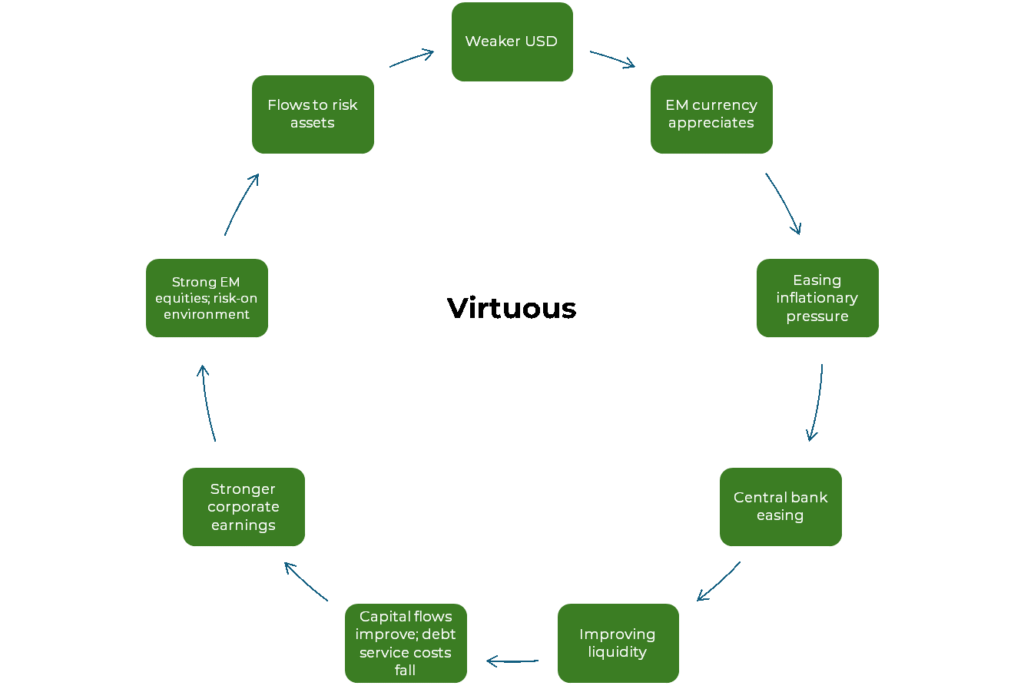
George Soros’s theory of Reflexivity provides an explanation for how biases and preconceptions interacting with economic reality can distort market pricing and create extended periods of disequilibrium. For EM, the combination of weaker fundamentals coupled with a perception of US exceptionalism has led to the formation of a self-reinforcing feedback loop which has been a major headwind for the asset class. Below is a rough schematic for how this loop has played out.

Vicious and virtuous circles in EM equities: ViciousSource: NS Partners.

Our view is that this cycle is coming to an end. Indeed, we believe that there is potential for a shift into a “virtuous circle” for EM, outlined below.

Vicious and virtuous circles in EM equities: VirtuousSource: NS Partners.

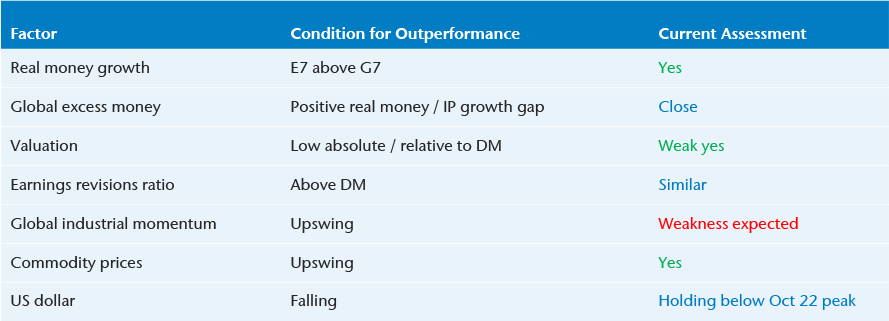
This outlook is based on a set of signals which we have used to advise clients invested in our DM and EM strategies looking to tweak the balance of exposure between the two. For context, our checklist is based on the idea that EM equities are a cyclical asset class and so tend to outperform when the global economy is strengthening (industrial cycle, commodity prices) and there is liquidity to chase the EM story (excess money, falling USD). They should also do better when economic prospects and earnings momentum are stronger than in DM (real money growth gap, revisions gap) and valuations are attractive.

Our latest update to the checklist (as of June 30, 2024) is below.

EM versus DM checklist
EM versus DM checklistSource: NS Partners.

The balance of factors we monitor now favours emerging market equities for the first time in years.

Our two cents – don’t wait around until everything goes green, as you will have missed the sharpest part of the rally.

Two checklist factors deserve special attention, given their historical usefulness in signalling an improving environment for EM equities.

Liquidity

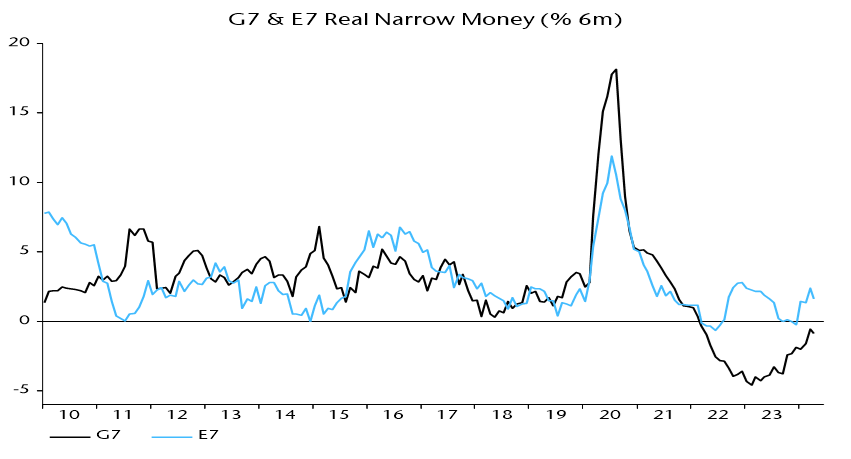
The E7 / G7 real money growth gap has been in favour of EM for some time, underpinned by better monetary policy making since 2020. This was reflected in better relative inflation performance for EM over DM, which has meant less need to tighten aggressively through the inflationary upswing, and potentially plenty of room to cut as the Fed eases.

Positive E7-G7 real money growth gap
G7 & E7 Real Narrow Money (% 6m)Source: NS Partners and LSEG Datastream.
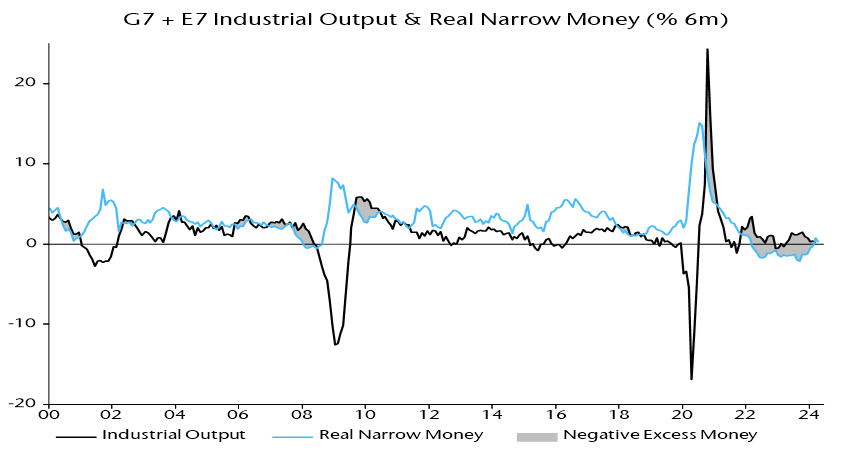
Additionally, the global excess money backdrop – proxied by the gap between real money and industrial output growth – may now be entering positive territory because of inflation peaking and industrial momentum weakening. The surplus liquidity can find its way into unloved financial assets, including EM equities. Prospective central bank pauses / reversals will sustain the trend.

Global “excess” money turning positive?
G7 + E7 Industrial Output & Real Narrow Money (% 6m)Source: NS Partners and LSEG Datastream.
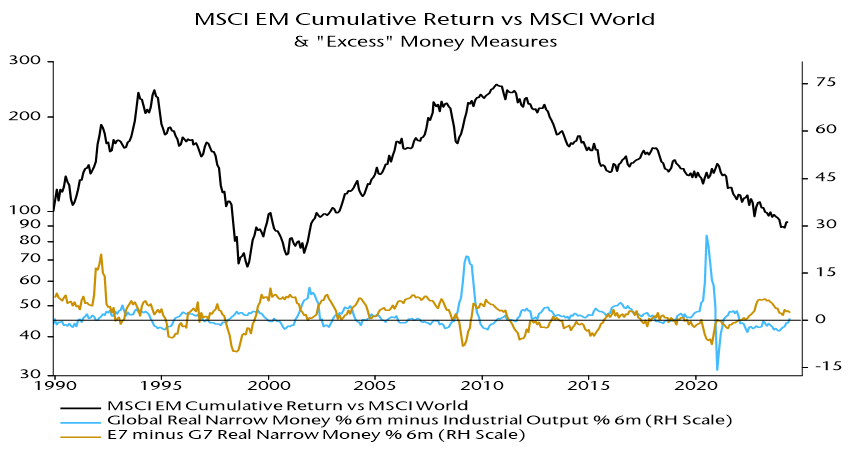
This is what we call a “double positive” liquidity environment, and could signal improving prospects for EM equities. In periods where these two monetary indicators have lined up this way, EM equities have outperformed MSCI World by an average of 10.5% per annum. Periods of EM outperformance are indicated in the shaded areas of the chart below. They line up nicely with the double positive.

EM relative performance & monetary indicators
MSCI EM Cumulative Return vs MSCI World & "Excess" Money MeasuresSource: NS Partners and LSEG Datastream.
King Dollar

The vicious and virtuous cycle diagrams above hint at just how important the dollar is as a driver of price and fundamental momentum in emerging markets.

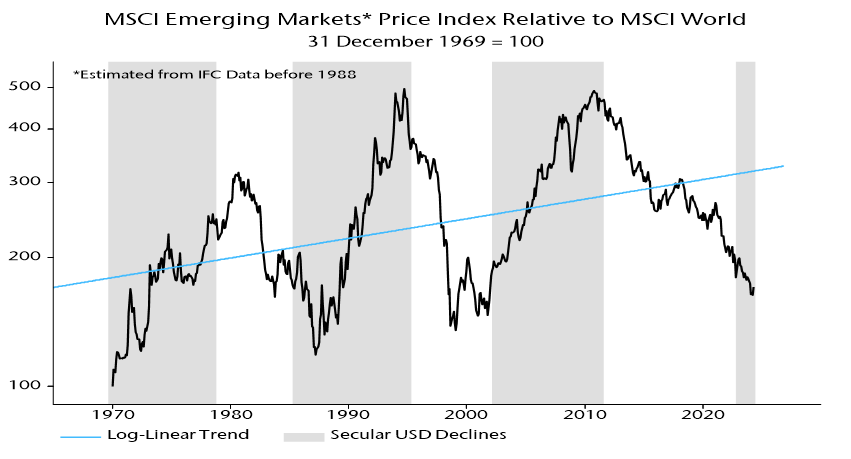
The chart below illustrates just how large a tailwind or headwind the dollar can be for the asset class.

EM outperformance during secular USD declines
MSCI Emerging Markets* Price Index Relative to MSCI World 31 December 1969 = 100 *Estimated from IFC Data before 1988Source: NS Partners and LSEG Datastream.
The relative performance drawdown for EM versus global equities during the last dollar bull market is in line with previous dollar bull markets, but the period over which this has occurred is roughly twice as long. The risk for investors fatigued from such an extended period of relative underperformance is capitulation right as the asset class is primed to outperform.

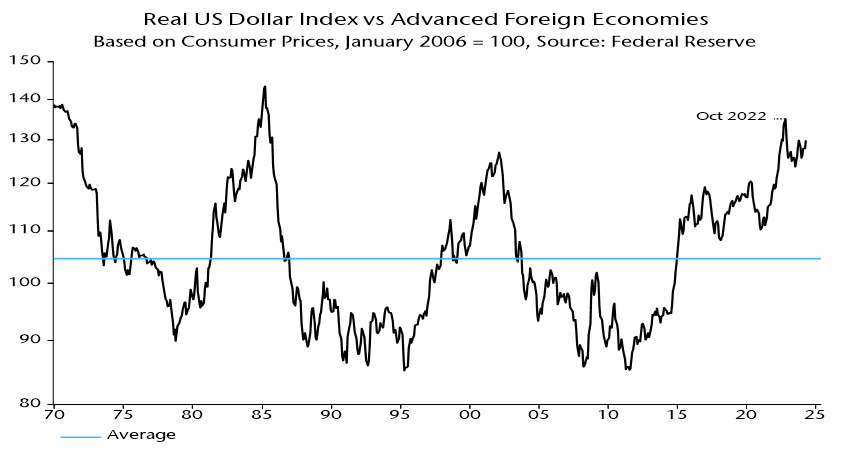
The real trade-weighted dollar is far above its long-run average and may have reached another secular peak in October 2022 – recent strength has failed to take out this high.

October 2022 USD peak?
Real US Dollar Index vs Advanced Foreign Economies Based on Consumer Prices, January 2006 = 100, Source: Federal Reserve.Source: NS Partners and LSEG Datastream.
The combination of monetary easing as inflation falls coupled with a weaker US dollar would provide a favourable backdrop for the outperformance of EM equities. Likely easing by the US Federal Reserve later this year will provide further scope for emerging market central banks to cut rates, allowing the credit cycle to move from stabilisation/recovery into expansion, providing support to economic and corporate earnings growth.

Such a pick up would encourage allocators oversaturated with US exposure to send marginal flows to emerging markets. With positioning at such extreme relative lows, even a small shift would be significant and another potential catalyst for entry into a virtuous cycle.

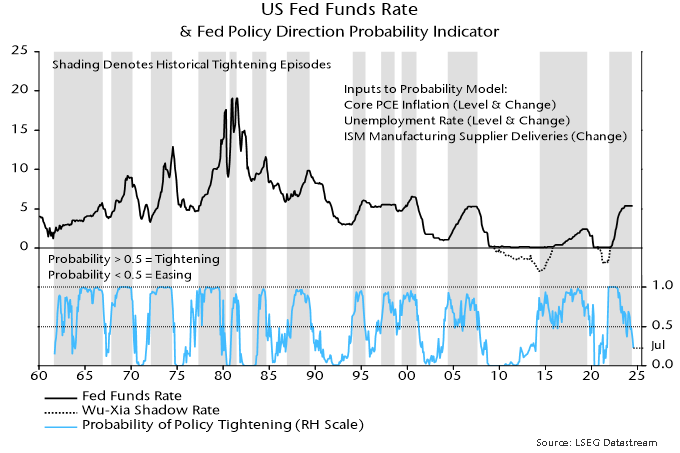
An analysis of the Fed’s historical behaviour suggests that the conditions for policy easing are in place.

Chart 1 shows the fitted values and current prediction of a logit probability model for classifying months according to whether the Fed is in policy-tightening or policy-easing mode.

Chart 1

Chart 1 showing US Fed Funds Rate & Fed Policy Direction Probability Indicator

The model’s determination for a particular month depends on values of annual core PCE inflation, the unemployment rate and the ISM manufacturing delivery delays index known at the end of the first week of the month (i.e. after the release of the employment report for the prior month).

The model can be thought of as an approximation of the Fed’s “average” reaction function over the last 60+ years. It correctly classifies 87% of months over this period, i.e. the estimated probability of being in policy-tightening mode was above 0.5 in tightening months and below 0.5 in easing months.

There is no memory effect – the model ignores whether the Fed was in tightening / easing mode in the previous month, only considering the above data series (with no dummy variables for “shocks”).

The dependent variable takes the value 1 from the month of the first rate increase in a tightening phase until the month before the first cut in a subsequent easing phase, and 0 otherwise. So a rate plateau before an easing is still classified as part of a tightening phase (and a rate floor before the first hike part of an easing phase).

The tightening / easing phases were identified judgementally and are shown by the shaded / unshaded areas in the chart. The Wu-Xia shadow rate informs the dating of phases during zero-rate periods since the GFC.

The model estimates the probability of the Fed being in tightening mode this month (July 2024) at 0.23, the lowest value since September 2021. Equivalently, the probability of a start of an easing phase is 0.77.

A fall in the tightening probability from 0.62 in March reflects a 0.2 pp rise in the unemployment rate over the last four months (from 3.9% to 4.1%) and a 0.3 pp fall in annual core PCE inflation (from 2.9% to 2.6%).

The Fed is unlikely to announce a rate cut at the conclusion of its next meeting on 31 July, as this would be at odds with recent communications (although the probability may be higher than the 0.05 implied by market pricing on 11 July, according to CME FedWatch).

The model’s shift, however, suggests a strong chance of a dovish statement teeing up a September move.