Chinese money and credit numbers for December suggest that policy stimulus is becoming effective, warranting an upgraded assessment of economic prospects.

Six-month rates of change of broad / narrow money and broad credit (total social financing) bottomed in June / July but the recovery through November was modest. All three jumped higher in December – see chart 1.

Chart 1

160125c1

Money measures – particularly narrow money – were negatively distorted last spring by regulatory enforcement of deposit rate ceilings*. The revival in six-month momentum partly reflects the dropping out of this effect. Still, December readings should be undistorted and broad money momentum is close to its 2015-19 average, when nominal GDP grew solidly.

Monetary financing of fiscal easing has been a key driver of the money growth pick-up. Banking system net lending to government (including by the PBoC) contributed 2.0 pp (not annualised) to M2 growth in the six months to December, the most since the 2015-16 stimulus episode.

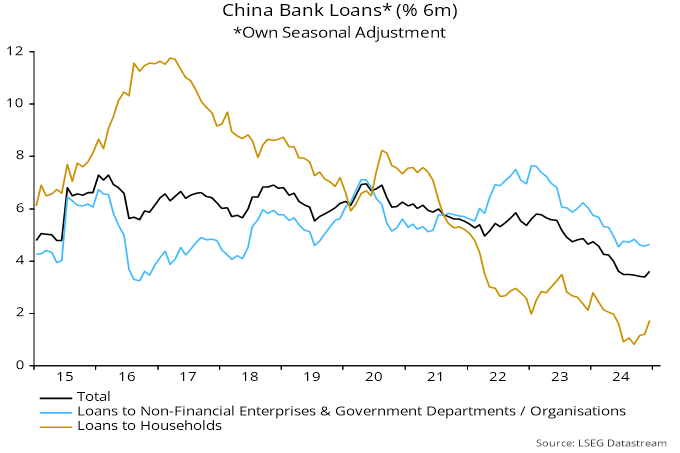
An apparent weak spot in the December release was a further fall in annual bank loan growth (i.e. excluding lending to government). The numbers, however, are being distorted by debt swap operations, involving repayment of bank loans by government-related organisations. Six-month loan momentum has edged up despite this drag, with household lending weakness abating – chart 2.

Chart 2

160125c2

Will the money growth recovery continue? Recent renewed pressure on the currency has been associated with a resumption of f/x sales and a firming of money market rates. The increase in term rates has so far been modest and may be offset by ongoing support from money-financed fiscal easing.

*Lower interest rates on demand deposits resulted in enterprises moving money into time deposits and non-monetary instruments while repaying bank loans.

The Northside Plus building at the University of Texas at Dallas.

Richardson, TX, January 13, 2025 – Connor, Clark & Lunn Infrastructure (CC&L Infrastructure) and Bestinver Infra (Bestinver) announced the acquisition of a majority interest in the Northside student housing project (Northside or the Project), a community of student housing facilities situated at the University of Texas at Dallas (UTD). The facilities were built in four phases between 2016 and 2021 and comprise approximately 1,200 units with the capacity to house over 2,500 students. Balfour Beatty, the international infrastructure group, is the current property manager and is retaining a minority equity ownership stake in the Project. CC&L Infrastructure and Bestinver acquired the entirety of the interest owned by funds managed by Tikehau Capital North America LLC d/b/a Tikehau Star Infra.

UTD is one of the highest ranked public universities in Texas, offering over 140 academic programs and hosting more than 50 research centres and institutes, with current enrolment totaling approximately 30,000 students. Northside operates under long-term land leases with the university, with an average of over 50 years remaining across each of the facilities.

“We are excited to further diversify our portfolio of infrastructure assets with the acquisition of this interest in Northside, which marks our first investment in the student housing sector,” said Matt O’Brien, President of CC&L Infrastructure. “Northside provides an essential service to UTD’s student community and supports a sizeable and growing enrolment base. We look forward to working with our partners and UTD in the successful operation of Northside for years to come.”

“Our investment in Northside underscores our continued focus on high-quality, stable and resilient assets in North America, and is the first of several investments we will make in the region through our Fund II,” said Francisco del Pozo, Head of Infrastructure Funds at Bestinver.

Agentis Capital served as financial advisor, White & Case LLP as legal counsel, Deloitte as accounting and tax advisor, and Infrata as technical advisor to CC&L Infrastructure and Bestinver.

About Connor, Clark & Lunn Infrastructure

CC&L Infrastructure invests in middle-market infrastructure assets with attractive risk-return characteristics, long lives and the potential to generate stable cash flows. To date, CC&L Infrastructure has accumulated over $6 billion in assets under management diversified across a variety of geographies, sectors and asset types, with nearly 100 underlying facilities across 35 individual investments. CC&L Infrastructure is a part of Connor, Clark & Lunn Financial Group Ltd., a multi-boutique asset management firm whose affiliates collectively manage over CAD132 billion in assets.

About Connor, Clark & Lunn Financial Group Ltd.

Connor, Clark & Lunn Financial Group Ltd. (CC&L Financial Group) is an independently owned, multi-affiliate asset management firm that provides a broad range of traditional and alternative investment management solutions to institutional and individual investors. CC&L Financial Group brings significant scale and expertise to the delivery of non-investment management functions through the centralization of all operational and distribution functions, allowing talented investment managers to focus on what they do best. CC&L Financial Group’s affiliates manage over $132 billion in assets. For more information, please visit cclgroup.com.

Contact
Sonja Weiss
Vice President
Connor, Clark & Lunn Infrastructure
(437) 561-6184
[email protected]

About Bestinver

As part of Acciona Group, Bestinver has been managing investment funds for more than thirty-five years, and is the leading independent asset manager in Spain with more than 50,000 investors and over 6.8 billion euros under management.

Bestinver created the division of Infrastructure funds with the objective of managing 1,500 million euros in alternative investments in the next five years. As part of this area of alternative investments, Bestinver incorporated Bestinver Infra FCR (“Bestinver Infra”), which was the first private equity fund from Bestinver to invest in infrastructure.

After the success of Bestinver Infra, Bestinver launched its second fund targeted at 350-400 million Euros to invest in global infrastructure assets (“Bestinver Infra II”).

The funds invest in brownfield, greenfield, and yellowfield assets in the transportation, renewable energy, social, telecom and water sectors located in Europe, North America and selected Latin American countries. Additionally, Bestinver is focused on creating long-term value by integrating ESG criteria into the Bestinver’s investment processes.

Contact
Jose Herrero Peña
Bestinver Gestión
[email protected]

Wind turbines in a large field and blue sky.

Toronto, January 7, 2025 – Connor, Clark & Lunn Infrastructure (CC&L Infrastructure) is pleased to announce the acquisition of a significant interest in two Ontario-based wind projects (the Projects) representing approximately 330 megawatts (MW) of gross capacity from Pattern Energy Group LP (Pattern Energy), a leading North American developer and operator of renewable energy assets. The acquisition increases the size of CC&L Infrastructure’s renewable energy portfolio to over 2 gigawatts (GW) of gross capacity, diversified across a variety of energy markets, contract counterparties, regulatory jurisdictions and technologies (i.e. wind, solar and hydro). Pattern Energy will maintain a minority equity stake in the Projects and will continue to manage and operate the assets.

The Projects, Armow Wind and Grand Renewable Wind, are both located in southern Ontario and have gross capacities of 180 MW and 149 MW, respectively, together generating energy equivalent to the annual consumption of almost 290,000 Ontarians. All of the energy generated by the Projects is sold under 20-year Power Purchase Agreements (PPAs) to the Independent Electricity System Operator (IESO) (rated Aa3 by Moody’s). Both assets use proven wind technology and each has been in operation for approximately a decade, performing largely in line with forecasts for power generation and availability over that period.

“This investment in Armow Wind and Grand Renewable Wind will expand our renewable energy portfolio to over 2 GWs, building on our long history of constructing and operating clean energy assets across North America,” said Matt O’Brien, President of CC&L Infrastructure. “We are excited to partner with Pattern Energy and look forward to leveraging our collective decades of experience safely and successfully operating renewable energy projects.”

The Projects contribute meaningfully to the communities in which they operate, generating millions of dollars in property taxes and ancillary revenues for the local communities over their asset lives. The Projects have committed to contribute a total of over $25 million to community benefit funds over the first 20 years of operations, and have supported local initiatives such as recreational facilities, public infrastructure and improvements to local infrastructure.

“Establishing this partnership with CC&L Infrastructure, an experienced and active Canadian infrastructure investor, will allow Pattern to grow our positive impact in Canada and to expand our portfolio in the country,” said Hunter Armistead, CEO at Pattern Energy. “Pattern has become Canada’s largest operators of wind power with projects generating enough clean energy to power nearly 1.5 million Canadians. We are proud to have created thousands of jobs and distributed millions in direct financial benefits to communities across the country over the last 15 years.”

CC&L Infrastructure and Pattern Energy will own the assets alongside Samsung Renewable Energy (Samsung) and Six Nations of the Grand River (in the case of Grand Renewable Wind). CC&L Infrastructure and Samsung have previously worked together to build and operate approximately 300 MW of solar projects across four sites in Ontario.

CIBC Capital Markets served as CC&L Infrastructure’s financial advisor on the transaction and Torys LLP served as its legal counsel. BMO Capital Markets acted as exclusive financial advisor for Pattern Energy and Osler, Hoskin & Harcourt LLP served as its legal counsel.

About Connor, Clark & Lunn Infrastructure

CC&L Infrastructure invests in middle-market infrastructure assets with attractive risk-return characteristics, long lives and the potential to generate stable cash flows. To date, CC&L Infrastructure has accumulated over $6 billion in assets under management diversified across a variety of geographies, sectors and asset types, with approximately 100 underlying facilities across over 35 individual investments. CC&L Infrastructure is a part of Connor, Clark & Lunn Financial Group Ltd., a multi-boutique asset management firm whose affiliates collectively manage approximately CAD132 billion in assets.

Contact
Sonja Weiss
Vice President
Connor, Clark & Lunn Infrastructure
(437) 561-6184
[email protected]

About Pattern Energy

Pattern Energy is one of the world’s largest privately-owned developers and operators of wind, solar, transmission, and energy storage projects. Its operational portfolio includes more than 30 renewable energy facilities that use proven, best-in-class technology with an operating capacity of nearly 6,000 MW across North America. Pattern Energy is guided by a long-term commitment to serve customers, protect the environment, and strengthen communities. For more information, visit www.patternenergy.com.

Contact
Matt Dallas
Pattern Energy
(917) 363-1333
[email protected]

Monetary trends suggest that the global economy will remain soft in H1 2025, while inflation rates will fall further, undershooting targets. Cycle analysis holds out a prospect of economic reacceleration later in the year but risk assets might have limited further upside even in this scenario, although international / EM equities might regain relative performance.

Global six-month real narrow money momentum recovered from a low in September 2023 into Q2 2024 but has since moved sideways at a weak level by historical standards – see chart 1. Based on a normal six to 12 month lead, this suggests below-trend economic growth through Q2 2025, at least.

Chart 1
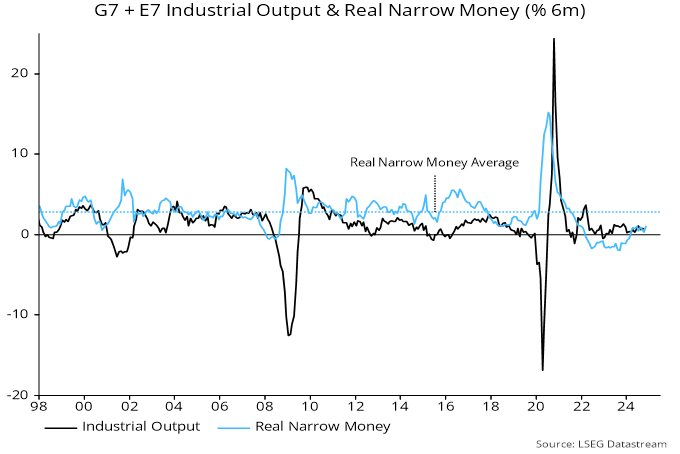
Chart 1 showing G7 plus E7 Industrial Output and Real Narrow Money (% 6 months)

Economies exhibiting monetary weakness are at greater risk from negative policy or other shocks. As an example, a fizzling-out of a recovery in UK six-month real narrow money momentum in H1 2024 signalled an approaching growth stall but the Budget tax shock appears to have tipped the economy into contraction.

With job openings / vacancy rates back in pre-pandemic ranges, below-trend global growth is likely to be associated with greater deterioration in labour markets than in 2024. In economics parlance, a movement down the Beveridge curve may be approaching a gradient shift such that a further fall in vacancies will be associated with a significant unemployment rise.

A further issue for monetary economists is the “false” US recession signal of 2022-23. Most annual contractions in US real narrow money historically were associated with recessions, and all on the scale of the 2023 decline – see chart 2. On three occasions (highlighted), however, the interval between the start of the contraction and the onset of recession was unusually long, i.e. up to 32 months.

Chart 2
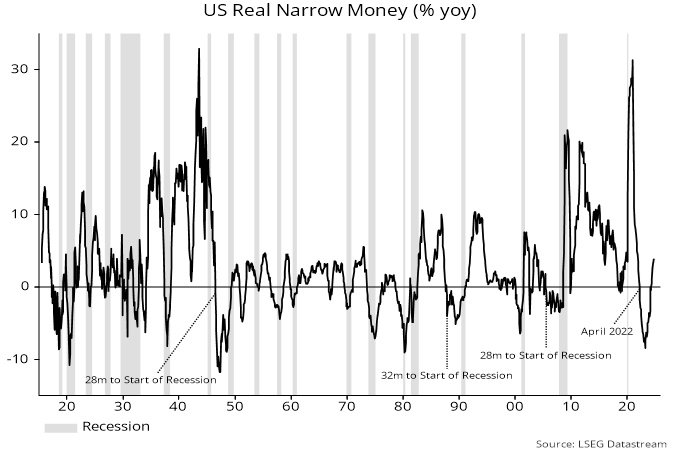
Chart 2 showing US Real Narrow Money (% year over year)

On inflation, the monetarist rule of thumb that price momentum follows the direction of broad money growth roughly two years earlier suggests a further slowdown into undershoot territory in H1 2025. Chart 3 shows the relationship for the Eurozone but the message of headline / core deceleration is the same for the US, Japan and the UK.

Chart 3
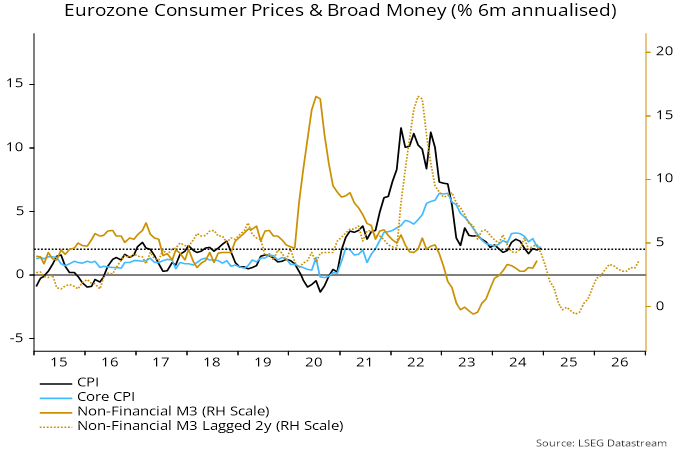
Chart 3 showing Eurozone Consumer Prices and Broad Money (% 6 month annualised)

Global PMI output price indices in manufacturing and services are close to 2015-19 averages, when headline / core inflation averages were below target.

Financial market prospects, on the “monetarist” view, depend on whether there is “excess” or “deficient” money relative to the economy’s needs. Two flow measures of global excess money were used here historically – the gap between six-month rates of change of real narrow money and industrial output, and the deviation of the annual change in real money from a slow moving average. A “safety first” approach of holding global equities only when both measures were positive would have outperformed buy-and-hold significantly over the long run.

The flow measures, however, remained mixed / negative in 2023-24, understating the availability of money to boost markets because they failed to capture a stock overhang from the 2020-21 monetary surge. To assess whether this stock influence remains positive, the approach here has been to use a modified version of the quantity theory in which the money stock is compared with an average of nominal GDP and gross wealth.

Chart 4 shows that an average of US nominal GDP and gross wealth remained below the level implied by the money stock through mid-2024, consistent with a positive stock influence on asset prices / the economy. Equivalent analysis for Japan and the Eurozone shows the same. In all three cases, however, the nominal GDP / wealth average moved ahead of the money stock during H2 2024, implying that stock and flow indicators are now aligned in suggesting a neutral / negative backdrop.

Chart 4
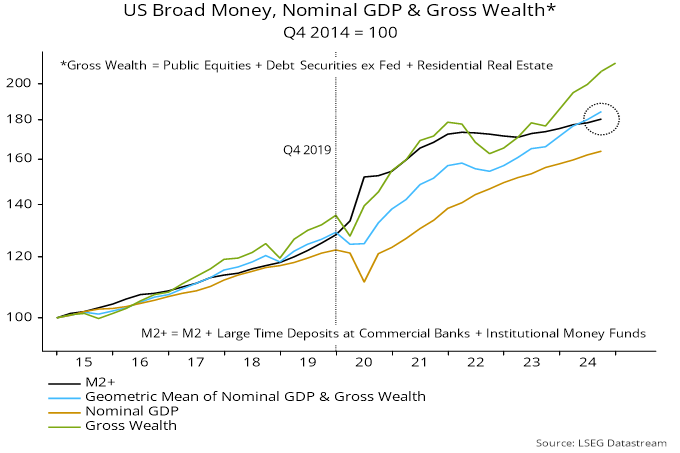
Chart 4 showing US Borad Money, Nominal GDP and Gross Wealth

While monetary indicators suggest near-term softness, cycle analysis holds out a prospect of stronger economic performance later in 2025 and in 2026. A key consideration is that the stockbuilding and business investment cycles appear some way from reaching peaks, with the next lows unlikely before H2 2026 and 2027 respectively.

The last trough in the stockbuilding cycle is judged to have occurred in Q1 2023, with national accounts inventories data and business surveys suggesting that the upswing is around its mid-point – chart 5. The previous cycle was shorter than the 3.5 year average, so the current one could be longer, with a low as late as H1 2027. An associated downswing might not start until H1 2026.

Chart 5
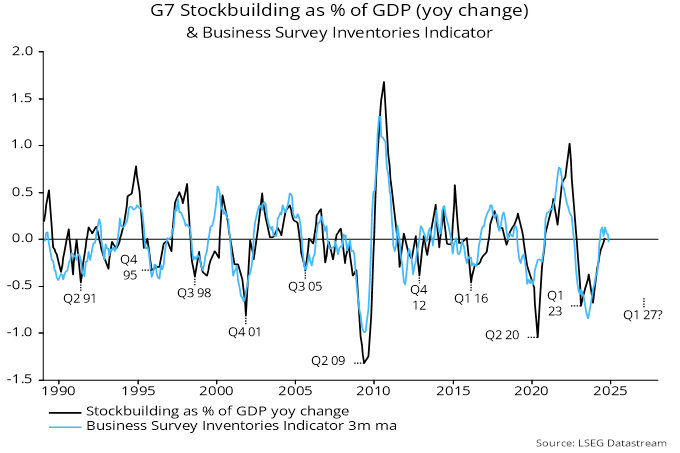
Chart 5 showing G7 Stockbuilding as % of GDP (year over year change)

The 7-11 year business investment cycle appears to have bottomed in 2020, although a case could be made that this was a false low due to the pandemic, with the last genuine trough reached following a mild downswing in 2015-16. On the more plausible former view, the next low is scheduled for 2027 or later, implying potential for a 2026 boom.

The longer-term housing cycle, which bottomed in 2009 and has averaged 18 years, is in the time window for a peak but significant weakness could be delayed until H2 2026 or later.

Monetary and cycle signals could be reconciled if near-term economic weakness / favourable inflation news triggers faster monetary policy easing and a strong pick-up in money growth into mid-year.

Would such a scenario be associated with further significant gains in risk assets? The history of the stockbuilding cycle suggests not.

Risk assets typically rally strongly in the first half of a stockbuilding cycle, partially retracing gains in the run-up to the next trough. Table 1 compares movements so far in the current cycle with averages at the same stage of the previous eight cycles, along with changes over the remainder of those cycles. US equities, cyclical sectors and precious metals have outperformed relative to history, suggesting a stronger likelihood that they will lose ground between now and the next trough.

Table 1
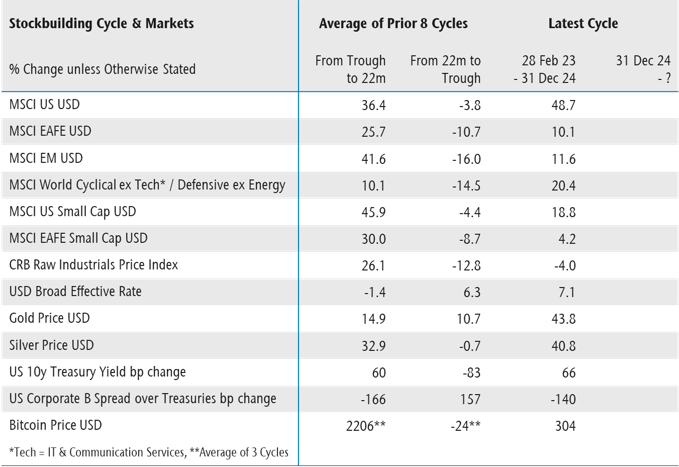
Table 1 showing Stockbuilding Cycle and Markets

Areas that have lagged relative to history include EAFE / EM equities, small caps and industrial commodities, hinting at catch-up potential in the event of a delayed stockbuilding cycle peak and late (H1 2027) trough. This prospect would be enhanced by a reversal of unusual US dollar strength so far in the current cycle.

Still, any such catch-up might be a relative rather than absolute move against a backdrop of a maturing cycle upswing, a possible US market correction and neutral / negative excess money conditions.
A person flipping a wooden block cube to change 2024 to 2025 in preparation of the new year.

As we look back on 2024, we saw the equity market prove itself to be a testament to resilience, and a return to speculative activity last seen since before the pandemic.

Below is a selection of charts that our team found to be particularly impactful, highlighting the environment we witnessed in 2024 and, more importantly, why we’re excited for 2025.

Speculation

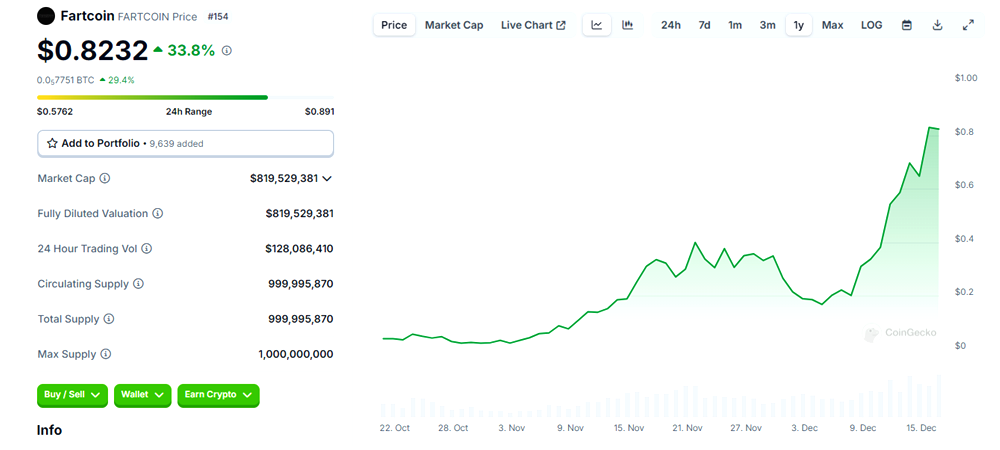
This year has been the year of the US equity markets, particularly the mega cap Magnificent Seven, up over 60% in 2024. The speculative fervour that gripped the United States has reached fever pitch. The best way to measure it may actually not be Bitcoin – even though it has more than tripled this year to trade above $100,000.

Have you heard of Fartcoin? Yes, you read that correctly. Just so you know, the coin is up over 1,000% since the US elections on November 5.

Snapshot of Fartcoin's value.
Source: CoinGecko

Not bad for a cryptocurrency that allows users to submit fart jokes or memes to claim initial tokens. Over USD60 million is traded every day; with a market cap of $830 million, it is the 189th largest cryptocurrency. We are in uncharted territories.

Regional market concentration

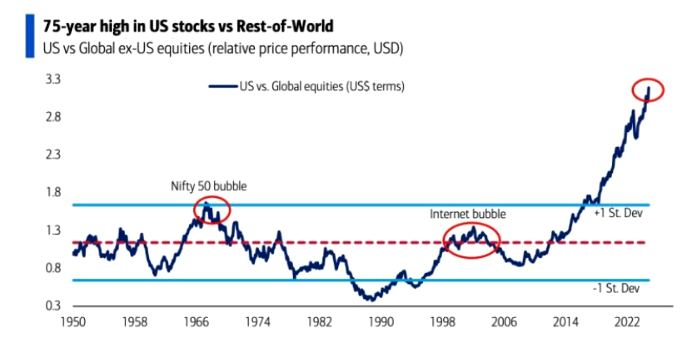
Line chart illustrating the 75-year high in US stocks versus the rest-of-world stocks over time since 1950.
Source: BofA Global Investment Strategy, Global Financial Data, Bloomberg

The concentration of the gap in valuation between US stocks and the rest of the world is driving up the valuation of US stocks to extreme levels. Global markets have been tumultuous since the pandemic, but with the rush for AI and technology, the US market has shown to be the most resilient, therefore drawing investors from abroad in droves.

Top ten concentration

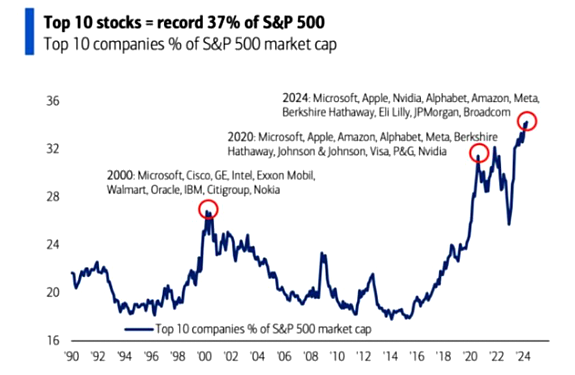
Line chart illustrating the top 10 stocks as a percentage of the S&P 500 over time since 1990.
Source: BofA Global Investment Strategy

Regarding the gap between the top-10 stocks in the S&P 500 and the remaining 490, a similar divergence is taking place when we examine equity market flows. In fact, the best way to measure the fervour is in the investor concentration towards US equities, specifically the S&P 500. With the Magnificent Seven making up nearly 50% of the S&P 500’s gain, this high is volatile. Any earnings slowdown or unfavourable news within this seven could result in outsized impacts on the overall performance.

We will let you judge if this a risky environment or not. To quote Mark Twain, “History doesn’t repeat itself, but it often rhymes.”

Instead of trying to find reasons why this market might correct, allow us to concentrate on what we see as opportunities.

Global opportunities outside of the United States

We’ve written numerous pieces on opportunities within small caps in JapanEurope and emerging markets this year, so it’s no surprise when we say that we believe that the Japanese economy will be the fastest growing developed market economy in 2025.

The country has turned the corner on deflation. The virtuous wage/price spiral has taken hold. Pay rose 3.6% for base pay and 5.17% in total pay in 2024. We expect a similar increase in 2025. Interest rates will probably rise another 0.5%. Japan is a beneficiary of mega trends, from friendshoring to AI, semi-conductor investments to green transition. A newly announced ¥39 trillion fiscal package will help even further. As a result, a stronger economy with a large discount in Japanese companies’ valuations and investor-friendly measures such as M&A and buybacks mean Japan should be the top performing developed equity market in 2025.

In Europe, how a few years make a huge difference. Countries like Spain and Italy should be outperformers, as well as the UK and Sweden as these countries and their economies begin to turn.

For emerging markets, China will deploy fiscal stimulus that is similar to 2008, putting a floor on deflation risks, stimulating consumption and buoying the stock market. Given the underweight of most asset managers, it may mean healthy returns for the Chinese markets.

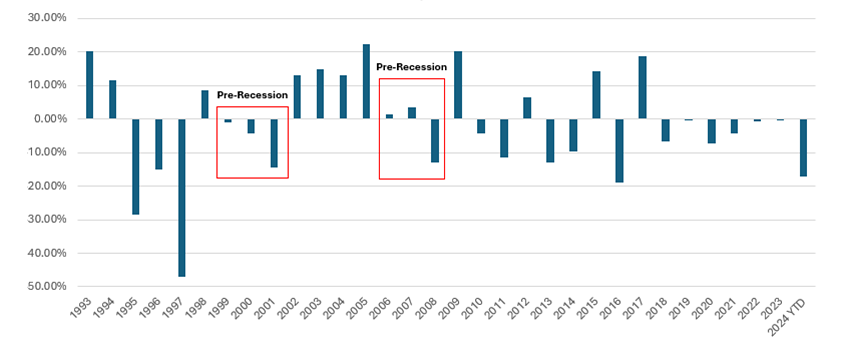
MSCI EAFE Small Cap minus Russell 2000
Bar graph showing the performance of the MSCI EAFE small cap minus the Russell 2000 from 1993 to present.
Source: Global Alpha Capital Management Ltd.

Since fall 2024, there has been a rotation into US small caps, fueled even more by the Trump Trade: Could we see international small caps catch up? One can observe the relative outperformance of EAFE small cap between 2002 and 2010. Seven years of underperformance is unprecedented. And we need to know that Japan is around 33% of the EAFE small cap index. According to the fundamentals and history, if there is a slowdown in the United States, international markets including international small caps could stand to be big beneficiaries.

Mergers and acquisitions

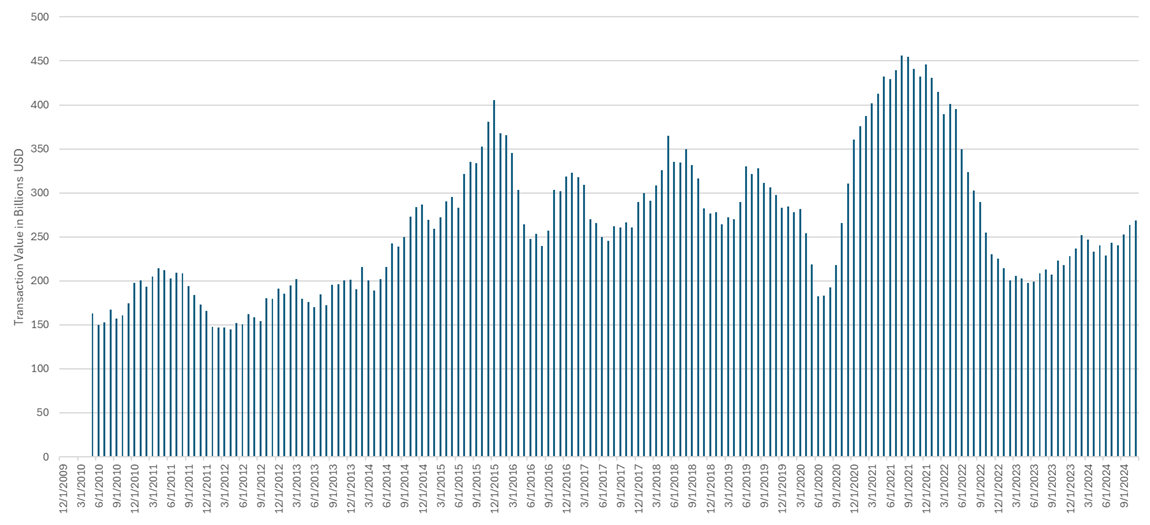
A bar graph showing the global mergers and acquisitions transaction values from 2009 to present.
Source: Global Alpha Capital Management Ltd.

We have also recently seen a pick-up in M&A activity. A consensus is emerging from advisors like Goldman Sachs, Evercore and others that 2025 will be a record year. M&A activity is projected to be 15% greater 2024, which was already up 15% over 2023.

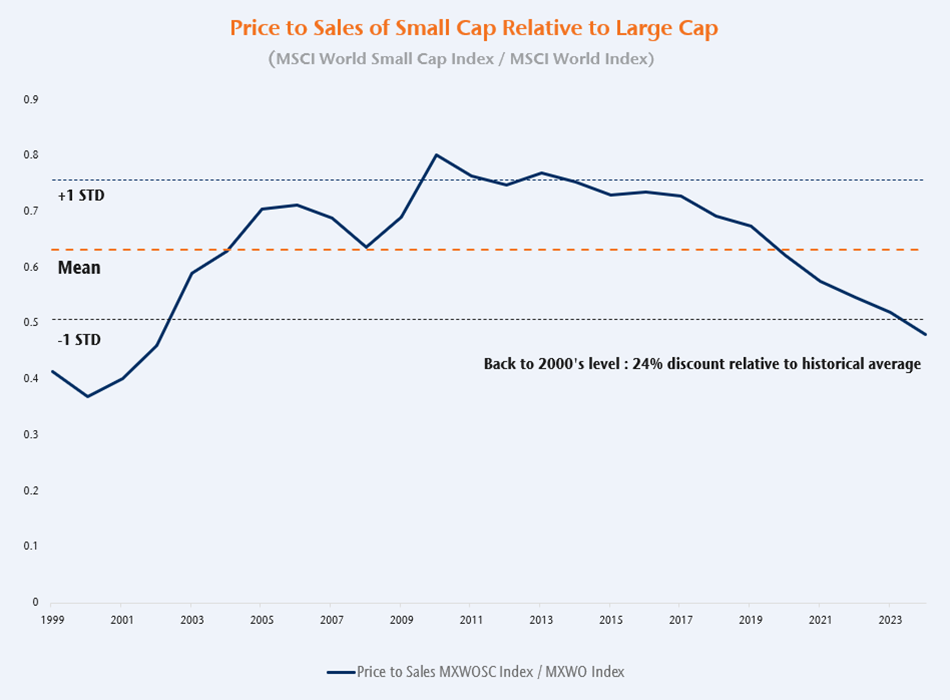
A line graph showing the price to sale of small cap relative to large cap over time since 1999.
Source: Global Alpha Capital Management Ltd.

Finally, the relative valuations of global and EAFE small caps versus large cap indicate a once-in-a-few-decades opportunity.

Investments are currently overloaded into the US market, with an oversaturation in the Magnificent Seven stocks. But it is clear there is opportunity in small caps – particularly international small caps – therefore, this is an opportunity that excites our team going into 2025.

In closing, the entire team at Global Alpha would like to thank you for your trust, and we want to wish you a beautiful holiday season and a wonderful 2025 ahead.

Chinese money trends are normalising after weakness, suggesting modest economic improvement.

A previous post argued that a recovery in money growth was under way but the extent of reacceleration was uncertain. A revival remains on track but has so far proved lacklustre.

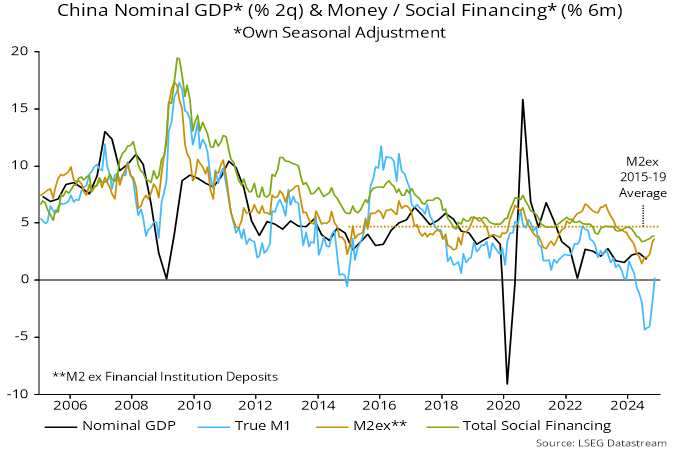
Money numbers were distorted in the spring by regulatory enforcement of deposit rate ceilings, which led to corporations switching out of demand deposits into time deposits and non-monetary instruments. Broader money measures were less affected, resulting in a focus here on the “M2ex” aggregate (i.e. official M2 minus deposits of financial institutions, which are volatile and less correlated with future activity / prices).

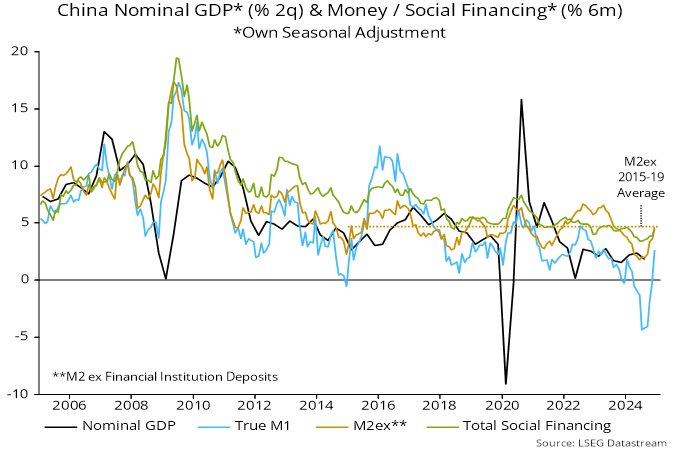
Six-month M2ex momentum bottomed in June and recovered further in November, though remains below its 2015-19 average – see chart 1.

Chart 1

Chart 1 showing China Nominal GDP* (% 2q) & Money / Social Financing* (% 6m) *Own Seasonal Adjustment

Narrow money momentum is much weaker but has started to normalise as the spring distortion drops out of the six-month comparison. (The “true M1” measure shown approximates to a new official M1 definition to be adopted from January.)

Chinese money momentum has led nominal GDP momentum by two quarters on average historically, so monetary reacceleration since mid-year suggests better economic data from early 2025.

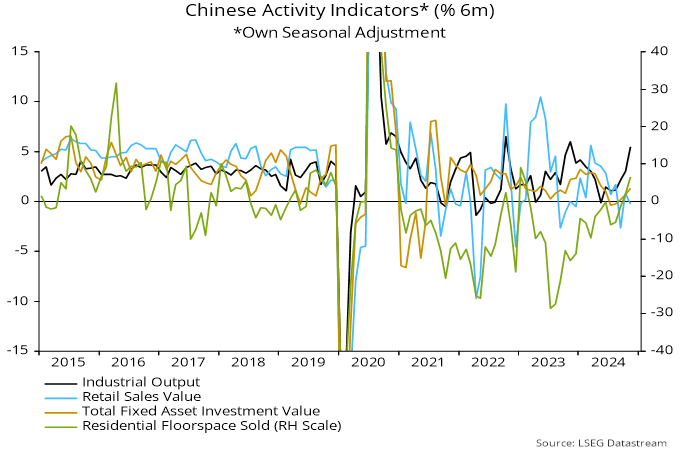
November activity numbers were positive on balance. Six-month rates of change of industrial output, fixed asset investment and home sales rose further but retail sales disappointed – chart 2. Output strength could reflect front-loading ahead of tariffs.

Chart 2

Chart 2 showing Chinese Activity Indicators* (% 6m) *Own Seasonal Adjustment

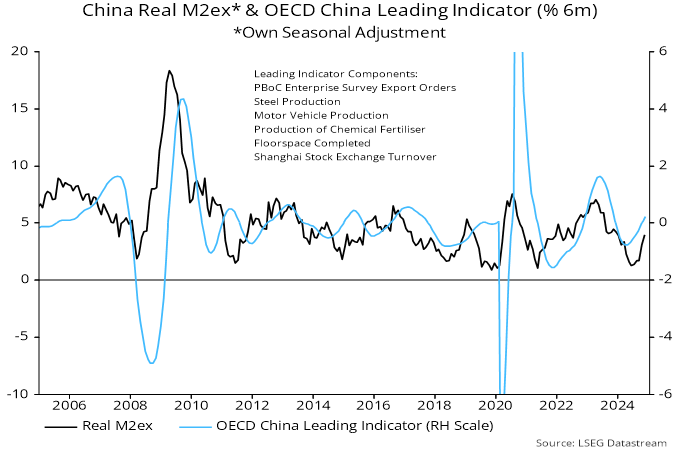
The suggestion from monetary trends of improving prospects is supported by the OECD’s composite leading indicator, six-month momentum of which has turned positive, suggesting above-trend growth – chart 3.

Chart 3

Chart 3 showing China Real M2ex* & OECD China Leading Indicator (% 6m) *Own Seasonal Adjustment

Real money momentum has led leading indicator momentum by four months on average historically but the low in the latter occurred earlier on this occasion, perhaps reflecting the regulatory distortion to monetary data mentioned above.

Modern towers and skyscrapers in the CBD near buildings of the Ottawa skyline.

Private credit volumes reached $1.5 trillion globally at the beginning of 2024 (vs. $1.0 trillion in 2020) and are projected to grow to $2.8 trillion by 2028. The US market makes up ~$1.0 trillion of volume, with the European (including the UK) market accounting for most of the remainder. Private credit has clearly become ubiquitous in the US market and is recognized as an increasingly attractive alternative to traditional US bank debt in the mid-market segment and Term Loan B (TLB)/high-yield bond market within the large cap space.

However, private credit in the Canadian market remains nascent and many of the private credit firms that have formed in Canada have pointed their origination efforts firmly towards the US market given the greater scale of opportunities available.

The obvious question to contemplate is why the Canadian market has not evolved or developed in the same way as that of the United States or Europe. Unique to the Canadian lending landscape is the dynamic of the “Big Six” domestic banks accounting for 80-90% of the lending market. These banks are very well-capitalized, have aligned themselves to balance sheet growth as a key performance metric and are relationship driven. Therefore, the typical Canadian borrower (especially sponsor-backed), can generally operate quite well within the confines of the traditional Canadian loan market. In both the United States and Europe, private credit growth is attributable to regulatory changes and banking sector consolidation that has yet to materialize to the same extent in Canada.

The opportunity for private credit in the Canadian context will likely not be the same as the United States, where it has evolved as the clear alternative to traditional bank debt. However, we expect that the asset class will at least be a largely complementary solution to existing banking relationships in the near-term.

Where private credit in Canada will excel as an alternative term debt provider is in specific situations and at points in time such as:

  • Management buyouts;
  • Growth capital;
  • Facilitating succession;
  • Private equity acquisitions;
  • M&A or business roll-up strategies;
  • Challenged situations; and
  • Where there is a flight of capital from certain industries (e.g. oil and gas).

Private credit in Canada is evolving as a complementary product to the Canadian banks rather than a direct competitor/alternative, and often occupies a segment best termed as “bank market adjacent.” Essentially, private credit is able to provide a solution at a particular stage in a company’s development that provides the necessary flexibility vs. traditional bank appetite/offering. The goal for all parties involved is for that company to eventually grow to a stage that calls for traditional bank debt.

Although the markets are different, the key advantages of private credit seen in the United States and Europe hold just as true in the Canadian context. These borrower preferences, as outlined below, are advantages that many borrowers in the United States and Europe are comfortable paying a premium for:

  • Speed/certainty of execution,
  • Nimble, innovative, and customized solutions,
  • Unburdened by “market convention” on terms & conditions or leverage profile, with the focus instead being on the overall credit – serviceability and sustainability of business performance, and
  • Highly experienced teams with a depth of knowledge through the cycles.

Relationships will always be a key consideration for entrepreneurs/CFOs/CEOs and the perceived risk of moving your lending relationship away from a traditional bank. Questioning lender reaction through a period of underperformance or a situation requiring flexibility are legitimate concerns when entering new relationships. However, many of the Canadian private credit firms are just as relationship-driven as the Canadian banks – another key difference between the Canadian and US/European market evolution. These firms are in the process of carving out a lending niche in a bank-dominated market and, in addition, many of them are financially supported by large Canadian entities who place high value in reputation and relationships within the Canadian market.

In conclusion, private credit in Canada has not reached the levels of growth or relative scale realized in the United States or Europe. Despite the differences in respective banking environments, private credit does serve a purpose in supporting Canadian businesses/entrepreneurs and the asset class will continue to develop and grow in Canada as banking dynamics and borrower preferences evolve.

For further information or to discuss financing for your next opportunity, call the team at MidStar Capital.

Photo of Metro at Edinburgh Market Place

Crestpoint Real Estate Investments Ltd. is excited to announce the acquisition of Edinburgh Market Place in Guelph, Ontario. This strategically located, 112,875 square foot grocery-anchored retail centre is fully leased to top national tenants including Metro, Staples and TD Canada Trust. Situated in a dominant retail node at the intersection of Edinburgh Road South and Stone Road West, and in close proximity to the University of Guelph, it is a highly visible, well-established shopping destination with abundant parking that attracts approximately seven million visitors annually. Crestpoint, on behalf of the Crestpoint Core Plus Real Estate Strategy (its open-end fund), will be acquiring a 100% interest in the property, which will be a great addition to our already diversified portfolio of high-quality assets.

Sectoral numbers show that recent US money growth has been focused on the household and financial sectors, with business holdings falling.

A recent post noted that US six-month narrow money momentum fell back in September / October, casting doubt on post-election economic optimism. Sectoral money trends revealed in the Fed’s Q3 financial accounts give further grounds for caution.

Chart 1 compares the six-month rate of change of the monthly broad measure calculated here – M2+, which adds large time deposits at commercial banks and institutional money funds to the official M2 series – with the two-quarter change in a domestic money aggregate derived from the financial accounts. The series are closely correlated with end-Q3 readings similar.

Chart 1

Chart 1 showing US Broad Money (% 6m / 2q annualised)

An advantage of the financial accounts data set is that it allows a breakdown of broad / narrow money between the household, non-financial business and financial sectors. Broad money growth in the two quarters to end-Q3 was driven by households and financial firms, with business money falling – chart 2. The narrow money decomposition (not shown) mirrors this pattern.

Chart 2

Chart 2 showing US Broad Money Holdings by Sector (% 2q annualised)

Business money trends have exhibited a stronger and more consistent relationship with future economic activity than household / financial sector developments historically. Changes in business liquidity can influence decisions about investment and hiring, with employment consequences feeding through to household incomes and money holdings.

The approach here, therefore, is to interpret the signal from a given level of aggregate money growth as more positive – or less negative – when the business component is outperforming (and vice versa).

Chart 3 shows that real business money – on both broad and narrow definitions – is falling on a year-ago basis, suggesting that a slowdown in investment will continue in 2025.

Chart 3

Chart 3 showing US Business Investment & Real Non-Financial Business Money (% yoy)

The Q3 financial accounts numbers also support an earlier proposition here that asset prices and nominal GDP have – in combination – moved above levels implied by the current broad money stock, i.e. there is no longer an “excess” money tailwind for the economy and markets.

To recap, the “quantity theory of wealth” is a suggested modification of the traditional quantity theory recognising that (broad) money demand depends on wealth as well as income and proposing equal elasticities. Nominal income is replaced on the right-hand side of the equation of exchange MV = PY by a geometric mean of income and wealth.

Using Q4 2014 as a base, the measure of gross wealth used here – the market value of public equities, debt securities (excluding Fed holdings) and the housing stock – had risen by 107% as of end-Q3 versus a 64% increase in nominal GDP. Implied growth of 84% in the geometric average compares with an increase of 80% in broad money over the same period – chart 4.

Chart 4

Chart 4 showing US Broad Money, Nominal GDP & Gross Wealth* Q4 2014 = 100 *Gross Wealth = Public Equities + Debt Securities ex Fed + Residential Real Estate

Equity / house price gains, debt issuance / QT and expected respectable nominal GDP expansion suggest that the overshoot will have widened in Q4.

Waterfront architectural landmarks of Sydney Harbour in aerial cityscape.

A sign of the times: tariffs will increasingly be part of our risk analysis resulting in both threats and opportunities in the global view of our investment universe. The impacts could be large in magnitude.

According to Goldman Sachs, a 25% tariff on North American trade could increase the consumer price index by 9%. In this extreme tariff environment for Canada and Mexico, Vietnam, Germany and Japan (all being equal) are the countries that would benefit in the short term as they have the most trade deficit with the United States. Mid-term, inflation sets back in and the winners would become sectors led by banks, real estate, utilities and commodities.

Lifting tariffs from down under

Meanwhile, at the other end of the globe, China and Australia are coming out of a trade war and Australia is set to benefit from increased free trade. China has recently ended heavy sanctions on Australian goods such as an 80.5% tariff on barley and a 212% tariff on wine. Further, China has recently declared an intent to promote free trade as a way of ending their economic slowdown. Over 30% of Australian exports are destined for China, making it by far Australia’s largest trading partner.

In 2024, trade between Australia and China continued to grow significantly, with volumes exceeding pre-pandemic levels. Australian exports like iron ore, coal and natural gas remained dominant, while products like barley, timber, and potentially wine and lobster recovered after previous trade restrictions were eased. China’s imports from Australia showed double-digit growth, supported by warming diplomatic ties.

Over-reliance on China prompted Australia to diversify. As per the Organisation for Economic Co-operation and Development (OECD), the recent Australia-UK Free Trade Agreement provides new opportunities for agricultural exports, opening doors for Australian beef, lamb and wine producers to access high-value European markets, reducing dependency on Asia.

Australian services exports surged by 9.9% in the June quarter, reflecting strong recovery in tourism and international education. These sectors are critical for reducing Australia’s reliance on raw materials and fostering a more balanced trade profile. In addition, Australians have kept busy addressing tariffs and non-tariff barriers. Tariff cuts under the Australia-India Economic Cooperation Agreement fostered significant increases in exports, particularly in mining and agri-products.​

Australia and the United States maintain a significant trade relationship, but the relationship is 20 times smaller than the US relationships with China or Canada. The 2023 Australian trade surplus with the United States was a mere $2.5 billion. Key exports from Australia include beef, alcoholic beverages and industrial equipment, while imports from the United States feature technology, vehicles and pharmaceuticals​.

Australian investments

Global Alpha is invested in Australia in different sectors with companies that both serve the local markets as well as ones dedicated to exporting goods. Many of its holdings should profit from reduced trade barriers.

The AUB Group Limited (AUB:AU) is an ASX200-listed insurance broker and underwriting group based in Australia. It operates across approximately 595 locations globally, employing over 5,500 people. The group manages about AUD10 billion in insurance premiums annually for around 1 million clients.

AUB acquired the UK-based Lloyd’s wholesale broker Tysers in 2022 for AUD880 million. The deal significantly expanded AUB’s international presence, integrating Tysers’ operations in London, Singapore, and Miami. Tysers, a leading Lloyd’s broker, contributed AUD192.4 million in revenue in its first full year under AUB, highlighting strong performance and alignment with AUB’s strategy to address global and specialty insurance markets.

Orora Group (ORA:AU) is a global leader in packaging, headquartered in Australia. It operates across Australasia, North America and Europe, with a strong focus on the beverage industry. Orora Beverage specializes in glass bottles, aluminum cans and closures for wine, beer and other beverages. The acquisition of Saverglass in France in 2023 expanded its global footprint in premium glass packaging.

Orora primarily exports glass bottles and beverage cans to China, with a focus on packaging solutions for beer, wine and more. Exports have historically been tied to the Australian wine industry, but volumes dropped significantly after Chinese tariffs were imposed on Australian wine. Orora was able to shift capacity to other markets and is now ready to reap the benefits as wine tariffs to China are eased.​

Orora’s total annual production includes about 900 million glass bottles and substantial can output, with investments in new facilities and sustainability to support future growth​.
Also headquartered in Australia, ALS Limited (ALQ:AU) is a leading global provider of testing, inspection and certification services. Operating through three main divisions – commodities, life sciences, and industrial – it specializes in servicing the mining and exploration industries through:

  • Analytical and metallurgical testing,
  • Geochemistry,
  • Quality testing,
  • Microbiological, physical and chemical testing, and
  • Remote monitoring.

ALS also provides diagnostic testing and engineering solutions for energy, infrastructure, and transportation, servicing the power and petrochemical sectors. The segment experienced growth in environmental services, particularly in Europe and the Americas, offset by challenges in pharmaceuticals​.

ALS stands to benefit soon on many fronts including the junior mining sector revival, the increased demand for environmental chemical testing, and the turnaround of its pharmaceutical testing division.