During the late 1950s, Gerald Tsai pioneered the strategy of momentum investing. He started the first publicly traded aggressive growth fund while working at Fidelity Management. The fund grew from $12.3 million in 1959 to $340 million in 1965. The term “go-go” was frequently used to describe this aggressive way of investing.
The 50s and 60s were golden years for the United States (US) economy and the stock market. During this time, we saw the rise of the professional fund manager, with the mutual fund industry managing $38.5 billion in assets and representing a quarter of all transactions on the stock market.[1] They had no idea they were creating a bubble, which would eventually burst. Since then, we have seen this pattern play out countless times, and yet, momentum investing never died out. In fact, it is back with a vengeance and will inevitably end in tears.
The Nifty Fifty
Momentum investing really took off when market commentators identified fifty stocks, which soon became the darlings of Wall Street. These companies shared strong traits, like high-quality franchises, good balance sheets, and strong topline growth. As these companies delivered higher returns, investors rewarded them with ever-increasing multiples.
Most professional investors started their careers on Wall Street in the 60s, so at this point, they had only seen the market go up.[2] They had just one rule when it came to the Nifty Fifty stocks – and the rule was buy!
The markets were so frothy that even legendary investor Warren Buffet closed his investment partnership on May 29, 1969. In the late 60s, Buffett noted in his letters that the number of attractive investment opportunities was rapidly diminishing. As a result, investors were piling onto the “winners”, regardless of price.
When the bears woke up in 1973, the Nifty Fifty stocks initially held up when compared to the rest of the market. However, it was just a matter of time before they saw severe selling pressure. As one columnist at Forbes Magazine put it, “the Nifty Fifty were taken out and shot one by one”.
The arrival of the Four Horsemen
Fast forward to the late 90s when the “information super highway” sprang forth from cyberspace, and the only companies that mattered, had something to do with the internet. Back then, Microsoft, Intel, Cisco, and Dell were referred to as the “Four Horsemen” given their total dominance in the tech world. There were times when these four represented 55-60% of the Nasdaq price movement. Not surprisingly, investors were attracted to tech due to the general adoption of the internet and sweeping investments in technology and telecom infrastructure.
The four were later joined by companies like Oracle, EMC, Sun Microsystems, AOL, eBay, and Yahoo. Eventually, the tech bubble burst, giving us yet another example of why momentum investing comes with a lot of risk.
The evolution of FAANGM
The tech bubble may have burst, but our obsession with tech giants lives on. Over the last few years, a new cohort of companies caught the eyes of momentum investors. Originally, they were called FANG stocks (Facebook, Amazon, Netflix and Alphabet). Eventually, the group evolved into FAANG (Adding Apple) and later FAANGM (adding Microsoft). These stocks are long recognized as powerful market movers. But how long will these giants rule?
Some similarities from the Nifty Fifty years
Just like in the 60s, investors and professional fund managers who joined Wall Street after the financial crisis of 2008 have only seen the market go up. While there has been some volatility from events like Brexit and the pandemic, the market has been consistently strong. The new breed of investor has only seen interest rates drop and governments eager to bail out the economy by printing money. In this environment, the only rule is to buy, buy, buy.
Robin Hood Army and WFH boredom
There is growing evidence that working from home (WFH) boredom has been driving many unsophisticated or non-professional investors to start playing the market. Historically, retail investors have not played a major role in the movement of individual stocks. However, according to research from Pipe Sandler, this has changed. Since COVID-19’s impact, we are seeing a high correlation between retail user accounts and stock price fluctuations.
The retail-investing approach unfortunately seems too simple: buy regardless of fundamentals or valuations.
Out-of-control valuations
The combined market cap of FAANGM is over $9 trillion dollars, which is greater than the MSCI World Small Cap Index, which has 4,432 constituents. The entire US stock market is worth $51 trillion dollars, meaning FAANGM stocks represent almost 18% of the market.
While it’s true these businesses are growing fast and their margins are better, a lot of the margins for companies like Google, Amazon, and Microsoft are from cloud computing, which over the long run is a commodity product and whose price has been falling. As a comparison, back in the 60s, Coke and McDonald’s were delivering hyper growth and attracting legions of investors who thought the party would never end. But eventually, the law of large numbers kicked in. That level of growth is unsustainable.
The mounting risk
Regulatory – There are numerous anti-trust lawsuits against FAANGM across the world. South Korea became the first country in the world to ban Google and Apple from requiring users to pay for apps with their own in-app purchasing systems. Facebook is fighting the Federal Trade Commission’s antitrust lawsuit while also facing a backlash from the whistleblower hearings.
Inflation and Interest rates – Looking back to the Nifty Fifty, interest rates were a lot higher, and globalization and automation were providing deflationary pressure. At the moment, interest rates are almost as low as they can get, unless we are going negative. Enormous liquidity released by the various central banks worldwide are giving rise to inflationary pressure.
Meanwhile, the debate over what is transitory and what is not continues. A higher interest rate will reduce the valuation for growth stocks. An inflationary environment will eat into the earnings power, which will lead to a lower multiple.
Portfolio impact
We do not participate in momentum investing. Our portfolio has much faster growth than the index, and is currently trading at a discount to our index. Our companies continue to deliver strong topline and bottom-line growth in their latest reported earnings. Our portfolio holdings have a strong balance sheet and a third of our companies have no debt. As money begins to move out of the various highflyers, we believe our names are ideally positioned to benefit from the reallocation.
[1] https://www.jstor.org/stable/40721527
[2] The Go-Go Years: The Drama and Crashing Finale of Wall Street’s Bullish 60s, By John Brooks
We recently launched our Emerging Markets (EM) Small Cap fund. Comprised of over 11,000 companies, the EM Small Cap universe presents plenty of very sound investment ideas. One of the main challenges we have encountered since launching the fund more than a month ago has been the strong Chinese government regulations in various sectors, mainly technology and education. While we do not have investments in these sectors in China, we have seen a climate of increasing uncertainty in other economic sectors.
From a local perspective (which can differ from Western perspective), Chinese policy-makers are aiming for common prosperity, which fundamentally entitles a policy shift towards reducing wealth inequality. The concept is not new; it has been a long-term goal of the Chinese government that has become more relevant recently. The Central Party and State Council jointly announced the plan on June 10, establishing Zhejiang province as the pilot zone. The 14th five-year plan (2021-2025) called for an “action plan” to be fully implemented by 2050 to become an advanced, modern economy. Among common prosperity goals are narrowing the income gap, tackling the increasing real estate prices, promoting higher household income growth, increasing public services, such as healthcare and education, and improving living conditions of rural residents, among many others. These common prosperity initiatives will likely rebalance the economy from investments to consumption, targeting the mid-low-income population. Moreover, the state’s role in public and private sectors is likely to become more relevant.
It is worth noting that the Chinese government seems to have downplayed the importance of paying too much attention to short-term growth. They indeed have a short-term buffer, considering the 2021 GDP target is “above 6%”, and the country is likely to grow in the range of 8% this year.[1] The current outlook is more focused on solving structural problems, which may have short-term collateral consequences, but the vision is to improve the long-term perspective. Indeed, President Xi has emphasized a couple of times that the aforementioned long-term goals are not just an economic objective, they are about the Party’s “governing foundation”. The foregoing is still interesting, since, as previously mentioned, the Western vision is often different. Billions of dollars have been lost in market capitalization of Chinese assets, driven by strict regulatory policy in the after-school tutoring sector, together with anti-monopoly and cybersecurity rules in the internet sector. The government has also tightened property policies. Currently a blanket of uncertainty persists regarding “which sector will be regulated next”. For example, almost one month ago, a state media article equated the gaming industry, which has many companies that trade on the stock market, to “opium”. Although the government quickly quashed this article and there were no official statements, it caused a rapid slump of shares linked to the gaming sector, reflecting the prevailing nervousness among investors. The government recently released new regulations for the industry, including limiting the amount of time children can play video games to three hours a week, and last week state media mentioned that companies should avoid the sole focus of pursuing profit, in order to prevent minors from becoming addicted to games. This sentiment led to another round of losses in gaming-related stocks.
Again, different perspectives come into play. We believe China is trying to improve its society in the long term, but are not very concerned about the effect this may have on investors in the short term. The question then is; how can we better cope and adjust to these policies for the benefit of our clients? China accounts for around 10% of the MSCI EM Small Caps index, making it an important investment for our fund. Our approach to this new environment is to understand the domestic perspective and invest in companies/sectors that are subject to less regulation and more likely to benefit from the new trends that we see emerging in the future. Each scenario presents a new opportunity and the trends include:
greater self-reliance on government-fostered technology (semiconductors, artificial intelligence);
renewable energy;
fitness;
consumption favouring local brands/companies; and
manufacturing industry and robotics for products designed mainly to support and strengthen the Chinese economy.
In manufacturing and robotics, Estun Automation (002747 CH) is one of our key holdings. The company is the largest domestic industrial robot-maker in China and one of the best-positioned stocks in the A-share Small-Cap automation sector. Estun also produces several key components itself, which gives the company a strong competitive advantage in relation to competitors who rely on external suppliers. For example, Estun is one of the few robot-makers that can manufacture servo systems and controllers in-house. It has also managed to gain cutting-edge technologies, like robot 3D vision and micro-servos via a number of acquisitions. In short, Estun has the capabilities to manufacture almost all of the core parts it needs, with the exception of reducers, although they still procure the basic mechanical parts and semiconductor chips. They also have production plants across the globe. The two key plants are UK-based Trio, acquired in 2017, a top 10 global player in motion control systems, and Germany-based Cloos, acquired in 2019, making the brand a cutting-edge welding robot. In light of this, supply chain management has become a key issue for Estun.
The latter is definitely a big advantage. For industrial automation, all the key core technology is in upstream components, like servos, motion control systems, and reducers. Thus, without access to upstream components, a company is merely one of many system integrators, which face a significantly lower entry barrier, intense competition, and lower margins. In fact, now that the Estun brand is better known, more external system integrators are starting to integrate Estun’s robots into their product portfolio, which is why Estun shifted resources away from their system integration department. Back in 2019, the revenue contribution of industrial robot manufacturing and sales, and system integration sub-segments was 50:50, but from 2020 onward, it’s been skewing towards robot sales. As of the first half of 2021, the proportion has shifted to 80:20 for sales of robots to system integration.
Nowadays, Estun’s main end markets are lithium-ion batteries, computers, communications, and consumer electronics (known as the 3C industry in China) applications, solar, welding robots (primarily for heavy machinery), and metal forming (processing). Smaller, fast-growing contributors include woodwork, home appliances, and packaging. Meanwhile, the core markets for the Cloos robot brand are medium- and heavy–plated 6-axis welding robots. Currently, this brand is gaining market share in China’s heavy machinery segment. Cloos is also developing their medium-plated welding robots, which are commonly used in heavy-duty trucks.
Industry-wise, according to the MIR database, a Chinese based, high-end, hardware-focused research, the China automation market size grew 26.9% year over year to approximately RMB153 billion in the first half of 2021. The market is continuously experiencing robust demand from new-economy manufacturers, notably industrial robots, electric vehicle batteries, wind turbines/solar panels, as well as 3C and logistics, and some of the more niche markets (e.g., tobacco, wood engraving), which are dominated by Japanese players. However, this represents a huge upside potential for players like Estun, who are narrowing their technology gap with international peers. Moreover, machine exports drove some of the automation demand in the first half of 2021. Estun (and peers like Innovance) have experienced continuous market share gains. The company is also well positioned to maintain its domestic industrial robot leadership position, especially in 4-axis and 6-axis industrial robots, which contributed to approximately 85% of their shipment volume in the first half of 2021.
Estun’s focus on the new-economy manufacturers, coupled with their expected market share gains, should ensure a secular growth trend in the long term. Although there has been plenty of uncertainty around the Chinese economy since the start of the second half of 2021, we continue to view industrial automation (IA) demand as among the highlights of local dynamics, given the favourable demand outlook and strong policy support for an industrial upgrade. Estun is a perfect example of a company that can position Chinese automation, robotics, and industrialization on par with the leading international players. We believe the company will get ongoing government support for achieving these targets in the mid/long term, so the company is unlikely to be exposed to any material regulation risk. In light of its quarterly politburo meeting outlining the drive to “encourage enterprise to scale up technological upgrade investment”, we expect the manufacturing industry to step up investing pursuit of robotization.
Estun has experienced short-term pressure driven by COVID-19 in China (primarily in Nanjing and Jiangsu, Estun’s headquarters and production base) and lower-than-expected results in Q2 2021 are likely to remain so for the rest of the year. The difficult quarter was driven by:
price hikes of parts, base metals and chips;
Estun prioritizing market share over margins in 2021; and
hikes in raw material transportation fees.
the delayed shipping of Trio motion controllers
We feel this situation is temporary and expect margin reversal from next year (or before), driven by ongoing operating leverage, improvements in internal cost control, and more import substitution from domestic parts. In fact, in their 2Q earnings results conference call, the company maintained 2021 revenue guidance of RMB 3.5-4.0 billion, with its 2021/22/25 industrial robot sale targets of 10k/15k/50k units unchanged. Estun management also expects profit margin to rise notably as its business expands.
Despite the short-term headwinds, we hold a positive view toward Estun, as we believe in the sustainability of industrialization and automation, on the back of a solid secular growth trend in the coming years in China. As the local market leader, Estun is now already directly competing with big foreign players, like Japan-based FANUC. Their acquisition of Cloos has significantly contributed to the positioning and diversification of Estun’s robots in China. We expect Estun’s market share to increase from for 3-4% to approximately 10% by 2025, meaning Chinese factories will increasingly shift to domestic rather than foreign brands. We believe Estun has the potential to emerge as one of the leader industrial robot manufacturers globally. This could be a similar story to other emerging domestic players in China, such as excavators, where domestic market leader Sany holds an approximate 25% market share.
As bottom-up investors, fundamentals drive our stock selection. We look for companies growing faster than their industry, with good margins and cash flows. We also need to understand local dynamics and invest accordingly. China’s recent policies are a good example of a divergence in timing and perspectives between local interests and foreign investors, as detailed above. The road has been bumpy, but opportunities are also emerging, especially in small-cap companies, that will likely have more room to grow in the long run. Government-encouraged manufacturing and robotics companies also present good opportunities in this scenario, which supports our preference for our holding Estun.
[1] www.dw.com
Shot with the DJI Mavic Pro
In Canada and other developed markets, equity diversification has changed significantly in recent years. Traditional investments are now less diversified due to the increasing integration of global supply chains and global markets’ interconnectedness.
The importance of diversification, however, has not changed. If anything, it is more important than ever. With declining interest rates and record-low bond yields, investors are on a quest for income and better returns. Many investors have increased their exposure to developed or emerging-market equity investments. However, they have experienced consequences when markets have tumbled in unison, such as during the early days of the COVID-19 pandemic.
Some investment managers now offer opportunities to invest in geographically unique markets. In particular, frontier markets are presented as a major opportunity for investors who have the flexibility to make long-term investments.
What are frontier markets?
Frontier markets are an alternative asset class focused on identifying opportunities in economies that are still in their infancy in terms of development. These “frontier” markets are less developed than emerging markets like China or Brazil.
Unlike emerging markets, there is no clear and standard definition of frontier markets. We consider frontier markets to be unclassified markets or markets that are not represented well in the emerging markets index, such as Indonesia, the Philippines, Vietnam, Ghana, and Kenya. These have large and growing populations and low but increasing income levels.
As incomes rise, these countries’ populations are expected to increase consumer spending on goods and services. It should increase the profitability and business maturity of local companies able to meet rising consumer demand – making such companies ripe for investment.
Understanding the risks and benefits of frontier investing
While many of these countries are high-risk due to their low level of economic maturity and potential political instability, their economies are highly localized and disconnected from global trends, making them a viable mechanism for diversifying portfolios. To mitigate risk, the companies we invest in are typically consumer-focused – with offerings that meet local consumption demand rather than global supply needs.
Investing in frontier markets can also generate social benefits, injecting much-needed capital into underinvested companies and helping drive regional economic development and the maturation of key industries. Investors can make their money do good in the world while also contributing to their long-term financial goals.
How do frontier market investments fit within an investor’s financial portfolio?
At CC&L Private Capital, we believe that adding a modest allocation to frontier markets can help improve the robustness of a portfolio under certain circumstances. However, any frontier investments need to be made based on a fulsome discussion of the risk and return trade-offs.
If you would like to find out more about our approach to frontier investing or learn how we can help you grow your investment returns, please contact us.
This post is for information only and is not intended as investment advice. The views expressed are those of the author at the time of publication and are subject to change at any time.
This strategy and any associated investments are only available to professional investors and eligible counterparties, as defined in the rules of the UK Financial Conduct Authority. This communication is not being made to, and should not be relied upon by, persons who are retail clients for FCA regulatory purposes. Vergent Asset Management LLP is not authorised by the FCA to deal with retail clients.
The strategy continues to be rewarded for the thesis we’ve built around technology, payments, and financial inclusion in our markets. The starting point for us in that process was the mobile money opportunity in East Africa which continues to be best exemplified by Kenya’s Safaricom’s M-Pesa. Over time, we built a deeper understanding of the payments value chain which helped us identify infrastructure players like Morocco’s Hightech Payment Systems which was an early investment in the life of the strategy. We also broadened the geographical scope of the thesis by expanding our core mobile money thesis towards West Africa into Ghana with MTN’s exciting Momo business which is now starting to get the attention it deserves from the market. We also benefited from the deepening opportunity set in the sector with transformational companies like Kazakhstan’s Kaspi.Kz coming to market last year. Our financial inclusion theme extended to microfinance companies like Bank BTPN Syariah in Indonesia which provides micro loans to nearly four million women entrepreneurs in rural Indonesia. BTPN Syariah has a fantastic opportunity to go from an offline centric credit disbursement and collection model into an Omni-channel offering that will help scale the business whilst improving the level of service they provide customers. Our initial thesis has evolved and strengthened since we started investing in the sector; financial inclusion and digital transformation has become a regulatory priority and the pandemic has only helped accelerate adoption and usage among consumers. Moreover, the companies we’ve invested in are constantly evolving with Kaspi.Kz continuing to add new services to its super app that counts over half of Kazakhstan’s population as active users and M-Pesa accelerating its transformation from a peer-to-peer USSD based service into a full-fledged lifestyle and financial services platform servicing ~25 million Kenyan consumers and ~300k merchants. Another factor that we must acknowledge has changed over the last two years is the valuations have re-rated for the broader sector both in the public and private markets. What reassures us on that front are four key points:
The aforementioned companies and others we own in the sector are all profitable
Their balance sheets are unlevered and in most cases net cash
They trade at reasonable multiples relative to the sector in developed markets (albeit at a premium to the rest of the portfolio) and private markets. In fact, no one company we’ve invested in currently trades on a P/E ratio that is in excess of 30x 2022 earnings. Note our emphasis on price to earnings ratio means all of our companies are bottom line profitable
The growth profile and optionality embedded in these business models means that the multiples we see on near term earnings will burn off fairly quickly in the next five years
Away from payments and technology, the strategy also experienced strong returns in the period from our retail portfolio in Morocco and the Philippines. In Morocco, the vaccination rollout program has been very successful with over 18m doses administered as of the date of writing (Morocco’s total population is ~36 million of which 27% is under the age of 15). This has bolstered the outlook for sales at Label Vie, the operator of the largest supermarket chain in the country under license from France’s Carrefour. Label Vie also operates the largest cash & carry format stores in the country under the Atacadao brand, a Brazilian concept brand also owned by Carrefour which caters to professional buyers and households. The reason for our optimism on the company’s short term prospects comes from the potential return of the hospitality channel as Morocco reopens to European tourism. Prior to the pandemic, a quarter of Atacadao’s sales came from the hospitality channel and we expect that some of that will start to show in sales over the next few quarters. Longer term, our bullish thesis on Label Vie is underpinned by the broader modern retail sector’s development and management team’s aggressive expansion strategy which is focused on scaling several formats including supermarkets (~700sqm), minimarkets (~200sqm), and Atacadao. It is worth nothing that Label Vie’s management is also investing in building an online presence in Morocco through “Bringo”, a Romanian online grocery concept that is also owned by Carrefour. Morocco is a very nascent market for online (~1% of retail sales) and according to our channel checks has not experienced the same step change in online shopping habits that other markets have experienced since the onset of the pandemic. This gives Label Vie an opportunity to build out its online channel thoughtfully by adapting its offerings and fulfillment strategy to local tastes and dynamics. We were encouraged by management’s receptiveness to our recommendations in this area and expect to continue to engage with them as they build out their online model. In the Philippines, we are seeing early signs of a recovery as vaccinations begin to pick up pace. Encouraged by that progress, we made an investment in a leading home improvement retailer that we believe will benefit tremendously from the return in construction spending and home renovation activity. It is worth nothing that unlike in other markets in the world, construction activity has been largely suppressed in the Philippines since the pandemic started in March of last year as a result of strict social distancing measures at the local and federal level.
In our last letter, we made a case for investors to think differently about how they approach emerging markets. We argued that many of the largest constituent countries of emerging market indices have reached levels of economic development, regulatory cycle, and market efficiency that makes them comparable to developed markets. We continue to advocate that the true emerging market opportunity today lies in the next generation of emerging markets like Egypt, Indonesia, Kenya, Pakistan, and Vietnam. Today, those market offer up a unique combination of a large, young and rapidly urbanizing consumer base that is increasingly connected but still not served in the same way their counterparts in more developed countries are. Our job is to find public companies that are able to fill that gap by offering services directly to those customers (B2C) or by enabling other businesses to offer those services to customers (B2B2C). That gap represents a substantial economic and social profit opportunity for well run businesses in which the strategy is generously invested.
Vergent Asset Management LLP
DISCLOSURES
1. Unless otherwise stated, all data is at June 30, 2021 and stated in US dollars (US$). Source: Connor, Clark & Lunn Financial Group, Thomson Reuters Datastream.
2. Performance history for the Vergent Emerging Opportunities Strategy is that of the Vergent Emerging Opportunities Composite. The Composite has an inception and creation date of August 2018.
3. Net performance figures are stated after management fees, estimated performance fees, trading expenses and before operating expenses. Operating expenses include items such as custodial fees for pooled vehicles and would also include charges for valuation, audit, tax and legal expenses. Such additional operating expenses would reduce the actual returns experienced by investors. Past performance of the strategy is no guarantee of future performance; Future returns are not guaranteed and a loss of capital may occur. For illustrative purposes, performance fee of 20% on added value over the hurdle rate of 6% plus the management fee of 1.25% have been assumed. Actual management fees charged to a particular account may vary.
4. There is no benchmark for the Vergent Emerging Opportunities Strategy because it has an absolute return objective
5. Standard Deviation measures the dispersion of monthly returns since the inception of the strategy.
Benchmarks and financial indices are shown for illustrative purposes only, are not available for direct investment, are unmanaged, assume reinvestment of income, do not reflect the impact of any management or incentive fees and have limitations when used for comparison or other purposes because they may have different volatility or other material characteristics (such as number and types of instruments) than the Strategy. The Strategy’s investments are not restricted to the instruments comprising any one index and do not in all cases correspond to the investments reflected in such indices.
These materials (“Presentation”) are furnished by Vergent Asset Management (“Vergent”) on a confidential basis for informational and illustration purposes only. This Presentation is intended for the use of the recipient only and may not be reproduced or distributed to any other person, in whole or in part, without the prior written consent of Vergent. Certain information contained in this Presentation is based on information obtained from third-party sources that Vergent considers to be reliable. However, Vergent makes no representation as to, and accepts no responsibility for, the accuracy, fairness or completeness of the information contained herein. The information is as of the date indicated and reflects present intention only. This information may be subject to change at any time, and Vergent is under no obligation to provide you with any updates or amendments to this Presentation. This Presentation is not an offer to buy or sell, nor a solicitation of an offer to buy or sell any security or other financial instrument advised by Vergent. This Presentation does not contain certain material information about the strategy, including important risk disclosures. An investment in the strategy is not suitable for all investors, and before making an investment in the strategy, you should consult with your professional advisor(s) to determine whether an investment in the strategy is suitable for you in light of your investment objectives and financial situation. Vergent does not purport to be an advisor as to legal, taxation, accounting, financial or regulatory matters in any jurisdiction, and the recipient should independently evaluate and judge the matters referred to in this Presentation. Vergent Asset Management LLP is registered in England and Wales with its registered office address at 8th Floor, 1 Knightsbridge Green, London SW1X 7QA, United Kingdom (Companies House number OC418829) and is authorized and is an Exempt Reporting Adviser in the USA. It is regulated by the Financial Conduct Authority (FRN: 791909).
THIRD-PARTY DATA PROVIDERS
This report may contain information obtained from third parties including: Merrill Lynch, Pierce, Fenner & Smith Incorporated (BofAML), S&P Global Ratings, and MSCI. Source: Merrill Lynch, Pierce, Fenner & Smith Incorporated (BofAML), used with permission. BofAML permits use of the BofAML indices related data on an “As Is” basis, makes no warranties regarding same, does not guarantee the suitability, quality, accuracy, timeliness, and/or completeness of the BofAML indices or any data included in, related to, or derived therefrom, assumes no liability in connection with the use of the foregoing, and does not sponsor, endorse, or recommend CC&L Canada, or any of its products. This may contain information obtained from third parties, including ratings from credit ratings agencies such as S&P Global Ratings. Reproduction and distribution of third party content in any form is prohibited except with the prior written permission of the related third party. Third party content providers do not guarantee the accuracy, completeness, timeliness or availability of any information, including ratings, and are not responsible for any errors or omissions (negligent or otherwise), regardless of the cause, or for the results obtained from the use of such content. THIRD PARTY CONTENT PROVIDERS GIVE NO EXPRESS OR IMPLIED WARRANTIES, INCLUDING, BUT NOT LIMITED TO, ANY WARRANTIES OF MERCHANTABILITY OR FITNESS FOR A PARTICULAR PURPOSE OR USE. THIRD PARTY CONTENT PROVIDERS SHALL NOT BE LIABLE FOR ANY DIRECT, INDIRECT, INCIDENTAL, EXEMPLARY, COMPENSATORY, PUNITIVE, SPECIAL OR CONSEQUENTIAL DAMAGES, COSTS, EXPENSES, LEGAL FEES, OR LOSSES (INCLUDING LOST INCOME OR PROFITS AND OPPORTUNITY COSTS OR LOSSES CAUSED BY NEGLIGENCE) IN CONNECTION WITH ANY USE OF THEIR CONTENT, INCLUDING RATINGS. Credit ratings are statements of opinions and are not statements of fact or recommendations to purchase, hold or sell securities. They do not address the suitability of securities or the suitability of securities for investment purposes, and should not be relied on as investment advice.
Source: MSCI. The MSCI information may only be used for your internal use, may not be reproduced or re-disseminated in any form and may not be used as a basis for or a component of any financial instruments or products or indices. MSCI makes no express or implied warranties or implied warranties or representations and shall have no liability whatsoever with respect to any MSCI data obtained herein. This report is not approved, reviewed or produced by MSCI.
This strategy and any associated investments are only available to professional investors and eligible counterparties, as defined in the rules of the UK Financial Conduct Authority. This communication is not being made to, and should not be relied upon by, persons who are retail clients for FCA regulatory purposes. Vergent Asset Management LLP is not authorised by the FCA to deal with retail clients.
The strategy continues to be rewarded for the thesis we’ve built around technology, payments, and financial inclusion in our markets. The starting point for us in that process was the mobile money opportunity in East Africa which continues to be best exemplified by Kenya’s Safaricom’s M-Pesa. Over time, we built a deeper understanding of the payments value chain which helped us identify infrastructure players like Morocco’s Hightech Payment Systems which was an early investment in the life of the strategy. We also broadened the geographical scope of the thesis by expanding our core mobile money thesis towards West Africa into Ghana with MTN’s exciting Momo business which is now starting to get the attention it deserves from the market. We also benefited from the deepening opportunity set in the sector with transformational companies like Kazakhstan’s Kaspi.Kz coming to market last year. Our financial inclusion theme extended to microfinance companies like Bank BTPN Syariah in Indonesia which provides micro loans to nearly four million women entrepreneurs in rural Indonesia. BTPN Syariah has a fantastic opportunity to go from an offline centric credit disbursement and collection model into an Omni-channel offering that will help scale the business whilst improving the level of service they provide customers. Our initial thesis has evolved and strengthened since we started investing in the sector; financial inclusion and digital transformation has become a regulatory priority and the pandemic has only helped accelerate adoption and usage among consumers. Moreover, the companies we’ve invested in are constantly evolving with Kaspi.Kz continuing to add new services to its super app that counts over half of Kazakhstan’s population as active users and M-Pesa accelerating its transformation from a peer-to-peer USSD based service into a full-fledged lifestyle and financial services platform servicing ~25 million Kenyan consumers and ~300k merchants. Another factor that we must acknowledge has changed over the last two years is the valuations have re-rated for the broader sector both in the public and private markets. What reassures us on that front are four key points:
The aforementioned companies and others we own in the sector are all profitable
Their balance sheets are unlevered and in most cases net cash
They trade at reasonable multiples relative to the sector in developed markets (albeit at a premium to the rest of the portfolio) and private markets. In fact, no one company we’ve invested in currently trades on a P/E ratio that is in excess of 30x 2022 earnings. Note our emphasis on price to earnings ratio means all of our companies are bottom line profitable
The growth profile and optionality embedded in these business models means that the multiples we see on near term earnings will burn off fairly quickly in the next five years
Away from payments and technology, the strategy also experienced strong returns in the period from our retail portfolio in Morocco and the Philippines. In Morocco, the vaccination rollout program has been very successful with over 18m doses administered as of the date of writing (Morocco’s total population is ~36 million of which 27% is under the age of 15). This has bolstered the outlook for sales at Label Vie, the operator of the largest supermarket chain in the country under license from France’s Carrefour. Label Vie also operates the largest cash & carry format stores in the country under the Atacadao brand, a Brazilian concept brand also owned by Carrefour which caters to professional buyers and households. The reason for our optimism on the company’s short term prospects comes from the potential return of the hospitality channel as Morocco reopens to European tourism. Prior to the pandemic, a quarter of Atacadao’s sales came from the hospitality channel and we expect that some of that will start to show in sales over the next few quarters. Longer term, our bullish thesis on Label Vie is underpinned by the broader modern retail sector’s development and management team’s aggressive expansion strategy which is focused on scaling several formats including supermarkets (~700sqm), minimarkets (~200sqm), and Atacadao. It is worth nothing that Label Vie’s management is also investing in building an online presence in Morocco through “Bringo”, a Romanian online grocery concept that is also owned by Carrefour. Morocco is a very nascent market for online (~1% of retail sales) and according to our channel checks has not experienced the same step change in online shopping habits that other markets have experienced since the onset of the pandemic. This gives Label Vie an opportunity to build out its online channel thoughtfully by adapting its offerings and fulfillment strategy to local tastes and dynamics. We were encouraged by management’s receptiveness to our recommendations in this area and expect to continue to engage with them as they build out their online model. In the Philippines, we are seeing early signs of a recovery as vaccinations begin to pick up pace. Encouraged by that progress, we made an investment in a leading home improvement retailer that we believe will benefit tremendously from the return in construction spending and home renovation activity. It is worth nothing that unlike in other markets in the world, construction activity has been largely suppressed in the Philippines since the pandemic started in March of last year as a result of strict social distancing measures at the local and federal level.
In our last letter, we made a case for investors to think differently about how they approach emerging markets. We argued that many of the largest constituent countries of emerging market indices have reached levels of economic development, regulatory cycle, and market efficiency that makes them comparable to developed markets. We continue to advocate that the true emerging market opportunity today lies in the next generation of emerging markets like Egypt, Indonesia, Kenya, Pakistan, and Vietnam. Today, those market offer up a unique combination of a large, young and rapidly urbanizing consumer base that is increasingly connected but still not served in the same way their counterparts in more developed countries are. Our job is to find public companies that are able to fill that gap by offering services directly to those customers (B2C) or by enabling other businesses to offer those services to customers (B2B2C). That gap represents a substantial economic and social profit opportunity for well run businesses in which the strategy is generously invested.
Vergent Asset Management LLP
DISCLOSURES
1. Unless otherwise stated, all data is at June 30, 2021 and stated in US dollars (US$). Source: Connor, Clark & Lunn Financial Group, Thomson Reuters Datastream.
2. Performance history for the Vergent Emerging Opportunities Strategy is that of the Vergent Emerging Opportunities Composite. The Composite has an inception and creation date of August 2018.
3. Net performance figures are stated after management fees, estimated performance fees, trading expenses and before operating expenses. Operating expenses include items such as custodial fees for pooled vehicles and would also include charges for valuation, audit, tax and legal expenses. Such additional operating expenses would reduce the actual returns experienced by investors. Past performance of the strategy is no guarantee of future performance; Future returns are not guaranteed and a loss of capital may occur. For illustrative purposes, performance fee of 20% on added value over the hurdle rate of 6% plus the management fee of 1.25% have been assumed. Actual management fees charged to a particular account may vary.
4. There is no benchmark for the Vergent Emerging Opportunities Strategy because it has an absolute return objective
5. Standard Deviation measures the dispersion of monthly returns since the inception of the strategy.
Benchmarks and financial indices are shown for illustrative purposes only, are not available for direct investment, are unmanaged, assume reinvestment of income, do not reflect the impact of any management or incentive fees and have limitations when used for comparison or other purposes because they may have different volatility or other material characteristics (such as number and types of instruments) than the Strategy. The Strategy’s investments are not restricted to the instruments comprising any one index and do not in all cases correspond to the investments reflected in such indices.
These materials (“Presentation”) are furnished by Vergent Asset Management (“Vergent”) on a confidential basis for informational and illustration purposes only. This Presentation is intended for the use of the recipient only and may not be reproduced or distributed to any other person, in whole or in part, without the prior written consent of Vergent. Certain information contained in this Presentation is based on information obtained from third-party sources that Vergent considers to be reliable. However, Vergent makes no representation as to, and accepts no responsibility for, the accuracy, fairness or completeness of the information contained herein. The information is as of the date indicated and reflects present intention only. This information may be subject to change at any time, and Vergent is under no obligation to provide you with any updates or amendments to this Presentation. This Presentation is not an offer to buy or sell, nor a solicitation of an offer to buy or sell any security or other financial instrument advised by Vergent. This Presentation does not contain certain material information about the strategy, including important risk disclosures. An investment in the strategy is not suitable for all investors, and before making an investment in the strategy, you should consult with your professional advisor(s) to determine whether an investment in the strategy is suitable for you in light of your investment objectives and financial situation. Vergent does not purport to be an advisor as to legal, taxation, accounting, financial or regulatory matters in any jurisdiction, and the recipient should independently evaluate and judge the matters referred to in this Presentation. Vergent Asset Management LLP is registered in England and Wales with its registered office address at 8th Floor, 1 Knightsbridge Green, London SW1X 7QA, United Kingdom (Companies House number OC418829) and is authorized and is an Exempt Reporting Adviser in the USA. It is regulated by the Financial Conduct Authority (FRN: 791909).
THIRD-PARTY DATA PROVIDERS
This report may contain information obtained from third parties including: Merrill Lynch, Pierce, Fenner & Smith Incorporated (BofAML), S&P Global Ratings, and MSCI. Source: Merrill Lynch, Pierce, Fenner & Smith Incorporated (BofAML), used with permission. BofAML permits use of the BofAML indices related data on an “As Is” basis, makes no warranties regarding same, does not guarantee the suitability, quality, accuracy, timeliness, and/or completeness of the BofAML indices or any data included in, related to, or derived therefrom, assumes no liability in connection with the use of the foregoing, and does not sponsor, endorse, or recommend CC&L Canada, or any of its products. This may contain information obtained from third parties, including ratings from credit ratings agencies such as S&P Global Ratings. Reproduction and distribution of third party content in any form is prohibited except with the prior written permission of the related third party. Third party content providers do not guarantee the accuracy, completeness, timeliness or availability of any information, including ratings, and are not responsible for any errors or omissions (negligent or otherwise), regardless of the cause, or for the results obtained from the use of such content. THIRD PARTY CONTENT PROVIDERS GIVE NO EXPRESS OR IMPLIED WARRANTIES, INCLUDING, BUT NOT LIMITED TO, ANY WARRANTIES OF MERCHANTABILITY OR FITNESS FOR A PARTICULAR PURPOSE OR USE. THIRD PARTY CONTENT PROVIDERS SHALL NOT BE LIABLE FOR ANY DIRECT, INDIRECT, INCIDENTAL, EXEMPLARY, COMPENSATORY, PUNITIVE, SPECIAL OR CONSEQUENTIAL DAMAGES, COSTS, EXPENSES, LEGAL FEES, OR LOSSES (INCLUDING LOST INCOME OR PROFITS AND OPPORTUNITY COSTS OR LOSSES CAUSED BY NEGLIGENCE) IN CONNECTION WITH ANY USE OF THEIR CONTENT, INCLUDING RATINGS. Credit ratings are statements of opinions and are not statements of fact or recommendations to purchase, hold or sell securities. They do not address the suitability of securities or the suitability of securities for investment purposes, and should not be relied on as investment advice.
Source: MSCI. The MSCI information may only be used for your internal use, may not be reproduced or re-disseminated in any form and may not be used as a basis for or a component of any financial instruments or products or indices. MSCI makes no express or implied warranties or implied warranties or representations and shall have no liability whatsoever with respect to any MSCI data obtained herein. This report is not approved, reviewed or produced by MSCI.
A Herbal Renaissance
COVID-19 has been a stark reminder of human mortality, particularly in the countries where we invest. Poor health infrastructure, strained fiscal resources, and the large informal labour market are just some of the factors magnifying its profoundly negative impact. It is easy to forget our privilege as we sit at our home offices with Amazon orders keeping the doorbell busy and fresh food only a phone tap away.
The notion of immortality has fascinated humans for millennia. Since the scientific revolution, death has become a technical challenge over a divine one[1]. Medical and societal advances have lifted global life expectancy from 46 to 72 years in the space of five decades[2]. Humans today are looking to live better for longer. In his book Homo Deus, Yuval Noah Harari talks at length on immortality, proposing enhanced-sapiens as the next evolution of our species. Once we satiate our consumption needs and wants, which have their respective ceilings, what is next? Whilst advances in genomics, artificial intelligence and prosthetics are given the most attention, what is more immediately relevant, and more accessible for the majority, are incremental life adjustments and new habit formations in day-to-day life.
“Having raised humanity above the beastly level of survival struggles, we will now aim to upgrade humans into gods, and turn Homo sapiens into Homo deus.” – Homo Deus, Yuval Noah Harari
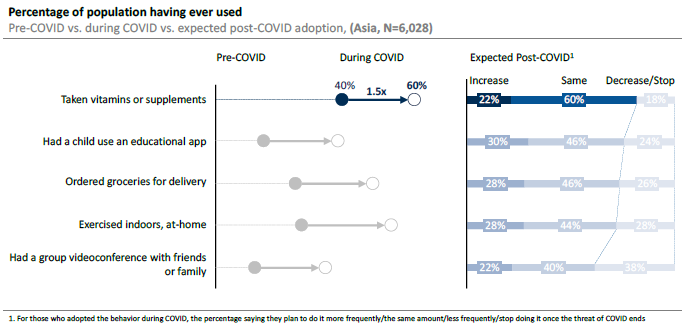
The pandemic appears to have accelerated the pursuit for healthier and better living, evident by an uptick in demand for better-for-you products, vitamins and supplements[3]. The global supplements market is estimated to be worth over $170 billion with the herbal sub-segment contributing $7.5 billion[4],[5]. The segment has grown on the back of heightened health and wellness considerations, enhanced expression of values in purchase behaviour and greater industry commercialisation. In developed countries, having saturated the margins of society, herbal and alternative medicines are now intertwined with more conventional Western practices. The ‘herbal influence’ is certainly visible in the fast-moving-consumer-goods (FMCG) industry, yet it is geared towards the premium end of the market. We believe this speaks to the idea that ‘herbal’ has, to some extent, become a heuristic cue for premium.
Vitamin and Supplement Consumption in Asia
We see a different picture in developing countries. In Asia specifically, we have witnessed more democratised consumption of herbal products and supplements as entrepreneurs, brand owners and even spiritual leaders have taken to formalising traditional remedies[6].
Source: L Catterton Asia Consumer Survey 2021
India is home to one of the best examples of this, with the modernisation and commercialisation of Ayurveda, an alternative medicine system, in everyday FMCG products[7]. Against the backdrop of rising Hindu nationalism and a democratisation of route-to-market accessibility, both local (Dabur, Himalaya, Emami, Marico and Patanjali) and multinational corporations (Nestle, Colgate, Unilever) have capitalised upon this structural trend. India has seen a culmination of factors, which together have propelled the segment to over $5 billion, with 76% of Indian households using Ayurvedic products for personal and health care needs[8]. COVID-19 has accelerated the growth of the Ayurvedic segment, not only for edible categories but also home and personal care items. India’s Health and Welfare Ministry even issued guidelines for recovering COVID-19 patients that included the consumption of Ayurvedic products.
Ayurvedic FMCG Products
Colgate is one of the many multinational brands that have capitalized on the growth in Indian alternative medicine market
In Indonesia, a market where we are invested, we have witnessed a similar trend. Increasingly consumers are allocating their marginal dollars to modern and branded versions of traditional remedies as well as products that more closely align with their religious and cultural identities.
Much like Ayurveda in India, Jamu is an ancient and indigenous form of care. It predicates that if ailments come from nature, their cure should too. Jamu comprises of a blend of tonics, ointments, oils and pills made from ginger, turmeric, tamarind, honey and other local spices found on the 17,000 island archipelago. Indonesians believe that these concoctions strengthen the immune system and serve as both a preventative and remedial solution to common illnesses. Historically, it was sold in traditional outlets, mainly by elder women (Jamu Gendong), sometimes in unhygienic conditions. According to the Ministry of Health, the Jamu industry is worth $2.7 billion and is consumed regularly by 49% of the 260 million population[9]. In contrast to Ayurveda however, Jamu has yet to benefit from the same global exposure, without a dedicated evangelist (see Baba Ramdev of Patanjali[10]) or full integration into mass market FMCG.
Conventional wisdom stipulates that Jamu is primarily consumed by elder generations, with younger, cosmopolitan consumers generally aspiring to international lifestyle products and wellness solutions[11]. What we have seen recently however, is a renewed interest in these traditional and herbal products as part of a longer-term trend. Jamu Cafes and Bars have emerged in Jakarta and there are dozens of companies that incorporate Jamu into both their edible and inedible products. The pandemic has also supported Jamu’s revived popularity amongst Indonesians[12]. President Joko ‘Jokowi’ Widodo publicised his morning Jamu routine and Dr. Chairul Anwar Nidom, Airlangga University, suggested drinking Jamu could boost immune systems. It seems as though global trends coupled with strong inherited tradition is leading to the growth of this budding industry.
Capitalising on the opportunity
One beneficiary of this herbal renaissance is our portfolio company, Sido Muncul (SIDO), a leading producer of herbal supplements in Indonesia. SIDO has built a business in modernizing a family recipe dating back to 1941; building a brand that now captures over 70% of its market. The company’s flagship product Tolak Angin is mainly used to treat ‘Masuk Angin’, a local ailment, but it is also taken to boost immunity[13]. Masuk Angin is not a medical term, but instead a colloquial term for the collective feeling of fever, chills, muscle ache and discomfort associated with the onset of what Westerners would call a cold. Its general applicability implies Tolak Angin is not limited to solving a single symptom, therefore use cases are plentiful.
The company is run by a professional team of third generation family members (who own 60%), complemented by seasoned executives in sales, distribution and finance. Regional Private Equity (PE) firm Affinity Partners took a stake in January 2018, and now hold 21% in the listed business. Affinity have supported management, whose natural strengths are in sourcing and production, by adding expertise in finance and logistics.
Sido Muncul Flagship Product – Tolak Angin
Source: Company
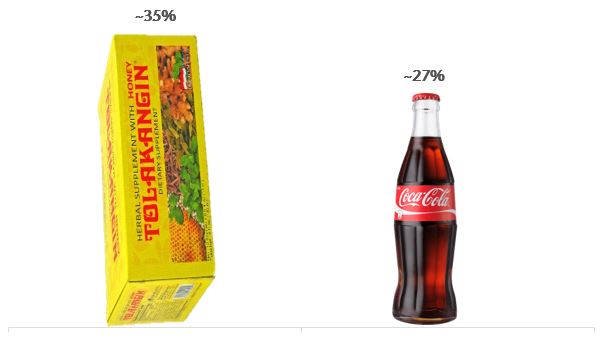
What is most striking (and attractive) about SIDO is the phenomenal margins it generates on Tolak Angin (+75% gross profit margins) which leads to a company level profitability profile that is far superior to even that of Coca Cola. Just like Coke, Tolak Angin has ultimate pricing power in its category and that is reflected in an approximate 20% premium on a per unit basis compared to its competitors. Unlike Coke, Tolak Angin does not have a strong second competitor and enjoys the benefits of being in a category that multinationals have found difficult to crack.
Operating Margin Comparison
Source: Bloomberg and Vergent analysis
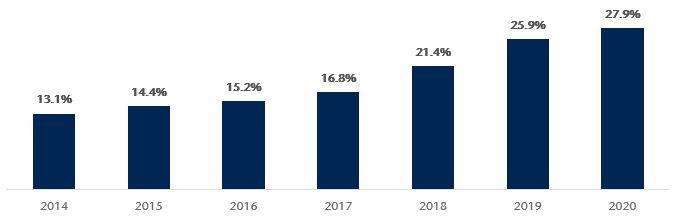
Return on invested capital more than doubled in the last six years as a result of SIDO scaling up manufacturing, optimising distribution, and making good capital allocation decisions. This has led to substantial free cash flow generation which management has been progressively paying out in dividends.
Return on Invested Capital (%)
Source: Vergent analysis
Despite the impressive revenue and profit margin performance to date, we see more growth for SIDO ahead. The company is now building on demand in the East of the country where per capita consumption is one quarter of that in Greater Jakarta. In addition, management have outlined an export strategy focused on the Philippines, Nigeria, Malaysia and Saudi Arabia where its products have an existing following. Building on the strength of the brand, the company is launching new higher value-added products through new formulations, formats and flavours. On the margins side, we see scope for further efficiency gains as factory utilisation improves, raw material pricing is standardised and the as innovation pipeline of high value products comes to market.
These materials (“Presentation”) are presented by Vergent Asset Management LLP <(“Vergent”)>. This Presentation is furnished on a confidential basis for informational and illustration purposes only. This Presentation is intended for the use of the recipient only and may not be reproduced or distributed to any other person, in whole or in part, without the prior written consent of Vergent.
Vergent Asset Management LLP is registered in England and Wales with its registered office address at 8th Floor, 1 Knightsbridge Green, London SW1X 7QA, United Kingdom (Companies House number OC418829) and is authorized and regulated by the Financial Conduct Authority (FRN: 791909).
This financial promotion is issued by Vergent Asset Management which is authorized and regulated by the Financial Conduct Authority (‘FCA’). Past performance is not indicative of future results. The value of your investment may go down as well as up and you may not receive upon redemption the full amount of your original investment.
THE PERFORMANCE PRESENTED HEREIN IS NOT INDICATIVE OF FUTURE RESULTS. The performance results contained herein are for informational purposes only, and are not meant to imply that Vergent’s trading programs will produce results similar to the performance results contained herein. There can be no assurance that Vergent or any account or product advised thereby will or is likely to achieve any results shown. There can be no assurance that such trading programs will make any profit at all or will be able to avoid incurring substantial losses. No representation is made that Vergent’s investment processes or investment objectives will or are likely to be successful or achieved.
Certain information contained in this Presentation is based on information obtained from third-party sources that Vergent considers to be reliable. However, Vergent makes no representation as to, and accepts no responsibility for, the accuracy, fairness or completeness of the information contained herein. The information is as of the date indicated and reflects present intention only. This information is subject to change at any time, and Vergent is under no obligation to provide you with any updates or amendments to this Presentation. The information contained in this Presentation is not complete and does not contain certain material information about the trading programs described herein, including important risk disclosures. Accordingly, this Presentation must be read in conjunction with, and is qualified in its entirety by, such other disclosure documentation as may be provided by Vergent from time to time in connection with a prospective investment. An investment in the strategy described herein may not be suitable for all clients, and before allocating any assets to the strategy or strategies, you should thoroughly review the terms and disclosures the strategy and consult with your professional advisor(s) to determine whether an investment in the strategy is suitable for you in light of your investment objectives and financial situation.
This Presentation may contain opinions pertaining to securities, financial products, transactions and investment strategies, and such opinions may differ from one to another. Any opinions, assumptions, assessments, statements, market commentary or the like (collectively, “Statements”) regarding past, current and/or future market conditions, themes, trends or events or which are forward-looking, including regarding portfolio characteristics and limits, constitute only subjective views, beliefs, outlooks, estimations or intentions of Vergent, should not be relied on, are subject to change due to a variety of factors, including fluctuating market conditions and economic factors, and involve inherent risks and uncertainties, both general and specific, many of which cannot be predicted or quantified and are beyond Vergent’s control. Future evidence and actual results could differ materially from those set forth in, contemplated by, or underlying these Statements, which are subject to change without notice. In light of these risks and uncertainties, there can be no assurance and no representation is given that these Statements are now, or will prove to be, accurate or complete in any way. Vergent undertakes no responsibility or obligation to revise or update such Statements. Statements expressed herein may not necessarily be shared by all personnel of Vergent. You acknowledge that you are capable of independently analyzing such Statements and the other information presented herein using your own expertise, due diligence and decision making, and you are solely responsible for any investment decisions made through your use of such Statements or other information and for any and all trading results achieved thereby, whether for your own account or on behalf of your clients.
This Presentation is not an offer to buy or sell, nor a solicitation of an offer to buy or sell any security or other financial instrument, or to invest assets in any account, advised by Vergent. An investment in any account advised by Vergent may be made only by qualified clients after receipt of formal investment management documentation and disclosures from Vergent, and only in those jurisdictions where permitted by law. Vergent’s investment strategies have management fees and operating expenses that would reduce returns to a client. Operating expenses include items such as custodial fees for segregated accounts and for pooled vehicles would also include charges for valuation, audit, tax and legal expenses. Such additional operating
expenses would reduce the actual returns experienced by investors in segregated accounts and pooled vehicles. Any client must be able to bear the risks involved in any potential investment and must meet the suitability requirements relating to its participation in the Trading Programs.
Financial indices are shown for illustrative purposes only, may not be available for direct investment, are unmanaged, assume reinvestment of income, do not reflect the impact of any management or incentive fees and have limitations when used for comparison or other purposes because they may have different volatility or other material characteristics (such as number and types of instruments) than the investment strategies described herein. Vergent’s investment strategies are not restricted to the instruments comprising any one index.
Vergent is not and does not purport to be an advisor as to legal, taxation, accounting, financial or regulatory matters in any jurisdiction. The recipient should independently evaluate and judge the matters referred to in this Presentation.
Net performance figures are stated after estimated management fees and transaction costs but before operating expenses. Operating expenses include items such as custodial fees for segregated accounts and for pooled vehicles would also include charges for valuation, audit, tax and legal expenses.
Third-party data providers
This report may contain information obtained from third parties including: Merrill Lynch, Pierce, Fenner & Smith Incorporated (BofAML), S&P Global Ratings, and MSCI.
Source: Merrill Lynch, Pierce, Fenner & Smith Incorporated (BofAML), used with permission. BofAML permits use of the BofAML indices related data on an “As Is” basis, makes no warranties regarding same, does not guarantee the suitability, quality, accuracy, timeliness, and/or completeness of the BofAML indices or any data included in, related to, or derived therefrom, assumes no liability in connection with the use of the foregoing, and does not sponsor, endorse, or recommend Vergent, or any of its products.
This may contain information obtained from third parties, including ratings from credit ratings agencies such as S&P Global Ratings. Reproduction and distribution of third party content in any form is prohibited except with the prior written permission of the related third party. Third party content providers do not guarantee the accuracy, completeness, timeliness or availability of any information, including ratings, and are not responsible for any errors or omissions (negligent orotherwise), regardless of the cause, or for the results obtained from the use of such content. THIRD PARTY CONTENT PROVIDERS GIVE NO EXPRESS OR IMPLIED WARRANTIES, INCLUDING, BUT NOT LIMITED TO, ANY WARRANTIES OF MERCHANTABILITY OR FITNESS FOR A PARTICULAR PURPOSE OR USE. THIRD PARTY CONTENT PROVIDERS SHALL NOT BE LIABLE FOR ANY DIRECT, INDIRECT, INCIDENTAL, EXEMPLARY, COMPENSATORY, PUNITIVE, SPECIAL OR CONSEQUENTIAL DAMAGES, COSTS, EXPENSES, LEGAL FEES, OR LOSSES (INCLUDING LOST INCOME OR PROFITS AND OPPORTUNITY COSTS OR LOSSES CAUSED BY NEGLIGENCE) IN CONNECTION WITH ANY USE OF THEIR CONTENT, INCLUDING RATINGS. Credit ratings are statements of opinions and are not statements of fact or recommendations to purchase, hold or sell securities. They do not address the suitability of securities or the suitability of securities for investment purposes, and should not be relied on as investment advice.
Source: MSCI. The MSCI information may only be used for your internal use, may not be reproduced or re-disseminated in any form and may not be used as a basis for or a component of any financial instruments or products or indices. MSCI makes no express or implied warranties or implied warranties or representations and shall have no liability whatsoever with respect to any MSCI data contained herein. This report is not approved, reviewed or produced by MSCI.
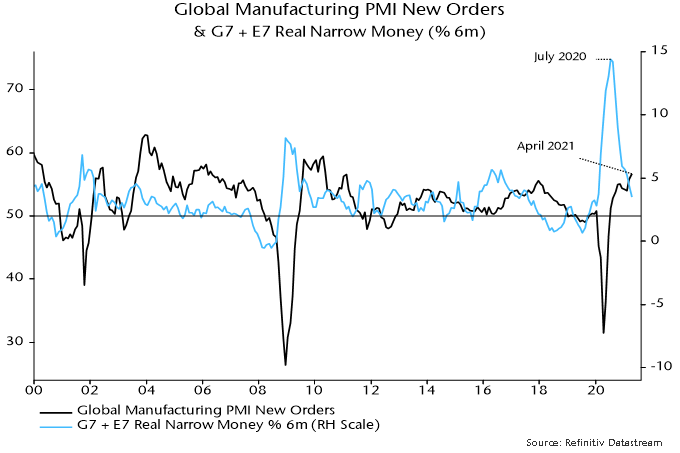
The forecast here remains that global industrial momentum, as measured by the manufacturing PMI new orders index, is at or close to a peak, with a multi-month decline in prospect.
The basis for the forecast is a fall in global six-month real narrow money growth from a peak in July 2020 – the rise into that peak is judged to correspond to the increase in PMI new orders to an 11-year high in April.
Available April monetary data indicate that real narrow money growth fell further last month, suggesting that the expected PMI decline will extend into late 2021 – see chart 1.
Chart 1
The presumption here is that PMI weakness will be modest, partly reflecting a view that the global stockbuilding cycle will remain in an upswing through H2. The cycle has averaged 3.5 years historically and bottomed in Q2 2020, suggesting a peak in Q1 2022 assuming an upswing of half-cycle length. Large declines in PMI new orders (i.e. to 50 or below) have usually occurred during cycle downswings.
Any PMI pull-back, however, could have significant market implications given consensus bullishness about global economic prospects.
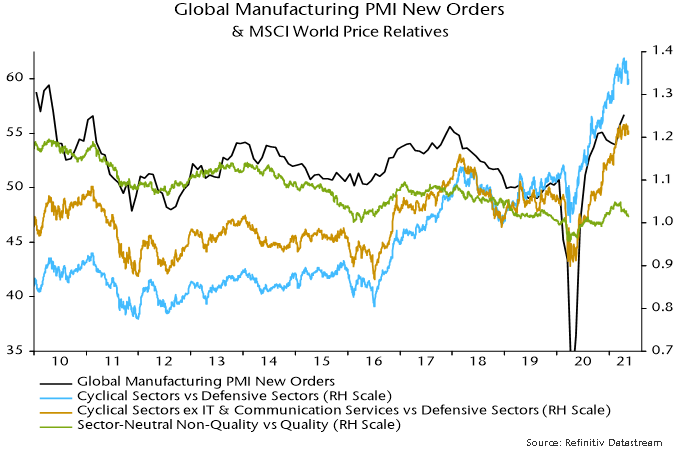
Historically, a declining trend in global manufacturing PMI new orders has been associated with underperformance of cyclical equity market sectors and outperformance of quality stocks within sectors. The price relative of MSCI World cyclical sectors to defensive sectors peaked in mid-April, falling to a three-month low last week – chart 2.
Chart 2
The decline has been driven by a correction in tech – the MSCI cyclical sectors basket includes IT and communication services. The price relative of non-tech cyclical sectors to defensive sectors has moved sideways since March.
The MSCI World sector-neutral quality index, meanwhile, has recovered relative to the non-quality portion of MSCI World since March, following underperformance in late 2020 / early 2021 when cyclical sectors were outperforming strongly.
Equity market behaviour, therefore, appears to have started to discount a PMI roll-over, although confirmation is required – in particular, a breakdown in the price relative of MSCI World non-tech cyclical sectors to defensive sectors.
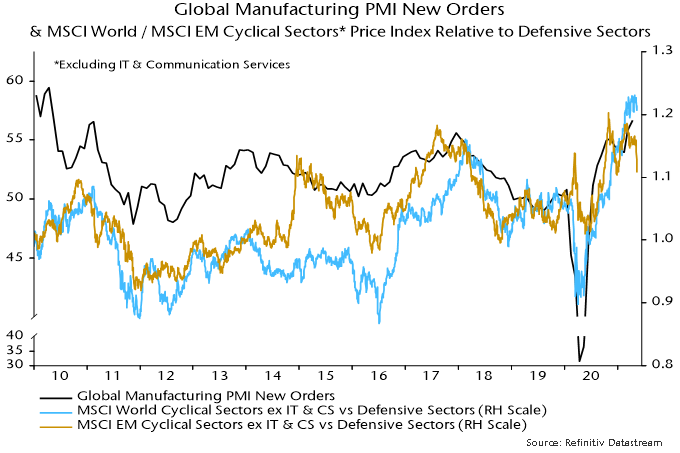
A sign that this could be imminent is a recent sharp fall in the non-tech cyclical to defensive sectors relative in emerging markets – chart 3. A possible interpretation is that the decline reflects worsening Chinese economic prospects, with China likely to be a key driver of a global slowdown. Early Chinese monetary policy easing may be required to mitigate this drag and lay the foundation for a resumption of cyclical outperformance.
Chart 3
Connor, Clark & Lunn Financial Group, one of Canada’s largest independent asset management firms, announced today the launch of the Connor, Clark & Lunn UCITS ICAV. The initial sub-funds include the CC&L Q Emerging Markets Equity UCITS Fund and the CC&L Q Global Equity Market Neutral UCITS Fund. The investment manager is Vancouver based Connor, Clark & Lunn Investment Management Ltd. (CC&L Investment Management), a team of 100 professionals who manage US$41.7 billion across a range of asset classes.
The CC&L Q Emerging Markets Equity UCITS Fund is an actively managed long-only equity strategy that targets long-term capital growth relative to emerging market equity indices.
The CC&L Q Global Equity Market Neutral UCITS Fund is an actively managed long/short equity strategy that seeks to generate returns that have a low correlation with global equity markets and to maximise long-term total return.
“We have successfully managed quantitative equity strategies for over two decades. Launching UCITS funds for our emerging markets and market neutral strategies allows these strategies to be available to European investors” said Martin Gerber, President & CIO of CC&L Investment Management.
The core of CC&L Investment Management’s investment philosophy is that equity prices are set by the growth, valuation and quality fundamentals of their companies over the long term. However, the market process by which prices accurately reflect these fundamentals is not perfect with a number of behavioral, informational and structural hurdles and frictions that can prevent stock prices from efficiently reflecting these fundamentals. This results in mispricings in the marketplace that offer opportunities to add value. These opportunities are evaluated using a systematic process that objectively assesses each company in relation to CC&L Investment Management’s entire global universe comprised of approximately 16,000 securities, 160 industry groups and 49 developed and emerging countries. The outcome of this daily process is an optimal portfolio that objectively and consistently invests in companies that will provide the best possible return while maintaining disciplined risk management.
“CC&L Investment Management’s experienced team and disciplined approach to investing provide the necessary foundation for success as they expand their product offering into Europe,” said Warren Stoddart, Co-CEO, Connor, Clark & Lunn Financial Group.
The Connor, Clark & Lunn UCITS ICAV is an Irish collective asset-management vehicle constituted as an umbrella fund with segregated liability among sub-funds and managed by Carne Global Fund Managers (Ireland) Limited. HSBC Global Fund Services is the administrator, registrar, depository, custodian and transfer agent; and Matheson acts as legal advisor as to Irish law.
For additional information on the sub-funds, click here to view the Prospectus, Supplements, and key investor information.
About Connor, Clark & Lunn Investment Management Ltd.
Connor, Clark & Lunn Investment Management Ltd. (CC&L Investment Management) is one of the largest independent partner-owned investment management firms in Canada with US$41.7 billion in assets under management. Founded in 1982, CC&L Investment Management offers a diverse array of investment services including equity, fixed income, balanced and alternative solutions including portable alpha, market neutral and absolute return strategies. CC&L Investment Management is a part of Connor, Clark & Lunn Financial Group Ltd.
About Connor, Clark & Lunn Financial Group Ltd.
Connor, Clark & Lunn Financial Group Ltd. (CC&L Financial Group) is a multi-boutique asset management firm that provides a broad range of investment management products and services to institutional investors, high net worth individuals and advisors. We bring significant scale and expertise to the delivery of non-investment management functions through the centralization of all operational and distribution functions, allowing our talented investment managers to focus on what they do best. With offices across Canada, and in Chicago and London, CC&L Financial Group’s affiliates manage over US$70 billion in assets. For more information, please visit www.cclgroup.com.
Contact
Carlos Stelin Director, Institutional Sales, Europe Connor, Clark & Lunn UK +44 (20) 3535 8107 [email protected]
This year has started on strong footing for global mergers and acquisitions (M&A). According to Refinitiv, global M&A hit a new record of $1.3 trillion as of March 31st, 2021.[1] What is driving this boom? On the news we have seen many big deals take shape, from GE divesting its business to Canadian Pacific expanding its footprint. But behind the headlines, something else is accelerating M&A activities, especially in the Unites States (US). We are talking about SPAC, which alone represent about 25% of the total deal volume in the US.
The first quarter of this year was also one of the busiest for IPOs, of which, once again, SPACs took the limelight. There were 296 SPACs raising $87 billion, a 20-fold increase over the same period last year.
First, a sponsor raises capital and incurs the cost of an IPO in a new shell company. To make the deal attractive to investors, the units are usually priced at $10 each and provide a warrant to buy more shares. The sponsor then has 12 to 24 months to find the target. If no target is found, or if the investors decide to vote “no” on the deal, the holders can redeem their investments.
We have seen this movie before
SPACs are in their third decade of existence. In the early 1990s, they were marketed as vehicles that helped small companies go public, while offering outsized favourable terms to their sponsors. In the late 90s, SPACs took a back seat. After all, why would a company do a reverse merger when you could easily raise money during the tech bubble? SPACs enjoyed a renaissance in late 2002, peaking at 66 IPOs just before the great financial crisis. They reappeared in early 2016, and have been going strong ever since. According to SPAC Analytics, in 2020, SPACs were 55% of IPOs, compared to 4% in 2013. So far this year, SPACs represent 79% of total IPOs.
SPACs versus a traditional IPO
SPACs are a pure genius way of going public. Since there is no identified target, a sponsor’s prospectus has no information about the business or the strategy. On the other hand, an IPO roadshow raises a lot of questions and invites a lot of scrutiny from investors.
In an IPO, there is no guarantee on the final valuation of the company. With a SPAC, the IPO has been done, and you have negotiated the valuation of your company with the sponsor. Plus the due diligence required for a merger is much less than SEC requirements for a regular IPO.
Cost could be another key factor. An IPO can cost anywhere between one to seven percent in fees for investment banks. With a SPAC, the underwriter may charge about five to six percent. However, there are other fees associated with the merger, which can end up being almost 20-25 percent of the total money the sponsor may raise.
Why are SPACs so popular?
A recent Wall Street Journal article counted 61 sports-related SPACs formed this year alone, compared to just five in 2019.[2] Athletes from Serena Williams, Stephen Curry, Naomi Osaka, Tony Hawk, Colin Kaepernick, and even Shaquille O’Neal, have shown interest in SPACs.
Everyone loves money, especially free money. SPAC founders and sponsors generally get about 20% of the shares of the SPAC as a fee for raising capital, finding the target, and, of course, giving it their brand name. Hedge Funds like it because they can use leverage to buy SPACs and also get preferential access to SPAC deals at the $10 share price. Everyone else has to wait and likely pay a higher price.
Most investors don’t read the annual reports of the companies they own, so they miss out on the fine print in the SPAC prospectus. For example, many are unaware of the lock-up period, which can be anywhere from six months to a year. Once the lock-up period is over, the floodgates open and add pressure to the stock price.
The clock is ticking?
SPACs don’t have time on their side because there is a limited window to close a deal. Targets are well aware of this restriction. They also know that a SPAC is required to spend at least 80% of its assets on a single deal. So the target always has the advantage. SPACs are paying a median price-to-sales ratio of 12.9, compared to 4.1 paid by other companies, according to 451 Research.[3]
SPAC-mania has been going on for a few years now, which means there is a lot of capital chasing deals, combined with ticking clock syndrome, which signals an inevitable decline in deal quality. We could easily see the SPAC bubble go bust once again.
How have SPACs performed historically?
A team of researchers analyzed completed mergers from January 2019 and June 2020, and found that SPACs lost 12% within the first six months, and dropped 35% on average after the first year. Bain & Co looked at 121 SPAC mergers from 2016 to 2020 and concluded that “more than 60% have lagged the S&P 500 since their merger dates, and 50% are trading down post-merger”. The other 40% are trading below the $10 IPO price.
At Global Alpha, we do not invest in SPACs. Our focus is on finding high-quality companies with defensible business models and strong balance sheets that should outperform the small-cap benchmark.
‘Utility: the state of being useful, profitable or beneficial’
Ask any respectable scientist or engineer how they achieved distinction, and they will likely tell you that they stood on the shoulders of giants. Such is the nature of their fields – you build upon the work of your predecessors. However, it would be a mistake to think that this is the only approach to development. Sometimes the best solutions come from scrapping the previous script, redefining the problem and standing on your own two feet.
Take the modern banking system as an example. While it has been tweaked and nudged into the digital age, the system is still – at its core – an iteration of a centuries old industry. If you look closely enough, not a lot has changed from the principles set out in the 15th century (and still employed to this day) by the Banca Monte dei Paschi di Siena. It is a rather extraordinary idea when you think about it, and one that stokes an interesting discussion internally when we ask ourselves what if we had the luxury of redesigning the system from scratch? Would we arrive at the same modern day setup? Would we see a need for a network of bank branches, for instance? Would utility bills and signatures be our preferred means of identity authorization?
In our view, it is a resounding no. But such is the consequence of an iterative process and a series of shortsighted ‘quick fixes’ that seldom appear shortsighted at the time (e.g. replacing cheques with debit cards); they assume a very different perspective when we take a step back. If we deconstruct ‘banking’ into the core utility on which it was designed – the store of wealth and the transfer of money – then it becomes apparent that the major providers of utility in most markets are no longer the banks. The value proposition is shifting from ‘where is the safest place to store my money’ to also include ‘what is the most seamless and cost effective way to transfer and manage my money’. The once dominant financial institutions are seeing their power eroded by technologically enabled disrupters, leveraging off mobile solutions, data and APIs.
Somewhat surprisingly, one of the best examples of this trend can be found in Kenya. It is rare that the markets in which we invest harbor a best in class operator – particularly in disruptive sectors, and in a global context – but mobile network operator, Safaricom, is one exception. Through their mobile money network, M-PESA, they have almost single handedly brought more than 30 million Kenyans into the digital payments age, in what has been one of the world’s greatest advances in financial inclusion1.
M-PESA, as the name suggests (M = ‘mobile’; PESA = ‘money’ in Swahili) was one of the earliest mobile money products in an industry that has since ballooned to include more than 1 billion people globally, of which more than 50% are located in Sub-Saharan Africa2. The idea is simple – a digital wallet that is linked to a mobile phone. There are no banks involved. No account numbers. No etching your name onto the back of a card. An individual’s e-wallet links directly to their SIM, meaning a phone number is all that is needed to send and receive money.
If you lived in Kenya in 2005 there was a 70% chance you didn’t have a bank account3. Today, as an adult in Kenya, there is almost 100% chance that you have an M-PESA account and have transferred money digitally to somebody else in Kenya. In 2019, the total value of transactions that ran through M-PESA was almost 15% higher than Kenya’s entire $96 billion GDP. That is a whopping 8 billion unique transactions, or more than 150 transactions per person. For context, in the same year Germany recorded less than 60 cashless transactions per person4. Money enters and exists the M-PESA ecosystem through a network of ‘agents’, which mainly comprises authorized dealers, but also includes retailers such as petrol stations, supermarkets and registered SMEs. There are over 200,000 of these agents – that is more than every bank branch, ATM, currency exchange and microfinance institution in Kenya combined5.
Source: World Bank; Vergent Asset Management LLP
Note that Safaricom changed the definition of M-PESA users in 2013 from ‘Total Number of Users’ to ‘Users that have used M-PESA at least once in the last 30 days’. Under the former definition, there are over 30m M-PESA users today.
The early signs of M-PESA’s infiltration – and to some extent, redefinition – of the banking system are clear. Consider M-Shwari, an application built on M-PESA through which consumers can apply for up to KES 50,000 (roughly USD $450) in short-term loans. When M-Shwari launched in November 2012, approximately 700,000 Kenyans had an outstanding personal loan. Just three months later, M-Shwari had signed up a staggering 2.9 million customers, which rose to 5 million by the end of the year and almost 10 million a year later6. For the bank that underwrites the loans – NCBA Bank – just under 50% of all loans disbursed in 2019 were through M-Shwari 7.
KCB Bank has enjoyed similar success. Just one year after launching KCB M-PESA, an almost identical short-term loan product, their customer base had more than doubled to 9 million people. That is one of the largest banks in East Africa, having taken 115 years to amass its first 4 million customers, taking just 12 months to add 5 million more8. It is quite remarkable to witness even the most established, multi-centurial banks such as KCB sliding down the value chain of their own industry.
As fundamental investors, we assess the strength of our companies through an array of qualitative and quantitative methods. Sometimes, however, it can be just as useful analysis to employ a far simpler framework. History has consistently proven (across both capitalist and socialist systems) the old adage that money is power. Less discussed, albeit a slight subtlety, is the opposite. Power is money – the idea that those with influence and control can lever their advantage in order to benefit financially. For some companies, we can gauge this power quantitatively by analyzing the take rate – the percentage commission charged per transaction. There are a number of factors that go into the take rate, but generally those with a stronger grip on their respective industries are able to demand a higher rate.
In this context, it is worth remembering that fundamentally, M-PESA is nothing more than a digital distributor. Consumers pay a small fee in return for the ability to distribute money to any other M-PESA user in Kenya. For financial products such as M-Shwari and KCB M-PESA, the underwriting banks pay for the privilege of distributing their products through M-PESA. The chart below compares the take rate that M-PESA earns on these financial products with some of the largest physical and digital distributors in the world. It is a surprising data point, but one which undeniably evidences the power that M-PESA holds over the Kenyan banking sector.
Source: Vergent Asset Management LLP
T-Mall includes fees for paying through AliPay. e-Bay is the blended rate for the US and international businesses. Kenya Banking Sector is calculated as the average yield for the last three years, adjusted for provisions for bad loans. Jiebei is an unsecured, consumer loan product. The rate given is on an annualized basis. Amazon is inclusive of 3P commissions, logistics fees and advertising fees.
What M-PESA has done for the financial development of Kenya has been nothing short of extraordinary. And what is most exciting is that we see this as just the start, the prelude to what is shaping up to be the most profound chapter of M-PESA’s story so far. As Ol’ Blue Eyes, Frank Sinatra, would say – “the best is yet to come”. M-PESA 2.0 will grow into its role as the core financial ecosystem in Kenya, and the global poster child for how technology and connectivity can expose the frailties of the modern banking system. We expect it will become much more than a convenient way to transfer money. Consumers will be able to pay for almost any good or service, settle bills and seamlessly send money from abroad; the government will collect taxes and pay public sector employees; banks will use it as their preferred channel to distribute credit, insurance and other financial products. Put another way, we believe M-PESA is on track to become the core provider of financial utility in Kenya.
We hasten to add that the next leg of M-PESA’s journey will not be all blue skies and rainbows. There will of course be storms ahead, as regulators and policy makers play catch up, and as the retail banking sector fights to stay relevant. Nevertheless, we are confident that M-PESA has what it takes to navigate these challenges successfully. Safaricom is, and has always been, our biggest bet. A company that from a small corner of Africa is spearheading one of the most powerful digital revolutions on the planet.
Vergent Asset Management April 8, 2021
1. Source: Safaricom, company accounts 2. Understanding why mobile money has been so disproportionately successful in Africa could be the subject of another paper entirely, and we will refrain from doing it an injustice by skimming over the details here. For the curious reader, we highlight what we think have been the three key ingredients: i) markets that have low banking penetration; ii) economies that are heavily reliant on cash; iii) populations that exhibit high rural density. 3. Source: GSMA Report, 2015 4. Source: Deutsche Bundesbank data 5. Source: CBK data 6. Source: FSD Kenya 7. Source: NCBA company accounts; Safaricom company accounts 8. Source: KCB company accounts
DISCLAIMER
These materials (“Presentation”) are presented by Vergent Asset Management LLP <(“Vergent”)>. This Presentation is furnished on a confidential basis for informational and illustration purposes only. This Presentation is intended for the use of the recipient only and may not be reproduced or distributed to any other person, in whole or in part, without the prior written consent of Vergent.
Vergent Asset Management LLP is registered in England and Wales with its registered office address at 8th Floor, 1 Knightsbridge Green, London SW1X 7QA, United Kingdom (Companies House number OC418829) and is authorized and regulated by the Financial Conduct Authority (FRN: 791909).
This financial promotion is issued by Vergent Asset Management which is authorized and regulated by the Financial Conduct Authority (‘FCA’). Past performance is not indicative of future results. The value of your investment may go down as well as up and you may not receive upon redemption the full amount of your original investment.
THE PERFORMANCE PRESENTED HEREIN IS NOT INDICATIVE OF FUTURE RESULTS. The performance results contained herein are for informational purposes only, and are not meant to imply that Vergent’s trading programs will produce results similar to the performance results contained herein. There can be no assurance that Vergent or any account or product advised thereby will or is likely to achieve any results shown. There can be no assurance that such trading programs will make any profit at all or will be able to avoid incurring substantial losses. No representation is made that Vergent’s investment processes or investment objectives will or are likely to be successful or achieved.
Certain information contained in this Presentation is based on information obtained from third-party sources that Vergent considers to be reliable. However, Vergent makes no representation as to, and accepts no responsibility for, the accuracy, fairness or completeness of the information contained herein. The information is as of the date indicated and reflects present intention only. This information is subject to change at any time, and Vergent is under no obligation to provide you with any updates or amendments to this Presentation. The information contained in this Presentation is not complete and does not contain certain material information about the trading programs described herein, including important risk disclosures. Accordingly, this Presentation must be read in conjunction with, and is qualified in its entirety by, such other disclosure documentation as may be provided by Vergent from time to time in connection with a prospective investment. An investment in the strategy described herein may not be suitable for all clients, and before allocating any assets to the strategy or strategies, you should thoroughly review the terms and disclosures the strategy and consult with your professional advisor(s) to determine whether an investment in the strategy is suitable for you in light of your investment objectives and financial situation.
This Presentation may contain opinions pertaining to securities, financial products, transactions and investment strategies, and such opinions may differ from one to another. Any opinions, assumptions, assessments, statements, market commentary or the like (collectively, “Statements”) regarding past, current and/or future market conditions, themes, trends or events or which are forward-looking, including regarding portfolio characteristics and limits, constitute only subjective views, beliefs, outlooks, estimations or intentions of Vergent, should not be relied on, are subject to change due to a variety of factors, including fluctuating market conditions and economic factors, and involve inherent risks and uncertainties, both general and specific, many of which cannot be predicted or quantified and are beyond Vergent’s control. Future evidence and actual results could differ materially from those set forth in, contemplated by, or underlying these Statements, which are subject to change without notice. In light of these risks and uncertainties, there can be no assurance and no representation is given that these Statements are now, or will prove to be, accurate or complete in any way. Vergent undertakes no responsibility or obligation to revise or update such Statements. Statements expressed herein may not necessarily be shared by all personnel of Vergent. You acknowledge that you are capable of independently analyzing such Statements and the other information presented herein using your own expertise, due diligence and decision making, and you are solely responsible for any investment decisions made through your use of such Statements or other information and for any and all trading results achieved thereby, whether for your own account or on behalf of your clients.
This Presentation is not an offer to buy or sell, nor a solicitation of an offer to buy or sell any security or other financial instrument, or to invest assets in any account, advised by Vergent. An investment in any account advised by Vergent may be made only by qualified clients after receipt of formal investment management documentation and disclosures from Vergent, and only in those jurisdictions where permitted by law. Vergent’s investment strategies have management fees and operating expenses that would reduce returns to a client. Operating expenses include items such as custodial fees for segregated accounts and for pooled vehicles would also include charges for valuation, audit, tax and legal expenses. Such additional operating expenses would reduce the actual returns experienced by investors in segregated accounts and pooled vehicles. Any client must be able to bear the risks involved in any potential investment and must meet the suitability requirements relating to its participation in the Trading Programs.
Financial indices are shown for illustrative purposes only, may not be available for direct investment, are unmanaged, assume reinvestment of income, do not reflect the impact of any management or incentive fees and have limitations when used for comparison or other purposes because they may have different volatility or other material characteristics (such as number and types of instruments) than the investment strategies described herein. Vergent’s investment strategies are not restricted to the instruments comprising any one index.
Vergent is not and does not purport to be an advisor as to legal, taxation, accounting, financial or regulatory matters in any jurisdiction. The recipient should independently evaluate and judge the matters referred to in this Presentation. Net performance figures are stated after estimated management fees and transaction costs but before operating expenses. Operating expenses include items such as custodial fees for segregated accounts and for pooled vehicles would also include charges for valuation, audit, tax and legal expenses.
Third-party data providers
This report may contain information obtained from third parties including: Merrill Lynch, Pierce, Fenner & Smith Incorporated (BofAML), S&P Global Ratings, and MSCI.
Source: Merrill Lynch, Pierce, Fenner & Smith Incorporated (BofAML), used with permission. BofAML permits use of the BofAML indices related data on an “As Is” basis, makes no warranties regarding same, does not guarantee the suitability, quality, accuracy, timeliness, and/or completeness of the BofAML indices or any data included in, related to, or derived therefrom, assumes no liability in connection with the use of the foregoing, and does not sponsor, endorse, or recommend Vergent, or any of its products.
This may contain information obtained from third parties, including ratings from credit ratings agencies such as S&P Global Ratings. Reproduction and distribution of third party content in any form is prohibited except with the prior written permission of the related third party. Third party content providers do not guarantee the accuracy, completeness, timeliness or availability of any information, including ratings, and are not responsible for any errors or omissions (negligent orotherwise), regardless of the cause, or for the results obtained from the use of such content. THIRD PARTY CONTENT PROVIDERS GIVE NO EXPRESS OR IMPLIED WARRANTIES, INCLUDING, BUT NOT LIMITED TO, ANY WARRANTIES OF MERCHANTABILITY OR FITNESS FOR A PARTICULAR PURPOSE OR USE. THIRD PARTY CONTENT PROVIDERS SHALL NOT BE LIABLE FOR ANY DIRECT, INDIRECT, INCIDENTAL, EXEMPLARY, COMPENSATORY, PUNITIVE, SPECIAL OR CONSEQUENTIAL DAMAGES, COSTS, EXPENSES, LEGAL FEES, OR LOSSES (INCLUDING LOST INCOME OR PROFITS AND OPPORTUNITY COSTS OR LOSSES CAUSED BY NEGLIGENCE) IN CONNECTION WITH ANY USE OF THEIR CONTENT, INCLUDING RATINGS. Credit ratings are statements of opinions and are not statements of fact or recommendations to purchase, hold or sell securities. They do not address the suitability of securities or the suitability of securities for investment purposes, and should not be relied on as investment advice.
Source: MSCI. The MSCI information may only be used for your internal use, may not be reproduced or re-disseminated in any form and may not be used as a basis for or a component of any financial instruments or products or indices. MSCI makes no express or implied warranties or implied warranties or representations and shall have no liability whatsoever with respect to any MSCI data contained herein. This report is not approved, reviewed or produced by MSCI.
The strategy continues to be focused on identifying transformational growth companies in the Frontier and smaller Emerging markets. Africa and Asia today represent ~90% of invested capital and the strategy owns or has previously owned companies in CEE, CIS, and the Middle East. Thematically, we’re primarily invested in the three following areas:
Financial inclusion and the development of the digital payments eco-system (i.e.: disruption of cash) via companies operating across a variety of sectors including in banks/microfinance, communications/media/mobile money, and software
Rising health and wellness awareness which we express through consumer health companies selling niche FMCG and healthcare providers offering medical services to their customers
The formalization of offline retail with a focus on the grocery and DIY category where our retailers have a large Omni-channel advantage over pure online competition as well as a scale and cost advantage over unorganized/traditional competition
Underpinning our confidence in these themes are the large addressable markets wherein our companies operate, the fragmented and weaker level of competition, and the quality of the management teams which run them (many of whom are also owners).
We highlight two such companies in this quarter’s letter.
MTN Ghana (MTNG) – the $1.8bn market cap company embodies the frontier equity story as well as any in our portfolio. MTNG is the leading telecom service provider in the West African nation of Ghana with over 24 million subscribers and a leading market share in voice (55%) and data (72%). However, what gets us excited about MTNG is “Momo”, the company’s mobile money business which is at the forefront of the digitalization of cash in the country. Similar to Mpesa in Kenya, Momo is already the winner in its market with a 98% share of all mobile money transactions and an active base of 10.2 million wallets in the country. Momo’s contribution to MTNG’s revenue has increased by ~350bps in the last two years to reach 21% in 2020. We see Momo’s growth coming from several areas including structural adoption of mobile money for peer-to-peer transfers as well as growth in value added use cases in the areas of remittances, loans and savings, and merchant services. Despite it being a $1bn+ revenue business with returns on invested capital of ~25% and an exciting fast growing fintech business, MTNG is not covered by the sell side community. This is perhaps because Ghana as a market is unclassified by MSCI and so is neither a frontier nor an emerging market by the index provider’s standards. On the buy side, many institutional investors will access MTNG via its parent company MTN Group out of South Africa, a sub-optimal way considering the multi-country operation of the parent co. This has presented us with a unique opportunity to directly own MTNG at ~5x price to earnings over the last two years. Even after a strong re-rating year-to-date, the stock is still trading below 7.5x trail 12m earnings with a dividend yield of +8%.
Unicharm Indonesia (UCID) – the $480m market cap company is the leading baby diaper and female sanitary brand in the country of ~250m people. Indonesia has one of the lowest penetration rates of baby diaper products in the world yet is expected to generate the second biggest growth in value terms in Asia Pacific after China. This is driven by demographics (over 4 million babies are born every year in Indonesia) and higher penetration rates driven by investments in innovation and distribution (UCID sells single diapers in certain retail channels to make the product affordable). UCID has nearly 47% of the baby diapers market in Indonesia which makes it almost 2x larger than its nearest competitor which puts it in a strong position to capture the growth in the market over the long term. UCID is also the market leader in sanitary female products and adult diapers which are high margin categories given competitive intensity is lower and premiumization opportunities larger (relative to baby diapers). While the top down opportunity is attractive, UCID has low operating margins compared to global peers. We attribute this mainly to the baby diaper category where consumers prioritize price over quality; consumers in Indonesia are predominantly price driven in their choices across most FMCG products and a high percentage of the target market (parents) still view baby diapers as a discretionary product. We do not foresee a change in consumer preferences in the near term in light of the impact that Covid-19 has inflicted on purchasing power. That being said, we are still expecting margins to trend upwards as the recent entry of Kimberly Clark via the acquisition of UCID’s main competitor Sofitex is likely to bring more pricing discipline to the market by way of lower promotional activity (note: the acquisition of Sofitex was done at 3x EV/Sales compared to 0.5x EV/Sales for UCID which on its own is an indication of the undervaluation present in the shares of UCID today). As the Indonesian economy reopens, we expect UCID’s general trade channel to also open up and offer another tailwind to margins over the next two years as the company earns a higher net price compared to the modern channel which is dominated by established mini market chains. We also see the development of the e-commerce channel as potentially positive for UCID’s margins as that targets a more affluent consumer base that buys more (volume) and better (quality). We’ve increased exposure to UCID over the last month having been encouraged by latest commentary from management on the competitive dynamics in the market following the entry of Kimberly Clark which we believe is a key catalyst for the thesis.
In conclusion:
The opportunity set for the strategy continues to be attractive despite the visible underperformance relative to emerging markets. A recent FT column by Simon Edelsten brought to light a phenomenon we’ve been talking about for some time: almost 2/3rd of the MSCI EM is in three countries (China, South Korea, and Taiwan) that have “emerged” if one judges by income levels, demographics, and market efficiency to paraphrase the article. In that light, we continue to see the frontier and emerging markets in which we specialize as a truer reflection of the classic emerging market story. Translating that opportunity to returns is still about selecting the right stocks for the long term and we believe our portfolio reflects that in its current composition.
Vergent Asset Management LLP
DISCLOSURES
1. Unless otherwise stated, all data is at March 31, 2021 and stated in US dollars (US$). Source: Connor, Clark & Lunn Financial Group, Thomson Reuters Datastream.
2. Performance history for the Vergent Emerging Opportunities Strategy is that of the Vergent Emerging Opportunities Composite. The Composite has an inception and creation date of August 2018.
3. Net performance figures are stated after management fees, estimated performance fees, trading expenses and before operating expenses. Operating expenses include items such as custodial fees for pooled vehicles and would also include charges for valuation, audit, tax and legal expenses. Such additional operating expenses would reduce the actual returns experienced by investors. Past performance of the strategy is no guarantee of future performance; Future returns are not guaranteed and a loss of capital may occur. For illustrative purposes, performance fee of 20% on added value over the hurdle rate of 6% plus the management fee of 1.25% have been assumed. Actual management fees charged to a particular account may vary.
4. There is no benchmark for the Vergent Emerging Opportunities Strategy because it has an absolute return objective
5. Standard Deviation measures the dispersion of monthly returns since the inception of the strategy.
Benchmarks and financial indices are shown for illustrative purposes only, are not available for direct investment, are unmanaged, assume reinvestment of income, do not reflect the impact of any management or incentive fees and have limitations when used for comparison or other purposes because they may have different volatility or other material characteristics (such as number and types of instruments) than the Strategy. The Strategy’s investments are not restricted to the instruments comprising any one index and do not in all cases correspond to the investments reflected in such indices.
These materials (“Presentation”) are furnished by Vergent Asset Management (“Vergent”) on a confidential basis for informational and illustration purposes only. This Presentation is intended for the use of the recipient only and may not be reproduced or distributed to any other person, in whole or in part, without the prior written consent of Vergent. Certain information contained in this Presentation is based on information obtained from third-party sources that Vergent considers to be reliable. However, Vergent makes no representation as to, and accepts no responsibility for, the accuracy, fairness or completeness of the information contained herein. The information is as of the date indicated and reflects present intention only. This information may be subject to change at any time, and Vergent is under no obligation to provide you with any updates or amendments to this Presentation. This Presentation is not an offer to buy or sell, nor a solicitation of an offer to buy or sell any security or other financial instrument advised by Vergent. This Presentation does not contain certain material information about the strategy, including important risk disclosures. An investment in the strategy is not suitable for all investors, and before making an investment in the strategy, you should consult with your professional advisor(s) to determine whether an investment in the strategy is suitable for you in light of your investment objectives and financial situation. Vergent does not purport to be an advisor as to legal, taxation, accounting, financial or regulatory matters in any jurisdiction, and the recipient should independently evaluate and judge the matters referred to in this Presentation. Vergent Asset Management LLP is registered in England and Wales with its registered office address at 8th Floor, 1 Knightsbridge Green, London SW1X 7QA, United Kingdom (Companies House number OC418829) and is authorized and is an Exempt Reporting Adviser in the USA. It is regulated by the Financial Conduct Authority (FRN: 791909).
Third-party data providers
This report may contain information obtained from third parties including: Merrill Lynch, Pierce, Fenner & Smith Incorporated (BofAML), S&P Global Ratings, and MSCI. Source: Merrill Lynch, Pierce, Fenner & Smith Incorporated (BofAML), used with permission. BofAML permits use of the BofAML indices related data on an “As Is” basis, makes no warranties regarding same, does not guarantee the suitability, quality, accuracy, timeliness, and/or completeness of the BofAML indices or any data included in, related to, or derived therefrom, assumes no liability in connection with the use of the foregoing, and does not sponsor, endorse, or recommend CC&L Canada, or any of its products. This may contain information obtained from third parties, including ratings from credit ratings agencies such as S&P Global Ratings. Reproduction and distribution of third party content in any form is prohibited except with the prior written permission of the related third party. Third party content providers do not guarantee the accuracy, completeness, timeliness or availability of any information, including ratings, and are not responsible for any errors or omissions (negligent or otherwise), regardless of the cause, or for the results obtained from the use of such content. THIRD PARTY CONTENT PROVIDERS GIVE NO EXPRESS OR IMPLIED WARRANTIES, INCLUDING, BUT NOT LIMITED TO, ANY WARRANTIES OF MERCHANTABILITY OR FITNESS FOR A PARTICULAR PURPOSE OR USE. THIRD PARTY CONTENT PROVIDERS SHALL NOT BE LIABLE FOR ANY DIRECT, INDIRECT, INCIDENTAL, EXEMPLARY, COMPENSATORY, PUNITIVE, SPECIAL OR CONSEQUENTIAL DAMAGES, COSTS, EXPENSES, LEGAL FEES, OR LOSSES (INCLUDING LOST INCOME OR PROFITS AND OPPORTUNITY COSTS OR LOSSES CAUSED BY NEGLIGENCE) IN CONNECTION WITH ANY USE OF THEIR CONTENT, INCLUDING RATINGS. Credit ratings are statements of opinions and are not statements of fact or recommendations to purchase, hold or sell securities. They do not address the suitability of securities or the suitability of securities for investment purposes, and should not be relied on as investment advice.
Source: MSCI. The MSCI information may only be used for your internal use, may not be reproduced or re-disseminated in any form and may not be used as a basis for or a component of any financial instruments or products or indices. MSCI makes no express or implied warranties or implied warranties or representations and shall have no liability whatsoever with respect to any MSCI data obtained herein. This report is not approved, reviewed or produced by MSCI.