Last week, our Emerging Markets (EM) team attended a fruitful Latin American (LatAm) conference in New York, hosted by BTG Pactual, the region’s leading investment bank. The event showcased a variety of promising investment ideas and featured rich discussions and robust participation. Hundreds of investors from around the world convened to meet with the c-suite executives and founders of about 200 companies, mainly from Mexico and Brazil.
Keynote speaker Stephen Schwarzman of Blackstone shared his view on the global geopolitical landscape and the current state of the US economy. He underscored the importance of constantly reinventing business models and taking risks in pioneering new products and services as a foundation for business durability.
Throughout the three-day conference, we conducted insightful meetings with 22 companies operating in the consumer, industrial, healthcare, financial, technology, energy, materials and real estate sectors providing a wide view of the LatAm economic landscape. In most of the conversations, we sensed cautious optimism, mainly driven by monetary easing and nearshoring trends. While most developed countries are grappling with inflation, many LatAm nations are in a disinflationary environment. Central banks in Chile, Brazil and Peru have already started cutting rates, with Colombia and Mexico expected to follow suit this year.
Nearshoring is a topic we’ve explored in previous writings, and it was a dominant theme among Mexican companies at the conference. Many see nearshoring-driven demand as structural and sustainable, providing ample growth opportunities across multiple sectors as global supply chains move to Mexico.
However, challenges do exist, such as infrastructural inadequacies, both industrial and residential (e.g., power and water availability, housing supply for labour), erratic political and regulatory climates, bureaucratic complexities and looming uncertainties around the upcoming elections in Mexico and the US. A possible spillover effect of “higher for longer rates” in the US also looms as a source of concern, potentially putting pressure on LatAm currencies amid the decoupling of monetary policies and eventual slowdown of the easing cycle in the region. Another area of concern is the ongoing tax reform in Brazil, well-known for its highly complicated tax system requiring nothing less than a PhD in law to properly understand all of its intricacies.
As for the top picks, we identified several promising opportunities that you might read about in our future commentaries, including:
Brazil’s largest operator of private oncology clinics and hospitals. The company leverages its strong brand and reputation, running a proven and scalable business model in a massive and dynamically growing market.
A fast-growing Brazilian athleisure brand enjoying strong brand awareness, a nimble operating model with great economics and ample white space for expansion.
The leading B2B online solutions provider to micro and small businesses, with a promising new product pipeline, well positioned for the digital transformation in Brazil with still low ecommerce penetration.
We also met with some of our LatAm holdings at the conference, including Odontoprev (ODPV3 BZ), which we initiated after our meeting with its management team at last year’s conference. Founded in 1987 by a group of dentists, Odontoprev is Brazil’s largest dental benefits provider, with over 8.4 million members and a cross-country network of 26,000 dentists. The company offers customized products to corporate customers and off-the-shelf products to SMEs and individuals, while leveraging its exclusive distribution network in a partnership with strategic shareholder, Bradesco. Its industry focus, well-established footprint, brand portfolio and proprietary dental tech infrastructure make it a standout among its peers. The company is run by a strong management team with a sound track record and rich industry expertise. Odontoprev has an asset-light business model and a low capex requirement with negative working capital generating high cashflow, resulting in a strong balance sheet in a net cash position. The company is a proven compounder with a 16% and 22% compound annual growth rate of revenue and net income, respectively, since its IPO in 2006.
The dynamics of EM, particularly in LatAm, are as layered as they are compelling. The investment choices we make today, be they cautious or bold, will have lasting implications.
Scheer, Rowlett & Associates Investment Management Limited (« SRA ») a le plaisir de vous informer de l’évolution de son personnel.
Lloyd Rowlett quittera son poste de président de Scheer Rowlett le 31 décembre 2023, dans le cadre du plan de succession à long terme qui a débuté il y a plus de 7 ans, et Ratul Kapur continuera d’exercer ses fonctions de président et de chef des placements de SRA (qui ont débuté le 1er janvier 2023).
« Nous avons fondé la société il y a 27 ans pour gérer l’argent de nos clients en appliquant une philosophie d’investissement axée sur la valeur, et lorsque je regarde en arrière, il est gratifiant de constater que nous sommes restés fidèles à cette approche tout au long de cette période et à travers une grande variété de conditions de marché. Nous avons fait de notre mieux pour que les clients qui nous ont fait confiance soient récompensés par les efforts de notre équipe talentueuse et engagée. Je suis très fier de la qualité des personnes que nous avons attirées dans l’entreprise et dont la mission sera de continuer à faire de leur mieux en utilisant le même processus d’investissement de valeur pour nos clients estimés après mon départ à la retraite. Je suis satisfait des rendements que nous avons enregistrés au cours des dernières années, Ratul ayant assumé une plus grande partie de mes tâches. Je suis également convaincu que, sous sa direction, l’équipe de SRA est très bien placée pour continuer à fournir de solides résultats à nos clients grâce à la même approche d’investissement axée sur la valeur que la société a utilisée depuis sa création », a déclaré Lloyd Rowlett.
La retraite de Lloyd est l’aboutissement d’un processus de planification de la relève soigneusement planifié ayant impliqué la transition progressive de ses responsabilités à Ratul Kapur. Ce dernier a rejoint l’entreprise en 2017, est devenu cogestionnaire en chef en 2020, cochef en 2021 et président et chef des placements le 1er janvier 2023.
« Au nom de toute l’équipe de SRA, nous tenons à remercier Lloyd pour son mentorat, ses conseils au fil des ans et à le féliciter pour sa carrière réussie en tant qu’investisseur. Nous le félicitons également pour avoir permis le succès à long terme de notre entreprise. En tant qu’investisseurs axés sur la valeur, nous demeurons enthousiastes en lien avec les perspectives des portefeuilles de nos clients et nous nous efforcerons d’être à la hauteur de l’exemple que Lloyd nous a donné en matière de discipline, d’engagement et de travail acharné. Nous souhaitons à John une retraite heureuse et en santé ». Ratul Kapur.
Sain Godil, ancienne lauréate d’une bourse d’études, et Global Alpha ont mis en place des bourses de 30 000 $ pour soutenir les étudiantes en finance à l’École de gestion John-Molson de l’Université Concordia, dans le but d’accroître la diversité dans le domaine de la finance et d’aider à éliminer les barrières liées au genre.
Peu importe que vous en ayez conscience ou non, les biais comportementaux et les influences peuvent mener à des réunions de comité et à des résultats inefficaces. Toutefois, le fait de connaître leur incidence peut non seulement contribuer à améliorer le processus décisionnel, mais aussi les rendements du portefeuille. Une combinaison de bons placements et d’un bon comportement est la recette pour obtenir des résultats optimaux.
Les pièges comportementaux peuvent prendre de nombreuses formes, comme le fait de ne pas mesurer pleinement la probabilité d’une occurrence ou d’avoir tendance à ancrer émotionnellement la prise en compte d’autres options à la situation actuelle. Le présent article traite de ces pièges ainsi que d’autres pièges courants.
Pièges
L’un des pièges courants est notre tendance à sous-estimer la probabilité d’une occurrence. Notre évaluation accorde souvent trop de poids aux résultats possibles, alors que nous devrions nous concentrer sur les résultats les plus probables. Un autre piège consiste à ne pas utiliser les enseignements tirés de nos expériences lorsque nous examinons les différentes options. En tirant parti de nos expériences, nous augmentons nos chances de prendre des décisions plus éclairées à l’avenir.
L’ancrage est une technique utilisée par un vendeur d’automobiles lorsque les prix affichés sur les voitures en montre sont beaucoup plus élevés que ce que l’acheteur finit par payer. Le prix affiché « ancre » les négociations pour le vendeur, mais donne à l’acheteur l’impression qu’il a fait une bonne affaire en payant moins que le prix affiché. L’ancrage est l’un des biais qui caractérisent la plupart des comités de placement lorsqu’ils réexaminent la répartition de l’actif. Les changements potentiels sont comparés à la répartition actuelle, ce qui peut rendre difficile, sur le plan émotif, de s’éloigner beaucoup de cette répartition. De plus, un tel attachement émotionnel peut ne pas être optimal pour atteindre les objectifs stratégiques.
La fatigue décisionnelle est un piège que la plupart d’entre nous connaissent, mais dont nous ne sommes pas toujours conscients. Elle survient lorsque le nombre de décisions prises dans une journée épuise notre détermination et que nous reportons des décisions, ou pire, en prenons de mauvaises. L’une des causes de cette fatigue est l’hypoglycémie, qui affecte notre énergie à prendre des décisions.
Quatre ennemis
Dans leur livre « Decisive »[1], Chip et Dan Heath désignent le cadrage serré, le biais de confirmation, l’émotion à court terme et l’excès de confiance comme les « quatre ennemis ». Vous devez prendre une décision, mais à cause d’un cadrage serré, vous passez à côté de certaines options. Le cadrage serré, c’est comme si un projecteur était braqué sur une partie de la scène et que tout ce qui pourrait être important se trouvait dans l’obscurité et n’était donc pas pris en compte.
Lorsque vous analysez différentes options, le biais de confirmation vous amène à collecter des renseignements qui vont dans le même sens que vos convictions. Accorder trop de poids à l’information qui confirme votre point de vue personnel et moins de poids à l’information qui contredit votre point de vue peut conduire à une mauvaise évaluation des risques associés à une décision.
Lorsque vous faites un choix, l’émotion à court terme peut vous pousser à prendre la mauvaise décision. Elle est particulièrement problématique lorsque nous devons prendre des décisions difficiles. Nos sentiments peuvent avoir une incidence défavorable sur la décision, car le cœur l’emporte sur la raison.
En prenant votre décision, vous pouvez avoir un excès de confiance dans le résultat futur. L’excès de confiance est un état d’esprit malheureux qui vous fait croire que vous connaissez l’avenir et qui sous-estime l’incertitude associée aux décisions.
Gérer les biais comportementaux
Les pièges comportementaux ne peuvent pas toujours être évités, mais nous pouvons les gérer.
Figure 1 : Gérer les pièges
Pièges comportementaux
Comment les gérer au mieux
Calculer les probabilités
Se concentrer sur les résultats probables
Appel à la mémoire
Se tenir prêt
Ancrage
Être ouvert aux façons de limiter
Fatigue décisionnelle
Le plus tôt est le mieux; examiner les points stratégiques en premier, prévoir des pauses et des collations
Lors de l’évaluation des options, il est important d’établir la probabilité des résultats et de concentrer vos efforts et votre énergie sur les résultats probables. Lorsqu’il récupère un souvenir, votre cerveau parcourt à nouveau les voies nerveuses créées lors de la formation du souvenir. La récupération d’informations contribue à renforcer notre mémoire, ce qui souligne l’importance de bien se préparer aux réunions pour profiter des expériences et des apprentissages passés.
Être conscient de l’existence de certains biais peut fortement aider à limiter leur influence. En ce qui concerne d’autres biais comme l’ancrage, il est important d’être ouvert aux façons de réduire les influences. Par exemple, lors de votre prochain examen de la répartition de l’actif, le fait de masquer les différentes répartitions peut vous aider à gérer le risque d’un attachement émotionnel à la répartition actuelle.
La meilleure façon de lutter contre la fatigue décisionnelle est de tenir les réunions tôt dans la journée afin d’optimiser la probabilité de prendre de bonnes décisions. S’il est impossible d’éviter d’avoir des réunions tard dans la journée, les premiers points à l’ordre du jour doivent être les plus importants, afin qu’ils soient traités lorsque les niveaux d’énergie sont élevés. Prévoir une collation pour recharger les niveaux d’énergie améliorera aussi le processus décisionnel.
Gérer les quatre ennemis
Ce processus peut permettre d’aborder chacun des quatre ennemis.
Figure 2 : Gérer les quatre ennemis
Quatre ennemis
Comment les gérer au mieux
Cadrage serré
Élargissez vos options
Biais de confirmation
Testez vos hypothèses dans un environnement réel
Émotion à court terme
Prenez de la distance
Excès de confiance
Préparez-vous à vous tromper
Élargir vos options peut mettre au jour des idées auxquelles vous n’aviez peut-être pas pensé et permet d’éviter un cadrage serré. Le concept consiste à éloigner par la pensée les projecteurs de la zone précédemment ciblée afin de découvrir des idées ou des options différentes. Par exemple, si votre comité est aux prises avec un défi particulier, communiquez avec un pair du secteur pour savoir comment il a relevé un défi semblable afin d’élargir votre point de vue.
Une approche à adopter face à un biais de confirmation consiste à tester vos hypothèses dans un environnement réel en demandant à quelqu’un de se faire l’avocat du diable pour instaurer une remise en question et des discussions constructives avant de prendre la décision.
Pour gérer l’émotion à court terme, pensez à mettre une certaine distance entre l’étude des options et la prise de décision. L’outil « 10/10/10 » mis au point par Suzy Welch, auteure spécialisée dans le monde des affaires, est une façon élégante de nous obliger à prendre de la distance lorsque nous évaluons des décisions. Imaginer comment nous nous sentirons dans 10 minutes, dans 10 mois et dans 10 ans peut nous aider à atténuer la portée émotionnelle d’une décision, car plus le délai est long, moins l’effet des influences émotionnelles est important.
En cas d’excès de confiance, vous devriez vous préparer à vous tromper, quel que soit votre degré de confiance. Comprendre que les choses pourraient ne pas se dérouler exactement comme prévu peut donner lieu à une prise de conscience importante lors de l’évaluation des options.
Prendre de meilleures décisions
Siéger à un comité de placement est un rôle qui nécessite de prendre de nombreuses décisions. Si vous ne pouvez pas contrôler le rendement des placements, vous pouvez gérer les effets négatifs potentiels des biais et des autres influences sur les décisions. Vous augmenterez ainsi vos chances d’atteindre vos objectifs à long terme.
1 Heath, Chip, et Dan Heath. Decisive:How to Make Better Choices in Life and Work. New York: Crown Business, 2013. Traduit en français en 2017 sous le titre « Comment faire les bons choix » aux éditions Clés des champs.
Abonnez-vous aux mises à jour
Japan has been quite cautious with pandemic control. Only on May 8, 2023 did the government downgrade COVID-19 to the same level as seasonal influenza. The country’s Q2 GDP grew 1.2% quarter-on quarter, outpacing market expectations, mainly driven by a rebound in exports and an increase in tourist arrivals. Japan boasts the world’s largest electronics industry and ranks third in automobile production. Real wages have turned positive for the first time in seven quarters and corporate appetite for investment was solid.
In September, two of our team members participated in investment conferences and conducted company visits in Japan. Business operations in the country are back to normal. Inbound tourism is visibly booming. Making a reservation at a restaurant is a must. In August, about 2.2 million foreign visitors travelled to Japan, representing 85.6% of the visitors seen in the same month in 2019.For context, about 32 million foreign tourists visited Japan in 2019 and spent a record high of ¥4.8 trillion.
Behind these short-term recovery signs, there are also indications of some long-term structural changes that lead us to believe that Japan is at inflection point and shifting from a deflationary to inflationary environment.
Japan inflation rate
These structural changes include:
Notable improvements in balance sheets. Historically, Japan’s prolonged deflation was triggered by the 1990s real estate bubble burst. This caused a credit crunch and a liquidity trap, essentially resulting in a balance sheet recession. Now, both property prices and corporate balance sheets have been on a consistent growth path.
The Yield Curve Control (YCC), having faced challenges, is likely to be phased out in the coming months. Introduced in 2016 by the Bank of Japan (BOJ) to combat deflation, YCC’s objective was to maintain low yields to stimulate consumer and business spending. This approach worked well when inflation was low because investors could enjoy the safe returns of government debt. But with inflation eroding those gains since the spring of 2022, investors have started to sell government bonds, pricing in the chance of a near-term rate hike. To maintain this framework, the BOJ intervened by buying bonds, to little avail. In December 2022, the BOJ doubled the band to allow the 10-year yield to move 0.5% above or below zero. Nevertheless, the 10-year Japanese Government Bond yield recently rose to 0.805%, a decade high. Many economists now expect the BOJ to discontinue the YCC within the next six months. We agree with this view and think the next logical step is for the BOJ to raise its short-term policy interest rate from -0.10% to 0%, given that inflation, largely attributed to wage growth, seems persistent.
Wages are on the rise again, a trend that should continue, driven by a severe long-term labour shortage. Japan may face a shortage of more than 11 million workers by 2040. Wage negotiations, particularly between major corporations and Rengo, also known as the Japanese Trade Union Confederation, are under close watch. The average wage hike was 3.58% in April 2023, the highest in three decades. For April 2024, the estimate is another hike of around 3%.
Japan’s stock market has recently reached a peak not seen in 30 years, with the Nikkei 225 Index up 19% year to date. Warren Buffett’s investment in five Japan-based trading companies provided a vote of confidence, indicating Berkshire might own as much as 9.9% of each of these companies. Many investors are attracted by cheap valuations, the return of inflation and a depreciated yen.
Early this year, the Tokyo Stock Exchange urged companies to boost their price-to-book (P/B) ratios. Half of the companies listed on the Tokyo Stock Exchange trade at a P/B ratio of below one, compared with just 3% of firms on the S&P 500 Index. As highlighted earlier, businesses now have solid balance sheets, positioning them to enhance shareholder returns. In the fiscal year 2023, the dividends and share buybacks of companies on the Nikkei 225 were at record levels.
Historically, Japanese small caps have outperformed large caps over the long term. However, since 2018, persistent macro uncertainties have swayed investors towards the relative stability of large caps.
Japanese small caps outperforming large caps (through Aug 2023)
Source: Nomura based on Nikkei
We believe Japanese small caps are poised to outperform, mainly due to three reasons.
Historically, small caps outperform during economy expansions thanks to their better growth potential.
Small caps are expected to have accelerated profit growth in the fiscal year 2024. As of October 6, 2023, the EPS of MSCI Japan Small Caps is expected to rise by 11.6% compared to the 6.5% growth expected for its large peers.
Small-cap valuations are nearing historic lows compared to large caps, the biggest discount in 11 years.
Source: Nomura, based on Toyo Keizai.
You may be curious about the impact of rising interest rates on our portfolio. Reassuringly, half of our Japan-based holdings are in a net cash position and the remainder carry low debt. A strong balance sheet has consistently been a key factor in our stock selection process. What’s more, to benefit from rising interest rates, this year we initiated a position in Concordia Financial Group (7189 JP), Japan’s third-largest regional bank, because we believe its growth will accelerate in a rising interest rate environment.
Amid Japan’s profound economic changes, we remain vigilant and adaptive, constantly refining our strategies and insights to help ensure that we navigate this evolving landscape in the best interests of our investors.
Following my trip to China in May 2023 and my recent commentary from June, I believe it is important to continue to share our thoughts on China, especially in light of recent disappointing economic developments and the new policy measures aimed at addressing its slowing economy.
Have we reached peak pessimism about China?
The real estate sector, along with its related industries, accounts for 20% to 30% of China’s GDP and has failed to rebound as expected. From January to July, real estate investment fell 8.5% year-on-year. Residential building areas deceased by 7.1% and total new construction areas declined by a quarter according to the National Bureau of Statistics.
China’s government has announced a slew of measures in the past few months to stimulate the sector, including:
Fiscal incentives: The Ministry of Finance on Aug. 18 extended personal income tax rebates for households upgrading their apartment until the end of 2025.
Mortgage easing: Banks no longer exclude those who have a repaid a mortgage from qualifying as first-time buyers if they don’t currently own a property. Big cities including Guangzhou and Shenzhen adopted this policy on Aug. 30.
Home-loan cuts: Starting Sept. 25, first-time homebuyers can renegotiate their mortgage interest rates, as announced by the central bank on Aug. 31.
Downpayment reductions: On Aug. 31, Beijing lowered the minimum downpayment ratio across the country to 20% for first-time homebuyers and 30% for second purchases.
Urban renewal: The State Council announced redevelopment support for older villages within mega cities. Metropolises including Shanghai and Guangzhou are following up.
Other measures: These include a nationwide cap on real estate commissions, allowing private equity funds to raise capital for residential property developments, pledging ¥200 billion (CDN$28 billion) in special loans to complete stalled housing projects and extending some of the 16-point plan to address liquidity issues in the sector.
We should soon find out if these measures prove adequate. The Mid-Autumn Festival from Sept. 29-30 followed by a week-long holiday from Oct. 1-6 for National Day is traditionally the busiest period of the year for real estate sales. But what if the bubble continues to deflate? Could it lead to a collapse contained within China or a long stagnation like Japan experienced? Or to something more globally damaging similar to the Great Financial Crisis of 2008?
Will China crash?
Contrary to these fears, we do not see a huge financial crisis in China. The country is a major creditor, most of its debts are in its own currency and the government controls all of the key banks.
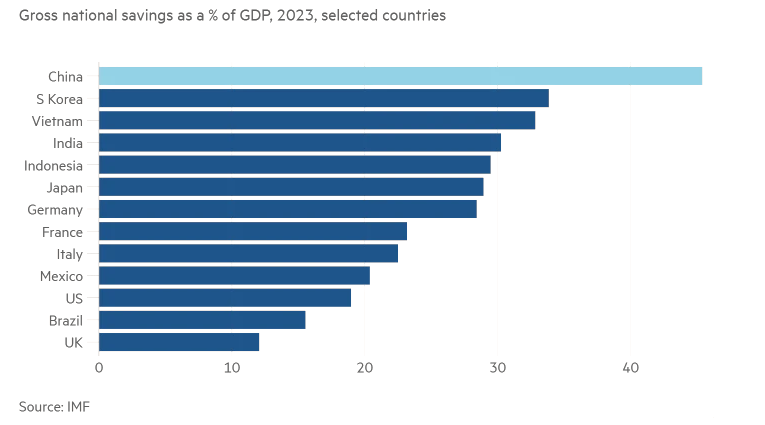
The current risk is the elevated savings rate, which could weaken demand.
Is China’s economic situation a repeat of Japan in the early 90s?
China today and Japan 30 years ago share many similarities: high debt levels, an aging population and a property bubble pop after years of growth. But China’s asset bubbles are comparatively smaller. And, in some cases, one could argue that the US also is in bubble territory. The following table is quite telling:
China
US
Japan (1990 peak)
Property value/GDP
260%
180%
560%
Stock market/GDP
65%
151%
142%
Urbanization rate
65%
83%
77%
Debt/GDP
95%
122%
62%
Source: World Bank and IMF.
Is it all bad? Can China bounce back?
China’s economy was supposed to drive a third of global economic growth this year. Its recent slowdown is sounding alarm bells across the world. According to an International Monetary Fund analysis, when China’s growth rate rises by 1 percentage point, global expansion is boosted by about 0.3 percentage points. Asian economies, along with African countries have been most affected by diminished trade. For example, Japan reported its first drop in exports in more than two years in July after China cut back on purchases of cars and semiconductors. Central bankers from South Korea and Thailand last week cited China’s weak recovery as a reason for downgrading their growth forecasts. The value of Chinese imports has fallen for nine of the last 10 months as demand retreats from the record highs set during the pandemic. The value of shipments from Africa, Asia and North America were all lower in July than a year ago. But is the situation as dire as appears? Some indicators seem to tell a different story.
The price of oil is approaching $100. According to a September report by OPEC, global crude oil demand is expected to reach a record 102.06 million barrels per day in 2023, up 2% from 2022. Demand in China, the world’s second-largest crude oil consumer, is projected to grow by 6% to 15.82 million barrels, an upward revision of 50,000 barrels from August. Official customs data shows that China’s crude oil imports in August reached 52.8 million tons, up 21% from the previous month. This translates to a 31% year-on-year increase and a 25% rise over pre-pandemic levels in August 2019. With overseas travel from China still not back to pre-pandemic levels, further growth in demand for crude oil and petroleum products could be expected as noted by Dominic Schnider, UBS’s head of commodities and Asia-Pacific currency markets.
In terms of metals, China’s refined copper consumption was the second-strongest year to date in August, a month when demand would typically weaken due to hot weather. This was reflected in a 36.6% increase month over month in China’s copper concentrate imports in August.
China’s aluminium imports jumped 38.9% in August from a year earlier, customs data shows. Imports of bauxite, a key raw material for aluminium, totaled 11.63 million tons last month, up 9% from the year prior. Bauxite imports in the first eight months of the year, at 96.62 million metric tons, were up 11.8% from a year earlier.
In our last commentary on China, we highlighted how it is trying to transition its economy away from real estate, infrastructure and exports to a more sustainable model led by domestic consumption, services and tourism. There is a lot of potential to unleash tremendous growth if Chinese consumers decide to increase their spending.
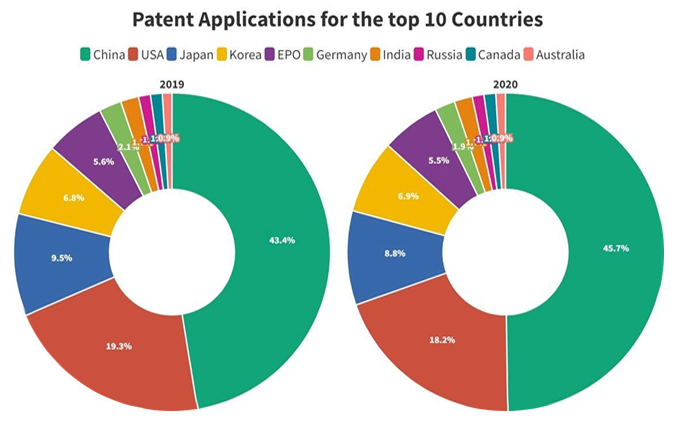
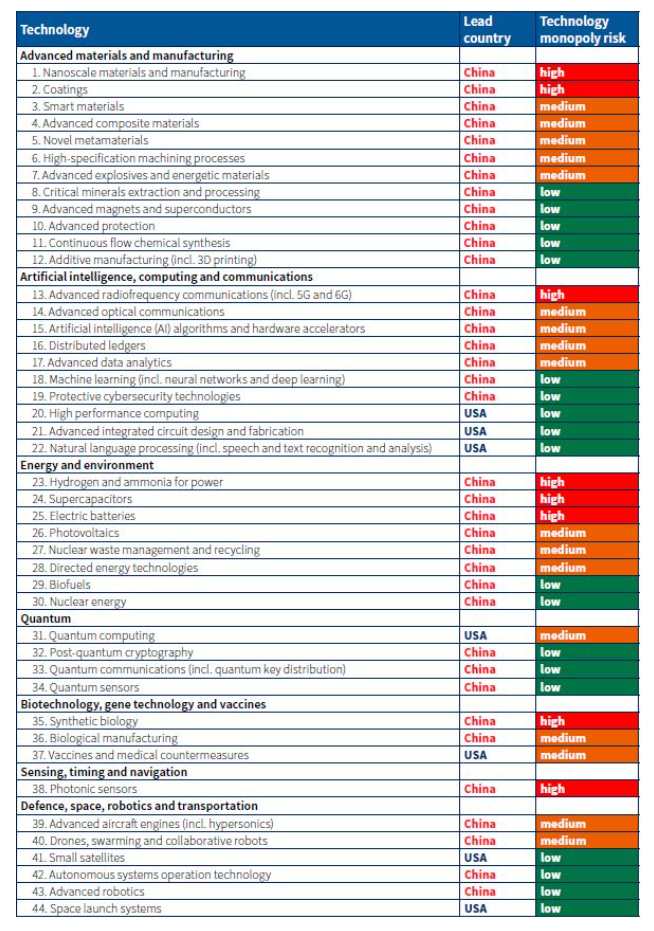
A study by the Australian Strategic Institute earlier this year showed that China leads in 37 of 44 tech fields, ranging from AI to robotics. China graduates 1.4 million engineers each year and leads the world in patent applications.
Source: World Economic Forum.
Technology fields and leading countries
Source: Australian Strategic Institute.
So, while there is a case for optimism, what if relations between China and its trading partners continue to deteriorate. What if trade barriers go up?
Who could replace China as a global economic engine?
Policymakers in the West may view a China slump as a geopolitical respite, but it raises a significant question: what are the global repercussions if China’s economy were to permanently stagnate?
According to World Bank data, China GDP grew by 263% between 2008 and 2021, while global growth was only 30%. China accounted for more than 40% of global growth during that period. Although some experts have pointed to India as a possible successor, it’s not a given. India’s manufacturing sector has contracted in recent years and private investment accounts for a smaller share of GDP than it did a decade ago.
Could this signal the end of global economic growth?
Global growth by period
1962-1973
5.4%
1977-1988
3.3%
1991-2000
3.0%
2009-2023
65%
Source: Capital Economics
We do not think the China growth story is over and believe the China pessimism is too extreme.
Summary
EM equities were down through the month, with Chinese equities continuing to drag.
Foreign investors dumped over US$3 billion of Chinese stocks through the month, despite better-than-expected retail sales figures (up 4.6% year on year) and industrial production numbers (up 4.5% year on year) for August.
Manufacturing PMIs also ticked up to 49.7 from 49.3 (above 50 points signals expansion).
New issues from Chinese banks also surged, beating expectations.
Industrials, staples and communications names in India outperformed wider EM, as did AI-linked semiconductor names in Taiwan and Korea.
Don’t look down
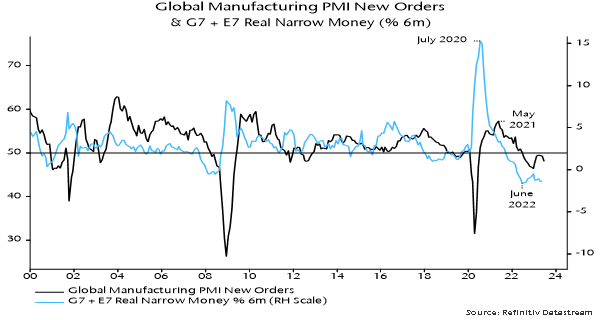
Is this the Wile E. Coyote over the canyon moment for markets? The delayed impact of vertiginous rate hikes across DMs on all maturing debt is now hitting consumption and investment. Yet central banks continue to talk tough and market pundits fret over the implications of “higher for longer rates.” It certainly feels like we are in a critical juncture for markets and the economy. Resilience of assets outside of fixed income appear out of step with the reality of higher rates and a weakening global economy, as illustrated by global PMIs falling for a fourth consecutive month.
Poor money numbers globally suggest that further economic contraction is likely. Despite this, central banks continue to talk tough on rates and many investors cling to hopes of a no landing/immaculate disinflation scenario unfolding, despite the cracks emerging in the global economy.
Echoes of the GFC
Some market commentators are comparing the complacency in markets to the 2006-7 period where investors bought into the idea of a soft landing, just as the lagged effect of excessive interest rate hikes began to roll through the economy.
JP Morgan’s Marko Kolanovic was quoted in the UK’s Financial Times noting the magnitude of change in interest rates in this cycle is around 5x the increase over 2002-2008 (FT Alphaville: Is it good when Wall Street compares today to 2007?). Kolanovic also pulled archive strategy commentary from 2007 which speaks to some of the risks markets face today:
“The economy provides compelling evidence that it is more resilient than many had earlier believed. … [R]enewed momentum is confirmed as economic data over the balance of December 2006 and January 2007 show an economy shaking off the effects of higher interest rates and high commodity prices. Market participants give up the ghost on their hopes for easings, accept that the Fed has engineered a soft landing, and buy (literally) into the view that a Goldilocks economy is in the making. Economic growth is solid at around 3% and led by a reinvigorated consumer; the residential housing sector slowly stabilises; corporate earnings growth moderates but doesn’t collapse; and inflationary pressures ease off but do not dissipate. Risky assets trade at full valuations and remain in a narrow, low vol range. We’ll call this the “head fake” phase — everything feels too good to be true because it is. In case you didn’t notice, this is where we are right now.”
As the article notes, history tends to rhyme rather than repeat and the availability heuristic of taking short cuts through sketchy historical analogies to explain the situation today can lead investors astray.
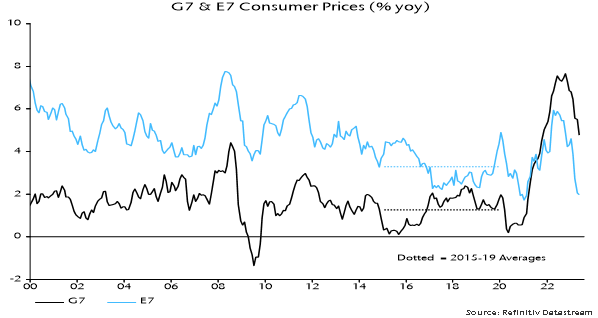
Indeed, the 1970s were a far from perfect comparison to post-pandemic inflation – we were flagging last year that a crash in broad money numbers would see inflation rattle back and even undershoot in 2024 (see chart below). This forecast remains on track despite the anxiety over rising energy prices. In contrast, broad money (our primary leading indicator for inflation) remained persistently high in the 70s.
In the pre-GFC era, central banks were signalling their commitment to keeping inflation in check while acknowledging that stresses in the system were starting to materialise. Talking tough today about “higher for longer” rate settings looks to us like the equal and opposite error to the excessively loose policy coming out of COVID lockdowns.
We question the widely held assumption that the global economy can muddle through without any shift in monetary policy in the months ahead. Our best bet is that global economic growth is likely to surprise to the downside in the next 3-6 months.
Green shoots
However, there is a silver lining. Unlike in 2007, most of the debt resides with governments and central banks rather than corporates and households. Price insensitive authorities can “extend and pretend”, socialising losses and thus providing some cushion to the impact of rate hikes. It may suggest why rapid rate increases haven’t yet bitten as hard as we initially expected.
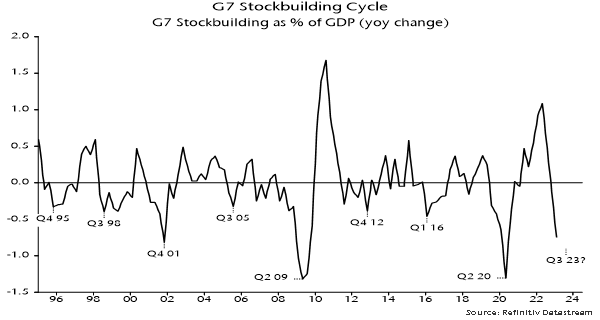
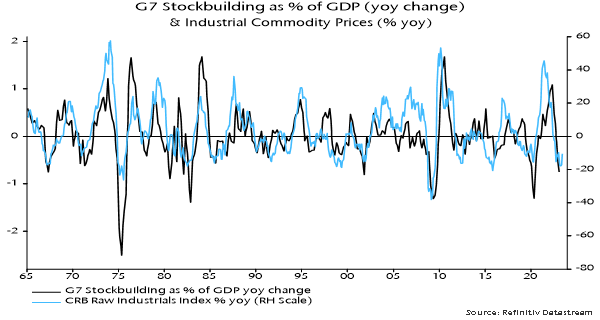
Another positive trend (particularly for EM) is a likely bottoming in the global stock building cycle.
Excessively high inventories in industries from semiconductors to apparel have been in a clean out phase amid weaker consumer demand, which in turn puts downward pressure on commodities prices.
Emerging markets provide the bulk of these goods and commodities, and will therefore benefit from a bottoming out of this downcycle in the next few months.
In Taiwan and Korea, we have seen semiconductor names rallying on reports that the sharp post-COVID inventory destocking cycle is approaching its end, and boosted by demand for high performance chips that power AI. In apparel, Nike recently reported a US$9 billion decline in inventories (down -10% year on year). Nike has up until now been forced to rely on discounts and promotions to clear inventory amid a period of subdued demand and higher competition from rivals like Adidas. Nike will now start to restock with new lines to be sold at higher prices, boosting profitability. Competitors are likely to follow suit, which collectively will boost EM companies that dominate the apparel supply chain.
The long term picture is bright for EM
While the near-term risks brought about by a global slowdown underpin our cautious positioning, there are compelling reasons to expect EM to outperform DM on the other side of this slowdown. Low inflation and higher rates in EM will open the door to rate cuts, while valuations and earnings are supportive. China looks oversold and could rally on more meaningful stimulus. Growth elsewhere, in Southeast Asia and countries like India, look set to outstrip their developed counterparts. As inflation continues to fall and the tightening cycle ends, global money numbers can revert into positive territory. This will be the key ingredient for an emerging market resurgence, as excess liquidity will flow to the superior fundamentals on offer in EM.
La Fondation CC&L est heureuse d’annoncer une contribution à la Société canadienne du sang, qui témoigne de son engagement envers la collectivité et qui a une incidence positive. En raison du succès de notre campagne de collecte de sang en août, nous tenons à remercier les participants qui ont appuyé cette importante initiative, menée par l’un de nos employés, Mohammad Shakeri.
Mohammad Shakeri est spécialiste au sein de l’équipe des opérations stratégiques du Groupe financier Connor, Clark & Lunn à Vancouver. Le don de sang est très important pour lui. Il en donne depuis dix ans et, comme plus de la moitié des Canadiens, ses proches et sa famille ont reçu des transfusions de sang dans le passé. Mohammad a fait la promotion de la collaboration dans le cadre de Partenaires pour la vie entre la Fondation CC&L et la Société canadienne du sang, en sensibilisant à ce service qui peut toucher tant de gens. Il s’agissait de la première activité de don de sang à CC&L au cours des dernières années et cette participation renforce notre engagement à l’échelle de l’entreprise à redonner aux collectivités dans lesquelles nous vivons et travaillons.
En bref
Chaque don de sang peut sauver jusqu’à trois vies.
Il faut parfois plusieurs donneurs pour sauver la vie d’un patient.
Comme chaque don de sang prend moins de 30 minutes, c’est un excellent investissement.
La demande de sang et de produits sanguins est constante. Nous vous encourageons à relever votre manche pour faire un don de sang en tout temps. Nous sommes participants actifs au programme Partenaires pour la vie et notre collaboration avec la Société canadienne du sang renforce notre engagement envers le soutien communautaire.
Regulatory risk is nothing new to investors, but it has gained prominence in the current geopolitical climate. Companies globally, especially those with operations or manufacturing facilities in China, are closely monitoring actions their government might take to undermine diplomatic relations. In the banking sector, the situation with SVB has led analysts to expect stricter regulatory frameworks for regional banks. Additionally, the ongoing Hollywood strikes have spotlighted AI as a contentious issue; actors are advocating for regulations that restrict studios from using their likeness for AI-generated content. And the list goes on.
In the 1990s and early 2000s, a laissez-faire attitude prevailed in developed countries, particularly in the US. It was the proof that the capitalist business model was sustainable, a perception supported by the slow pace of regulation during the quickly developing dotcom bubble and the pre-financial crisis housing market. In a hegemonic global environment, smaller nations found few reasons not to strategically align themselves with dominant powers, leading to accelerated deregulation in many developed countries. However, this framework began to shift as the US-led global world order faced challenges from competing political and economic ideologies.
Enter the cycle of protectionism. The consequences of protectionism are well-documented: higher prices due to lack of competition, which leads to persistent inflation; weaker economic growth since international trade isn’t fully offset by domestic consumption, and a more fragile labour market as a result. When various stakeholders voice their discontent with a worsening economic environment, democratic governments often respond by enacting policies, introducing regulations or applying other short-term solutions in an attempt to alleviate the problems they created. These often penalize high-performing industries or companies and may involve levying taxes or setting price ceilings. Such changes catch both company management and shareholders off-guard.
Our clients know that Global Alpha uses a bottom-up approach to stock picking. However, our team also recognizes the increasing need in being risk aware about changes in regulatory frameworks, both at the industry and company levels.
A striking example occurred around this time last year with one of our holdings, Norway Royal Salmon (NRS). The Norwegian government unexpectedly announced a 40% tax rate on resources, which included salmon. Although the company had a solid business model and shareholder satisfaction was high, the stock dropped over 20% in a day, making it one of our worst performers for that quarter. Nevertheless, it was widely understood that NRS was set to merge with one of its competitors, Salmar. We believed this merger would provide for shareholders as it would create one of the largest players worldwide in fish farming and significant advantages, especially given that the larger entity could more effectively adapt to this new tax than smaller competitors. As of March 2023, the Norwegian government lowered its proposed tax rate to 35% to facilitate legislative approval, and we remain happy shareholders of Salmar.
Another recent case involves CVS Group (CVSG LN), a UK-based integrated provider of veterinary care. In early September, the UK Competition and Markets Authority (CMA) announced its review of competitiveness in the veterinary sector, causing CVSG stock to drop more than 25%. Investors immediately assumed that CVS, as the largest player in the space, would be the review’s primary focus. However, our analysis suggests these concerns may be exaggerated. Reviews by the CMA do not always lead to material industry impacts, as shown by its review of UK grocers earlier this year. Furthermore, while CVS has been a major player in consolidating the UK veterinary industry, it has not led to unreasonable price hikes. Average increases for CVS products and services hover around 3% net, which is unlikely to be seen as an outlier. There are minor areas, like lack of transparency in cross-selling and customer awareness regarding chain ownership, where CVS might face some hurdles, but we do not anticipate a substantial impact on the business model.
Lastly, it is worth noting that regulatory and policy shifts can provide positive effects. The waste management industry is expected to benefit as recycling becomes increasingly crucial in creating more sustainable societies. Our portfolios include waste management companies like Casella Waste (CWST US) and Renewi (RWI LN). We expect that new recycling requirements across various commodities will improve margins in what has historically been a low-margin industry.
While no one on Global Alpha’s investment team is a policy expert, our job requires us to consider two important angles: the potential threats to a business model arising from policy shifts, and the actual impact on our investment thesis when a regulatory change happens. One reason for our cautious stance on AI investment opportunities is the level of uncertainty regarding when and how governments will implement regulations. Salmon farming and veterinary care may not capture the public imagination like AI does, but we are confident in our ability to navigate regulatory risks in these industries more successfully.
Une occasion de favoriser les avantages mutuels et de soutenir le développement durable
Cet article a été initialement publié dans le numéro 33 du Journal of Aboriginal Management (JAM), dans le thème Infrastructures : Bâtir un avenir meilleur.
À PROPOS DE L’AUTEUR
Peter Muldowney Chef, Stratégie institutionnelle à catégories d’actifs multiples, au sein du Groupe financier Connor, Clark & Lunn
Peter Muldowney est chef, Stratégie institutionnelle à catégories d’actifs multiples, au sein du Groupe financier Connor, Clark & Lunn, et il dirige l’initiative Échange stratégique du cabinet. M. Muldowney possède plus de 20 ans d’expérience dans les placements au Canada, aux États-Unis et au Royaume-Uni. Avant de se joindre au cabinet en 2011, il a commencé sa carrière comme consultant, dirigeant notamment deux des plus importants cabinets au Canada. En 2008, il est passé au secteur de la gestion de placement et a mis sur pied une nouvelle division de placement pour une société d’assurance canadienne. Peter Muldowney a terminé les 4 saisons de la réconciliation de l’Université des Premières Nations du Canada et a obtenu la Certification professionnelle en placements durables (CPPD) de l’Université Concordia en 2022.
La participation des Autochtones dans des projets d’infrastructures favorise l’autonomisation économique des communautés tout en contribuant à la réussite et à la durabilité globales des projets. Dans cet article, nous examinons certaines des façons dont les communautés autochtones peuvent participer aux investissements en infrastructures et nous soulignons les avantages que de tels partenariats peuvent créer.
L’investissement responsable nécessite la mobilisation inclusive des parties prenantes
Les projets d’infrastructures sont généralement des actifs corporels à grande échelle qui répondent à un besoin humain de base. Ces actifs sont essentiels au bien-être des communautés et au bon fonctionnement des économies locales. Les infrastructures englobent des projets comme les routes, les ponts, les écoles, les hôpitaux, la distribution et le traitement de l’eau, ainsi que la production et le transport d’électricité. L’aménagement et la construction de ces actifs nécessitent des investissements importants et l’apport de nombreuses parties prenantes. L’importance des projets d’infrastructure pour les communautés, leur nature à long terme et leur taille exigent une approche de placement responsable pour garantir et maintenir un permis social d’exploitation.
La mobilisation des parties prenantes joue un rôle crucial, car elle fait en sorte que les placements intègrent un large éventail de perspectives et produisent des résultats positifs. En fin de compte, l’investissement responsable consiste à produire des rendements financiers tout en tenant compte de l’incidence plus générale sur la société et l’environnement. Une approche inclusive de la mobilisation est essentielle pour garantir que toutes les parties concernées sont consultées.
On reconnaît de plus en plus l’importance d’inclure les peuples autochtones en tant que parties prenantes essentielles dans les projets d’infrastructures, en veillant à ce que leurs droits, leur patrimoine culturel et leurs intérêts économiques soient respectés et soutenus. Cela est particulièrement important dans des pays comme le Canada, où de nombreux projets d’infrastructures ont un impact direct sur les terres et les territoires des Autochtones, ainsi que sur leurs peuples et leurs communautés.
Cette sensibilisation accrue, combinée à une plus grande volonté d’inclusivité de la part des gouvernements et des entreprises, devrait contribuer à accroître la participation des Autochtones à l’aménagement responsable de nouveaux projets d’infrastructures durables au Canada. Toutefois, il est important que ces efforts soient axés sur le désir d’une véritable compréhension des points de vue et des priorités des Autochtones, ainsi que sur l’établissement d’une relation authentique qui vise à atteindre un avantage mutuel. Une telle approche favorise la transparence tout en encourageant la collaboration et la recherche de consensus, qui peuvent améliorer la prise de décisions et les résultats.
La collaboration favorise les avantages mutuels et le développement durable
Les partenariats positifs offrent une voie prometteuse vers des occasions d’investissement plus inclusives qui facilitent l’autonomisation économique des communautés autochtones et appuient l’aménagement, la construction et l’exploitation de projets d’infrastructures durables et de grande qualité.
La participation accrue des Autochtones peut contribuer aux efforts de réconciliation en encourageant le développement des entreprises autochtones, l’autodétermination et des résultats socioéconomiques positifs. Les flux de trésorerie réguliers générés par les investissements en infrastructures peuvent fournir aux partenaires autochtones des fonds pour répondre à un grand nombre d’objectifs : logement, soins de santé, éducation, installations récréatives, centres communautaires, développement économique, revitalisation culturelle, ou tout ce que la communauté valorise et priorise.
La mobilisation des communautés autochtones contribue également à protéger la valeur des investissements dans les infrastructures : elle atténue certains risques, permet d’éviter ou de résoudre promptement les conflits et les problèmes juridiques et rend l’aménagement et l’exploitation des projets plus fluides et efficaces.
Scott Munro, chef de la direction adjoint du Conseil de gestion financière des Premières Nations, l’a bien souligné dans son article sur l’évolution des normes ESG (JAM 32) : « La manière dont une entreprise prend en compte et respecte les droits des Autochtones déterminera l’impact sur sa valeur d’entreprise. Si l’entreprise ne peut montrer aux investisseurs et aux prêteurs qu’elle a obtenu le consentement libre, préalable et éclairé des peuples autochtones touchés par un projet, aussi bien intentionné et avantageux qu’il soit, le conflit sera inévitable. Le projet pourrait être retardé ou prêter le flanc à un litige coûteux, et l’entreprise fera face à une atteinte à sa réputation et à des actionnaires mécontents. »
En plus d’atténuer certains des risques associés aux projets d’infrastructures, la participation active des communautés autochtones dès les premières étapes de la planification des projets apporte des connaissances et des perspectives locales précieuses. Les communautés autochtones connaissent très bien leurs terres, leurs ressources et leurs pratiques traditionnelles. Ces perspectives contribuent à améliorer la conception des projets, à approfondir les connaissances dans les domaines d’importance archéologique, à gérer durablement les ressources, à préserver la biodiversité et à réaliser des évaluations d’impact environnemental plus robustes, tout en favorisant une surveillance et un entretien efficaces de l’environnement.
La collaboration accroît la durabilité des projets et renforce les efforts d’intendance en intégrant les perspectives et les pratiques autochtones qui se sont avérées respectueuses de l’environnement et résilientes au fil des générations. Elle peut mener à des résultats plus fructueux, tant pour le projet que pour les communautés concernées, en promouvant la collaboration, la confiance et la prospérité partagée.
Des occasions pour les Autochtones dans les infrastructures
Les collectivités autochtones peuvent participer à un projet d’infrastructures de différentes façons. Elles peuvent le faire directement par le biais d’une participation en actions, d’un partage des revenus ou d’une autre entente mutuellement avantageuse, ou encore d’une participation moins directe comme un placement dans une entreprise d’infrastructures publique ou un fonds d’infrastructures privé.
Le plus souvent, la participation est officialisée au moyen d’une entente négociée sur les avantages qui régit la relation entre la communauté autochtone et le projet d’infrastructures. Ces ententes énoncent les avantages et la rémunération spécifiques que la communauté autochtone recevra en échange de son soutien ou de son consentement à un projet, en veillant à ce que ses intérêts soient codifiés et reconnus dans le cadre des activités courantes du projet. Les ententes fructueuses facilitent la consultation et l’approbation de la communauté en tenant compte de ses objectifs sociaux, économiques et environnementaux, tout en assurant une distribution équitable des coûts et des avantages du projet. Les avantages peuvent comprendre la rémunération financière, des possibilités d’emploi, la formation professionnelle et les initiatives de développement communautaire.
La participation en actions permet à la communauté autochtone de participer directement aux facteurs économiques des investissements en infrastructures. En ayant une participation dans un projet, les communautés reçoivent des profits et prennent part à certains aspects du processus décisionnel. Les ententes de partage des revenus sont une autre façon pour les communautés autochtones de partager les profits générés par un projet d’infrastructures et peuvent constituer une importante source de revenus. Ces deux types d’ententes peuvent renforcer leur économie, favoriser la création d’emplois et améliorer l’accès aux ressources.
En plus des participations en actions et des paiements de redevances, on peut envisager d’autres ententes mutuellement avantageuses. Il est important de reconnaître que les besoins, les valeurs et les ambitions de chaque communauté autochtone sont uniques de la même façon que chaque projet d’infrastructures est distinct. Bien qu’il y ait des avantages à tirer parti de l’expérience passée et des pratiques exemplaires, il n’existe pas d’approche universelle. Chaque discussion doit s’amorcer dans le respect de la communauté autochtone et la volonté de dialogue ouvert qui aboutissent à une entente et à une collaboration productive.
Accent mis par CC&L Infrastructure sur la valeur partagée et les partenariats solides
CC&L Infrastructure investit dans des infrastructures présentant un profil risque-rendement attrayant, une longue durée de vie et la possibilité de générer des flux de trésorerie stables pour une clientèle très diversifiée : fiducies autochtones, fonds de pension publics et privés, sociétés d’assurance vie, institutions financières, fondations et fonds de dotation, particuliers fortunés, etc.
En tant que propriétaire d’actifs à long terme et intendant du capital de ses clients, CC&L Infrastructure se concentre sur la gestion responsable de ses actifs, qui comprend une approche systématique de l’évaluation des facteurs environnementaux, sociaux et de gouvernance. Nous croyons que cette approche améliore notre capacité à gérer le risque, protège la valeur de nos placements et bonifie le rendement des placements à long terme.
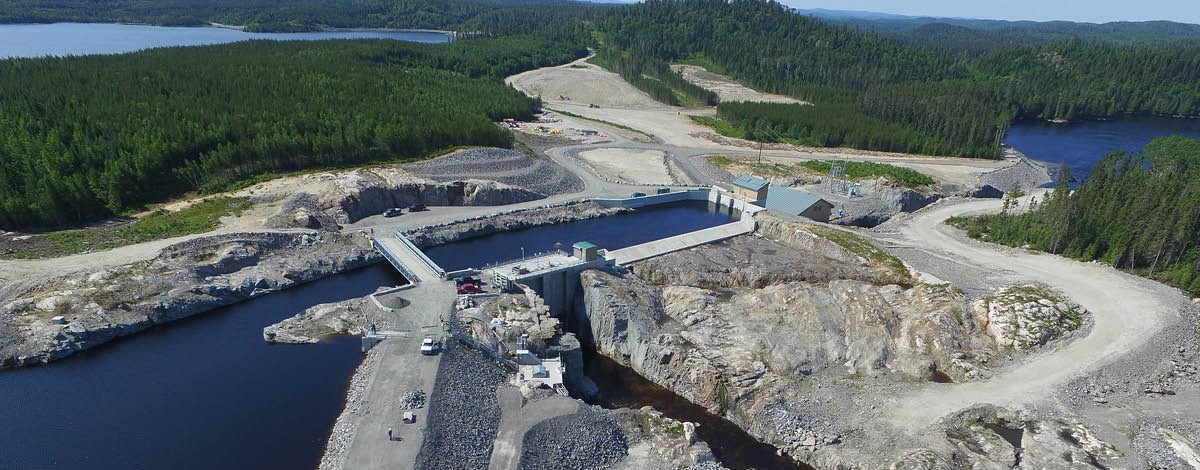
Notre société collabore depuis longtemps avec des partenaires autochtones. Il y a plus de 15 ans, nous avons collaboré avec les Premières Nations locales lors de notre premier investissement; aujourd’hui, nous coopérons d’une façon ou d’une autre avec les communautés autochtones pour plus de la moitié des actifs d’infrastructures canadiens en portefeuille. Il s’agit notamment de plusieurs installations hydroélectriques au fil de l’eau et projets d’énergie solaire dans lesquels nos partenaires autochtones détiennent une participation directe à nos côtés.
CC&L Infrastructure est membre du Groupe financier Connor, Clark & Lunn Ltée, une société de gestion de placements détenue par ses employés, dotée d’une structure multientreprise et dont les sociétés affiliées gèrent collectivement un actif de plus de 222 milliards de dollars canadiens.