Small caps are earning another look

Manarola village at dusk. Cinque Terre National Park, Italy.

This is the second in a two-part series on small caps. Last week, we looked at historical small caps performance, recent small caps performance and the reasons behind the unexpected. This week, we dive into what this means for allocators and skeptics.

Small caps have captured the attention of allocators, what with their outperformance of large caps, their durability through economic surprises and the access they offer outside of the crowded top ten mega caps. How does this information impact portfolio allocations?

Implementation: where the allocator’s choices can make a difference

The case for small caps is strongest when implementation is treated as part of the allocation decision. In a broad and inefficient universe, choosing active over passive, quality over the index, and a global opportunity set can make a meaningful difference. What needs to be considered when it comes to portfolio allocation?

Active over passive

We’ve previously discussed eVestment peer universe data showing the median active manager added value in Global and EAFE small cap. As of May 31, 2026, according to eVestment peer universe data the median EAFE small-cap manager has delivered 1.75% higher returns than the  MSCI EAFE Small Cap index, since the inception of our respective strategies.

BofA Global Research notes that small-cap active managers have posted better hit rates than large-cap active managers in seven of the last 11 years through 2025. The opportunity set supports it: BofA shows the long-run annualized Quintile 1 versus Quintile 5 spread for the FCF/EV factor within the Russell 2000 is approximately 20 percentage points, versus 7 within the Russell 1000.

Quality over the index

As we argued in our December 2025 commentary, “Time to take out the trash – Why high ROE matters in the long run,” the global small-cap universe contains over 12,000 names and the dispersion between the best and worst businesses is enormous.

Global breadth, with a regional lens

EAFE small caps are, in our view, the strongest within-asset-class call today. The European valuation gap to long-term averages is wide, the regional economies are at different points in their cycles, and the structural themes – German fiscal deployment, European industrial policy, Japanese reform – sit disproportionately in this universe.

Four objections to small caps, and what the evidence actually shows

If the historical evidence supports investing in small caps, and allocators have the opportunity to actively make a difference within portfolios, why aren’t small caps more heavily weighted? The four objections below come up most often in our conversations with allocators.

« Small caps are too volatile in this environment. »

But BofA Global Research’s May 2026 data documents that the realized volatility of the Russell 2000 has been lower than the S&P 500 during this decade’s worst weeks – a reversal of the prior pattern. The same has held year to date through the Iran war, and through several recent stress episodes (Brexit 2016, Taper Tantrum 2013, COVID 2020, tariffs 2025).

Reality is the dispersion in S&P 500 names has compressed as concentration has risen, while small-cap volatility no longer carries the size premium it once did. Volatility is no longer the reason to avoid the asset class.

« The small-cap index has become a junk bucket of non-earners and unprofitable biotechs. »

This was true through 2022. It is becoming less true. The median ROE of the Russell 2000 has been rising off multi-decade lows, the share of non-earners has begun to decline, the Russell 2000 saw more upgrades to the Russell 1000 than downgrades in the 2023 and 2024 rebalances and the share of US IPOs with negative earnings has fallen from roughly 80% during the 2020–22 bubble to approximately 60% year to date.

The S&P 600, which applies a profitability screen, currently has only about 10% non-earners against approximately 32% in the Russell 2000 – a structural choice available to any allocator concerned about index composition. As we argued before, high-ROE small caps have, over multi-year horizons, materially outperformed their lower-quality peers; quality selection is the answer to this objection, not avoidance of the asset class.

« Active managers can’t beat the small-cap index – look at 2025. »

2025 was the worst year on record for active small cap managers, with roughly 15% beating the Russell 2000 (BofA). It was also one of the most extreme low-quality rallies of the past decade. Active small cap managers tend to be structurally tilted toward quality, which is precisely the wrong tilt during a junk-led move. The longer-run picture is different. As above, active small cap managers have posted better hit rates than active large cap managers in seven of the last 11 years. The 2025 episode is best understood as an extreme drawdown in a strategy that has otherwise compounded reliably, not as evidence that the asset class is too efficient for active management.

« We should wait for rate cuts before adding small caps. »

Two pieces of evidence cut against this. First, per Kepler Cheuvreux, the historical correlation between European small-cap relative performance and the German Bund yield has materially weakened since early 2025. The asset class has been outperforming through rising rates, not waiting for them to fall. Second, per BofA, what matters more for small-cap performance than rates per se is the corporate profits cycle: in periods of accelerating EPS growth, US small caps have averaged 18–19% annual returns regardless of whether GDP was accelerating or decelerating, with the highest average and best hit rate in accelerating EPS combined with decelerating GDP.

The current Russell 2000 forward P/E of approximately 16.9x implies roughly 8% annualized 10-year returns based on the historical regression (BofA, R-squared 0.46). The setup does not require a particular rate path to work.

The case against small caps often rests on backward-looking assumptions: higher volatility, weaker quality, poor active outcomes and rate dependence. But recent evidence is showing us that those assumptions need to be revisited.

Sizing: the wrong question, asked the right way

Clients regularly ask how much small cap is the right amount. In our September 2025 article, “Why small caps are built for what’s next,”* we shared that our typical recommendation falls between 5% and 15%, and the precise figure matters less than the choice to size the allocation meaningfully in the first place. A four-asset mean-variance optimization on EAFE and US large and small caps – using eVestment median manager returns from January 1999 to June 2025 – produces an efficient frontier on which an all-large-cap portfolio does not sit. The closest efficient point combines roughly 30% small caps with 70% US large caps at the same volatility level, with higher expected returns. The number will vary with assumptions; the qualitative conclusion does not.

The harder question for most allocators is not 5% versus 15%. It is whether the strategic underweight that has accumulated over a decade of large-cap dominance gets revisited at all. The structural arguments stand on their own.

The recent evidence – small-cap outperformance through a genuinely difficult macro backdrop, broad-based across sectors, decoupled from bond yields, supported by a valuation gap that has if anything widened, and an index whose quality composition is improving from its 2022 lows – reinforces the timing. The objections can keep coming, but we can see through them with evidence-backed rebuttals. Allocators can make a clear difference. We think the case for revisiting the underweight is as clear as it has been in years.

Global Alpha was founded on the conviction that small caps are an inefficient asset class in which an experienced team can generate alpha across a full cycle. We are happy to discuss how a small-cap allocation can be sized within a particular plan’s constraints, and how our Global and International Small Cap strategies have navigated the recent environment.

* Contact us for a copy of this article.

Global equities have lost momentum. The MSCI World index is little changed since mid-May. The equal-weight version of the index remains below a high reached in late February – see chart 1.

Chart 1

NSP_COMM_2026-06-15_Chart03.png

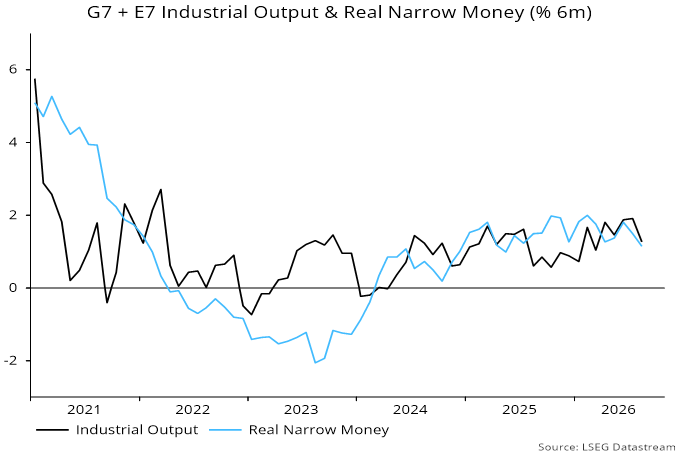
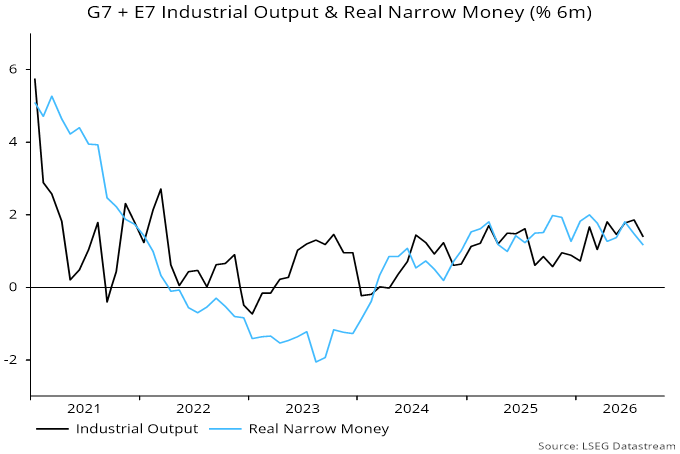
The stall could be explained by a less favourable “excess” money backdrop. Six-month growth of global (i.e. G7 plus E7) real money – on both narrow and broad definitions – crossed below that of industrial output in April. Narrow money growth was higher over August-March, while the broad money gap had been positive in most months since end-2022 – chart 2.

Chart 2

NSP_COMM_2026-06-15_Chart03.png

Real money growth rates appear to have recovered in May but may not have moved back above output expansion, based on partial information.

Prospects for a restoration of excess money support are mixed.

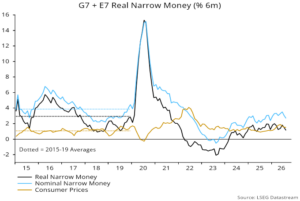
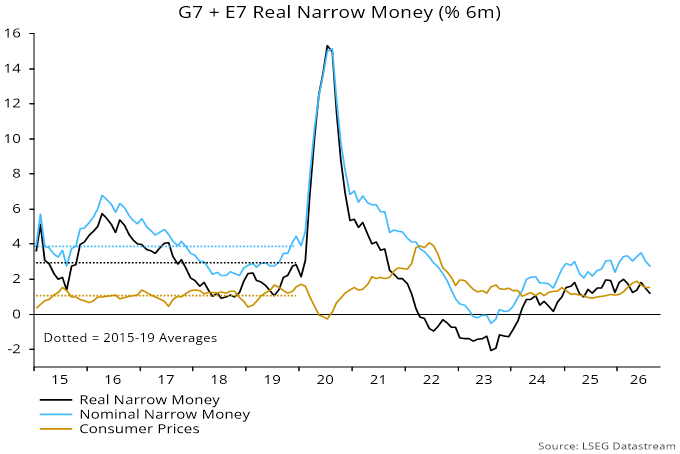
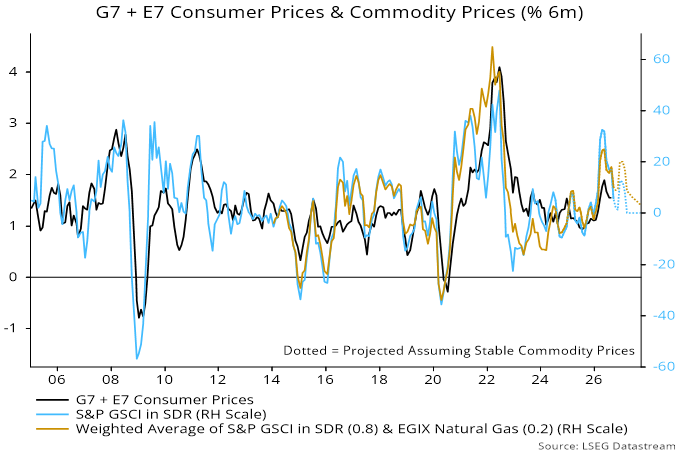
The real money slowdown reflected an energy-driven rise in six-month CPI momentum. This should reverse if recent commodity price relief is sustained – chart 3.

Chart 3

NSP_COMM_2026-06-15_Chart04.png

Yield curves, however, remain higher than before Gulf conflict, reflecting tighter actual and expected monetary policies. Higher rates could dampen nominal money growth.

Meanwhile, solid June flash PMI results suggest that six-month industrial output expansion will hold up near term.

As previously discussed, global money growth has been supported recently by faster US expansion. Six-month growth of the preferred US narrow and broad measures here – M1A and M2+ respectively – rose further to 9.3% and 8.2% annualised respectively in May – chart 4. (The M1A series has been adjusted for a reclassification of some savings deposits as demand deposits in November.)

Chart 4

NSP_COMM_2026-06-15_Chart04.png

By contrast, six-month growth of Eurozone and UK broad money – as measured by non-financial M3 / M4 – was just 3.7% and 3.4% annualised respectively in April. May numbers are released next week.

The break-out of US six-month money growth above a January 2025 high coincided with a resumption of Fed balance sheet expansion. Chair Warsh wants to reverse this policy, suggesting a future downside risk to money trends.

Think big. Buy small caps

Colorful houses sit on a cliff in Cinque Terre (meaning “Five Lands”), in Liguria, Italy.

This is a two-part series on small caps. This week, we look at historical small caps performance, recent small caps performance and the reasons behind the unexpected. Next week, we’ll dive into what this means for allocators and skeptics.


The case for a meaningful small-cap allocation in institutional portfolios

Small caps have just done something the textbook says they should not have. Since the Middle East conflict began at the end of February 2026, small caps have outperformed large caps on both sides of the Atlantic – through an oil-price spike, a sharp re-pricing of European front-end rates and deeply negative eurozone economic surprises. Inside those headline numbers, that is not the behaviour of an asset class to be avoided.

GACM_COMM_2026-06-17_Chart01
Source: Bloomberg


Small caps have outperformed large caps on both sides of the Atlantic for the last two years.

GACM_COMM_2026-06-17_Chart02
Source: Bloomberg


Crowded at the top, despite a universe of options

MSCI’s classification methodology defines small caps as roughly the bottom 14% of free-float market capitalization in each country it covers. This creates a universe that spans over 12,000 listed companies and the institutional allocation to that universe has, if anything, contracted. Even within the S&P 500, long-only funds remain overweight the largest quintile by market cap and underweight the smallest. The result is a public-equity allocation that, for all its sophistication, is structurally tethered to the same fifty or so mega-caps that everyone else owns.

As we observed in our September 2025 article, “Why small caps are built for what’s next,”* three of the four episodes of extreme S&P 500 top-ten concentration over the past century – the Go-Go conglomerate years, the Nifty Fifty, and the dot-com boom – were each followed by extended periods of small-cap leadership. Top-ten concentration at the dot-com peak reached 37.0%; today it stands at roughly 40%. The fourth episode, today’s AI-and-Mag-7 configuration, has not yet resolved. An allocator who treats the current setup as permanent is implicitly betting that this time is different, despite repeated historical evidence.
 

Why small caps matter through the cycle, not just at the turn

Small caps earn a place in the policy mix on three grounds independent of timing the next rotation.

  1. Breadth of opportunity.
    The small-cap universe is where most listed companies actually live, offering diversified factor and theme exposure that a mega-cap-dominated large-cap book does not provide. Further, the sector composition is materially different from large caps; US small caps carry more industrials, financials and real estate than US large caps, against an underweight in technology.
  2. Direct, undiluted exposure to the themes that matter.
    Reshoring, European fiscal expansion, defence, grid and AI-infrastructure build-out and Japanese corporate reform all get expressed more purely through small caps than through the large-cap index, because the pure-play, picks-and-shovels companies in these themes are typically not listed at large-cap market capitalizations.
  3. Differentiated economic exposure.
    According to research by Kepler Cheuvreux, European small caps generate roughly 60% of revenues from within Europe, versus roughly 33% for the blue-chip 50. This domestic tilt has become a feature rather than a bug in a world of recurring trade frictions, and the pattern broadly extends across EAFE.Bloomberg data indicate that Japanese small caps generate roughly 65–75% of their revenues domestically, compared with about 45% for TOPIX large caps. That domestic exposure leaves them well positioned to benefit from the emerging global order.


Unexpected outperformance: How are small caps doing it?

The cyclical setup we identified previously – technological disruption, top-of-market concentration, valuations well above long-run averages – remains in place. The conditions since end-February 2026 have been textbook unfavourable for small caps. Per Kepler, European front-end rate expectations re-priced sharply higher, eurozone economic surprises turned deeply negative, and oil spiked before partially retracing. Kepler’s analysis of monthly relative returns since 1994 shows European small caps have, on average, underperformed large caps by roughly -0.29% per month in OECD-defined « downturn » phases and -0.43% per month in « slowdown » phases. That headwind has not materialized.

And yet, small caps are outperforming large caps. Two features of the outperformance are worth flagging:

  1. Outperformance has been broad-based across sectors rather than carried by a narrow theme: Kepler’s sector-level data since February 27, 2026 shows positive median small-cap performance against negative median large-cap performance, with European small caps outperforming large caps in nearly every sector.
  2. Small caps’ historical sensitivity to bond yields has visibly weakened – per Kepler, the relative performance of European small caps versus large caps has materially decoupled from the German Bund yield since early 2025, breaking a relationship that had held for most of the post-2021 period.

The asset class is no longer waiting for rate cuts.

The valuation picture is the cleanest piece of the case. On Kepler’s data, European large caps trade at roughly 15.2x forward earnings against a long-term average since 2009 of 13.2x. European small caps trade at 14.4x against an average of 14.8x. The US picture is similar: BofA Global Research reports the relative forward P/E of the Russell 2000 versus the Russell 1000 is approximately 0.82x, and historically the relative forward P/E explains roughly 46% of the variability in subsequent 10-year relative returns.
 

Next week: turning the case into allocation

Small cap performance has been unexpected, but not entirely surprising. As investment managers specializing small caps, we know what small caps are capable of. Now that this market segment is regaining the attention of investors, what does this information mean for portfolio allocations? How can allocators adjust their underweight? We’ll discuss those details in next week’s commentary.

Global Alpha was founded on the conviction that small caps are an inefficient asset class in which an experienced team can generate alpha across a full cycle. We are happy to discuss how a small-cap allocation can be sized within a particular plan’s constraints, and how our Global and International Small Cap strategies have navigated the recent environment.

* Contact us for a copy of this article.

Seoul Tower during spring in South Korea.

Last month, we wrote to investors about how the outperformance of EM equities was the product of a very narrow rally driven by a boom in South Korean and Taiwan tech companies. We noted that despite parabolic moves in semiconductor stocks, valuations have actually become cheaper due to a massive acceleration in earnings growth underpinned by rising US hyperscaler investment seeking to power frontier AI models.

In the weeks since, tech stocks continued to surge in feverish trading led by leveraged retail investors in South Korea. Jefferies Global Head of Equity Strategies, Chris Wood, flagged in early April that margin lending in South Korea had doubled from W15.8 trillion at the end of 2024 to an incredible W32.7 trillion this year.

Korea margin loan balance (Kospi + Kosdaq)
Graph showing Korea margin loan balance increasing over time.
Source: Jefferies Global Equity, April 2026.

Investors also rushed to gain exposure through passive vehicles including leveraged ETFs.

 CSOP SK Hynix daily 2X leveraged product
Two graphs illustrating the purchasing trend of CSOP SK Hynix daily 2x leveraged product over time.
Source: Bloomberg

Among GEM managers, overweight positioning has been steadily rising since the beginning of 2025.

A line graph illustrating that global emerging markets managers have been increasing overweight positioning through 2025-2026, for both active and passive South Korea.

Source: NS Partners & EPFR (date to end-April 2026).


The only game in town

The acceleration in fundamentals for stocks in the AI supply chain has been so dramatic that it has swamped the broader EM investment universe. The economic drag created by the US–Iran conflict has hit markets with higher sensitivity to rising energy prices. As these markets weather the economic turbulence, AI looks increasingly like the only game in town. In response, many investors have sold down areas hit by these tailwinds to fund larger weightings in AI-exposed names.

This shift in allocation resembles Charlie Munger’s “Lollapalooza Effect,” where extreme, disproportionate outcomes arise when multiple cognitive biases and incentives converge and reinforce each other simultaneously. In this case, a shift by investors, attracted by a sharp acceleration in fundamentals, has been magnified by systematic strategies, passives and leverage chasing the momentum. As a result, the IT sector now accounts for over 40% of the benchmark.

A line graph illustrating MSCI EM weights, showing that as investment in IT has been increasing, so has investment in Korea and Taiwan.
Source: NS Partners & LSEG Datastream.


Deteriorating monetary backdrop another source of fragility

Our Chief Economist, Simon Ward, has been writing about a global monetary squeeze which began in the months leading up to Gulf War III. This was exacerbated by the war sending commodity prices and CPI momentum higher, leading to a slowdown in real money growth.

Deterioration in real money growth due to high CPI momentum
Line graph illustrating the deterioration of real money growth across G7 and E7 due to high CPI momentum.
Source: Money Moves Markets, May 2026.

Nominal money expansion to counteract the liquidity squeeze is unlikely in the near term, with most major central banks now making more hawkish noises in response to price pressures. This means less liquidity support for markets, especially in pockets which have run hard such as semiconductors.

Broken story or a reset in overbought technicals?

In early June, crowded positioning and an itch to take profits collided with rising macro uncertainty arising from the release of strong US payroll data which topped market forecasts, igniting fears the US Federal Reserve would be forced into tightening monetary policy. It is also possible that forthcoming blockbuster IPOs of SpaceX, OpenAI and Anthropic placing a strain on market liquidity further unsettled investors sitting on large gains. This culminated in a sharp selloff on the 5th of June, with winning trades in the tech sector suffering the most.

Line graph illustrating the daily change of the MXEF Momentum Index over time to April 2026.
Source: Bloomberg data


Behavioural discipline

As noted in last month’s commentary, Rallying EM equities reflect an AI-powered earnings surge, we had been trimming AI exposure into strength on a view that parabolic stock moves would inevitably run into a pullback. We have also been re-allocating within our IT exposure (a modest c.3% overweight as at the end of May), from companies where stock performance risks becoming detached from reality and into niches benefiting from the same demand drivers but where investor enthusiasm has not been so frenzied.

Over the past few years, we have worked to sweat our risk budget within the AI-supply chain, tweaking the portfolio as data and conviction changes by rotating through a number of segments outlined below.

AI exposure across layers
Image showing NSP's exposure to AI across five layers: energy, chips, infrastructure, models, and applications. The image contains several company logo examples for each of the five layers.
Source: NS Partners, June 2026.

The aim of this activity is to maximise risk-adjusted returns by maintaining a healthy exposure to AI supply chain companies, but in an allocation that is cheaper, less crowded, more positively skewed and with more independent catalysts than a static allocation to the original winners.

Des affiches publicitaires RealTruck sont apposées à l'extérieur du magasin Rack Attack, une société du portefeuille de Banyan Capital Partners.

Rack Attack, une entreprise du portefeuille de Banyan Capital Partners, a annoncé aujourd’hui son partenariat avec RealTruck, apportant ainsi les produits et l’expertise de RealTruck à chacun des 45 points de vente au détail de Rack Attack. Le partenariat est conçu pour rendre les accessoires haut de gamme pour camions plus accessibles pour les clients, en combinaison avec l’expertise offerte en magasin et les services d’installation.

« Le lancement officiel des magasins de détail RealTruck dans nos points de vente Rack Attack rehaussera notre partenariat et créera l’expérience client ultime. Ensemble, nous offrons aux propriétaires de camions et aux amateurs de plein air le plus grand choix de produits, ainsi que le meilleur service dans tous nos marchés en Amérique du Nord », explique Alexander Welbers, chef de la direction de Rack Attack.

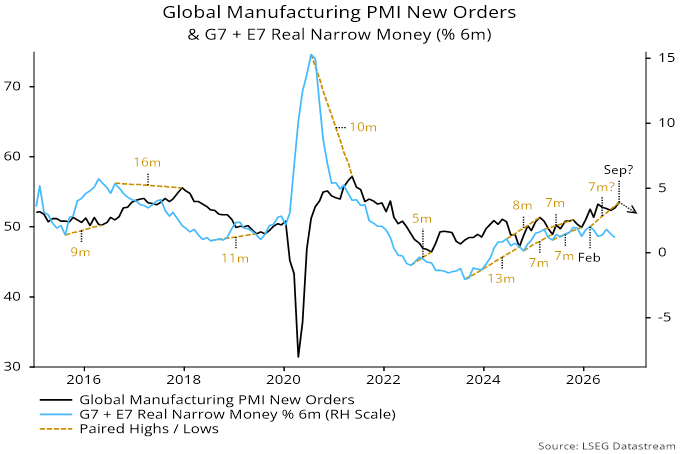
OECD leading indicator data and survey evidence on stocks support the forecast of a H2 loss of industrial momentum.

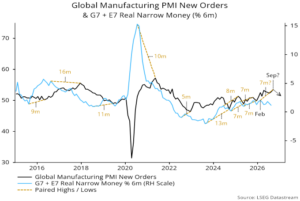
Global manufacturing PMI new orders edged down in May from April’s four-year-plus high. The expectation here has been for a further decline in H2, reflecting a slowdown in global six-month real narrow money momentum from a February peak – see previous post.

Two recent releases support this forecast. First, one-month growth of the OECD’s G7 leading indicator fell again in May. Growth peaked in December and has led PMI new orders by three months on average historically, suggesting that April’s orders high will prove lasting – see chart 1.

Chart 1

NSP-WeeklyBulletin-20260601-Chart14-1024×888-1.png

Secondly, the PMI stocks of purchases index indicates that stockpiling of inputs accelerated further last month, likely marking a cycle peak – chart 2.

Chart 2

NSP-WeeklyBulletin-20260601-Chart13-1024×889-1.png

Growth in new orders is related to the rate of change of stockbuilding, implying a slowdown even in the unlikely event that the stocks of purchases index remains at its current extended level – chart 3.

Chart 3

NSP-WeeklyBulletin-20260601-Chart13-1024×889-1.png

An LNG tanker at a gas terminal.

AI infrastructure investment has moved upstream. The advent of ChatGPT, Claude and other AI applications fueled demand for semiconductor chips that enable the software to “think.” The demand concurrently brought about record capital expenditures to build out hyperscale data centres housing those chips. Now the bottleneck is even more basic: power. For AI, electricity is no longer a utility input; it is strategic infrastructure.

Data centre growth needs energy – a lot of it

That shift is colliding with a US grid whose expansion is constrained at multiple points: new generators are stuck in interconnection queues; interstate transmission still requires approvals across multiple jurisdictions; transformer shortages are delaying grid upgrades; and local opposition is increasingly slowing or cancelling data centre projects. North American Electric Reliability Corporation’s 2025 long-term reliability assessment warned that 13 of 23 North American assessment areas face resource-adequacy challenges over the next decade, underscoring that the issue is not only energy volume, but deliverability and reliability.

Electric Power Research Institute’s Powering Intelligence 2026 report makes the same point from the data centre side. Its “Generation and Capacity Impacts of Data Center Load” analysis finds that data centre growth could require large additions of generation and transmission capacity, but that supply-chain, siting and permitting constraints may limit how fast those additions arrive. In least-cost scenarios, incremental data centre load is met primarily by new and existing gas generation rather than carbon-free resources.

Getting power to where it’s hard to get

That naturally explains the recent order flow into large reciprocating engines. In April, the Finnish vessel engine manufacturer Wärtsilä Oyj Abp announced a 790 MW off-grid power solution for a new Texas data centre facility, using its 50SG natural gas engines. Wärtsilä explicitly framed the order around fast access to reliable power in a region where the grid cannot adequately meet urgent AI-infrastructure demand. Around the same time, the Korean shipbuilder HD Hyundai Heavy Industries Co. Ltd. disclosed that it had signed a US data centre power generation equipment contract based on its 20 MW-class HiMSEN engines, citing total capacity of 684 MW.

The appeal is straightforward. Large reciprocating engines are modular, dispatchable, fast-starting, scalable in increments and deployable closer to load than central-station plants. Compared with combined-cycle gas turbines, nuclear projects or major transmission upgrades, they can often be installed in shorter phases and avoid waiting years for grid interconnection. For a data centre developer, speed-to-power can be as important as cost-of-power.

Maintaining engine power at sea and on land

HD Hyundai Marine Solution Co. Ltd. (443060 KS) in our Emerging Markets Small Cap Strategy is the sole authorized provider of maintenance, repair and overhaul (MRO) aftermarket services to HiMSEN engines worldwide. As a HD Hyundai-affiliate, the company benefits from having HD Hyundai Heavy Industries – the world’s second largest shipbuilder and the largest manufacturer of medium-speed 4-stroke vessel engines – as a captive market. Of approximately 17,000 HiMSEN units in operation globally (most of them generating power for over 4,000 ships at sea), roughly 2,000 units are generating power on the ground.

Could data centres move offshore?

Mitsui O.S.K. Lines and Karpowership’s Kinetics have already signed a memorandum of understanding to develop what they describe as the world’s first integrated floating data centre platform, hosted on a retrofitted vessel and supplied by a powership capable of using LNG. In that scenario, vessel-engine makers are also powering the physical layer of AI.

Photo de l'équipe de Crestpoint devant le chantier de King + Park.  

La société Crestpoint Real Estate Investments est heureuse de poursuivre son partenariat avec Vestcor et Anthem Properties dans le cadre du projet d’envergure King + Park, un immeuble à usage mixte à la frontière de Burnaby. En compagnie du maire de Burnaby et d’autres invités, Crestpoint, Vestcor et Anthem ont pris part à la cérémonie d’inauguration des travaux du projet le 1er juin 2026.

Situé dans un milieu axé sur le transport en commun, le projet complet de King + Park comprend :

  • 724 logements locatifs dans deux tours sur un même socle (la phase 1 est en cours de construction)
  • Restauration de l’emblématique Boot Office Tower
  • 512 350 pieds carrés de locaux à bureaux conservés et restaurés (Boot)
  • 43 402 pieds carrés d’espaces commerciaux livrés à toutes les phases
  • 1 559 logements en copropriété divise (phase future)

Comme l’a souligné Max Rosenfeld, vice-président exécutif et chef de la gestion des biens à Crestpoint, King + Park est « à la fois une occasion unique d’honorer le patrimoine et de réinventer un site », et Crestpoint est ravie de prendre part à un projet qui aura un impact positif et durable.

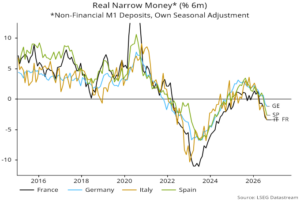
Eurozone and UK April money numbers signal rising recession risk and suggest that policy-makers should be considering easing not tightening.

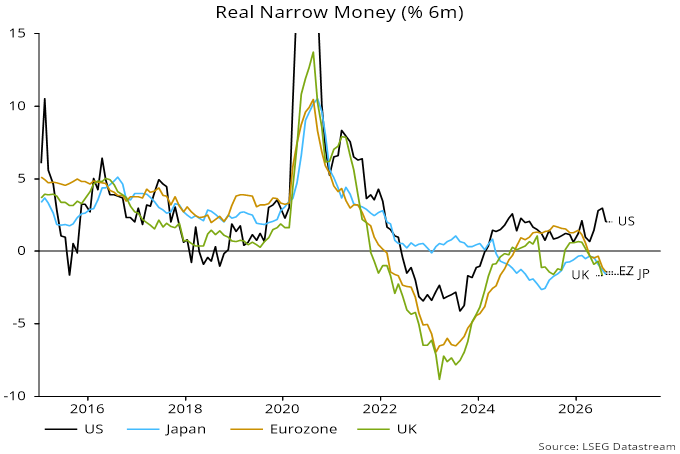
Three-month annualised growth of Eurozone narrow money – as measured by non-financial M1 – slumped from 5.3% to 1.5% between January and April. UK growth fell from 3.8% to 0.7% over the same period, with a large contraction in April alone.

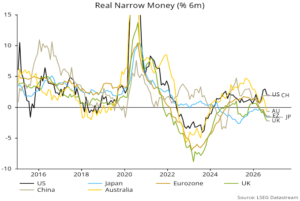
The nominal slowdowns compound a squeeze on real money from consumer price acceleration due to the Gulf War III supply shock. Six-month momentum of real narrow money fell to zero in the UK in April while turning negative in the Eurozone – see chart 1.

Chart 1

NSP-WeeklyBulletin-20260511-Chart13-1024×889-1.png

Real money contractions have been a recession warning signal historically. An obvious push-back is that much greater weakness in 2022-23 was not reflected in a subsequent economic slump. Negative momentum was a misleading indicator of monetary conditions then because of a large overhang from the 2020-21 money growth surge. There is no such overhang now, so dismissing current weakness on the basis of that experience is dangerous.

Broad money trends are also worrying, with nominal growth of only 3.5% and 3.6% annualised respectively in Eurozone non-financial M3 and UK non-financial M4 in the three months to April. US broad money, by contrast, expanded at a 7.6% pace over the same period (M2+ measure).

Globally, six-month real narrow money momentum fell for a second month in April, supporting the forecast of a fall in manufacturing PMI new orders during H2 – chart 2.

Chart 2

NSP-WeeklyBulletin-20260511-Chart14-1024×888-1.png

Immeuble du quartier des affaires du centre-ville de Vancouver, près de Robson Square.

Les marchés boursiers ont continué d’atteindre de nouveaux sommets malgré un contexte qui, à première vue, devrait être beaucoup moins favorable. La guerre au Moyen-Orient, les prix élevés du pétrole, le resserrement des conditions financières et l’incertitude entourant les politiques n’ont pas fait dérailler l’appétit pour le risque. Il y a eu des périodes de volatilité en cours de route, mais aucune n’a considérablement perturbé la tendance générale à la hausse. Au lieu de cela, les actions se sont redressées, les marchés du crédit sont demeurés solides et les investisseurs ont, à maintes reprises, ignoré les chocs qui, au cours des cycles précédents, ont peut-être déclenché une réévaluation plus importante.

Les moteurs de la remontée

La vigueur des marchés boursiers est attribuable à l’alignement de deux forces exceptionnellement puissantes et concentrées.

La première étant le cycle d’investissement alimenté par l’IA, qui se démarque non seulement par l’ampleur du cycle des dépenses en immobilisations (graphique 1), mais aussi par sa structure. Les investissements sont stimulés par un petit groupe de fournisseurs de services infonuagiques à très grande échelle qui engagent des sommes sans précédent dans des centres de données et des infrastructures de soutien qui, selon certaines estimations, pourraient atteindre 5 000 G$ US au cours des cinq prochaines années; de plus en plus, les sociétés tirent parti des marchés mondiaux du crédit pour financer ces investissements. Les marchés du crédit, en particulier, n’agissent pas comme une contrainte. Les fortes émissions ont été facilement absorbées, la solide demande maintenant les écarts de taux serrés, même si l’offre augmente. Au Canada, la première émission d’obligations feuille d’érable d’Alphabet a atteint un niveau record de 8,5 G$ CA et a été très bien absorbée. En fait, les conditions de financement favorisent l’expansion économique au lieu de la limiter.

Graphique 1 : Les investissements dans les technologies ont bondi aux États-Unis
Graphique linéaire illustrant les investissements dans les technologies aux États-Unis par rapport à leur tendance en pourcentage du PIB de 1980 à aujourd’hui.Source : US Bureau of Economic Analysis et Macrobond.

Parallèlement, les bénéfices des sociétés ont été manifestement solides. L’indice S&P 500 est en voie d’enregistrer une croissance des bénéfices d’environ 28 % sur 12 mois au premier trimestre, soit le rythme le plus rapide depuis 2021. Plus important encore, cette vigueur a été généralisée. Dix secteurs ont annoncé une croissance de leurs bénéfices, sept secteurs ayant enregistré des gains de plus de 10 %, notamment les technologies de l’information, la finance, l’industrie et les matériaux (graphique 2).

Graphique 2 : La croissance des bénéfices aux États-Unis est solide et généralisée
Graphique à barres illustrant la croissance des bénéfices de l’indice S&P 500 sur 12 mois pour le premier trimestre de 2026; la croissance est généralisée à l’échelle des secteurs.Source : FactSet. Remarque : Au 21 mai 2026.

Bien que les bénéfices soient généralisés, un groupe relativement petit de sociétés d’IA et liées à l’IA dicte les révisions, l’humeur et la répartition du capital. Pourtant, malgré l’ampleur des investissements, la contribution directe à la croissance du PIB demeure limitée. Ce qui rend le contexte actuel inhabituel, c’est que la remontée n’est pas purement spéculative, car les bénéfices sont élevés. Tant que la résilience généralisée des bénéfices se poursuivra parallèlement à un moteur concentré de croissance, la trajectoire vers le haut peut rester inchangée.

Disparition des risques de baisse

Si le moteur explique l’orientation des marchés, la persistance de la remontée reflète le fait que les risques ne se sont pas matérialisés à plusieurs reprises. La situation géopolitique est l’exemple le plus évident, les perturbations dans le détroit d’Ormuz ayant fait grimper les prix du pétrole de façon importante, mais pas à des niveaux compatibles avec l’ampleur du choc. Par ailleurs, d’autres risques macroéconomiques sont largement ignorés. Les marchés de l’emploi continuent de ralentir, mais ils semblent avoir touché un plancher, de sorte que la croissance de l’emploi et des revenus demeure suffisante pour soutenir la consommation.

Fait important, l’inflation s’est révélée persistante. En avril, les prix à la production aux États-Unis ont fortement augmenté, l’IPP global ayant progressé de 1,4 % sur un mois, en raison de la forte hausse des composantes liées à l’énergie. Sous la surface, toutefois, la situation semble modérée. Les prix des biens de consommation de base indiqués dans le rapport d’avril sur l’IPC ont fait du surplace pendant le mois, et les prix des services de base, bien que toujours élevés, n’ont pas beaucoup augmenté (graphique 3). De plus, le mécanisme de transmission semble plus faible que lors des cycles précédents, y compris la période après la pandémie, lorsque les hausses rapides des salaires et les politiques budgétaires et monétaires très expansionnistes ont renforcé l’inflation à l’échelle de l’économie.

Graphique 3 : Les prix des services de base sont relativement contenus
Graphique linéaire illustrant l’inflation de base selon l’IPC des services (excluant l’énergie et le logement) au fil du temps de 2015 à aujourd’hui.Source : US Bureau of Labor Statistics et Macrobond.

Les marchés n’ignorent pas les risques – ils observent que ces risques ne se traduisent pas par des bénéfices négatifs ou une croissance négative, et s’ajustent en conséquence. Chaque fois que le risque passe inaperçu, les marchés deviennent enclins à faire abstraction des chocs. Les préoccupations s’estompent plus rapidement et le positionnement se reconstruit plus rapidement.

Qu’est-ce qui pourrait briser cet optimisme à l’égard du risque?

Les taux obligataires ont augmenté, les taux à court terme ayant fortement grimpé et les courbes de taux s’aplatissant, une combinaison habituellement associée au resserrement des conditions financières. Depuis le début du conflit, les taux des obligations américaines à 10 ans ont augmenté considérablement, et les taux des obligations à 30 ans ont dépassé le seuil psychologiquement important de 5 %. Les taux à court terme ont augmenté encore plus fortement, en raison des pressions inflationnistes et de la résilience de la croissance. Par ailleurs, les actifs risqués ont continué de se redresser parallèlement à cette hausse, une dynamique inhabituelle de fin de cycle qui fait en sorte que le système se dirige vers des taux d’intérêt toujours plus élevés. Fait intéressant, les mêmes forces qui soutiennent les actifs risqués contribuent également à ce resserrement. Le cycle d’investissement alimenté par l’IA soutient la demande, renforce les pressions inflationnistes (graphique 4) et fait en sorte que la politique monétaire est plus restrictive que ce que les marchés auraient pu prévoir. En ce sens, l’optimisme qui alimente la remontée est également ce qui empêche l’assouplissement de la politique monétaire.

Graphique 4 : Les pressions inflationnistes à court terme s’intensifient
Graphique linéaire illustrant l’indice des prix à la production des composants et accessoires électroniques sur 12 mois, qui affiche une forte hausse depuis le deuxième trimestre de 2025.Source : US Bureau of Labor Statistics et Macrobond.

Cela crée des tensions croissantes. Dans le passé, la hausse des taux d’actualisation et le resserrement des conditions financières ont pesé sur les valorisations boursières. La politique monétaire ajoute une autre couche d’incertitude. Les banques centrales délaissent l’assouplissement monétaire, en raison des risques croissants d’inflation. Elles craignent que les attentes d’inflation ne soient plus ancrées dans leurs niveaux cibles si le choc étroit des prix des matières premières se traduit par une réaccélération de l’inflation de base (même si l’on suppose actuellement que les perturbations énergétiques sont temporaires et gérables). De plus, aux États-Unis, la transition vers un nouveau président de la Réserve fédérale crée une autre incertitude qui pourrait renverser la souplesse du régime précédent.

Stratégie de portefeuille

Dans les portefeuilles équilibrés, les actions et les titres à revenu fixe demeurent légèrement sous-pondérés. Cette position a été mise en œuvre à la fin du premier trimestre, lorsque les marchés sont entrés dans une phase de « choc inflationniste d’abord, puis risque de croissance plus tard ». Les risques de récession se sont depuis atténués, de sorte que les actions se négocient maintenant près de sommets historiques, intégrant des hypothèses de croissance relativement optimistes. Par conséquent, la patience et la souplesse demeurent importantes. Nous cherchons à accroître le risque de façon opportuniste en périodes de faiblesse des marchés ou de ventes massives attribuables au positionnement. Nous privilégions les actions canadiennes par rapport aux actions américaines, et nous sommes optimistes à long terme à l’égard du Canada.

Dans les portefeuilles de titres à revenu fixe, la conjoncture demeure difficile, car la forte croissance, l’inflation persistante et la hausse des prix de l’énergie continuent d’exercer des pressions à la hausse sur les taux obligataires. Les marchés ont constamment revu à la baisse leurs attentes à l’égard des réductions de taux d’intérêt et ont commencé à anticiper la possibilité de hausses des taux directeurs au Canada et aux États-Unis. Par conséquent, la courbe des taux s’est aplatie et les taux ont augmenté. Cette tendance devrait se poursuivre, mais pas de façon linéaire. La durée continuera d’être gérée de façon tactique, mais sera de préférence plus courte que celle de l’indice de référence, avec un accent sur la souplesse plutôt que sur d’importantes positions directionnelles.

Les portefeuilles d’actions fondamentales continuent d’investir dans des sociétés affichant des bénéfices résilients. Bien que la reprise dans son ensemble demeure intacte, nous avons interrompu l’augmentation des placements cycliques afin d’atténuer le risque de baisse. Nous avons également réduit la pondération des modèles d’affaires les plus vulnérables aux perturbations causées par l’IA, tout en augmentant de façon sélective la pondération des secteurs qui sont positionnés de manière à profiter du cycle plus large des dépenses en immobilisations et des infrastructures liées à l’IA, y compris les secteurs liés aux matières premières.

Le contexte actuel continue de privilégier une approche opportuniste, et nous cherchons à accroître le risque avec prudence.