Chinese money / credit trends remain weak but could be at a turning point.

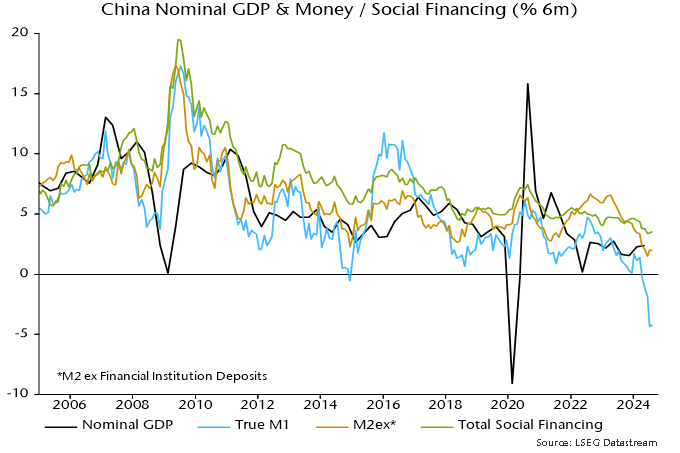
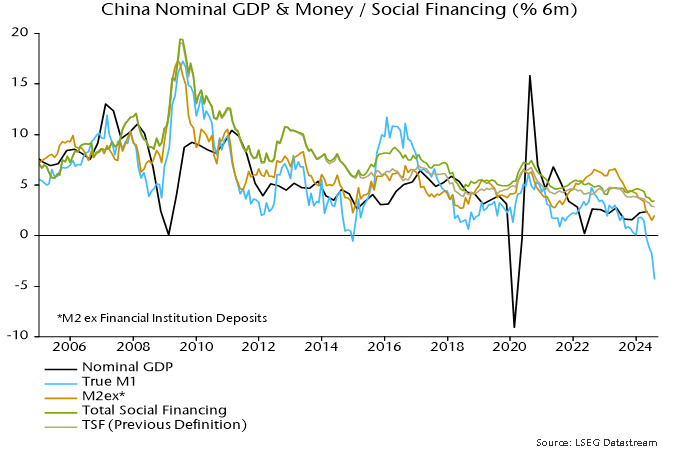
Six-month rates of change of broad money and total social financing have stabilised above June lows – see chart 1. (Broad money here refers to M2 excluding money holdings of financial institutions, which are volatile and less informative about economic prospects.)

Chart 1

20240920_NSP_MMM_C1_ChinaNominalGDPMoneySocialFinancing

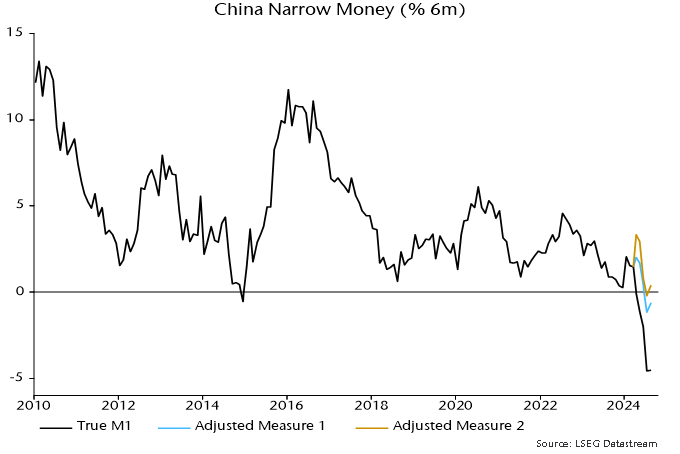
Narrow money is contracting at a record pace but has been distorted by regulatory changes in April that have reduced the attractiveness of demand deposits, resulting in enterprises shifting into time deposits and money substitutes while repaying some short-term bank borrowing. (The “true M1” measure shown adds household demand deposits to the published M1 aggregate to align with international monetary convention.)

Chart 2 compares six-month rates of change of the raw narrow money series and two adjusted measures. The first assumes that the share of demand deposits in total bank deposits of non-financial enterprises would have remained at its March level in the absence of the regulatory changes. The second additionally adds the inflow to instant-access wealth management products (WMPs) since end-March (data sourced from CICC), on the assumption that this represents a transfer from demand deposits. Six-month momentum of the latter measure was similar in July to the series low reached at end-2014.

Chart 2

20240920_NSP_MMM_C2_ChinaNarrowMoney

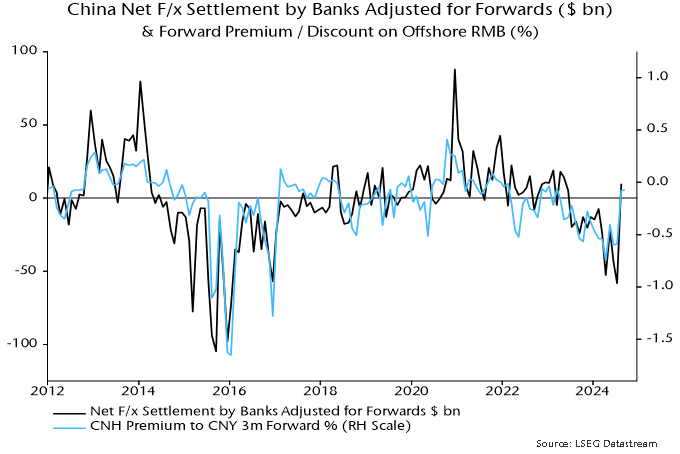
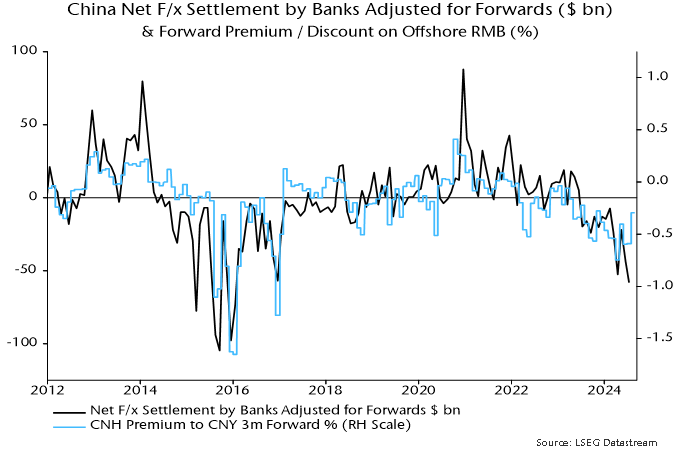
A key reason for expecting money / credit reacceleration is that the yen rally has relieved pressure on the RMB, easing monetary conditions directly and opening up space for further PBoC policy action. The balance of payments turnaround is confirmed by a swing in the banking system’s net f/x transactions, including forwards, from sales of $58 billion in July to purchases of $10 billion in August. This series captures covert intervention via state banks (h/t Brad Setser) and an August reversal had been suggested by a sharp narrowing of the forward discount on the offshore RMB, which has remained lower so far in September – chart 3.

Chart 3

20240920_NSP_MMM_C3_ChinaNetFxSettlementbyBanksAdjustedforForwardsForwardPremiumDiscountonOffshoreRMB

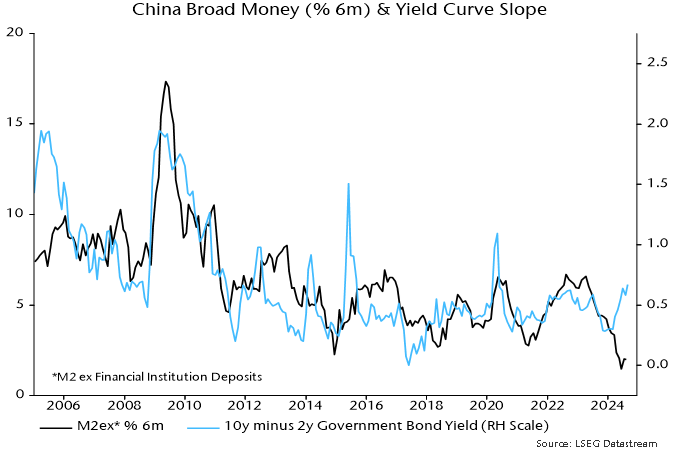
Actual and expected monetary easing has been reflected in a further steepening of the yield curve, which has correlated with, and sometimes led, money momentum historically – chart 4.

Chart 4

20240920_NSP_MMM_C4_ChinaBroadMoneyYieldCurveSlope

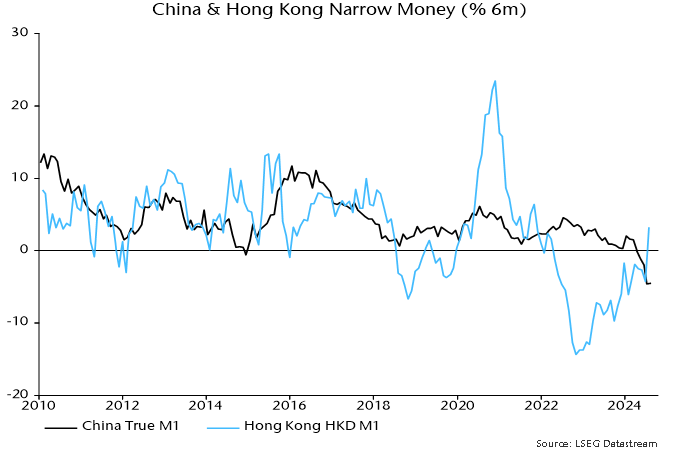
An easing of Chinese monetary conditions coupled with the start of a Fed rate-cutting cycle could have a powerful monetary impact in Hong Kong, where six-month momentum of local-currency M1 recently returned to positive territory, having reached its weakest level since the Asian crisis in October 2022 – chart 5.

Chart 5

20240920_NSP_MMM_C5_ChinaHongKongNarrowMoney

The most important issue in the global economic outlook is the meaning of Chinese monetary weakness.

Six-month rates of change of narrow / broad money, bank lending and total social financing (on both new and old definitions*) reached record lows in June / July – see chart 1.

Chart 1

20240816_NSP_MMM_C1_ChinaNominalGDPMoneySocialFinancing

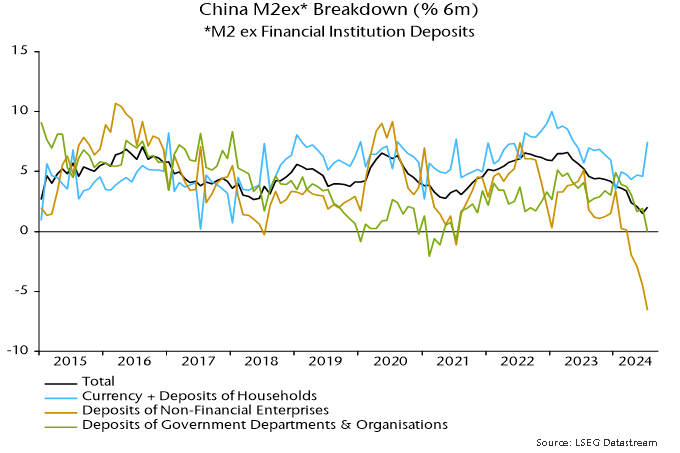
Monetary weakness has been entirely focused on the corporate sector: M2 deposits of non-financial enterprises plunged 6.6% (13.6% annualised) in the six months to July (own seasonal adjustment) – chart 2.

Chart 2

20240816_NSP_MMM_C2_ChinaM2exBreakdown

Recent regulatory changes appear to account for only a small portion of the corporate broad money decline.

A clampdown on banks paying interest above regulatory ceilings has resulted in a shift out of demand deposits but money has largely stayed in the banking system – available data suggest modest inflows to wealth management products and other non-monetary assets.

The clampdown has also discouraged the practice of “fund idling” (round-tripping in UK monetary parlance), whereby banks offered loans to corporate borrowers to meet official lending targets, with borrowers incentivised to hold the funds on deposit.

If an unwinding of such activity accounted for the decline in corporate money, however, short-term bank lending to corporations would be expected to show equivalent weakness. Such lending has continued to grow, albeit at a slower pace recently, as have longer-term loans.

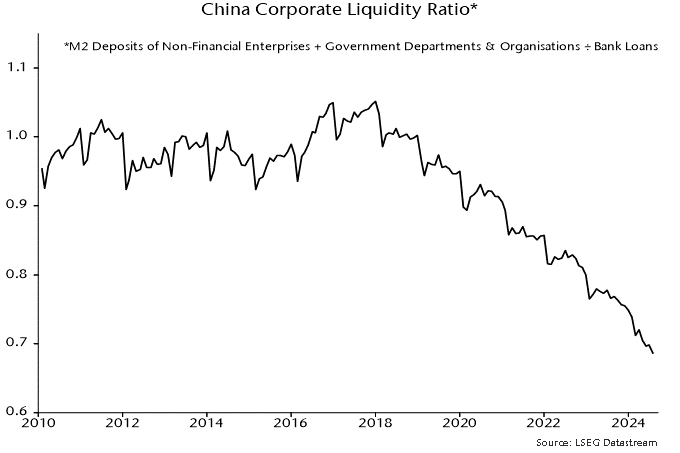
A trend decline in the ratio of corporate M2 deposits to bank borrowing, therefore, has accelerated – chart 3.

Chart 3

20240816_NSP_MMM_C3_ChinaCorporateLiquidityRatio

Household money holdings, by contrast, have been growing solidly – chart 2. An alternative explanation for the corporate money decline is simply that households are still hunkering down as the property crisis deepens, with weakening demand for consumer goods / services and housing transferring income and liquidity from the corporate sector.

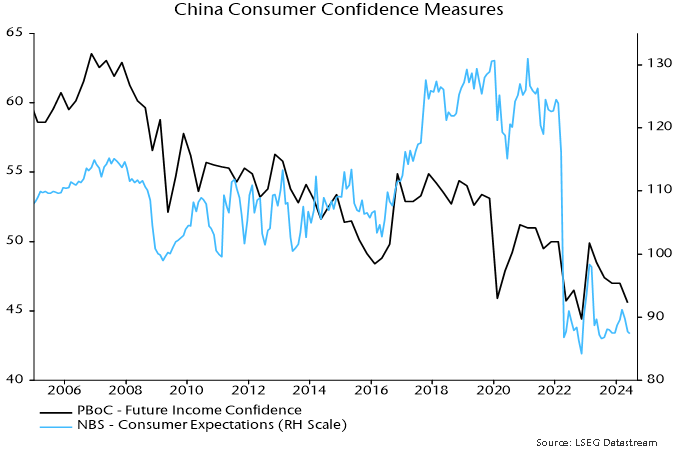
The latest PBoC and NBS consumer surveys confirm rock-bottom sentiment – chart 4. If this explanation is correct, corporate money weakness may presage a collapse in profits – chart 5.

Chart 4

20240816_NSP_MMM_C4_ChinaConsumerConfidenceMeasures

Chart 5

20240816_NSP_MMM_C5_ChinaINdustrialProfitsM2DepositsNonFinancialEnterprises

Why hasn’t the PBoC hit the panic button? Policy easing has been constrained by currency weakness: the most comprehensive measure of f/x intervention (h/t Brad Setser) reached $58 billion in July, the highest since 2016 – chart 6. The recent yen rally has offered some relief, reflected in a narrower offshore forward discount, but the authorities may be concerned that this will prove temporary.

Chart 6

20240816_NSP_MMM_C6_ChinaNetFxSettlementBanksAdjustedForwards

The strange policy of trying to push longer-term yields higher against a recessionary / deflationary backdrop may represent an attempt to support the currency, rather than being motivated primarily by concern about financial risks. To the extent that the policy results in banks selling bonds, however, the result will be to exacerbate monetary weakness and economic woes.

*The previous definition excludes government bonds so is a measure of credit expansion to the “real economy”.