Closeup of a person pumping gasoline fuel in their car at gas station.

In-depth macro analysis has always been a cornerstone of this process, based on an understanding that emerging markets are highly sensitive to macro shocks which can overwhelm ostensibly solid company fundamentals. The outbreak of conflict following US and Israeli strikes to take out the Iranian regime is one such event, and has sparked violent moves in markets. Our macroeconomic analysis and risk controls are crucial in helping to navigate a volatile environment.

The approach to macroeconomic analysis here is disciplined and incremental, and does not involve the type of Hail Mary calls (i.e., speculating on President Trump’s war aims) that get market pundits invitations onto Bloomberg and CNBC. Our approach to forming a top-down view of our markets is to mark the direction of travel, whether it be our monetary indicators or more qualitative factors such as politics and institutional quality. We marshal all of these data points into one number which rates the level of conviction for a country with 1 being the highest level of conviction corresponding with a maximum overweight (key caveat: provided we can find the right stocks that fit our process), and 5 being lowest (meaning no exposure at all). As the data changes, we will tweak that level of conviction, which should be tightly aligned with adjustments made in the portfolio.

This work is designed to help us understand how the investment environment is changing through cycles, structural change and theme-driven liquidity. Through this context, we can get a sense of what types of businesses are likely to be rewarded in a given environment and adjust the portfolio accordingly.

Test and re-test

We are big subscribers to the insights of psychologist and writer, Phillip Tetlock, who is an expert on forecasting. His studies found that the best long-term forecasters are those who are able to make probabilistic estimates, calibrate, learn and update beliefs frequently. They make many small corrections to their analysis as fresh data arrives, which leads to better long-run accuracy than rigid “set and forget” predictions. This is the forecasting approach we adopt in both our macro and company analysis, illustrated in our process diagram below.
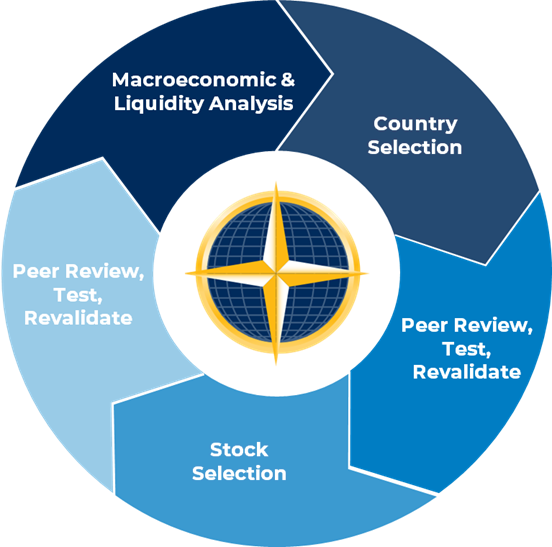
NSP_COMM_2026-03-11_Chart01

Through periods of high uncertainty and violent market moves like what we have currently, we lean heavily into this OODA (Observe, Orient, Decide, Act) Loop. This involves a constant testing and re-testing of our macro views and investment hypotheses, and tweaking of the portfolio as conditions change.

Example: lifting oil exposure

Moving from being zero weight in oil companies at the start of 2026 to equal weight (and with more beta to oil than the index) by the end of February is one example of how iterative tweaks in our macro analysis left the portfolio in a better position to weather the events of early March.

Towards the end of last year, one of the most debated topics of discussion in the team was our heavy underweight to the energy sector and, in particular, oil. Our only energy holding at the end of 2025 was uranium miner CGN.

While we remain structurally cautious about oil’s long-term investment prospects, from a portfolio risk perspective we became concerned that having no oil exposure had turned into a crowded consensus trade – especially as weak prices began to squeeze US shale production. This alongside news of a US naval build up in the Persian Gulf, Arabian Sea and Eastern Mediterranean early in the year suggested the portfolio was exposed to risk of a geopolitical shock in the region. Through January and February, we gradually lifted our oil exposure from zero to an equal weight of over 3.5%.

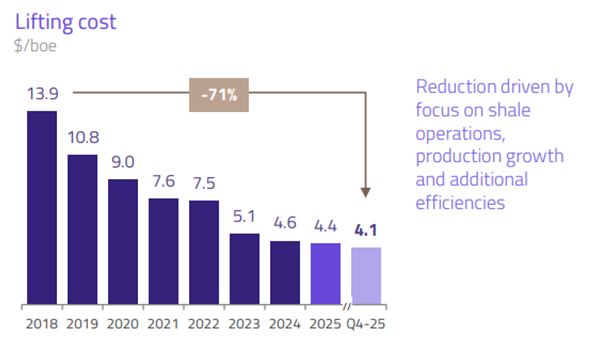
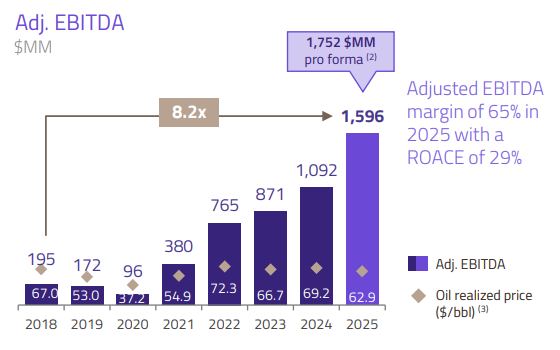
While our macro and risk analysis helped to identify a potential vulnerability, we could not know that conflict was about to break out in early March and drive such a dramatic hike in the price of oil. It was not a case of just adding oil beta to the portfolio. We added Argentinian shale oil producer Vista Energy and Petrochina based on their healthy returns on invested capital sustainable even through weak pricing environments, underpinned by growing production profiles, capital discipline and low lifting costs.

Vista Energy: Production growth and falling lifting costs driving earnings growth
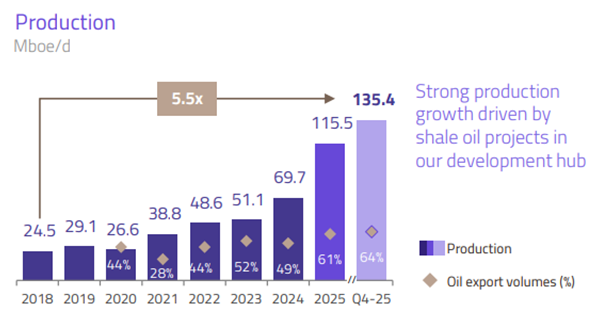
NSP_COMM_2026-03-11_Chart02
NSP_COMM_2026-03-11_Chart03
NSP_COMM_2026-03-11_Chart04
Source: Vista Energy Investor Relations 2026

The lift to oil exposure was timely, helping to preserve relative gains made this year despite sharp drawdowns in other winning positions that had been hit by broad risk-off sentiment.

Where to from here?

We rated the global monetary backdrop as modestly supportive coming into this shock, largely reflecting favourable trends in EM. However, we have been expecting the global stockbuilding cycle to turn down during 2026, giving us a bias to increase defensive positioning at the margin, especially on any signs of monetary weakness.

The energy price spike, unless swiftly reversed, will push up inflation and squeeze real money growth. It is leading to a revision of expectations for central bank policies, which may dampen nominal money growth. Nominal money trends are also at risk from recent tightening in US private credit conditions, which the current shock may exacerbate.

We are cautious and do not expect the negative effects of this shock will be swift to reverse, so our inclination is to add to defensive positioning on any rally, rather than to view current market weakness as a buying opportunity.
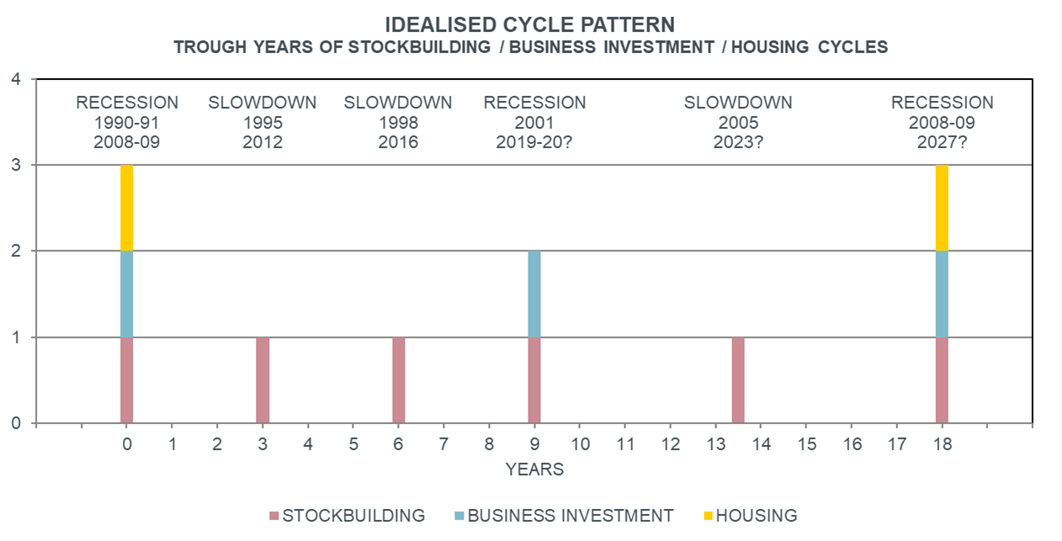
The long-standing forecast here has been that the three key global economic cycles – stockbuilding, business investment and housing – would enter downswings by 2026-27.

In the event that the downswings were synchronised, the result would be a major recession, on the scale of 1974-75 or 2008-09.

If the downswings occurred successively, the result would be a long period of rolling weakness including a less severe recession – the early 1990s scenario.

Chart 1 is an exhibit used in 2018, suggesting – based on average cycle timings – a recession bottoming in 2019-20, a slowdown into 2023 and a major recession around 2027. The former two played out.

Chart 1

NSP-WeeklyBulletin-20260309-Chart7-1024×897-1.png

The housing cycle is already in a downswing, the stockbuilding cycle is at or close to a peak, while the business investment cycle is well-advanced. The Gulf War III energy price shock could be the trigger for synchronised weakness.

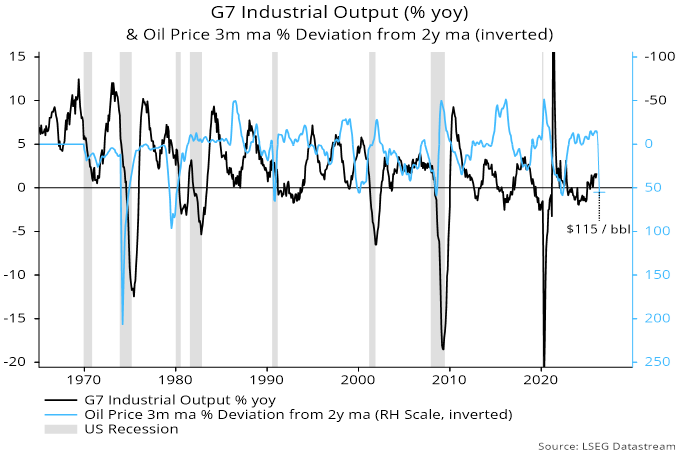
There have been six oil price “shocks” since the 1960s, defined here as episodes in which the spot price rose 50% or more above its two-year moving average for at least three months. All were followed by a significant contraction in G7 industrial output and five were associated with a US recession, as determined by the NBER – chart 2.

Chart 2

NSP-WeeklyBulletin-20260309-Chart8-1024×897-1.png

Spot Brent of $100 per barrel represents a 37% premium to the two-year moving average. Oil would have to be sustained at about $115 for three months for the current spike to qualify as a “shock”.

The oil intensity of GDP has fallen dramatically since the 1970s, suggesting less vulnerability to shocks. This could explain why the most recent shock – in 2022 – did not involve a US recession.

An alternative view is that a recession was avoided because the cyclical backdrop was less unfavourable and there was pent-up demand due to pandemic disruption, reflected in a large monetary overhang. The stockbuilding cycle turned down in 2022 but the housing and business investment cycles were in late upswing and recovery phases respectively.

The prior shocks caused short-term inflation spikes and were associated with upward pressure on interest rates, contributing to a fall in nominal narrow money momentum. G7 real money contracted ahead of maximum economic weakness. Real money data will be key for assessing the extent of current economic damage.

Cozy modern bedroom with white bedding, wood panel walls and warm lighting.

“A good laugh and long sleep are the best cures in a doctor’s book.” – Old Irish proverb

It’s been more than a decade since the CDC declared sleep disorders “a public health epidemic.” Since then, the world has woken up and taken note. The long-term impact of sleep loss on mental health and physical performance has been widely documented in scientific studies. From cardiovascular disease to compromised immunity and burnout, poor sleeping habits quietly add up over time while increasing our mortality risk. Sleep is also important for cognitive health because it gives the brain time to remove toxins that accumulate while we are awake.

The three foundational pillars of human health are sleep, diet and exercise. Diet and exercise have always dominated conversations around health with very little attention paid to sleep and sleeping habits. Now sleep (or the lack of it) has finally caught the attention of society at large and with it we have seen the rise of the sleep economy.

The broader sleep economy encompasses everything from sleeping aids to sleep medication and supplements, bedding and furnishing to sleep tourism. Just the sleeping-aid market is estimated to reach $188 billion according to Statista. The emergence of the sleep economy is best represented by the popularity of products like the Oura ring that tracks heart rates, sleep cycles and recovery metrics. Oura ring has sold over 5.5 million rings and the company behind it, Oura Health, was valued at $11 billion last year.

Beyond just physical products, we are also seeing the rise of sleep tourism, with travelers showing an increased preference for sleep-focused holidays. Hotels understand that their customers now value good quality sleep and offer everything from smart beds and pillow menus to sleep-specific spa treatments and dedicated sleep programs to help reset the circadian rhythm and allow customers to rest.

One of the holdings in our portfolio is Atour Lifestyle Holdings Ltd. (ATAT US), the largest hotel operator in China’s upper-midscale segment. There are several attributes of the business that make it attractive purely as a hotel operator – from its brand strength to its ability to expand in an asset-light manner while maintaining its attractiveness to prospective franchisees.

However, Atour also has a fast-growing retail business that caters directly to emerging sleep economy trends. From deep sleep pillows to mattresses and comforters, Atour is the first hotel chain in China to develop a retail business around the sleep economy. Sleep economy aside, Atour also taps into so called new consumption trends in China where consumers prioritize maintaining a balanced lifestyle and personal fulfillment over conspicuous consumption that was prioritized by their parent’s generation. From that perspective, Atour for us checks two boxes: the rise of the sleep economy and shift in spending toward services like travel and tourism, concerts etc.

Atour is able to create synergies with its hotel business by cross selling its products to its hotel guests. Hotel guests get what is in effect a free trial when they stay at an Atour property and their real-time feedback is used to enhance product R&D. It helps that Atour’s premium positioning has a positive spillover effect on the brand positioning of its sleep products. Being alert to changing societal norms and evolving spending priorities is a key element in identifying themes within our investment process. We sleep well at night knowing that these thematic tailwinds provide a nice boost to Atour’s revenues and profitability on top of good execution with its core hotel business.

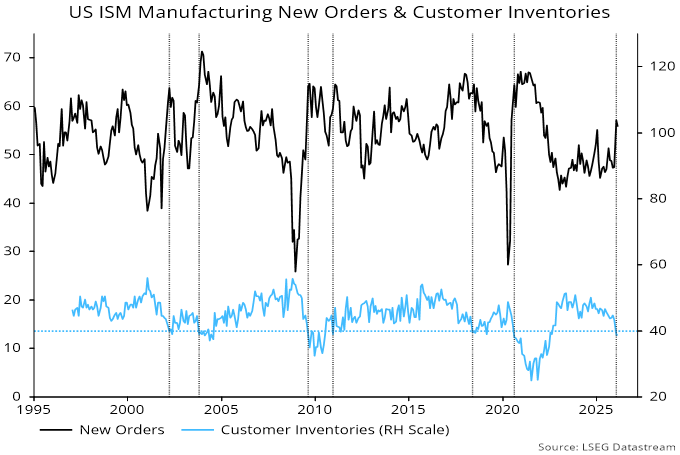
A rise in the ISM manufacturing new orders index was expected to be short-lived even before the outbreak of Gulf War III.

The index jumped from 47.4 in December to 57.1 in January, with a small retreat to 55.8 in February. The January reading was the strongest since 2022.

The ISM rise, along with a parallel increase in global manufacturing PMI new orders, boosted hopes of a sustained industrial upswing with an associated earnings-driven broadening of equity market gains.

The interpretation here, by contrast, has been that the ISM / PMI rises reflect the global stockbuilding cycle moving into a peak. The cycle was expected to begin a downswing by mid-2026 into a H1 2027 low.

The ISM customer inventories index supports this interpretation. The jump in new orders has been accompanied by a sharp fall in customer inventories to below 40. Previous declines to sub-40 occurred around peaks in new orders – see chart 1.

Chart 1

040326c3.png

This seems, on first consideration, perverse. The customer inventories index is a gauge of whether stock levels are too high or low. Falling / low readings might be expected to signal future restocking, resulting in a rise in new orders.

The explanation for the opposite relationship is that, by the time they report lower inventories, customers are already placing restocking orders, i.e. the additional demand is reflected in current not future new orders. The next phase of the cycle involves customers reducing demand as inventories return to a comfortable level. This phase marks the new orders peak.

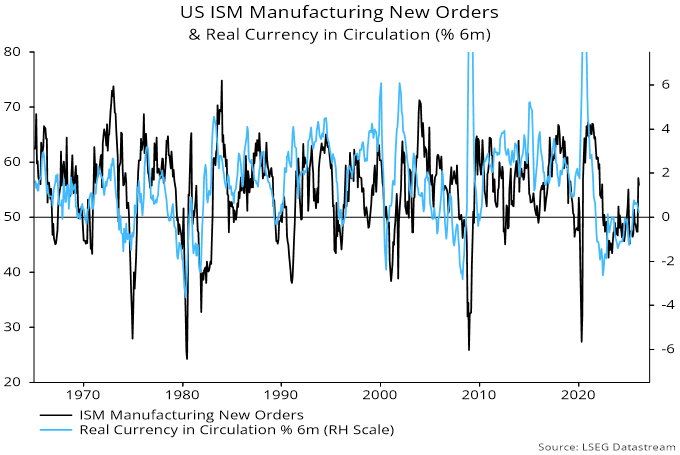
An imminent ISM new orders reversal is also implied by a recent decline in six-month growth of real currency in circulation, which has led the orders index by an average eight months historically and peaked most recently in August – chart 2.

Chart 2

040326c3.png

The suggested explanation for this relationship is that currency demand is influenced by retail spending plans, with such spending driving orders placed by retailers / wholesalers. The currency slowdown may indicate that spending prospects were deteriorating before the energy price shock.

Photo de Lindsay Holtz et Moira Turnbull-Fox.

Lindsay Holtz et Moira Turnbull-Fox ont été mises en vedette dans un récent article de Benefits and Pensions Monitor intitulé « Why micro-communities matter for women’s careers ». Elles ont parlé de notre collectif de femmes et de l’importance de créer des espaces pour les femmes dans l’ensemble du Groupe financier CC&L et de ses sociétés affiliées afin qu’elles puissent établir des liens et s’entraider.

« Il existe de nombreux événements de réseautage à l’externe auxquels les gens peuvent participer, mais nous avons constaté qu’il y avait un manque ici même, à l’interne. Il nous a donc été facile de saisir cette occasion et de l’orienter dans la direction que nous souhaitions lui donner », explique Lindsay.

L’article coïncidait avec la Journée internationale de la femme, un rappel mondial des progrès réalisés, du travail qui reste à faire et de l’importance de créer des environnements où les femmes peuvent diriger, s’épanouir et se faire entendre. C’est le moment de célébrer les réalisations, de promouvoir l’équité et de réaffirmer notre engagement à soutenir les femmes dans nos milieux de travail et nos collectivités.

 
Lire l’article complet

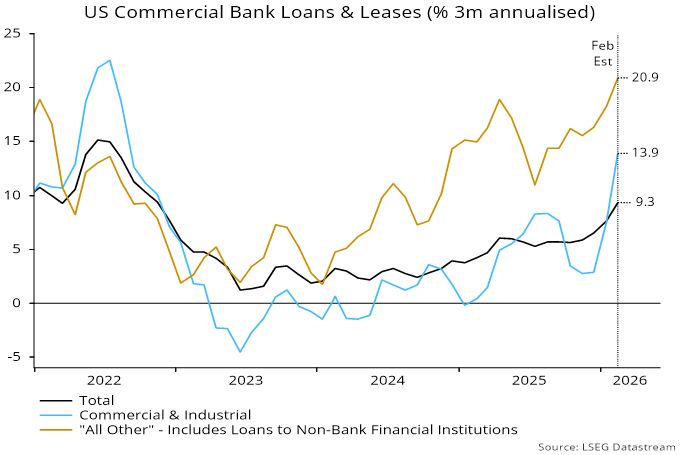
A recent pick-up in commercial bank loan growth is unlikely to be a positive signal for economic prospects.

Commercial banks’ loans and leases are estimated to have risen at a 9% plus annualised rate in the three months to February, up from 5.9% in the prior three months, based on weekly data through mid-month – see chart 1.

Chart 1

250226c3.png

Unlike money measures, bank loans are a coincident or lagging indicator of economic activity. Commercial and industrial (C&I) loans and consumer installment credit are components of the US Conference Board lagging economic index.

The recent acceleration has been driven by two categories: C&I loans, which account for 21% of total loans and leases; and “all other”, accounting for 23%, which includes loans to non-bank financial institutions.

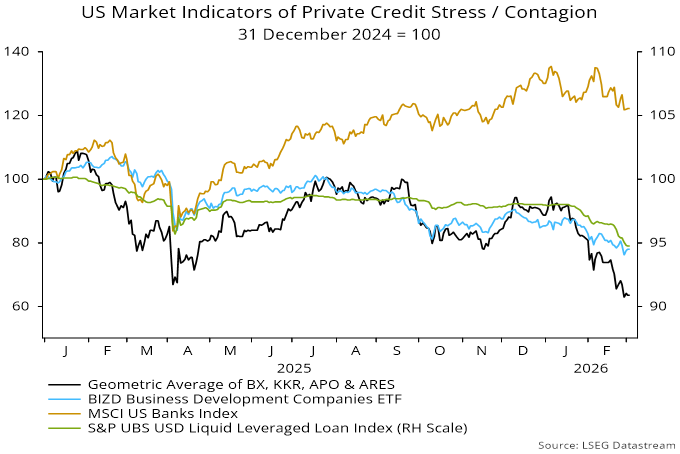
Growth of the latter category rose strongly over 2024-25 as banks contributed funding to a boom in private credit. Worries about credit quality and illiquidity have ended this boom, with market indicators signalling rising stress – chart 2. The recent further strength in “all other” loan growth may reflect private lenders drawing down bank credit lines as other sources of funding dry up.

Chart 2

250226c5.png

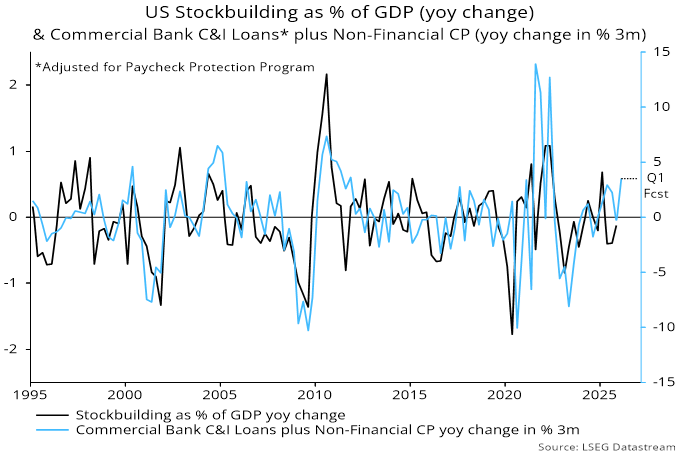
Reduced availability of private credit probably partly explains the pick-up in demand for C&I bank loans. However, such demand is also influenced by the stockbuilding cycle – chart 3. Stronger growth suggests that stockbuilding has rebounded in early 2026, supporting concurrent economic activity but with payback likely later in the year.

Chart 3

250226c2.png

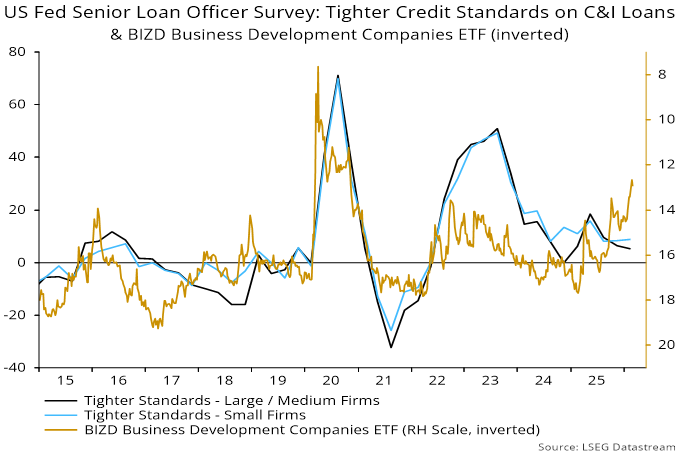
To the extent that bank loan acceleration reflects a “reintermediation” of credit demand due to a bust in private credit, it is likely to cause banks to tighten lending standards, with negative monetary and economic implications. Such tightening may be confirmed in the April Fed senior loan officer opinion survey released in early May – chart 4.

Chart 4

250226c3.png

A Japanese "Shinkansen" (or bullet train), traveling through the Tokyo cityscape at dusk.

Japan is a country that remains steeped in tradition and ritual, even as it embraces and leads advanced technologies such as factory automation, semiconductor production equipment and high-speed trains. Staid practices such as invoicing expenses via fax machines, saving data on floppy disks and even signing documents with physical ink stamps continued unabated until the pandemic forced a wholesale rethink.

Historical context: System integrators

Japanese companies’ approach towards IT infrastructure differs fundamentally from their American and European counterparts. In the 1960s, the Japanese government was concerned about IT competitiveness against American behemoths, IBM and Intel. Therefore, the government funded the development of IT national champion NTT, as well as three other IT groups, Fujitsu and Hitachi, NEC and Toshiba, as well as Mitsubishi Electric and Oki. It also awarded these groups public projects over the decades since. By the 1980s, the private sector saw the spinoff of consulting subsidiaries, specializing in the IT needs of service sectors such as e-commerce and finance. These consultants became known as System Integrators (SIs).

Competitive advantage: Talent monopsony

SIs coordinate software vendors, hyperscalers, subcontractors and non-tech companies’ IT departments to meet their clients’ IT needs. SIs’ customer stickiness is strong because clients desire customization but can’t secure the top IT talent because of customers’ comparatively low salaries. Local companies’ IT workers are generalists who don’t know how to effectively procure hardware, manage software or even develop an IT strategy. Gartner found that 67% of such companies blamed « talent scarcity » as a major obstacle to IT upgrades (vs. 38% globally). With growing IT labour shortages and few students pursuing tech degrees, SIs’ core role between the key parties is what leads to higher margins, enabling companies to hire top SI talent.

Industry outlook: Long growth runway

IDC estimated that Japan’s $180 billion in annual general IT spend would grow at 6.4% CAGR into 2029E. Mordor Intelligence estimated that cloud spending would grow significantly faster than general at 17% CAGR into 2031E. According to Gartner, in 2021 31% of Japanese companies stored data on the cloud, with cloud comprising only 4.3% of total IT spend (vs. 14.4% North America, 9.7% Europe, 6.4% China). As of 2023, according to the Information Technology Promotion Agency, large Japanese firms with more than 1,000 employees had already drawn even with large American firms with ~63% of them noting that they had dedicated digital transformation (DX) departments (vs. ~64% for large American firms). In contrast, smaller Japanese firms with fewer than 1,000 employees were lagging behind with just ~12-41% reporting dedicated DX departments (vs. ~39–66% for smaller American firms). Smaller capitalization SIs serve small customers.

Gen-AI: More opportunity than threat

While software-as-a-service (SaaS) company stocks have sold off across America, Europe and Japan year to date, we expect strong demand for cybersecurity and infrastructure to continue, benefiting SIs. This is because declining software development costs amid AI-led coding and fiercer price competition against AI agents reduce overall software package costs. While lower prices hurt SaaS supplier margins, they boost customers demand.

SIs are crucial to the integration of software packages with hardware and networks, all safeguarded by cybersecurity. Japanese companies’ core IT systems were built by the SIs themselves in complex layers based on evolving business needs and characteristics. This makes it hard to standardize processes, a necessary precursor to an AI-first automated approach. Rather, our SIs will even benefit from rising demand for limited IT system standardization as companies seek to deploy agentic AI. Admittedly, agentic AI has the potential to replace end-user applications in enterprise resource planning, but we believe that SIs will retain their crucial role in maintaining infrastructure by offering cybersecurity.

DX favours smaller SIs

Mentioned above, DX refers to the implementation of digitalization through efforts such as transitioning data to the cloud to avoid reliance on onsite physical data storage and, more recently, rolling out gen-AI models to boost productivity. The term captures the shift in approach from treating IT as peripheral toward recognizing its centrality. As IT competitiveness and DX continue in Japan, the next leg of growth should be led by DX service providers that focus on smaller firms.

Simplex Holdings

Simplex Holdings Inc. (4373 JP) was founded in 1997. In 2001, it began offering banks with solutions like IT consulting, systems development, and operations and maintenance. Over the decades, it expanded into FX brokerages, equity, futures, options platforms, insurers and crypto. In 2013, it conducted a $211 million buyout with Carlyle. Carlyle later sold its equity stake upon Simplex’s September 2021 relisting on the Tokyo Stock Exchange. We feel that Simplex is well positioned to benefit from this trend.

* all dollar amounts referenced in this article are in USD.

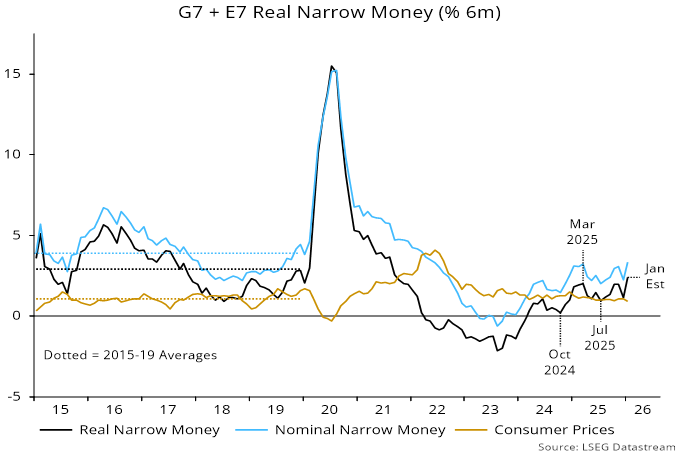
Global six-month real narrow money momentum is estimated to have rebounded from a sharp December fall to reach a new high in January, based on monetary data covering three-quarters of the G7 plus E7 aggregate tracked here – see chart 1.

Chart 1

200226c1i.png

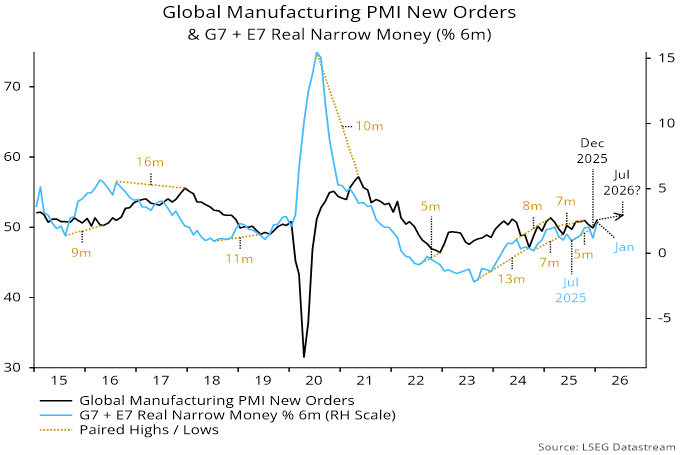
The December drop was the basis for an earlier forecast that a rise in global manufacturing PMI new orders would fizzle out in Q2, with a relapse into Q3. The January monetary news suggests that the current upswing will be sustained into H2 – chart 2.

Chart 2

Chart 2 showing Global Manufacturing PMI New Orders & G7 + E7 Real Narrow Money (% 6m)

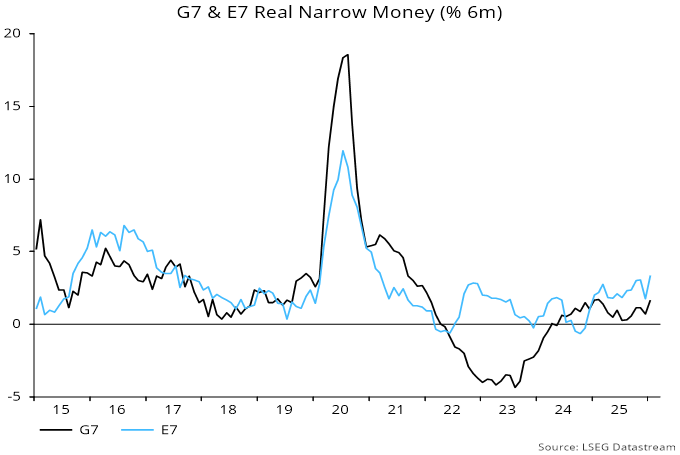
Both G7 and E7 components contributed to the January rise in real money momentum, but the G7 series is estimated to have remained below a February 2025 peak, whereas E7 momentum reached a new high – chart 3.

Chart 3

200226c1i.png

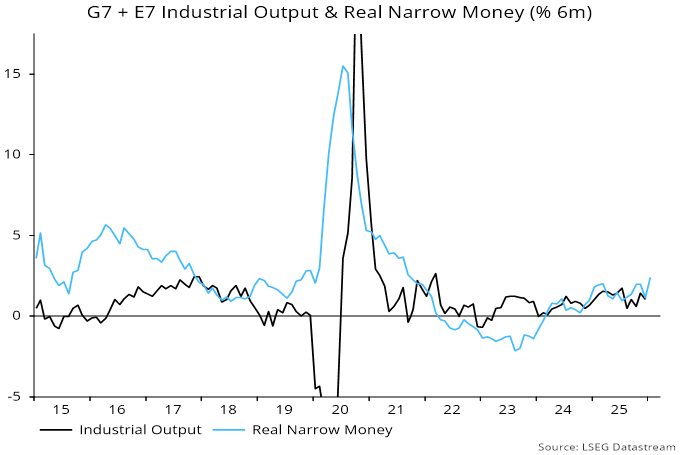
The rebound in global real money growth has likely restored a positive differential with industrial output momentum, suggesting “excess” money support for markets – chart 4.

Chart 4

20251127_NSP_MMM_Image_WP-Thumbnail.jpg

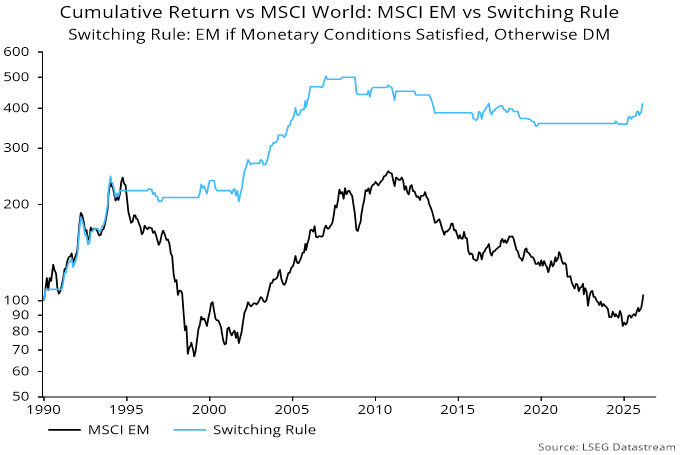
Previous posts noted that EM equities outperformed DM on average historically in months following positive readings of this differential and the E7 / G7 real money growth gap (allowing for reporting lags). The joint condition was in place in nine of the last 12 months. Chart 5 shows the performance of a monthly switching rule that prefers EM only when the joint condition is satisfied, otherwise reverting to DM. The latest news implies that the rule will continue to favour EM in March and, probably, April.

Chart 5

Mixed flash PMIs

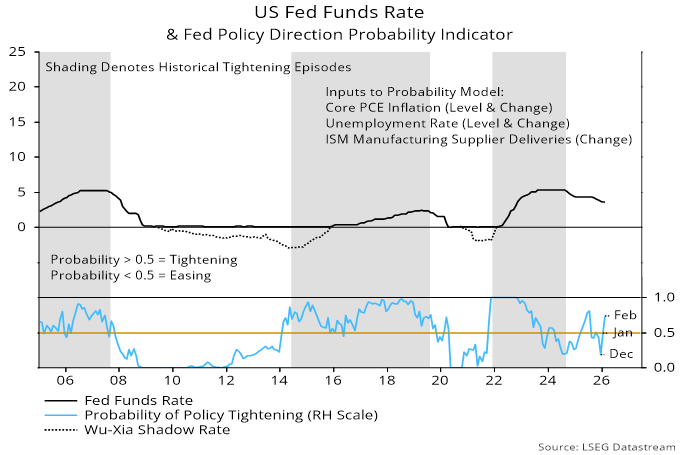
The historical Fed would be shifting to a tightening bias in response to recent economic news, according to a simple model.

To recap, the model classifies the Fed as being in tightening or easing mode depending on whether a probability estimate is above or below 0.5. The estimate is based on currently reported and lagged values of annual core PCE inflation, the unemployment rate and the ISM manufacturing delivery delays index. Despite the small number of inputs, the model does a satisfactory job of “explaining” the Fed’s past actions.

The model reading moved below 0.5 in August ahead of the September / October rate cuts, falling further in December, when the Fed delivered another reduction while signalling an expectation of additional moves in 2026 – see chart 1.

Chart 1

US Fed Funds Rate & Fed Policy Direction Probability Indicator

The reading, however, rebounded to around neutral in January and has climbed above 0.7 in February. The turnaround has been driven by a combination of a fall in the unemployment rate from 4.54% in November to 4.28% in January, a rebound in the ISM deliveries index from a November low and slightly firmer annual core PCE inflation (3.0% in December).

Additional data points for all three series will be available before the March FOMC meeting.

The January model shift is consistent with minutes of last month’s meeting, showing a strong consensus in favour of a hold with “several” participants viewing interest rate risks as two-sided.

A high-performance personal computer displaying a modern video game in a room illuminated by futuristic neon lighting.

The rapid repricing of global gaming equities year to date reflects a sharp narrative pivot in the market, hitting the stocks of portfolios holding Tencent, as well as other leading players such as Nintendo and Roblox. Only months ago, consensus held that AI would be an operational tailwind for game developers through cost reduction and faster content generation.

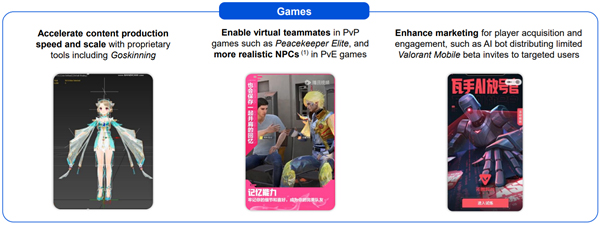
AI enhancing content production and experience
Image illustrating the different ways that AI can enhance gaming content production and the in-game experience.
Source: Tencent Investor Relations 2026

Following new AI model releases such as Anthropic’s Claude Code and Google’s Project Genie, the prevailing fear is that AI will disrupt traditional game development entirely.

The question for investors is whether Tencent, as the world’s largest gaming company by revenue, is positioned to benefit from or be impaired by this shift.

AI as a development tool

Tencent’s core strength is scale – both financial scale and model training scale. In discussions with management late last year, they emphasised that AI is already deeply embedded in their workflow: procedural content generation, NPC behavioural modelling, art and animation tooling and faster iteration cycles. These capabilities are not theoretical; Tencent purchases more AI compute and silicon than nearly any other company in Asia, outside hyperscalers.

Small studios will indeed be empowered by AI, lowering entry barriers and enabling “one hit wonder” creators, much like YouTube transformed video production.

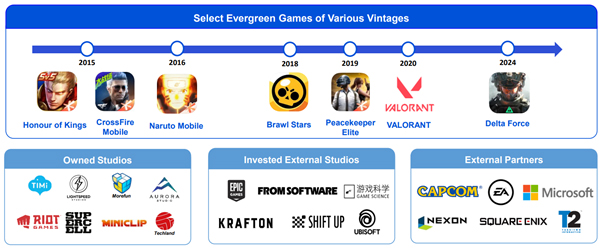
However, distribution, marketing and IP longevity remain durable moats. Tencent excels in all three. Owning evergreen franchises – over 80% of its portfolio – means that even if development costs fall, the value of recognised IP rises.

Timeline showing the years different evergreen game properties of Tencent were introduced. Logos of Tencent owned studios, invested external studios and external partners are displayed to show Tencent's network.
Source: Tencent Investor Relations 2026

AI makes content easier to create, but not easier to distribute at scale, monetise efficiently or ensure regulatory compliance – areas where Tencent’s ecosystem advantage is overwhelming.

Golden age of movie studios gives way to more atomised content creators – parallels?

Consider the shift from studio dominance in Hollywood to a more atomised creator economy. AI could indeed enable a long tail of nimble game creators, just as digital tools transformed music and film production. If so, Tencent’s role may shift toward that of a global distributor and platform – akin to Netflix in video or Spotify in music.

But unlike movies, gaming economics rely heavily on ongoing monetisation: loot boxes, in-game economies, battle passes, skins and continuous seasonal content. Even if AI reduces production costs, developers with large user bases can simply retain the value by expanding monetisable content. Consumers rarely pay less – they typically pay more in more immersive and interactive environments. Tencent’s superior ability to drive retention and average revenue per user works in its favour.

Fear premium

Tencent today trades at ~16x PE with mid-teens EPS growth, and minimal risk to near-term earnings. This is historically inexpensive for a high-quality global IP and distribution engine. The derating reflects uncertainty over future industry economics – not current fundamentals.

The key debate is not whether Tencent gets disrupted this year (unlikely), but whether AI compresses long duration returns on capital for AAA studios globally.

Markets are trying to reprice the terminal value of moats like content creation and distribution.

Our view: Tencent is better positioned than most

AI will shift value around the gaming ecosystem. Some of that may move to consumers, some to new AI native studios and some to distributors. But scale matters. IP matters. Distribution matters. And Tencent is uniquely advantaged in all three.

The company may face multiple compression as investors debate the long-term competitive dynamics, but fundamentally, Tencent is more likely to be a beneficiary of AI than a casualty. The path will be volatile, but the structural advantages remain intact.

Trump’s trade doctrine: Opening the door to higher-return industrial champions

Last month, I spoke with Benefits and Pensions Monitor about the short-term noise generated by Trump tariff headlines. We explored whether investors should be looking through the noise based on the TACO (Trump Always Chickens Out) view that the US president will retreat in the face of market revolt.

My argument was that, while amusing, TACO risks obscuring the unmistakable direction of travel. US trade policy signals a shift to a multipolar world, defined by a US centric economic sphere and a China centric one, each with competing supply chains, industrial priorities and strategic alliances. Tariffs are signals of tectonic shifts in global trade.

Our view is that these shifts bring risks, but will also be a durable source of opportunity for EM investors.

When China is taken out of your supply chain, everyone makes money

Traditionally, sectors like shipbuilding, industrial machinery, energy logistics and specialty manufacturing have been deeply cyclical with limited pricing power. They lived and died by freight rates, commodity cycles and economic growth. But the combination of US reindustrialisation, reshoring and decoupling from China is transforming these industries.

Historically commoditised, price‑taking businesses are now at the heart of national security and industrial policy. Reindustrialisation and rebuilding supply chains have the potential to drive visibility, margins and returns on capital that would have been unthinkable a few years ago.

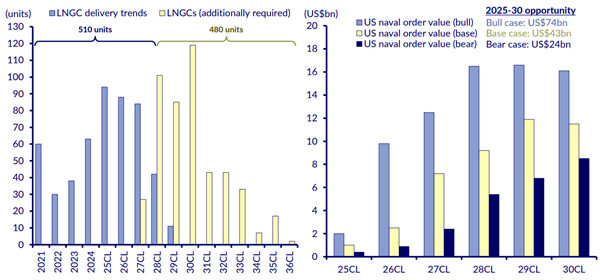
For example, the order books of Korean shipbuilders are increasingly less shaped by commercial shipping cycles, and increasingly by long‑cycle defence, LNG infrastructure and government‑aligned industrial programmes across the United States and its allies.

Major opportunities ahead for Korean shipbuilders in LNGC and naval vessels
Bar graphs illustrating Korean shipbuilders decreasingly affected by commercial shipping cycles.
Source: CLSA, Clarksons

US-China decoupling has effectively removed Chinese yards from security‑sensitive projects, structurally elevating demand for non‑Chinese capacity.

For countries aligned with US industrial and security priorities – Korea, Japan, India, parts of ASEAN – select industries have the potential to enjoy rerating as increasingly strategic rather than cyclical businesses.

This extends far beyond shipbuilding. We are seeing it in components for AI data centres, grid and power equipment, strategic metals, defence, electronics, energy infrastructure and advanced manufacturing.

These sectors are beginning to enjoy the boost of multi‑year, policy‑backed spending.

Many EM countries offer the scale, labour force depth and geopolitical neutrality that global supply chains now require. As the world bifurcates, EM manufacturers, suppliers and logistics operators are becoming essential nodes in both the US and China spheres. This creates a long pipeline of opportunities in markets that historically suffered from volatility and low returns.

In short, Trump’s trade doctrine accelerates a global realignment that raises the return potential of industries previously stuck in low‑margin cycles.