post in October gave a hopeful view of Chinese prospects, noting that “excess” money had accumulated and could flow into equities and the economy if policy-makers signalled a commitment to expansion.

The consensus is now optimistic, believing that property market support measures and the removal of pandemic control restrictions will result in strong economic acceleration through 2023. Yet the latest money / credit data signal caution.

Globally, Chinese reopening is expected to be reflationary. Reopening, however, will release supply as well as demand. The former effect could dominate, resulting in additional downward pressure on Chinese export prices.

Six-month growth of true M1 peaked in July 2022, falling back to its March level in December – see chart 1. This suggests a slowing of underlying nominal GDP momentum from Q2. The levels of nominal and real narrow money growth are modest by historical standards. 

Chart 1
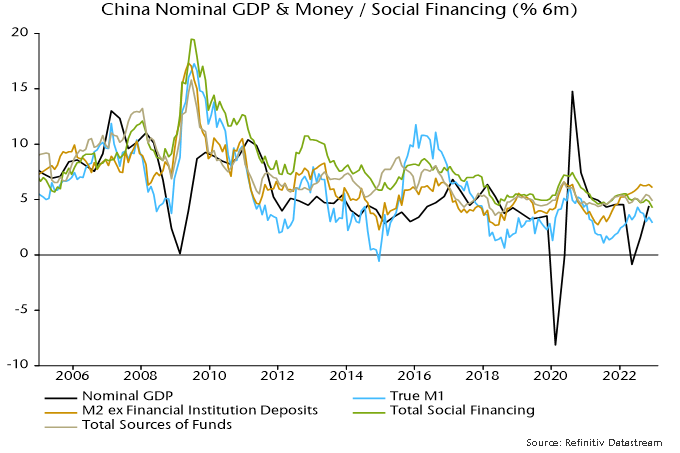
Chart 1 showing China Nominal GDP & Money / Social Financing (% 6m)

Broad money trends are stronger, with six-month growth of the favoured measure here – M2 excluding deposits of non-bank financial institutions – ending 2022 near the top of its range in recent years. Money, however, needs to shift from time deposits into M1 to signal rising confidence and spending intentions. 

Broad money growth may have been inflated by a switch out of wealth management products and other bank liabilities into deposits. The total stock of bank funding has been growing less strongly, with minimal acceleration since 2021 – chart 1. 

Many analysts follow the “credit impulse” – the rate of change of credit growth, usually expressed relative to GDP. This often gives the same message as narrow money trends (but is judged here to be less reliable) and also suggests a loss of economic momentum – chart 2. 

Chart 2
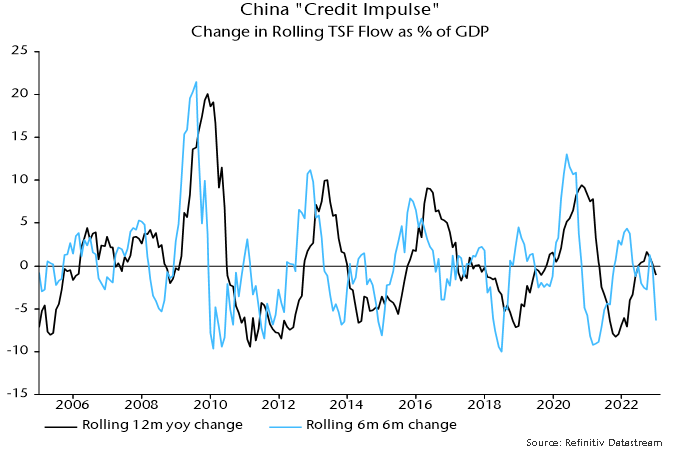
Chart 2 showing China “Credit Impulse” Change in Rolling TSF Flow as % of GDP

Bulls argue that excess household savings will fuel a consumption boom, drawing parallels with G7 experience following reopenings. Chinese households did not receive stimulus checks or direct wage support and the excess is likely to be considerably smaller, implying less pent-up demand. 

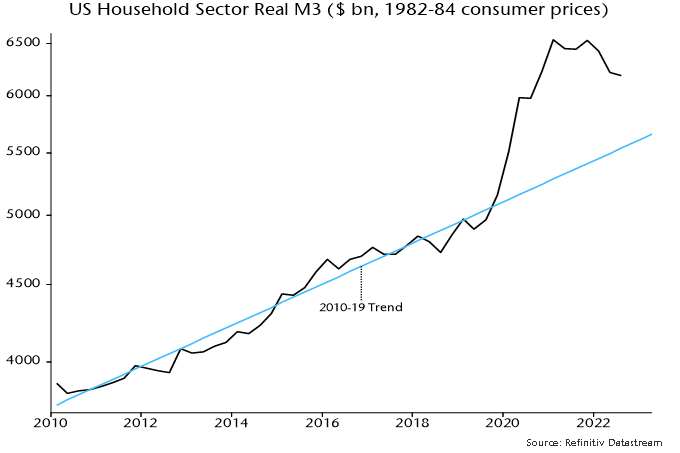
Supporting this view, household real M2 deposits in December were 8% above their pre-pandemic trend (and may have been inflated by the early timing of the Chinese New Year) – chart 3. US household real M3 holdings reached a peak 24% overshoot of the comparable trend in March 2021 – chart 4. 

Chart 3
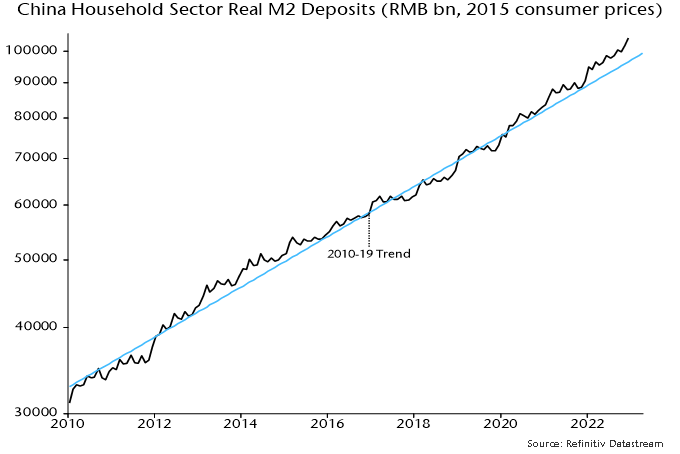
Chart 3 showing China Household Sector Real M2 Deposits (RMB bn, 2015 consumer prices)

Chart 4

Chart 4 showing US Household Sector Real M3 ($ bn, 1982-84 consumer prices)

Fed policy remained expansionary as pandemic drags faded. The PBoC, by contrast, appears concerned about inflationary risks from rapid reopening and has engineered or at least tolerated a significant rise in term money rates. The increase in late 2022 was universally dismissed by China specialists as a year-end phenomenon unrelated to any policy shift but a minor fall in early January has since given way to another rise – chart 5. 

Chart 5
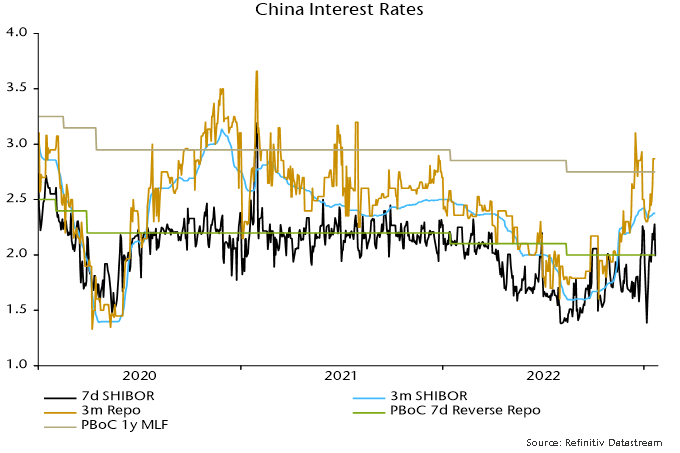
Chart 5 showing China Interest Rates

The view here is that the reopening boost to domestic demand will be modest and biased towards services. For goods, supply expansion due to reduced disruption may outweigh the lift to demand. 

Global trade moved into contraction in late 2022, partly reflecting an accelerating downswing in the global stockbuilding cycle. With supply constraints easing, Chinese exporters are likely to cut prices to increase market share, especially given the super-competitive level of the RMB – chart 6. 

Chart 6
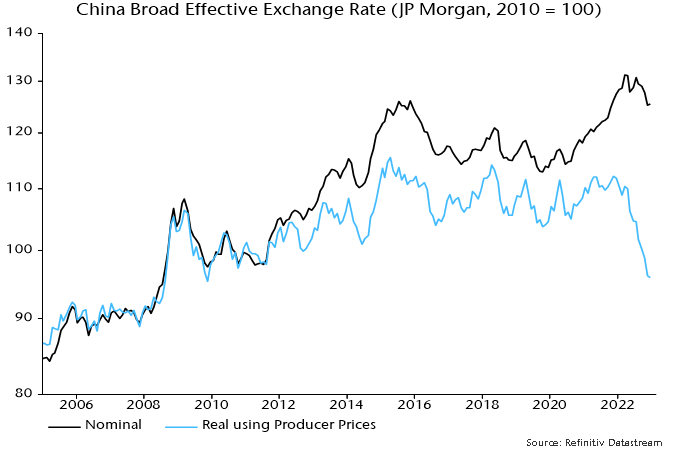
Chart 6 showing China Broad Effective Exchange Rate (JP Morgan, 2010 = 100)

Recent Bank of England signals have been deemed to be less hawkish than those of the Fed and ECB, contributing to a view that UK policy tightening is less likely to prove excessive, in the sense of causing greater economic damage than necessary to return inflation to target. 

Monetary trends do not support this hope. 

It should be remembered that the Bank embarked on rate hikes and QT before the Fed and has raised rates by 340bp versus the ECB’s 250 bp. 

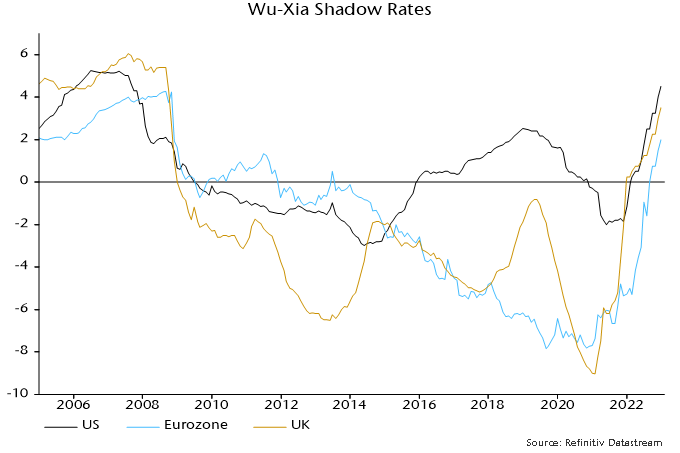
“Shadow” rate estimates attempt to incorporate the impact of unconventional monetary policy measures. The Wu-Xia shadow rate for the UK has risen by 1250 bp from its 2021 low versus increases of 650 bp and 980 bp respectively in the US and Eurozone – see chart 1. 

Chart 1

Chart 1 showing Wu-Xia Shadow Rates

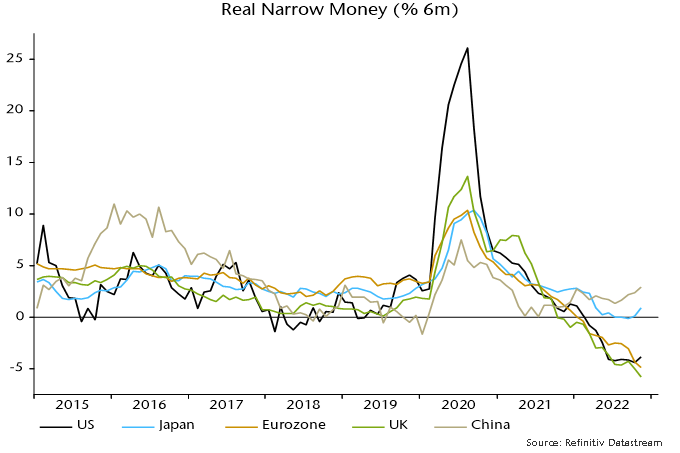
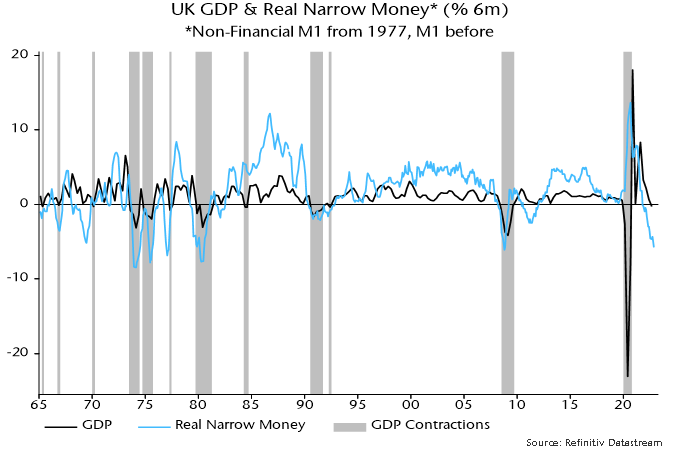
UK real narrow money (i.e. non-financial M1 deflated by consumer prices) contracted by more than comparable US / Eurozone measures in the six months to November – chart 2. The decline is historically extreme and suggests a severe recession – chart 3. 

Chart 2

Chart 2 showing Real Narrow Money (% 6m)

Chart 3

Chart 3 showing UK GDP & Real Narrow Money* (% 6m) *Non-Financial M1 from 1977, M1 before

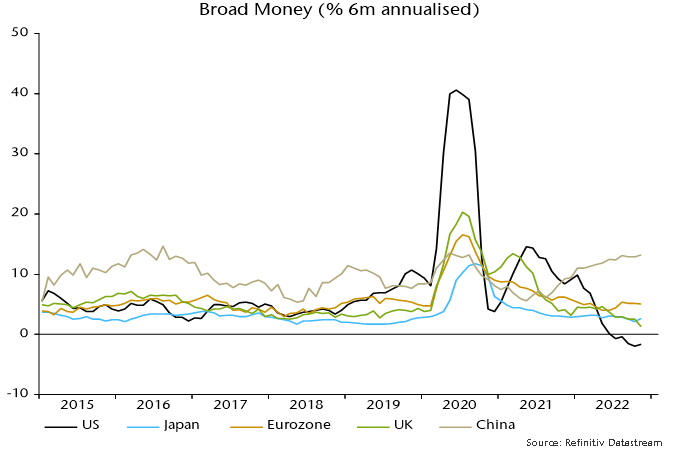
UK nominal broad money (non-financial M4) grew by just 1.3% at an annualised rate in the six months to November – chart 4. The comparable Eurozone measure rose at a 5.0% pace. US broad money contracted but is correcting a much larger increase in 2020-21. 

Chart 4

Chart 4 showing Broad Money (% 6m annualised)

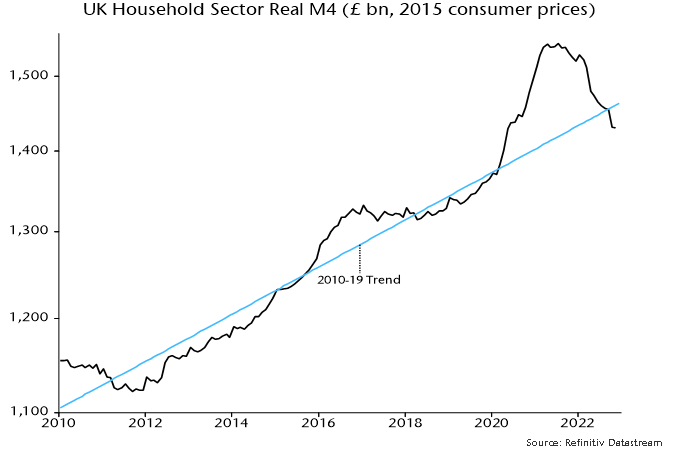
Real broad money holdings of UK households have retraced almost all of the pandemic-related surge, falling to the lowest level since May 2020 – chart 5. Far from “excess” money balances supporting spending, a real money squeeze is now likely to magnify consumption weakness. 

Chart 5

Chart 5 showing UK Household Sector Real M4 (£ bn, 2015 consumer prices)

Bank of England communications may be becoming less hawkish but the damage has been done. Officials ignored the monetary signal that a 2021-22 inflation spike would reverse with modest policy restraint. The economic consequences of overkill are likely to be at least as bad as in the US / Eurozone.

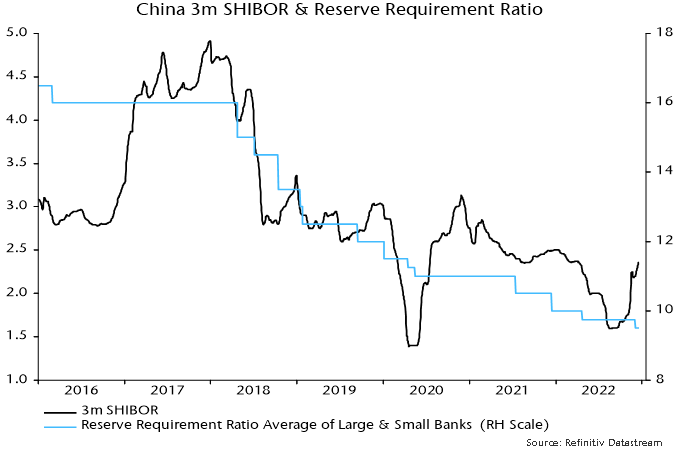
The BoJ’s decision to widen the fluctuation band of the 10-year JGB yield around the zero target follows an apparent withdrawal of monetary policy support by the PBoC in recent weeks. 

Three-month SHIBOR has risen by 75 bp since late September and is now only 15 bp below its start-of-year level – see chart 1. Upward pressure has been partly market-driven but the PBoC has chosen not to accommodate increased demand for liquidity. 

Chart 1

Chart 1 showing China 3m SHIBOR & Reserve Requirement Ratio

The PBoC’s Q3 monetary policy report, issued in November, expressed concern about medium-term inflation risks, stressing the importance of avoiding excessive monetary growth. An apparent hawkish shift may have been reinforced by the shock abandonment of the zero covid policy, which officials may view as likely to boost near-term price pressures via a faster demand recovery and / or an increase in supply bottlenecks. 

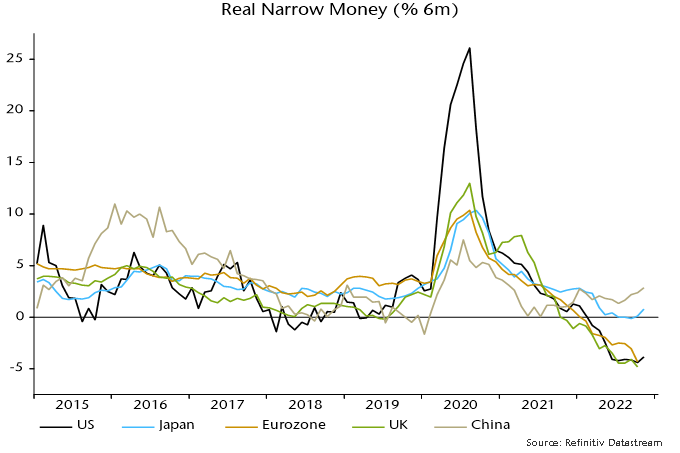
The Japanese / Chinese policy moves are worrying because monetary trends in the two economies have been providing a modest offset to significant US / European weakness – chart 2. That support could now fade. 

Chart 2

Chart 2 showing Real Narrow Money (% 6m)

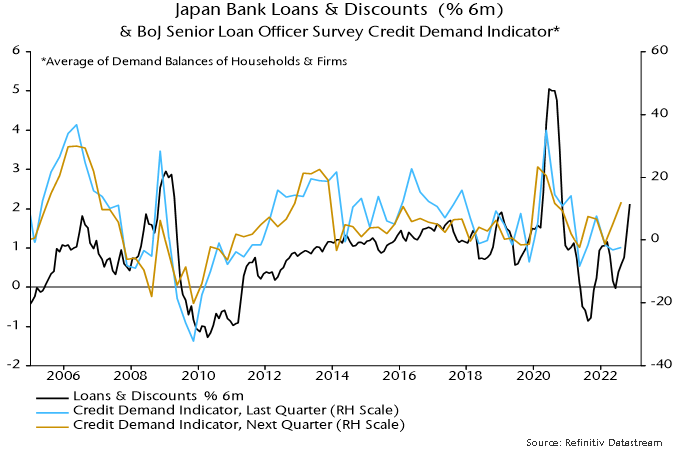
A rise in Japanese six-month narrow money growth in November was accompanied by a further pick-up in bank lending, consistent with stronger credit demand expectations in the BoJ’s Q3 loan officer survey – chart 3. The hope is that firmer bank loan growth / money creation will survive a modest policy adjustment. 

Chart 3

Chart 3 showing Japan Bank Loans & Discounts (% 6m) & BoJ Senior Loan Officer Survey Credit Demand Indicator* *Average of Demand of Households & Firms

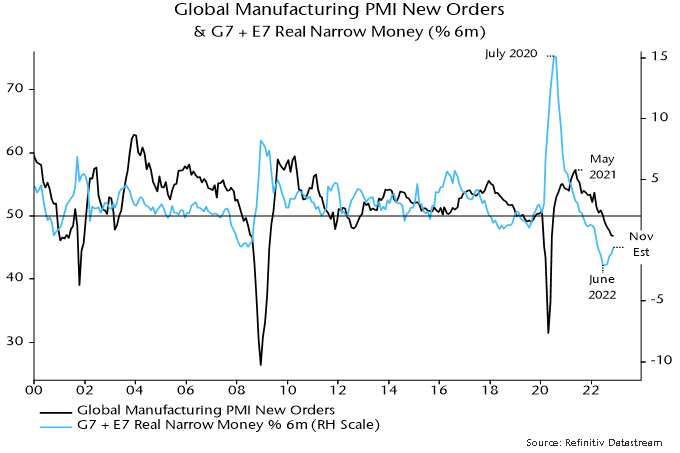
Global six-month real narrow money momentum is estimated to have risen for a fifth month in November but remains negative – chart 3. Allowing for the usual lag, the suggestion is that global manufacturing PMI new orders will bottom by next spring but remain in recessionary territory into Q3. 

Chart 4

Chart 4 showing Global Manufacturing PMI New Orders & G7 + E7 Real Narrow Money (% 6m)

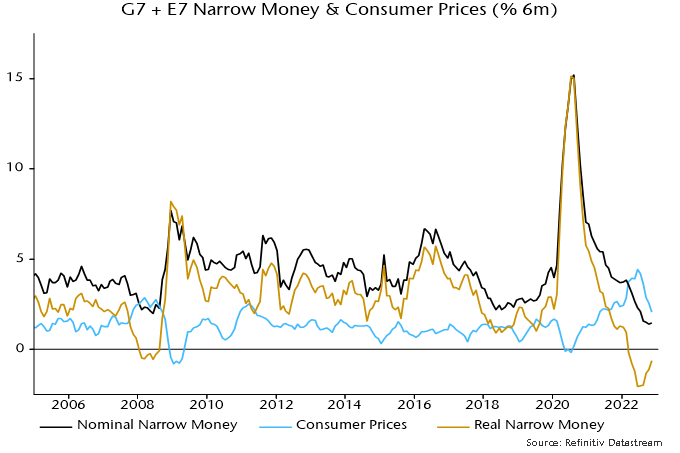
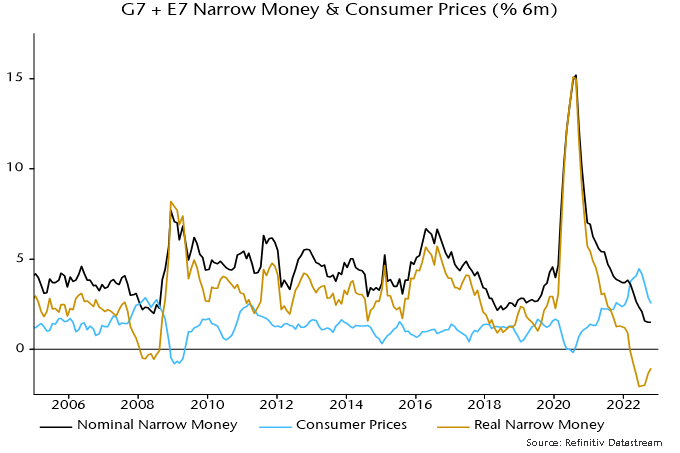
The recovery in real money momentum continues to be driven by a slowdown in six-month CPI inflation, with nominal money growth languishing – chart 5. The inflation decline will extend but overly hawkish central banks risk pushing nominal money momentum to new lows. 

Chart 5

Chart 5 showing G7 + E7 Narrow Money & Consumer Prices (% 6m)

The global manufacturing PMI new orders index was little changed in November, the six-month rate of change of the OECD’s G7 leading indicator has hooked up and cyclical sectors have been outperforming defensive sectors in the recent equity market rally. Do these developments signal a bottoming of global economic momentum and a prospective H1 2023 recovery? 

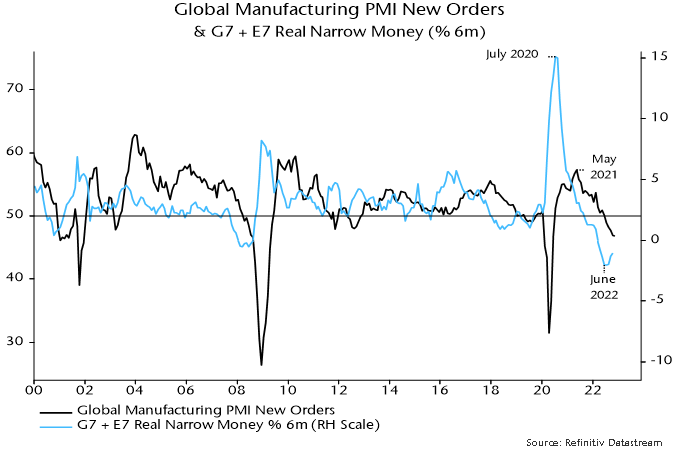
Monetary trends argue not. Global (i.e. G7 plus E7) six-month narrow money momentum rose slightly for a fourth month in October but remains in negative (i.e. recessionary) territory. All previous recoveries through the 50 level in global manufacturing PMI new orders were preceded by real money momentum rising above 2% – see chart 1. 

Chart 1

Chart 1 showing Global Manufacturing PMI New Orders & G7 + E7 Real Narrow Money (% 6m)

The June low in real narrow money momentum will probably hold but a corresponding PMI new orders low is unlikely before Q1 2023. There was a 10-month lag between the most recent real money growth peak (July 2020) and the matching PMI top (May 2021). 

There are additional negative considerations. The rise in real money momentum since June has been due to an inflation slowdown, with nominal money growth weakening further – chart 2. Previous PMI recoveries were preceded by nominal as well as real money accelerations. 

Chart 2

Chart 2 showing G7 + E7 Narrow Money & Consumer Prices (% 6m)

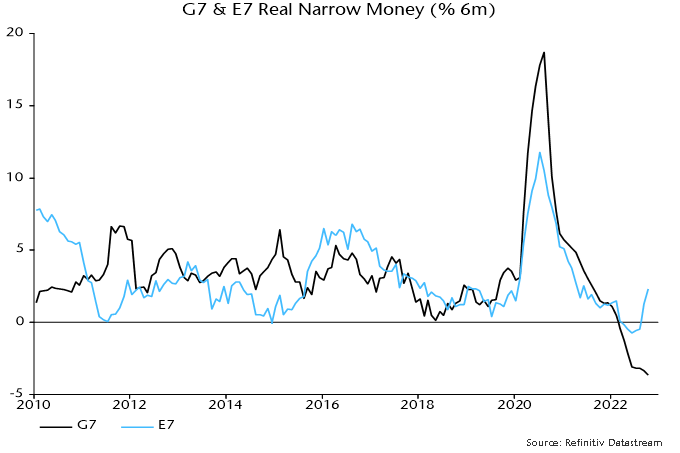
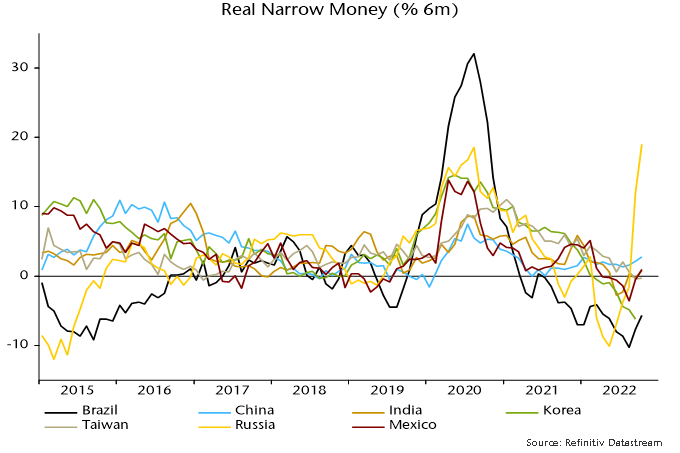
The rise in global real money momentum reflects the E7 component, with G7 momentum still weakening – chart 3. China, India, Mexico and Brazil have contributed to the E7 recovery but the increase has been exaggerated by a nominal money surge and inflation drop in Russia – chart 4. The latter may be of limited global relevance given Russia’s partial economic isolation. 

Chart 3

Chart 3 showing G7 + E7 Real Narrow Money (% 6m)

Chart 4

Chart 4 showing Real Narrow Money (% 6m)

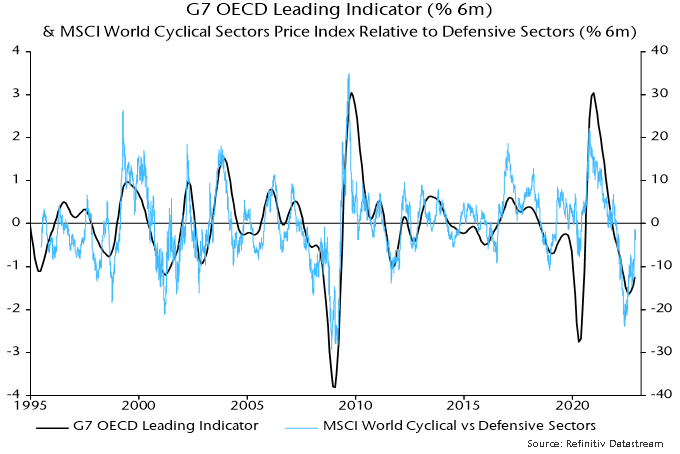
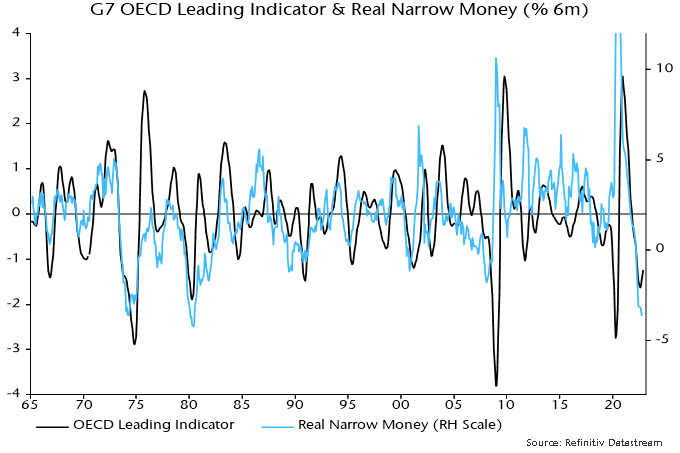
The six-month rate of change of the OECD’s G7 leading indicator rose slightly for a third month in November, according to calculations here. This appears to be a hopeful signal – bottomings historically have usually been followed by sustained recoveries, as chart 5 shows. The uptick is also consistent with recent better relative performance of cyclical equity market sectors. 

Chart 5

Chart 5 showing G7 OECD Leading Indicator (% 6m) & MSCI World Cyclical Sectors Price Index Relative to Defensive Sectors (% 6m)

Initial indicator readings, however, are often revised significantly and previous sustained recoveries in the six-month rate of change from negative territory were accompanied or more usually preceded by a revival in G7 real narrow money momentum – chart 6. With the latter yet to bottom, the uptick in indicator momentum may be either revised away or reversed. 

Chart 6
Chart 6 showing G7 OECD Leading Indicator & Real Narrow Money (% 6m)
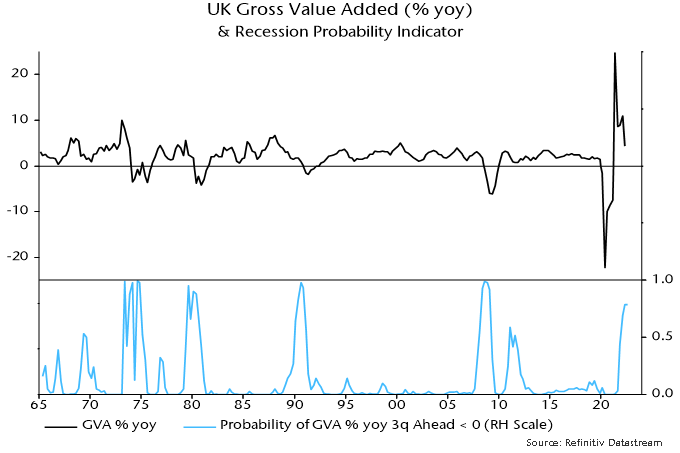
A “monetarist” UK recession probability model used here signalled a 70% likelihood of a recession in 2022 back in March. Coincident data suggest that contraction began in the summer. The model now indicates that the recession will last through Q2 2023, at least. 

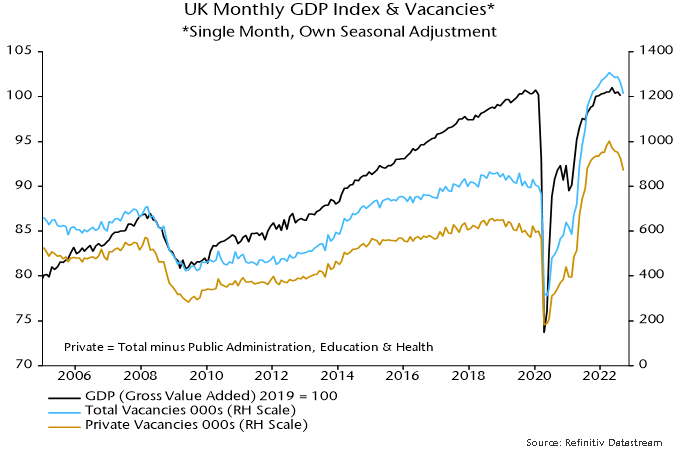
Monthly GDP figures have been affected by holiday distortions and are often revised significantly but current data show a peak in May and a 0.9% drop by August. 

Employment is a lagging indicator so further growth in the PAYE jobs measure (also subject to large revisions) through September does not preclude a recession having begun*. Job vacancies, by contrast, are coincident. The ONS vacancies series peaked in May, falling steadily through September. 

The published ONS series is a three-month moving average but single-month numbers are available on a non-seasonally-adjusted basis, to which an adjustment procedure can be applied. The resulting total vacancies series peaked in April, falling modestly through July before plunging in August / September– see chart 1. The suggestion is that economic conditions worsened sharply at the end of Q3. 

Chart 1

Chart 1 showing UK Monthly GDP Index & Vacancies* *Single Month, Own Seasonal Adjustment

The decline in total vacancies reflects a larger fall in private sector openings, which were down by 13% in September from a May peak, offset by a further rise in the public sector driven by health and social care. 

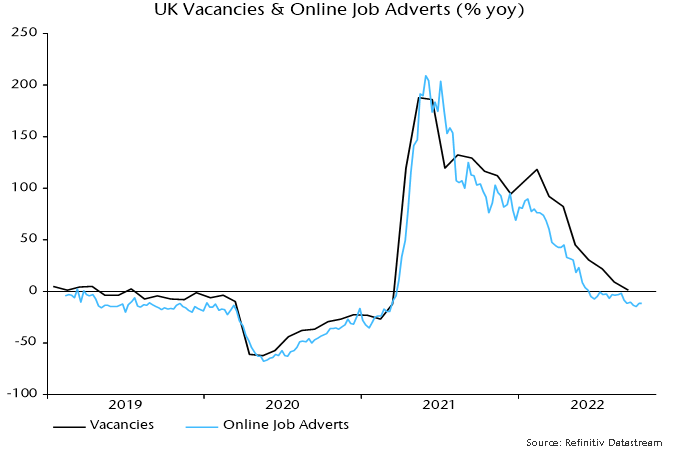
The official vacancies numbers are from a survey of employers but the ONS also compiles weekly indices of online job adverts from data supplied by Adzuna. These indices have a short history and are not seasonally adjusted but the year-on-year change in total job adverts mirrors that of total vacancies – chart 2. 

Chart 2

Chart 2 showing UK Vacancies & Online Job Adverts (% yoy)

Inputs to the recession probability model include real money measures, interest rates, credit spreads, share prices, house prices and the effective exchange rate – see previous post for more details. The model looks out three quarters and the probability estimate stood at 79% at end-Q3, suggesting that the economy will still be in recession in Q2 2023 – chart 3. 

Chart 3

Chart 3 showing UK Gross Value Added (% yoy) & Recession Probability Indicator

House price strength was a moderating influence on the model reading until recently but coming weakness may contribute to the probability estimate remaining in recession territory. 

*The Labour Force Survey measure of employees in employment fell between May and July but recovered in August.

Bank of England Chief Economist Huw Pill has suggested that fiscal policy easing in the mini-Budget and the reaction in markets warrant a “significant monetary policy response”. Why? 

UK monetary trends continue to weaken and are consistent with a medium-term return of inflation to target, if not below. 

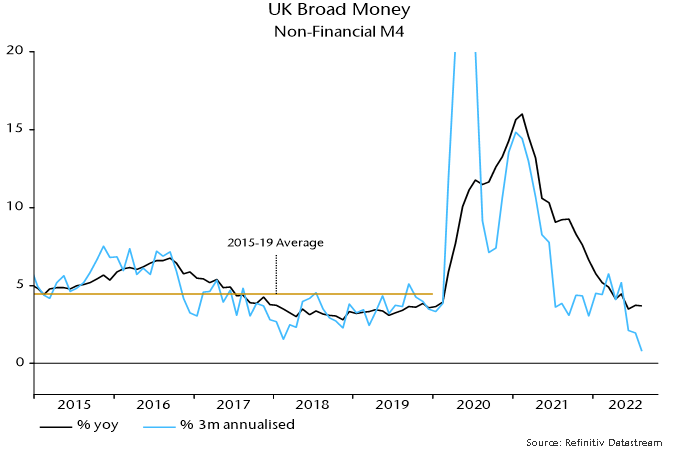
Annual growth of non-financial M4 – the preferred broad aggregate here, comprising holdings of households and private non-financial firms – was unchanged at 3.7% in August, below an average of 4.4% over 2015-19. The three-month rate of expansion fell further to just 0.8% annualised – see chart 1. 

Chart 1

Chart 1 showing UK Broad Money Non-Financial M4

Should the Bank tighten to offset the inflationary impact of exchange rate weakness? The “monetarist” view is that currency movements can delay or speed up the transmission of monetary changes to prices but have no longer-term inflation impact as long as money growth is stable. 

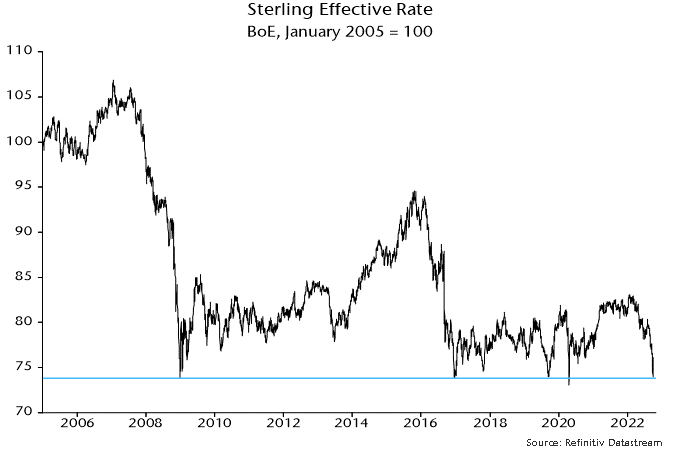
The sterling effective rate index was down by 10% on a year before at last week’s low point but the annual change reached -25% during the GFC and -19% after the Brexit referendum. The index hasn’t (yet) broken below its GFC low – chart 2. 

Chart 2

Chart 2 showing Sterling Effective Rate BoE, January 2005 = 100

The greater concern here is that increased government borrowing will be financed significantly through the banking system, resulting in another boost to money growth. This could occur via voluntary purchases of gilts by commercial banks in response to higher yields or because the Bank is forced to offer sustained support to a dysfunctional market. 

Such a scenario, however, is possible rather than likely. Any monetary boost from deficit financing could be offset or outweighed by a further weakening of private sector credit trends as banks pass on higher funding costs and widen spreads. 

The Bank would have made better recent decisions if it had paid attention to monetary trends: it wouldn’t have expanded QE in November 2020, would have raised rates earlier in 2021 and wouldn’t have embarked on QT. Current monetary weakness argues against policy tightening. The Bank may judge it necessary to hike rates to bolster its credibility, and that of the wider UK policy-making framework. Bank officials, however, should avoid inflating market expectations and be prepared to reverse increases if markets calm and – as seems likely – money trends remain soft.

Cyclical equity market sectors have recouped part of their H1 underperformance of defensive sectors but monetary and cycle considerations suggest further weakness ahead. 

MSCI divides the 11 GICS sectors into cyclical and defensive baskets, the former comprising materials, industrials, consumer discretionary, financials, real estate, IT and communication services, and the latter consumer staples, health care, utilities and energy. 

The analysis here additionally separates the “tech” sectors of IT and communication services from other cyclical sectors on the grounds that they correlate differently with macro factors. Similarly, energy has distinct characteristics warranting separate consideration from other defensive sectors. 

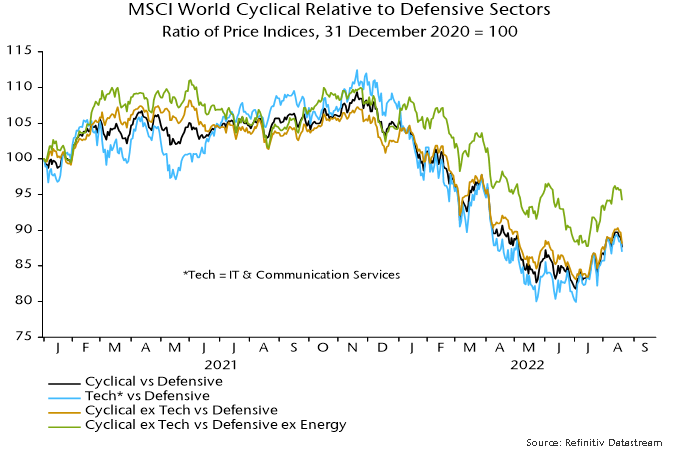
Chart 1 shows various measures of cyclical sector relative price performance, all of which staged significant recoveries from July into late last week. 

Chart 1

Chart 1 showing MSCI World Cyclical Relative to Defensive Sectors Ratio of Price Indices, 31 December 2020 = 100

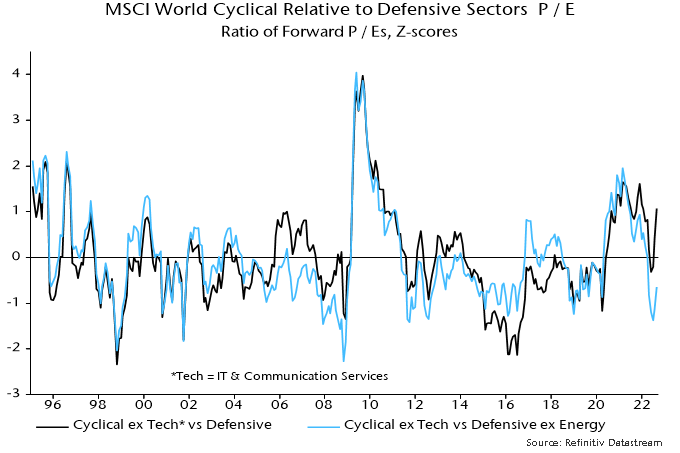
Is there a valuation case for cyclical sectors following their H1 underperformance? Chart 2 shows that the forward P/E of non-tech cyclical sectors relative to the defensive sectors basket is above its long-term average, suggesting overvaluation. 

Chart 2

Chart 2 showing MSCI World Cyclical Relative to Defensive Sectors P / E Ratio of Forward P / Es, Z-scores

The overshoot, however, reflects current / expected high earnings in energy. Excluding energy from the defensive basket, the P/E relative was 1.4 standard deviations below average at the recent low, although the gap has since halved. 

The suggestion that non-tech cyclical sectors offer value, however, depends on current earnings forecasts proving reliable. With the global economy entering recession, downgrades are multiplying and are likely to be larger on average in cyclical sectors. The P/E relative, in other words, could normalise via earnings rather than a cyclical relative price recovery. 

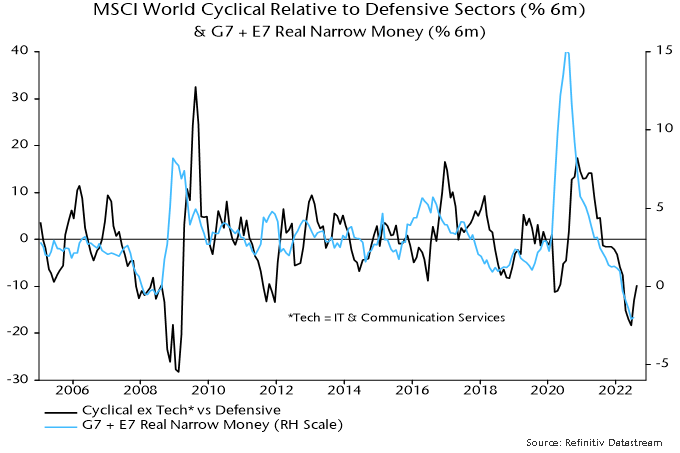
Global monetary trends continue to suggest cyclical weakness. Six-month real narrow money momentum usually moves ahead of major swings in relative price momentum but remains stuck at a multi-decade low – chart 3. 

Chart 3

Chart 3 showing MSCI World Cyclical Relative to Defensive Sectors (% 6m) & G7 + E7 Real Narrow Money (% 6m)

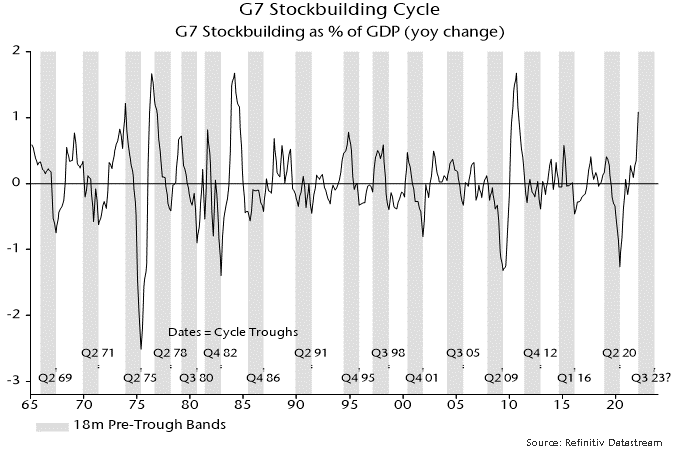
Cyclical relative performance also correlates with the stockbuilding cycle, which, according to the assessment here, is entering a downswing that is unlikely to bottom before mid-2023. Chart 4 shows a long-term history of the cycle, with shaded areas marking 18-month windows preceding prior lows. 

Chart 4

Chart 4 showing G7 Stockbuilding Cycle G7 Stockbuilding as % of GDP (yoy change)

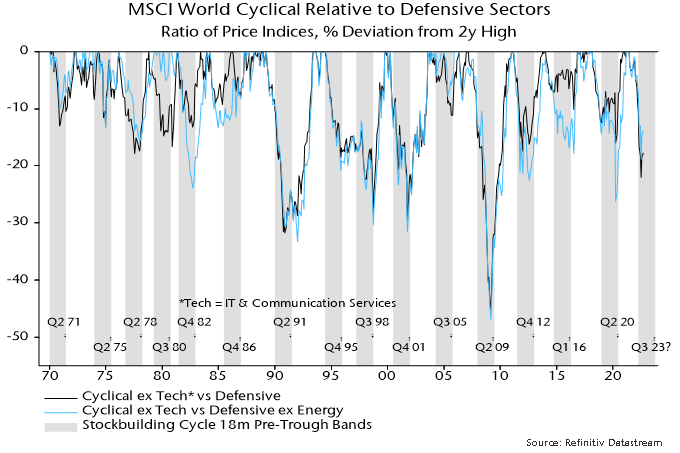
Chart 5 reproduces the shading in chart 4, superimposing the drawdown from a rolling two-year high of the non-tech cyclical / defensive sector price relative (including and excluding energy). Historically, the price relative has usually bottomed late in the downswing, or even after the trough. 

Chart 5

Chart 5 showing MSCI World Cyclical to Defensive Sectors Ratio of Price Indices, % Deviation from 2y High

Cyclical sectors also underperformed sharply at the start of downswings in 2000 and 2011. Minor recoveries ensued followed by a second bout of weakness as the cycle moved towards the trough. 

A major relative price low in July so soon after the cycle peak would be unprecedented.

The yield spread over Treasuries of the ICE BofA US corporate high yield index rose from 310 bp at end-December to a peak of 599 in early July. It has since retraced more than half of this move. Was the early July peak a major top, with a further decline in prospect? This seems unlikely, for several reasons.

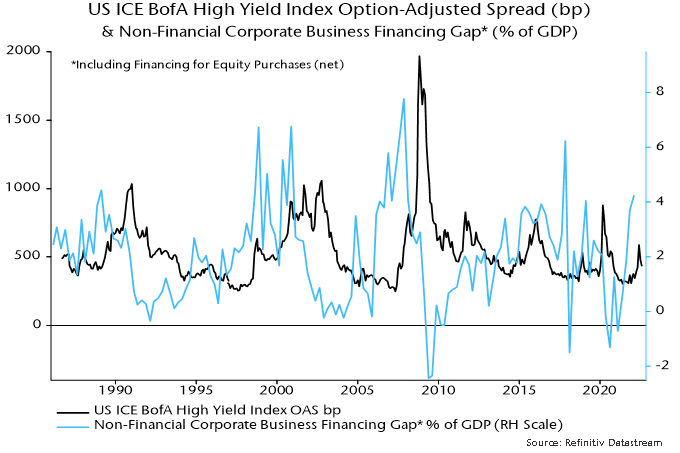
First, the “financing gap” of non-financial corporations – the difference between capital spending and domestic retained earnings – is a long leading indicator of credit spreads and has widened significantly in recent quarters.

Chart 1 shows an expanded measure of the gap including financing required for net equity purchases. This measure moved from a negative position (i.e. a surplus) in Q1 2021 to 4.3% of GDP in Q1 this year, reflecting a strong rise in capital spending – including on inventories – and a pick-up in equity buying.

Chart 1

Chart 1 showing US ICE BofA High Yield Index Option-Adjusted Spread (bp) & Non-Financial Corporate Business Financing Gap* (% of GDP) *Including Financing for Equity Purchases (net)

The expanded financing gap rose above 4% of GDP in 1989, 1998, 2000, 2006 and 2019. The high yield spread subsequently increased to at least 850 bp. (The gap also exceeded 4% in Q4 2017 but was temporarily inflated that quarter by revenue shifting by corporations to take advantage of lower tax rates from 2018 – there was an offsetting surplus in Q1 2018.)

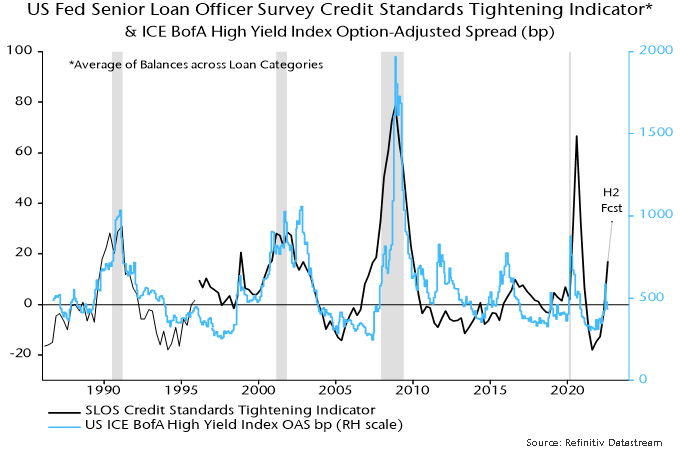
Secondly, the high yield spread correlates contemporaneously with the credit tightening balance in the Fed’s senior loan officer survey – chart 2. This rose sharply between April and July and special questions in the July survey suggest a further increase in H2 – see previous post for more details.

Chart 2

Chart 2 showing US Fed Senior Loan Officer Survey Credit Standards Tightening Indicator* & ICE BofA High Yield Index Option-Adjusted Spread (bp) *Average of Balances across Loan Categories

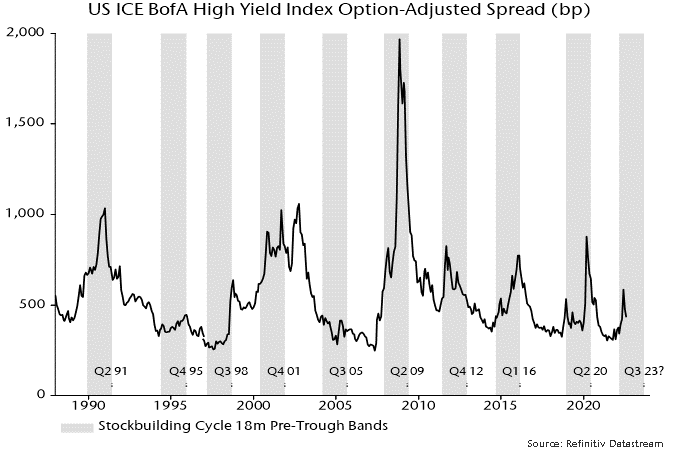
Thirdly, the stockbuilding cycle is judged here to have entered a downswing that may – based on the average length of the cycle – extend into mid to late 2023. Historically, the high yield spread has usually peaked late in the downswing or even after the trough – chart 3. The 2011-12 downswing was an exception but the early surge in the spread on that occasion probably reflected credit market contagion from the Eurozone sovereign debt crisis.

Chart 3

Chart 3 showing US ICE BofA High Yield Index Option-Adjusted Spread (bp)

Finally, the two measures of global “excess” money tracked here remain negative, a condition historically associated with a widening spread on average – table 1. The first measure – the gap between six-month real narrow money and industrial output momentum – may turn positive during H2 but the second measure – the deviation of 12-month real momentum from a moving average – will almost certainly remain negative. That combination has also been negative for credit historically.

Table 1

Table 1 showing Average Change in US High Yield Spread ICE BofA Index, 1986-2021, bp annualised

The Fed’s July senior loan officer survey signals a major slowdown in US bank lending in H2 and 2023.

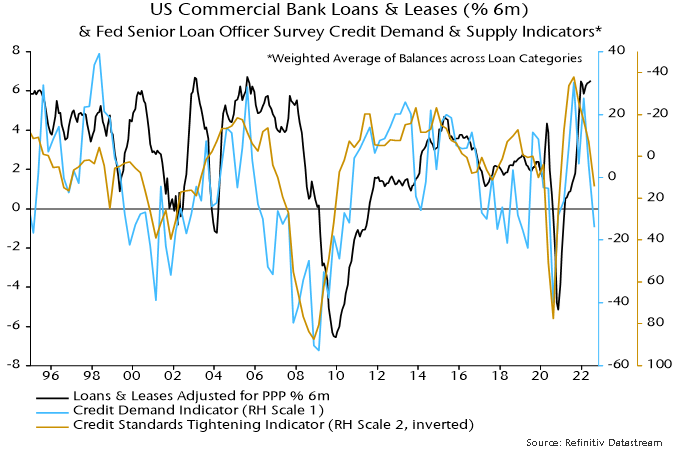
Most commentary focuses on survey responses about credit standards and demand for commercial and industrial (C&I) loans. However, the Fed calculates aggregate indicators incorporating data for all loan categories (i.e. also including commercial real estate (CRE), consumer and residential mortgages).

These indicators weakened sharply in Q2*, moving below their averages since 1995 – see chart 1.

Chart 1

Chart 1 showing US Commercial Bank Loans & Leases (%6 m) & Fed Senior Loan Officer Survey Credit Demand & Supply Indicators* *Weighted Average of Balances across Loan Categories

Demand for residential mortgages weakened most, with smaller declines for CRE and consumer loans. C&I loan demand remained strong, driven by inventory financing (negative for economic prospects).

Credit tightening was across the board but most pronounced for CRE and C&I loans. Banks cited a less favourable economic outlook, industry-specific problems and reduced risk tolerance as key drivers of the tightening of C&I loan standards.

Is the degree of credit restriction consistent with a recession? The Fed’s aggregate credit tightening indicator combines data for the various loan categories using their weights in banks’ lending books. The indicator is unavailable before 1995 but similar results are obtained using a simple rather than weighted average, and this alternative indicator can be estimated for earlier years from partial data for the loan categories.

Chart 2 shows that this alternative indicator rose above 28% before or during seven of the last eight recessions, with no false positive signals. The single false negative was the double-dip recession of 1981-82, which was arguably an extension of the 1980 contraction rather than a separate cyclical event.

Chart 2

Chart 2 showing US Fed Senior Loan Officer Survey Credit Standards Tightening Indicator* *Average of Balances across Loan Categories

The indicator rose from -4% in the April survey to 17% in July, i.e. below the critical value. The current level was reached in 1968, 1978 and 1998 without an accompanying recession.

The July survey, however, included special questions about banks’ expectations for credit tightening for selected loan categories in H2. A net 52% expect to tighten standards on C&I loans, up from an actual 23% in Q2. Smaller but significant increases are signalled for consumer loans and residential mortgages. Assuming no change for CRE loans (which were not covered by the special questions), the aggregate alternative indicator in chart 2 is forecast to rise to 33%, i.e. above the 28% recession threshold.

*The survey cut-off date was 30 June.

Central bankers have ignored the lessons of their 2020-21 policy blunder and deserve the opprobrium they are likely to attract as an economic debacle continues to play out over coming quarters.

Policy-making can be accurately described as anti-monetarist, not merely in the sense that money data are ignored but rather that decisions are the precise opposite of those warranted by monetary trends.

The central banks continued to pursue ludicrously outsized QE in 2020-21 even as money growth surged to a level that would have embarrassed their 1970s predecessors; and they ripped up earlier guidance and tightened aggressively this year despite monetary trends screaming recession and now deflation risk.

June money data for the US, Eurozone and UK published this week highlight the scale of the policy fiasco under way before this month’s further tightening moves. (The Bank of Japan deserves an honourable mention for refusing to join the lemming rush.)

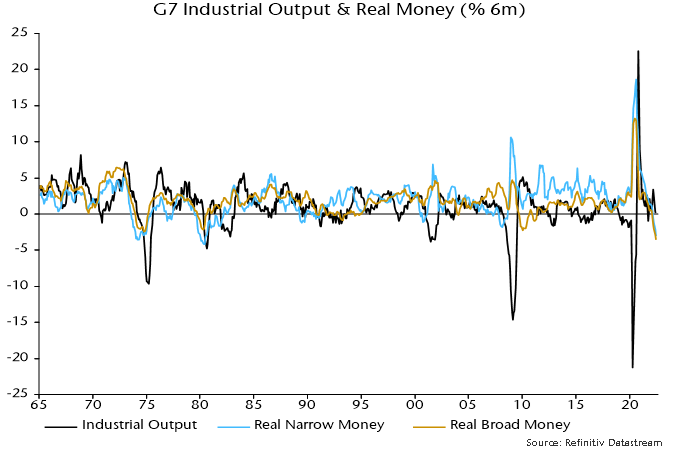
With Canada yet to release June data, the six-month rate of change of G7 real narrow money is estimated to have fallen further to -3.1% (-6.1% annualised), a level previously reached only before / during severe recessions in the mid 1970s and early 1980s. Real broad money, meanwhile, is contracting faster than during those episodes – see chart 1.

Chart 1

Chart 1 showing G7 Industrial Output & Real Money (% 6m)

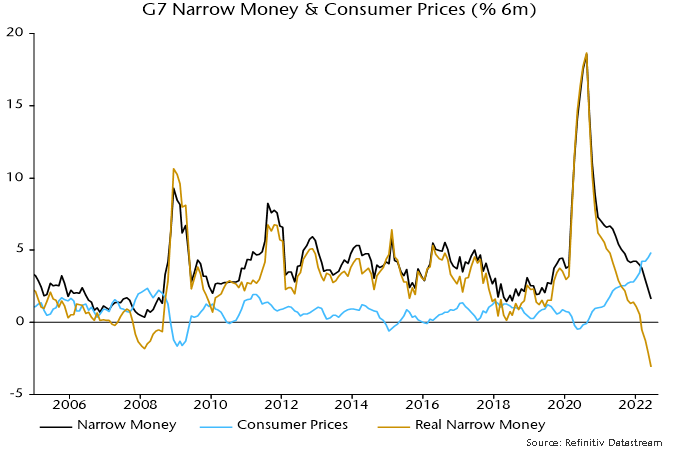
Until April, real money weakness was attributable mainly to high inflation – six-month growth of nominal narrow money, though slowing sharply, was still in the middle of its pre-pandemic range. No longer: six-month nominal growth fell to 1.6% (3.3% annualised) in June – chart 2.

Chart 2

Chart 2 showing G7 Narrow Money & Consumer Prices (% 6m)

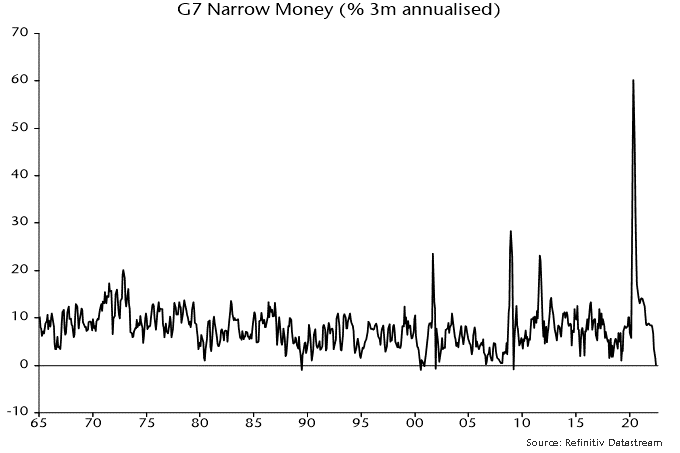
The impact of this year’s policy tightening is better reflected in the three-month rate of change, which crossed below zero in June, a rare occurrence signalling recession and / or price declines historically – chart 3.

Chart 3

Chart 3 showing G7 Narrow Money (% 3m annualised)

The narrow money measures calculated here for the US and UK fell month-on-month in June, while the Eurozone measure was flat.

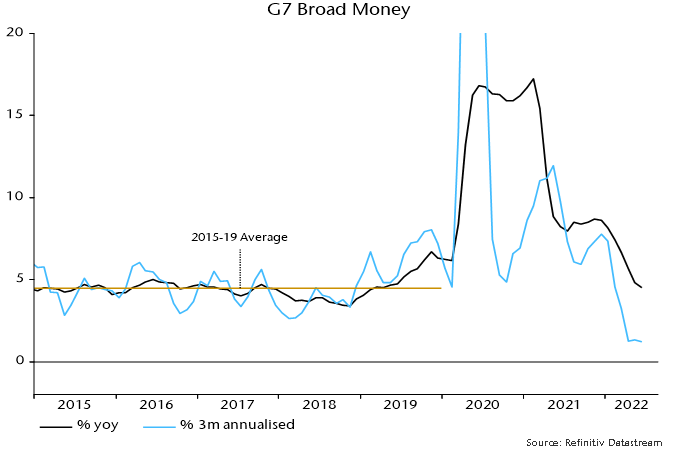
Narrow money is more sensitive to policy changes than broad money but the broad numbers are no less alarming. Three-month growth of G7 broad money slumped to 1.3% annualised in April, moving sideways in May and June – chart 4.

Chart 4

Chart 4 showing G7 Broad Money

The monetary evidence, therefore, is that policy settings had already reached overkill territory by mid-year, suggesting a severe recession with rising medium-term deflation risk.

One false counter-argument to this assessment cites the strength of bank loan growth, particularly in the US. Non-monetarists offer this as evidence that financial conditions are not yet restrictive. Even some monetarists have suggested that lending strength is relevant for assessing rate settings, since money growth will recover if lending momentum is sustained.

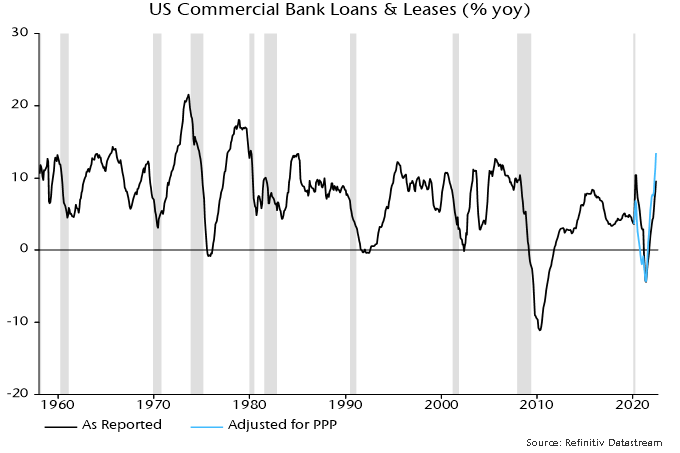
It won’t be. Bank lending is a coincident / lagging indicator of the economy. It is normal for loan growth to be strong and / or rising before a recession – chart 5.

Chart 5

Chart 5 showing US Commercial Bank Loans & Leases (% yoy)

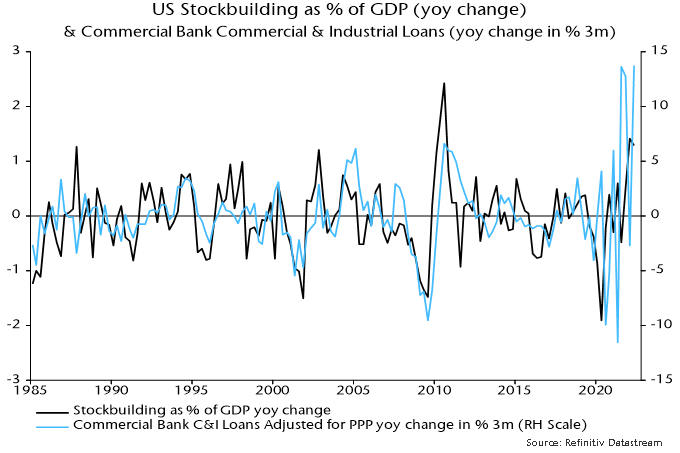
Corporate loan demand has been inflated by an unusually large surge in stockbuilding that is now starting to reverse – chart 6. The ECB’s latest bank lending survey signalled a sharp fall in credit demand, along with tightening supply – expect the corresponding Fed survey next week to give the same warning.

Chart 6
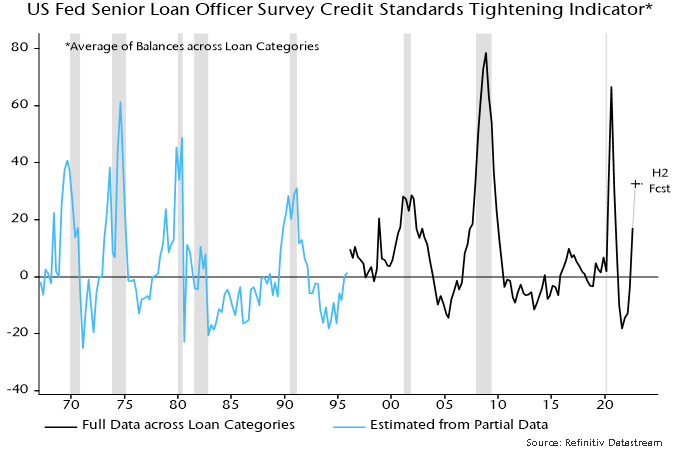
Chart 6 showing US Stockbuilding as % of GDP (yoy change) & Commercial Bank Commercial & Industrial Loans (yoy change in % 3m)