Occasionally we are reminded that cybersecurity decisions have real-world impacts. In early 2021, news of a cyber attack at a water treatment plant in Florida was made public, in which one of the employees lost control of his mouse and watched as the hacker increased the level of sodium hydroxide 111 times from its intended level, making it dangerous to even touch the water. Luckily, the computer’s owner was proactive in rectifying the situation and escalating the case to the FBI. Even though many security checks were in place, making it unlikely that the contaminated water would reach the population, this case illustrates how ill equipped modern infrastructure is to deal with cybersecurity threats.

On May 7, Colonial Pipeline announced that it became the victim of a ransomware cyber attack that forced the company to halt all pipeline operations for a full week, making it the largest successful cyberattack on an oil infrastructure target to date. As the largest refined oil pipeline system in the eastern United States (US), the consequences were felt immediately. An estimated 12,000 gas stations faced shortages, fuel prices rose to more than $3/gallon, and panic buying surged to levels not seen since the toilet paper mania at the onset of the pandemic last year. As is usually the case with ransomware attacks, management did not know exactly how severe the breach was or how long it would take to have the systems work again on their own. As such, the company went ahead and paid the full ransom of 75 bitcoins, worth roughly US$4.4 million, and its operations were able to resume several days later.

Ransomware and other forms of cyber attacks are much more frequent than one would expect. In its annual “State of Email Security” report, Mimecast Ltd. found that 61% of organizations surveyed had been impacted by ransomware in 2020, an increase of 20% over 2019. On average, these companies lost six working days of system downtime and for 37%, the downtime lasted a week or more. One of the worst parts is that more than half of the victims paid the ransom demand but only 66% of them were able to retrieve their data afterward. This means one third never saw their data again despite paying the ransom.

In past commentaries we discussed how email is the most frequent and vulnerable attack vector, even more so since work from home became the norm. Since the beginning of the pandemic, it has been found that employees are three times more likely to click on malicious emails than they had before, while the number of email threats rose 64% year over year. This implies that working from home is also leading to employees being less vigilant about potential threats. Meanwhile, companies have been slow to adapt. Cybersecurity training is provided by only one out of five companies, despite almost half of technology chiefs believing that their biggest weakness stems from their employees’ lack of cybersecurity knowledge. Furthermore, one in ten companies do not even have an email security system.

With this in mind, it is not difficult to understand why Global Alpha has maintained continuous exposure to the cybersecurity sector over the years. In the past, we owned names such as Sophos, Nice Systems, and we currently own Mimecast Ltd. (MIME US).

Business Overview

Mimecast is a cloud-based platform that offers email security solutions. They provide a range of services, including targeted threat protection, encryption, large file sending services, and data leak prevention. Peter Bauer is one of the co-founders of the firm and has been CEO since its inception in 2003. Insiders own about 7% of the shares outstanding.

Competitive Advantages

Given the sticky nature of the business, Mimecast enjoys very high retention rates. They also have the fastest search service-level agreement in the industry because their service architecture was designed for the cloud from the beginning.

Mimecast processes over 400 million emails every day, and has more than 300 billion emails under management. They are the only email security provider to guarantee 100% continuity on Office 365.

Growth Strategy

  • Cross sell opportunities as the average customer owns around 3.5 products (up from 3.2 in 2019)
  • New product launches (6 products at its IPO in 2015, currently 11)
  • Increased penetration in the enterprise business

We are always on the lookout for new investment opportunities with secular growth opportunities. Our ability to be highly selective and nimble in our portfolio holdings leaves us well positioned to add some exposure to the online security industry at attractive valuations.
As most of you know, fundamental research informs Global Alpha’s stock selection, as it identifies equities with growing earnings that will meet or exceed our expectations. The pandemic challenged this philosophy in 2020, due to the volatile and unpredictable nature of corporate earnings. With low rates and subsidies, cashed-up investors looked elsewhere and flocked to non-earning companies, sending the Nasdaq 45.1% higher versus the S&P 500 at 18.4%.

A company with no earnings typically supports its stock price with material events that can de-risk future earnings. Investors gravitate to this approach as it can provide substantial short-term returns given the timelines around material events are well understood. Global Alpha tends to focus more on the entire capex cycle, smoothing out the volatility of a single event. For example, the technology and biotechnologies industries hold many event-driven companies. 

Hedge funds are a class of investors that commonly use event-driven strategies. According to the Hedge Fund Research (HFR) Database, the highest-returning hedge fund strategies in 2020 were event-driven funds, which gained 9.3% for the year. Macro hedge funds returned 5.2% for the year, while HFR’s own relative value index ended 2020 up 3.3%. The hedge fund industry’s total assets stand at $3.8 trillion, a 21% growth in one year. This occurred while the industry has had net outflows of -1.9% in 2020, according to Opalesque, a hedge fund publication.[1]

Interestingly, the Financial Industry Regulatory Authority (FINRA) reports that margin debt has jumped 51% since February 2020, to $823 billion in March 2021.[2] The $340 billion change is three times greater than any annual change in the last decade. It is therefore arguable that hedge funds, as well as many investors, are highly levered and exposed to event-driven companies.

Following the debacle of Archegos Capital Management, which faced massive margin calls from its prime brokers, Federal Reserve Governor Lael Brainard stated, “The Archegos event illustrates the limited visibility into hedge fund exposures and serves as a reminder that available measures of hedge fund leverage may not be capturing important risks.”

Where is all the new levered money (or at least part of it)?

According to PWC, the United States (US) equity and IPO capital markets in Q1 kicked off with yet another record, driven by the continued SPAC attack, with 389 IPOs raising $125 billion; 2020 raised $150 billion in total. A lot of this money is in newly issued, event driven, technology and biotechnology companies. The money is used to develop new products and services at an accelerated pace to catch up to their rich IPO valuations.  

These amounts materialize as capex and revenues to the subcontractors of technology or biotechnology companies, commonly known as the picks and shovel of an industry. Global Alpha is invested in these types of companies, which stand to benefit from the capital exuberance described above.

Additionally, our companies are profitable and diversified. They also are of lesser interest to event-driven hedge funds. These companies could be at a lesser risk of mass sell-off due to an Archegos Capital Management type liquidity crunch. Rich in pharmaceutical history, Europe holds many excellent contract research organizations that appear in our investment universe and have the biopharma industry as clients.

Evotec (EVT:GR)

Based in Hamburg, Germany, Evotec operates multiple scientifically driven contract research centers for the biopharma industry. The company has extensive scientific knowledge to assist in genetic and biochemical drug development programs.

With the large biopharma market growing at a compound annual growth rate (CAGR) of 13.5%, Evotec has been gaining market share with a 20% growth rate. The company recently launched a low cost biological drug production platform that is expected to grow revenues considerably in the mid-term. Evotec also signed an agreement with the Japanese giant Takeda for the development of RNAi drugs.

Oxford Biomedica (OXB:LN)

Global Alpha also owns Oxford BioMedica, a biopharmaceutical company engaged in the production of viral vectors, a key component of delivering a genetic drug.  Without vectors or other delivery systems, genetic material decays extremely quickly in the body. Oxford BioMedica offers a variety of vectors, including adenoviruses that are used in the present coronavirus vaccination program with AstraZeneca. However, it specializes in lentivirals, which have proven very efficient with biologics.

The FDA is predicting a wave of cell and gene therapies coming to market in the next few years, which is set to drive the overall end market to exceed $20 billion in the mid-term. The lentivirus vector market is expected to grow in excess of $1 billion by 2026, from $350-400 million today.


[1] https://www.opalesque.com/

[2] https://www.finra.org/

The forecast here remains that global industrial momentum, as measured by the manufacturing PMI new orders index, is at or close to a peak, with a multi-month decline in prospect.

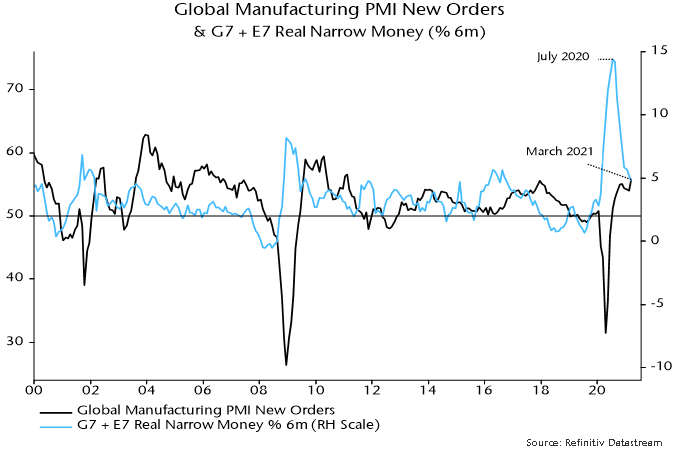
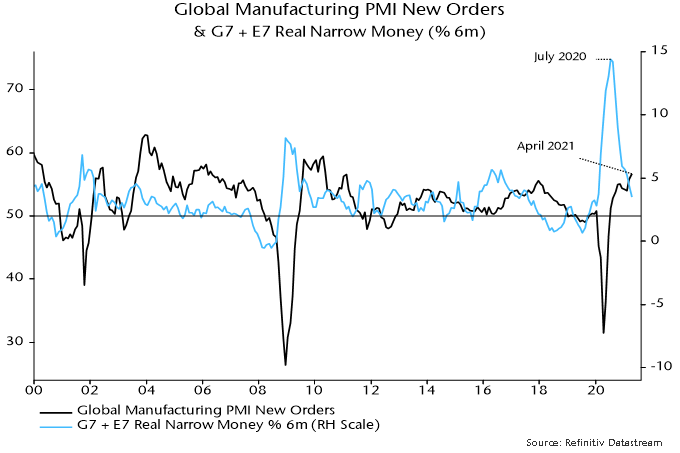
The basis for the forecast is a fall in global six-month real narrow money growth from a peak in July 2020 – the rise into that peak is judged to correspond to the increase in PMI new orders to an 11-year high in April.

Available April monetary data indicate that real narrow money growth fell further last month, suggesting that the expected PMI decline will extend into late 2021 – see chart 1.

Chart 1

The presumption here is that PMI weakness will be modest, partly reflecting a view that the global stockbuilding cycle will remain in an upswing through H2. The cycle has averaged 3.5 years historically and bottomed in Q2 2020, suggesting a peak in Q1 2022 assuming an upswing of half-cycle length. Large declines in PMI new orders (i.e. to 50 or below) have usually occurred during cycle downswings.

Any PMI pull-back, however, could have significant market implications given consensus bullishness about global economic prospects.

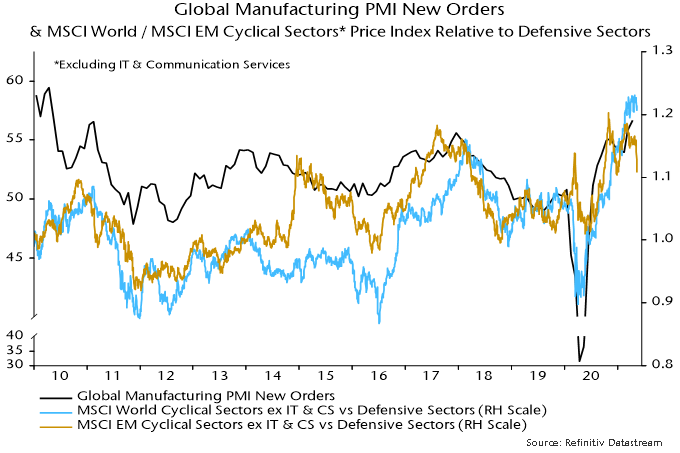
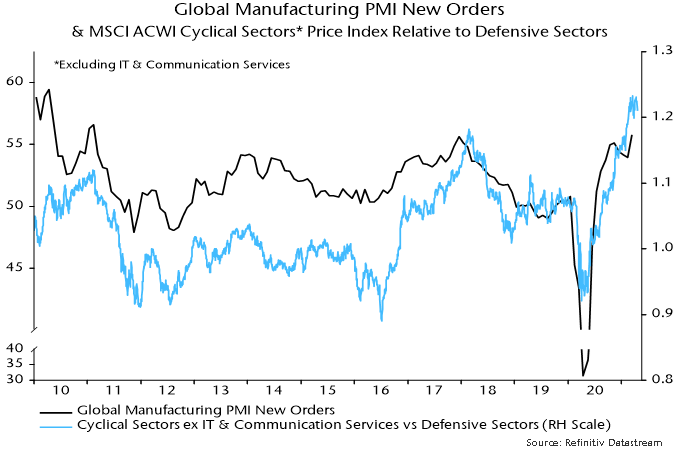
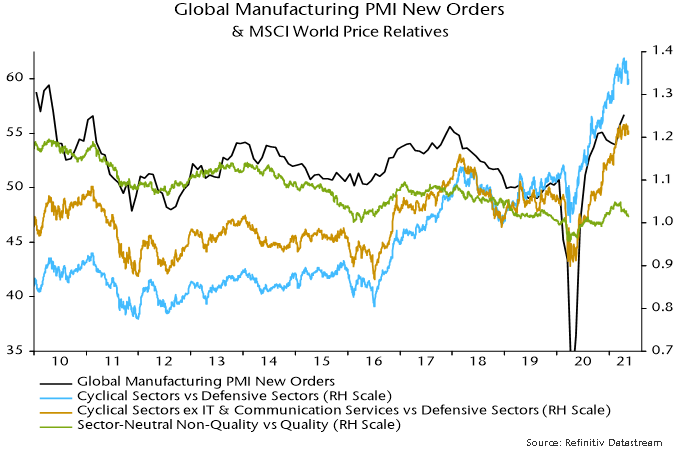
Historically, a declining trend in global manufacturing PMI new orders has been associated with underperformance of cyclical equity market sectors and outperformance of quality stocks within sectors. The price relative of MSCI World cyclical sectors to defensive sectors peaked in mid-April, falling to a three-month low last week – chart 2.

Chart 2

The decline has been driven by a correction in tech – the MSCI cyclical sectors basket includes IT and communication services. The price relative of non-tech cyclical sectors to defensive sectors has moved sideways since March.

The MSCI World sector-neutral quality index, meanwhile, has recovered relative to the non-quality portion of MSCI World since March, following underperformance in late 2020 / early 2021 when cyclical sectors were outperforming strongly.

Equity market behaviour, therefore, appears to have started to discount a PMI roll-over, although confirmation is required – in particular, a breakdown in the price relative of MSCI World non-tech cyclical sectors to defensive sectors.

A sign that this could be imminent is a recent sharp fall in the non-tech cyclical to defensive sectors relative in emerging markets – chart 3. A possible interpretation is that the decline reflects worsening Chinese economic prospects, with China likely to be a key driver of a global slowdown. Early Chinese monetary policy easing may be required to mitigate this drag and lay the foundation for a resumption of cyclical outperformance.

Chart 3

On April 22 and 23, 2021, United States (US) President Joe Biden convened 40 world leaders for a virtual Leaders Summit on Climate, to rally the world in combatting the climate crisis.

Many countries announced ambitious new climate targets, ensuring that nations accounting for half of the world’s economy are now committed to the emission reductions needed globally to keep the goal of limiting global warming to 1.5 degrees Celsius within reach. For example:

  • The US submitted a new “nationally determined contribution” (NDC) under the Paris Agreement, setting an economy-wide emissions target of a 50-52% reduction below 2005 levels in 2030. 
    • Japan will cut emissions by 46-50% below 2013 levels by 2030, with strong efforts toward achieving a 50% reduction, a significant acceleration from its existing 26% reduction goal.
    • Canada will strengthen its NDC to a 40-45% reduction from 2005 levels by 2030, a significant increase over its previous target to reduce emissions 30% below 2005 levels by 2030.
    • The United Kingdom will embed in law a 78% greenhouse gas reduction below 1990 levels by 2035.
    • The European Union is putting into law a target of reducing net greenhouse gas emissions by at least 55% by 2030, and a net zero target by 2050.
    • China and Russia also reaffirmed commitments to reduce emissions, and agreed to cooperate with the US on climate change despite division on issues like trade and human rights.

During one of the sessions, Unleashing Climate Innovation, world leaders urged investment in mitigation and adaptation technologies, which include clean fuels such as hydrogen; renewables such as offshore wind and geothermal energy; energy storage; clean desalination; carbon capture; advanced mobility; sustainable urban design; and monitoring technologies to verify emissions and stop deforestation.

At Global Alpha, sustainability is one of our five major investment themes. The energy transition towards a low-carbon society provides long-term growth opportunities. We look for niche market leaders who will benefit from this secular growth trend. A few current holdings include:

  • Clean Energy Fuels (CLNE US), based in the US, designs, builds and operates natural gas filling stations for vehicle fleets. It has 550+ stations in North America. Its primary fuel is Renewable Natural Gas (RNG), the only fuel available for heavy-duty vehicles that can have carbon-negative emissions (RNG avoids more emissions than it generates).
  • Ormat Technologies (ORA US), based in the US, is a leading renewable energy provider globally with a 932 megawatt portfolio. Its business expands from geothermal to recovered energy and energy storage.
  • Hexagon Composites (HEX NO), based in Norway, is a global market leader in a carbon fiber gas containment system used in the transportation industry. It operates in Norway, Germany and the US. Hexagon’s products are mostly used for clean alternatives, such as RNG, hydrogen, and propane.

We also invest in companies related to electric vehicles (EV) and waste management but this week, we would like to profile one of our new holdings, Iwatani Corporation (8088 JP), which is the largest distributor of hydrogen, LPG, and helium in Japan.

Business Overview

Founded in 1930, Iwatani is a leading distributor of gases for industrial and household use in Japan. It has several business areas. The industrial gases segment includes hydrogen, oxygen, nitrogen, helium, semi-conductor material gas and medical gas. The energy segment distributes a wide range of gases such as LPG, LNG, kerosene, and gasoline. The company also manufacturers machinery and environmental-friendly materials, such as biomass fuels, eco PET resin and EV-related battery materials.

Iwatani is the only fully-integrated supplier of hydrogen in Japan, with a nation-wide network, including manufacturing, transportation, storage, supply, and security.

Target Market

Iwatani has a steadily growing product portfolio led by LPG, but the new growth driver is hydrogen.

Japan was the first country to adopt a « Basic Hydrogen Strategy » as early as in 2017. Japan aims to increase the number of fuel cell vehicles (FCVs) to 40,000 units by 2020, to 200,000 units by 2025 and to 800,000 units by 2030. It also aims to increase the number of hydrogen stations to 160 by 2020, to 320 by 2025, and to 900 by 2030.[1]


The Japanese hydrogen market is expected to grow 56-fold to JPY 408.5 billion by 2030, according to the market research company Fuji Keizai.

Competitive Advantages

  • Top market shares in Japan
    • #1 in hydrogen sales volume with 70% market share
    • #1 hydrogen stations network with 33% market share
    • #1 in helium sales with 50% Japan market share, and 8% global market share
    • #1 in LPG sales in the retail market with 4.1% market share
    • #1 in LPG sales in the wholesale market with 13.1% market share
    • #1 in the portable gas cooking stoves market with 80% market share
    • #1 in the cassette gas canisters with 60% market share
  • Close relationship with government as the industry leader
    • High entry barriers: a highly regulated industry because safety is of the utmost importance when handling industry gases.

Growth Strategy

  • Distribution: expand distribution network for hydrogen and LPG
  • Consolidation : 
  • To acquire smaller LPG competitors
  • To acquire companies into its organized Marui Gas network


Management

Akiji Makino has been Iwatani’s Chairman and CEO since 2012. He joined the company in 2000 and has rich industry experience. Insiders own about 16%, including the Iwatani Naoji Foundation.


ESG

Iwatani has been an industry leader in energy transition. Its sustainability report is very comprehensive. Iwatani’s major offices are ISO14001 certified. The company is focused on eco-friendly products and promotes eco-efficient use of energy. At its workplace, Iwatani promotes diversity, employee development, and provides support for child care and nursing care.

Regarding corporate governance, Iwatani has met all the requirements of the Tokyo Stock Exchange. However, at Global Alpha, we apply more stringent requirements in line with western standards. For example, we encouraged the company to have at least one-third of board directors be independent, with a separate board chair and CEO, and at least one female board director.


Risks

  • Delay in the rollout of FCV commercialization ad FC technology development
  • Decline in LPG price
  • Low industrial production

[1] https://www.meti.go.jp/english/press/2017/pdf/1226_003a.pdf

Le Groupe financier Connor, Clark & Lunn, l’une des plus importantes sociétés indépendantes de gestion de placements au Canada, a annoncé aujourd’hui le lancement de l’ICAV OPCVM Connor, Clark & Lunn. Le Fonds OPCVM d’actions de marchés émergents Q CC&L et le Fonds OPCVM d’actions mondiales Q neutre au marché CC&L font partie des sous-fonds initiaux. Le gestionnaire de placement est Gestion de placements Connor, Clark & Lunn Ltée (Gestion de placements CC&L), une équipe de 100 professionnels de Vancouver qui gère un actif de 41,7 milliards de dollars américains dans diverses catégories d’actif.

Le Fonds OPCVM d’actions de marchés émergents Q CC&L est une stratégie à gestion active composée exclusivement de positions acheteur sur des actions qui vise une croissance du capital à long terme par rapport aux indices boursiers des marchés émergents.

Le Fonds OPCVM d’actions mondiales Q neutre au marché CC&L est une stratégie à gestion active composée de positions acheteur et vendeur sur des actions qui vise à produire des rendements présentant une faible corrélation avec les marchés boursiers mondiaux et à maximiser le rendement total à long terme.

« Nous gérons avec succès des stratégies quantitatives d’actions depuis plus de 20 ans. Le lancement de ces fonds OPCVM permet aux investisseurs européens d’avoir accès à nos stratégies relatives aux marchés émergents et neutres au marché », se réjouit Martin Gerber, président et chef des placements de Gestion de placements CC&L.

La philosophie de placement de Gestion de placements CC&L repose sur le fait que les cours des actions sont établis en fonction des paramètres fondamentaux de croissance, de valorisation et de qualité de leurs sociétés sur un horizon à long terme. Toutefois, le processus de marché qui fait en sorte que les prix reflètent ces paramètres fondamentaux de façon juste n’est pas parfait. En effet, nombreux sont les obstacles et points de friction de nature comportementale, informationnelle et structurelle qui peuvent empêcher que le cours des actions reflète ces paramètres fondamentaux. Il en découle des évaluations inexactes sur le marché qui constituent des occasions d’ajouter de la valeur. Ces occasions font l’objet d’un processus systématique par lequel chaque société est évaluée objectivement par rapport à l’ensemble de l’univers mondial de Gestion de placements CC&L, lequel est composé d’environ 16 000 titres, 160 secteurs d’activité et 49 pays développés et émergents. Ce processus quotidien a pour résultat un portefeuille optimal qui investit constamment et objectivement dans les sociétés qui procureront les meilleurs rendements possibles tout en limitant rigoureusement le risque.

« C’est grâce à son équipe chevronnée et à son approche rigoureuse en matière de placements que Gestion de placements CC&L peut étendre avec succès sa gamme de produits en Europe », indique Warren Stoddart, cochef de la direction du Groupe financier Connor, Clark & Lunn.

L’ICAV OPCVM Connor, Clark & Lunn est un instrument irlandais de gestion collective d’actifs qui est constitué sous la forme d’un

fonds à compartiments avec responsabilité distincte entre les sous-fonds et géré par Carne Global Fund Managers (Ireland) Limited. HSBC Global Fund Services agit à titre d’administrateur, de registraire, de dépositaire et d’agent de transfert, et Matheson agit à titre de conseiller juridique en ce qui a trait aux lois irlandaises.

Si vous souhaitez en savoir plus sur les sous-fonds, cliquez ici pour consulter les prospectus, les suppléments et les renseignements clés à l’intention des investisseurs.

À propos de Gestion de placements Connor, Clark & Lunn Ltée

Gestion de placements Connor, Clark & Lunn Ltée (Gestion de placements CC&L) est l’une des plus importantes sociétés de gestion de placements indépendantes au Canada (elle appartient à ses associés) et gère un actif de plus de 41,7 milliards de dollars américains. Fondée en 1982, elle propose une gamme diversifiée de solutions de placements traditionnels (actions, titres à revenu fixe et placements équilibrés) et non traditionnels (stratégies neutres au marché, à alpha portable et à rendement absolu). Gestion de placements CC&L est membre du Groupe financier Connor, Clark & Lunn Ltée.

À propos du Groupe financier Connor, Clark & Lunn Ltée.

Le Groupe financier Connor, Clark & Lunn Ltée (Groupe financier CC&L) est une société de gestion de placements regroupant plusieurs sociétés, qui offre un large éventail de produits et de services de gestion de placements aux investisseurs institutionnels, aux particuliers fortunés et aux conseillers. Cette structure nous procure une envergure et une expertise considérables qui nous permettent d’assumer des fonctions administratives qui ne sont pas liées aux placements tout en laissant nos gestionnaires de placement se concentrer sur ce qu’ils font le mieux grâce à la centralisation des activités liées aux opérations et à la distribution. Possédant des bureaux un peu partout au Canada, de même qu’à Chicago et à Londres, les sociétés affiliées au Groupe financier CC&L gèrent des actifs totalisant plus de 70 milliards de dollars américains. Pour obtenir de plus amples renseignements, veuillez consulter le site www.cclgroup.com.

Personne-ressource

Carlos Stelin
Directeur, Ventes institutionnelles (Europe)
Connor, Clark & Lunn UK
+44 (20) 3535-8107
[email protected]

Governments around the world are incurring record deficits to sustain their economies during the COVID-19 pandemic. These deficits are expected to persist, as revenue will be needed to rebuild infrastructure and support an aging population.

Benjamin Franklin, the inventor, philosopher, politician, and one of the founding fathers of the United States, famously said: “In this world, nothing can be said to be certain, except death and taxes.” Yet, in 2018, a record year for corporate profits levels, 91 Fortune 500 companies paid no federal income tax; among them, companies such as Amazon, Netflix, Chevron, GM, and Delta.  Even more, their tax rate was -5%, meaning they got a tax refund. The 379 profitable Fortune 500 members paid an effective federal tax rate of 11.3%, almost half of the 21% tax rate established in the 2017 tax revamp. That represented a missing $73.9 billion worth of tax revenue for the federal government. As a result, in 2019, the Organisation for Economic Co-operation and Development (OECD) formally established base erosion and profit shifting (BEPS).

What is BEPS?

BEPS refers to tax planning strategies that exploit gaps and mismatches in tax rules to artificially shift profits to low or no-tax locations where there is little or no economic activity or to erode tax bases through deductible payments, such as interest or royalties. Although some of the schemes used are illegal, most are not. This undermines the fairness and integrity of tax systems because businesses that operate across borders can use BEPS to gain a competitive advantage over enterprises that operate at a domestic level.  Moreover, when taxpayers see multinational corporations legally avoiding income tax, it undermines voluntary compliance by all taxpayers.”

“BEPS is of major significance for developing countries due to their heavy reliance on corporate income tax, particularly from multinational enterprises. Engaging developing countries in the international tax agenda is important to ensure that they receive support to address their specific needs and can effectively participate in the process of standard-setting on international tax.”

The digital economy giants have been very apt at using BEPS. Looking at cash taxes paid globally by FAANG stocks in 2019/2020, according to Global Alpha’s estimates, Facebook paid 12.75%, Apple 14.4%, Amazon 7%, Netflix 7.3%, and Google 11.9%. As an example of BEPS, Google declared $23 billion in revenues in Bermuda in 2017. Until 2015, Amazon was able to declare all its European revenues in Luxembourg.

The significant tax drag caused by these large multinationals was a major issue in negotiations over tax reforms at the OECD, since they were largely US corporations. The stalemate brought many local governments, such as Australia, the United Kingdom (UK), and France, to impose a local tax based on revenues earned in their respective country. That brought retaliation from the US by taxing imports from these countries.

This graph shows that in the 1970s, the largest corporation paid slightly higher tax rates than smaller ones. By the early 80s, the situation reversed, and the unfair advantage of larger companies has amplified since.

Why should we care? The tax system encourages businesses to consolidate and grow bigger. With a risk, they may abuse their market dominant position. The discussion until recently was concentrating on anti-trust measures. Companies like Amazon, Google and Facebook are currently being investigated by various government entities using anti-trust laws. As the case against Microsoft in 2001 demonstrated, it is hard to win a case against multinationals as current anti-trust regulations focus on the price paid by consumers. Anti-trust cases are overly complex and may take years before reaching a conclusion. Studies show that a minimum corporate tax would be a more effective way to ensure fairness and stable government revenues.

In the last few weeks, US President Joe Biden and his secretary of the Treasury, Janet Yellen, former Federal Reserve chairwoman, have proposed an ambitious plan to arrive at a global framework on taxation, which would stop the race to the bottom and allow countries to fund their needed services to their population.

The Biden tax plan includes the following proposed business tax changes:

  • Increase the corporate income tax rate, from 21 to 28 percent.
    • Create a minimum tax of at least 15% on corporations with book profits of $100 million or higher.
    • Double the tax rate on global income earned by subsidiaries of U.S. firms, from 10.5 percent to 21 percent.

Immediately, countries around the world, like France, Canada, Germany, Japan and many others, welcomed the idea. President Biden went further in supporting the idea of a local tax based on local revenues. There is a high likelihood that OECD negotiations may finally reach a new global tax accord by the end of this summer.

What would be the impact on stock markets?

First, we think the large cap US benchmarks would be most negatively affected, as they incorporate most of the large digital companies, which as explained above, have been the biggest users of BEPS.  The S&P500 sells at a record price-to-sale ratio and at an extremely high 24x 2021 earnings.  Increasing the tax on these earnings by 25% would mean a ratio above 30 times, which is unprecedented. That compares with a ratio of 17 times for the MSCI EAFE index (ex: North America).

Smaller companies, as discussed, pay a much higher tax rate. The impact of revised tax rates will be much smaller.  The MSCI EAFE small-cap index sells at 17.9 times 2021 earnings. In addition, the MSCI World small-cap index, which includes the US and Canada, sells at 18.8 times 2021 earnings. The impact should be less for smaller companies, which should drive outperformance. Another aspect that we should mention is the increased importance of ESG in investment decisions.

The environmental impact and carbon footprint of companies is now an important topic for investors. We believe that aggressive tax planning and avoidance may very soon become another important factor that investors may look at.

When it comes to vaccination campaigns, the United States (US), United Kingdom (UK), and Israel continue to lead the way. Following the vaccination of some of the most vulnerable populations, the rate of hospitalizations are decreasing. Efficient vaccination campaigns in the US and UK have increased confidence that economic activity will continue to grow in the coming months. Many indications show strong pent-up demand from both consumers and corporates starting to increase.

In other parts of the world where vaccinations are taking longer, reopening will be slightly delayed. Despite the slow start in Europe, governments are intensifying their campaigns as the supply of vaccines increases. This should enable the economy to reopen and activity to rebound. As restrictions ease, we continue to expect the economy to recover rapidly beyond Q2.

There are some interesting data points that suggest a stronger economic activity as restrictions ease:

Some recreational and sports goods have become more popular in this pandemic as leisure options narrowed. Bicycle sales are enjoying phenomenal demand. Suppliers have indicated that stock levels in the supply chain are much too low and that the return to a more normal inventory level would already lead to a high double-digit market growth. RV manufacturers and RV rental marketplaces is another segment that cannot keep up with demand. Thanks to a tight supply chain, strong demand and low inventories, this segment should enjoy good order visibility for 2021 and beyond. 

Regarding travel, US domestic and international flights are at the highest levels since the end of March 2020. Europe, which relies more on intercontinental traffic, has not improved much yet, but there are positive signs starting to emerge. The European Commission presented a proposal to create a digital Green Certificate to facilitate the safe free movement of citizens within the EU. Another example is Iceland, which will open its borders this week to visitors who have received the vaccine without the need for testing or quarantine. Australia and New Zealand will also have a similar arrangement starting next week.

Restaurant bookings are soaring in some parts of the US, but also in the UK, as outdoor bars and restaurants opened earlier this week.[2] With a reduced supply of pubs and restaurants, the ones that operate should enjoy strong consumer traffic. Apparently, outdoor tables booked out several weeks in advance after the UK government announced its reopening framework this winter.  

These observations and data points are no surprise, as people look forward to leisure activities and travel after months of restrictions. The important variables now are how fast populations are being vaccinated and how efficient vaccines are in terms of preventing a person from carrying or passing on the virus.


[1] Bloomberg – EMEA WEEK AHEAD: ECB to Hold, Russia Hike, U.K. Jobs

[2] https://www.opentable.com/state-of-industry

Global six-month real narrow money growth appears to have edged lower in March, continuing a downtrend since last summer. This suggests that an expected relapse in global industrial momentum will extend through late Q3 / early Q4.

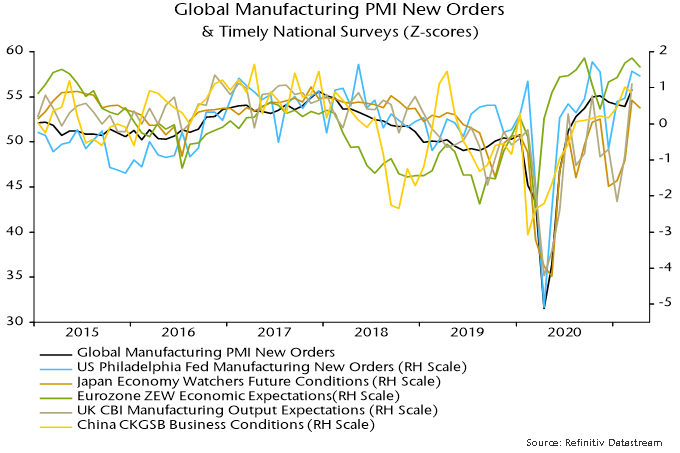
The global manufacturing PMI new orders index reached a new recovery high in March, consistent with a surge in six-month real narrow money growth into July / August 2020, allowing for the historical average 6-7 month lead time. More recent national surveys hint that March will mark a top – see chart 1.

Chart 1

The March real money growth estimate is based on information for the US, China, Japan, India and Brazil, together accounting for 70% of the G7 plus E7 aggregate tracked here. The US component is estimated from weekly data on currency in circulation and commercial bank deposits – official March money numbers are released next week and the Fed no longer provides weekly updates.

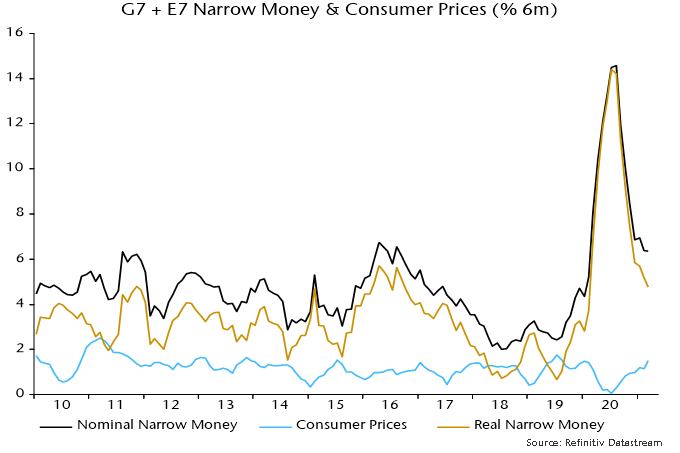
Global six-month real narrow money growth appears to have eased further to its lowest level since February 2020, reflecting stable nominal growth and another rise in six-month CPI inflation – charts 2 and 3.

Chart 2

Chart 3

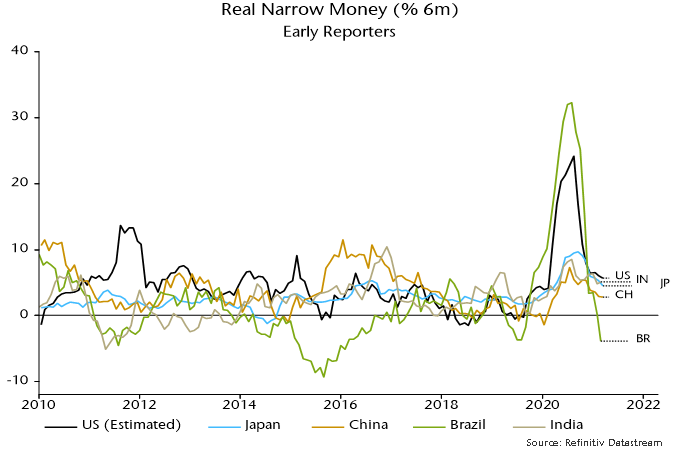
Chart 4 shows the early reporting countries individually. US six-month real narrow money growth is estimated to have edged lower despite disbursement of $318 bn of stimulus payments to households – these were made in the second half of the month and may have a larger impact in April (the money numbers are month averages).

Chart 4

Six-month growth also eased slightly further in Japan and China, with a small rise in India. Brazil moved into contraction although this needs to be placed in the context of an extraordinary surge last summer – 12-month growth is still strong.

Markets could be starting to offer corroboration of the scenario of a global manufacturing PMI new orders peak and pull-back, with Treasury yields stalling and equity market cyclical sectors no longer outperforming – chart 5.

Chart 5

Will global six-month real narrow money growth recover? Six-month CPI inflation is likely to rise slightly further in April / May but could fall back in H2 as commodity prices move sideways or correct.

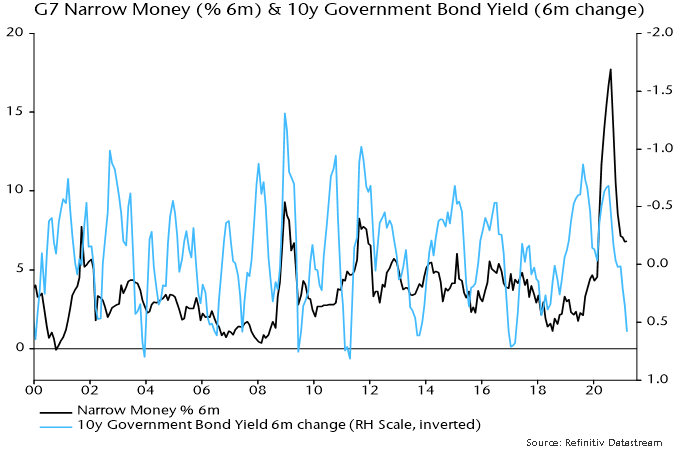
Fiscal stimulus is acting to push up US nominal money growth but there may be an offsetting drag across the G7 from recent bond yield rises – chart 6.

Chart 6

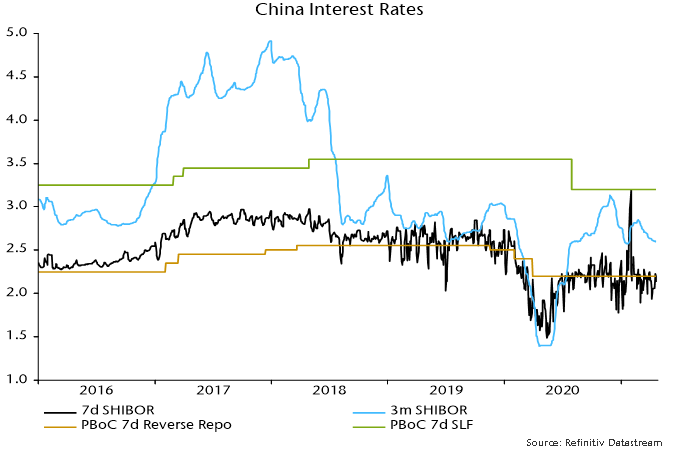
A revival in Chinese narrow money growth probably requires a PBoC policy shift. The view here has been that policy was overtightened in H2 2020 and the economy would slow in H1 2021. This scenario appears to be playing out, with Q1 GDP disappointing and industrial output falling in March. Core CPI inflation (i.e. ex. food and energy) is at 0.3% and a surge in PPI inflation reflects input cost rises that are squeezing downstream margins. The PBoC has allowed three-month SHIBOR to drift back to its January low, consistent with a switch to an easing bias – chart 7.

Chart 7

This year has started on strong footing for global mergers and acquisitions (M&A). According to Refinitiv, global M&A hit a new record of $1.3 trillion as of March 31st, 2021.[1] What is driving this boom? On the news we have seen many big deals take shape, from GE divesting its business to Canadian Pacific expanding its footprint. But behind the headlines, something else is accelerating M&A activities, especially in the Unites States (US). We are talking about SPAC, which alone represent about 25% of the total deal volume in the US.

The first quarter of this year was also one of the busiest for IPOs, of which, once again, SPACs took the limelight. There were 296 SPACs raising $87 billion, a 20-fold increase over the same period last year.

What is a SPAC?

A SPAC or “Special Purpose Acquisition Corporation” is a vehicle used to acquire a private company and make it public without going through the traditional IPO process. Back in the 1980s, there was something called a “blank check offering”. These were companies focused on finding promising operating enterprises — prospects that sounded great on brokers’ cold call pitches (typical “pump and dump” schemes). Fraud and manipulation was so rampant among these blank check companies, the SEC adopted Rule 419 under the Securities Act of 1933 , “requiring investors’ funds to be held in escrow, filing of a post-effective amendment upon execution of an acquisition agreement, and the return of the escrowed funds if an acquisition has not occurred within 18 months of the effective date of the initial registration statement.”.

David Nussbaum, a Long Island based lawyer and CEO of GKN Securities, understood the new rules would reduce interest from investors. So he reinvented the blank check concept in 1992, and SPACs were born. The SPAC structure allowed for trading, but included many provisions to protect investors — like allowing investors to opt out of the merged company and get their money back once a deal is done.

How do SPACs work?

First, a sponsor raises capital and incurs the cost of an IPO in a new shell company. To make the deal attractive to investors, the units are usually priced at $10 each and provide a warrant to buy more shares. The sponsor then has 12 to 24 months to find the target. If no target is found, or if the investors decide to vote “no” on the deal, the holders can redeem their investments.

We have seen this movie before

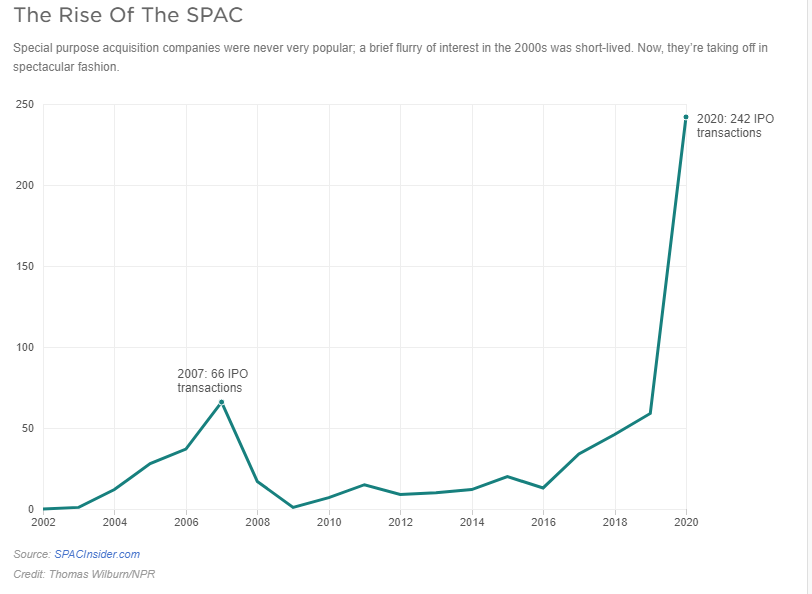
SPACs are in their third decade of existence. In the early 1990s, they were marketed as vehicles that helped small companies go public, while offering outsized favourable terms to their sponsors. In the late 90s, SPACs took a back seat. After all, why would a company do a reverse merger when you could easily raise money during the tech bubble? SPACs enjoyed a renaissance in late 2002, peaking at 66 IPOs just before the great financial crisis. They reappeared in early 2016, and have been going strong ever since. According to SPAC Analytics, in 2020, SPACs were 55% of IPOs, compared to 4% in 2013. So far this year, SPACs represent 79% of total IPOs.

SPACs versus a traditional IPO

SPACs are a pure genius way of going public. Since there is no identified target, a sponsor’s prospectus has no information about the business or the strategy. On the other hand, an IPO roadshow raises a lot of questions and invites a lot of scrutiny from investors.

In an IPO, there is no guarantee on the final valuation of the company. With a SPAC, the IPO has been done, and you have negotiated the valuation of your company with the sponsor. Plus the due diligence required for a merger is much less than SEC requirements for a regular IPO.

Cost could be another key factor. An IPO can cost anywhere between one to seven percent in fees for investment banks. With a SPAC, the underwriter may charge about five to six percent. However, there are other fees associated with the merger, which can end up being almost 20-25 percent of the total money the sponsor may raise.

Why are SPACs so popular?

A recent Wall Street Journal article counted 61 sports-related SPACs formed this year alone, compared to just five in 2019.[2] Athletes from Serena Williams, Stephen Curry, Naomi Osaka, Tony Hawk, Colin Kaepernick, and even Shaquille O’Neal, have shown interest in SPACs.

Everyone loves money, especially free money. SPAC founders and sponsors generally get about 20% of the shares of the SPAC as a fee for raising capital, finding the target, and, of course, giving it their brand name. Hedge Funds like it because they can use leverage to buy SPACs and also get preferential access to SPAC deals at the $10 share price. Everyone else has to wait and likely pay a higher price.

Most investors don’t read the annual reports of the companies they own, so they miss out on the fine print in the SPAC prospectus. For example, many are unaware of the lock-up period, which can be anywhere from six months to a year. Once the lock-up period is over, the floodgates open and add pressure to the stock price. 

The clock is ticking?

SPACs don’t have time on their side because there is a limited window to close a deal. Targets are well aware of this restriction. They also know that a SPAC is required to spend at least 80% of its assets on a single deal. So the target always has the advantage. SPACs are paying a median price-to-sales ratio of 12.9, compared to 4.1 paid by other companies, according to 451 Research.[3]

SPAC-mania has been going on for a few years now, which means there is a lot of capital chasing deals, combined with ticking clock syndrome, which signals an inevitable decline in deal quality. We could easily see the SPAC bubble go bust once again.

How have SPACs performed historically?

A team of researchers analyzed completed mergers from January 2019 and June 2020, and found that SPACs lost 12% within the first six months, and dropped 35% on average after the first year. Bain & Co looked at 121 SPAC mergers from 2016 to 2020 and concluded that “more than 60% have lagged the S&P 500 since their merger dates, and 50% are trading down post-merger”. The other 40% are trading below the $10 IPO price.

Portfolio Impact

Regulators like the SEC are beginning to take a closer look at SPACs. SEC recently issued an investor alert pointing out that just because celebrities are backing SPACs doesn’t mean retail investors should follow suit.

At Global Alpha, we do not invest in SPACs. Our focus is on finding high-quality companies with defensible business models and strong balance sheets that should outperform the small-cap benchmark.


[1] https://news.yahoo.com/deal-making-smashed-records-q1-141243172.html  

[2] https://www.wsj.com/articles/the-celebrities-from-serena-williams-to-a-rod-fueling-the-spac-boom-11615973578

[3] https://usa-latestnews.com/technology/with-valuations-on-us-startups-skyrocketing-spacs-are-starting-to-shop-overseas/