The limestone quarry in Faxe, Denmark’s largest man-made excavation.

Lime and limestone are materials that have shaped human civilization for thousands of years. Limestone is a common sedimentary rock formed mostly from calcium carbonate. It develops over millions of years from either marine organisms (shells, coral, plankton, etc.) or chemical precipitation in oceans and lakes.

Limestone is converted into lime by burning (calcining) it in a kiln at 1000ºC. Lime can then be mixed with water (hydrated) to form hydrated lime. Finished lime then absorbs CO2 and slowly transforms back to calcium carbonate (i.e., limestone). The lime cycle is one of the oldest known chemical cycles used by humans

Limestone been used as building material for centuries, from pyramids to great cathedrals of Europe, including Notre Dame, Westminster Abbey and St Peter’s Basilica. More commonly it is used as an ingredient in cement and concrete, and in building roads. It is also a widely used industrial mineral, either unprocessed or transformed into a lime derivative.

Limestone is estimated to account for 15% of surface rock on Earth, but high-purity limestone valued in industrial, construction, environmental and agricultural applications is much rarer as are deposits of scale that can be commercially exploited.

Applications across industries

SigmaRoc PLC (SRC LN), a recent addition to the portfolio, is a lime and minerals group targeting quarried materials assets in the UK and Northern Europe. The business is asset backed with over 2.7 billion tonnes of mineral reserves and resources, the equivalent of over 100 years of resources.

SigmaRoc has exposure to the construction, industrial and environmental end markets with applications such as:

Construction

  • Quarried limestone and granite materials are used in both infrastructure and residential applications such as the construction of roads, railways, bridges, ports, airports and buildings. The main products include aggregates, asphalt, ready mix concrete, pre-cast concrete and dimension stone.

Industrial

  • Lime is used as a flux in steel and copper production to remove impurities and control melt chemistry.
  • Quicklime is involved in pulp and paper production.
  • Limestone powder is used as a filler in paints and adhesives.

Environmental

  • Quicklime, slaked lime and limestone powder remove acidic compounds from flue gas.
  • Lime treats drinking water by raising pH, and wastewater by reducing toxicity.
  • In soil treatment, lime raises soil pH.

Quarries and their locations

SigmaRoc has an advantage in that it owns quarries. In countries where it does not own quarries (the UK and Poland), it has on-site kilns and long-term supply agreements with the quarry owner. Owning the quarry means fixed costs are manageable and ensures both the quantity and quality of supply.

Having quarries located close to customers has key logistical advantages. Firstly, the weight of the product means it is not feasible to ship long distances. Lime products are dangerous to transport due to lime’s high chemical reactivity. It is classified as corrosive under transport regulations and producers need regulatory compliance to ship. Quicklime degrades over time, meaning shipping long distances is unfeasible, reducing the threat of imports.

Integration, growth and megatrends

The three main lime producers in Europe are SigmaRoc and two privately owned Belgian companies. After those, the market is fragmented and the SigmaRoc has a “buy-and-build” growth model. The strategy is to acquire assets (quarries, lime and limestone businesses, related infrastructure) in fragmented local markets, then integrate them to extract synergies, scale and efficiency.

SigmaRoc has cyclical recovery potential and is poised to benefit from megatrends that support long-term growth. If macro conditions improve – supported by infrastructure spending, lower rates and renewed housing policy – SigmaRoc’s scale and flexibility could drive outperformance. Its diversified presence across geographies also helps smooth region-specific cycles.

Future growth is also supported by the ongoing electrification of economy. This creates a huge increase in demand for batteries, and lime is required in the mining and refining of lithium. European steel – and especially green steel – should also benefit from electrification, so long as the industry is protected from high carbon inputs, potentially reduced import quotas and higher tariffs. Beyond electrification, flue gas scrubbing creates an environmental market for lime, a process that addresses shipping emissions.

Limestone and lime are attractive markets due to high barriers to entry, the irreplaceable nature of product and the lack of material import flow into Europe. With an M&A track record as the foundation for future growth, we believe that makes SigmaRoc a compelling investment in the materials sector.

Bulk sub-sea industrial glass fiber optic cable on a metal spool on a ship's stand. The yellow data line is coiled around a black reel in a storage yard.

The technology that harnesses wind and solar power is highly noticeable at a glance – it is hard to miss towering wind turbines or gleaming fields of solar panels. But what is not so obvious is how the power gets from those visible generators into the electrical grid that eventually powers your home.

Nexans S.A. (NEX FP) is increasingly emerging as a differentiated way to play the next phase of the energy transition, where the focus shifts from building renewable capacity to connecting it at scale.

While the first wave of the energy transition was defined by rapid growth in wind and solar generation, the current phase is more complex: integrating that capacity into power systems. This is where Nexans sits – at the intersection of renewable buildout and the infrastructure required to make it usable.

Europe’s plan for energy security

In this context, offshore wind is becoming a central driver of demand once again. Following a period of delays linked to cost inflation and project economics, Europe is now moving to re-accelerate deployment. At the January 2026 North Sea Summit, governments committed to developing ~100GW of offshore wind capacity, with a longer-term ambition of 300GW by 2050, alongside coordinated investments in cross-border grid infrastructure.

This renewed momentum is not just about decarbonization, it is increasingly tied to energy security and affordability. European policymakers are prioritizing domestically generated electricity to reduce dependence on imports, while structurally higher and more volatile power prices continue to incentivize investment in renewable capacity.

Nexans ready to support Europe’s wind commitments

For Nexans, offshore wind is particularly attractive. Each project requires significant volumes of high-voltage subsea export cables and increasingly complex interconnection solutions, positioning cable suppliers as critical enablers of deployment. As projects scale and networks become more integrated, demand is shifting toward higher-specification, higher-margin systems areas where Nexans has strong technological capabilities.

At the same time, the company’s strategic repositioning over recent years has sharpened this exposure. By exiting more commoditized cable activities and focusing on electrification and high-voltage segments, Nexans has aligned its portfolio with the fastest-growing and most structurally supported parts of the market.

Buying local – Nexans is Europe-based

This is further reinforced by an evolving policy backdrop in Europe. The EU’s industrial strategy is increasingly incorporating local content requirements and procurement incentives aimed at strengthening domestic manufacturing in key energy technologies. For a Europe-based player like Nexans, this creates a supportive competitive environment, particularly in large-scale infrastructure linked to renewables.

Importantly, supply dynamics remain favourable. High-voltage subsea cable capacity is limited globally, with long lead times and high technical barriers to expansion. As offshore wind deployment accelerates again, this constraint is likely to support pricing and contract discipline across the industry.

Disciplined execution, rising returns

The key focus for investors is increasingly on Nexans’ ability to translate strong structural demand into consistent and higher-quality earnings. As the group continues to prioritize selective project execution and disciplined contract structures, visibility on margins and cash generation is improving. This reflects a more mature operating model, with greater emphasis on value over volume and a clear focus on returns.

In that context, Nexans offers a differentiated exposure to renewables, not through generation itself, but through the critical systems that enable renewable electricity to be delivered, scaled and monetized. As Europe enters a renewed phase of offshore wind expansion and electrification, the company may be well positioned to capture both growth and improving returns.

Cozy modern bedroom with white bedding, wood panel walls and warm lighting.

“A good laugh and long sleep are the best cures in a doctor’s book.” – Old Irish proverb

It’s been more than a decade since the CDC declared sleep disorders “a public health epidemic.” Since then, the world has woken up and taken note. The long-term impact of sleep loss on mental health and physical performance has been widely documented in scientific studies. From cardiovascular disease to compromised immunity and burnout, poor sleeping habits quietly add up over time while increasing our mortality risk. Sleep is also important for cognitive health because it gives the brain time to remove toxins that accumulate while we are awake.

The three foundational pillars of human health are sleep, diet and exercise. Diet and exercise have always dominated conversations around health with very little attention paid to sleep and sleeping habits. Now sleep (or the lack of it) has finally caught the attention of society at large and with it we have seen the rise of the sleep economy.

The broader sleep economy encompasses everything from sleeping aids to sleep medication and supplements, bedding and furnishing to sleep tourism. Just the sleeping-aid market is estimated to reach $188 billion according to Statista. The emergence of the sleep economy is best represented by the popularity of products like the Oura ring that tracks heart rates, sleep cycles and recovery metrics. Oura ring has sold over 5.5 million rings and the company behind it, Oura Health, was valued at $11 billion last year.

Beyond just physical products, we are also seeing the rise of sleep tourism, with travelers showing an increased preference for sleep-focused holidays. Hotels understand that their customers now value good quality sleep and offer everything from smart beds and pillow menus to sleep-specific spa treatments and dedicated sleep programs to help reset the circadian rhythm and allow customers to rest.

One of the holdings in our portfolio is Atour Lifestyle Holdings Ltd. (ATAT US), the largest hotel operator in China’s upper-midscale segment. There are several attributes of the business that make it attractive purely as a hotel operator – from its brand strength to its ability to expand in an asset-light manner while maintaining its attractiveness to prospective franchisees.

However, Atour also has a fast-growing retail business that caters directly to emerging sleep economy trends. From deep sleep pillows to mattresses and comforters, Atour is the first hotel chain in China to develop a retail business around the sleep economy. Sleep economy aside, Atour also taps into so called new consumption trends in China where consumers prioritize maintaining a balanced lifestyle and personal fulfillment over conspicuous consumption that was prioritized by their parent’s generation. From that perspective, Atour for us checks two boxes: the rise of the sleep economy and shift in spending toward services like travel and tourism, concerts etc.

Atour is able to create synergies with its hotel business by cross selling its products to its hotel guests. Hotel guests get what is in effect a free trial when they stay at an Atour property and their real-time feedback is used to enhance product R&D. It helps that Atour’s premium positioning has a positive spillover effect on the brand positioning of its sleep products. Being alert to changing societal norms and evolving spending priorities is a key element in identifying themes within our investment process. We sleep well at night knowing that these thematic tailwinds provide a nice boost to Atour’s revenues and profitability on top of good execution with its core hotel business.

A Japanese "Shinkansen" (or bullet train), traveling through the Tokyo cityscape at dusk.

Japan is a country that remains steeped in tradition and ritual, even as it embraces and leads advanced technologies such as factory automation, semiconductor production equipment and high-speed trains. Staid practices such as invoicing expenses via fax machines, saving data on floppy disks and even signing documents with physical ink stamps continued unabated until the pandemic forced a wholesale rethink.

Historical context: System integrators

Japanese companies’ approach towards IT infrastructure differs fundamentally from their American and European counterparts. In the 1960s, the Japanese government was concerned about IT competitiveness against American behemoths, IBM and Intel. Therefore, the government funded the development of IT national champion NTT, as well as three other IT groups, Fujitsu and Hitachi, NEC and Toshiba, as well as Mitsubishi Electric and Oki. It also awarded these groups public projects over the decades since. By the 1980s, the private sector saw the spinoff of consulting subsidiaries, specializing in the IT needs of service sectors such as e-commerce and finance. These consultants became known as System Integrators (SIs).

Competitive advantage: Talent monopsony

SIs coordinate software vendors, hyperscalers, subcontractors and non-tech companies’ IT departments to meet their clients’ IT needs. SIs’ customer stickiness is strong because clients desire customization but can’t secure the top IT talent because of customers’ comparatively low salaries. Local companies’ IT workers are generalists who don’t know how to effectively procure hardware, manage software or even develop an IT strategy. Gartner found that 67% of such companies blamed « talent scarcity » as a major obstacle to IT upgrades (vs. 38% globally). With growing IT labour shortages and few students pursuing tech degrees, SIs’ core role between the key parties is what leads to higher margins, enabling companies to hire top SI talent.

Industry outlook: Long growth runway

IDC estimated that Japan’s $180 billion in annual general IT spend would grow at 6.4% CAGR into 2029E. Mordor Intelligence estimated that cloud spending would grow significantly faster than general at 17% CAGR into 2031E. According to Gartner, in 2021 31% of Japanese companies stored data on the cloud, with cloud comprising only 4.3% of total IT spend (vs. 14.4% North America, 9.7% Europe, 6.4% China). As of 2023, according to the Information Technology Promotion Agency, large Japanese firms with more than 1,000 employees had already drawn even with large American firms with ~63% of them noting that they had dedicated digital transformation (DX) departments (vs. ~64% for large American firms). In contrast, smaller Japanese firms with fewer than 1,000 employees were lagging behind with just ~12-41% reporting dedicated DX departments (vs. ~39–66% for smaller American firms). Smaller capitalization SIs serve small customers.

Gen-AI: More opportunity than threat

While software-as-a-service (SaaS) company stocks have sold off across America, Europe and Japan year to date, we expect strong demand for cybersecurity and infrastructure to continue, benefiting SIs. This is because declining software development costs amid AI-led coding and fiercer price competition against AI agents reduce overall software package costs. While lower prices hurt SaaS supplier margins, they boost customers demand.

SIs are crucial to the integration of software packages with hardware and networks, all safeguarded by cybersecurity. Japanese companies’ core IT systems were built by the SIs themselves in complex layers based on evolving business needs and characteristics. This makes it hard to standardize processes, a necessary precursor to an AI-first automated approach. Rather, our SIs will even benefit from rising demand for limited IT system standardization as companies seek to deploy agentic AI. Admittedly, agentic AI has the potential to replace end-user applications in enterprise resource planning, but we believe that SIs will retain their crucial role in maintaining infrastructure by offering cybersecurity.

DX favours smaller SIs

Mentioned above, DX refers to the implementation of digitalization through efforts such as transitioning data to the cloud to avoid reliance on onsite physical data storage and, more recently, rolling out gen-AI models to boost productivity. The term captures the shift in approach from treating IT as peripheral toward recognizing its centrality. As IT competitiveness and DX continue in Japan, the next leg of growth should be led by DX service providers that focus on smaller firms.

Simplex Holdings

Simplex Holdings Inc. (4373 JP) was founded in 1997. In 2001, it began offering banks with solutions like IT consulting, systems development, and operations and maintenance. Over the decades, it expanded into FX brokerages, equity, futures, options platforms, insurers and crypto. In 2013, it conducted a $211 million buyout with Carlyle. Carlyle later sold its equity stake upon Simplex’s September 2021 relisting on the Tokyo Stock Exchange. We feel that Simplex is well positioned to benefit from this trend.

* all dollar amounts referenced in this article are in USD.

Electrical cables with the outer protective sheath cut, exposing the copper wiring.

Chile’s 2025 presidential election marked a meaningful political inflection, with markets interpreting the outcome as a shift toward a more pro-business, market-oriented policy framework focused on restoring economic growth and encouraging private investment. The incoming administration has emphasized fiscal discipline, regulatory clarity and the strategic importance of export-oriented sectors – particularly copper – in driving medium-term economic expansion.

For the mining sector, this shift points to clearer permitting processes, a more pragmatic stance toward private capital and improved project visibility, all of which are especially relevant for long-life assets requiring sustained investment. Against a backdrop of structurally rising global copper demand – driven by electrification, grid expansion and the energy infrastructure needed to support AI-related data centre growth – this political realignment strengthens the case for selective exposure to high-quality copper producers.

Capstone Copper Corp. (CS TSE) is well positioned to benefit from this environment, with approximately two-thirds of consolidated copper production generated in Chile, providing direct leverage to a more constructive domestic policy backdrop. The company is executing a district-scale growth strategy targeting a ~70% increase in annual copper production to approximately 400 ktpa, driven by long-life Chilean assets and capital-efficient brownfield expansions. Near-term growth is led by the Mantoverde Optimized expansion, expected to deliver an incremental ~20ktpa of copper with declining unit costs, while the fully permitted Santo Domingo project represents a transformational medium-term opportunity with a sanctioning decision expected in H2 2026. Supported by more than $1 billion in available liquidity and net leverage of approximately 0.9x EBITDA (TTM), Capstone is well positioned to translate a supportive policy environment into improved execution, cash flow growth and valuation upside.

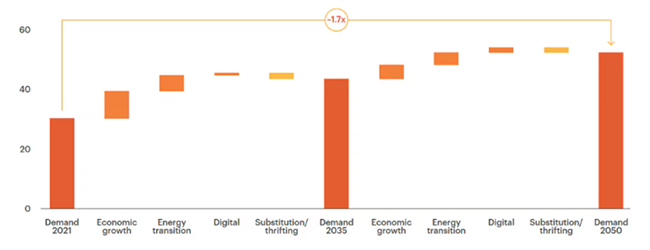
Global copper demand is poised for significant growth over the coming decades, with BHP projecting a roughly 70% increase to more than 50 million tonnes annually by 2050, up from around 31 Mt as of 2021.

Copper demand projected to grow ~70% through to 2050…
(Copper demand by key theme, Mt)
Bar graph showing the projected growth of copper demand from 2021 to 2050, highlighting key areas of demand growth.
Source: “BHP Insights: how copper will shape our future,” BHP

This surge is driven by a combination of traditional economic expansion, as developing economies electrify and improve living standards, and newer demand sources tied to the energy transition and digitalization. Technologies such as electric vehicles, renewable power infrastructure and data centres – all of which are copper-intensive – are central to this trend, fueling higher material requirements even as substitution and efficiency improvements evolve.

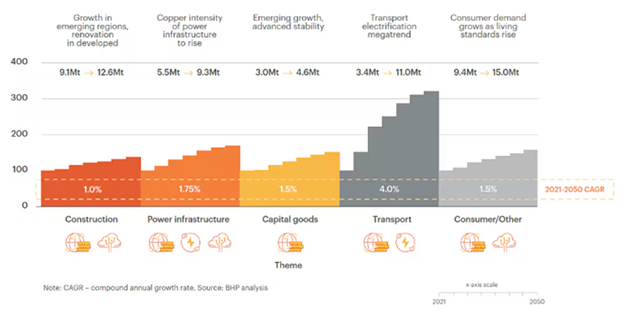
…an average of 2% per year*
(Copper demand by end-use sector, indexed to 2021)
Bar graph showing the projected growth of copper demand, grouped by end-use sector. 
Source: “BHP Insights: how copper will shape our future,” BHP

These dynamics favour producers with scalable assets, permitted growth projects and balance sheet flexibility. In this context, Capstone Copper is well positioned to benefit from supportive domestic policy and increased demand for copper, with an opportunity to increase valuation and sustain cash flow through disciplined execution.

Sergels Square, Stockholm, Sweden.

Retail brokers have benefited immensely from the impact of retail investors on financial markets since the onset of COVID. Robinhood is now a familiar name to most Americans, but virtually all the brokerages globally have benefited from the rising tide of retail investors’ enthusiasm for investing and trading. In this note, we examine some of the mega-trends that have helped European brokerages outperform the market since COVID emerged in 2020.

1. Retail participation and retail financial product availability.

Since the 2008 recession, retail investors have gained access to a multitude of new products like index ETFs, crypto, fractional shares, robo-advisors, IPOs and even private markets. This led to an explosive growth in retail investment, especially since 2020 and the dawn of COVID. Digital and mobile platforms, along with significantly reduced commission costs, have made it easier than ever for a younger demographic to access the markets. The vast majority of onboarded customers over the last decade have not lived through the trauma of the 2008 recession and see any market pullback as an opportunity to double down on their favourite stocks.

2. Increase in cross-border trading.

It is well documented that investors, including retail, have historically had a strong home bias in their asset allocations. But the US stock market outperformance since 2009, along with the disproportionate share of tech mega-cap attention, has led to consistent inflows into the US market. It has also created a larger level of familiarity with US companies that are more covered/discussed by pundits. All this has led to a higher level of cross-border trading in non-US brokerages that is typically much more lucrative as they usually pocket a large spread on foreign exchange transactions.

3. Digitalization and banks losing market share.

Over the last decade, brokerages have been able to consistently gain market share from large banks, thanks to a less-bloated corporate structure and a tech stack that could be built from scratch and not built on legacy bank structures. This has allowed them to be in a position to compete more aggressively on fees, transaction costs and overall value proposition as retail brokerage fees remain a minuscule proportion of mega-banks’ revenue and don’t garner a lot of attention from a strategic perspective.

4. Increase in share of income from NII.

Although net interest income (NII) has been declining for European brokers since the end of 2023, decreasing with the ECB rates, it remains at a more attractive level than pre-COVID and is expected to remain as such for the foreseeable future. Additionally, most brokers have been able to increase NII since 2023 thanks to client gains and account cash balance more than compensating for the lower rates.

Brokers have also been more efficient at increasing the spread between the amount they pay on deposit and the amount they get paid (known as net interest margin or NIM). Having managed deposit pass-through well on the way up and down, brokers are now better structurally positioned to benefit from deposit growth.

5. Benefit from macro volatility.

A key feature of brokerages’ stocks in a portfolio is their positive skew to market volatility. Because they make money from the number of trades, they are agnostic to market direction, as long as it causes participants to trade more. Just over the last year or so, events such as the US election, Liberation Day, the French budget and now the Venezuela situation have all been positive tailwinds mentioned by various brokerage CEOs.

It’s worth noting, however, that brokerages are not immune to long periods or volatility or market drawdown, all of which would lead customers to reduce their equity exposure.

We gained exposure to the retail brokerage space in one of our strategies through Nordnet (SAVE SS), a Swedish brokerage firm with a banking licence. It has exposure primarily to the Nordics with a top-two position in all markets and is slowly working on building a presence in Germany. It derives a bit more than half its revenue from commission and the rest from interest income.

Sweden is one of the countries with the highest savings rate globally, and financial literacy is also higher than the Europe average. Finland, Norway and Denmark also rank highly but are less penetrated and less competitive than Sweden. All have been a strong source of growth for Nordnet, which has consistently been among the top names in the space for customer satisfaction.

Given its diversified product offerings that include a full suite of investments, savings, pension and banking products, as well as its best-in-class technology platform (releases an update every 2.5 days on average and with a 99.9% platform uptime), Nordnet is able to maintain a customer acquisition cost of SEK790 – which is below the vast majority of peers – and its small social media platform has been able to generate a strong media presence and customer engagement.

Here is where Nordnet stands on the brokers mega-trends:

  1. Financialization: Sweden is one of the countries in Europe with high financial literacy. Other Nordic countries rank above average as well.
  2. Cross-border trading: Between 2022 and 2025, share of cross-border trading increased from 27% to 31.5% and is one of the primary contributors to the increase in income per transaction increasing from SEK31 to SEK39 over that same period.
  3. Digitalization and market share gains: Both Nordnet and its close competitor, Avanza, have gained tremendous market share over the last decade and now rank second and first respectively by trading activity. This is despite still being behind Sweden’s largest four banks on savings capital. They both rank top of their class on user experience surveys.
  4. Net interest income: NII was as low as 20% of overall revenue in 2021 and is now steadying at 42% of total revenue after peaking at 58% in 2023. We expect the share of NII to remain structurally higher than pre-COVID.
  5. Macro volatility: Nordnet benefited from large macro events such as the US election and Liberation Day. In Q2 2025, following Liberation Day, Nordnet reported a 22% year-over-year (YoY) increase in trading volume. As for the US election in 2024, it saw a 14% YoY increase in trading volume.

Despite the volatility of their operational performance, brokerage firms provide a unique type of exposure to a diversified portfolio, one that is very different to how you would think of typical insurance and bank financials. There are reasons to believe brokers will continue to outperform the overall market and will continue to look for opportunities to participate.

Wind turbines in Oiz eolic park, Spain.

The past year was yet another eventful one for sustainability investors and the broader Environmental, Social and Governance (ESG) landscape. 2025 was marked by a succession of extreme weather events, a near-record global temperature average and significant international policy developments, including the EU’s Omnibus simplification package and further amendments to greenwashing claims under Canada’s Competition Act. Importantly, the average global temperature for the three-year period from 2023 to 2025 likely exceeded the 1.5°C threshold above pre-industrial levels for the first time – a milestone that underscores the growing urgency for governments, companies and investors to reassess how climate risks are managed and priced.

In this commentary, we highlight five ESG trends set to shape the year ahead, revealing both challenges and opportunities for investors and businesses alike.

1. From climate mitigation to climate survival

With the 1.5°C threshold now effectively behind us, the focus is shifting from climate mitigation alone to climate adaptation and resilience. Markets are increasingly pricing physical climate risks – from flooding and heat stress to water scarcity – into valuations, insurance costs and credit risk. At the policy level, governments are directing more capital toward adaptation priorities such as resilient infrastructure, water systems, food security and disaster preparedness, with several countries announcing a major increase in adaptation finance, aiming to triple it to $120 billion annually by 2035. For investors, exposure to climate resilience is becoming critical. We believe that companies enabling societies to withstand and adapt to physical climate impacts are likely to play an increasingly important role in long-term portfolios.

2. ESG returns to its financial roots

After surging in prominence during the pandemic years, ESG has faced political pushbacks and skepticism in parts of the market. This recalibration is now forcing a clearer definition of what ESG truly represents: financially material business issues. Labour practices, supply-chain resilience, governance failures and environmental liabilities matter because they can directly affect cash flows, valuations and license to operate – and indirectly shape the long-term sustainability of economic growth. In 2026, we believe ESG will be re-anchored to its original purpose: identifying risks and opportunities that are financially relevant to investors.

3. ESG integration is also becoming mainstream

ESG is no longer a niche strategy or a product label. Sustainability considerations are increasingly embedded across investment processes, from equity and credit analysis to portfolio construction and risk management. In Canada alone, ESG integration is used by 96% of investors, representing 87% of AUM. Whether or not a fund is explicitly marketed as “ESG,” these factors are becoming part of standard due diligence, and therefore increasingly a core component of the investment infrastructure. We believe this trend will continue in the new year and accentuate in many markets around the world as countries like Japan, China and India are increasingly adopting ESG initiatives.

4. The redefinition of “responsible” capital

Energy security, defence, critical infrastructure and industrial resilience are being re-examined through an ESG lens. Investors are increasingly debating when exclusion gives way to responsibility, and whether financing defence capabilities, transition metals or strategic industries is incompatible with – or essential to – long-term sustainability. This shift reflects a more pragmatic approach to ESG, recognizing that social stability, security and resilient supply chains are foundational to sustainable development. We believe that 2026 will be marked by further discussions and guidance around how to invest responsibly in previously deemed harmful sectors, with workgroups such as the Principles for Responsible Defence Investment (PRDI) initiative.

5. AI and data-driven ESG analysis

Artificial intelligence (AI) and advanced data analytics are transforming how most sectors operate. ESG is no different. From climate modelling and supply-chain monitoring to controversy detection and impact measurement, AI is enabling more timely, granular and forward-looking ESG analysis. The competitive edge is moving away from simply having ESG data toward better understanding of the data, as well as interpreting signals faster and more effectively than the market. As AI capabilities continue to advance, we believe ESG will increasingly become more dynamic, data-driven and integral to enhance risk management, uncover emerging opportunities and improve long-term investment decision-making.

Final thoughts

At Global Alpha, it’s never been about chasing ESG trends, but remaining disciplined and consistent in our investment processes. ESG has always been about financial risk mitigation and long-term value creation – doing what is right for our clients by identifying material risks and opportunities in a rapidly changing world. From climate resilience and supply-chain stability to governance quality and data-driven analysis, ESG considerations have long been embedded in how we assess risk and opportunity across portfolios.

As the ESG landscape continues to evolve, our philosophy remains unchanged: identifying and managing material risks, while allocating capital to businesses positioned to create durable value in a rapidly changing world.

Une vue aérienne du réseau autoroutier vital de la Thaïlande.

Les investisseurs canadiens privilégient depuis longtemps les actions canadiennes et y consacrent une plus grande part de leurs portefeuilles que ne le laissent croire les indices de référence des actions mondiales. Malgré la solide performance du marché boursier canadien en 2025, la récente remontée des marchés américains (alimentée par la progression des géants des technologies de l’information ou « sept magnifiques ») a incité certains investisseurs à repenser cette approche. Les investisseurs canadiens affichent une préférence semblable pour leurs titres nationaux à celle de leurs homologues à l’échelle mondiale. Même si certains investisseurs misent entièrement sur les actions mondiales, il y a plusieurs avantages à privilégier les actions canadiennes.

Biais domestique

Le biais domestique consiste à construire un portefeuille de placement qui privilégie instinctivement les actions de votre propre pays, une tendance commune chez les investisseurs à l’échelle mondiale. Même si les actions canadiennes ne représentent que 3 % à 4 % des marchés boursiers mondiaux, le confort de ce qui est connu fait qu’une place beaucoup plus importante leur est accordée dans les portefeuilles d’actions. Il est courant pour les investisseurs canadiens de consacrer entre 20 % et 40 % de leur exposition totale aux actions canadiennes.

De nombreux investisseurs surpondèrent largement les actions de leur marché domestique par rapport au poids réel de leur pays dans le marché mondial. Selon l’étude Global Pension Assets Study 2025 du Thinking Ahead Institute de WTW sur les actifs des régimes de retraite mondiaux, cette préférence est particulièrement forte du côté des investisseurs dans les caisses de retraite australiennes, japonaises et britanniques, qui investissent entre 20 % et 45 % de leur exposition totale en actions dans des sociétés de leur pays d’origine. Bien que les investisseurs des régimes de retraite américains affichent généralement la plus forte allocation domestique, celle-ci reflète en grande partie le poids important du marché américain au sein du marché mondial.

Les arguments en faveur d’une approche axée sur le pays d’origine plutôt que sur la capitalisation boursière mondiale viennent aussi avec leurs propres défis, notamment une certaine concentration sectorielle. Toutefois, chaque approche offre une perspective unique sur la façon de gérer le risque et les occasions.

Caractéristiques des différentes approches

Le tableau suivant présente les caractéristiques des différentes approches de gestion du total des actifs en actions.

Préférence pour les actions canadiennes Actions mondiales seulement
Monnaie Investir dans des actifs libellés en dollars canadiens permet aux investisseurs institutionnels, comme les caisses de retraite, les fonds de dotation et les fondations, de contourner le risque de change. Ainsi, la valeur des actifs suit l’évolution des éléments de passif, ce qui élimine les fluctuations de valorisation causées par les écarts de change. Investir à l’échelle mondiale n’est pas seulement une question de géographie; c’est aussi une question de monnaie. Les actions mondiales offrent une exposition à plusieurs devises, offrant une protection naturelle si le dollar canadien subit un choc lors d’un repli mondial ou d’une chute des prix des produits de base.
Caractéristiques des indices Le marché boursier canadien se démarque à l’échelle mondiale grâce à sa concentration dans les secteurs des ressources et de la finance, ce qui façonne son profil risque-rendement unique. Pendant les périodes de forte hausse des prix des produits de base, par exemple, les actions canadiennes peuvent offrir des avantages sur le plan de la diversification par rapport aux marchés mondiaux. Sur le plan sectoriel, le marché mondial est davantage axé sur les occasions de croissance, comme les secteurs des technologies de l’information et de la santé, comparativement au Canada.
Diversification Bien que le marché canadien soit plus petit et plus concentré, ce qui accroît la volatilité des rendements, il peut consolider les rendements totaux des actions lorsqu’il est jumelé aux actions mondiales dans une stratégie misant sur une certaine diversification. La diversification à l’échelle mondiale évite aux investisseurs de mettre tous leurs œufs dans le même panier d’actions. Selon l’indice mondial adopté, elle donne accès à de nombreux pays développés et émergents.
Potentiel d’alpha Le potentiel de valeur ajoutée provenant de la gestion active a été plus constant pour les actions canadiennes que pour les actions mondiales et a constitué une importante source de rendement supplémentaire. La gestion active dans les portefeuilles d’actions mondiales a généré de la valeur ajoutée, malgré les récents obstacles attribuables à la solide performance des sociétés technologiques.


Pourquoi privilégier les actions canadiennes?

Les portefeuilles qui privilégient les actions canadiennes offrent la possibilité d’obtenir de meilleurs rendements boursiers globaux ajustés au risque que les portefeuilles exclusivement mondiaux. Ils présentent l’avantage d’un potentiel de valeur ajoutée plus constant grâce à une gestion active, ainsi qu’à un contexte économique favorable au Canada qui amplifie leur potentiel de croissance.

Perspective de rendement

L’analyse du rendement historique relatif des actions canadiennes (indice S&P/TSX) par rapport aux principaux indices boursiers mondiaux (indice MSCI Monde tous pays et indice MSCI Monde) met en évidence la résilience et les avantages que peuvent procurer une préférence pour les actions canadiennes. Même si les indices mondiaux se retrouvent souvent à l’avant-plan, on ne peut désigner un seul gagnant clair et constant. À l’exception de la dernière décennie, les actions canadiennes ont surpassé les actions mondiales pendant de longues périodes, selon leurs rendements sur des périodes mobiles de quatre ans, en dollars canadiens, par rapport aux indices mondiaux (Figure 1). Bien que les manchettes mettent l’accent sur les sept magnifiques qui alimentent les gains des actions américaines et mondiales, les actions canadiennes ont discrètement suivi le rendement des actions mondiales au cours des dernières périodes mobiles de quatre ans.

Figure 1 – Rendements des indices boursiers mondiaux par rapport à ceux des indices boursiers canadiens
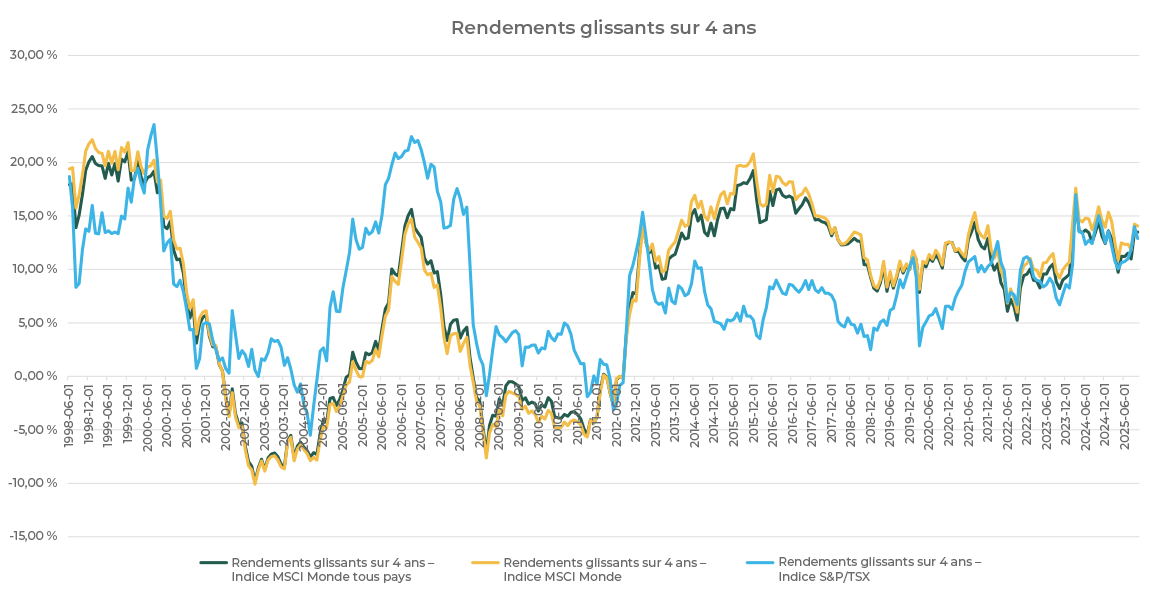
Graphique linéaire illustrant les rendements sur quatre ans pour l'indice MSCI ACWI, l'indice MSCI World et l'indice S&P/TSX de 1996 à 2025.
Sources : MSCI, FTSE et Bloomberg

Lorsque l’on analyse la volatilité des indices boursiers canadiens et mondiaux, le portrait se précise, car les actions canadiennes sont généralement plus volatiles que les actions mondiales non couvertes (Figure 2). Cet état de fait concorde avec la concentration plus élevée du marché canadien par rapport au marché boursier mondial.

Figure 2 – Volatilité des rendements des indices boursiers mondiaux et canadiens
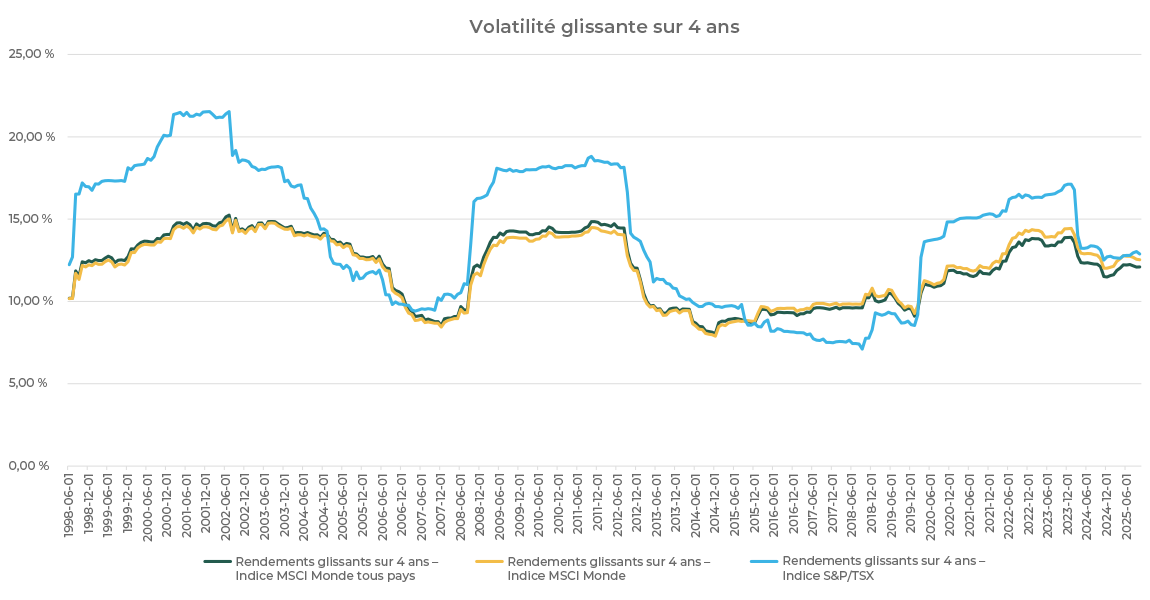
Graphique linéaire illustrant la volatilité sur quatre ans pour l'indice MSCI ACWI, l'indice MSCI World et l'indice S&P/TSX de 1998 à 2025.
Sources : MSCI, FTSE et Bloomberg

Fait surprenant : les portefeuilles qui privilégient les actions canadiennes, plus que la capitalisation boursière de celles-ci, ont généralement connu une volatilité globale inférieure à celle d’un portefeuille strictement mondial, comme l’illustre un portefeuille composé à 70 % d’actions mondiales (indice MSCI Monde tous pays) et à 30 % d’actions canadiennes (Figure 3). Si l’on tient également compte du rendement sur une période mobile de quatre ans (Figure 4), cela signifie que les rendements ajustés au risque sont plus élevés dans une stratégie centrée sue le pays d’origine.

Figure 3 – Volatilité des rendements des indices boursiers mondiaux et canadiens
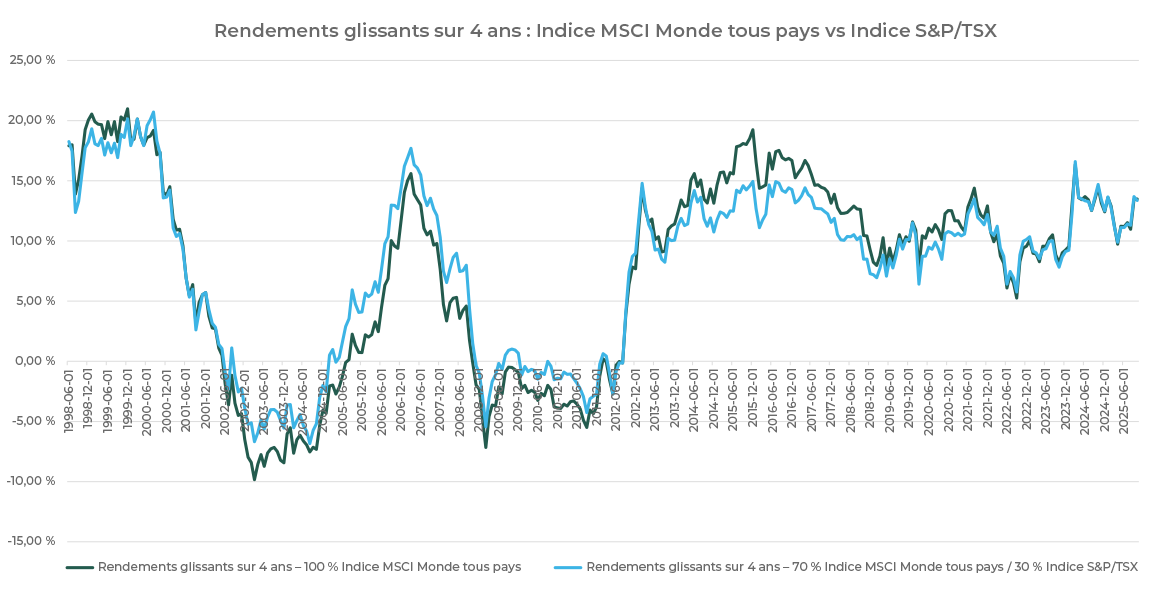
Graphique linéaire illustrant la volatilité sur quatre ans de l'indice MSCI ACWI par rapport à l'indice MSCI ACWI/S&P/TSX de 1998 à 2025.
Sources : MSCI, FTSE et Bloomberg

Figure 4 – Rendements des indices boursiers mondiaux et nationaux
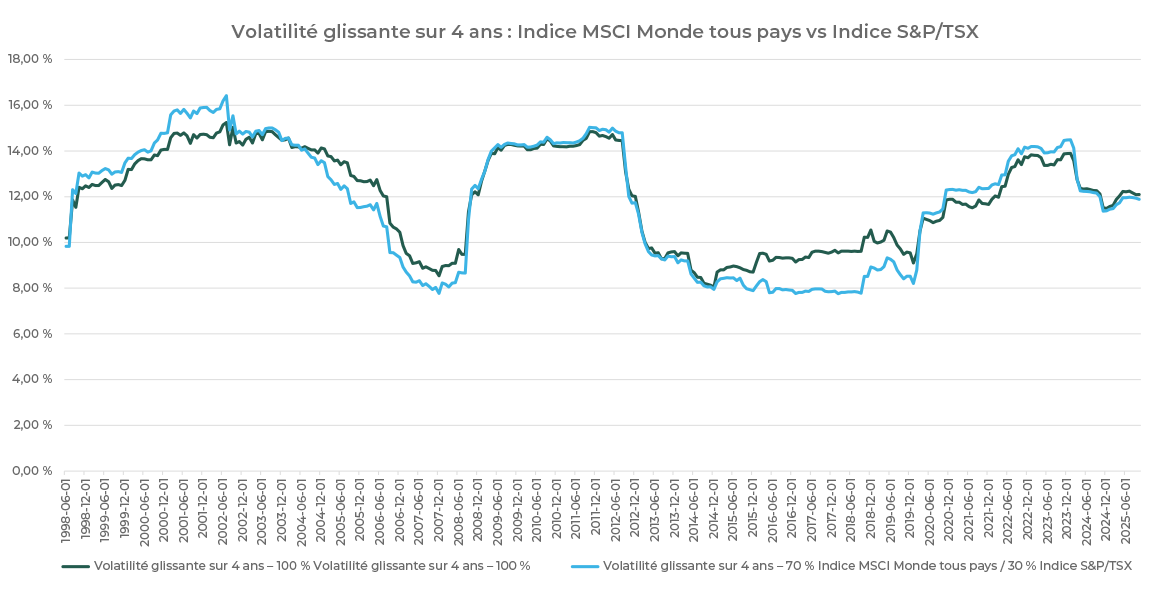
Graphique linéaire illustrant le biais entre les actions mondiales et les actions nationales : rendements sur 4 ans pour l'indice MSCI ACWI par rapport à l'indice MSCI ACWI/S&P/TSX de 1998 à 2025.
Sources : MSCI, FTSE et Bloomberg

Potentiel d’alpha

La gestion active offre la possibilité d’obtenir un rendement supplémentaire. Même si l’influence des actions liées aux technologies de l’information a récemment laissé entrevoir des difficultés pour les gestionnaires actifs en général, les gestionnaires d’actions canadiennes ont en moyenne dégagé une valeur ajoutée plus constante au fil du temps que les gestionnaires d’actions mondiales (Figure 5).

Figure 5 – Valeur ajoutée médiane des actions canadiennes par rapport aux actions mondiales
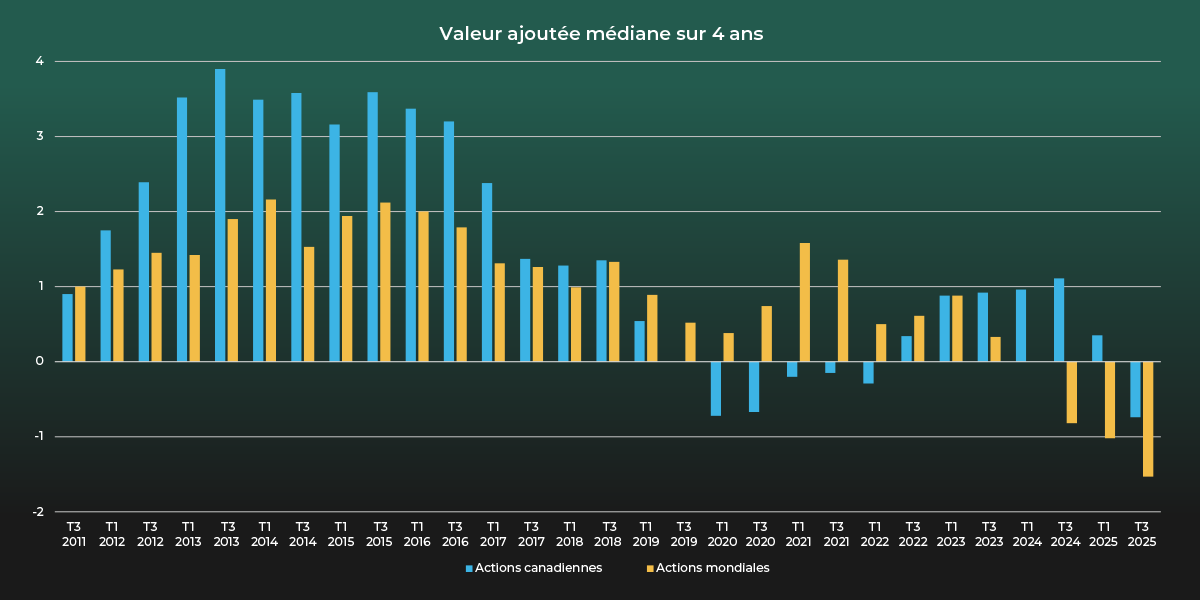
Graphique à barres illustrant les actions canadiennes par rapport aux actions mondiales : valeur ajoutée médiane sur 4 ans du troisième trimestre 2011 au troisième trimestre 2025.
Remarque : Selon l’univers de gestion et l’indice MSCI Monde tous pays pour les actions mondiales.
Sources : eVestment, Groupe financier Connor, Clark & Lunn

Contexte économique actuel

Le Canada est bien placé pour offrir à la fois de la valeur et de la croissance aux investisseurs. Le pays entre avec confiance dans une nouvelle ère de croissance économique, stimulée par un programme favorable aux entreprises. Sous la direction du premier ministre Mark Carney, le pays adopte des réformes qui éliminent les barrières commerciales interprovinciales, simplifient la réglementation et accélèrent le développement des ressources et des infrastructures. Les mesures politiques, comme l’assouplissement de la taxe sur le carbone, témoignent d’un engagement plus large à faire du Canada un pays plus attrayant pour les entreprises. Parallèlement, les réductions vigoureuses des taux d’intérêt décrétées par la Banque du Canada et l’accent que met le gouvernement sur les mesures de relance budgétaire contribuent à stimuler la croissance intérieure.

Les riches réserves canadiennes de matières premières qui seront essentielles dans le futur, comme le cuivre, l’uranium, l’or, les terres rares et le gaz naturel, devraient jouer un rôle crucial dans la transition énergétique mondiale. Par exemple, l’installation de nouveaux terminaux d’exportation de gaz naturel liquéfié sur la côte Ouest ouvre les portes aux marchés asiatiques. Le secteur bancaire du pays, réputé pour sa stabilité et sa réglementation rigoureuse, est un autre atout résilient dans un monde imprévisible.

Tirer parti des forces locales et des occasions mondiales

Bien que les actions mondiales offrent de nombreuses occasions de placement, une préférence accordée aux actions canadiennes dans la répartition totale des actions offre des avantages stratégiques, en particulier pour les investisseurs qui recherchent une stabilité en matière de devises, une exposition à un marché unique, une plus grande part de gestion active ainsi qu’une gestion plus efficace du risque. Une approche optimale pour la structure d’ensemble d’un portefeuille d’actions est une combinaison réfléchie d’actions canadiennes et d’actions mondiales qui affiche une préférence pour le pays d’origine.


Wooden number blocks changing from 2025 to 2026 on a table against a golden bokeh background.

As we close out another year, we acknowledge it has been a difficult one for fundamental investors focused on quality companies.

How does Global Alpha define “quality”?  We mean companies with:

  • Revenue growth with a high portion of recurring revenues
  • Healthy profit margins
  • Strong balance sheet
  • Dividend paying
  • Fair valuation, ideally below the market multiples

Instead of quality, the market has been fixated on size (the bigger, the better), liquidity (the more liquid, the better) and momentum (what goes up will continue to go up).

In other words, it’s a very speculative market.

Are we in a bubble?

Ruchir Sharma, Chair of Rockefeller International, asked that exact same question in his piece in Financial Times – The four ‘O’s that shape a bubble. He described four characteristics that define a bubble, “four Os”: overvaluation, over-ownership, overinvestment and over-leverage. In our view, today’s market checks all four boxes.

Overvaluation

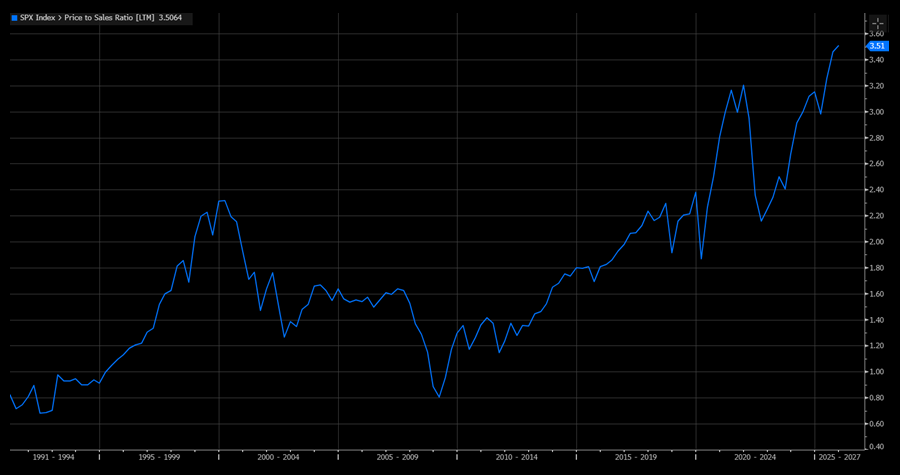
Consider the S&P 500 price-to-sales ratio. It is currently at an all-time high, well above the peak reached during the tech bubble in 2000. The market is paying record prices for each dollar of revenue.

Line graph illustrating the all-time high of the S&P 500 price-to-sales ratio.
Source: Bloomberg

Over-ownership

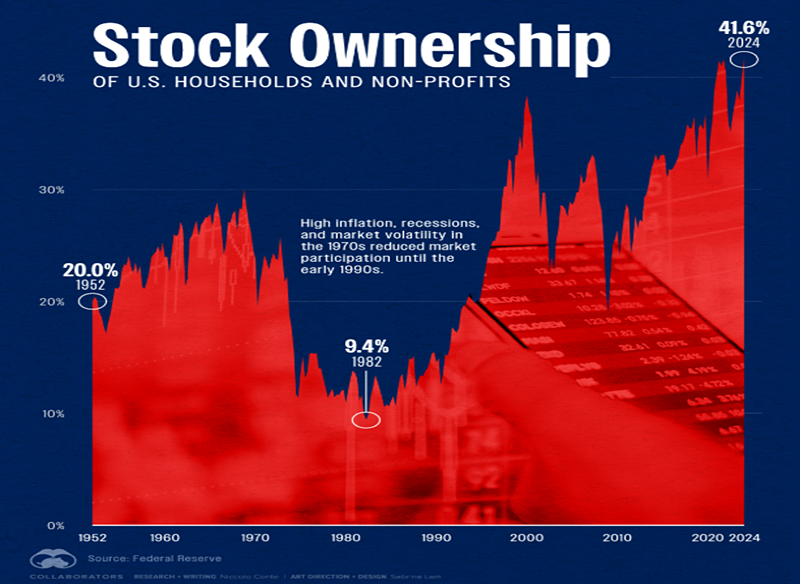
US household stock ownership, as a share of financial assets, is also at record levels. According to Gallup, about 165 million Americans – roughly 62% of US adults – own stocks, an all-time high.

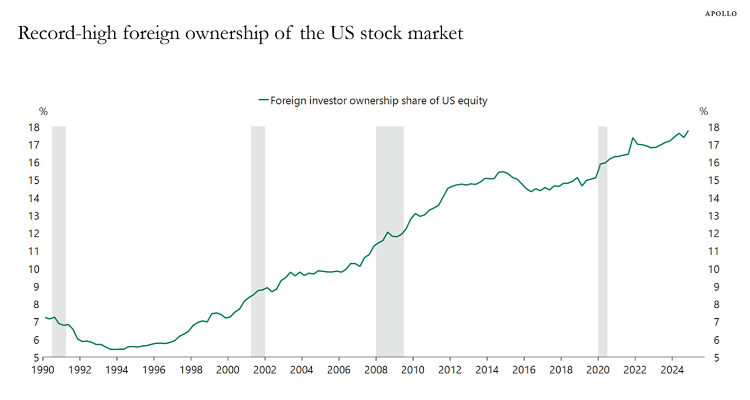
On top of that, foreign investors now hold a record share of US equities. The market has rarely, if ever, been this “crowded.”

Bar graph showing the percentage of stock ownership of US households and non-profits from 1952 to 2024.
Source: Federal Reserve

Line graph illustrating the record-high foreign ownership of the US stock market.
Sources: Federal Reserve, Macrobond, Apollo Chief Economist

Overinvestment

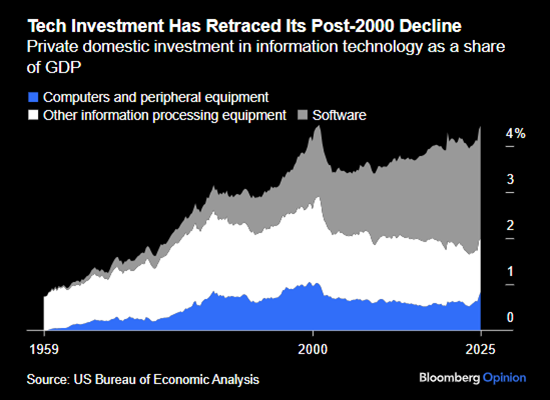
Technology investment has recently surpassed 6% of US GDP, eclipsing the previous record set in 2000. But the ultimate return on these investments is still uncertain, and there are signs that adoption is slowing rather than accelerating.

Graph illustrating private domestic investment in information technology as a share of GDP, comparing computers and peripheral equipment, software, and other information processing equipment.

Over-leverage

We often hear about the enormous cash balances of the “Magnificent Seven.” However, much less attention is paid to the other side of their balance sheets: liabilities.

Amazon, Meta, and Microsoft are now net debtors, and they are increasingly financing capital expenditures with debt.

So, all four Os suggest a bubble. But who are we to know?

Surely, this time, it’ll be different! Right?

We recently looked at some assumptions underpinning the current enthusiasm and valuations.

The general consensus is that global semiconductor sales will grow at an annualized rate in the mid- to high-20% range over the coming decade.

During the strongest period until now – the 1990s, with the advent of the personal computer and the internet – annualized growth in semiconductor sales was about 15%.

Once again, the narrative is that “it’s different this time.”

What could deflate this bubble?
If we had to name one catalyst, it would be Nvidia, now the largest company in the world by market value, the most owned and traded stock globally, and the poster child for the AI wave.

What could go wrong with Nvidia?

In a word: Competition. More competition would likely mean lower market share, lower prices and lower profit margins.

Lessons from Novo Nordisk

The chart below shows the stock price of Novo Nordisk, which was the largest European company by market value just over a year ago. As a leader in GLP-1 “miracle drugs” used for weight loss and other health benefits, Novo Nordisk became the market’s favourite story.

As competition intensified and prices came under pressure, Novo Nordisk experienced a dramatic shift: its market value has dropped by 68% since its peak in June 2024.

What happened to this market leader?

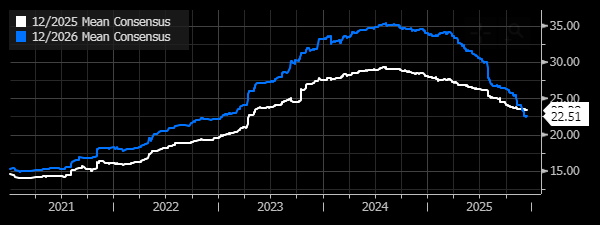
Simple: more competition and lower prices. In 2024, Novo Nordisk earned €24.48 per share, up 29% from 2023. By mid-2024, analysts were expecting earnings of €30 per share in 2025, implying another 23% growth.

Line graph showing the stock price of Novo Nordisk from 2018 to present.
Source: Bloomberg

Line graph comparing the 12/2025 and 12/2026 mean concensus for Novo Nordisk.
Source: Bloomberg

Instead, according to Bloomberg consensus estimates, earnings for 2025 will be around €23.38, a decline of approximately 4.5%, with a further decline expected in 2026. Novo Nordisk remains a great company, investors have just overpaid for it.

Lessons from Cisco

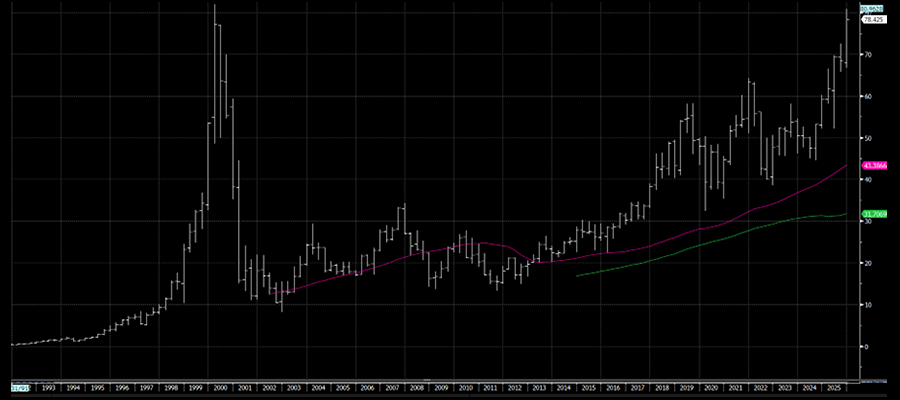
At the peak of the dot-com era, Cisco Systems was the company that defined the Internet age. It was the most valuable company in the world at the start of 2000, supplying the routers needed to handle internet traffic that was doubling every few months.

Despite that dominant position, Cisco’s stock only just regained its 2000 peak price last week – more than two decades later.

Line graph illustrating the stock price of Cisco Systems from the early 1990s to present.
Source: Bloomberg

Looking at past trends, we do not expect Nvidia to maintain the market share and pricing power implied in current analyst forecasts. In our view (shaped by history that competition, regulation and changing narratives eventually catch up with even the most celebrated leaders), it is more prudent to diversify and pivot back to high-quality, reasonably valued companies with durable earnings and strong balance sheets

Lastly, we encourage you to read our previously published piece on quality: Time to take out the trash – Why high ROE matters in the long run. We breakdown how quality outperforms in the long-run and why it matters as an allocator.

We wish you a happy holiday season to you and your loved ones.

May 2026 bring peace and happiness to the world.

A little boy playing on a tablet at night.

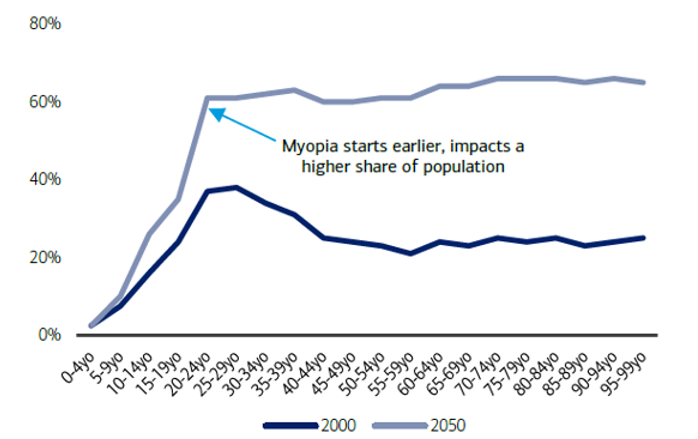
Of the five senses, vision is regarded as the most important as it allows us to navigate our environment, recognize the faces of our loved ones and read and watch to learn and entertain. But a good number of us do not have healthy eyes. According to the World Health Organization (WHO), at least 2.2 billion people globally suffer from near or distant vision impairment. The organization recognizes myopia as a significant public health concern given its rising prevalence around the world. A review of 276 studies (involving more than 5.4 million children from 50 countries across six continents) by the British Journal of Ophthalmology revealed that global prevalence of myopia among children and adolescents increased from 24% in 1990 to 36% in 2023 – one in three of all children and teens are nearsighted today. What is even more concerning is that myopia is starting earlier in children than before.

Prevalence of myopia by age group in 2000 vs. 2050, % of world population
Line graph comparing the projected prevalence of myopia by age group in 2000 vs. 2050, as a percentage of the world population.
Source: American Academy of Ophthalmology, BofA Global Research

The study predicted that approximately 740 million children and teens (more than half globally) will be myopic by 2050. American Academy of Ophthalmology in its 2016 article forecasted that by 2050, myopia would affect nearly half of global population. A more conservative projection this year puts the number at ~40% of global population – but it is clear that the world 25 years from now will have more than the 2.2 billion people in need of corrective lenses today.

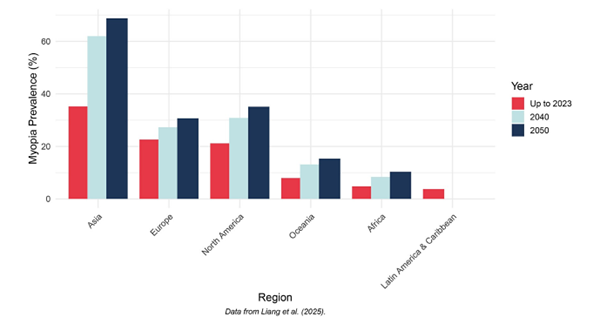
Prevalence of myopia is not even across the world. Asia sees a higher prevalence (close to 40%) that is two to four times higher than that of other regions. East Asian countries – China, Taiwan, South Korea, Japan and Singapore – see much higher myopia rates, exceeding 80–90%, in their adolescent populations.

Bar graph comparing the projected prevalence of myopia by global regions as a percentage of regional population.
Source: ScienceDirect, Global perspectives on myopia and pathologic myopia: From environmental drivers to precision medicine

Primary drivers of myopia are genetics, near-work activities and lack of outdoor activities. A recent article in Progress in Retinal and Eye Research journal linked the high prevalences in the East Asian countries to educational systems characterized by intense academic competition, prolonged school hours and substantial homework assignments which significantly reduce opportunities for outdoor activities.

The WHO estimated that vision impairment cost the global economy an estimated USD411 billion in productivity loss, with only 36% of people with myopia having access to an appropriate intervention. Shanghai Conant Optical Co. Ltd. (2276 HK) in our Emerging Markets Small Cap Strategy seeks to address this global myopia pandemic. SCO, a sub-USD3 billion market cap company, is the second largest resin (plastic) optical lens maker in the world after EssilorLuxottica in terms of production volume. At its manufacturing locations across China and Japan, the company produced 209 million pieces to serve customers in over 90 countries around the world in 2024.

We believe SCO’s customer value proposition of value for money is especially effective in the product category of optical lenses. SCO’s high-index lenses (such as 1.74 and 1.67) are approximately half the price of comparable lenses from EssilorLuxottica, Hoya and Zeiss whilst providing the same level of vision correction. On product quality, SCO is an ODM (original design manufacturer) for all the previously mentioned global brands with various lens-coating options available. For the brand-conscious, it is “fortunately” very difficult to tell which brand of lens one is wearing. We are not surprised that the company is especially seeing strong demand in developing countries where its customer value proposition would be stronger. As a person who has been wearing glasses for the past three decades, I have found myself switching from the expensive Hoya and Nikon to much more affordable brands (including Asahi-Lite which is now owned by SCO), which have provided an identical visual experience – I have not looked back since.

China offers a significant room for growth, having entered the world’s largest short-sighted country in 2018, two decades after the company was established. Over 700 million people or roughly half the population in China are diagnosed with myopia. The prevalence of myopia is especially high in school-aged children – roughly 40%/70%/80% of students in elementary/middle/high school suffered from myopia according to a 2022 study published in Investigative Ophthalmology & Visual Science. Laser eye surgery is not an option for these youths, and they must rely on glasses for vision correction until they are older. SCO’s sales in China focus on higher-index lenses where competition is more limited and penetration is lower, and 80% of those sales are of its own brand. The company’s growth in China has been margin accretive given the higher mix of own brand and higher-index lenses.

The company is also involved in the development of AI/AR glasses with leading technology companies in North America and China. SCO as a partner to the technology companies makes sense, given SCO’s scale and cost competitiveness. We appreciate that SCO is trying to solve the problem of the global myopia pandemic, but do not doubt that AI/AR glasses offer the next leg of growth for the company.