Markets overview

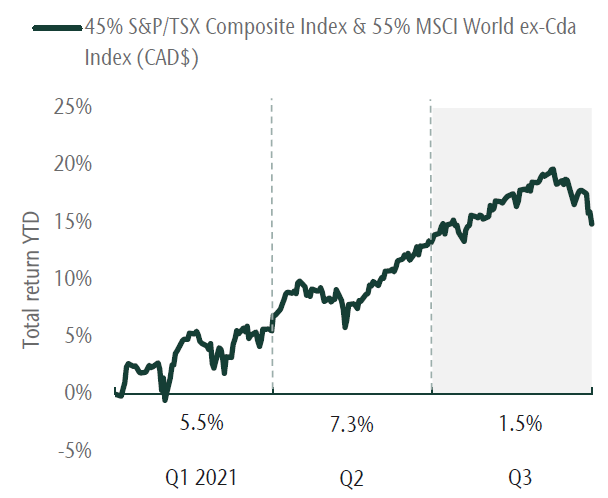
The economic recovery from the pandemic has been strong and more enthusiastic than expected. There is a surge in demand for goods which is contributing to supply shortages and rising inflation. Given the backdrop, policymakers are beginning to reduce the emergency level stimulus that was put in place. The equity market response has been more volatility and lower returns than earlier in the recovery. This is expected given the outlook for more moderate growth and less support from central banks. On the quarter the S&P/TSX Composite Index was up 0.2% and the MSCI World ex Canada (C$) advanced 2.5%. Year to date this brings these market returns to 17.5% and 12.6%, respectively. 

More moderate equity returns in Q3
Source: MSCI, Refinitiv

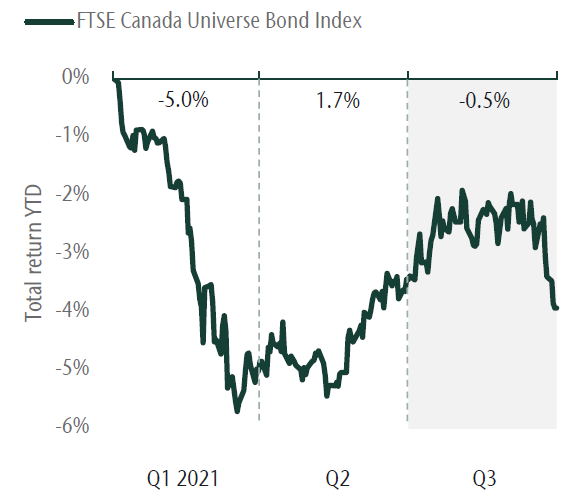
Bonds produced negative returns this quarter and year as yields were affected by both a surge in growth earlier in the year and recent changes to central bank policy. The FTSE Canada Universe Bond Index was down -0.5% for the quarter and down -4.0% for the year. High yield and short bonds, which are less sensitive to changes in yield, generated positive returns. 

Bond returns remain negative
Source: FTSE, Refinitiv

Portfolio strategy

Our view is that we are experiencing a strong economic recovery supported by a broadening global restart. At the same time we expect higher inflation and a more muted monetary response going forward. We maintain an overweight to equities but recognize risks are rising. As equity market performance has been strong, we have taken profits. Within equities, we have an overweight to small-cap stocks which will benefit from above trend growth. Within bonds, we have been increasing our high yield exposure which is more attractive than core bonds given their low expected return. 

Our portfolio management teams continue to favour more cyclical companies that are levered to the economic recovery. However, given the outlook for slower economic growth, inflation and supply bottlenecks, we are adding companies that can generate strong earnings despite these headwinds. Within fixed income, we have taken profits by reducing exposure to the corporate sector as well as real return bonds that have benefited significantly from higher inflation. Our positioning in portfolios has served clients well and remains attractive as we move into the final quarter of the year. 

From the desk of Jeff Guise, Managing Director, Chief Investment Officer, CC&L Private Capital.

This post is for information only and is not intended as investment advice. The views expressed are those of the author at the time of publication and are subject to change at any time.
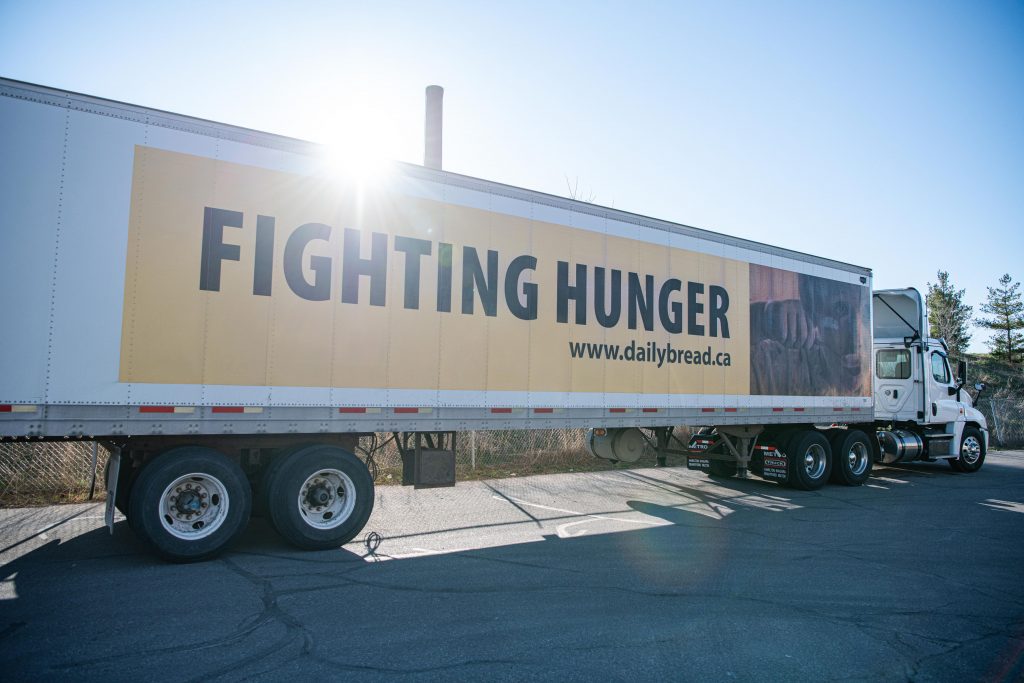

L’Action de grâce est le moment de l’année où nous réfléchissons aux aspects heureux de notre vie et témoignons de notre reconnaissance envers nos amis, notre famille et ceux qui nous soutiennent. Chez CC&L, nous sommes reconnaissants pour nos banques alimentaires locales et pour l’aide qu’elles continuent d’apporter dans les collectivités où nous vivons et travaillons. 

Les banques alimentaires ont joué un rôle essentiel dans la vie de nombreuses personnes, en particulier parce que la COVID-19 a entraîné davantage d’insécurité alimentaire pour plus de familles partout au pays. Depuis le début de la pandémie, les banques alimentaires ont enregistré une hausse de plus de 50 % du nombre de personnes ayant besoin de leurs services. Si la tendance actuelle se maintient, les banques alimentaires de Toronto enregistreront 1,4 million de visites d’ici la fin de 2021. 

Pendant plusieurs années, la Fondation CC&L a donné à la Daily Bread Food Bank de Toronto et a récemment accru son soutien en s’engageant à apporter son aide sur plusieurs années. Fondée en 1983, Daily Bread est devenue l’une des plus importantes banques alimentaires au Canada. Elle vise à ce que personne ne souffre de la faim ou se heurte à des obstacles pour accéder à de la nourriture. Elle offre des repas sains et nutritifs aux personnes qui vivent dans l’insécurité alimentaire au moyen de presque 200 programmes alimentaires.

« Bien qu’un sentiment de normalité revienne dans notre ville, la réalité est très différente pour des dizaines de milliers de personnes vivant dans la pauvreté. En août 2021, plus de 113 000 personnes se sont présentées aux banques alimentaires membres de Daily Bread, soit une hausse de 67 % par rapport à la même période l’an dernier », affirme Neil Hetherington, chef de la direction de Daily Bread Food Bank. « Nous sommes profondément reconnaissants envers CC&L d’avoir accepté, à l’occasion de l’Action de grâces, de verser un don généreux qui garantira que toutes les personnes, adultes, aînés ou enfants, de notre ville qui vivent dans l’insécurité alimentaire pourront se procurer des aliments. »

À propos de la Fondation Connor, Clark & Lunn

Créée en 1999, la Fondation CC&L est soutenue par le Groupe financier CC&L et ses sociétés affiliées, et reçoit des demandes de ses clients, de ses employés et d’autres personnes en vue de financer des programmes et des organismes sans but lucratif voués à la promotion d’un meilleur environnement, à l’amélioration de l’éducation, à l’avancement des sciences et de la médecine, au développement de collectivités plus dynamiques et aux arts.

Personne-ressource

Colin Aubrey
Directeur général
Fondation Connor, Clark & Lunn
[email protected]

Markets overview

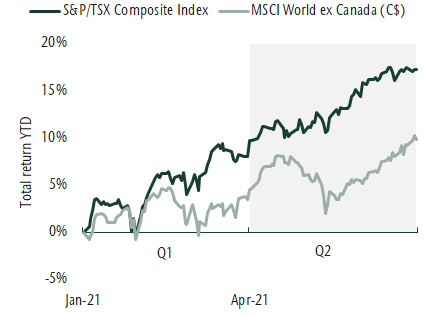
This quarter we saw the economic recovery continue to gather pace. Support for the recovery has come from easing restrictions and accommodative policy. More recently, countries have committed to expanding their spending programs to fight the remaining negative effects of the pandemic while improving longer-term growth prospects. Together this forms a positive backdrop for equities and we have seen companies significantly outpace earnings expectations. This quarter the S&P/TSX Composite Index was up 8.5% and the MSCI World ex Canada (C$) advanced 6.2%. Year to date this brings these market returns to 17.3% and 9.9%, respectively. Stronger performance from the S&P/TSX Composite reflects a strong Canadian dollar and a higher weight in the index to top performing cyclical sectors like energy and financials. Regardless, both Canadian and global results have been very strong.

Equity markets reach new highs

Source: MSCI, Refinitiv

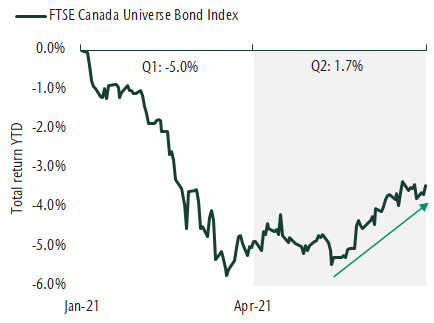
Bond returns have shown recent improvement after declining earlier in the year. This quarter the market has largely looked through a sharp increase in inflation which has been fueled by the robust economic recovery. Bond yields have declined modestly and prices have moved higher. The result was an increase of 1.7% for the FTSE Canada Universe Bond Index this quarter. The largest contributors to performance have come from provincial and corporate bonds.

Bonds begin recovery from Q1 decline

Source: FTSE, Refinitiv

Portfolio strategy

Our view is that we are in the midst of a strong economic recovery supported by pent up demand, accommodative policy and record levels of fiscal stimulus. This is a market-friendly backdrop and portfolios have been positioned to benefit from the recovery. We have been tactically overweight equities. As equity market performance has been strong, we have taken profits and rebalanced to maintain our desired exposure. Within equities, we have an overweight to small-cap stocks and maintain an allocation to value stocks. This quarter we also increased our emerging markets position. Within bonds, we have been overweight high yield, which is attractive in the early stages of a market cycle. This asset mix positioning has served us well and remains attractive in the current environment.

Our portfolio management teams generally continue to favour more cyclical companies that are levered to the economic recovery. These stocks have done well and in select cases we have reduced our exposure. This is because while the economic recovery has been strong, results have begun to moderate. At the same time, inflation has been higher than expected. While we don’t believe inflation levels will be disruptive in the long term, current conditions may lead to market volatility. Within fixed income, similar to equity portfolios, we remain overweight companies that are benefiting from the reopening of the economy.

From the desk of Jeff Guise, Managing Director, Chief Investment Officer, CC&L Private Capital.

This post is for information only and is not intended as investment advice. The views expressed are those of the author at the time of publication and are subject to change at any time.
Markets overview

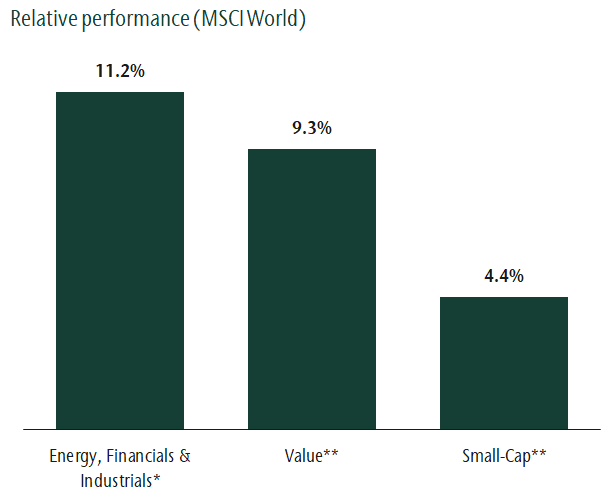
Equity markets reached new highs this quarter as virus cases declined and market signals suggest that the global economic recovery remains strong (despite lockdowns). Support for the recovery has come in the form of monetary and fiscal stimulus and in March the US passed another significant fiscal package. This quarter the S&P/TSX Composite Index was up 8.1% and the MSCI World ex Canada (C$) advanced 3.5%. Stronger performance from the Canadian market reflects a higher weighting to cyclical sectors like energy, financials and industrials which have benefited from an acceleration in global growth expectations. Within equity markets value and small-cap stocks have outperformed which is a rotation away from areas that performed well for most of 2020.

Stocks led by economically sensitive segments

*Energy, financial and industrial sector average return less the average return of the remaining sectors. **Returns are relative to the growth and large-cap benchmarks, respectively, using corresponding MSCI World benchmarks. Quarterly return ending March 31, 2021. Source: MSCI, Refinitiv

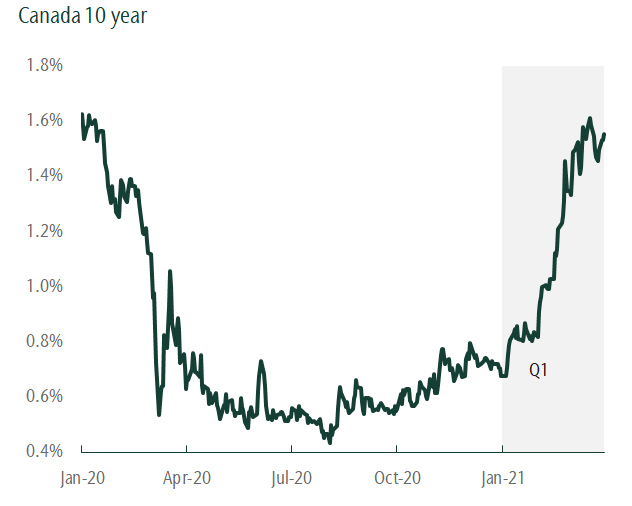
Bond yields rise

Source: Refinitiv

Stronger economic growth and accommodative policy led to a selloff in bonds and a spike in yields across maturities. The result of increased yields was a negative return for the FTSE Canada Universe Bond Index of -5.0%, the worst quarterly performance since the first quarter of 1994. Government and provincial bonds were most affected while declines in corporate were more muted. 

Our thoughts

We believe the global economy and corporate earnings will continue to recover as more businesses gradually resume normal operations and government stimulus provides continued support. Portfolios are positioned to benefit from this improving outlook. As such, our asset mix positioning remains overweight equities. However, strong performance from equities relative to bonds led us to rebalance this quarter to maintain our desired exposure. Within equities we have an overweight to small-cap stocks and maintain an allocation to value stocks. This quarter we also increased our emerging markets position. Within bonds, allocations to short bonds and high yield have protected portfolios in a period of rising yields. This asset mix positioning has served us well this quarter and remains attractive in the current environment.

Our portfolio management teams have selectively positioned portfolios to more cyclical assets that are expected to benefit from continued improvements in the economy. Our equity teams have taken gains in some businesses that have benefited from COVID-19 and bought companies that can outperform in a more positive investment environment. This includes companies within the financial sector as well as the travel and leisure industry. Within bond portfolios we are overweight credit, inflation-protected debt and have lower sensitivity in the portfolio to changes in yield. Although our overall positioning in portfolios reflects a positive outlook we remained well diversified. 

From the desk of Jeff Guise, Managing Director, Chief Investment Officer, CC&L Private Capital.

This post is for information only and is not intended as investment advice. The views expressed are those of the author at the time of publication and are subject to change at any time.
TORONTO, ON, March 1, 2021 – CarbonFree Technology and Connor, Clark & Lunn Infrastructure (CC&L Infrastructure) today announced the sale of their jointly owned interest in a portfolio of commercial-scale Ontario solar projects to Potentia Renewables Inc, with funding from the newly created Power Sustainable Energy Infrastructure Partnership.

The BrightRoof solar portfolio, comprised of 57 rooftop and 5 ground-mount operating projects located across the province, has a generating capacity 18.6 MWp and produces more than 20 GWh of clean electricity each year. Twelve of the projects in the portfolio are wholly owned, while the other 50 are owned in partnership with the Métis Nation of Ontario (MNO), which will continue to hold its stake in the portfolio.

Over the past 10 years of working together, CarbonFree and CC&L Infrastructure have shifted their focus to developing and operating larger, utility-scale solar projects. In addition to the BrightRoof portfolio and 390 MWp of larger Ontario solar projects, the two companies have developed, constructed and operate 200 MWp of solar plants in Chile and have the rights to another 100 MWp of solar plants in Chile, to be constructed before the end of 2022.

CarbonFree and CC&L Infrastructure would like to thank the MNO for its steadfast partnership since 2012.

About CarbonFree Technology

CarbonFree Technology is a leading solar project developer, owner and operator, based in Toronto, Canada. CarbonFree develops and owns solar projects in Canada, the United States and Chile. Over the past 14 years, the company has developed more than 100 solar power projects with a total capacity of more than 500 MWp. For more information, please visit www.carbonfree.com.

About Connor, Clark & Lunn Infrastructure

CC&L Infrastructure invests in middle-market infrastructure and infrastructure-like assets with highly attractive risk-return characteristics, long lives and the potential to generate stable cash flows. CC&L Infrastructure is a part of Connor, Clark & Lunn Financial Group Ltd., a multi-boutique asset management firm whose affiliates collectively manage over CAD$86 billion in assets. For more information, please visit www.cclinfrastructure.com.

Contact

Kaitlin Blainey
Director
Connor, Clark & Lunn Infrastructure
(416) 216-8047
[email protected]

David Oxtoby
CEO
CarbonFree Technology
(416) 975-8800 x604
[email protected]

Markets overview

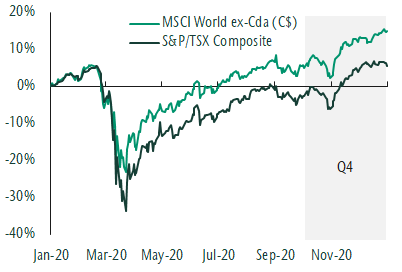
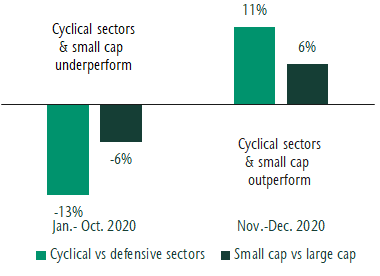
Equity market returns were strong this quarter as the global economy continued to show signs of healing in the face of rising virus cases and more shutdowns. The S&P/TSX Composite Index was up 9.0% and the MSCI World ex Canada Index (C$) advanced 8.8% this quarter. The start of November marked a significant inflection point for markets. The US election resulted in some short-term market volatility which subsided. This was followed by the clearly positive news of an approved COVID-19 vaccine. A better vaccine that is available to people faster than previously expected provides a boost to the economic outlook, even if it does take many months to distribute widely. This has allowed investors to look beyond near-term economic uncertainty to a more normal environment. A shift in market leadership followed as investors bought companies that were most negatively affected by lockdowns and stood to benefit the most from an eventual end of the pandemic. In addition, assets that are more sensitive to the economic cycle began to outperform. This includes cyclical sectors like energy and financials as well as asset classes like global small cap stocks.

Equity markets reach new highs in Q4

Source: Refinitiv

Significant shift in market leadership

Sector returns are for the MSCI World. Cyclical sectors include materials, energy, consumer discretionary, financials and real estate. Defensive sectors include consumer staples, health care and utilities. Small cap returns are based on the MSCI World Small Cap Index and large cap returns are for the MSCI World Index. All returns in Canadian dollars. Source: Refinitiv

Bond returns were mixed this quarter. Government and provincial bonds were modestly negative and corporate bonds generated positive returns. The net result was that the FTSE Canada Universe Bond Index returned 0.6% for the quarter. High yield bonds, like equities, benefited from an improved investor outlook. Despite default rates remaining elevated, demand for these investments has been strong and yields have tightened. 

Our thoughts

We have been seeing a recovery in the economy unfolding for some time and have positioned portfolios accordingly. We have maintained an overweight to equities with a bias to global stocks. We have increased our weight to asset classes that tend to do well in a recovery such as small cap stocks. This quarter we sold core bonds and bought high yield bonds as credit conditions improved. This is consistent with the beginning of a new business cycle which historically coincides with improving returns for high yield. 

Overall our equity teams continue to own resilient, stable businesses that have higher earnings growth than the market. Through the recovery we have selectively added more cyclical companies standing to benefit from an improving outlook and the start of a new business cycle. Within Canada this means increasing exposure to banks and energy companies. Within our global strategy we remain overweight emerging markets and have reduced the underweight to financials and increased positioning in select leisure companies. Within fixed income we are overweight credit and inflation-protected debt. Our positioning has benefited clients well this quarter and year.

From the desk of Jeff Guise, Managing Director, Chief Investment Officer, CC&L Private Capital.

This post is for information only and is not intended as investment advice. The views expressed are those of the author at the time of publication and are subject to change at any time.