The historical Fed would be shifting to a tightening bias in response to recent economic news, according to a simple model.

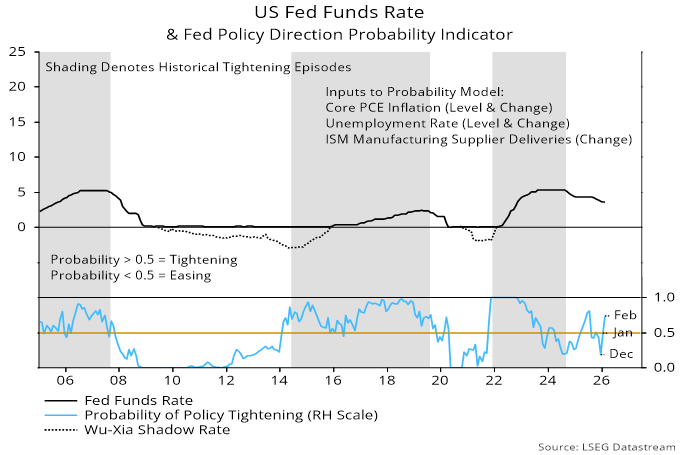
To recap, the model classifies the Fed as being in tightening or easing mode depending on whether a probability estimate is above or below 0.5. The estimate is based on currently reported and lagged values of annual core PCE inflation, the unemployment rate and the ISM manufacturing delivery delays index. Despite the small number of inputs, the model does a satisfactory job of “explaining” the Fed’s past actions.

The model reading moved below 0.5 in August ahead of the September / October rate cuts, falling further in December, when the Fed delivered another reduction while signalling an expectation of additional moves in 2026 – see chart 1.

Chart 1

US Fed Funds Rate & Fed Policy Direction Probability Indicator

The reading, however, rebounded to around neutral in January and has climbed above 0.7 in February. The turnaround has been driven by a combination of a fall in the unemployment rate from 4.54% in November to 4.28% in January, a rebound in the ISM deliveries index from a November low and slightly firmer annual core PCE inflation (3.0% in December).

Additional data points for all three series will be available before the March FOMC meeting.

The January model shift is consistent with minutes of last month’s meeting, showing a strong consensus in favour of a hold with “several” participants viewing interest rate risks as two-sided.

A high-performance personal computer displaying a modern video game in a room illuminated by futuristic neon lighting.

The rapid repricing of global gaming equities year to date reflects a sharp narrative pivot in the market, hitting the stocks of portfolios holding Tencent, as well as other leading players such as Nintendo and Roblox. Only months ago, consensus held that AI would be an operational tailwind for game developers through cost reduction and faster content generation.

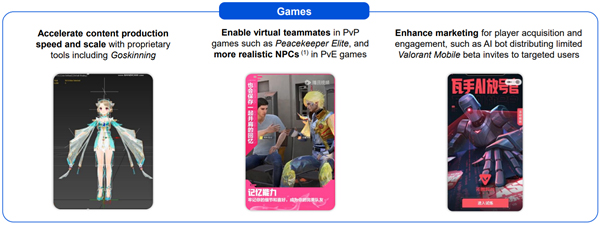
AI enhancing content production and experience
Image illustrating the different ways that AI can enhance gaming content production and the in-game experience.
Source: Tencent Investor Relations 2026

Following new AI model releases such as Anthropic’s Claude Code and Google’s Project Genie, the prevailing fear is that AI will disrupt traditional game development entirely.

The question for investors is whether Tencent, as the world’s largest gaming company by revenue, is positioned to benefit from or be impaired by this shift.

AI as a development tool

Tencent’s core strength is scale – both financial scale and model training scale. In discussions with management late last year, they emphasised that AI is already deeply embedded in their workflow: procedural content generation, NPC behavioural modelling, art and animation tooling and faster iteration cycles. These capabilities are not theoretical; Tencent purchases more AI compute and silicon than nearly any other company in Asia, outside hyperscalers.

Small studios will indeed be empowered by AI, lowering entry barriers and enabling “one hit wonder” creators, much like YouTube transformed video production.

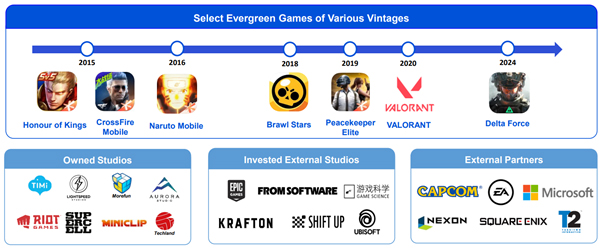
However, distribution, marketing and IP longevity remain durable moats. Tencent excels in all three. Owning evergreen franchises – over 80% of its portfolio – means that even if development costs fall, the value of recognised IP rises.

Timeline showing the years different evergreen game properties of Tencent were introduced. Logos of Tencent owned studios, invested external studios and external partners are displayed to show Tencent's network.
Source: Tencent Investor Relations 2026

AI makes content easier to create, but not easier to distribute at scale, monetise efficiently or ensure regulatory compliance – areas where Tencent’s ecosystem advantage is overwhelming.

Golden age of movie studios gives way to more atomised content creators – parallels?

Consider the shift from studio dominance in Hollywood to a more atomised creator economy. AI could indeed enable a long tail of nimble game creators, just as digital tools transformed music and film production. If so, Tencent’s role may shift toward that of a global distributor and platform – akin to Netflix in video or Spotify in music.

But unlike movies, gaming economics rely heavily on ongoing monetisation: loot boxes, in-game economies, battle passes, skins and continuous seasonal content. Even if AI reduces production costs, developers with large user bases can simply retain the value by expanding monetisable content. Consumers rarely pay less – they typically pay more in more immersive and interactive environments. Tencent’s superior ability to drive retention and average revenue per user works in its favour.

Fear premium

Tencent today trades at ~16x PE with mid-teens EPS growth, and minimal risk to near-term earnings. This is historically inexpensive for a high-quality global IP and distribution engine. The derating reflects uncertainty over future industry economics – not current fundamentals.

The key debate is not whether Tencent gets disrupted this year (unlikely), but whether AI compresses long duration returns on capital for AAA studios globally.

Markets are trying to reprice the terminal value of moats like content creation and distribution.

Our view: Tencent is better positioned than most

AI will shift value around the gaming ecosystem. Some of that may move to consumers, some to new AI native studios and some to distributors. But scale matters. IP matters. Distribution matters. And Tencent is uniquely advantaged in all three.

The company may face multiple compression as investors debate the long-term competitive dynamics, but fundamentally, Tencent is more likely to be a beneficiary of AI than a casualty. The path will be volatile, but the structural advantages remain intact.

Trump’s trade doctrine: Opening the door to higher-return industrial champions

Last month, I spoke with Benefits and Pensions Monitor about the short-term noise generated by Trump tariff headlines. We explored whether investors should be looking through the noise based on the TACO (Trump Always Chickens Out) view that the US president will retreat in the face of market revolt.

My argument was that, while amusing, TACO risks obscuring the unmistakable direction of travel. US trade policy signals a shift to a multipolar world, defined by a US centric economic sphere and a China centric one, each with competing supply chains, industrial priorities and strategic alliances. Tariffs are signals of tectonic shifts in global trade.

Our view is that these shifts bring risks, but will also be a durable source of opportunity for EM investors.

When China is taken out of your supply chain, everyone makes money

Traditionally, sectors like shipbuilding, industrial machinery, energy logistics and specialty manufacturing have been deeply cyclical with limited pricing power. They lived and died by freight rates, commodity cycles and economic growth. But the combination of US reindustrialisation, reshoring and decoupling from China is transforming these industries.

Historically commoditised, price‑taking businesses are now at the heart of national security and industrial policy. Reindustrialisation and rebuilding supply chains have the potential to drive visibility, margins and returns on capital that would have been unthinkable a few years ago.

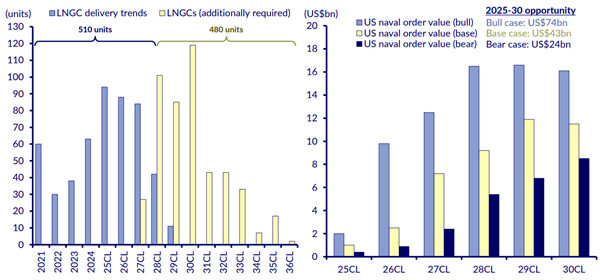
For example, the order books of Korean shipbuilders are increasingly less shaped by commercial shipping cycles, and increasingly by long‑cycle defence, LNG infrastructure and government‑aligned industrial programmes across the United States and its allies.

Major opportunities ahead for Korean shipbuilders in LNGC and naval vessels
Bar graphs illustrating Korean shipbuilders decreasingly affected by commercial shipping cycles.
Source: CLSA, Clarksons

US-China decoupling has effectively removed Chinese yards from security‑sensitive projects, structurally elevating demand for non‑Chinese capacity.

For countries aligned with US industrial and security priorities – Korea, Japan, India, parts of ASEAN – select industries have the potential to enjoy rerating as increasingly strategic rather than cyclical businesses.

This extends far beyond shipbuilding. We are seeing it in components for AI data centres, grid and power equipment, strategic metals, defence, electronics, energy infrastructure and advanced manufacturing.

These sectors are beginning to enjoy the boost of multi‑year, policy‑backed spending.

Many EM countries offer the scale, labour force depth and geopolitical neutrality that global supply chains now require. As the world bifurcates, EM manufacturers, suppliers and logistics operators are becoming essential nodes in both the US and China spheres. This creates a long pipeline of opportunities in markets that historically suffered from volatility and low returns.

In short, Trump’s trade doctrine accelerates a global realignment that raises the return potential of industries previously stuck in low‑margin cycles.

Vue de dessus de chaussures posées sur une flèche jaune vif pointant vers le haut, sur fond de flèches blanches pointant vers le bas.

Dans l’environnement complexe et en constante évolution d’aujourd’hui, les compétences techniques et la puissance intellectuelle sont importantes, mais ne suffisent plus pour garantir le succès du leadership. Le monde est rempli de professionnels hautement qualifiés et hautement spécialisés. Ce qui distingue véritablement les dirigeants exceptionnels est l’intelligence émotionnelle, c’est-à-dire la capacité de reconnaître, de comprendre et de gérer les émotions, tant les vôtres que celles des autres.

Au cœur du leadership, l’intelligence émotionnelle façonne la prise de décision des dirigeants, leur capacité à gérer les conflits, à bâtir la confiance et, en fin de compte, à diriger efficacement des équipes, des organisations et des conseils d’administration.

Comprendre l’intelligence émotionnelle

L’intelligence émotionnelle, ou quotient émotionnel (QE), désigne la capacité d’écouter nos émotions, de comprendre leur influence sur nos actionset de les canaliser de façon constructive. Contrairement à notre quotient intellectuel (QI), qui a tendance à rester stable tout au long de notre vie, le QE n’est pas fixe. Il peut être renforcé à n’importe quelle étape de la vie, ce qui en fait l’un des outils les plus puissants que les dirigeants peuvent développer activement.

Daniel Goleman, éminent spécialiste du QE, décrit l’intelligence émotionnelle comme le fondement d’un leadership d’exception, car, comme il le souligne, « le leadership d’exception passe par les émotions. » Les dirigeants qui développent leur QE acquièrent une plus grande conscience de soi, tissent des relations plus solides et créent des cultures de confiance,autant d’éléments essentiels dans des environnements auxenjeux élevés tels que la gouvernance d’un conseil d’administration.

Les fondements neuroscientifiques du QE

Le QE peut sembler abstrait, mais il s’appuie sur la neuroscience. Toutes les informationssensorielles passent par le tronc cérébral, puis par le système limbique, qui est le centre émotionnel du cerveau, avant d’atteindre le cortex préfrontal, la partierationnelle du cerveau.

Cette séquence démontre que nous ressentons avant de penser. Les émotions déclenchent des réactions physiologiques bien avant que nous interprétions consciemment ce qui se passe. Comprendre cette dynamique permet desaisir comment de fortes réactions émotionnelles peuvent compromettre la prise de décision, et pourquoi apprendre à les réguler est essentiel pour un leadership efficace et le développement des relations.

La neuroscience révèle également que les émotions ne sont pasfigées. Ce sont des prédictions que notre cerveau fait à partir d’expériences passées. Tout comme nous pouvons acquérir une nouvelle compétence, nous pouvons remodeler nos réactions émotionnelles en nous exposant à de nouvelles expériences, en nous exerçant à réfléchir et en adoptant intentionnellement des habitudes plus saines.

Les quatre domaines de l’intelligence émotionnelle

L’intelligence émotionnelle comprend quatre domaines liés entre eux. Ensemble, ils forment un schéma pour un leadership plus fort:

1. La conscience de soi

La conscience de soi est la capacité de reconnaître nos émotions en temps réel et de comprendre comment elles façonnent nos perceptions, nos comportements et nos impulsions. Elle est à la base du QE, car pour gérer vos réactions, vous devez d’abord reconnaître et nommer l’émotion.

Des signes physiques se manifestent souvent avant que nous en ayons conscience : muscles tendus, palpitationsou joues rouges. Dans ces situations, se poser la question « Qu’est-ce que je ressens? » active le cerveau rationnel, ce qui peut vous permettre de mieux gérer votre émotion.

Les émotions ne sont pas des obstacles; ce sont des données à interpréter. La colère, la peur, le bonheur, la surprise, la tristesse et le dégoût véhiculent chacun un message. Les dirigeants qui apprennent à interpréter ces signaux prennent des décisions plus claires et plus réfléchies.

2. La gestion de soi

Une fois les émotions identifiées, l’objectif est de les gérer L’autogestion consiste à réfléchir avant d’agir, surtout dans les moments de stress, de frustration ou d’anxiété.

Plusieurs techniques vous aideront à acquérir cette compétence :

  • Nommer l’émotion.. Mettre des mots surce que vous ressentez permet de réduire l’intensité de l’émotion en apaisant le système émotionnel limbique.
  • P.A.T. – Pause, Acknowledge, Think. (Faire une pause, prendre conscience, réfléchir) Ce ralentissement momentané relance le cortex préfrontal rationnel.
  • Réfléchir. Une réflexion, même brève, aide le cerveau à assimiler les expériences et à ajuster son comportement. Réfléchir consiste simplement à penser attentivement, à donner au cerveau une occasion de faire une pause au milieu du chaos et d’interpréter ce qui s’est produit.
  • W.A.I.T. – Why Am I Talking? (Pourquoi est-ce que je parle?) Cette simple question favorise des contributions réfléchies, particulièrement dans le cadre d’un conseil d’administration. En choisissant de vous exprimer uniquement lorsque vous avez vraiment quelque chose de pertinent à dire ou d’original à apporter, vous gagnez davantage de respect et d’influence auprès de vos pairs.

Changer ses habitudes émotionnelles peut sembler inconfortable, comme croiser les bras dans le « mauvais » sens, mais avec la répétition, de nouveaux comportements s’installent. C’est l’essence de la neuroplasticité —la capacité du cerveau à se remodeler grâce à une pratique assidue.

3. La conscience sociale

La conscience sociale consiste à comprendre les émotions et les comportements des autres. Les outils et approches pour l’améliorer incluent :

  • Écouter et observer. Cela implique de ne pas parler, de ne pas anticiper ce que les autres vont dire et de ne pas planifier votre réponse pendant qu’ils parlent. Cela peut paraître évident, mais nous sommes nombreux à ne pas véritablement écouter lorsque quelqu’un parle.
  • L’empathie. Il s’agit de la capacité de regarder sous la surface et de comprendre ce qu’une personne pourrait ressentir ou vivre.
  • Reconnaître les émotions. Vous pouvez les reconnaître en observant le ton de la voix et le langage corporel.
  • I.T.S. – Stay In Their Story. (Restez concentré sur leur histoire) Cette technique vous rappelle qu’il faut résister à l’envie partager votre propre expérience et de rester centré sur l’interlocuteur.

Le comportement est comme un iceberg où la partie visible n’est qu’une fraction de ce qui se passe réellement. En portant attention à ce qui se cache sous la surface, les dirigeants renforcent leur empathie et peuvent nouer des relations humaines plus profondes.

La conscience sociale nécessite également une gestion minutieuse du langage corporel, car il peut révéler ce que vous ressentez, comme lever les yeux au ciel ou montrer des signes d’ennui. Toutefois, le langage corporel peut aussi être trompeur :une personne qui croise les bras n’est pas forcément désengagée, elle peut simplement avoir froid ou chercher à se rassurer.

Il est également important de reconnaître que certaines différences neurologiques influencent le comportement et les interactions sociales. Lorsque la neurodiversité et l’intelligence émotionnelle se croisent, les défis peuvent s’intensifier, car les personnes neurodivergentes peuvent être injustement perçues en raison du peu d’expression ou d’un style d’interaction sociale différent.

Compte tenu de l’utilisation accrue des environnements virtuels pour les réunions, les signaux non verbaux sont limités. Par conséquent, il est encore plus important de faire des pauses intentionnelles et d’inviter explicitement les participants à s’exprimer.

4. La gestion des relations

La gestion des relations est la capacité de communiquer efficacement, de gérer les conflits, de collaborer et de nouer des relations interpersonnelles solides.

Les principaux comportements qui favorisent de solides relations sont les suivants :

  • Manifester un intérêt sincère envers les autres
  • Accorder toute son attention lors d’une conversation
  • Utiliser le contact visuel pour montrer son engagement
  • Gérer les conflits de façon calme et constructive
  • Faire preuve de constance et de fiabilité

Pour les membres d’un conseil d’administration, la gestion des relations a une incidence directe sur l’efficacité de la gouvernance. Les interactions positives renforcent la confiance, tandis qu’une mauvaise communication, l’évitement ou l’incohérence l’érodent.

QE et gouvernance du conseil d’administration

Les conseils d’administration évoluent dans des environnements très complexes, avec des priorités concurrentes et des personnalités diverses. L’expertise technique est essentielle, mais c’est l’intelligence émotionnelle qui permet une prise de décision efficace.

Les conseils d’administration dont les membres ont un QE élevé sont capables de :

  • Naviguer des conversations difficiles avec respect
  • Offrir un environnement sûr où les membres s’expriment ouvertement
  • Prendre des décisions fondées sur la clarté plutôt que sur l’émotion
  • Renforcer la collaboration et éviter les conflits dysfonctionnels
  • Maintenir la confiance grâce à la cohérence et à la responsabilité

L’intelligence émotionnelle améliore à la fois le leadership individuel et l’efficacité collective du conseil d’administration.

La confiance, véritable monnaie des conseils d’administration efficaces

Selon Pamela Barnum, spécialiste de la confiance et des relations, chaque interaction avec des collègues ou des membres du conseil d’administration constitue une transaction de confiance. La confiance s’accumule lentement, comme les intérêts composés d’un placement. Mais la confiance peut aussi s’éroder, comme une mauvaise dette peut nuire à un placement.

Une métaphore parlante est celle d’un registre de la confiance, où chaque comportement est un dépôt ou un retrait :

  • Respecter ses engagements : dépôt
  • Assumer la responsabilité de ses erreurs : dépôt
  • Non-respect des échéances sans communication : retrait
  • Rétention d’information : retrait
  • Soutenir un collègue dans un moment difficile : dépôt

Les conseils d’administration n’ont pas besoin d’être parfaits. Mais ils doivent maintenir un solde net positif pour être efficaces. Une saine gouvernance consiste à repérer rapidement les « fuites de confiance » et à les gérer avec honnêteté et détermination.

Investir dans le QE

L’intelligence émotionnelle n’est pas un luxe, c’est un impératif pour le leadership. Elle détermine dans quelle mesure les dirigeants se comprennent, nouent des liens avec les autres, résolvent les conflits et bâtissent la confiance. Contrairement au QI, le QE peut être appris, mis en pratique et renforcé à n’importe quelle étape de la vie.

Dans les conseils d’administration, le QE renforce la gouvernance, améliore la prise de décisions et crée un environnement de confiance nécessaire pour des équipes de direction saines et très performantes.

En investissant dans l’intelligence émotionnelle, tant individuellement que collectivement, les conseils d’administration se donnent les moyens de gouverner avec clarté, compassion et intégrité.

Electrical cables with the outer protective sheath cut, exposing the copper wiring.

Chile’s 2025 presidential election marked a meaningful political inflection, with markets interpreting the outcome as a shift toward a more pro-business, market-oriented policy framework focused on restoring economic growth and encouraging private investment. The incoming administration has emphasized fiscal discipline, regulatory clarity and the strategic importance of export-oriented sectors – particularly copper – in driving medium-term economic expansion.

For the mining sector, this shift points to clearer permitting processes, a more pragmatic stance toward private capital and improved project visibility, all of which are especially relevant for long-life assets requiring sustained investment. Against a backdrop of structurally rising global copper demand – driven by electrification, grid expansion and the energy infrastructure needed to support AI-related data centre growth – this political realignment strengthens the case for selective exposure to high-quality copper producers.

Capstone Copper Corp. (CS TSE) is well positioned to benefit from this environment, with approximately two-thirds of consolidated copper production generated in Chile, providing direct leverage to a more constructive domestic policy backdrop. The company is executing a district-scale growth strategy targeting a ~70% increase in annual copper production to approximately 400 ktpa, driven by long-life Chilean assets and capital-efficient brownfield expansions. Near-term growth is led by the Mantoverde Optimized expansion, expected to deliver an incremental ~20ktpa of copper with declining unit costs, while the fully permitted Santo Domingo project represents a transformational medium-term opportunity with a sanctioning decision expected in H2 2026. Supported by more than $1 billion in available liquidity and net leverage of approximately 0.9x EBITDA (TTM), Capstone is well positioned to translate a supportive policy environment into improved execution, cash flow growth and valuation upside.

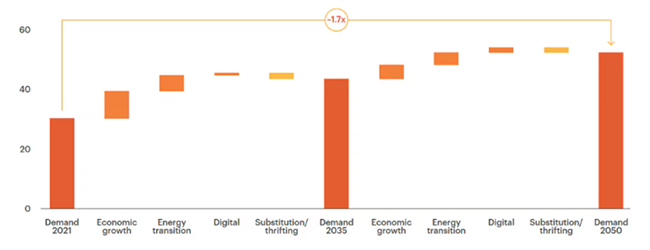
Global copper demand is poised for significant growth over the coming decades, with BHP projecting a roughly 70% increase to more than 50 million tonnes annually by 2050, up from around 31 Mt as of 2021.

Copper demand projected to grow ~70% through to 2050…
(Copper demand by key theme, Mt)
Bar graph showing the projected growth of copper demand from 2021 to 2050, highlighting key areas of demand growth.
Source: “BHP Insights: how copper will shape our future,” BHP

This surge is driven by a combination of traditional economic expansion, as developing economies electrify and improve living standards, and newer demand sources tied to the energy transition and digitalization. Technologies such as electric vehicles, renewable power infrastructure and data centres – all of which are copper-intensive – are central to this trend, fueling higher material requirements even as substitution and efficiency improvements evolve.

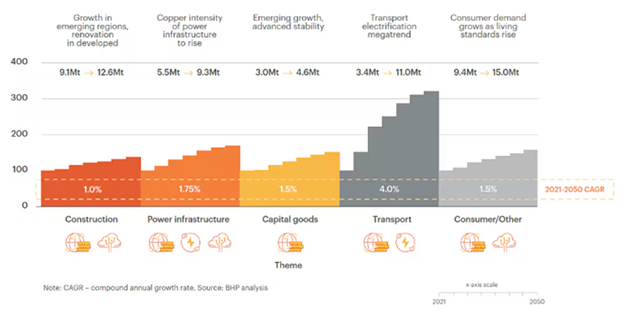
…an average of 2% per year*
(Copper demand by end-use sector, indexed to 2021)
Bar graph showing the projected growth of copper demand, grouped by end-use sector. 
Source: “BHP Insights: how copper will shape our future,” BHP

These dynamics favour producers with scalable assets, permitted growth projects and balance sheet flexibility. In this context, Capstone Copper is well positioned to benefit from supportive domestic policy and increased demand for copper, with an opportunity to increase valuation and sustain cash flow through disciplined execution.

US demand deposits surged by 17% between October and December. A previous post argued that this was likely to reflect a reporting change, rather than a flow of money between accounts. The Fed’s Public Affairs office has confirmed this interpretation in response to a query:

“The large swings in demand deposits and other liquid deposits in November and December 2025 on the H.6 were due to a reclassification of deposits.”

The reclassification has not affected the official M1 and M2 aggregates, which include both deposit categories. It has, however, distorted the M1A measure tracked here – comprising currency in circulation and demand deposits – as well as narrow money indicators constructed by other analysts.

The procedure adopted here has been to “correct” the M1A numbers by assuming that growth of demand deposits in November and December would have equalled that of total liquid deposits in the absence of the distortion. Chart 1 compares annual growth rates of the unadjusted and adjusted series.

Chart 1

110226c1

Claims have been circulating that US narrow money growth surged into end-2025, feeding narratives of excess liquidity and dollar debasement. Such claims appear not to account for the deposit data distortion and should be discounted.

Sunset aerial view of the Prophet's Mosque in Medina, Saudi Arabia.

MENA equity markets ended the fourth quarter of 2025 with a return of -4.3%, as measured by the S&P Pan Arab Composite (TR) Net Index, compared with a 4.3% gain for the MSCI Emerging Markets Index over the same period. For the year-to-date period ending December 31, MENA markets returned 4.1%, versus 30.6% for emerging markets (EM).

The region’s long US dollar and long oil exposure, combined with its under-representation in the AI theme, resulted in meaningful underperformance relative to MSCI EM Index in 2025. As regional specialists, we are not required to make allocation trade-offs between MENA and other EMs; however, we acknowledge that the bar for regional outperformance will remain high. The outlook for 2026 suggests a continuation of a weaker US dollar, lower oil prices and sustained capital flows toward AI-linked assets.

From our vantage point, we see a healthy opportunity set developing for the strategy as we enter 2026, driven by the following factors:

  • Following last year’s underperformance, MENA equity markets lost valuation premium relative to EM, and expectations heading into 2026 have been reset lower. As a result, valuation risk is limited, and we are seeing opportunities to select high-quality stocks that were caught up in broad market corrections – opportunities that have been scarce in recent years.
  • The region’s socioeconomic reform agenda remains one of the strongest structural investment themes across EM. These reforms should support non-linear profit pool growth in select industries, including financial services, technology, energy, infrastructure and real estate.
  • The recalibration of ambitious giga-projects in Saudi Arabia signals a more pragmatic approach to capital spending and resource allocation. This shift enhances policy credibility, which we view as essential for building investor confidence and ensuring sustainable public finances.
  • Capital market relevance continues to be a priority for regional governments. We believe this should translate into a broadly supportive market environment, characterized by investor-friendly policies and improved market investability.
  • Return dispersion across MENA markets – a theme we have discussed previously – remains pronounced. In 2025, the performance gap between Kuwait (the best-performing market) and Saudi Arabia (the weakest) reached a striking 34%. We continue to see sufficient idiosyncratic country-level drivers and market dynamics for dispersion to persist in 2026 and beyond. In addition, smaller markets such as Egypt, Oman and Morocco are experiencing a resurgence, positioning the strategy well to capitalize on these developments.

Entering 2026, the portfolio’s largest country overweights are Qatar and Egypt, where we favour the combination of attractive valuations, low investor positioning and visible growth. In Egypt, growth is already evident, while in Qatar we expect momentum to build later in the year as the country approaches its LNG windfall in 2027.

Conversely, we are underweight Kuwait and the UAE, having reduced exposure to financials in both markets due to valuation considerations and, in Kuwait’s case, lower confidence in policy support. In the UAE, we remain committed to our view that late-cycle opportunities in infrastructure and energy will outperform more cyclical segments such as financials and real estate, while acknowledging that this positioning did not perform as expected in 2025. In Saudi Arabia, the strategy remains modestly underweight; however, we retain strong bottom-up conviction in select opportunities across financial services, insurance and industrials.

We look forward to updating you on the strategy in our next letter.

Photo de TJ Sutter.

Dans une entrevue publiée par Benefits and Pensions Monitor, TJ Sutter de Gestion de placements CC&L, présente une analyse approfondie des stratégies permettant aux investisseurs d’évoluer dans le contexte complexe actuel des titres à revenu fixe.

« Les gens sont encore un peu marqués par 2022. Ils ne considèrent plus la duration comme le bastion de la résilience du portefeuille qu’elle était auparavant », a déclaré TJ Sutter, gestionnaire de portefeuille et chef de l’équipe des titres à revenu fixe de Gestion de placements CC&L, soulignant une remise en question des stratégies par les investisseurs institutionnels. « Les gens adoptent une approche plus créative », a-t-il ajouté, précisant qu’ils recherchent également des indices de crédit à court terme, une duration couverte et des flux de rendement non corrélés.

TJ commente également le rôle des gestionnaires de placements dans le secteur des titres à revenu fixe :

« Le gestionnaire médian des titres à revenu fixe surperforme le marché, contrairement aux actions. Cela me démontre qu’il existe des preuves de compétences sur le marché des titres à revenu fixe », a-t-il dit, ajoutant que trop souvent, les investisseurs se concentrent aux rendements sans examiner ce qui les génère réellement.
 
Lire l’article complet

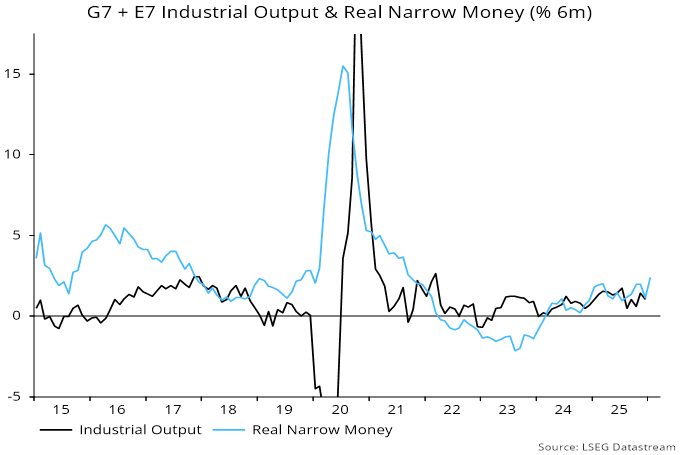
A January post noted the possibility that global six-month real narrow money momentum had crossed below industrial output growth in December, suggesting less favourable monetary conditions for markets. Recent dramatic sell-offs in some speculative assets could reflect such a shift.

The suggestion is still tentative: additional – but not yet complete – December data indicate that the two series converged rather than intersected – see chart 1.

Chart 1

060226c1

Will a cross-over be confirmed soon? Monetary prospects are uncertain but stronger January manufacturing PMI results suggest a rise in six-month industrial output momentum in early 2026.

In data since 1970, global equities outperformed US dollar cash significantly on average in months following a positive reading of the gap between real money and output momentum (by 12.0% annualised). (The calculation allows for reporting lags.)

By contrast, negative gaps were associated with average underperformance in the following month (of 5.5%).

Needless to say, these averages conceal frequent “misses” in both directions.

The six-month real money / output momentum gap was positive in most months in 2025. It was, however, negative in 2023 and much of 2024, when equities rallied strongly.

As previously discussed, the six-month gap was a misleading guide to “excess” money over this period because of a large monetary overhang from the money growth surge in 2020-21.

A simple way of illustrating this overhang is to compare five-year growth rates of real money and industrial output. Real money growth was still much higher in 2023 – chart 2.

Chart 2

060226c2

The five-year gap turned negative last year. It last closed in the early stages of the GFC bear market.

Back then, the six-month gap had been negative for more than a year. The closing of the five-year gap was followed by an acceleration of the market decline.

With the five-year gap already negative, a negative shift in the six-month gap could be reflected in more immediate market weakness than in 2007-08.

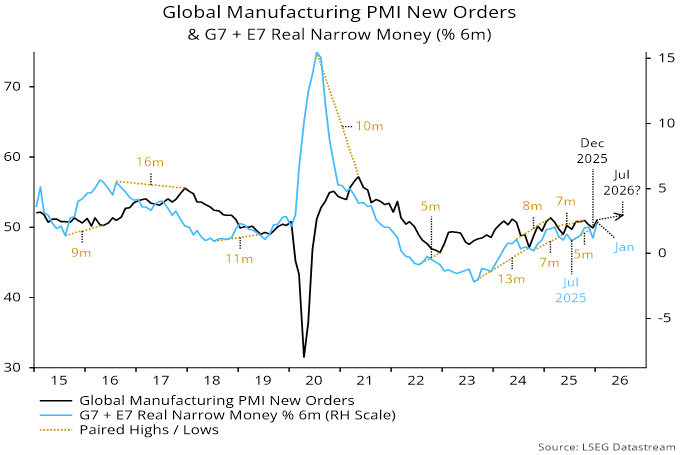
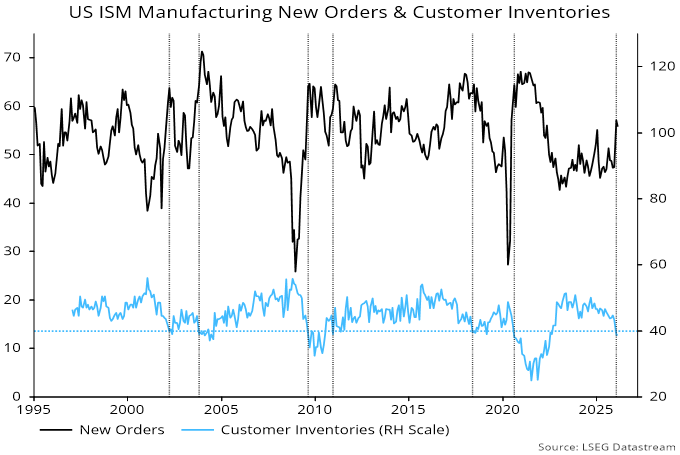
Global manufacturing PMI new orders recovered strongly in January following a November / December relapse. Both the fall and revival had been signalled by money trends: global six-month real narrow money momentum declined sharply in April / May 2025 but rebounded into November. The seven-month interval between a (revised) May low in real money momentum and the December PMI trough matches the lead time at the prior two turning points – see chart 1.

Chart 1

030226c1

The rise in real narrow money momentum into November suggests that the PMI upswing will extend into Q2. As foreshadowed in a previous post, however, real money momentum declined sharply in December, retracing most of its May-November gain. Accordingly, the manufacturing bounce is expected to fizzle out in Q2, with renewed weakness into Q3.

Real narrow money momentum has slowed across most major economies, though to varying degrees. China and India have contributed most to the global decline, although the Indian number remains strong – chart 2.

Chart 2

030226c2

The US series shown incorporates an adjustment for a suggested distortion to demand deposit data affecting the M1A measure used here. However, substituting the official M1 measure – unaffected by the mooted distortion – for M1A would give the same current reading.

Eurozone momentum remains above the US level while the UK has recovered from significant weakness in mid-2025, suggesting improving relative economic prospects. Still, both series have stalled at modest levels, cautioning against optimism.

Japanese real narrow money contraction continues to flag a policy mistake, while a faster decline in Brazil argues for urgent rate cuts. (The Brazil manufacturing PMI was the weakest in the global stable in January.)

Elsewhere, prior strength in Australian real narrow money momentum is consistent with recent upbeat economic news but a slowdown since September suggests that prospects were cooling before this week’s rate hike.

Eurozone and UK money trends have shown disappointingly small responses to policy easing, suggesting that rates remain in restrictive territory and casting doubt on hopes of stronger economic growth.

The preferred monetary aggregates here are “non-financial”, covering households and non-financial corporations. Money holdings of financial institutions are volatile and less informative about near-term economic prospects.

A recovery in six-month growth rates of Eurozone narrow and broad money stalled in early 2025 despite the ECB continuing to cut rates through June, with both well below pre-pandemic averages – see chart 1.

Chart 1

300126c1

The UK profile is different. The laggardly pace of rate cuts appears to have contributed to a relapse in growth rates in H1 2025 but these recovered into November, moving sideways in December – chart 2.

Chart 2

300126c2

While suggesting UK relative improvement, narrow money expansion remains beneath its pre-pandemic average (and the Eurozone level), with annual broad money growth a below-par 3.8% (versus 2.7% in the Eurozone).

One reason for the disappointing responses is that policy rate cuts have yet to translate into a decline in longer-term yields. Relatedly, UK QT has been a significant and unnecessary drag.

A hopeful scenario is that low inflation implied by weak broad money trends will allow longer-term yields to subside. Still, additional policy adjustment will likely also be required to generate a monetary response sufficient to warrant economic optimism.