Will the Bank of Japan’s latest attempt to exit ZIRP prove any more successful than its previous two efforts, in 2000 and 2006?

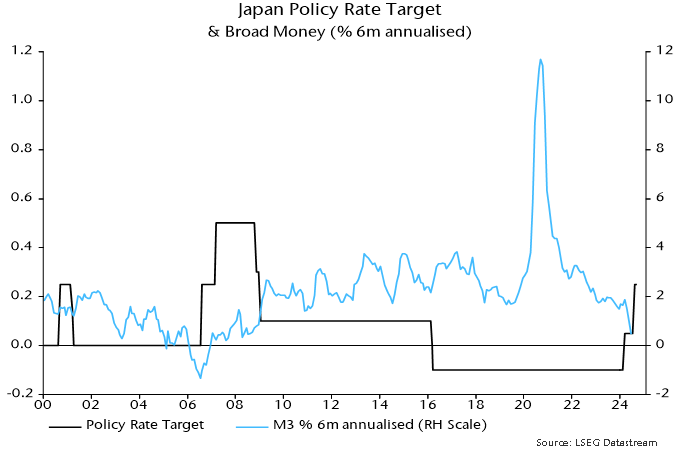
The monetary backdrop is no more promising. The six-month rate of change of broad money M3 was 0.5% annualised in June compared with 1.3% and -1.1% respectively before the August 2000 and July 2006 rate hikes – see chart 1.

Chart 1

20240801_NSP_MMM_C1_JapanPolicyRateTargetBroadMoney

Money growth, admittedly, has been depressed by recent record intervention to support the yen. The judgement here is that the authorities have marked out a major low in the currency – see previous post – so f/x sales are likely to slow / end.

A reduced intervention drag, however, will be offset by a contractionary monetary influence from QT. The announced phased reduction in monthly purchases implies that the BoJ’s JGB holdings will fall by about ¥8 trn during H2 2024, equivalent to an annualised 1.0% of M3.

Credit developments are superficially more supportive of policy tightening. The six-month rate of change of commercial banks’ loans and leases was 3.5% annualised in June compared with -1.9% and 2.8% before the 2000 / 2006 hikes.

Bank lending, however, is usually a lagging indicator of economic momentum, suggesting a slowdown ahead in response to recent activity weakness.

The BoJ “will … continue to raise the policy interest rate” if its outlook for economic activity and prices is realised. Headline and core CPI inflation are projected to be close to the 2% target in fiscal years 2025 and 2026 based on the output gap turning positive and a “virtuous cycle between prices and wages continuing to intensify”.

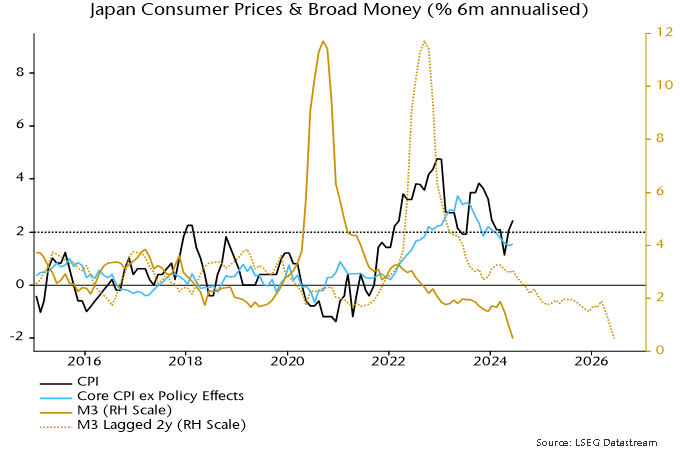
The “monetarist”  forecast, by contrast, is that inflation is heading for a big undershoot. Six-month core CPI momentum was 1.5% annualised in June*, with lagged broad money growth suggesting a further decline into 2025 – chart 2.

Chart 2

20240801_NSP_MMM_C2_JapanConsumerPricesBroadMoney

Coming Japanese inflation experience will be another test of forecasting approaches. Simplistic monetarism has trounced new Keynesian orthodoxy so far this decade. Another win for monetarist simpletons will spell third time unlucky for the BoJ.

*Own estimate adjusting for policy effects and seasonals.

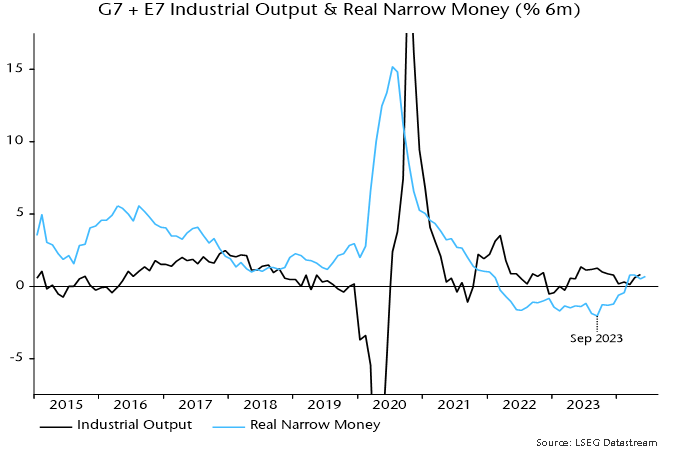
Global six-month real narrow money momentum – a key indicator in the forecasting process followed here – is estimated to have moved sideways for a third month in June, based on monetary data covering 85% of the aggregate.

Real money momentum has recovered from a September 2023 low but remains below both its long-run average and the average in the 10 years preceding the GFC, when short-term interest rates were closer to recent levels – see chart 1.

Chart 1

20240726_NSP_MMM_C1_G7E7IndustrialOutputRealNarrowMoney

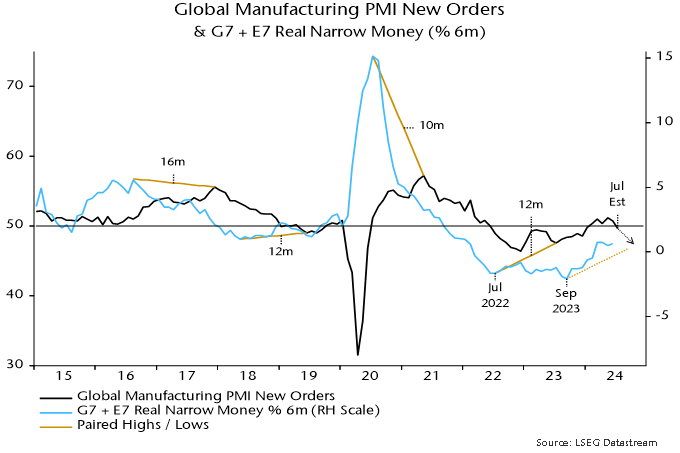
The expectation here has been that the fall into the September 2023 low would be reflected in a weakening of global industrial momentum into late 2024. DM flash PMI results for July support this forecast, implying a fall in global manufacturing PMI new orders from 50.8 in June to below 50, assuming unchanged readings for China / EM.

Chart 2

20240726_NSP_MMM_C2_GlobalManufacturingPMINewOrdersG7E7RealNarrowMoney

The stalling-out of real money momentum at a weak level suggests that economic expansion will remain sub-par in early 2025.

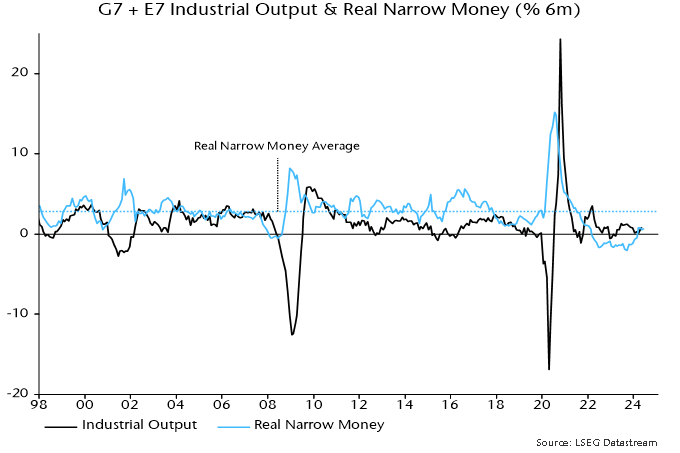
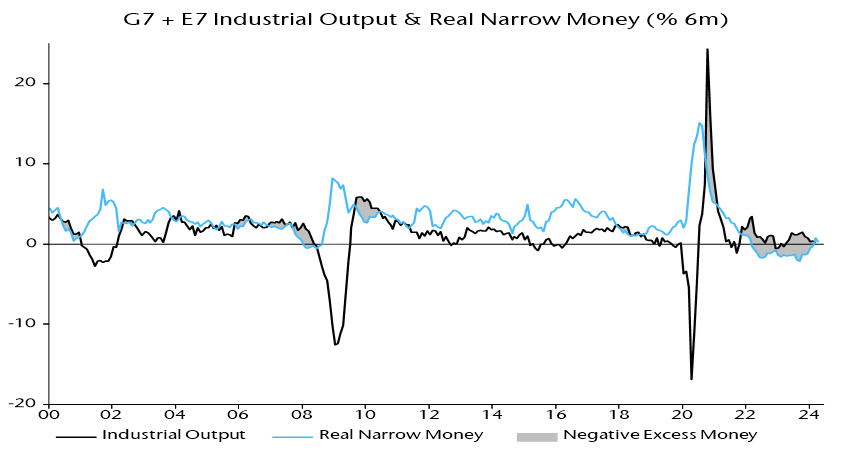
Global six-month industrial output growth, meanwhile, recovered in April / May, crossing back above real money momentum – chart 3. The implied negative shift in “excess” money conditions may partly explain recent market weakness / rotation.

Chart 3

20240726_NSP_MMM_C3_G7E7IndustrialOutputRealNarrowMoney

Global six-month real narrow money momentum was held back in May / June by weakness in China and Japan, discussed in recent notes. A US slowdown is a risk going forward.

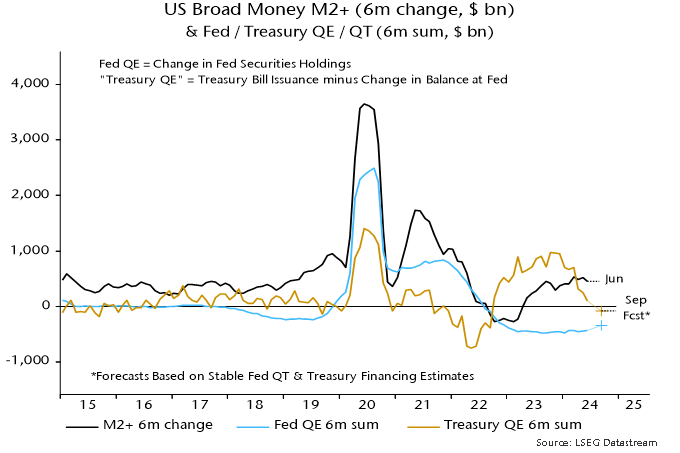
note in February argued that expansionary deficit financing operations – “Treasury QE” – have more than offset the monetary drag from Fed QT. Specifically, the Treasury relied on running down its cash balance at the Fed and issuing Treasury bills to fund the deficit in H2 2022 and 2023. The former represents a direct monetary injection while bill issuance is likely to expand broad money because bills are mostly purchased by money funds and banks. (A recent paper from Hudson Bay Capital makes a similar point, referring to variations in the maturity profile of debt sales as “activist Treasury issuance”.)

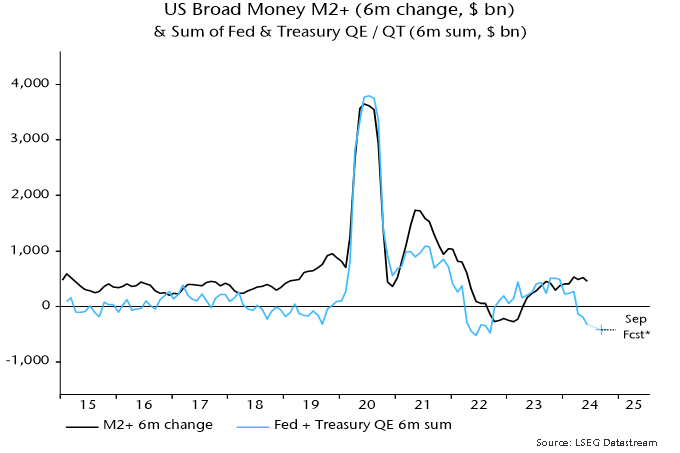
The February article and an update in May, however, noted that Treasury financing estimates implied that the six-month running total of Treasury QE would slow sharply in Q2 and turn negative in Q3. With Fed QT continuing, albeit at a slower pace, the joint Treasury / Fed impact on broad money was on course to become significantly contractionary.

Treasury QE has fallen as expected and the joint contribution has become negative – charts 4 and 5. Six-month broad money momentum has yet to slow significantly, although three-month growth in June was the weakest since November. Money momentum lagged when the joint impact swung from negative to positive in late 2022 / early 2023.

Chart 4

20240726_NSP_MMM_C4_USBroadMoneyM2FedTreasuryQEQT

Chart 5

20240726_NSP_MMM_C5_USBroadMoneyM2SumofFedTreasuryQEQT

The approach here places greater weight on narrow than broad money for short-term forecasting. A US broad money slowdown, in theory, could be accompanied by stable or stronger narrow money expansion, for example if rising confidence leads to an increase in broad money velocity, with an associated portfolio shift into demand deposits. Such a scenario, however, is less likely the longer the Fed delays significant rate cuts.

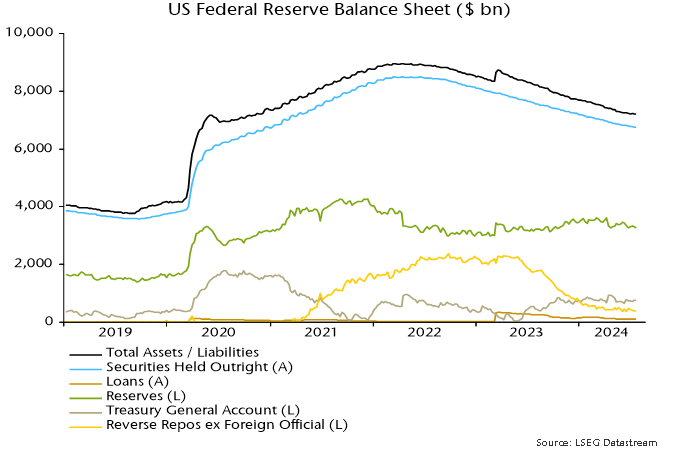
The slowdown in Treasury QE explains a reversal lower in US bank reserves since April – chart 6. The prior rise in reserves, despite ongoing Fed balance sheet contraction, occurred because money funds were moving funds out of the overnight reverse repo facility in order to buy newly-issued Treasury bills, with the Treasury reinjecting the cash via the deficit.

Chart 6

20240726_NSP_MMM_C6_USFederalReserveBalanceSheet

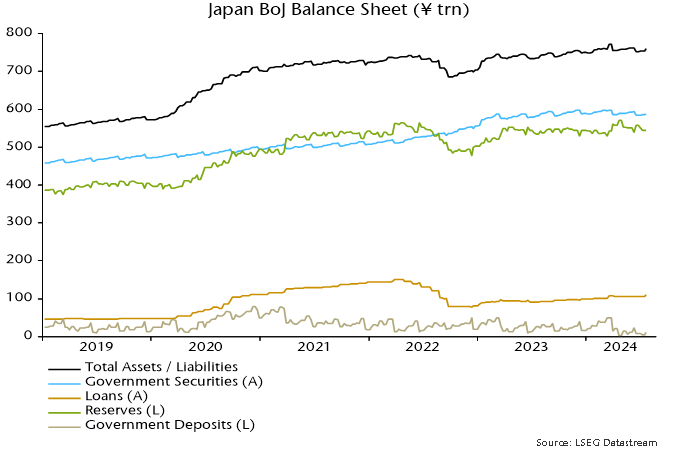
Japanese bank reserves are also on course to fall as the BoJ embarks on QT – chart 7. Market speculation is that the MPC will announce a reduction in gross JGB purchases to ¥3 trn per month at next week’s meeting, from an average ¥5.7 trn in H1. With redemptions averaging ¥6.5 trn over the last year, this suggests monthly QT of ¥3.5 trn ($23 bn), equivalent to 2.6% of broad money M3 at an annualised rate.

Chart 7

20240726_NSP_MMM_C7_JapanBoJBalanceSheet

GACM_COMM_2024-07-25_Images_WP-Banner

The reporting season of our international holdings gets underway in the weeks ahead. After a particularly strong Q1 reporting season, forward earnings per share estimates for the STOXX 600 have been flat since June. Some sectors, like in travel and leisure have observed an increase in their earnings revision while others, like in luxury or in construction and materials have obtained a lower-than-expected earnings revision. On the revenue side, we saw a weaker forward sales revision lately, a potential signal that the macroeconomic trends might remain complicated for the second half of 2024. On a sector basis, consumers and technology seems to be experiencing a soft patch. When not impacted by delay, new order intakes seem to be coming through but the cadence in manufacturing is progressing at a slow pace.

Political risk is back

Index performance rebased to 100 (USD)

GACM_COMM_2024-07-25_Chart01_v1.2

Source: Bloomberg, MSCI.

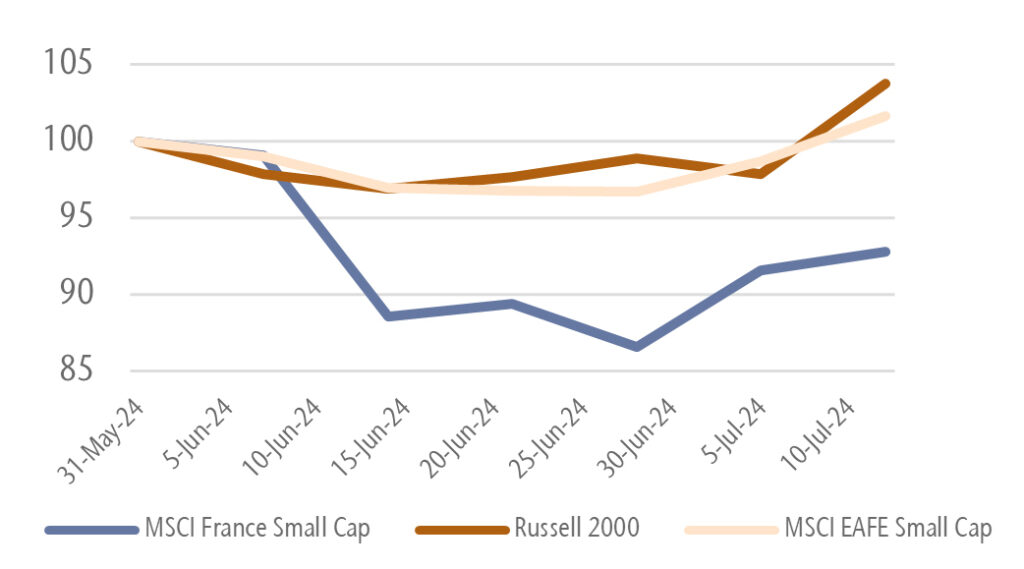
Volatility spiked last month due to a political risk resurgence in Europe. The French election caught investors off guard and prompted many to de-risk and reallocate elsewhere. French bond yield has narrowed since the end of June, but equity hasn’t recovered much. French equities have suffered and have trailed other benchmarks since early June.

The left-wing alliance unexpectedly won the election, beating both the presidential and far-right party. Now, attention turns to the election of a new President of the National Assembly in July. The balance of power seems to have shifted towards the center-left alliance and this could be the best-case scenario for markets. The formation of a technocracy cannot be ruled out either.

The first real test for the new government will probably be to vote on the upcoming preliminary budget that needs to be submitted to the European Commission by mid-October. Last month the European Commission signaled that France should be put under excessive deficit procedure. If that proposition is adopted by the European Council, France will have to meet the requirement of the European Union’s (EU) fiscal rules. The incoming government will have little room to maneuver from a fiscal point of view. Considering that the last time France recorded a surplus was in 2001, the challenge is colossal.

Political uncertainty adversely affects the decision-making processes of companies. It will be interesting to track how companies intend to reallocate capital in the upcoming months.

Investors positioning

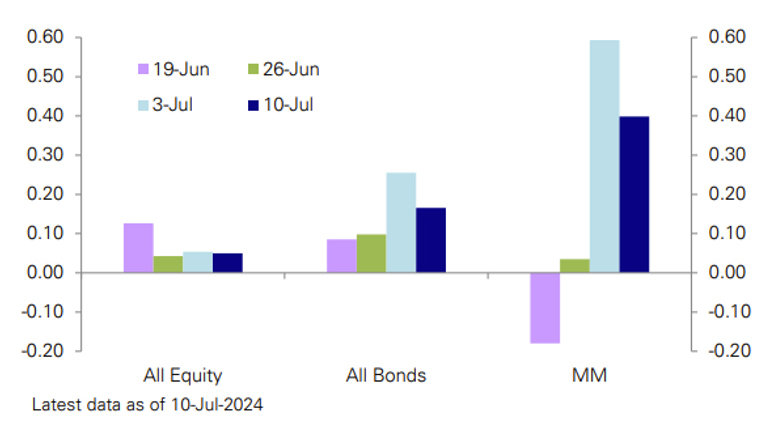
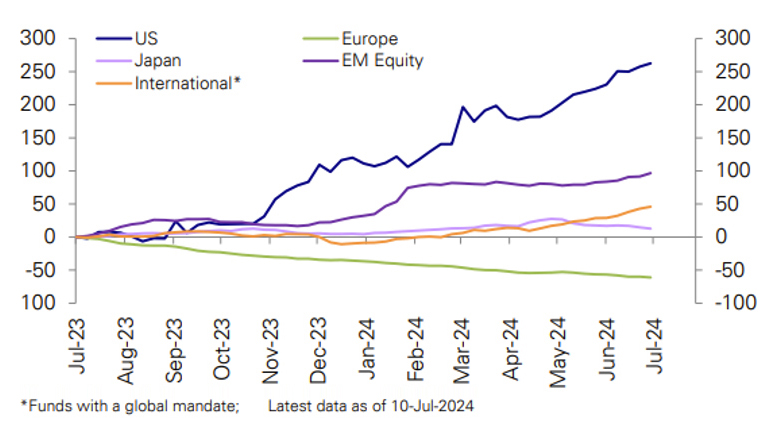
Fund flows are trending towards bonds and money market funds. US equity fund inflows remain high but have slowed, reflecting cautious investor sentiment. In Europe, equity funds are experiencing outflows, while Asia ex-Japan sees significant inflows, particularly in China and India. Technology remains the top sector, while materials and consumer sectors show muted interest. Shares of small caps in the US have recently surged, with the Russell 2000 Index hitting a 2024 high, fueled by optimism regarding the federal reserve’s advancements in combating inflation and the increased likelihood of interest rate cuts.

Fund Flows (last 4 weeks, % of assets)

GACM_COMM_2024-07-25_Chart02_v1.2

Source: Deutsche Bank.

Cumulative equity flows (last 12m, weekly, $bn)

GACM_COMM_2024-07-25_Chart03_v1.2

Source: Deutsche Bank.

Small caps is a key beneficiary of the expected lower rates, and given they continue to trade at a 20-year low valuation versus their larger counterparts, we believe now is an interesting time to own small caps.

Rendering of building at 1218 Thurlow Street, Vancouver

Investissements immobiliers Crestpoint Ltée, l’un des plus importants gestionnaires d’actions et de titres de créance du secteur immobilier commercial au Canada, a le plaisir d’annoncer le lancement et le financement initial de la Stratégie immobilière opportuniste Crestpoint (le « Fonds »), son premier produit à capital fixe.

Le Fonds, qui dispose d’une période de mobilisation de capitaux de douze mois et d’une durée totale de huit ans, a pour objectif d’investir dans une gamme de placements immobiliers opportunistes au Canada et vise un rendement brut annualisé de 15 % à 18 %. Les rendements obtenus proviendront principalement de l’appréciation du capital réalisée grâce à des acquisitions sélectives et stratégiques et à l’approche active et concrète de Crestpoint en matière de gestion d’actifs.

Parallèlement au lancement et à la clôture initiale, Crestpoint est également heureuse d’annoncer que le Fonds a réalisé son premier placement, soit le 1318 Thurlow Street, un projet d’aménagement de 0,4 acre situé à l’angle sud-ouest de l’intersection des rues Thurlow et Burnaby, dans le quartier populaire de West End, au centre-ville de Vancouver, en Colombie-Britannique. Une fois terminé, cet immeuble locatif multifamilial en béton de 32 étages, comprenant 300 logements composés de studios et d’appartements de 1, 2 et 3 chambres à coucher, ainsi que des aires de commodité intérieures et extérieures, offrira aux locataires des vues impressionnantes. Bénéficiant d’un score d’accès piétonnier de 96, la propriété est stratégiquement située dans une localité axée sur les transports en commun, à proximité des restaurants, des magasins, de Sunset Beach, du quartier des affaires du centre-ville, des hôpitaux et des universités. En partenariat avec Anthem Properties Group Ltd, Crestpoint, au nom du Fonds, a acquis une participation de 77 % dans la propriété, Anthem Properties détenant les 23 % restants.

« Depuis la création de Crestpoint en 2010, certains de nos meilleurs placements ont été réalisés dans des périodes caractérisées par la volatilité et les bouleversements du marché que nous connaissons aujourd’hui, a indiqué Kevin Leon, chef de la direction de Crestpoint. Nous croyons qu’il s’agit d’un contexte de placement intéressant. Nous prévoyons recourir à plusieurs stratégies pour créer de la valeur et en tirer parti, notamment en repositionnant les actifs sous-gérés, en recapitalisant les propriétés dont le bilan est faible et en rénovant les immeubles existants selon des normes plus élevées. »

Le Fonds, qui privilégie l’appréciation du capital, est destiné aux clients institutionnels qui souhaitent avoir accès à un portefeuille présentant un rendement potentiel plus élevé que celui offert dans le secteur immobilier de base, ce qui leur offre un choix supplémentaire et une occasion de diversification. Cette stratégie vient compléter la Stratégie immobilière de base plus phare de Crestpoint, un fonds à capital variable de 5,3 milliards de dollars, qui a été l’un des fonds de base et de base plus les plus performants au Canada depuis sa création en 2011. En 2022, Crestpoint a lancé la Stratégie de dette immobilière Crestpoint, un fonds hypothécaire à capital variable qui a devancé son indice de référence depuis sa création.

Max Rosenfeld, premier vice-président et chef de Gestion d’actifs chez Crestpoint, a ajouté : « Cette nouvelle stratégie tire parti de notre expertise en gestion et de nos relations étroites avec les professionnels en placement immobilier au Canada, des atouts qui nous ont permis de réaliser plus de 3 milliards de dollars d’investissements opportunistes et à valeur ajoutée au cours des 13 dernières années. »

Après le succès de cette première mobilisation de capitaux, le Fonds procédera à d’autres clôtures pour permettre à d’autres investisseurs de participer, la prochaine clôture étant prévue pour le quatrième trimestre de 2024.

À propos de Crestpoint

Investissements immobiliers Crestpoint Ltée est une société de gestion de placements immobiliers commerciaux qui cherche à fournir aux investisseurs un accès direct à un portefeuille diversifié d’actions et de titres de créance du secteur immobilier commercial. Comptant plus de 10 milliards de dollars sous gestion, Crestpoint est une société affiliée au Groupe financier Connor, Clark & Lunn, l’une des plus grandes sociétés privées et indépendantes de gestion de placements multientreprise au Canada. Elle possède des bureaux partout au pays ainsi qu’aux États-Unis, au Royaume-Uni et en Inde. Le Groupe financier CC&L et ses sociétés affiliées gèrent collectivement des actifs de plus de 133 milliards de dollars canadiens répartis dans une vaste gamme de produits et de solutions de placements traditionnels et non traditionnels destinés aux clients institutionnels, aux clients fortunés et aux particuliers. Pour obtenir de plus amples renseignements, veuillez consulter le site crestpoint.com.

Personne-ressource

Elizabeth Steele
Directrice, Relations avec les clients
Investissements immobiliers Crestpoint Ltée
416 304-8743
[email protected]

NSP_COMM_2024-07-17_Images_WP-Banner

The underperformance of emerging markets equities relative to the US has tested the patience of even its most diehard advocates of the asset class over the past few years. While EM equities posted a respectable 9.9% return in USD terms in 2023, this looks anaemic next to a roaring 26.3% for the S&P 500.

The disparity between the US and EM over the past decade tempts investors into the behavioural trap of building conviction for future returns based on what has performed well in the recent past. It is easy to forget that the annualised returns from 2000 to end-2023 for EM were 7.6% versus 7.8% for the US, both outpacing 6.2% for MSCI World. The risk here is that a pro-cyclical mindset can lead to perverse thinking where conviction strengthens for a popular asset class as the likelihood of a good result decreases, and vice versa.

US equities outperformed on a decade of stronger economic growth out of the GFC, fed by a new credit cycle and strong fiscal deficits fuelling stronger corporate earnings and a dollar bull market, along with multiple expansion. On the flipside, EM moved through a painful deleveraging compounded by foreign reserve managers chasing US exceptionalism and buying dollars which choked EM further.

Several contrarian market commentators have recently pointed out that the fundamental picture in EM in many ways looks more compelling than in the US – lower valuations, trough earnings, cheap currencies, lower inflation, as well as greater fiscal and monetary discipline.

So what explains the continued underperformance, and is there anything that can break this cycle?

Vicious and virtuous circles in EM equities

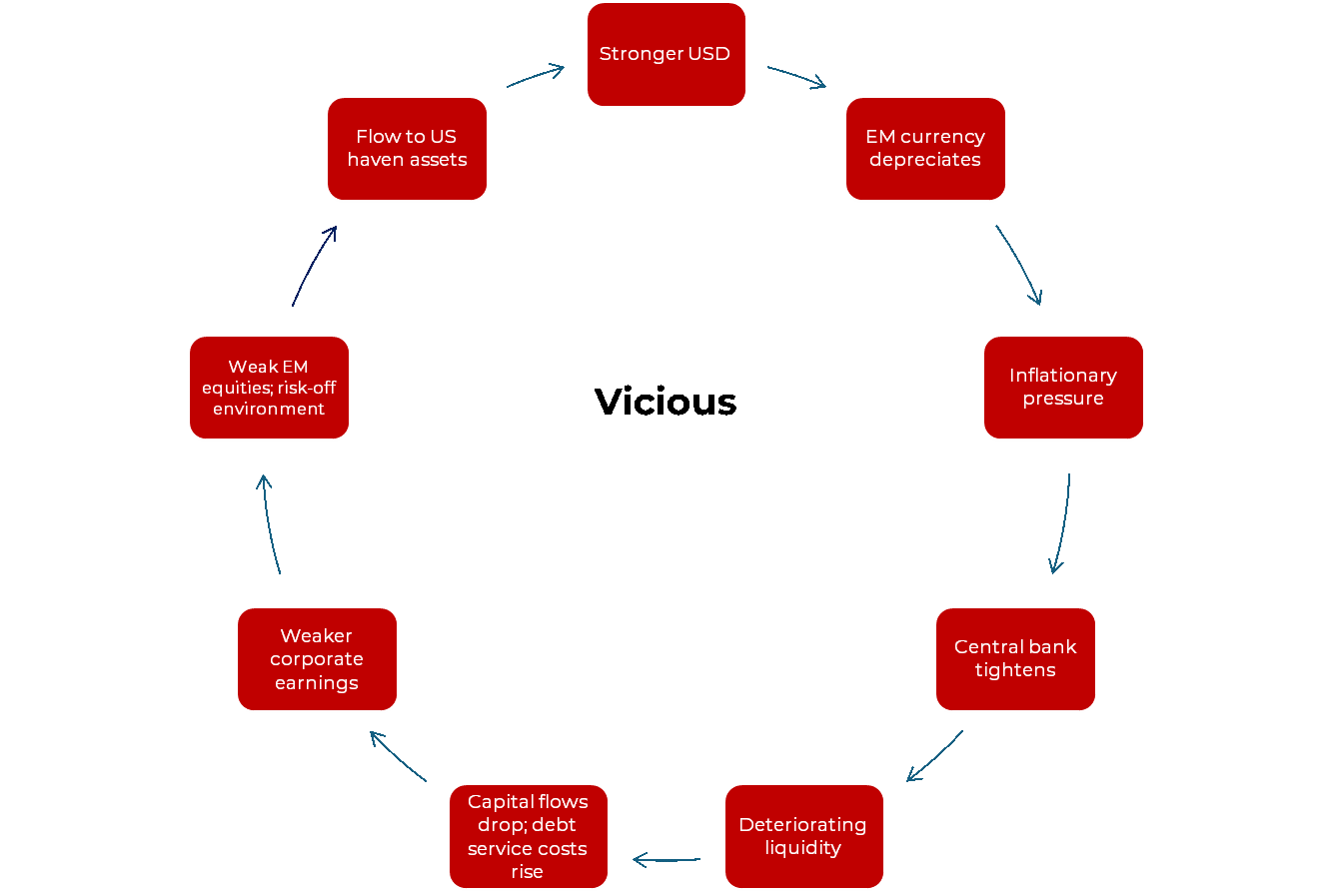
George Soros’s theory of Reflexivity provides an explanation for how biases and preconceptions interacting with economic reality can distort market pricing and create extended periods of disequilibrium. For EM, the combination of weaker fundamentals coupled with a perception of US exceptionalism has led to the formation of a self-reinforcing feedback loop which has been a major headwind for the asset class. Below is a rough schematic for how this loop has played out.

NSP_COMM_2024-07-17_Chart01Source: NS Partners.

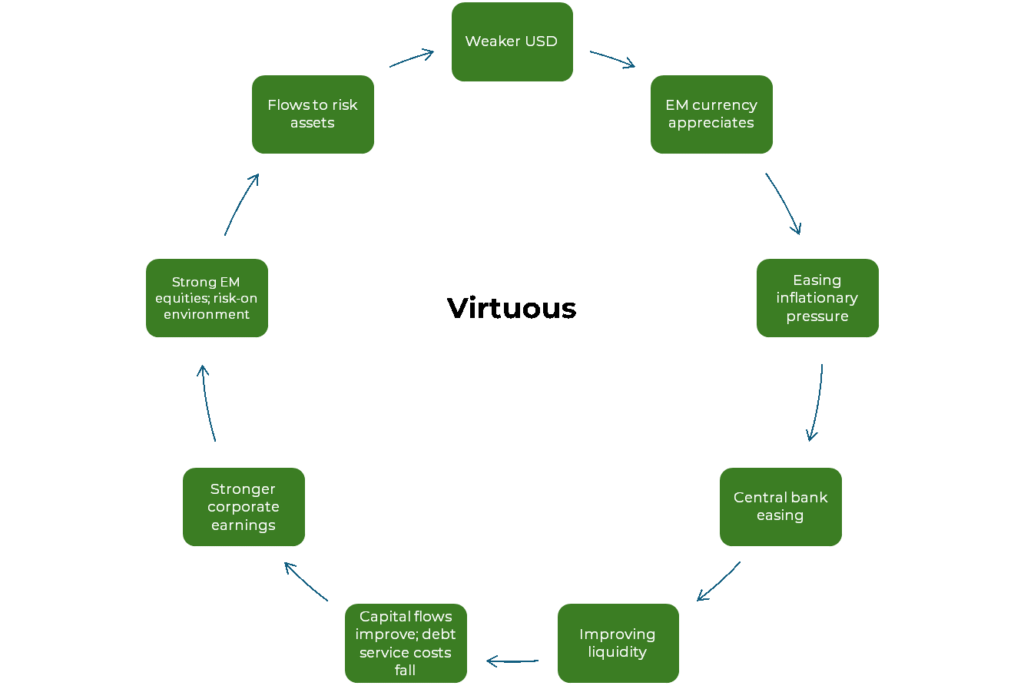
Our view is that this cycle is coming to an end. Indeed, we believe that there is potential for a shift into a “virtuous circle” for EM, outlined below.

NSP_COMM_2024-07-17_Chart02Source: NS Partners.

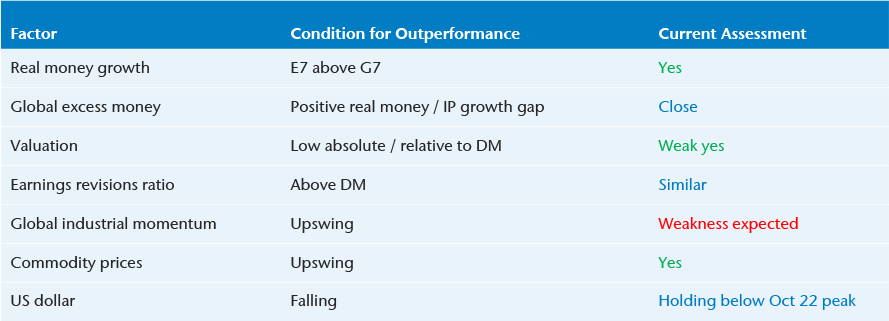
This outlook is based on a set of signals which we have used to advise clients invested in our DM and EM strategies looking to tweak the balance of exposure between the two. For context, our checklist is based on the idea that EM equities are a cyclical asset class and so tend to outperform when the global economy is strengthening (industrial cycle, commodity prices) and there is liquidity to chase the EM story (excess money, falling USD). They should also do better when economic prospects and earnings momentum are stronger than in DM (real money growth gap, revisions gap) and valuations are attractive.

Our latest update to the checklist (as of June 30, 2024) is below.

EM versus DM checklist
Microsoft PowerPoint – EM checklist 200524 (002) – Read-OnlySource: NS Partners.

The balance of factors we monitor now favours emerging market equities for the first time in years.

Our two cents – don’t wait around until everything goes green, as you will have missed the sharpest part of the rally.

Two checklist factors deserve special attention, given their historical usefulness in signalling an improving environment for EM equities.

Liquidity

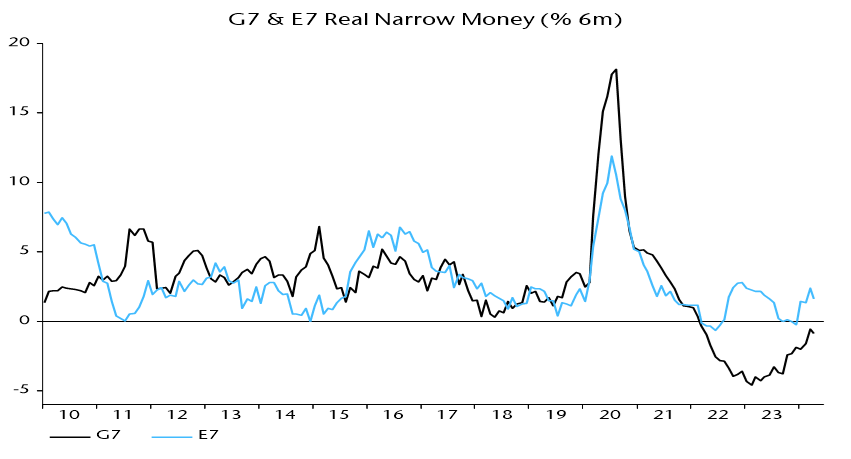
The E7 / G7 real money growth gap has been in favour of EM for some time, underpinned by better monetary policy making since 2020. This was reflected in better relative inflation performance for EM over DM, which has meant less need to tighten aggressively through the inflationary upswing, and potentially plenty of room to cut as the Fed eases.

Positive E7-G7 real money growth gap
NSP_COMM_2024-07-17_Chart04Source: NS Partners and LSEG Datastream.

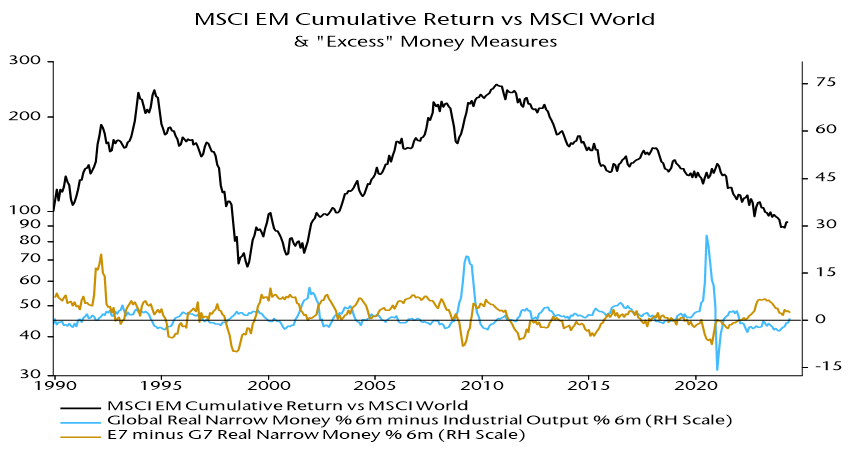
Additionally, the global excess money backdrop – proxied by the gap between real money and industrial output growth – may now be entering positive territory because of inflation peaking and industrial momentum weakening. The surplus liquidity can find its way into unloved financial assets, including EM equities. Prospective central bank pauses / reversals will sustain the trend.

Global “excess” money turning positive?
NSP_COMM_2024-07-17_Chart05Source: NS Partners and LSEG Datastream.

This is what we call a “double positive” liquidity environment, and could signal improving prospects for EM equities. In periods where these two monetary indicators have lined up this way, EM equities have outperformed MSCI World by an average of 10.5% per annum. Periods of EM outperformance are indicated in the shaded areas of the chart below. They line up nicely with the double positive.

EM relative performance & monetary indicators
NSP_COMM_2024-07-17_Chart06Source: NS Partners and LSEG Datastream.

King Dollar

The vicious and virtuous cycle diagrams above hint at just how important the dollar is as a driver of price and fundamental momentum in emerging markets.

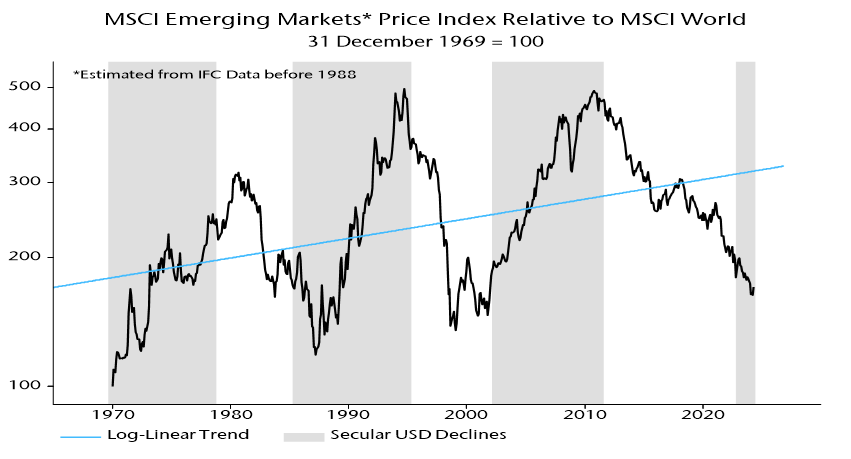
The chart below illustrates just how large a tailwind or headwind the dollar can be for the asset class.

EM outperformance during secular USD declines
NSP_COMM_2024-07-17_Chart07-revSource: NS Partners and LSEG Datastream.

The relative performance drawdown for EM versus global equities during the last dollar bull market is in line with previous dollar bull markets, but the period over which this has occurred is roughly twice as long. The risk for investors fatigued from such an extended period of relative underperformance is capitulation right as the asset class is primed to outperform.

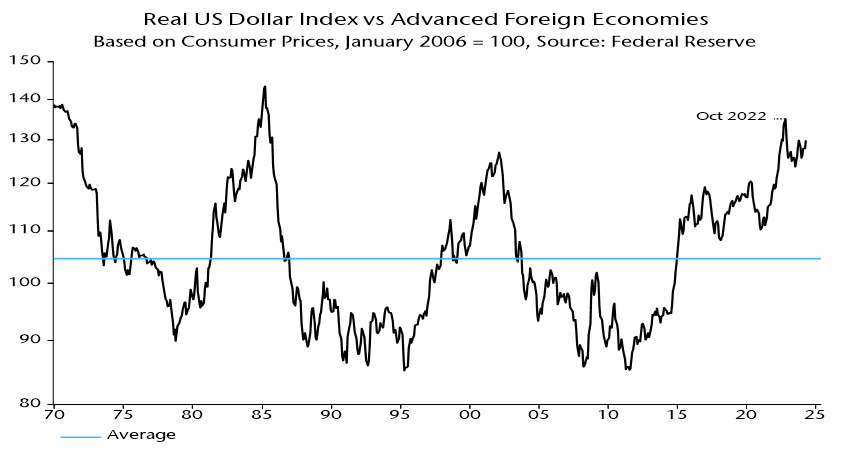
The real trade-weighted dollar is far above its long-run average and may have reached another secular peak in October 2022 – recent strength has failed to take out this high.

October 2022 USD peak?
NSP_COMM_2024-07-17_Chart08-revSource: NS Partners and LSEG Datastream.

The combination of monetary easing as inflation falls coupled with a weaker US dollar would provide a favourable backdrop for the outperformance of EM equities. Likely easing by the US Federal Reserve later this year will provide further scope for emerging market central banks to cut rates, allowing the credit cycle to move from stabilisation/recovery into expansion, providing support to economic and corporate earnings growth.

Such a pick up would encourage allocators oversaturated with US exposure to send marginal flows to emerging markets. With positioning at such extreme relative lows, even a small shift would be significant and another potential catalyst for entry into a virtuous cycle.

Chinese money trends are puzzling but ominous, suggesting – at a minimum – that the economy will remain weak through H2.

Q2 real GDP growth came in below expectations but there was better news on the nominal side: two-quarter nominal GDP expansion rose for a second quarter as the GDP deflator stabilised – see chart 1.

Chart 1

20240717_NSP_MMM_C1_ChinaNominalRealGDP

This improvement tallies with a recovery in six-month rates of change of narrow money and broad credit around end-2023. Money and credit momentum, however, has since slumped, reaching a new record low in June – chart 2.

Chart 2

20240717_NSP_MMM_C2_ChinaNominalGDPMoneySocialFinancing

post a month ago noted that money – and to a lesser extent credit – numbers have been distorted by a regulatory clampdown on the practice of banks paying supplementary interest. This has resulted in non-financial enterprises (NFEs) moving money out of demand deposits into time deposits and non-monetary instruments such as wealth management products (WMPs), as well as repaying some debt.

The post suggested discounting narrow money weakness and focusing on an expanded broad money aggregate including WMPs. The six-month rate of change of this measure had slowed significantly but was still within – just – the historical range of six-month broad money growth.

That is no longer the case. CICC numbers on WMPs show an outflow in June. Six-month growth of the expanded measure has converged down towards that of conventional broad money – chart 3.

Chart 3

20240717_NSP_MMM_C3_ChinaNarrowBroadMoneywithAdjustmentforWMPs

F/x intervention to support the yuan has contributed to monetary weakness but the effect has been minor. Net f/x settlement by banks – which captures spot intervention using the balance sheets of state banks and other institutions – amounted to CNY590 bn ($83 bn) or 0.2% of broad money in the six months to May (a June number is due this week).

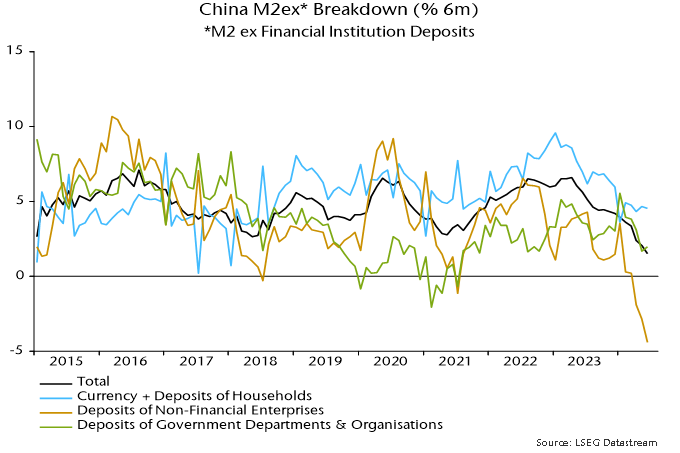
Household money growth, it should be emphasised, is stable and respectable: broad money weakness is entirely attributable to a loss of NFE deposits – chart 4. The puzzle is the destination of the “missing” NFE money. Only a small portion is likely to have been used to repay debt: banks’ short-term corporate lending fell in April / May but rebounded to a new high in June.

Chart 4

20240717_NSP_MMM_C4_ChinaM2exBreakdownM2exFinancialInstitutionDeposits

The focus of monetary weakness on NFEs suggests downside risk to investment and hiring, with negative feedback from the latter to consumer spending.

An analysis of the Fed’s historical behaviour suggests that the conditions for policy easing are in place.

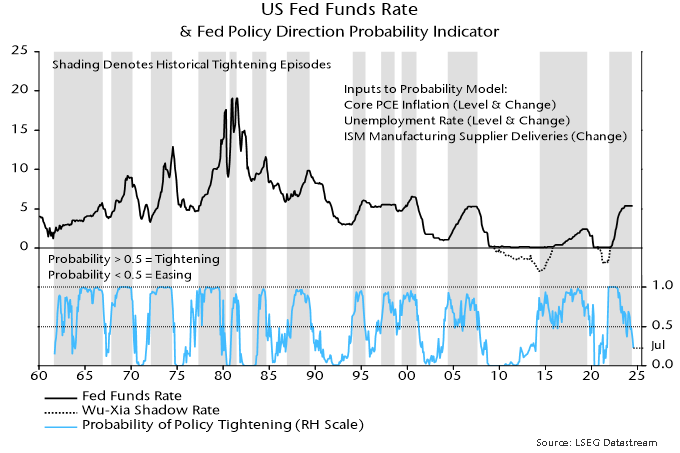
Chart 1 shows the fitted values and current prediction of a logit probability model for classifying months according to whether the Fed is in policy-tightening or policy-easing mode.

Chart 1

20240711_NSP_MMM_C1_USFedFundsRateFedPolicyDirectionProbabilityIndicator

The model’s determination for a particular month depends on values of annual core PCE inflation, the unemployment rate and the ISM manufacturing delivery delays index known at the end of the first week of the month (i.e. after the release of the employment report for the prior month).

The model can be thought of as an approximation of the Fed’s “average” reaction function over the last 60+ years. It correctly classifies 87% of months over this period, i.e. the estimated probability of being in policy-tightening mode was above 0.5 in tightening months and below 0.5 in easing months.

There is no memory effect – the model ignores whether the Fed was in tightening / easing mode in the previous month, only considering the above data series (with no dummy variables for “shocks”).

The dependent variable takes the value 1 from the month of the first rate increase in a tightening phase until the month before the first cut in a subsequent easing phase, and 0 otherwise. So a rate plateau before an easing is still classified as part of a tightening phase (and a rate floor before the first hike part of an easing phase).

The tightening / easing phases were identified judgementally and are shown by the shaded / unshaded areas in the chart. The Wu-Xia shadow rate informs the dating of phases during zero-rate periods since the GFC.

The model estimates the probability of the Fed being in tightening mode this month (July 2024) at 0.23, the lowest value since September 2021. Equivalently, the probability of a start of an easing phase is 0.77.

A fall in the tightening probability from 0.62 in March reflects a 0.2 pp rise in the unemployment rate over the last four months (from 3.9% to 4.1%) and a 0.3 pp fall in annual core PCE inflation (from 2.9% to 2.6%).

The Fed is unlikely to announce a rate cut at the conclusion of its next meeting on 31 July, as this would be at odds with recent communications (although the probability may be higher than the 0.05 implied by market pricing on 11 July, according to CME FedWatch).

The model’s shift, however, suggests a strong chance of a dovish statement teeing up a September move.

Modern office building with green leaves reflecting off of the glass panels.

Five longstanding ESG themes that predate responsible investing.

Environmental, Social and Governance (ESG) factors can be seen as idealistic in investing and at odds with business performance and measurable results. However, this view overlooks their financial implications for businesses and investors, with global small caps being no exception. ESG considerations, from board independence to community relations and environmental risks, can be useful to help assess financial stability, risk management and competitive advantage.

This week’s commentary will explore five themes that show how ESG factors can be important to sustainable financial success.

1. Board member independence

Good governance has long been an investor focus. Board independence helps ensure strategic guidance free from internal influences, reducing conflicts of interests. Independent directors provide unbiased oversight on risk management, which can help to avert crises and challenge management assumptions, leading to a more thorough analysis of strategic options and their implications. Independent boards often see higher profitability and navigate risks better, reflected in their market valuation and investor confidence.

An example is our holding Kurita Water Industries, which has 50% board independence, above the average in Japan. Its independent directors bring diverse perspectives, valuable in global expansion, and help Kurita maintain a solid financial position and sustainable growth in a competitive environment.

2. Product quality and safety

High product quality and safety standards fulfill regulatory requirements and boost consumer trust and brand reputation. They can reduce the risk of costly recalls and legal issues, directly impacting sales volume and the bottom line.

For instance, our holding Menicon, Japan’s first and largest contact lens manufacturer, has international quality standard certifications for medical devices, including ISO 13485/EN ISO 13485. Each of its subsidiaries maintains its own quality management system, with general managers in development, pharmaceutics and sales overseeing safety management. There have been no regulatory recalls of Menicon’s products in recent years.

3. Community relations

Strong community relations are vital for a company to obtain a license to operate, potentially increasing project approvals. Community ties can also provide supportive networks during crises and facilitate local cooperation. Conversely, community opposition can lead to project delays, increased costs and even cessation, affecting expected returns.

An example of a company holding that benefits from its community investment is Advantage Energy, from Western Canada. Although community issues are common in the natural gas sector, the company strives to be an active community member, attending monthly meetings to facilitate communication and cooperation regarding energy developments. It has faced no project opposition or delays and operates smoothly.

4. Physical risks of climate events on company assets

Climate change heightens extreme weather events and natural disasters, increasing the risk of damaging company assets, disrupting supply chains and increasing operational costs. These risks can also affect insurance premiums and lead to regulatory penalties, straining financial resources. Companies that mitigate these risks can protect assets and maintain profitability.

For example, our Arena REIT holding in Australia, with 272 social infrastructure properties, faces bushfire and extreme weather risks, leading to potential property damage, operational disruptions and higher insurance costs for tenants. Arena REIT maintains a geographically diversified portfolio and conducts thorough due diligence on bushfire zones and flood overlays during acquisitions. It also ensures adequate disaster insurance for repairs and reinstatement across its properties.

5. Employee relations

High employee morale and fair labour practices create a positive work environment, enhanced job satisfaction and reduced turnover. This boosts productivity and innovation, benefitting a company’s financial health. Conversely, poor employee relations can result in high turnover rates, lost productivity, strikes and reputational damage, negatively impacting financial health.

Our Vital Farms holding exemplifies good employee relations. The company produces and sells eggs, butter and ghee from pasture-raised hens. Certified as a B Corp, one of the highest standards of good corporate practices, Vital Farms has best-in-class initiatives for workers’ wellbeing, such as the ReVITAlize remote crew retreat, inclusive farmer open houses, comprehensive onboarding and an annual employee engagement survey.

The financial imperatives of ESG

These examples highlight how ESG integration can be used in financial decisions. As global small-cap managers, our commitment to incorporating ESG considerations into our investment decisions is one of the inputs for achieving sustainable financial success and aligning with our fiduciary duty to act in our clients’ best interests.

Disclaimer: ESG integration at Global Alpha is driven by taking into account material sustainability and/or ESG risks that could impact investment returns, rather than being driven by specific ethical principles or norms. The investment professionals may still invest in securities that present sustainability and/or ESG risks, including where the portfolio managers believe the potential compensation outweighs the risks identified.

Monetary analysis suggests that the global economy will weaken into early 2025, while inflation will continue to decline. A cyclical forecasting framework, on the other hand, points to the possibility of strong economic growth in H2 2025 and 2026.

Are the two perspectives inconsistent? A reconciliation could involve downside economic and inflation surprises in H2 2024 triggering a dramatic escalation of monetary policy easing. A subsequent pick-up in money growth would lay the foundation for a H2 2025 / 2026 economic boom.

How would equities perform in this scenario? Bulls would argue that any near-term weakness due to negative economic news would be swiftly reversed as policies eased and markets shifted focus to the sunlit uplands of H2 2025 / 2026.

More likely, a significant fall in risk asset prices would be necessary to generate easing of the required speed and scale, and a subsequent recovery might take time to gather pace.

Global six-month real narrow money momentum has recovered from a major low in September 2023 but remains weak by historical standards and fell back in May – see chart 1. The assessment here is that the decline into the 2023 low will be reflected in a weakening of global economic momentum in H2 2024.

Chart 1
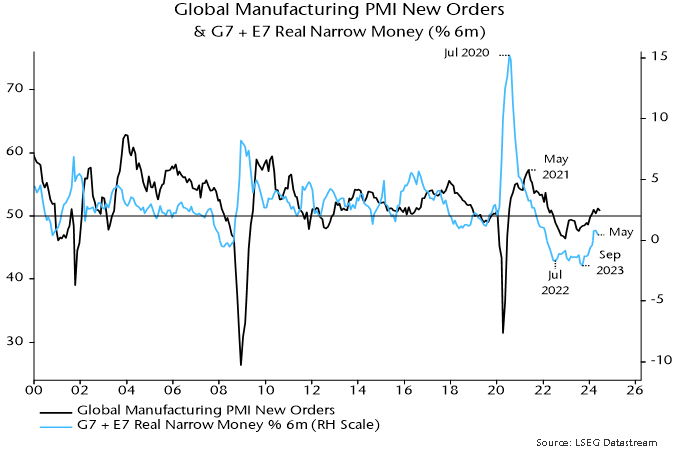
20240704_NSP_MMM_C1_GlobalManufacturingPMINewOrders

A counter-argument is that a typical lead-time between lows in real money and economic momentum historically has been six to 12 months. On this basis, negative fall-out from the September 2023 real money momentum low should be reaching a maximum now, with the subsequent recovery to be reflected in economic acceleration in late 2024.

The latter interpretation is consistent with the consensus view that a sustainable economic upswing is under way and will gather pace as inflation progress allows gradual monetary policy easing.

The pessimistic view here reflects three main considerations. First, economic acceleration now would imply an absence of any negative counterpart to the September 2023 real money momentum low – historically very unusual.

Secondly, the lag between money and the economy has recently been at the top end of the historical range, suggesting that a significant portion of 2023 monetary weakness has yet to feed through.

Highs in real money momentum in August 2016 and July 2020 preceded highs in global manufacturing PMI new orders by 16 and 10 months respectively, while a low in May 2018 occurred a year before a corresponding PMI trough – chart 2.

Chart 2
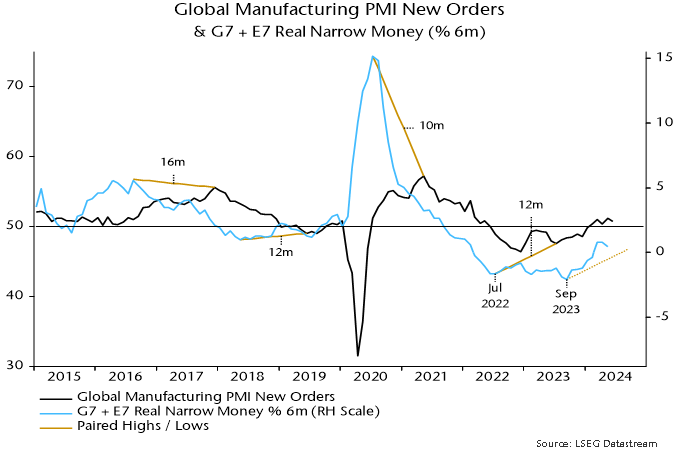
20240704_NSP_MMM_C2_GlobalManufacturingPMINewOrdersPaired

So a PMI low associated with the September 2023 real money momentum trough could occur as late as January 2025.

Thirdly, stock as well as flow considerations have been important for analysing the impact of money on the economy in recent years, and a current shortfall of real narrow money from its pre-pandemic trend may counteract a positive influence from the (tepid) recovery in momentum since September 2023 – chart 3.

Chart 3

20240704_NSP_MMM_C3_RatioOfG7E7RealNarrowMoneyToIndustrialOutput

The decline in real money momentum into the September 2023 low began from a minor peak in December 2022, suggesting that the PMI – even allowing for a longer-than-normal lag – should have peaked by early 2024. Global manufacturing PMI new orders rose into March and made a marginal new high in May. However, two indicators displaying a significant contemporaneous correlation with PMI new orders historically – PMI future output and US ISM new orders – peaked in January. The future output series fell sharply in June, consistent with the view that another PMI downturn is starting – chart 4.

Chart 4

20240704_NSP_MMM_C4_GlobalManufacturingPMI

Signs of weakness are also apparent under the hood of the services PMI survey. Overall new business has been boosted by financial sector strength, reflecting buoyant markets, but the consumer services component fell to a six-month low in June – chart 5.

Chart 5

20240704_NSP_MMM_C5_GlobalServicesPMINewBusiness

Could a weakening of economic momentum in H2 2024 snowball into a deep / prolonged recession? The cycles element of the forecasting process used here suggests not.

Severe / sustained recessions occur when the three investment cycles – stockbuilding, business capex and housing – move into lows simultaneously. The most recent troughs in the three cycles are judged to have occurred in Q1 2023, 2020 and 2009 respectively. Allowing for their usual lengths (3-5, 7-11 and 15-25 years), the next feasible window for simultaneous lows is 2027-28 – chart 6. Cycle influences should be positive until then.

Chart 6

20240704_NSP_MMM_C6_ActualPossibleCycleTroughYears

Major busts associated with triple-cycle lows, indeed, are usually preceded by economic booms. Such booms often involve policy shifts that super-charge positive cyclical forces. The 1987 stock market crash, for example, triggered rate cuts by the Fed and other central banks that magnified a late 1980s housing cycle peak.

Could significant policy easing in H2 2024 / H1 2025 similarly catalyse a H2 2025 / 2026 boom? Such a policy shift, on the view here, is plausible because negative economic news into early 2025 is likely to be accompanied a melting of inflation concerns.

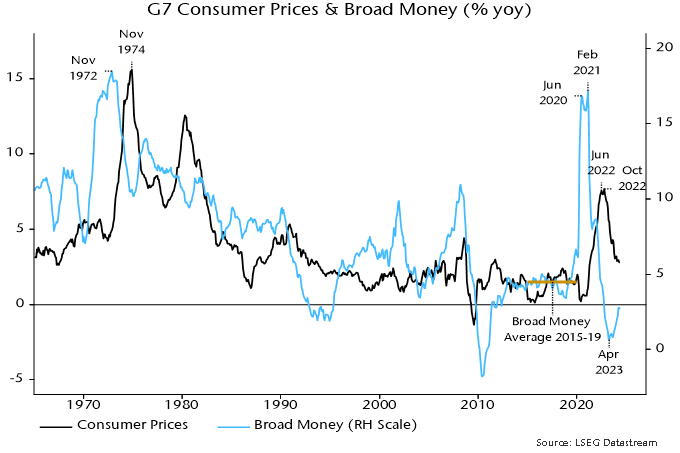
The latter suggestion is based on the monetarist rule-of-thumb that inflation follows money trends with a roughly two-year lag. G7 broad money growth of about 4.5% pa is consistent with 2% inflation. Annual growth returned to this level in mid-2022, reflected in a forecast here that inflation rates would move back to target in H2 2024 – chart 7.

Chart 7
20240704_NSP_MMM_C7_G7ConsumerPricesBroadMoney

The forecast is within reach. Annual US PCE and Eurozone CPI inflation rates were 2.5% in May and June respectively, with a fall to 2% in prospect by end-Q3 on reasonable assumptions for monthly index changes. UK CPI inflation has already dropped to 2.0%.

G7 annual broad money growth continued to decline into 2023, reaching a low of 0.6% in April 2023 and recovering gradually to 2.7% in May 2024. The suggestion from the monetarist rule, therefore, is that inflation rates will move below target in H1 2025 and remain low into 2026.

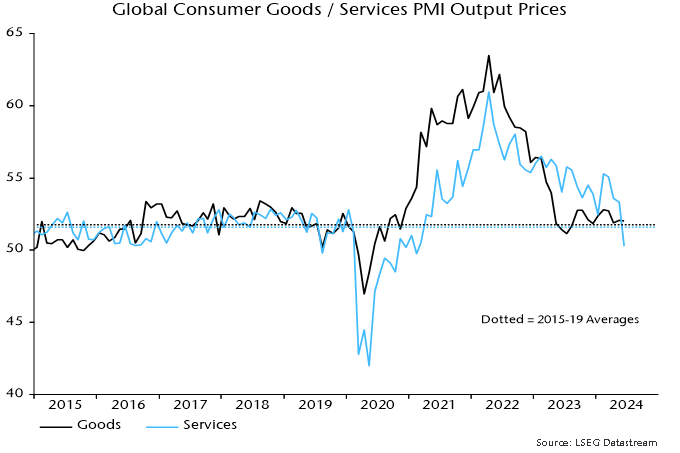
Central banks have been focusing on stickier services inflation, neglecting historical evidence that services prices lag both food / energy costs and core goods prices. Those relationships, and easing wage pressures, suggest that services resilience is about to crumble, a possibility supported by a sharp drop in the global consumer services PMI output price index in June to below its pre-pandemic average – chart 8.

Chart 8
20240704_NSP_MMM_C8_GlobalConsumerGoodsServicesPMIOutputPrices

The approach here uses two flow measures of global “excess” money to assess the monetary backdrop for equity markets: the gap between global six-month real narrow money and industrial output momentum, and the deviation of annual real money growth from a long-term moving average.

The two measures turned negative around end-2021, ahead of 2022 market weakness, but remained sub-zero as global indices rallied to new highs in H1 2024. The latter “miss” may be attributable to a money stock overshoot shown in chart 3 – the flow measures of excess money may have failed to capture the deployment of existing precautionary money holdings.

Still, the MSCI World index in US dollars outperformed dollar deposits by only 3.9% between end-2021 and end-June 2024, with the gain dependent on a small number of US mega-caps: the equal-weighted version of the index underperformed deposits by 8.4% over the same period.

What now? The money stock overshoot has reversed. The first excess money measure has recovered to zero but the second remains significantly negative. Mixed readings have been associated with equities underperforming deposits on average historically, with some examples of significant losses. Caution still appears warranted.

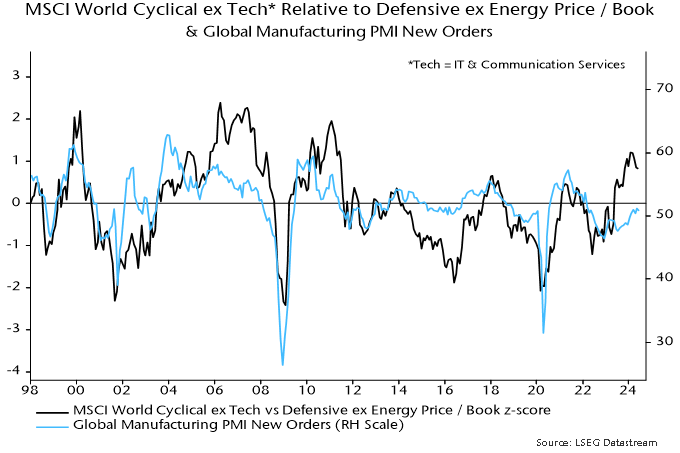
An obvious suggestion based on the economic scenario described above is to overweight defensive sectors. Non-tech cyclical sectors gave back some of their outperformance in Q2 but are still relatively expensive by historical standards, apparently discounting PMI strength – chart 9.

Chart 9
20240704_NSP_MMM_C9_MSCIWorldCyclicalExTech

Accelerated monetary policy easing could be favourable for EM equities, especially if associated with a weaker US dollar. Monetary indicators are promising. EM equities have outperformed historically when real narrow money growth has been higher in the E7 than the G7 and the first global excess money measure has been positive – chart 10. The former condition remains in place and the second is borderline.

Chart 10

20240704_NSP_MMM_C10_MSCIEMCumulativeReturnVsMSCIWorld

Monetary analysis suggests that the global economy will weaken into early 2025, while inflation will continue to decline. A cyclical forecasting framework, on the other hand, points to the possibility of strong economic growth in H2 2025 and 2026.

Are the two perspectives inconsistent? A reconciliation could involve downside economic and inflation surprises in H2 2024 triggering a dramatic escalation of monetary policy easing. A subsequent pick-up in money growth would lay the foundation for a H2 2025 / 2026 economic boom.

How would equities perform in this scenario? Bulls would argue that any near-term weakness due to negative economic news would be swiftly reversed as policies eased and markets shifted focus to the sunlit uplands of H2 2025 / 2026.

More likely, a significant fall in risk asset prices would be necessary to generate easing of the required speed and scale, and a subsequent recovery might take time to gather pace.

Global six-month real narrow money momentum has recovered from a major low in September 2023 but remains weak by historical standards and fell back in May – see chart 1. The assessment here is that the decline into the 2023 low will be reflected in a weakening of global economic momentum in H2 2024.

Chart 1

Chart 1 showing Global Manufacturing PMI New Orders and G7 plus E7 Real Narrow Money

A counter-argument is that a typical lead-time between lows in real money and economic momentum historically has been six to 12 months. On this basis, negative fall-out from the September 2023 real money momentum low should be reaching a maximum now, with the subsequent recovery to be reflected in economic acceleration in late 2024.

The latter interpretation is consistent with the consensus view that a sustainable economic upswing is under way and will gather pace as inflation progress allows gradual monetary policy easing.

The pessimistic view here reflects three main considerations. First, economic acceleration now would imply an absence of any negative counterpart to the September 2023 real money momentum low – historically very unusual.

Secondly, the lag between money and the economy has recently been at the top end of the historical range, suggesting that a significant portion of 2023 monetary weakness has yet to feed through.

Highs in real money momentum in August 2016 and July 2020 preceded highs in global manufacturing PMI new orders by 16 and 10 months respectively, while a low in May 2018 occurred a year before a corresponding PMI trough – chart 2.

Chart 2

Chart 2 showing Global Manufacturing PMI New Orders and G7 plus E7 Real Narrow Money

So a PMI low associated with the September 2023 real money momentum trough could occur as late as January 2025.

Thirdly, stock as well as flow considerations have been important for analysing the impact of money on the economy in recent years, and a current shortfall of real narrow money from its pre-pandemic trend may counteract a positive influence from the (tepid) recovery in momentum since September 2023 – chart 3.

Chart 3

Chart 3 showing Ratio of G7 and E7 Real Narrow Money to Industrial Output and 1995 to 2019 Log-Linear Trend

The decline in real money momentum into the September 2023 low began from a minor peak in December 2022, suggesting that the PMI – even allowing for a longer-than-normal lag – should have peaked by early 2024. Global manufacturing PMI new orders rose into March and made a marginal new high in May. However, two indicators displaying a significant contemporaneous correlation with PMI new orders historically – PMI future output and US ISM new orders – peaked in January. The future output series fell sharply in June, consistent with the view that another PMI downturn is starting – chart 4.

Chart 4

Chart 4 showing Global Manufacturing PMI New Orders and Global Manufacturing PMI Future Output / US ISM Manufacturing New Orders

Signs of weakness are also apparent under the hood of the services PMI survey. Overall new business has been boosted by financial sector strength, reflecting buoyant markets, but the consumer services component fell to a six-month low in June – chart 5.

Chart 5

Chart 5 showing Global Services PMI New Business

Could a weakening of economic momentum in H2 2024 snowball into a deep / prolonged recession? The cycles element of the forecasting process used here suggests not.

Severe / sustained recessions occur when the three investment cycles – stockbuilding, business capex and housing – move into lows simultaneously. The most recent troughs in the three cycles are judged to have occurred in Q1 2023, 2020 and 2009 respectively. Allowing for their usual lengths (3-5, 7-11 and 15-25 years), the next feasible window for simultaneous lows is 2027-28 – chart 6. Cycle influences should be positive until then.

Chart 6

Chart 6 showing Actual and Possible Cycle Trough Years

Major busts associated with triple-cycle lows, indeed, are usually preceded by economic booms. Such booms often involve policy shifts that super-charge positive cyclical forces. The 1987 stock market crash, for example, triggered rate cuts by the Fed and other central banks that magnified a late 1980s housing cycle peak.

Could significant policy easing in H2 2024 / H1 2025 similarly catalyse a H2 2025 / 2026 boom? Such a policy shift, on the view here, is plausible because negative economic news into early 2025 is likely to be accompanied a melting of inflation concerns.

The latter suggestion is based on the monetarist rule-of-thumb that inflation follows money trends with a roughly two-year lag. G7 broad money growth of about 4.5% pa is consistent with 2% inflation. Annual growth returned to this level in mid-2022, reflected in a forecast here that inflation rates would move back to target in H2 2024 – chart 7.

Chart 7

Chart 7 showing G7 Consumer Prices and Broad Money

The forecast is within reach. Annual US PCE and Eurozone CPI inflation rates were 2.5% in May and June respectively, with a fall to 2% in prospect by end-Q3 on reasonable assumptions for monthly index changes. UK CPI inflation has already dropped to 2.0%.

G7 annual broad money growth continued to decline into 2023, reaching a low of 0.6% in April 2023 and recovering gradually to 2.7% in May 2024. The suggestion from the monetarist rule, therefore, is that inflation rates will move below target in H1 2025 and remain low into 2026.

Central banks have been focusing on stickier services inflation, neglecting historical evidence that services prices lag both food / energy costs and core goods prices. Those relationships, and easing wage pressures, suggest that services resilience is about to crumble, a possibility supported by a sharp drop in the global consumer services PMI output price index in June to below its pre-pandemic average – chart 8.

Chart 8

Chart 8 showing Global Consumer Goods / Services PMI Output Prices

The approach here uses two flow measures of global “excess” money to assess the monetary backdrop for equity markets: the gap between global six-month real narrow money and industrial output momentum, and the deviation of annual real money growth from a long-term moving average.

The two measures turned negative around end-2021, ahead of 2022 market weakness, but remained sub-zero as global indices rallied to new highs in H1 2024. The latter “miss” may be attributable to a money stock overshoot shown in chart 3 – the flow measures of excess money may have failed to capture the deployment of existing precautionary money holdings.

Still, the MSCI World index in US dollars outperformed dollar deposits by only 3.9% between end-2021 and end-June 2024, with the gain dependent on a small number of US mega-caps: the equal-weighted version of the index underperformed deposits by 8.4% over the same period.

What now? The money stock overshoot has reversed. The first excess money measure has recovered to zero but the second remains significantly negative. Mixed readings have been associated with equities underperforming deposits on average historically, with some examples of significant losses. Caution still appears warranted.

An obvious suggestion based on the economic scenario described above is to overweight defensive sectors. Non-tech cyclical sectors gave back some of their outperformance in Q2 but are still relatively expensive by historical standards, apparently discounting PMI strength – chart 9.

Chart 9

Chart 9 showing MSCI World Cyclical ex Tech* Relative to Devensive ex Energy Price/Book and Global Manufacturing PMI New Orders

Accelerated monetary policy easing could be favourable for EM equities, especially if associated with a weaker US dollar. Monetary indicators are promising. EM equities have outperformed historically when real narrow money growth has been higher in the E7 than the G7 and the first global excess money measure has been positive – chart 10. The former condition remains in place and the second is borderline.

Chart 10

Chart 10 showing MSCI EM Cumulative Return vs MSCI World and "Excess" Money Measures