Tokyo central area city view with Azabudai Hills and Tokyo Tower at night.

Japan’s equity market is undergoing a structural reset. In October, Japan experienced its strongest month in net equity inflow in at least two decades. Net purchases by foreign investors reached 3.44 trillion yen, largely beating the previous record of 2.68 trillion yen in April 2013. A few factors contributed to the rally:

  1. Expectations of pro-growth stimulus under new leadership of Sanae Takaichi.
  2. Optimism on AI-related stocks.
  3. Normalization of policy interest rate to create a sustainable and wage-driven inflation.
  4. Acceleration of Tokyo Stock Exchange’s (TSE) corporate governance reforms.

According to Bloomberg, net equity outflows during 2015–2022 were about 13 trillion yen. So, it is reasonable to think that there is plenty of room for more inflows in the future.

Political impact and AI sentiment can be volatile. At Global Alpha, we would rather focus on structural changes such as sweeping TSE reforms and normalization of policy interest rate for healthy inflation. These two factors have been the game changers of Japan equity market in the past three years.

Game changer #1: TSE reforms

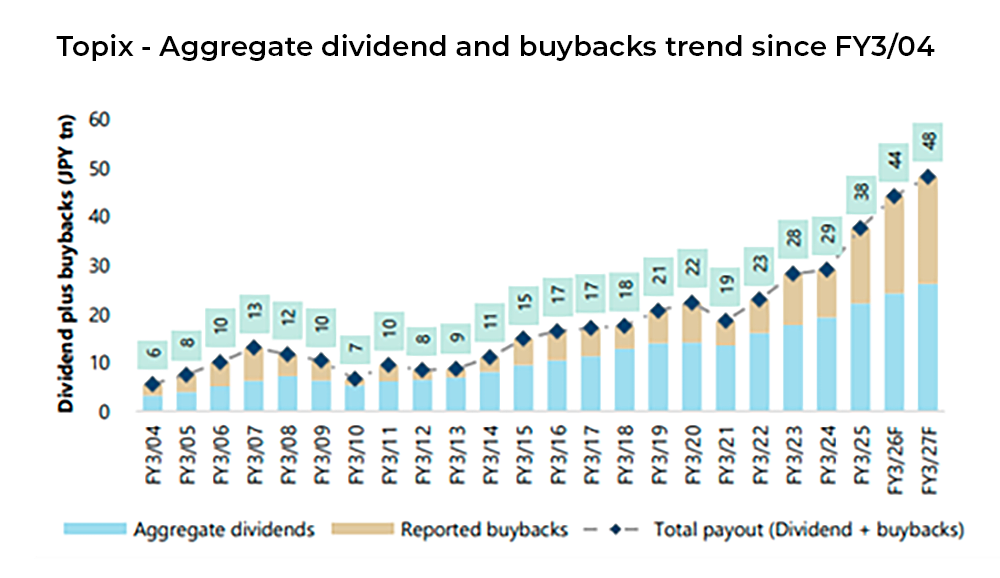
The positive impact of the TSE reforms on the market is mainly reflected in higher dividends, share buybacks, return on equity (ROE) and price-to-book value (P/B). Since TSE’s initiative on increasing shareholder values in 2023, we have seen notable increases in dividend and share buybacks.Chart showing Topix-Aggregate divident buybacks trend since FY3-04.

 Sources: Factset, Jefferies

In the global context, Japan still has a long way to go to improve its ROE and P/B. Currently, 47% of stocks in Japan Prime Index are trading below 1x P/B. In contrast, the percentage is 15% in MSCI Europe and 5% in S&P 500. Median ROEs during 2000–2024 for MSCI regions are 10.1% in Japan, 12.0% in Europe and 16.2% in the United States. Working toward global standards could be attractive opportunities for Japan equities.

Game changer #2: Normalization of policy interest rate

In March 2024, Japan exited its negative interest rate policy with the first hike in 17 years. Since January 2025, the rate has been stable at 0.5%. Bank of Japan (BOJ) expects core inflation to be around 2.7% for fiscal year 2025, slowing to 1.8% in fiscal year 2026 and returning to its 2% target in fiscal year 2027. Recent BOJ meeting summaries indicated a chance of further interest rate hikes.

Year to date, “banks” is among the top performing industry groups in the MSCI Japan Small Cap Index, up 46.8%. We have two holdings directly benefiting from both the rising interest rate cycle and improving corporate value.

  • Yokohama Financial Group Inc. (7186 JP)
    • One of Japan’s largest regional banks, growing both organically and via M&As.
    • A key differentiator is that its main customer base is in Kanagawa prefecture, close to Tokyo, which has a stable population outlook and strong economic growth.
    • ROE has been consistently improving from 2.3% in fiscal year 2021 to 7.0% now.
    • P/B also increased from 0.45 in fiscal year 2021 to 1.0 now.
    • After the recent quarter results, the company upgraded its full-year guidance for earnings and dividends.
    • Further, it unveiled a share buyback program for up to 30 billion yen.
  • Rakuten Bank Ltd. (5838 JP)
    • Japan’s first and largest digital bank by both customer accounts and deposit balances.
    • Its parent company Rakuten Group is the number one web brand in Japan with over 100 million members, which continues to benefit Rakuten Bank in customer acquisition and cross-selling.
    • The company is targeting roughly 25 million customer accounts and 20 trillion yen in deposits by fiscal year 2027.
    • Among the six digital banks in Japan, Rakuten Bank achieved the highest deposit growth in the past five years.
    • ROE has consistently been improving from 12.3% in fiscal year 2021 to 20.2%.

Icebergs drone aerial image top view - Climate Change and Global Warming. Icebergs from melting glacier. Arctic nature ice landscape in Unesco World Heritage Site.

The introduction of coal ignited the first major energy transition and powered industry, cities and progress for hundreds of years. It was not until the 1970s that oil products took centre stage, and fossil fuels became the backbone of modern life. Natural gas gained prominence in more recent decades. The world stands at the brink of another energy transformation, but this time, the stakes are higher. Previous energy transitions were driven by economic growth and soaring consumption. Now, the challenge is to ensure everyone has access to energy, while urgently reducing emissions to protect our planet.

The issue

Earth’s atmosphere is like a greenhouse, with gases such as water vapour, carbon dioxide, and nitrous oxide acting as invisible walls. They let sunlight in and trap heat, keeping our planet warm enough for life. Without them, Earth would be a frozen wasteland. Yet, as we pump more greenhouse gases into the air, the planet is heating up.

Carbon dioxide is the most significant contributor to warming, far outpacing other gases. Five major sectors: energy, agriculture, industry, waste management and land use change are the main culprits. The energy sector alone is responsible for a staggering 76% of emissions, mostly from electricity and heating production, transportation, and manufacturing.

Since the dawn of the Industrial Revolution, atmospheric carbon dioxide has soared by more than a third, driven by human activity. Global warming reached new levels in 2024, becoming the hottest year ever recorded, surpassing 1.5°C above pre-industrial levels for the first time.

The consequences

The warming of the planet has consequences for many areas, including our oceans, weather, food sources and health.

  • Melting ice sheets: Greenland and Antarctica are losing ice, releasing extra water once held in glaciers, causing sea levels to rise and threatening coastal communities.
  • Extreme weather: Warmer temperatures are changing weather patterns and fuel more intense storms, floods, wildfires and droughts.
  • Food systems: Crops struggle in thirsty soil, water grows scarce and plant and animal ecosystems need to migrate to survive.
  • Urban health: Heat lingers in cities, thickening the air with smog and causing serious health problems.

Climate change risk is not just about environmental issues, whether preventing rising sea levels or protecting forests, it is also about businesses and communities navigating transition and adaptation risks.

  • Transition risks include the impact of governments introducing carbon taxes or strict emissions limits. Companies could see profits shrink overnight. Advancements in technologies could make today’s energy systems obsolete, forcing companies to innovate or fall behind. As investors and consumers shift focus to greater sustainability, a company’s reputation – and stock price – could swing wildly if it is seen as lagging on climate action.
  • Adaptation risks could imply even well-meaning solutions backfiring. Building sea walls might protect cities from rising seas but could also disrupt delicate ecosystems. Every action has the potential of unintended ripple effects.

Climate change action plan

Governments worldwide are stepping up. The Paris Agreement set ambitious goals for cutting greenhouse gases, and now countries are pushing for even tougher targets, with most aiming for “net zero” by 2050. Each nation must share its plan for the next decade, explaining how it will cut emissions, adapt to climate impacts and what help it needs.

Carbon pricing is gaining ground, with around 40 countries charging for carbon pollution to encourage cleaner energy and fund sustainable projects. The goal is to keep global temperatures from rising more than 2°C above pre-industrial levels, and ideally, limit the increase to just 1.5°C.

While 2024 was the first year global temperatures exceeded 1.5°C, climate science looks at long-term averages, not just single-year spikes. Staying below 1.5°C could help avoid irreversible tipping points, reduce extreme weather and protect food supplies.

Human factor

Another challenge with the climate action plan is that humans are not good at long-term planning. We tend to focus on what is right in front of us, making it tough to stick to long-term climate goals, as witnessed by the United States twice leaving the Paris Agreement, and the Canada Pension Plan quietly dropping its net zero 2050 goal when rules around environmental claims became stricter.

People tend to give more weight to short-term risks and rewards than those far in the future. The latest World Economic Forum Global Risks report shows this bias. When asked about the next 10 years, climate risks dominate the top five risks. But when asked about the next two years, only one climate risk makes the top five. If we keep thinking short-term, we risk missing the bigger picture and holding back real progress in the battle against climate change.

Role of investors

Institutional investors have a pivotal role to shape how the climate change story unfolds. By directing capital toward renewable energy and climate-friendly projects, these investors have the power to accelerate the world’s transition to a low-carbon future. Through shareholder engagement and proxy voting, they can push companies to cut emissions and be more transparent about climate risks.

Canadian regulators are sounding the alarm, highlighting that climate change is not just an environmental risk, it is a financial one too. The latest guidelines from the Canadian Association of Pension Supervisory Authorities (CAPSA) urge boards to take climate risks seriously, warning that both physical and transition risks will only grow over time. Effective risk management means looking to the future and preparing for what lies ahead.

Opportunity knocks

Energy transition is not just about responsibility; it is also about opportunity. Investing in renewables, electrified transport, power grids and energy storage has already attracted nearly USD2 trillion, with double-digit growth even in challenging times. Figure 1 highlights where the money is flowing, with electrified transport and power grids getting the lion’s share.

Figure 1 – Where investment is flowing

Figure 1 showing Where investment is flowing Figure 1 highlights where the money is flowing, with electrified transport and power grids getting the lion’s share.

The path to renewable energy is not straightforward. For example, while battery storage is improving, many systems only last a few hours, so innovation is needed for longer battery storage. While technology is contributing to the climate change battle, it is also creating environmental and productivity challenges. Digital infrastructure and artificial intelligence (AI) are driving up electricity demand. For example, data centres powering AI models are energy-hungry, adding new pressure to the grid.

Emerging opportunities, such as geothermal and renewable fuels, are lagging the more mature sectors, drawing only 7% of total investment and seeing a material decline from previous years.

The scale of future infrastructure investment needed is staggering. Roads, airports, power plants, water utilities and telecom networks all need major upgrades. Without a surge in investment, the world could face a USD15 trillion infrastructure gap by 2040. For this reason, fossil fuels will remain part of the energy mix for years to come, despite the decline in use and rapid growth in renewables. Nuclear is also making a comeback as a cleaner option for large-scale power, although it is costly and slow to build so there are limitations to how much it can contribute.

Seize the moment

Climate change is a risk we cannot ignore, but it is also an opportunity for those ready to act. Whenever there is a discussion about risks and opportunities, they will typically be viewed as opposites. However, for climate change, they are not necessarily in conflict, since the opportunity, such as investment in renewable energy sources, can play a key role in managing climate-related risks.

The energy transition journey requires investment, innovation and leadership. Investors have a pivotal role to play, and those who step up stand to gain not just healthy returns, but a chance to make a lasting impact on the planet.

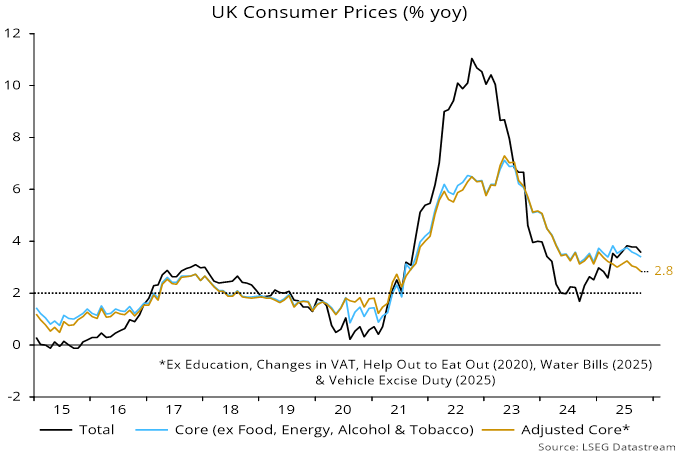
A measure of UK annual core CPI inflation excluding direct policy effects fell further to 2.8% in October, the lowest since August 2021 – see chart 1.

Chart 1

Chart 1 showing UK Consumer Prices (% yoy)

The measure adjusts for the imposition of VAT on school fees and bumper one-off rises in water bills and vehicle excise duty. It does not strip out the indirect impact of government actions, including national insurance and minimum wage rises and new packaging waste fees. The NI increase alone may have boosted annual core inflation by 0.25 pp, based on projections in the February Monetary Policy Report.

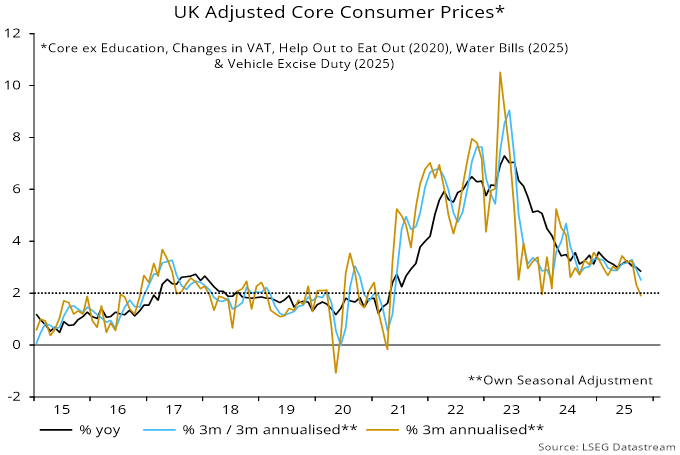
Policy effects are fading from shorter-term rates of change. The adjusted core measure rose at a 2.5% annualised pace in the three months to October from the previous three months, and by 1.9% between July and October – chart 2.

Chart 2

Chart 2 showing UK Adjusted Core Consumer Prices* *Core ex Education, Changes in VAT, Help Out to Eat Out (2020), Water Bills (2025) & Vehicle Excise Duty (2025)

The core slowdown is consistent with lagged monetary trends, which suggest further deceleration in H1 2026.

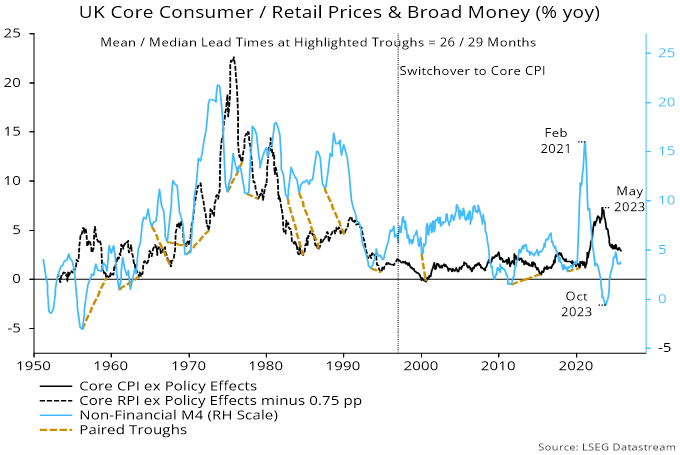
Lows in annual broad money growth preceded lows in adjusted core inflation with mean and median lags of 26 and 29 months respectively since WW2. Money growth bottomed in October 2023, suggesting an inflation low between December 2025 and March 2026 – chart 3.

Chart 3

Chart 3 showing UK Core Consumer / Retail Prices & Broad Money (% yoy)

The indirect policy effects cited above may have delayed transmission, raising the possibility of a longer-than-average lag on this occasion.

Money growth, moreover, has remained weak since 2023, suggesting that low core inflation will be sustained into 2027, at least.

Beyond core, food inflation has remained sticky but could break lower in 2026. Annual food inflation of 4.8% in October compares with 1.9% in the Eurozone. Readings were similar at the time of the October 2024 Budget, suggesting that most of the current wedge reflects policy effects. Average UK food inflation was below the Eurozone level over 2015-24.

Based on plausible core / food assumptions, and assuming a neutral Budget impact, annual headline CPI inflation could fall to c.2.25% by Q2 2026 (versus a Bank forecast of 2.9%), with a return to target during H2.

Chinese October money / credit numbers were mixed, suggesting a continuation of sluggish economic growth.

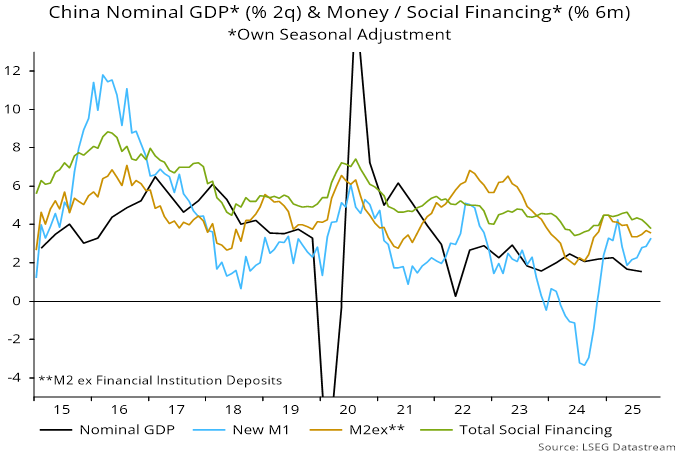
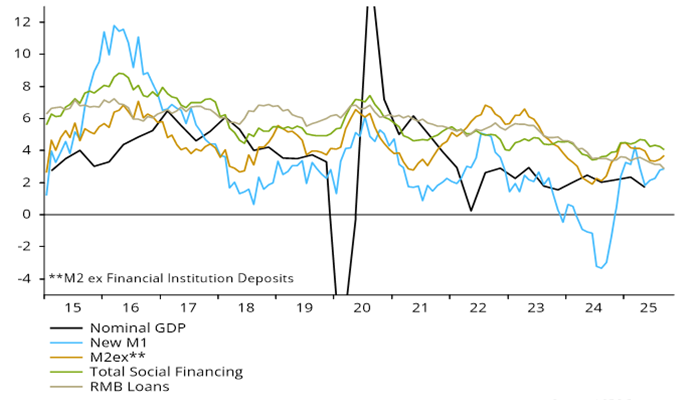
On the positive side, six-month growth of narrow money M1 extended its recent recovery, reaching its highest since March – see chart 1. (A fall in the year-on-year measure reflected an unfavourable base effect.)

Chart 1

Chart 1 showing China Nominal GDP* (% 2q) & Money / Social Financing* (% 6m) *Own Seasonal Adjustment

Broad credit slowed further, however, while growth of broad money – on the preferred definition here excluding deposits of financial institutions – fell back.

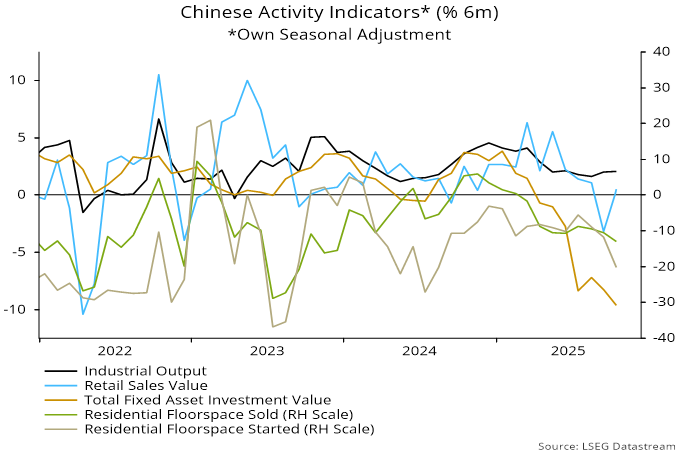
Concern about downside economic risks is supported by October activity numbers, showing faster rates of contraction of fixed asset investment and housing sales / starts – chart 2.

Chart 2

Chart 2 showing Chinese Activity Indicators* (% 6m) *Own Seasonal Adjustment

The weakness of the fixed asset investment data is difficult to square with Q3 GDP results showing an investment contribution of 0.9 pp to annual growth of 4.8%. The national accounts number includes stockbuilding but there is no indication from other evidence – admittedly limited – of a rapid build-up of inventories.

Industrial output growth continues to hold up while retail sales recovered after September weakness.

The authorities announced modest additional stimulus measures in September / October – new investment financing and an increase in local government bond issuance, each of RMB500 bn – and probably need to see greater weakness in the data before considering further action.

A positive gap between money growth and nominal GDP expansion may continue to offer support to equities, given low bond yields and still-negative property trends.

From a global perspective, lacklustre Chinese news presents no challenge to the forecast here of a loss of industrial momentum into early 2026 – see previous post.


Marine logistics hub. Containers ship in cargo port. Sea barge is awaiting unloading. Cargo cranes load containers onto ship. Transportation of goods by sea. Port on summer day. Oceanic logistics.

After decades of offshoring, companies are increasingly building capacity closer to end markets. This nearshoring trend has triggered a surge in new factories, warehouses and intermodal terminals. The world is entering a new phase of industrial investment as countries rebuild supply chains, renew critical infrastructure and accelerate the shift to cleaner logistics. Manufacturing nearshoring, port electrification and large-scale public infrastructure programs are reshaping industrial demand.  

Governments are deploying significant stimulus toward infrastructure modernization. The U.S. Infrastructure Investment and Jobs Act, Europe’s Green Deal programs and national port renewal projects all call for automation and emissions reduction in logistics. Port operators, for example, are increasingly replacing diesel-powered cranes with hybrid or fully electric units, a market where Konecranes is already a technology leader. 

Among the beneficiaries from that multi-year capex cycle stands Konecranes (KCR FH), the Finnish leader in lifting equipment and services, positioned at the crossroads of automation and reindustrialization. Konecranes is one of our holdings in our International Small Cap Strategy.

As one of the largest global players in its niche, Konecranes benefits from scale-driven pricing power, a broad installed base and a growing stream of recurring service revenue. Its service segment, representing about 40% of group sales, generates EBITA margins above 20% – roughly double those of new equipment – thanks to long-term maintenance contracts and critical spare-parts sales that are largely price inelastic. The company services more than 600,000 cranes worldwide, leveraging its digital platform for predictive maintenance and uptime analytics. This connectivity creates high customer switching costs and allows for value-based pricing rather than cost-based competition.

Scale also enhances resilience. Through years of acquisitions and regional integrations, Konecranes has consolidated a fragmented market, broadening its service reach across 120 countries and multiple industries. This global footprint enables it to spread R&D, logistics and data infrastructure over a larger customer base while improving service response times – a key differentiator versus smaller peers. Moreover, the company’s ability to bundle equipment, parts and digital services strengthens customer relationships and supports long-term contracts that are difficult for competitors to displace. 

Equipment downtime can be very costly for customers. For Konecranes, this translates into pricing leverage and high renewal rates on service agreements. The inelastic nature of maintenance pricing, combined with the company’s deep integration into clients’ safety and compliance frameworks, provides durable margins and steady cash flow. Over time, Konecranes’ mix shift toward services and automation has driven operating margins from 7% to over 13% in five years, positioning it among the more profitable industrial equipment consolidators globally. 

Konecranes combines a diversified portfolio with a clear strategy centred on electrification, automation and data-driven service. This balance provides resilience across economic cycles while capturing long-term secular growth from reindustrialization and infrastructure renewal. We believe Konecranes is well placed to capture these structural tailwinds. Its technological leadership, digital service model and exposure to automation-driven capital expenditure make it a key indirect beneficiary of the ongoing industrial transformation.

Wadala, Sewri, Lalbaug - skyline of Mumbai, India.

Considering the importance of structural liquidity in emerging market investing

We argue that a narrow focus on company fundamentals leaves investors increasingly exposed to powerful external forces like structural and cyclical liquidity shifts.

These forces influence capital availability, investor behaviour and asset pricing, often overriding fundamentals in the short to medium term.

Below, we run through two EM-specific examples of how we think about structural liquidity, along with a brief comment on market structure globally.

China’s National Team steps in as foreign investors hit eject

The “China is un-investable” doldrums from early 2021 to the beginning of 2024 saw the MSCI China Index drop from a peak to trough by over 50% in USD terms. Haphazard regulatory clampdowns on the technology and education sectors, a collapsing property market, and Sino-US tensions saw foreign investors run for the exits.

At the peak of the revulsion, we saw many liquid and high-quality companies being dumped, seemingly irrespective of fundamentals. For us, this was a painful experience with many of our favourite names caught up in the stampede. It was also a valuable lesson about the impact of what we call structural liquidity in markets and its power to create extended and sharp periods of disequilibrium where prices appear completely detached from fundamentals.

In our process, we define structural liquidity as the long-term, underlying availability of capital within a financial system or market. Unlike short-term liquidity (which can fluctuate daily), structural liquidity is shaped by:

  • The depth and breadth of financial institutions
  • The regulatory environment
  • The savings rate and capital formation
  • The presence of long-term investors (e.g., pension funds, sovereign wealth funds and other state-linked allocators)
  • Factors outside of a given country – i.e. pressures on foreign allocators to shift exposure

Our clients are very familiar with our work analysing monetary cycles, with the aim of anticipating economic and market environments over the next year or so. This is a powerful tool for understanding the prevailing investment backdrop and how we expect it to evolve.

Structural liquidity gets less coverage, but understanding this factor can be just as impactful for performance, especially at extremes. Analysing the evolving composition of a country’s financial markets can provide insights into how changes in liquidity flows may be felt across asset classes.

Through the China doldrums, structural liquidity was working against us. Foreign investors were more heavily weighted to higher-quality companies, aligned with our stock picking bias. As these investors yanked funds from the market, we saw favoured names get cut down regardless of the fact that many of these business were fundamentally well positioned to weather China’s weak economy and geopolitical turbulence.

At the same time, state allocators in China (the “National Team”) were instructed to support the market. The reflex for these institutions was to buy ETFs loaded up with state owned enterprises (SOEs). This created an odd dynamic where more economically sensitive, highly indebted and relatively poorly governed companies (including distressed banks and property companies) were dramatically outperforming quality companies in an economic slump.

Investor flows and their composition had a huge impact on returns through much of the 2022–2024 period. In hindsight, the optimal strategy to navigate the volatility would have been to reduce the risk budget for “foreign favourites” while increasing the weighting to select SOEs which fit our stock picking framework. Unfortunately, we were slow to pick up the trend and by the time we had a firm grasp of the situation, valuations of our favourite businesses were starting to look incredibly cheap while already robust fundamentals appeared to be strengthening.

We reviewed China exposure in depth and exited a few positions that were exposed to persistently weak consumer sentiment. We also travelled in China extensively to meet with dozens of companies as soon as the country reopened from the pandemic. This helped to accelerate idea generation and generate more competition for capital within our China exposure. The rest was behavioural, with our iterative process of testing and re-testing stock theses and country views underpinning our conviction to stick with a number of out-of-favour companies.

The slump in quality stocks came to an end as Chinese authorities announced monetary and fiscal loosening in September 2024 to stimulate the economy. This was followed by the Deepseek shock in January 2025, which shone a light on Chinese innovation in AI which was progressing rapidly and at a fraction of the cost in the United States. Suddenly, domestic allocators were rushing into Chinese consumer tech stocks leading China’s AI development. Improving liquidity supported a broadening out of the rally, boosting other innovative companies such as battery leader CATL, drug development company Wuxi Biologics and Hong Kong financials such as Futu Holdings.

Structural liquidity is playing an important role in providing fuel for the rally. With China’s weak housing markets and longer-term bond yields recently moving up from record lows, equities have been the default beneficiary of improving monetary trends which has fuelled a liquidity-driven bull market this year.

China nominal GDP* (% 2q) & money / social financing* (% 6m)
*Own seasonal adjustment
Line graph showing China nominal GDP and money and/or social financing.
Source: NS Partners and LSEG.

So far it has been domestic money within China participating in the rally, with foreign investors yet to return. Global investors will likely want to see Sino-US tensions cool further following the October APEC summit between Trump and Xi where a temporary truce was announced.

China equities flows: domestic vs. foreign investors
Line graph showing China equity flows, comparing domestic and foreign investors.

Source: EPFR

While it is pleasing to see our investment style come back into favour, we aren’t falling in love with this rally. Any downturn in liquidity would be a signal to reduce exposure. In addition, while our companies have broadly reported well, much of the wider rally this year has come from re-rating.

Two bar graphs. The first bar graph illustrates the P vs. E contributions (according to MSCI markets) as a percentage of US-dollar total returns for different countries. The second bar graph illustrates the PE/G comparisions (according to MSCI APxJ markets as a PE/G ratio for different countries.
Source: Jeffries, October 2025

We are wary of chasing momentum in the China AI thematic without support from fundamentals. This is a fragile trade and vulnerable to a stall in money growth in our view.

Beware relying on mean reversion tables in India

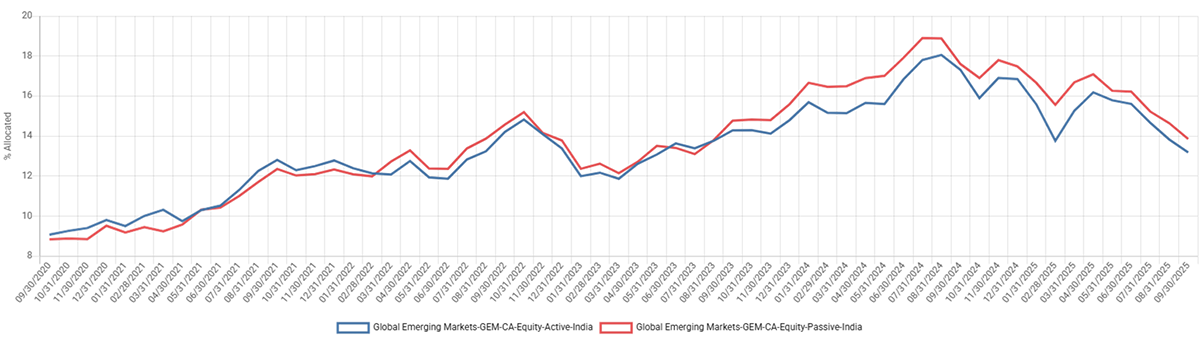
India offers a different perspective on the importance of structural liquidity. Indian equities outperformed for years leading into 2025, and yet most EM investors were underweight the market citing rich valuations.

GEMs active vs. passive country allocations
Line graph comparing global emerging markets with active and passive country allocations to India.
Source: EPFR

While we were certainly mindful of India’s valuation premium to wider EM, the rise of domestic mutual funds driving flows into equities as Indian workers contribute to their pension accounts is a major structural change. We have seen this before in places like Chile or Australia, and once this trend picks up steam it can be dangerous to rely too heavily on your mean reversion tables!

While we did shift to an underweight in India at the end of 2024, the move was modest and largely based on a view that a deluge of IPOs coming to market was soaking up too much liquidity. This factor, combined with high valuations, supported our view that the market looked to be due a period of consolidation after several years of strong gains.

Model GEM portfolio: India strategy macro ratings and weightings

India Rating Exposure Share of risk Relative weight
October 2025 3 13% 16.9% -2.5%
June 2025 3 17% 22% -1.1%
December 2024 4 19% 20% -0.5%
June 2024 3 21% 30% +1.9%
December 2023 2 19% 19.7% +2.6%
June 2023 1 17% 14.4% +2.2%

Source: NS Partners

More recently however, agressive central bank rate cuts have fuelled a pick-up in cyclical liquidity, and while it is a near-term headwind, the flurry of IPOs will deepen the market and produce a more vibrant opportunity set. At the company level, earnings growth is set to lead EM for the next few years. While we are happy to wait for the market to come back to us for now, we see no reason to dismantle our India exposure with such a strong structural backdrop and will be ready to add back when the opportunity arises.

Passive dominance and market fragility

Thinking more broadly, we have been reading some eye-opening analysis from market strategist and investor Michael Green on the impact of rising passive dominance in markets. I won’t rehash the whole thesis in detail, but in a nutshell, Green argues that passive investing has fundamentally reshaped market dynamics by inflating valuations of the largest stocks and undermining traditional price discovery.

As index funds allocate capital based on market cap rather than fundamentals, they create a self-reinforcing cycle where rising prices attract more flows, further distorting valuations. This mechanism favours size and trend over intrinsic value and ignores quality companies outside major indices.

Markets become increasingly inelastic as passive share grows and the share of active and valuation-driven investment falls. The outcome is that liquidity no longer scales with market cap. This makes large stocks more vulnerable to outsized price impacts from passive flows.

Therefore, the largest beneficiaries of a constant inflows to passive vehicles could suffer sharp reversals should those flows reverse, exposing the market to volatility and mispricing.

Finally, Green highlights what he sees as an absurdity, being the construction of rigid rule-based investment strategies meant to operate in markets, which are complex adaptive systems. The dominance of this approach to investment is distorting markets and capital allocation which will have negative real-world impacts in magnifying the power of megacap firms and stifling innovation and creative destruction.

Having always considered the impact of structural liquidity in our markets as a part of our process, Green’s work resonates with our team. In our view, it will be crucial going forward for active investors to have an awareness of how rising passive dominance will create distortions in markets and identify the risks and opportunities that will flow from them.

Senior couple walking and holding hands on beach at sunset.

It’s no secret that public finances in most of the markets Global Alpha covers are in a dire state, and one of the common culprits is usually pensions and other retirement benefits. Countries such as France and Italy spent roughly 15% of GDP over each of the last two years and are on average the second largest item after health care. Many countries are having to increase retirement age to alleviate the strain, and less than 30% of Gen Z expect to retire with similar retirement benefits than older generations.

In the 90s, Australia took its own unique approach to ensuring retirement-system sustainability through the development of the superannuation system. It is a mandatory savings scheme where employers are required to fund a minimum percentage of an employee’s salary into a superannuation fund on their behalf. Employees are then able to invest the amount on their own if they choose to and start withdrawing it at 65. This simple approach created one of the largest pension systems in the world with $4.1 trillion in assets, where employers contributed $147 billion in the last year. The Super Guarantee threshold, the percentage of salary employers must deposit, has once again increased this year to 12%.

Given the high expected retirement assets, it’s no surprise that Australian retirees have had a willingness to tolerate higher risk in their asset allocation while asset classes like annuities have seen a lower adoption rate compared to other developed economies. While the population is overall still young compared to the United States, there is a growing concern among experts that too much risk is being taken by individuals that cannot afford it. Regulators and policymakers in recent years have taken several steps to attempt to address the problem:

  • Implementation of Retirement Income Covenant in 2022 requiring superannuation trustees to put additional emphasis on diversification and flexibility and increase educational resources.
  • Friendlier mean-test treatment for lifetime income streams to improve middle-class retirees’ wealth and therefore reduce the need for risk-taking to reach retirement goals.
  • Consultation on potential changes to capital settings and requirements for annuity products, with the aim of reducing capital intensity of insurers and allowing for more competitive pricing and supply, therefore making the product more attractive as part of an asset allocation.

We recently initiated a name that gives us exposure to this dynamic: Challenger Limited (CGF AU). The company operates both an APRA‑regulated life division (annuities and related longevity solutions) and a multi‑manager funds management arm (Fidante and Challenger Investment Management). Challenger manages $130 billion in assets.

As mentioned, annuities as an investment product in Australia has some of the lowest adoption rates of all developed countries at 2% vs. 15% for Japan and 20% for the United States. While some of this difference can be explained by demographics, the reality is that regulatory capital intensity for annuity providers has been much higher than other countries (meaning their pricing ends up worst) and education on the product has been lacklustre. What piqued our interest in the Challenger story is that the Australian Prudential Regulation Authority (APRA) has announced steps to address these problems as it seeks to encourage workers to include an annuity allocation in their retirement savings account. Some of the steps proposed by APRA to reduce capital intensity are now clearer. In 2025, APRA confirmed a consultation to change the treatment of the illiquidity premium, with the stated intent to lower capital requirements for annuity products when risk controls and asset‑liability matching are robust. If implemented as outlined, this would make pricing more competitive and broaden supply without compromising solvency standards.

As the dominant player in the annuity market, with a market share estimated around 90-95%, Challenger has been one of the more influential and proactive companies in providing feedback to the regulators and there are reasons to believe that regulators are using Challenger’s data to evaluate the impact of potential changes.

Even without betting on regulatory changes, Challenger has plenty of things going for it. The core annuity business in Australia is growing nicely as they are consistently landing new mandates with super annuities (which are being urged to provide their members with more guaranteed income products), the annuity book duration is increasing (allowing for higher margin/investment return), their unique Japan exposure is showing strong momentum (and they are expected to land another distributor in the near future) and the firm is launching new products both on the annuity and investment side which appear to be showing initial success.

One of the advantages of taking a global view on investing is that it allows us to find differentiated stories in a space we typically would not be overly excited about. Life insurance companies in Europe or the United States tend to exhibit bond-like features, being highly defensive and providing decent cash-flow. Meanwhile, Australia built one of the most successful retirement savings engines globally and is set to benefit from a large demographic tailwind that should see life insurers like Challenger benefit over the next decade, in addition to having regulatory tailwinds and policymakers’ support.

The forecast that global manufacturing PMI new orders will inflect weaker from a Q4 peak is supported by the “internals” of the October survey.

While new orders rose on the month, the increase was smaller than had been suggested by DM flash surveys, reflecting an EM decline led by China and Korea – often global bellwethers.

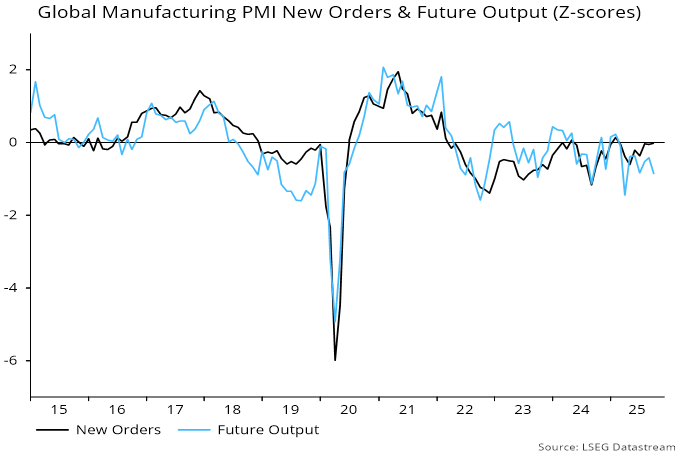
Firms were gloomier despite the orders uptick, with the future output index falling to its lowest since April in the wake of the “Liberation Day” shock. In contrast to new orders, this component is below its post-2015 average – see chart 1. (So is the corresponding services gauge.)

Chart 1

051125c1

Pessimism may partly reflect an inventory overhang: indices measuring additions to stocks of purchased inputs and finished goods were in the 82nd and 97th percentiles of their long-run ranges (i.e. since 1998) respectively last month – more evidence that the global stockbuilding cycle is peaking.

Purchases of inputs boost orders of supplier firms. Accordingly, the new orders index is positively correlated with changes in the stocks of purchases index. The latter is likely to fall from its currently extended level. Even a stabilisation would imply a decline in the rate of change, in turn suggesting softer new orders – chart 2.

Chart 2

051125c2

Global manufacturing deceleration is often associated with underperformance of cyclical equity market sectors. The price relative of MSCI World non-tech cyclical sectors versus defensive sectors ex. energy is below a September peak – chart 3.

Chart 3

051125c3

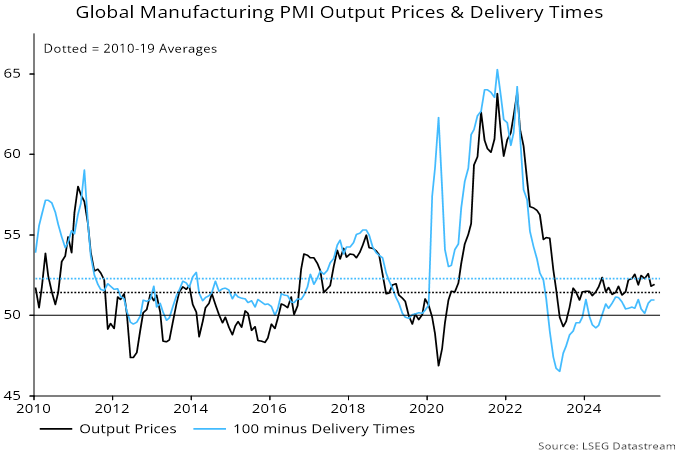
Cyclical earnings are more at risk when pricing power is weak. The output price index has fallen back and is close to its 2010-19 average, while delivery delays remain below the corresponding average, suggesting excess capacity and / or inventories – chart 4.

Chart 4

051125c4i

Plaça d'Espanya in Barcelona, Spain at night.

The Spanish economy has been the star performer in Europe recently, and consequently its principal stock exchange has also produced the best returns. In this week’s commentary, we look at the underlying reasons behind the performance of both the economy and stock market, as well as some of Global Alpha’s holdings in the country.

The Spanish economy grew over 3% in 2024, and another 2.7% of growth is forecast for 2025 which is significantly more than other advanced economies in Europe. The European Central Bank is forecasting 1.2% growth for the euro zone this year. Spain has seen its credit rating upgraded in recent weeks, in stark contrast to other large, developed economies such as the United States and France, which have recently seen their credit ratings downgraded.

A significant factor of this star performance is how the demographic situation in Spain is different from its peers. While the general movement in Europe has been toward more restrictive policies on immigration, Spain’s border has remained more open. The majority of the 600,000 average annual net inflow of immigrants are of working age which has resulted in record levels of employment (yet still the EU’s highest unemployment rate) and means Spain is not experiencing the labour shortage found elsewhere in Europe. A secondary effect is the increase in domestic consumer spending. Given that most immigrants are coming from Latin America, a shared language and culture have been key in the integration and, more importantly, acceptance into society. Most of the jobs being filled by migrants are in hospitality and construction, so there is more to be done to attract workers in high-end service sectors.

Spain has been, and continues to be, a prime beneficiary of the EU’s Recovery and Resilience Fund (RRF); only Italy has received more. The RRF provides loans and grants to EU member states for reforms and investments to make economies greener, more digital and ultimately more resilient. Spain received over €20 billion as recently as August for investment in renewable energy, rail and cybersecurity. The push into renewable energy because of the funds received from the RRF has reduced energy cost pressure and increased industrial competitiveness.

A final reason why the Spanish economy has performed so well has been the resiliency of tourism. Tourism accounts for approximately 12% of Spain’s GDP. Spain had a record number of visitors in 2024, an increase of 10% compared to 2023, and that record is expected to be beaten once again in 2025.

Combining the strength of the economy, investments and improved credit rating leads to the Spanish stock market outperforming. The outperformance is also helped by the composition of the IBEX 35, which has a large exposure to banks and financial institutions. The banks have outperformed on the back of the strong macroeconomic backdrop and improved asset quality post structural reforms. Spanish banks have low US tariff exposure, as do other domestic focused industries such as utilities and telecommunication companies.

Global Alpha counts three Spanish companies in its portfolios that give exposure to Spanish tourism, the resilient labour environment and domestic spending. Meliá Hotels International S.A. (MEL ES) owns and manages hotels and resorts. Meliá operates luxury, upscale and mid-scale hotels and resorts. Meliá operates hotels in Europe, Asia and the Americas. With fiscal spending increasing in Europe, consumer sentiment should improve, and leisure spending continues to show resilience. The demand in Spain means rates should remain strong and Meliá is well placed to benefit. Meliá has a much-improved balance sheet that trades at an attractive valuation.

Fluidra S.A. (FDR SM) is a global leader in the pool and wellness industry. They design and manufacture a range of products for residential and commercial swimming pools. The products include pumps, valves, heaters, filters, pool-cleaner robots, chemicals, and devices for pool IoT devices. Around 70% of Fluidra’s sales are to the residential end-market, and aftermarket accounts for the majority of Fluidra’s sales over the cycle, providing resilience while the industry waits for new-build activity to recover. Fluidra continues to trade at a discount to its US peers.

Merlin Properties Socimi S.A. (MRL SM) is the largest Spanish commercial REIT. It operates a 100% Iberian portfolio centred around offices, shopping centres, logistics, and most recently, data centres. Most of its assets are in the prime cities of Madrid, Barcelona, and Lisbon. The recent investment in data centres will start to contribute meaningfully to rental income by 2028 and represents the next leg of growth.

A headwind for Spain’s continued prosperity is that the minority government has been unable to pass much legislation. It has, however, avoided much of the turmoil seen in France. The challenge now is to capitalize on the domestic demand, robust tourism and EU recovery funds to continue to outperform its European peers.

Sunset over the skyline of the Nile River and Cairo, Egypt.
Strategy overview

The strategy invests in frontier and emerging market companies that we believe will benefit from demographic trends, changing consumer behaviour, policy and regulatory reform and technological advancement.

Egypt, Vietnam and Poland were the top three country contributors to strategy P&L in the quarter, whereas Indonesia, Lithuania and the Philippines were the worst three country contributors. On a sector basis, banks, non-bank financials and health care were the top three sector contributors to strategy P&L, whereas consumer staples, media and entertainment and consumer services were the worst three sector contributors. Below, we highlight the three best and worst stock performers during the quarter (by USD returns generated to the strategy) and share our latest observations on the portfolio and the broader investment environment.

Top Performers

Integrated Diagnostics Holdings PLC (IDHC LN)

IDHC is a leading laboratory and diagnostics provider in Egypt and Jordan with smaller operations in Nigeria and Saudi. IDHC shares returned 62.8% in during the quarter as investor sentiment turned more constructive toward Egypt and as the market responded positively to the resumption of dividends by the company that was announced with strong second quarter results. The resumption of dividends is a reflection of management’s more assured view on Egypt and signals confidence in the outlook for earnings going forward. We see further upside in the shares as we expect the company can generate nearly half of its market capitalisation in aggregate free cash in 2026 and 2027 and expect discount rates on Egyptian assets to decline as inflationary pressures subside. On the business model side, management continues to execute well by scaling the testing-at-home business (now approximately 20% of revenue), closing a ~$9 million transaction in a leading Cairo-based diagnostic imaging centre and expanding its capex-light lab roll-out via hospital and medical centre partnerships.

Kelington Group BHD (KGRB MK)

KGRB is a Malaysian engineer solutions provider with a core competency in Ultra-High Purity (UHP) gas and chemical delivery systems in the semiconductor, flat-panel display, solar and LED industries. KGRB shares returned 48.3% in the quarter as the market reacted positively to a string of contract awards announced in July and August. The most notable announcement by the company was the signing of a framework agreement with a multinational semiconductor company in Dresden, Germany with a minimum value of $35 million. KGRB is bidding on more than $1.3 billion worth of work, of which 44% is in Europe, so this contract win gives us more confidence in the company’s right-to-win in that market. KGRB’s market capitalisation crossed the $1billion mark in the quarter and its average daily value has quintupled to $5 million compared to its one-year average. While the shares have done very well year to date, the company would have only recently entered the radar screen of a large subset of emerging and global market investors who we believe will appreciate the positioning of the company in the semiconductor value chain. As a result, we see a nice combination of fundamental and technical catalysts for the shares going forward.

Ho Chi Minh City Development JS Commercial Bank (HDB VN)

HDB is a mid-sized private sector Vietnamese bank serving 23 million customers with a strong competitive advantage in the SME and consumer segments of the market. HDB shares returned 39.6% in the quarter as they benefitted from a sector-wide rally in Vietnamese bank stocks in the quarter on account of strong system lending growth, a pro-growth economic policy that appears to have been spurred on by tariff anxiety and a euphoric domestic retail investor base. We like HDB for its sector leading returns (ROE of ~27%) and proactive management which has allowed it to grow its loan book at twice the sector average. However, with the strong share price performance, we deemed the risk-reward setup no longer conducive for continued ownership and decided to exit the stock at the end of the quarter.

Worst performers

Sumber Alfaria Trijaya Tbk (AMRT IJ)
AMRT is the leading mini-market retailer in Indonesia with a network of over 20,000 stores. The company operates in an effective duopoly along with competitor Indomart, which operates around the same number of stores in Indonesia. AMRT shares lost 21.7% in the quarter as sentiment toward Indonesia soured on increased policy uncertainty and weak consumer confidence, culminating in a short period of violent protests in the last week of August. While we reduced the strategy’s exposure to Indonesia in the quarter (including in AMRT), we remain confident in the company’s ability to manage through this period of uncertainty aided by a net cash balance sheet and a defensive business model. We find the valuation appealing here at ~20x 2026 earnings and believe the business can underwrite mid-teens local currency bottom line and free cash flow CAGR for the next three years.

Hikma Pharmaceuticals PLC (HIK LN)
HIK is a Jordan-headquartered, global generic pharmaceutical company listed on the London Stock Exchange. HIK shares lost 19.4% in the quarter as policy uncertainty in the US market (~50% of group sales) and unfavourable currency movements weighed on the stock, despite the company affirming guidance in their latest results. While we see a lot of value in the shares at less than 10x 2026 earnings and think the group’s diverse revenue mix and manufacturing presence in the United States are appealing attributes, we decided to exit the shares for the time being as policy risk continues to supress the multiple and can present a risk to earnings.

Baltic Classifieds Group PLC (BCG LN)
BCG is the dominant online classifieds platform in the Baltic region operating across Lithuania, Latvia and Estonia. BCG shares lost 21.1% in the quarter following a revenue and profit downgrade issued by the company (by only 3–4%) which management attributed entirely to the new vehicle transaction and ownership tax in Estonia. Uncertainty on whether this tax will stay or go is impacting transaction activity on the company’s Auto 24 platform. Estonia has one of the highest motorisation rates in Europe and the Baltics and we believe the profit hit resulting from the tax uncertainty will likely be transitory in nature. We continue to like the pricing power of BCG across several verticals in the three countries it operates, and we see continued support for the share price from the company’s buyback program.

Outlook

Amidst volatile geopolitics and frothy asset markets, we continue to find attractive opportunities to deploy capital in our core markets. While some risks have emerged in the ASEAN region (namely in Indonesia, Philippines and Thailand) from messy politics, we find that valuations of our portfolio companies in those three countries have largely absorbed those risks. In other regions, we believe the Middle East offers good opportunities post the recent correction in Saudi and UAE equities. In Africa, we see green shoots emerge from subsiding inflationary pressure in Egypt, while Morocco’s “Gen-Z” protests offered an opportunity for us to reshuffle and add to favoured stocks on weakness.  In Central Eastern Europe, we continue to see a rich opportunity set with our portfolio indexing to small and midcap high growth companies.

Broadly, the portfolio is appropriately diverse from a regional and sectoral perspective with 20 countries across 16 GICS industry groups. Within those areas, the portfolio owns a unique combination of companies that exhibit growth, re-rating potential and idiosyncratic catalysts.

We look forward to updating you on the strategy in the next quarter.