Historical Museum, St. Basil Cathedral, Red Square, Kremlin in Moscow.

Summary

  • Improving politics and continued economic strength in Greece propelled strong returns, the market up nearly 10% in USD terms over the month.
  • More cyclical markets caught a bid, boosting Brazilian and Chilean equities. Given the deterioration of money numbers globally, we are not tempted to chase rallies across materials and energy as the likelihood of a sharp recession increases.
  • Indian stocks have been beneficiaries of reallocation by foreign investors abandoning China in recent months, with portfolio names across Industrials, Financials and Health Care posting modest gains. The challenge in India, as ever, is weighing up India’s incredible development story with rich valuations. However, we know that relying on mean reversion tables can be a fraught exercise when structural change is occurring. An economy is not a zero-sum game, or a closed loop where everything must revert to the mean. India’s ascent up the development ladder will expand the domain of the economy, and often in ways that are underappreciated and underestimated by the market.
  • Chinese equities were steady, capping off a poor quarter overall. We maintain a slight overweight in China, with positive money numbers continuing to support a modest recovery, low inflation, incredibly cheap real exchanges rates, and modest valuations for a host of high-quality businesses. However, more support from the authorities is needed to ensure weakness in the property sector does not feed into a vicious economic cycle that spills into other sectors.

Greek summer

Greek stocks continued their strong run into summer, boosted in June by the re-election of conservative leader Kyriakos Mitsotakis. The result vindicates the decision by Mitsotakis to call a snap election after his party fell short of a clear majority in April elections. His New Democracy party commands 40.5% of the national vote, almost 23 percentage points ahead of Alexis Tsipras’ Syriza party. The result marks an incredible turnaround from the brutal downturn of the European financial crisis, three IMF bailouts and painful economic restructuring, to Greek government bonds shedding junk status earlier this year, with the yield discount to Italian counterparts at its highest level since 1999. Further improvement to investment-grade status would unlock greater foreign investment, and lower borrowing costs for government and businesses. If Mitsotakis can deliver on campaign promises to boost salaries, lower taxes, restructure the healthcare system and upgrade Greece’s infrastructure, then the future is bright.

Thailand’s post-election limbo

Political risk following Thailand’s national elections appears to be rising, as uncertainty grows over whether the progressive Move Forward party will be allowed to form government despite its strong showing in recent national elections. The Thai electoral commission announced that it is investigating whether party leader Pita Limjaroenrat broke campaign rules through ownership of shares in a media company. The presidential candidate has denied any wrongdoing. However, the investigation may threaten the chances for Move Forward to garner enough support in Thailand’s unelected Senate (appointed under the previous conservative military-aligned government) to confirm a ruling coalition led by Pita. Failure to confirm the Move Forward coalition would represent a significant step backward for Thailand’s institutional quality and damage the trust of voters, and would limit the country’s development trajectory. It is likely that the post-election political wrangling and horse trading to form government has only just begun.

China’s authorities need to get creative to end the slump

Xi Jinping faces some monumental challenges both at home and abroad. High youth unemployment has the potential to become socially destabilising if it continues to worsen, and a renewed slump in property prices threatens to further dent the already brittle psyche of consumers and corporates. We agree that meaningful stimulus is needed to break consumers and corporates out of this coma. It needs to be a fiscal and/or monetary bazooka, and not the sniper shots we have seen over the past few months. The big question is whether this message is getting to the man at the top? Economic tsar Li Qiang has been talking up support for the private sector in recent months, and he is right to do so given it generates 95% of jobs in China. But this positive rhetoric does not appear to have been embraced by Xi, who has stuck to pledges of deleveraging at all costs, limiting policy options for dealing with China’s slump. Given Xi’s directive to avoid resorting to excessive leverage in property and infrastructure to boost the economy, authorities may need to get creative. If meaningful stimulus can charge the recovery, sentiment for Chinese equities will turn quickly.

Warlordism undermines state power in Russia

Poor Sino-US relations and fears that China may seek to take Taiwan by force remain a headline risk for many EM investors. Last year we wrote that Russia’s botched invasion of Ukraine and the strength of the Western response painted a clear picture to Beijing of the risks associated with conflict and further deterioration of relations with the West. Yevgeny Prigozhin’s jolly through Russia with his band of Wagner mercenaries underlined this risk, as the mutineers moved virtually unopposed through Russia, taking the southern military command post in Rostov-on-Don and breezing through a series of supine military checkpoints as they barrelled towards Moscow. While the uprising was eventually put down thanks to the intervention of Putin’s Belarussian stooge president Lukashenko, it suggests that the government no longer commands a monopoly on violence in Russia. The risk is that this emboldens would-be usurpers in the Kremlin and secessionists in Russia’s vast periphery, risking the rise of warlordism reminiscent of Republican China. While the CCP has tightened its grip over the People’s Liberation Army under Xi, a high-risk amphibious assault on Taiwan inviting a US military response and harsh Western sanctions would place incredible pressure on state power structures at a time of economic fragility and high youth unemployment. Recent chaos in Russia reinforces our view that Russia’s invasion of Ukraine actually lowers the risk of China attempting to take Taiwan by force.

Historical Museum, St. Basil Cathedral, Red Square, Kremlin in Moscow.

Summary

  • Improving politics and continued economic strength in Greece propelled strong returns, the market up nearly 10% in USD terms over the month.
  • More cyclical markets caught a bid, boosting Brazilian and Chilean equities. Given the deterioration of money numbers globally, we are not tempted to chase rallies across materials and energy as the likelihood of a sharp recession increases.
  • Indian stocks have been beneficiaries of reallocation by foreign investors abandoning China in recent months, with portfolio names across Industrials, Financials and Health Care posting modest gains. The challenge in India, as ever, is weighing up India’s incredible development story with rich valuations. However, we know that relying on mean reversion tables can be a fraught exercise when structural change is occurring. An economy is not a zero-sum game, or a closed loop where everything must revert to the mean. India’s ascent up the development ladder will expand the domain of the economy, and often in ways that are underappreciated and underestimated by the market.
  • Chinese equities were steady, capping off a poor quarter overall. We maintain a slight overweight in China, with positive money numbers continuing to support a modest recovery, low inflation, incredibly cheap real exchanges rates, and modest valuations for a host of high-quality businesses. However, more support from the authorities is needed to ensure weakness in the property sector does not feed into a vicious economic cycle that spills into other sectors.

Greek summer

Greek stocks continued their strong run into summer, boosted in June by the re-election of conservative leader Kyriakos Mitsotakis. The result vindicates the decision by Mitsotakis to call a snap election after his party fell short of a clear majority in April elections. His New Democracy party commands 40.5% of the national vote, almost 23 percentage points ahead of Alexis Tsipras’ Syriza party. The result marks an incredible turnaround from the brutal downturn of the European financial crisis, three IMF bailouts and painful economic restructuring, to Greek government bonds shedding junk status earlier this year, with the yield discount to Italian counterparts at its highest level since 1999. Further improvement to investment-grade status would unlock greater foreign investment, and lower borrowing costs for government and businesses. If Mitsotakis can deliver on campaign promises to boost salaries, lower taxes, restructure the healthcare system and upgrade Greece’s infrastructure, then the future is bright.

Thailand’s post-election limbo

Political risk following Thailand’s national elections appears to be rising, as uncertainty grows over whether the progressive Move Forward party will be allowed to form government despite its strong showing in recent national elections. The Thai electoral commission announced that it is investigating whether party leader Pita Limjaroenrat broke campaign rules through ownership of shares in a media company. The presidential candidate has denied any wrongdoing. However, the investigation may threaten the chances for Move Forward to garner enough support in Thailand’s unelected Senate (appointed under the previous conservative military-aligned government) to confirm a ruling coalition led by Pita. Failure to confirm the Move Forward coalition would represent a significant step backward for Thailand’s institutional quality and damage the trust of voters, and would limit the country’s development trajectory. It is likely that the post-election political wrangling and horse trading to form government has only just begun.

China’s authorities need to get creative to end the slump

Xi Jinping faces some monumental challenges both at home and abroad. High youth unemployment has the potential to become socially destabilising if it continues to worsen, and a renewed slump in property prices threatens to further dent the already brittle psyche of consumers and corporates. We agree that meaningful stimulus is needed to break consumers and corporates out of this coma. It needs to be a fiscal and/or monetary bazooka, and not the sniper shots we have seen over the past few months. The big question is whether this message is getting to the man at the top? Economic tsar Li Qiang has been talking up support for the private sector in recent months, and he is right to do so given it generates 95% of jobs in China. But this positive rhetoric does not appear to have been embraced by Xi, who has stuck to pledges of deleveraging at all costs, limiting policy options for dealing with China’s slump. Given Xi’s directive to avoid resorting to excessive leverage in property and infrastructure to boost the economy, authorities may need to get creative. If meaningful stimulus can charge the recovery, sentiment for Chinese equities will turn quickly.

Warlordism undermines state power in Russia

Poor Sino-US relations and fears that China may seek to take Taiwan by force remain a headline risk for many EM investors. Last year we wrote that Russia’s botched invasion of Ukraine and the strength of the Western response painted a clear picture to Beijing of the risks associated with conflict and further deterioration of relations with the West. Yevgeny Prigozhin’s jolly through Russia with his band of Wagner mercenaries underlined this risk, as the mutineers moved virtually unopposed through Russia, taking the southern military command post in Rostov-on-Don and breezing through a series of supine military checkpoints as they barrelled towards Moscow. While the uprising was eventually put down thanks to the intervention of Putin’s Belarussian stooge president Lukashenko, it suggests that the government no longer commands a monopoly on violence in Russia. The risk is that this emboldens would-be usurpers in the Kremlin and secessionists in Russia’s vast periphery, risking the rise of warlordism reminiscent of Republican China. While the CCP has tightened its grip over the People’s Liberation Army under Xi, a high-risk amphibious assault on Taiwan inviting a US military response and harsh Western sanctions would place incredible pressure on state power structures at a time of economic fragility and high youth unemployment. Recent chaos in Russia reinforces our view that Russia’s invasion of Ukraine actually lowers the risk of China attempting to take Taiwan by force.
Business woman looking at data on a computer at night. The coding is reflecting off of her glasses.

It seems like it happened overnight. Artificial Intelligence (AI) went from something distant that would not typically come up in small talk between colleagues (unless you work in the field, maybe), to the next great game changer that promises to transform the way everything is done. ChatGPT is now already a household name that can write homework for students, find bugs in programmers’ code or even draft a basic contract according to your specification. Just two months after the release of ChatGPT by OpenAI in November 2022, it had already become the fastest-growing software application in history with well over 100 million users. Subsequently this led to massive investments by Google, Baidu, Meta and many others to develop competing technologies to maintain their market shares.

Every time a new technology or concept is the subject of such interest, the media spends an incredible amount of resources theorizing all the different ways in which the world will be made different by this new shiny thing. Yet very few of these promised changes end up making a lasting impact. Blockchain was supposed to revolutionize the world of finance and decentralize the entire system, yet it remains a niche technology with a damaged reputation from the crypto craze.

The metaverse was sold as something that would be part of our everyday life with most households having their own VR headset, much like everyone had their own PC. We’re not quite there yet, although Apple now seems to believe this is the next big thing.

Finally, 5G was meant to unlock so many opportunities with promised better connectivity, low latency and no pocket loss. Every company was mentioning some opportunities from the internet of things to cloud gaming. All these frenzies had something in common: actors that overpromise and underdeliver in spectacular fashion, at least in the short term.

Then comes the new buzzword: generative AI. Between the Q4 2022 and Q1 2023 earnings season, the mention of AI in earning calls more than doubled among S&P500 companies. Nvidia rallied almost 200% in 2023 as one of the most obvious potential beneficiaries and is now worth over $1 trillion while trading at 40x revenues. For reference, these are dotcom bubble multiples.

Artificial intelligence as a field of research goes back to the late 1950s, 15 years after the famous Turing test was first put forward. So how did it become all the rage overnight over 60 years later? Long story short, significant advances in Large Language Models (LLM) in the last decade paved the way to commercial use of generative AI. In a context where the global economy has needed new productivity catalysts to prevent GDP deceleration and to help reduce inflationary pressure in the post-COVID era, ChatGPT seems to be filling the void almost too perfectly. As a new productivity tool that could potentially impact almost every aspect of the service economy, it’s no wonder everyone is jumping on the hype train. Nonetheless, if the commercialization of the internet is any reference, and assuming the impact of AI is of a similar size, we are still at the beginning of the dotcom/AI bubble where euphoria is high, and every company is set to either benefit from AI or disappear into irrelevance. Seasoned investors who lived through the internet bubble may offer one or more of the following pieces of advice:

  • Your internet/AI stock pick will likely prove wrong in the long term, as it will take years to fully realize the impact of the technology, while regulations can hinder companies’ plans.
  • Your stock pick could be the right one, yet the current valuation may still not make sense.
  • There are solid companies outside the tech/AI bubble that are being unfairly penalized as investors sell them to buy into the new hype stock.

Within this speculative environment, we identified an opportunity to initiate a position in a company that had been on our radar for a long time: Keywords Studios (KWS LN). Based in Ireland, Keywords is the dominant player in the fragmented market of video game outsourcing. With studios in over 26 countries, across eight different lines of business and three development divisions, Keywords operates at an unmatched scale three times larger than its closest competitor, yet with a market share of only 6%. The company offers services covering a wide range of developer requirements, including audio services, customer support for live games, marketing and social media management and bug testing.

Keywords had long been a darling in the video game small-cap space, commanding a valuation that made it challenging for us to justify an investment, despite its strong niche positioning and business model. However, near the end of April, the company appeared on an AI loser basket built by Bank of America, based on the belief that most of Keywords’ services would eventually be brought back in-house by game developers due the reduced need for labour caused by new AI technologies. This triggered a downward spiral in the share price. From that point on, negative momentum continued to feed on itself driven by index weight adjustments, loss cutting, quant signals and so on.

On closer examination, it became clear to us that the story was being misunderstood and that investors were selling services companies like Keywords indiscriminately. In fact, Keywords had already been making acquisitions and investments in AI technologies for at least a year before ChatGPT became a household name. It was already using this technology to enhance its localization services (Kantan AI), customer support business line (Helpshift), and to improve on its quality testing expertise (Mighty Games), among other things. Furthermore, Keywords is uniquely positioned to benefit from exposing its machine learning systems to a variety of games, languages and codes. It has a scale advantage that individual video game developers cannot match.

So why did we choose to invest in Keywords and not a game developer that owns its own intellectual property (IP)? The global video game market is highly hit-driven, which introduces risks and revenue lumpiness for developers, especially in the small-cap space where the number of IPs a company holds is usually limited and few games are released each year. Additionally, there is a significant ramp-up time when a new project is undertaken, as the game developer’s workload is not consistently aligned with that of the audio or functional testing teams, meaning employees may not always have the necessary workload to keep them on payroll.

In this environment, it is easy to understand why video game companies of all sizes are increasingly turning to outsourcing various stages of development. This is where Keywords excels. By working with virtually all the top gaming companies in the world, the company can leverage its scale to provide a consistent workload to its studios. Furthermore, by working across an unparalleled variety of games, Keywords builds a unique breadth of expertise without the need to manage its own IP or take on the risks associated with the release of a single title. Keywords is a great way of betting on the growth of the video game industry without making a call on specific titles or the medium on which it is consumed. The company represents most of what we would look for in a core portfolio holding: a leader in a niche market with pricing power, strong secular tailwinds and a good track record. And we got to buy it at a discount to its average valuation, thanks to investors that fell for this new AI mania.

Monetary and cycle aspects of the forecasting approach used here are currently in tension. Global real narrow money trends suggest a renewed weakening of economic momentum into late 2023. Cyclical forces, however, are scheduled to become more supportive from early 2024 as the stockbuilding cycle bottoms out and moves into a recovery phase. 

The two messages can be reconciled if real money momentum recovers over the remainder of 2023, confirming an improving outlook for 2024. Momentum is expected to be lifted by a further slowdown in inflation but a sufficient recovery is unlikely without a policy reversal by major central banks. Current signals are that such a reversal will require a dramatic deterioration in economic data and / or major market weakness. 

Economic news has been confusing, allowing optimists and pessimists to claim support for their assessments. Weakness appears the correct interpretation based on national accounts data. An average of the expenditure and income measures of US GDP rose at an annualised rate of only 0.3% in the five quarters to Q1 2023. The monthly measure of UK gross value added has flatlined since last summer while Eurozone GDP slipped into contraction in Q4 / Q1. 

Claims of economic resilience or even strength focus on solid employment growth and tight labour markets. Weak GDP expansion has been unusually jobs-rich because of a rebound in the share of lower-productivity services activities. With the goods / services split normalising, this composition boost is probably ending. 

GDP / employment divergence has been echoed in PMIs, with manufacturing weakness balanced by services strength. Again, the assumption here is that services exceptionalism is temporary, reflecting a later release of pent-up demand, suggesting focusing on manufacturing as a better guide to trend. 

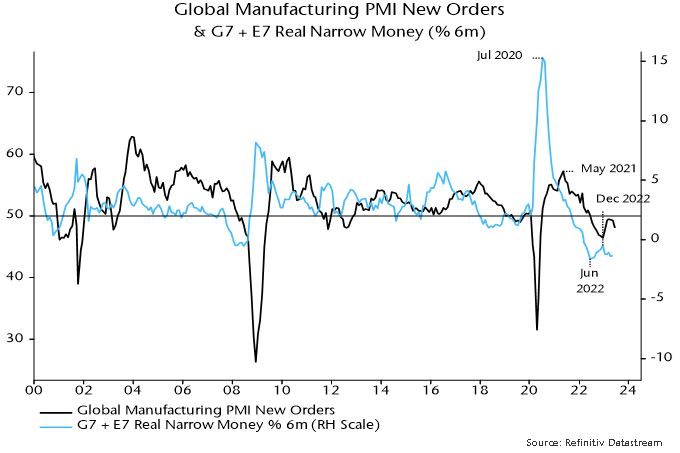
The global manufacturing PMI new orders index reached a 31-month low in December 2022, recovering modestly into the spring before falling back sharply in June. A revival and relapse had been signalled by six-month real narrow money momentum, which recovered during H2 2022 but eased again in early 2023. The recent slide extended into May, suggesting further PMI weakness into late 2023 – see chart 1. 

Chart 1

Chart 1 showing Global Manufacturing PMI New Orders & G7 + E7 Real Narrow Money (% 6m)

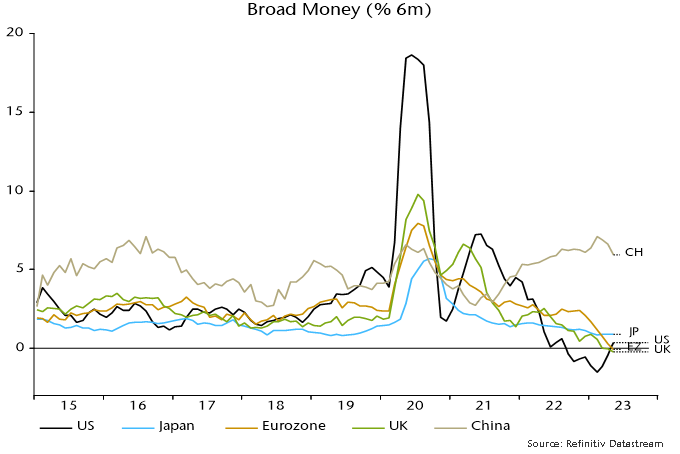
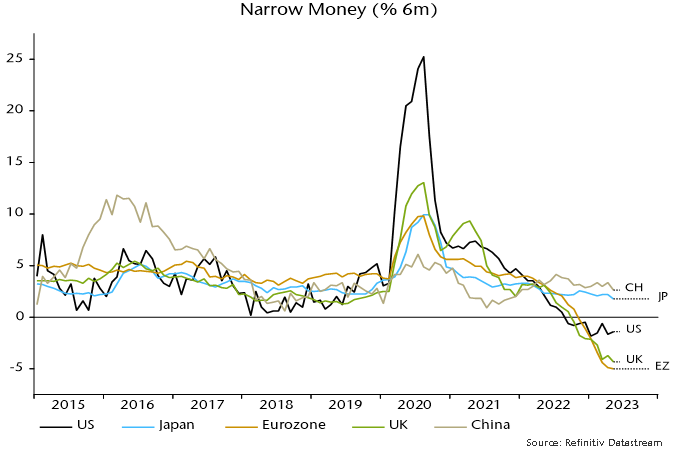
Monetary alarm bells are ringing loudest in Europe. Six-month rates of contraction of Eurozone and UK nominal narrow money quickened further in May, contrasting with less negative and stabilising US momentum – chart 2. Six-month changes in broad money have also now crossed below zero and the corresponding US change – chart 3. Trends in Sweden and Switzerland are even weaker. 

Chart 2

Chart 2 showing Narrow Money (% 6m)

Chart 3

Chart 3 showing Broad Money (% 6m)

China and India remain positive monetary outliers but narrow money momentum is modest by historical standards and has subsided recently. Relative to monetary trends, the consensus view on China looked overoptimistic at the start of 2023 and appears excessively gloomy now, although further policy easing is warranted to cushion the economy against likely export weakness despite a super-competitive exchange rate. 

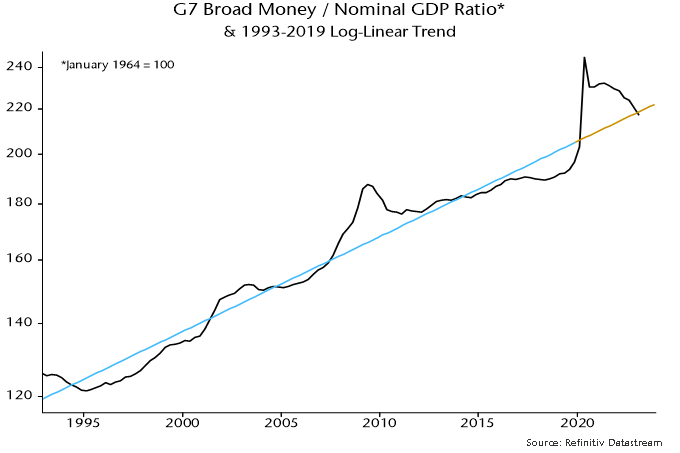
To the extent that the global economy has proved more resilient than expected, one explanation is that the impact of monetary weakness has been delayed by an overhang of “excess” money balances / savings resulting from 2020-21 stimulus. The ratio of G7 broad money to nominal GDP crossed back below its pre-pandemic trend in Q1 2023, suggesting that stock and flow arguments for pessimism are becoming aligned – chart 4. 

Chart 4

Chart 4 showing G7 Broad Money / Nominal GDP Ratio* & 1993-2019 Log-Linear Trend *January 1964 = 100

Cycle analysis is used here to provide longer-term context and a cross-check of monetary signals. Economic fluctuations reflect the interaction of three investment cycles: a shorter stockbuilding cycle typically of about 3 1/3 years in duration; an intermediate business investment cycle of 7-11 years; and a longer housing cycle averaging about 18 years. 

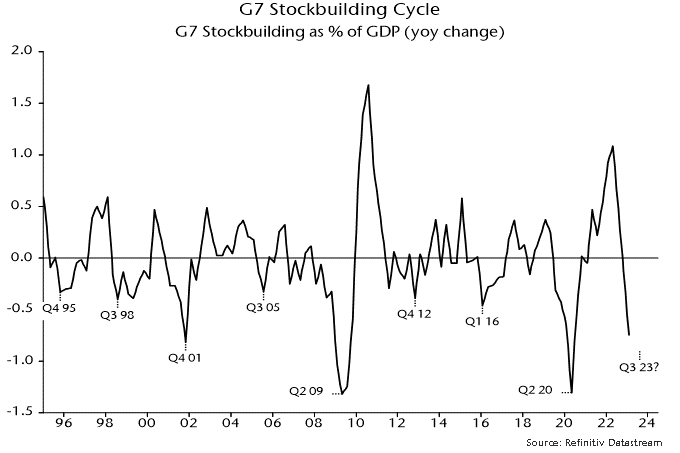
The business investment and housing cycles last reached lows in 2020 and 2009 respectively. If current cycles are of normal length, the next lows could occur in the late 2020s. Downswings into lows typically play out over 1-3 years so are unlikely to begin before 2025. This suggests that recent softness in housing and business investment represents a temporary correction within ongoing upswings. Current cyclical weakness, on this interpretation, reflects a downswing in the shorter-term stockbuilding cycle, which last bottomed in Q2 2020 and recently entered the time band for another low. 

Stockbuilding cycle downswings in isolation are usually associated with global economic slowdowns or at worst recessions that are modest and / or geographically contained. Examples of the latter include the 1970 US recession and the 2011-12 Eurozone downturn. Against a backdrop of monetary weakness and unusually rapid policy tightening, the expectation here has been the current downswing would be more severe and global than the norm. 

The cycle analysis suggests, however, that the window for severe economic weakness will begin to close from late 2023. Recent stockbuilding data indicate that the cycle downswing is already well-advanced, consistent with a low being reached before year-end – chart 5. A stockbuilding recovery could combine with continuing upswings in business and housing investment to drive global economic reacceleration in 2024-25. As noted, however, such a scenario requires confirmation from an early recovery in real money momentum, in turn probably dependent on H2 policy reversals. 

Chart 5

Chart 5 showing G7 Stockbuilding Cycle G7 Stockbuilding as % of GDP (yoy change)

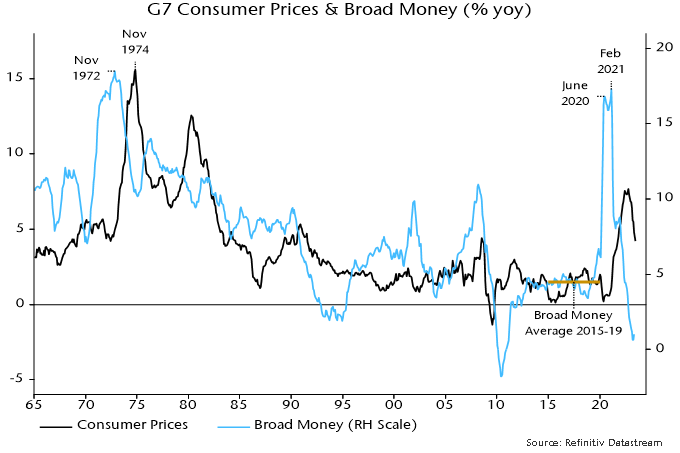
The “monetarist” forecast was that G7 headline CPI inflation would fall rapidly from early 2023, mirroring a large and sustained decline in annual broad money growth from a February 2021 peak.  This scenario is playing out: a GDP-weighted average of G7 national headline rates dropped from 6.8% in January to 4.8% in May, with a further decline to 4.2% projected for June – chart 6. 

Chart 6

Chart 6 showing G7 Consumer Prices & Broad Money (% yoy)

Broad money growth returned to its pre-pandemic average in mid-2022 so – allowing for a standard two-year lead – inflation rates may be back at pre-pandemic (i.e. target-consistent) levels in mid-2024. Recent further monetary deceleration suggests significant risk of an undershoot in late 2024 / 25. The cyclical counterargument is that stockbuilding cycle upswings are usually associated with rising commodity prices, which may support headline rates moving through 2024. 

A tendency of policy-makers and commentators to downplay headline progress and focus on stickier core readings is the mirror-image of 2021 claims that a headline surge was “transitory”. Disinflation is following the usual sequence from commodities to goods to lagging services / wages. Recent US / Eurozone data confirm a downshift in short-term core momentum, e.g. US “super-core” consumption prices – ex. food, energy, housing and used cars – rose by an annualised 3.1% between February and May, the smallest three-month gain since December 2020. 

The two global “excess” money indicators calculated here – the gap between six-month real narrow money and industrial output momentum, and the deviation of 12-month real narrow money momentum from a slow moving average – have been negative in most months since the start of 2022, suggesting an unfavourable backdrop for equity markets. Despite a strong H1 rally, the MSCI World index was 8.2% below its closing 2021 level at end-June. Cyclical sectors (including tech) lagged defensive sectors (including energy) over this period. 

An earlier hope that the first measure – the real money / output momentum gap – would turn positive during H1 was dashed by a combination of renewed monetary weakness and a production boost from an easing of supply constraints. With June global manufacturing PMI results signalling output contraction, a cross-over remains possible soon. The second measure – the deviation of real money momentum from a moving average – is further from a switch. 

Historically, equity markets outperformed cash on average only when both measures were positive – still a distant prospect. Both the current negative / negative and possible positive / negative configurations were associated with non-energy defensive sectors outperforming non-tech cyclical sectors.

As Pride Month draws to a close, the CC&L Foundation and employees successfully raised $13,200 for Rainbow Railroad. Throughout June, CC&L Financial Group and its affiliates actively championed the cause of LGBTQ+ individuals, demonstrating our support for their safety and right to live authentically regardless of geographic boundaries.  

We encourage individuals and organizations alike to continue supporting LGBTQ+ equality. By amplifying voices, providing resources and advocating for change, we can collectively work towards building a society that celebrates the rights and identities of all people, irrespective of their sexual orientation or gender identity. 

About Rainbow Railroad 

Rainbow Railroad is a renowned Canadian organization dedicated to assisting LGBTQ+ individuals worldwide who face violence, persecution or discrimination based on their sexual orientation or gender identity. Through a network of volunteers and partners, Rainbow Railroad provides vital resources, support and safe travel options, enabling LGBTQ+ individuals to escape oppressive environments and rebuild their lives with dignity and freedom. Learn more about this important work at rainbowrailroad.org

Rainbow Railroad logo
Aerial photograph of a coastal car parking lot as waves break nearby.

The transportation industry has undergone significant change in recent years due to the impact of COVID-19 and technological advancements. Last mile deliveries and car sharing have emerged as important ways of reducing transportation costs. However, it’s worth noting that Uber is now more expensive than taxis in many cases. The industry is continuously transforming, with autonomous driving being a prominent example.

COVID-19 disrupted personal transportation as people avoided public transit and stayed home. But now, as we move forward, consumers are faced with hard choices to balance their budgets, and corporations are demanding increased presence in the workplace. 

According to the American Public Transportation Association (APTA), t​he average household spends 16 cents of every dollar on transportation and 93% of this amount is allocated to buying, maintaining and operating cars. This makes transportation the second-largest expenditure after housing. By opting for public transportation and reducing car ownership, households can save nearly $10,000. This saving becomes substantial when considering the average household income of $67,521 in the United States, especially if housing costs are considered fixed. 

There are several secular trends driving the growth of the public transportation market regardless of economic downturns. One such trend is the cost disparity between operating a new bus route and expanding road lanes, which continues to widen as land availability diminishes. Recent studies have also shown that road expansion leads to lower real estate prices compared to improvements in bus transit. Hence, municipalities become important stakeholders for bus transit as real estate prices directly correlate with property taxes. 

To support public transportation, governments typically provide subsidies for its operations and passenger ticketing often represents the service rather than a revenue source. In the US alone, the government has subsidized public transport with up to $108 billion, including $91 billion in guaranteed funding until 2026 under the 2021 Bipartisan Infrastructure Law. This represents the most significant federal investment in transit in the country’s history.

Demographically, millennials initiated a shift away from youth car ownership a decade ago. Accelerating immigration and rising housing costs further indicate an increased reliance on public transportation.

The global public transportation market was valued at USD214.54 billion in 2022 and is expected to grow at a compound annual growth rate (CAGR) of 3.7% from 2023 to 2030

During our recent travels to Australia, we observed the noticeable effects of accelerating immigration. Sydney and Melbourne suburbs are well-positioned for population growth thanks to their organized infrastructure and pleasant weather. The country is now attracting immigrants from beyond Southeast Asia and Melbourne in particular is a vibrant cultural hub poised for multi-year urban expansion.

We visited several real estate developments that are unaffected by slowdowns due to high immigration levels and lack of housing.

When it comes to sustainability, public transit is surpassed only by bicycles. According to the Environmental Protection Agency, transportation is responsible for 28% of greenhouse gas emissions. Whether using electric, biogas or hydrogen-powered vehicles, implementing green public transportation is crucial for controlling greenhouse gas emissions, especially as emerging markets catch up with urbanization levels. 

In the realm of public transportation, Global Alpha holds the Kelsian Group (KLS:AU). 

Headquartered in Adelaide since 1989, the Kelsian Group has emerged as a leader in public bus, marine transport and tourism operations. It consists of Australia’s most experienced providers of multi-modal public transport services and tourism experiences, operating ferry, bus and light rail services domestically and internationally. 

In 2022, the Kelsian Group transported more than 257 million customers, employing around 9,000 people and operating approximately 4,000 buses, 113 vessels and 24 light rail vehicles. 

Earlier this year, the company acquired the US-based All Aboard America to establish a presence in the US sunbelt region, which has favourable demographics. The founder of Kelsian personally relocated to Denver to ensure successful acquisition integration. 

The US bus transportation industry remains fragmented and as the market becomes more complex with the need for new technologies and multi-engine platform expertise (such as biogas, electric and hydrogen), smaller operators will struggle to compete. 

The public transportation industry qualifies as defensive growth. Bus operators typically work under multi-year agreements, often lasting seven years, with inflation adjustment clauses to protect them from cost accelerations. Their compensation is typically based on the quality of their route execution rather than the number of passengers, making low-volume routes still profitable.

Kelsian operates a best-in-class technology platform to optimize its routes and its comprehensive bus driver acquisition and training programs result in low turnover rates. Additionally, it leads the way in offering electrified biogas and hydrogen-powered transportation solutions. As we redesign transit for a greener and more connected society, the future holds tremendous opportunities.

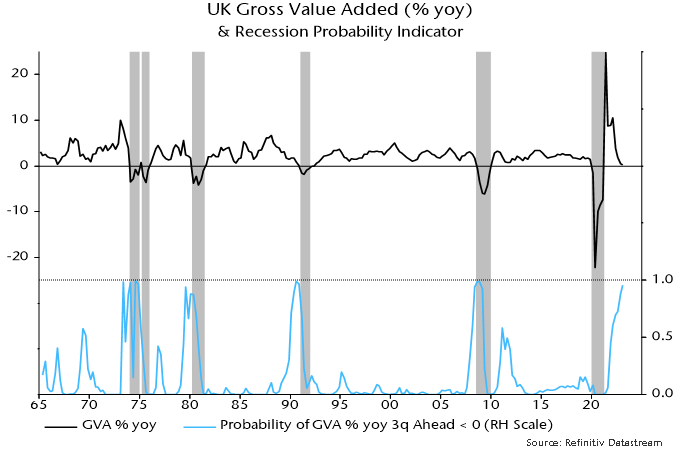
A recession likelihood gauge placing weight on monetary variables indicates a high probability of a contraction in UK GDP / gross value added (GVA) over the remainder of 2023. 

The indicator, regularly referenced in posts here, is based on a model that generates projections for the four-quarter change in GVA three quarters in advance using current and lagged values of a range of monetary and financial inputs. 

Using data up to June 2022, the model assigned a 70% probability to the four-quarter change in GVA being negative in Q1 2023. The current ONS estimate of this change is +0.2%. 

UK Gross Value Added (% yoy) & Recession Probability Indicator. Source: Refinitiv Datastream.

The probability reading rises to 96% incorporating data through March 2023, i.e. there is a 96% likelihood of the four-quarter change in GVA in Q4 2023 being negative, according to the model. 

The statistical analysis underlying the model indicates that GDP prospects are significantly influenced by movements in real narrow money (non-financial M1) and real corporate broad money (M4). Six-month rates of change of these measures have moved deeper into negative territory since mid-2022. 

The model’s increased pessimism also reflects a deepening inversion of the yield curve and falling real house prices. Other inputs include credit spreads and local share prices, which have yet to display recession-scale weakness.

A recession likelihood gauge placing weight on monetary variables indicates a high probability of a contraction in UK GDP / gross value added (GVA) over the remainder of 2023. 

The indicator, regularly referenced in posts here, is based on a model that generates projections for the four-quarter change in GVA three quarters in advance using current and lagged values of a range of monetary and financial inputs. 

Using data up to June 2022, the model assigned a 70% probability to the four-quarter change in GVA being negative in Q1 2023. The current ONS estimate of this change is +0.2%. 

UK Gross Value Added (% yoy) & Recession Probability Indicator. Source: Refinitiv Datastream.

The probability reading rises to 96% incorporating data through March 2023, i.e. there is a 96% likelihood of the four-quarter change in GVA in Q4 2023 being negative, according to the model. 

The statistical analysis underlying the model indicates that GDP prospects are significantly influenced by movements in real narrow money (non-financial M1) and real corporate broad money (M4). Six-month rates of change of these measures have moved deeper into negative territory since mid-2022. 

The model’s increased pessimism also reflects a deepening inversion of the yield curve and falling real house prices. Other inputs include credit spreads and local share prices, which have yet to display recession-scale weakness.

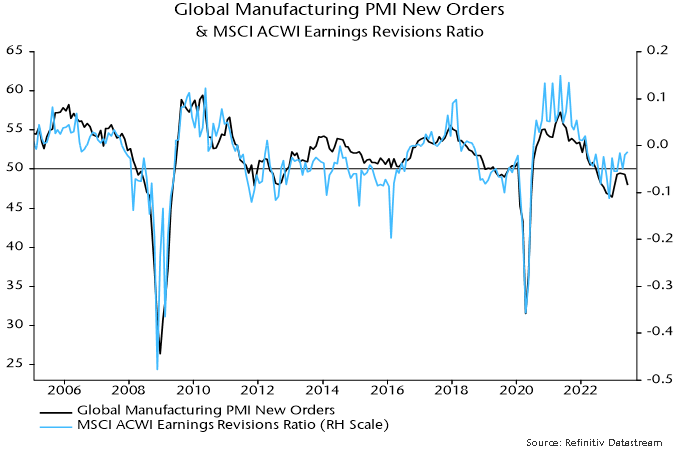
DM flash results released last week suggest that the global manufacturing PMI new orders index fell sharply in June, having moved sideways in April and May following a Q1 recovery – see chart 1. 

Chart 1

Global Manufacturing PMI New Orders, & G7 + E7 Real Narrow Money (% 6m). Source: Refinitiv Datastream.

The relapse is consistent with a decline in global six-month real narrow money momentum from a local peak in December 2022. A recovery in real money momentum during H2 2022 had presaged the Q1 PMI revival. 

Real narrow money momentum is estimated to have fallen again in May, based on partial data, suggesting further PMI weakness into late 2023. 

The global earnings revisions ratio has been contemporaneously correlated with manufacturing PMI new orders historically but remained at an above-average level in June, widening a recent divergence – chart 2. 

Chart 2

Global Manufacturing PMI New Orders, & MSCI ACWI Earnings Revisions Ratio. Source: Refinitiv Datastream.

Based on monetary trends, a reconvergence is more likely to occur via weaker earnings revisions than a PMI rebound. 

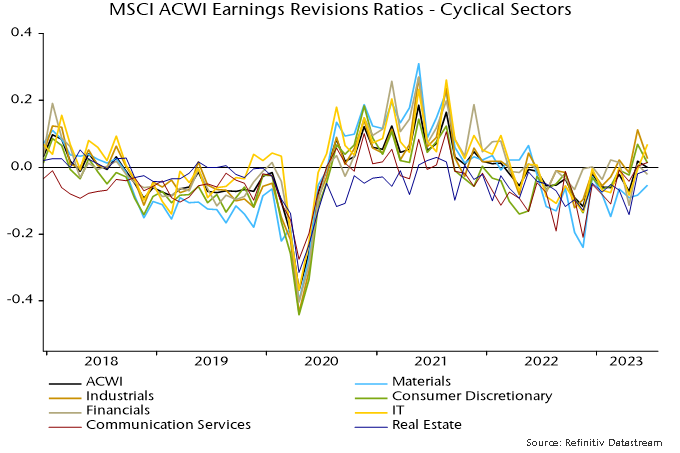
Charts 3 and 4 show that revisions resilience has been driven by cyclical sectors – in particular, IT, industrials and consumer discretionary. Notable weakness has been confined to the materials sector. Cyclical sectors may be at greater risk of downgrades if the global revisions ratio heads south. 

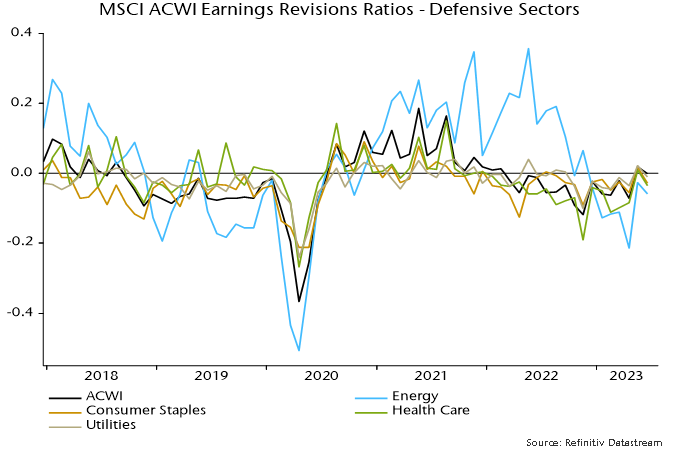
Defensive sector revisions have underperformed recently but are likely to be less sensitive to economic weakness. 

Chart 3

MSCI ACWI Earnings Revisions Ratios - Cyclical Sectors. Source: Refinitiv Datastream.

Chart 4

MSCI ACWI Earnings Revisions Ratios - Defensive Sectors. Source: Refinitiv Datastream.

The positive divergence of earnings revisions from the PMI may reflect firms’ ability to push through price increases to compensate for slower volumes. The deviation of the global revisions ratio (rescaled) from manufacturing PMI new orders – i.e. the gap between the blue and black lines in chart 2 – has displayed a weak positive correlation with the PMI output price index historically (contemporaneous correlation coefficient = +0.41). 

Any earnings support from pricing gains is now going into reverse: the output price index has crashed from an April 2022 peak of 63.8 to 49.8 in May, with DM flash results suggesting a further fall last month.

Photo of Sabrina Lacroix

Global Alpha has a new addition as our Senior Compliance Manager. Please join us in extending a warm welcome to Sabrina Lacroix!

Sabrina brings a wealth of experience to Global Alpha having previously served as the Director of Regulatory Compliance and Controls at Trans-Canada Capital Inc. and in progressively senior positions at Hexavest Inc., including Vice President of Compliance & Legal Affairs.

She earned her Bachelor of Commerce degree in Finance from McGill University and is a CFA charterholder.

As our Senior Compliance Manager, Sabrina will be responsible for overseeing compliance operations and ensuring that our investment activities align with regulations. Her contributions to maintaining a culture of compliance and navigating complex legal landscapes will be invaluable to our firm’s success.