International equity markets performed well over the first two months of 2026 but gave up virtually all of their gains in March after the US and Israel began air attacks on Iran. Stocks sold off as the oil price climbed above US$100 a barrel, driving inflation fears and higher bond yields. The MSCI EAFE index returned 0.15% in local currency terms and –1.24% in US dollars. Not surprisingly, energy was the best performing sector, gaining 40% as the crude oil price as measured by Brent finished the quarter up 73%. The worst performing sector was consumer discretionary, which lost 15%, with autos weak and luxury goods companies hit by disruption in the important Middle East market and the travel industry. Big net importers of energy had most to lose from the oil shock; Japan had risen 15% by February month-end but fell back to finish the quarter up 1.37% in US dollars.

At the time of writing, a two-week cease-fire has been declared although neither side seems clear about the terms. The willingness of the antagonists to negotiate suggests that both have much to lose if hostilities continue, with the closure of the straits of Hormuz weighing on Republican prospects in November’s midterm elections, and the Iranian theocratic government’s grip on power threatened by the progressive degradation of its infrastructure. Whether the cease-fire holds and what will follow remains to be seen but investors had low expectations and initially welcomed the beginning of a dialogue.

Our baseline view of a deterioration in global economic conditions through 2026 has been reinforced by the Gulf War III shock. This view reflected an assessment that the three key economic cycles – stockbuilding, business investment and housing – had entered time windows for weakness. We were, however, awaiting a negative signal from monetary trends to confirm the forecast. The shock should deliver this confirmation: real money growth will be squeezed by a near-term inflation pick-up, while higher interest rates will likely slow nominal money trends.

In Europe, the second energy price shock in five years along with harsh rhetoric from President Trump, who expected more support from NATO allies for his campaign, is another stark reminder of the need to diversify energy supply and increase spending on defense. This comes at a difficult time fiscally for the likes of Italy, France and the UK but Germany has room to implement its promised increase in spending. Japan’s reliance on energy and raw material imports has pushed the yen lower, adding to the inflationary effect of the rise in crude. Still, economic uncertainty may put the Bank of Japan on pause despite its preference for ‘normalising’ interest rates.

Stock selection was negative across regions, notably in industrials, financials and consumer staples and discretionary. In industrials, Ryanair (-18%) de-rated on higher oil prices, having already weakened on news of a provision for a fine for its distribution practices in Italy, although Q3 numbers beat expectations. In staples Unilever (-13%) announced an agreement with McCormick to combine their foods businesses. Investors reacted negatively to the structure of the deal, which leaves Unilever with exposure to the new combined entity, although the logic of splitting the food operations away from the household products business is sound. In materials Heidelberg (-20%) has been hit by proposed changes to decarbonisation regulation increasing the burden on cement producers but the company should still benefit from better pricing power and Germany’s infrastructure spending. In contrast, mining giant Rio (+19%) was boosted by strong operational results with record iron ore production in the Pilbara region in Australia; Investors also like the growing copper exposure. In real estate, Australian property company Goodman (-14%) disappointed investors by not upgrading numbers, with upward pressure on local interest rates also not helping.

In IT, Japanese services company NEC (-27%) has had a disappointing start on the portfolio after being hit by AI disruption concerns, though should benefit from the broader Japan IT catch-up theme. Semiconductor maker Screen (+20%) fared better as the company is the no. 1 player in wafer cleaning, which is gaining in importance as shrink intensifies. Stock selection was better in healthcare, where not owning Novo Nordisk (-27%) was positive and AstraZeneca (+8%) outperformed the sector after continued strength in its oncology franchise, with management reaffirming steady revenue and profit growth in 2026. Performance was also positive in communications, with Dutch telecom operator KPN (+21%) delivering solid Q4 results and a reassuring 2026 outlook – the company is defensive with a high dividend yield and relatively strong balance sheet.

Activity over the quarter has been elevated and has raised exposure to IT, energy, utilities and real estate at the expense of financials, consumer discretionary, healthcare and industrials. We have introduced electrical equipment provider Siemens Energy, which benefits from an oligopoly in gas services and grid technology and has a strong order backlog and improving mix driving a margin uplift. We have also introduced other defensive stocks such as Sun Hung Kai Properties in Hong Kong and French telecom operator Orange.

In Japan we switched Sony into NEC on concern about a shortage of memory chips for their electronic products. We have also re-introduced Softbank, which remains one of the best AI plays in the market, as well as discount supermarket operator Kobe Bussan – the company has a differentiated private label offering and lots of room to grow in its fragmented domestic market. We have added to emerging markets with the purchase of Taiwan Semiconductor, which continues to benefit from the enormous demand for chips driven by AI. We have also introduced Chinese battery manufacture Contemporary Amperex Technology, which is well positioned in the energy transition theme supplying to EVs and grid storage.

On the sell side we exited several stocks vulnerable to persistent market worries about the impact of AI disruption. These include software companies such as SAP, Amadeus and Xero, business service groups Experian and RELX and online groups Rightmove and Tencent. Investors are reluctant to pay high multiples for companies where the terminal value is uncertain due to the impact of competition from AI. Managements generally see no threat and often cite opportunities, but the market is unwilling to give them the benefit of the doubt.

The AI theme remains a key driver of markets. We are focusing the portfolio on companies that are beneficiaries of the capex cycle while avoiding those making investments with uncertain returns and the potentially disrupted. This is expressed in an overweight in IT and a focus on power generation and related areas such as copper. The energy shock will squeeze real money growth and credit conditions are tightening, so we still favour defensive sectors and quality as economic prospects are likely to deteriorate in the second half. Consumer discretionary is an underweight as stocks are under pressure from lower spending while staples are positioned neutral as food and drink companies are suffering from GLP-1 weight loss drugs impacting sales. We are cautiously optimistic about European fiscal loosening but looking to see this reflected in improving money trends. The focus remains on companies with high margins, economic moats and technological innovation that will deliver return on invested capital above the market average.

The Composite fell by 3.23% (3.38% Net) versus a 1.24% fall for the benchmark.

After a roaring start to the year for EM equities, the outbreak of Gulf War III in early March saw the asset class stumble. This was despite market de-risking in crowded trades hitting exposure in large cap technology stocks and gold miners. While these stocks fell in March, stock picking across defence companies, AI supply chain leaders specialising in power efficiency, and a lift in exposure to oil producers (ahead of the conflict breaking out) were positive contributors, helping to preserve relative gains made through January and February. Trading activity over the period reflects a cautious view that the negative effects of the energy shock will not be swift to reverse, negative for EM commodity importers. Whipsawing markets provided opportunities to tilt the portfolio toward areas that are more insulated from the energy shock including battery and solar power names in China and banks in Saudi Arabia.

Exposure across the GCC was a negative contributor to performance. The largest drag came from being underweight a rally in Saudi Arabia which despite the conflict is under-owned by EM investors, a beneficiary of the stronger oil price, and supported by domestic allocators. Our overweight to the UAE was negative, driven largely by the decline in Dubai property developer Emaar. Elsewhere in the region, holdings in Egyptian property developer TMG and Comi Bank fell on fears a sustained oil spike will undermine the recent trend of falling inflation, rates, tourism boom and investment from GGC countries.

At the end of 2025, our only Energy holding was uranium miner CGN. While we remain structurally cautious on the long term prospects for oil as an investment, we were conscious that the absence of any oil exposure had become a highly consensus position and was becoming uncomfortable given the weak oil price and news of a US naval build up in the Persian Gulf. We lifted our Energy exposure to an equal weight in high quality names with assets outside of the Persian Gulf, including Argentinian shale oil producer Vista Energy and Petrochina. Both companies boast healthy returns on invested capital, sustainable even through weak pricing environments, underpinned by growing production profiles, capital discipline and low lifting costs. Contributions from other commodities including gold and copper were positive over the quarter but suffered a pullback in March. Following strong rallies and with a deteriorating global economic backdrop we decided to start reducing copper and gold exposure, including exiting Grupo Mexico, Chifeng Gold and Aura Minerals.

South Korean equities began 2026 by continuing rapid ascent powered by semiconductor companies including holdings SK Hynix and Samsung Electronics. This was further buoyed by progress in Value Up corporate reform efforts which saw the KOSPI double from mid-2025 levels. Investors were quick to take profits in winners on the outbreak of conflict in March, exacerbated by concerns that South Korea would be vulnerable to an energy shock as an export driven economy and oil importer. Memory names have been more insulted from the conflict than other exporters geared to consumer demand and rising materials costs. Supply of high bandwidth memory remains a bottleneck for AI training and inference as model sizes and context lengths grow. The supply/demand mismatch in memory has been so great that Samsung Electronics and SK Hynix are now the second and fourth ranked companies by operating profit (2026 estimates) globally according to KB Securities. In Taiwan, strong stock picking contributions based around AI’s energy bottleneck drove outperformance in niche supply chain names such as Asia Vital Components and Delta Electronics.

Our exposure to the power bottleneck for AI development was at the heart of a positive contribution from China exposure, which was resilient through the market turbulence. We increased our position in the world’s largest battery maker CATL, and bought back into leading solar invertor and energy storage producer Sungrow. Last year China added an enormous 500 GW of power capacity to its grid, more than the rest of the world combined. Much of this comes from rapid growth of solar energy, which by some measures is now cheaper than coal power in China. The battery and power management technology supplied by CATL and Sungrow is crucial to this revolution. Meanwhile, consumer internet holdings Trip.com and Tencent Music were key detractors. Both face pressure from margin compression and subdued earnings growth as they invest in longer term opportunities—Trip.com through overseas expansion, and Tencent Music via its offline concert and ticketing. These investment headwinds have been amplified by a regulatory investigation into Trip for alleged monopolistic behaviour, and by intensifying competition for Tencent Music from Douyin (TikTok), which is aggressively building its streaming user base. While both remain high quality businesses, we opted to exit Trip and reduce Tencent Music in absence of potential catalysts in the medium term.

Underweight positioning in India (held since late 2024) continues to be a positive contributor. The market is suffering from an exodus of foreign capital and an IPO pipeline as far as the eye can see which is soaking up liquidity, only partially mitigated by growing domestic mutual fund flows. India also resembles a “reverse AI trade,” lacking exposure to hardware and infrastructure components of the AI supply chain. HDFC Bank continued to struggle as a large liquid name and hence vulnerable to foreign outflows, along with slower deposit growth, falling rates hitting net interest margins, and increased provisions weighing on profitability. Telecoms infrastructure provider Indus Towers was a relative outperformer in India on signs that the monetisation of its tower base is accelerating relative to new tower additions. Indonesia was the only other Asian market which underperformed India during the quarter. As noted in previous commentaries, rising governance risks and fiscal profligacy under President Prabowo led to us downgrade our macro score for the country and cut exposure. Consequently, we held a zero weight as the market plummeted in January when MSCI flagged its concerns over market liquidity and governance quality.

Central banks shifting to a tightening bias as a kneejerk response to the Gulf War III energy shock is likely to be yet another policy mistake. Broad money growth remains weak, suggesting that inflation over the medium term is not the key risk. We are focused on the potential for energy-related demand destruction coming at the same time as housing and stock building cycles roll over. Rallies on positive headlines from US-Iran negotiations may present good opportunities to continue trimming exposure where upside is most dependent on cyclical strength.

The Composite rose 2.17% (1.96% Net) versus an 0.17% fall for the benchmark.

Cycle analysis indicates that the global economy is in a time window for weakness, suggesting a significant risk that the Gulf War III shock triggers a recession. Real money trends will be key for assessing whether a negative scenario is playing out.

The housing, business investment and stockbuilding cycles average 18, 9 and 3.5 years respectively. The most recent lows are judged to have occurred in 2009, 2020 and 2023, suggesting that the next bottoms will be reached around 2027, 2029 and 2027. All three cycles, therefore, are expected to be in downswings over the next 1-3 years.

Cycle history suggests two possibilities. If the three downswings coincide, a major recession is likely. Historical precedents include the severe global downturns of 1974-75 and 2008-09.

If the cycle lows are spaced out over several years, the template would be the early 1990s – a longer period of rolling economic weakness involving a less damaging recession.

An earlier episode of triple cycle weakness in the late 1950s was also associated with a less pronounced recession but the fall in output on that occasion was limited by strong trend economic growth, reflecting post-war reconstruction.

The impact of shocks on the global economy depends on the cyclical backdrop. Activity bounced back strongly after the 2020 covid shock partly because the stockbuilding and business investment cycles were in time windows to enter recovery phases, while the housing cycle remained in an upswing.

Similarly, economic damage from the 2022 energy shock due to Russia’s invasion of Ukraine was limited by support from the business investment and housing cycles, with only the stockbuilding cycle then in a weak phase.

The timing of the Gulf War III shock echoes the 1973 Arab oil embargo, which hit as the three cycles were peaking and resulted in synchronised and self-reinforcing downswings into 1975 lows.

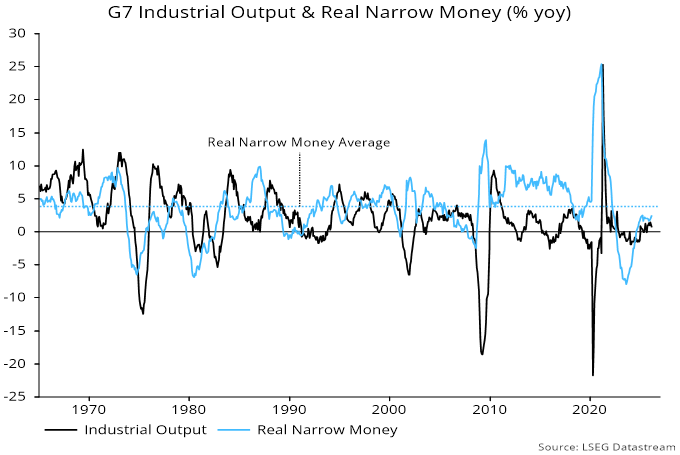
There are important mitigating differences from the 1973 shock. The oil price rise has been much smaller, while the oil intensity of GDP has fallen significantly. The 1973 shock occurred against a backdrop of double-digit G7 money growth, ensuring an inflationary outcome – current expansion is still low. Surging inflation forced major monetary policy tightening, the combined result being a severe real money squeeze – see chart 1.

Chart 1

Chart 1 showing G7 Industrial Output & Real Narrow Money (% yoy)

Real money trends appeared modestly supportive before the current shock: global / G7 growth had firmed into early 2026, suggesting that economic expansion was on course to hold up through Q3.

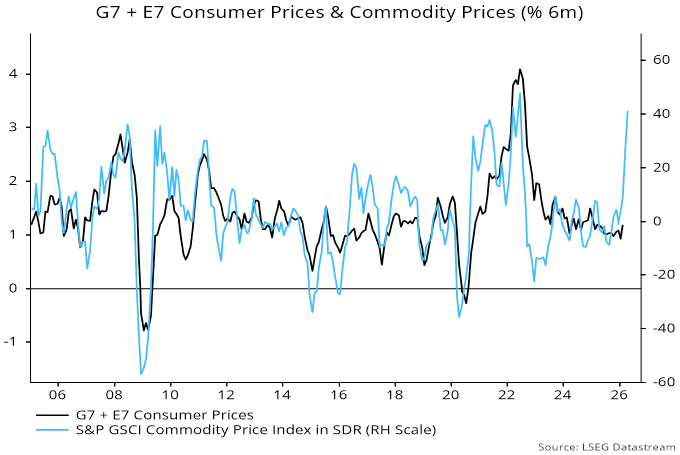
The mechanical impact of higher energy and other costs on consumer price inflation will ensure a sharp slowdown in real money momentum into mid-year – chart 2. The extent of the decline will be key for assessing the likely degree of economic weakness. As noted, modest money growth argues against significant “second-round” inflation effects but central banks are hinting at precautionary tightening, which would magnify monetary weakness.

Chart 2

Chart 2 showing G7 + E7 Consumer Prices & Commodity Prices (% 6m)

A further risk is of “endogenous” monetary tightening if the Gulf War III shock interacts with recent problems in private lending, leading to a generalised reduction in credit availability. Such a shift could be signalled in ECB and Fed loan officer surveys due in late April and early May respectively.

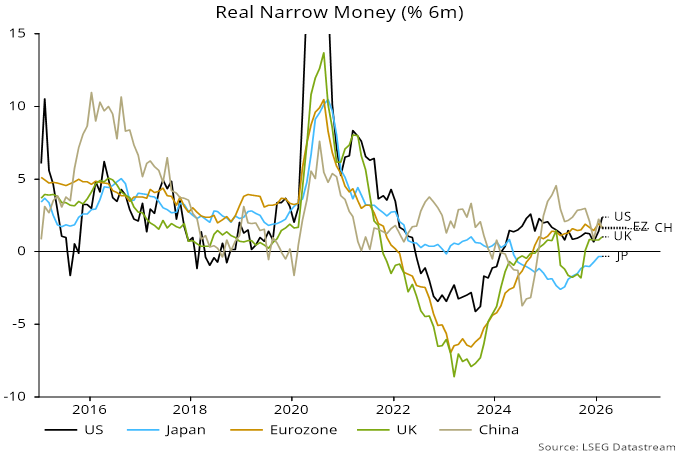
Country real money numbers through February suggest that US economic prospects were improving absolutely and relative to other majors before the shock – chart 3.

Chart 3

Chart 3 showing Real Narrow Money (% 6m)

Japanese monetary weakness continues to argue that BoJ policy tightening – via large-scale QT as well as rate hikes – has been misguided. As expected, core CPI inflation – ex. food and energy – has fallen and is below 2% even stripping out the impact of government subsidies.

Recoveries in Eurozone and UK real money momentum have stalled at unimpressive levels, suggesting dull economic prospects before the shock. Within the Eurozone, readings are similar across the large economies, with France no longer a negative outlier.

Chinese real money momentum has slowed but may hold up better than elsewhere going forward, reflecting stable interest rates and government intervention to limit price rises. A strong balance of payments position, partly stemming from a still significantly undervalued currency, is generating monetary inflows.

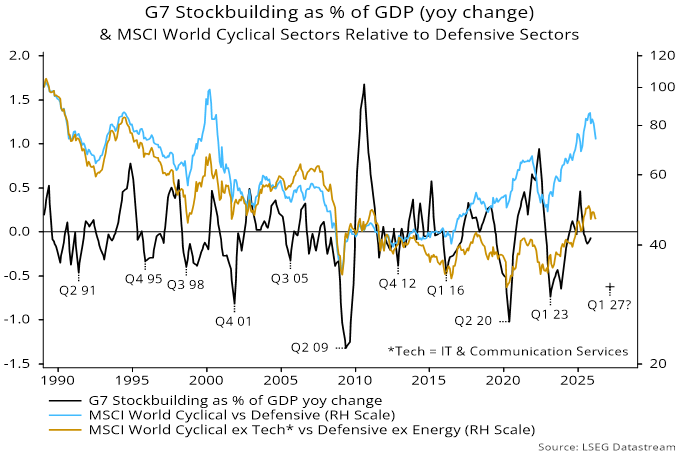
Cyclical equity market sectors had started to underperform before the shock. The cyclical / defensive relative is correlated with the stockbuilding cycle, which is not expected to bottom before late 2026 at the earliest – chart 4.

Chart 4

Chart 4 showing G7 Stockbuilding as % of GDP (yoy change) & MSCI World Cyclical Sectors Relative to Defensive Sectors


Bulk sub-sea industrial glass fiber optic cable on a metal spool on a ship's stand. The yellow data line is coiled around a black reel in a storage yard.

The technology that harnesses wind and solar power is highly noticeable at a glance – it is hard to miss towering wind turbines or gleaming fields of solar panels. But what is not so obvious is how the power gets from those visible generators into the electrical grid that eventually powers your home.

Nexans S.A. (NEX FP) is increasingly emerging as a differentiated way to play the next phase of the energy transition, where the focus shifts from building renewable capacity to connecting it at scale.

While the first wave of the energy transition was defined by rapid growth in wind and solar generation, the current phase is more complex: integrating that capacity into power systems. This is where Nexans sits – at the intersection of renewable buildout and the infrastructure required to make it usable.

Europe’s plan for energy security

In this context, offshore wind is becoming a central driver of demand once again. Following a period of delays linked to cost inflation and project economics, Europe is now moving to re-accelerate deployment. At the January 2026 North Sea Summit, governments committed to developing ~100GW of offshore wind capacity, with a longer-term ambition of 300GW by 2050, alongside coordinated investments in cross-border grid infrastructure.

This renewed momentum is not just about decarbonization, it is increasingly tied to energy security and affordability. European policymakers are prioritizing domestically generated electricity to reduce dependence on imports, while structurally higher and more volatile power prices continue to incentivize investment in renewable capacity.

Nexans ready to support Europe’s wind commitments

For Nexans, offshore wind is particularly attractive. Each project requires significant volumes of high-voltage subsea export cables and increasingly complex interconnection solutions, positioning cable suppliers as critical enablers of deployment. As projects scale and networks become more integrated, demand is shifting toward higher-specification, higher-margin systems areas where Nexans has strong technological capabilities.

At the same time, the company’s strategic repositioning over recent years has sharpened this exposure. By exiting more commoditized cable activities and focusing on electrification and high-voltage segments, Nexans has aligned its portfolio with the fastest-growing and most structurally supported parts of the market.

Buying local – Nexans is Europe-based

This is further reinforced by an evolving policy backdrop in Europe. The EU’s industrial strategy is increasingly incorporating local content requirements and procurement incentives aimed at strengthening domestic manufacturing in key energy technologies. For a Europe-based player like Nexans, this creates a supportive competitive environment, particularly in large-scale infrastructure linked to renewables.

Importantly, supply dynamics remain favourable. High-voltage subsea cable capacity is limited globally, with long lead times and high technical barriers to expansion. As offshore wind deployment accelerates again, this constraint is likely to support pricing and contract discipline across the industry.

Disciplined execution, rising returns

The key focus for investors is increasingly on Nexans’ ability to translate strong structural demand into consistent and higher-quality earnings. As the group continues to prioritize selective project execution and disciplined contract structures, visibility on margins and cash generation is improving. This reflects a more mature operating model, with greater emphasis on value over volume and a clear focus on returns.

In that context, Nexans offers a differentiated exposure to renewables, not through generation itself, but through the critical systems that enable renewable electricity to be delivered, scaled and monetized. As Europe enters a renewed phase of offshore wind expansion and electrification, the company may be well positioned to capture both growth and improving returns.

Monetary trends suggest that US economic prospects were improving relative to the Eurozone before the Gulf War III energy shock.

US six-month real narrow money growth rose to its highest since September 2024 last month – see chart 1. (The M1A aggregate used here – comprising currency in circulation and demand deposits – has been adjusted for a previously discussed distortion to November / December deposit data.)

Chart 1

Chart 1 showing Real Narrow Money (% 6m)

Comparable Eurozone growth, by contrast, eased slightly, resulting in the US taking the lead for the first time since June. Japanese momentum was stable in negative territory, while UK February money numbers have yet to be released.

Global – i.e. G7 plus E7 – six-month real narrow money growth is estimated to have been little changed from January’s high, based on monetary data covering 88% of the aggregate – chart 2. So global economic momentum appears to have been on course to hold up through Q3 before the Gulf War III shock.

Chart 2

Chart 2 showing G7 + E7 Real Narrow Money (% 6m)

An early, sharp reversal in real money growth is in prospect, however, as the energy shock boosts six-month consumer price momentum. Higher interest rates, meanwhile, will likely slow nominal money expansion.

Real money trends, therefore, may be moving into alignment with a forecast based on cycle analysis of significant economic weakness in H2 2026-2027.

The Gulf War III mortgage rate shock may be the trigger for the long-term housing cycle to enter its “bust” phase.

The driving variable of the cycle is demand for new and existing homes. This is reflected in turnover and has secondary impacts on new construction and prices. Prices usually lag volume gauges of the cycle.

The UK cycle can be traced back in various indicators to the early 18th century (at least) – see chart 1. Official statistics on turnover – property transactions – start in 1959. Turnover is closely correlated with the number of approved or actual loans for house purchase, data for which begin in the interwar period. To go back further, it is necessary to rely on completions data, a regional (Middlesex) series on registrations of property deeds and an indirect gauge, imports of timber, for the earliest years.

Chart 1

Chart 1 showing UK Housing Cycle Selected Indicators of Activity, Rebased, Log Scale

The dates in the chart are suggested timings of housing cycle lows. Based on these dates, there were 16 complete cycles, measured from low to low, over the 298 years between 1711 and 2009, implying an average cycle length of 18.6 years.

The two cycle downswings in the first half of the 20th century were magnified and extended by the World Wars – it is reasonable to assume that the lows would otherwise have occurred several years earlier.

The three completed cycles since WW2 were of similar length – 18, 18 and 17 years respectively. If the current cycle were to conform to the 18.6-year long-term average, another low would be reached in 2027-2028.

Chart 2 shows higher-frequency data on property transactions and mortgage approvals. The peak of the current cycle, in 2021, occurred earlier than in the prior two, as pandemic-related policy stimulus pulled forward demand. Activity corrected sharply in 2022-23 as interest rates rose but staged a partial recovery in 2024-25. This appears to have ended, with mortgage approvals easing to a 23-month low in January.

Chart 2

Chart 2 showing UK Property Transactions & Mortgage Approvals (000s)

The new buyer enquiries component of the RICS housing survey is correlated with the annual rate of change of mortgage approvals – chart 3. Buyer demand is likely to weaken in response to the mortgage rate shock, suggesting a further / faster decline in approvals.

Chart 3

Chart 3 showing UK Mortgage Approvals for House Purchase (yoy change, 000s) & RICS Housing Survey New Buyer Enquiries

The rate of change of approvals, in turn, leads the rate of change of annual house price inflation – chart 4. Falling approvals suggest that annual price momentum – 1.4% in January, according to the ONS index – will slow further, probably turning negative.

Chart 4

Chart 4 showing UK House Price Acceleration (yoy change in % yoy) & Mortgage Approvals for House Purchase (yoy change, 000s)

Housebuilding stocks are behaving consistently with the onset of the bust phase of the cycle, recently breaking below their 2022 trough to reach the lowest level since 2013 – chart 5.

Chart 5

Chart 5 showing UK Property Transactions (000s) & Home Construction Stocks

The Gulf War III energy shock has been compounded by a dramatic repricing of interest rate expectations, partly reflecting hawkish central bank communications, particularly from the ECB and Bank of England.

The central banks fear a repeat of the inflation upsurge around the Russian invasion of Ukraine, their accepted wisdom being that higher energy prices destabilised inflation expectations, resulting in significant “second-round” effects.

The “monetarist” view is that the impact of a shock on price- and wage-setting depends on the prevailing monetary environment. The Russia-Ukraine shock generated large second-round effects because it occurred against a backdrop of strong money growth. Eurozone and UK broad money – as measured by non-financial M3 and M4 – rose by 9.1% and 10.5% annualised respectively in the preceding two years – see chart 1.

Chart 1

Chart 1 showing Brent Oil Price ($ / bbl) & Eurozone / UK Broad Money (% 2y annualised)

The latest two-year growth rates, by contrast, are 3.2% and 3.9%, with little sign of acceleration in shorter-term data. Money to nominal GDP ratios have returned to around end-2019 levels. Unlike in 2022, there is no monetary “excess” to accommodate a sustained inflation rise.

Policy tightening against this backdrop would likely result in much more serious economic weakness than in 2022-23, with attendant risk of a medium-term inflation undershoot.

One caveat to a relaxed view of second-round effects is that political pressure to respond to a new cost-of-living shock could trigger a fiscal / funding crisis, forcing a return to QE that results in another money growth surge. Still, the suspension of central bank independence implied by such a scenario will be more likely if officials compound their 2021-22 policy error by making the opposite mistake now.

Closeup of a person pumping gasoline fuel in their car at gas station.

In-depth macro analysis has always been a cornerstone of this process, based on an understanding that emerging markets are highly sensitive to macro shocks which can overwhelm ostensibly solid company fundamentals. The outbreak of conflict following US and Israeli strikes to take out the Iranian regime is one such event, and has sparked violent moves in markets. Our macroeconomic analysis and risk controls are crucial in helping to navigate a volatile environment.

The approach to macroeconomic analysis here is disciplined and incremental, and does not involve the type of Hail Mary calls (i.e., speculating on President Trump’s war aims) that get market pundits invitations onto Bloomberg and CNBC. Our approach to forming a top-down view of our markets is to mark the direction of travel, whether it be our monetary indicators or more qualitative factors such as politics and institutional quality. We marshal all of these data points into one number which rates the level of conviction for a country with 1 being the highest level of conviction corresponding with a maximum overweight (key caveat: provided we can find the right stocks that fit our process), and 5 being lowest (meaning no exposure at all). As the data changes, we will tweak that level of conviction, which should be tightly aligned with adjustments made in the portfolio.

This work is designed to help us understand how the investment environment is changing through cycles, structural change and theme-driven liquidity. Through this context, we can get a sense of what types of businesses are likely to be rewarded in a given environment and adjust the portfolio accordingly.

Test and re-test

We are big subscribers to the insights of psychologist and writer, Phillip Tetlock, who is an expert on forecasting. His studies found that the best long-term forecasters are those who are able to make probabilistic estimates, calibrate, learn and update beliefs frequently. They make many small corrections to their analysis as fresh data arrives, which leads to better long-run accuracy than rigid “set and forget” predictions. This is the forecasting approach we adopt in both our macro and company analysis, illustrated in our process diagram below.

NSP_COMM_2026-03-11_Chart01

Through periods of high uncertainty and violent market moves like what we have currently, we lean heavily into this OODA (Observe, Orient, Decide, Act) Loop. This involves a constant testing and re-testing of our macro views and investment hypotheses, and tweaking of the portfolio as conditions change.

Example: lifting oil exposure

Moving from being zero weight in oil companies at the start of 2026 to equal weight (and with more beta to oil than the index) by the end of February is one example of how iterative tweaks in our macro analysis left the portfolio in a better position to weather the events of early March.

Towards the end of last year, one of the most debated topics of discussion in the team was our heavy underweight to the energy sector and, in particular, oil. Our only energy holding at the end of 2025 was uranium miner CGN.

While we remain structurally cautious about oil’s long-term investment prospects, from a portfolio risk perspective we became concerned that having no oil exposure had turned into a crowded consensus trade – especially as weak prices began to squeeze US shale production. This alongside news of a US naval build up in the Persian Gulf, Arabian Sea and Eastern Mediterranean early in the year suggested the portfolio was exposed to risk of a geopolitical shock in the region. Through January and February, we gradually lifted our oil exposure from zero to an equal weight of over 3.5%.

While our macro and risk analysis helped to identify a potential vulnerability, we could not know that conflict was about to break out in early March and drive such a dramatic hike in the price of oil. It was not a case of just adding oil beta to the portfolio. We added Argentinian shale oil producer Vista Energy and Petrochina based on their healthy returns on invested capital sustainable even through weak pricing environments, underpinned by growing production profiles, capital discipline and low lifting costs.

Vista Energy: Production growth and falling lifting costs driving earnings growth
NSP_COMM_2026-03-11_Chart02
NSP_COMM_2026-03-11_Chart03
NSP_COMM_2026-03-11_Chart04
Source: Vista Energy Investor Relations 2026

The lift to oil exposure was timely, helping to preserve relative gains made this year despite sharp drawdowns in other winning positions that had been hit by broad risk-off sentiment.

Where to from here?

We rated the global monetary backdrop as modestly supportive coming into this shock, largely reflecting favourable trends in EM. However, we have been expecting the global stockbuilding cycle to turn down during 2026, giving us a bias to increase defensive positioning at the margin, especially on any signs of monetary weakness.

The energy price spike, unless swiftly reversed, will push up inflation and squeeze real money growth. It is leading to a revision of expectations for central bank policies, which may dampen nominal money growth. Nominal money trends are also at risk from recent tightening in US private credit conditions, which the current shock may exacerbate.

We are cautious and do not expect the negative effects of this shock will be swift to reverse, so our inclination is to add to defensive positioning on any rally, rather than to view current market weakness as a buying opportunity.

The long-standing forecast here has been that the three key global economic cycles – stockbuilding, business investment and housing – would enter downswings by 2026-27.

In the event that the downswings were synchronised, the result would be a major recession, on the scale of 1974-75 or 2008-09.

If the downswings occurred successively, the result would be a long period of rolling weakness including a less severe recession – the early 1990s scenario.

Chart 1 is an exhibit used in 2018, suggesting – based on average cycle timings – a recession bottoming in 2019-20, a slowdown into 2023 and a major recession around 2027. The former two played out.

Chart 1

Chart 1 showing Idealised Cycle Pattern Trough Years of Stockbuilding / Business Investment / Housing Cycles

The housing cycle is already in a downswing, the stockbuilding cycle is at or close to a peak, while the business investment cycle is well-advanced. The Gulf War III energy price shock could be the trigger for synchronised weakness.

There have been six oil price “shocks” since the 1960s, defined here as episodes in which the spot price rose 50% or more above its two-year moving average for at least three months. All were followed by a significant contraction in G7 industrial output and five were associated with a US recession, as determined by the NBER – chart 2.

Chart 2

Chart 2 showing G7 Industrial Output (% yoy) & Oil Price 3m ma % Deviation from 2y ma (inverted)

Spot Brent of $100 per barrel represents a 37% premium to the two-year moving average. Oil would have to be sustained at about $115 for three months for the current spike to qualify as a “shock”.

The oil intensity of GDP has fallen dramatically since the 1970s, suggesting less vulnerability to shocks. This could explain why the most recent shock – in 2022 – did not involve a US recession.

An alternative view is that a recession was avoided because the cyclical backdrop was less unfavourable and there was pent-up demand due to pandemic disruption, reflected in a large monetary overhang. The stockbuilding cycle turned down in 2022 but the housing and business investment cycles were in late upswing and recovery phases respectively.

The prior shocks caused short-term inflation spikes and were associated with upward pressure on interest rates, contributing to a fall in nominal narrow money momentum. G7 real money contracted ahead of maximum economic weakness. Real money data will be key for assessing the extent of current economic damage.

Cozy modern bedroom with white bedding, wood panel walls and warm lighting.

“A good laugh and long sleep are the best cures in a doctor’s book.” – Old Irish proverb

It’s been more than a decade since the CDC declared sleep disorders “a public health epidemic.” Since then, the world has woken up and taken note. The long-term impact of sleep loss on mental health and physical performance has been widely documented in scientific studies. From cardiovascular disease to compromised immunity and burnout, poor sleeping habits quietly add up over time while increasing our mortality risk. Sleep is also important for cognitive health because it gives the brain time to remove toxins that accumulate while we are awake.

The three foundational pillars of human health are sleep, diet and exercise. Diet and exercise have always dominated conversations around health with very little attention paid to sleep and sleeping habits. Now sleep (or the lack of it) has finally caught the attention of society at large and with it we have seen the rise of the sleep economy.

The broader sleep economy encompasses everything from sleeping aids to sleep medication and supplements, bedding and furnishing to sleep tourism. Just the sleeping-aid market is estimated to reach $188 billion according to Statista. The emergence of the sleep economy is best represented by the popularity of products like the Oura ring that tracks heart rates, sleep cycles and recovery metrics. Oura ring has sold over 5.5 million rings and the company behind it, Oura Health, was valued at $11 billion last year.

Beyond just physical products, we are also seeing the rise of sleep tourism, with travelers showing an increased preference for sleep-focused holidays. Hotels understand that their customers now value good quality sleep and offer everything from smart beds and pillow menus to sleep-specific spa treatments and dedicated sleep programs to help reset the circadian rhythm and allow customers to rest.

One of the holdings in our portfolio is Atour Lifestyle Holdings Ltd. (ATAT US), the largest hotel operator in China’s upper-midscale segment. There are several attributes of the business that make it attractive purely as a hotel operator – from its brand strength to its ability to expand in an asset-light manner while maintaining its attractiveness to prospective franchisees.

However, Atour also has a fast-growing retail business that caters directly to emerging sleep economy trends. From deep sleep pillows to mattresses and comforters, Atour is the first hotel chain in China to develop a retail business around the sleep economy. Sleep economy aside, Atour also taps into so called new consumption trends in China where consumers prioritize maintaining a balanced lifestyle and personal fulfillment over conspicuous consumption that was prioritized by their parent’s generation. From that perspective, Atour for us checks two boxes: the rise of the sleep economy and shift in spending toward services like travel and tourism, concerts etc.

Atour is able to create synergies with its hotel business by cross selling its products to its hotel guests. Hotel guests get what is in effect a free trial when they stay at an Atour property and their real-time feedback is used to enhance product R&D. It helps that Atour’s premium positioning has a positive spillover effect on the brand positioning of its sleep products. Being alert to changing societal norms and evolving spending priorities is a key element in identifying themes within our investment process. We sleep well at night knowing that these thematic tailwinds provide a nice boost to Atour’s revenues and profitability on top of good execution with its core hotel business.